by Bill French Sr. | Jan 6, 2026 | Hydro Facility Articles
Why Understanding Hydroelectric Infrastructure Matters
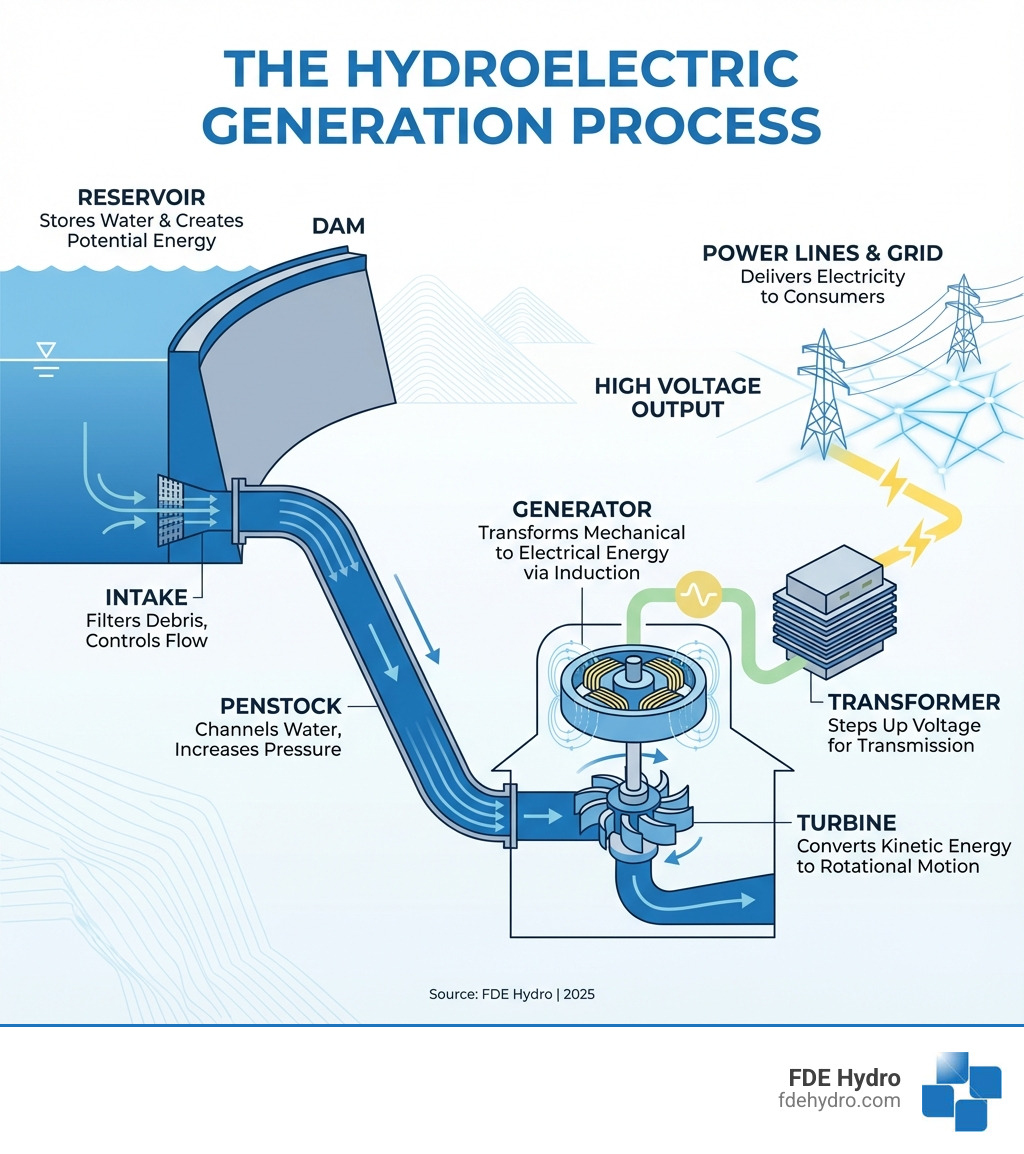
Hydro dam components are the essential building blocks that transform the raw power of flowing water into the electricity that powers over 1 billion people worldwide. These interconnected systems include:
- Dam and Reservoir – Stores water and creates hydraulic head
- Intake Structures and Gates – Controls water flow and filters debris
- Penstock – Channels water under high pressure to the turbines
- Turbine – Converts water’s kinetic energy into rotational motion
- Generator – Transforms mechanical energy into electrical energy
- Transformers and Control Systems – Regulates voltage and manages operations
- Powerhouse – Houses turbines, generators, and control equipment
- Transmission Lines – Delivers electricity to the grid
In 2022 alone, hydropower generated 4,289 TWh, representing 15% of total global electricity production and half of all renewable energy. The beauty of hydroelectric systems lies in their neat simplicity—water flows in one end, and electricity comes out the other, with theoretical conversion efficiencies near 100% because the process involves mechanical energy rather than thermal energy.
Each component plays a critical role in this energy conversion chain. The dam creates potential energy by establishing head height. The penstock accelerates water flow and increases pressure. The turbine converts kinetic energy into rotational motion. The generator uses electromagnetic induction to produce electrical current. And control systems act as the facility’s nervous system, ensuring safe and efficient operation.
I’m Bill French Sr., founder and CEO of FDE Hydro, and over the past five decades I’ve worked extensively with hydroelectric infrastructure, including participation in the Department of Energy’s Hydro Power Vision Technology Task Force focused on next-generation solutions for hydro dam components. This experience has shown me that understanding these core systems is essential for anyone overseeing water infrastructure projects.
The Foundation: Water Containment and Control Structures
At the very heart of any hydroelectric system, we find the structures that manage the water itself. Think of these as the gatekeepers and the battery, holding vast amounts of potential energy ready to be releaseed. Our goal, as engineers and innovators in this field, is to harness this natural power safely and efficiently.
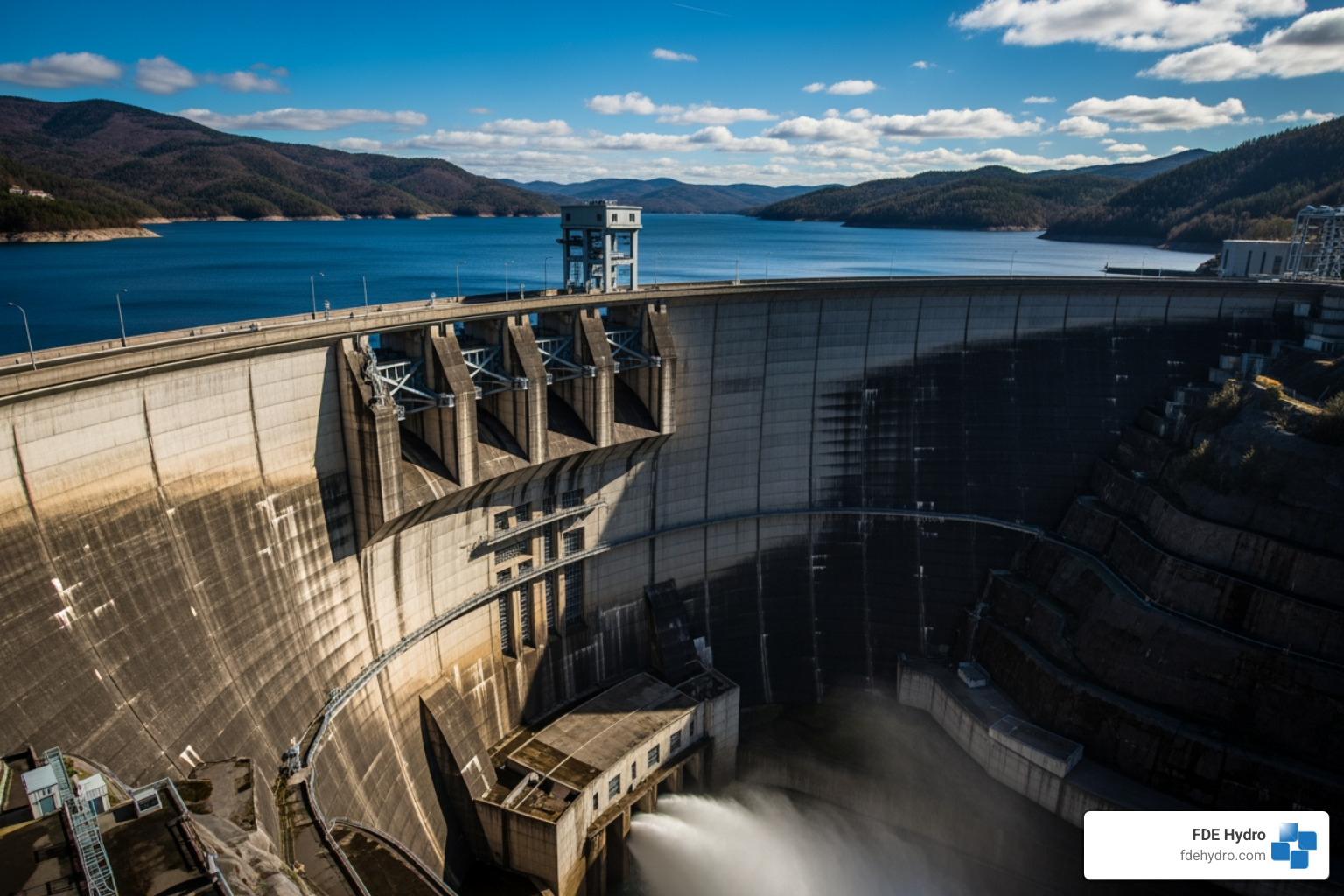
The dam, a colossal feat of engineering, is the primary structure that holds back a river, creating a large body of water known as the reservoir. This isn’t just a big puddle; it’s our energy storage unit. The higher the water is held, the greater its potential energy – a concept we call “head height.” This head height is crucial because it dictates how much force the water will have when it eventually flows through the system.
Beyond power generation, these reservoirs serve multiple vital functions. They are often critical for flood control, regulating water levels to protect downstream communities. Many also provide reliable water supplies for cities and agriculture, and let’s not forget the recreational opportunities they create. Imagine the joy of boating or fishing on a reservoir that’s also powering thousands of homes! The storage capacity of global hydropower reservoirs is truly impressive, estimated at approximately 1,500 terawatt-hours of electrical energy in one full cycle. This makes them nature’s battery, storing energy on a massive scale.
The Dam
When we talk about the dam itself, we’re discussing a structure designed to withstand immense pressure. There are several types, each suited to different geological and hydrological conditions:
- Gravity Dams: These rely on their sheer weight and mass to resist the water’s pressure. They are often thick and robust, like a steadfast guardian holding back the tide.
- Arch Dams: Utilizing a curved design, these dams transfer the water’s force horizontally into the surrounding canyon walls, making them highly efficient in narrow, rocky gorges. They’re like a natural archer, redirecting the force.
- Embankment Dams: Constructed from compacted earth and rock, these dams are usually wider at the base and taper upwards. They are versatile and can be built in various locations.
At FDE Hydro, we’re constantly pushing the boundaries of dam construction. Our innovative modular precast concrete technology, often referred to as the “French Dam,” is revolutionizing how these structures are built and retrofitted in regions like North America, Brazil, and Europe. This approach significantly reduces construction costs and time, making hydropower projects more accessible and sustainable. You can learn more about these methods on our Dam Construction Methods and Dams pages.
Intake, Gates, and Spillways
Once the water is safely stored, we need precise ways to control its flow. This is where the intake structures, gates, and spillways come into play.
The intake structure is the entry point for water from the reservoir into the power generation system. Its design is critical to ensure a smooth, air-free inlet, which is essential for optimal efficiency and to prevent damage to downstream equipment. Imagine trying to drink through a straw that keeps sucking in air – it’s not very effective, right? The same principle applies here.
A crucial part of the intake is the trash rack. These are sturdy screens designed to filter out larger debris like leaves, branches, or even curious logs, preventing them from entering the penstock and potentially damaging the turbine. We also often design an area of ‘quiet water’ at the intake, allowing finer sediment to settle before it can cause abrasive wear on the turbine blades.
Control gates, such as sluice gates, are positioned at the intake to regulate the amount of water flowing into the penstock. These are our precise valves, allowing operators to adjust water flow based on electricity demand or water availability. These high-pressure gates, whether fixed wheel, sliding, or radial, need to be robust to handle the immense forces of the water. For more on how we manage this flow, check out our insights on Water Control Structures.
Finally, spillways are the dam’s ultimate safety valves. They are designed to safely release excess water from the reservoir, especially during periods of heavy rainfall or snowmelt, preventing the dam from being overtopped. This is a critical flood control mechanism, ensuring the safety of the dam and downstream areas. Spillway gates, often radial or fixed wheel, enable controlled flood discharge, making them essential for operational safety. You can dig deeper into their function on our Spillways page.
The Primary Hydro Dam Components for Power Generation
Now that we’ve contained and controlled the water, it’s time to put its energy to work. This section covers the core hydro dam components that perform the magical change of water’s kinetic energy into mechanical energy, and then into electricity. It’s a journey from raw power to usable power!
The entire process hinges on a brilliant chain reaction of energy conversion. The potential energy stored in the reservoir is released as water flows downwards, converting into kinetic energy. This kinetic energy then drives the turbine, changing it into mechanical energy. Finally, the generator takes this mechanical energy and, through the wonders of electromagnetism, converts it into the electrical energy that lights up our homes and cities. The elegance of this conversion process, from water’s raw power to electricity, is truly amazing. If you’re curious about the mechanics, we highly recommend exploring How a Hydroelectric Dam Works.
The Penstock
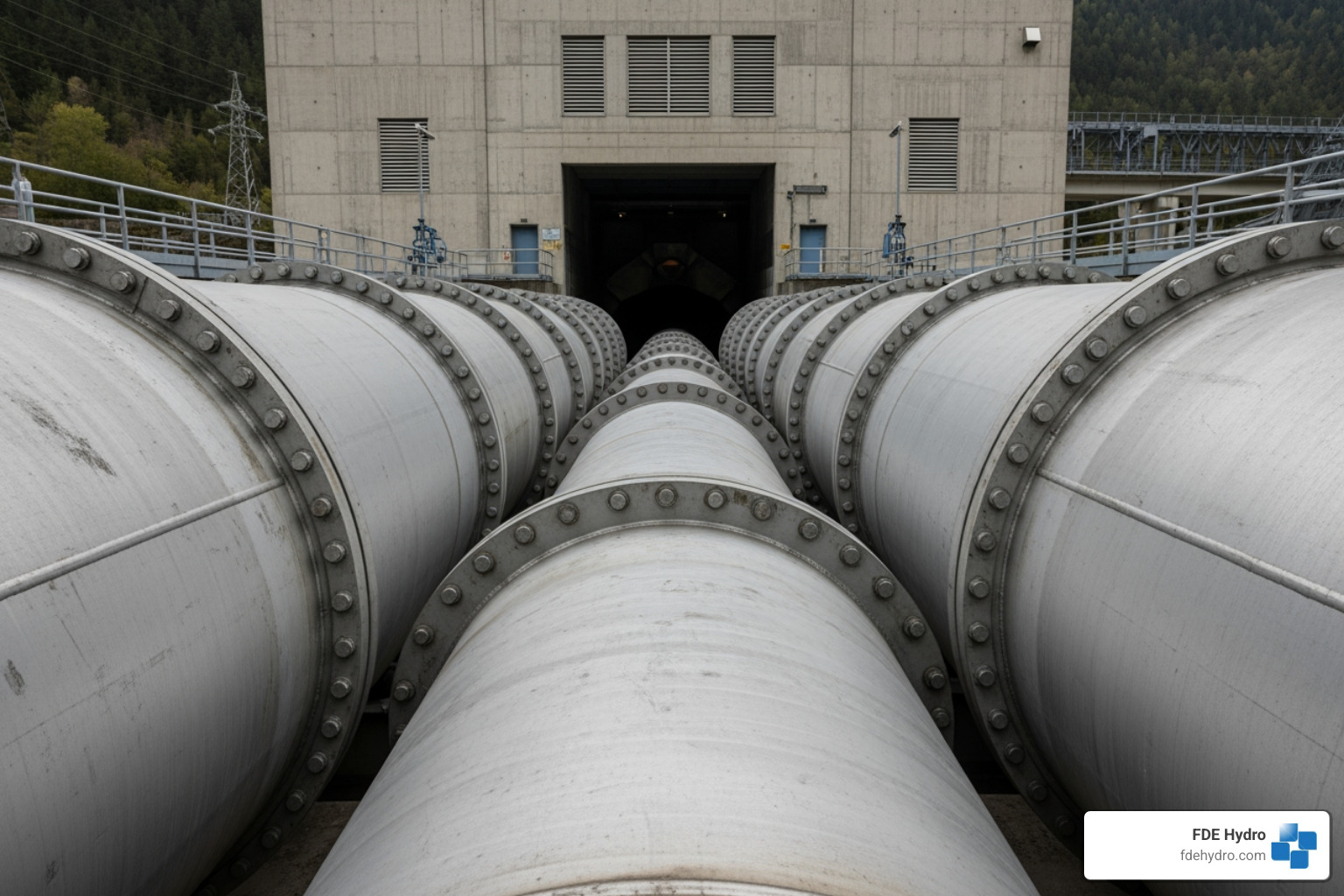
The penstock is essentially a large pipeline that channels water from the intake structure down to the turbine. But it’s far more than just a pipe; it’s a critical component designed to increase water pressure and direct it with immense force. As the water travels down the penstock, the vertical drop creates significant head pressure, focusing the water’s power directly towards the turbine.
Penstocks are typically made of robust materials like steel, capable of withstanding the high internal pressures and external environmental conditions. The design of the penstock—its diameter, length, and routing—is paramount to the system’s efficiency. A small-diameter penstock, for instance, can significantly reduce the available horsepower even if it carries all the available water, due to increased friction. Conversely, larger diameters create less friction, optimizing flow. Furthermore, ensure no air enters the pipeline, as air pockets can reduce horsepower and even damage the turbine. Hydraulic optimization of these water conduits is a major concern in penstock construction, ensuring the least head losses. To learn more about this crucial conduit, check out What is a Penstock?.
Essential Mechanical Hydro dam components: The Turbine
The turbine is often considered the heart of the hydroelectric power plant. It’s the component that directly translates the force of the flowing water into rotational motion, setting the entire electricity generation process in motion. When the high-pressure water from the penstock strikes the turbine’s blades, it causes a central shaft to spin rapidly. This rotational motion is the mechanical energy we’ve been working towards.
Selecting the right type of turbine is crucial and depends heavily on the specific “head” (the vertical distance the water falls) and “flow” (the volume of water available) conditions of the site. Here’s a quick overview of the main types:
| Turbine Type |
Head Conditions |
Flow Conditions |
Typical Application |
| Pelton |
High (150m – 1500m) |
Low |
High head dams with long penstocks. |
| Francis |
Medium (20m – 600m) |
Medium to High |
The most common and versatile type, used in a wide range of conditions. |
| Kaplan |
Low (2m – 50m) |
High |
Run-of-river plants and other low-head projects. |
| Bulb/Pit/S |
Very Low (2m – 30m) |
High |
Low-head projects needing high efficiency and flow capacities. |
| Pump |
Wide Range (Up to 700m) |
Variable |
Pumped storage plants, which can also pump water back to the reservoir. |
Turbine innovation has been ongoing for over 150 years, leading to solutions that are not only powerful but also environmentally conscious. For example, pioneering work has been done on fish-friendly designs and oil-free hubs to prevent water pollution, which aligns perfectly with our commitment to sustainable infrastructure.
Key Electrical Hydro dam components: The Generator
Once the turbine is spinning, its mechanical energy needs to be converted into usable electricity. This is the job of the generator, a marvel of electrical engineering. The generator is directly coupled to the turbine’s shaft, so as the turbine spins, the generator also rotates.
The magic happens inside the generator through a principle called electromagnetic induction. This is where magnets spin rapidly past coils of copper wire (or vice versa), causing electrons to move and thereby generating an electrical current. The generator consists of two main parts:
- Rotor: This is the rotating part, typically equipped with powerful electromagnets.
- Stator: This is the stationary part, containing the copper wire coils.
As the rotor spins within the stator, the magnetic fields cut across the copper coils, inducing an electrical voltage and current. This process converts the mechanical energy from the spinning turbine into electrical energy, specifically alternating current (AC). A typical hydroelectric generator might spin at around 90 revolutions per minute, producing electricity at standard grid frequencies (e.g., 60 Hz in North America). This clever conversion is how we harness the raw force of water into the electrical power we use every day.
The Delivery Network: From Powerhouse to Grid
With electricity successfully generated, the next crucial step is to prepare it for distribution and send it out to the wider world. This involves several more specialized hydro dam components that ensure the power is safe, stable, and ready for consumption.
The powerhouse is the central hub where the turbines and generators are housed. It’s more than just a building; it’s a strategically designed facility that protects all the vital equipment from the elements and serves as the epicenter of renewable energy generation. From here, the newly generated electricity starts on its final journey, passing through transformers for voltage regulation and then onto transmission lines to reach the National Grid.
Operating a hydroelectric dam is a complex dance between water flow, electricity demand, and safety protocols. This is orchestrated by sophisticated control systems, which we like to think of as the dam’s “nervous system.” These systems, often incorporating SCADA (Supervisory Control and Data Acquisition) technology, allow operators to monitor and adjust critical parameters in real-time. We can fine-tune water flow rates, open and close gates, and regulate turbine speeds to ensure the plant operates at peak efficiency and responds dynamically to grid demands. This level of automation and precision is vital for both safety and optimal power output. For more insights into these intricate systems, visit our Water Control Systems page.
Immediately after the generators, the electricity, typically produced at a relatively low voltage, enters the transformers. These are essential for preparing the power for long-distance transmission. Transformers “step up” the voltage, converting the lower voltage electricity into a much higher voltage. Why higher voltage? Because transmitting electricity at high voltages drastically reduces energy loss over long distances. Without this crucial step, a significant portion of the generated power would dissipate as heat before it ever reached our homes and businesses. Once the voltage is boosted, the electricity is ready to be fed into the transmission lines, which carry it across vast distances to substations and ultimately to consumers.
Design, Innovation, and Sustainability in Hydropower
Building and operating hydroelectric dams isn’t just about raw power; it’s about smart design, continuous innovation, and a deep commitment to sustainability. At FDE Hydro, we understand that every decision, from the initial blueprint to daily maintenance, impacts the long-term success and environmental footprint of a project.
Our design considerations always prioritize operational safety, efficiency, and longevity. We aim for systems that are robust, reliable, and easy to maintain. This means building in fail-safe mechanisms, ensuring redundancy in critical systems, and providing comprehensive training for operators. Regular maintenance of all hydro dam components isn’t just a good idea; it’s crucial for ensuring efficiency and extending the lifespan of the entire plant. It helps prevent costly breakdowns, saves budget in the long run, and ensures consistent productivity. Our work with modular precast concrete technology, for instance, significantly reduces the time and cost associated with construction and retrofitting, making these projects more feasible and sustainable. Dive deeper into our advancements on our Hydropower Innovation page.
Minimizing Environmental Impact
While hydropower is a clean, renewable energy source, we acknowledge the importance of minimizing its environmental footprint. Innovations in hydro dam components are constantly evolving to address these concerns, particularly regarding aquatic life and water quality.
A major focus is on protecting fish populations. This has led to the development of fish-friendly turbines, designed to reduce harm to fish passing through the system. Technologies like the Minimum Gap Runner (MGR) improve fish survival rates to over 95% by minimizing gaps where fish could be injured. Some modern turbine concepts, for example, feature slower rotational speeds and fewer blades, specifically engineered to reduce fish mortality. Beyond turbine design, we also implement solutions like fish ladders (structures that allow fish to bypass dams) to facilitate upstream and downstream migration. You can find more details on these advancements in fish-friendly turbine design.
Another critical area is maintaining water quality. Traditional turbine hubs sometimes use oil, which could potentially leak and pollute the water. Innovations like oil-free hubs and greaseless technologies eliminate this risk entirely, ensuring that no harmful substances are released into the environment. Furthermore, aerating turbines (also known as auto-venting turbines) are designed to improve dissolved oxygen levels in the water released downstream. This is particularly important in reservoirs where water at lower depths can become oxygen-deficient, impacting aquatic ecosystems. By drawing atmospheric air into the turbine during operation, we can significantly improve the health of the downstream river environment. These advancements are integral to our vision for Sustainable Power Generation.
The Future of Hydro Dam Components
The world of hydropower is far from static. We are continually exploring new technologies and approaches to make hydroelectric systems even more efficient, sustainable, and adaptable. The future of hydro dam components is exciting and holds immense promise.
We’re seeing rapid advancements in areas like smart sensors and AI for resource management. These technologies allow for unprecedented levels of real-time monitoring, predictive maintenance, and optimized operation. Imagine a system that can anticipate potential equipment failures before they happen, or intelligently adjust water release based on complex weather patterns and energy demand forecasts. This is the power of AI for Resource Management coming to life.
Future trends also include the development of hybrid systems, where hydropower plants are integrated with other renewable energy sources like solar or wind, and coupled with advanced energy storage solutions. This creates a more stable and reliable energy supply, leveraging the strengths of each technology.
At FDE Hydro, we’re particularly enthusiastic about our role in pioneering modular dam construction using precast concrete technology. This approach allows for faster, more cost-effective, and less disruptive construction and retrofitting of dams in North America, Brazil, and Europe. Instead of building dams piece by piece on-site, we can manufacture large, high-quality precast components off-site and then rapidly assemble them. This not only speeds up project timelines but also improves quality control and reduces environmental impact during construction. This innovative shift in construction methodology is a game-changer for the industry, making hydropower expansion more practical and efficient.
Frequently Asked Questions about Hydro Dam Parts
What are the 5 main parts of a hydroelectric dam?
The five primary hydro dam components are:
- The Dam itself, which creates the reservoir.
- The Reservoir, storing the water and its potential energy.
- The Penstock, channeling the water under pressure.
- The Turbine, which converts water’s energy into mechanical rotation.
- The Generator, changing mechanical energy into electricity.
How do the components work together to generate electricity?
It’s a beautifully orchestrated sequence:
Water stored in the reservoir (created by the dam) builds up potential energy. When released, it flows with increasing speed and pressure through the penstock. This high-velocity water strikes the blades of the turbine, causing it to spin. The spinning turbine, in turn, rotates the shaft of the generator, which then uses electromagnetic induction to convert this mechanical energy into electrical energy. This electricity is then sent through transformers and transmission lines to the grid.
What is the most important component of a hydroelectric power plant?
While the turbine and generator are often considered the “heart” of power production because they perform the actual energy conversion to electricity, it’s crucial to understand that all hydro dam components are interdependent. The dam and reservoir provide the necessary potential energy. The penstock delivers the water with force. The intake, gates, and spillways ensure controlled and safe operation. Without any one of these elements functioning correctly, the entire system cannot operate safely or efficiently. Therefore, while some parts directly produce power, the interconnectedness and integrity of all components are what truly make a hydroelectric power plant successful.
Conclusion
We’ve journeyed through the intricate world of hydro dam components, from the towering structures that hold back vast bodies of water to the delicate mechanisms that convert raw kinetic energy into the electricity powering our lives. Each part, whether it’s the mighty dam, the precise control gates, the robust penstock, the dynamic turbine, or the electrical generator, plays an indispensable role in the complex, interconnected system of hydroelectric power generation.
Hydropower stands as a cornerstone of our Clean Energy Infrastructure, providing a reliable and sustainable source of electricity for billions worldwide. As we look to the future, our commitment at FDE Hydro is to continue innovating, developing solutions that not only improve efficiency and safety but also minimize environmental impact. Our modular precast concrete technology is a testament to this, offering advanced and rapid-install solutions for both new construction and retrofitting projects in North America, Brazil, and Europe.
We invite you to explore how our innovative approaches are shaping the future of water infrastructure. To learn more about our cutting-edge designs and how we’re building the next generation of hydroelectric power, we encourage you to explore our advanced and rapid-install solutions with our precast models. Together, we can build a more sustainable and energy-secure future.
by Bill French Sr. | Dec 22, 2025 | Hydro Facility Articles
Why Hydropower Asset Management is Critical for Long-Term Success
Hydropower asset management is a strategic approach to maintaining, operating, and optimizing hydroelectric facilities for maximum reliability, performance, and value over their lifecycle. Here’s what it involves:
Key Components of Hydropower Asset Management:
- Condition Assessment – Regular evaluation of equipment health using routine O&M data and specialized testing
- Risk-Based Prioritization – Ranking investments by likelihood and consequence of failure
- Data-Driven Decisions – Using CMMS/EAMS systems to track performance and predict maintenance needs
- Strategic Planning – Aligning maintenance budgets with long-term capital improvement goals
- Performance Optimization – Extending asset life while maximizing generation output and revenue
The stakes are high: most critical equipment in North American hydroelectric facilities is near or beyond its design life. For example, the average generator step-up transformer is over 34 years old. However, with robust asset management, hydropower facilities can operate for over 100 years—far longer than other generation technologies.
Many operators have data, but it’s often compartmentalized, incomplete, or low-quality, hindering good decisions. As equipment ages and regulations evolve, a lack of a comprehensive asset management approach leads to a reactive cycle of addressing failures instead of preventing them.
Hydropower’s role is more critical than ever in the energy transition. Its dispatchability and operational flexibility are essential for integrating intermittent renewables like wind and solar. To secure this role, operators must view asset management as a value creation tool, not just a cost center.
This requires moving from simple schedules to strategic programs using condition assessments, risk analysis, and economic modeling. It involves using frameworks like the Hydropower Asset Management Partnership (hydroAMP) and justifying improvements with data-driven insights on risk and opportunity, not just age.
I’m Bill French Sr., Founder and CEO of FDE Hydro™, and I’ve spent decades in civil construction and hydropower innovation, including serving on the Department of Energy’s Hydro Power Vision Technology Task Force. Through this experience, I’ve seen how strategic hydropower asset management transforms facilities from aging liabilities into competitive, resilient assets that support the clean energy transition.
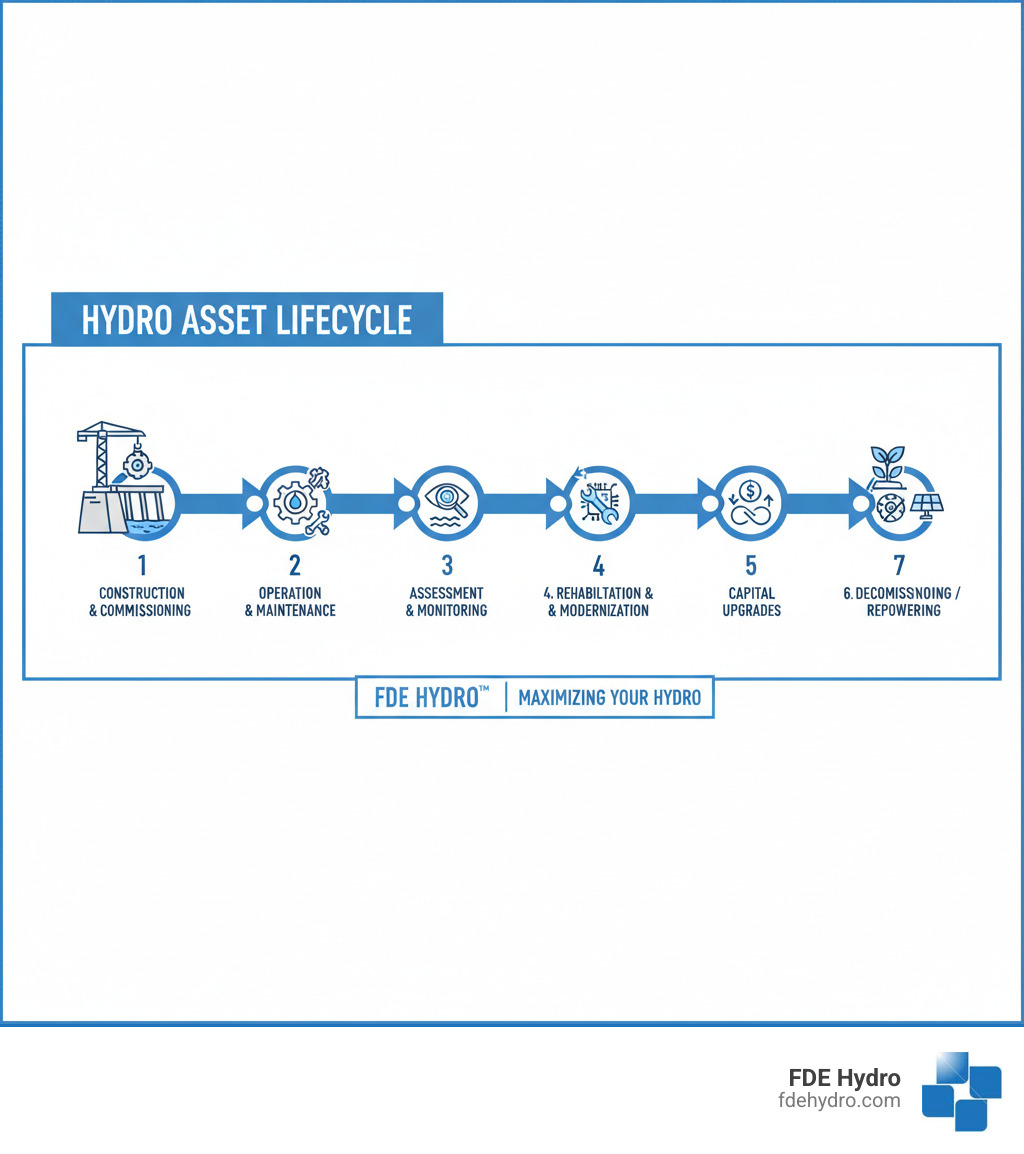
Hydropower asset management terms simplified:
The Core Components of a Resilient Hydropower Program
Aging infrastructure doesn’t mean declining performance. With strategic hydropower asset management, facilities can operate reliably and profitably for decades past their design life by moving from reactive to proactive management.
A resilient program builds organizational resilience—the ability to adapt to failures, market changes, or regulatory shifts. This requires integrating five key elements: program development, capital improvement planning, information solutions, operational performance monitoring, and condition assessment.
Program development establishes the framework for all asset-related decisions. The ISO 55000 series (ISO 55000, 55001, and 55002) offers a proven roadmap for building these systems, connecting leadership strategy with daily operations.
Capital Improvement Planning (CIP) turns the framework into action, optimizing the timing and sequence of investments to maximize value and manage risk.
Information solutions like a CMMS (Computerized Maintenance Management System) or EAMS (Enterprise Asset Management System) act as the program’s central nervous system, turning scattered data into actionable insights.
Operational performance tracking ensures assets deliver required reliability and output. Condition assessment provides the diagnostic data to determine when intervention is necessary or can be deferred.
When these components work together, they create a system that drives reliability and performance across the portfolio. More info about Hydropower Project Costs
Primary Objectives of Asset Management
Hydropower asset management is a means to achieve specific, measurable outcomes that impact your bottom line and operational success.
Operational excellence means facilities run smoothly and efficiently. It streamlines workflows, allowing teams to focus on optimizing performance and making maintenance strategic, not chaotic.
Minimizing downtime is a tangible benefit. A good program identifies potential failures early, allowing maintenance to be scheduled during low-value periods to avoid lost revenue and penalties from unplanned outages.
Risk reduction encompasses safety, environmental, and regulatory risks. Systematically addressing these risks protects personnel, profits, and compliance.
Cost-control is about finding the balance between under-maintaining (costly failures) and over-maintaining (wasted resources). The goal is the lowest lifecycle cost, not the lowest immediate expense.
Extending asset lifespan is critical for aging equipment. Strategic refurbishments and replacements can keep facilities productive for decades, with well-managed plants often operating for over 100 years.
Resource allocation ensures limited capital, personnel, and time are directed where they create the most value, with decisions based on data, not intuition.
Defining and Prioritizing Critical Assets
Not all assets deserve equal attention. Some failures are minor inconveniences; others can shut down an entire operation. Hydropower asset management is about knowing the difference and prioritizing accordingly.
This requires a system-level understanding of how components interact. A facility is an integrated system where one failure can cascade. For example, a small bearing failure could destroy a multi-million dollar turbine.
Criticality analysis combines failure likelihood with its consequences. A worn gasket is a low-consequence failure. In contrast, a generator step-up transformer failure can cause extended outages and catastrophic revenue loss, especially with procurement times of 18 months or more.
Failure probability assessment considers age, condition, maintenance history, and operating environment to help anticipate problems.
The consequence of failure evaluation considers lost revenue, repair costs, safety, environmental risks, and regulatory penalties, as well as spare part availability and lead times.
Combining these factors creates a risk profile for each asset, allowing you to rank assets and focus budgets on the components that matter most.
This isn’t about ignoring low-priority assets. It’s about ensuring that when your GSU transformer shows signs of degradation, you’re already planning for replacement rather than finding the problem during a catastrophic failure. More info about Hydroelectric Dam Components
Data-Driven Decisions: From Assessment to Action
The real challenge of hydropower asset management isn’t collecting data, but turning it into clear decisions and making it work for you.
Most facilities have decades of data in maintenance logs, reports, and records. The problem is that this data is often scattered, inconsistent, incomplete, and unreliable.
Modern information systems like Computerized Maintenance Management Systems (CMMS) and Enterprise Asset Management Systems (EAMS) are the backbone of data-driven hydropower asset management. They organize data, track equipment condition, and help spot patterns.
Software alone isn’t a solution. The real work is improving data quality through team training, clear procedures, and regular audits. It also requires developing analytical skills to recognize fleet-wide trends.
Getting this right allows you to see new cause-and-effect relationships, predict failures, justify investments with evidence, and automate routine decisions, freeing up your team for complex challenges.

The Role of Condition Assessments in Hydropower Asset Management
Condition assessments are the blueprints of hydropower asset management, revealing the real health of your equipment based on objective, measurable indicators, not just age or assumptions.
Tier 1 assessments provide a baseline using existing O&M data, age, and history. Assets are scored against standardized indicators to produce a Condition Index and a Data Quality Indicator. This streamlined approach avoids spending on specialized tests unless necessary.
Tier 2 evaluations are used when Tier 1 raises red flags or for critical equipment. They involve specialized, non-routine testing, often with outside experts. While more costly, this deeper analysis is essential for critical assets like a generator step-up transformer with a long lead time.
The Hydropower Asset Management Partnership (hydroAMP) is an invaluable industry resource. Its framework helps operators objectively evaluate equipment condition with standardized methods, supporting long-term investment strategies, annual budgets, and performance tracking. It helps facilities shift from reactive to strategic planning.
Learn about the hydroAMP framework
Good condition data is only half the battle; it must be used to make smart investment decisions about which projects to fund, defer, and prioritize for the best ROI.
In hydropower asset management, we use two main analysis types: Type 1 for straightforward financial analysis and Type 2 for comprehensive risk-based evaluation.
| Analysis Type |
Focus |
Key Factors Considered |
Application |
| Type 1 |
Condition and Cost |
Total cost, current-year cost, incremental maintenance, achievability, project phase, Condition Index. |
Best for simpler investment decisions, such as replacing a relatively inexpensive piece of equipment like a compressor, where the primary concerns are the asset’s condition and the direct cost of repair or replacement. |
| Type 2 |
Condition, Cost, and Consequence (Risk) |
All Type 1 factors PLUS marginal value of generation, outage duration, revenue at risk, risk map score, other business factors (e.g., safety, legal, environmental, regulatory). |
Essential for complex investment decisions involving critical power train equipment (generators, transformers, turbines), where the consequences of failure are significant and can impact multiple areas beyond direct cost, including lost revenue and grid reliability. |
Risk maps are a powerful tool, plotting equipment condition against consequence of failure. This visual instantly highlights top-priority vulnerabilities, like a generator in poor condition with high failure consequences.
For financial analysis, Net Present Value (NPV) is ideal. Unlike other metrics, NPV accurately accounts for the time value of money and all cash flows over a project’s lifespan, which is crucial for major, long-term investments.
For example, evaluating a generator and turbine replacement requires considering upfront cost, increased capacity, generation benefits, reduced maintenance, and avoided environmental costs, all projected over decades and discounted to today’s dollars using NPV. This rigorous, data-driven analysis provides solid justification for multi-million-dollar projects.
More info about Dam Rehabilitation
Strategic Hydropower Asset Management in a Modern Energy Market
As the energy world changes, hydropower asset management must keep pace. Hydropower is more essential than ever because, unlike solar and wind, it can deliver power on demand.
Hydropower facilities can ramp up or down quickly to meet demand. This dispatchability makes them perfect partners for intermittent renewables and guardians of grid stability, balancing the grid when other sources are unavailable.
This increased importance brings challenges and opportunities. Volatile energy markets require agile hydropower asset management strategies that optimize both equipment performance and market value creation.

Justifying Budgets for Capital Improvements
Securing budgets is a tough part of hydropower asset management. For example, the DOE recently requested $7 billion for hydropower improvements but received only $550 million, highlighting the need to make every dollar count.
A solid hydropower asset management program is your best advocate. With comprehensive data and analytical tools (like Type 1 and 2 analyses), you can build compelling business cases that show an asset’s risk profile, cost of failure, and ROI, going beyond simply stating its age.
This data-driven approach transforms capital planning from reactive to strategic. You can demonstrate that proactive replacement of a critical component, based on its condition and risk, saves more than waiting for a catastrophic failure and its associated costs.
Long lead times for major equipment (e.g., 18+ months for transformers) are another crucial factor. Good asset management data allows for strategic procurement, avoiding expedited shipping costs and extended downtime, which is invaluable for managing risk and resources.
More info about Reinvigorating Hydropower
Leveraging Operational Flexibility and Market Expectations
Combining technical decisions with market strategy is where hydropower asset management excels. Hydropower’s flexibility is a commercial advantage in volatile markets, creating value through ancillary services and optimized generation timing.
Outage management is a strategic tool. Major refurbishments should be scheduled during periods of low expected power prices. This minimizes lost revenue and can reduce project costs, improving overall profitability.
Forward power price expectations also guide investment timing. If prices are projected to rise, accelerating efficiency upgrades can capture more value. If prices are projected to be low, non-critical investments might be deferred, while always maintaining safety and reliability.
The key is integrating market dynamics into your asset management framework. Condition assessments show what needs doing; market expectations help determine when to do it for maximum value. This transforms hydropower asset management from maintenance into a value creation strategy.
Practical guidance from the World Bank
The Future of Hydropower Asset Management: Innovation and Value Creation
The future of hydropower asset management is about predicting, preventing, and optimizing operations. Digital innovations like predictive maintenance, sensor-driven optimization, and AI-powered analytics are becoming essential tools.
In practice, this means using real-time sensor data to predict a component’s remaining lifetime instead of waiting for scheduled inspections. This shift from time-based to condition-based, prognostics-driven maintenance is revolutionary, improving reliability, availability, resource use, and profitability.
As the electricity sector moves toward sustainability, hydropower asset management innovation is key. These advanced approaches prevent failures, reduce environmental impacts, and ensure peak performance. For aging North American assets, these innovations are essential for survival and success.
More info about Hydropower Innovation
Adapting to New Technologies and Methods
Adopting new technologies doesn’t require starting from scratch. Existing CMMS and EAMS systems are foundations that can be integrated with modern data analytics tools, turning them into powerful predictive engines.
This integration allows sensor data to flow into optimization models to predict failures, schedule maintenance economically, and optimize reservoir management. Forward-thinking operators are creating intelligent systems that learn and improve over time.
Prognostics-driven maintenance enables smarter, preventative decisions. Work can be scheduled during low-price periods and long-lead-time equipment ordered proactively, all with data-backed confidence.
The key is to start where you are and build progressively. Even small steps toward digital integration can significantly improve your hydropower asset management program’s effectiveness.
AI-Driven Development insights
Enhancing Value in the Energy Transition
Hydropower asset management open ups hidden value that supports the energy transition. As wind and solar grow, the grid needs hydropower’s reliable, dispatchable power to fill intermittency gaps.
An often-overlooked opportunity is improving flow measurement accuracy. Case studies show this can increase annual generation by 0.4% to 1.8%. Over decades, this translates to substantial revenue increases, often enough to fund other critical improvements.
Beyond flow measurement, strategic asset management improves overall generation efficiency by optimizing turbines and reducing transmission losses. This technical optimization also has environmental benefits, generating more clean electricity from every drop of water.
The energy transition needs hydropower to succeed. By continuously improving the technical, environmental, and water-use efficiency of our existing fleet through smart hydropower asset management, we secure hydropower’s role as a cornerstone of sustainable energy infrastructure.
At FDE Hydro, we know modern asset management and innovative construction go hand in hand. Our modular precast concrete technology helps extend the life and improve the performance of hydropower infrastructure, complementing your asset management program with faster, more cost-effective, long-term construction solutions.
More info about Sustainable Power Generation
Frequently Asked Questions about Hydropower Asset Management
What is the first step in creating a hydropower asset management program?
The first step is to establish clear objectives aligned with your organization’s strategic priorities, such as improving reliability, reducing costs, or extending asset life. Once objectives are defined, conduct a thorough inventory and condition assessment of all assets. This provides a baseline understanding of your equipment’s health, identifying what’s in good shape and what needs attention. You can’t plan a path forward without knowing your starting point.
How does asset management help with aging hydropower infrastructure?
Hydropower asset management provides a structured framework to manage aging infrastructure. Instead of reacting to failures, it allows for systematic condition assessment and risk-based prioritization of repairs and replacements. This proactive approach prevents catastrophic failures, as a planned outage is always better than an emergency shutdown. By justifying investments with data, asset management extends the viable lifespan of facilities, allowing them to operate for over 100 years with proper maintenance.
Yes. While the scale is different, the fundamental principles of hydropower asset management apply and are highly beneficial for small plants. Smaller facilities often have tighter budgets and smaller teams, making a structured approach even more valuable. A simplified, customized program helps prioritize limited resources effectively. It improves reliability, ensures safety compliance, and maximizes revenue by changing operations from reactive to strategic, making the plant more sustainable and profitable.
Conclusion
Hydropower asset management is about changing hydroelectric facilities from aging cost centers into strategic, value-creating assets. By establishing robust programs (using frameworks like ISO 55000), prioritizing critical assets, using condition assessments for smart decisions, and justifying investments with analytical tools, we can move from a reactive maintenance cycle to a powerful, sustainable approach.
The stakes are high. With aging equipment and hydropower’s vital role in grid stability, old operational methods are no longer sufficient. By applying strategic hydropower asset management, facilities can operate reliably for over a century, adapting to evolving market demands.
Technology is revolutionizing what’s possible. Tools like predictive maintenance, sensor-driven optimization, and AI-powered analytics are available now to prevent failures, optimize real-time performance, and maximize asset value while minimizing environmental impact.
At FDE Hydro™, we combine smart asset management with innovative construction. Our patented modular precast concrete technology, the “French Dam,” addresses aging infrastructure and new development needs in North America, Brazil, and Europe. By reducing construction costs and timelines, we help operators implement critical capital improvements identified by their asset management programs, building resilient, efficient facilities for future generations.
The journey from reactive maintenance to strategic value creation is worthwhile. The principles—understand your assets, prioritize based on data, invest strategically, and continuously optimize—apply to any size operation. Together, we can ensure hydropower remains a cornerstone of clean, reliable energy.
Learn how to finance long-term hydropower projects by mitigating risks
by Bill French Sr. | Dec 19, 2025 | Hydro Facility Articles
Why Water Infrastructure Projects Matter More Than Ever
Water infrastructure projects are the backbone of safe drinking water in America, but the nation faces a critical juncture. Here’s what you need to know:
Key Facts About U.S. Water Infrastructure Projects:
- $50 billion federal investment through the Infrastructure Investment and Jobs Act – the largest water investment in U.S. history
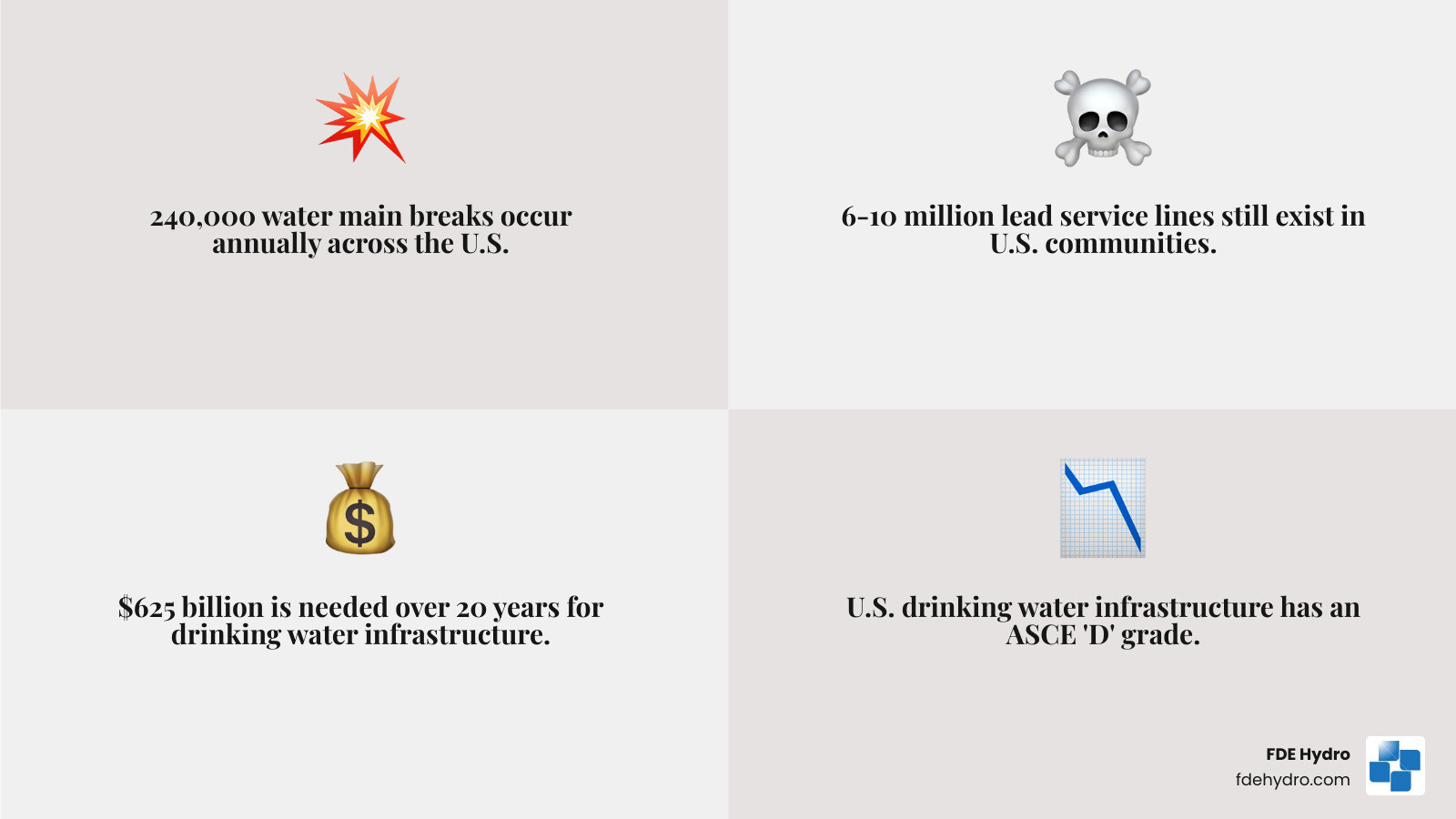
- $625 billion needed over the next 20 years for drinking water infrastructure
- 6-10 million lead service lines still exist across the United States
- Grade D – the ASCE’s rating for U.S. drinking water infrastructure for over a decade
- Major funding sources include State Revolving Funds (SRFs), WIFIA loans, and USDA Rural Development programs
The numbers tell a sobering story. Much of America’s water infrastructure is aging rapidly, with some pipes dating back to the 1800s. These systems are strained by climate change, which brings extreme droughts and floods, and threatened by emerging contaminants like PFAS “forever chemicals” that existing plants weren’t designed to handle.
However, there’s unprecedented opportunity. The Bipartisan Infrastructure Law offers a once-in-a-generation chance to rebuild. Federal programs like WIFIA and SRFs are making large-scale upgrades more affordable, and communities are shifting from crisis response to proactive, technology-enabled management.
The path forward requires smart investment, innovative construction methods, and proven technologies that can deliver results faster and more cost-effectively than traditional approaches.
I’m Bill French Sr., Founder and CEO of FDE Hydro™. For over five decades, I’ve focused on civil construction innovation, from participating in the DOE’s Hydro Power Vision Task Force to developing the modular solutions we use today. I’ve seen how the right technology can dramatically reduce costs, accelerate timelines, and deliver more resilient water systems.
Quick water infrastructure projects definitions:
The State of America’s Water Systems: Challenges and Urgencies
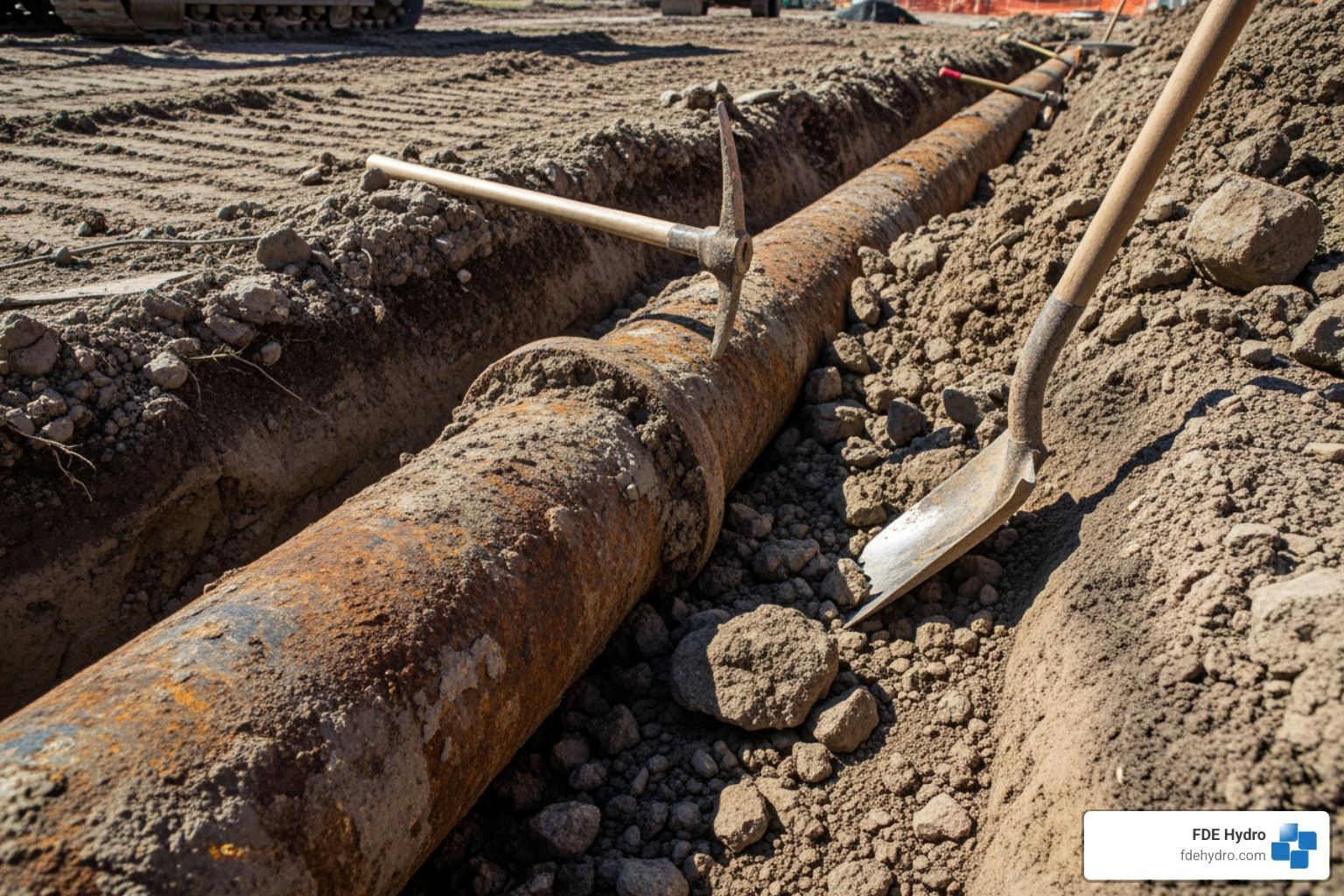
Let’s talk about the reality facing our water infrastructure projects today. The American Society of Civil Engineers has given U.S. drinking water infrastructure a “D” grade for over a decade. We’re dealing with pipes laid generations ago, some dating back to the 1800s. These aging systems lead to frequent water main breaks, wasting millions of gallons of treated water and creating contamination risks.
Age isn’t our only challenge. Climate change is rewriting the rules, with droughts pushing storage to its limits in some regions while intense rainfall overwhelms systems in others. The infrastructure built for yesterday’s climate isn’t ready for tomorrow’s extremes.
Then there are new contaminants our grandparents never worried about. PFAS—”forever chemicals”—are showing up in water supplies nationwide, and our older treatment plants weren’t designed to remove them. The same is true for harmful algal blooms fueled by nutrient runoff. The economic toll of failing infrastructure is immense, including lost productivity, health costs, and environmental damage, as detailed in a joint report on the State of the Infrastructure by the Bureau of Reclamation and the U.S. Army Corps of Engineers.
Addressing Historical Underinvestment and New Threats
For decades, our approach to water infrastructure has been reactive, waiting for crises before acting. This pattern of deferred maintenance has created a massive infrastructure deficit. The good news is that we can now move from patching old systems to modernizing them with smarter designs and better technology, as seen in how Aging Infrastructure Being Replaced with Next Generation Civil Solutions can transform this challenge.
As threats evolve, our water infrastructure projects must evolve too. PFAS contamination is a tough new frontier, affecting about a quarter of the nation. Removing these compounds requires advanced treatment technologies that many facilities lack. Similarly, harmful algal blooms, like the one that made Toledo, Ohio’s water undrinkable in 2014, are becoming more common. Addressing these threats requires comprehensive strategies, from source water protection to advanced Water Control Systems.
Fortunately, the federal government is taking this seriously. The Bipartisan Infrastructure Law dedicates $10 billion to addressing PFAS and other new threats, pushing utilities to test for and treat these contaminants. We are finally shifting from reactive crisis management to proactive defense.
Funding the Flow: Navigating Federal Investment in Water Infrastructure Projects
We’re living through the single largest federal investment in water America has ever seen. The Bipartisan Infrastructure Law delivers more than $50 billion to the EPA alone for water infrastructure projects. This historic funding reaches local communities through key programs.
State Revolving Funds (SRFs) are state-managed loan programs that blend federal and state dollars. They offer low-interest loans for a wide range of projects, and as loans are repaid, the money is recycled to fund future projects, creating a self-sustaining cycle of reinvestment.
The Water Infrastructure Finance and Innovation Act (WIFIA), administered by the EPA, provides long-term, low-interest loans for large, nationally significant projects. WIFIA has already saved utilities over $5 billion in financing costs. For rural America, USDA Rural Development programs provide targeted assistance and financing.
This comprehensive federal approach reflects a commitment to Sustainable Infrastructure Development. For a deeper dive on WIFIA, the American Water Works Association offers an excellent analysis: Fluid Financing of Water Utility Infrastructure With WIFIA.
How Funding Empowers Local Projects
The power of SRFs and WIFIA is how they provide money. By dramatically reducing borrowing costs—WIFIA loans can cut financing costs by 25%—these programs make ambitious water infrastructure projects feasible. Savings can mean lower water bills for families or the ability to tackle additional upgrades. SRFs are particularly vital for smaller systems, with 38% of Drinking Water SRF funds going to systems serving 10,000 people or fewer, leveling the playing field for communities that struggle to access capital markets.
| Feature |
WIFIA |
SRFs (Drinking Water & Clean Water) |
| Loan Terms |
Low-interest, long-term (up to 35 years) |
Low-interest (often below market), various terms |
| Project Size |
Large, nationally/regionally significant ($20M+ or $5M+ for small communities) |
Small to large, state-specific thresholds |
| Application Process |
Direct to EPA, competitive |
Through state agencies, application varies by state |
| Funding Source |
Federal appropriations, repaid loans |
Federal capitalization grants, state matching funds, repaid loans |
| Key Benefit |
Significant cost savings, flexible repayment |
Flexible, self-sustaining, supports a broad range of projects |
| Typical Projects |
New construction, large upgrades |
Lead service line replacement, treatment plant upgrades, collection systems |
Key Funding Allocations Under the IIJA
The Bipartisan Infrastructure Law makes strategic investments in the most critical areas. Key allocations include:
- $15 billion for lead service line replacement, a national commitment to eliminate this preventable health crisis.
- $11.7 billion for wastewater and stormwater systems through the Clean Water SRF to protect our rivers and lakes.
- $9 billion total to address emerging contaminants like PFAS, acknowledging that public health requires staying ahead of new threats.
- $8.3 billion to the Bureau of Reclamation for water infrastructure in the Western U.S., targeting drought resilience and dam safety.
These funds represent real projects in real communities—new treatment plants, replaced pipes, and cleaner water, creating a once-in-a-generation opportunity to transform American water infrastructure.
Blueprint for Resilience: Key Project Categories and Their Impact
Building a resilient water future requires a comprehensive approach to water infrastructure projects. This blueprint includes everything from purifying drinking water and managing stormwater to replacing lead service lines and building new storage. These projects are interconnected; a new reservoir provides drought resilience and flood control, while an upgraded treatment plant can enable water recycling. Thoughtful design of Water Control Structures can serve multiple purposes, delivering greater value for every dollar invested.
Modernizing Drinking Water and Wastewater Systems
Many water infrastructure projects directly impact your daily life. With 6-10 million lead service lines still in use, federal funding is finally enabling large-scale replacement programs to eliminate this toxic threat. At the same time, treatment plants built mid-century are being upgraded to handle modern demands and emerging contaminants like PFAS. For example, the Kansas River Wastewater Treatment Plant Improvements Project is modernizing facilities to meet current and future needs. Finally, cities are tackling water loss from leaky pipes. San Francisco’s $4.8 billion Water System Improvement Program successfully repaired and seismically upgraded its network, showing what’s possible with sustained commitment.
Building Resilience Against Climate Change
Climate change is reshaping how we approach water infrastructure projects, demanding systems that can handle extremes like droughts and floods. Key strategies include:
- Water Storage: Capturing water during wet periods for use in dry times is fundamental. New reservoirs, like one being built in California, are a key part of this strategy.
- Climate-Adaptive Systems: Large-scale initiatives like California’s Delta Conveyance Project are designed to protect water delivery from climate change and seismic risks.
- Water Recycling and Reuse: Treating wastewater to drinking water standards is a game-changer for drought-prone regions, creating a reliable, local water source.
Federal investment is backing these efforts, with the Inflation Reduction Act providing $4.6 billion for drought response in the West. At FDE Hydro, we see climate resilience as an opportunity. Our work in Hydropower Retrofitting shows how existing infrastructure can be upgraded for water storage, flood control, and clean energy. We believe The Biggest Untapped Solution to Climate Change is in the Water, and we’re committed to developing adaptive solutions.
The Technology Revolution in Water Management
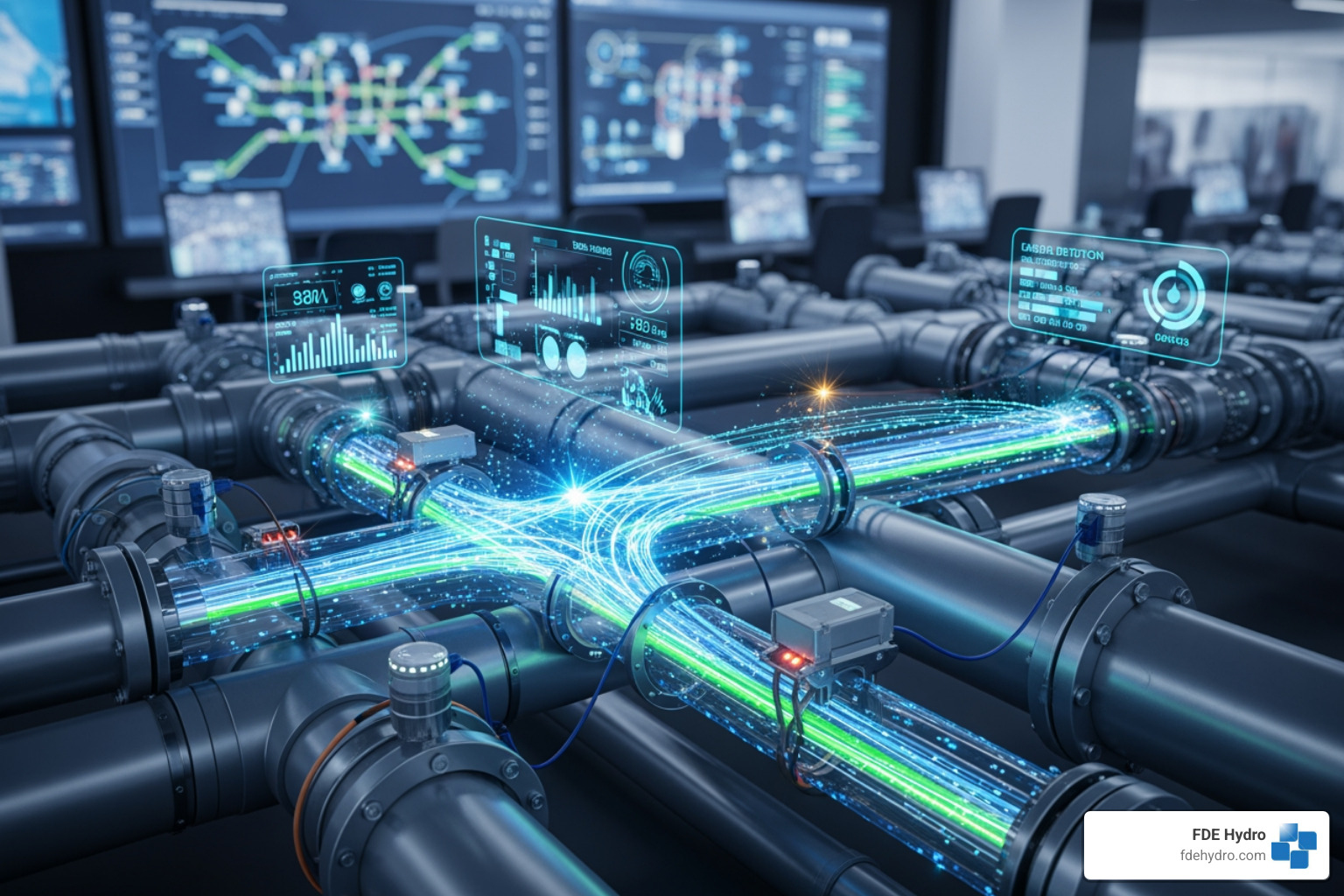
The management of water infrastructure projects is undergoing a technological revolution, shifting from a reactive to a proactive, data-driven approach. Smart water grids use sensors and meters to monitor flow, pressure, and quality in real time, allowing operators to detect leaks and other issues instantly. Predictive analytics takes this a step further, using data to forecast potential equipment failures so maintenance can be scheduled proactively, saving money and preventing disruptions.
On the treatment side, advanced technologies like reverse osmosis are crucial for removing emerging contaminants like PFAS. These innovations are part of a broader move toward Clean Energy Infrastructure that makes water purification more effective and sustainable.
Innovations in Construction for Water Infrastructure Projects
At FDE Hydro, we’ve spent decades rethinking how water infrastructure projects are built. Our patented modular precast concrete technology represents a complete departure from traditional methods. Instead of building everything on-site, we prefabricate major components in a controlled factory environment. These precision-engineered modules are then transported and assembled on-site.
The impact is transformative. Construction time drops from years to months, and costs are significantly reduced by streamlining the process and minimizing on-site labor. Quality and safety both improve, as factory conditions allow for a level of precision impossible in the field. This approach is the essence of our Modular Construction Techniques, delivering more durable and resilient infrastructure faster and for less cost.
The Future of Hydropower and Dam Safety
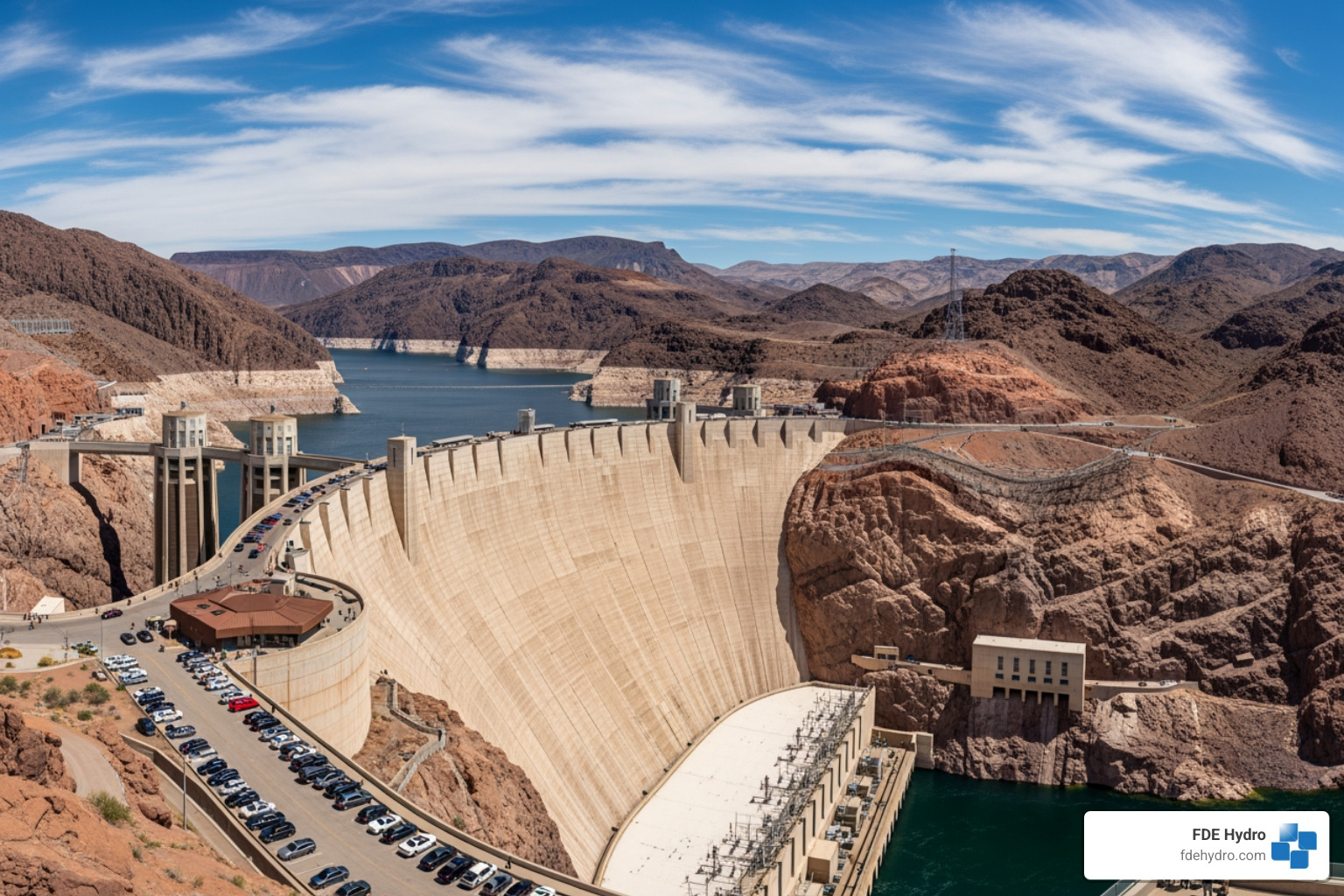
Hydropower is an integral part of America’s water infrastructure, but many facilities are aging. The opportunity is enormous: thousands of existing non-powered dams can be retrofitted to generate clean energy. Our work in Hydropower Innovation and Hydroelectric Dam Construction makes these upgrades faster and more affordable.
Dam safety is also critical, as older structures face new pressures from extreme weather. Federal investment is flowing into spillway improvements and structural upgrades to ensure these dams can withstand future demands while continuing to provide power, water supply, and flood control. Programs like the Army Corps Water Infrastructure Financing Program are helping to fund these vital non-Federal dam projects.
Frequently Asked Questions about Water Infrastructure Management
What are the first steps for a utility to access federal funding like WIFIA or SRFs?
To access federal funding for your water infrastructure projects, start by developing a clear capital improvement plan that outlines your project’s scope, cost, and community benefits. For State Revolving Funds (SRFs), your first call should be to your state’s SRF program administrators, who can guide you through their specific application process. You can find contacts on the EPA’s website for State DWSRF contacts. For larger projects suited for the Water Infrastructure Finance and Innovation Act (WIFIA), you’ll work directly with the EPA. Review the EPA’s guidance on how to apply for WIFIA assistance and engage with the agency early in your planning process.
How do new technologies help manage aging water infrastructure?
New technologies are shifting the management of aging water infrastructure projects from reactive to proactive. Acoustic sensors and smart meters can detect leaks in real time, reducing water loss and preventing catastrophic breaks. Predictive analytics uses historical data to forecast equipment failures, allowing utilities to schedule maintenance proactively, saving money and avoiding service interruptions. Furthermore, trenchless technologies like pipe lining allow for the replacement of underground pipes with minimal excavation, reducing disruption to communities and speeding up project completion. Together, these innovations extend the life of existing assets and make operations more cost-effective.
What is the role of public-private partnerships (P3s) in water projects?
Public-private partnerships (P3s) are a valuable tool for delivering large, complex water infrastructure projects. In a P3, a public entity partners with a private company that may help design, build, finance, and operate a new facility, like a treatment plant. This model can accelerate project delivery by leveraging private sector capital, efficiency, and innovation—such as advanced construction methods that reduce costs and timelines. The public entity retains ownership and oversight, while both parties share risks and rewards. For communities with significant infrastructure needs but limited upfront capital, P3s offer a path to modernize their water systems effectively.
Conclusion: Building a Sustainable Water Future
Our water infrastructure projects face real challenges, from aging pipes to climate change and new contaminants. Yet, we also have an unprecedented opportunity. The Bipartisan Infrastructure Law provides historic funding, and new technologies offer smarter ways to manage our systems. This is our chance to move beyond the reactive fixes of the past and build for the future.
Success, however, isn’t just about funding. It requires smarter construction. At FDE Hydro, we’ve perfected our modular precast concrete technology because traditional methods are too slow and costly for the scale of the challenge we face. Our approach—fabricating components in a factory and assembling them on-site—dramatically cuts construction time, reduces costs, and delivers higher-quality, more resilient structures. This is true for new hydroelectric dams and critical water control systems.
Proactive management, smart investment, and proven innovation are the keys to a sustainable water future. The opportunity we have now is to rebuild our infrastructure the right way—to be more resilient, efficient, and durable for generations to come. I’ve dedicated my career to this work because every community deserves safe, reliable water.
If you’re ready to move beyond “how we’ve always done it” and explore what next-generation solutions can do for your community, I invite you to learn more about next-generation Dam Rehabilitation and Encapsulation techniques. Together, we can build a better water future.
by Bill French Sr. | Dec 17, 2025 | Hydro Facility Articles
Why Water Control Systems Matter More Than Ever
A water control system is infrastructure designed to regulate, monitor, and manage the flow, distribution, and quality of water. Combining hardware (sensors, valves, pumps) with software (SCADA platforms, IoT dashboards), these systems ensure efficient water use, prevent damage, and support sustainability goals.
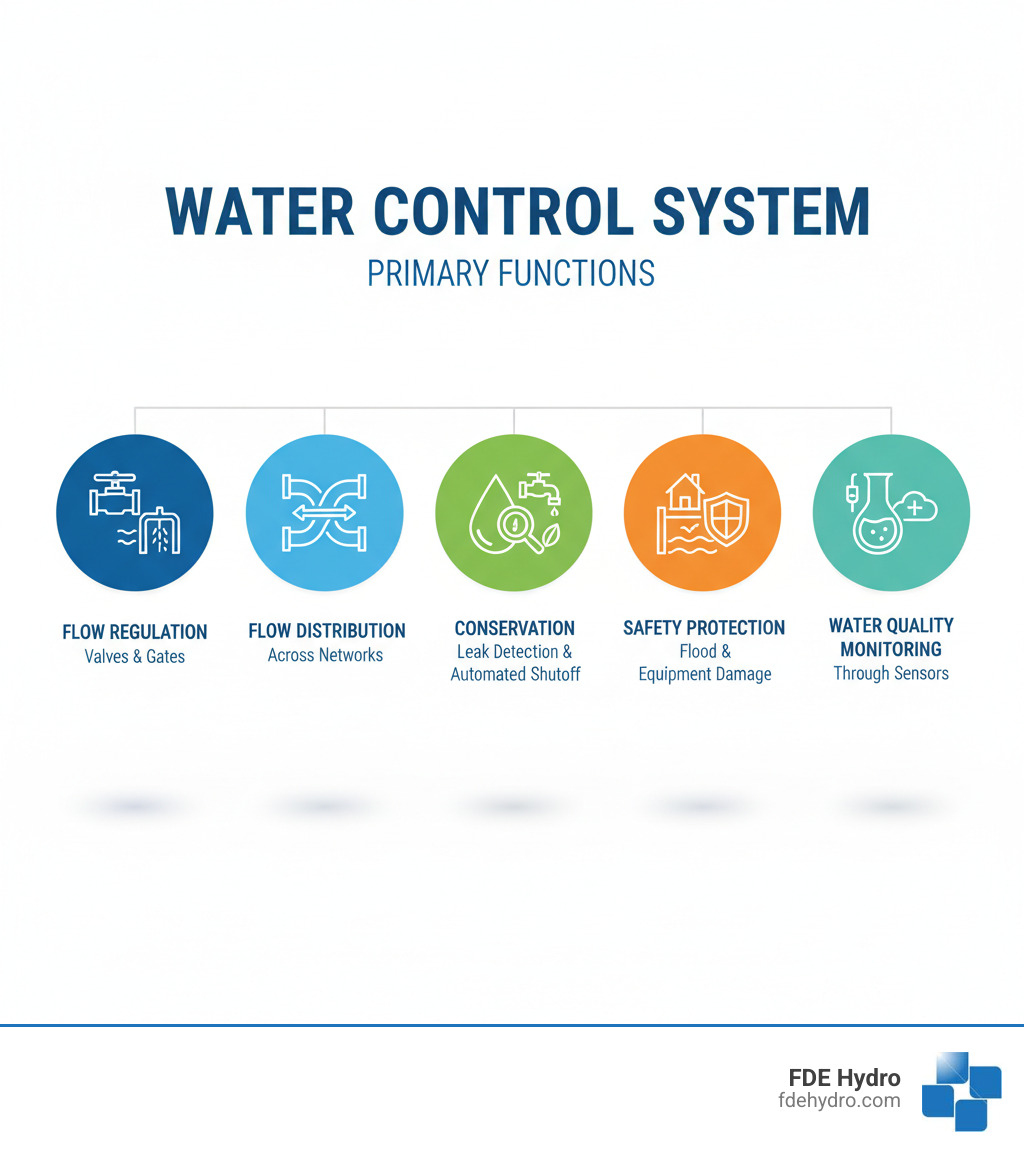
Key functions of water control systems include:
- Flow Regulation – Controlling water volume and pressure through pipes, canals, or reservoirs
- Distribution Management – Ensuring water reaches intended destinations efficiently
- Conservation – Reducing waste through leak detection, automated shutoff, and optimized usage
- Safety Protection – Preventing floods, equipment damage, and infrastructure failures
- Quality Monitoring – Tracking contamination, sediment, and chemical levels
The need for better water control is urgent. Water scarcity affects more than 40% of the world’s population—a figure expected to rise with climate change. Reflecting this, the global smart water management market is projected to reach $27.8 billion by 2030 as industries and municipalities invest in smarter systems.
These systems deliver significant savings: municipal water loss can be cut by up to 20%, agricultural water use by 15-30%, and industrial energy costs by 10-25%. For homeowners, automated shutoff systems can prevent an average of $10,000-$15,000 in leak-related damages.
I’m Bill French Sr., Founder and CEO of FDE Hydro™, where we develop modular civil construction solutions for the hydropower industry. With over five decades in heavy civil construction, I’ve learned that efficient water management is the backbone of resilient infrastructure. At FDE Hydro, we focus on innovative water control systems that benefit both present and future environments.
What Are the Core Functions of a Water Control System?
A water control system’s core mission is to ensure water goes where it needs to, when it needs to, and in the right amount. Its primary functions work in harmony to achieve this.
Water regulation and distribution are the most fundamental jobs. This means controlling the volume and pressure of water flowing through pipes, canals, or reservoirs to meet demand precisely. Whether keeping pressure steady in a home or managing levels at Dams for hydropower, this control is essential for efficiency and reliability.
Conservation has become critical as water scarcity and climate change intensify. Modern water control systems tackle this through smart leak detection, automated shutoffs, and optimized scheduling. These technologies are vital for creating Sustainable Water Infrastructure and have a massive impact in agriculture, which accounts for 70% of global freshwater use.
Safety and protection are equally important. By monitoring water levels and controlling releases through gates and Spillways, these systems protect communities from floods. They also perform water quality management by using sensors to track contaminants and sediment. At the same time, they provide equipment protection by preventing pumps from running dry or safeguarding turbines from debris, extending the life of infrastructure investments. As scientific research on water resources and climate change highlights, such integrated management is essential for climate adaptation.
Anatomy of a Modern Water Control System
A modern water control system integrates hardware and software to manage water with precision.
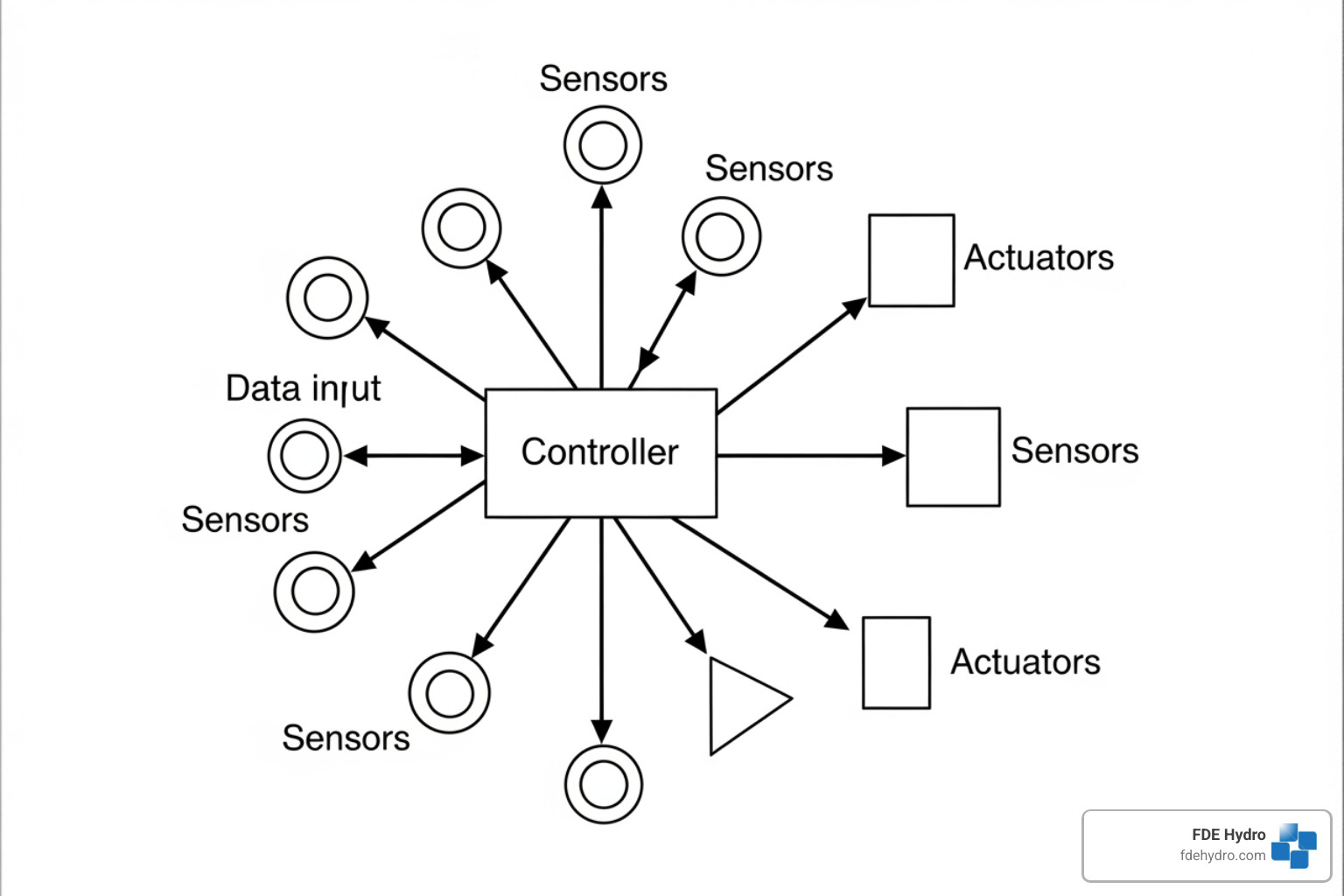
This section explains the key components of a modern water control system, showing how they work together to achieve optimal water management.
Key Hardware Components
Hardware components are the physical parts of the system that perform sensing and control actions.
- Sensors gather critical data. Flow sensors measure water speed, while pressure sensors monitor pressure and can even detect minute leaks. Level sensors, such as reliable pressure transducers or simpler float switches, track water levels in tanks and reservoirs. Quality sensors monitor pH, turbidity, and chemical composition.
- Actuators perform the physical work. Valves control flow and pressure, ranging from manual to sophisticated automatic control valves. Pumps move water where it needs to go. Control gates are massive structures that manage large water flows at Water Control Structures and hydroelectric facilities.
- Controllers are the system’s brain. Programmable Logic Controllers (PLCs) handle complex industrial automation, while smaller Microcontrollers (like the ESP32) are ideal for IoT applications. Remote Terminal Units (RTUs) enable remote monitoring and control.
- Communication Networks like radio, cellular, or wired connections link these components, enabling real-time management.
Software and Intelligent Control
Software transforms the hardware into a truly smart water control system.
Centralized control platforms (often SCADA systems) provide a complete, real-time overview of the entire water network. IoT dashboards make this data accessible from anywhere, allowing an operator to check a well’s water level or monitor industrial usage from a phone.
Data analytics and predictive modeling analyze historical data to spot trends, predict equipment failures, and optimize operations. For example, comparing rainfall data with well recovery rates provides powerful information for planning.
This intelligence is improved by integration with industrial automation, creating an interconnected framework that improves overall efficiency. At FDE Hydro, we advance these capabilities through AI-Driven Development, using artificial intelligence to make systems smarter. The Design and Implementation of an Automated Water Monitoring and Control System shows how microcontrollers can create autonomous systems that ensure reliable supply without constant human intervention.
Applications Across Sectors: From Homes to Hydropower
The versatility of a water control system allows it to be adapted for vastly different applications, from a single home to a massive hydroelectric facility. While the principles of monitoring and managing water remain the same, the scale and goals vary by sector.
| Sector |
Primary Goals |
Common Technologies |
Scale |
| Residential |
Leak prevention, water conservation, comfort |
Smart shut-off valves, leak detectors, smart irrigation, water softeners |
Single home to apartment complex |
| Agricultural |
Efficient irrigation, crop yield optimization |
Smart irrigation controllers, soil moisture sensors, automated canal gates, flow meters |
Small farm to large-scale irrigation district |
| Industrial |
Process efficiency, equipment protection, compliance |
Water level controls (cooling towers), flow control systems, wastewater treatment controls |
Single plant to multi-site operations |
| Municipal |
Distribution, quality, flood control, resource management |
SCADA systems, smart meters, pressure regulation, dam controls, flood sensors |
City-wide to regional water authority |
Residential and Commercial Systems
In homes and commercial buildings, water control systems work quietly to protect property and conserve resources. Leak detection with automated shutoff valves is a key feature, immediately closing the main water supply when a burst pipe is detected to prevent catastrophic water damage. In colder climates like Canada and the northern U.S., some systems also monitor temperature to prevent pipes from freezing and bursting.
Smart irrigation timers adjust watering schedules based on local weather data, conserving water while keeping landscapes healthy. In commercial buildings, sub-metering tracks usage by tenant to promote accountability, while water softeners and filtration systems improve water quality.
Agricultural Water Control
With agriculture being the largest consumer of freshwater, efficient water control systems are essential for global food security. Precision irrigation uses data from soil moisture sensors to deliver water directly to crop root zones, minimizing waste and maximizing yields. This technology is a genuine win-win for farmers and the environment.
Canal automation scales up this efficiency. Instead of manual gate adjustments, automated systems coordinate gates along entire canal networks to ensure consistent flow and eliminate spillage, making open canals nearly as precise as pressurized pipes at a fraction of the cost. For more insights, explore our page on irrigation control systems.
Industrial and Municipal Infrastructure
At the industrial and municipal scale, water control systems are feats of engineering managing enormous volumes of water. In process water management, they maintain exact water levels and flow rates critical for cooling towers, refineries, and manufacturing. Optimized controls can significantly reduce energy consumption from pumping.
Wastewater treatment plants rely on these systems to regulate chemical dosing and biological processes to meet strict environmental regulations. Municipal distribution networks use advanced SCADA systems to monitor thousands of miles of pipes, manage pressure, detect leaks, and ensure reliable service to millions of customers.
Flood control infrastructure, including dams and Spillways, protects communities by managing extreme water flows. At FDE Hydro, we contribute our expertise to these critical Water Control Structures, as detailed in our Hydroelectric Dam Components Ultimate Guide.
The Advantages of Automation and Smart Technology
The shift toward automated water control systems is a practical pathway to efficiency, sustainability, and significant cost savings.

This section details the benefits of implementing an automated water control system.
Cost Savings and Efficiency
The financial case for automated water control systems is compelling. They lead to significant cost savings through reduced water loss, as every gallon saved is money that doesn’t need to be spent on sourcing, treating, and pumping. This leads directly to lower energy consumption, as pumps run only when needed and at optimal speeds.
Automation also minimizes labor costs by freeing personnel from manual monitoring and adjustments to focus on more complex tasks. Perhaps most importantly, these systems help prevent costly equipment failures. By continuously monitoring equipment health and detecting anomalies early, they can shut down machinery before catastrophic damage occurs, saving far more than the initial investment. Our work at FDE Hydro demonstrates this principle, using efficient methods like those in Why Precast Cost Less to build more resilient and cost-effective infrastructure.
Improved Conservation and Compliance
Beyond financial gains, automated systems are powerful tools for environmental stewardship. They make meeting regulatory standards in regions like the United States and Europe almost effortless by providing precise, consistent control and detailed records for reporting.
By reducing water waste and energy use, these systems directly contribute to achieving sustainability goals. This aligns with our mission at FDE Hydro to develop sustainable solutions like hydropower, which offers many environmental advantages as detailed in the Benefits of Hydropower Plant. The accurate usage data they provide transforms water management from guesswork into a science, enabling informed planning and demonstrating a commitment to reducing environmental impact.
Challenges, Maintenance, and Future Innovations
While modern water control systems offer incredible benefits, they require thoughtful planning, ongoing maintenance, and adaptation to new challenges.
The initial investment costs can be substantial, particularly for large-scale projects. However, the long-term savings from reduced water loss, lower energy bills, and prevented failures often provide a clear return on investment. Another growing concern is cybersecurity vulnerabilities. As critical infrastructure becomes connected, robust security protocols are essential to protect communities from service disruptions or safety hazards. Finally, system integration complexity requires expert implementation, especially when upgrading Aging Infrastructure Being Replaced with Next Generation Civil Solutions with a mix of old and new components.
Installation and Maintenance Considerations
Proper installation and maintenance are key to a system’s longevity and performance. This begins with a thorough site assessment to understand existing infrastructure and environmental challenges. Component selection is also critical; sensors and actuators must be rated for the specific operating environment to ensure reliability.
Ongoing tasks include periodic sensor calibration to maintain accuracy and managed software updates to patch vulnerabilities and add features. Despite automation, regular physical inspections by trained personnel remain irreplaceable for spotting leaks, corrosion, or physical damage. For major infrastructure, specialized approaches like Dam Rehabilitation Encapsulation offer innovative solutions for extending service life.
The Future of Water Control Technology
The future of water control system technology is being shaped by powerful innovations.
Digital twins, virtual replicas of physical water systems, allow engineers to simulate scenarios and optimize strategies without real-world risk. AI for predictive maintenance is evolving to analyze complex data patterns and anticipate equipment failures weeks in advance, minimizing downtime. At FDE Hydro, our work with AI-Driven Development explores how these technologies can optimize both construction and operations.
Advanced non-invasive sensors promise easier and more reliable monitoring without direct water contact, reducing installation costs. Decentralized control systems are also emerging, creating more resilient networks where segments can operate autonomously. At FDE Hydro, we focus on Using Technology to Minimize the Duration of Impacts to build smarter systems faster, more affordably, and with less environmental impact.
Conclusion
We’ve seen how water control systems are essential for regulating flow, distributing water, conserving resources, and ensuring safety. From the hardware of sensors and actuators to the intelligence of modern software, these systems are versatile tools with applications in our homes, on our farms, and across our cities.
The benefits are compelling. Intelligent automation leads to significant savings in water and energy, reduces operational costs, and prevents costly disasters. More importantly, this technology represents a collective commitment to managing water more responsibly. With a large portion of the world’s population facing water scarcity, we cannot afford to waste this vital resource.
At FDE Hydro, this mission is personal. Our innovative, patented modular precast concrete technology—the “French Dam”—is designed to make building and retrofitting hydroelectric dams and water control infrastructure faster, more cost-effective, and more sustainable across North America, Brazil, and Europe.
The future is bright, with innovations like digital twins, AI-driven predictive maintenance, and advanced sensors set to make our water systems even smarter and more resilient. We are embracing these technologies to deliver reliable, efficient, and sustainable water management.
Whether you’re managing a farm, an industrial facility, or municipal infrastructure, understanding water control systems is crucial. To learn more about how advanced water control contributes to renewable energy and sustainable infrastructure, explore our resources on Hydropower and our comprehensive guide to Water Control Systems.
by Bill French Sr. | Dec 12, 2025 | Hydro Facility Articles
Why Water Control Structures Matter for Modern Infrastructure
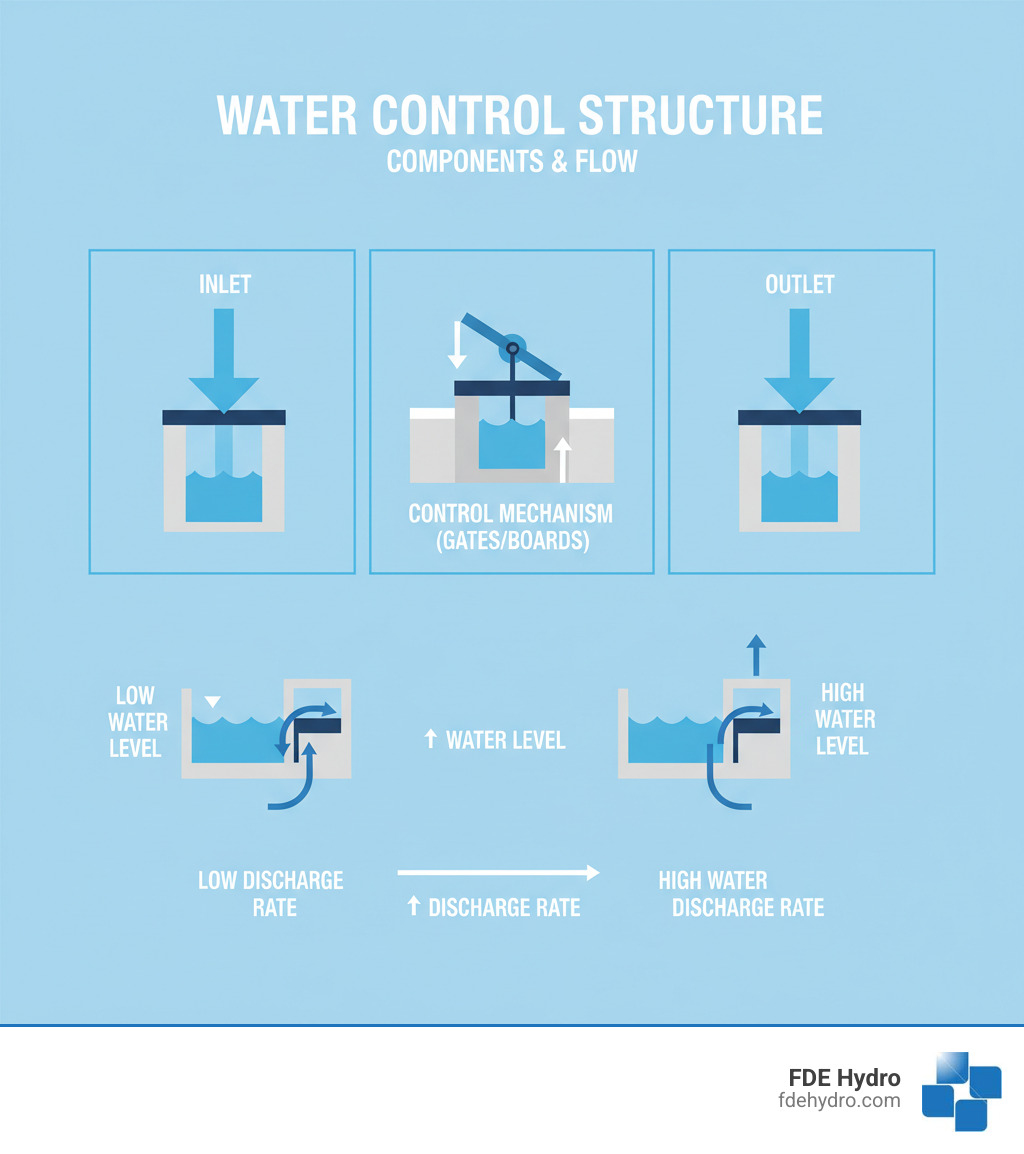
Water control structures are permanent installations that control the stage, discharge, and direction of water flow in channels, pipes, and waterways. These hydraulic devices serve critical functions, including:
- Flow Management – Controlling the rate and direction of water movement.
- Water Level Control – Maintaining desired water levels in reservoirs and drainage systems.
- Quality Improvement – Reducing sediment and nutrient discharge.
- Habitat Creation – Supporting fish and wildlife through managed water conditions.
- Flood Risk Reduction – Impounding and releasing water to protect downstream areas.
- Agricultural Support – Managing drainage and irrigation for crop production.
These structures range from simple flashboard risers to complex automated gates, with costs varying from hundreds to many thousands of dollars for engineered systems.
The terminology has evolved from “flood control” to “flood risk management,” reflecting that structures reduce, not eliminate, water-related risks. This shift mirrors a broader understanding of working with natural systems instead of dominating them.
Modern water infrastructure faces mounting challenges from high costs, long timelines, and climate change, which requires adaptable structures. The need for innovation has never been greater.
I’m Bill French Sr., Founder and CEO of FDE Hydro. With over five decades in heavy civil construction, I’ve focused on developing modular water control structures for the hydropower industry that reduce construction time and costs while improving environmental outcomes.
The Core Functions of Water Control Structures
Water control structures are the workhorses of modern water management, performing essential tasks that touch nearly every aspect of our lives. From our food to the health of our rivers, these structures do the heavy lifting. Let’s explore how they make a difference across three critical areas.
Managing Water for Agriculture and Conservation
When you think about farming, you might picture tractors and combines, but beneath many productive fields lies an intricate network of drainage systems—and water control structures are the valves that make them work intelligently.
These structures excel in flatter landscapes where land slopes are less than 0.5 percent. Installed in farm canals, ditches, or subsurface drain tiles, they offer a dual benefit: helping crops thrive while protecting downstream water quality.
By raising the water table in fields with subsurface drainage, these structures slow drainage outflow and create conditions for denitrification—a natural process where bacteria convert harmful nitrates into harmless nitrogen gas. The result is cleaner water flowing into streams and rivers.
The precision is remarkable. For corn, farmers might maintain water levels 12 to 18 inches below ground in spring and fall, dropping them during peak growth. When managed correctly along at least 50 percent of a ditch, keeping water within 30 inches of the surface can drastically cut nitrate losses and often leads to improved crop yields.
In conservation areas like riparian buffers, water control structures help restore natural water flow patterns. Raising the water table in these vegetated zones boosts their ability to filter pollutants. The Conservation Practice Standard Structure for Water Control (Code 587) provides detailed guidance on implementing these systems for maximum environmental benefit.
Controlling Stormwater and Preventing Floods
The shift from “flood control” to “flood risk management” reflects that we can reduce flood risks, but not eliminate them. Water control structures are central to this reduction strategy.
A reservoir behind a dam captures storm runoff, which is then released gradually via water control systems at rates the downstream channel can handle. This process smooths a dangerous flow spike into a manageable stream.
The U.S. Army Corps of Engineers manages this balance across watersheds using reservoirs, levees, and diversions. Their Management of Water Control Systems manual details how they coordinate objectives like flood reduction, water supply, and environmental protection.
A properly designed structure must discharge the design flow rate with no more than a 0.5-foot head (the water level difference across the structure). In spillways, features like concrete piers slow water to prevent erosion.
In urban areas, smaller water control structures manage runoff from pavement, reducing downstream surges and sediment loads that would otherwise harm aquatic life.
Creating and Protecting Natural Habitats
Water control structures are powerful tools for environmental restoration and habitat preservation. With thoughtful design, these structures can revive degraded ecosystems.
Wetland restoration is a perfect example. By managing water levels to create saturated conditions, we can rebuild wetlands that mimic natural patterns, creating havens for wildlife while filtering pollutants.
Water temperature regulation through cold water release structures is vital for downstream fisheries. By drawing water from various reservoir depths, we can influence release temperatures to support species like trout and salmon.
Timing also matters. Managing water levels for spawning might mean maintaining stable reservoir levels during critical breeding periods or using timed drawdowns to improve feeding opportunities for juvenile fish.
We ensure aquatic animal and recreational passage around our structures with fish ladders and other facilities. These allow migrating species to move freely, changing potential barriers into supportive structures.
The goal is always balance—meeting human needs while protecting the natural systems that sustain us.
An In-Depth Look at Common Types of Water Control Structures
Water control structures come in many shapes and sizes, each designed for specific functions and environments. Think of them as tools in a toolbox—you wouldn’t use a hammer to turn a screw, and you wouldn’t use a gate where a simple weir would do the job better.
The key distinction is between passive structures, which work without any intervention once installed, and active structures, which require manual or automated adjustments to function properly. Understanding these differences helps you choose the right solution for your specific water management challenge.
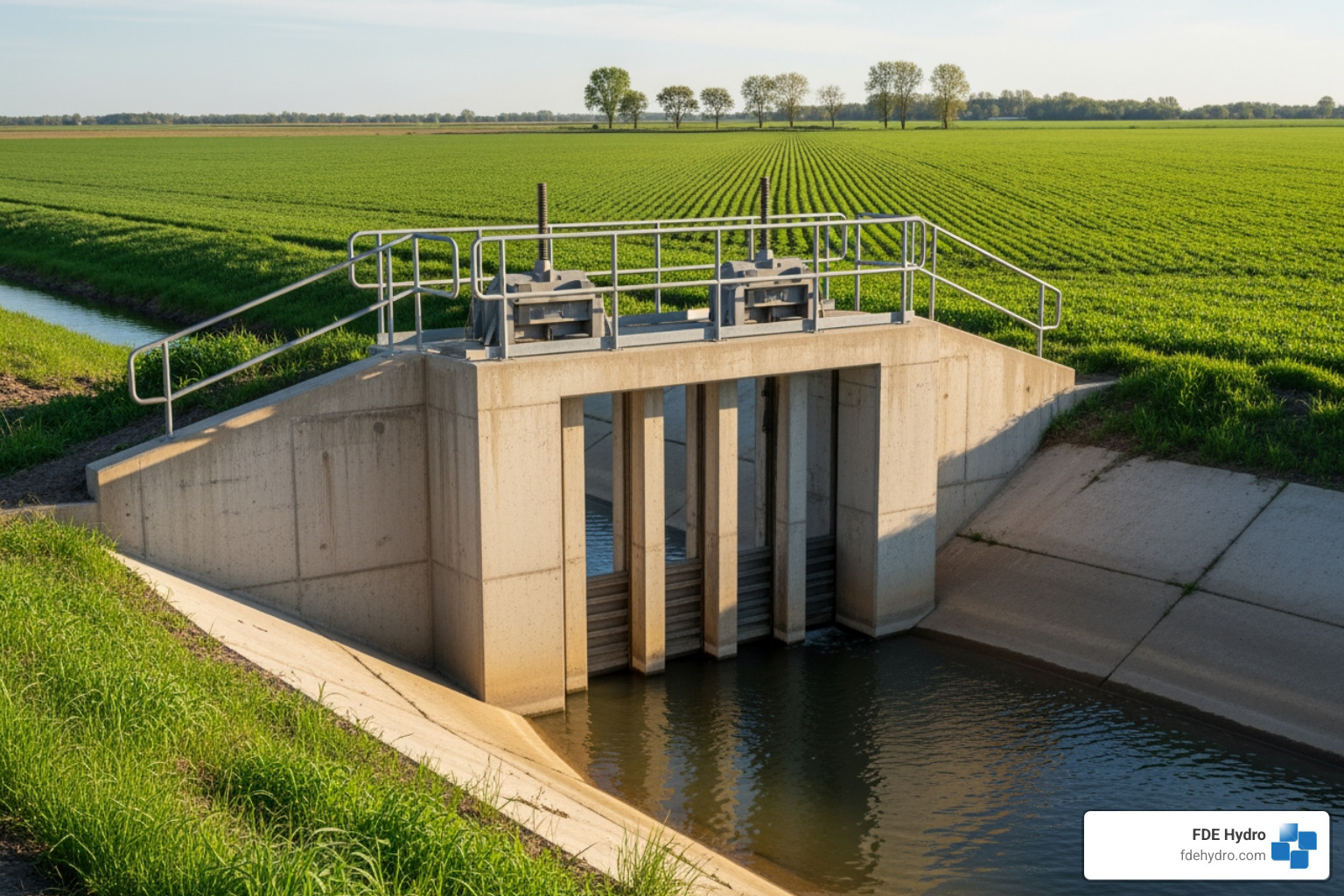
Here’s a comparison of some common types:
| Feature |
Flashboard Risers |
Gates & Valves |
Weirs |
| Control Type |
Manual, passive |
Active, manual/automated |
Passive, fixed |
| Adjustability |
Step-wise (board removal) |
Continuous |
Limited (fixed crest) |
| Primary Use |
Water level management, drainage |
Flow regulation, shut-off |
Flow measurement, level control |
| Flow Impact |
Gravity flow, adjustable |
Regulated flow, on/off |
Fixed overflow, flow measurement |
| Complexity |
Low-moderate |
Moderate-high |
Low-moderate |
Flashboard Risers and Inline Structures
Flashboard risers are workhorses in agricultural settings and pond management. The design is neatly simple: a vertical structure with grooves that hold removable boards called stoplogs. Need to drain a pond for maintenance? Remove some boards. Want to raise the water level for irrigation? Add them back. It’s like adjusting the height of a dam one board at a time.
Pond risers provide the vertical conduit through which water flows, and they’re typically designed for gravity flow systems—meaning water moves naturally downhill without pumps. This simplicity is both a strength and a limitation. While these systems are reliable and require no power, they’re not pressure-rated, and you should expect some seepage. That’s just physics at work.
Inline structures take this concept underground. These are installed directly within subsurface drainage conduits like drain tiles or tubes, managing water levels beneath your fields. Installation requires replacing at least 20 feet of perforated drain pipe with non-perforated pipe connected to the structure. For single drain lines, you’ll want the drain pipe upslope of the structure to exceed 500 feet for maximum effectiveness.
A smart cost-saving approach is installing water control structures on submains where multiple drain lines discharge. This reduces the number of structures needed while maintaining control over a larger area—assuming your topography cooperates. Our Water Control Infrastructure Guide 2025 dives deeper into these design strategies and helps you make the right choices for your specific site.
Gates, Valves, and Weirs
When you need more dynamic control over water flow, gates and valves step up to the plate. Sluice gates are commonly used for managing silt in ditches and canals—slide them open or closed to control flow. Screw gates offer even finer control, allowing you to dial in precise flow rates by turning a threaded mechanism. It’s the difference between a light switch and a dimmer.
Flap gates and tide gates serve specialized roles. Flap gates act as one-way valves, letting water flow out but preventing backflow. Tide gates are particularly valuable in coastal areas, where they prevent tidal surges or high water from pushing back into freshwater channels. Nobody wants saltwater contaminating their irrigation system.
Weirs represent the passive end of the spectrum. These structures force water to flow over a crest or through a notch, and they excel at flow measurement and maintaining specific upstream water levels. V-notch weirs are perfect for measuring low flows with precision, while outlet weirs and broader designs handle larger volumes. Concrete hump weirs create a smooth, predictable overflow pattern that’s ideal for certain applications.
The beauty of weirs is their simplicity—no moving parts, no maintenance headaches. Water hits the crest and flows over in a predictable pattern that engineers can measure and calculate with remarkable accuracy. These components often integrate into larger systems, including those covered in our Hydroelectric Dam Components Ultimate Guide.
Ancillary Components and Their Roles
The stars of water control might be gates, weirs, and risers, but the supporting cast deserves recognition too. These ancillary components keep everything running smoothly and extend the life of your infrastructure.
Trash racks and debris screens are your first line of defense against clogging. They catch leaves, branches, weed seeds, and other debris before it enters pipelines or jams control mechanisms. Think of them as the bouncer at the door—keeping the troublemakers out so the party inside can continue uninterrupted.
Bar guards take this protection a step further, blocking large debris from inlets while also deterring rodents from entering pipes. A beaver or muskrat can cause surprising damage to a water control system, and prevention is far cheaper than repair.
Speaking of beavers, beaver guards are specialized structures designed to prevent these industrious animals from building dams around or within your water control structures. Beavers are remarkable engineers in their own right, but their construction projects rarely align with your water management goals.
Stilling basins appear downstream of many structures, where they serve a critical but often overlooked function. Fast-moving water carries tremendous energy, and when it exits a pipe or flows over a weir, that energy needs somewhere to go. Stilling basins dissipate this energy gradually, preventing erosion and protecting channel beds and banks from damage.
Turnouts are simple but essential for irrigation systems. These structures divert water from main channels into smaller laterals or directly into fields. They’re the traffic directors of agricultural water management.
Finally, pump boxes protect pumps and associated equipment from weather and vandalism while allowing for controlled water transfer. They might not be glamorous, but they’re practical—and in water management, practical solutions often matter most.
Design, Materials, and Installation Best Practices
Getting a water control structure right from the start makes all the difference. At FDE Hydro, we’ve learned that proper design, smart material choices, and careful installation aren’t just nice-to-have—they’re the foundation of structures that actually work for decades.
The truth is, designing these systems isn’t always straightforward. Simple prefabricated structures for subsurface drainage might not need an engineer’s stamp, but anything more complex—especially structures going into ditches or channels—absolutely requires professional engineering oversight. We’ve seen too many well-intentioned projects fail because someone skipped this step.
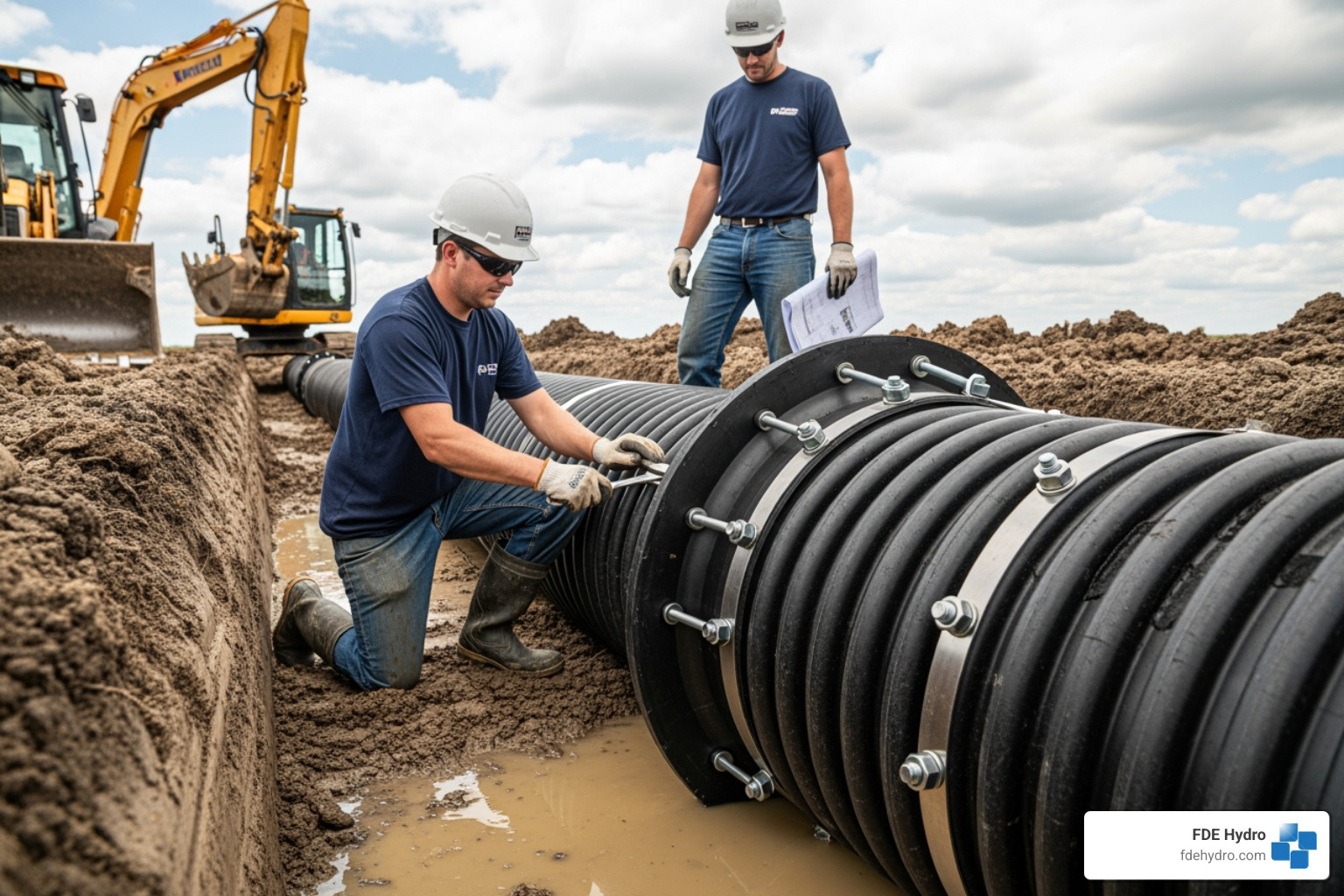
Here’s something critical to understand: the effectiveness of water control structures varies dramatically from site to site. What works beautifully in one location might struggle in another, even if the structures look identical on paper. That’s why we start every project with thorough engineering design, examining topography, soil conditions, and the specific hydrological outcomes you’re trying to achieve.
Before breaking ground, you’ll need permits. This isn’t red tape for its own sake—it’s about ensuring your structure meets federal, state, and local regulations that protect water quality and public safety. We always secure all required permits before construction begins. Our Hydroelectric Dam Design Complete Guide walks through many of these considerations in detail.
Common Materials and Their Impact
The materials you choose today will determine whether you’re maintaining your structure every few months or barely thinking about it for years. We’ve worked with every material imaginable, and here’s what actually performs in the field.
PVC has become our go-to for many applications, and for good reason. It resists corrosion, stays lightweight for easier installation, and holds up remarkably well in water. Our inline structures use rugged half-inch-thick PVC with anodized aluminum corner profiles and stainless steel screws. For larger structures, we increase the bottom sheet thickness to a full inch. One important note: skip plastic risers anywhere fire is a concern.
Steel brings best strength, especially for larger gates, risers, and structural supports. Corrugated steel pipes often get an asphalt coating for extra corrosion protection. We can adapt steel designs to fit directly onto various culvert pipes, which saves time and money during installation.
Concrete used to dominate the flashboard riser market, though the old designs were often expensive and labor-intensive to build. But concrete isn’t going anywhere—it remains essential for robust foundations, larger dams, and specific weir types like concrete hump weirs. The stability of a concrete control in a channel far exceeds what you’d get in sandy, flood-prone areas.
Geotextiles might not look impressive, but these specialized fabrics do heavy lifting in filtration, separation, reinforcement, and erosion control around structures. They’re often the unsung heroes that keep everything else working properly.
We design all our water control structures to last at least 20 years, balancing upfront investment with long-term performance and minimal maintenance headaches.
Key Design Considerations for Water Control Structures
Every successful water control structure starts with careful attention to several critical design elements. Miss any of these, and you’re setting yourself up for problems down the road.
Pipe sizing matters more than many people realize. We typically work with pipes from 4 inches to 12 inches in diameter, matching the required flow capacity of your drainage system. Go too small and you create bottlenecks; too large and you waste money on unnecessary capacity.
Structure height depends entirely on your water level control needs. When risers exceed six feet, we add a 3-inch by 3-inch channel for lateral support. Wider risers—from 48 inches up to 96 inches and beyond—get 3-inch wide H-beams for improved stability. These aren’t optional extras; they’re structural necessities.
Head limitations require careful calculation. The structure’s capacity must discharge the design flow rate with no more than a half-foot of head. Under cropped conditions, exceeding this 0.5-foot design head can harm your crops and reduce the structure’s effectiveness.
Anti-seep collars prevent one of the most common failure modes: pipe washout from seepage along the outside of the pipe. These rubber collars, typically 2 feet by 2 feet or 3 feet by 3 feet, work with any smooth-wall pipe or corrugated plastic tubing. Installation requires cutting a round hole about 33 percent smaller than the pipe diameter to ensure a tight seal. We always recommend using anti-seep collars with inline structures—they’re inexpensive insurance against expensive problems.
Structural reinforcement becomes critical as structures grow larger. H-beams and channels provide the lateral support and stability that keeps everything aligned and functional year after year. Cutting corners here is penny-wise and pound-foolish.
Safety measures aren’t afterthoughts—they’re designed in from the start. We incorporate features like safety railings and clear operational instructions to prevent serious injury or loss of life. Our approach aligns with proven Dam Construction Methods that prioritize both effectiveness and safety.
Installation and Maintenance Requirements
Even the best-designed water control structure will fail if installed poorly or maintained haphazardly. Here’s what actually works in the field.
Installation starts with stable base preparation. We excavate and grade the base, inlet, and outlet pipes, then create a solid, stable foundation on compacted soil or fill sand. Shortcuts here lead to settling and misalignment that only get worse over time.
Backfilling requires patience and care. We hand-tamp in 6-inch lifts around the structure, avoiding mechanical compaction or direct contact with heavy machinery that could crack or damage components. Yes, it takes longer. Yes, it’s worth it.
Pipe connections use flexible couplers secured with stainless steel clamps, creating watertight yet flexible joints that accommodate minor ground movement. The structure must be leveled vertically before backfilling—trying to adjust it afterward rarely works well.
Once installed, regular maintenance keeps everything running smoothly. Debris removal tops the list—trash, leaves, branches, and algae can dramatically alter how your control manages water. We recommend checking pipe inlets and trash racks regularly and clearing them promptly.
For structures with movable components like stoplogs, seal lubrication with a product like Lubriplate Grease ensures smooth operation and minimizes seepage. This simple step takes minutes but prevents hours of frustration later.
Vegetative protection around structures prevents erosion and stabilizes soil. Seed or sod all disturbed earth surfaces with appropriate vegetation. Where permanent vegetation struggles, mulches or gravels provide reliable protection. Don’t let bare areas persist—they’re erosion waiting to happen.
Routine inspections should happen at least twice yearly, with additional checks after major storms. Look at structures, embankments, spillways, and appurtenances for damage or blockages. Catching small problems early prevents big failures later.
Finally, create a detailed operation and maintenance plan and review it with your land manager. This plan should cover maximum, minimum, and normal water control elevations, inspection schedules, clean-out procedures, and vegetated border use. Keep operational records of structure adjustments—they’re invaluable for troubleshooting and optimization.
Neglecting maintenance doesn’t just reduce efficiency—it increases costs and risks structural failure. Our expertise in Dam Rehabilitation Encapsulation reinforces our commitment to keeping water infrastructure healthy for the long haul.
The Future of Water Management
The landscape of water management is continuously evolving, driven by the increasing demands of a growing population and the unpredictable impacts of climate change. The design and technology of water control structures are adapting to meet these challenges, moving towards more resilient, efficient, and sustainable solutions.
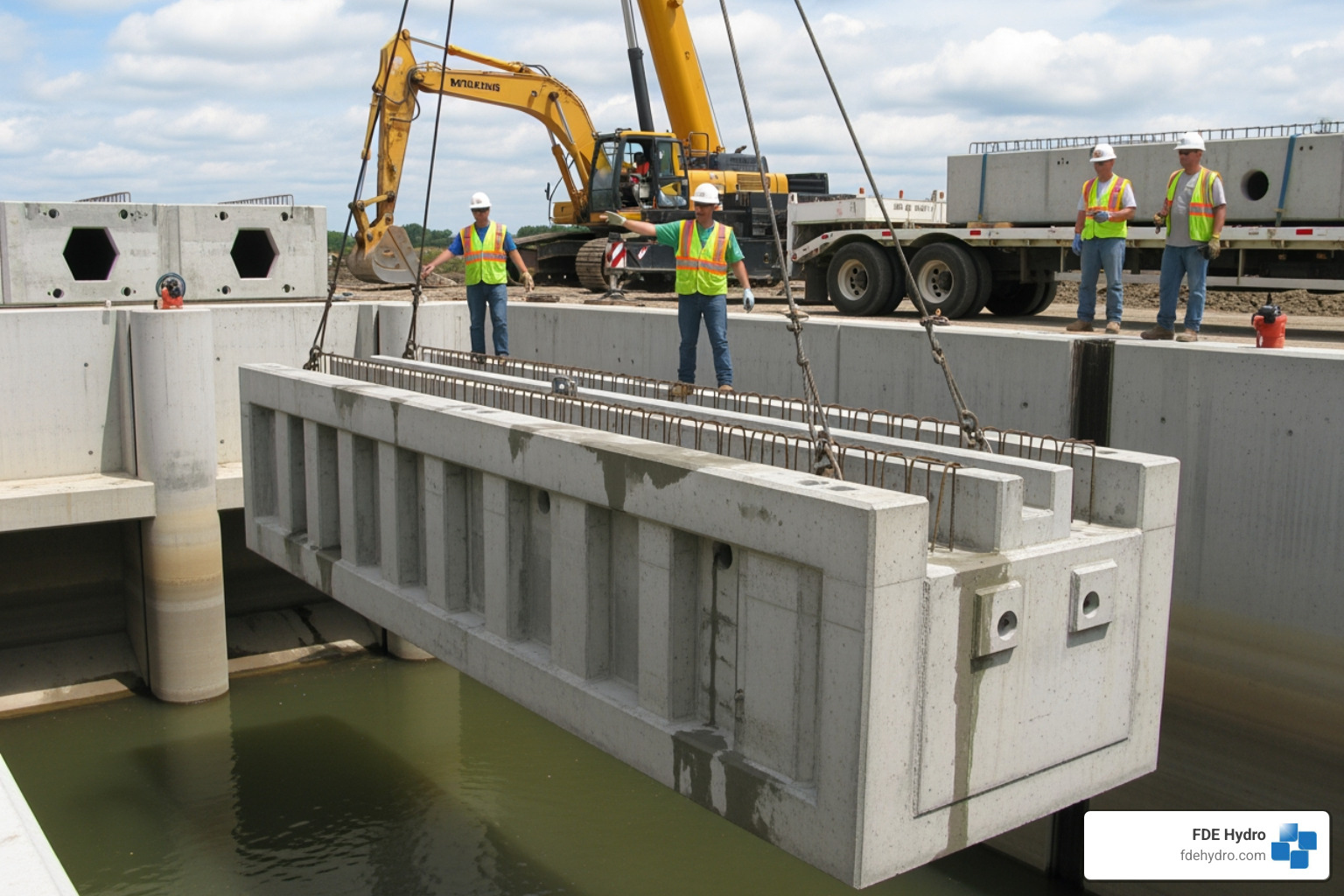
Looking back, the shift from labor-intensive concrete flashboard risers to prefabricated steel inlet boxes happened because we needed something more practical and affordable. Today, we’re seeing another change—one focused on adaptability and intelligent monitoring. We’re building climate change preparedness and resilience planning into everything we do, recognizing that our structures need to handle much greater variability in water levels and flow patterns.
The rise of smart water systems and remote monitoring is revolutionizing how we manage water resources. These systems use sensors and data analytics to deliver real-time information about water levels, flow rates, and quality. This means we can respond faster and optimize control like never before. The U.S. Army Corps of Engineers, for instance, uses Water Management Enterprise Systems to integrate data and improve operational decisions across their vast network. These technological advances are fundamental to building truly Sustainable Water Infrastructure.
The Future of Water Control Structures
At FDE Hydro, we’re not just watching this evolution—we’re driving it. Our patented modular precast concrete technology, known as “French Dam” technology, represents a fundamental shift in how we construct and retrofit water control structures and hydroelectric dams.
This modular approach delivers tangible benefits that matter. Reduced construction time comes from prefabricating components off-site, which can slash project schedules dramatically. Significant cost reduction follows naturally when you minimize on-site labor and equipment needs—we’re talking about substantial savings that make projects financially viable. Improved durability is built into every engineered precast concrete component, ensuring structures can withstand harsh environmental conditions for decades.
Manufacturing components in a controlled factory environment also means better quality control. You get more reliable structures because every piece is built to exact specifications, not cobbled together on a muddy construction site. And perhaps most importantly, the modular nature of our components provides real flexibility—you can design with greater freedom and expand or modify structures later without starting from scratch.
We’re already deploying this innovative technology across North America, including the United States and Canada, as well as in Brazil and Europe. It’s a scalable and sustainable approach that works in diverse environments. We believe that leveraging advanced manufacturing techniques like modular precast concrete isn’t just about building better structures—it’s about open uping what could be The Biggest Untapped Solution to Climate Change is in the Water.
The future of water management demands structures that are smarter, stronger, and faster to build. That’s exactly what we’re delivering.
Conclusion
Throughout this guide, we’ve explored how water control structures serve as the backbone of modern water management, quietly performing essential work that touches nearly every aspect of our lives. These permanent installations manage the stage, discharge, and direction of water flow, supporting everything from productive farmland to thriving ecosystems.
We’ve seen how these structures lift water tables to reduce nutrient runoff in agricultural settings, regulate stormwater flows to protect communities from flooding, and create the precise conditions needed for fish spawning and wetland restoration. The diversity of available solutions—from simple flashboard risers with removable stoplogs to sophisticated gate systems and precisely calibrated weirs—demonstrates the adaptability of these technologies to meet specific site needs.
The technical details matter deeply. Selecting appropriate materials like corrosion-resistant PVC, robust steel, and durable concrete directly impacts how long a structure will serve its purpose. Design considerations such as proper pipe sizing, anti-seep collar installation, and adequate head capacity determine whether a structure will function effectively or require costly repairs. And perhaps most importantly, the commitment to regular maintenance—clearing debris, lubricating seals, and conducting semiannual inspections—separates structures that last decades from those that fail prematurely.
The future of water management is arriving faster than many realize. Climate change demands structures that can handle more extreme variability in rainfall and drought. Growing populations need solutions that work harder while costing less. At FDE Hydro, our modular precast concrete technology addresses these challenges head-on, cutting construction timelines and costs while delivering improved durability and quality control. This approach isn’t just about building better infrastructure—it’s about creating resilient systems that can adapt to whatever challenges tomorrow brings.
Water management has always required us to balance competing needs: economic development against environmental protection, immediate costs versus long-term value, human needs alongside ecosystem health. The most successful water control structures are those designed with this balance in mind, serving multiple purposes while remaining flexible enough to adapt as conditions change.
We invite you to explore how innovative solutions can transform your water management challenges into opportunities. Learn more about advanced hydropower solutions and find how modern technology is reshaping what’s possible in water infrastructure.
by Bill French Sr. | Dec 4, 2025 | Hydro Facility Articles
Why Hydropower Maintenance Matters More Than Ever
Hydro power plant maintenance is the systematic inspection, servicing, and repair of a facility’s components to ensure continuous operation, maximize energy production, and extend asset lifespan to 100+ years. It involves preventive, predictive, and corrective strategies, along with periodic modernization.
With about 70% of all renewable electricity generated globally coming from hydropower, these facilities are critical infrastructure. Good maintenance ensures reliable access to clean energy for decades.
Hydropower facilities can last for more than 100 years when properly maintained. In contrast, neglected plants require constant, costly refurbishment. A total modernization is typically needed every 50 years—a significant investment that can require months of shutdown.
The stakes are high. A sub-optimally operated hydropower system suffers reduced energy production and income. These capital-intensive assets only produce significant returns when maintained to a high standard.
The challenge is growing as infrastructure ages. Over half of the world’s installed hydropower capacity was built before 1990, making these assets prone to failure without proper maintenance. This can lead to high costs and impact grid stability.
I’m Bill French Sr., Founder and CEO of FDE Hydro™, where we focus on delivering modular construction solutions that reduce long-term *hydro power plant maintenance burdens from the start.* My five decades of heavy civil construction experience have given me deep insight into how proper planning and innovative construction can dramatically improve facility longevity and operational efficiency.
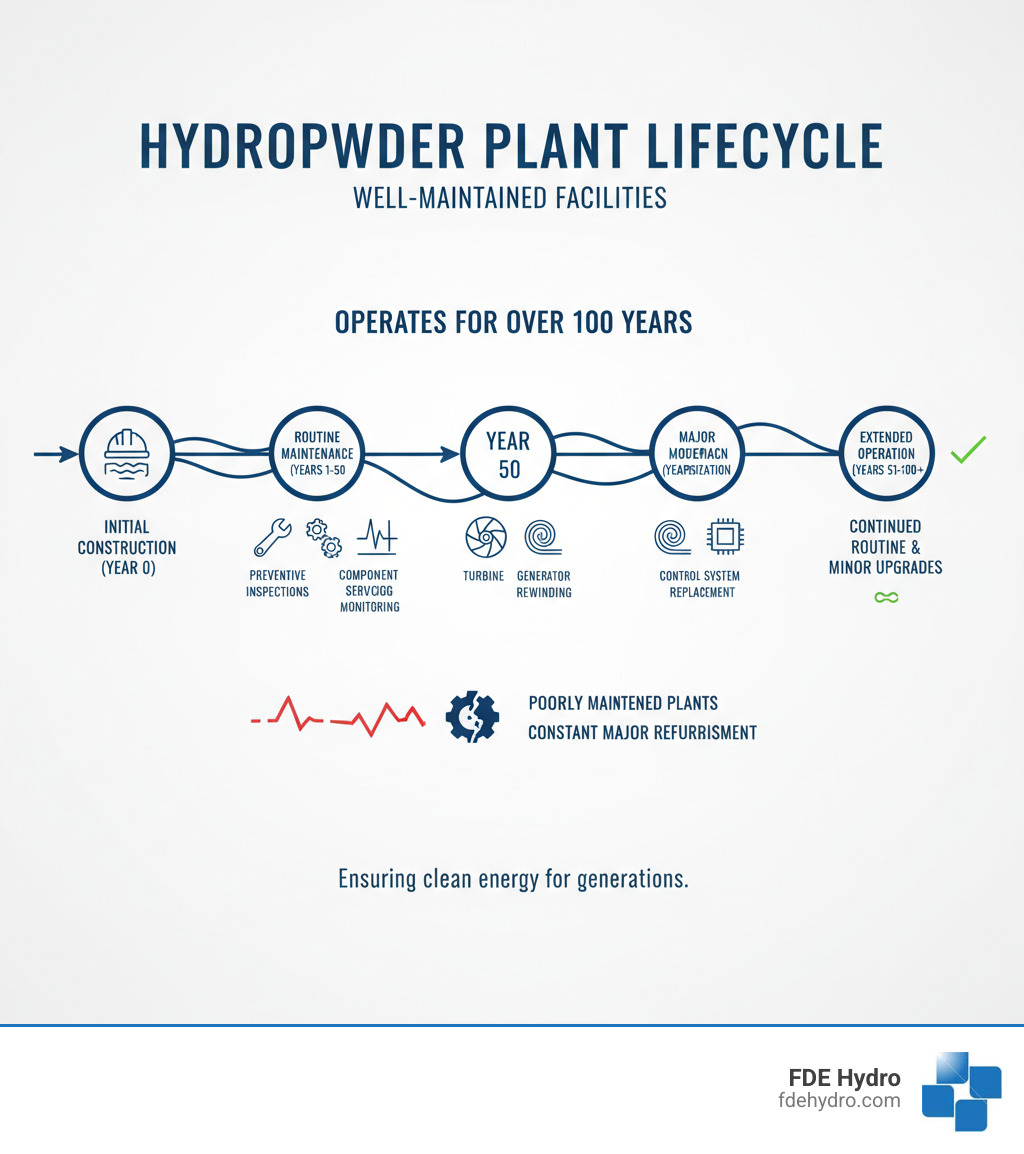
The Anatomy of a Hydropower Plant: Key Maintenance Areas
A hydropower plant is a complex system where every component matters. Understanding what needs attention is the first step to mastering hydro power plant maintenance.
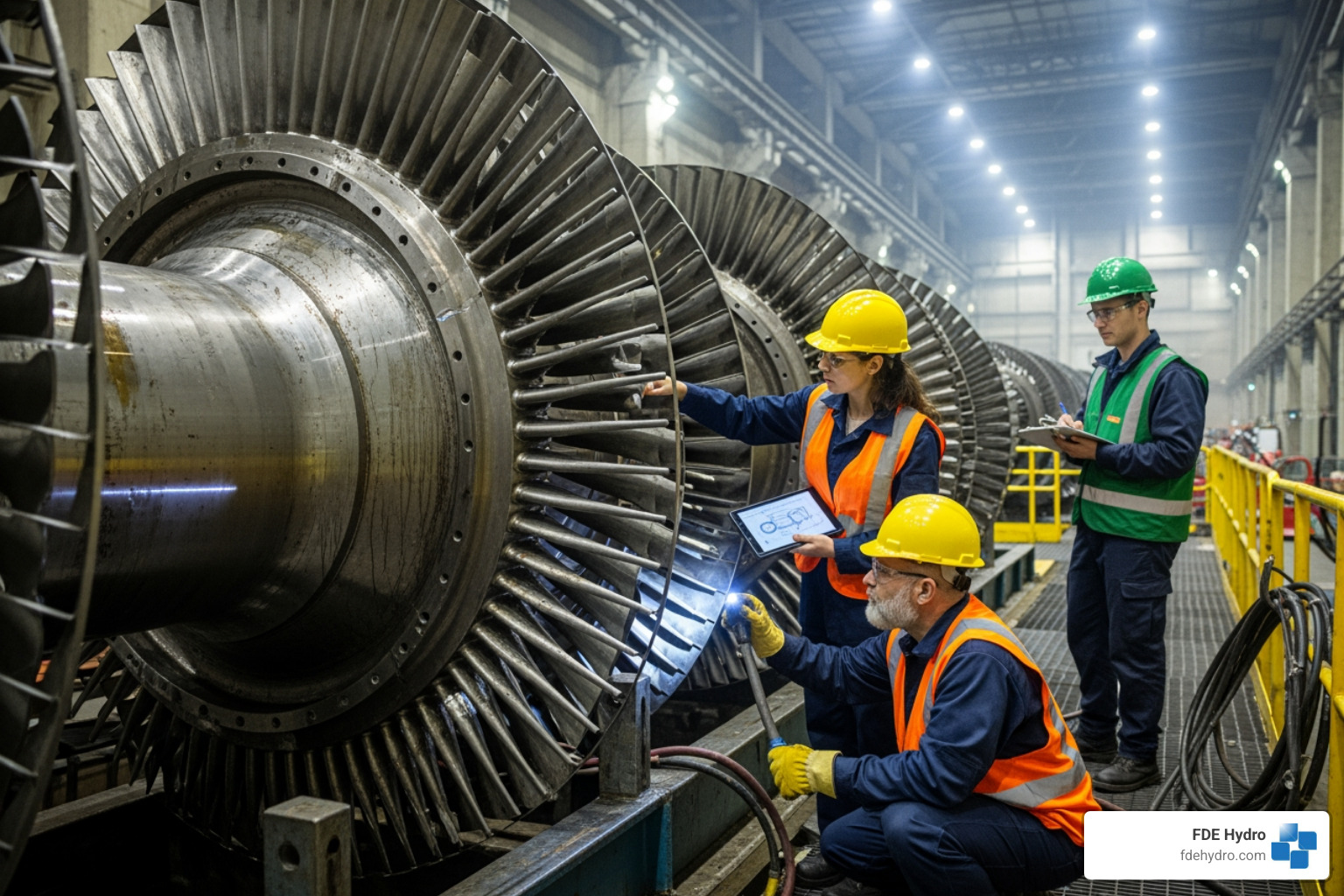
Civil Structures and Waterways
These foundational elements face relentless pressure from water and weather.
- Dam Integrity: Regular inspections are essential to catch cracks, erosion, or seepage, preventing catastrophic failures. Our Hydroelectric Dam Components: Ultimate Guide provides a comprehensive overview.
- Penstocks: These massive pipes require internal and external checks for corrosion and cavitation pitting, which can weaken the structure.
- Spillway Gates & Intake Screens: Gates must be tested to ensure they operate during high-flow events. Screens need regular cleaning to prevent debris from damaging downstream equipment.
- Debris Management & Corrosion Protection: Ongoing debris removal and corrosion protection (coatings, cathodic systems) are critical for longevity, as emphasized in industry guides like the Bureau of Reclamation’s FIST manuals.
Electromechanical Equipment
This is where water’s energy becomes electricity and where maintenance directly impacts revenue.
- Turbines & Generators: Turbines face immense force and require regular cavitation repair and balancing. Generators, which convert rotation into current, need specialized servicing like rewinding and re-insulation.
- Transformers & Switchgear: Transformers step up voltage for transmission and require oil analysis and cooling system checks. Switchgear, the plant’s electrical safety system, needs regular testing and calibration.
- Control Systems & Auxiliary Motors: The plant’s “brain”—PLCs and SCADA systems—needs software updates and calibration. Smaller auxiliary motors that power pumps and valves are also critical; their failure can shut down main units.
Supporting Systems
A network of support systems is essential for safe and efficient operation.
- Hydraulic, Cooling, and Lubrication Systems: Hydraulic units power gates and valves. Cooling systems dissipate heat from generators and transformers. Lubrication systems prevent friction and wear on all rotating machinery. All require regular fluid checks, filter changes, and inspections.
- Fire Protection & SCADA: Fire detection and suppression systems must be tested to protect against electrical and oil-related risks. SCADA systems enable remote monitoring and require network security and sensor calibration.
- Load-Handling Equipment: Overhead cranes are vital for major maintenance tasks. Their failure can cause significant delays, so rigorous inspection of their structural and mechanical components is crucial.
Strategic Approaches to Hydro Power Plant Maintenance
Effective hydro power plant maintenance uses a toolbox of strategies. The smartest operators know when to use each tool.
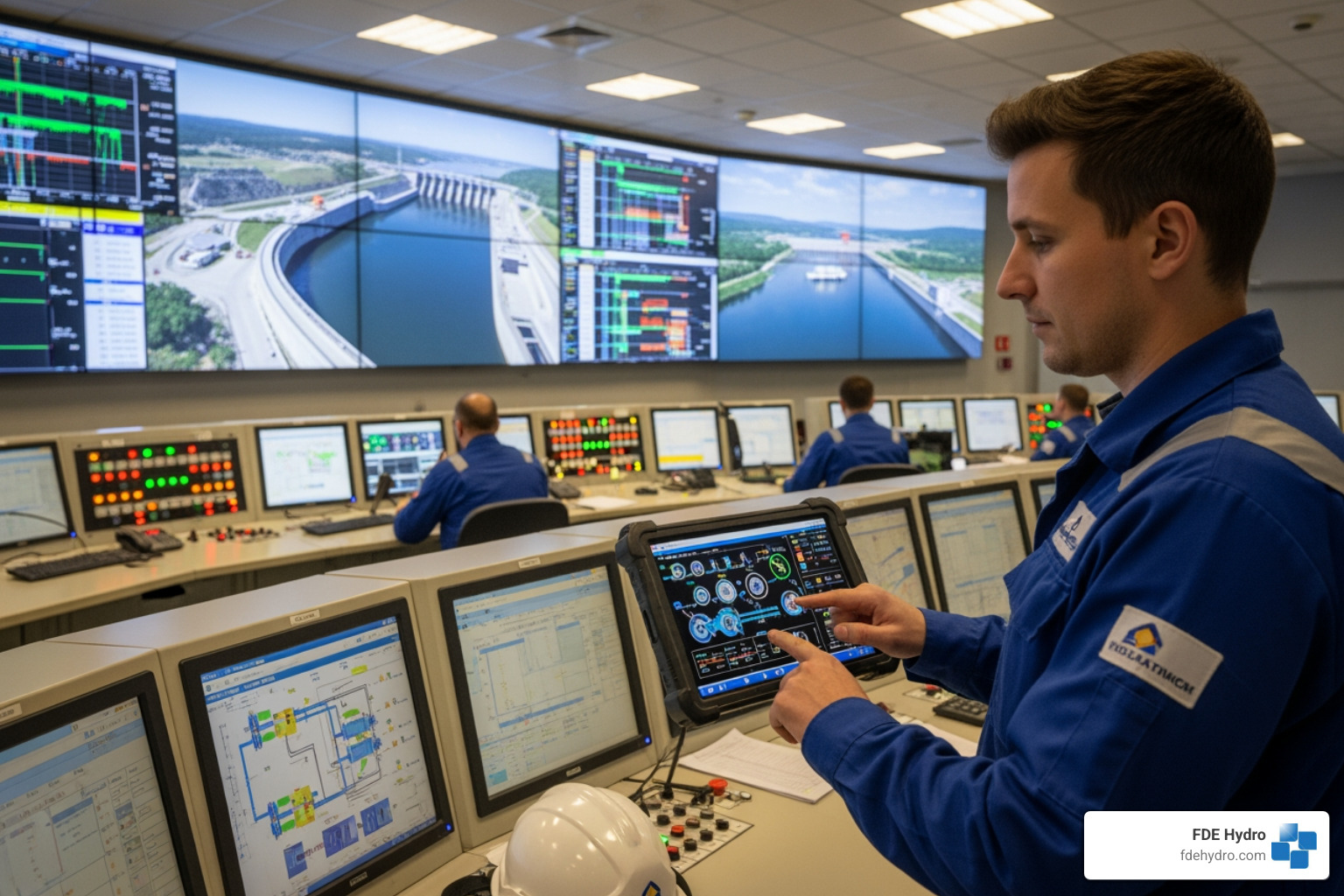
Preventive Maintenance
Preventive maintenance is the bedrock of a smooth-running plant. The philosophy is simple: perform scheduled inspections, routine lubrication, and component replacements based on lifespan to catch problems before they cause failures. Industry playbooks like the Bureau of Reclamation’s FIST manuals provide detailed frameworks for this methodical work.
A typical annual preventive checklist includes:
- Turbine, gearbox, and generator functional checks and lubrication
- Hydraulic system checks (fluid levels, filters, leaks)
- Sensor and controller calibration
- Inspection of intake areas and pipelines
- Electrical inspection and testing
- Testing hydraulic accumulators
- Cleaning automated intake screens
Predictive Maintenance (PdM)
Predictive maintenance uses technology to forecast failures. Instead of just following a schedule, operators listen to what the equipment is telling them through condition monitoring.
- Condition Monitoring: Technologies like vibration analysis, thermal imaging, and oil analysis assess equipment health in real-time.
- Early Issue Identification: Digital Asset Performance Management (APM) systems analyze this data to identify issues before they become emergencies. This allows repairs to be scheduled precisely when needed, avoiding both premature parts replacement and catastrophic failures. This proactive approach is central to the future of hydropower, ensuring greater reliability.
Corrective and Emergency Maintenance
Even with the best strategies, unexpected failures occur. Corrective maintenance is about responding quickly and effectively.
- Unplanned Outage Response: When a critical component fails, speed is essential. Rapid access to emergency response teams minimizes costly downtime.
- Failure Analysis: After a failure, a root cause investigation is crucial to understand why it broke and prevent a recurrence.
- Spare Parts Management: A well-managed inventory of genuine, high-quality spare parts is an insurance policy against extended downtime, ensuring replacements are on hand when needed.
The High Stakes of Maintenance: Benefits, Costs, and Challenges
Investing in robust hydro power plant maintenance is arguably the most important strategic decision for a facility, impacting profitability, safety, and long-term sustainability.
Key Benefits of a Robust Maintenance Program
Comprehensive maintenance secures the future of your operation with substantial, measurable advantages.
- Guaranteed Availability: Consistent maintenance reduces unexpected equipment failures, keeping plants online and generating power. This reliability is why hydropower is known as the guardian of the grid.
- Extended Lifespan: Well-maintained facilities can operate for over 100 years, a proven track record confirmed by the World Bank.
- Increased Energy Production: Efficiently running equipment converts more water energy into electricity, maintaining consistently high production levels.
- Improved Safety: A well-maintained plant is a safer workplace, reducing accident risks for personnel and the community.
- Predictable Costs: Proactive maintenance allows for planned, budgeted expenses rather than costly emergency repairs.
For more on hydropower’s reliability, explore the Benefits of Hydropower Plant.
Common Challenges and How to Address Them
Hydro power plant maintenance comes with real challenges.
- Aging Infrastructure: With over half the world’s hydro capacity built before 1990, older facilities require thoughtful, long-term modernization plans.
- Modernization & Shutdowns: Major overhauls, typically needed every 50 years, are complex and require four to six months of downtime. This lost revenue can be minimized by scheduling work during low-production periods.
- Remote Sites & Skilled Labor: Many plants are in remote locations, complicating logistics. Furthermore, securing skilled technicians with specialized knowledge is increasingly difficult, making partnerships with experienced service providers essential.
Understanding the Costs of Hydro Power Plant Maintenance
The true cost of maintenance includes direct expenses and the hidden costs of deferring it.
| Cost Category |
Routine O&M |
Major Overhaul |
Equipment Failure |
| Direct Expenses |
Regular inspections, parts replacement, lubrication, minor repairs—budgeted and predictable |
Planned equipment upgrades, turbine refurbishment, generator rewinding—scheduled during low-revenue periods |
Emergency repairs, expedited shipping, overtime labor—unpredictable and premium-priced |
| Lost Revenue |
Minimal—brief scheduled outages during low-demand periods |
Moderate—4-6 months shutdown, but planned to minimize impact |
Severe—unexpected outage duration unknown, occurring at worst possible times |
| Long-term Impact |
Extends asset life to 100+ years, maintains peak efficiency |
Modernizes facility for another 50 years of operation, may increase capacity 1-2% |
Cascading failures, shortened equipment lifespan, reputation damage with grid operators |
| Typical Cost Range |
2-3% of annual revenue (industry standard) |
$50-500 million depending on facility size |
3-10x higher than planned maintenance, plus opportunity costs |
The numbers are clear: routine maintenance is a predictable expense, while emergency repairs can cost up to ten times more, not including lost revenue. The long-term ROI overwhelmingly favors proactive maintenance. At FDE Hydro, our modular precast technology builds durability into the structure from day one, reducing future maintenance burdens and supporting the century-plus lifespan that makes hydropower so valuable.
The Digital Frontier: Enhancing Maintenance with Technology
The world of hydro power plant maintenance is shifting from a reactive approach to intelligent, data-driven management that anticipates problems before they happen.
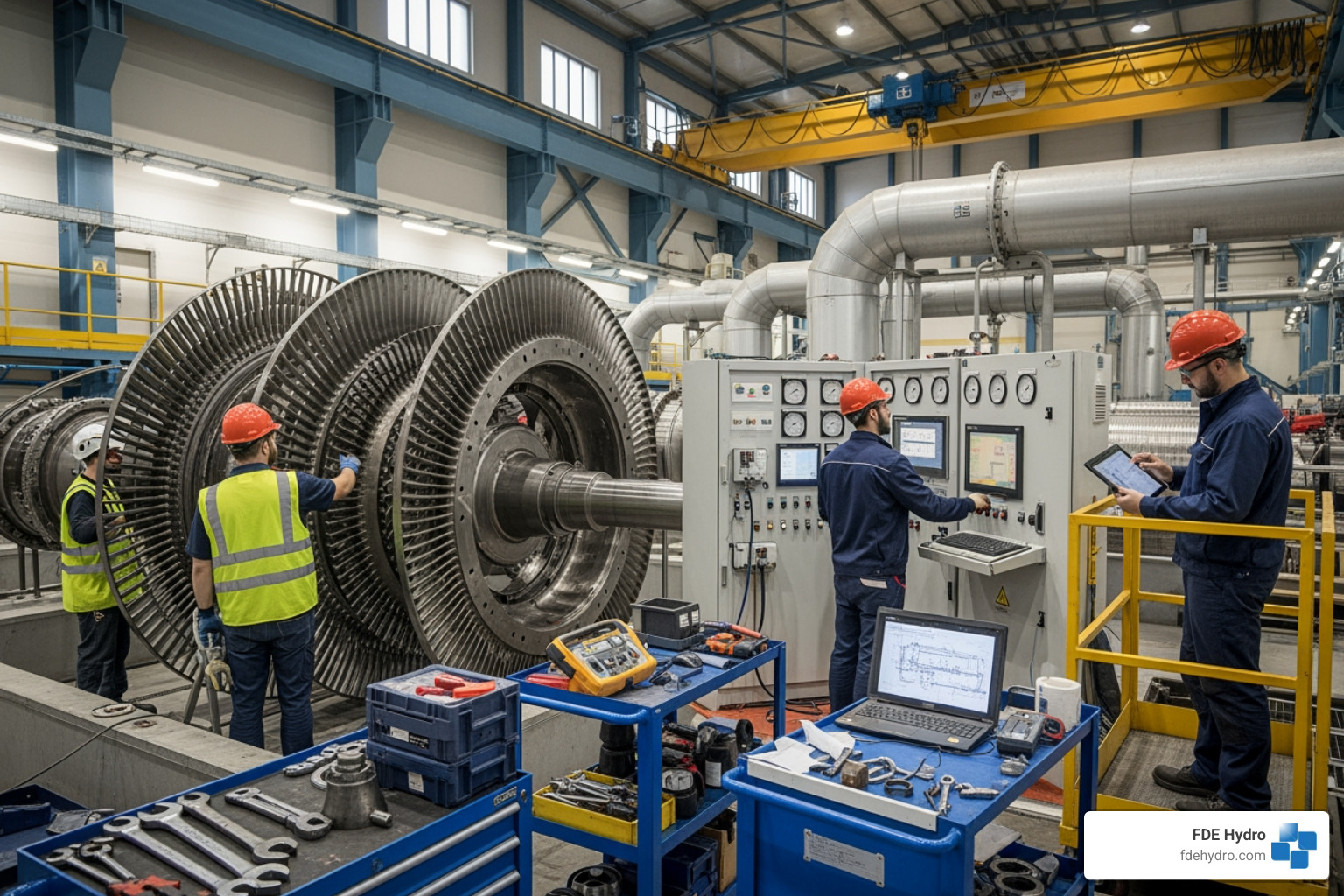
APM solutions act as the nervous system of a hydropower plant, integrating digital monitoring with advanced analytics for a real-time view of every critical component. Sensors continuously collect data, which is then processed by APM platforms to identify patterns and anomalies.
The most impressive feature is AI-powered predictions. Machine learning algorithms analyze historical and current data to forecast potential equipment failures. These advanced APM solutions are designed to identify issues early, providing warnings that allow maintenance teams to act before a small problem becomes a major crisis. This early fault detection transforms maintenance into a planned, strategic operation and helps optimize performance across the board.
Innovations in Maintenance Technology
The technological revolution extends beyond software to physical inspections and repairs, making the work safer and faster.
- Drones and Robotic Crawlers: Drones are invaluable for visual inspections of large structures like dams and spillways, capturing high-resolution imagery without putting personnel at risk. Inside penstocks, robotic crawlers can perform detailed inspections and minor repairs without needing to dewater the pipe.
- Advanced Sensors: Miniaturized wireless sensors provide increasingly granular data on vibration, temperature, and pressure, feeding APM systems to create a detailed picture of equipment health.
- Eco-Friendly Cleaning: Innovative techniques like Dry Ice Blast Cleaning use frozen carbon dioxide pellets to clean generators and other equipment. This method leaves no residue, doesn’t damage delicate components, and is non-toxic.
The pace of innovation continues, with institutions like the National Renewable Energy Laboratory pushing the boundaries of hydropower technology. Their research helps ensure the future of hydropower will be even more reliable and sustainable. At FDE Hydro, we believe modern construction methods reduce maintenance from day one, helping facilities achieve a 100-year lifespan with maximum performance.
Compliance and Best Practices: Safety and Environmental Stewardship
Effective hydro power plant maintenance is about more than keeping turbines spinning; it’s about working safely and protecting the environment. As stewards of both energy and natural resources, we prioritize worker safety and minimal ecological impact.
Regulatory Standards and Safety Protocols
Hydropower plants can be dangerous, involving high voltage, massive machinery, and immense water pressure. Safety is woven into every aspect of our maintenance operations.
- Key Standards: In the U.S., OSHA standards form the backbone of safety programs. Guidelines from the U.S. Army Corps of Engineers (USACE) and the Bureau of Reclamation (FIST manuals) provide detailed, practical safety criteria for hydropower facilities.
- Energy Control & Arc Flash: Robust lockout/tagout programs are fundamental to prevent accidental equipment startup during maintenance. Arc flash assessments are also critical to identify electrical hazards and establish safe work practices.
- Fire Prevention: Comprehensive firefighting and prevention strategies, including detection and suppression systems, are essential to protect personnel and assets from electrical and oil-related fire risks.
For more on the infrastructure supporting these systems, see our Water Control Infrastructure Guide 2025.
Environmental Considerations and Best Practices
Our commitment to clean energy requires that our maintenance activities protect surrounding ecosystems.
- Eco-Friendly Materials: We use Environmentally Acceptable Lubricants (EALs) in areas with any risk of discharge into water. Unlike petroleum-based oils, EALs biodegrade rapidly and pose minimal environmental risk.
- Water Quality & Fish Passage: We manage dissolved oxygen (DO) levels to protect aquatic life downstream, sometimes using auto-venting turbine technology. We also ensure fish passage systems like ladders and bypass channels remain clear and functional.
- Spill Prevention & Impact Minimization: Strict oil spill prevention protocols are non-negotiable. During major repairs, we employ measures like waste management and erosion control to minimize ecological impact, often timing work to avoid sensitive periods for local wildlife.
At FDE Hydro, our modular precast technology also minimizes environmental disruption during construction and future retrofits, a benefit that extends throughout the facility’s long lifespan.
Conclusion: Securing the Future of Hydropower
The story of hydro power plant maintenance is one of continuous investment in the future of clean energy. A well-maintained hydropower facility is a legacy asset, capable of generating clean electricity for 100 years or more. This remarkable longevity doesn’t happen by accident; it requires dedication.
Successful maintenance relies on a strategic blend of preventive, predictive, and corrective approaches. Modern tools like Asset Performance Management systems, drones, and AI-powered analytics make this work more effective than ever. However, technology alone is not enough. Safety for technicians and communities must always come first, and environmental stewardship is a core responsibility. Using Environmentally Acceptable Lubricants and maintaining fish passages are not just regulations—they are commitments to being good neighbors to the natural world.
Here at FDE Hydro™, we know that innovation in construction sets the stage for easier, more cost-effective maintenance. Our modular precast technology creates durable structures that reduce the maintenance burden for decades. As explored in our article on Financing Long-Term Hydropower Requires Mitigating Risks Prior to ROI, considering the full lifecycle from day one is key to economic viability.
The future of hydropower is bright. With proper maintenance, strategic modernization, and continued innovation, these remarkable facilities will continue to be a reliable, flexible, and clean cornerstone of our energy supply for generations to come. We’re not just maintaining equipment; we’re securing a cleaner, more sustainable energy future.

