by Bill French Sr. | Jan 1, 2026 | Microgrid Articles
The Dawn of Energy Independence: An Introduction to Microgrids
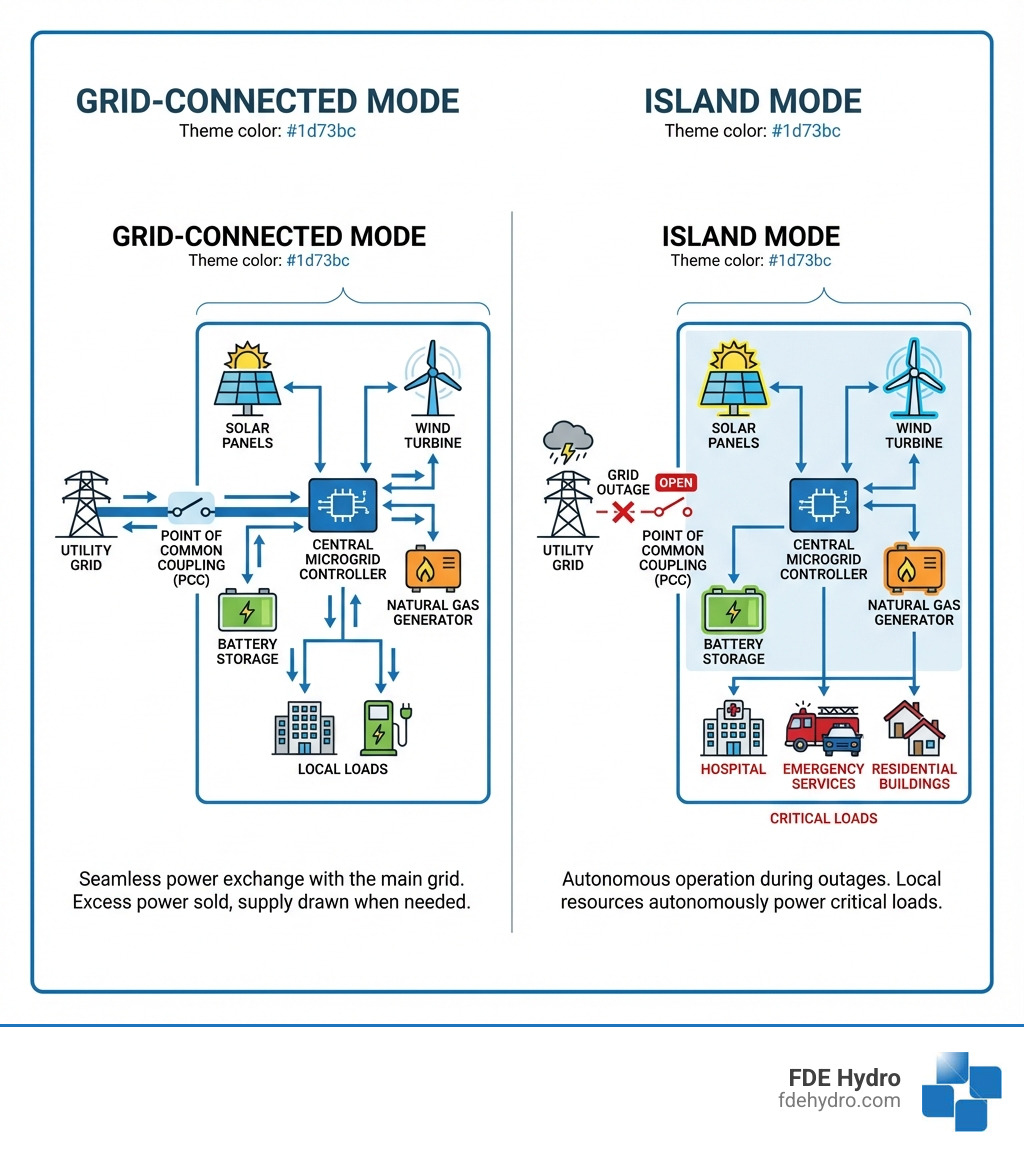
What is a microgrid and how does it work? A microgrid is a group of interconnected loads and distributed energy resources within clearly defined electrical boundaries that acts as a single controllable entity. It can operate either connected to the main utility grid or independently in “island mode,” using local generation sources like solar panels, wind turbines, batteries, and natural gas generators to power a localized area such as a campus, hospital, or community.
Quick Answer: How Microgrids Work
- Grid-Connected Mode: The microgrid operates alongside the main utility grid, drawing power when needed, selling excess power back, or providing services like peak shaving to reduce energy costs.
- Island Mode: When the main grid experiences an outage or disturbance, the microgrid automatically disconnects and operates independently using its local energy resources to keep critical facilities powered.
- Key Components: A microgrid controller (the “brain”) manages distributed energy resources (solar, wind, batteries, generators), monitors grid conditions, and coordinates the seamless transition between operating modes.
When Superstorm Sandy struck in 2012, a university microgrid successfully islanded from the local distribution grid and continued to provide reliable power to its campus while also serving as a community resilience hub. This real-world example demonstrates why microgrids represent more than backup power—they’re a fundamental shift toward localized energy independence and grid resilience.
The global market for microgrids could grow to USD 55 billion by 2032, driven by falling costs of renewable energy and energy storage, increasing grid vulnerabilities, and the urgent need for resilient power systems. From airports saving $1 million annually to remote communities gaining reliable electricity for the first time, microgrids are changing how we generate, distribute, and consume power.
I’m Bill French Sr., Founder and CEO of FDE Hydro, and I’ve spent decades working on infrastructure projects that require reliable, resilient power systems. Through my participation in the Department of Energy’s Hydropower Vision Technology Task Force and extensive work in heavy civil construction, I’ve seen what is a microgrid and how does it work to support critical operations and enable sustainable energy futures. This guide will walk you through everything you need to know about these systems.
What is a Microgrid and How Does It Work?
Defining the Modern Microgrid: More Than Just Backup Power
At its heart, what is a microgrid and how does it work can be understood as a localized, self-sufficient energy system designed to provide reliable power to a specific area. The U.S. Department of Energy (DOE) defines a microgrid as “a group of interconnected loads and distributed energy resources within clearly defined electrical boundaries that acts as a single controllable entity with respect to the grid.” This means it has clear borders, whether it’s a university campus, a military base, or an industrial park, and it can be controlled as one cohesive unit.
This definition, highlighted in initiatives like The US DoE’s Microgrid Initiative, emphasizes its dual nature: a microgrid can operate either connected to the larger utility grid (grid-connected mode) or entirely on its own (island mode). This ability to “island” is a game-changer, allowing critical facilities to maintain power even when the main grid goes down. It’s not just about having a backup generator; it’s about intelligent, localized energy management that ensures continuity and optimizes energy use.
The Anatomy of a Microgrid: Key Components Explained
To understand what is a microgrid and how does it work, we need to dissect its core components. Think of a microgrid as a miniature version of the larger utility grid, complete with its own generation, distribution, and control systems.
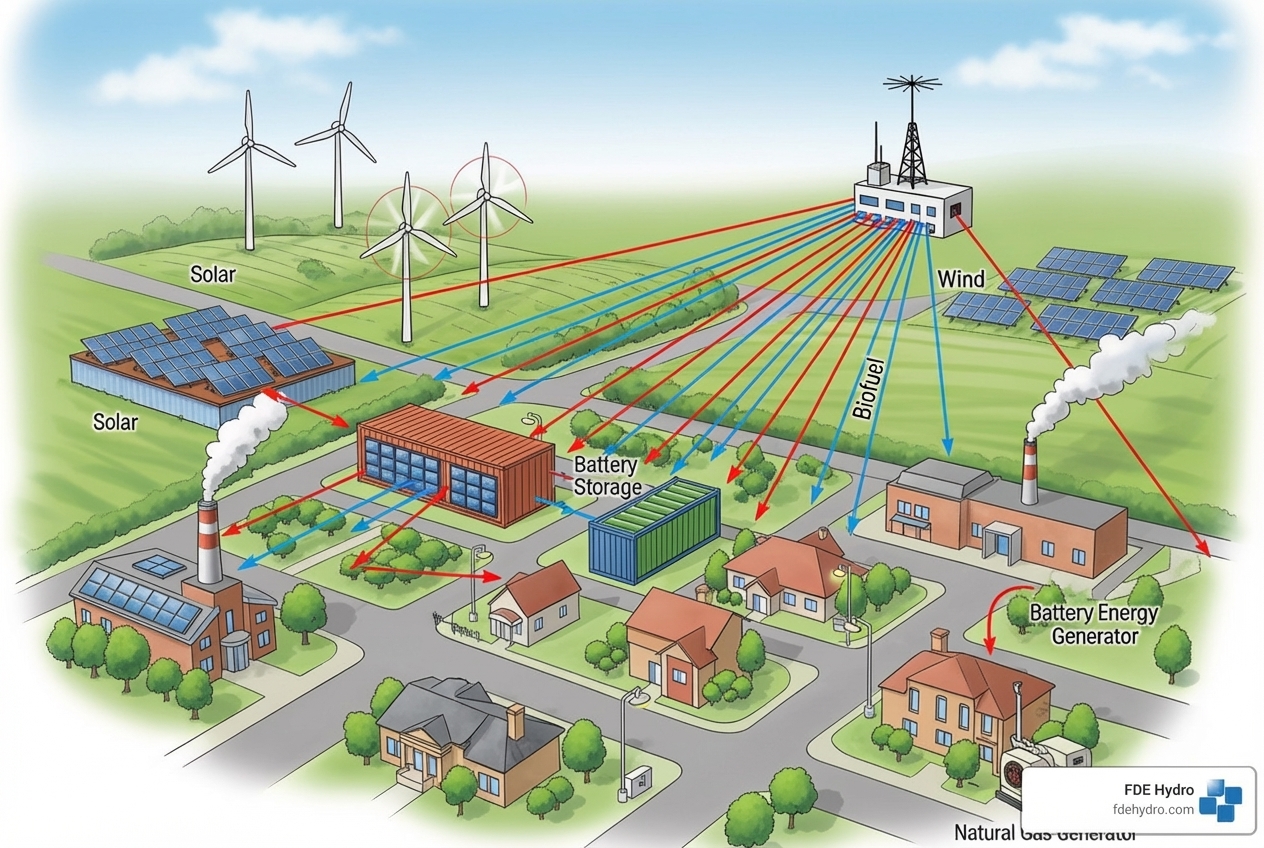
The main parts include:
- Distributed Energy Resources (DERs): These are the power sources located within the microgrid’s boundaries. They can be traditional generators like diesel or natural gas, or, increasingly, renewable sources such as solar panels, wind turbines, and even hydroelectric systems—a specialty of ours at FDE Hydro. These DERs are crucial for generating electricity close to where it’s consumed, reducing transmission losses.
- Energy Storage Systems (ESS): Often comprising large battery banks, such as lithium-ion batteries, ESS are vital for balancing intermittent renewable energy sources (like solar when the sun isn’t shining) and providing instant power during grid outages. They store excess energy and release it when demand is high or generation is low.
- Microgrid Controller: This is the “brain” of the microgrid. It’s a sophisticated software and hardware system that continuously monitors grid conditions, manages the DERs and ESS, balances loads, and decides when to connect to or disconnect from the main grid. It ensures stable and efficient operation, orchestrating all the components in harmony.
- Point of Common Coupling (PCC): This is the electrical connection point where the microgrid interfaces with the larger utility grid. It’s the gateway that allows the microgrid to exchange power with the main grid or disconnect from it entirely.
- Loads: These are simply the consumers of electricity within the microgrid’s boundaries—buildings, homes, businesses, and critical infrastructure.
For a deeper dive into the fundamental concepts of electricity and energy, you might find our page on More about energy basics illuminating.
How a Microgrid Works in Its Two Primary Operational Modes
The operational flexibility of a microgrid is one of its most defining characteristics, allowing it to function effectively in two distinct modes:
- Grid-Connected Mode: In this mode, the microgrid operates in parallel with the main utility grid, drawing power from it when local generation is insufficient or less economical, and feeding excess power back into the grid when local generation surpasses demand. This mode offers several advantages:
- Peak Shaving: By generating or discharging stored energy during periods of high demand and high utility prices, microgrids can significantly reduce electricity bills. It’s like having your own energy buffet during rush hour!
- Demand Response: Microgrids can respond to signals from the utility to reduce their consumption from the main grid, helping to stabilize the larger system during strain.
- Revenue Generation: In some regulatory environments, microgrids can sell surplus power or provide ancillary services (like voltage regulation) back to the main grid, creating an additional income stream.
- Island Mode: This is where the microgrid truly shines in terms of resilience. When a disturbance occurs on the main grid (a blackout, storm damage, or equipment failure), the microgrid controller detects the anomaly at the PCC and automatically disconnects from the main grid. It then operates autonomously, using its internal DERs and ESS to power its local loads.
- Autonomous Operation: The microgrid controller carefully balances generation and demand within its boundaries, ensuring stable power delivery to connected facilities.
- Black Start Capability: Many microgrids are designed with the ability to “black start”—meaning they can restart their own generation sources and restore power to the local loads without any external power from the main grid. This is crucial for rapid recovery after a complete blackout.
- Seamless Islanding: The transition from grid-connected to island mode is often so quick and smooth that occupants within the microgrid may not even notice an interruption, a testament to the sophistication of modern microgrid controls.
The Powerful Payoffs: Key Benefits of Microgrids
Microgrids offer a compelling suite of advantages that address some of the most pressing energy challenges of our time, from aging infrastructure to climate change.
Best Resilience and Reliability

One of the most immediate and impactful benefits of microgrids is their ability to improve power continuity and resilience. We’ve all experienced the frustration of a power outage, but for critical facilities like hospitals, emergency services, and data centers, an outage can be catastrophic.
During Superstorm Sandy, as we mentioned earlier, the New York University microgrid successfully disconnected from the main grid and continued to provide power to much of its campus, acting as a vital lifeline and resilience hub for the community during a widespread blackout. This isn’t an isolated incident; microgrids are specifically designed to support critical infrastructure by ensuring that power keeps flowing even when the main grid fails.
By localizing power generation and distribution, microgrids can significantly reduce the duration and impact of outages. When a disturbance occurs, the microgrid simply “islands” itself, protecting its internal loads from the instability of the larger grid. This self-sufficiency means quicker recovery times and a more robust energy supply for the facilities that need it most.
Significant Economic and Efficiency Gains
Beyond resilience, microgrids offer substantial economic and efficiency benefits that can lead to impressive savings and smarter energy management.
Consider the Pittsburgh International Airport, which switched to a solar and natural gas microgrid. This strategic move led to a reported USD 1 million in savings in its first year alone, as detailed in How a microgrid saved an airport $1 Million. That’s a serious chunk of change! Similarly, a California winery built a microgrid around photovoltaic (PV) solar energy, reducing its monthly energy bills from USD 15,000 to a mere USD 1,000. These aren’t just isolated success stories; they highlight the potential for significant operational cost reductions.
A key factor in this efficiency is the reduction of transmission losses. In traditional grids, electricity can lose anywhere from 8 to 15% of its energy while traveling long distances from centralized power plants to consumers. By generating power closer to the point of consumption, microgrids minimize these losses, delivering more of the generated energy directly to where it’s needed.
Furthermore, with advanced control systems, often leveraging sophisticated algorithms and even AI in energy management, microgrids can dynamically manage energy supply and demand. They can optimize when to use local generation, when to draw from the grid, and when to store energy, all based on real-time prices and operational needs. This intelligent management contributes directly to lower operating costs and a more efficient energy ecosystem.
For us at FDE Hydro, a core mission is to advance sustainable energy solutions, and microgrids are powerful allies in this endeavor. They provide an ideal platform for integrating clean energy sources and reducing our collective carbon footprint.
Microgrids excel at incorporating diverse renewable energy technologies like solar, wind, and crucially for us, hydropower. By combining these with energy storage systems, microgrids can overcome the inherent intermittency of renewables (what happens when the sun doesn’t shine or the wind doesn’t blow?). The stored energy or a backup generator can seamlessly fill any gaps, ensuring a consistent and reliable power supply. This integration is key to achieving sustainability goals and transitioning towards a cleaner energy future.
Moreover, by enabling the widespread adoption of local renewable generation, microgrids reduce reliance on fossil fuel-based power plants, leading to fewer greenhouse gas emissions. They are a tangible step towards cleaner air and a healthier planet. Our work in developing efficient and reliable hydropower solutions, for instance, perfectly complements the microgrid model, providing a consistent, low-carbon DER. To learn more about the potential of various green technologies, explore our insights on efficient renewable resources.
From Concept to Community: Types, Challenges, and Real-World Examples
Microgrids aren’t a one-size-fits-all solution; they come in various configurations, each custom to specific needs and environments. However, their implementation isn’t without its problems.
A Spectrum of Microgrid Classifications
Understanding the different types of microgrids helps illustrate their versatility:
- Remote (Off-Grid) Microgrids: These microgrids operate entirely independently of the main utility grid, often in isolated locations where connecting to the central grid is impractical or too costly. Think remote communities in Canada or Brazil, scientific research stations, or island nations. They rely solely on their internal DERs and storage.
- Grid-Connected Microgrids: The most common type, these microgrids are physically connected to the main utility grid but have the capability to disconnect and operate autonomously when needed. They offer the best of both worlds: grid reliability for daily operations and independent resilience during outages.
- Networked Microgrids: These are more advanced systems where multiple microgrids or DERs are connected to the same utility grid circuit segment, often serving a wider geographic area. They can share resources and improve overall resilience across a larger community.
Beyond these operational classifications, microgrids can also be categorized by their scale and complexity:
- Level 1 “Single Building Microgrid”: This is the simplest form, typically serving a single building with one or more DERs, such as a solar PV system or a combined heat and power (CHP) unit, all interconnected at a single utility meter.
- Level 2 “Partial Feeder” or “Campus Microgrid”: This type serves multiple buildings or a campus (like a university or industrial park) with a single or multiple DER system, still usually interconnected at one utility meter. The New York University microgrid is a prime example of a campus microgrid.
- Level 3 “Full Feeder” or “Community Microgrid”: These are the most extensive, serving multiple buildings or customers where loads and generation sources may not be at the same utility meter. These advanced microgrids have one point of common coupling (PCC) where they can operate independently from the utility grid, providing resilience to an entire community.
Navigating the Challenges of Implementation
While the benefits are clear, deploying microgrids involves several key considerations and challenges:
- High Upfront Costs: Microgrids require significant initial investment. A 2018 study by the National Renewable Energy Laboratory (NREL) found that microgrids in the Continental U.S. cost an average of $2 million-$5 million per megawatt (MW) to develop. This can be a barrier for many potential adopters.
- Regulatory Barriers: The regulatory landscape for microgrids is still evolving. Interconnection standards, tariffs for selling power back to the grid, and ownership models can vary significantly, creating complexities in planning and deployment.
- Technical Complexity: Designing, integrating, and operating a microgrid involves sophisticated engineering. Managing diverse DERs, ensuring seamless transitions between grid-connected and island modes, and maintaining power quality all require advanced technical expertise and control systems.
- Cybersecurity Concerns: As highly integrated and automated systems, microgrids are susceptible to cyber threats. Protecting the control systems and communication networks from malicious attacks is paramount to maintaining reliability and security.
Despite these challenges, the long-term benefits in resilience, cost savings, and sustainability often outweigh the initial problems. For those interested in the broader picture of developing robust energy systems, our Energy infrastructure development guide offers further insights.
Microgrids in Action: Case Studies
Real-world examples truly bring to life what is a microgrid and how does it work. We’ve already touched upon a few, but let’s dig into some others within our operational geographies:
- Pittsburgh International Airport (United States): This facility implemented a microgrid using solar and natural gas generation. As noted earlier, it saved the airport USD 1 million in its first year, demonstrating both economic viability and improved energy independence for critical infrastructure.
- New York University (New York, United States): During the widespread power outages caused by Superstorm Sandy, NYU’s microgrid successfully isolated itself from the main grid, providing continuous power to its campus. This allowed the university to serve as a vital community resource, highlighting the resilience benefits for urban centers.
- California Winery (California, United States): A great example of a smaller-scale microgrid, this winery integrated photovoltaic (PV) solar energy into its operations. The result was a dramatic reduction in monthly energy bills, from USD 15,000 to just USD 1,000, showcasing how microgrids can benefit commercial enterprises and agricultural sectors. You can find more insights into similar projects in the California microgrid case studies.
These examples, from major transportation hubs to academic institutions and agricultural businesses, underscore the diverse applications and tangible benefits that microgrids deliver.
Frequently Asked Questions About Microgrid Technology
We often get asked specific questions about microgrids, so let’s address some of the most common ones.
How do microgrids differ from the smart grid?
This is a fantastic question! While both microgrids and smart grids aim to modernize our energy infrastructure, they operate on different scales and have distinct primary functions.
- Scale: The most significant difference is scale. A microgrid is a localized energy system, typically serving a campus, a neighborhood, or an industrial facility. It has clearly defined electrical boundaries. In contrast, a smart grid is a large-scale modernization of the entire utility grid—an expansive network that covers vast geographic areas, potentially an entire state or country.
- Autonomy: A microgrid’s defining characteristic is its ability to “island”—to disconnect from the main grid and operate independently. This self-sufficiency is what provides localized resilience. A smart grid, while highly advanced with two-way communication and automation, is still fundamentally connected to and dependent on the central power generation and transmission system. It improves efficiency, reliability, and responsiveness across the entire grid, but it doesn’t typically operate autonomously in localized segments during a full grid outage.
Think of it this way: if the traditional grid is a highway system, a smart grid is an upgraded, intelligent highway with real-time traffic monitoring and automated vehicle control. A microgrid, however, is a self-contained private road system with its own power generation, capable of operating even if the main highway is shut down.
What is the role of Distributed Energy Resources (DERs) in a microgrid?
Distributed Energy Resources (DERs) are the very heart of a microgrid. Without them, a microgrid wouldn’t exist! They are the small-scale, localized electricity generators and storage devices that allow a microgrid to produce power close to its consumers.
DERs can include a variety of technologies:
- Solar panels: Capturing energy from the sun.
- Wind turbines: Using wind power.
- Hydropower: Utilizing flowing water, a specialty for us at FDE Hydro, offering a consistent and powerful renewable source.
- Geothermal: Tapping into the Earth’s heat.
- Combined Heat and Power (CHP): Generating both electricity and useful heat from a single fuel source.
- Energy storage systems: Primarily batteries, which store excess energy from renewables or the grid and discharge it when needed.
These DERs enable local generation and self-sufficiency, which are fundamental to a microgrid’s operation. They allow the microgrid to reduce its reliance on the main grid, cut down on transmission losses, and provide power even during outages. For anyone looking to start on projects involving these technologies, our Guide to renewable energy projects is an excellent resource.
What is the first step to building a microgrid?
Building a microgrid is a significant undertaking, but the first step is always the most crucial: a thorough feasibility study. This isn’t just about crunching numbers; it’s about understanding needs, assessing capabilities, and charting a clear path forward.
Here’s what a comprehensive feasibility study typically involves:
- Defining Goals: What do you want your microgrid to achieve? Is it primarily for resilience during outages, significant cost savings, integrating more renewables, or a combination? Clear goals will guide all subsequent decisions.
- Identifying Critical Loads: Which facilities or processes absolutely cannot lose power? For a hospital, it’s life support and operating rooms. For a data center, it’s servers. Understanding these critical loads is paramount for designing a system that ensures their continuous operation.
- Assessing Existing Infrastructure: What power sources, electrical distribution systems, and control mechanisms are already in place? This audit helps identify what can be leveraged and what needs to be added or upgraded.
- Site Audit: A detailed physical inspection of the proposed microgrid site to evaluate space for DERs (like solar arrays or our modular hydropower solutions), assess interconnection points, and identify any environmental or logistical constraints.
- Load Data Analysis: Collecting historical electricity consumption data (ideally 12 months of 15-minute interval utility bills) to understand energy demand patterns, peak loads, and energy profiles.
This initial phase helps determine if a microgrid is technically viable and economically beneficial for your specific location and objectives.
The Future is Local: Building a Resilient Energy Tomorrow
The energy landscape is undeniably shifting. With increasing grid vulnerabilities due to aging infrastructure and extreme weather events, coupled with the urgent need for decarbonization, microgrids represent a powerful solution. The projected growth of the global microgrid market to USD 55 billion by 2032 underscores a clear trend towards energy independence and decentralization.
This shift empowers communities, campuses, and industries to take control of their energy destiny, fostering resilience against disruptions and paving the way for a more sustainable future. At FDE Hydro, we’re proud to contribute to this revolution by providing foundational hydropower components that offer reliable, clean energy generation within these localized systems. Our innovative modular precast concrete technology is designed to significantly reduce the cost and time of building and retrofitting hydroelectric dams in North America, Brazil, and Europe, making robust microgrid solutions more accessible.
As we continue to innovate and expand our capabilities, we believe that the principles of localized, resilient, and sustainable energy will define the next generation of power infrastructure. We invite you to learn more about how we can help you achieve your energy goals and explore our advanced microgrid solutions.
by Bill French Sr. | Dec 31, 2025 | Hydropower Articles
Why the Global Hydropower Market Matters for the Energy Transition
The global hydropower market is the world’s largest source of renewable electricity, supplying 14.3% of global power across 150 countries. Valued between USD 109-257 billion in 2024, the sector is projected to reach USD 184-280 billion by 2030-2032. Despite this growth, development has slowed, even as the world must double its hydropower capacity by 2050 to meet net-zero targets.
Key Market Facts at a Glance:
- Global Capacity: 1,253-1,412 GW installed (2024)
- Annual Growth: 15.1-24.6 GW added in 2024
- Market Leaders: Asia-Pacific (37-40% share), China dominates with 377+ GW
- Investment Need: USD 130 billion annually required to meet climate goals
- Storage Potential: Pumped storage provides over 90% of global energy storage
- Untapped Potential: Roughly 50% of economically viable hydropower remains undeveloped
Hydropower is more than a power source; it’s the backbone of grid stability. Its ability to ramp up and down rapidly is essential for balancing intermittent renewables like solar and wind. However, the industry faces headwinds: aging infrastructure (average plant age is 45-50 years in developed markets), high upfront costs, long development timelines, and environmental concerns. The solution lies in modernizing existing facilities, expanding pumped storage, and adopting innovative construction methods.
I’m Bill French Sr., Founder and CEO of FDE Hydro™, and for over five decades I’ve worked in heavy civil construction before pioneering modular solutions for the global hydropower market through our patented French Dam technology. Our mission is to address the industry’s most pressing challenges—excessive costs and timelines—by delivering innovative, environmentally-conscious construction methods that make hydropower development more accessible and sustainable.
Global hydropower market terms to know:
Global Hydropower Market Dynamics: Size, Growth, and Projections
The global hydropower market is a powerhouse in the renewable energy landscape. Market valuations for 2024 range from USD 109 billion to USD 257 billion, with a clear growth trajectory toward USD 184-280 billion by the early 2030s. Projected growth rates vary from 1.5% to 6.84% CAGR, reflecting different scenarios for policy support and technological advancement.
In 2024, the world added 15.1-24.6 GW of new capacity, bringing the total installed capacity to 1,253-1,412 GW. Hydropower continues to supply 14.3% of the world’s electricity, making it the largest single source of renewable power. It is the workhorse that enables the integration of variable renewables like solar and wind.
However, a critical investment gap exists. To meet climate targets and double capacity by 2050, the sector requires approximately USD 130 billion annually—more than double current levels. This funding shortfall highlights the need for construction innovations that reduce costs and timelines, making every dollar go further. More info about renewable energy projects.
Component and Capacity Segmentation
Breaking down the global hydropower market, the civil construction segment (dams, tunnels, etc.) is dominant, accounting for over 33.24% of revenue in 2024. This is followed by electromechanical equipment (turbines, generators) and power infrastructure. The high cost of civil construction is often the primary hurdle for new projects.
In terms of capacity, large and medium hydropower projects (>100 MW) make up over 70% of the market, providing essential baseload power and grid stability. However, the fastest growth is in small, micro, and pico hydropower systems. Projected to grow at 5.37% annually, these smaller installations offer lower environmental impact, faster deployment, and can power remote communities. This proves hydropower is a scalable and adaptable solution.
Our modular precast concrete technology directly addresses the high costs of civil construction, making it a viable solution across all capacity ranges. More info about hydroelectric dam components.
Regional Analysis of the Global Hydropower Market
The global hydropower market varies significantly by region. While Asia-Pacific leads in new capacity, major opportunities for modernization exist in North America, Europe, and Brazil—key focus areas for FDE Hydro™.
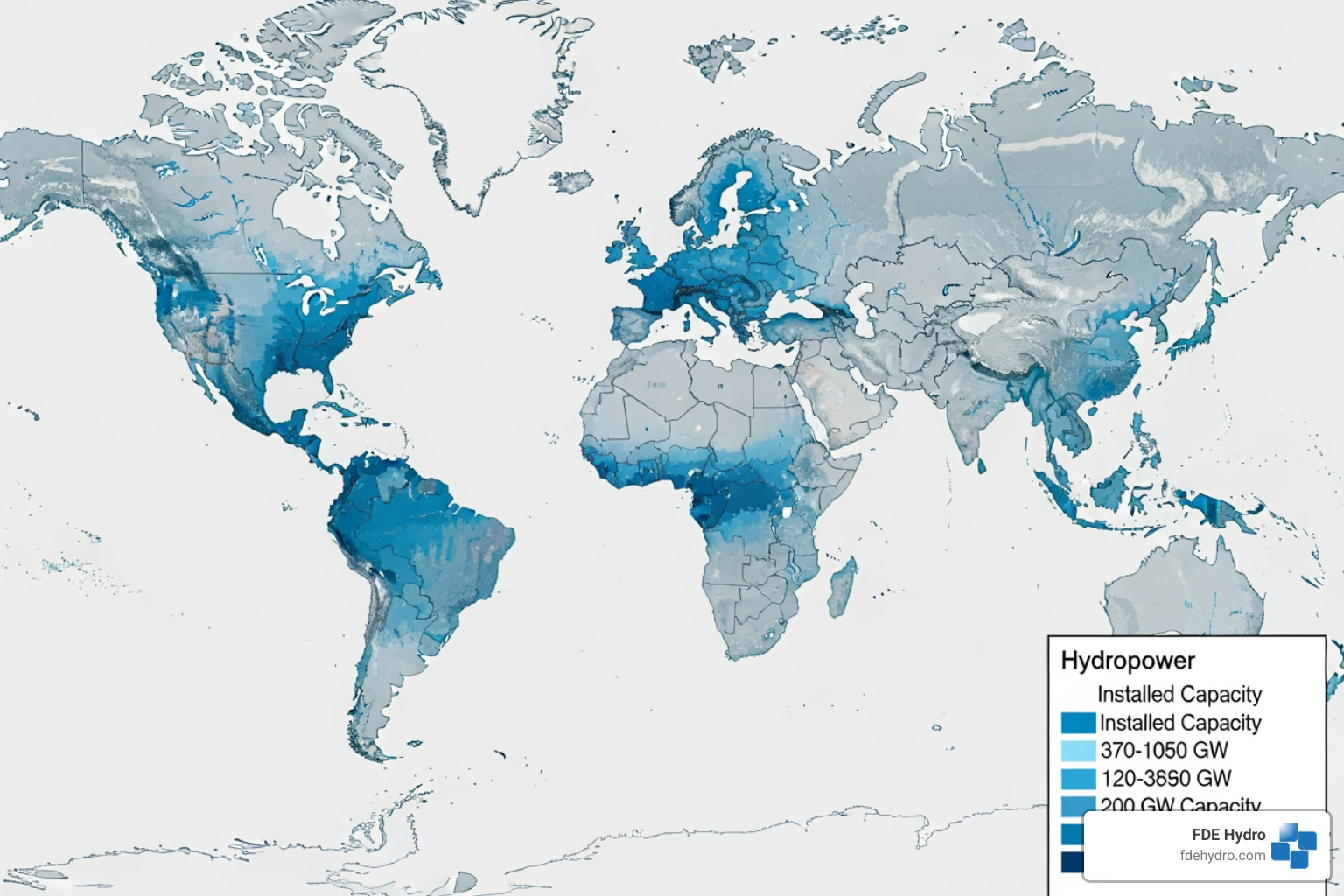
Europe held a 27.67% revenue share in 2024 with nearly 259 GW of capacity. The critical issue is its aging fleet, with an average facility age of 45 years. Modernization is expected to comprise 90% of hydropower investment this decade, driven by the EU’s goal of 42.5% renewable energy by 2030.
North America faces a similar situation, with average plant ages near 50 years. The U.S. has 80.92 GW of capacity, and the Department of Energy is actively supporting upgrades. With 360 GW of untapped potential and half of the non-federal fleet facing relicensing by 2035, the region is a modernization goldmine. More info about hydropower construction in North America.
Brazil and Latin America are highly dependent on hydropower, which supplies 45% of the region’s electricity. Brazil leads with over 109.9 GW of installed capacity. While new growth is modest, the vast existing infrastructure (176 GW in South America) offers immense potential for optimization and modernization. These regions all require faster, cost-effective construction methods, where modular approaches can make a significant impact.
The Engine of Growth: Technology, Modernization, and Investment
The global hydropower market is evolving rapidly, driven by technological breakthroughs. Advancements include more efficient turbines, advanced materials, and optimized run-of-river systems. Small-scale modular hydropower systems are also gaining traction, offering flexible deployment in locations unsuitable for large dams.
Digitalization is revolutionizing plant operations. Using AI, IoT, and data analytics, modern facilities can self-monitor, predict maintenance needs, and optimize efficiency in real-time. Digital twin technology enables operators to run virtual simulations for testing and troubleshooting. Other key innovations include free-flow turbines for low-current rivers and variable-speed turbines that adapt to water flow.
The rise of hybrid systems that integrate hydropower with solar and wind is particularly promising. This strategic pairing leverages hydropower’s core strength: flexibility. Hydropower can ramp up instantly to fill gaps when solar or wind generation drops, creating a stable and reliable clean energy grid.
More info about hydropower advancements and innovations.
The Rise of Pumped Storage and Modernization
Two forces are reshaping the global hydropower market: the growth of pumped storage hydropower (PSH) and the urgent need for modernization.
PSH acts as the world’s largest “rechargeable water battery.” It uses cheap, off-peak electricity to pump water to an upper reservoir and releases it to generate power during peak demand. PSH facilities store approximately 9,000 GWh of energy, over 90% of the world’s total energy storage. With 8.4 GW of new PSH capacity added in 2024 and 600 GW in the global pipeline, it is indispensable for balancing intermittent renewables.
Simultaneously, much of the existing hydropower fleet is aging. In North America and Europe, the average plant is 45-50 years old. By 2030, over 20% of the global fleet’s generating units will be older than 55 years, requiring major replacement. This presents a massive opportunity for modernization. Retrofitting older plants with new technology can boost efficiency, extend life, and improve environmental performance.
The required investment is significant: an estimated USD 127 billion is needed for modernization by 2030, with a total need of USD 300 billion to upgrade all aging plants. In North America and Europe, modernization will account for nearly 90% of hydropower investment this decade. Our modular construction methods at FDE Hydro™ make these retrofits faster and more affordable, helping to close the investment gap.
More info about Pumped Storage Hydropower.
Strategic Developments and Industry Progress
Progress in the semi-consolidated global hydropower market relies on collaboration between public agencies, private companies, and governments.
Modernization contracts are now central to development in mature markets like North America and Europe, focusing on upgrading aging plants to improve efficiency and extend lifespans. Public-private partnerships are essential for funding these large-scale projects. Government support, such as incentives from the U.S. Department of Energy and the EU’s renewable energy targets, is crucial for reducing financial risk and encouraging private investment. Regulatory frameworks that compensate hydropower for its grid stability services are also improving the investment climate.
While the industry expands globally, FDE Hydro™ focuses on North America, Brazil, and Europe, where our modular construction methods can have the greatest impact. Our patented French Dam technology directly addresses the industry’s primary obstacles: excessive costs and lengthy timelines. By delivering projects faster and more affordably, we help attract private investment and ensure hydropower’s long-term viability. Success requires a combination of innovation and local expertise to steer regional geology, regulations, and community needs.
Read about FDE Hydro’s approach to modernization and project delivery.
Navigating Headwinds: Challenges and Opportunities in the Hydropower Sector
The global hydropower market faces significant challenges that demand innovative solutions. Each challenge, however, presents an opportunity for growth.
Key headwinds include:
- High Upfront Capital Costs: New projects require substantial investment, with 2022 costs ranging from USD 6,574/kW to USD 8,611/kW.
- Long Development Timelines: Complex permitting and lengthy construction schedules can deter investors.
- Environmental and Social Impacts: Large-scale projects can disrupt ecosystems, fish migration, and local communities, requiring careful environmental assessments and public engagement.
- Climate Change Risks: Hydropower is vulnerable to climate change effects like droughts and floods, which create uncertainty in water availability and power generation.
| Metric |
Hydropower |
Solar PV |
Wind |
Natural Gas |
| LCOE (USD/MWh) |
47-84 |
26-50 |
24-75 |
44-73 |
| Capacity Factor |
30-70% |
10-25% |
25-45% |
50-60% |
| Grid Services |
Excellent (rapid ramp, storage) |
Limited |
Limited |
Good |
| Land Use (m²/MWh/year) |
Low (reservoir varies) |
High |
Moderate |
Low |
Overcoming Barriers and Seizing Opportunities in the Global Hydropower Market
Despite these challenges, the global hydropower market is filled with opportunity. With the right innovation and policies, hydropower can serve as the “guardian of the grid.”
Globally, about half of hydropower’s economically viable potential is undeveloped. The technically feasible potential is a staggering 16,000 TWh per year, with less than a third currently exploited. Regions like North America, Brazil, and Europe offer significant room for growth.
Government policies and incentives are key to open uping this potential. Support from the U.S. Department of Energy (DOE) and the EU’s renewable energy targets are driving investment in modernization and pumped storage. These policies recognize hydropower as the backbone that enables other renewables.
Read the U.S. Hydropower Market Report.
Hydropower’s greatest strength is providing grid stability services. Its ability to ramp generation up and down rapidly is essential for balancing variable renewables. Hydropower accounts for nearly 30% of the world’s flexible electricity supply. As markets evolve to better compensate for this flexibility, the business case for hydro strengthens. Additionally, projects provide public benefits like flood control, irrigation, and water supply that add value beyond electricity generation.
At FDE Hydro™, our mission is to tackle development barriers directly. Our patented French Dam modular technology reduces construction costs and timelines, making projects more financially attractive and faster to complete. This approach helps overcome traditional problems, delivering clean, reliable hydropower sooner.
More info about why hydropower is the guardian of the grid.
Frequently Asked Questions about the Global Hydropower Market
Here are answers to common questions about the global hydropower market and its role in the energy transition.
What is the projected growth of the global hydropower market?
The global hydropower market is projected to grow steadily, with forecasts ranging from 1.5% to 6.84% CAGR. This will increase its market valuation from a 2024 range of USD 109-257 billion to USD 184-280 billion by the early 2030s. This growth is driven by the global push for clean energy and the increasing need for hydropower’s grid stability services to support intermittent renewables like solar and wind.
Why is hydropower considered a crucial renewable energy source?
Hydropower is the world’s largest source of renewable electricity, supplying 14.3% of global power. Its crucial role stems from its unique combination of reliability and flexibility. It provides reliable, baseload power and can ramp generation up or down in minutes to balance the grid. Furthermore, pumped storage hydropower (PSH) offers massive energy storage capacity—over 9,000 GWh globally, or 90% of the world’s total. This storage is indispensable for integrating high levels of intermittent renewables into a stable grid.
What are the main challenges facing hydropower development?
The main challenges facing the global hydropower market are:
- High Initial Investment Costs: New projects require significant capital, with costs ranging from USD 6,574/kW to USD 8,611/kW.
- Long Development Timelines: Complex permitting and construction processes can take years, increasing financial risk.
- Environmental and Social Impacts: Large dams can disrupt ecosystems and communities, necessitating thorough environmental assessments and stakeholder engagement.
- Climate Change Variability: Altered precipitation patterns, including droughts and floods, create uncertainty in water availability and power generation.
These challenges drive the need for innovative solutions, like the modular construction methods developed by FDE Hydro™, which reduce costs and timelines, making projects more economically viable.
Conclusion
The global hydropower market is at a critical juncture for the energy transition. It is the backbone of a renewable grid, providing the reliable, flexible power and large-scale storage that enables the growth of solar and wind.
The future lies not only in new construction but in modernizing the existing fleet. Thousands of aging plants in North America and Europe require upgrades, representing a USD 127 billion investment opportunity by 2030. Overcoming barriers like high costs, long timelines, and environmental concerns is essential. This requires supportive policies and, most importantly, technological innovation.
This is the core mission of FDE Hydro™. Our patented French Dam technology uses modular precast concrete to directly attack the industry’s biggest challenges: excessive costs and lengthy timelines. By making hydropower development and retrofitting faster, more affordable, and sustainable, we can open up the 50% of economically viable potential that remains untapped. The energy transition needs hydropower, and hydropower needs innovation. We are ready to deliver.
Learn how advanced encapsulation technologies are reinvigorating aging hydropower infrastructure.
by Bill French Sr. | Dec 30, 2025 | Hydropower Articles
Why Hydroelectric Power Solutions Are Critical to Our Energy Future
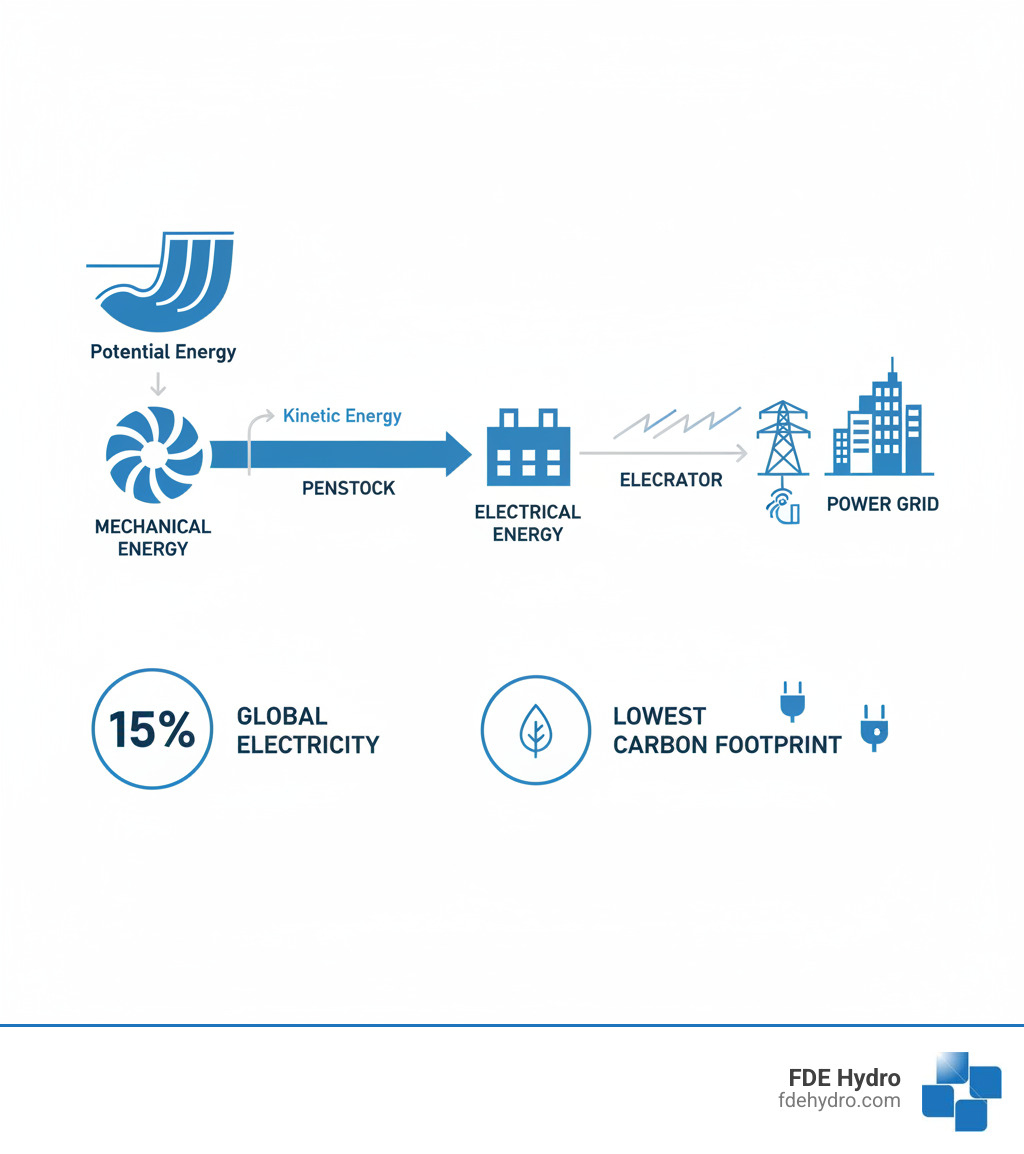
Hydroelectric power solutions are a proven, reliable method for generating clean electricity. By converting the kinetic energy of water into power, these systems provide over 15% of the world’s electricity with the lowest lifecycle carbon footprint of any energy source. From massive storage dams to run-of-river plants, hydroelectric solutions offer a unique combination of renewable generation, grid stability, and large-scale energy storage.
Key Hydroelectric Power Solutions:
- Storage (Impoundment) Systems – Large dams with reservoirs for on-demand power generation
- Run-of-River Plants – Minimal environmental impact, continuous generation from natural flow
- Pumped Storage Hydropower – Grid-scale energy storage providing 96% of US utility-scale storage capacity
- Small and Micro-Hydro – Decentralized, community-scale installations for localized power
- Hybrid Systems – Integration with solar, wind, and battery storage for optimized performance
The global hydropower sector is at a critical juncture. By 2030, 40% of all hydropower plants worldwide will be at least 40 years old, creating an urgent need for modernization. Traditional development has been constrained by high capital costs, long construction timelines (5-10 years), and significant environmental concerns.
“The industrial revolution was powered by water; water, wind and sun together will power the sustainable growth of the future.” This vision is becoming reality as the industry adopts new technologies that reduce construction time and costs while minimizing environmental disruption.
I’m Bill French Sr., Founder and CEO of FDE Hydro™, where I’ve pioneered patented modular precast construction technology. After five decades in civil construction, I founded FDE Hydro™ to address the industry’s most pressing challenges with faster, more cost-effective approaches to delivering hydroelectric power solutions.
Must-know hydroelectric power solutions terms:
A Guide to Hydroelectric Plant Types
Hydropower plants vary to match their environment and energy needs. Understanding the differences is key, as each type offers unique strengths—from large-scale energy storage to steady baseline power. At FDE Hydro™, our modular construction expertise makes all types of hydroelectric power solutions faster to build, more affordable, and gentler on the environment across our projects in North America, Brazil, and Europe.
Storage (Impoundment) Hydropower
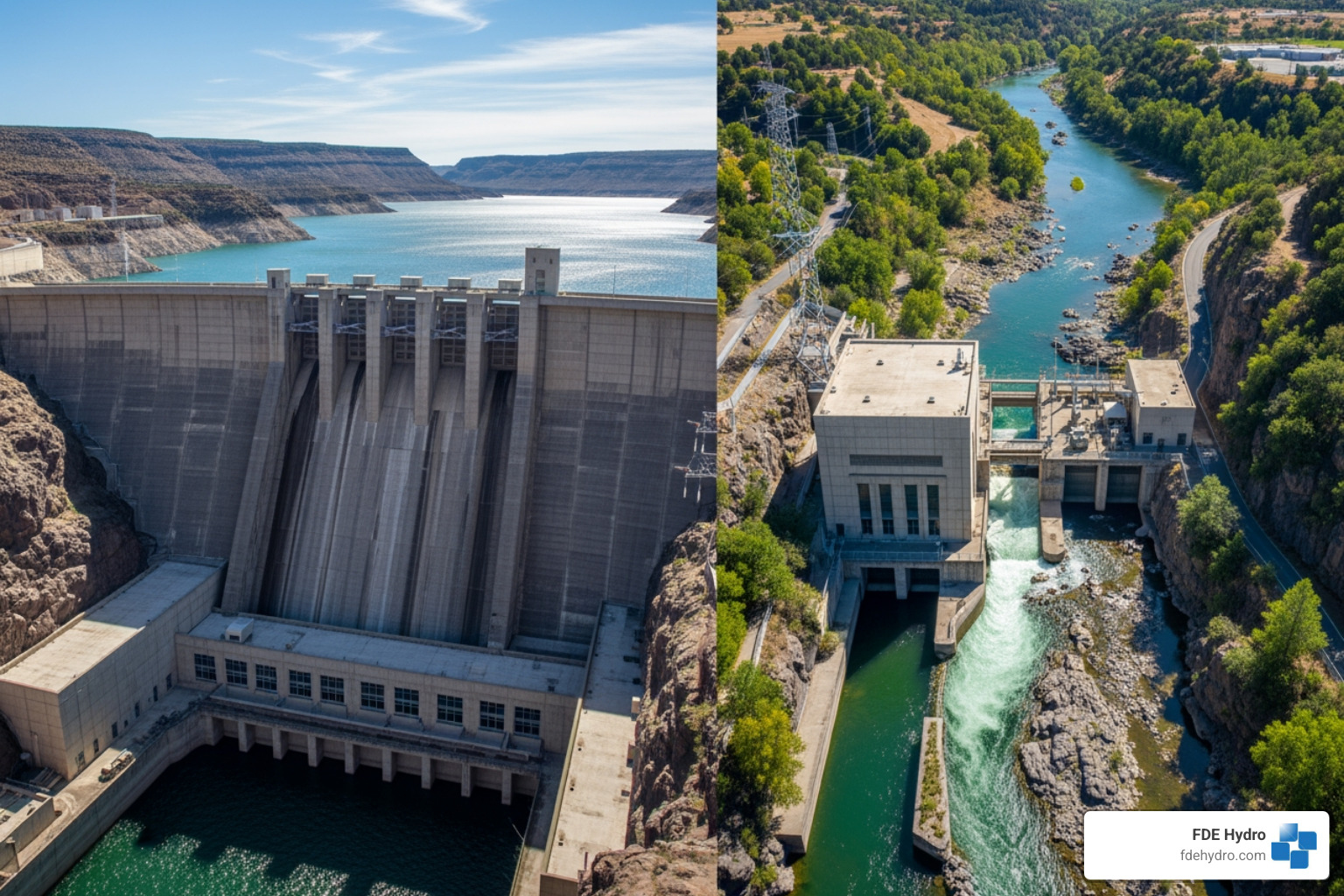
Storage hydropower plants, like the Hoover Dam, use massive dams to create reservoirs. This stored water represents potential energy, enabling valuable on-demand power generation. Operators can release water through turbines within minutes to meet demand spikes, making these plants perfect for peak load supply. Hydropower provides over 24 GW of firm capacity in the U.S., much of it from storage plants that can store energy for days or even months.
For more information on these foundational structures, explore our resources on Dams.
Run-of-River Hydropower
Run-of-river plants work with a river’s natural flow instead of blocking it with a large dam. They divert some water through a powerhouse and return it downstream. This minimal impoundment approach reduces the environmental footprint, avoiding large-scale flooding and ecosystem disruption. These plants provide continuous electricity for baseline power, often with lower transmission losses, making them a viable clean energy solution where large dams are not feasible.
Find how we’re advancing these types of facilities at New Hydro Facilities.
Pumped Storage Hydropower (PSH)
Pumped storage hydropower (PSH) acts as the world’s water battery. It uses two reservoirs at different elevations. When power is cheap and plentiful, water is pumped to the upper reservoir. When demand is high, the water is released back down through turbines to generate electricity. This makes PSH the top solution for grid-scale energy storage, providing an astounding 96% of all utility-scale energy storage in the United States. PSH plants can ramp up in minutes, making them essential for balancing the grid and backing up intermittent renewables like wind and solar.
Learn more about this vital technology on our Pumped Storage Hydropower page.
Small and Micro-Hydro Solutions
Small hydropower plants (typically up to 30 megawatts) fit where large dams cannot, such as in municipal water systems or irrigation canals. These small and micro-hydro solutions provide decentralized power for remote communities or industrial facilities, delivering community-scale benefits. They are affordable, often paying for themselves in a few years, and are ideal for low-head applications. Our modular construction techniques are particularly effective for these projects, allowing for quick, cost-effective deployment.
Explore the potential of community-scale projects through the Drawdown® Explorer on small hydro.
The Core Technology Behind Hydroelectric Power Solutions
Every hydroelectric plant converts water’s natural power into electricity using several core technologies working in harmony. At FDE Hydro™, we advance these technologies to ensure our hydroelectric power solutions deliver exceptional performance and reliability.
Turbines and Generators
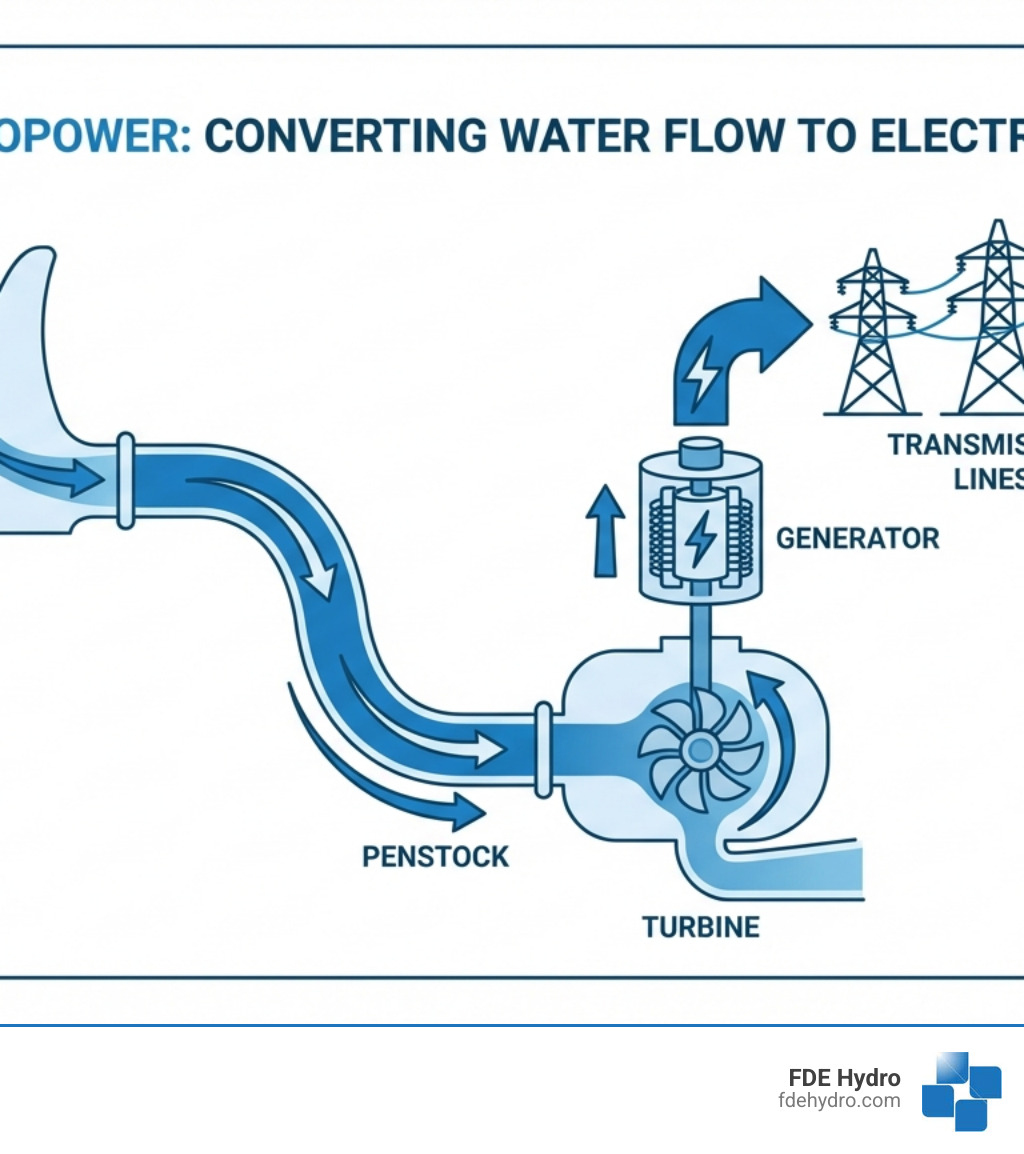
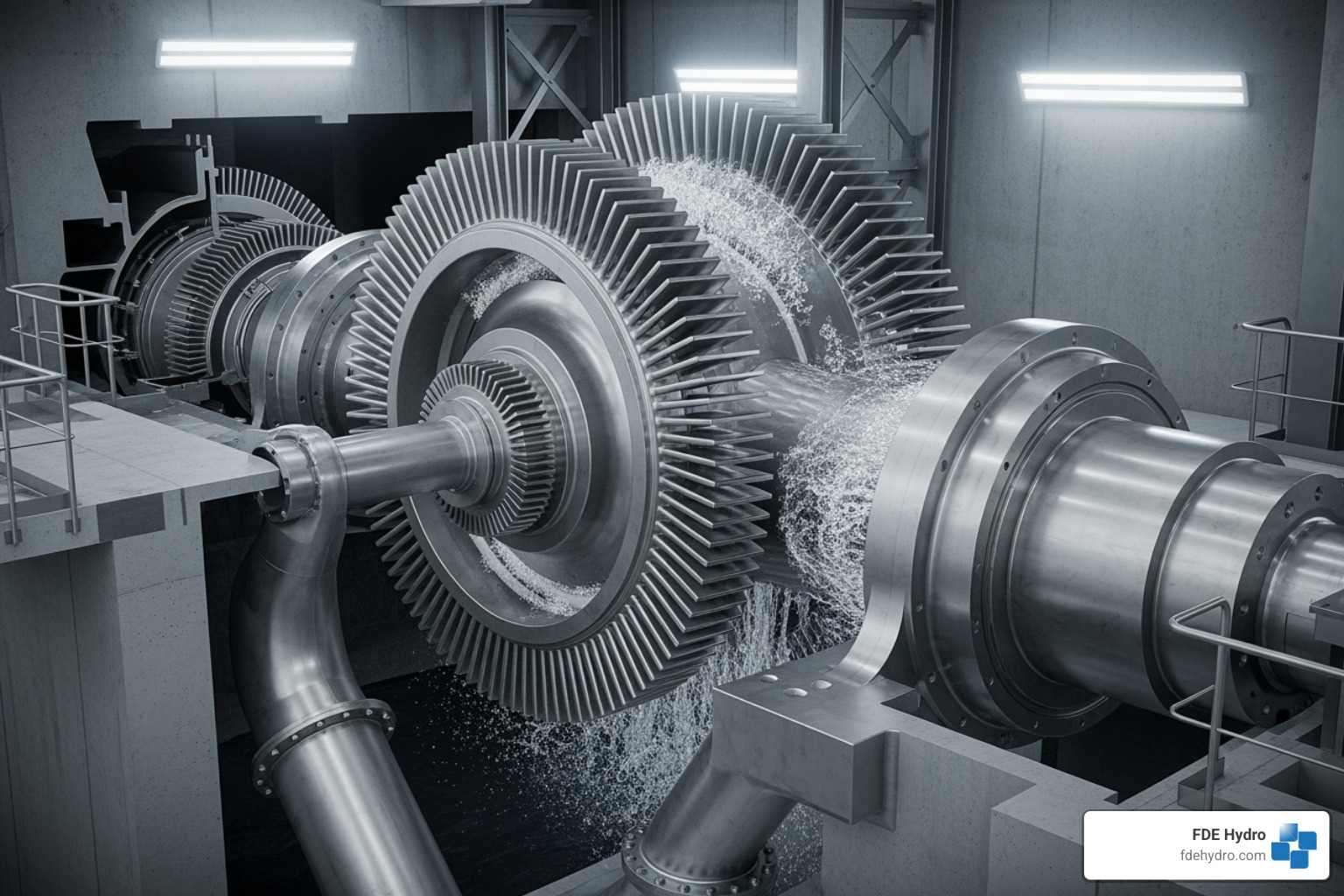
Water strikes turbine blades, causing them to spin at high speed. The turbine choice depends on the site’s head (water fall distance) and flow rate.
- Pelton turbines are for high-head, low-flow sites.
- Francis turbines, the most common type, suit medium head and flow conditions.
- Kaplan turbines are ideal for low-head, high-flow environments, with adjustable blades for efficiency.
The turbine spins a connected generator, which uses electromagnetic induction to convert this mechanical rotation into AC electricity for the grid. Our comprehensive Hydroelectric Dam Components: The Ultimate Guide explores these components in greater detail.
Dams and Water Control Infrastructure
The infrastructure managing water flow is as critical as the turbines for successful hydroelectric power solutions.
- Penstocks are massive pipes that channel water to the turbines under high pressure.
- Spillways act as safety valves, releasing excess water during floods to prevent the dam from overtopping.
- Gates provide operators with precise control over water movement into penstocks and spillways.
Proper management of these components ensures safe, efficient operation. Our approach to Water Control Infrastructure Guide 2025 reflects our commitment to building reliable systems.
Digitalization and Automation
Digital technology has made modern hydropower plants smarter and more responsive.
- Smart plant operation uses advanced control systems for real-time monitoring of performance, water levels, and equipment status.
- Predictive maintenance uses sensor data to identify potential issues before they cause downtime, reducing costs and extending equipment life.
- Digital twin technology creates virtual models for testing and optimizing operations without affecting the physical plant.
These digital tools, including centralized IoT monitoring, build a more resilient and efficient energy infrastructure. We integrate these technologies into all our projects, believing they are essential to the future of Hydropower Innovation.
Hydropower’s Role as the Guardian of the Modern Grid
The electrical grid requires a constant balance between power supply and fluctuating demand. With intermittent renewables like solar and wind, this is a major challenge. Hydroelectric power solutions are key to solving this puzzle and ensuring grid stability.
Ensuring Grid Stability and Flexibility
Hydropower provides firm capacity—reliable power that’s available on demand, unlike weather-dependent solar and wind. The U.S. has over 24 GW of firm hydropower capacity. Hydropower’s real superpower is its speed; plants can respond to grid changes in minutes. For example, pumped storage can ramp up to 400 MW in less than 60 seconds. This rapid response makes hydropower the perfect backup for intermittent renewables, seamlessly filling gaps when the sun isn’t shining or the wind isn’t blowing. This flexibility makes it the guardian of the grid, a role we explore at 4 Reasons Why Hydropower is the Guardian of the Grid.
A Cornerstone of the Renewable Energy Mix
In North America, hydroelectric power solutions are a renewable energy heavyweight, accounting for 27.37% of U.S. utility-scale renewable generation and 5.86% of total U.S. generation. Hydropower’s longevity is remarkable; facilities routinely operate for 65-85 years, far longer than solar or wind assets, making them multi-generational sources of clean energy. Canada, the world’s second-largest hydropower producer, exemplifies its importance. This proven reliability makes hydropower a trusted foundation for Sustainable Power Generation.
Beyond Electricity: Co-Benefits
Beyond electricity, many hydroelectric power solutions offer significant co-benefits. Dams provide critical flood control by storing excess water, while their reservoirs supply reliable water for agricultural irrigation and municipal drinking water. These man-made lakes also create recreational opportunities like boating and fishing, which boost local economies. This multi-purpose nature makes hydropower an integrated water management solution, and at FDE Hydro™, we consider all these benefits when designing our projects.
Navigating the Economics and Environmental Landscape
Understanding the economics and environmental impact of hydroelectric power solutions is crucial. While there are significant upfront costs, they are balanced by decades of low-cost, clean energy. At FDE Hydro™, our innovative approaches make these projects more economically accessible while reducing their environmental footprint.
The Economic Case for Hydropower
The primary financial hurdle for hydropower is its high initial investment. However, once operational, the economics are highly favorable. Operational costs are remarkably low because the fuel—water—is free, and facilities are built to last 65 to 85 years with modest maintenance. This results in stable energy prices and a strong long-term return on investment. Modernization can further boost efficiency by up to 7% and output by as much as 50%, with quick payback. As we explain in Financing Long-Term Hydropower Requires Mitigating Risks Prior to ROI, our modular approach helps reduce upfront costs and financial risks. For a full breakdown, see our Hydropower Project Costs guide.
Key Environmental Considerations and Mitigations
While hydropower has the lowest lifecycle carbon footprint of any energy source, address its environmental impacts.
- Fish migration can be disrupted, but modern solutions like fish ladders and bypass channels provide safe passage.
- Water quality can be affected by changes in flow and temperature. We design facilities to maintain healthy environmental flows to support downstream ecosystems.
- Sediment management is also key, as dams can trap sediment. We use techniques like sediment flushing and bypasses to maintain natural river processes.
At FDE Hydro™, our commitment to Sustainable Water Infrastructure means we design hydroelectric power solutions that generate clean energy while protecting the rivers that make it possible.
The Next Wave: Innovations in Hydropower
The hydropower industry is in the middle of an exciting change, with innovations fundamentally altering how we build and operate hydroelectric power solutions. At FDE Hydro™, we are actively driving this evolution with technologies that make hydropower faster, more affordable, and more sustainable.
Modernizing Aging Infrastructure
By 2030, 40% of all hydropower plants worldwide will be at least 40 years old, presenting a major opportunity. Modernizing these plants can dramatically improve efficiency by up to 7% and increase peak output by up to 50%. These upgrades extend a facility’s life, making it perform like new. Refurbishing existing plants is often more sustainable and economical than building from scratch, which is why we focus on Aging Infrastructure Being Replaced With Next-Generation Civil Solutions.
The Future of Hydroelectric Power Solutions: Modular Construction
FDE Hydro™ is leading the charge with our patented modular precast concrete technology—the “French Dam.” Traditional dam construction takes 5-10 years. Our approach flips this model by manufacturing large, precision-engineered modules off-site for rapid on-site installation. This means faster construction and substantial cost savings. Shorter construction periods also mean less environmental disruption. Our Modular Construction Techniques offer a superior alternative, as documented in Why Precast Costs Less.
Advancements in Research and Hybrid Systems
The future of hydropower lies in creating smarter, integrated energy systems. Researchers are exploring innovative combinations like floating solar panels on reservoirs to maximize generation from a single site. Battery storage hybrids pair hydropower’s bulk energy with the instantaneous response of batteries for optimal grid support. Meanwhile, national labs like the National Renewable Energy Laboratory continue to advance research in materials, turbines, and environmental strategies, ensuring the Future of Hydropower remains at the cutting edge.
Conclusion: Powering a Sustainable Future with Water
Hydropower is a proven, evolving force for clean energy. It provides 15% of the world’s electricity with the lowest lifecycle carbon footprint and acts as the guardian of the grid by providing best stability and flexibility. The fact that 40% of global plants will be over 40 years old by 2030 is not a crisis, but a transformative opportunity to reimagine how we build and maintain these facilities.
At FDE Hydro™, our patented modular precast concrete technology addresses this challenge. Traditional construction takes 5-10 years; our method of manufacturing modules off-site for rapid assembly delivers projects faster, more affordably, and with less environmental disruption across North America, Brazil, and Europe.
The future of hydroelectric power solutions combines the technology’s 65-85 year lifespan with innovations like floating solar integration, battery storage hybrids, and digital twin technology. At FDE Hydro™, we are committed to using water’s potential efficiently and responsibly. The future is efficient, rapidly deployable, and powered by water.
Ready to be part of this change? Explore next-generation dam technologies and find how we’re building tomorrow’s energy infrastructure today.
by Bill French Sr. | Dec 29, 2025 | Energy Resource Articles
Why Construction Costs Are Soaring—And What You Can Do About It
Reduce construction costs without sacrificing quality—that’s the challenge facing every project manager today. Here’s how to get started:
- Strategic Planning: Apply value engineering during design to eliminate unnecessary expenses.
- Innovative Methods: Use prefabrication and modular construction to cut labor costs by 20-40%.
- Smart Sourcing: Buy materials in bulk and source locally to reduce transportation expenses.
- Technology Integration: Implement BIM and construction management software to prevent costly errors.
- Waste Reduction: Minimize material waste through careful planning and reuse strategies.
- Risk Management: Establish contingency funds and clear contracts to avoid budget overruns.
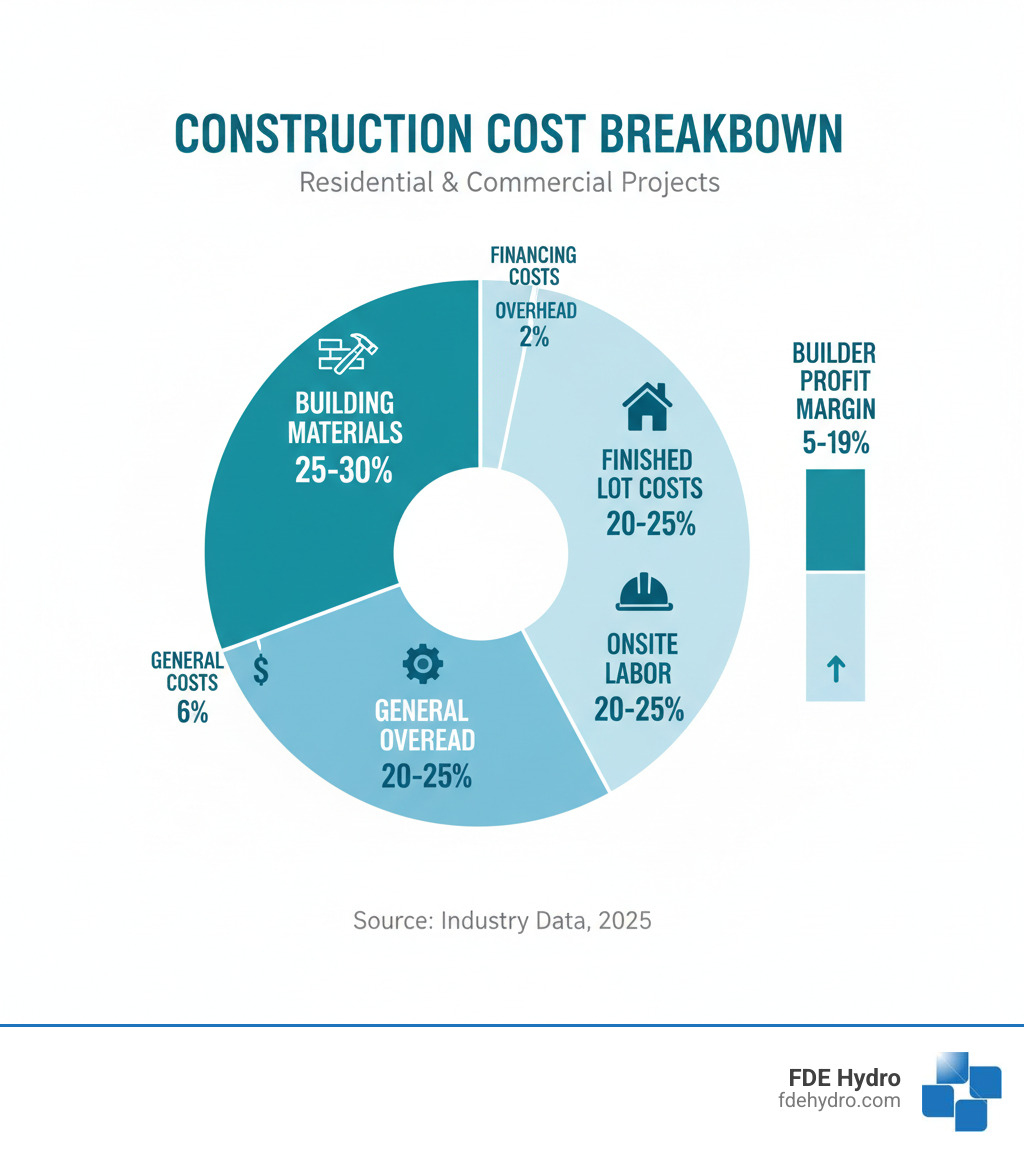
The construction industry faces unprecedented pressure from rising material prices and labor shortages. With material and labor costs representing over 90% of project expenses, profitability is squeezed across every sector. Yet, cost overruns aren’t inevitable. The primary obstacle is often mismanagement and lack of supervision, not a lack of tools. Strategic approaches can deliver substantial savings: 20-30% for residential projects, 10-20% for infrastructure, and 25-35% for industrial construction.
This guide provides a comprehensive blueprint for savings across the project lifecycle. You’ll find proven strategies for delivering on-time, on-budget results, even in challenging economic conditions. The key is to understand your costs and implement strategic controls at each phase. Whether for a small residential build or a multi-million dollar infrastructure project, the fundamentals are the same: plan carefully, build efficiently, and manage relentlessly.
I’m Bill French Sr., founder and CEO of FDE Hydro. With five decades in heavy civil construction and hydropower, I’ve pioneered methods to reduce construction costs using innovative modular approaches. My experience leading over $200M in annual projects has taught me that the smartest savings come from working better, not cheaper.
Essential reduce construction costs terms:
Strategic Planning and Design: The Foundation of Cost Savings
The journey to reduce construction costs begins long before the first shovel hits the ground—it starts in the planning and design phase. Smart decisions here have the biggest impact on your bottom line, preventing costly rework later. It’s much cheaper to fix a problem on paper than to rebuild on-site. That’s why we start with a comprehensive cost breakdown structure (CBS)—a detailed outline of every expense. This financial roadmap provides clarity on where to spend and save. We also consider our Means and Methods early, selecting the most efficient construction techniques for the job.

How Value Engineering Helps Reduce Construction Costs
Value engineering isn’t about cutting corners; it’s about maximizing value at minimum cost without compromising quality. The process involves critically analyzing every design element and material. For each component, we ask: “Is this the most efficient way to achieve our goal?”
Life-cycle cost analysis is a key part of this. We look beyond the upfront price to consider long-term expenses like maintenance and energy use. High-performance insulation might cost more initially but saves thousands in energy bills over the building’s lifespan.
Space optimization is another powerful tool. Efficient layouts can reduce overall square footage without sacrificing functionality. Every square foot eliminated saves on materials, labor, and future utility costs. For kitchens and bathrooms—the most expensive rooms per square foot—consider phased upgrades. Install cost-effective fixtures initially and plan to upgrade later. For example, rough in the plumbing for a jetted tub but install a standard one first. The upgrade becomes a simple swap without structural changes.
Smart Design Choices for a Leaner Budget
Early design decisions have ripple effects throughout the project. Here are the choices that make the biggest difference:
- Define wants versus needs: Honestly separate the must-haves from the nice-to-haves to prioritize spending where it truly matters.
- Choose stock vs. custom designs: Modifying an existing stock plan offers personalization while saving substantially on architectural fees compared to a fully custom design.
- Reduce square footage: A smaller footprint is the most direct way to reduce construction costs, as it means less material, labor, and a shorter timeline.
- Build upward, not outward: A two-story design is more cost-effective than a sprawling single-story home of the same size because it minimizes foundation and roof expenses relative to the living area.
- Simplify roof systems: A simple roofline is far more economical than a complex one with multiple gables and valleys, requiring fewer materials and less specialized labor.
- Use open-plan layouts: Reducing interior walls and doors saves on materials and labor while making spaces feel larger and more flexible.
- Select finishes wisely: Using drywall for ceilings costs about half as much as pine paneling. These choices add up quickly.
- Use expensive materials strategically: For specialty homes, use expensive finishes like logs or stone as accents rather than covering entire surfaces. This provides visual interest without the high price tag.
Smart design doesn’t feel like a compromise; it feels like intelligent planning that delivers a beautiful, functional project without unnecessary expense.
Innovative Materials and Methods to Reduce Construction Costs
The materials you choose and the methods you employ can transform your project’s bottom line. We’ve spent decades exploring innovative approaches that cut costs and deliver better, faster results.
The Power of Prefabrication and Off-Site Building
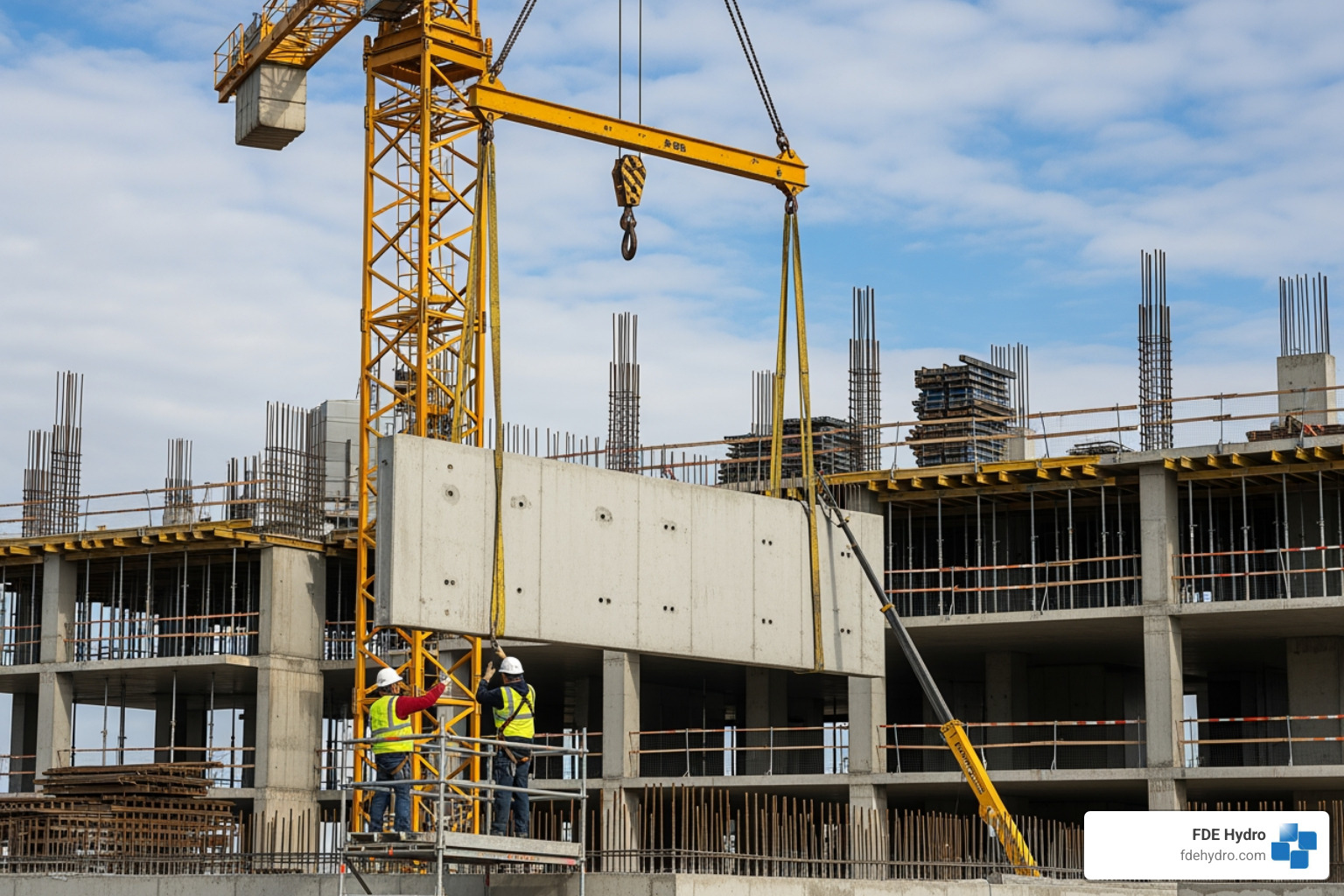
Prefabrication and modular construction involve manufacturing building components in a factory and assembling them on-site. This approach has revolutionized building in North America, Brazil, and Europe, offering substantial benefits:
- Reduced on-site labor: Factory workflows are streamlined and unaffected by weather, directly lowering labor costs.
- Minimized material waste: Controlled environments allow for precise cuts and material optimization, drastically reducing waste compared to traditional sites.
- Faster project completion: Components are manufactured while site preparation occurs, shaving months off schedules. At FDE Hydro, our proprietary “French Dam” modular technology exemplifies this speed, allowing projects to generate revenue sooner. Learn more about our Modular Construction Techniques.
- Improved quality control: Factory conditions allow for consistent inspections and adherence to standards, resulting in fewer defects.
The durability and energy efficiency of precast concrete panels are exceptional. A 6.5″ concrete wall offers a fire-resistance rating of four hours or more. These panels can integrate multiple layers (finishes, insulation, structure) into one system, while their thermal mass helps regulate indoor temperatures, lowering long-term energy costs.
Our research shows Why Precast Costs Less. In our projects, modular precast concrete eliminates labor-intensive processes and waste, delivering transformative savings that help clients reduce construction costs.
Strategic Sourcing for Materials and Equipment
Smart procurement is about finding the best value, not just the lowest price. This means balancing cost with quality and reliability.
- Build strong supplier relationships: Long-term partnerships with reputable suppliers can lead to better pricing, volume discounts, and flexible payment terms.
- Negotiate bulk purchase discounts: Accurate forecasting allows for buying in volume, which yields significant per-unit savings on large-scale projects.
- Source materials locally: This reduces transportation costs and leverages local suppliers’ knowledge of regional codes and logistics. For projects requiring Rapid Installment of Module Precast Civil Infrastructure, local sourcing is essential.
- Use just-in-time (JIT) delivery: Materials arrive precisely when needed, minimizing on-site storage, damage, and theft. JIT requires meticulous planning but is a powerful tool to reduce construction costs.
Optimizing On-Site Operations and Labor Management
Even with great planning, what happens on the job site can make or break your budget. Inefficient operations or poor labor management can derail a project, but small improvements here can yield dramatic results to reduce construction costs.
Labor costs can consume 40% of a construction project’s budget, so managing this expense is essential. Start by hiring skilled workers. Experienced tradespeople command higher rates but work faster, make fewer mistakes, and produce higher quality results, which ultimately lowers costs by reducing rework and delays.
Better scheduling is another game-changer. Coordinating trades effectively minimizes downtime and keeps the project moving. We also invest in training and development. A well-trained workforce is safer and more efficient, and safety training alone prevents costly accidents.
How Technology Can Reduce Construction Costs
Technology gives craftspeople better tools to work smarter. Here’s how it helps:
- Building Information Modeling (BIM) creates a detailed 3D digital model of the project. This allows for “clash detection,” identifying problems like a pipe running through a beam before construction begins. Fixing issues with a mouse click instead of a jackhammer prevents costly rework and keeps schedules on track.
- Construction management software provides real-time visibility into project costs, schedules, and subcontractors. Kingston Homes, for example, achieved a 15% cost reduction using such software. It allows managers to address budget issues immediately, not at the end of the month.
- Drones are invaluable for fast, accurate site surveys and progress monitoring. They can also conduct safety inspections in hard-to-reach areas, reducing risk.
- Automation and robotics are increasingly used for repetitive tasks like rebar-tying, performing them faster and with more consistent quality than manual methods.
Controlling Scope Creep and Change Orders
Change orders are budget killers. A seemingly “little change” can cascade through a project, causing rework, schedule delays, and increased subcontractor costs.
Our first defense is developing clear contracts that outline every project aspect, including a process for handling changes. Ambiguity invites uncontrolled costs.
We also implement a formal change management process. Every request is documented, evaluated for its cost and schedule impact, and formally approved by all stakeholders before implementation. This ensures everyone understands the financial implications.
Maintaining clear communication with stakeholders prevents many change orders by surfacing potential issues early. Finally, avoiding last-minute design changes after construction begins is critical. The cost of changes multiplies exponentially once work is underway. Get the design right before the first pour to reduce construction costs dramatically.
Navigating Financials, Risks, and Regulations
To reduce construction costs, you must understand financial realities, manage risks, and steer regulations. These factors can make or break your bottom line.
Proactive Risk and Financial Management
Every project has risks; how you manage them determines success. Many wonder about acting as their own general contractor to save on the builder’s 4.8% to 18.9% profit margin. However, this is risky. Subcontractors often charge homeowners more, you lack the purchasing power of a professional builder, and insurance premiums are higher. The cost of inexperience and mistakes can quickly erase any potential savings.
Contingency funds are essential. We build a 5-10% cushion into our budgets for surprises like material surcharges or unexpected site conditions. This prevents delays while scrambling for funds.
Building strong relationships with lenders secures favorable financing terms, which can significantly reduce construction costs over a project’s life. A single percentage point difference on a multi-million dollar project is substantial. Finally, adequate insurance is a necessary upfront cost that protects against catastrophic financial losses.
How Regulations and Competition Impact the Bottom Line
The regulatory environment and market competition directly influence construction costs. We’ve seen this across North America and Brazil.
Restrictive Project Labour Agreements (PLAs) can dramatically inflate costs by limiting competition. In Ontario, Canada, a PLA is projected to add $168 million to $525 million to the cost of a new hospital because fewer companies could bid on the work.
Conversely, open competition drives down prices. The Region of Waterloo in Canada saved $24 million in two years after opening tenders to all qualified companies, seeing a 14% drop in average bid prices. The City of Hamilton estimated savings up to 21%. As one report notes, Increased competition is critical to counter rising construction prices.
Skilled trades training program rigidity also presents a challenge. When certification depends on hours worked rather than skill, it creates labor shortages. Reforming the system to recognize skills at every stage would expand the labor pool, address shortages, and ultimately reduce construction costs.
Frequently Asked Questions about Reducing Construction Costs
What is the most effective way to lower construction costs?
The most powerful way to reduce construction costs is through meticulous pre-construction planning and design. Decisions made during this phase—simplifying a roofline, reducing square footage, or applying value engineering—have the largest downstream effect on material and labor costs. Projects that invest time and expertise upfront consistently come in on budget.
Can I save money by acting as my own general contractor?
While it’s tempting to save the builder’s profit margin (which can be 4.8% to 18.9%), the risks often outweigh the reward. Subcontractors may charge you more than a professional builder who provides repeat business. You’ll lack a builder’s purchasing power for materials and have to buy or rent specialty tools for a single job.
Furthermore, insurance companies view individual builders as a higher risk, leading to higher premiums. The cost of mistakes due to inexperience can quickly eliminate any supposed savings. Unless you have significant construction experience, hiring a professional is usually the smarter financial choice.
How does technology like BIM help reduce costs?
Building Information Modeling (BIM) saves money by creating a detailed 3D digital model of your project, allowing you to catch problems before they become expensive. The key feature is clash detection. This lets you see where elements conflict—like a plumbing line running through a structural beam—and fix the issue digitally during the design phase.
Resolving these conflicts on a screen instead of on-site with jackhammers prevents costly rework, material waste, and schedule delays. In my experience with large-scale infrastructure, BIM is invaluable for ensuring modular components fit together precisely, which is critical for staying on budget and on schedule.
Conclusion
The path to reduce construction costs isn’t about taking shortcuts; it’s about building smarter. We’ve walked through the essential strategies that deliver exceptional value, starting with strategic planning and design, where your most powerful cost-saving decisions are made.
Next is the power of innovation—embracing prefabrication, modular construction, and smart sourcing to slash costs and timelines. On-site efficiency and management preserve those savings through technology like BIM and vigilant scope control. Finally, understanding the financial and regulatory landscape protects your bottom line from unexpected hits.
The construction industry faces challenges, but obstacles can be overcome. Data shows that systematic strategies can yield savings of 10-35% depending on the sector. The key is a commitment to planning, innovation, and excellence in execution.
At FDE Hydro, we’ve built our reputation on this philosophy. Our innovative modular precast concrete technology, the “French Dam,” is designed to lower expenses and accelerate project timelines in the energy and water sectors across North America, Brazil, and Europe. We’ve spent five decades proving that the smartest way to reduce construction costs is to work better, not cheaper.
The future of construction belongs to those who accept these principles. Every project is an opportunity to prove that quality, efficiency, and cost-effectiveness can coexist.
Ready to see how modular innovation can transform your next project? Learn more about controlling Hydropower Project Costs with FDE Hydro’s cutting-edge solutions.
by Bill French Sr. | Dec 29, 2025 | Energy Resource Articles
Understanding Energy Resource Development
Energy resource development is the process of finding, extracting, and using natural energy sources to power our world. It includes everything from drilling for oil to using the sun’s rays. Understanding where our energy comes from is key to our daily lives and our future.
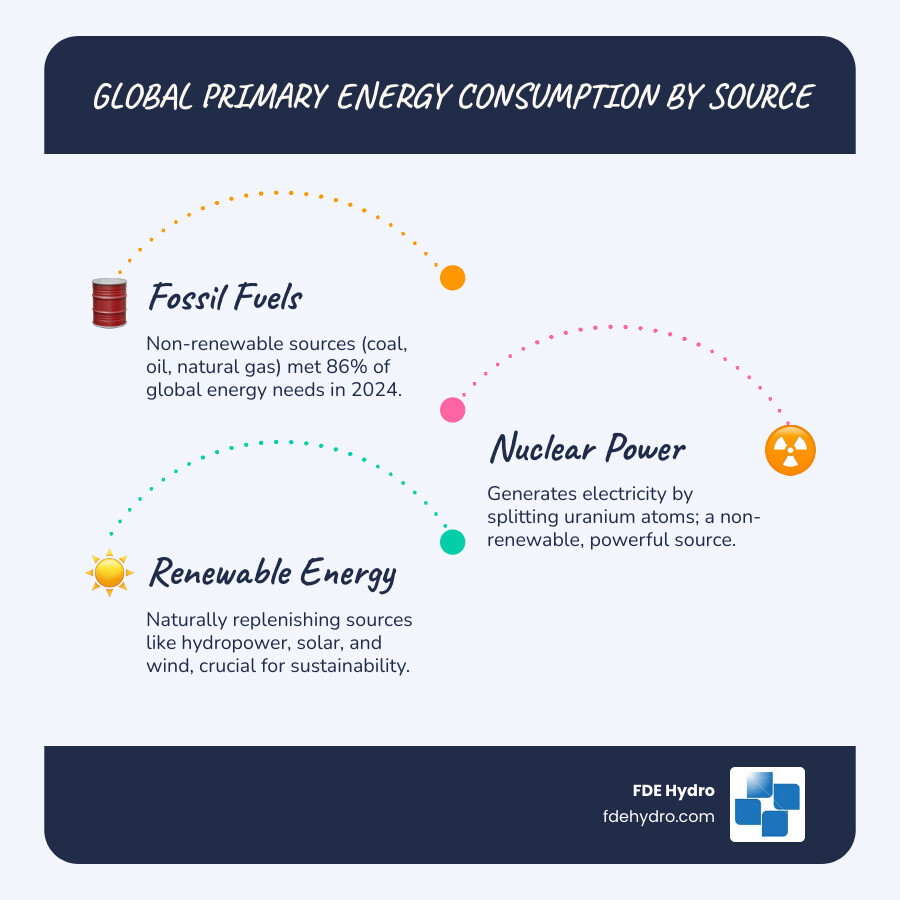
Here’s a quick breakdown of the world’s primary energy sources:
- Fossil Fuels: These are non-renewable sources like coal, oil, and natural gas. They currently make up the largest part of our energy supply.
- Nuclear Power: This comes from splitting atoms, usually uranium, to create heat and electricity. It’s also non-renewable.
- Renewable Energy: These sources naturally replenish. They include hydropower, solar, wind, geothermal, and biofuels.
Our modern world deeply relies on energy. It powers our homes, transportation, and industries. In 2024, a significant 86% of global energy needs were met by fossil fuels. This shows how crucial energy resource development is, but also highlights the ongoing challenge of shifting towards more sustainable options. This guide will explore this vital field.
I’m Bill French Sr., Founder and CEO of FDE Hydro™. My five decades in heavy civil construction and my participation in the Department of Energy’s Hydro Power Vision Task Force have deeply shaped my understanding of energy resource development, particularly in advancing modular hydropower solutions for clean energy.
Relevant articles related to Energy resource development:
The Spectrum of Energy Resources
When we talk about energy resource development, we’re diving into a fascinating world of different sources that power our lives. Each one has its own special qualities, its upsides, and its unique challenges. We often sort these sources into two big groups: primary, which are found in nature, and secondary, which are converted from primary sources. But perhaps even more importantly, we classify them as renewable or non-renewable. Here at FDE Hydro™, our hearts and efforts are firmly rooted in the renewable side of things, with a special focus on hydropower.
Primary energy sources are just as they sound — they’re raw energy from nature, like crude oil bubbling up from the ground or sunlight warming your face. Secondary sources, on the other hand, are what we get after we transform that raw energy, think of electricity made from coal or power generated by solar panels. If you’re curious to learn more about the very basics of energy, our Energy 101 guide is a great place to start!
There are many amazing renewable energy sources leading the charge toward a cleaner future. These include hydropower, which uses the natural flow of water; solar power, converting sunlight into electricity or heat; wind power, using the breeze with turbines; geothermal energy, tapping into the Earth’s internal warmth; biofuels, created from organic matter; and even oceanic energy, capturing power from tides, waves, and ocean currents.
Classifying Renewable Resources
Renewable resources are truly special because they naturally replenish themselves within a human timeframe. Unlike fossil fuels, which take millions of years to form and are quickly used up, renewables offer us a sustainable path forward. They’re like nature’s endless battery pack!
Hydropower, our area of expertise, truly shines in this lineup. It’s a proven technology that puts the powerful force of water to work, spinning turbines to generate clean electricity. Now, the environmental footprint of hydropower can certainly vary depending on the project. While large traditional dams might change local ecosystems, modern approaches – especially those using modular technology like ours – are designed to minimize disruption and actually improve existing infrastructure. In fact, the 2023 Statistical Review of World Energy confirms that hydropower remains a vital cornerstone of global electricity generation, providing a significant chunk of our planet’s renewable power.
The Central Role of Hydropower in Clean Energy
Here at FDE Hydro™, we truly believe hydropower holds a unique and incredibly important spot in the clean energy world. It’s more than just making electricity; it’s about delivering steady, reliable power that can beautifully balance the natural ups and downs of other renewables like solar and wind. This makes it a crucial player in achieving truly Sustainable Power Generation. To dive deeper into its capabilities, check out our main page on Hydropower.
Hydropower offers so many compelling advantages:
- It provides reliability and baseload power. Unlike solar or wind, which depend on sunshine or breeze, hydropower can deliver a consistent supply of electricity, often on demand. This makes it perfect for providing the foundational power we rely on every day.
- It boosts grid stability. Hydropower plants can quickly adjust their output, offering essential services like frequency regulation and voltage support to keep our electrical grid running smoothly. This is why we often say hydropower is the guardian of the grid!
- It’s fantastic for water management. Many hydropower facilities serve multiple purposes, helping with flood control, providing water for irrigation, and ensuring a stable water supply for communities. They’re truly multi-talented!
- And once they’re built, these plants have low operating costs. This means they provide long-term, affordable electricity.
Back in 2015, hydropower generated an impressive 16.6% of the world’s total electricity, and a remarkable 70% of all renewable electricity. That’s a huge contribution! Our innovative, patented modular precast concrete technology, affectionately known as the “French Dam,” is designed to build and retrofit hydroelectric dams and water control systems across North America, Brazil, and Europe. This smart approach drastically cuts down construction costs and time, making clean hydropower more accessible and efficient for everyone. To learn more about how we bring these exciting projects to life, be sure to explore our Renewable Energy Projects Complete Guide.
The Evolution and Technology of Energy Resource Development
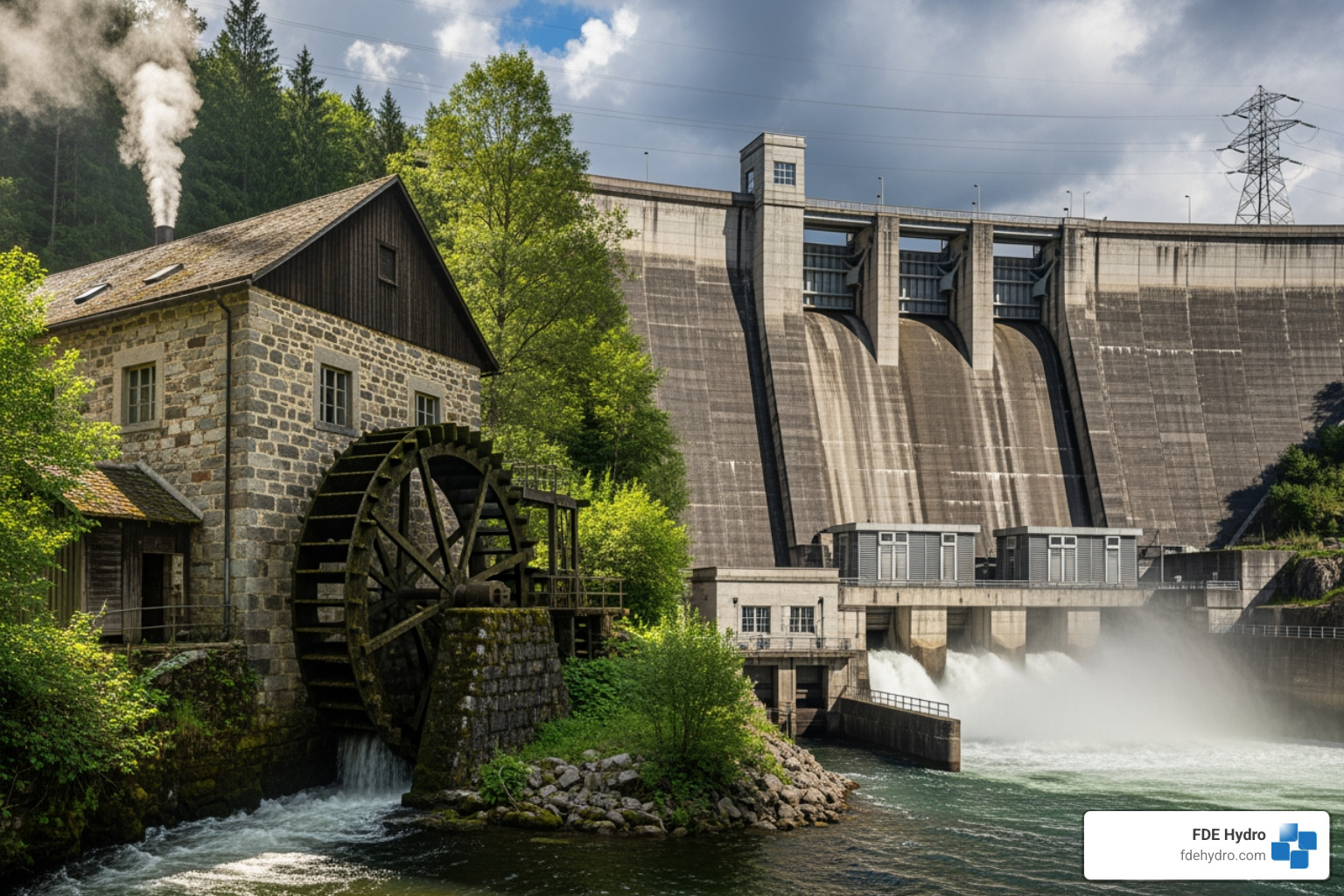
The story of energy resource development is one of human ingenuity and constant adaptation. From the first controlled fires to today’s sophisticated power grids, our relationship with energy has defined how we live, work, and build our societies.
A Historical Perspective on Energy Development
Think back to our earliest ancestors. Their energy toolkit was pretty simple: wood for warmth and cooking, animals to help with heavy work, and their own muscle power. But even then, humans recognized the power of flowing water. Those first watermills, grinding grain and powering early workshops, were the humble beginnings of what we now call hydropower.
The real game-changer came with the Industrial Revolution in the 18th century. Coal became king, and suddenly we could power massive factories and light up entire cities. Steam engines transformed everything from manufacturing to transportation. This era laid the foundation for the modern energy systems we rely on today, particularly in Europe and North America.
Then came electrification in the 20th century. This wasn’t just about turning on lights—it fundamentally changed how we lived. Factories became more efficient, homes more comfortable, and entire new industries became possible. Large-scale hydropower projects joined fossil fuels in powering this change, and they’ve been working reliably ever since.
Today, we’re in the midst of what many call the renewable revolution. Concerns about climate change and dwindling fossil fuel reserves have pushed us to rethink how we generate power. This shift toward cleaner, more sustainable sources isn’t just good environmental policy—it’s smart business. You can explore more info about the evolution of energy and see how far we’ve come.
Key Technologies in Modern Hydropower Resource Development
Modern hydropower looks nothing like those old watermills. Today’s technology maximizes efficiency while minimizing environmental impact—a balance that’s become increasingly important.
Advanced hydropower turbines are engineering marvels. From traditional Francis and Kaplan designs to newer fish-friendly models, these machines convert water’s kinetic energy into electricity with remarkable efficiency. Each type is optimized for different water flow conditions and head heights.
Pumped storage hydroelectricity deserves special mention because it’s essentially a giant battery for the grid. Here’s how it works: when electricity demand is low (like at night), excess power pumps water uphill to a reservoir. When demand spikes, that water rushes back down through turbines, generating electricity exactly when it’s needed. This technology is already proving crucial for grid stability in the US and Europe, especially as more intermittent renewables come online.
Advanced control systems bring hydropower into the digital age. Automated monitoring and precise flow management mean these plants can respond instantly to grid needs, optimizing performance and integrating seamlessly with other energy sources.
At FDE Hydro™, we’re proud to be pushing this technology even further. Our patented modular precast concrete technology—the “French Dam”—represents a genuine breakthrough in hydropower development. Instead of years-long construction projects, our approach dramatically cuts both time and costs. We’re building and retrofitting hydroelectric dams and water control systems across North America, Brazil, and Europe, making clean hydropower more accessible than ever. We’re also embracing AI-Driven Development to optimize everything from design to daily operations.
From Source to Socket: Energy Transmission and Infrastructure
Generating electricity is only half the challenge. Getting that power to your home or business requires an incredibly complex network—what we call the electrical grid. This massive interconnected system includes power plants, high-voltage transmission lines, substations, and the local distribution lines that finally bring electricity to your door.
High-voltage transmission lines are the workhorses of this system, carrying massive amounts of electricity across hundreds of miles with minimal loss. The higher the voltage, the more efficiently power travels long distances. These lines connect generating stations to the population centers where that power is needed.
Substations act as the grid’s translators. They step voltage up for efficient long-distance transmission, then step it back down for safe local distribution. Think of them as the crucial connection points that keep electricity flowing smoothly throughout the system.
The future of energy resource development increasingly depends on smart grids. These digitally improved networks can detect and respond to local changes in real time, improving reliability and making it much easier to integrate renewable sources. When a cloud passes over a solar farm or the wind dies down, smart grids can instantly adjust, pulling power from other sources—often hydropower—to maintain stability.
Microgrids represent another exciting development. These smaller, localized grids can operate independently or stay connected to the main grid, providing improved reliability for critical infrastructure or remote communities. At FDE Hydro™, we often design our hydropower solutions to work within a Microgrid framework, offering communities greater energy independence.
The electrical grids in the US, Canada, and Europe are among the world’s most sophisticated, but they require constant investment and upgrading. As we integrate more renewable sources and face increasing demand, this infrastructure becomes even more critical. Our Energy Infrastructure Development Complete Guide goes deeper into the planning and execution of these essential systems.
Impacts, Efficiency, and the Path Forward

Every form of energy resource development carries its own set of consequences, both environmental and economic. The question isn’t whether there’s an impact—there always is. The real question is how we can maximize the benefits while minimizing the harm as we move toward a cleaner, more sustainable future.
Environmental and Economic Impacts of Hydropower Development
Let’s be honest: no energy source is perfect. Even hydropower, one of the cleanest options available, comes with considerations. But when you compare it to fossil fuels, which met 86% of the world’s energy needs in 2024, the advantages become crystal clear.
On the environmental side, hydropower’s biggest win is greenhouse gas reduction. During operation, hydropower produces zero direct greenhouse gas emissions. That’s a huge difference from coal or natural gas plants that continuously pump carbon dioxide into our atmosphere.
The challenges with hydropower typically involve water and land use. Large conventional dams can alter river ecosystems, affect fish migration patterns, and sometimes displace communities when reservoirs are created. But here’s where modern innovation makes a real difference. Our modular, precast concrete technology at FDE Hydro™ focuses on retrofitting existing dams and water control systems. Instead of building massive new structures, we’re maximizing what’s already there. This approach dramatically reduces environmental disturbances while developing new hydropower capacity with a much smaller footprint.
The economic story is equally compelling. Hydropower projects create economic growth through job creation—from engineers and construction workers during the building phase to operations and maintenance staff for decades after. These aren’t temporary jobs, either. They’re skilled positions that support families and communities.
Once a hydropower facility is up and running, it provides stable, affordable electricity for generations. Unlike fossil fuels, where prices swing wildly with global markets, hydropower offers predictable, low-cost energy that shields consumers from volatility. Meanwhile, fossil-fuel subsidies continue hurting the global environment and security, propping up an industry with significant environmental and health costs.
The Critical Role of Energy Efficiency
Here’s something many people don’t realize: the cheapest, cleanest energy is the energy we never use in the first place. That’s why energy efficiency is often called the “first fuel” in energy resource development strategies.
Think about it this way—reducing energy demand means we need less new power generation capacity. Every kilowatt-hour we save through efficiency is a kilowatt-hour we don’t need to produce. It’s that simple.
The beauty of energy conservation measures is that many are surprisingly straightforward. Better building insulation in homes and offices across North America and Europe can slash heating and cooling demands. Upgrading to efficient technologies like LED lighting makes a real difference—compact fluorescent lights use two-thirds less energy and last 6 to 10 times longer than old incandescent bulbs. Modern appliances, smart thermostats, and improved industrial processes all add up to massive savings.
Energy efficiency and renewable energy are often called “the twin pillars of sustainable energy.” They work hand-in-hand, supporting each other in building a truly sustainable future. At FDE Hydro™, we’re even exploring how AI Energy Management can optimize energy use across different sectors, making our systems smarter and more responsive.
The path forward isn’t just about building more clean energy—it’s about using less energy overall while making what we do use as clean as possible. That’s the combination that will get us where we need to go.
Navigating the Global Energy Landscape
When we talk about energy resource development, it’s so much more than just power plants and dams. It’s a huge, interconnected puzzle that touches on global politics, international agreements, and even the safety of our nations. Every choice we make about energy sends ripples across the world.
Major Global Players and Policies
The way we get and use energy isn’t just decided in one place. Big international groups and governments all play a role in shaping our energy future. Think of organizations like the International Energy Agency (IEA). They give us important insights and advice, like in their detailed World Energy Outlook. These reports help guide decisions everywhere.
Then there are global agreements, like the Paris Agreement. These set goals for cutting down harmful emissions, which in turn encourages everyone to invest more in clean energy. Here in the United States, the Department of Energy (DOE) and its Office of Energy Efficiency and Renewable Energy (EERE) are big drivers of new ideas. They help fund new energy innovations through programs on the EERE Funding Opportunity eXCHANGE. You’ll find similar efforts in places like Canada, Brazil, and Europe, all working towards a cleaner energy future.
How Hydropower Development Contributes to National Security
Energy isn’t just about keeping the lights on; it’s a huge part of a nation’s security. A country needs reliable energy to protect itself, keep its economy strong, and ensure its people are safe. This is where energy resource development, especially hydropower, truly shines.
First, there’s energy independence. When a country can produce its own energy, it doesn’t have to rely on other nations, especially for fuels that can be unstable. Hydropower is a domestic resource in many places, including North America, Brazil, and Europe. This means it helps countries stand on their own two feet, making them less open to global troubles.
Then, there’s supply chain security. Having different ways to get energy, and producing it at home, helps protect us from problems in global supply chains. Hydropower plants are also incredibly strong and last a long time. They’re a vital part of a nation’s key infrastructure, providing steady power even when things get tough, like during bad weather. We often talk about “energy resilience” now, which means being able to bounce back from power outages, rather than just “energy independence.” It’s about having a strong, diverse energy system, much like what’s discussed in “Brittle Power: Energy Plan for National Security.”
Challenges and Opportunities in the Clean Energy Transition
Moving to a truly sustainable energy future is a huge journey. Back in 2024, a big chunk of our energy—86%—still came from fossil fuels. Switching away from that means facing some big challenges, but it also brings amazing opportunities.
Hydropower plays a vital role here. Think about solar and wind power; they’re wonderful, but they don’t always produce electricity when we need it. That’s called intermittency. Hydropower, with its ability to quickly adjust how much power it makes, steps in as a flexible partner. It helps keep the grid steady and reliable.
Beyond pumped hydro, new energy storage solutions are always being developed to help manage these ups and downs. We also need to modernize our electrical grids. This means big upgrades to our existing systems, which opens the door for lots of new Clean Energy Infrastructure projects. This shift isn’t just good for the planet; it’s a powerful engine for our economy. It creates millions of green jobs in making, installing, and researching new technologies. Innovation, like FDE Hydro’s modular hydropower solutions, is key to speeding up this change.
At FDE Hydro™, we’re proud to be a big part of this solution. Our special modular precast concrete technology helps us build hydropower projects faster, more affordably, and in a way that’s kind to the environment. We’re working hard in North America, Brazil, and Europe to build a stronger, cleaner, and more secure energy future for everyone.
Frequently Asked Questions about Energy Resource Development
What are the main classifications of energy resources?
When people talk about energy resource development, they’re usually dividing resources into two main camps: renewable and non-renewable.
Non-renewable resources are the ones we’re trying to move away from. These include fossil fuels like coal, oil, and natural gas, plus nuclear fuels like uranium. The problem? They’re finite. Once they’re gone, they’re gone. They took millions of years to form, and we’re burning through them in mere centuries.
Renewable resources are the future. These naturally replenish on a human timescale, meaning they’re essentially inexhaustible when managed properly. This category includes hydropower (our specialty at FDE Hydro™), solar, wind, geothermal, biofuels, and oceanic energy from tides and waves.
At FDE Hydro™, our focus is squarely on renewable resources, with hydropower as the leading example of sustainable energy resource development. We believe hydropower isn’t just renewable—it’s also reliable, flexible, and proven over more than a century of use.
Why is energy efficiency important for energy development?
Energy efficiency is crucial because it tackles the problem from the demand side rather than just the supply side. Think of it this way: the cleanest, cheapest energy is the energy you never had to produce in the first place.
When we use less energy to achieve the same results—whether that’s lighting a room, heating a home, or running a factory—we reduce the overall strain on our resources. This matters for both renewable and non-renewable sources. Lower demand means we need fewer new energy resource development projects, which translates to less environmental impact, lower greenhouse gas emissions, and reduced costs for consumers.
Energy efficiency is often called one of the “twin pillars” of sustainable energy policy, working hand-in-hand with renewable energy development. By reducing how much energy we need, we make the transition to a clean energy system more manageable and cost-effective. It’s a win-win: better for the planet and better for our wallets.
What is the biggest challenge in transitioning to 100% renewable energy?
The biggest challenge, especially in large interconnected grids across North America, Brazil, and Europe, is dealing with the intermittency and variability of certain renewable sources. Solar panels don’t generate power at night. Wind turbines sit idle when the air is calm. These aren’t minor inconveniences—they’re fundamental characteristics that affect grid reliability.
This creates a real need for reliable, on-demand power and robust energy storage solutions to keep the lights on 24/7. You can’t just tell a hospital or a manufacturing plant to shut down when the sun goes behind a cloud.
This is where hydropower shines. It provides flexible, dispatchable power that can ramp up or down quickly to balance the grid. Pumped storage hydropower acts like a giant battery, storing energy when there’s excess and releasing it when demand peaks. Hydropower and energy storage technologies play a key role in maintaining a reliable power supply and supporting grid stability as we integrate more variable renewables.
At FDE Hydro™, we see this as an opportunity. Our modular technology makes it faster and more affordable to build and retrofit hydropower facilities, helping to solve one of the biggest challenges in the clean energy transition.
Conclusion
Wow, what a journey we’ve been on! We’ve traveled through the amazing story of energy resource development, right from our ancestors huddling around a fire to the super-smart power grids that light up our world today. It’s been a wild ride, and our constant search for energy has truly shaped human history. But now, it’s clear we’re at a turning point, looking at a huge shift towards a more sustainable future.
Here’s the undeniable truth: clean energy is our future. While fossil fuels have powered us for a long time, the push for change is stronger than ever. This big shift means we don’t just need new ways to make energy; we also need clever new infrastructure and smart technologies. These tools will help us capture and deliver clean power in the most efficient and reliable ways possible.
At FDE Hydro™, we’re thrilled to be leading the charge in this exciting new era. Our unique, patented modular precast concrete technology, often called the “French Dam,” is truly changing how we build and upgrade hydropower plants. It makes these projects faster, more affordable, and much kinder to our environment. By modernizing hydropower, we’re doing more than just building dams; we’re creating the strong backbone for a resilient, clean energy network across North America, Brazil, and Europe. We’re helping to build a future where clean, dependable energy lights up our homes, protects our planet, and keeps our nations secure.
The future of energy isn’t just coming; it’s already here, and it’s flowing with power. To dive deeper into advanced hydropower solutions and see how we’re making this future a reality, please learn more about FDE Hydro’s innovative approaches.

