

Why Water Management Infrastructure Matters More Than Ever
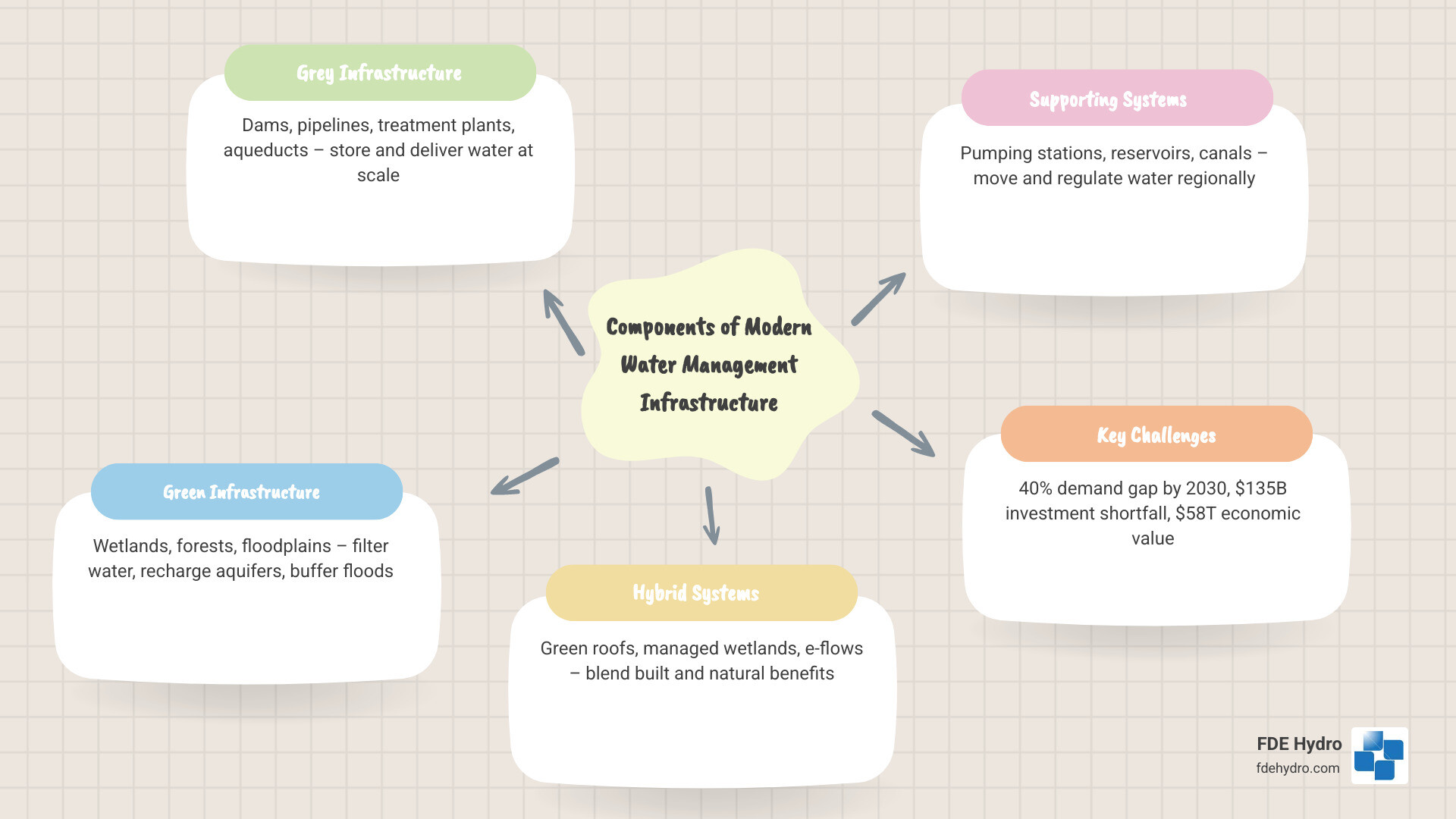
Water management infrastructure encompasses the systems — both built and natural — that collect, store, treat, and deliver water to homes, farms, and industries.
Here is a quick overview of what it includes and why it matters:
| Category | Examples | Key Purpose |
|---|---|---|
| Grey (built) infrastructure | Dams, pipelines, treatment plants, aqueducts | Store and deliver water at scale |
| Green (natural) infrastructure | Wetlands, forests, river floodplains | Filter water, recharge aquifers, buffer floods |
| Hybrid systems | Green roofs, managed wetlands, e-flows | Combine built and natural benefits |
| Supporting systems | Pumping stations, reservoirs, canals | Move and regulate water across regions |
Why it matters:
- Global water demand is expected to outstrip supply by 40% by 2030
- The total economic value of water reached $58 trillion in 2021 — roughly 60% of global GDP
- Every $1 invested in water and sanitation returns $4 in reduced healthcare costs
- Despite this, the world faces an annual $135 billion investment shortfall to meet SDG water goals
Without well-designed, well-maintained water infrastructure, communities face shortages, crop failures, economic losses, and public health crises. This is not a future risk — it is already happening in regions across the globe.
I’m Bill French, Sr., Founder and CEO of FDE Hydro™, and I’ve spent decades leading complex heavy civil construction projects — from large-scale site development to modular infrastructure innovation — giving me a front-row seat to the challenges and opportunities in water management infrastructure. In this guide, I’ll walk you through how these systems work, where they’re falling short, and what smarter, more efficient approaches look like today.
Water management infrastructure glossary:
Defining Water Management Infrastructure: Grey vs. Green Systems
When we talk about water management infrastructure, we are looking at a continuum. On one end, you have the “grey” systems—the hard, engineered assets like concrete dams and steel pipes. On the other end is “green” infrastructure—the natural ecosystems like forests and wetlands that provide essential water services.
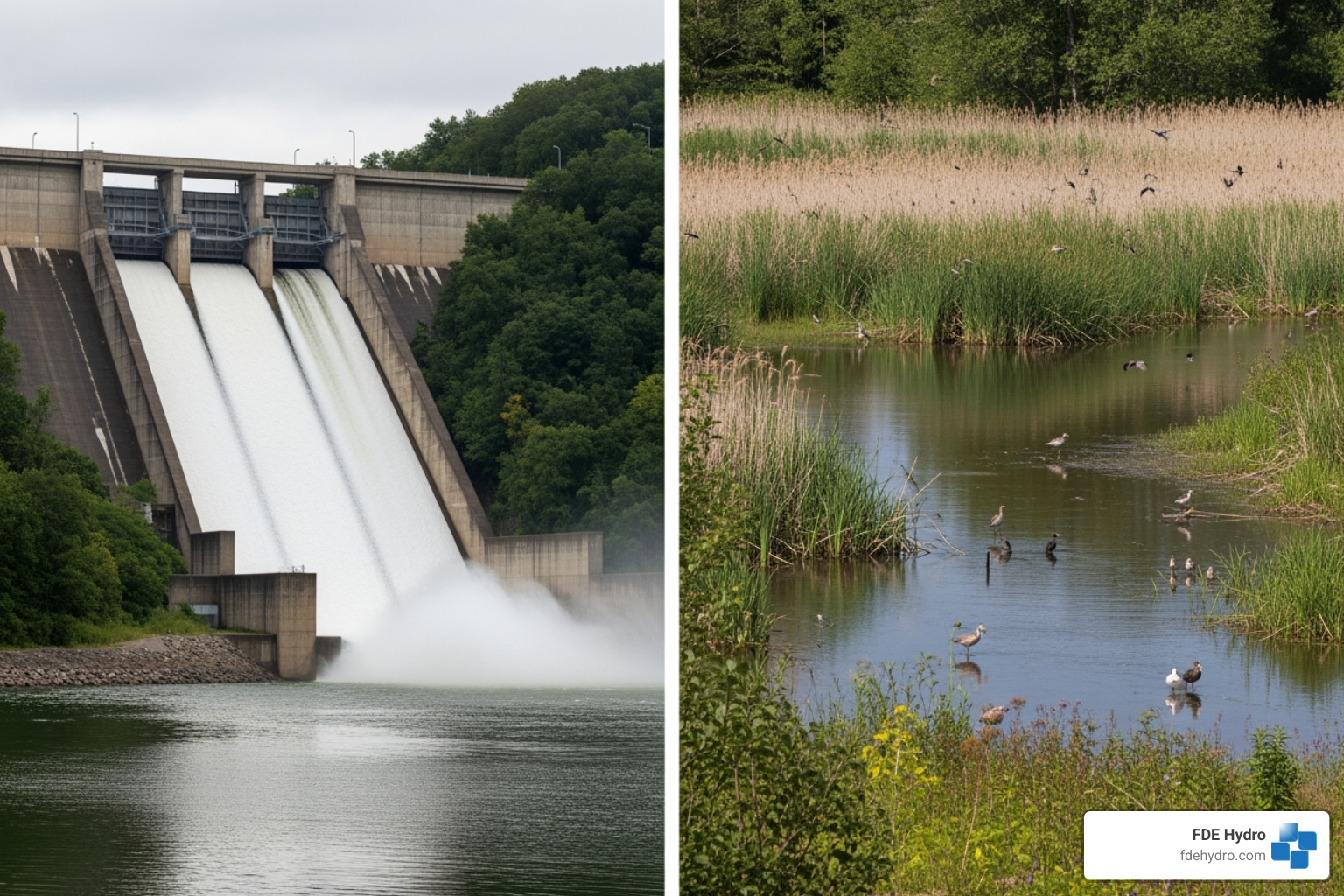
For a long time, the world focused almost exclusively on grey infrastructure. While these systems are vital for moving massive amounts of water to thirsty cities, they often came at the cost of the environment. Today, we are learning that the most resilient systems are those that integrate both. By combining the reliability of built structures with the flexibility of nature, we can create sustainable water infrastructure that protects biodiversity while serving human needs.
An exciting example of this integration is the proposal to cover open canals with solar panels. Scientific research on energy and water co-benefits from solar-covered canals suggests that such a move could reduce evaporation by 11 to 22 million gallons per mile while generating clean energy to power the very pumps that move the water.
The Role of Grey Systems in Modern Water Management Infrastructure
Grey infrastructure remains the backbone of urban and agricultural life. Think of the California Aqueduct, a 444-mile marvel that moves water from the north to the south of the state. These systems include:
- Dams and Reservoirs: These act as massive “batteries” for water, holding it during wet years to ensure we have enough during droughts.
- Aqueducts and Pipelines: These are the highways of water, stretching hundreds of miles to bridge the gap between where water is found and where it is needed.
- Pumping Plants: Facilities like the Edmonston Pumping Plant lift water nearly 2,000 feet over mountains—an incredible feat of engineering.
- Treatment Plants: These ensure that the water coming out of your tap is safe to drink and that wastewater is cleaned before being returned to the environment.
At FDE Hydro™, we focus on making this grey infrastructure more efficient. Our Water Control Infrastructure Guide 2025 highlights how modular precast concrete technology can build these essential assets faster and with a lower carbon footprint.
Nature-Based Solutions and Hybrid Water Management Infrastructure
Green infrastructure isn’t just about “saving the trees”—it’s a functional part of a Water Control System. Nature-based solutions include:
- Wetlands: These act as natural filters, removing pollutants from runoff before it reaches our rivers.
- Groundwater Recharge: Instead of letting storm runoff flow into the ocean, we use managed plains to let it soak back into the earth, refilling our aquifers.
- Environmental Flows (E-flows): This involves managing dams to mimic natural river cycles, which is critical for the survival of fish like the Chinook salmon.
Hybrid systems use nature to take the pressure off built systems. For example, a restored wetland can act as a buffer for a levee, reducing the risk of a catastrophic breach during a flood.
The Economic and Social Imperative for Investment
The numbers behind water management infrastructure are staggering. Water isn’t just a resource; it’s an economic engine. In 2021, the quantifiable economic use value of water was estimated at $58 trillion. That’s 60% of the entire world’s GDP!
However, there is a massive gap between what we need and what we are spending.
| Metric | Value |
|---|---|
| Total mobilized funds needed by 2030 | $6.7 Trillion |
| Annual global investment shortfall | $135 Billion |
| Return on Investment (ROI) for sanitation | 4:1 (in health savings) |
Investing in Water Infrastructure Solutions isn’t just about building pipes; it’s about saving lives. For every dollar we put into clean water and sanitation, we save four dollars in healthcare costs. That is a return any investor would love.
Socioeconomic Challenges and Community Impact
While the benefits are clear, we must be honest about the challenges. Historically, large-scale projects have sometimes displaced populations or disrupted cultural heritage. Balancing the need for regional water security with local community rights is essential for Water Resource Management.
A modern success story in balancing these needs is the Navajo-Gallup Water Supply Project. In the Gallup, New Mexico area, groundwater levels have dropped about 200 feet over the last decade. Over 40% of Navajo Nation households have had to haul water for their daily needs. This project will eventually deliver 37,764 acre-feet of water annually to 250,000 people through 300 miles of pipeline, providing equitable access to a community that has long been underserved.
Environmental Impacts and the Infrastructure Risk Paradox
Every time we move water or block a river, there are consequences. Dams can fragment habitats and block fish migration. Reservoirs, especially in warmer climates, can emit greenhouse gases from decomposing organic matter.
One of the most visible impacts in California is land subsidence. In the Tulare Basin, the ground is literally sinking at a rate of about one foot per year because we are pumping groundwater faster than nature can replace it. This sinking doesn’t just damage the environment; it wrecks our Water Control Structures, causing canals to crack and lose their capacity to move water.
Managing Risks in Aging Systems
This brings us to the “infrastructure risk paradox.” This is the idea that the safer we make an area (by building a levee or a dam), the more people want to build there. If that aging infrastructure eventually fails, the damage is far greater than if we had never built the protection in the first place.
Managing this risk requires:
- Continuous Monitoring: Using satellite data (InSAR) to track how the ground is moving.
- Regular Maintenance: Many of our current systems are decades old and need urgent repair.
- Smart Retrofitting: Instead of starting from scratch, we can use modern Water Control Systems to upgrade existing dams. At FDE Hydro™, our modular precast technology allows us to retrofit dams with minimal disruption to the local environment and at a fraction of the traditional cost.
Learn more about these challenges in our Water Infrastructure Projects Guide.
Case Studies: Large-Scale Water Distribution in California
California serves as a living laboratory for water management infrastructure. The state relies on two massive, interconnected systems:
- The State Water Project (SWP): This project, managed by the state, delivers water to 27 million people and 750,000 acres of farmland. On average, about 66% of its water goes to cities and 34% to agriculture.
- The Central Valley Project (CVP): A federal project that focuses more heavily on farming, delivering about 5 million acre-feet of water to farms every year—enough to irrigate 3 million acres.
These projects are what allow California to be an agricultural powerhouse and a home to nearly 40 million people. But they are under pressure. The Central Valley Project and the SWP must now navigate a future where the snowpack—our natural reservoir—is shrinking due to rising temperatures.
Climate Adaptation and Future Resilience
Climate change is the biggest threat to these systems. Experts predict that SWP reliability could drop by 25% in just the next 20 years. To fight back, the state has developed the State Water Project Adaptation Strategy.
Resilience strategies include:
- Forecast-Informed Reservoir Operations (FIRO): Using better weather data to decide exactly when to hold water and when to release it for flood safety.
- Desalination: Turning seawater into fresh water, though this remains an expensive option.
- Climate Bonds: Using innovative financial mechanisms to fund projects that meet strict environmental and resilience standards.
For a deeper dive into how we can build for the future, check out our guide on Water Management Solutions.
Frequently Asked Questions about Water Infrastructure
What is the difference between grey and green water infrastructure?
Grey infrastructure refers to human-engineered structures like dams, pipes, and treatment plants. Green infrastructure uses natural systems—like wetlands, forests, and soil—to manage water flow and quality. A hybrid approach uses both to maximize efficiency and environmental health.
Why is there a global funding gap for water projects?
The gap exists because water infrastructure is incredibly expensive to build and maintain, and the benefits (like improved public health) are often long-term and hard to monetize immediately. We need to mobilize about $6.7 trillion by 2030 to meet global goals, but we are currently falling short by $135 billion every year.
How does land subsidence affect water delivery systems?
When groundwater is over-pumped, the soil layers collapse, causing the ground to sink. This “subsidence” can change the slope of gravity-fed canals (like the California Aqueduct), reducing their capacity and causing structural cracks that are very expensive to repair.
Conclusion
Building better water management infrastructure is the defining challenge of our generation. We have to find a way to balance the development needs of a growing population with the urgent necessity of conservation.
At FDE Hydro™, we believe the answer lies in innovation. By using our patented modular precast concrete technology—the “French Dam”—we can build and retrofit hydroelectric dams and Water Control Structures in a way that is faster, cheaper, and more sustainable. Whether we are working in the United States, Canada, Brazil, or Europe, our goal is to provide the Water Control Solutions that make a climate-resilient future possible.
Water is life, but it’s our infrastructure that makes modern life possible. Let’s build it right.
