by Adaptify Support | Mar 6, 2026 | Precast Dam Articles
What is Precast Modular Technology?
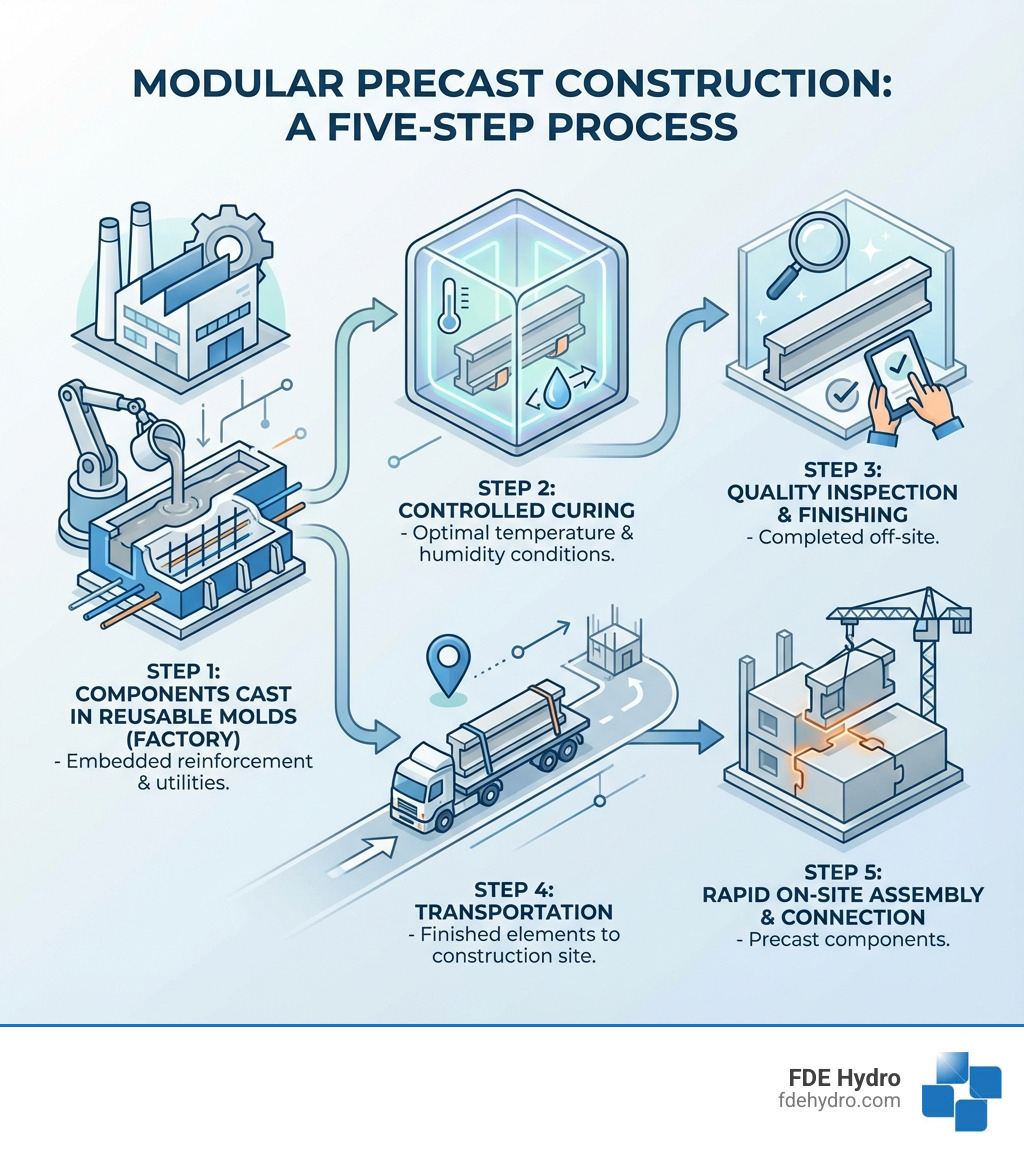
Precast Modular Technology is a modern way to build. It involves making parts of a building, or even whole rooms, in a factory. These parts are then brought to the construction site and put together quickly.
Here’s a quick look at what Precast Modular Technology is:
- Factory-made: Building sections or “modules” (like walls, floors, or entire bathroom pods) are created in a controlled factory setting.
- Off-site precision: This allows for high quality and exact measurements, as factory conditions are ideal.
- On-site assembly: Once made, these modules are shipped to the building site and rapidly assembled, like giant LEGO blocks.
- Faster construction: This method significantly cuts down the time it takes to build, compared to traditional ways.
The construction world is changing fast, and Precast Modular Technology is leading the way. This innovative approach moves much of the building process from the messy, outdoor construction site to clean, efficient factories. Instead of building piece-by-piece on location, large parts of a structure are made ahead of time.
Think of it like this: whole rooms, wall sections, or floor panels are cast from concrete in a factory. These “modules” are built with high precision and quality control. Once they are ready, they are delivered to the building site. There, workers quickly put them together. This way of building is a big step away from traditional methods. It makes construction faster, more reliable, and often better for the environment.
I’m Bill French Sr., and I’ve spent decades in civil construction, where I’ve seen how Precast Modular Technology is changing the industry, especially in projects like modular bridge construction. At FDE Hydro™, we’re focused on bringing these powerful, factory-made solutions to the hydropower sector, building faster and smarter.
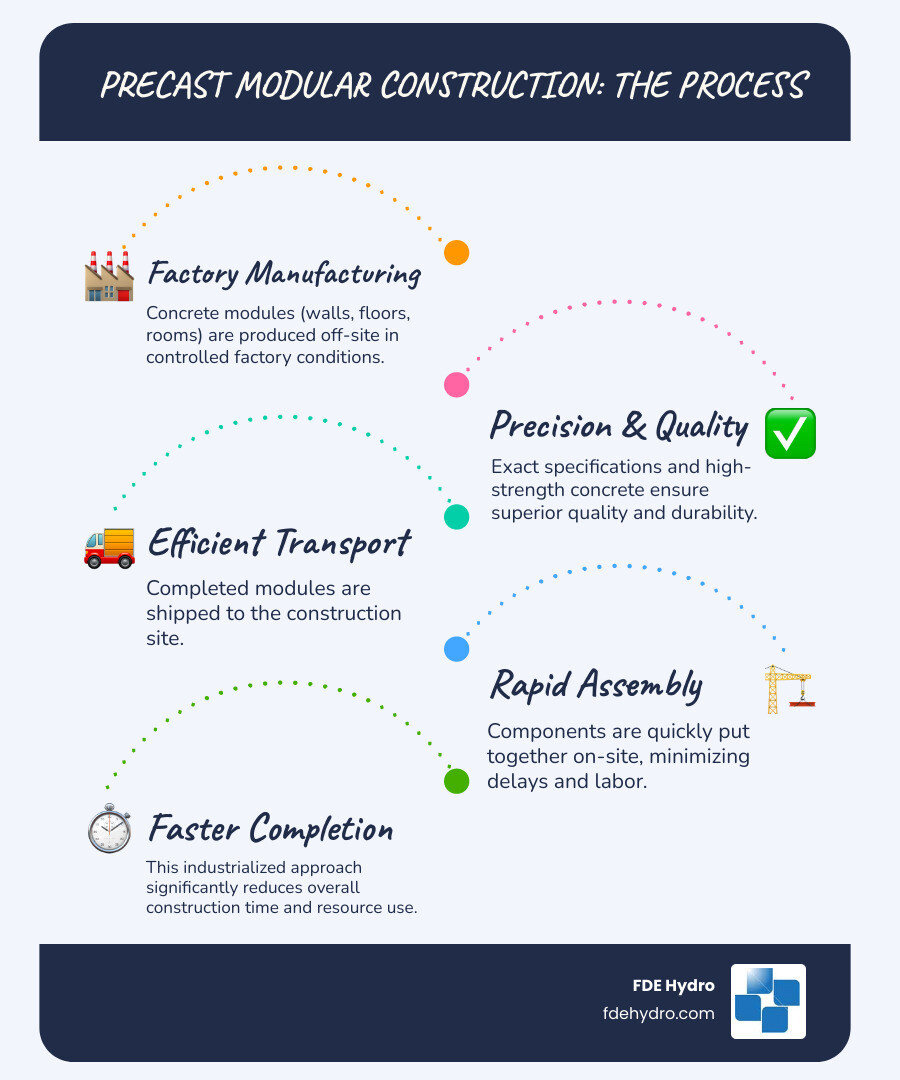
At its core, Precast Modular Technology involves the industrialized design, production, and construction using prefabricated reinforced concrete elements. This means that instead of pouring concrete and building walls on-site (traditional cast-in-situ methods), components like slabs, walls, and stairs are manufactured off-site in a controlled environment. These elements are then transported and assembled on the construction site. This method is gaining popularity worldwide because it offers significant advantages over traditional building.
For instance, 3D Modular Precast Technology involves casting “lego-like” concrete modules—such as entire rooms, toilets, kitchens, and bathrooms—in a factory. These complete units are then delivered to the site, ready for assembly. This change in how we build means less time, cost, and resources are expended compared to conventional approaches. We achieve this by leveraging advanced Modular Construction Techniques that streamline the entire process from design to assembly.
Key Precast Modular Technology vocabulary:
The Unbeatable Advantages of Building Modular
When we talk about the benefits of Precast Modular Technology, we’re not just talking about minor improvements; we’re discussing a shift that makes construction faster, more cost-effective, higher quality, more sustainable, and safer. Many industry experts consider modular precast one of the fastest, most profitable, sustainable, and cost-effective ways to build today.
Let’s look at how Precast Modular Technology stacks up against traditional construction methods:
| Feature |
Precast Modular Construction |
Traditional Construction |
| Timeline |
Significantly reduced due to parallel processes and off-site manufacturing |
Longer, sequential processes, subject to delays |
| On-site Labor |
Minimized, requiring smaller, specialized assembly teams |
High demand for various trades, labor-intensive |
| Waste |
Dramatically reduced through factory precision and material management |
Higher waste generation from on-site cutting and errors |
| Weather Delays |
Manufacturing unaffected by weather; only assembly is exposed |
Highly susceptible to weather-related delays |
| Quality |
Superior, consistent quality due to controlled factory environment |
Varies greatly, dependent on on-site conditions and labor skills |
We’ve seen how adopting precast solutions leads to a wide array of benefits. You can Explore Precast Concrete Advantages to understand the depth of these benefits.
Accelerated Construction Timelines
One of the most compelling advantages of Precast Modular Technology is the dramatic reduction in construction timelines. How do we achieve this? It’s all about efficiency and parallel processing.
Unlike traditional construction, where site preparation and building construction happen sequentially, precast modular methods allow for both to occur simultaneously. While our teams are preparing the foundation and site, modules are being manufactured in a factory. This parallel workflow significantly shortens the overall construction timeline. For example, precast installation can save up to 30% of the time compared to a poured-in-place solution.
The controlled factory environment also means that manufacturing can continue regardless of adverse weather conditions. Rain, snow, or extreme temperatures—which would typically halt or delay traditional on-site work—have no impact on module production. This ensures continuous work and predictable delivery schedules. The reduced need for on-site labor also contributes to speed, as fewer workers are needed for the assembly phase, allowing for quicker mobilization and completion. This focus on speed is critical for projects demanding Rapid Installment of Module Precast Civil Infrastructure.
Superior Quality and Precision Through Factory Control
Quality and precision are paramount in construction, and this is where Precast Modular Technology truly shines. When components are manufactured in a controlled factory environment, they are built to exact specifications, resulting in higher quality and consistency than what can typically be achieved on a dynamic construction site.
This controlled setting allows for rigorous quality control at every stage of production. Each module is carefully crafted, ensuring improved precision, consistency, and durability. This means fewer defects, less rework, and a stronger, more reliable finished product. The robust construction techniques used in module manufacturing also improve the resilience of buildings, making them more resistant to natural disasters such as earthquakes and hurricanes. The result is a high-strength concrete product with many inherent benefits, as it is manufactured off-site at a specialized production facility. We dig deeper into these aspects when we Learn about Precast Concrete Technology.
Cost Savings and Environmental Responsibility
Beyond speed and quality, Precast Modular Technology also offers significant cost savings and plays a crucial role in environmental responsibility.
The efficiency of factory production leads to better resource management and the use of sustainable materials, which in turn reduces waste and minimizes environmental impact. The efficient use of materials and resources in a factory setting minimizes waste and reduces the overall environmental footprint of construction projects. This approach not only helps us build greener but also contributes to lower long-term operating costs.
For instance, buildings constructed with advanced precast systems can be 60% more energy-efficient and produce less than 10% of the greenhouse gas emissions compared to typical low-rise buildings. This inherent energy efficiency, often achieved by positioning insulation on the exterior of the precast concrete walls, reduces heating and cooling demands. Furthermore, precast concrete is fire, mold, and weather-resistant, reducing long-term maintenance needs. This leads to buildings that are less costly to build and operate. To understand the full financial picture, we encourage you to Discover Why Precast Costs Less.
The Building Blocks: Components and Applications of Precast Modular Technology
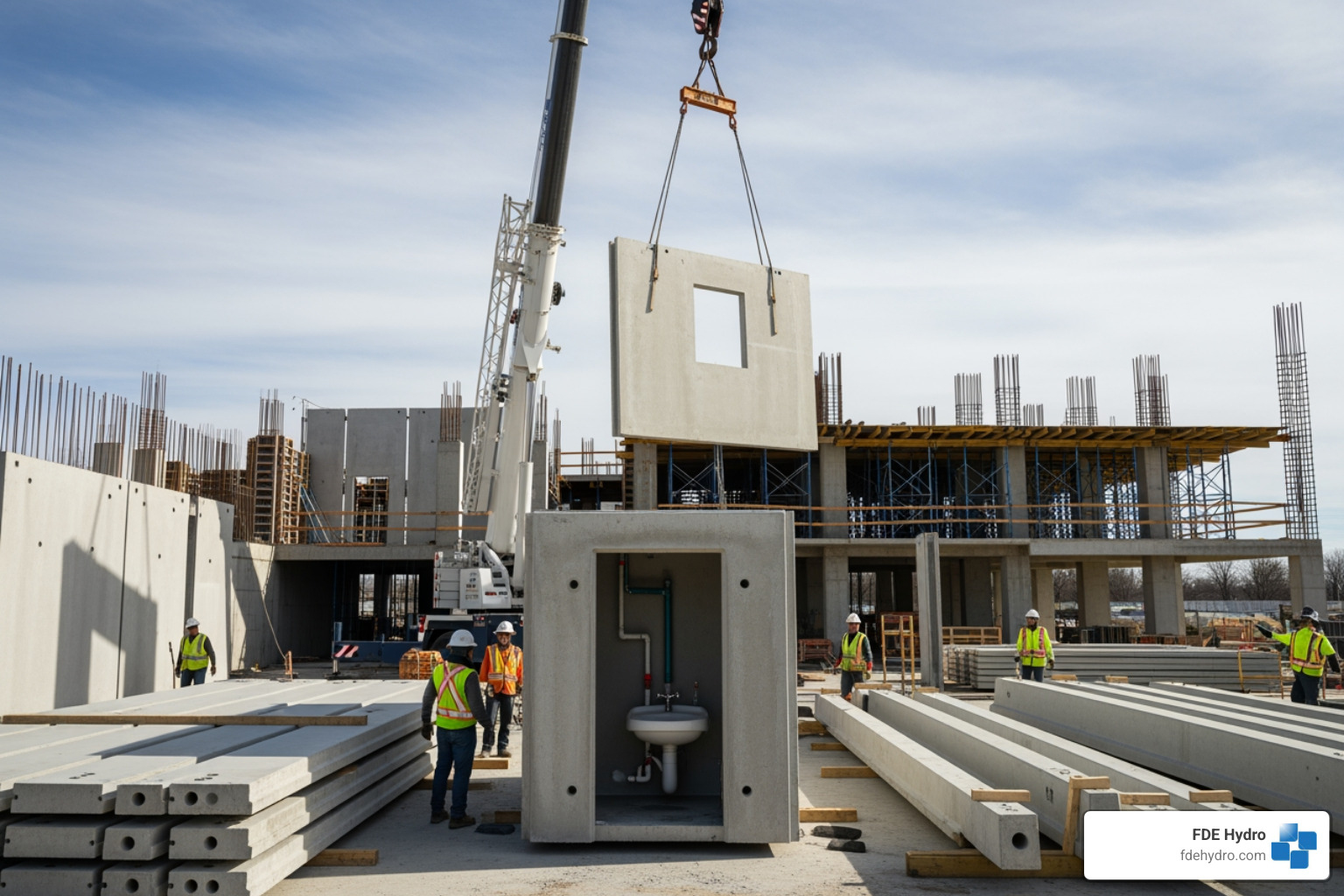
The versatility of Precast Modular Technology lies in its “building blocks”—the diverse components and modules that can be manufactured off-site. These elements range from simple flat panels to complex three-dimensional volumetric units, allowing us to construct a wide array of structures. This technology is changing multiple industries, from housing to critical infrastructure.
The core idea is to create standardized, yet adaptable, components that can be rapidly assembled. From structural panels to entire bathroom pods, the possibilities are vast. This adaptability means that a broad spectrum of projects can benefit from the speed, quality, and sustainability that precast modular methods offer.
The Core Components of Precast Modular Technology
At the heart of Precast Modular Technology are its varied components. We can categorize these into several types:
- 2D Panels: These are flat elements like precast wall panels and floor slabs. They are engineered to bear loads and form the structural envelope of a building. For example, some precast concrete building systems use structural building modules and precast wall panels, while others rely on prefabricated concrete panels for walls, floors, and stairs.
- 3D Volumetric Modules: These are complete, three-dimensional units, often referred to as volumetric pods. They can be entire rooms, bathrooms, kitchens, or utility spaces. 3D Modular Precast Technology involves casting these “lego-like” concrete modules in a factory. Bathroom pods, commonly used in hotels and retirement homes, are a prime example of these prefabricated components that are installed directly on the building site.
- Structural Elements: Beyond panels, precast technology also produces beams, columns, and stairs. These elements are designed to integrate seamlessly, forming the skeleton of the structure. For instance, precast stairs are often manufactured as monolithic pieces with embedded electrical conduits and slip-resistant finishes.
- Integrated Systems: A significant advancement in precast modular construction is the ability to embed various building systems directly into the concrete components during manufacturing. This can include electrical conduits, plumbing lines, fire suppression systems, and even HVAC ductwork. Some advanced systems, for example, integrate multiple construction divisions—structural, architectural, electrical, building envelope, heating/cooling, fire suppression, and plumbing—into single precast components.
We constantly develop new applications and designs for these components. You can See examples of Precast Models that showcase the breadth of this technology.
Precast Modular Technology is not limited to a single sector; its advantages make it suitable for a diverse range of industries and building types, particularly in North America, Brazil, and Europe.
- Multi-Unit Residential Housing: From detached houses to multi-story apartment buildings, modular precast offers rapid construction and consistent quality, helping to address housing shortages. We’ve seen significant use of precast components in residential projects, often constituting a large volume of the structural concrete.
- High-Demand Data Centers: The rapid growth of data centers, especially across North America, demands expedited construction schedules. There are nearly 5,000 operating data centers across North America, with hundreds more in development. The Canada data center market alone is projected to more than double by 2030 to U$22.24 billion. Precast modular concrete is proving to be a robust solution for these facilities, which require high load capacities, large clear spans, and rapid deployment.
- Hospitals and Schools: Public buildings like schools and hospitals benefit from the speed and controlled environment of modular construction, allowing for faster delivery of essential infrastructure with high quality and minimal disruption to surrounding communities.
- Hotels and Hospitality: The use of volumetric pods, such as prefabricated bathroom units, significantly accelerates hotel construction, ensuring consistency and quality across many rooms.
- Infrastructure: Beyond buildings, precast modular elements are invaluable for infrastructure projects. This includes bridges, tunnels, and water control systems. We are actively involved in these applications, particularly for Aging Infrastructure Being Replaced with Next-Generation Civil Solutions.
Navigating Challenges and The Future Outlook
While the benefits of Precast Modular Technology are undeniable, like any advanced construction method, it comes with its own set of challenges. However, the industry is continuously innovating to address these, paving the way for an even brighter future. The outlook for precast modular construction is incredibly promising, as it offers compelling solutions to some of the most pressing global demands, from housing crises to the rapid expansion of digital infrastructure.
Addressing the Practical Limitations
We acknowledge that there are specific problems that need to be considered when implementing Precast Modular Technology:
- Transportation Logistics for Large Modules: Transporting large modules from the factory to the construction site can be logistically challenging, especially for sites located in remote or hard-to-reach areas. This requires careful planning and specialized heavy transport equipment.
- High Initial Factory Investment: The initial setup for a specialized manufacturing facility can be significant. The cost of specialized equipment and the development of factory infrastructure may be higher than traditional construction methods. However, this investment often pays off through economies of scale and long-term efficiency gains.
- Site Access Constraints: Urban construction sites, particularly in dense cities like New York City, can have limited access, making it difficult to maneuver and hoist large precast components. This necessitates meticulous site planning and coordination.
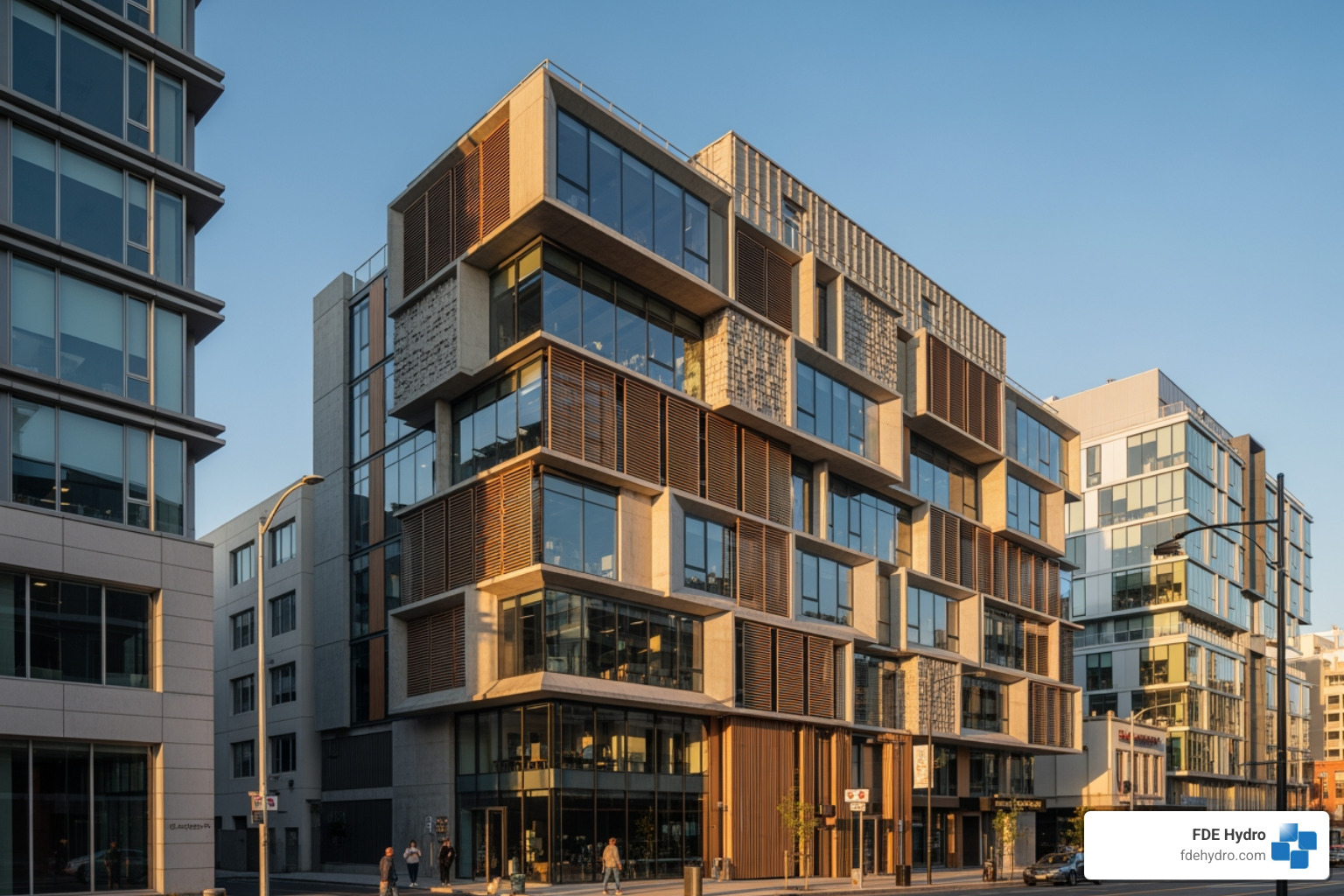
- Perceived Design Rigidity: Historically, modular construction was sometimes associated with a uniform, boxy aesthetic. However, modern Precast Modular Technology offers a wide range of design options and architectural finishes, allowing for significant flexibility and unique building designs. We can achieve diverse architectural styles through various exterior cladding options, ensuring aesthetic freedom.
The Future of Precast Modular Technology in a Demanding World
The future of Precast Modular Technology is bright, driven by global trends and specific industry demands.
- Solving Housing Shortages: In many regions, including parts of the United States and Europe, there’s an urgent need for affordable and rapidly deployable housing. Precast modular methods offer a scalable solution to build quality homes faster and more efficiently.
- Fueling the Data Center Boom: The digital economy relies heavily on data centers, and their demand is exploding. Globally, a McKinsey report forecasts $6.7 trillion of capital expenditures associated with data centers and supporting infrastructure over the next five years. The current timeline of nine to twelve months to complete a new facility is no longer acceptable, with developers targeting under four months for turnkey data centers. Precast concrete provides the speed, structural integrity, and thermal performance needed for these critical facilities, which are growing rapidly in North America, with nearly 5,000 operating data centers across the continent and hundreds more in development in the U.S. and Canada.
- Impact of AI on Construction Needs: The rise of Artificial Intelligence (AI) is further accelerating the demand for data centers and other specialized infrastructure. Precast Modular Technology is uniquely positioned to meet these urgent, high-volume demands.
- Smart Cities and Digitalization: As cities evolve into smart, interconnected environments, the need for efficient, adaptable, and sustainable construction methods grows. Precast modular solutions align perfectly with the principles of smart city development, offering industrialized construction that can be integrated with digital design and building management systems.
Case Study Spotlight: Next-Generation Infrastructure
At FDE Hydro™, we are at the forefront of applying Precast Modular Technology to critical infrastructure, demonstrating its power in real-world scenarios across North America, Brazil, and Europe. Our innovative, patented modular precast concrete technology, often referred to as the “French Dam,” is specifically designed for building and retrofitting hydroelectric dams and water control systems. This significantly reduces construction costs and time, providing solutions for:
- Rapid Bridge Construction: Using modular precast elements, we’ve seen examples of A National Example of Rapid Bridge Construction Using Modular Precast Elements that dramatically cut down project timelines and minimize disruption.
- Water Control Systems: Our expertise extends to developing advanced water control infrastructure, utilizing modular precast for efficiency and durability.
- Hydropower Applications: The “French Dam” technology exemplifies how modular precast can revolutionize hydroelectric projects, offering faster deployment and improved resilience. You can learn more about Modular Dam Construction and how we’re building the future of renewable energy.
Frequently Asked Questions about Precast Modular Construction
We often get questions about Precast Modular Technology. Here are some of the most common ones we address:
How durable are precast modular buildings?
Precast Modular Technology results in exceptionally durable structures. Buildings constructed with precast concrete are designed for a long lifespan, often exceeding 100 years. The robust nature of precast concrete means it offers superior resistance to fire, mold, pests, and general wear and tear, reducing long-term maintenance needs. Furthermore, the inherent strength and precise engineering of precast modules significantly improve resilience against natural disasters such as earthquakes and hurricanes, ensuring structures remain safe and stable.
Is precast modular construction environmentally friendly?
Yes, Precast Modular Technology is highly environmentally friendly. The controlled factory environment allows for precise material usage, minimizing waste and enabling efficient recycling of materials. This significantly reduces on-site construction waste, noise, and dust levels, making construction projects less disruptive to surrounding communities. Moreover, precast modular buildings are designed for inherent energy efficiency, often incorporating insulation directly into the panels. This leads to structures that are 60% more energy-efficient and produce less than 10% of the greenhouse gas emissions compared to traditional buildings, reducing the operational carbon footprint over the building’s lifespan.
Can you customize the design of a precast modular building?
Absolutely! Modern Precast Modular Technology offers remarkable design flexibility. While standardization is key to efficiency, it does not limit aesthetic choices or unique building designs. We can achieve a wide range of architectural styles and finishes. The exterior cladding, for example, is often separate from the precast structure, allowing for diverse architectural expressions that can be applied either in the factory or on-site. This ensures that while the core structure benefits from modular efficiency, the final appearance can be fully customized to meet specific design visions and blend seamlessly with any urban or natural landscape.
Conclusion: Building the Future, One Module at a Time
As we’ve explored, Precast Modular Technology is more than just a construction method; it’s a paradigm shift that is reshaping how we build the world around us. From accelerating timelines and enhancing quality to driving sustainability and reducing costs, its advantages are revolutionizing the construction industry. This technology provides efficiency and scalability previously unimagined, addressing critical demands like housing shortages and the exponential growth of data centers.
At FDE Hydro™, we are proud to be part of this revolution, applying advanced modular precast systems to vital infrastructure projects. Our patented “French Dam” technology for hydroelectric dams and water control systems in North America, Brazil, and Europe is a testament to the power and potential of this innovative approach. As the industry evolves, precast modular systems offer a smarter, faster, and more sustainable path forward for everything from housing to critical infrastructure. We believe the future is truly modular, and we are building it, one precisely engineered component at a time.
Learn more about innovative modular dam solutions
by Bill French Sr. | Feb 13, 2026 | Precast Dam Articles
Why Modular Precast Dams Are Changing Water Infrastructure
A modular precast dam is a water impoundment structure built from factory-manufactured concrete modules that are transported to the site and rapidly assembled, offering dramatic reductions in construction time and cost compared to traditional cast-in-place methods.
Key advantages of modular precast dams include:
- Cost Savings: 40-60% reduction in construction costs compared to conventional dams
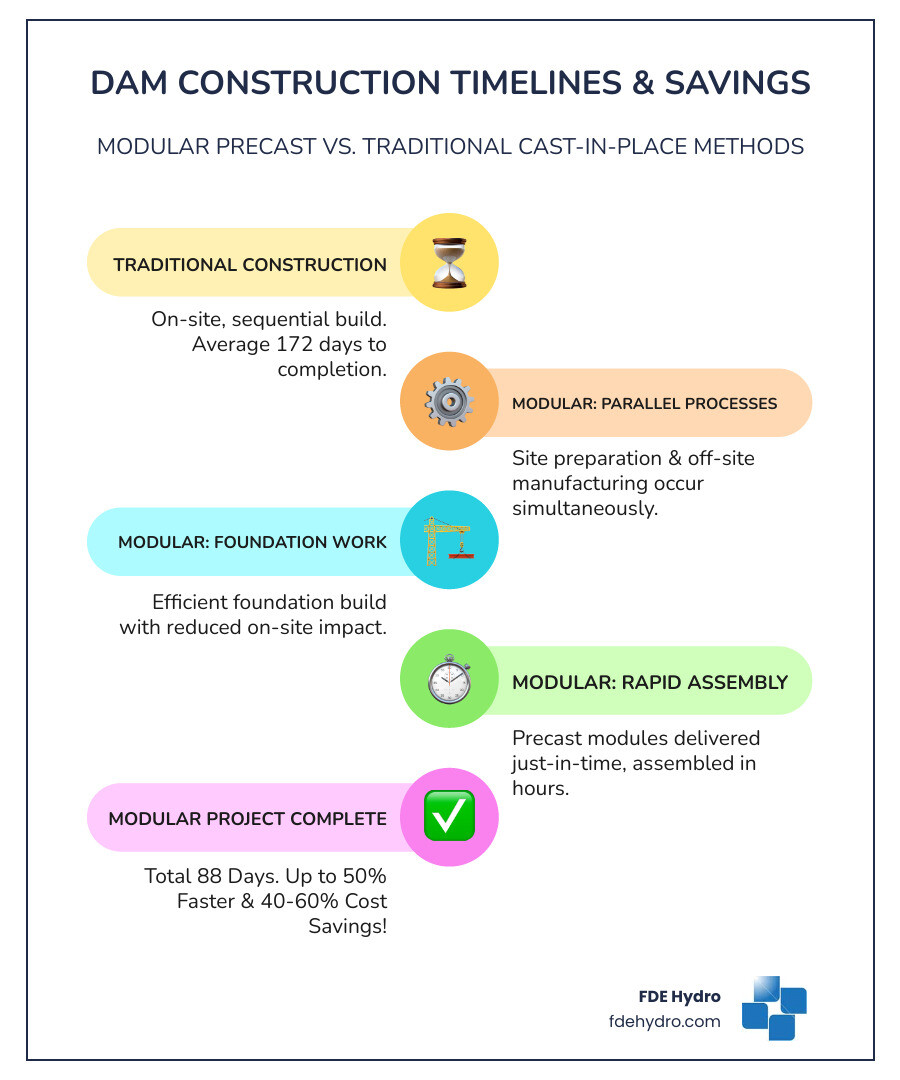
- Speed: Construction timeline reduced by up to 50% (from 172 days to 88 days)
- Quality Control: Factory-manufactured in controlled environments for consistent strength and durability
- Weather Independence: Off-site manufacturing eliminates weather-related delays
- Reduced Risk: Minimized on-site labor requirements and shortened exposure to schedule overruns
- Environmental Benefits: Smaller construction footprint and reduced riverbed disruption
Traditional dam construction faces significant challenges. The average U.S. dam is 58 years old, and physical civil construction accounts for 40-90% of total hydropower development costs. Weather delays, lengthy construction periods, and budget overruns plague conventional projects. These factors make dam repair and new development increasingly difficult to justify financially.
Modular precast dam technology addresses these challenges head-on. Instead of building dams entirely on-site with weather-dependent concrete pours, precast modules are manufactured in controlled factory settings while site preparation happens simultaneously. Once delivered, these modules—some weighing 27,000 pounds—can be assembled in hours rather than months. The result is a monolithic structure that meets or exceeds the strength and durability of traditional dams.
I’m Bill French Sr., Founder and CEO of FDE Hydro™, where we’ve pioneered the patented “French Dam” modular precast dam system to revolutionize water infrastructure construction. My five decades in heavy civil construction and site development provide the foundation for delivering these innovative solutions to the hydropower industry.
The evidence is compelling. Full-scale design comparisons show that a modular precast dam can be constructed in 88 days versus 172 days for cast-in-place alternatives. Cost savings are equally dramatic: a 22-foot high modular precast dam costs approximately $900,000 compared to $1,980,000 for traditional construction—a 55% reduction. For larger structures, savings remain substantial, with a 50-foot dam showing 40% cost reduction.
Related content about modular precast dam:
The Enduring Challenges of Conventional Dam Construction
For generations, dams have been cornerstones of our infrastructure, providing hydropower, water supply, flood control, and irrigation. However, the methods used to build and maintain these structures have long been fraught with significant challenges and costs.
One of the most pressing issues we face today is aging infrastructure. The average age of the 90,580 recorded dams in the U.S. is 58 years, with many exceeding their original 50-year service life expectancy. This aging network demands urgent repair and replacement, yet the costs and complexities of traditional civil construction often make such projects prohibitive. The physical civil construction itself is the largest single component of new hydropower development cost, ranging from a staggering 40% to 90% of the total capital cost, depending on the project size.
These high capital costs are exacerbated by inherent project risks. Traditional dam construction relies heavily on on-site, in-situ concrete pouring, which makes projects highly susceptible to weather delays and river flood events. A single major storm can bring work to a standstill, pushing schedules back by weeks or even months, leading to significant budget overruns. Lengthy construction periods, contracting delays, and long lead times for major equipment further compound these risks. When a project stretches for years, the potential for unexpected issues—from material price fluctuations to labor shortages—grows exponentially.
Beyond the financial and logistical problems, conventional dam construction often entails significant environmental disruption. Large-scale on-site operations require extensive land disturbance, heavy machinery, and prolonged periods of activity within sensitive river ecosystems. This can negatively impact water quality, aquatic habitats, and local communities. For instance, massive projects like the Belo Monte Hydroelectric Dam complex in Brazil, while providing immense power, also highlight the scale of environmental and social impacts associated with traditional large-dam construction.
The need for innovative and more efficient Dam Construction Methods that can mitigate these challenges is clearer than ever. We need solutions that are not only cost-effective and faster but also minimize environmental impact and improve safety.
How a Modular Precast Dam Revolutionizes the Building Process
Imagine building a dam like assembling a giant set of LEGOs. That’s essentially the revolution offered by modular precast construction. This approach tackles the traditional challenges head-on by shifting the majority of the civil construction work from the unpredictable river environment to controlled factory settings.
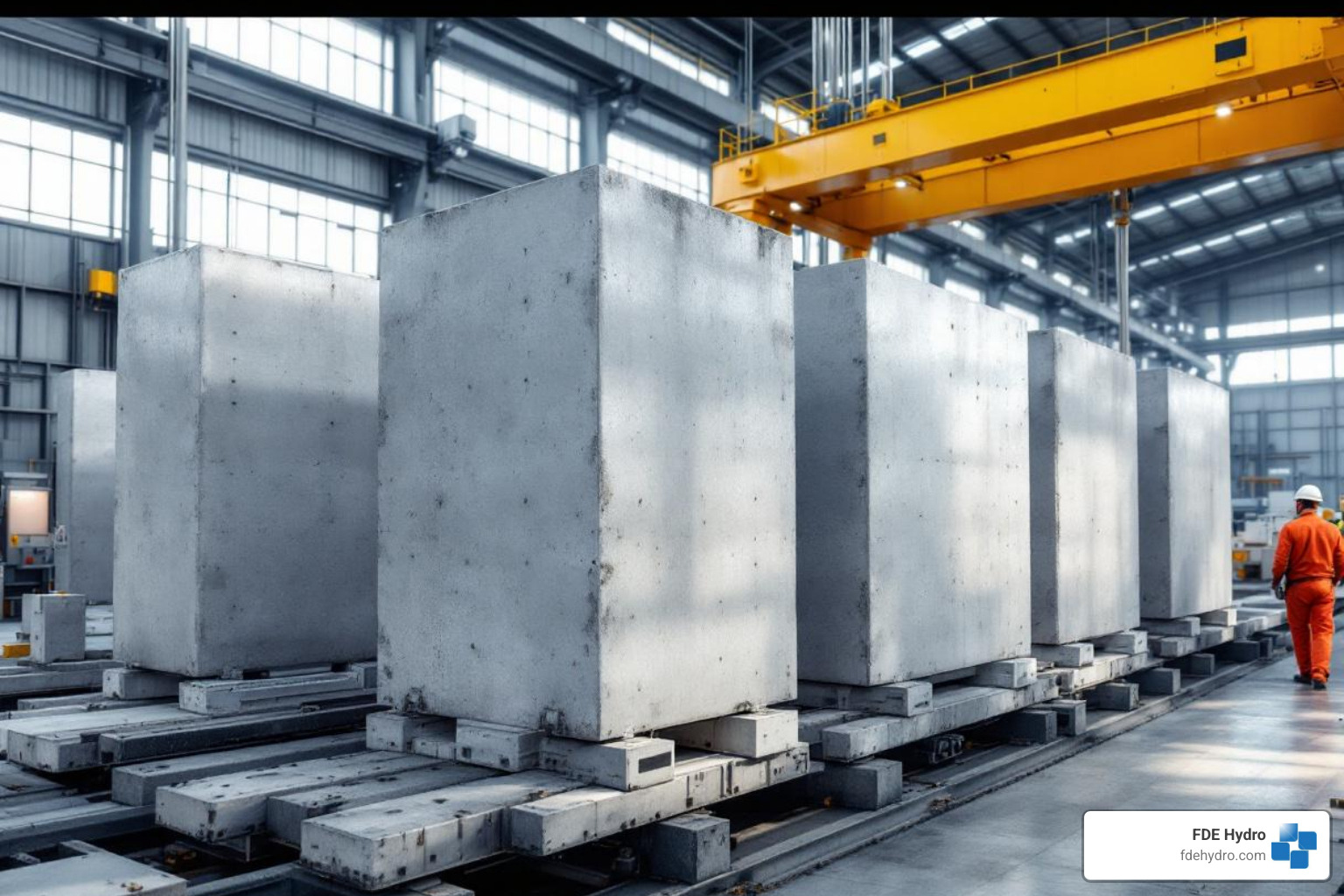
At the heart of this revolution is off-site manufacturing. Instead of pouring concrete on-site, which is weather-dependent and requires extensive temporary formwork, we manufacture high-quality, reinforced concrete modules in specialized facilities. This allows for superior quality control, as conditions like temperature, humidity, and curing can be precisely managed, leading to stronger, more durable concrete elements.
This method also enables parallel processing. While our skilled teams are busy fabricating the specialized modules in the factory, another crew can be simultaneously preparing the project site. This could involve foundation work, excavation, and other necessary groundwork. This parallel workflow dramatically shortens the overall project timeline, as these crucial phases are no longer sequential.
Once manufactured, the modules are transported to the site for just-in-time delivery. This minimizes the need for large on-site storage areas, further reducing the construction footprint. The modules are then rapidly assembled using cranes and specialized equipment. This “click-and-connect” approach means that a project that might traditionally take months or even years of on-site work can be completed in a fraction of the time. This rapid installation is a hallmark of Rapid Installment of Module Precast Civil Infrastructure.
The benefits extend to reduced on-site labor. With most of the heavy, complex work completed off-site, fewer personnel are required in the potentially hazardous construction zone. This not only improves safety but also addresses challenges related to skilled labor availability. The entire Precast Concrete Industry benefits from this shift towards efficiency and control.
The ‘French Dam’ System: A Case Study in Innovation
Our patented “French Dam” system exemplifies this innovative approach. It’s designed specifically for the construction and retrofit of hydroelectric dams, water control systems, and powerhouses, offering a sophisticated and adaptable solution for almost every type of site condition.
The system works by utilizing standardized, yet adaptable, interlocking concrete blocks. These modules are engineered to fit together precisely, forming a robust structure. Once positioned, they are secured using post-tensioning systems and rock anchors, effectively changing the individual modules into a single, monolithic structure that can withstand immense hydraulic forces. The design allows for independent replacement of modular elements or removal of the entire structure if needed, offering unparalleled flexibility.
We, along with our partners, successfully completed a prototype of the “French Dam” in the U.S. This prototype, a 24-foot-long by 16-foot-high structure, consisted of six 8-foot by 8-foot concrete blocks, each weighing approximately 27,000 pounds. The most impressive part? This entire structure was assembled in less than 3.5 hours. This proof-of-concept demonstrated that precast concrete modules meet desired structural and hydraulic integrity, with minimal leakage observed during testing. This success was a significant milestone, confirming the viability of the technology and its potential to be a “game changer” for the hydro industry, as detailed in the Prototype of Modular Precast French Dam Completed report and subsequent validation that French Dam Technology Passes the Test.
Versatile Applications for Modern Water Infrastructure
The adaptability of the modular precast dam system means its applications are incredibly broad, extending beyond just traditional dam construction. We can use this technology for a wide array of water impoundment and control structures.
For new Hydroelectric Dam Construction, our modular approach provides a faster, more cost-effective pathway to developing new renewable energy sources. But it’s not just about new builds. With so much aging infrastructure in the U.S., dam rehabilitation is a critical need. Our system is ideal for retrofitting or rehabilitating existing dams, enhancing their safety and extending their operational life.
Beyond large dams, the technology is perfectly suited for smaller structures like weirs (low dams used to raise the water level of a river or stream) and diversion structures that channel water for irrigation or other purposes. We can also construct modular powerhouses, integrating the turbine and generator units directly into the precast structure, further streamlining hydropower development.
Our solutions also extend to coastal and flood protection, including sea walls. Modular precast sea walls can be constructed off-site and installed rapidly, enabling deployment in half the time of conventional concrete walls. This is crucial for protecting communities from rising sea levels and extreme weather events. The “French Dam” system offers comprehensive Water Infrastructure Solutions for various needs, adapting to virtually any size, shape, height, and width.
The Quantifiable Benefits of Precast Modular Dams
The adoption of a modular precast dam system isn’t just about innovation; it’s about delivering tangible, measurable advantages that translate into significant project success. The benefits are wide-ranging, impacting everything from project timelines and budgets to safety and environmental stewardship.
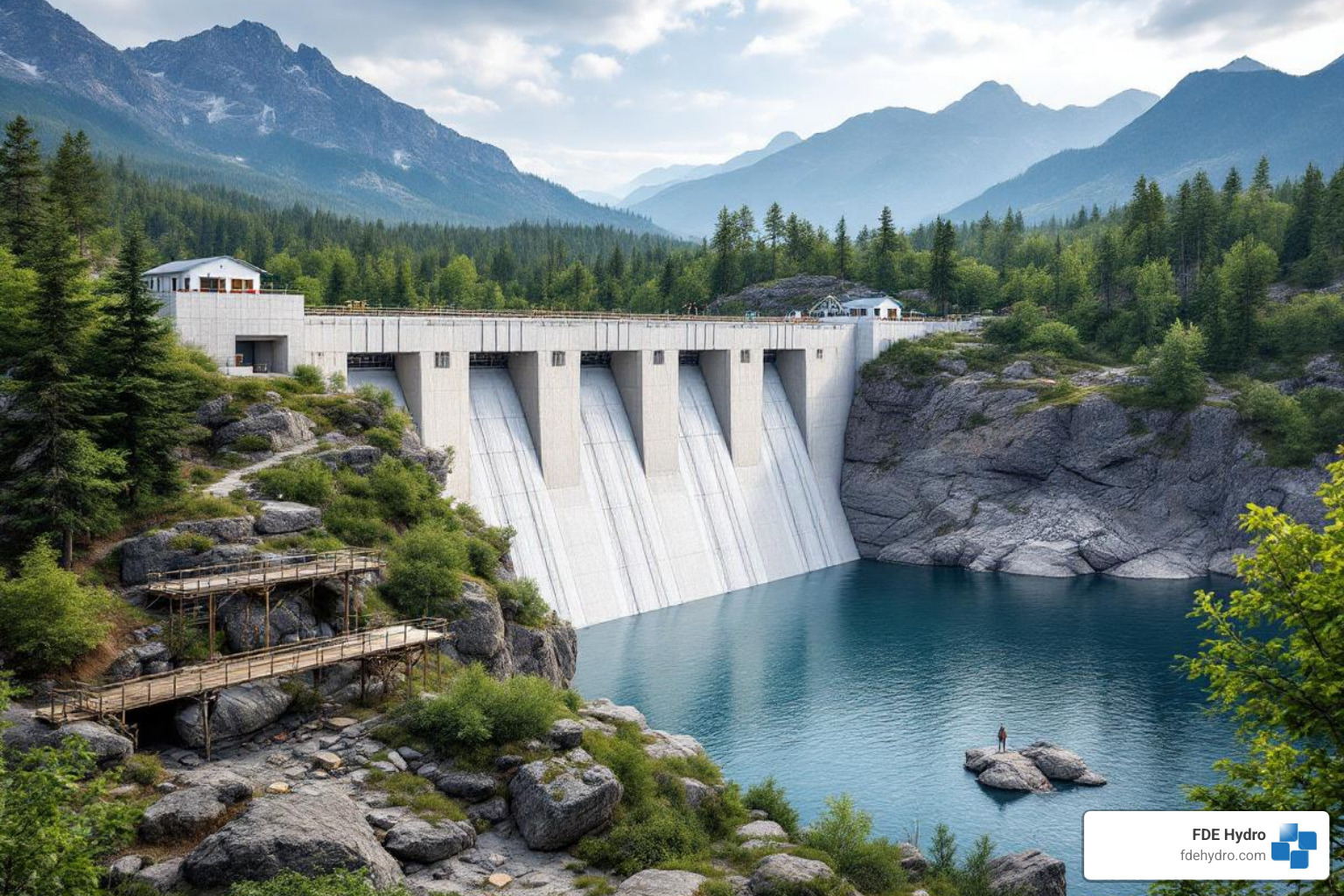
At FDE Hydro™, we’ve seen how our approach leads to substantial risk mitigation. By moving complex construction tasks to a controlled factory environment, we reduce the uncertainties associated with on-site work, such as adverse weather, difficult terrain, and fluctuating river conditions. This minimizes potential delays and safety hazards, contributing to improved site safety for all personnel.
For developers, this translates directly into a faster ROI (Return on Investment). Shorter construction periods mean that hydropower facilities can come online much sooner, generating revenue and offsetting initial capital investments more quickly. This speed and efficiency are key drivers for Hydropower Innovation and the broader adoption of advanced construction techniques. The advantages of precast concrete are well-documented across various industries, and its application in water impoundment structures brings these same Precast Concrete Advantages to a critical sector.
Drastic Reductions in Cost and Time for a modular precast dam
Perhaps the most compelling benefits of our modular precast dam technology are the dramatic reductions in both cost and construction time. Our research and full-scale design comparisons consistently show significant savings over traditional cast-in-place (CIP) methods.
Consider the following table, which illustrates the estimated cost savings for different dam heights:
| Dam Height |
Conventional Cast-in-Place (CIP) Cost |
Modular Precast Dam Cost |
Percentage Savings |
| 22 feet |
$1,980,000 |
$900,000 |
55% |
| 30 feet |
$3,830,000 |
$1,500,000 |
60% |
| 50 feet |
$8,050,000 |
$4,600,000 |
40% |
These figures highlight how a modular precast dam can drastically Reduce Construction Costs for water infrastructure projects. The savings are achieved through a combination of reduced on-site labor, faster installation, minimized material waste, and the efficiencies of factory production.
Beyond cost, the impact on the construction schedule is equally impressive. A hypothetical full-scale design analysis, comparing a modular precast dam to a previously constructed CIP dam in the U.S., revealed significant time savings. The original CIP reconstruction took 172 days. By utilizing our modular precast approach, the estimated reconstruction time was reduced to 118 days with fixed start dates (a 31% reduction), and an even more remarkable 88 days with flexible scheduling (a 49% reduction). This ability to cut project duration by nearly half is invaluable, especially for critical infrastructure projects where every day counts.
Environmental and Safety Advantages of a modular precast dam
Our commitment to innovation extends beyond economics and efficiency to encompass environmental responsibility and safety. A modular precast dam offers distinct advantages in these crucial areas.
The most immediate environmental benefit is a reduced on-site footprint. Because most of the fabrication occurs off-site, the construction area at the dam location is significantly smaller and less intrusive. This minimizes the disturbance to surrounding ecosystems, requiring less excavation, less temporary infrastructure, and fewer heavy vehicle movements in sensitive areas. We also generate less construction waste on-site, as any waste from module manufacturing is typically recycled within the factory environment.
Critically, the method allows for minimized riverbed disruption. Rapid assembly means that periods of in-river work can be significantly shortened, reducing the impact on aquatic life and water flow. This approach aligns with principles of Sustainable Infrastructure Development.
From a safety perspective, transferring manufacturing to a controlled factory environment inherently leads to fewer on-site labor hours in hazardous conditions. Workers are not exposed to the same risks of working at heights, around heavy machinery in unpredictable weather, or in close proximity to flowing water for extended periods. This drastically improves overall site safety. Furthermore, the weather-independent construction schedule of off-site manufacturing means that projects are less likely to experience delays due to harsh conditions, avoiding the pressure to work in unsafe environments to meet deadlines.
Implementation and Future Outlook
Implementing a modular precast dam project, while offering numerous advantages, requires careful planning and consideration to ensure seamless execution.
The first critical step is a thorough site suitability analysis. While our system is highly adaptable, understanding the specific hydrological, geological, and physical conditions of a site is paramount. This includes assessing the riverbed, rock formations, and flood patterns to inform the foundation design. Foundation preparation is a key aspect, often involving rock anchors or pile support systems to securely link the modular elements to the riverbed, creating a cohesive, stable structure. Our patented working platform system with rock bolt linkage is specifically designed for this purpose.
Transportation logistics also play a vital role. While modules are designed for efficient transport, factors like road weight restrictions and access to remote locations must be carefully planned. However, the benefits of controlled off-site manufacturing and rapid on-site assembly typically outweigh these logistical considerations.
The future outlook for modular precast dam technology is incredibly promising. The U.S. DOE Hydropower VISION report has already recommended modular approaches for new in-stream hydropower facilities, recognizing their potential to revitalize the sector. We are seeing growing adoption by regulators in the U.S. and Europe who are increasingly willing to include precast concrete as an alternative in project specifications. This indicates a growing recognition of the safety, environmental, and economic benefits of modular construction.
Our technology, as highlighted in the Precast, Modular Construction for Water Impoundment Infrastructure paper, represents a significant step forward. We believe that modular precast construction will become a standard practice in the hydropower and water infrastructure sectors, driving innovation and efficiency. The ongoing advancements and discussions, such as those anticipated at Hydropower Advancements & Innovations 2025, underscore this growing momentum. Our Means and Methods are continually evolving to meet these future demands.
Frequently Asked Questions about Modular Precast Dams
How strong are modular precast dams?
Our modular precast dams are engineered to be exceptionally strong and durable. They use high-strength concrete manufactured in controlled factory environments, which often exceeds the quality achievable with on-site pours. The modules are designed with interlocking joints and are further reinforced using post-tensioning cables and rock anchors. This system effectively binds the individual modules together, forming a truly monolithic structure that meets or exceeds the most stringent engineering standards for conventional dams, capable of withstanding significant hydraulic, seismic, and environmental loads.
Can modular dams be used for any size project?
Absolutely! The beauty of our modular system is its incredible scalability and adaptability. Our designs are custom to be highly flexible, allowing them to adapt to any size, shape, height, and width required for a project. Whether it’s a small weir for water diversion, a medium-sized dam for hydropower generation, or a large-scale impoundment structure, the modular approach can be customized to fit the specific needs. This flexibility means that Precast Pushes the Limits of Scale, making it a versatile solution for diverse water infrastructure demands.
What is the lifespan of a precast dam?
With a modular precast dam, we’re not just building for today, but for generations to come. The use of high-quality factory-produced concrete ensures superior density and durability, which are critical for long-term performance in harsh water environments. Our dams are engineered for an impressive service life of 100+ years, often surpassing the typical lifespan of traditionally constructed dams. They are highly resistant to environmental degradation, including freeze-thaw cycles and chemical exposure, thanks to the controlled manufacturing processes and robust materials used.
Conclusion: Building the Future of Water Infrastructure
The challenges facing our aging water infrastructure are immense, but the solutions offered by modular precast dam technology provide a clear path forward. We’ve seen how this innovative approach delivers unparalleled speed, cost-effectiveness, improved safety, and critical sustainability benefits.
By shifting construction from unpredictable river environments to controlled factory settings, we dramatically reduce project timelines, cut costs by up to 60%, and mitigate the risks inherent in traditional civil construction. The “French Dam” system, with its interlocking, high-strength concrete modules, is a proven solution for modernizing our infrastructure, making hydropower development more attractive and accessible than ever before.
At FDE Hydro™, we are proud to be at the forefront of this change, providing the innovative technologies needed for a sustainable future. We invite you to explore how our solutions can benefit your next project.
Renewable Energy Construction is not just about generating power; it’s about building smarter, faster, and more responsibly. Explore our innovative dam solutions and find how we are shaping the future of water infrastructure.
by Adaptify Support | Jan 19, 2026 | Precast Dam Articles
Why Concrete Construction Methods Matter for Modern Infrastructure
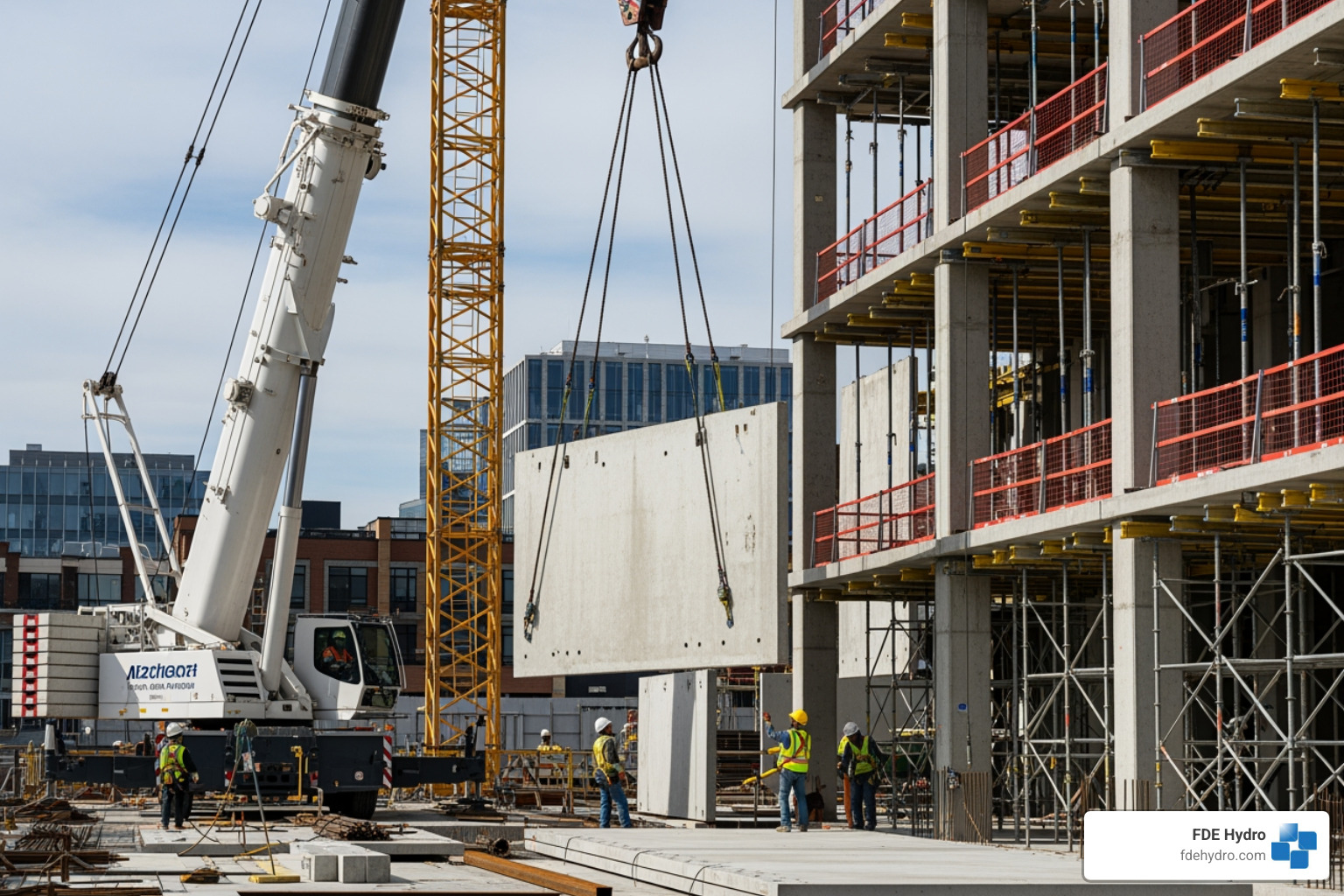
Precast concrete advantages are reshaping how we approach large-scale infrastructure projects. In construction, concrete is a vital building material—but how and where it’s produced makes all the difference. The choice between precast, modular, and cast-in-place concrete directly impacts project timelines, costs, quality, and long-term performance.
Key Precast Concrete Advantages at a Glance:
- Superior Quality Control – Factory manufacturing ensures consistent mix design, precise curing, and minimal defects
- Faster Construction – Off-site fabrication allows parallel site work and just-in-time delivery, reducing timelines by months
- Lower Total Costs – Reduced on-site labor, less weather delay, and efficient material use cut overall project expenses
- Improved Durability – Controlled curing produces high-density concrete resistant to weather, fire, and corrosion
- Design Flexibility – Custom molds enable complex shapes, textures, and finishes for both structural and architectural applications
- Improved Safety – Fewer workers on-site and controlled factory conditions reduce workplace accidents
- Sustainability – Minimized waste, material recyclability, and energy efficiency support green building goals
Every construction project—whether it’s a hydroelectric dam, bridge, or commercial building—faces the same challenges: tight budgets, demanding schedules, and the need for structures that last generations. Traditional cast-in-place concrete, mixed and poured on-site, has served the industry for decades. But it’s vulnerable to weather delays, quality variations, and extensive labor requirements.
Precast concrete takes a different approach. Components are manufactured in controlled factory environments, then transported to the construction site for rapid assembly. This industrialized method delivers consistent quality while dramatically compressing construction schedules.
Modular construction extends these benefits even further, treating entire building sections or infrastructure components as prefabricated units. For water infrastructure and hydropower projects, this means changing months of on-site work into days of assembly.
The controlled environment where precast concrete is manufactured is key. Factory conditions eliminate weather as a variable. Quality inspections happen at every stage. Curing processes are optimized. The result? Concrete that’s stronger, more durable, and more reliable than most site-cast alternatives.
I’m Bill French Sr., Founder and CEO of FDE Hydro™, where we’ve revolutionized hydropower construction through modular precast solutions including the patented French Dam. My five decades in heavy civil construction, including landmark projects like the I-93 Fast14 utilizing modular precast bridge construction, have shown me how precast concrete advantages deliver changeal value for large-scale infrastructure.
What is Precast Concrete and How Does It Compare?
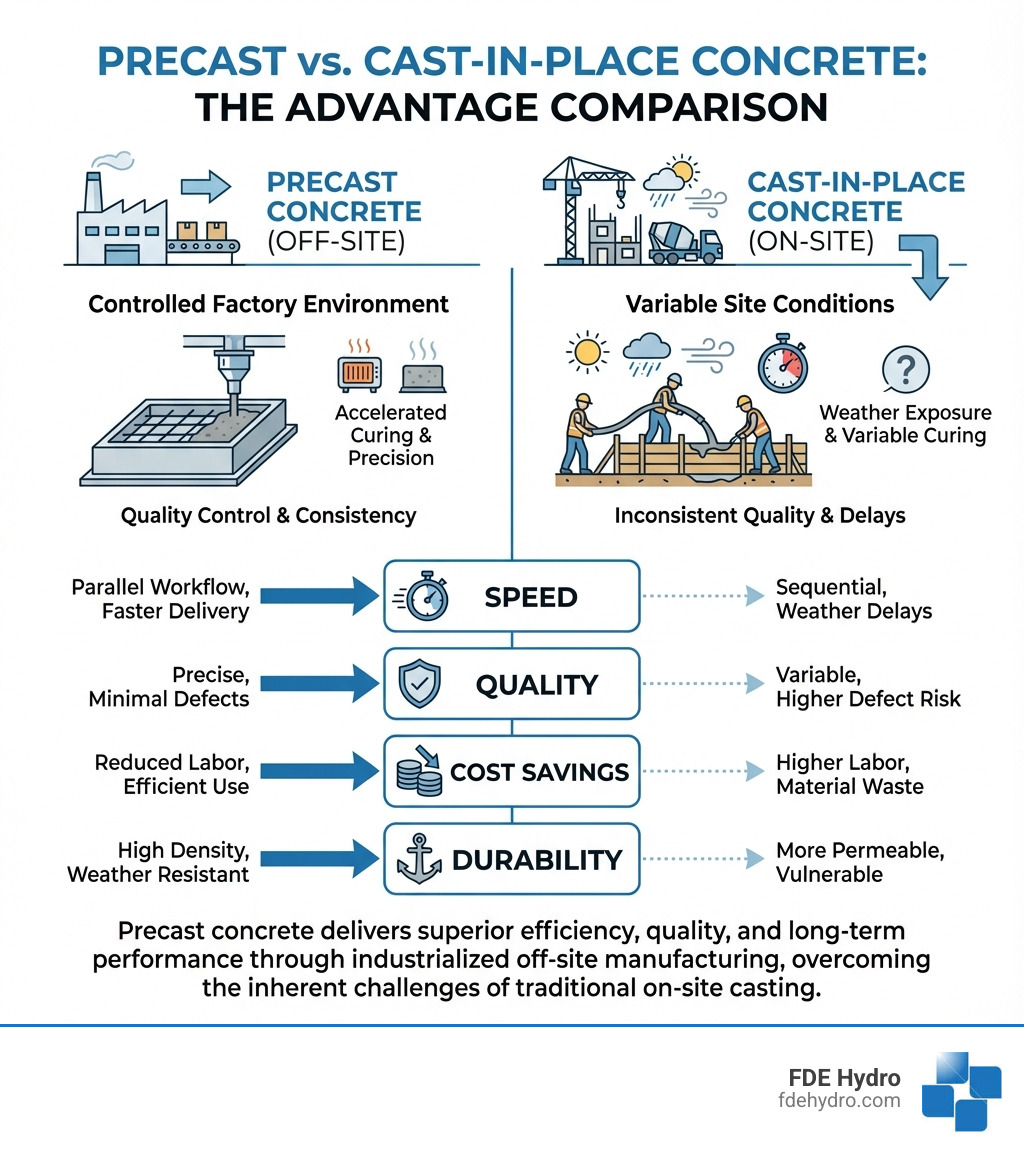
At its heart, precast concrete is simply concrete that is cast somewhere other than where it will ultimately be used. Think of it as a carefully crafted component, manufactured in a dedicated factory, or “precast plant,” before being shipped to the construction site. This off-site manufacturing process allows for unparalleled control over every aspect of production, from the mix design to the curing conditions.
In contrast, traditional cast-in-place concrete is mixed and poured directly on the job site. While this method offers flexibility for unique, one-off designs, it’s inherently exposed to the whims of weather, site conditions, and the availability of skilled labor. This can lead to variability in quality and significant delays.
A specialized form of precast concrete, prestressed concrete, further improves its capabilities. Here, high-strength steel strands are incorporated and put under tension before the concrete is cast and cured. Once the concrete hardens and the tension is released, the concrete becomes compressed, significantly increasing its load-carrying capacity, allowing for greater spans, and reducing the potential for cracks. This makes it an incredibly robust option for demanding structural applications.
To illustrate the fundamental differences and why precast concrete advantages often tip the scales, let’s look at a quick comparison:
| Feature |
Precast Concrete |
Cast-in-Place Concrete |
| Quality Control |
Superior, factory-controlled conditions |
Variable, dependent on on-site conditions |
| Construction Speed |
Faster assembly, simultaneous site work |
Slower, sequential, requires on-site curing |
| Weather Dependency |
Minimal impact on production, unaffected on-site |
Highly susceptible to weather delays |
| Site Disruption |
Reduced, less equipment and labor on-site |
Higher, more equipment, materials, and labor on-site |
| Labor Requirements |
Less on-site skilled labor needed |
More on-site skilled labor for forming and pouring |
The modern construction landscape, particularly in North America, Brazil, and Europe where we operate, increasingly favors the efficiency and reliability that precast methods offer. This shift is driving innovation across the entire precast industry. For more detailed insights into this versatile material, you can explore comprehensive resources like About Precast.
The Core Precast Concrete Advantages: Quality, Speed, and Cost
When we talk about the transformative power of precast concrete, we’re really honing in on three pillars: unparalleled quality, accelerated timelines, and significant cost savings. This isn’t just about building faster; it’s about building smarter, with industrialized production leading to greater efficiency and reliability. The sum of these benefits is why precast offers superior value in modern construction.
Superior Quality and Durability from Controlled Manufacturing
One of the most compelling precast concrete advantages stems directly from its manufacturing environment. Imagine baking a cake: would you prefer to do it in a state-of-the-art, climate-controlled kitchen, or outdoors in unpredictable weather? It’s a bit like that with concrete.
In a factory-controlled environment, every variable is carefully managed. This means:
- Consistent Mix Design: We ensure the precise proportions of cement, water, aggregates, and admixtures every single time. This eliminates the guesswork and variability inherent in on-site mixing, leading to a consistently strong and uniform product.
- Precise Curing Process: Curing is crucial for concrete strength. In our plants, we control temperature and humidity, often employing accelerated curing methods. This ensures the concrete reaches its optimal strength faster and more reliably than traditional site-cured concrete. This controlled curing environment, coupled with an optimized water-to-cement ratio, significantly reduces the likelihood of cracking.
- High-Density Concrete: The rigorous control over mixing, placement, and consolidation (often using advanced vibration techniques) results in high-density concrete. This dense structure is less porous, making it incredibly resistant to acid attack, corrosion, and impact.
- Reduced Cracking: Because precast concrete is cured under ideal conditions, it’s far less prone to the shrinkage and thermal cracking that can plague site-poured concrete exposed to fluctuating outdoor conditions.
- A1 Fire Rating: Precast concrete is inherently non-combustible. It doesn’t catch fire, give off toxic fumes, or add fuel to a blaze, earning it a top A1 fire rating. This provides superior fire resistance, enhancing safety for occupants and protecting structural integrity.
- Excellent Weather and Corrosion Resistance: Its high density and controlled composition make precast concrete incredibly durable against the elements. It stands up to freeze-thaw cycles, moisture, and corrosive agents, performing exceptionally well even in harsh marine or coastal environments.
- Long Service Life: All these factors—superior materials, precise manufacturing, and inherent resilience—contribute to an exceptionally long service life. Precast concrete structures are often designed to last 100 years or more with minimal maintenance.
Accelerated Construction Timelines and Reduced Project Costs
Time is money in construction, and this is where precast concrete advantages truly shine. We’ve all seen projects stalled by unexpected rain, freezing temperatures, or simply waiting for concrete to cure. Precast largely sidesteps these issues.
Here’s how we accelerate timelines and reduce costs:
- Off-site Fabrication: Components are manufactured in our plants while site preparation, foundation work, and other parallel tasks are completed concurrently. This means no wasted time waiting for one phase to finish before the next can begin. It’s like building with high-precision LEGOs!
- Just-in-Time Delivery: Finished components are delivered to the site precisely when needed for erection. This minimizes on-site storage requirements and streamlines logistics. Our focus on rapid installment of module precast civil infrastructure exemplifies this efficiency.
- Reduced On-site Labor: A significant portion of the work is shifted from the busy, often cramped, construction site to the controlled factory environment. This means fewer workers are needed on-site, which not only reduces labor costs but also helps mitigate skilled labor shortages.
- Less Site Congestion: With fewer materials, equipment, and personnel on-site, the construction area is cleaner, more organized, and easier to manage. This leads to smoother operations and fewer logistical headaches.
- Minimal Weather Delays: Since manufacturing happens indoors, production isn’t halted by rain, snow, or extreme heat. On-site, the erection of precast components is also far less susceptible to weather, unlike pouring and curing traditional concrete. An unexpected downpour might stop an on-site pour, but it won’t stop a crane from lifting precast slabs into place.
- Earlier Project Completion: The combined effect of parallel workflows, faster assembly, and fewer delays means projects are completed sooner. This can lead to earlier occupancy, quicker return on investment, and significant savings on project financing.
The efficiency and predictability of precast construction translate directly into cost savings. This is why precast costs less in the long run, making it an economically sound choice for diverse projects across the United States, Canada, Brazil, and Europe.
One of the often-underestimated precast concrete advantages is its incredible adaptability. It’s not just a workhorse material; it’s a chameleon, capable of changing into an almost limitless array of aesthetic forms and performing robustly in the most challenging conditions. This makes it ideal for everything from architectural masterpieces to high-performance infrastructure. To understand the possibilities, one only needs to look at the diverse range of precast models available.
Opening up Aesthetic and Structural Flexibility
Precast concrete offers designers an expansive palette to work with, limited only by imagination. We can mold concrete into virtually any shape, size, or form, bringing architectural visions to life with precision and consistency.
- Custom Molds and Complex Shapes: Our controlled factory setting allows for the creation of intricate custom molds, enabling us to cast complex shapes and detailed designs that would be difficult, if not impossible, to achieve with on-site pouring. From graceful curves to sharp angles, precast delivers.
- Variety of Sizes: Whether it’s a massive bridge beam spanning a river or a delicate architectural facade panel, precast components can be custom to meet specific project requirements with a wide range of weights and thicknesses.
- Architectural Finishes, Textures, and Integral Colors: Precast concrete isn’t just gray! We can incorporate a vast array of architectural finishes, from smooth polished surfaces to exposed aggregate, ribbed, or sandblasted textures. Integral colors, pigments mixed directly into the concrete, allow for a permanent and consistent hue throughout the material, offering a rich aesthetic without the need for additional coatings. This means we can deliver building exteriors that are both beautiful and durable.
- Structural Components and Heavy Load-Bearing Capacity: Beyond aesthetics, precast excels structurally. Our components, especially prestressed elements, can achieve exceptional load-bearing capacity. This allows for long, clear spans and fewer internal columns, offering greater flexibility in interior layouts for buildings and robust support for heavy infrastructure. Prestressed panels, for instance, can handle loads exceeding 100,000 pounds, with even higher capacities achievable through specialized design and reinforcement.
When it comes to enduring the test of time and resisting environmental stressors, precast concrete is like a superhero for your building. Its inherent properties make it incredibly resilient, making it a preferred choice for structures that need to withstand the toughest conditions.
- Superior Fire Resistance: As an A1 fire-rated material, precast concrete is non-combustible. It won’t ignite, doesn’t spread flames, and won’t release toxic fumes during a fire. This provides crucial passive fire protection, giving occupants more time to evacuate and helping to preserve the structural integrity of the building.
- Excellent Noise Reduction and Sound Insulation: The high density of precast concrete makes it an outstanding sound barrier. It effectively blocks out external noise and reduces sound transmission between rooms, making it ideal for residential complexes, hotels, schools, and commercial buildings where acoustic comfort is paramount. Think of how quiet a concrete basement can be!
- Moisture and Rot Resistance: Unlike organic building materials, precast concrete is impervious to moisture-related issues. It won’t rot, mold, or mildew, even in damp environments like basements or water control structures.
- Pest Resistance: Termites, rodents, and other pests can’t chew through concrete, making precast structures naturally resistant to infestations and reducing the need for chemical treatments.
- Ideal for Harsh Environments: From the corrosive salt air of coastal regions to the extreme temperature fluctuations of inland climates, precast concrete performs exceptionally. Its inherent durability makes it a reliable choice for infrastructure projects that face constant exposure to aggressive elements.
- Multi-Hazard Resilience: These combined properties contribute to precast concrete’s multi-hazard resilience. It stands strong against wind, seismic activity, fire, and flood, providing long-term safety and security for buildings and infrastructure. This focus on endurance is critical for modern construction, as highlighted in discussions around innovation and resilience with precast concrete.
The Future is Modular: Safety and Sustainability in Precast Construction
As we look towards the future of construction, modern methods are increasingly prioritizing environmental responsibility and worker safety. The integration of modular and precast technologies represents a significant leap forward in achieving these goals, especially for large-scale infrastructure projects in the United States, Canada, Brazil, and Europe. Our work at FDE Hydro, particularly with modular precast solutions for water control systems, exemplifies this commitment.

Building a Greener Future with One of the Top Precast Concrete Advantages
Sustainability is no longer an option; it’s a necessity. Precast concrete offers a robust pathway to greener construction practices throughout a project’s lifecycle.
- Reduced On-site Waste: Manufacturing in a controlled factory environment drastically minimizes waste. Scraps, excess concrete, and other materials can often be recycled or reused within the plant, leading to far less debris heading to landfills from the construction site.
- Material Efficiency: The precision of factory production ensures that materials are used efficiently, reducing over-ordering and cutting down on waste. This meticulous approach contributes to a lower overall carbon footprint for the project.
- Recyclability of Concrete: Concrete is a natural building material, and at the end of its exceptionally long service life, it’s almost entirely recyclable. Up to 95% of concrete and its reinforcement can be crushed and reused as aggregate in new concrete mixes or as fill material, closing the loop on construction waste.
- Thermal Mass for Energy Savings: Precast concrete’s inherent thermal mass allows it to absorb and store heat, then release it slowly. This property helps regulate indoor temperatures, reducing the demand for heating and cooling. This passive energy efficiency can lead to significant long-term energy savings for buildings and contribute to a lower operational carbon footprint. Its excellent thermal insulation properties also help in limiting energy use.
- LEED Certification Points: Due to its durability, recyclability, energy efficiency, and local sourcing potential, precast concrete products can contribute significantly to achieving LEED (Leadership in Energy and Environmental Design) certification points. Some projects have even seen up to 26 LEED points attributed to the use of precast concrete. This makes it an excellent choice for sustainable water infrastructure projects. The overall precast concrete’s sustainability is a key factor in its growing adoption.
Enhancing Site Safety and Addressing Challenges
Safety is paramount on any construction site. By shifting a large portion of the work off-site, precast concrete fundamentally changes the safety profile of a project, significantly reducing risks for workers.
- Fewer On-site Workers: With components manufactured in a factory, fewer personnel are required on the actual construction site. This directly translates to less congestion, fewer opportunities for accidents, and a generally safer working environment.
- Reduced Workplace Accidents: Factory environments are inherently more controlled, predictable, and ergonomic than dynamic construction sites. Workers operate in stable conditions, often with specialized machinery designed for safety, leading to a substantial reduction in workplace accidents compared to traditional on-site methods.
- Controlled Factory Conditions: Fabrication happens at ground level, eliminating many of the risks associated with working at heights, exposure to severe weather, and uneven terrain. This proactive approach to safety is a major precast concrete advantage.
While precast concrete offers undeniable safety benefits, we also acknowledge and manage its unique challenges:
- Transportation Logistics: Precast components, especially large ones, can be heavy and require careful planning for transport from the plant to the job site. This involves specialized heavy haulage and detailed route planning to ensure safe and timely delivery.
- Heavy Lifting Equipment: Once on-site, the installation of precast elements requires robust lifting equipment, such as tower cranes or mobile cranes. While this equipment is crucial, its use is concentrated on the assembly phase, not continuous pouring and framing.
- Connection Detailing: Ensuring strong and precise connections between precast elements is critical for structural integrity. This requires careful design and installation, but advancements in connection technology continue to simplify and strengthen these interfaces.
These challenges are well-understood and carefully managed within the industry. Through careful planning, advanced engineering, and the use of specialized equipment, the benefits of precast concrete, including its safety advantages, far outweigh these logistical considerations. This systematic approach aligns perfectly with modern modular construction techniques that prioritize efficiency and safety.
Frequently Asked Questions about Precast Concrete
We understand that adopting new construction methods can bring up questions. Here are some of the most common inquiries we receive about precast concrete.
Are precast concrete walls load-bearing?
Absolutely! Precast concrete walls and columns are specifically engineered to be load-bearing. In fact, many precast systems are designed to form the primary structural system of a building. Prestressed panels, for instance, are renowned for their immense strength and can handle loads exceeding 100,000 pounds. With appropriate reinforcement and design, even higher capacities can be achieved, making them ideal for everything from multi-story buildings and parking structures to large-scale Water Control Structures that bear the immense forces of water.
Is precast concrete more expensive than traditional concrete?
This is a common misconception! While the initial unit cost of a precast component might sometimes appear higher than raw materials for cast-in-place concrete, the overall project cost often ends up being lower. This is because precast concrete advantages drive significant savings in other areas. We see reductions in labor costs due to fewer on-site workers and faster assembly. There are fewer costly weather delays, and the accelerated construction schedule means earlier project completion and reduced financing costs. When you factor in the long-term durability and minimal maintenance requirements, precast concrete often provides a superior return on investment. You can find more on why precast costs less by exploring our detailed analysis.
How is precast concrete used in large infrastructure like dams?
Precast concrete is revolutionizing the construction and retrofitting of large infrastructure projects, particularly in the hydropower sector, where we at FDE Hydro are at the forefront. For projects like dams, precast allows for highly efficient modular construction. Instead of pouring massive amounts of concrete on-site in challenging conditions, individual components—such as sluice gates, spillway sections, or structural elements—are manufactured with extreme precision in our controlled factory environments. These modules are then transported to the site and rapidly assembled, drastically reducing construction time and costs. This modular approach is a core principle of innovative Hydroelectric Dam Construction methods, allowing for faster deployment, higher quality, and reduced environmental impact on critical water infrastructure projects across our operational regions.
Conclusion
As we’ve explored, the precast concrete advantages are numerous and impactful, making it a superior choice for modern construction. From the inherent quality and durability born from controlled factory environments to the accelerated timelines and significant cost savings, precast concrete offers a compelling value proposition. Its versatility in design, exceptional resilience against environmental stressors, and contributions to both site safety and environmental sustainability further solidify its position as a leading building material.
At FDE Hydro, we’ve harnessed these benefits to revolutionize hydropower construction. Our innovative use of modular precast technology, including the patented French Dam, demonstrates how these advantages translate into tangible results—significantly reducing construction costs and time for hydroelectric dams and water control systems across North America, Brazil, and Europe.
By embracing precast concrete, we’re not just building structures; we’re building a more efficient, sustainable, and resilient future. We invite you to learn more about how modular precast is transforming the hydropower industry and find the difference it can make for your next project.
by Bill French Sr. | Jan 2, 2026 | Precast Dam Articles
Why Modular Precast Is Changing Infrastructure Development
Modular precast is a construction method where concrete building elements are manufactured in a controlled factory environment, then transported to the construction site for rapid assembly. Unlike traditional cast-in-place concrete poured on-site, modular precast offers:
- Faster construction timelines – components arrive ready to install
- Superior quality control – factory conditions ensure consistent, high-strength concrete
- Reduced on-site labor – assembly requires fewer workers than traditional methods
- Improved durability – controlled curing produces more resilient structures
- Cost savings – shorter schedules, less equipment, and earlier building use
The construction industry is under pressure. Infrastructure projects face escalating costs, tight timelines, and mounting risks from weather delays and labor shortages. Traditional cast-in-place concrete construction, while flexible, can’t keep pace with modern demands.
Consider this: data center developers who once accepted nine to 12-month construction schedules are now targeting under four months. Bridge projects that once snarled traffic for years now use prefabricated elements installed over a single weekend. The global forecast shows $6.7 trillion in capital expenditures for data centers and infrastructure over the next five years.
The solution gaining momentum? Modular precast concrete—a method that moves the messy, weather-dependent work of concrete construction from chaotic job sites into climate-controlled factories where precision, speed, and quality reign.
I’m Bill French Sr., Founder and CEO of FDE Hydro™, where we’ve pioneered modular precast applications in hydropower infrastructure, including our patented French Dam technology. My five decades leading major civil construction projects, including the landmark I-93 Fast14 bridge project utilizing modular precast bridge construction, taught me that the future belongs to methods that reduce risk while accelerating delivery.
Must-know modular precast terms:
The Core Advantages: Why Build with Modular Precast?
When we talk about modular precast construction, we’re not just discussing a different way to pour concrete; we’re talking about a fundamental shift in how we approach building, emphasizing efficiency, predictability, and long-term value. The benefits extend far beyond the initial construction phase, influencing everything from project timelines and budgets to the structural integrity and environmental footprint of our infrastructure.
Best Speed and Cost-Effectiveness
One of the most compelling reasons to choose modular precast is the sheer speed it brings to a project. Imagine building critical infrastructure components off-site, in parallel with site preparation. This concurrency dramatically shortens project timelines. For instance, some of our clients using modular precast solutions for buildings can have them installed on a level layer of compacted stone in less than an hour, with wall panels and roof slabs erected in a fraction of the time of other methods.
This speed translates directly into significant cost savings. By reducing the time spent on-site, we minimize labor costs, equipment rental fees, and the expenses associated with managing a prolonged construction zone. The precast concrete construction method considers entire costs for the shell, including material savings, lower site equipment costs due to shorter construction time, and earlier building utilization. This concept is beautifully explained in our article Why Precast Cost Less.
Consider the burgeoning data center market. The Canada data center market alone is projected to more than double by 2030 to U$22.24 billion. Globally, a McKinsey report forecasts an astounding $6.7 trillion of capital expenditures associated with data centers and supporting infrastructure over the next five years. The demand for rapid deployment is intense; developers are now targeting not even four months to complete a new data center facility, a stark contrast to the previous nine to 12-month standard. Modular precast is proving to be a game-changer here, as it allows offsite fabrication and rapid onsite assembly, meeting these aggressive timelines.
Beyond buildings, the same principles apply to civil infrastructure. Prefabricated Bridge Elements and Systems (PBES), a form of modular precast, are structural components built offsite to reduce onsite construction time and mobility impact. The use of PBES improves site constructability, total project delivery time, material quality, product durability, and work-zone safety, while also reducing traffic impacts and weather-related delays. This means less disruption for communities and a faster return to full functionality for vital transportation networks.
Superior Quality and Precision
One of the cornerstones of modular precast construction is the unparalleled quality control it offers. When concrete elements are cast in a factory, they are produced in a controlled environment, shielded from the unpredictable whims of weather conditions. This means consistent temperatures, humidity levels, and curing processes, all contributing to a higher-strength, more uniform product.
Unlike cast-in-place concrete, where variables on a construction site can lead to inconsistencies, modular precast benefits from a high degree of quality control. This includes precise measurement of materials, meticulous mixing, and continuous monitoring throughout the casting and curing stages. The result is a high-strength concrete product that meets exact specifications every time. This rigorous control significantly reduces the chances of on-site errors and rework, saving both time and money. Our article on Precast Concrete Advantages digs deeper into how this controlled environment translates to superior structural integrity and longevity.
Improved Durability and Structural Resilience
Modular precast concrete is not just fast and precise; it’s also incredibly tough. The controlled manufacturing process yields a product with exceptional durability and structural resilience, making it ideal for critical infrastructure and long-lasting buildings.
Precast concrete offers unparalleled resistance to fires, natural disasters (such as extreme heat, cold, rain, wind, and even seismic events), insects, and mold. This inherent resilience is a major advantage, especially for structures that must withstand the test of time and environmental stresses. For example, in data centers where structural integrity is paramount, precast concrete can accommodate loads that approach 400lb/ft2 on floors and 350 lb/ft2 on roofs, thanks to innovations like deep-stem double-tees. These robust components can span over 18 meters, providing the large, clear-span spaces often required in such facilities.
The high-strength concrete and meticulous manufacturing process contribute to a longer service life and lower maintenance requirements over the lifetime of the structure. This long-term performance makes modular precast an excellent investment for projects where longevity and minimal upkeep are key considerations, aligning perfectly with the goals of next-gen civil solutions.
Sustainability and Environmental Benefits
In an era where sustainable construction is not just a buzzword but a necessity, modular precast construction shines brightly. Its factory-based production inherently leads to several environmental advantages.
One of the most significant benefits is material savings. For instance, pre-stressed hollow-core slabs, a common modular precast component, can save up to 45 percent in concrete compared to reinforced concrete floors cast in a 3D mold or a plain cast-in-situ reinforced slab. This reduction in material also means a decrease in the amount of pre-stressing steel needed, potentially cutting it by 30 percent due to the lower self-weight of hollow core slabs. In an average apartment, using pre-stressed hollow core slabs can mean savings of about 14 tons of concrete and more than 250 kg of steel – that’s a substantial reduction in resource consumption!
Furthermore, modular precast contributes to energy efficiency. Insulated precast concrete wall panels, for example, can achieve R-values of R-20 or more, depending on the type and thickness of insulation (e.g., EPS, XPS, or polyisocyanurate). These panels can work as the only load-bearing walls, providing excellent thermal performance and reducing heating and cooling loads, especially crucial for energy-intensive facilities like data centers.
The factory setting also allows for better waste management and recycling of materials, reducing overall construction waste that often plagues traditional sites. Less site disruption, reduced noise pollution, and fewer vehicle emissions from prolonged on-site work further underscore the environmental advantages of modular precast. We believe this approach is fundamental to Sustainable Infrastructure Development.
Key Components and Technologies in Modern Systems
The versatility of modular precast lies in the wide array of components and the cutting-edge technologies that drive their production. From simple panels to complex volumetric units, modern systems leverage innovation to deliver customized, high-performance solutions.
The Building Blocks: From Panels to Pods
At its heart, modular precast construction relies on a diverse range of standardized and custom-made components. These “building blocks” are manufactured with precision in controlled environments, ready for assembly.
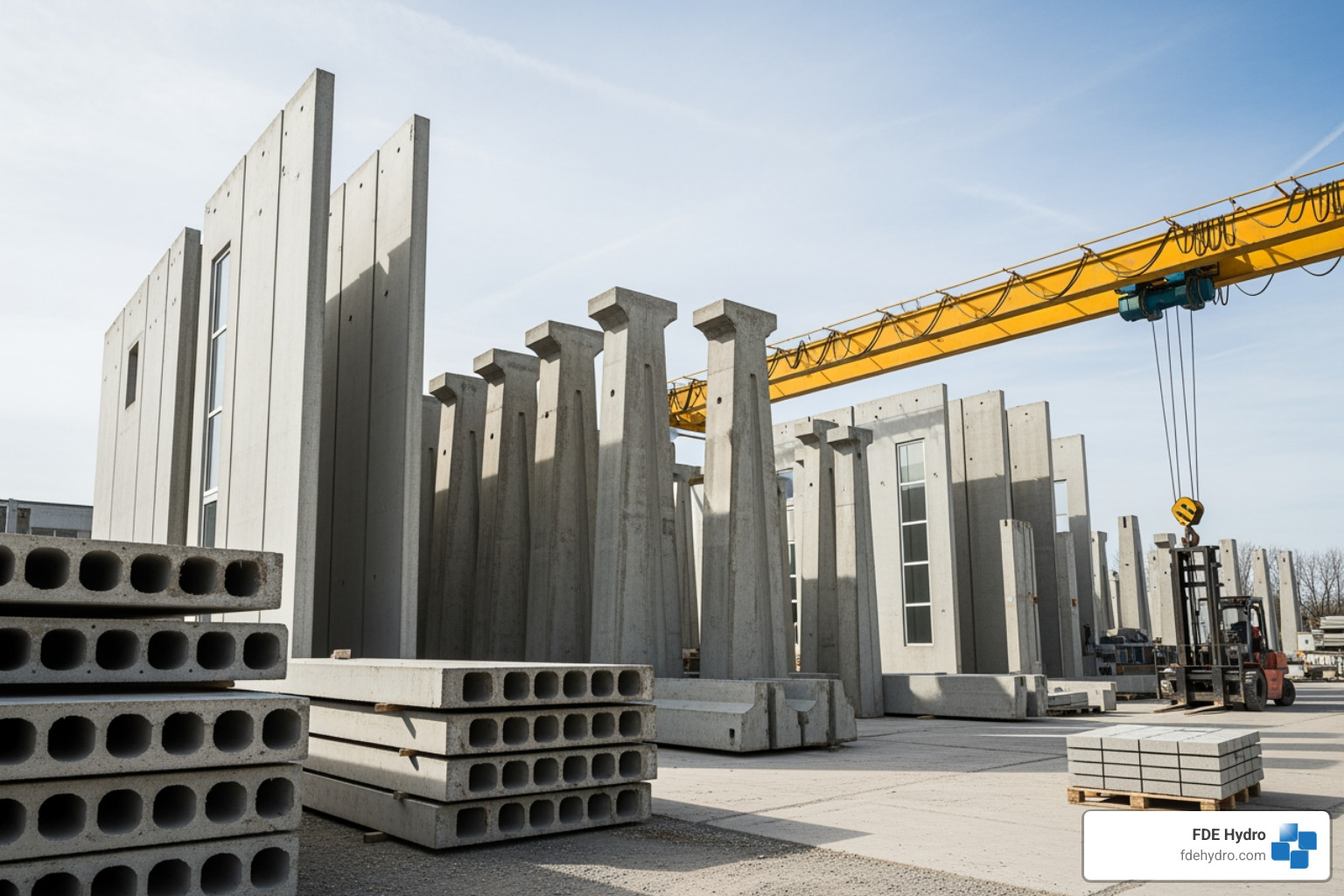
- Pre-stressed hollow-core slabs: These are a staple for floors and roofs, capable of spanning from 8 meters to 12 meters. Their hollow cores reduce weight while maintaining structural integrity, leading to material savings.
- Insulated sandwich panels: Comprising two concrete wythes separated by an insulating layer, these panels provide excellent thermal performance (R-values of R-20 or more are achievable) and can serve as both the structural envelope and finished exterior/interior walls.
- Architectural cladding: Beyond structural elements, modular precast allows for highly customizable architectural panels that can be used to clad building facades, offering aesthetic versatility with various finishes and textures.
- Volumetric 3D modules: These are essentially entire rooms or sections of a building cast as a single unit. While they can be heavy (over 30 tons for room-sized modules), they offer extreme speed on-site. Historically, these have been predominant for prison cells, with structures as high as 10 to 12 stories. Their use has expanded to school classrooms, hotel/motel rooms, and even bathroom pods, arriving at the site nearly complete and outfitted. You can find an overview of precast components that illustrates this diversity.
The Role of Technology in modular precast Production
The precision and efficiency of modular precast wouldn’t be possible without advanced technology and automation. The modern precast plant is a hub of innovation, where digital design meets robotic manufacturing.
- Automation and Robotics: From automated batching plants to robotic rebar placement and concrete pouring, automation streamlines the production process, ensuring consistency, speed, and safety. This reduces manual labor and minimizes human error.
- Building Information Modeling (BIM): BIM is crucial for the design and coordination of modular precast projects. It allows for the creation of detailed 3D models of components, facilitating clash detection, optimizing material usage, and ensuring precise fit-up on-site.
- 3D Engineered Models and Digital As-Builts: These technologies improve the accuracy of design and documentation, providing a digital twin of the project that can be used from initial design through to facility management. This level of detail is a significant leap from traditional blueprints.
These technological advancements optimize the entire production process, from design to the construction site, enhancing efficiency, quality control, and the overall deliverability of complex projects. We explore these innovations further in our discussion of Precast Concrete Technology.
Aesthetic Freedom and Customization
A common misconception about modular precast is that it leads to “cookie-cutter” or aesthetically limited buildings. We are here to tell you that is absolutely not the case! Modern modular precast offers remarkable design flexibility and customization options, allowing architects and designers to release their creativity.
Precast concrete is incredibly responsive to the designer’s needs. Colors, shapes, and textures are often more attainable with precast than with competitive materials. We can achieve a vast array of finishes:
- Formliners: These reusable molds can impart intricate patterns, textures, or even simulated natural materials (like wood or stone) onto the concrete surface.
- Textures: From smooth and polished to sandblasted, exposed aggregate, or ribbed, the surface texture can dramatically alter the appearance.
- Colors: Pigments can be added to the concrete mix to achieve a wide spectrum of colors. Additionally, exterior finishes can be stained with UV-resistant, vibrant colors, offering options like simulated ashlar, brick, barnboard, or block.
- Aggregate exposure: By varying the size and type of aggregate and the depth of exposure, we can create unique visual effects, from subtle speckles to bold, textured surfaces.
This level of customization means that modular precast can be used to create visually stunning and unique structures, dispelling any myths about limited design. Just look at how a Breezy Brazilian Prefab Is Made From Six Tiny Modules – Dwell and you’ll see the aesthetic possibilities are virtually endless.
Applications Across Industries: Where Modular Precast Shines
The beauty of modular precast lies in its adaptability. While it excels in projects requiring speed and repetition, its inherent strengths make it suitable for a surprisingly diverse range of applications, from critical infrastructure to modern housing solutions.
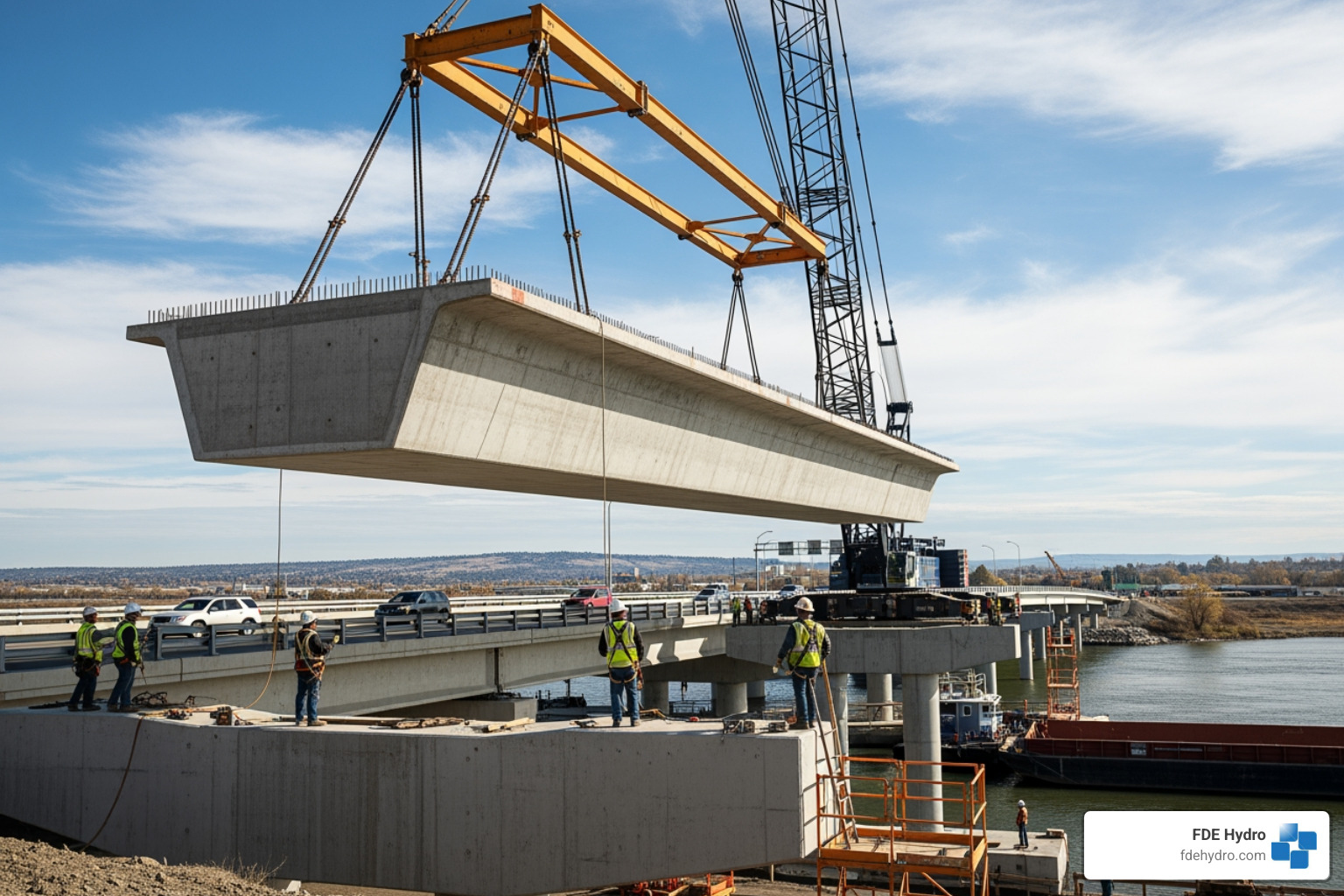
Accelerating Critical Infrastructure
For large-scale public works and vital infrastructure, modular precast is a game-changer. It’s about minimizing disruption, accelerating completion, and ensuring long-term resilience.
- Prefabricated Bridge Elements and Systems (PBES): As mentioned earlier, PBES are critical for Accelerated Bridge Construction (ABC). By building bridge components off-site, we can significantly reduce the time traffic is impacted, improve work-zone safety, and minimize weather-related delays. This method is gaining traction across North America, including projects in the U.S. and Canada, for rapid bridge replacement and rehabilitation. The FHWA’s information on Prefabricated Bridge Elements and Systems highlights how this approach improves site constructability, total project delivery time, material quality, and product durability.
- Water Control Systems: This is where our expertise at FDE Hydro™ truly comes into play. Our patented “French Dam” technology uses modular precast concrete for building and retrofitting hydroelectric dams and other water control systems. This approach significantly reduces construction costs and time compared to traditional methods, especially in regions like North America, Brazil, and Europe where we operate. The rapid installment of module precast civil infrastructure is changing how we approach vital water management projects. You can learn more about this innovative approach in our article on Modular Dam Construction.
Building the Future of Data and Housing
The rapid expansion of the digital world and the ongoing demand for affordable, quality housing present immense challenges that modular precast is uniquely positioned to address.
- Data Centers: The data center boom, fueled by AI and cloud computing, demands unprecedented speed-to-market. With nearly 5,000 operating data centres across North America and hundreds more in development in the U.S. and Canada, the pressure is on. As a McKinsey report indicates, the global capital expenditures for data centers and supporting infrastructure are projected to reach $6.7 trillion over the next five years. Modular precast offers the solution: rapid assembly, ability to accommodate heavy load requirements (up to 400lb/ft2 on floors), and high R-value insulated wall panels (R-20 or more) crucial for maintaining precise temperature control. Its resilience to fire and natural disasters also provides peace of mind for critical operations.
- Multi-story Housing and Commercial Buildings: The efficiency of modular precast is not limited to specialized facilities. It’s a proven method for constructing multi-story apartment buildings, hotels, and classrooms. Modular precast units have been successfully used for prison cells for many years, expanding to school classrooms and hotel/motel rooms. These units can be outfitted and finished at the plant, arriving at the site nearly complete, drastically cutting down on construction time and enabling quicker occupancy.
Navigating the Challenges and Limitations
While the advantages of modular precast are compelling, like any construction method, it comes with its own set of considerations. Understanding these challenges upfront allows for better planning and more successful project outcomes.
Logistical Problems: Transportation and Handling
The very nature of modular precast—large, pre-fabricated elements—introduces specific logistical problems.
- Module weight and size limitations: Room-sized 3D precast concrete modules can weigh more than 30 tons. Transporting such heavy and often oversized components requires specialized equipment and careful planning. The sheer dimensions of panels and modules can be limited by road regulations, bridge clearances, and vehicle capacities.
- Site access: Even if elements can be transported, the construction site itself must be accessible for large delivery vehicles and heavy lifting cranes. Tight urban sites or remote locations can pose significant challenges.
- Specialized transport and crane capacity: The handling and erection of heavy modular precast elements demand powerful cranes and experienced operators. This can add to the project cost and require meticulous scheduling.
Design and Connection Complexity
The factory-controlled precision of modular precast means that design decisions need to be finalized much earlier in the project lifecycle compared to traditional construction.
- Early design freeze: Changes later in the design process can be costly and cause significant delays, as molds may already be fabricated or components produced. This necessitates a more thorough and collaborative design phase upfront.
- Importance of precision: Every connection point, every utility penetration, and every dimension must be exact. Tolerances are much tighter in modular precast, requiring meticulous detailing and coordination between the design team, the precast manufacturer, and the on-site assembly crew.
- Force-fitting connections: The connection details between modular precast elements are critical for structural integrity and must be carefully engineered for force-fitting and durability. These connections need to be robust, efficient to assemble on-site, and capable of transferring loads effectively.
- Collaboration between teams: Successful modular precast projects rely heavily on seamless communication and collaboration among all stakeholders, from architects and engineers to the precast plant and the installation crew. This integrated approach ensures that all potential issues are addressed during the design phase, long before concrete is poured.
| Feature |
Modular Precast |
Cast-in-Place Concrete |
| Flexibility |
Design freeze required early; highly customizable within module constraints |
High design flexibility; changes easier during construction |
| Speed |
Rapid on-site assembly; concurrent off-site production |
Slower on-site construction; sequential operations |
| Quality Control |
Superior (factory controlled environment) |
Variable (site conditions, weather dependent) |
| Initial Planning |
Requires extensive upfront design and coordination |
More adaptable during construction |
| Site Impact |
Minimal disruption, noise, waste |
Significant site activity, noise, waste |
| Weather Dependency |
Low (factory production) |
High (site pouring and curing) |
| Labor Needs |
Lower on-site labor; skilled factory workforce |
Higher on-site labor; less specialized skill often used |
| Cost |
Lower overall project cost (due to speed, efficiency) |
Can be higher due to longer timelines, site overhead |
| Durability |
Excellent (high-strength, controlled curing) |
Good (can vary with site conditions) |
Frequently Asked Questions about Modular Precast Construction
What is the main difference between modular precast and traditional construction?
The primary difference lies in where the building elements are created. Modular precast involves manufacturing components like walls, floors, beams, and even entire 3D modules in a controlled factory setting before transporting them to the site for assembly. This “off-site” approach contrasts sharply with traditional construction, like cast-in-place concrete, which involves forming, pouring, and curing concrete directly on-site.
Traditional methods are slower, more susceptible to weather delays, and can have more variability in quality due to changing site conditions. Modular precast, by moving much of the work into a controlled environment, ensures consistent quality, faster timelines, and reduced on-site disruption.
Is modular precast only for simple, boxy buildings?
Not at all! This is a common misconception we love to dispel. While modular precast is incredibly efficient for repetitive structures like hotel rooms, prison cells, or data centers, modern precast technology offers vast aesthetic flexibility. Through the use of various molds, formliners, aggregates, and specialized finishes, architects can achieve a wide range of complex shapes, intricate textures, and vibrant colors.
We can simulate natural stone, brick, or wood, create unique patterns, or achieve sleek, modern facades. The ability to embed architectural elements directly into the precast during manufacturing means that “customization” is not an afterthought, but an integral part of the design process. The result is structures that are both highly functional and visually appealing, dispelling the myth of “cookie-cutter” buildings.
How long can a modular precast structure last?
Modular precast concrete structures are exceptionally durable and designed for a very long service life. Produced with high-quality, high-strength concrete in a controlled environment, they are inherently more robust and consistent than their cast-in-place counterparts. This controlled production environment leads to concrete that is stronger, denser, and less permeable, making it highly resistant to environmental degradation.
Precast concrete offers unparalleled resistance to fires, natural disasters, insects, and mold. With proper design and maintenance, modular precast structures can easily last for many decades, often 50-100 years or more, requiring minimal upkeep throughout their lifespan. This longevity makes them a highly sustainable and cost-effective choice for long-term infrastructure and building projects.
Conclusion
As we’ve explored, modular precast isn’t just a construction trend; it’s a fundamental evolution in how we build. From accelerating project timelines and delivering significant cost savings to ensuring superior quality, enhancing durability, and championing sustainability, the benefits are clear and compelling. We’ve seen how it’s revolutionizing diverse sectors, from the critical infrastructure of bridges and dams to the booming demand for data centers and housing across North America, Brazil, and Europe.
At FDE Hydro™, we believe in the power of innovation to solve complex challenges. Our work with patented modular precast technology, like the French Dam, is a testament to the transformative potential of this method in renewable energy and water control systems. By embracing modular precast, we’re not just building faster; we’re building better, stronger, and more sustainably for the future.
We invite you to learn more about how modular precast can benefit your next project. Explore advanced modular precast solutions for dams and find how we’re shaping the future of infrastructure, one precise, factory-made component at a time.
by Bill French Sr. | Dec 27, 2025 | Precast Dam Articles
Why Modular Precast Concrete Matters for Modern Infrastructure
Modular precast concrete is a construction method where concrete elements are prefabricated in a factory and assembled on-site. This approach significantly reduces environmental impact, accelerates timelines, and increases productivity compared to traditional methods, making it critical for infrastructure like hydropower facilities and dams where reducing costs and timelines is paramount.
Key benefits of modular precast concrete:
- Speed – Up to 30% faster than poured-in-place construction, with modules installed in hours or days instead of weeks
- Quality – Factory-controlled manufacturing minimizes errors and enables use of high-performance materials
- Durability – Structures last 100-150+ years with superior resistance to fire, storms, floods, and earthquakes
- Sustainability – Reduces waste, enables material reuse, and can achieve 60% better energy efficiency
- Cost – Lower overall project costs through reduced labor, faster timelines, and less site disruption
The construction industry generates about 38% of global CO2 emissions. Traditional methods create significant waste and are prone to weather delays. In contrast, industrialized prefabrication optimizes material use, improves quality management, and dramatically reduces on-site construction time, offering a proven solution to the challenges of large-scale civil construction.
I’m Bill French Sr., Founder and CEO of FDE Hydro, and I’ve spent five decades in heavy civil construction, including groundbreaking work with modular precast concrete on projects like the I-93 Fast14 bridge construction. My experience has shown that this construction method represents the future of efficient, sustainable infrastructure development.
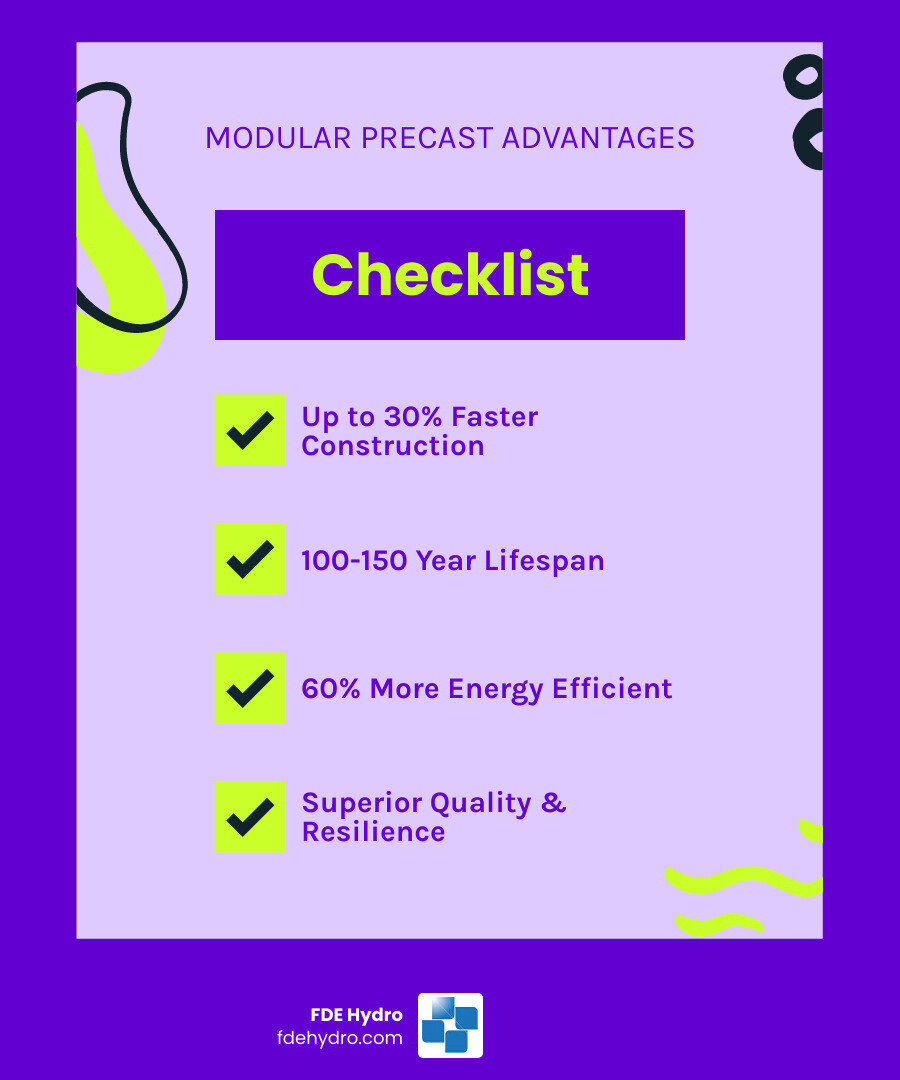
Modular precast concrete definitions:
The Core Principles: How It Works and Why It’s Different
Think of modular precast concrete as building with sophisticated, giant blocks instead of pouring concrete on-site. It’s a fundamental shift from traditional construction. Instead of dealing with weather, multiple crews, and material logistics on a chaotic site, we manufacture standardized concrete elements in a controlled factory environment. These precision-engineered pieces are then transported and assembled on-site like a puzzle.
Traditional construction is unpredictable. Rain, snow, or extreme heat can delay projects and affect quality. With modular precast concrete, we eliminate these variables. Manufacturing indoors ensures consistent quality and dramatically reduces waste. The accuracy of factory production means pieces fit together perfectly, a level of precision nearly impossible to achieve in the field.
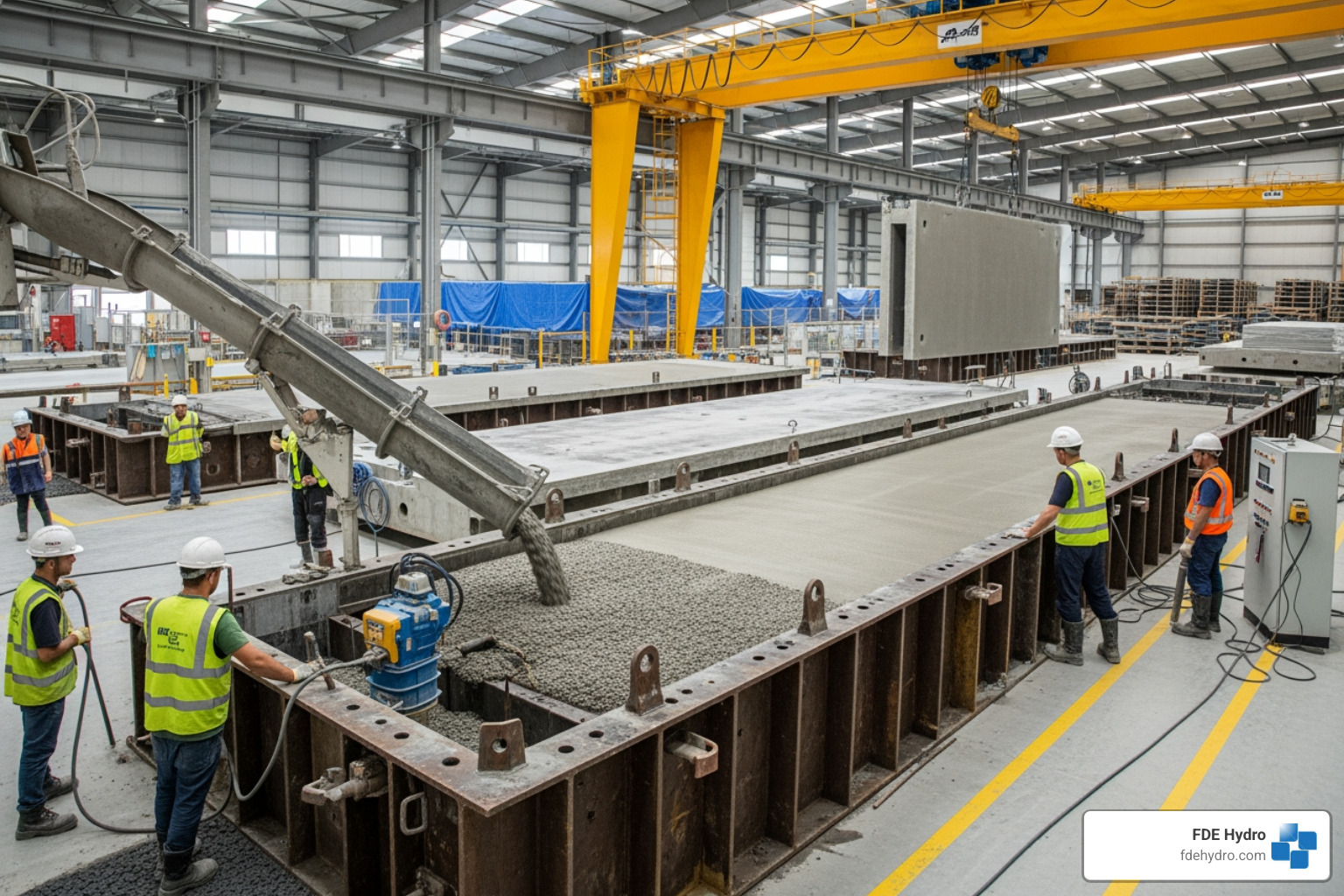
The speed difference is remarkable, with projects completed months faster. For infrastructure like hydropower systems, this speed means faster delivery and lower costs. This approach also leads to cleaner, more organized sites with less noise and disruption. Modular Construction Techniques have transformed how we build critical infrastructure.
| Feature |
Modular Precast Construction |
Traditional On-Site Construction |
| Timeline |
Rapid turnkey (weeks/months), up to 30% faster, weather-independent |
Slower (months/years), susceptible to weather delays |
| Quality Control |
Factory-controlled, integrated quality checks, minimized inaccuracies |
On-site variability, weather-dependent, potential for human error |
| Waste Reduction |
Optimized material flows, reduced on-site waste |
Significant on-site waste generation, material inefficiencies |
| Weather Impact |
Manufacturing unaffected by weather, indoor assembly |
Highly susceptible to weather delays and conditions |
| Site Congestion |
Minimized on-site labor, fewer trucks, less noise |
High traffic, noise, and labor density on-site |
| Material Use |
Enables high-performance, resource-efficient materials |
Standard materials, often less optimized for performance |
The Process of Modular Precast Concrete Manufacturing
Creating modular precast concrete elements is a precise, orchestrated process that begins long before on-site work.
It starts with design and engineering, where advanced software like Building Information Modeling (BIM) and Computer-Aided Design (CAD) are used to create inherently modular structures. Each element is engineered to the millimeter for strength, efficiency, and ease of assembly. These digital tools, which have evolved since the 1980s, enable mass customization with incredible precision.
Next, high-precision, often reusable molds are fabricated based on the designs. The concrete casting occurs in a controlled factory, allowing the use of high-performance mixes under ideal temperature and humidity. The curing process is also controlled, often accelerated with steam or heat to achieve strength rapidly and consistently. Finally, factory finishing (like insulation or waterproofing) is applied before modules are transported to the site, ready for installation.
When modular precast concrete elements arrive, the project shifts into high gear. While modules are manufactured, site preparation like laying foundations occurs simultaneously. This just-in-sequence delivery minimizes site congestion, noise, and the number of vehicles compared to traditional construction.
Large cranes handle crane erection, lifting modules into place. Entire sections can be installed in a single day—work that would take weeks with poured-in-place methods. Specialized connection technology securely joins the modules, creating a monolithic structure. This process requires minimized on-site labor, resulting in a safer, more efficient site with less construction noise and congestion. This rapid, turnkey construction is a game-changer for delivering critical infrastructure like hydropower plants and water control systems quickly and efficiently.
The Evolution of Building: From Historical Concepts to Modern Systems
The concept of modular precast concrete is over a century old. Early experiments with precast elements appeared in the late 1800s, such as reinforced concrete beams in the 1891 Biarritz Casino and room-sized modules in 1896. By the early 20th century, architects like Walter Gropius championed prefabrication for affordable housing, and large-scale projects like Liverpool’s Eldon Street Mass Housing in 1905 proved its viability.
The real boom occurred after World War II, when Europe’s need for rapid rebuilding drove the “Mass Production and Standardization” era. Systems like I-464 and Camus used large, standardized precast panels. While fast, these “closed modular systems” resulted in monotonous designs and limited flexibility.
In response, the “Open Prefabrication Period” (1970-1985) introduced compatible components from various manufacturers, allowing for more creative freedom. This shifted the focus from monolithic modules to flexible component assembly.
The digital revolution, starting around 1985, transformed manufacturing. CAD (Computer-Aided Design) and PLC (Programmable Logic Controller) systems enabled mass customization, combining mass-production efficiency with custom-design flexibility. This dramatically reduced labor and increased precision.
By the 2000s, Building Information Modeling (BIM), combined with CAM (Computer-Aided Manufacturing), created a seamless digital workflow from concept to production. Today, we can design, simulate, and generate manufacturing instructions within a single integrated environment. This evolution is what makes modern modular precast concrete so capable, allowing us to build smarter and with higher quality than ever. Research on Modularisation in Construction and Precast Building Systems documents this journey.
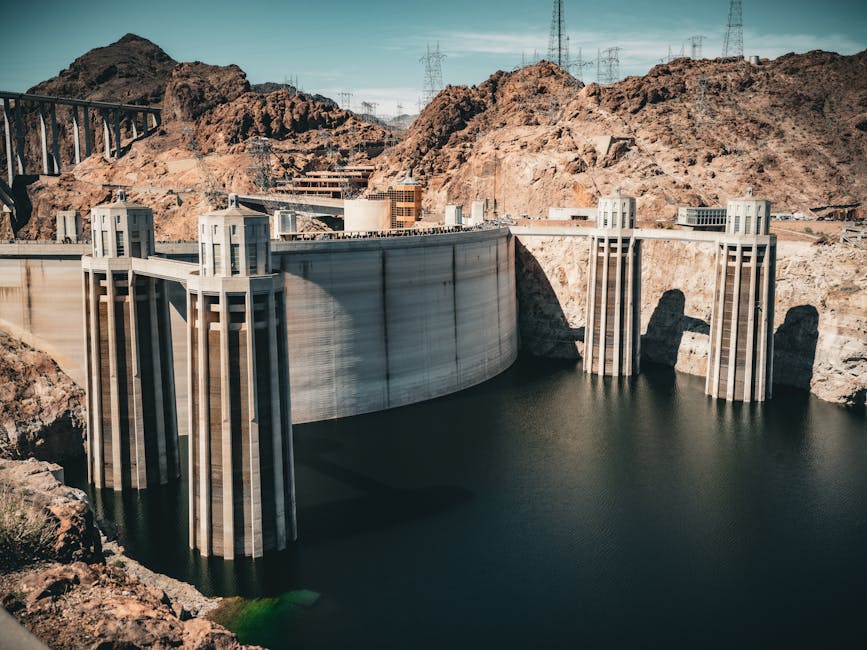
Key Advantages of Modular Precast Concrete
After five decades in heavy civil construction, I’ve seen that modular precast concrete stands apart. It’s a reimagining of how we build critical infrastructure, offering transformative advantages in speed, durability, sustainability, cost, safety, and resilience. These are not abstract claims but measured outcomes on real projects, from hydropower facilities to water control systems.
Accelerated Construction Timelines
Time is money in construction, and traditional schedules are vulnerable to weather and labor issues. Modular precast concrete changes this equation, achieving up to 30% time savings compared to conventional methods.
The key is weather-independent manufacturing. While on-site work halts for rain or snow, our factories produce high-quality modules in climate-controlled facilities. When modules arrive on-site, components that would take weeks to build are installed in hours or days. This rapid turnkey approach, detailed in our work with Rapid Installment of Module Precast Civil Infrastructure, is invaluable for projects with tight seasonal windows, such as hydropower facilities.
Best Durability and Resilience
Infrastructure like dams and hydropower plants must last for centuries. Modular precast concrete delivers an extraordinary lifespan of 100 to 150 years or more, thanks to high-performance materials and factory-controlled quality that eliminates on-site inconsistencies.
Beyond longevity, these structures offer superior resistance to disasters like tornadoes, earthquakes, floods, and fires. This resilience comes from the inherent strength of engineered precast concrete. The structural integrity achieved in a factory simply cannot be matched in the field, where curing conditions are variable. This durability also means low maintenance requirements, leading to dramatically lower lifecycle costs and greater long-term confidence for project owners.
Sustainability and Economic Benefits
The construction industry is a major contributor to global environmental challenges, causing about 38% of global CO2 emissions and consuming 85% of mineral raw materials. Modular precast concrete offers a more sustainable path.
Factory production optimizes material flows, drastically reducing the waste common on traditional job sites. The resulting structures can also be up to 60% more energy-efficient due to superior insulation and airtight construction. Furthermore, the modular design supports a circular economy; modules can be reused, re-deployed, or recycled, minimizing demolition and extending material life.
These environmental advantages are complemented by economic benefits. Modular precast concrete typically costs less over the asset’s lifecycle due to reduced labor, faster completion, and lower maintenance. This value proposition, detailed in Why Precast Cost Less, makes renewable energy infrastructure more affordable and accessible.
Modern Applications and the Role of Technology
The versatility of modular precast concrete has expanded from simple structures to sophisticated, mission-critical infrastructure. At FDE Hydro, we apply these techniques to challenging water projects across North America, Brazil, and Europe, where cutting-edge technology is the foundation of our success.
Diverse Infrastructure Applications
Our work at FDE Hydro centers on replacing aging water infrastructure. We use our patented modular precast concrete technology to construct hydropower plants and retrofit dams with unprecedented speed and efficiency. This approach extends the life of critical community assets.
The impact of this technology spans multiple sectors:
- Bridge Construction: Rapid replacement systems allow entire bridge sections to be installed overnight, minimizing traffic disruption, as seen in A National Example of Rapid Bridge Construction Using Modular Precast Elements.
- Water Control Systems: Factory-made elements ensure reliability for everything from complex aqueducts to flood control structures.
- Tunnels: Precast segments create stable, low-maintenance underground passages.
- Retaining Walls: Precast systems manage difficult terrains and protect vital infrastructure.
Other applications include utility buildings, pump stations, and water treatment facilities, all benefiting from the precision of factory manufacturing. The Precast/Prestressed Concrete Institute showcases many such Modular Components from the Precast/Prestressed Concrete Institute, which serve as ready-to-install “building blocks.”
The Impact of Technology and Overcoming Challenges
Modern technology makes modular precast concrete exceptional. Building Information Modeling (BIM) is central, allowing us to create a complete virtual model to simulate construction and prevent conflicts. CAD/CAM systems bridge design and reality, translating precise digital plans into physical elements. Automation in manufacturing further improves accuracy, safety, and quality.
However, the method has considerations that require expertise. Transportation logistics for large modules demand careful planning and specialized equipment. Connection complexities require advanced engineering to ensure structural integrity, especially for dams. Perhaps most importantly, success depends on early design integration. The modular approach must be part of the project from its inception, requiring close collaboration between designers, engineers, and manufacturers.
These challenges are not roadblocks but factors that are managed through experience, planning, and innovation.
The Future of Construction: Trends and Innovations
The evolution of modular precast concrete is accelerating, driven by the global need for smarter, more sustainable infrastructure. Future trends promise to make this method even more powerful.
Mass customization is becoming standard. Digital design and automated manufacturing allow for unique, shape-optimized elements that meet specific project needs efficiently. This supports higher ecological standards and CO2 reduction by enabling precisely designed, high-quality components.
Breakthroughs in high-performance concrete are also emerging. New mixtures, including self-healing variants, ultra-high-performance concrete (UHPC), and low-carbon concretes, are making modules stronger, more durable, and more sustainable. These materials allow for thinner, lighter, yet more robust structures.
We are also moving toward smart modules with integrated technology. Embedded sensors can monitor structural health, fiber optics can provide data, and integrated systems can manage heating and cooling. These intelligent modules will offer real-time performance insights and predictive maintenance capabilities.
Further automation in factories and on-site, using robotics and drones, will streamline logistics, boost safety, and reduce labor needs. As labor shortages persist, automation is a necessity for updating infrastructure affordably. These innovations are enabling larger and more complex projects, pushing the boundaries of what’s possible with precast. Learn more about how precast is expanding its capabilities.
Conclusion
As we’ve seen, modular precast concrete is more than a construction method—it’s a transformative approach to building vital infrastructure. From its historical roots to today’s digitally-powered systems, it consistently outperforms traditional methods.
The advantages are clear: accelerated timelines, superior durability and resilience for a 100-150+ year lifespan, and significant sustainability and economic benefits. For projects like hydropower plants, dams, and bridges across North America, Brazil, and Europe, modular precast concrete is proving its worth. The integration of modern technology, from BIM to automation, enables unparalleled precision and scale.
At FDE Hydro, we are proud to pioneer this innovation with our patented technology for hydroelectric dams and water control systems. This represents a fundamental shift in the construction paradigm—a smarter, faster, and stronger way to build. It’s how we future-proof our infrastructure, ensuring reliability and efficiency for generations to come.
Want to dive deeper into how we’re revolutionizing hydropower solutions with our advanced modular precast concrete technology? We invite you to explore further.
Learn more about advanced hydropower solutions
by Bill French Sr. | Dec 18, 2025 | Precast Dam Articles
The Blueprint for Modern Construction
Precast concrete advantages are changing how we build large-scale infrastructure. The key benefits include:
- Speed: Reduces construction timelines by up to 50%.
- Quality: Factory-controlled production ensures consistent strength.
- Durability: Offers a service life exceeding 100 years with minimal maintenance.
- Sustainability: Can earn up to 26 LEED points and reduces on-site waste by 90%.
- Safety: Reduces on-site labor and hazards.
- Cost-Effectiveness: Delivers lower long-term costs and a faster ROI.
Precast concrete is cast in reusable molds in a controlled factory, cured to optimal strength, and then transported to sites for rapid installation. This differs from traditional cast-in-place methods, where concrete is poured and cured on-site, subject to weather delays and quality issues.
Manufacturing occurs in certified plants where structural components—columns, beams, walls, and more—are produced under rigorous quality control. This allows for year-round production while site preparation proceeds simultaneously. Once cured, components are delivered just-in-time for quick installation, compressing schedules from months to weeks.
For water infrastructure and hydropower, these precast concrete advantages are critical. Harsh conditions and tight project windows make precast an ideal solution. Its resistance to moisture, corrosion, and extreme weather addresses the unique challenges of marine applications.
I’m Bill French, founder and CEO of FDE Hydro™, and in my five decades in heavy civil construction, I’ve seen precast technology revolutionize project delivery. My experience proves that embracing modular precast isn’t just about building faster—it’s about building smarter for the next century.
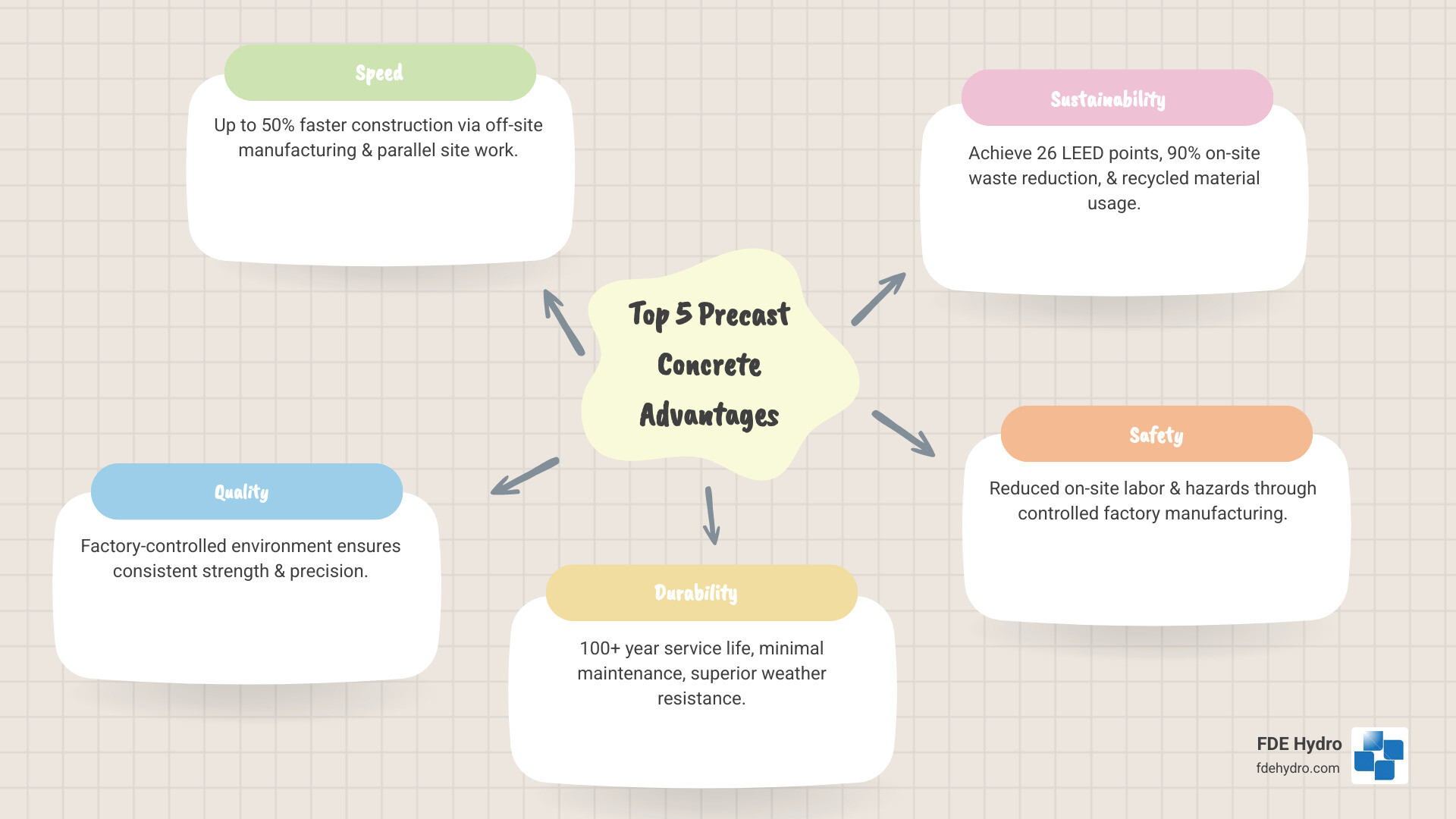
1. Accelerated Construction: Building Faster and Smarter
One of the most significant precast concrete advantages is speed. Projects using precast can finish up to 50% faster than with traditional methods, a timeline reduction that can save an entire season of work.
The secret is parallel processing. With traditional cast-in-place concrete, work is sequential: pour, wait, cure, and hope for good weather. Precast flips this model. While the site team excavates and lays foundations, structural components are simultaneously manufactured in a controlled factory environment. Site work and fabrication happen at the same time.
This synchronized approach enables just-in-time delivery. Components arrive on-site fully cured, inspected, and ready for immediate installation, eliminating on-site curing delays and material storage issues.
Furthermore, all-weather manufacturing means production continues year-round, regardless of rain, snow, or extreme temperatures. This eliminates weather-related delays that commonly plague traditional construction.
The installation phase is also remarkably fast. A small erection team can assemble precast components in days or weeks, a task that would take months for a large on-site crew. This minimized on-site labor requirement accelerates the schedule and reduces costs.
We’ve applied these principles to critical infrastructure. Our Rapid Installment of Module Precast Civil Infrastructure shows how complex systems can be assembled with speed. Similarly, the 93 Fast Bridge Replacement System Now Being Utilized Throughout US proves that entire bridge sections can be installed over a weekend.
Faster project completion means reduced financing costs, earlier revenue generation, and less community disruption. In an industry where time is money, these precast concrete advantages deliver significant value.
2. Superior Quality and Best Resilience
When it comes to quality and resilience, the precast concrete advantages are clear. The factory setting provides a controlled environment where every variable is managed, unlike on-site cast-in-place concrete, which is exposed to weather and inconsistent conditions.
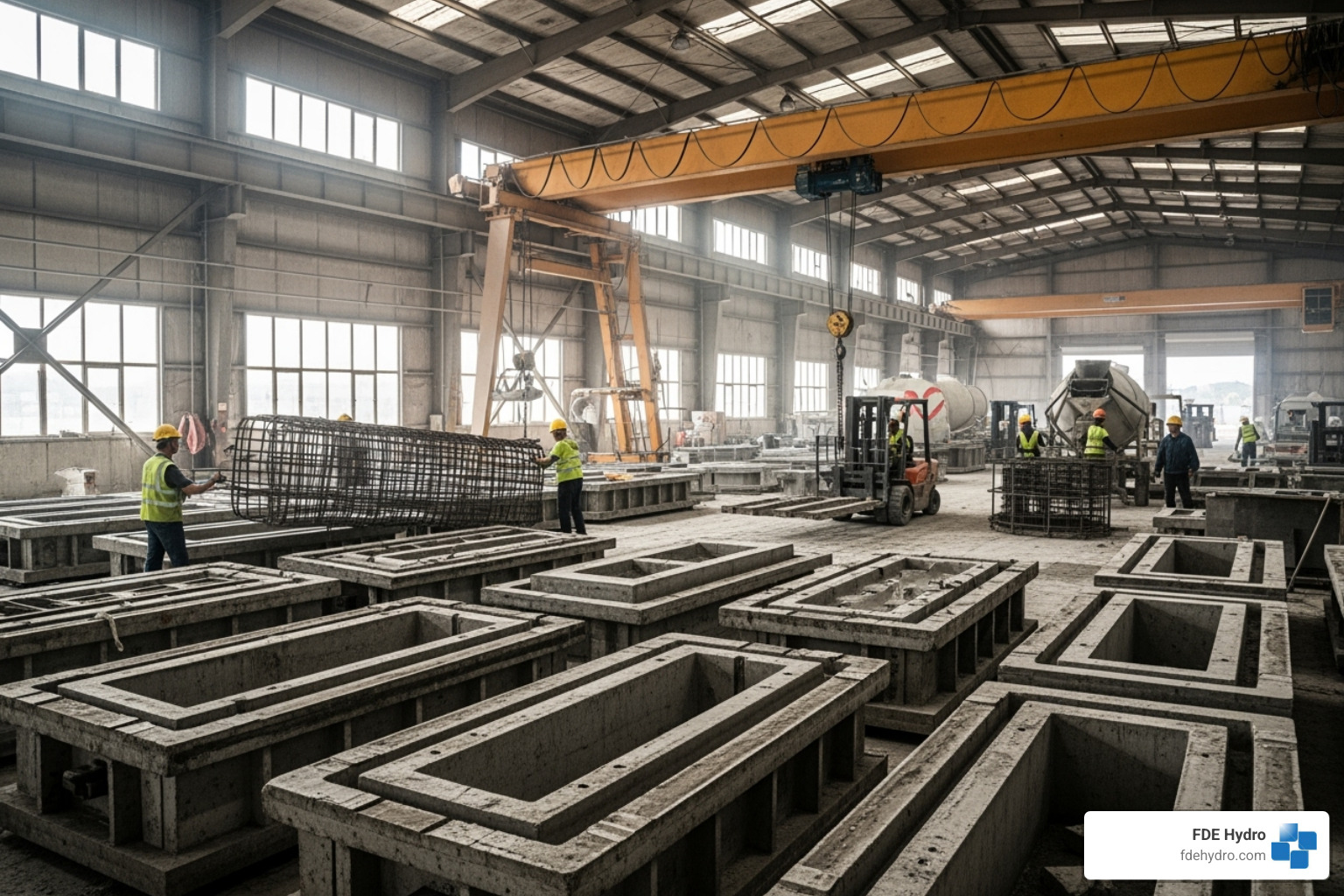
Inside a precast plant, quality control is integral. Consistent mix designs, precise aggregate ratios, and optimal curing conditions are maintained—standards nearly impossible to replicate on an open construction site. This meticulous process produces concrete with superior strength. Pre-stressing techniques can be added to achieve even greater load-bearing capacity, allowing for longer clear spans with slender structural members.
The real payoff is longevity. Precast structures have a service life that can exceed 100 years with minimal maintenance. This durability is confirmed by research, such as that from the Resilient Structures – Canadian Precast Concrete Institute, which shows precast is built to withstand environmental stressors and time.
Beyond strength, precast concrete offers impressive performance benefits.
- Fire Resistance: Concrete is non-combustible and earns an excellent A1 fire rating. It maintains structural integrity far longer than steel in high heat, providing critical time for evacuation and preventing the spread of fire.
- Sound Insulation: The natural density of precast concrete walls makes them excellent at blocking noise, ideal for residential buildings, hotels, and offices.
- Environmental Resistance: Precast concrete resists rot, pests, mildew, and freeze-thaw cycles. This resilience is essential for projects in harsh conditions.
Our Modular Sea Wall Systems, for example, face relentless saltwater and wave action. In these applications, the moisture resistance and durability of precast are not just benefits—they are essential for creating a system that lasts for decades without constant, expensive repairs.
3. Unpacking the Core Precast Concrete Advantages for Cost and Sustainability
Beyond speed and quality, the precast concrete advantages for cost and sustainability are equally impressive.
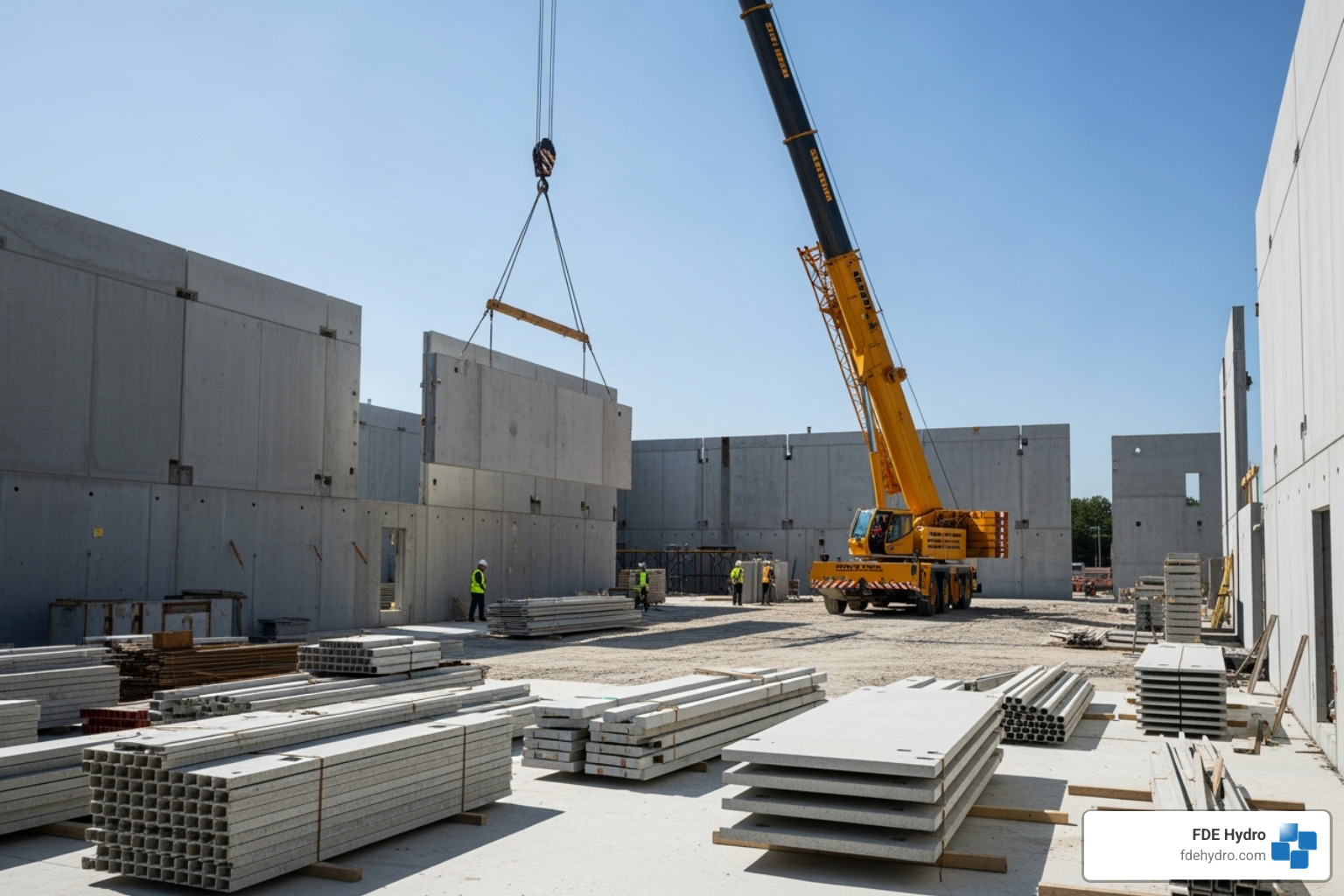
Factory-based production significantly reduces on-site labor needs, lowering costs from day one. Over the long term, precast’s exceptional durability leads to dramatically lower lifecycle costs. A structure that requires minimal maintenance and lasts over a century offers a faster return on investment, as explained in Why Precast Costs Less.
From a sustainability perspective, precast excels. The controlled factory environment allows for precise material management, reducing on-site waste by up to 90%. Excess materials and even recycled content like glass can be incorporated back into production, minimizing the demand for virgin resources. This efficiency contributes to a lower carbon footprint.
Precast concrete can also contribute up to 26 LEED points. Its thermal mass helps regulate building temperatures, improving energy efficiency. It also acts as an effective air barrier and emits virtually no volatile organic compounds (VOCs), leading to healthier indoor air quality.
Cost-Effectiveness: Long-Term Precast Concrete Advantages
While a precast plant requires initial investment, the long-term savings are substantial. The durability of precast means minimal maintenance, translating directly into lower operational expenses over the structure’s 100+ year service life.
This cost-effectiveness is particularly impactful for large-scale developments like affordable housing. As shown in projects highlighted by Precast Concrete Delivers Affordable Housing, the combination of rapid construction and low ongoing costs makes precast an ideal solution for community infrastructure.
A faster ROI is achieved through quicker construction, reduced labor costs, and minimal maintenance expenses. For developers and owners, these precast concrete advantages create a compelling business case that grows stronger over time.
4. Design Freedom and A Safer Work Environment
Contrary to the image of plain gray boxes, one of the key precast concrete advantages is incredible design freedom. Precast is an architect’s playground, offering immense creative possibilities.
Its versatility allows for virtually any texture, color, or shape. Finishes can range from smooth and polished to textured, and facing materials like brick or stone can be incorporated directly into panels. Reusable molds enable the creation of custom forms with intricate details that would be difficult or expensive to achieve with cast-in-place methods. This allows for bold facades, curved walls, and unique architectural expressions, as shown in our Precast Models.
Beyond aesthetics, pre-stressed precast concrete allows for long, clear spans without interior columns. This creates open, flexible interior spaces that can be easily reconfigured. As the Architectural Precast Association notes in Why Use Architectural Precast, the material delivers versatility, resilience, and quality in one package.
Safety as a Standard
Safety is another critical advantage. Traditional construction sites are crowded and hazardous. Precast concrete transforms this by shifting most of the work to a controlled factory environment.
This move dramatically reduces the number of on-site workers, which in turn lowers the risk of accidents. The factory itself is a safer setting, with specialized equipment, strict safety protocols, and no weather-related hazards. On-site, the installation process is streamlined and requires less time, minimal material storage, and reduced congestion. This shift to off-site manufacturing significantly reduces risks, making the entire construction process safer for everyone involved.
5. Precast vs. Cast-in-Place: A Head-to-Head Comparison
Choosing between precast and traditional cast-in-place concrete is a fundamental project decision. While both use concrete, their manufacturing and application methods lead to vastly different outcomes, highlighting the true precast concrete advantages.
The key differences are summarized below:
| Feature |
Precast Concrete |
Cast-in-Place Concrete |
| Speed |
Faster construction through off-site fabrication and parallel processing with just-in-time delivery |
Slower sequential on-site pouring and curing, highly weather-dependent |
| Quality Control |
High consistency from factory-controlled environment with precise mix design and optimal curing |
Variable quality affected by on-site conditions, weather, and less controlled processes |
| Cost |
Lower long-term lifecycle costs with reduced on-site labor; higher initial plant setup |
Higher on-site labor costs with potential delay expenses; lower initial setup if no plant needed |
| Site Impact |
Minimal waste (up to 90% reduction), less congestion, reduced noise and disruption |
More on-site waste, material storage, noise, and disruption |
| Weather Dependency |
Manufacturing unaffected by weather, ensuring consistent production schedules |
Highly dependent on favorable conditions for pouring and curing, leading to potential delays |
| Design Flexibility |
Excellent aesthetic versatility with custom forms, textures, colors, and long clear spans |
More limited aesthetic options without extensive on-site finishing; complex shapes require custom formwork |
While the precast concrete advantages are compelling, it is important to consider potential challenges.
- Transportation logistics: Large, heavy precast components require specialized trucks, cranes, and careful route planning. Proximity to a precast plant is a key factor, as we’ve learned from projects like the 93 Fast Bridge Replacement System Now Being Utilized Throughout US, where logistics are critical.
- Connection sensitivity: The connections between precast elements must be executed with precision on-site to ensure structural integrity. Working with experienced engineers and installers is essential to avoid issues.
- Initial plant investment: Setting up a precast facility requires a significant upfront cost. However, for projects with large volumes or repeatable components, this investment pays for itself through efficiency, consistency, and long-term savings.
With careful planning, these challenges are manageable. For FDE Hydro, the benefits of precast align perfectly with the demanding requirements of water infrastructure and hydropower projects, where durability, precision, and rapid deployment are paramount.
6. Versatile Applications: From Buildings to Bridges and Beyond
The precast concrete advantages of speed, quality, and durability make it a remarkably versatile solution for a diverse range of projects, from commercial buildings to critical infrastructure.
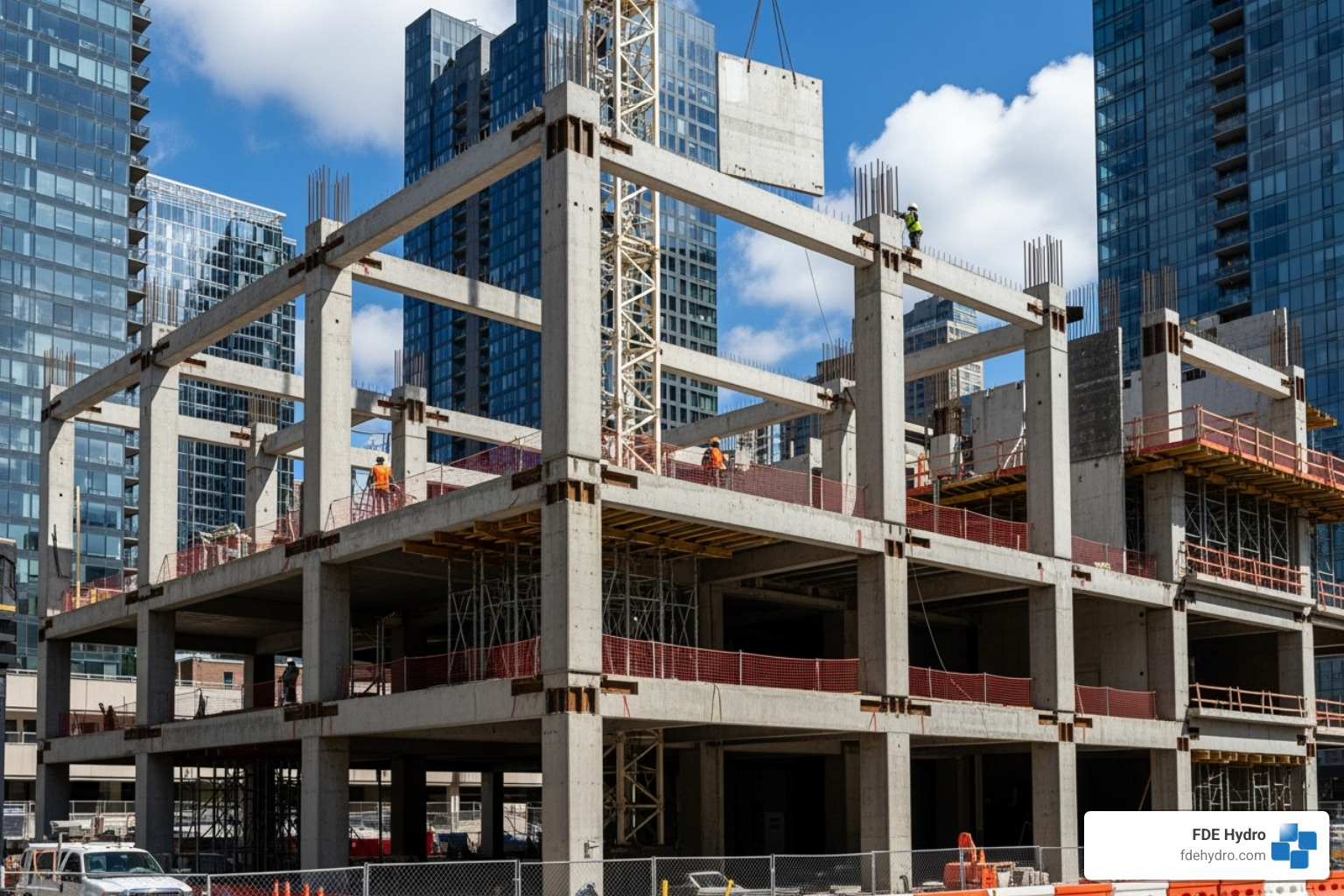
In urban environments, precast is used for commercial buildings and parking structures, where rapid assembly and durability are key. The repetitive nature of parking garage design makes precast especially efficient.
In civil infrastructure, precast excels. Bridges, for example, can be built in a fraction of the time of traditional methods. Our project, A National Example of Rapid Bridge Construction Using Modular Precast Elements, shows how entire spans can be assembled in days, minimizing public disruption. Other common applications include durable retaining walls, culverts, and sound barriers.
For specialized applications, precast is even more critical. At FDE Hydro™, we use modular precast technology for water control systems and hydropower infrastructure. These projects demand precision and resistance to constant water exposure. Our Modular Powerhouses and the Prototype of Modular Precast French Dam Completed demonstrate how precast can make renewable energy projects faster and more cost-effective.
Other applications include foundations, basements, floors, beams, columns, stairs, utility structures, and tunnel segments. All these uses share a common need for reliable, efficient, and long-lasting construction. The consistent precast concrete advantages make it an indispensable material in modern construction.
Conclusion: Building the Future with Precast Concrete
The precast concrete advantages offer a transformative approach to construction that is faster, smarter, and more durable. Every step, from factory production to on-site installation, is optimized for exceptional results.
By guaranteeing superior quality, compressing timelines by up to 50%, and reducing on-site labor and waste, precast creates a win-win scenario. Its sustainability benefits—including LEED potential, use of recycled materials, and improved energy efficiency—align with the need to build responsibly.
Precast also offers design freedom and makes construction sites safer. While there are logistical considerations, the long-term benefits of durability, speed, and cost savings make it a clear choice for forward-thinking projects.
At FDE Hydro™, we have seen how precast revolutionizes the renewable energy sector. Our patented French Dam system applies these advantages to hydropower and water infrastructure projects across North America, Brazil, and Europe, making them faster, more affordable, and built to last.
After five decades in heavy civil construction, I know that precast concrete challenges conventional thinking by prioritizing quality and safety from day one. Whether for a building, bridge, or hydropower installation, precast offers a proven path forward.
Ready to see how these precast concrete advantages can transform your next project? Explore our innovative means and methods for your next project and find how we can help you build smarter, faster, and for generations to come.

