by Bill French Sr. | Dec 29, 2025 | Energy Resource Articles
Why Construction Costs Are Soaring—And What You Can Do About It
Reduce construction costs without sacrificing quality—that’s the challenge facing every project manager today. Here’s how to get started:
- Strategic Planning: Apply value engineering during design to eliminate unnecessary expenses.
- Innovative Methods: Use prefabrication and modular construction to cut labor costs by 20-40%.
- Smart Sourcing: Buy materials in bulk and source locally to reduce transportation expenses.
- Technology Integration: Implement BIM and construction management software to prevent costly errors.
- Waste Reduction: Minimize material waste through careful planning and reuse strategies.
- Risk Management: Establish contingency funds and clear contracts to avoid budget overruns.
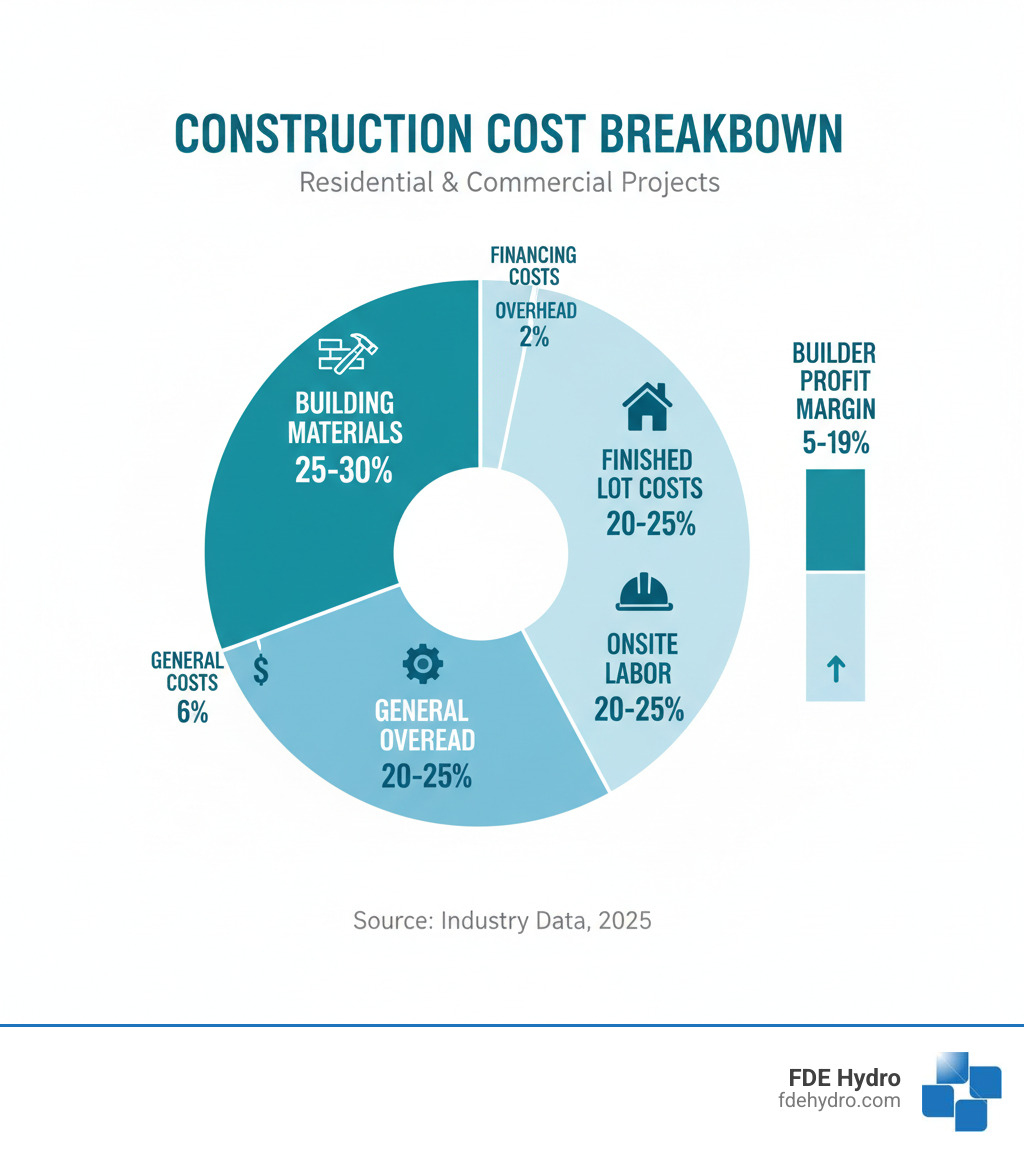
The construction industry faces unprecedented pressure from rising material prices and labor shortages. With material and labor costs representing over 90% of project expenses, profitability is squeezed across every sector. Yet, cost overruns aren’t inevitable. The primary obstacle is often mismanagement and lack of supervision, not a lack of tools. Strategic approaches can deliver substantial savings: 20-30% for residential projects, 10-20% for infrastructure, and 25-35% for industrial construction.
This guide provides a comprehensive blueprint for savings across the project lifecycle. You’ll find proven strategies for delivering on-time, on-budget results, even in challenging economic conditions. The key is to understand your costs and implement strategic controls at each phase. Whether for a small residential build or a multi-million dollar infrastructure project, the fundamentals are the same: plan carefully, build efficiently, and manage relentlessly.
I’m Bill French Sr., founder and CEO of FDE Hydro. With five decades in heavy civil construction and hydropower, I’ve pioneered methods to reduce construction costs using innovative modular approaches. My experience leading over $200M in annual projects has taught me that the smartest savings come from working better, not cheaper.
Essential reduce construction costs terms:
Strategic Planning and Design: The Foundation of Cost Savings
The journey to reduce construction costs begins long before the first shovel hits the ground—it starts in the planning and design phase. Smart decisions here have the biggest impact on your bottom line, preventing costly rework later. It’s much cheaper to fix a problem on paper than to rebuild on-site. That’s why we start with a comprehensive cost breakdown structure (CBS)—a detailed outline of every expense. This financial roadmap provides clarity on where to spend and save. We also consider our Means and Methods early, selecting the most efficient construction techniques for the job.

How Value Engineering Helps Reduce Construction Costs
Value engineering isn’t about cutting corners; it’s about maximizing value at minimum cost without compromising quality. The process involves critically analyzing every design element and material. For each component, we ask: “Is this the most efficient way to achieve our goal?”
Life-cycle cost analysis is a key part of this. We look beyond the upfront price to consider long-term expenses like maintenance and energy use. High-performance insulation might cost more initially but saves thousands in energy bills over the building’s lifespan.
Space optimization is another powerful tool. Efficient layouts can reduce overall square footage without sacrificing functionality. Every square foot eliminated saves on materials, labor, and future utility costs. For kitchens and bathrooms—the most expensive rooms per square foot—consider phased upgrades. Install cost-effective fixtures initially and plan to upgrade later. For example, rough in the plumbing for a jetted tub but install a standard one first. The upgrade becomes a simple swap without structural changes.
Smart Design Choices for a Leaner Budget
Early design decisions have ripple effects throughout the project. Here are the choices that make the biggest difference:
- Define wants versus needs: Honestly separate the must-haves from the nice-to-haves to prioritize spending where it truly matters.
- Choose stock vs. custom designs: Modifying an existing stock plan offers personalization while saving substantially on architectural fees compared to a fully custom design.
- Reduce square footage: A smaller footprint is the most direct way to reduce construction costs, as it means less material, labor, and a shorter timeline.
- Build upward, not outward: A two-story design is more cost-effective than a sprawling single-story home of the same size because it minimizes foundation and roof expenses relative to the living area.
- Simplify roof systems: A simple roofline is far more economical than a complex one with multiple gables and valleys, requiring fewer materials and less specialized labor.
- Use open-plan layouts: Reducing interior walls and doors saves on materials and labor while making spaces feel larger and more flexible.
- Select finishes wisely: Using drywall for ceilings costs about half as much as pine paneling. These choices add up quickly.
- Use expensive materials strategically: For specialty homes, use expensive finishes like logs or stone as accents rather than covering entire surfaces. This provides visual interest without the high price tag.
Smart design doesn’t feel like a compromise; it feels like intelligent planning that delivers a beautiful, functional project without unnecessary expense.
Innovative Materials and Methods to Reduce Construction Costs
The materials you choose and the methods you employ can transform your project’s bottom line. We’ve spent decades exploring innovative approaches that cut costs and deliver better, faster results.
The Power of Prefabrication and Off-Site Building
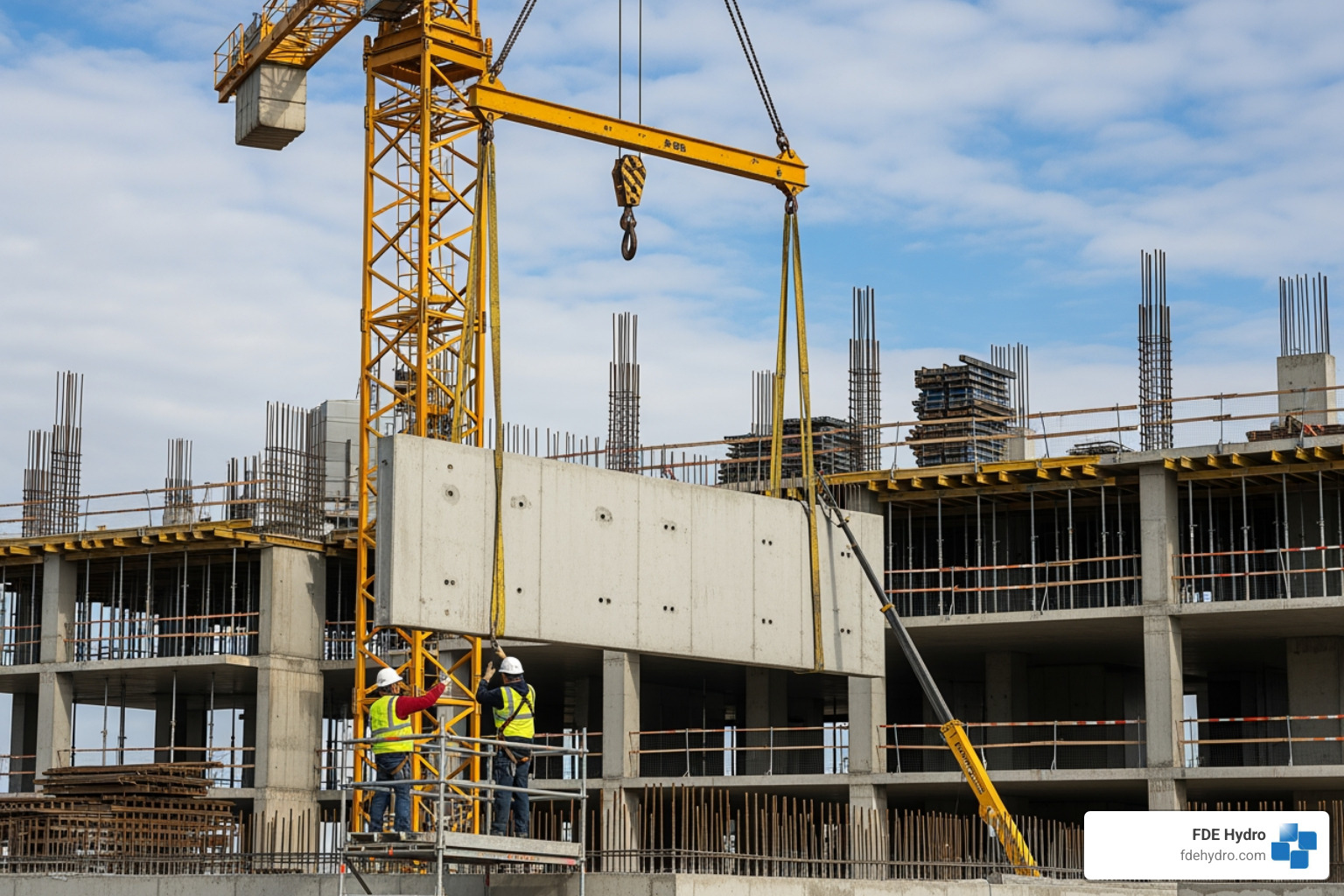
Prefabrication and modular construction involve manufacturing building components in a factory and assembling them on-site. This approach has revolutionized building in North America, Brazil, and Europe, offering substantial benefits:
- Reduced on-site labor: Factory workflows are streamlined and unaffected by weather, directly lowering labor costs.
- Minimized material waste: Controlled environments allow for precise cuts and material optimization, drastically reducing waste compared to traditional sites.
- Faster project completion: Components are manufactured while site preparation occurs, shaving months off schedules. At FDE Hydro, our proprietary “French Dam” modular technology exemplifies this speed, allowing projects to generate revenue sooner. Learn more about our Modular Construction Techniques.
- Improved quality control: Factory conditions allow for consistent inspections and adherence to standards, resulting in fewer defects.
The durability and energy efficiency of precast concrete panels are exceptional. A 6.5″ concrete wall offers a fire-resistance rating of four hours or more. These panels can integrate multiple layers (finishes, insulation, structure) into one system, while their thermal mass helps regulate indoor temperatures, lowering long-term energy costs.
Our research shows Why Precast Costs Less. In our projects, modular precast concrete eliminates labor-intensive processes and waste, delivering transformative savings that help clients reduce construction costs.
Strategic Sourcing for Materials and Equipment
Smart procurement is about finding the best value, not just the lowest price. This means balancing cost with quality and reliability.
- Build strong supplier relationships: Long-term partnerships with reputable suppliers can lead to better pricing, volume discounts, and flexible payment terms.
- Negotiate bulk purchase discounts: Accurate forecasting allows for buying in volume, which yields significant per-unit savings on large-scale projects.
- Source materials locally: This reduces transportation costs and leverages local suppliers’ knowledge of regional codes and logistics. For projects requiring Rapid Installment of Module Precast Civil Infrastructure, local sourcing is essential.
- Use just-in-time (JIT) delivery: Materials arrive precisely when needed, minimizing on-site storage, damage, and theft. JIT requires meticulous planning but is a powerful tool to reduce construction costs.
Optimizing On-Site Operations and Labor Management
Even with great planning, what happens on the job site can make or break your budget. Inefficient operations or poor labor management can derail a project, but small improvements here can yield dramatic results to reduce construction costs.
Labor costs can consume 40% of a construction project’s budget, so managing this expense is essential. Start by hiring skilled workers. Experienced tradespeople command higher rates but work faster, make fewer mistakes, and produce higher quality results, which ultimately lowers costs by reducing rework and delays.
Better scheduling is another game-changer. Coordinating trades effectively minimizes downtime and keeps the project moving. We also invest in training and development. A well-trained workforce is safer and more efficient, and safety training alone prevents costly accidents.
How Technology Can Reduce Construction Costs
Technology gives craftspeople better tools to work smarter. Here’s how it helps:
- Building Information Modeling (BIM) creates a detailed 3D digital model of the project. This allows for “clash detection,” identifying problems like a pipe running through a beam before construction begins. Fixing issues with a mouse click instead of a jackhammer prevents costly rework and keeps schedules on track.
- Construction management software provides real-time visibility into project costs, schedules, and subcontractors. Kingston Homes, for example, achieved a 15% cost reduction using such software. It allows managers to address budget issues immediately, not at the end of the month.
- Drones are invaluable for fast, accurate site surveys and progress monitoring. They can also conduct safety inspections in hard-to-reach areas, reducing risk.
- Automation and robotics are increasingly used for repetitive tasks like rebar-tying, performing them faster and with more consistent quality than manual methods.
Controlling Scope Creep and Change Orders
Change orders are budget killers. A seemingly “little change” can cascade through a project, causing rework, schedule delays, and increased subcontractor costs.
Our first defense is developing clear contracts that outline every project aspect, including a process for handling changes. Ambiguity invites uncontrolled costs.
We also implement a formal change management process. Every request is documented, evaluated for its cost and schedule impact, and formally approved by all stakeholders before implementation. This ensures everyone understands the financial implications.
Maintaining clear communication with stakeholders prevents many change orders by surfacing potential issues early. Finally, avoiding last-minute design changes after construction begins is critical. The cost of changes multiplies exponentially once work is underway. Get the design right before the first pour to reduce construction costs dramatically.
Navigating Financials, Risks, and Regulations
To reduce construction costs, you must understand financial realities, manage risks, and steer regulations. These factors can make or break your bottom line.
Proactive Risk and Financial Management
Every project has risks; how you manage them determines success. Many wonder about acting as their own general contractor to save on the builder’s 4.8% to 18.9% profit margin. However, this is risky. Subcontractors often charge homeowners more, you lack the purchasing power of a professional builder, and insurance premiums are higher. The cost of inexperience and mistakes can quickly erase any potential savings.
Contingency funds are essential. We build a 5-10% cushion into our budgets for surprises like material surcharges or unexpected site conditions. This prevents delays while scrambling for funds.
Building strong relationships with lenders secures favorable financing terms, which can significantly reduce construction costs over a project’s life. A single percentage point difference on a multi-million dollar project is substantial. Finally, adequate insurance is a necessary upfront cost that protects against catastrophic financial losses.
How Regulations and Competition Impact the Bottom Line
The regulatory environment and market competition directly influence construction costs. We’ve seen this across North America and Brazil.
Restrictive Project Labour Agreements (PLAs) can dramatically inflate costs by limiting competition. In Ontario, Canada, a PLA is projected to add $168 million to $525 million to the cost of a new hospital because fewer companies could bid on the work.
Conversely, open competition drives down prices. The Region of Waterloo in Canada saved $24 million in two years after opening tenders to all qualified companies, seeing a 14% drop in average bid prices. The City of Hamilton estimated savings up to 21%. As one report notes, Increased competition is critical to counter rising construction prices.
Skilled trades training program rigidity also presents a challenge. When certification depends on hours worked rather than skill, it creates labor shortages. Reforming the system to recognize skills at every stage would expand the labor pool, address shortages, and ultimately reduce construction costs.
Frequently Asked Questions about Reducing Construction Costs
What is the most effective way to lower construction costs?
The most powerful way to reduce construction costs is through meticulous pre-construction planning and design. Decisions made during this phase—simplifying a roofline, reducing square footage, or applying value engineering—have the largest downstream effect on material and labor costs. Projects that invest time and expertise upfront consistently come in on budget.
Can I save money by acting as my own general contractor?
While it’s tempting to save the builder’s profit margin (which can be 4.8% to 18.9%), the risks often outweigh the reward. Subcontractors may charge you more than a professional builder who provides repeat business. You’ll lack a builder’s purchasing power for materials and have to buy or rent specialty tools for a single job.
Furthermore, insurance companies view individual builders as a higher risk, leading to higher premiums. The cost of mistakes due to inexperience can quickly eliminate any supposed savings. Unless you have significant construction experience, hiring a professional is usually the smarter financial choice.
How does technology like BIM help reduce costs?
Building Information Modeling (BIM) saves money by creating a detailed 3D digital model of your project, allowing you to catch problems before they become expensive. The key feature is clash detection. This lets you see where elements conflict—like a plumbing line running through a structural beam—and fix the issue digitally during the design phase.
Resolving these conflicts on a screen instead of on-site with jackhammers prevents costly rework, material waste, and schedule delays. In my experience with large-scale infrastructure, BIM is invaluable for ensuring modular components fit together precisely, which is critical for staying on budget and on schedule.
Conclusion
The path to reduce construction costs isn’t about taking shortcuts; it’s about building smarter. We’ve walked through the essential strategies that deliver exceptional value, starting with strategic planning and design, where your most powerful cost-saving decisions are made.
Next is the power of innovation—embracing prefabrication, modular construction, and smart sourcing to slash costs and timelines. On-site efficiency and management preserve those savings through technology like BIM and vigilant scope control. Finally, understanding the financial and regulatory landscape protects your bottom line from unexpected hits.
The construction industry faces challenges, but obstacles can be overcome. Data shows that systematic strategies can yield savings of 10-35% depending on the sector. The key is a commitment to planning, innovation, and excellence in execution.
At FDE Hydro, we’ve built our reputation on this philosophy. Our innovative modular precast concrete technology, the “French Dam,” is designed to lower expenses and accelerate project timelines in the energy and water sectors across North America, Brazil, and Europe. We’ve spent five decades proving that the smartest way to reduce construction costs is to work better, not cheaper.
The future of construction belongs to those who accept these principles. Every project is an opportunity to prove that quality, efficiency, and cost-effectiveness can coexist.
Ready to see how modular innovation can transform your next project? Learn more about controlling Hydropower Project Costs with FDE Hydro’s cutting-edge solutions.
by Bill French Sr. | Dec 29, 2025 | Energy Resource Articles
Understanding Energy Resource Development
Energy resource development is the process of finding, extracting, and using natural energy sources to power our world. It includes everything from drilling for oil to using the sun’s rays. Understanding where our energy comes from is key to our daily lives and our future.
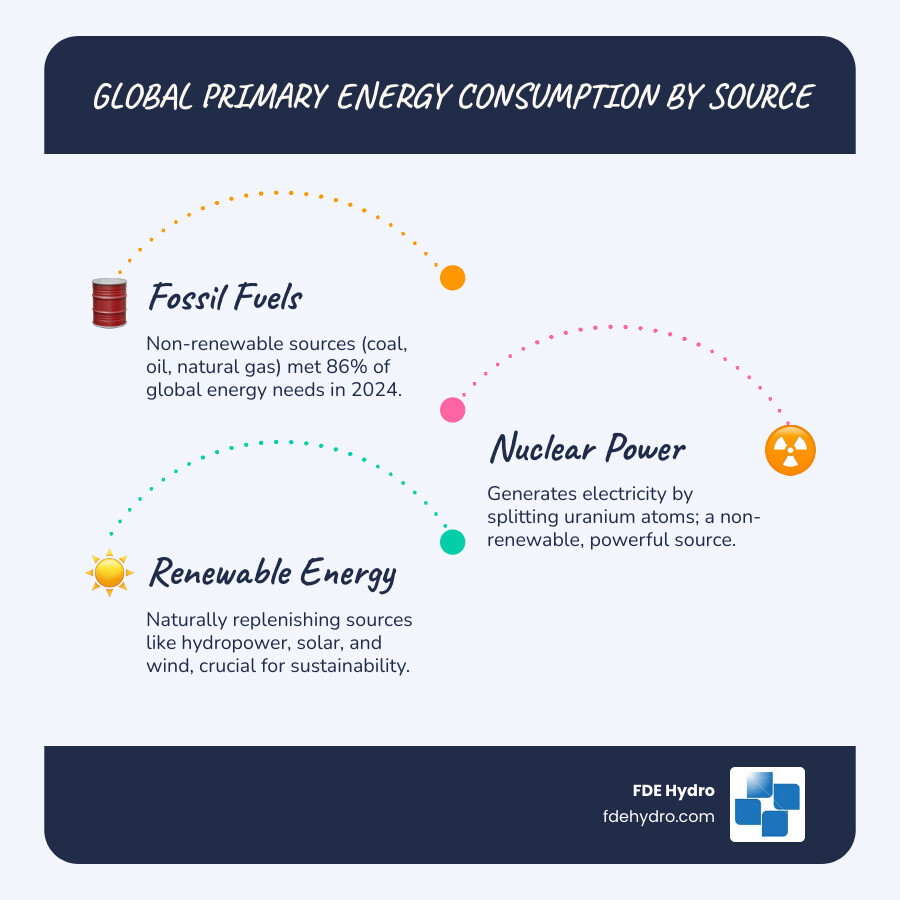
Here’s a quick breakdown of the world’s primary energy sources:
- Fossil Fuels: These are non-renewable sources like coal, oil, and natural gas. They currently make up the largest part of our energy supply.
- Nuclear Power: This comes from splitting atoms, usually uranium, to create heat and electricity. It’s also non-renewable.
- Renewable Energy: These sources naturally replenish. They include hydropower, solar, wind, geothermal, and biofuels.
Our modern world deeply relies on energy. It powers our homes, transportation, and industries. In 2024, a significant 86% of global energy needs were met by fossil fuels. This shows how crucial energy resource development is, but also highlights the ongoing challenge of shifting towards more sustainable options. This guide will explore this vital field.
I’m Bill French Sr., Founder and CEO of FDE Hydro™. My five decades in heavy civil construction and my participation in the Department of Energy’s Hydro Power Vision Task Force have deeply shaped my understanding of energy resource development, particularly in advancing modular hydropower solutions for clean energy.
Relevant articles related to Energy resource development:
The Spectrum of Energy Resources
When we talk about energy resource development, we’re diving into a fascinating world of different sources that power our lives. Each one has its own special qualities, its upsides, and its unique challenges. We often sort these sources into two big groups: primary, which are found in nature, and secondary, which are converted from primary sources. But perhaps even more importantly, we classify them as renewable or non-renewable. Here at FDE Hydro™, our hearts and efforts are firmly rooted in the renewable side of things, with a special focus on hydropower.
Primary energy sources are just as they sound — they’re raw energy from nature, like crude oil bubbling up from the ground or sunlight warming your face. Secondary sources, on the other hand, are what we get after we transform that raw energy, think of electricity made from coal or power generated by solar panels. If you’re curious to learn more about the very basics of energy, our Energy 101 guide is a great place to start!
There are many amazing renewable energy sources leading the charge toward a cleaner future. These include hydropower, which uses the natural flow of water; solar power, converting sunlight into electricity or heat; wind power, using the breeze with turbines; geothermal energy, tapping into the Earth’s internal warmth; biofuels, created from organic matter; and even oceanic energy, capturing power from tides, waves, and ocean currents.
Classifying Renewable Resources
Renewable resources are truly special because they naturally replenish themselves within a human timeframe. Unlike fossil fuels, which take millions of years to form and are quickly used up, renewables offer us a sustainable path forward. They’re like nature’s endless battery pack!
Hydropower, our area of expertise, truly shines in this lineup. It’s a proven technology that puts the powerful force of water to work, spinning turbines to generate clean electricity. Now, the environmental footprint of hydropower can certainly vary depending on the project. While large traditional dams might change local ecosystems, modern approaches – especially those using modular technology like ours – are designed to minimize disruption and actually improve existing infrastructure. In fact, the 2023 Statistical Review of World Energy confirms that hydropower remains a vital cornerstone of global electricity generation, providing a significant chunk of our planet’s renewable power.
The Central Role of Hydropower in Clean Energy
Here at FDE Hydro™, we truly believe hydropower holds a unique and incredibly important spot in the clean energy world. It’s more than just making electricity; it’s about delivering steady, reliable power that can beautifully balance the natural ups and downs of other renewables like solar and wind. This makes it a crucial player in achieving truly Sustainable Power Generation. To dive deeper into its capabilities, check out our main page on Hydropower.
Hydropower offers so many compelling advantages:
- It provides reliability and baseload power. Unlike solar or wind, which depend on sunshine or breeze, hydropower can deliver a consistent supply of electricity, often on demand. This makes it perfect for providing the foundational power we rely on every day.
- It boosts grid stability. Hydropower plants can quickly adjust their output, offering essential services like frequency regulation and voltage support to keep our electrical grid running smoothly. This is why we often say hydropower is the guardian of the grid!
- It’s fantastic for water management. Many hydropower facilities serve multiple purposes, helping with flood control, providing water for irrigation, and ensuring a stable water supply for communities. They’re truly multi-talented!
- And once they’re built, these plants have low operating costs. This means they provide long-term, affordable electricity.
Back in 2015, hydropower generated an impressive 16.6% of the world’s total electricity, and a remarkable 70% of all renewable electricity. That’s a huge contribution! Our innovative, patented modular precast concrete technology, affectionately known as the “French Dam,” is designed to build and retrofit hydroelectric dams and water control systems across North America, Brazil, and Europe. This smart approach drastically cuts down construction costs and time, making clean hydropower more accessible and efficient for everyone. To learn more about how we bring these exciting projects to life, be sure to explore our Renewable Energy Projects Complete Guide.
The Evolution and Technology of Energy Resource Development
The story of energy resource development is one of human ingenuity and constant adaptation. From the first controlled fires to today’s sophisticated power grids, our relationship with energy has defined how we live, work, and build our societies.
A Historical Perspective on Energy Development
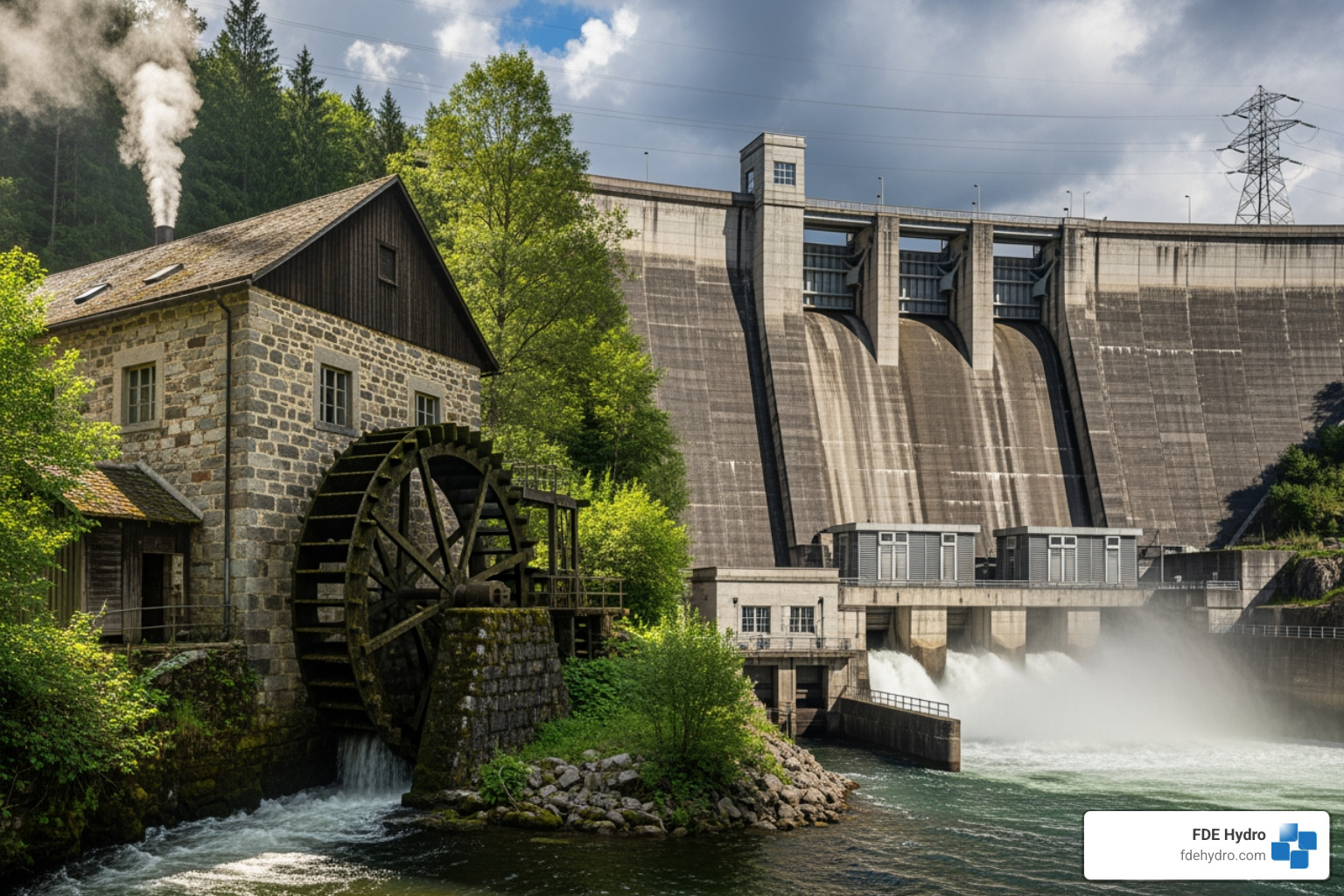
Think back to our earliest ancestors. Their energy toolkit was pretty simple: wood for warmth and cooking, animals to help with heavy work, and their own muscle power. But even then, humans recognized the power of flowing water. Those first watermills, grinding grain and powering early workshops, were the humble beginnings of what we now call hydropower.
The real game-changer came with the Industrial Revolution in the 18th century. Coal became king, and suddenly we could power massive factories and light up entire cities. Steam engines transformed everything from manufacturing to transportation. This era laid the foundation for the modern energy systems we rely on today, particularly in Europe and North America.
Then came electrification in the 20th century. This wasn’t just about turning on lights—it fundamentally changed how we lived. Factories became more efficient, homes more comfortable, and entire new industries became possible. Large-scale hydropower projects joined fossil fuels in powering this change, and they’ve been working reliably ever since.
Today, we’re in the midst of what many call the renewable revolution. Concerns about climate change and dwindling fossil fuel reserves have pushed us to rethink how we generate power. This shift toward cleaner, more sustainable sources isn’t just good environmental policy—it’s smart business. You can explore more info about the evolution of energy and see how far we’ve come.
Key Technologies in Modern Hydropower Resource Development
Modern hydropower looks nothing like those old watermills. Today’s technology maximizes efficiency while minimizing environmental impact—a balance that’s become increasingly important.
Advanced hydropower turbines are engineering marvels. From traditional Francis and Kaplan designs to newer fish-friendly models, these machines convert water’s kinetic energy into electricity with remarkable efficiency. Each type is optimized for different water flow conditions and head heights.
Pumped storage hydroelectricity deserves special mention because it’s essentially a giant battery for the grid. Here’s how it works: when electricity demand is low (like at night), excess power pumps water uphill to a reservoir. When demand spikes, that water rushes back down through turbines, generating electricity exactly when it’s needed. This technology is already proving crucial for grid stability in the US and Europe, especially as more intermittent renewables come online.
Advanced control systems bring hydropower into the digital age. Automated monitoring and precise flow management mean these plants can respond instantly to grid needs, optimizing performance and integrating seamlessly with other energy sources.
At FDE Hydro™, we’re proud to be pushing this technology even further. Our patented modular precast concrete technology—the “French Dam”—represents a genuine breakthrough in hydropower development. Instead of years-long construction projects, our approach dramatically cuts both time and costs. We’re building and retrofitting hydroelectric dams and water control systems across North America, Brazil, and Europe, making clean hydropower more accessible than ever. We’re also embracing AI-Driven Development to optimize everything from design to daily operations.
From Source to Socket: Energy Transmission and Infrastructure
Generating electricity is only half the challenge. Getting that power to your home or business requires an incredibly complex network—what we call the electrical grid. This massive interconnected system includes power plants, high-voltage transmission lines, substations, and the local distribution lines that finally bring electricity to your door.
High-voltage transmission lines are the workhorses of this system, carrying massive amounts of electricity across hundreds of miles with minimal loss. The higher the voltage, the more efficiently power travels long distances. These lines connect generating stations to the population centers where that power is needed.
Substations act as the grid’s translators. They step voltage up for efficient long-distance transmission, then step it back down for safe local distribution. Think of them as the crucial connection points that keep electricity flowing smoothly throughout the system.
The future of energy resource development increasingly depends on smart grids. These digitally improved networks can detect and respond to local changes in real time, improving reliability and making it much easier to integrate renewable sources. When a cloud passes over a solar farm or the wind dies down, smart grids can instantly adjust, pulling power from other sources—often hydropower—to maintain stability.
Microgrids represent another exciting development. These smaller, localized grids can operate independently or stay connected to the main grid, providing improved reliability for critical infrastructure or remote communities. At FDE Hydro™, we often design our hydropower solutions to work within a Microgrid framework, offering communities greater energy independence.
The electrical grids in the US, Canada, and Europe are among the world’s most sophisticated, but they require constant investment and upgrading. As we integrate more renewable sources and face increasing demand, this infrastructure becomes even more critical. Our Energy Infrastructure Development Complete Guide goes deeper into the planning and execution of these essential systems.
Impacts, Efficiency, and the Path Forward

Every form of energy resource development carries its own set of consequences, both environmental and economic. The question isn’t whether there’s an impact—there always is. The real question is how we can maximize the benefits while minimizing the harm as we move toward a cleaner, more sustainable future.
Environmental and Economic Impacts of Hydropower Development
Let’s be honest: no energy source is perfect. Even hydropower, one of the cleanest options available, comes with considerations. But when you compare it to fossil fuels, which met 86% of the world’s energy needs in 2024, the advantages become crystal clear.
On the environmental side, hydropower’s biggest win is greenhouse gas reduction. During operation, hydropower produces zero direct greenhouse gas emissions. That’s a huge difference from coal or natural gas plants that continuously pump carbon dioxide into our atmosphere.
The challenges with hydropower typically involve water and land use. Large conventional dams can alter river ecosystems, affect fish migration patterns, and sometimes displace communities when reservoirs are created. But here’s where modern innovation makes a real difference. Our modular, precast concrete technology at FDE Hydro™ focuses on retrofitting existing dams and water control systems. Instead of building massive new structures, we’re maximizing what’s already there. This approach dramatically reduces environmental disturbances while developing new hydropower capacity with a much smaller footprint.
The economic story is equally compelling. Hydropower projects create economic growth through job creation—from engineers and construction workers during the building phase to operations and maintenance staff for decades after. These aren’t temporary jobs, either. They’re skilled positions that support families and communities.
Once a hydropower facility is up and running, it provides stable, affordable electricity for generations. Unlike fossil fuels, where prices swing wildly with global markets, hydropower offers predictable, low-cost energy that shields consumers from volatility. Meanwhile, fossil-fuel subsidies continue hurting the global environment and security, propping up an industry with significant environmental and health costs.
The Critical Role of Energy Efficiency
Here’s something many people don’t realize: the cheapest, cleanest energy is the energy we never use in the first place. That’s why energy efficiency is often called the “first fuel” in energy resource development strategies.
Think about it this way—reducing energy demand means we need less new power generation capacity. Every kilowatt-hour we save through efficiency is a kilowatt-hour we don’t need to produce. It’s that simple.
The beauty of energy conservation measures is that many are surprisingly straightforward. Better building insulation in homes and offices across North America and Europe can slash heating and cooling demands. Upgrading to efficient technologies like LED lighting makes a real difference—compact fluorescent lights use two-thirds less energy and last 6 to 10 times longer than old incandescent bulbs. Modern appliances, smart thermostats, and improved industrial processes all add up to massive savings.
Energy efficiency and renewable energy are often called “the twin pillars of sustainable energy.” They work hand-in-hand, supporting each other in building a truly sustainable future. At FDE Hydro™, we’re even exploring how AI Energy Management can optimize energy use across different sectors, making our systems smarter and more responsive.
The path forward isn’t just about building more clean energy—it’s about using less energy overall while making what we do use as clean as possible. That’s the combination that will get us where we need to go.
Navigating the Global Energy Landscape
When we talk about energy resource development, it’s so much more than just power plants and dams. It’s a huge, interconnected puzzle that touches on global politics, international agreements, and even the safety of our nations. Every choice we make about energy sends ripples across the world.
Major Global Players and Policies
The way we get and use energy isn’t just decided in one place. Big international groups and governments all play a role in shaping our energy future. Think of organizations like the International Energy Agency (IEA). They give us important insights and advice, like in their detailed World Energy Outlook. These reports help guide decisions everywhere.
Then there are global agreements, like the Paris Agreement. These set goals for cutting down harmful emissions, which in turn encourages everyone to invest more in clean energy. Here in the United States, the Department of Energy (DOE) and its Office of Energy Efficiency and Renewable Energy (EERE) are big drivers of new ideas. They help fund new energy innovations through programs on the EERE Funding Opportunity eXCHANGE. You’ll find similar efforts in places like Canada, Brazil, and Europe, all working towards a cleaner energy future.
How Hydropower Development Contributes to National Security
Energy isn’t just about keeping the lights on; it’s a huge part of a nation’s security. A country needs reliable energy to protect itself, keep its economy strong, and ensure its people are safe. This is where energy resource development, especially hydropower, truly shines.
First, there’s energy independence. When a country can produce its own energy, it doesn’t have to rely on other nations, especially for fuels that can be unstable. Hydropower is a domestic resource in many places, including North America, Brazil, and Europe. This means it helps countries stand on their own two feet, making them less open to global troubles.
Then, there’s supply chain security. Having different ways to get energy, and producing it at home, helps protect us from problems in global supply chains. Hydropower plants are also incredibly strong and last a long time. They’re a vital part of a nation’s key infrastructure, providing steady power even when things get tough, like during bad weather. We often talk about “energy resilience” now, which means being able to bounce back from power outages, rather than just “energy independence.” It’s about having a strong, diverse energy system, much like what’s discussed in “Brittle Power: Energy Plan for National Security.”
Challenges and Opportunities in the Clean Energy Transition
Moving to a truly sustainable energy future is a huge journey. Back in 2024, a big chunk of our energy—86%—still came from fossil fuels. Switching away from that means facing some big challenges, but it also brings amazing opportunities.
Hydropower plays a vital role here. Think about solar and wind power; they’re wonderful, but they don’t always produce electricity when we need it. That’s called intermittency. Hydropower, with its ability to quickly adjust how much power it makes, steps in as a flexible partner. It helps keep the grid steady and reliable.
Beyond pumped hydro, new energy storage solutions are always being developed to help manage these ups and downs. We also need to modernize our electrical grids. This means big upgrades to our existing systems, which opens the door for lots of new Clean Energy Infrastructure projects. This shift isn’t just good for the planet; it’s a powerful engine for our economy. It creates millions of green jobs in making, installing, and researching new technologies. Innovation, like FDE Hydro’s modular hydropower solutions, is key to speeding up this change.
At FDE Hydro™, we’re proud to be a big part of this solution. Our special modular precast concrete technology helps us build hydropower projects faster, more affordably, and in a way that’s kind to the environment. We’re working hard in North America, Brazil, and Europe to build a stronger, cleaner, and more secure energy future for everyone.
Frequently Asked Questions about Energy Resource Development
What are the main classifications of energy resources?
When people talk about energy resource development, they’re usually dividing resources into two main camps: renewable and non-renewable.
Non-renewable resources are the ones we’re trying to move away from. These include fossil fuels like coal, oil, and natural gas, plus nuclear fuels like uranium. The problem? They’re finite. Once they’re gone, they’re gone. They took millions of years to form, and we’re burning through them in mere centuries.
Renewable resources are the future. These naturally replenish on a human timescale, meaning they’re essentially inexhaustible when managed properly. This category includes hydropower (our specialty at FDE Hydro™), solar, wind, geothermal, biofuels, and oceanic energy from tides and waves.
At FDE Hydro™, our focus is squarely on renewable resources, with hydropower as the leading example of sustainable energy resource development. We believe hydropower isn’t just renewable—it’s also reliable, flexible, and proven over more than a century of use.
Why is energy efficiency important for energy development?
Energy efficiency is crucial because it tackles the problem from the demand side rather than just the supply side. Think of it this way: the cleanest, cheapest energy is the energy you never had to produce in the first place.
When we use less energy to achieve the same results—whether that’s lighting a room, heating a home, or running a factory—we reduce the overall strain on our resources. This matters for both renewable and non-renewable sources. Lower demand means we need fewer new energy resource development projects, which translates to less environmental impact, lower greenhouse gas emissions, and reduced costs for consumers.
Energy efficiency is often called one of the “twin pillars” of sustainable energy policy, working hand-in-hand with renewable energy development. By reducing how much energy we need, we make the transition to a clean energy system more manageable and cost-effective. It’s a win-win: better for the planet and better for our wallets.
What is the biggest challenge in transitioning to 100% renewable energy?
The biggest challenge, especially in large interconnected grids across North America, Brazil, and Europe, is dealing with the intermittency and variability of certain renewable sources. Solar panels don’t generate power at night. Wind turbines sit idle when the air is calm. These aren’t minor inconveniences—they’re fundamental characteristics that affect grid reliability.
This creates a real need for reliable, on-demand power and robust energy storage solutions to keep the lights on 24/7. You can’t just tell a hospital or a manufacturing plant to shut down when the sun goes behind a cloud.
This is where hydropower shines. It provides flexible, dispatchable power that can ramp up or down quickly to balance the grid. Pumped storage hydropower acts like a giant battery, storing energy when there’s excess and releasing it when demand peaks. Hydropower and energy storage technologies play a key role in maintaining a reliable power supply and supporting grid stability as we integrate more variable renewables.
At FDE Hydro™, we see this as an opportunity. Our modular technology makes it faster and more affordable to build and retrofit hydropower facilities, helping to solve one of the biggest challenges in the clean energy transition.
Conclusion
Wow, what a journey we’ve been on! We’ve traveled through the amazing story of energy resource development, right from our ancestors huddling around a fire to the super-smart power grids that light up our world today. It’s been a wild ride, and our constant search for energy has truly shaped human history. But now, it’s clear we’re at a turning point, looking at a huge shift towards a more sustainable future.
Here’s the undeniable truth: clean energy is our future. While fossil fuels have powered us for a long time, the push for change is stronger than ever. This big shift means we don’t just need new ways to make energy; we also need clever new infrastructure and smart technologies. These tools will help us capture and deliver clean power in the most efficient and reliable ways possible.
At FDE Hydro™, we’re thrilled to be leading the charge in this exciting new era. Our unique, patented modular precast concrete technology, often called the “French Dam,” is truly changing how we build and upgrade hydropower plants. It makes these projects faster, more affordable, and much kinder to our environment. By modernizing hydropower, we’re doing more than just building dams; we’re creating the strong backbone for a resilient, clean energy network across North America, Brazil, and Europe. We’re helping to build a future where clean, dependable energy lights up our homes, protects our planet, and keeps our nations secure.
The future of energy isn’t just coming; it’s already here, and it’s flowing with power. To dive deeper into advanced hydropower solutions and see how we’re making this future a reality, please learn more about FDE Hydro’s innovative approaches.
by Bill French Sr. | Dec 26, 2025 | Energy Resource Articles
The Rise of Eco Friendly Crypto Mining
If you’re looking for Eco friendly crypto mining methods, here’s a quick overview of how the industry is becoming more sustainable:
- Renewable Energy: Using clean sources like hydro, solar, and wind.
- Efficient Mechanisms: Moving from Proof-of-Work (PoW) to Proof-of-Stake (PoS).
- Heat Reuse: Repurposing waste heat for heating or agriculture.
- Grid Balancing: Stabilizing power grids by managing energy demand.
- Waste Energy: Utilizing flared natural gas that would otherwise be wasted.
Eco friendly crypto mining is a critical topic, as the high energy use of currencies like Bitcoin has raised significant environmental concerns over carbon emissions and grid strain.
However, the industry is shifting towards greener mining. This guide explores innovative solutions for creating digital value responsibly, benefiting both the planet and the digital economy.
My name is Bill French Sr., and as the Founder and CEO of FDE Hydro, I’ve dedicated my career to sustainable infrastructure solutions. My team and I developed the “French Dam,” a patented modular hydropower system, which directly supports the potential for truly Eco friendly crypto mining operations.
Quick look at Eco friendly crypto mining:
The concept of “digital gold” is compelling, but traditional cryptocurrency mining, especially for Bitcoin, has historically come at a high environmental cost, straining natural resources.
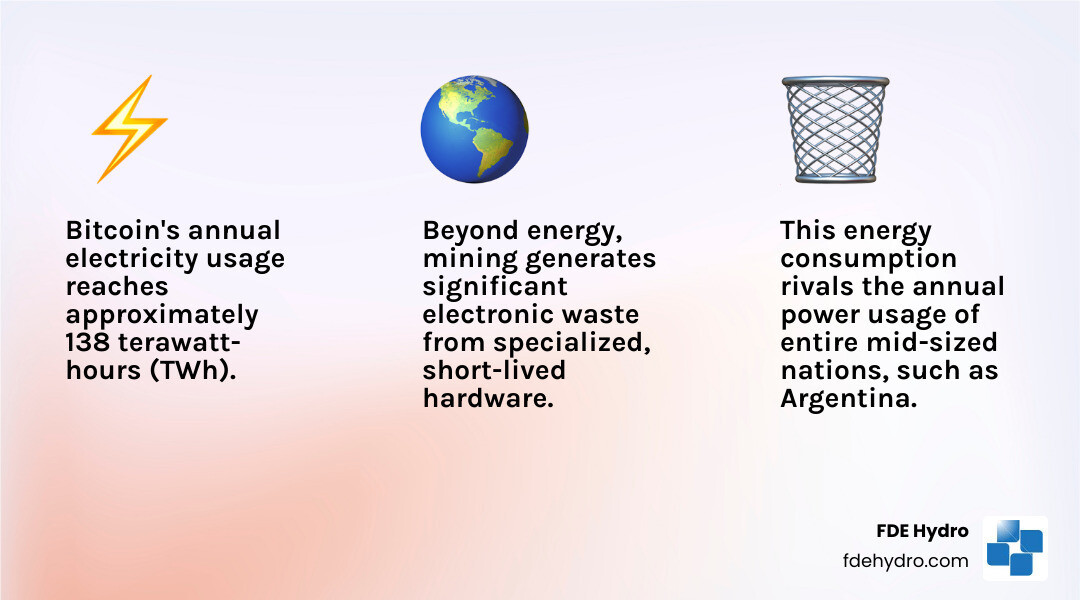
Traditional crypto mining, particularly for big names like Bitcoin, relies on something called Proof-of-Work (PoW). It’s super secure, but it also uses a ton of energy. Recent studies estimate Bitcoin’s annual electricity usage at around 138 TWh (terawatt-hours)—comparable to the consumption of a country like Argentina or Ukraine.
When sourced from fossil fuels, this energy use results in significant carbon emissions, once estimated at nearly 40 million tons of CO2 annually. Beyond emissions, the full environmental story includes electronic waste (e-waste), water consumption, land use, and noise pollution. As detailed in a study on Bitcoin’s environmental effects, these challenges highlight the need for sustainable crypto solutions.
How Proof-of-Work (PoW) Drives Energy Demand
Proof-of-Work (PoW) is energy-intensive by design. It involves a global competition where powerful computers race to solve complex mathematical puzzles. The winner adds the next block of transactions to the blockchain and earns a cryptocurrency reward.
The network’s difficulty automatically adjusts to maintain a consistent block creation time, forcing miners to use ever-more powerful hardware. This led to the development of Application-Specific Integrated Circuits (ASICs)—machines designed solely for mining that consume vast amounts of electricity.
This incentive structure creates a continuous cycle of seeking cheaper electricity and more powerful hardware, driving the network’s total energy consumption upward. As HBR explains, Bitcoin’s energy use is integral to its security, making the balance with Eco friendly crypto mining a key challenge.
Beyond Energy: The Full Environmental Impact
While we often focus on energy use, the environmental toll of traditional crypto mining goes much deeper than just electricity bills.
Reliance on fossil fuels significantly increases mining’s carbon footprint. Despite growing awareness, recent CCAF estimates showed a substantial portion of Bitcoin’s energy still comes from non-renewable sources like coal and natural gas, contributing to greenhouse gas emissions.
Another major issue is electronic waste (e-waste). ASIC miners have a short lifespan of 4-5 years before becoming obsolete. One 2021 study estimated this generates over 30,000 tons of e-waste annually, posing a significant disposal and recycling challenge.
Water consumption is another concern, as facilities require large amounts for cooling, especially in warm climates. This can strain local water supplies in water-scarce regions.
Finally, noise pollution from the constant hum of cooling fans can disrupt nearby communities. At FDE Hydro, we design modular, contained solutions that minimize environmental impacts like noise, which is vital for truly Eco friendly crypto mining.
The Green Revolution: Advancing Sustainable Mining with Renewable Energy
The environmental challenges of crypto mining have sparked a green revolution in the industry. This shift away from fossil fuels is driven by economics and a vision for the future of cryptocurrency.
Switching from fossil fuels to clean energy can cut a mining operation’s greenhouse gas emissions by over 70%. This isn’t a minor improvement; it’s a fundamental reimagining of the industry.
At FDE Hydro, our patented modular hydropower systems are a perfect match for this transition. By reducing the cost and construction time of hydroelectric projects, we make clean energy more accessible for miners across North America and beyond.
Energy-efficient practices are also crucial. Miners are optimizing operations with better cooling, more efficient hardware, and timing their energy use to align with renewable availability. This combination makes Eco friendly crypto mining economically attractive.
Hydropower: A Leading Solution for Eco Friendly Crypto Mining
The greenest mining operations often cluster around hydroelectric resources in places like Canada, the Pacific Northwest of the United States, and Brazil. Hydropower offers a key advantage over other renewables: reliability.
Let’s be honest about the differences between traditional mining and hydropower-based operations:
| Feature |
Traditional Fossil-Fuel Mining |
Hydropower-Based Mining |
| Energy Source |
Coal, Natural Gas, Oil |
Hydroelectric Dams |
| Carbon Emissions |
High |
Very Low to Zero |
| Energy Cost Stability |
Volatile, subject to market fluctuations |
Generally stable and low over long term |
| Environmental Impact |
Significant (GHG, air pollution, water use for cooling towers) |
Minimal (habitat disruption during construction, water flow management) |
| Operational Reliability |
Dependent on fuel supply chains |
Highly reliable, consistent baseload power |
| Scalability |
Can be scaled with grid access |
Scalable, especially with modular solutions like ours |
| Grid Impact |
Adds strain, especially during peak demand if grid is fossil-heavy |
Can improve grid stability, use excess capacity |
Hydroelectric power provides a consistent, renewable energy supply 24/7, unlike intermittent solar and wind. This baseload power is invaluable for mining operations that need to run continuously. The IEA offers a comprehensive review of hydropower’s environmental advantages.
The low carbon emissions of hydropower are another key benefit. Powering rigs with water instead of coal virtually eliminates an operation’s carbon footprint, which is increasingly important to environmentally conscious investors.
Modern hydropower technology also offers scalability and reliability. Our modular French Dam system was designed to overcome the high cost and long construction timelines of traditional dams, making it feasible to develop new hydro resources for mining operations.
Hydropower-based mining also strengthens network security and decentralization. Geographically dispersed operations powered by local renewables make the network more resilient to disruptions.
Addressing Challenges in Renewable-Powered Mining
However, renewable-powered mining faces several challenges.
Key challenges include grid integration to balance variable renewables, managing seasonal variability in power generation (even for hydro), and securing the large infrastructure investment required for new projects.
Modular and scalable solutions are essential. Our technology addresses this by allowing projects to start smaller and expand as needed. Overcoming adoption barriers requires proving that green mining is economically smart. As renewable energy is often the cheapest option, the business case for Eco friendly crypto mining is becoming undeniable.
Powering the Future: Hydropower and Eco Friendly Crypto Mining
The future of Eco friendly crypto mining is not just an environmental imperative; it’s a smart business decision. Environmental responsibility and economic advantage are now aligning.
Miners need cheap, reliable energy to remain profitable, especially as Bitcoin rewards decrease. Increasingly, renewable energy is the cheapest option, with some sources costing less than two cents per kilowatt-hour. This makes the choice for green energy an obvious one.
This economic reality is driving global change. For example, Gryphon Digital Mining achieved 100% renewable power by early 2024, primarily from hydroelectric sources. Other major players show a similar commitment. CleanSpark (94% carbon-free power), TeraWulf (91% zero-carbon), Iris Energy (95-99% renewable), and Bitfarms (99% renewable) all rely heavily on sources like hydro, nuclear, wind, and solar.
This trend is industry-wide. Recent data from the Cambridge Centre for Alternative Finance shows that sustainable sources (renewables and nuclear) now power over half of the Bitcoin network, a significant increase from previous years. The industry is changing in real time.
Tapping into Clean Energy Sources
The future of Eco friendly crypto mining depends on smart infrastructure connecting miners to clean power. Hydroelectric power is central to this vision due to its 24/7 reliability.
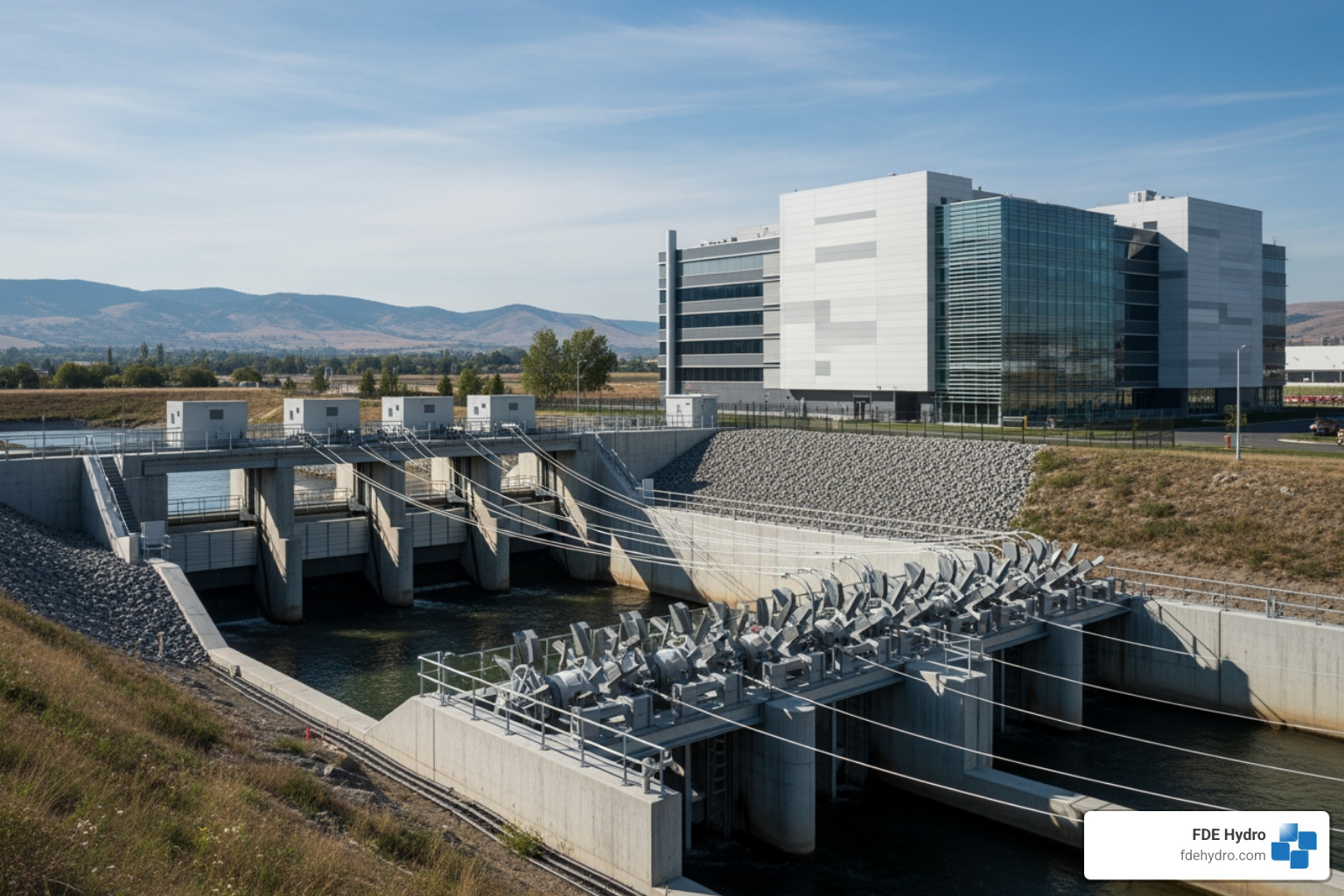
Our work at FDE Hydro is directly relevant here. The French Dam, our patented modular hydropower system, overcomes the high cost and long timelines of traditional hydro projects, accelerating clean energy adoption. This allows us to deploy affordable, dedicated clean energy infrastructure for miners across the United States, Canada, Brazil, and Europe, matching the scale and location of their operations.
While hydropower provides reliable baseload power, it can be combined with solar and wind to create a resilient, hybrid energy mix. This approach offers flexibility and maximizes the use of clean resources.
The Symbiotic Relationship with Energy Grids
Eco friendly crypto mining operations are evolving from mere energy consumers to active partners in stabilizing renewable energy grids.
Renewable sources like solar and wind often produce excess power when demand is low. This energy is typically wasted, or ‘curtailed.’ Crypto miners can act as a ‘buyer of last resort,’ consuming this surplus energy and making renewable projects more financially viable. Through demand response programs, they can also power down during peak demand to stabilize the grid, as seen in places like Texas.
This flexibility acts as a shock absorber for the grid. In fact, one study shows that Bitcoin mining can accelerate the sustainable energy transition by improving the economics of renewable plants.
Measuring and Verifying Eco Friendly Crypto Mining
As the industry matures, transparently measuring and verifying Eco friendly crypto mining claims is crucial to prevent ‘greenwashing.’
It’s important to distinguish between zero-carbon (no emissions from the source, like hydropower) and carbon-neutral (emissions are offset via methods like purchasing Renewable Energy Certificates). While carbon-neutrality has a role, we believe in prioritizing true zero-carbon energy sources. Preventing emissions at the source is always the better approach.
Transparency is key. Initiatives are emerging to help miners measure and report their energy use with standardized metrics, allowing for data-backed validation of green claims. At FDE Hydro, we support this push for verification. Our modular hydropower systems provide verifiable, zero-carbon energy, making sustainability a built-in feature of the infrastructure itself.
Beyond the Grid: Innovative Approaches to Sustainable Mining
Beyond clean energy, the crypto mining industry is embracing creative solutions to shrink its environmental footprint. This innovative, circular-economy approach is at the heart of Eco friendly crypto mining.
Turning Waste into Value: Heat Reuse and Gas Flaring
One of the most innovative strategies is heat reuse, which turns the immense heat generated by mining equipment into a valuable resource. In Europe, some companies capture this waste heat for district heating systems. Others use it to warm greenhouses for agriculture, as seen in the Netherlands. In a unique example from Norway, one miner even uses waste heat to dry timber, showcasing how byproducts can serve other industries.

Another innovation tackles gas flaring at oil fields. Instead of wasting this methane—a potent greenhouse gas—companies are capturing it to power mobile mining rigs. This reduces emissions while providing energy for Eco friendly crypto mining.
The Role of Policy and Market Incentives
Technology alone isn’t enough; government policy and market incentives are crucial for promoting sustainable mining.
In the United States, government reports have highlighted crypto’s climate impact, leading to a mix of policies. Some states have placed moratoriums on certain mining types, while others offer tax incentives for using clean energy.
A key market challenge is the ‘lack of product differentiation’—it’s difficult to distinguish ‘green’ Bitcoin from Bitcoin mined with fossil fuels. This can penalize miners who invest in renewable energy. Potential solutions include subsidies for green mining or methods to ‘tag’ coins based on their energy source, ensuring that sustainability makes good business sense.
Frequently Asked Questions about Eco-Friendly Crypto Mining
Here are answers to some of the most common questions about making crypto mining more sustainable.
Which cryptocurrencies are the most eco-friendly?
The most eco-friendly cryptocurrencies are defined by two factors: their consensus mechanism and their energy source.
The primary difference is between energy-intensive Proof-of-Work (PoW), used by Bitcoin, and the highly efficient Proof-of-Stake (PoS) mechanism. PoS validators stake their own crypto to validate transactions, eliminating the need for a computational race. When Ethereum switched to PoS in 2022 (‘The Merge’), its energy consumption dropped by over 99.9%.
Other cryptocurrencies designed for sustainability include Solana (PoS), Cardano (PoS), and Chia, which uses a unique ‘Proof of Space and Time’ mechanism based on hard drive storage.
However, the energy source is just as important. A PoW currency like Bitcoin can be mined sustainably when powered by renewables. At FDE Hydro, our modular hydropower systems provide the reliable, zero-carbon energy needed to make PoW mining eco-friendly.
Can Bitcoin mining ever be truly sustainable?
Yes, Bitcoin mining can be truly sustainable, and the transition is already happening.
The path to 100% renewable-powered PoW is driven by economics. Miners seek the cheapest energy, and renewables like hydropower are now often the most cost-effective option. This advantage is critical as mining rewards decrease over time.
Bitcoin mining also offers a unique sustainability benefit: grid stabilization. Miners can act as a flexible load, consuming excess renewable energy that would otherwise be wasted and powering down during peak demand. This helps balance the grid and improves the economics of renewable projects.
Leading companies are already proving this model works. Gryphon Digital Mining, CleanSpark, TeraWulf, Iris Energy, and Bitfarms all power their large-scale operations with exceptionally high percentages (91-100%) of carbon-free and renewable energy, with a heavy reliance on hydropower.
These large-scale facilities prove that Eco friendly crypto mining is both feasible and profitable. Our modular hydropower technology at FDE Hydro accelerates this transition by making clean energy infrastructure more accessible.
How can I support eco friendly crypto mining?
Anyone can take steps to support Eco friendly crypto mining.
- Support transparent miners. Choose mining companies that openly report their energy mix and carbon footprint. This encourages accountability and allows for informed decisions.
- Advocate for smart policy. Encourage policymakers in the United States, Canada, Brazil, and Europe to create regulations and incentives that favor renewable energy for mining.
- Invest in green operations. Consider investing in mining operations powered by renewables like hydropower. Supporting these companies helps fund the infrastructure, like that built by FDE Hydro, needed for a sustainable digital future.
- Choose green platforms. As the market evolves, use exchanges and platforms that highlight or prioritize sustainably mined assets. This sends a clear market signal that sustainability matters.
Conclusion: Building a Sustainable Digital Future
The journey of cryptocurrency mining began with energy-intensive Proof-of-Work systems that raised valid environmental concerns, from carbon emissions to e-waste. It became clear that the “digital gold” rush needed a greener path.
The good news is that a green revolution is underway. The industry is rapidly shifting to Eco friendly crypto mining by embracing clean energy like solar, wind, and especially hydropower. Leading companies in the United States, Canada, and Europe are proving that renewable-powered mining is a present-day reality.
Innovation extends beyond clean energy to a circular economy model. Creative solutions like reusing waste heat for district heating or agriculture and using flared gas to power mining rigs turn waste into value.
This evolution is also a smart economic move. Eco friendly crypto mining helps stabilize energy grids by acting as a flexible load, making renewable projects more profitable and pushing the industry toward a greener future.
At FDE Hydro, we believe the future of cryptocurrency must be sustainable. Our patented modular hydropower technology offers a practical path forward by reducing the cost and time needed to build renewable energy infrastructure. This is vital for a greener digital economy, enabling miners in the United States, Canada, Brazil, and Europe to access clean, reliable power.
The journey to fully Eco friendly crypto mining is ongoing. Through continued innovation and shared commitment, we can build a sustainable digital future that benefits our planet, our communities, and the digital economy.
Learn more about our innovative hydropower solutions
by Bill French Sr. | Dec 24, 2025 | Energy Resource Articles
Why Renewable Energy Construction Matters Now More Than Ever
Renewable energy construction is the specialized process of designing and building infrastructure that generates power from clean sources like solar, wind, and water. This rapidly expanding sector is changing the global energy landscape by replacing fossil fuel facilities with cleaner alternatives, employing millions, and driving technological innovation in large-scale infrastructure.
Key facts about renewable energy construction:
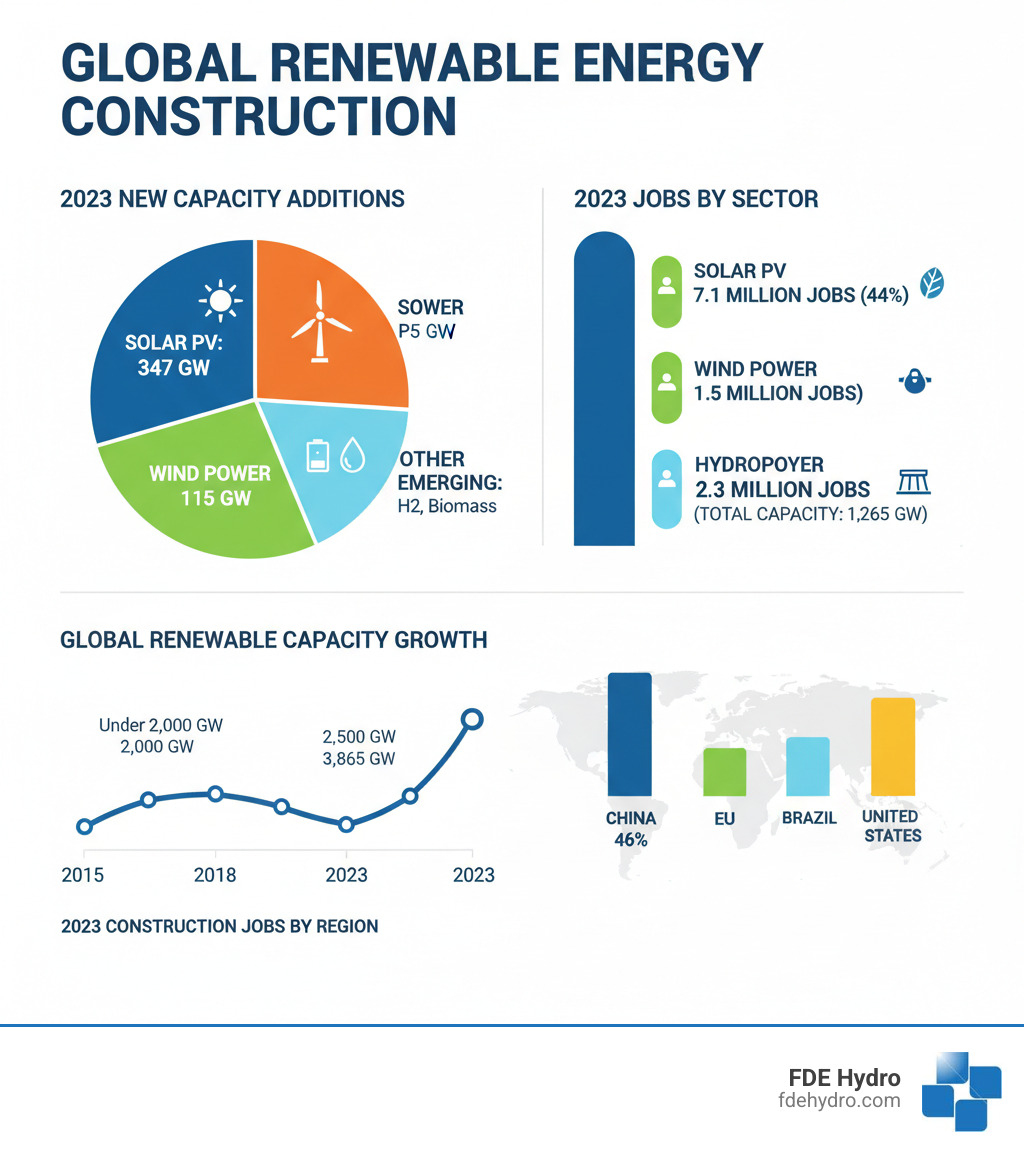
- Scale of Growth: 473 gigawatts (GW) of new renewable capacity were installed globally in 2023, with solar PV leading at 347 GW.
- Employment Impact: The sector employed 16.2 million people worldwide in 2023, with solar PV accounting for 7.1 million jobs.
- Major Project Types: Solar farms, wind parks, hydroelectric facilities, battery storage, and green hydrogen plants.
- Top Challenges: Supply chain constraints, skilled labor shortages, permitting delays, and grid integration.
- Cost Trends: Technology costs continue to fall while demand accelerates, making projects more economically viable.
The global shift to renewables is reshaping the construction sector. A convergence of climate goals, government incentives, and falling technology costs has created an unprecedented building boom in clean energy infrastructure. While the sector faces challenges like supply chain strains and labor shortages, the momentum is undeniable, with global investment in clean technology manufacturing reaching $235 billion in 2023.
I’m Bill French Sr., Founder and CEO of FDE Hydro. We’ve pioneered modular construction solutions for the hydropower industry, including our patented French Dam technology. With five decades of experience in major civil construction, I’ve seen how innovation can dramatically reduce costs and timelines in renewable energy construction.
Find more about renewable energy construction:
The Driving Forces Behind the Green Building Boom
An unprecedented surge in renewable energy construction is fundamentally changing how we power our lives. This green building boom is driven by several converging forces.
The urgency to reduce carbon emissions has moved from policy discussions to concrete action on construction sites worldwide. Governments are backing this with financial incentives that have transformed the economic equation for renewable projects. In the United States, federal tax credits can cover up to 30% of adoption costs, while similar government policies in Europe and Brazil are creating favorable investment conditions.
It’s not just governments pushing this forward. Corporate ESG goals have become a powerful driver, as major companies build onsite solar, invest in wind farms, and partner on community projects to meet carbon neutrality targets. This is good for the planet and for business, as customers, investors, and employees increasingly demand sustainability.
Energy security is another key motivator. Countries are realizing the strategic advantage of domestic renewable resources like wind, sun, and water, which offer resilience and independence from the geopolitical complications of imported fossil fuels. Building out clean energy infrastructure means building national resilience.
Perhaps most compellingly, the economics have fundamentally shifted. Falling technology costs have made renewable energy construction financially smart. With no ongoing fuel costs, the global market for clean energy technologies is projected to nearly triple to over $2 trillion by 2035. Finally, strong public demand for sustainability translates into the political will and corporate action needed to reshape our energy landscape.
At FDE Hydro, we see these forces driving innovation in sustainable power generation, particularly in building and modernizing hydropower facilities faster and more cost-effectively than ever before.
A Spectrum of Projects: What’s Being Built?
Renewable energy construction encompasses a diverse ecosystem of projects, each designed to harness nature’s power in unique ways. From vast solar fields to towering wind turbines, this sector is changing our landscapes.
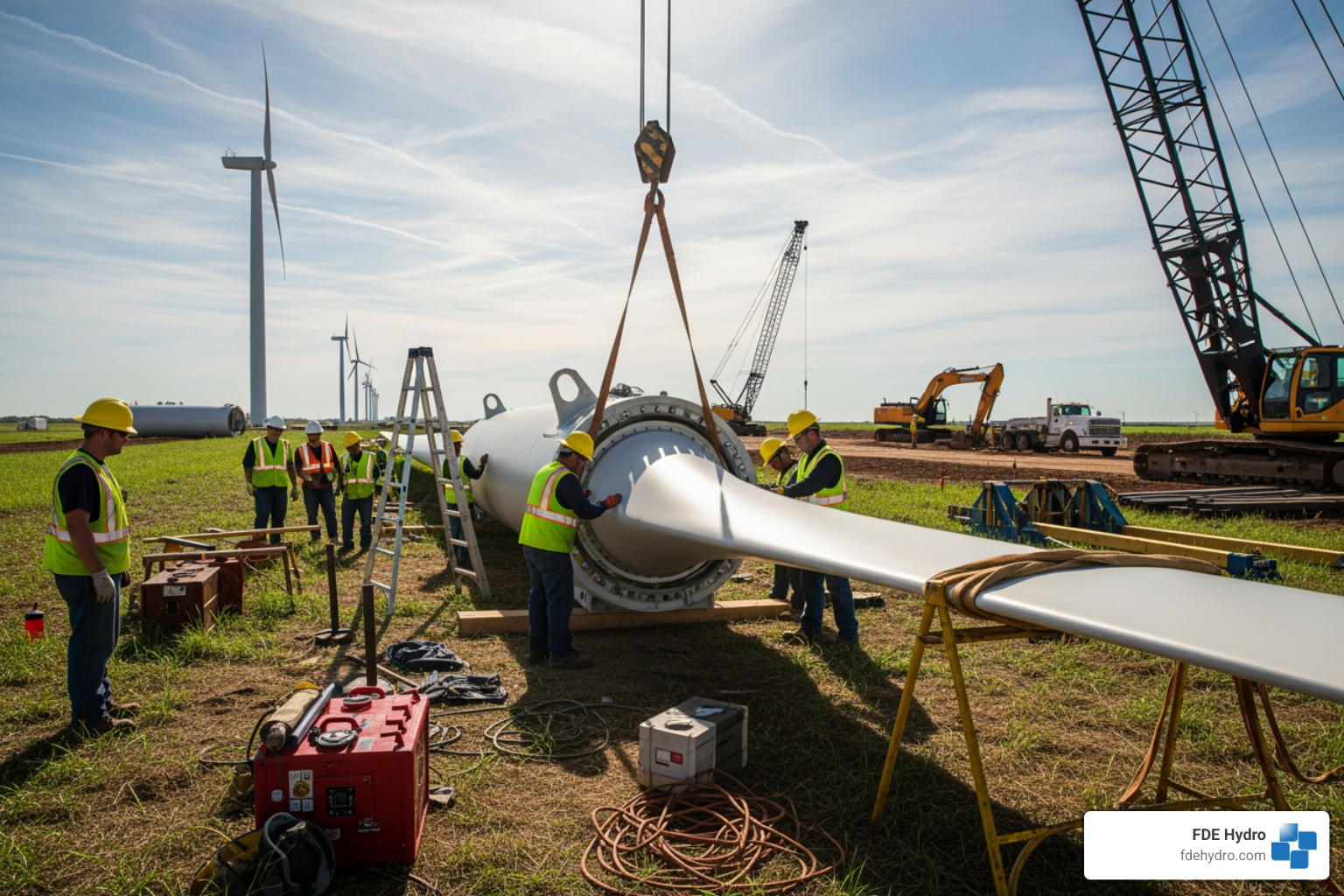
This section details the major types of renewable energy construction projects changing our energy landscape.
Solar Power Plant Construction
Solar is the fastest-growing segment in renewable energy construction, with a record 347 GW of solar photovoltaic capacity added globally in 2023. Utility-scale solar farms can cover thousands of acres, requiring extensive site preparation and complex electrical work for grid interconnection. In 2023, the U.S. installed 24.8 GW, Europe added 54.3 GW, and Brazil installed 11.9 GW. Other projects include community solar, which allows multiple customers to share a local installation, and agrivoltaics, an innovative approach where liftd solar panels allow farming to continue beneath them. Even buildings are becoming power generators, with building-integrated solar systems capable of fulfilling up to 83% of a structure’s energy needs, contributing to efficient Sustainable Power Generation.
Wind Farm Construction
Wind energy construction presents impressive logistical challenges, such as transporting massive turbine blades. Onshore wind farms require massive foundations and tall towers; in 2023, the US installed 6.3 GW and Brazil added nearly 5 GW. Offshore wind projects are even more complex, using stronger winds in harsh marine environments with specialized underwater foundations and subsea cabling. Globally, 115 GW of wind power capacity were added in 2023, driven by technology like improved blade designs. We’re also seeing innovation in building-integrated wind systems as part of comprehensive Energy 101 solutions.
Hydropower Construction and Modernization
Water is one of our oldest and most reliable renewable sources, and it’s where FDE Hydro’s expertise shines. While new dam construction continues in regions like Brazil, much of the opportunity in North America and Europe lies in hydropower retrofitting. Modernizing aging facilities with new turbines and controls can dramatically boost efficiency and extend their operational life. This work involves upgrading powerhouses, dams, spillways, and gates. Learn more about Hydropower Retrofitting.
Pumped storage hydropower is also crucial, acting as a giant grid battery by storing energy to be released during peak demand. This technology is vital for integrating intermittent renewables like solar and wind. More about Pumped Storage Hydropower.
Our patented French Dam technology revolutionizes these projects. This modular precast concrete system, utilizing Modular Construction Techniques, significantly reduces costs and timelines, making Hydroelectric Dam Construction faster and more sustainable.
Emerging Renewable Energy Construction Projects
The sector constantly evolves with new technologies:
- Battery Energy Storage Systems (BESS) are critical for grid stability, storing excess renewable energy for later use.
- Green hydrogen facilities use renewable electricity to split water, creating a clean fuel for heavy industry and transportation.
- Biomass power plants convert organic waste into electricity, requiring specialized material handling equipment.
- Geothermal energy extraction taps into the earth’s heat, providing reliable baseload power through deep well drilling and power plant construction.
These emerging areas highlight an important truth: The Biggest Untapped Solution to Climate Change is in the Water, and in the ingenuity of our engineers and construction crews.
Navigating the Complexities of Renewable Energy Construction
Building a clean energy future presents real challenges, but these same challenges are driving innovation and creating significant economic opportunities. This section explores the primary problems, required expertise, and economic impacts of clean energy infrastructure development.
Overcoming Key Construction Challenges
Renewable energy projects come with a unique set of complications:
- Supply chain constraints: Global demand for components like solar panels and turbine blades leads to delays and cost increases, sometimes forcing project cancellations.
- Permitting and regulatory maze: Navigating local, state, and federal permits is often lengthy and unpredictable, creating uncertainty for developers.
- Grid integration issues: Connecting new projects to the grid often requires significant and costly upgrades to existing transmission infrastructure, leading to delays.
- Skilled labor shortage: The sector’s rapid growth has led to a shortage of qualified engineers, project managers, and electricians. Robust workforce development programs are critical.
- Managing project costs: The upfront capital investment for construction is substantial. Innovative methods, like FDE Hydro’s modular approach, are key to reducing costs and ensuring financial returns, as detailed in Financing Long-Term Hydropower Requires Mitigating Risks Prior to ROI.
Essential Expertise for Project Success
Success in renewable energy construction depends on assembling a team with the right expertise:
- Preconstruction services: Meticulous planning and risk mitigation are crucial to avoid costly surprises during the build phase.
- Engineering and design: Deep knowledge of renewable technologies is paramount to optimize for efficiency, longevity, and site-specific conditions.
- Project management: Professionals must execute complex projects on time and budget while coordinating diverse labor forces and subcontractors.
- Quality control: Every component must meet stringent standards to ensure safety and long-term performance.
- Site safety protocols: A world-class safety culture is non-negotiable to protect workers in inherently dangerous environments.
- Risk management: Proactively addressing environmental, financial, and operational risks keeps projects on track. At FDE Hydro, we bring this comprehensive expertise to every project, as outlined in our Energy Infrastructure Development: Complete Guide.
The Economic and Social Impact of Renewable Energy Construction
The growth of renewable energy construction is changing economies and communities in profound ways.
Renewable energy employed 16.2 million people globally in 2023, with solar PV leading at 7.1 million jobs and wind at 1.5 million. These are often well-paying, future-proof careers. The EU has 1.8 million jobs in the sector, the U.S. has over 1 million, and Brazil boasts 1.6 million. You can explore these figures in IRENA’s annual review on jobs.
Beyond direct employment, projects inject capital into local economies by using local suppliers and crews. Many developers also prioritize community benefit agreements, providing direct economic advantages to local residents. The ultimate goal is a just energy transition that ensures this massive shift provides inclusive and equitable socio-economic benefits for everyone.
The Future is Now: Innovation and Sustainability in Construction
The renewable energy construction sector is evolving rapidly, driven by essential innovations that are making projects smarter, faster, and more sustainable.

This section looks at the technologies and trends shaping the next generation of green infrastructure.
Technological Innovations Shaping the Sector
Technology is changing how we build massive infrastructure projects. AI Energy Management helps optimize project schedules and manage grid operations. Drones are now a common tool for site surveying and inspection, improving efficiency and safety. Robotics are increasingly used for repetitive assembly tasks, while advanced materials like more efficient solar cells and lighter turbine blades are expanding what’s possible.
Modular construction is a key innovation. At FDE Hydro, we’ve pioneered this with our Modular Powerhouses and patented French Dam technology. We fabricate components in a factory and assemble them on-site, which slashes construction time, minimizes environmental disruption, and ensures superior quality. This proves Why Precast Cost Less while delivering better results. These Modular Construction Techniques are revolutionizing hydropower.
Building a Sustainable Future, Sustainably
If we’re building clean energy infrastructure, we must build it cleanly. This means integrating sustainability into every phase of construction.
We use green building practices, such as choosing sustainable materials and energy-efficient equipment. We practice responsible land stewardship; for example, agrivoltaics projects allow farming to continue under solar panels. We also conduct lifecycle assessments and accept circular economy principles by designing for durability, reuse, and recycling to minimize waste. Reducing our construction carbon footprint by optimizing logistics and using cleaner fuels is an ongoing priority. This holistic approach to Sustainable Infrastructure Development is critical for meeting global climate goals, as noted in the IEA’s report on energy tech perspectives.
Outlook and Future Trends
Looking ahead, several key trends are reshaping renewable energy construction:
- Hybrid projects combining solar with battery storage are becoming standard to provide reliable power.
- Grid modernization with smart technologies is essential to handle the complexity of modern energy systems.
- Decentralized energy resources like microgrids are gaining traction, making the energy system more resilient.
- Repowering aging assets, such as retrofitting older wind and hydropower facilities with modern technology, can dramatically increase output. This is a core part of our work in Hydropower Retrofitting.
These trends point to a future that is not just cleaner, but smarter and more resilient. At FDE Hydro, we are proud to help shape the Future of Hydropower and the broader renewable energy landscape.
Frequently Asked Questions about Renewable Energy Construction
Here are answers to some of the most common questions we receive about renewable energy construction, based on our decades of experience in the field.
What are the biggest challenges in renewable energy construction today?
The biggest challenges in renewable energy construction are supply chain disruptions, a shortage of skilled labor, lengthy and complex permitting processes, and delays in connecting projects to the electrical grid. These factors can increase costs and extend project timelines, making streamlined construction processes like those we explore in Financing Long-Term Hydropower Requires Mitigating Risks Prior to ROI even more critical.
How does technology make renewable construction more efficient?
Technology is making renewable energy construction faster, safer, and more cost-effective. For example, our modular precast components, like those used in our patented French Dam technology, are fabricated in controlled factory settings for higher quality and then rapidly assembled on-site. This approach, detailed in Why Precast Cost Less, significantly reduces construction timelines. Other key technologies include AI-driven project management and drones for site surveying, all of which boost efficiency and are central to innovations like our Modular Powerhouses.
Which renewable energy sector creates the most construction jobs?
Solar photovoltaics (PV) is the largest job creator in renewable energy construction, accounting for 7.1 million jobs globally in 2023. The sector provides employment across the entire value chain, from manufacturing to installation and maintenance. Wind energy is also a major employer with 1.5 million jobs, while hydropower offers stable, long-term employment, particularly in the modernization projects that FDE Hydro specializes in.
Conclusion: Building the Power of Tomorrow
Renewable energy construction is not just another industry—it’s the foundation upon which we’re building a livable future. Every solar farm, wind turbine, and modernized hydropower facility represents hope, progress, and a commitment to a better world.
Despite challenges like supply chain tangles and complex regulations, the momentum is undeniable. In 2023, the world added 473 gigawatts of new renewable capacity, and the sector now employs 16.2 million people globally, boosting economies from North America to Brazil and Europe.
At FDE Hydro, we’ve seen how innovation can revolutionize this field. Our patented French Dam technology and modular precast solutions prove we can build critical Hydropower infrastructure faster, more cost-effectively, and with less environmental disruption than traditional methods.
Looking forward, the opportunities are breathtaking. Hybrid projects, grid modernization, and the repowering of aging assets are becoming standard. The convergence of AI, modular techniques, and advanced materials is making previously impossible projects routine.
Beyond the technology and economics, we are building resilience and a system that works with nature. The challenges are real, but when innovation meets determination, remarkable things happen. We are not just building the power of tomorrow; we are constructing opportunity, security, and a sustainable future, one project at a time.
by Bill French Sr. | Dec 11, 2025 | Energy Resource Articles
The Environmental Price of Digital Gold
Crypto mining sustainability is a critical concern as the industry consumes vast amounts of energy and generates significant environmental impacts:
- Energy Consumption: Bitcoin mining alone uses 138-173 TWh annually, equivalent to countries like Ukraine or Poland
- Carbon Emissions: Global crypto mining produces 39.8-90.6 million tonnes of CO₂ annually
- Current Renewable Mix: Only 41-43% of Bitcoin’s energy comes from renewable sources as of 2024
- Health Impact: 1.9 million Americans are exposed to higher air pollution from mining operations
- Water & E-Waste: Mining consumes 1.65 billion cubic meters of water annually and generates significant electronic waste
Cryptocurrency mining has evolved from a niche technical pursuit into a global industry with a massive environmental footprint. Bitcoin, often called “digital gold,” reached a market capitalization exceeding $1.3 trillion by 2024. But this digital wealth comes at a real-world cost. The infrastructure supporting mainstream cryptocurrencies uses enormous amounts of energy—173.42 terawatt hours annually according to recent studies. That’s more electricity than entire nations consume.
The environmental impact extends far beyond energy consumption. Recent research reveals troubling effects on air quality, water resources, and land use. A Harvard-led study found that Bitcoin mining exposes millions of Americans to harmful fine particulate air pollution. The UN documented water usage sufficient to meet the domestic needs of over 300 million people in rural Sub-Saharan Africa. And mining operations generate mounting piles of electronic waste as specialized hardware becomes obsolete in as little as 1.3 years.
This raises urgent questions. Can an industry built on computing power ever be truly sustainable? Is the innovation worth the environmental price? And what solutions exist that could reconcile digital advancement with ecological responsibility?
As Bill French Sr., Founder and CEO of FDE Hydro™, I’ve spent decades in heavy civil construction and the past nine years focused on modular hydropower solutions designed to benefit present and future environments. My work with the Department of Energy’s Hydro Power Vision Task Force and development of innovative hydropower technologies has given me unique insight into how crypto mining sustainability can be achieved through clean, renewable energy integration.
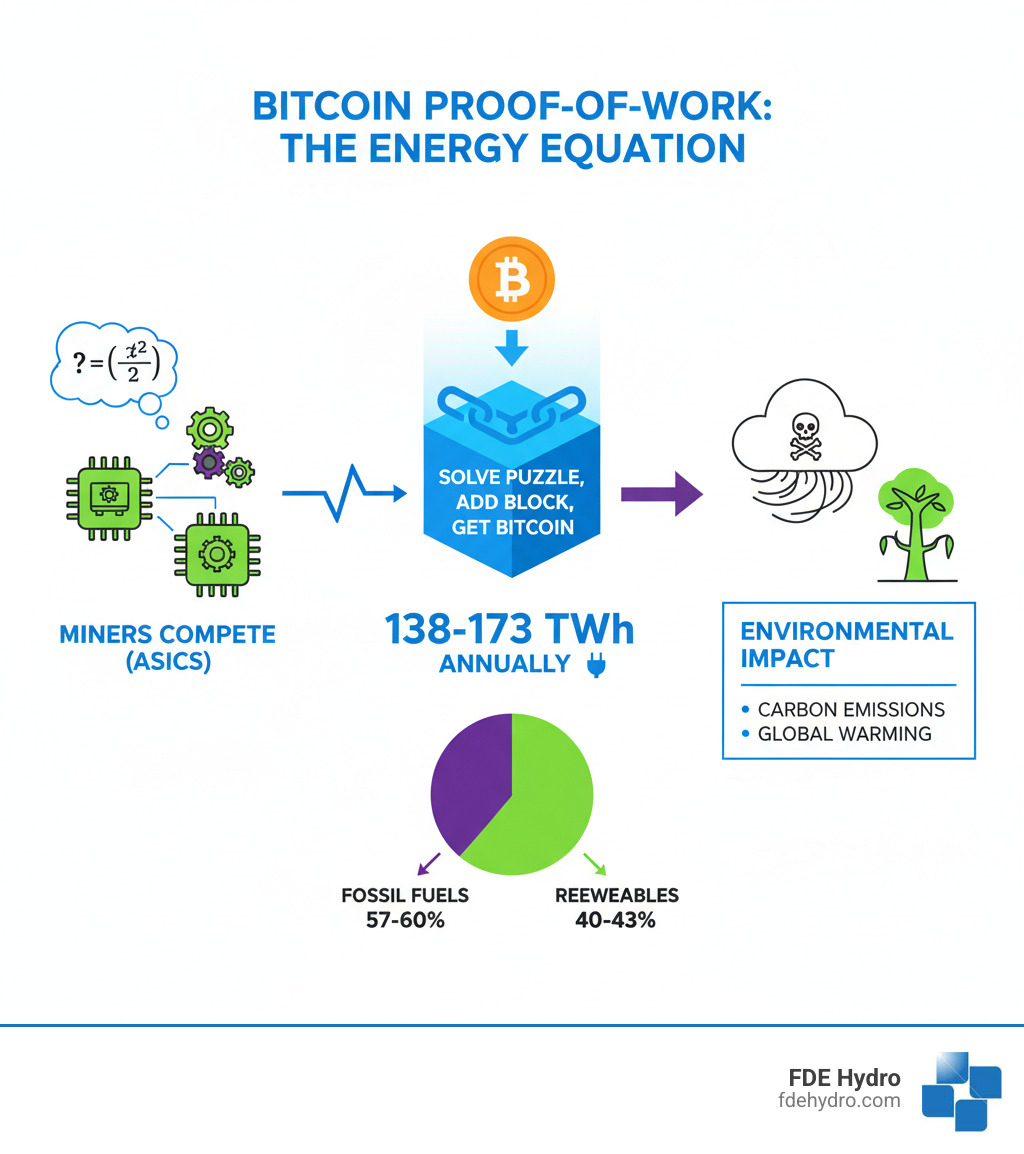
The Unquenchable Thirst: Bitcoin’s Massive Energy Consumption

Bitcoin mining consumes 173.42 terawatt hours of electricity annually—more than entire countries like Ukraine or Poland. If Bitcoin were a country, it would rank 27th globally in energy use, consuming more power than Pakistan.
This represents about 0.5% of all electricity used on Earth. For comparison, the entire global payment system (credit cards, bank transfers) uses only 0.2%. Bitcoin alone uses more than double that.
The culprit is Bitcoin’s Proof-of-Work mechanism. Miners compete to solve complex puzzles, with the winner adding a block to the blockchain and earning Bitcoin. This relentless competition drives ever-increasing energy use.
For crypto mining sustainability, the power source is critical. As of 2025, 43% comes from renewables. The remaining 57% relies on fossil fuels (38% natural gas, 9% coal) and nuclear (10%). While the trend is positive, most of Bitcoin’s power still harms our planet.
On a per-transaction basis, the numbers are even more sobering. A single Bitcoin transaction uses an estimated 500 kilowatt hours, while a VISA transaction uses just 0.001 kWh—a difference of 500,000 times.
You can explore more detailed comparisons through this analysis: Bitcoin’s energy use compared to countries.
This electricity use translates directly into staggering carbon emissions.
Bitcoin’s annual carbon footprint equals burning 84 billion pounds of coal or running 190 natural gas power plants for a year. To offset this naturally, you’d need to plant 3.9 billion trees—a forest the size of the Netherlands.
Economically, between 2016 and 2021, every dollar of Bitcoin mined caused 35 cents in climate damage. This accounts for real-world costs like health impacts and extreme weather, leading some to call Bitcoin “digital crude” instead of “digital gold.”
As of 2025, Bitcoin produces 39.8 million tonnes of CO₂ annually, comparable to the carbon footprint of Slovakia. These figures show that Bitcoin mining creates serious environmental challenges. They highlight why a shift to clean energy, especially stable solutions like hydropower, is essential for the industry and our planet.
Beyond Carbon: The Hidden Environmental Costs
Bitcoin’s environmental impact goes beyond carbon emissions. While CO₂ gets the headlines, the true cost of crypto mining sustainability challenges affects our air, water, and land. These hidden costs impact communities, ecosystems, and public health in ways that are often overlooked.

Air Pollution: A Cross-State Public Health Concern
A groundbreaking Harvard-led study on Bitcoin mining’s air pollution revealed that mining significantly increases fine particulate air pollution (PM2.5). These microscopic particles are linked to serious health conditions like cancer, heart disease, and dementia.
The connection is straightforward: most large-scale U.S. Bitcoin mines draw power from fossil fuel plants. Burning coal or natural gas for mining’s massive electricity needs releases PM2.5 and other pollutants.
The 34 largest U.S. Bitcoin mines consumed 33% more electricity than Los Angeles from August 2022 to July 2023. This resulted in an estimated 1.9 million Americans being exposed to higher PM2.5 pollution from mining.
The challenge is that pollution crosses state borders. A North Carolina mine might use power from a Kentucky plant, with pollution drifting to Illinois. This creates a regulatory nightmare, as states cannot unilaterally regulate emissions from their neighbors, underscoring the need for federal action.
Water, Land, and Electronic Waste
The footprint extends to water, land, and e-waste. Mining hardware requires massive amounts of water for cooling. Bitcoin’s global water footprint in 2020-2021 reached 1.65 cubic kilometers—enough for the domestic needs of over 300 million people in rural sub-Saharan Africa.
At FDE Hydro, we work to harness water power sustainably. The contrast between water as a renewable solution and water consumed for cooling is stark. You can explore water’s potential as a climate solution in The Biggest Untapped Solution to Climate Change is in the Water and learn about Hydropower.
Land use is another challenge. The global Bitcoin mining network’s land footprint in 2020-2021 was over 1,870 square kilometers, 1.4 times the area of Los Angeles. Responsible land use requires thoughtful, long-term planning.
Then there’s the electronic waste problem. Bitcoin mining uses specialized hardware (ASICs) that become obsolete quickly. The average lifespan is just 1.3 years, though some studies suggest 4-5 years. This rapid turnover creates over 30,000 tonnes of e-waste annually (2021), with each transaction generating about 272 grams. The volume creates a significant environmental burden, along with noise pollution from cooling fans.
For a comprehensive look at these interconnected environmental impacts, the UN study on Bitcoin’s environmental footprint provides valuable insights into how crypto mining sustainability must address far more than just carbon emissions.
The Path to Crypto Mining Sustainability
The environmental challenges are urgent, but the path to crypto mining sustainability is within reach through practical solutions. Clean, renewable energy—especially hydropower—is central to balancing technological progress with environmental stewardship. As a developer of modular hydropower, I’ve seen how the right infrastructure can transform industries. The crypto mining sector is at a crossroads, and its direction will shape the future of digital currency and our planet.
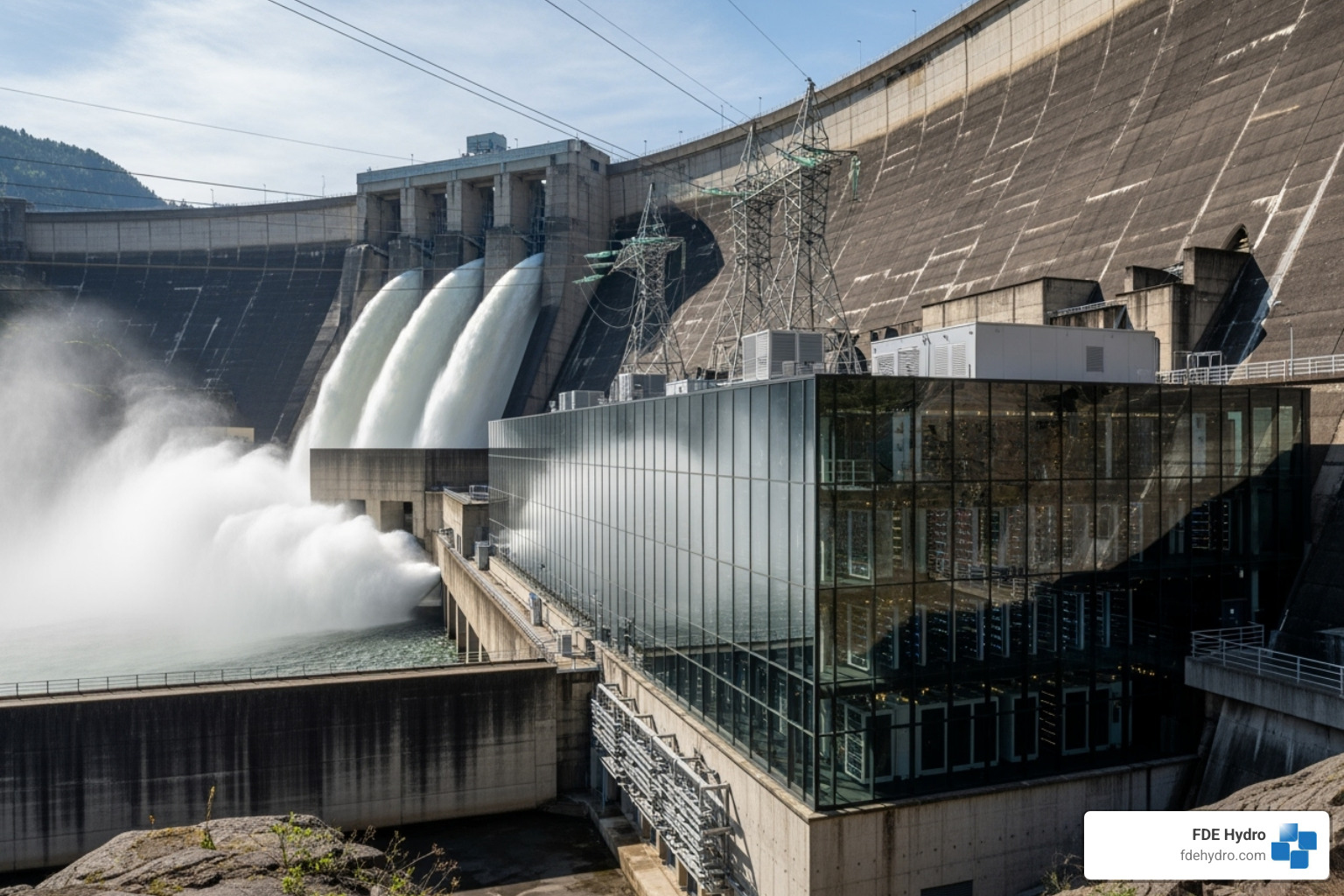
Key Challenges for Crypto Mining Sustainability
Achieving sustainable Bitcoin mining isn’t simple. Several challenges stand in the way.
The intermittency problem is the biggest hurdle. Solar and wind are not constant, but Bitcoin mining runs 24/7, demanding reliable electricity. This mismatch, without massive energy storage, leads to unpredictable power. In the competitive Proof-of-Work race, downtime means lost revenue, pushing miners toward reliable but dirty fossil fuels.
Next is the “green Bitcoin” problem. All Bitcoin is identical, whether mined with hydropower or coal. There’s no premium for sustainably mined coins. Conscious miners invest in clean energy but receive no market reward, while those using the cheapest (often dirtiest) power face no penalty. As of 2023, U.S. Bitcoin miners still drew 54% of their power from fossil fuels.
When externalities aren’t priced in—when miners don’t pay for the pollution they create—the market naturally favors the cheapest energy. The price-security feedback loop in Proof-of-Work intensifies this, rewarding computational power above all else while society bears the environmental costs. For a deeper dive into these systemic barriers, this academic research offers valuable insights: Barriers to sustainable Bitcoin mining.
Innovations and Solutions for Sustainable Crypto Mining
The transition to crypto mining sustainability is already happening, driven by smart technology, strategic energy partnerships, and thoughtful policy.
Co-locating mining operations with renewable energy projects is a promising strategy, especially with stable sources like hydropower. Unlike solar and wind, hydropower is dispatchable—you can control its output to match demand. Water stored behind a dam represents stored energy, making hydropower the perfect partner for energy-hungry operations like crypto mining.
At FDE Hydro, our modular hydropower solutions make clean energy deployment faster and more affordable. Our patented “French Dam” technology dramatically reduces the cost and time to build or retrofit hydroelectric facilities. These efficient, modular systems can bring reliable, clean hydropower to data centers and mining operations at scale. The potential is enormous, including Reinvigorating Hydropower infrastructure that already exists.
Beyond direct power supply, Bitcoin mining can support renewable energy development. Miners can act as flexible loads, consuming excess renewable energy. This improves the economics of renewable projects. Some miners even use methane that would otherwise be vented from oil wells and landfills, offering a carbon-negative contribution. In 2024, about 2.38% of Bitcoin’s energy came from this source.
The trends are positive. The renewable share in Bitcoin’s global energy mix climbed from 20% in 2011 to 41% in 2024, with projections suggesting at least 70% by 2030. This shift is driven by miners seeking cheaper power, greening energy grids, and stricter regulations.
Policy interventions are crucial. Subsidies for green energy and carbon taxes can accelerate the transition. Regulations in Canada and Iceland require environmental assessments. In the U.S., the White House and EPA are studying impacts, while states like New York have imposed moratoriums on new fossil fuel-powered operations.
Our work extends beyond traditional hydropower. We’re developing Microgrid and Pumped Storage Hydropower systems that provide grid stability and energy storage. These technologies create resilient energy systems for sustainable data centers. We actively participate in industry discussions about these innovations, as highlighted in our Recording: Innovating the Future: Cleantech and Energy Storage Panel Discussion.
The path forward is clear: we must choose clean energy over fossil fuels. This ensures technological progress serves both innovation and environmental responsibility. With the right infrastructure, smart policies, and industry leadership, we can build a digital economy that thrives without sacrificing our planet. That’s not just good for the environment—it’s good business.
Frequently Asked Questions about Crypto’s Environmental Impact
How does Bitcoin’s energy use compare to VISA?
The difference between Bitcoin and traditional payment systems is eye-opening. A single Bitcoin transaction gobbles up roughly 500 kWh of electricity. Compare that to a VISA transaction, which uses about 0.001 kWh. That’s right—one Bitcoin transaction uses thousands of times more energy than swiping your credit card at the grocery store.
When we zoom out to look at the big picture, it becomes even more striking. The entire global payment system—every credit card swipe, every digital payment, every ATM withdrawal—uses about 0.2% of the world’s electricity. Bitcoin mining alone consumes 0.5% of global electricity. Think about that for a moment: a single cryptocurrency uses more than twice the energy of the entire traditional financial transaction infrastructure that serves billions of people daily.
This comparison highlights why crypto mining sustainability isn’t just an environmental talking point—it’s an urgent challenge that demands innovative solutions.
Can crypto mining ever be truly green?
Yes, we genuinely believe crypto mining can become truly green. But let’s be honest: it won’t happen overnight, and it requires fundamental changes across the entire industry.
The potential is real. As of 2024, Bitcoin’s energy mix already includes about 41% renewable sources, and projections suggest this could reach 70% by 2030. That’s encouraging progress, but we need to push further toward 100% clean energy. This is where stable, dispatchable renewable sources like hydropower become absolutely critical. Unlike solar and wind, which fluctuate with weather conditions, hydropower provides the consistent, round-the-clock power that mining operations demand.
The path forward requires several key elements working together. We need a major shift in the energy mix, moving mining operations to facilities powered entirely by renewables. Technological advancements matter too—both in developing more energy-efficient mining hardware and in the broader adoption of alternative consensus mechanisms that don’t require massive computational power. And supportive regulations must create real incentives for green mining while penalizing reliance on fossil fuels.
At FDE Hydro, we’re working to provide exactly the kind of clean energy infrastructure this transition requires. Our modular hydropower technology can deploy reliable, renewable power faster and more affordably than traditional dam construction. By co-locating mining operations with hydropower facilities, we can dramatically reduce environmental impact while supporting the digital economy. The technology exists—now we need the will to implement it at scale.
What is being done to regulate crypto mining’s pollution?
The regulatory landscape for crypto mining looks like a patchwork quilt, with different jurisdictions taking dramatically different approaches.
China took the most extreme stance, implementing a complete ban on all cryptocurrency mining activities in 2021. Energy consumption and environmental concerns drove this decision, and it instantly reshaped the global mining landscape as operations scrambled to relocate.
The European Union has taken a more measured but still serious approach. EU regulators have actively debated banning energy-intensive Proof-of-Work mining altogether. While they haven’t pulled that trigger yet, they’ve made it clear that cryptocurrencies need to transition toward more sustainable consensus mechanisms. The pressure is mounting.
In the United States, the response has been fragmented. The White House Office of Science and Technology Policy and the EPA have launched studies examining the energy usage and environmental footprint of crypto assets. But without unified federal regulation, individual states are charting their own courses. New York, for instance, has placed moratoriums on new fossil fuel-powered crypto mining plants. Meanwhile, Texas has rolled out the welcome mat with tax incentives, hoping to put excess energy to use and potentially manage methane emissions from oil and gas operations.
This state-by-state patchwork creates real challenges. Harvard study we discussed earlier? It revealed how air pollution from mining operations crosses state lines—a Bitcoin mine in North Carolina might draw power from a Kentucky plant, and the resulting pollution drifts into Illinois. No single state can effectively regulate these cross-border impacts alone. This reality underscores the need for federal intervention, potentially through EPA regulations requiring stricter emissions controls from power plants that supply mining operations.
The global regulatory picture reveals an industry at a crossroads, with governments worldwide struggling to balance innovation with environmental responsibility.
Conclusion: Reconciling Digital Innovation with Environmental Responsibility
Our exploration of Bitcoin’s environmental impact has taken us through some sobering territory. The numbers tell a powerful story: energy consumption rivaling entire nations, carbon emissions equivalent to burning 84 billion pounds of coal, and 1.9 million Americans breathing polluted air from mining operations. Add to that a massive water footprint, significant land use, and mountains of electronic waste. The environmental price tag attached to our “digital gold” is substantial.
Yet the biggest challenges often present the greatest opportunities for innovation. The path to crypto mining sustainability isn’t a fantasy—it’s an engineering problem waiting for practical solutions.
We face significant problems like the intermittency of solar and wind, the lack of market differentiation for “green” Bitcoin, and economic pressure driving miners toward fossil fuels. These are real obstacles, but they’re not impossible.
The solution lies in a three-pronged approach: technological innovation, smart regulation, and a fundamental shift toward clean energy sources. This is where hydropower’s unique advantages become clear. Unlike intermittent renewables, hydropower delivers stable, dispatchable energy around the clock. It’s the reliable backbone that crypto mining needs to go truly green.
At FDE Hydro, we’ve spent nine years developing modular hydropower solutions to meet modern energy challenges. Our patented “French Dam” technology can deploy hydroelectric systems faster and more cost-effectively, allowing crypto mining operations to partner with stable, carbon-free power sources.
The industry is already moving in the right direction. The renewable energy share in Bitcoin mining grew to 41% in 2024, with projections suggesting 70% by 2030. We’re seeing miners co-locate with renewable projects and even tap methane that would otherwise be vented. These are smart business decisions that prove sustainability and profitability can work hand in hand.
But we can’t rely on market forces alone. Smart policy interventions—carbon taxes, green energy subsidies, and regulations that protect public health—will accelerate this transition. The digital economy and environmental responsibility don’t have to be at odds. As we continue innovating, we must build on a foundation of ecological stewardship. That means choosing reliable renewable energy sources like the hydropower systems we’re developing to power tomorrow’s sustainable infrastructure.
The technology exists. The economic incentives are aligning. The regulatory momentum is building. What we need now is commitment—from miners, policymakers, investors, and energy providers—to make crypto mining sustainability the standard, not the exception.
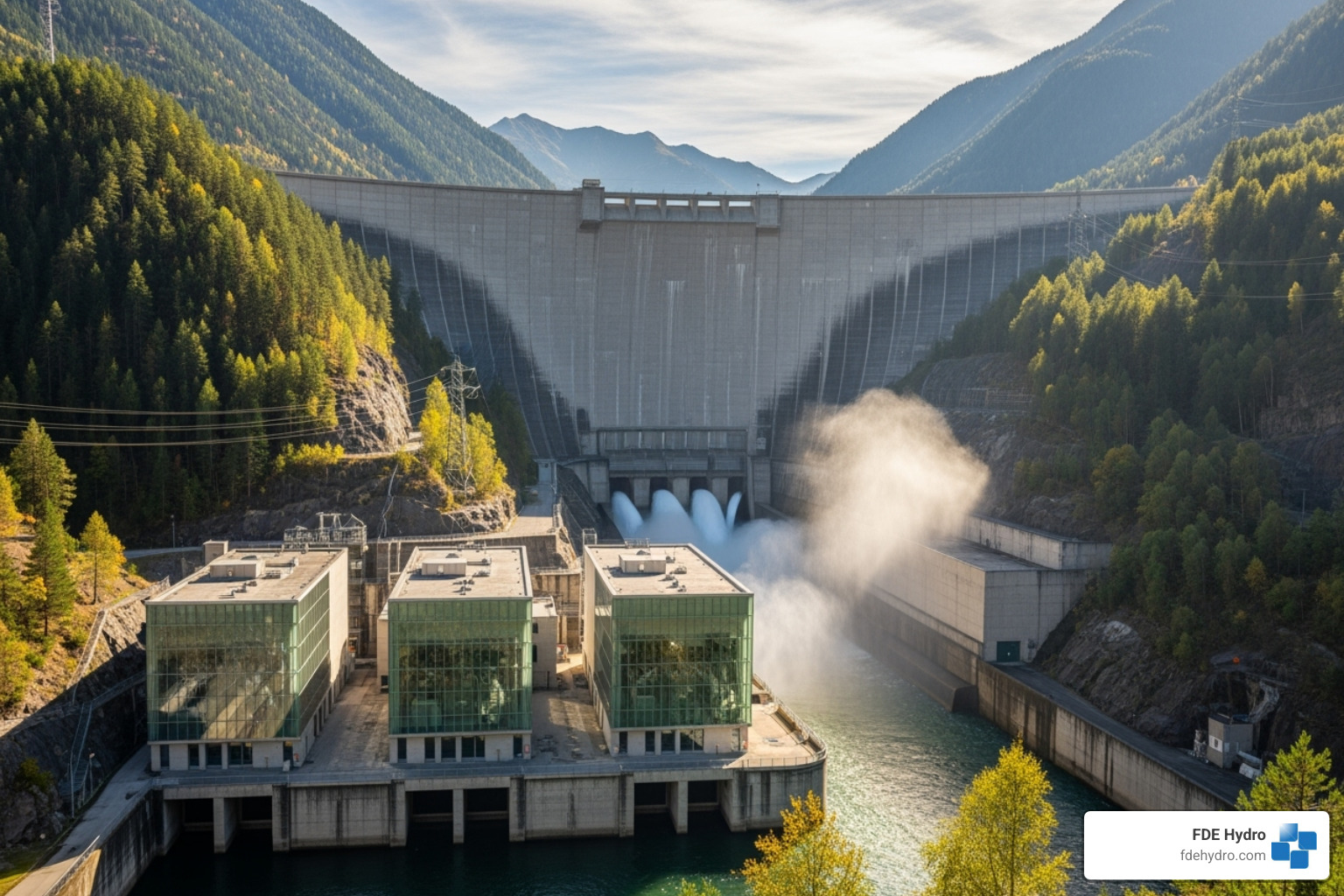
I invite you to explore how our hydropower innovations can contribute to a cleaner, more sustainable digital future: Learn more about our innovative hydropower solutions.
by Bill French Sr. | Dec 10, 2025 | Energy Resource Articles
Why AI for Resource Management is Changing Project Delivery
AI for resource management applies artificial intelligence to optimize how organizations allocate people, equipment, and budgets. By analyzing complex project data, it matches the right resources to tasks, predicts future needs, and automates scheduling to reduce manual planning time by up to 50%. The result is real-time visibility into team capacity and project health.
The numbers are compelling. Organizations using AI-powered tools report utilization rates above 75% (compared to the 40% industry average), a 43% increase in billable time, and 5-10% higher project margins. For large-scale infrastructure projects, these gains provide a significant competitive advantage.
Traditional resource management relies on spreadsheets and gut instinct, which is inefficient and error-prone as projects scale. AI processes vast amounts of data to find patterns humans miss, balancing deadlines, skills, and budgets simultaneously. What once required expensive custom development is now available in user-friendly platforms that forecast workloads, suggest team compositions, and alert managers to bottlenecks before they occur.
I’m Bill French Sr., Founder and CEO of FDE Hydro, where we’ve pioneered modular construction solutions for the hydropower industry. After decades of managing complex civil infrastructure projects, I’ve seen how effective resource allocation separates successful projects from troubled ones. Today’s AI tools offer capabilities we could only dream of in earlier years. Let’s explore how they can transform your project delivery.
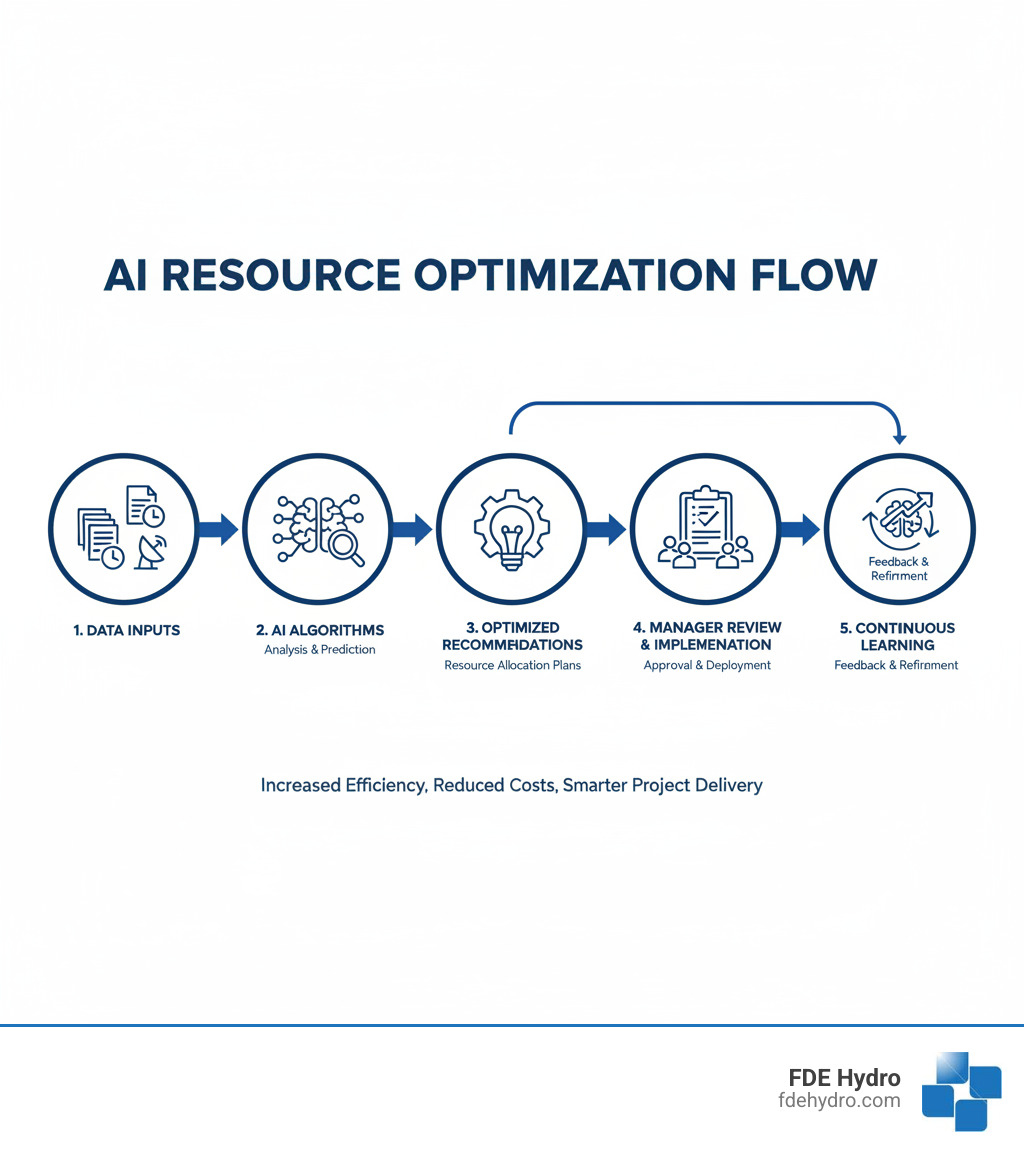
Defining AI in a Resource Context
At its core, AI for resource management uses intelligent systems to make smarter, faster decisions about valuable assets. It moves beyond simple automation by applying predictive analytics and optimization algorithms to uncover deep insights from historical and real-time data. This allows organizations to shift from reactive problem-solving to proactive, data-driven planning, ensuring resource plans are always one step ahead.
What Types of Resources Can AI Manage?
AI is versatile and can manage a wide array of assets beyond just personnel.
- Personnel: AI matches individuals to projects based on skills and availability, helping to predict and prevent burnout.
- Equipment and Machinery: For industries like ours at FDE Hydro, AI optimizes the deployment and maintenance of heavy equipment, minimizing downtime for critical assets used in our modular precast concrete technology.
- Financial Capital: AI tracks budgets, forecasts spending, and identifies potential cost overruns early.
- Inventory and Materials: It can manage stock levels and optimize procurement to ensure materials are available when needed for our hydropower projects.
- Time: As our most precious resource, AI helps optimize project timelines and identify potential delays to maximize project velocity.
If an asset needs to be allocated, scheduled, or tracked, AI can manage it more intelligently. For more on how we use technology to maximize efficiency, explore our approach to innovation: More info about our innovative technology.
The Core Benefits of AI for Resource Management
The real-world impact of AI for resource management is about fundamentally improving project delivery. AI transforms resource management from a reactive scramble into a strategic advantage, leading to increased productivity, better project outcomes, and higher margins. Common results include a 20% boost in utilization, 5-10% higher project margins, and a 12x return on investment.
AI turns hours of manual planning into decisions made in minutes.
- Demand forecasting: AI accurately predicts resource needs by analyzing historical data, preventing over-staffing or under-staffing.
- Automated scheduling: The system continuously matches resources to tasks based on skills, availability, and deadlines, eliminating spreadsheet nightmares.
- Skill matching: AI goes beyond keywords to evaluate past performance and find the best person for each task, ensuring quality outcomes.
- Workload balancing: By monitoring team capacity, AI flags potential overloads and suggests reallocations to prevent burnout.
These capabilities reduce administrative time on scheduling and reporting by up to 50%, freeing managers for more strategic work. This people-first approach balances business goals with employee well-being, creating an environment where teams thrive.
AI for resource management provides tight control over project finances. Real-time cost tracking offers instant visibility into spending, alerting you to variances before they become critical. This allows for better margin control, with organizations consistently seeing 5-10% higher project margins through optimized resource allocation.
Revenue forecasting also becomes more reliable as AI analyzes project pipelines and resource availability. The impressive 12x return on investment comes from reduced waste, higher utilization, and faster project delivery. For budgeting, AI offers data-driven forecasting and scenario planning, allowing you to test allocation strategies and understand their financial impact before committing.
At FDE Hydro, financial performance is linked to our commitment to sustainable infrastructure. AI helps optimize resource allocation in our operations, supporting both profitability and sustainability, aligning with principles in resources like Accelerating AI with Sustainability – A Playbook.
Boosting Efficiency and Project Outcomes
AI helps ensure projects finish on time, on budget, and at high quality. Increased utilization rates (often from 40% to over 75%) mean projects move faster. AI also reduces human error in allocation, leading to more reliable planning and better team morale.
Key benefits include:
- Risk prediction: AI analyzes project data to flag risks like budget overruns or delays, allowing for proactive intervention. This is critical for complex infrastructure projects where delays cost millions.
- Improved agility: When project parameters change, AI instantly suggests optimized adjustments, making the organization more responsive.
- Reduced manual reporting: With a 50%+ reduction in reporting time, managers can focus on strategic decisions instead of administrative tasks.
At FDE Hydro, efficiency is core to our mission. Our modular precast concrete technology already cuts construction time, and AI-powered resource management amplifies these gains. Learn more about our approach here: More info about our energy solutions.
Choosing the Right AI Resource Management Software

Selecting the right AI for resource management software means finding a tool that aligns with your business needs, scales with your growth, and is easy for your team to use. Key considerations include:
- Scalability: The software should work for your current team size but also support future expansion.
- User Experience: An intuitive interface is crucial for adoption. If the software is too complex, it won’t be used effectively.
- Integration: The platform must connect seamlessly with your existing project management, CRM, and financial tools to avoid data silos.
- Customization: Look for flexibility to adapt to your industry’s unique workflows, such as the long timelines and specialized equipment needs in hydropower.
- Analytics: The software should provide deep, actionable insights, not just surface-level reports.
Core Features to Look for in AI for Resource Management Software
When evaluating platforms, prioritize these transformative features:
- Intelligent Resource Recommendation: The software should analyze skills, availability, and performance to suggest the optimal person or team for each project.
- AI Workload Forecasting: Look for tools that predict when team members will become available, preventing overbooking and helping you make realistic commitments.
- Real-time Reporting Dashboards: Instant, customizable visibility into utilization, project status, and budgets is essential for agile decision-making.
- AI Headcount Planning: This feature analyzes demand and capacity to advise when and what roles to hire, enabling proactive team building.
- Automated Resource Allocation: The platform should continuously optimize assignments based on cost, speed, and skill alignment, handling complex calculations automatically.
Integration is essential for a unified workflow. Modern platforms are designed to connect with your existing technology stack via robust API access, allowing data to flow automatically between systems.
Look for pre-built connectors for popular tools like Jira, Salesforce, and HubSpot. This ensures your sales pipeline informs resource planning and creates a smooth handoff from sales to project execution. The goal is to achieve unified project intelligence—a single source of truth that pulls data from across your organization. For unique needs, custom API integrations offer even more power, as shown in various Developer API Success Stories.
At FDE Hydro, seamless integration is key to managing our complex hydropower projects. Connecting our resource management system with project tracking and financial tools eliminates friction and keeps everyone aligned.
A Practical Guide to Integrating AI into Your Workflow

Integrating AI for resource management is a journey that requires careful planning and team buy-in. It’s about evolving how your organization makes decisions. Success depends on a solid strategy, change management, and a culture of continuous improvement.
Practical Steps for Successful Integration
- Define Clear Objectives: Before choosing a tool, determine what you want to achieve. Are you aiming to reduce budget overruns, improve work-life balance, or forecast needs more accurately? Your goals will guide the entire process.
- Evaluate Data Quality: AI is only as good as the data it receives. Assess the accuracy and consistency of your project records, time tracking, and resource usage data. Clean up your data first for the best results.
- Choose the Right Tool: Select a solution that solves your specific challenges, integrates with existing systems, and is user-friendly. Involve your team in the selection process.
- Start with a Pilot Program: Test the software with a single team or project. This low-risk approach allows you to gather feedback and make adjustments before a company-wide rollout.
- Train Your Team: Invest in comprehensive training that explains the “why” behind the change, not just the “how.” Empowering your team with knowledge is key to adoption. Learn more about our approach to teamwork here: More info about our team.
- Review and Refine Continuously: AI is not a “set it and forget it” technology. Regularly check in to assess progress against your objectives, identify bottlenecks, and act on team feedback.
Handling Data Security and Measuring ROI
Two critical questions for any implementation are data security and return on investment (ROI).
For data security, choose reputable platforms with robust encryption, access controls, and compliance with regulations like GDPR. Always verify a vendor’s security protocols and data handling practices to ensure they meet your industry’s standards, following guidelines for the Responsible use of artificial intelligence in government.
To measure ROI, track key metrics where AI delivers value. You’ll likely see utilization rates jump by 20% or more, project margins increase by 5-10%, and administrative time drop by 50%. Also, monitor project success rates and team satisfaction. Many organizations see returns as high as 12x their initial investment as efficiency, better decision-making, and reduced waste compound over time.
At FDE Hydro, the principles of precision and continuous improvement that guide our modular construction approach also apply to our adoption of new technologies. It’s about working smarter.
Frequently Asked Questions about AI Resource Management
Is AI resource management software suitable for all business sizes?
Yes. AI for resource management software is highly scalable and benefits businesses of all sizes.
- Small Businesses: AI helps smaller teams optimize limited resources, make smarter hiring decisions, and compete more effectively. Many providers offer flexible, per-user pricing models.
- Large Enterprises: For large organizations, AI is essential for coordinating complex resource allocation across numerous projects and departments, providing a unified view that is impossible to achieve manually.
The key is choosing a solution that fits your budget and scales with your growth.
How does AI resource management software handle unexpected project changes?
AI excels at adapting to unexpected changes, a key advantage over static planning tools.
- Dynamic Rescheduling: When priorities shift or a resource becomes unavailable, the AI can instantly re-evaluate dependencies and suggest a new, optimized schedule.
- Real-time Alerts: The system constantly monitors project health and alerts managers to risks like budget overruns or delays, allowing for proactive intervention.
- Scenario Planning: Many tools let you model the impact of potential changes before committing, helping you choose the best path forward and improving organizational agility.
Can AI eliminate human bias in resource allocation?
AI can significantly reduce, but not completely eliminate, human bias.
- Reduction of Bias: By using objective data like skills and availability, AI minimizes the influence of unconscious biases in allocation decisions.
- Risk of Inherited Bias: However, if the historical data used to train the AI contains biases, the system may perpetuate them.
- Human Oversight is Crucial: For this reason, human oversight is essential. Managers must review AI recommendations to ensure fairness and logic. The goal is to use AI as a powerful assistant that helps us make more objective decisions, not as a fully autonomous replacement.
Conclusion: The Future of Project Delivery is Intelligent
We’ve reached an inflection point where AI for resource management is fundamentally rethinking how projects are delivered. This technology offers tangible benefits, including higher utilization rates, increased billable time, and improved project margins, leading to healthier businesses and more engaged teams.
As we’ve explored, AI transforms tedious planning into a fast, intelligent process. By choosing the right software and following a practical integration plan, organizations can achieve operational excellence. For those of us building critical infrastructure, these capabilities are essential. At FDE Hydro, we know that innovation in how we manage our resources is just as important as the modular construction solutions we pioneer.
Adopting AI is about more than a competitive edge; it’s about creating more agile, efficient, and human-centric organizations. AI acts as a partner, handling complex data analysis so managers can focus on leading, mentoring, and creative problem-solving.
The organizations that accept these intelligent systems will not just survive but thrive. They will deliver projects faster, more profitably, and with greater predictability. They will attract top talent and build the solutions our world needs with unprecedented efficiency. The future of project delivery is intelligent, and it’s here now.
Ready to explore how intelligent systems can transform your project delivery? Learn more about how we’re applying innovation across every aspect of modern hydropower: Learn more about advanced hydropower solutions.

