by Bill French Sr. | Dec 9, 2025 | Energy Resource Articles
Why Understanding Renewable Energy Efficiency Matters
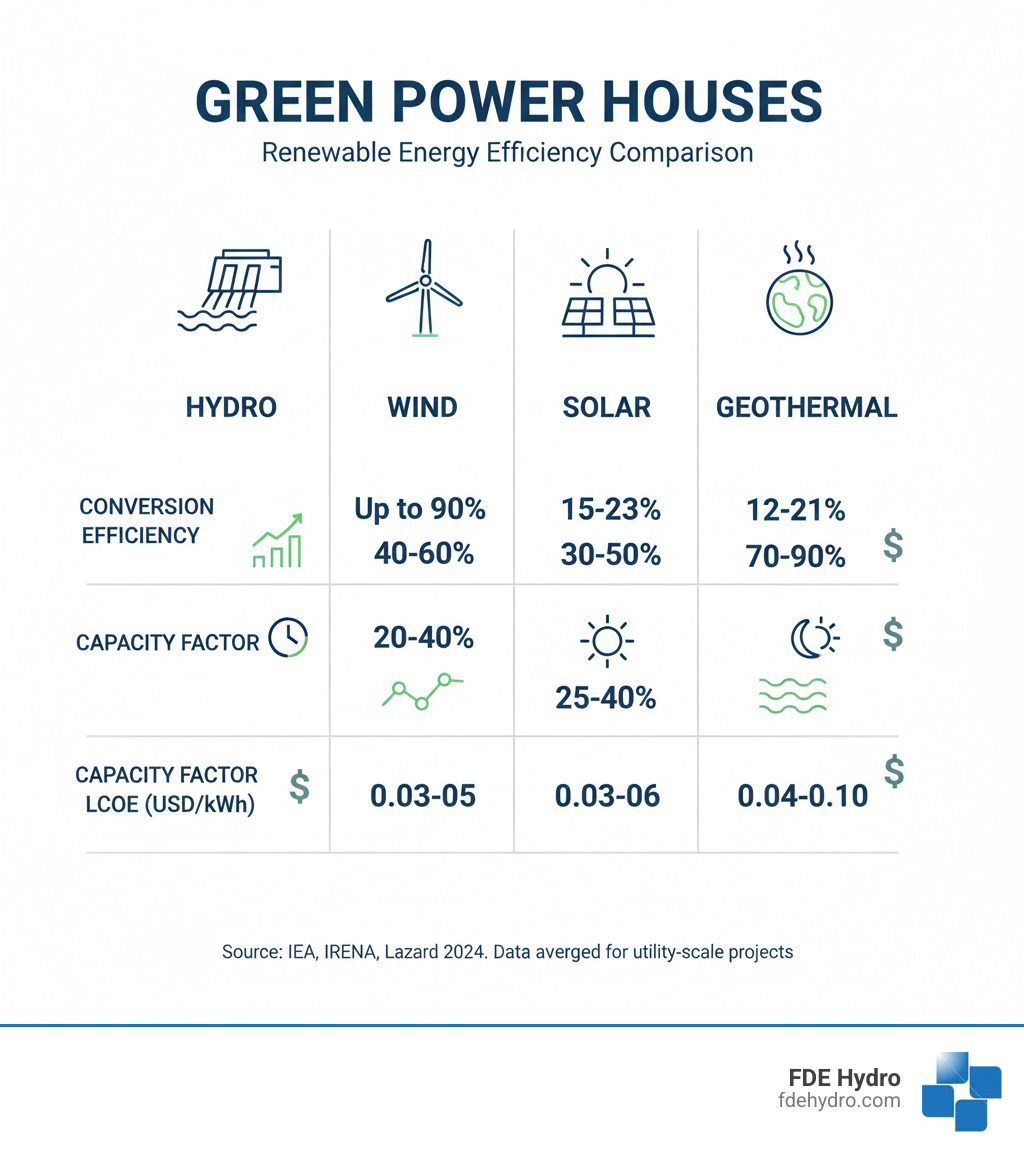
What renewable energy resource is the most efficient depends on how you measure efficiency. Hydropower leads in conversion efficiency at up to 90%, wind offers the highest energy return on investment (EROI) at 1,164%, and geothermal provides the most consistent output. Here’s a quick comparison:
| Energy Source |
Conversion Efficiency |
Key Advantage |
Primary Limitation |
| Hydropower |
Up to 90% |
Highest conversion rate, reliable baseload power |
High upfront construction costs |
| Wind |
20-40% capacity factor |
Exceptional energy return (1,164% EROI), low operating costs |
Intermittent, location-dependent |
| Geothermal |
12-21% |
Consistent 24/7 generation, stable output |
Limited to specific geographic regions |
| Solar PV |
15-23% |
Rapidly declining costs, highly accessible |
Weather-dependent, requires storage |
The global energy landscape is changing, with renewables now generating over 20% of all U.S. electricity. As we move away from fossil fuels, understanding which resources deliver the most energy for the least input is critical.
But “efficiency” isn’t one simple number. Conversion efficiency measures how much incoming energy becomes electricity. Capacity factor reveals how often a plant runs at full potential. Levelized Cost of Energy (LCOE) calculates the true cost per kilowatt-hour over a project’s life. And Energy Return on Investment (EROI) shows how much energy you get back compared to what you put in.
I’m Bill French Sr., Founder and CEO of FDE Hydro. We’ve spent years developing modular solutions to answer the question of what renewable energy resource is the most efficient by reducing the construction barriers that have historically limited hydropower. Our work with the Department of Energy’s Hydro Power Vision Task Force has shown us that efficiency is about both technology and smart implementation.
Understanding Efficiency: How Are Renewables Measured?
When asking what renewable energy resource is the most efficient, it’s important to know that the energy world uses multiple yardsticks to measure performance. Each one tells a different part of the story.
At FDE Hydro, we know the smartest approach looks at the complete picture—not just raw power, but also economics, reliability, and environmental footprint.
Here are the key metrics:
- Levelized Cost of Electricity (LCOE): This is the total cost to build and operate a power plant over its lifetime, divided by the electricity it produces. It allows for a fair comparison between different technologies. For example, the global weighted average LCOE for onshore wind was just $0.033 per kilowatt-hour in 2023, showing how competitive renewables have become.
- Capacity Factor: This tells us how much a plant actually produces compared to its maximum potential. A 100-megawatt facility running at full power half the year has a 50% capacity factor. Hydropower often achieves high capacity factors because water can be stored and released when needed, making it a reliable baseload power source.
- Conversion Efficiency: This is the percentage of incoming energy (like sunlight or water flow) that gets converted to electricity. A hydropower turbine can convert 90% of water’s kinetic energy, while a typical coal plant is only about 29% efficient.
Conversion Efficiency vs. Energy Return on Investment (EROI)
These two terms measure different things. Conversion efficiency is about the moment of generation—how much energy is captured right then and there. Energy Return on Investment (EROI) takes the long view, asking how much energy a system produces over its entire life compared to the energy used to build, maintain, and decommission it.
This is where wind energy shines, delivering an incredible 1,164% EROI. For every unit of energy invested, we get back more than eleven units. High conversion efficiency doesn’t guarantee high EROI, and vice versa. Hydropower’s 90% conversion is phenomenal, but the energy invested in construction is substantial. Each metric reveals a different truth about efficiency.
How Renewables Stack Up Against Fossil Fuels
The efficiency gap widens when you consider the entire lifecycle. Fossil fuels require energy-intensive extraction, transportation, and processing, all while producing lifecycle emissions. Renewables, once built, tap into naturally replenishing energy flows with near-zero emissions and no fuel extraction costs. Our work in Clean Energy Infrastructure focuses on maximizing this inherent advantage.
| Energy Source |
LCOE (USD/kWh, 2023 Global Avg) |
Capacity Factor (2023 Global Avg) |
Conversion Efficiency (Typical) |
| Hydropower |
0.057 |
40-60% (baseload) |
Up to 90% |
| Wind (Onshore) |
0.033 |
36% |
20-40% (capacity factor) |
| Solar PV (Utility-scale) |
0.044 |
15-30% |
15-23% |
| Geothermal |
0.069 |
70-90% |
12-21% |
| Coal |
Higher than new renewables |
50-70% |
~29% |
Data from IRENA Renewable Power Generation Costs in 2023 and multiple industry sources
What Renewable Energy Resource Is the Most Efficient? A Detailed Comparison
There is no single answer to what renewable energy resource is the most efficient. Like tools in a toolbox, each renewable source has its own superpower, making it the champion in different situations. Most experts point to wind, geothermal, hydroelectricity, and solar power as the efficiency leaders. Understanding their unique strengths is key, a topic we explore in our [Energy 101](https://fdehydro.com/energy-101/) resources.
- Wind energy delivers an extraordinary Energy Return on Investment (EROI) of 1,164%. The energy generated over a turbine’s lifetime dwarfs the energy needed to build and maintain it.
- Geothermal energy is the champion of consistency, with capacity factors reaching 70-90%. It provides reliable 24/7 power, regardless of weather.
- Hydroelectricity takes the crown for pure conversion efficiency, often hitting 90% or higher. Almost all of the water’s kinetic energy becomes electricity.
- Solar power’s efficiency story is about accessibility and economics. Costs have plummeted, making it deployable almost anywhere the sun shines.
What makes hydropower one of the most efficient renewable energy resources?
At FDE Hydro, we focus on hydropower because it excels in metrics that matter for reliable, large-scale energy.
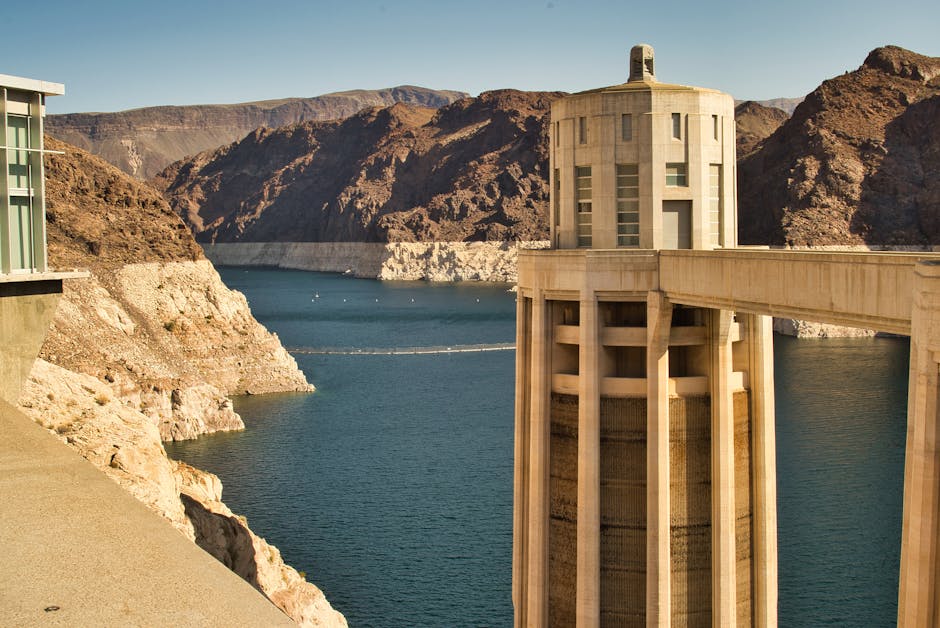
Hydropower plants achieve conversion efficiencies exceeding 90%, far surpassing fossil fuels and even other renewables in this regard. This makes it a standout when people ask what renewable energy resource is the most efficient in terms of pure conversion.
Beyond that, hydropower’s reliability and high capacity factor (often 40-60%) make it a cornerstone of a stable grid. We can control the flow of water, generating electricity precisely when needed. This dispatchability allows hydropower to act as a natural battery, balancing the grid. Once built, a hydro facility can operate for a century or more with low operating costs and free “fuel” from the water cycle.
Furthermore, [Pumped Storage Hydropower](https://fdehydro.com/pumped-storage-hydropower/) turns these facilities into massive energy storage systems, which is increasingly valuable as more intermittent renewables come online. While traditional projects have high costs and environmental impacts, our modular “French Dam” technology was developed to dramatically reduce construction costs and timelines while minimizing disruption. This approach makes this highly efficient resource more accessible and sustainable, aligning with the [Benefits of Hydropower Plant](https://fdehydro.com/benefits-of-hydropower-plant/) development.
What makes wind a contender for the most efficient renewable energy resource?
Wind turbines represent one of the most energy-efficient technologies ever developed.
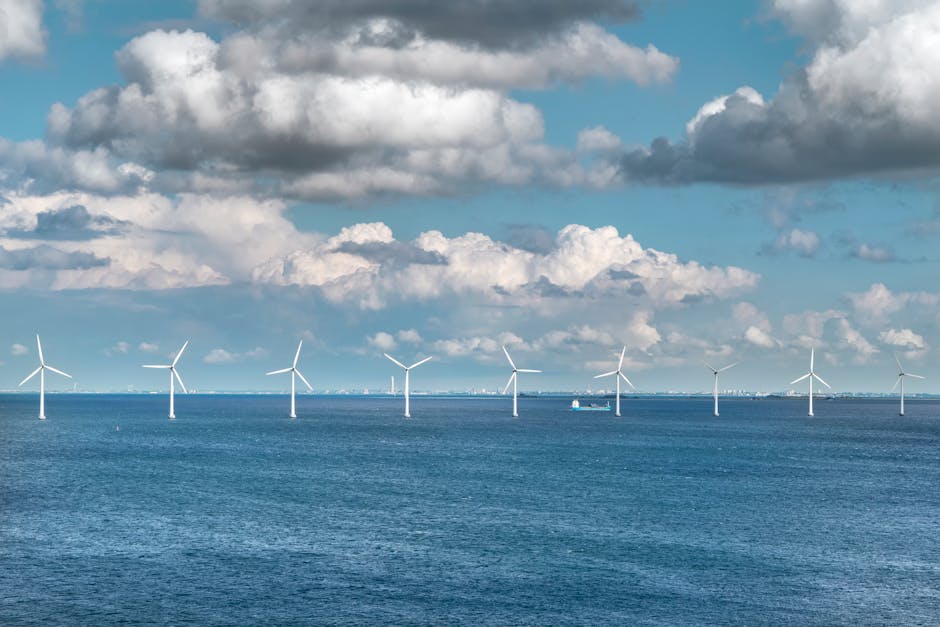
Wind’s superpower is its extraordinary Energy Return on Investment (EROI) of 1,164%. For every unit of energy invested over its lifetime, a turbine produces more than eleven units of clean electricity. Once spinning, operating costs are minimal because the fuel is free. This translates to some of the lowest electricity costs available today.
Modern turbines have capacity factors of 20-40%, and engineers continue to push closer to the theoretical maximum efficiency defined by Betz’s Law (59.3%). In the United States, wind already accounts for [9.2 percent of U.S. electricity generation](https://www.eia.gov/tools/faqs/faq.php?id=427&t=3). The main challenge is intermittency, which requires backup generation or energy storage. Siting can also be a challenge, but modern designs and careful planning are addressing these issues.
Geothermal and Solar: Consistent vs. Accessible Power
Geothermal and solar offer different paths to efficiency. Geothermal provides steady, dependable power, while solar offers widespread accessibility and rapidly improving economics.
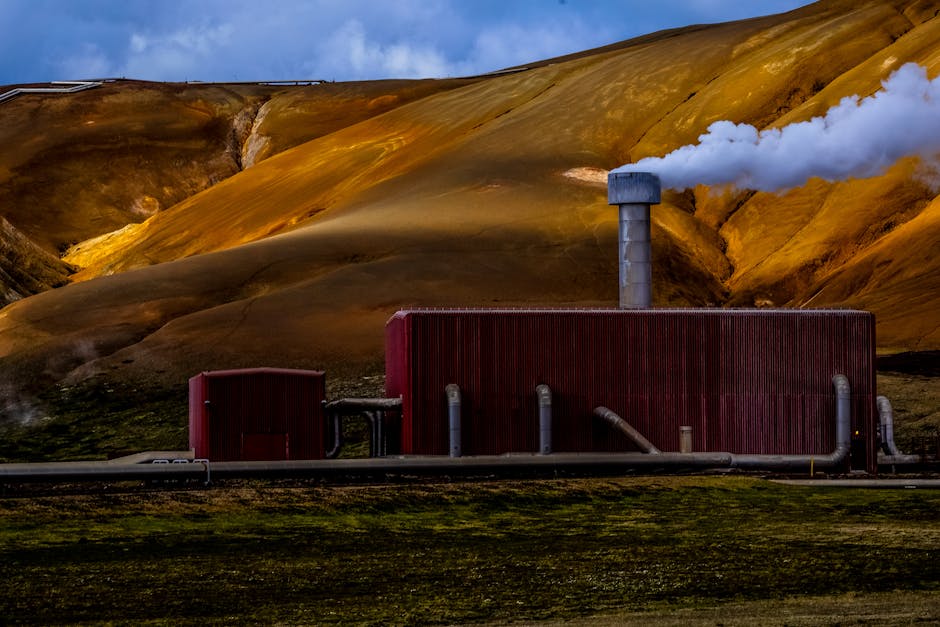
Geothermal energy taps into the Earth’s internal heat, boasting capacity factors of 70-90% for reliable, 24/7 baseload power. Its conversion efficiency is a modest 12-21%, but its unwavering output is incredibly valuable. The main limitations are high initial drilling costs and the need for specific geological conditions, though next-generation technologies aim to expand its reach.
Solar energy, on the other hand, is almost universally accessible. Its costs have dropped dramatically, making it the cheapest renewable source in many regions. Panel conversion efficiency is steadily climbing from the typical 15-23% range, with lab records exceeding 40%. Solar’s main challenge is intermittency, which requires energy storage solutions like batteries. As part of our commitment to [Sustainable Infrastructure Development](https://fdehydro.com/sustainable-infrastructure-development/), we see both as essential pieces of a diversified energy future.
Are there any renewable energy sources that are less efficient?
While all renewables are an improvement over fossil fuels, some lag behind the efficiency leaders.
Biomass energy, which involves burning organic matter, has lower conversion efficiency due to its multi-step process. There is also an ongoing debate about its carbon neutrality, as burning wood can release significant carbon that takes decades to be reabsorbed by new tree growth.
Solar thermal energy for electricity generation uses mirrors to create steam to drive a turbine. This process is generally less efficient than direct photovoltaic (PV) conversion and often requires large amounts of water, which is a problem in the arid regions best suited for it. For these reasons, biomass and solar thermal typically fall behind hydropower, wind, geothermal, and solar PV in overall efficiency.
Key Factors That Influence Renewable Energy Efficiency
When evaluating what renewable energy resource is the most efficient, it’s crucial to understand that real-world performance is not static. Efficiency is dynamic, influenced by several interconnected factors that can either boost or hinder a project’s output.
Technology advancements are a primary driver. Solar panel efficiencies are constantly climbing, wind turbines are becoming larger and more aerodynamic, and even established technologies are improving. At FDE Hydro, our work on [Renewable Energy Patents](https://fdehydro.com/renewable-energy-patents/) focuses on making hydroelectric systems more cost-effective and efficient to build.
Geographical location and weather conditions are paramount. A solar farm needs sun, a wind farm needs consistent wind, and a hydropower plant needs reliable water flow and elevation changes. Geothermal is limited to areas with accessible subterranean heat. Daily and seasonal weather patterns directly impact the output of intermittent sources like solar and wind, and long-term patterns like droughts can affect hydropower.
Maintenance and operations also play a significant role. A well-maintained facility will consistently produce more power. Regular inspections and timely repairs can make a substantial difference in energy production and revenue over the life of a plant.
Finally, grid integration is critical. A renewable source is only as efficient as the system that delivers its power. If the grid cannot handle the electricity produced, output may be curtailed, wasting free energy. Modernizing the power grid with smart technologies is vital to maximizing the efficiency of our renewable investments. Optimizing all these factors together is how we build a truly sustainable energy future.
The Future of Efficient Renewables
The quest for what renewable energy resource is the most efficient is an ongoing journey of innovation. The future is being shaped by a convergence of new technologies, smarter policies, and crucial infrastructure upgrades.
Technological breakthroughs are expanding our options. Next-generation geothermal systems (EGS) promise to open up heat from hot, dry rock almost anywhere, potentially changing it from a niche resource into a widespread baseload power option. In solar, perovskite solar cells are generating excitement for their potential to offer higher conversion efficiencies at lower manufacturing costs. Floating solar farms are also gaining traction, as they conserve land space and can be more efficient due to the cooling effect of the water.
Technology alone isn’t enough. Policy plays a crucial role by creating stable markets and incentivizing research. Initiatives like the EU’s REPowerEU Plan and the U.S. Inflation Reduction Act are releasing unprecedented funding for clean energy, streamlining development and fostering innovation.
Grid modernization is the unsung hero of this transition. A smarter grid, like the one the U.S. Department of Energy is working to build by modernizing the power grid, means less wasted energy and better integration of variable sources like wind and solar.
This brings us to energy storage solutions, the key to open uping the full potential of renewables. While battery technology is advancing rapidly, large-scale solutions like [Pumped Storage Hydropower](https://fdehydro.com/pumped-storage-hydropower/) act as giant, grid-scale batteries, ensuring reliability when the sun isn’t shining or the wind isn’t blowing.
At FDE Hydro, we are committed to this evolution through [Hydropower Innovation](https://fdehydro.com/hydropower-innovation/). Our modular approach makes hydropower a more flexible and responsive part of this diverse energy mix. The future isn’t about a single winner; it’s about an integrated system where solar’s accessibility, wind’s energy return, geothermal’s consistency, and hydropower’s reliability work together.
Frequently Asked Questions about Efficient Renewable Energy
What is the cheapest renewable energy source?
In terms of cost, solar power and onshore wind are the champions of affordability. Thanks to plummeting manufacturing costs, they are now the cheapest sources of new electricity in many regions.
The global weighted average Levelized Cost of Electricity (LCOE) in 2023 for utility-scale solar PV was just USD 0.044/kWh. Onshore wind was even cheaper at USD 0.033/kWh. This means building new renewable capacity is often more economical than new fossil fuel options, as confirmed by the [IRENA cost report](https://mc-cd8320d4-36a1-40ac-83cc-3389-cdn-endpoint.azureedge.net/-/media/Files/IRENA/Agency/Publication/2023/Aug/IRENA_Renewable_power_generation_costs_in_2022.pdf). The answer to what renewable energy resource is the most efficient increasingly includes economic efficiency, where solar and wind lead.
Is nuclear power a renewable energy source?
No, nuclear power is not considered a renewable energy source. While it is a low-carbon, zero-emission source of electricity during operation, it relies on uranium, which is a finite resource mined from the ground, much like coal or natural gas.
Renewable energy, by definition, comes from natural sources that are constantly replenished, such as sunlight, wind, water, and geothermal heat. Because its fuel source is not replenishable, nuclear power does not fit this definition. It’s an important distinction when planning for a truly sustainable energy future.
Which renewable energy is the most reliable?
When it comes to reliability—delivering power whenever it’s needed—two sources stand out: hydropower and geothermal energy.
Hydropower is “dispatchable,” meaning operators can control its output. By storing water in reservoirs, we can ramp generation up or down to meet demand, making hydropower a guardian of grid stability. This is why we at FDE Hydro are passionate about making this reliable technology more accessible.
Geothermal energy offers unwavering consistency. It taps into the Earth’s internal heat, allowing plants to operate 24/7 as a source of baseload power, which is the steady foundation of electricity the grid always needs.
In contrast, solar and wind are intermittent, as their output depends on the weather. They are crucial parts of the energy mix but require backup or storage from reliable partners like hydropower and geothermal to ensure a constant supply of power.
Conclusion: Efficiency is Key to a Sustainable Future
So, what renewable energy resource is the most efficient? The answer is a team of performers, each excelling in different ways. Hydropower offers best conversion efficiency and reliability. Wind delivers an incredible energy return on investment. Geothermal provides consistent 24/7 power, and solar leads in accessibility and low cost.
The path to a sustainable future lies in a diverse mix of these sources, creating a resilient system where each technology’s strengths compensate for the others’ limitations. Intermittent sources like solar and wind provide abundant, cheap power, while dispatchable sources like hydropower and geothermal fill the gaps to ensure constant reliability.
At FDE Hydro, we see how hydropower’s unique combination of high efficiency and reliability makes it an irreplaceable part of this energy mix. That’s why we’re focused on [Reinvigorating Hydropower](https://fdehydro.com/reinvigorating-hydropower/) with our innovative modular technology. By reducing the cost and time to build and retrofit facilities, we’re helping ensure this highly efficient resource powers our communities for generations.
The future of energy is diverse, clean, and efficient. To learn more about this cornerstone technology, explore the power and potential of [Hydropower](https://fdehydro.com/hydropower/).
by Bill French Sr. | Dec 3, 2025 | Energy Resource Articles
The Global Energy Change: Why Sustainable Energy Production Matters Now More Than Ever
Sustainable energy production is the generation of power from sources that meet present needs without compromising the ability of future generations to meet theirs. Here’s what you need to know:
- What it includes: Solar, wind, hydropower, geothermal, and bioenergy
- Key benefit: Reduces greenhouse gas emissions by up to 90% compared to fossil fuels
- Current status: Renewables account for 30% of global electricity, up from 20% a decade ago
- Cost advantage: Solar and wind are now 41-53% cheaper than new fossil fuel plants
- Job creation: Clean energy creates 3x more jobs per dollar invested than fossil fuels
- Health impact: Prevents millions of premature deaths annually by reducing air pollution
- Investment need: $4.5 trillion per year until 2030 to reach net-zero emissions by 2050
Energy is at the heart of the climate challenge—and key to the solution. While fossil fuels still provide 80% of global energy, the landscape is changing. Between 2015 and 2024, renewable energy capacity grew by 140%, while fossil fuel capacity increased by just 16%. In 2024 alone, clean energy investment hit $2 trillion, far outpacing the $1.2 trillion that went into fossil fuels.
Despite this progress, we’re not moving fast enough. To meet Paris Agreement goals and limit global warming to 1.5°C, emissions must drop by almost half by 2030 and reach net-zero by 2050. The transition creates a more resilient, equitable energy system, offering energy security, cleaner air, and new jobs in a sector that already employs 35 million people worldwide.
I’m Bill French Sr., Founder and CEO of FDE Hydro™, and I’ve spent decades working on energy infrastructure. After 50 years leading a top site contractor, I founded FDE Hydro™ to bring modular, environmentally beneficial solutions to sustainable energy production through innovative hydropower. Since 2015, I’ve worked with the U.S. Department of Energy to define next-generation hydropower, and we continue to modernize clean energy infrastructure across North America, Brazil, and Europe.
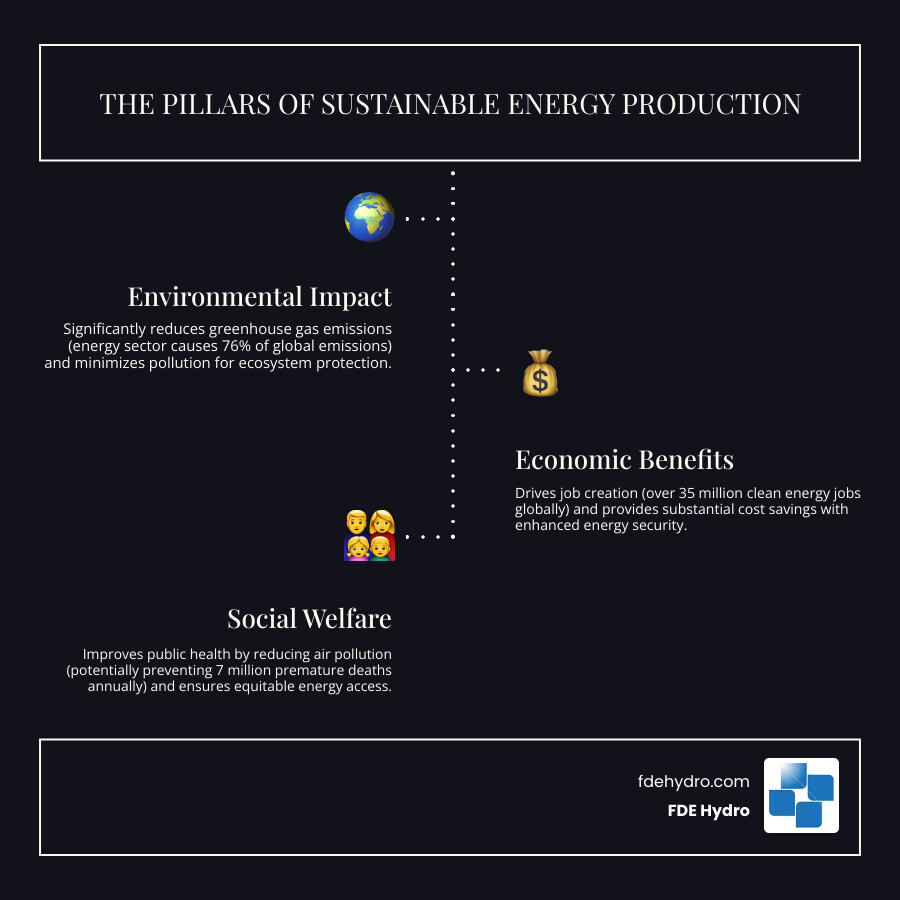
What is Sustainable Energy and Why Does It Matter?
While often used interchangeably, “sustainable energy” and “renewable energy” have a key difference. Renewable energy comes from natural sources that replenish themselves, like sun and wind. Sustainable energy is power that meets our needs today without compromising the future. It must be non-depleting, environmentally sound, and socially equitable.
Most renewables like solar, wind, and hydropower are also sustainable. However, some renewables may not be. For example, bioenergy from crops is renewable, but it isn’t sustainable if it causes deforestation or competes with food production. The concept of sustainable energy production has evolved to encompass environmental, social, and economic viability, recognizing that our planet, communities, and economy are all connected Scientific research on the history and themes of sustainable energy development.
The Environmental Imperative
Our reliance on fossil fuels is the primary driver of climate change. Burning coal, oil, and gas releases greenhouse gases that trap heat, warming our planet by 1.5 degrees Celsius since the industrial revolution. This warming triggers severe weather, melting ice caps, and rising seas. The energy sector alone is responsible for about 75% of these emissions The latest data on greenhouse gas emissions from energy.
Beyond climate change, fossil fuels cause immediate harm through air and water pollution, leading to neurological damage, cancer, and heart disease. An alarming 99% of the global population breathes air that fails to meet basic quality standards WHO data on air quality and health. Shifting to sustainable energy production is a direct path to cleaner air, safer water, and healthier communities.
The Economic Case for sustainable energy production
The economic argument for clean energy is now undeniable. Solar power is 41% cheaper than fossil fuel alternatives, and offshore wind is 53% cheaper. Renewables are now the most affordable option for new electricity in most of the world.
The job market reflects this shift. The clean energy sector employs nearly 35 million people, with 14 million new jobs projected by 2030 Data on clean energy job growth. For every dollar invested, renewables create three times more jobs than fossil fuels.
| Sector |
Jobs Created per Dollar Invested |
Investment Trends (2024) |
| Renewable Energy |
3x more than fossil fuels |
$2 trillion |
| Fossil Fuels |
1x (baseline) |
$1.2 trillion |
This transition creates real jobs in communities across North America, Brazil, and Europe—the very places FDE Hydro™ operates. While the required global investment of $4.5 trillion per year until 2030 seems large, it pales in comparison to the $7 trillion spent on fossil fuels in 2022, including subsidies and unpriced health and environmental costs. Investing in renewables avoids these hidden costs and could save the world up to $4.2 trillion annually by 2030 through reduced pollution and climate impacts.
The Social and Health Benefits
The human impact underscores the urgency of this transition. Air pollution is linked to 7 million premature deaths annually, with an economic cost of $8.1 trillion per year (6.1% of global GDP). These are not just statistics; they represent families and communities suffering from preventable illnesses like asthma, heart disease, and cancer.
Transitioning to clean energy delivers immediate health benefits by cleaning the air we breathe. It also promotes energy equity. Globally, 790 million people lack electricity, and 2.6 billion use polluting cooking fuels. Sustainable energy production offers a path to reliable, affordable, and clean power for all, creating healthier and more prosperous communities.
The Primary Sources of Sustainable Energy Production
Electricity has to come from somewhere, and increasingly, it’s from sources that won’t run out or harm the planet. The U.S. Energy Information Administration tracks several major renewable sources that form the foundation of sustainable energy production: solar, wind, hydropower, geothermal, and bioenergy.
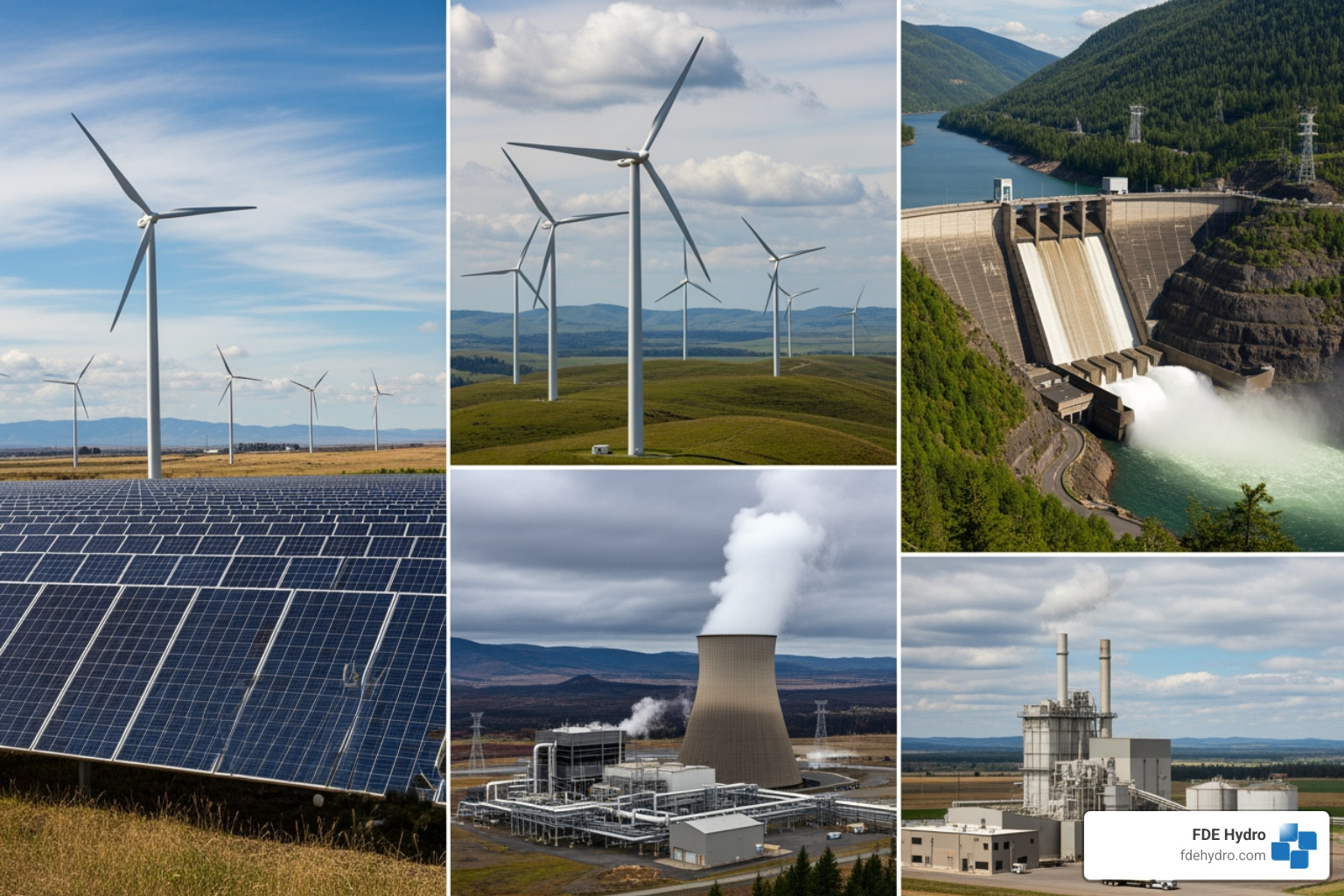
Each source has unique strengths, and a diverse energy mix is key. What works in sunny California differs from what’s ideal for rural Brazil or mountainous Europe.
Solar Power: Using the Sun
The sun provides more energy than humanity uses. Solar power captures this abundance. Photovoltaic (PV) panels convert sunlight directly into electricity, while concentrated solar power (CSP) uses mirrors to create steam that drives a turbine. Thanks to plummeting manufacturing costs, solar is often the cheapest new electricity source. Global solar capacity was projected to expand by up to 50% between 2019 and 2024 IEA report on solar energy’s future. The primary challenge, intermittency, is being solved by advances in battery storage, which makes solar power reliable around the clock.
Wind Power: Capturing the Breeze
Modern wind turbines are a cornerstone of sustainable energy production. Moving air spins large blades connected to a generator, creating electricity. Onshore turbines are common in plains and hills, while offshore turbines tap into stronger, more consistent ocean winds. The world’s technical potential for wind energy exceeds total global electricity production Information on how wind turbines work. Like solar, wind’s intermittency is being addressed by battery storage, making it an increasingly reliable and cost-effective power source.
Hydropower: The Force of Water
Hydropower is the largest renewable energy source in the electricity sector today, generating 4,200 TWh globally in 2018 2019 Hydropower Status Report. It’s one of the oldest and most reliable forms of sustainable energy production.
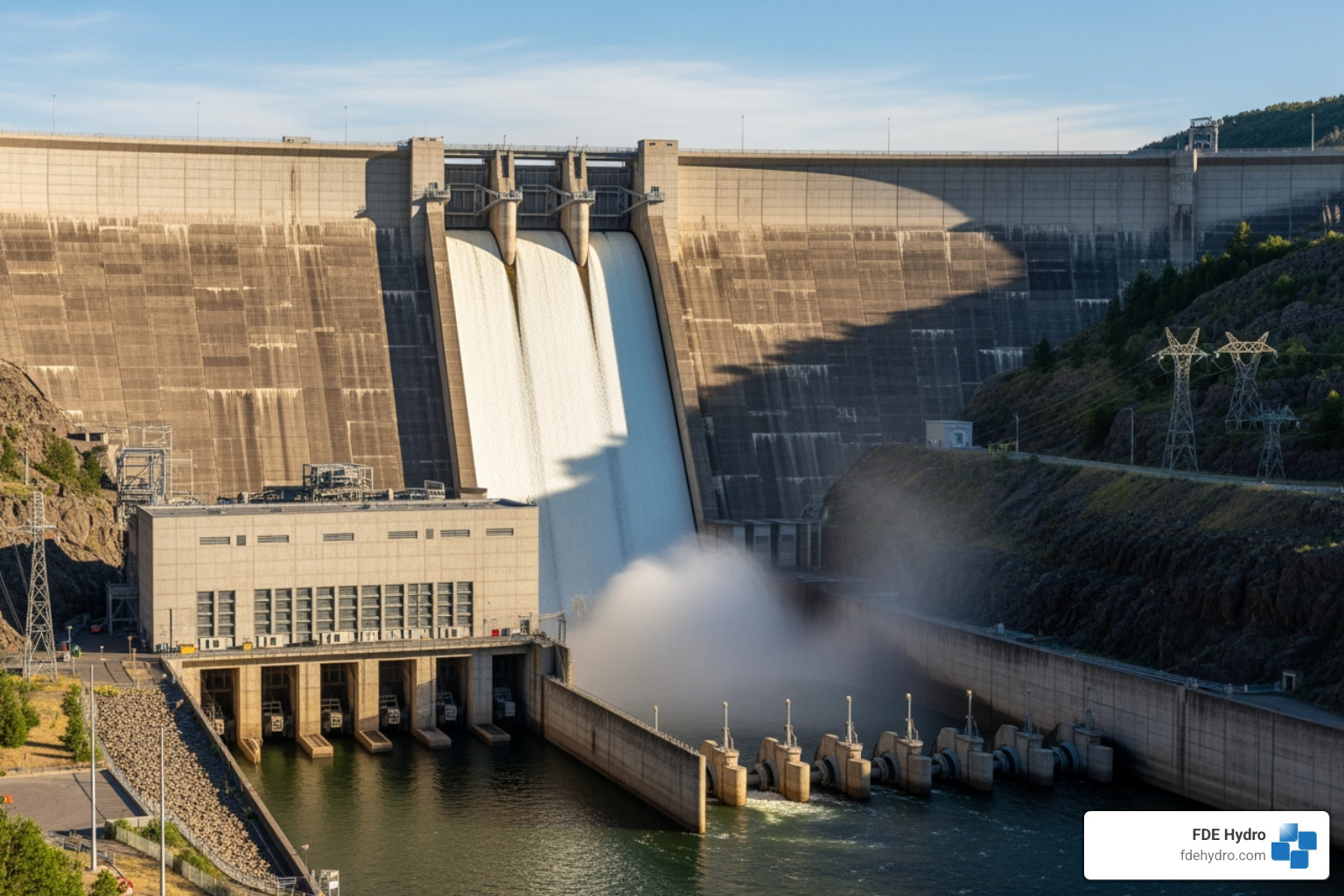
While large dams are the most familiar form, hydropower also includes run-of-river systems, tidal power, and wave power. A key advantage is pumped storage, which acts as a giant battery for the grid. Water is pumped to an upper reservoir during low demand and released to generate power when demand peaks. This makes hydropower essential for balancing intermittent renewables like solar and wind.
This is where FDE Hydro™’s work is critical. Hydropower retrofitting modernizes existing dams to improve power generation without new construction. Our patented modular precast concrete technology, the “French Dam,” dramatically cuts construction costs and timelines for upgrading hydroelectric facilities. We are actively applying this technology on projects across North America, Brazil, and Europe. Learn more about our approach at Reinvigorating Hydropower and Hydroelectric Dam Construction.
Geothermal and Bioenergy: Tapping Earth’s Resources
Two other key sources are geothermal and bioenergy. Geothermal energy taps into heat from Earth’s core, using steam from underground reservoirs to generate steady, reliable power that is not dependent on weather. Bioenergy derives power from organic matter like agricultural waste, forestry residues, and municipal waste. This biomass can be burned for heat and electricity or converted into biofuels. While bioenergy is renewable, its sustainability depends on responsible sourcing that doesn’t deplete forests or compete with food production IRENA overview of bioenergy. Together, these five sources provide a diverse toolkit for a sustainable energy future.
Accelerating the Global Transition: Challenges and Solutions
Shifting the world to sustainable energy production is a massive undertaking. It requires about $4.5 trillion in annual investment until 2030 to reach net-zero emissions by 2050. Beyond funding, we face technical and logistical problems.
Our electrical grids were not designed for the variable output of solar and wind, creating a need for better energy storage and smarter grid management. Supply chains for critical minerals like lithium and cobalt are complex. Furthermore, outdated regulations, slow permitting, and public resistance can delay vital projects. These are significant challenges, but solutions are emerging just as quickly.
The Role of Policy and International Cooperation
Effective government policy is crucial for accelerating the transition. Financial incentives like tax credits and feed-in tariffs give investors the confidence to fund renewable projects. Even more impactful is phasing out fossil fuel subsidies, which totaled a staggering $7 trillion in 2022 when including health and environmental costs. Removing these artificial advantages would level the playing field for renewables, which are already cheaper in most places.
Streamlined regulatory and permitting processes are also essential to attract private investment. International cooperation, guided by frameworks like the Paris Agreement, is driving global progress. At COP28, nations committed to tripling renewable energy capacity by 2030, a goal that is spurring policy changes in North America, Brazil, Europe, and beyond. Climate change is a shared problem, and the solutions must be shared as well.
The Future of sustainable energy production: Projections and Innovations
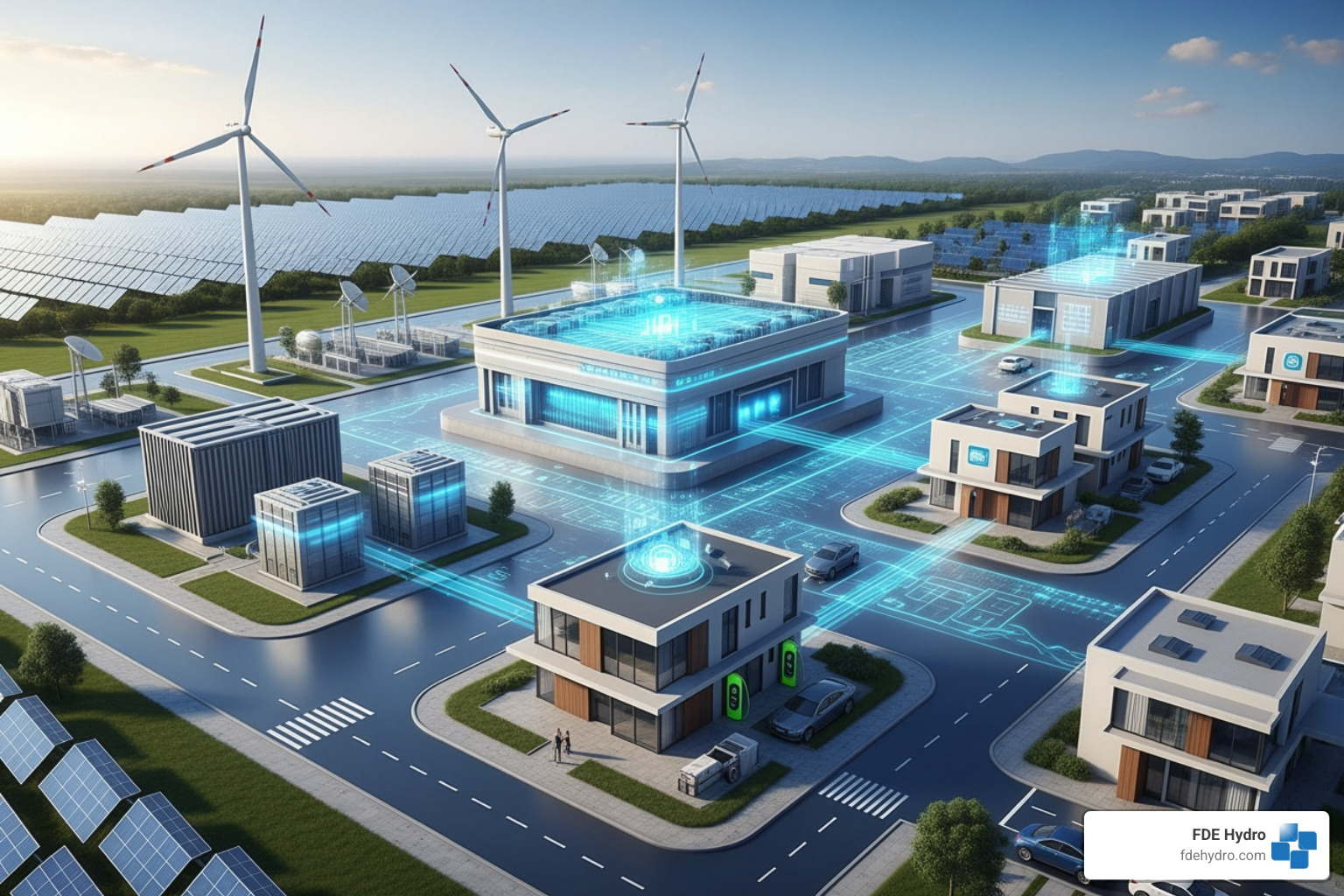
The pace of innovation is exhilarating. Projections suggest renewables could supply 65% of the world’s energy by 2030 and over 90% of its electricity by 2050. Key innovations driving this shift include:
- Advanced Energy Storage: Improved battery technology and cost-effective pumped hydro storage are solving the intermittency puzzle.
- Green Hydrogen: Created using renewable electricity, this zero-emission fuel can decarbonize heavy industry and transport.
- AI and Digitalization: Smart systems optimize grid operations and demand forecasting, potentially reducing emissions by 20% in key sectors.
- Smart Grids: These modernized networks use digital communication to balance supply and demand in real-time, seamlessly integrating diverse energy sources.
How Individuals and Communities Can Contribute
The energy transition is a collective effort. Individual and community actions have a significant impact. The most sustainable energy is the energy we don’t use, so simple efficiency measures like LED lighting and better insulation are a powerful first step.
Homeowners can install rooftop solar, while others can join community solar projects. Choosing electric vehicles, public transit, or cycling reduces transport emissions. Most importantly, advocating for change by engaging with policymakers creates the political will for large-scale investment in sustainable infrastructure. Supporting businesses committed to sustainable energy production also sends a powerful market signal.
At FDE Hydro™, we see this collective action firsthand. Our projects succeed because communities, utilities, and governments work together to modernize clean energy infrastructure, proving that the transition is happening now, and we are all part of it.
Frequently Asked Questions about Sustainable Energy
What is the main difference between sustainable and renewable energy?
Renewable energy comes from sources that naturally replenish, like sun and wind. Sustainable energy is a broader concept: it’s energy that meets current needs without compromising the future. It must be environmentally harmless, socially equitable, and economically viable. While most sustainable energy is renewable, not all renewable energy is automatically sustainable. For example, a biofuel crop might be renewable, but if it causes deforestation, it isn’t sustainable.
Which sustainable energy source is the most efficient?
In terms of reducing demand, energy efficiency itself is the most effective tool—the cleanest energy is the energy you don’t use. When it comes to generating electricity, hydropower is a leader, converting up to 90% of the water’s energy into power. This is why we at FDE Hydro™ focus on modernizing hydropower infrastructure. However, solar and wind are also highly efficient and rapidly improving. The best approach is a diverse mix of sources custom to local conditions, as each has unique strengths, like geothermal’s constant baseload power.
How can developing countries afford to transition to sustainable energy?
This transition is increasingly affordable and advantageous for developing nations. The costs of solar and wind have fallen so dramatically that they are now the cheapest source of new electricity in most of the world. This allows developing countries to leapfrog fossil fuel infrastructure and build cleaner, more resilient systems from the start. International climate finance, development aid, and private investment provide crucial support. For many, decentralized renewables like solar mini-grids are the fastest and cheapest way to achieve energy access, create local jobs, and improve energy security.
Conclusion
We are at a critical turning point. The shift to sustainable energy production is not a distant goal but an immediate necessity. The evidence is clear: clean energy is cheaper, creates more jobs, improves public health, and protects our planet.
We are in a race against time. To meet Paris Agreement goals, global emissions must fall by nearly half by 2030 and reach net-zero by 2050. This is a monumental task, but it is achievable with collective action. Governments must enact smart policies, industries must scale clean technologies, and individuals must contribute through efficiency and advocacy.
At FDE Hydro™, our role is clear. Hydropower is the reliable workhorse of the renewable world, essential for balancing the grid. Much of this infrastructure is aging, and our patented modular precast concrete technology offers a solution. By dramatically reducing the time and cost of building and retrofitting hydroelectric facilities, we help communities in North America, Brazil, and Europe harness this proven form of sustainable energy production.
After decades in infrastructure, I know that the best solutions are often the most practical. The path forward requires sustained commitment. Every project brings us closer to a future with cleaner air, affordable energy, and economic opportunity. That is the future we are building, one project at a time.
If you’re interested in learning how modern hydropower technology can help your community generate clean, reliable electricity, I invite you to explore our hydropower retrofitting services. Together, we can build the sustainable energy infrastructure the future deserves.
by Bill French Sr. | Nov 24, 2025 | Energy Resource Articles
Why Next Gen Manufacturing Energy Resources Are Critical for Modern Industry
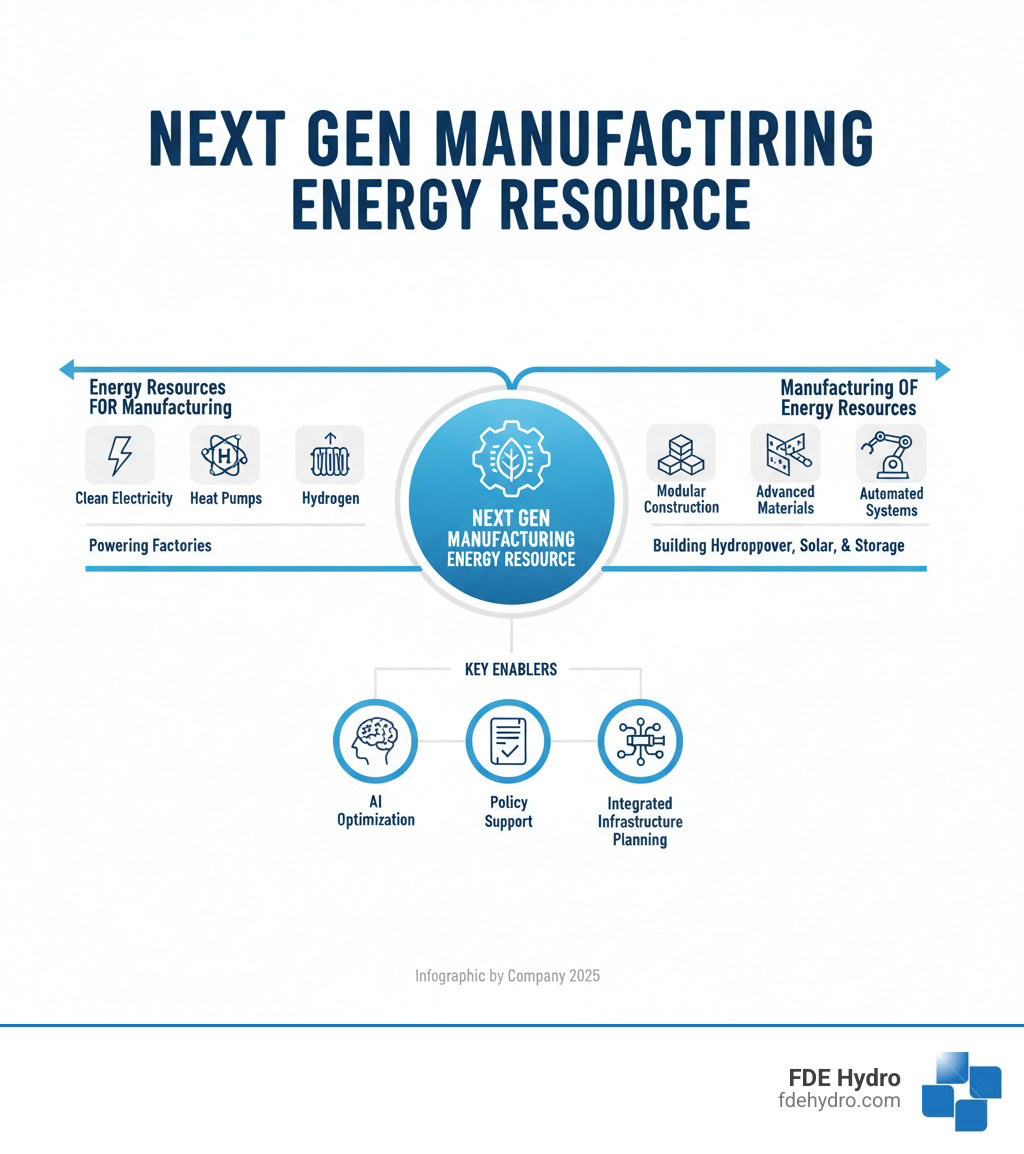
Next gen manufacturing energy resource describes two interconnected concepts: the clean energy sources fueling modern factories, and the cutting-edge manufacturing that produces our energy transition technologies. It spans from AI-optimized grids powering smart factories to the modular construction of new hydropower facilities.
Key Components of Next Gen Manufacturing Energy Resources:
- Clean Baseload Power: Nuclear (including SMRs), hydropower, and geothermal for 24/7 reliable electricity.
- Smart Grid Technologies: AI systems, digital twins, and real-time monitoring for energy optimization.
- Energy Storage Solutions: Batteries, pumped storage hydropower, and thermal storage to balance renewables.
- Advanced Manufacturing Processes: Modular construction, automation, and innovative materials to reduce cost and carbon.
- Integrated Infrastructure: Coordinated planning across electricity, hydrogen, and carbon management networks.
The urgency is clear. Projections show electricity demand surging due to industrial use, data centers, and electrification. Data center demand alone is expected to double by 2030. Meanwhile, the industrial sector accounts for 38% of greenhouse gas emissions, and manufacturing consumes 20% of all U.S. energy.
Why This Matters Now
Legacy energy infrastructure cannot meet these modern demands. Today’s manufacturing requires decentralized, adaptable, zero-emission generation. Companies face pressure to decarbonize and secure reliable, clean power for a competitive edge. This convergence means advanced manufacturing needs abundant clean electricity, while the energy sector needs advanced manufacturing to build its future—from modular hydropower to grid-scale batteries.
I’m Bill French, Sr., Founder and CEO of FDE Hydro. We’ve developed patented modular precast concrete technology that revolutionizes hydropower construction. It’s a cornerstone next gen manufacturing energy resource, delivering both the infrastructure and the clean power modern industry demands. With five decades in heavy civil construction and experience on the DOE’s Hydropower Vision Technology Task Force, I’ve seen how manufacturing innovation enables our energy transition.
The Shifting Energy Paradigm for Advanced Manufacturing
The old energy playbook—massive, centralized fossil-fuel plants—is becoming obsolete. We face a perfect storm of challenges: surging electricity demand from AI and electrification, the urgent need to decarbonize industrial operations, and geopolitical energy insecurity. Developing a comprehensive next gen manufacturing energy resource strategy is no longer optional; it’s essential for survival.
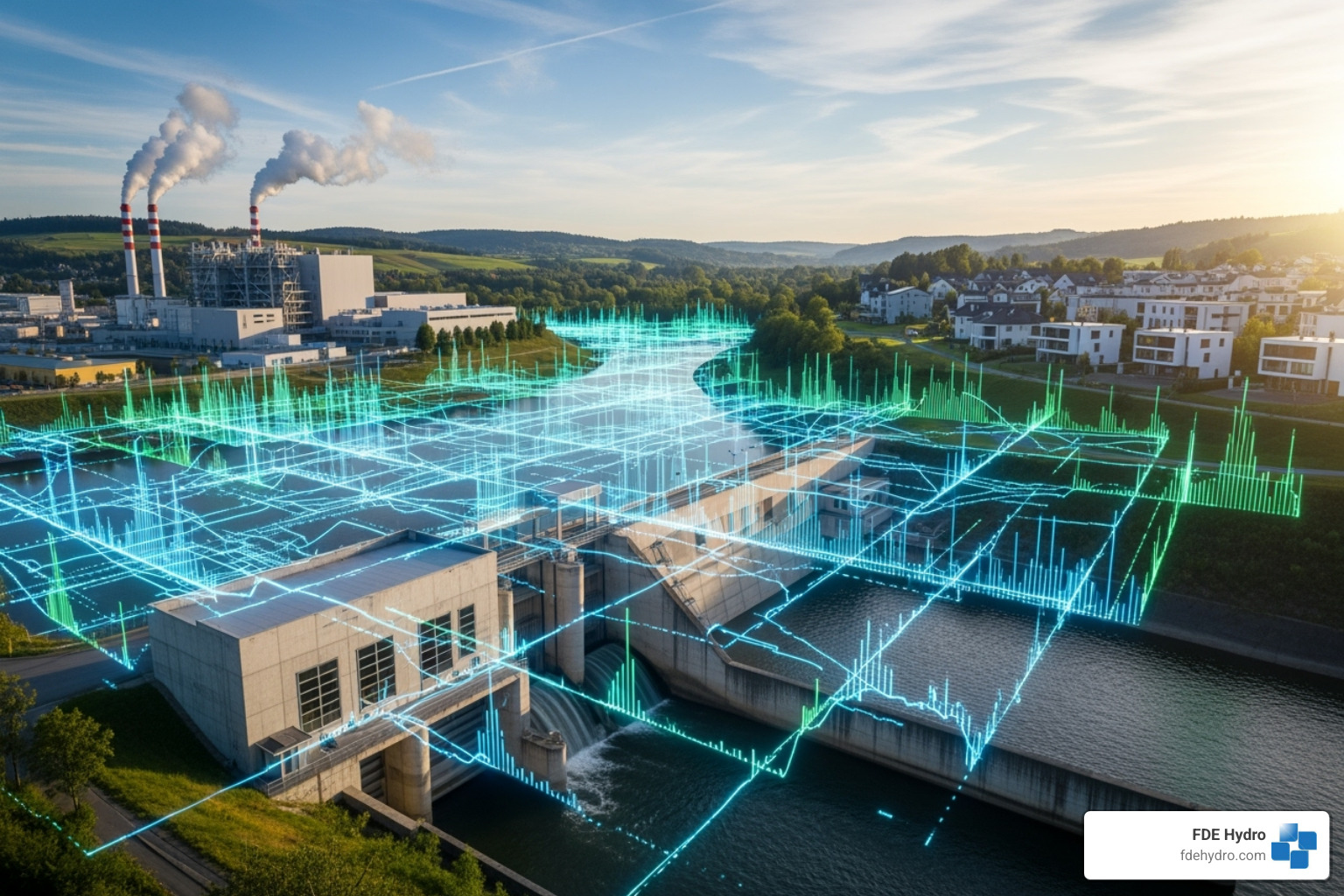
The shift is fundamental. We are moving from a one-way flow of power to a complex, distributed model with millions of energy sources like rooftop solar, wind farms, and battery systems. This introduces complexity our legacy infrastructure was never designed to handle. Without intelligent management, it’s like trying to run a digital economy on dial-up technology. For more on these concepts, we’ve put together more info about the basics of energy.
Why Today’s Grid Wasn’t Built for Tomorrow’s Industry
Our existing grid was engineered for centralized, one-directional power flow from large plants. It lacks the real-time visibility and dynamic control needed to manage thousands of distributed energy resources, from factory solar panels to electric vehicle fleets feeding power back to the grid.
This centralized model also created single points of failure, making it vulnerable to large-scale outages. Climate change exacerbates this with more frequent and severe weather events stressing aging infrastructure. Without fundamental upgrades, this system cannot support modern clean energy. We need grids that can see, think, and respond in real-time.
The Unprecedented Demand from AI and Electrification
Just as we’re trying to clean up our energy system, demand is exploding. Artificial intelligence is a primary driver. Data centers powering AI consumed roughly 500 terawatt-hours globally in 2023, with projections showing this demand could more than double by 2030. As the IEA notes, AI is set to drive surging electricity demand, reshaping energy markets.
Industrial electrification adds to this demand, as factories replace fossil-fuel processes with electric alternatives and EV manufacturing scales up. For example, Ontario expects industrial electricity use to jump 58% by 2035. This surge creates an immediate challenge: where will all this clean, reliable, 24/7 power come from?
You can’t run AI models or automated factories on intermittent power. A robust next gen manufacturing energy resource strategy, combining reliable baseload power like hydropower with smart technologies, is critical for economic competitiveness. The countries and companies that solve this energy equation will lead the next industrial revolution.
The Core Components of a Next Gen Manufacturing Energy Resource Strategy
No single energy source can do it all. A resilient energy future for manufacturing requires a diverse portfolio: a balanced mix of reliable baseload power, flexible renewables, and smart storage solutions. This ecosystem approach ensures grid stability and energy security, allowing factories to keep running even as conditions change.
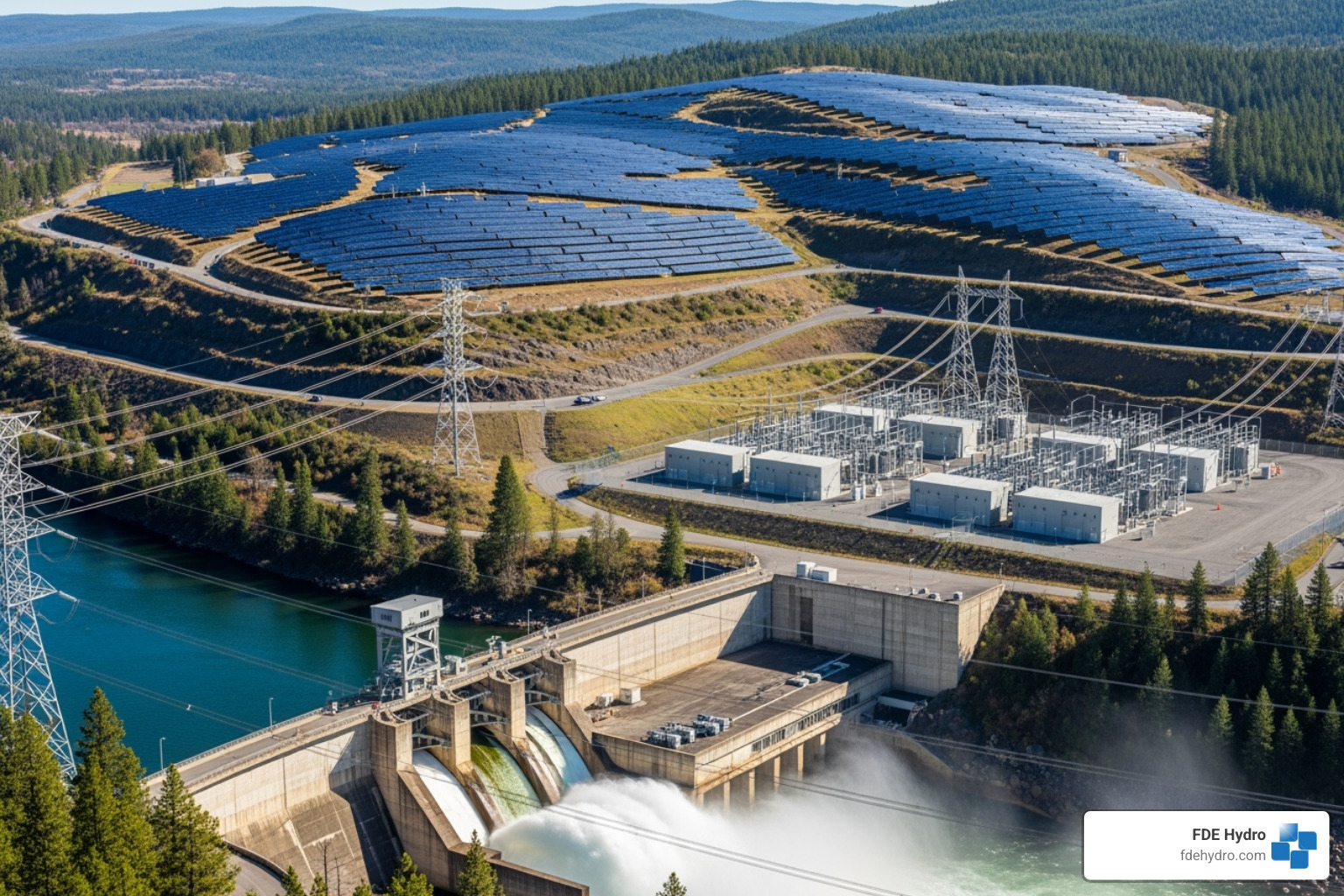
A comprehensive next gen manufacturing energy resource strategy must balance always-on baseload generation with intermittent renewables like solar and wind, all integrated with energy storage and smart grid technologies.
| Energy Source |
Power Type |
Land Footprint |
Grid Services |
| Hydropower |
Baseload/Flexible |
Moderate |
Frequency Regulation, Black Start, Load Following, Storage |
| Solar |
Intermittent |
Large |
Peak Shaving (with storage), Voltage Support (with inverters) |
| Battery Storage |
Flexible/Storage |
Small |
Arbitrage, Frequency Regulation, Capacity Firming |
Hydropower’s Guardian Role as a Next Gen Manufacturing Energy Resource
Hydropower is a cornerstone next gen manufacturing energy resource that modern grids cannot function without. It provides reliable, 24/7 baseload power, but unlike other sources, it is also incredibly flexible. Production can be ramped up or down in minutes to balance the grid when solar or wind power fluctuates.
Hydropower also delivers critical grid services like frequency regulation, black start capabilities (restarting a grid after a shutdown), and load following (tracking daily demand). At FDE Hydro, our patented modular precast concrete technology revolutionizes how hydropower facilities are built and retrofitted. Our approach dramatically cuts time and costs, making it feasible to upgrade existing dams and develop new low-impact sites. We’re building the infrastructure backbone that makes a renewable-heavy grid viable. Learn more about 4 Reasons Why Hydropower is the Guardian of the Grid.
The Role of Clean Fuels and Energy Storage as a Next Gen Manufacturing Energy Resource
If hydropower is the anchor, energy storage and clean fuels are the agile responders. Battery storage systems capture excess renewable energy and release it when needed, providing services like arbitrage, frequency regulation, and capacity firming to smooth out intermittency.
Pumped storage hydropower offers energy storage on a massive scale. It uses cheap, abundant electricity to pump water to a higher reservoir, then releases it through turbines to generate power during peak demand. It’s a giant, natural battery capable of storing huge amounts of energy for days. You can Learn about Pumped Storage Hydropower and its essential role in grid stability.
Green hydrogen, produced with renewable electricity, is another key component. It can power heavy industry, fuel transportation, and be stored for later conversion back to electricity. Together, these technologies provide the flexibility needed for a renewable-heavy grid, forming a comprehensive next gen manufacturing energy resource strategy.
Smart Systems: Leveraging AI and Digital Twins for Energy Efficiency
For an optimized next gen manufacturing energy resource strategy, artificial intelligence and digital twins are the brains of the operation. These Industry 4.0 technologies turn the massive amounts of data generated by factory floors into a competitive advantage.
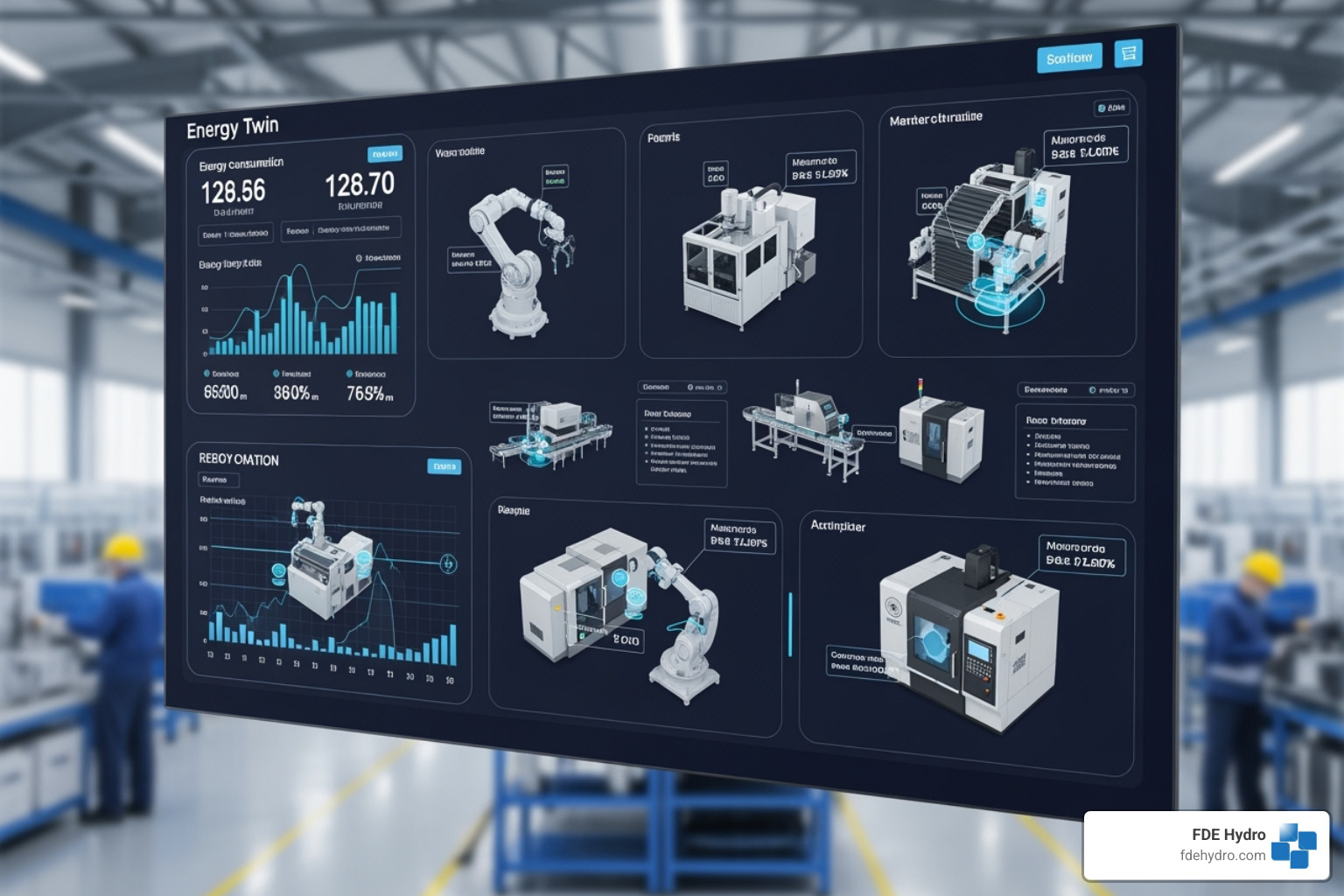
AI and Machine Learning (ML) process information to spot patterns, predict problems, and make real-time adjustments. They can monitor consumption, forecast needs, and optimize production schedules for maximum efficiency. For more detail, see this research on Leveraging AI for energy-efficient manufacturing systems. When combined with digital twins—virtual replicas of physical systems—you can test optimization ideas virtually, eliminating costly mistakes and energy waste before they happen.
AI-Powered Grid and Facility Management
AI is making the electricity grid smarter. Smart grids use AI to analyze data from millions of points, forecasting energy behavior and balancing the system automatically. This intelligence extends to industrial facilities through microgrids—localized energy networks that use AI to coordinate on-site energy sources (like solar, batteries, and hydropower) and optimize for cost and reliability.
Utilities also use platforms like ADMS and DERMS to manage distributed energy resources, ensuring grid stability. This enables demand-side flexibility, where factories can shift energy-intensive processes to times when clean power is abundant and cheaper—a win for both manufacturers and the grid.
The Energy Efficiency-Digital Twin (EE-DT) Framework
An Energy Efficiency-Digital Twin (EE-DT) is a complete virtual copy of your factory, updated in real-time by plant sensors. With AI, it becomes a powerful tool for managing your next gen manufacturing energy resource strategy.
The EE-DT allows you to run “what-if” scenarios without disrupting production. You can test new schedules to cut energy costs, simulate machine adjustments to save electricity, and use AI-powered predictive maintenance to identify potential failures before they waste energy and cause downtime. This virtual simulation lets you optimize every parameter for maximum efficiency and reduce waste before it occurs. This proactive approach, powered by AI and digital twins, is a fundamental shift in energy management for manufacturing.
Policy, Investment, and Building the Future
Changing our energy landscape requires collaboration between governments, industries, and communities. National roadmaps like the U.S. “National Blueprint for a Clean & Competitive Industrial Sector” are crucial because they promote integrated energy planning across electricity, hydrogen, and carbon management systems. A robust next gen manufacturing energy resource strategy depends on this holistic approach.
Public-private partnerships are key to tackling large-scale projects by pooling expertise and sharing risks. “Buy Clean” initiatives also drive change by creating government demand for low-carbon products, incentivizing sustainable manufacturing. Finally, this transition must include workforce development and community engagement, especially when Replacing aging infrastructure with next-gen solutions.
Government’s Role in De-Risking Innovation
Building the future is expensive and risky, especially for cutting-edge clean energy technologies. Government plays a critical role in reducing this risk for private investors. Strategic investments, such as those in the Bipartisan Infrastructure Law and the Inflation Reduction Act, provide funding and tax credits that make bold innovation financially viable.
Beyond funding, governments can remove bureaucratic bottlenecks by streamlining complex permitting processes. They can also create guaranteed demand through “Buy Clean” public procurement programs. These coordinated efforts make next gen manufacturing energy resource development attractive for private industry, accelerating the deployment of new technologies.
The Importance of Integrated Infrastructure
A new power plant is useless without transmission lines. Clean hydrogen is unhelpful without pipelines. This is why integrated infrastructure is fundamental to any next gen manufacturing energy resource strategy.
The electric grid needs expansion and modernization to connect new renewable sources to industrial centers and manage two-way power flow. The rise of clean fuels like hydrogen and the use of carbon capture require new pipeline and storage networks. The U.S. National Blueprint’s emphasis on “geographic industrial clusters” where generation, manufacturing, and carbon management are co-located is a smart approach to maximize efficiency.
At FDE Hydro, our work developing Modular Powerhouses for modern infrastructure directly supports this vision. Our modular technology builds hydropower facilities faster and more affordably, ensuring the physical infrastructure for reliable power generation keeps pace. A smart grid needs dependable power, and hydropower is an essential piece of the puzzle.
Frequently Asked Questions about Next Gen Manufacturing Energy Resources
What is the biggest challenge in transitioning to next-gen energy for manufacturing?
There are three interconnected challenges. First is modernizing the electrical grid to handle distributed, intermittent resources like solar and wind. Second is the high upfront capital cost of new clean energy technologies, which makes government incentives and public-private partnerships crucial. Third is building out the enabling infrastructure, such as new transmission lines, hydrogen pipelines, and carbon storage networks. Solving these requires an integrated approach.
How does AI improve energy efficiency in manufacturing?
AI acts as an efficiency detective for your factory. It analyzes massive datasets to spot energy-saving opportunities. Key functions include predicting energy consumption to adjust operations, optimizing production schedules to run intensive processes during off-peak hours, and controlling equipment in real-time for peak efficiency. AI also enables predictive maintenance, identifying failing equipment before it wastes energy and causes downtime. This makes AI an indispensable tool for any next gen manufacturing energy resource strategy.
What role does hydropower play in the next-gen energy mix?
Hydropower is the “guardian of the grid” because it provides the essential stability that makes a renewables-heavy system work. While solar and wind are intermittent, hydropower delivers reliable, 24/7 renewable energy. It is also dispatchable, meaning it can be ramped up or down instantly to balance fluctuations from other sources and maintain grid stability.
Pumped storage hydropower acts as a massive battery for the grid. It uses excess renewable energy to pump water to a higher reservoir, then releases it to generate power when demand is high. As one of the largest-scale and most proven storage technologies, it is critical for a resilient grid that next gen manufacturing energy resources demand. To learn more, you can Learn about Pumped Storage Hydropower.
Conclusion
The future of manufacturing is sustainable and intelligent. The next gen manufacturing energy resource strategies we’ve explored are the foundation for competitive, resilient industries.
Success requires an integrated approach where technology, policy, and investment align. Smart technologies like AI need reliable baseload power, and government incentives need deployable solutions. None of these pieces work in isolation.
At FDE Hydro, we focus on a crucial piece of this puzzle: making hydropower more accessible. Our patented modular precast concrete technology builds dams faster and more affordably. We ensure that this reliable, flexible, 24/7 renewable energy source—the guardian of the grid—can be built where it’s needed. When intermittent renewables are unavailable, hydropower keeps factories running and data centers humming.
The clean energy transition is our generation’s defining infrastructure challenge. Success depends on innovation in both what we build and how we build it. Advanced manufacturing enables our energy future, and advanced energy powers our manufacturing capabilities. We’re not just building infrastructure; we’re building opportunity for energy independence, good jobs, and a competitive, clean economy.
If you want to see how innovative construction methods are advancing renewable energy, we invite you to Explore the future of Hydropower with us. Let’s build this clean, interconnected future together.
by Bill French Sr. | Nov 21, 2025 | Energy Resource Articles
The Staggering Scale of Crypto’s Energy Appetite
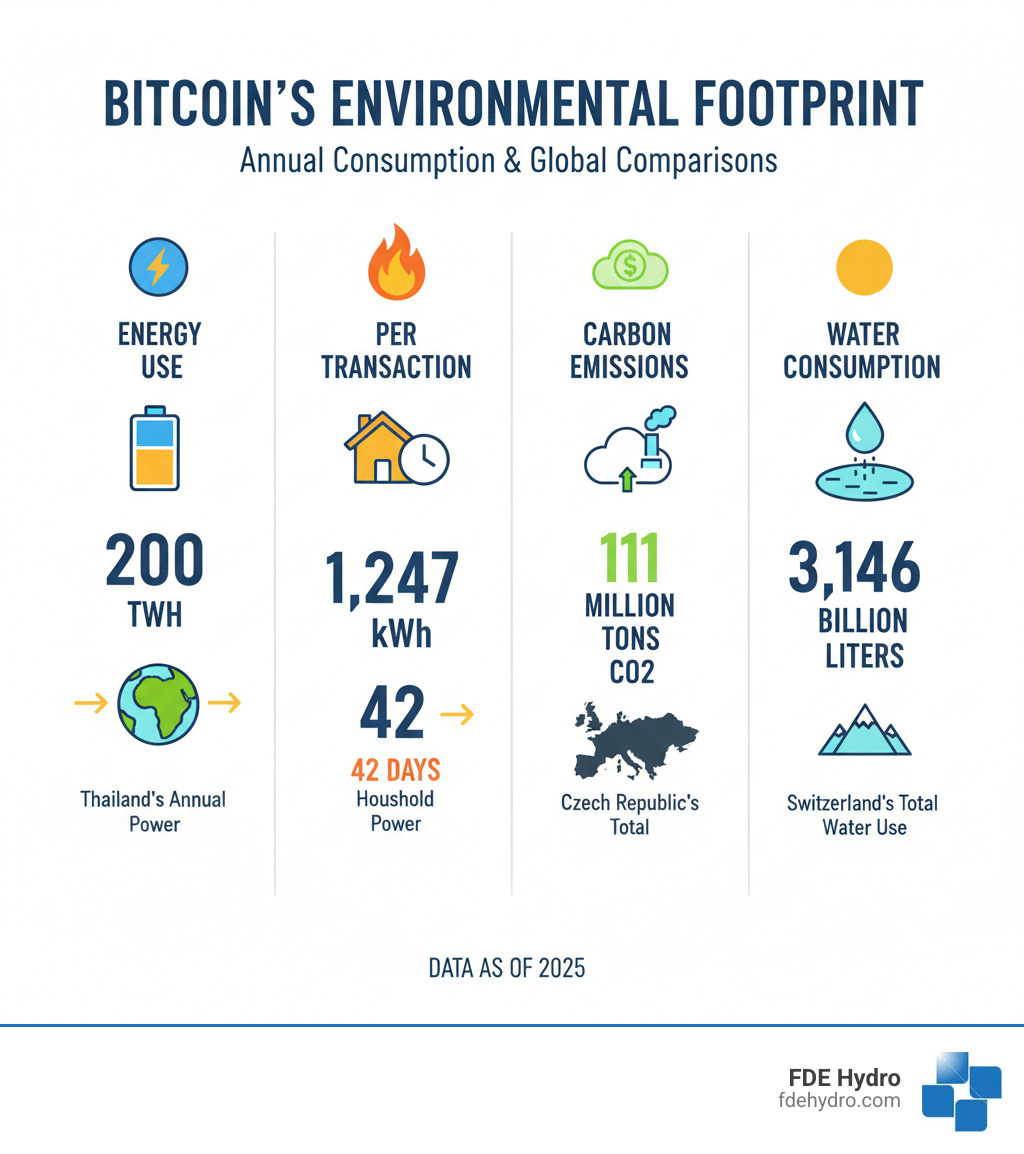
Crypto mining power consumption is a major environmental issue of the digital age. The cryptocurrency industry’s energy use is staggering:
- Annual Energy Use: Bitcoin alone consumes approximately 150-200 TWh of electricity per year—comparable to entire countries like Thailand or Poland.
- Per Transaction: A single Bitcoin transaction uses roughly 1,247 kWh, enough to power an average U.S. household for over 42 days.
- Carbon Footprint: The Bitcoin network generates an estimated 90-111 million tons of CO2 annually, similar to the Czech Republic’s total emissions.
- Water Consumption: Bitcoin mining uses approximately 3,146 billion liters of water per year for cooling and electricity generation.
- Growth Trend: Since the April 2024 halving event, the energy required to mine one Bitcoin has doubled from 407,000 kWh to 850,000 kWh.
One Bitcoin transaction carries the same carbon footprint as 1.5 million VISA transactions. As cryptocurrency adoption grows, so does the strain on electrical grids. In the United States, crypto mining now accounts for an estimated 0.6% to 2.3% of total electricity consumption—enough to power 3 to 6 million homes.
This massive demand creates an infrastructure challenge, affecting grid reliability and electricity prices. Policymakers from Texas to Kazakhstan are struggling to manage this growth without compromising power systems or climate goals.
The true environmental impact of crypto mining power consumption depends on factors like miner location, local power grid carbon intensity, and operational flexibility. Some miners use stranded renewable energy, while others rely on coal-heavy grids.
As Bill French Sr., Founder and CEO of FDE Hydro™, I’ve spent decades in energy infrastructure and was selected by the Department of Energy to help define next-generation hydropower. Understanding crypto mining power consumption is essential for developing the renewable energy systems needed to support our growing computational demands.
The Engine of Bitcoin: Why Proof of Work is So Power-Hungry
Bitcoin’s massive energy use stems from its Proof of Work (PoW) consensus mechanism. In this global, 24/7 competition, powerful computers race to solve complex mathematical puzzles. The winner adds the next block of transactions to the blockchain and earns a Bitcoin reward.

This computational race is what makes crypto mining power consumption so enormous. The computers perform “hashing”—repeatedly guessing a random number until they find the correct one.
The Bitcoin network automatically adjusts puzzle difficulty every two weeks to maintain a 10-minute average block time. As more powerful miners join, the puzzles get harder, creating an arms race for computational power. This system ensures security and decentralization at a high energy cost, as more competition means more electricity consumption.
The Soaring Energy Cost Per Coin
The electricity needed to mine one Bitcoin fluctuates with mining competition, which is heavily influenced by halving events. These events, occurring roughly every four years, cut the mining reward in half. The April 20, 2024, halving dropped the reward from 6.25 to 3.125 Bitcoin per block.
Consequently, the energy required to mine one Bitcoin jumped from about 407,000 kWh to 850,000 kWh, and the cost leaped from roughly $42,656 to $89,095.
This dynamic drives miners to use specialized hardware called ASICs (Application-Specific Integrated Circuits). While designed for efficiency, these machines consume huge amounts of power 24/7. Each new generation of ASICs pushes crypto mining power consumption higher as miners compete to remain profitable, as detailed in a recent study.
A single Bitcoin transaction uses approximately 1,247 kWh of electricity—enough to power an average U.S. home for over 42 days. Each transaction also generates about 696 kilograms of CO2, equivalent to the emissions from 1.5 million VISA transactions.
The difference stems from scalability limitations. The Bitcoin network is limited to about 7 transactions per second, whereas traditional systems like Visa process thousands. Visa’s entire global operation in 2019 used a fraction of Bitcoin’s energy while processing vastly more transactions.
Bitcoin’s block size limit and 10-minute confirmation time create a bottleneck. During network congestion, the energy cost per transaction soars, as the same massive power usage validates fewer transactions.
This is Bitcoin’s paradox: its security comes at a growing environmental cost. Understanding these dynamics is crucial for the future of digital finance and energy infrastructure.
The environmental impact of crypto mining power consumption goes beyond electricity bills to include carbon emissions, water use, and electronic waste. The true cost of Bitcoin extends far beyond the power meter.
The Scale of Crypto Mining Power Consumption
Bitcoin’s annual electricity consumption is around 199.63 TWh, more than nations like Finland and similar to Poland. This dedicates an entire country’s worth of power to a single digital currency network.
In the U.S., crypto mining consumes 0.6% to 2.3% of total electricity, enough for three to six million homes. In Canada, the world’s fourth-largest mining hub, operations have used about 4,048 gigawatt hours since early 2024, representing a 6.48% share of global production.
This demand challenges power grids in regions like New York, California, and Kansas, especially during peak periods. The Cambridge Bitcoin Electricity Consumption Index tracks these figures, while the International Energy Agency projects that crypto and data centers’ share of world electricity demand will grow from 2% in 2022 to 3.5% by 2026, straining infrastructure.
Beyond Energy: Carbon, Water, and E-Waste
Beyond electricity, the environmental impact is multifaceted. Bitcoin’s carbon footprint is 77 to 111.35 million tonnes of CO2 annually, comparable to the Czech Republic’s total emissions. The impact depends not just on how much energy is used, but its source. Miners on coal-powered grids have a much higher carbon intensity.
Water consumption is another significant factor. Bitcoin mining’s water footprint was around 1.5 billion liters in 2021, with some analyses suggesting 1,650 billion liters from 2020-2021. Bitcoin’s annual fresh water consumption is comparable to Switzerland’s total use—approximately 3,146 billion liters. This demand can strain local ecosystems, as detailed in research on Bitcoin’s water footprint.
Finally, the rapid obsolescence of hardware creates significant e-waste. The race for powerful mining equipment generates about 24.73 kilotonnes of electronic waste annually, similar to the small IT equipment waste of the Netherlands. These specialized rigs contain materials that require proper disposal, adding to the global e-waste problem.
The environmental footprint of crypto mining affects local power grids, water supplies, and waste management systems globally, with impacts that are still being fully measured.
The Challenges of Measuring Crypto Mining Power Consumption
Measuring crypto mining power consumption is remarkably tricky. The decentralized and opaque nature of mining operations makes accurate measurement a persistent challenge. Mining is scattered globally, with no central registry or reporting requirements, forcing researchers to rely on economic modeling and assumptions.
Estimates vary wildly based on assumptions about electricity prices and hardware efficiency, leading to discrepancies of hundreds of TWh. The dynamic nature of the market adds further difficulty. As new ASICs are released and network difficulty increases, the energy landscape constantly shifts. A paper on revisiting Bitcoin’s carbon footprint explores these complexities.
The Problem with Pinpointing Miner Locations
Geographic distribution is constantly shifting, and miners often keep locations private for security, regulatory, and economic reasons. For instance, the U.S. share of Bitcoin mining grew from 3.4% to 37.8% between 2020 and 2022 after China’s crackdown, but precise locations within states like New York or California remain unclear. The Cambridge mining map offers the best available data but has significant gaps.
Underground mining operations further obscure the data. Miner location is critical because it determines the carbon intensity of the electricity used. A farm using hydropower in Quebec has a far lower impact than one using coal in Kazakhstan. This geographic shifting makes tracking the network’s true carbon footprint incredibly challenging.
Why Accurate Estimates Are So Difficult
Even with location data, precise calculation is difficult. The methodology for energy estimation requires assumptions at every step. Researchers start with the public network hashrate but must estimate the hardware used, its efficiency, and electricity costs.
Each variable introduces uncertainty. Hardware efficiency varies widely: a new ASIC might use 30 watts per terahash, while an older model uses 100. Across millions of machines, this creates huge estimate divergences. Self-reported data is often incomplete, as mining companies have little incentive to disclose their full impact.
The constant fluctuation in network hashrate adds a final layer of complexity. As Bitcoin’s price and energy costs change, miners enter and exit the market, meaning crypto mining power consumption is not a static figure. Despite these challenges, researchers continue to refine their models. While perfect accuracy is elusive, current estimates are sufficient to grasp the scale of the problem and the need for sustainable solutions.
The Path to a Greener Ledger: Solutions and Alternatives
The environmental challenges of crypto mining power consumption are significant but not impossible. Progress is being made through cleaner energy, smarter operations, and better regulations. The solutions must be as innovative as the technology itself.
Tapping into Renewable Resources
Encouragingly, nearly 50% of Bitcoin mining already uses clean energy. Hydropower leads at 23.12%, followed by wind (13.98%), solar (4.98%), and other renewables (2.40%). This is where companies like FDE Hydro™ can make a difference by providing reliable, clean hydropower infrastructure.
However, challenges remain. The intermittent nature of solar and wind power clashes with the 24/7 demand of mining. When renewables are unavailable, miners may switch to fossil fuels, straining grids.
This challenge presents a unique opportunity. Miners are flexible electricity consumers who can act as “buyers of first resort” for new renewable projects, making them financially viable. They can also be “buyers of last resort” for surplus renewable power that the grid cannot absorb. Miners are increasingly locating near stranded energy assets, like underused power plants or flared methane gas, which helps balance grids and reduce emissions. Hydropower is crucial here, offering the reliability and dispatchability that wind and solar lack. This is why hydropower’s role in the energy grid is so critical for supporting modern computational demands. More details can be found in this research on renewable energy use in mining.
Industry-Led Initiatives for Sustainability
The crypto industry is also developing initiatives to reduce its footprint, from carbon mitigation to grid management. Carbon offsetting through credits or sequestration projects is a common practice. While sometimes criticized, verified offsetting projects can reduce net emissions during the transition to cleaner energy.
More promising is the growth of demand-response programs. Miners in Texas, New York, and California voluntarily reduce power use during peak demand, which is smart grid management. This helps prevent the use of carbon-intensive “peaker” plants and can avoid millions of tons of CO2 emissions.
Government regulations are also evolving, with incentives for renewables, carbon taxes, and greater transparency requirements to accelerate the transition to cleaner mining.
At FDE Hydro™, we believe the future of sustainable crypto mining power consumption combines clean energy infrastructure with smart operations. Our work on innovations in hydropower focuses on making reliable renewable energy more accessible, which is essential for powering the next generation of digital infrastructure responsibly.
Frequently Asked Questions about Crypto’s Environmental Impact
The term “digital gold” invites a comparison between the environmental impacts of Bitcoin and traditional gold mining. Traditional gold mining is a physical process involving heavy machinery, diesel fuel, and chemical extraction. The industry produces about 81 million metric tonnes of CO2 annually.
Bitcoin mining avoids direct land destruction, but its impact is still severe. Mining a single Bitcoin generates an estimated 678 tonnes of CO2, whereas mining the equivalent value in physical gold produces about 42 tonnes of CO2. Bitcoin’s carbon intensity per unit of value is currently far higher.
The impacts differ: gold mining causes direct land disruption and pollution, while Bitcoin’s impact stems from crypto mining power consumption, emissions, water use, and e-waste. Both are environmentally costly, as shown in data on resource extraction emissions.
Why is the Bitcoin network so slow if it uses so much power?
It’s a common question: if Bitcoin uses so much power, why isn’t it fast? The energy isn’t for speed; it’s for security and decentralization—Bitcoin’s original design goals.
Bitcoin is intentionally designed to add a new block every 10 minutes and process only about 7 transactions per second. This deliberate slowness, a result of the energy-intensive Proof of Work mechanism, is a trade-off that ensures the network is incredibly resistant to tampering and centralized control. Security and decentralization are prioritized over speed and scalability.
What are the future projections for crypto mining power consumption?
Predicting future crypto mining power consumption is complex, but several key forces will shape its trajectory.
- Future halving events will continue to force out inefficient miners and drive investment in more efficient hardware, though network difficulty adjustments often offset these gains.
- Hardware efficiency improvements are ongoing but approaching physical limits, meaning technology alone isn’t the solution.
- Competition from AI is creating a major new demand for energy. AI data centers may soon consume more power than Bitcoin mining, straining grids and increasing electricity costs.
- Regulatory pressures like carbon taxes and incentives for renewables will likely make fossil-fuel-powered mining economically unviable.
- Alternative consensus mechanisms like Proof of Stake (PoS) offer a path forward. Ethereum’s move to PoS cut its energy use by over 99.85%, proving less energy-intensive models are viable.
At FDE Hydro™, we believe the future requires a mix of solutions, including greater adoption of renewable energy sources like hydropower and continued innovation in both blockchain technology and clean energy infrastructure.
Conclusion: Powering the Future of Digital Finance Sustainably
As we’ve seen, crypto mining power consumption is a major global issue, with Bitcoin’s energy use rivaling that of entire countries. The network’s impact includes massive electricity use per transaction, significant carbon emissions, water strain, and growing electronic waste, affecting communities worldwide.
However, the story isn’t entirely negative. Nearly half of Bitcoin mining now uses renewable energy, and miners are helping balance power grids. Alternatives like Proof of Stake demonstrate that low-energy cryptocurrencies are possible, with Ethereum cutting its consumption by over 99%.
The path forward requires reliable, clean, 24/7 power. This is where hydropower excels. At FDE Hydro™, our patented modular technology makes building and retrofitting hydroelectric dams faster and more cost-effective. We deliver stable, emissions-free energy in North America, Brazil, and Europe to support both traditional and emerging computational demands.
Water is one of Earth’s most dependable renewable resources, offering the consistency that intermittent sources like wind and solar cannot always provide. Investing in proven, modern hydropower is key to ensuring digital finance can evolve without compromising our planet’s future.
The crypto industry must evolve sustainably. The tools—clean energy, grid integration, efficient hardware, and new consensus mechanisms—already exist. At FDE Hydro™, we are committed to being part of the solution. We believe digital innovation and environmental responsibility can coexist. By using water’s power through modern hydropower, we can help build a sustainable energy future. To learn more about how hydropower is shaping this future, explore the value of hydropower.
The question isn’t if we can power digital finance sustainably, but if we will.
by Bill French Sr. | Nov 20, 2025 | Energy Resource Articles
The Energy Crisis Hidden in Plain Sight: Understanding AI’s Massive Power Demands
AI energy resource consumption is rapidly becoming one of the most pressing infrastructure challenges of our time. Here’s what you need to know:
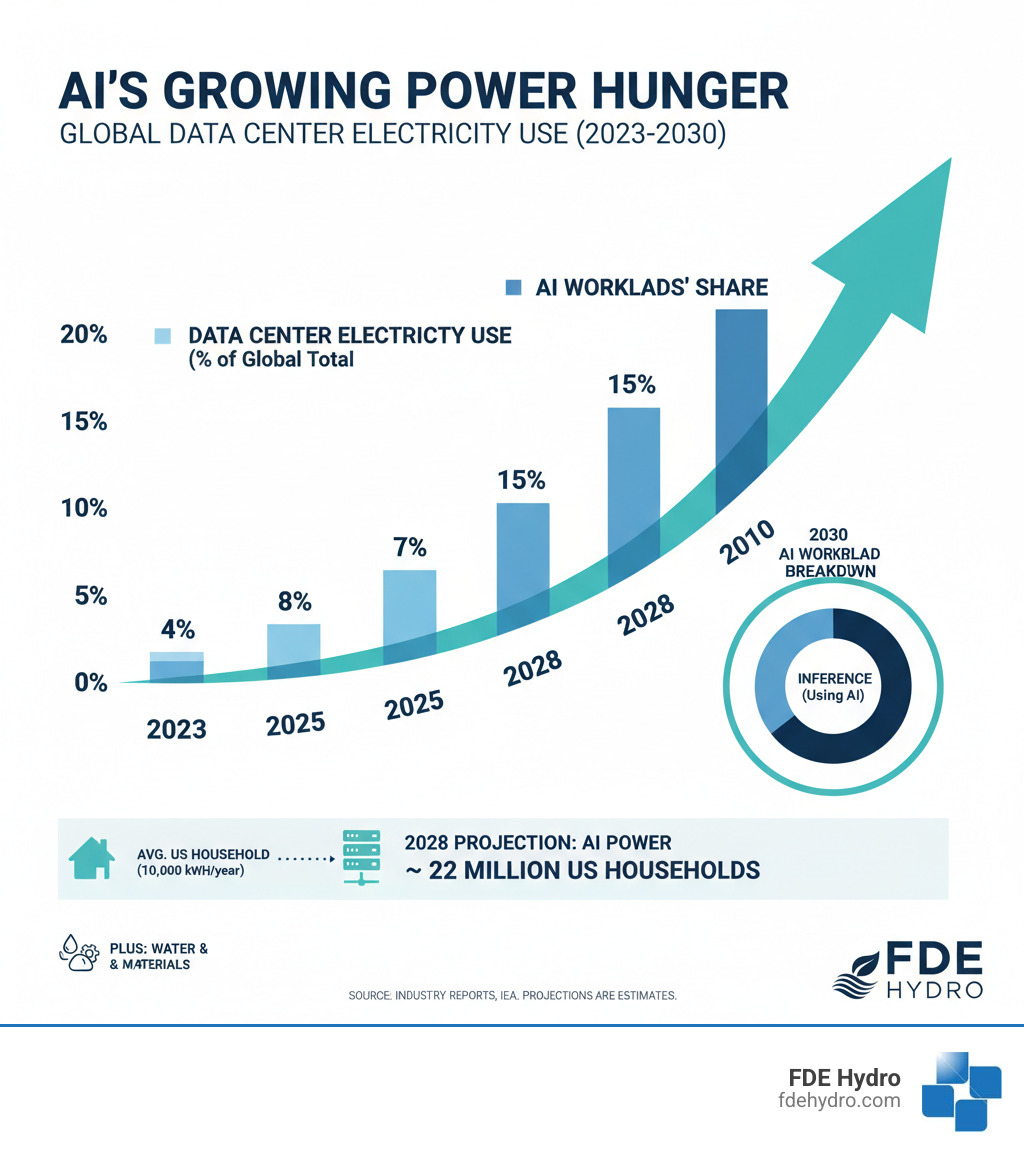
- Current Scale: Data centers consumed 4.4% of U.S. electricity in 2023, with AI workloads driving the majority of growth
- Projected Growth: By 2028, AI could consume as much electricity annually as 22% of all U.S. households
- Hidden Costs: Beyond electricity, AI infrastructure consumes millions of gallons of water and requires 800 kg of raw materials per 2 kg of computing hardware
- Transparency Gap: Most technology companies treat energy usage as a trade secret, making accurate measurement nearly impossible
- Global Impact: By 2030-2035, data centers could account for 20% of global electricity use
Two months after ChatGPT’s release in November 2022, it had reached 100 million active users. Suddenly, everyone was racing to deploy more generative AI. But behind every chatbot conversation, image generation, and AI-powered recommendation sits a massive, power-hungry infrastructure that most people never see.
The numbers are staggering. A single query through an AI chatbot consumes 10 times the electricity of a standard web search. Training large language models can consume 50 gigawatt-hours of energy—enough to power a major city for three days. And this is just the beginning.
The AI revolution isn’t just a software story. It’s fundamentally an energy infrastructure challenge. As AI becomes embedded in everything from smartphones to industrial operations, the question isn’t whether we can build the models—it’s whether we can power them sustainably.
This matters because the decisions we make today about AI energy resource planning will shape decades of infrastructure investment, electricity costs, and environmental impact. For those managing large-scale infrastructure projects, understanding this energy demand is critical to planning future capacity and ensuring reliable power delivery.
I’m Bill French Sr., Founder and CEO of FDE Hydro, where we’ve spent years developing modular hydropower solutions that deliver reliable, clean baseload power—exactly the kind of stable AI energy resource that data centers and AI infrastructure desperately need. After five decades building critical infrastructure and participating in the Department of Energy’s strategic planning for next-generation hydropower, I’ve seen how energy challenges can make or break technological progress.
AI energy resource helpful reading:
From Chatbots to Power Grids: Quantifying AI’s Voracious Energy Demand
Every time you ask an AI chatbot a question, you’re tapping into an energy infrastructure that rivals small cities. The numbers behind this technological revolution tell a story that most people never see—and it’s happening faster than anyone expected.
The International Energy Agency has been tracking this surge, and their projections are eye-opening. According to the IEA, data center electricity use will double by 2026, reaching 1,000 terawatt-hours. To put that in perspective, that’s roughly equivalent to Japan’s entire electricity consumption today.
This isn’t just about a few server rooms humming away in the background. We’re talking about a fundamental shift in how our electrical grids need to operate. The AI energy resource challenge is reshaping infrastructure planning from the ground up.
The Drivers of Consumption: Training vs. Inference
Here’s something that surprises most people: there are actually two very different ways AI consumes energy, and understanding the difference matters.
Training a model is like teaching someone a new skill from scratch. You’re feeding massive amounts of information into the system, running calculations millions of times over, adjusting and refining until the AI “learns” what you want it to do. This process is incredibly energy-intensive. Training a large language model can consume 50 gigawatt-hours of energy—enough to power a major city for three days straight.
But here’s the twist: once that training is done, the real energy drain is just beginning.
Inference is what happens when you actually use the AI—when it answers your question, generates an image, or writes that email for you. Each individual task might seem small, but we’re now doing billions of these tasks every single day. In fact, experts estimate that 80–90% of computing power for AI is now spent on inference, not training. The AI energy resource demand from inference alone is reshaping data center design.
The type of task makes a huge difference too. A single ChatGPT query consumes 10 times the electricity of a Google search. Text generation is actually the most efficient AI task. Image generation requires significantly more power. And video generation? That’s where things get truly demanding—generating just a 5-second video can consume around 3.4 million joules of energy.
Think about using AI throughout a typical day: 15 text queries, 10 image generations, and 3 short videos. That single day of AI use consumes about 2.9 kilowatt-hours of electricity. Now multiply that by millions of users worldwide, and you start to see the scale of the challenge.
A Staggering Scale: AI’s Consumption in Context
Let’s talk about what these numbers actually mean for our infrastructure.
In 2023, data centers consumed 4.4% of U.S. electricity. That’s already substantial, but what’s coming next is what keeps energy planners up at night. By 2028, that share could triple. AI alone could consume as much electricity annually as 22% of all U.S. households.
Here’s another way to think about it: data centers in the U.S. used somewhere around 200 terawatt-hours of electricity in 2024. That’s roughly what it takes to power Thailand for an entire year. Within those data centers, the AI-specific servers consumed between 53 and 76 terawatt-hours.
The projections for 2028 are even more striking. Power dedicated to AI-specific purposes in the U.S. could rise to between 165 and 326 terawatt-hours per year. We’re not talking about modest growth—this is exponential expansion happening in real time.
This rapid change of data infrastructure into a massive power challenge demands immediate attention and smart solutions. The question isn’t whether AI will continue growing—it’s whether our energy infrastructure can keep pace sustainably.
That’s where reliable, clean AI energy resource solutions become critical. The technology sector needs baseload power that’s available 24/7, not intermittent sources that fluctuate with weather conditions. This is exactly the kind of infrastructure challenge that modular hydropower was designed to solve.

When we talk about AI’s environmental impact, electricity usually takes center stage. But here’s the thing: electricity is just the tip of the iceberg. Behind every AI query lies a complex infrastructure with a footprint that extends far beyond the power meter. We’re talking about massive water consumption, mountains of electronic waste, and the mining of rare earth minerals from some of the most fragile ecosystems on Earth.
These hidden costs matter tremendously when we’re planning sustainable AI energy resource infrastructure. They affect communities, ecosystems, and the long-term viability of AI itself. Let’s pull back the curtain and look at what’s really happening.
The Thirst for Data: AI’s Shocking Water Usage
Here’s something most people don’t realize: data centers are essentially giant heat generators that need constant cooling. And cooling at this scale? It requires an enormous amount of water.
The numbers tell a startling story. Google’s data centers used 20 percent more water in 2022 than in 2021. Microsoft saw an even steeper jump—their water consumption rose by 34 percent in the same period. These aren’t small increases. We’re talking about millions upon millions of gallons.
Looking ahead, the projections are even more concerning. According to research, AI infrastructure may soon consume six times more water than Denmark—a country of 6 million people. Think about that for a moment. The cooling systems for our AI tools could rival the entire water needs of a nation.
This creates real problems for real people. In communities across the country, data centers compete directly with local water needs. Agriculture suffers. Drinking water supplies get strained. Natural ecosystems that depend on consistent water levels face disruption. Take The Dalles, Oregon, as an example—a town that’s seen how data center water demands can strain local resources and spark community tension.
The location of data centers and the cooling technologies they use aren’t just technical decisions. They’re choices that ripple through entire communities and ecosystems. When we plan AI energy resource infrastructure, we need to think about water just as carefully as we think about watts.
From Mine to Landfill: The Hardware Lifecycle
The environmental story of AI starts long before any model gets trained. It begins in mines around the world, where rare earth minerals are extracted—often at tremendous environmental and social cost.
Here’s a sobering fact: making a 2 kg computer requires 800 kg of raw materials. That’s right—for every two kilograms of hardware sitting in a data center, 800 kilograms of earth had to be moved, processed, and refined. The ratio is almost unbelievable, but it reflects the complex manufacturing process and the diverse materials needed for modern computing equipment.
These materials include rare earth elements whose mining can devastate landscapes, contaminate water supplies, and create serious human rights concerns in mining communities. The extraction process itself is energy-intensive and often involves hazardous chemicals.
But the environmental burden doesn’t end once the hardware is built. AI technology advances so rapidly that servers and processors become obsolete quickly. This creates a growing mountain of electronic waste—or e-waste—that contains mercury, lead, cadmium, and other hazardous substances. When not properly recycled, these toxins leach into soil and groundwater, creating long-term environmental hazards.
The full lifecycle impact of AI hardware—from extraction to manufacturing, through years of energy-hungry operation, to eventual disposal—represents a substantial environmental burden. More on the e-waste crisis reveals just how serious this challenge has become.
When we develop comprehensive AI energy resource strategies, we can’t focus solely on operational electricity. We need to account for the carbon emissions from manufacturing, the water consumed in production and cooling, and the waste generated at every stage. Only by seeing the complete picture can we build truly sustainable AI infrastructure.
The Transparency Void: Why We Can’t Accurately Measure AI’s Impact
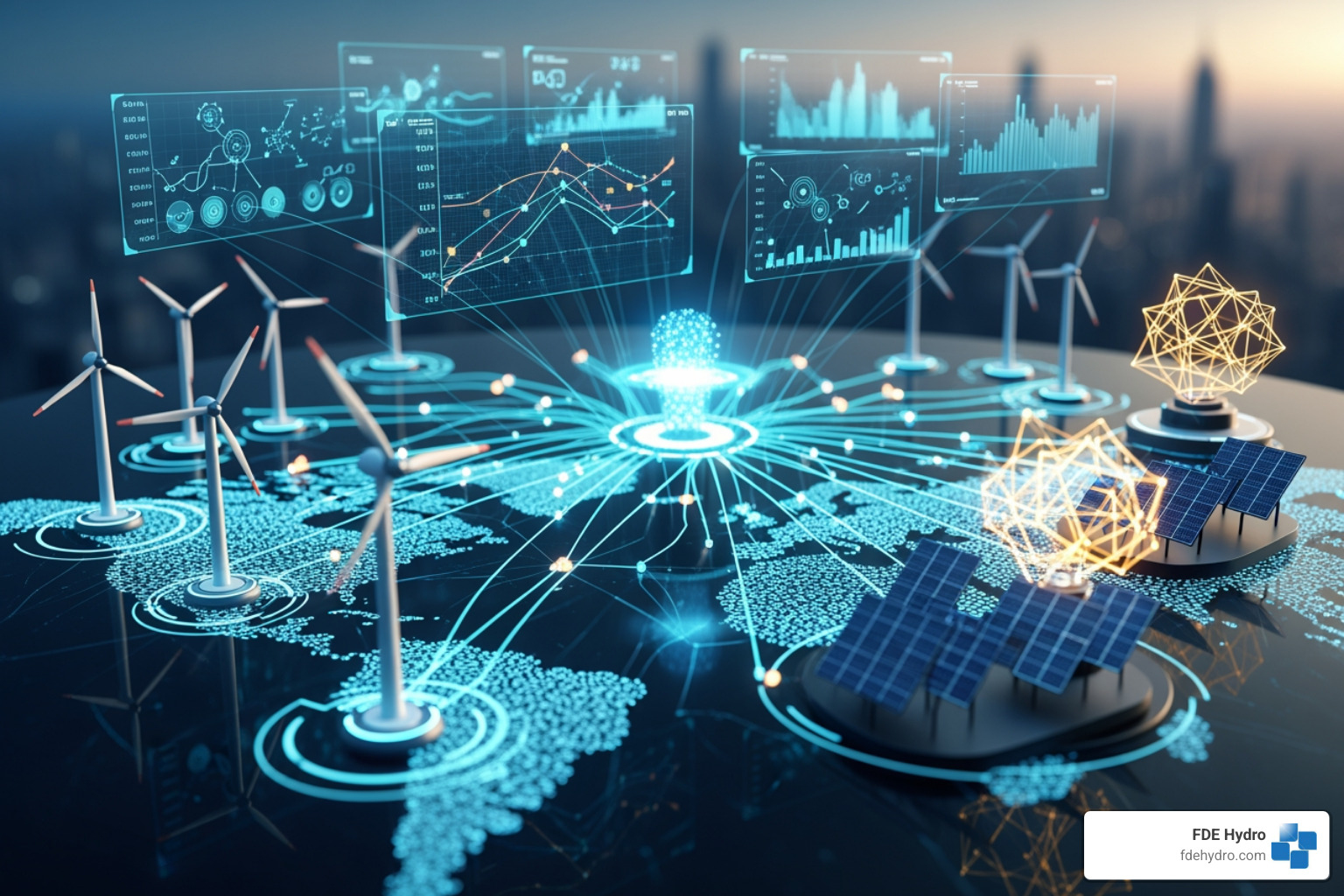
Here’s the uncomfortable truth: we don’t really know how much energy AI is using. Not precisely, anyway. And that’s a serious problem when we’re trying to plan for the future of our AI energy resource infrastructure.
It’s like trying to budget for a household where half the family refuses to tell you what they’re spending. You can see the credit card bill climbing, but you can’t pinpoint where the money’s actually going.
The Problem with “Hearsay” Numbers
Most technology companies treat their energy usage data like a closely guarded secret. They’ll cite competitive concerns or proprietary information, but the result is the same: researchers and infrastructure planners are left in the dark. This forces scientists to reverse-engineer estimates based on limited information, leading to what one group of researchers aptly called “hearsay numbers.” A 2022 paper highlights the difficulty for data scientists in accessing GHG impact measurements.
Even when we can analyze open-source models, measuring the full power draw is remarkably complex. We might know how much energy the specialized processors consume, but what about the central processing units? The cooling systems? The memory modules? All the auxiliary equipment that keeps these systems running?
Microsoft research on approximating total power draw suggests that doubling the graphics processor energy consumption can give us a rough approximation of total power draw for inference tasks. But it’s still just that—a rough approximation, not a precise measurement.
Initiatives like the AI Energy Score are trying to rate models on energy efficiency, which is a step in the right direction. But their effectiveness is severely limited when closed-source companies simply choose not to participate. Without mandatory reporting standards, these voluntary efforts can only accomplish so much.
The Need for Greater Transparency
The lack of disclosure creates real challenges for anyone trying to plan reliable AI energy resource infrastructure. Most companies running data centers won’t reveal what percentage of their energy actually goes toward processing AI workloads. Google stands out as a rare exception, acknowledging that machine learning accounts for somewhat less than 15 percent of its data centers’ energy use. But this level of openness is the exception, not the rule.
The situation gets even murkier when we consider carbon intensity. A data center powered by renewable hydropower has a vastly different environmental impact than one running on coal-fired electricity. Yet without transparency about the energy mix powering these facilities, we can’t accurately assess the carbon emissions associated with AI.
We’ve observed that the carbon intensity of electricity used by data centers was 48% higher than the U.S. average. That’s a significant difference, and it matters enormously for environmental planning. Data centers tend to locate in regions with abundant, cheaper power—but that power frequently comes from grids heavily reliant on fossil fuels.
This is why we urgently need standardized reporting mechanisms. Not voluntary guidelines that companies can ignore, but mandated transparency requirements that give infrastructure planners, policymakers, and the public the information they need to make informed decisions about our energy future. Without this transparency, we’re essentially building critical infrastructure in the dark, hoping our estimates are close enough. That’s not a strategy—it’s a gamble.
Taming the Beast: Can We Make AI a Sustainable AI Energy Resource?
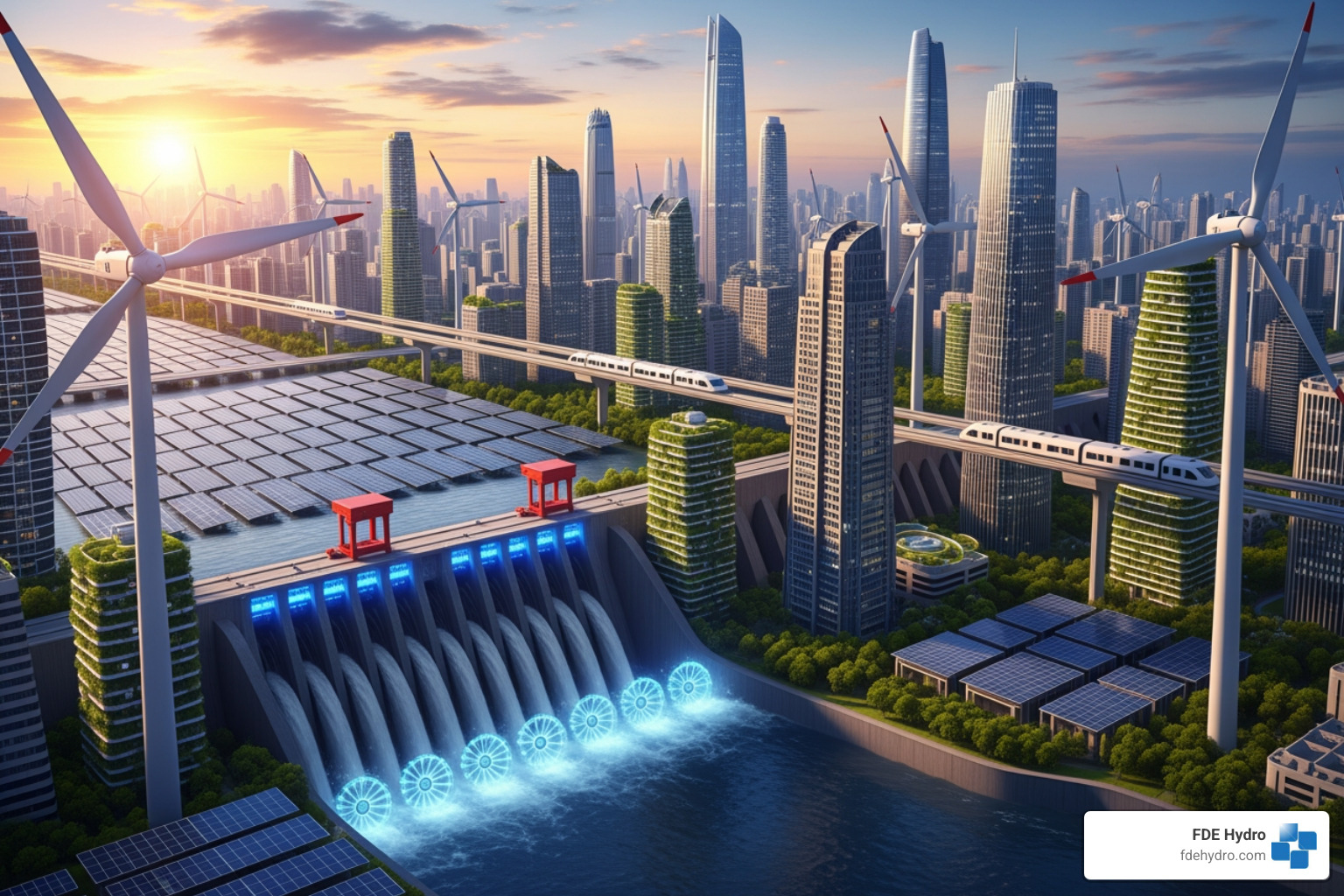
The energy challenge facing AI is massive, but it’s not impossible. I’ve spent decades working on infrastructure projects, and I’ve learned that the biggest challenges often have practical, achievable solutions. The key is approaching them strategically, with the right tools and technologies.
Making AI sustainable requires us to think bigger than just plugging data centers into cleaner power sources. It demands a fundamental shift in how we design, power, and operate the infrastructure that makes AI possible.
The path to sustainable AI runs through multiple interconnected strategies. Researchers and engineers are developing more efficient algorithms that can perform the same tasks while consuming less energy. This means smarter code that doesn’t waste computing power on unnecessary calculations. At the same time, we’re seeing innovations in hardware design that allow processors to do more work per watt of electricity consumed.
Data center design itself is evolving rapidly. Modern facilities are implementing advanced cooling technologies that reduce or eliminate water consumption, optimizing how servers are used to minimize idle energy waste, and even capturing waste heat for other productive uses. These improvements can dramatically reduce the environmental footprint of AI operations.
Interestingly, AI can also be part of the solution to our broader energy challenges. When properly deployed, AI can optimize power grids, predict energy demand with remarkable accuracy, and manage distributed energy resources more effectively than traditional systems. AI is being used to map destructive dredging and even to help reduce contrails from aircraft. The technology that’s creating our energy challenge can also help us solve it.
But here’s where we need to be careful. There’s a phenomenon called the Jevons paradox: when technology becomes more efficient, we often end up using more of it, not less. If AI becomes incredibly efficient and cheap to run, companies might simply deploy it more widely, potentially canceling out the efficiency gains. This means efficiency alone isn’t enough—we need sustainable energy sources powering these systems from the start.
The Renewable Revolution: Powering the Future AI Energy Resource
Here’s the fundamental challenge: data centers need power 24 hours a day, 7 days a week, 365 days a year. There are no breaks, no downtime, no “we’ll wait until the sun comes out” periods. This creates a unique problem for renewable energy planning.
Solar panels don’t generate electricity at night. Wind turbines sit idle when the air is still. These are excellent technologies, but they can’t single-handedly meet the constant, unwavering power demands of AI infrastructure. What we need is stable, baseload renewable energy that can deliver consistent power around the clock.
This is where hydropower becomes absolutely critical. Unlike intermittent renewables, hydropower provides continuous, dispatchable power that can respond instantly to changing grid demands. It’s the kind of reliable, clean energy that AI energy resource planning desperately needs.
At FDE Hydro, we’ve developed microgrid solutions using our modular French Dam technology that can deliver this exact kind of stable, renewable power. Our precast concrete systems dramatically reduce the cost and construction time for hydroelectric facilities, making clean baseload power more accessible exactly when we need it most.
Think of hydropower as the anchor that allows other renewables to flourish. When solar and wind are producing, great—use that power. But when they’re not, hydropower fills the gap, ensuring the lights stay on and the servers keep running. This isn’t just theory; it’s why we call hydropower the guardian of the grid. For more on this concept, check out our article on 4 Reasons Why Hydropower is the Guardian of the Grid.
As AI continues to expand, the companies and regions that will succeed are those that plan now for reliable, clean energy infrastructure. The technology exists. The question is whether we’ll deploy it quickly enough to meet the coming demand without compromising our environmental commitments.
Regulation and Rate Hikes: The Coming Reckoning for AI’s Growth

For years, AI development has operated in something of a wild west—innovate fast, worry about the consequences later. But that era is ending. Policymakers around the world are waking up to the reality that AI’s explosive growth comes with serious environmental and economic trade-offs. The question isn’t whether regulation is coming; it’s what form it will take and how quickly it will reshape the AI energy resource landscape.
The Dawn of Regulation
Europe is leading the charge. The EU has approved legislation to temper AI’s environmental impact, marking one of the first comprehensive attempts to hold AI development accountable for its environmental footprint. This isn’t just symbolic—it’s a blueprint that other regions are watching closely.
Here in the United States, we’re seeing similar momentum. The AI Environmental Impacts Bill, currently working its way through Congress, would require federal agencies to assess and publicly report on AI’s energy consumption and environmental effects. It’s an important first step toward transparency in an industry that has historically guarded its energy data like state secrets.
Meanwhile, international standards organizations aren’t sitting idle. The International Organization for Standardization (ISO) is developing criteria for what they’re calling “sustainable AI.” These standards will establish benchmarks for measuring energy efficiency, raw material consumption, and water usage across the AI lifecycle. While some of these initiatives start as non-binding recommendations, they create frameworks that often become industry expectations—and eventually, requirements.
The regulatory landscape is shifting from voluntary best practices to mandatory accountability. Companies that plan ahead for these changes will have a significant advantage over those caught flat-footed.
Here’s where things get personal for everyday consumers. The billions being invested in AI infrastructure don’t exist in a vacuum. Someone has to pay for the massive expansion of our electricity grid, and that someone might be you.
Utility companies are negotiating major agreements with technology companies to deliver the staggering amounts of power their data centers demand. But building new generation capacity and upgrading transmission infrastructure costs money—a lot of it. Those costs typically get passed along to ratepayers. A Virginia report estimates potential monthly cost increases for residents as data centers continue their rapid expansion in the state. Virginia isn’t unique; any region experiencing data center growth faces similar pressures.
The financial impact goes beyond your monthly electric bill, though. We need to consider what researchers call “higher-order effects”—the ripple consequences of widespread AI deployment. Take autonomous vehicles, for instance. While self-driving cars might be more efficient individually, some experts worry they could make driving so convenient that people drive more overall, actually increasing total emissions. It’s the kind of unintended consequence that’s hard to predict but important to consider.
There’s also the troubling potential for AI-generated misinformation to undermine climate action. When AI systems can produce convincing but false information about environmental challenges, it becomes harder to build the public consensus needed for meaningful change. These broader societal impacts don’t show up on energy meters, but they’re part of the true cost of our AI future.
The reality is that AI’s growth trajectory is bumping up against hard limits—both environmental and economic. How we steer this tension between innovation and sustainability will define not just the future of AI, but the future of our energy infrastructure and the costs we all bear for it.
Conclusion: Powering the Future of Intelligence, Responsibly
We stand at a crossroads. AI isn’t just another technology trend—it’s a fundamental shift in how we live, work, and solve problems. But here’s the thing: this revolution runs on electricity, water, and raw materials at a scale most of us never imagined.
The numbers we’ve explored aren’t just statistics. They represent real decisions happening right now about our energy future. Every data center that breaks ground, every AI model that gets deployed, every query that gets processed—these are shaping decades of infrastructure investment and environmental impact.
But here’s what gives me hope after five decades in infrastructure: AI energy resource challenges aren’t impossible. We’ve faced big infrastructure problems before, and we’ve solved them. The difference this time is urgency. We don’t have the luxury of waiting decades to get this right.
The solution isn’t to slow down AI development. That ship has sailed, and frankly, we need AI’s capabilities to tackle climate change, optimize resource use, and solve problems we haven’t even identified yet. The real challenge is making sure we power this revolution responsibly.
This means demanding transparency from tech companies about their energy and water usage. It means investing in efficiency at every level—smarter algorithms, better hardware, more efficient data centers. And critically, it means choosing the right energy sources to power this future.
This is where stable, clean, baseload power becomes non-negotiable. Solar and wind are important pieces of the puzzle, but data centers need power that flows 24/7, regardless of weather or time of day. They need the kind of reliable, dispatchable energy that hydropower delivers.
At FDE Hydro, we’ve spent years developing modular precast concrete technology that makes hydroelectric infrastructure faster and more affordable to build. We’re not just selling equipment—we’re providing a crucial piece of the AI energy resource puzzle. Our “French Dam” technology offers exactly the kind of stable, clean power that AI infrastructure demands.
The future of AI and the future of energy aren’t separate conversations. They’re the same conversation. As we push the boundaries of what machines can do, we need to be equally innovative about how we power them. The Biggest Untapped Solution to Climate Change is in the Water, and it’s ready to help us build a smarter, more sustainable world.
The choices we make today about AI’s energy infrastructure will echo for generations. Let’s make sure we get them right.
Learn more about the power of Hydropower.

