by Bill French Sr. | Dec 22, 2025 | Hydro Facility Articles
Why Hydropower Asset Management is Critical for Long-Term Success
Hydropower asset management is a strategic approach to maintaining, operating, and optimizing hydroelectric facilities for maximum reliability, performance, and value over their lifecycle. Here’s what it involves:
Key Components of Hydropower Asset Management:
- Condition Assessment – Regular evaluation of equipment health using routine O&M data and specialized testing
- Risk-Based Prioritization – Ranking investments by likelihood and consequence of failure
- Data-Driven Decisions – Using CMMS/EAMS systems to track performance and predict maintenance needs
- Strategic Planning – Aligning maintenance budgets with long-term capital improvement goals
- Performance Optimization – Extending asset life while maximizing generation output and revenue
The stakes are high: most critical equipment in North American hydroelectric facilities is near or beyond its design life. For example, the average generator step-up transformer is over 34 years old. However, with robust asset management, hydropower facilities can operate for over 100 years—far longer than other generation technologies.
Many operators have data, but it’s often compartmentalized, incomplete, or low-quality, hindering good decisions. As equipment ages and regulations evolve, a lack of a comprehensive asset management approach leads to a reactive cycle of addressing failures instead of preventing them.
Hydropower’s role is more critical than ever in the energy transition. Its dispatchability and operational flexibility are essential for integrating intermittent renewables like wind and solar. To secure this role, operators must view asset management as a value creation tool, not just a cost center.
This requires moving from simple schedules to strategic programs using condition assessments, risk analysis, and economic modeling. It involves using frameworks like the Hydropower Asset Management Partnership (hydroAMP) and justifying improvements with data-driven insights on risk and opportunity, not just age.
I’m Bill French Sr., Founder and CEO of FDE Hydro™, and I’ve spent decades in civil construction and hydropower innovation, including serving on the Department of Energy’s Hydro Power Vision Technology Task Force. Through this experience, I’ve seen how strategic hydropower asset management transforms facilities from aging liabilities into competitive, resilient assets that support the clean energy transition.
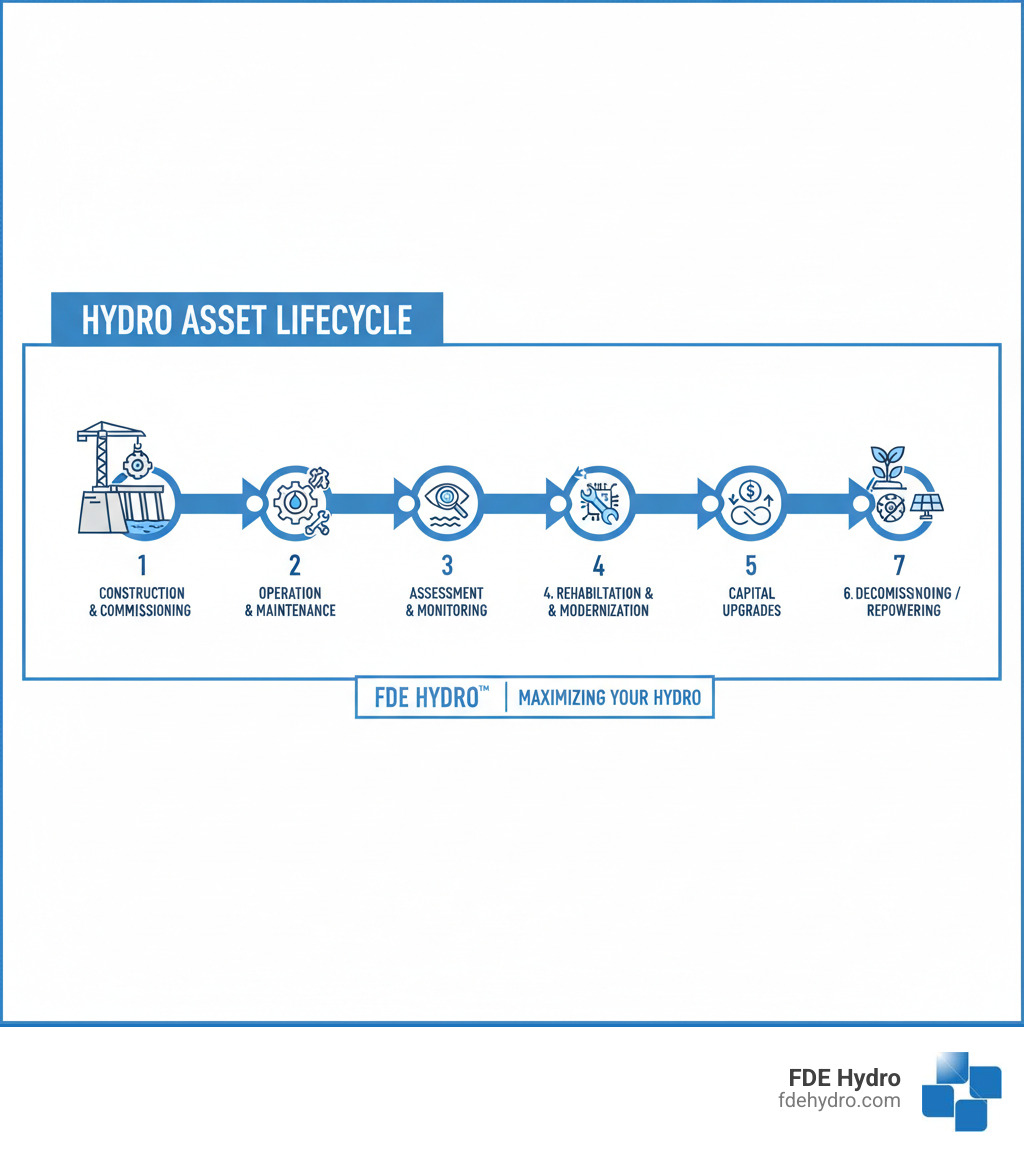
Hydropower asset management terms simplified:
The Core Components of a Resilient Hydropower Program
Aging infrastructure doesn’t mean declining performance. With strategic hydropower asset management, facilities can operate reliably and profitably for decades past their design life by moving from reactive to proactive management.
A resilient program builds organizational resilience—the ability to adapt to failures, market changes, or regulatory shifts. This requires integrating five key elements: program development, capital improvement planning, information solutions, operational performance monitoring, and condition assessment.
Program development establishes the framework for all asset-related decisions. The ISO 55000 series (ISO 55000, 55001, and 55002) offers a proven roadmap for building these systems, connecting leadership strategy with daily operations.
Capital Improvement Planning (CIP) turns the framework into action, optimizing the timing and sequence of investments to maximize value and manage risk.
Information solutions like a CMMS (Computerized Maintenance Management System) or EAMS (Enterprise Asset Management System) act as the program’s central nervous system, turning scattered data into actionable insights.
Operational performance tracking ensures assets deliver required reliability and output. Condition assessment provides the diagnostic data to determine when intervention is necessary or can be deferred.
When these components work together, they create a system that drives reliability and performance across the portfolio. More info about Hydropower Project Costs
Primary Objectives of Asset Management
Hydropower asset management is a means to achieve specific, measurable outcomes that impact your bottom line and operational success.
Operational excellence means facilities run smoothly and efficiently. It streamlines workflows, allowing teams to focus on optimizing performance and making maintenance strategic, not chaotic.
Minimizing downtime is a tangible benefit. A good program identifies potential failures early, allowing maintenance to be scheduled during low-value periods to avoid lost revenue and penalties from unplanned outages.
Risk reduction encompasses safety, environmental, and regulatory risks. Systematically addressing these risks protects personnel, profits, and compliance.
Cost-control is about finding the balance between under-maintaining (costly failures) and over-maintaining (wasted resources). The goal is the lowest lifecycle cost, not the lowest immediate expense.
Extending asset lifespan is critical for aging equipment. Strategic refurbishments and replacements can keep facilities productive for decades, with well-managed plants often operating for over 100 years.
Resource allocation ensures limited capital, personnel, and time are directed where they create the most value, with decisions based on data, not intuition.
Defining and Prioritizing Critical Assets
Not all assets deserve equal attention. Some failures are minor inconveniences; others can shut down an entire operation. Hydropower asset management is about knowing the difference and prioritizing accordingly.
This requires a system-level understanding of how components interact. A facility is an integrated system where one failure can cascade. For example, a small bearing failure could destroy a multi-million dollar turbine.
Criticality analysis combines failure likelihood with its consequences. A worn gasket is a low-consequence failure. In contrast, a generator step-up transformer failure can cause extended outages and catastrophic revenue loss, especially with procurement times of 18 months or more.
Failure probability assessment considers age, condition, maintenance history, and operating environment to help anticipate problems.
The consequence of failure evaluation considers lost revenue, repair costs, safety, environmental risks, and regulatory penalties, as well as spare part availability and lead times.
Combining these factors creates a risk profile for each asset, allowing you to rank assets and focus budgets on the components that matter most.
This isn’t about ignoring low-priority assets. It’s about ensuring that when your GSU transformer shows signs of degradation, you’re already planning for replacement rather than finding the problem during a catastrophic failure. More info about Hydroelectric Dam Components
Data-Driven Decisions: From Assessment to Action
The real challenge of hydropower asset management isn’t collecting data, but turning it into clear decisions and making it work for you.
Most facilities have decades of data in maintenance logs, reports, and records. The problem is that this data is often scattered, inconsistent, incomplete, and unreliable.
Modern information systems like Computerized Maintenance Management Systems (CMMS) and Enterprise Asset Management Systems (EAMS) are the backbone of data-driven hydropower asset management. They organize data, track equipment condition, and help spot patterns.
Software alone isn’t a solution. The real work is improving data quality through team training, clear procedures, and regular audits. It also requires developing analytical skills to recognize fleet-wide trends.
Getting this right allows you to see new cause-and-effect relationships, predict failures, justify investments with evidence, and automate routine decisions, freeing up your team for complex challenges.

The Role of Condition Assessments in Hydropower Asset Management
Condition assessments are the blueprints of hydropower asset management, revealing the real health of your equipment based on objective, measurable indicators, not just age or assumptions.
Tier 1 assessments provide a baseline using existing O&M data, age, and history. Assets are scored against standardized indicators to produce a Condition Index and a Data Quality Indicator. This streamlined approach avoids spending on specialized tests unless necessary.
Tier 2 evaluations are used when Tier 1 raises red flags or for critical equipment. They involve specialized, non-routine testing, often with outside experts. While more costly, this deeper analysis is essential for critical assets like a generator step-up transformer with a long lead time.
The Hydropower Asset Management Partnership (hydroAMP) is an invaluable industry resource. Its framework helps operators objectively evaluate equipment condition with standardized methods, supporting long-term investment strategies, annual budgets, and performance tracking. It helps facilities shift from reactive to strategic planning.
Learn about the hydroAMP framework
Good condition data is only half the battle; it must be used to make smart investment decisions about which projects to fund, defer, and prioritize for the best ROI.
In hydropower asset management, we use two main analysis types: Type 1 for straightforward financial analysis and Type 2 for comprehensive risk-based evaluation.
| Analysis Type |
Focus |
Key Factors Considered |
Application |
| Type 1 |
Condition and Cost |
Total cost, current-year cost, incremental maintenance, achievability, project phase, Condition Index. |
Best for simpler investment decisions, such as replacing a relatively inexpensive piece of equipment like a compressor, where the primary concerns are the asset’s condition and the direct cost of repair or replacement. |
| Type 2 |
Condition, Cost, and Consequence (Risk) |
All Type 1 factors PLUS marginal value of generation, outage duration, revenue at risk, risk map score, other business factors (e.g., safety, legal, environmental, regulatory). |
Essential for complex investment decisions involving critical power train equipment (generators, transformers, turbines), where the consequences of failure are significant and can impact multiple areas beyond direct cost, including lost revenue and grid reliability. |
Risk maps are a powerful tool, plotting equipment condition against consequence of failure. This visual instantly highlights top-priority vulnerabilities, like a generator in poor condition with high failure consequences.
For financial analysis, Net Present Value (NPV) is ideal. Unlike other metrics, NPV accurately accounts for the time value of money and all cash flows over a project’s lifespan, which is crucial for major, long-term investments.
For example, evaluating a generator and turbine replacement requires considering upfront cost, increased capacity, generation benefits, reduced maintenance, and avoided environmental costs, all projected over decades and discounted to today’s dollars using NPV. This rigorous, data-driven analysis provides solid justification for multi-million-dollar projects.
More info about Dam Rehabilitation
Strategic Hydropower Asset Management in a Modern Energy Market
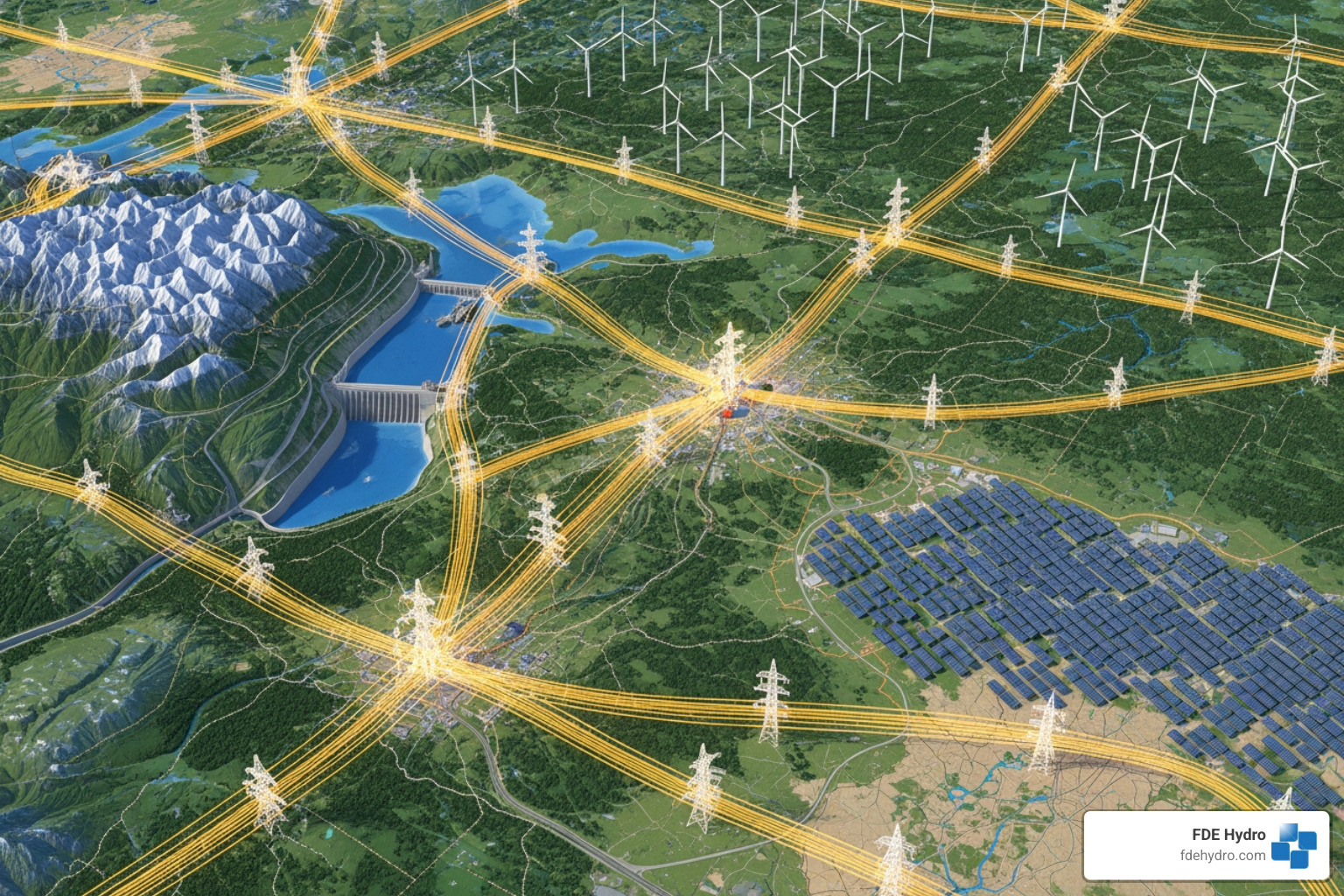
As the energy world changes, hydropower asset management must keep pace. Hydropower is more essential than ever because, unlike solar and wind, it can deliver power on demand.
Hydropower facilities can ramp up or down quickly to meet demand. This dispatchability makes them perfect partners for intermittent renewables and guardians of grid stability, balancing the grid when other sources are unavailable.
This increased importance brings challenges and opportunities. Volatile energy markets require agile hydropower asset management strategies that optimize both equipment performance and market value creation.
Justifying Budgets for Capital Improvements
Securing budgets is a tough part of hydropower asset management. For example, the DOE recently requested $7 billion for hydropower improvements but received only $550 million, highlighting the need to make every dollar count.
A solid hydropower asset management program is your best advocate. With comprehensive data and analytical tools (like Type 1 and 2 analyses), you can build compelling business cases that show an asset’s risk profile, cost of failure, and ROI, going beyond simply stating its age.
This data-driven approach transforms capital planning from reactive to strategic. You can demonstrate that proactive replacement of a critical component, based on its condition and risk, saves more than waiting for a catastrophic failure and its associated costs.
Long lead times for major equipment (e.g., 18+ months for transformers) are another crucial factor. Good asset management data allows for strategic procurement, avoiding expedited shipping costs and extended downtime, which is invaluable for managing risk and resources.
More info about Reinvigorating Hydropower
Leveraging Operational Flexibility and Market Expectations
Combining technical decisions with market strategy is where hydropower asset management excels. Hydropower’s flexibility is a commercial advantage in volatile markets, creating value through ancillary services and optimized generation timing.
Outage management is a strategic tool. Major refurbishments should be scheduled during periods of low expected power prices. This minimizes lost revenue and can reduce project costs, improving overall profitability.
Forward power price expectations also guide investment timing. If prices are projected to rise, accelerating efficiency upgrades can capture more value. If prices are projected to be low, non-critical investments might be deferred, while always maintaining safety and reliability.
The key is integrating market dynamics into your asset management framework. Condition assessments show what needs doing; market expectations help determine when to do it for maximum value. This transforms hydropower asset management from maintenance into a value creation strategy.
Practical guidance from the World Bank
The Future of Hydropower Asset Management: Innovation and Value Creation
The future of hydropower asset management is about predicting, preventing, and optimizing operations. Digital innovations like predictive maintenance, sensor-driven optimization, and AI-powered analytics are becoming essential tools.
In practice, this means using real-time sensor data to predict a component’s remaining lifetime instead of waiting for scheduled inspections. This shift from time-based to condition-based, prognostics-driven maintenance is revolutionary, improving reliability, availability, resource use, and profitability.
As the electricity sector moves toward sustainability, hydropower asset management innovation is key. These advanced approaches prevent failures, reduce environmental impacts, and ensure peak performance. For aging North American assets, these innovations are essential for survival and success.
More info about Hydropower Innovation
Adapting to New Technologies and Methods
Adopting new technologies doesn’t require starting from scratch. Existing CMMS and EAMS systems are foundations that can be integrated with modern data analytics tools, turning them into powerful predictive engines.
This integration allows sensor data to flow into optimization models to predict failures, schedule maintenance economically, and optimize reservoir management. Forward-thinking operators are creating intelligent systems that learn and improve over time.
Prognostics-driven maintenance enables smarter, preventative decisions. Work can be scheduled during low-price periods and long-lead-time equipment ordered proactively, all with data-backed confidence.
The key is to start where you are and build progressively. Even small steps toward digital integration can significantly improve your hydropower asset management program’s effectiveness.
AI-Driven Development insights
Enhancing Value in the Energy Transition
Hydropower asset management open ups hidden value that supports the energy transition. As wind and solar grow, the grid needs hydropower’s reliable, dispatchable power to fill intermittency gaps.
An often-overlooked opportunity is improving flow measurement accuracy. Case studies show this can increase annual generation by 0.4% to 1.8%. Over decades, this translates to substantial revenue increases, often enough to fund other critical improvements.
Beyond flow measurement, strategic asset management improves overall generation efficiency by optimizing turbines and reducing transmission losses. This technical optimization also has environmental benefits, generating more clean electricity from every drop of water.
The energy transition needs hydropower to succeed. By continuously improving the technical, environmental, and water-use efficiency of our existing fleet through smart hydropower asset management, we secure hydropower’s role as a cornerstone of sustainable energy infrastructure.
At FDE Hydro, we know modern asset management and innovative construction go hand in hand. Our modular precast concrete technology helps extend the life and improve the performance of hydropower infrastructure, complementing your asset management program with faster, more cost-effective, long-term construction solutions.
More info about Sustainable Power Generation
Frequently Asked Questions about Hydropower Asset Management
What is the first step in creating a hydropower asset management program?
The first step is to establish clear objectives aligned with your organization’s strategic priorities, such as improving reliability, reducing costs, or extending asset life. Once objectives are defined, conduct a thorough inventory and condition assessment of all assets. This provides a baseline understanding of your equipment’s health, identifying what’s in good shape and what needs attention. You can’t plan a path forward without knowing your starting point.
How does asset management help with aging hydropower infrastructure?
Hydropower asset management provides a structured framework to manage aging infrastructure. Instead of reacting to failures, it allows for systematic condition assessment and risk-based prioritization of repairs and replacements. This proactive approach prevents catastrophic failures, as a planned outage is always better than an emergency shutdown. By justifying investments with data, asset management extends the viable lifespan of facilities, allowing them to operate for over 100 years with proper maintenance.
Yes. While the scale is different, the fundamental principles of hydropower asset management apply and are highly beneficial for small plants. Smaller facilities often have tighter budgets and smaller teams, making a structured approach even more valuable. A simplified, customized program helps prioritize limited resources effectively. It improves reliability, ensures safety compliance, and maximizes revenue by changing operations from reactive to strategic, making the plant more sustainable and profitable.
Conclusion
Hydropower asset management is about changing hydroelectric facilities from aging cost centers into strategic, value-creating assets. By establishing robust programs (using frameworks like ISO 55000), prioritizing critical assets, using condition assessments for smart decisions, and justifying investments with analytical tools, we can move from a reactive maintenance cycle to a powerful, sustainable approach.
The stakes are high. With aging equipment and hydropower’s vital role in grid stability, old operational methods are no longer sufficient. By applying strategic hydropower asset management, facilities can operate reliably for over a century, adapting to evolving market demands.
Technology is revolutionizing what’s possible. Tools like predictive maintenance, sensor-driven optimization, and AI-powered analytics are available now to prevent failures, optimize real-time performance, and maximize asset value while minimizing environmental impact.
At FDE Hydro™, we combine smart asset management with innovative construction. Our patented modular precast concrete technology, the “French Dam,” addresses aging infrastructure and new development needs in North America, Brazil, and Europe. By reducing construction costs and timelines, we help operators implement critical capital improvements identified by their asset management programs, building resilient, efficient facilities for future generations.
The journey from reactive maintenance to strategic value creation is worthwhile. The principles—understand your assets, prioritize based on data, invest strategically, and continuously optimize—apply to any size operation. Together, we can ensure hydropower remains a cornerstone of clean, reliable energy.
Learn how to finance long-term hydropower projects by mitigating risks
by Bill French Sr. | Dec 19, 2025 | Hydro Facility Articles
Why Water Infrastructure Projects Matter More Than Ever
Water infrastructure projects are the backbone of safe drinking water in America, but the nation faces a critical juncture. Here’s what you need to know:
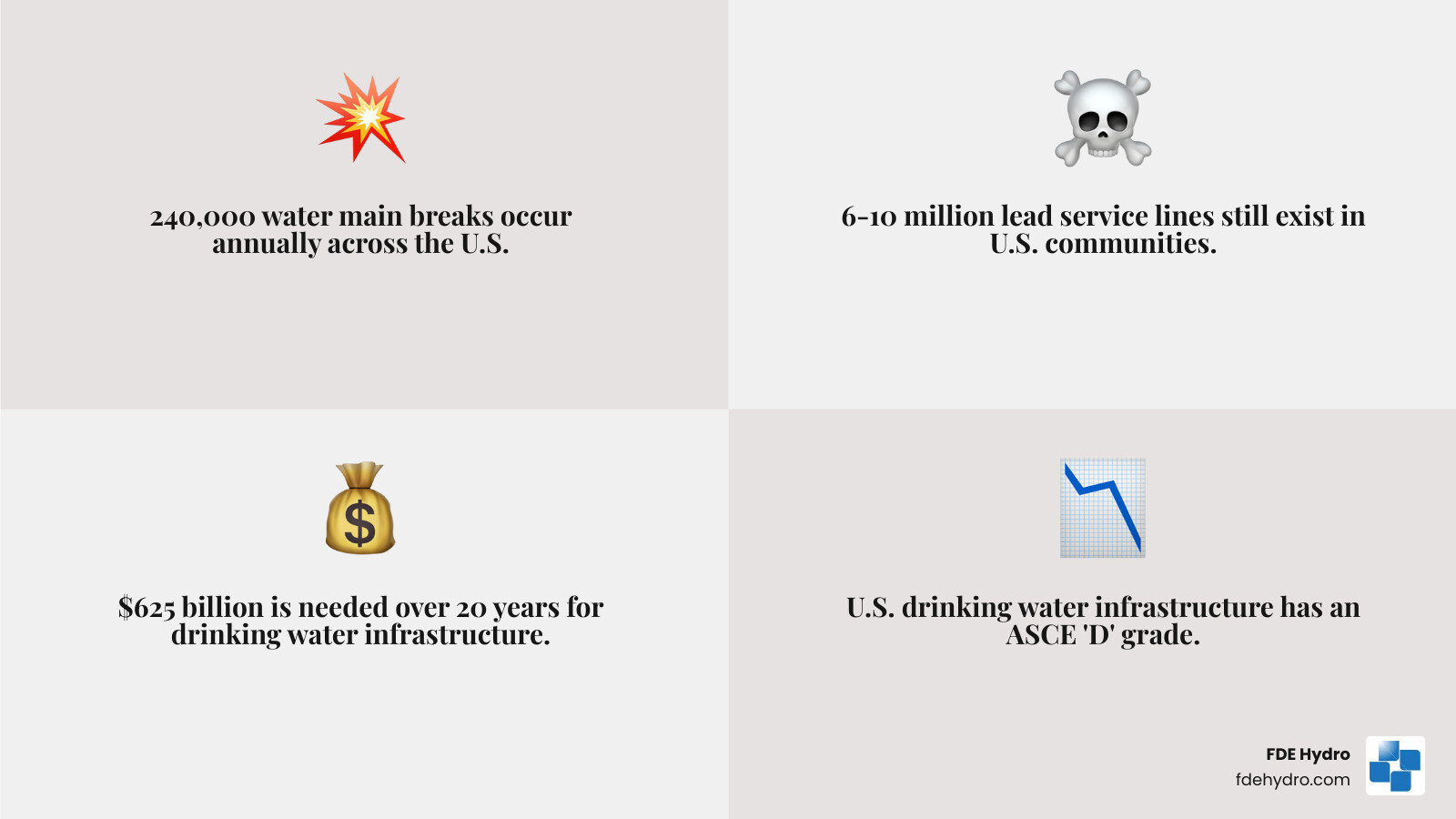
Key Facts About U.S. Water Infrastructure Projects:
- $50 billion federal investment through the Infrastructure Investment and Jobs Act – the largest water investment in U.S. history
- $625 billion needed over the next 20 years for drinking water infrastructure
- 6-10 million lead service lines still exist across the United States
- Grade D – the ASCE’s rating for U.S. drinking water infrastructure for over a decade
- Major funding sources include State Revolving Funds (SRFs), WIFIA loans, and USDA Rural Development programs
The numbers tell a sobering story. Much of America’s water infrastructure is aging rapidly, with some pipes dating back to the 1800s. These systems are strained by climate change, which brings extreme droughts and floods, and threatened by emerging contaminants like PFAS “forever chemicals” that existing plants weren’t designed to handle.
However, there’s unprecedented opportunity. The Bipartisan Infrastructure Law offers a once-in-a-generation chance to rebuild. Federal programs like WIFIA and SRFs are making large-scale upgrades more affordable, and communities are shifting from crisis response to proactive, technology-enabled management.
The path forward requires smart investment, innovative construction methods, and proven technologies that can deliver results faster and more cost-effectively than traditional approaches.
I’m Bill French Sr., Founder and CEO of FDE Hydro™. For over five decades, I’ve focused on civil construction innovation, from participating in the DOE’s Hydro Power Vision Task Force to developing the modular solutions we use today. I’ve seen how the right technology can dramatically reduce costs, accelerate timelines, and deliver more resilient water systems.
Quick water infrastructure projects definitions:
The State of America’s Water Systems: Challenges and Urgencies
Let’s talk about the reality facing our water infrastructure projects today. The American Society of Civil Engineers has given U.S. drinking water infrastructure a “D” grade for over a decade. We’re dealing with pipes laid generations ago, some dating back to the 1800s. These aging systems lead to frequent water main breaks, wasting millions of gallons of treated water and creating contamination risks.
Age isn’t our only challenge. Climate change is rewriting the rules, with droughts pushing storage to its limits in some regions while intense rainfall overwhelms systems in others. The infrastructure built for yesterday’s climate isn’t ready for tomorrow’s extremes.
Then there are new contaminants our grandparents never worried about. PFAS—”forever chemicals”—are showing up in water supplies nationwide, and our older treatment plants weren’t designed to remove them. The same is true for harmful algal blooms fueled by nutrient runoff. The economic toll of failing infrastructure is immense, including lost productivity, health costs, and environmental damage, as detailed in a joint report on the State of the Infrastructure by the Bureau of Reclamation and the U.S. Army Corps of Engineers.
Addressing Historical Underinvestment and New Threats
For decades, our approach to water infrastructure has been reactive, waiting for crises before acting. This pattern of deferred maintenance has created a massive infrastructure deficit. The good news is that we can now move from patching old systems to modernizing them with smarter designs and better technology, as seen in how Aging Infrastructure Being Replaced with Next Generation Civil Solutions can transform this challenge.
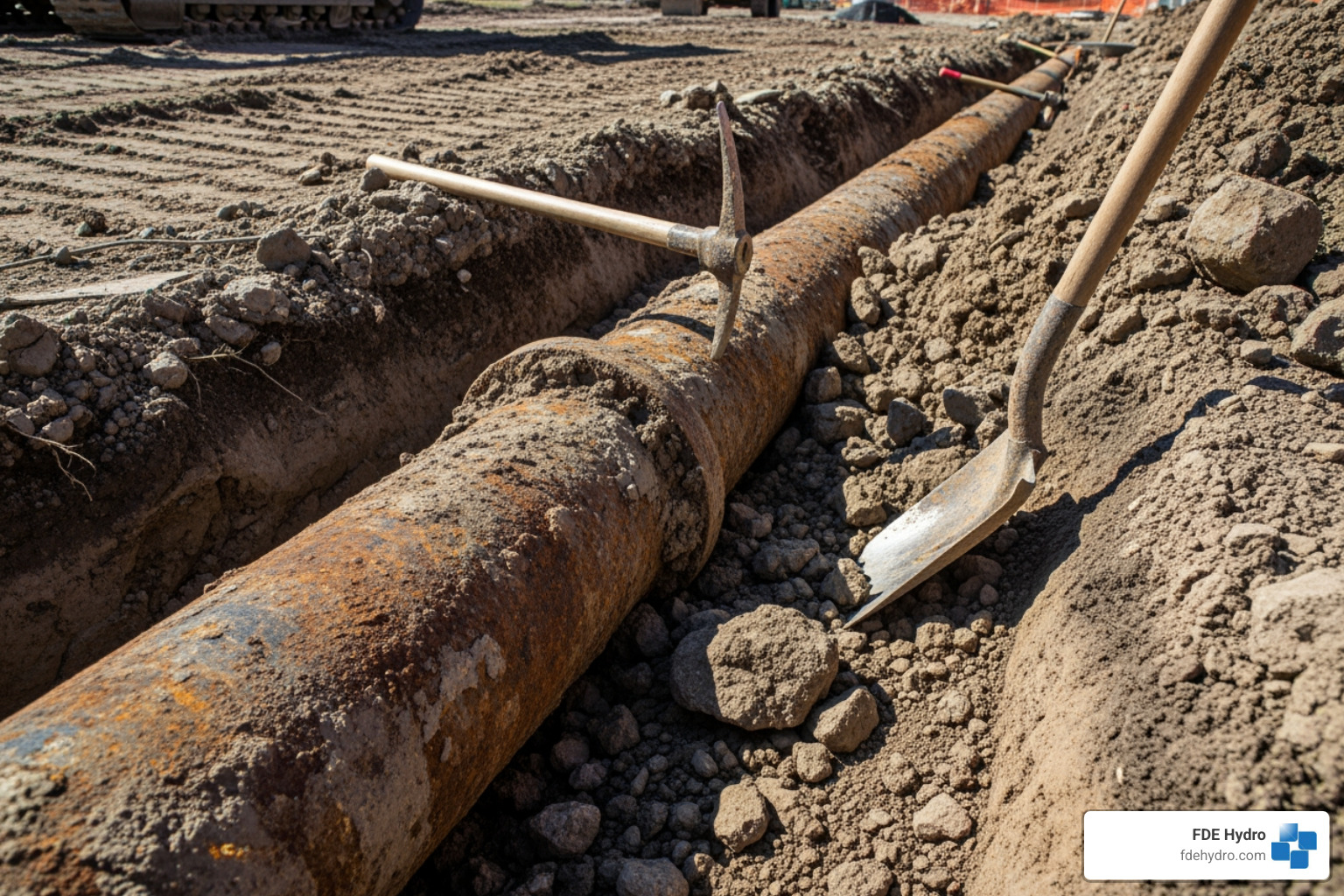
As threats evolve, our water infrastructure projects must evolve too. PFAS contamination is a tough new frontier, affecting about a quarter of the nation. Removing these compounds requires advanced treatment technologies that many facilities lack. Similarly, harmful algal blooms, like the one that made Toledo, Ohio’s water undrinkable in 2014, are becoming more common. Addressing these threats requires comprehensive strategies, from source water protection to advanced Water Control Systems.
Fortunately, the federal government is taking this seriously. The Bipartisan Infrastructure Law dedicates $10 billion to addressing PFAS and other new threats, pushing utilities to test for and treat these contaminants. We are finally shifting from reactive crisis management to proactive defense.
Funding the Flow: Navigating Federal Investment in Water Infrastructure Projects
We’re living through the single largest federal investment in water America has ever seen. The Bipartisan Infrastructure Law delivers more than $50 billion to the EPA alone for water infrastructure projects. This historic funding reaches local communities through key programs.
State Revolving Funds (SRFs) are state-managed loan programs that blend federal and state dollars. They offer low-interest loans for a wide range of projects, and as loans are repaid, the money is recycled to fund future projects, creating a self-sustaining cycle of reinvestment.
The Water Infrastructure Finance and Innovation Act (WIFIA), administered by the EPA, provides long-term, low-interest loans for large, nationally significant projects. WIFIA has already saved utilities over $5 billion in financing costs. For rural America, USDA Rural Development programs provide targeted assistance and financing.
This comprehensive federal approach reflects a commitment to Sustainable Infrastructure Development. For a deeper dive on WIFIA, the American Water Works Association offers an excellent analysis: Fluid Financing of Water Utility Infrastructure With WIFIA.
How Funding Empowers Local Projects
The power of SRFs and WIFIA is how they provide money. By dramatically reducing borrowing costs—WIFIA loans can cut financing costs by 25%—these programs make ambitious water infrastructure projects feasible. Savings can mean lower water bills for families or the ability to tackle additional upgrades. SRFs are particularly vital for smaller systems, with 38% of Drinking Water SRF funds going to systems serving 10,000 people or fewer, leveling the playing field for communities that struggle to access capital markets.
| Feature |
WIFIA |
SRFs (Drinking Water & Clean Water) |
| Loan Terms |
Low-interest, long-term (up to 35 years) |
Low-interest (often below market), various terms |
| Project Size |
Large, nationally/regionally significant ($20M+ or $5M+ for small communities) |
Small to large, state-specific thresholds |
| Application Process |
Direct to EPA, competitive |
Through state agencies, application varies by state |
| Funding Source |
Federal appropriations, repaid loans |
Federal capitalization grants, state matching funds, repaid loans |
| Key Benefit |
Significant cost savings, flexible repayment |
Flexible, self-sustaining, supports a broad range of projects |
| Typical Projects |
New construction, large upgrades |
Lead service line replacement, treatment plant upgrades, collection systems |
Key Funding Allocations Under the IIJA
The Bipartisan Infrastructure Law makes strategic investments in the most critical areas. Key allocations include:
- $15 billion for lead service line replacement, a national commitment to eliminate this preventable health crisis.
- $11.7 billion for wastewater and stormwater systems through the Clean Water SRF to protect our rivers and lakes.
- $9 billion total to address emerging contaminants like PFAS, acknowledging that public health requires staying ahead of new threats.
- $8.3 billion to the Bureau of Reclamation for water infrastructure in the Western U.S., targeting drought resilience and dam safety.
These funds represent real projects in real communities—new treatment plants, replaced pipes, and cleaner water, creating a once-in-a-generation opportunity to transform American water infrastructure.
Blueprint for Resilience: Key Project Categories and Their Impact
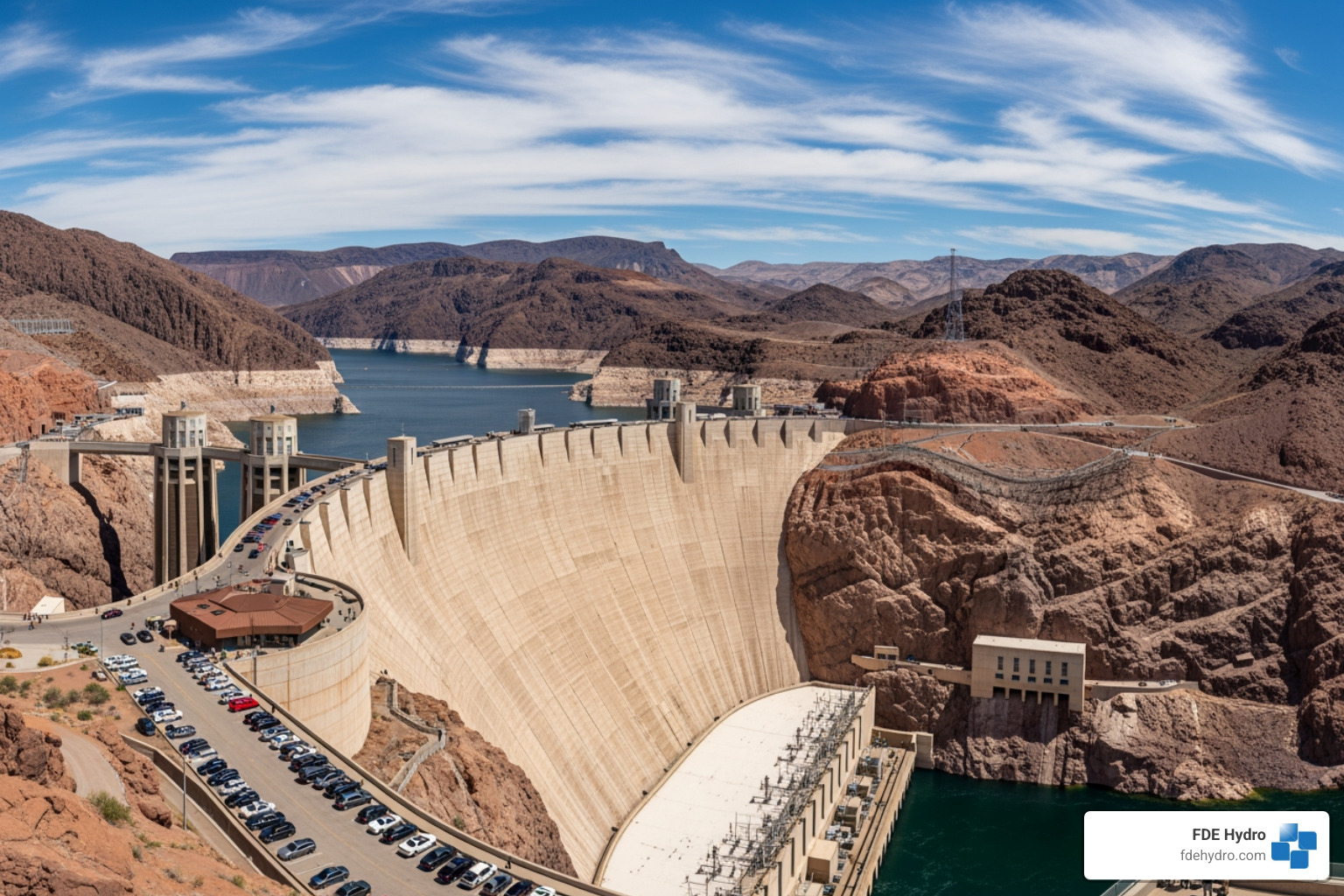
Building a resilient water future requires a comprehensive approach to water infrastructure projects. This blueprint includes everything from purifying drinking water and managing stormwater to replacing lead service lines and building new storage. These projects are interconnected; a new reservoir provides drought resilience and flood control, while an upgraded treatment plant can enable water recycling. Thoughtful design of Water Control Structures can serve multiple purposes, delivering greater value for every dollar invested.
Modernizing Drinking Water and Wastewater Systems
Many water infrastructure projects directly impact your daily life. With 6-10 million lead service lines still in use, federal funding is finally enabling large-scale replacement programs to eliminate this toxic threat. At the same time, treatment plants built mid-century are being upgraded to handle modern demands and emerging contaminants like PFAS. For example, the Kansas River Wastewater Treatment Plant Improvements Project is modernizing facilities to meet current and future needs. Finally, cities are tackling water loss from leaky pipes. San Francisco’s $4.8 billion Water System Improvement Program successfully repaired and seismically upgraded its network, showing what’s possible with sustained commitment.
Building Resilience Against Climate Change
Climate change is reshaping how we approach water infrastructure projects, demanding systems that can handle extremes like droughts and floods. Key strategies include:
- Water Storage: Capturing water during wet periods for use in dry times is fundamental. New reservoirs, like one being built in California, are a key part of this strategy.
- Climate-Adaptive Systems: Large-scale initiatives like California’s Delta Conveyance Project are designed to protect water delivery from climate change and seismic risks.
- Water Recycling and Reuse: Treating wastewater to drinking water standards is a game-changer for drought-prone regions, creating a reliable, local water source.
Federal investment is backing these efforts, with the Inflation Reduction Act providing $4.6 billion for drought response in the West. At FDE Hydro, we see climate resilience as an opportunity. Our work in Hydropower Retrofitting shows how existing infrastructure can be upgraded for water storage, flood control, and clean energy. We believe The Biggest Untapped Solution to Climate Change is in the Water, and we’re committed to developing adaptive solutions.
The Technology Revolution in Water Management
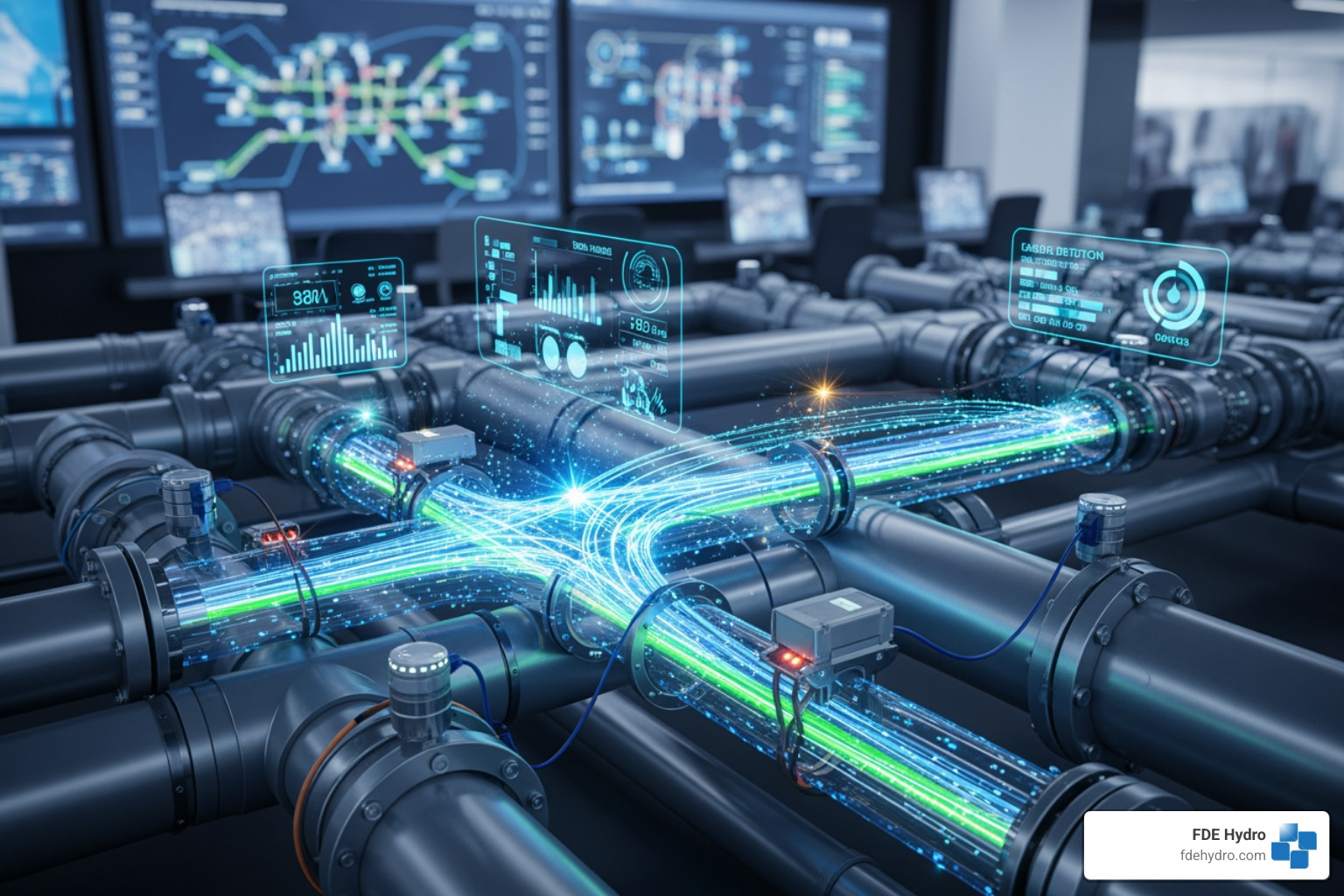
The management of water infrastructure projects is undergoing a technological revolution, shifting from a reactive to a proactive, data-driven approach. Smart water grids use sensors and meters to monitor flow, pressure, and quality in real time, allowing operators to detect leaks and other issues instantly. Predictive analytics takes this a step further, using data to forecast potential equipment failures so maintenance can be scheduled proactively, saving money and preventing disruptions.
On the treatment side, advanced technologies like reverse osmosis are crucial for removing emerging contaminants like PFAS. These innovations are part of a broader move toward Clean Energy Infrastructure that makes water purification more effective and sustainable.
Innovations in Construction for Water Infrastructure Projects
At FDE Hydro, we’ve spent decades rethinking how water infrastructure projects are built. Our patented modular precast concrete technology represents a complete departure from traditional methods. Instead of building everything on-site, we prefabricate major components in a controlled factory environment. These precision-engineered modules are then transported and assembled on-site.
The impact is transformative. Construction time drops from years to months, and costs are significantly reduced by streamlining the process and minimizing on-site labor. Quality and safety both improve, as factory conditions allow for a level of precision impossible in the field. This approach is the essence of our Modular Construction Techniques, delivering more durable and resilient infrastructure faster and for less cost.
The Future of Hydropower and Dam Safety
Hydropower is an integral part of America’s water infrastructure, but many facilities are aging. The opportunity is enormous: thousands of existing non-powered dams can be retrofitted to generate clean energy. Our work in Hydropower Innovation and Hydroelectric Dam Construction makes these upgrades faster and more affordable.
Dam safety is also critical, as older structures face new pressures from extreme weather. Federal investment is flowing into spillway improvements and structural upgrades to ensure these dams can withstand future demands while continuing to provide power, water supply, and flood control. Programs like the Army Corps Water Infrastructure Financing Program are helping to fund these vital non-Federal dam projects.
Frequently Asked Questions about Water Infrastructure Management
What are the first steps for a utility to access federal funding like WIFIA or SRFs?
To access federal funding for your water infrastructure projects, start by developing a clear capital improvement plan that outlines your project’s scope, cost, and community benefits. For State Revolving Funds (SRFs), your first call should be to your state’s SRF program administrators, who can guide you through their specific application process. You can find contacts on the EPA’s website for State DWSRF contacts. For larger projects suited for the Water Infrastructure Finance and Innovation Act (WIFIA), you’ll work directly with the EPA. Review the EPA’s guidance on how to apply for WIFIA assistance and engage with the agency early in your planning process.
How do new technologies help manage aging water infrastructure?
New technologies are shifting the management of aging water infrastructure projects from reactive to proactive. Acoustic sensors and smart meters can detect leaks in real time, reducing water loss and preventing catastrophic breaks. Predictive analytics uses historical data to forecast equipment failures, allowing utilities to schedule maintenance proactively, saving money and avoiding service interruptions. Furthermore, trenchless technologies like pipe lining allow for the replacement of underground pipes with minimal excavation, reducing disruption to communities and speeding up project completion. Together, these innovations extend the life of existing assets and make operations more cost-effective.
What is the role of public-private partnerships (P3s) in water projects?
Public-private partnerships (P3s) are a valuable tool for delivering large, complex water infrastructure projects. In a P3, a public entity partners with a private company that may help design, build, finance, and operate a new facility, like a treatment plant. This model can accelerate project delivery by leveraging private sector capital, efficiency, and innovation—such as advanced construction methods that reduce costs and timelines. The public entity retains ownership and oversight, while both parties share risks and rewards. For communities with significant infrastructure needs but limited upfront capital, P3s offer a path to modernize their water systems effectively.
Conclusion: Building a Sustainable Water Future
Our water infrastructure projects face real challenges, from aging pipes to climate change and new contaminants. Yet, we also have an unprecedented opportunity. The Bipartisan Infrastructure Law provides historic funding, and new technologies offer smarter ways to manage our systems. This is our chance to move beyond the reactive fixes of the past and build for the future.
Success, however, isn’t just about funding. It requires smarter construction. At FDE Hydro, we’ve perfected our modular precast concrete technology because traditional methods are too slow and costly for the scale of the challenge we face. Our approach—fabricating components in a factory and assembling them on-site—dramatically cuts construction time, reduces costs, and delivers higher-quality, more resilient structures. This is true for new hydroelectric dams and critical water control systems.
Proactive management, smart investment, and proven innovation are the keys to a sustainable water future. The opportunity we have now is to rebuild our infrastructure the right way—to be more resilient, efficient, and durable for generations to come. I’ve dedicated my career to this work because every community deserves safe, reliable water.
If you’re ready to move beyond “how we’ve always done it” and explore what next-generation solutions can do for your community, I invite you to learn more about next-generation Dam Rehabilitation and Encapsulation techniques. Together, we can build a better water future.
by Bill French Sr. | Dec 18, 2025 | Precast Dam Articles
The Blueprint for Modern Construction
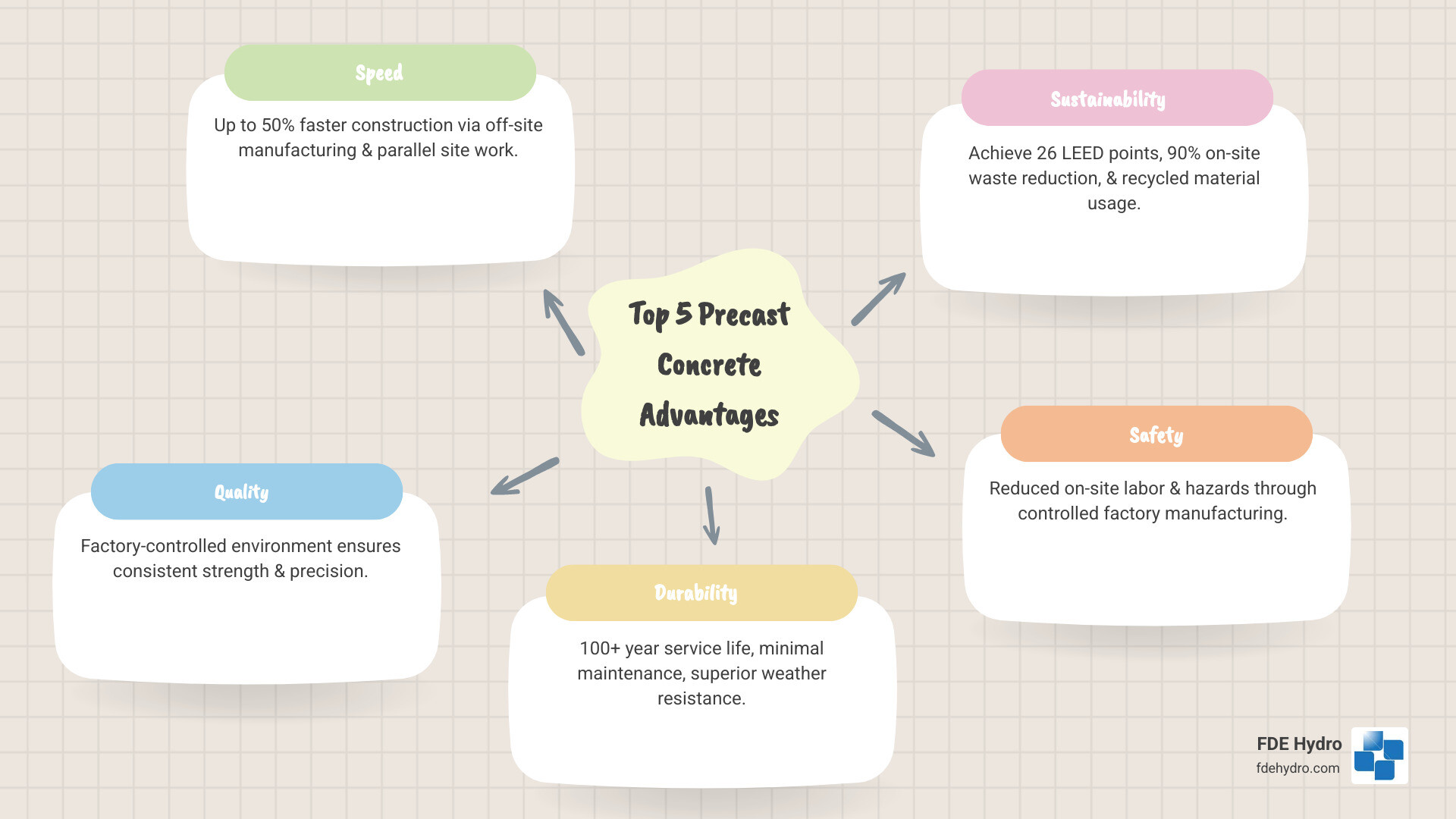
Precast concrete advantages are changing how we build large-scale infrastructure. The key benefits include:
- Speed: Reduces construction timelines by up to 50%.
- Quality: Factory-controlled production ensures consistent strength.
- Durability: Offers a service life exceeding 100 years with minimal maintenance.
- Sustainability: Can earn up to 26 LEED points and reduces on-site waste by 90%.
- Safety: Reduces on-site labor and hazards.
- Cost-Effectiveness: Delivers lower long-term costs and a faster ROI.
Precast concrete is cast in reusable molds in a controlled factory, cured to optimal strength, and then transported to sites for rapid installation. This differs from traditional cast-in-place methods, where concrete is poured and cured on-site, subject to weather delays and quality issues.
Manufacturing occurs in certified plants where structural components—columns, beams, walls, and more—are produced under rigorous quality control. This allows for year-round production while site preparation proceeds simultaneously. Once cured, components are delivered just-in-time for quick installation, compressing schedules from months to weeks.
For water infrastructure and hydropower, these precast concrete advantages are critical. Harsh conditions and tight project windows make precast an ideal solution. Its resistance to moisture, corrosion, and extreme weather addresses the unique challenges of marine applications.
I’m Bill French, founder and CEO of FDE Hydro™, and in my five decades in heavy civil construction, I’ve seen precast technology revolutionize project delivery. My experience proves that embracing modular precast isn’t just about building faster—it’s about building smarter for the next century.
1. Accelerated Construction: Building Faster and Smarter
One of the most significant precast concrete advantages is speed. Projects using precast can finish up to 50% faster than with traditional methods, a timeline reduction that can save an entire season of work.
The secret is parallel processing. With traditional cast-in-place concrete, work is sequential: pour, wait, cure, and hope for good weather. Precast flips this model. While the site team excavates and lays foundations, structural components are simultaneously manufactured in a controlled factory environment. Site work and fabrication happen at the same time.
This synchronized approach enables just-in-time delivery. Components arrive on-site fully cured, inspected, and ready for immediate installation, eliminating on-site curing delays and material storage issues.
Furthermore, all-weather manufacturing means production continues year-round, regardless of rain, snow, or extreme temperatures. This eliminates weather-related delays that commonly plague traditional construction.
The installation phase is also remarkably fast. A small erection team can assemble precast components in days or weeks, a task that would take months for a large on-site crew. This minimized on-site labor requirement accelerates the schedule and reduces costs.
We’ve applied these principles to critical infrastructure. Our Rapid Installment of Module Precast Civil Infrastructure shows how complex systems can be assembled with speed. Similarly, the 93 Fast Bridge Replacement System Now Being Utilized Throughout US proves that entire bridge sections can be installed over a weekend.
Faster project completion means reduced financing costs, earlier revenue generation, and less community disruption. In an industry where time is money, these precast concrete advantages deliver significant value.
2. Superior Quality and Best Resilience
When it comes to quality and resilience, the precast concrete advantages are clear. The factory setting provides a controlled environment where every variable is managed, unlike on-site cast-in-place concrete, which is exposed to weather and inconsistent conditions.
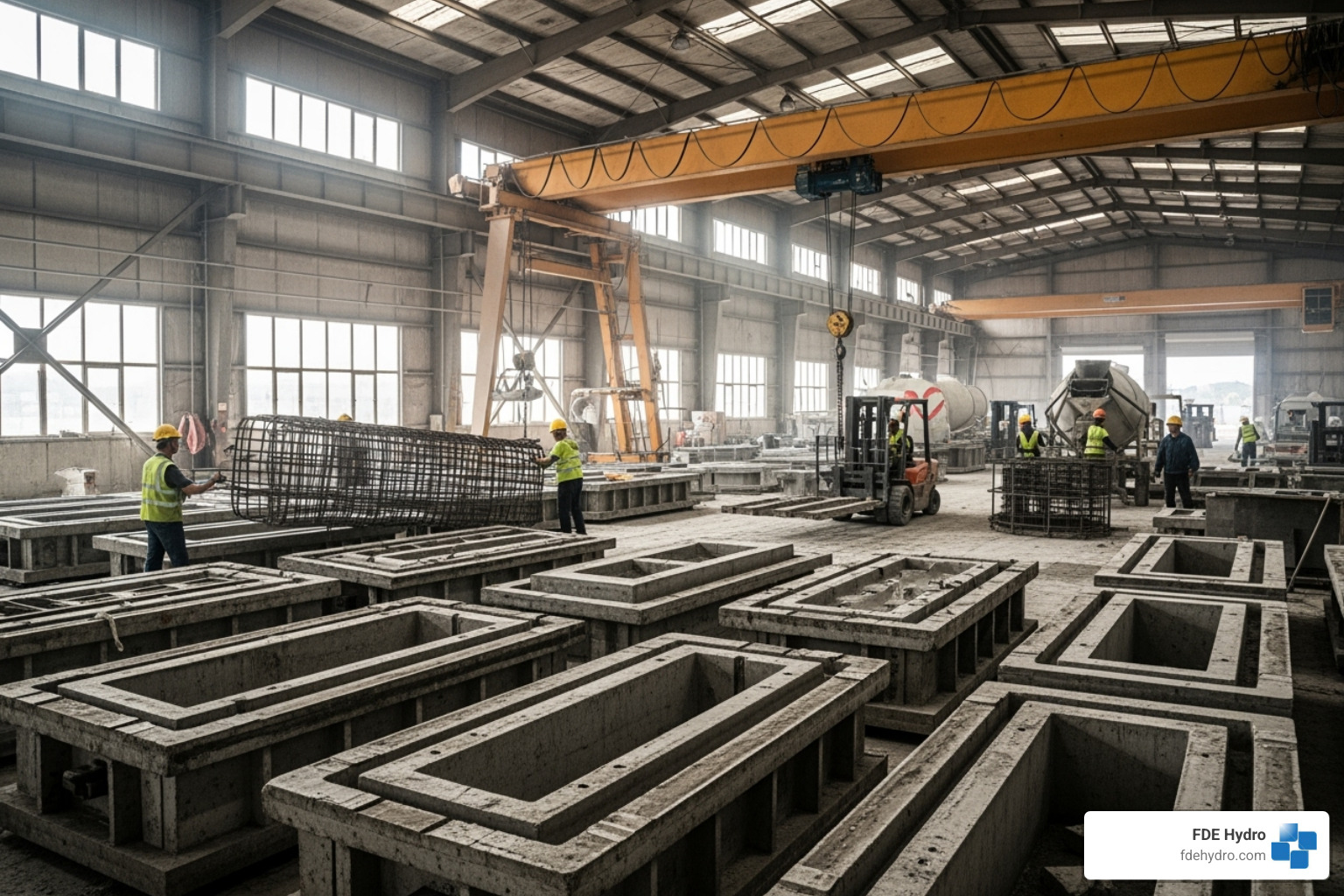
Inside a precast plant, quality control is integral. Consistent mix designs, precise aggregate ratios, and optimal curing conditions are maintained—standards nearly impossible to replicate on an open construction site. This meticulous process produces concrete with superior strength. Pre-stressing techniques can be added to achieve even greater load-bearing capacity, allowing for longer clear spans with slender structural members.
The real payoff is longevity. Precast structures have a service life that can exceed 100 years with minimal maintenance. This durability is confirmed by research, such as that from the Resilient Structures – Canadian Precast Concrete Institute, which shows precast is built to withstand environmental stressors and time.
Beyond strength, precast concrete offers impressive performance benefits.
- Fire Resistance: Concrete is non-combustible and earns an excellent A1 fire rating. It maintains structural integrity far longer than steel in high heat, providing critical time for evacuation and preventing the spread of fire.
- Sound Insulation: The natural density of precast concrete walls makes them excellent at blocking noise, ideal for residential buildings, hotels, and offices.
- Environmental Resistance: Precast concrete resists rot, pests, mildew, and freeze-thaw cycles. This resilience is essential for projects in harsh conditions.
Our Modular Sea Wall Systems, for example, face relentless saltwater and wave action. In these applications, the moisture resistance and durability of precast are not just benefits—they are essential for creating a system that lasts for decades without constant, expensive repairs.
3. Unpacking the Core Precast Concrete Advantages for Cost and Sustainability
Beyond speed and quality, the precast concrete advantages for cost and sustainability are equally impressive.
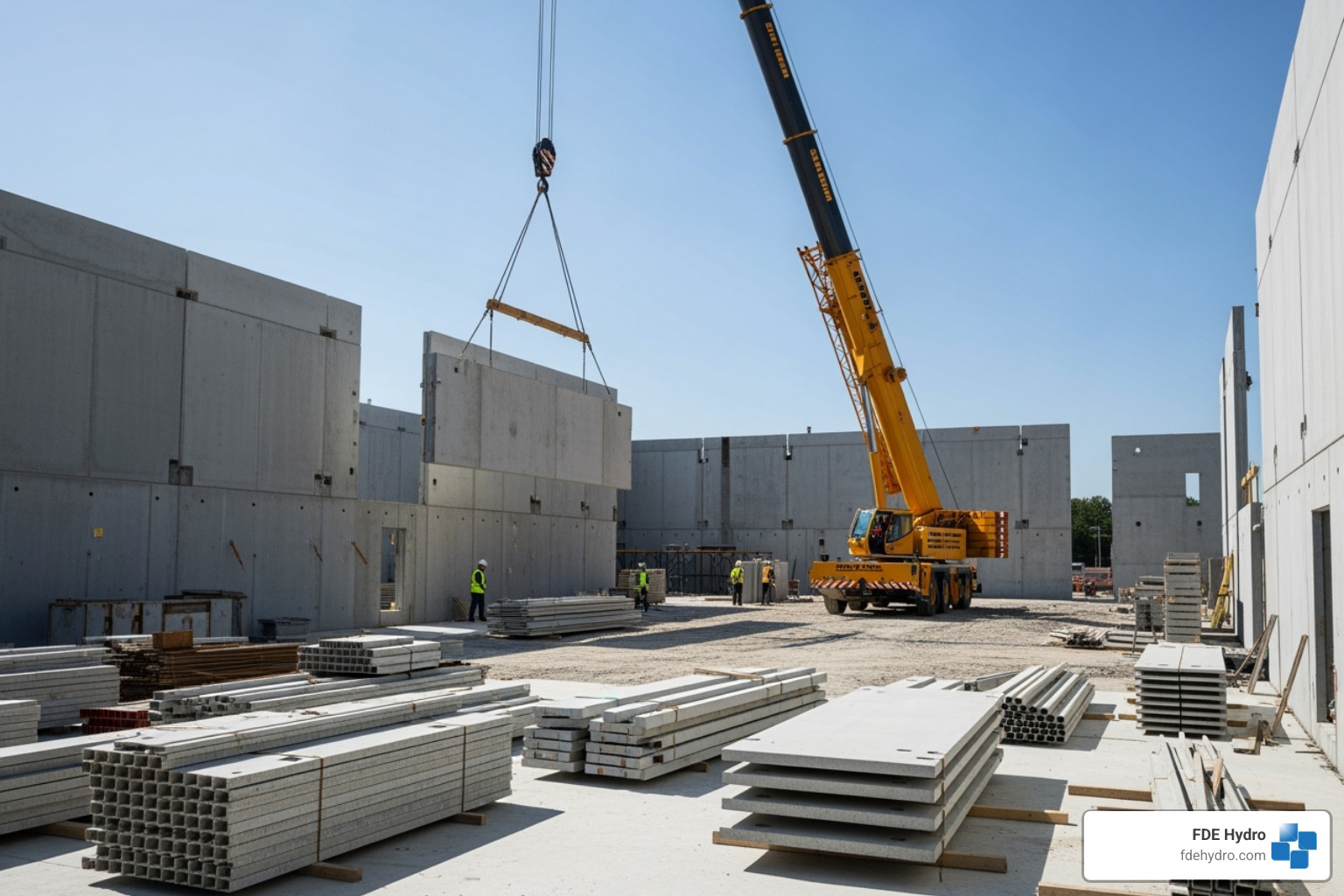
Factory-based production significantly reduces on-site labor needs, lowering costs from day one. Over the long term, precast’s exceptional durability leads to dramatically lower lifecycle costs. A structure that requires minimal maintenance and lasts over a century offers a faster return on investment, as explained in Why Precast Costs Less.
From a sustainability perspective, precast excels. The controlled factory environment allows for precise material management, reducing on-site waste by up to 90%. Excess materials and even recycled content like glass can be incorporated back into production, minimizing the demand for virgin resources. This efficiency contributes to a lower carbon footprint.
Precast concrete can also contribute up to 26 LEED points. Its thermal mass helps regulate building temperatures, improving energy efficiency. It also acts as an effective air barrier and emits virtually no volatile organic compounds (VOCs), leading to healthier indoor air quality.
Cost-Effectiveness: Long-Term Precast Concrete Advantages
While a precast plant requires initial investment, the long-term savings are substantial. The durability of precast means minimal maintenance, translating directly into lower operational expenses over the structure’s 100+ year service life.
This cost-effectiveness is particularly impactful for large-scale developments like affordable housing. As shown in projects highlighted by Precast Concrete Delivers Affordable Housing, the combination of rapid construction and low ongoing costs makes precast an ideal solution for community infrastructure.
A faster ROI is achieved through quicker construction, reduced labor costs, and minimal maintenance expenses. For developers and owners, these precast concrete advantages create a compelling business case that grows stronger over time.
4. Design Freedom and A Safer Work Environment
Contrary to the image of plain gray boxes, one of the key precast concrete advantages is incredible design freedom. Precast is an architect’s playground, offering immense creative possibilities.
Its versatility allows for virtually any texture, color, or shape. Finishes can range from smooth and polished to textured, and facing materials like brick or stone can be incorporated directly into panels. Reusable molds enable the creation of custom forms with intricate details that would be difficult or expensive to achieve with cast-in-place methods. This allows for bold facades, curved walls, and unique architectural expressions, as shown in our Precast Models.
Beyond aesthetics, pre-stressed precast concrete allows for long, clear spans without interior columns. This creates open, flexible interior spaces that can be easily reconfigured. As the Architectural Precast Association notes in Why Use Architectural Precast, the material delivers versatility, resilience, and quality in one package.
Safety as a Standard
Safety is another critical advantage. Traditional construction sites are crowded and hazardous. Precast concrete transforms this by shifting most of the work to a controlled factory environment.
This move dramatically reduces the number of on-site workers, which in turn lowers the risk of accidents. The factory itself is a safer setting, with specialized equipment, strict safety protocols, and no weather-related hazards. On-site, the installation process is streamlined and requires less time, minimal material storage, and reduced congestion. This shift to off-site manufacturing significantly reduces risks, making the entire construction process safer for everyone involved.
5. Precast vs. Cast-in-Place: A Head-to-Head Comparison
Choosing between precast and traditional cast-in-place concrete is a fundamental project decision. While both use concrete, their manufacturing and application methods lead to vastly different outcomes, highlighting the true precast concrete advantages.
The key differences are summarized below:
| Feature |
Precast Concrete |
Cast-in-Place Concrete |
| Speed |
Faster construction through off-site fabrication and parallel processing with just-in-time delivery |
Slower sequential on-site pouring and curing, highly weather-dependent |
| Quality Control |
High consistency from factory-controlled environment with precise mix design and optimal curing |
Variable quality affected by on-site conditions, weather, and less controlled processes |
| Cost |
Lower long-term lifecycle costs with reduced on-site labor; higher initial plant setup |
Higher on-site labor costs with potential delay expenses; lower initial setup if no plant needed |
| Site Impact |
Minimal waste (up to 90% reduction), less congestion, reduced noise and disruption |
More on-site waste, material storage, noise, and disruption |
| Weather Dependency |
Manufacturing unaffected by weather, ensuring consistent production schedules |
Highly dependent on favorable conditions for pouring and curing, leading to potential delays |
| Design Flexibility |
Excellent aesthetic versatility with custom forms, textures, colors, and long clear spans |
More limited aesthetic options without extensive on-site finishing; complex shapes require custom formwork |
While the precast concrete advantages are compelling, it is important to consider potential challenges.
- Transportation logistics: Large, heavy precast components require specialized trucks, cranes, and careful route planning. Proximity to a precast plant is a key factor, as we’ve learned from projects like the 93 Fast Bridge Replacement System Now Being Utilized Throughout US, where logistics are critical.
- Connection sensitivity: The connections between precast elements must be executed with precision on-site to ensure structural integrity. Working with experienced engineers and installers is essential to avoid issues.
- Initial plant investment: Setting up a precast facility requires a significant upfront cost. However, for projects with large volumes or repeatable components, this investment pays for itself through efficiency, consistency, and long-term savings.
With careful planning, these challenges are manageable. For FDE Hydro, the benefits of precast align perfectly with the demanding requirements of water infrastructure and hydropower projects, where durability, precision, and rapid deployment are paramount.
6. Versatile Applications: From Buildings to Bridges and Beyond
The precast concrete advantages of speed, quality, and durability make it a remarkably versatile solution for a diverse range of projects, from commercial buildings to critical infrastructure.
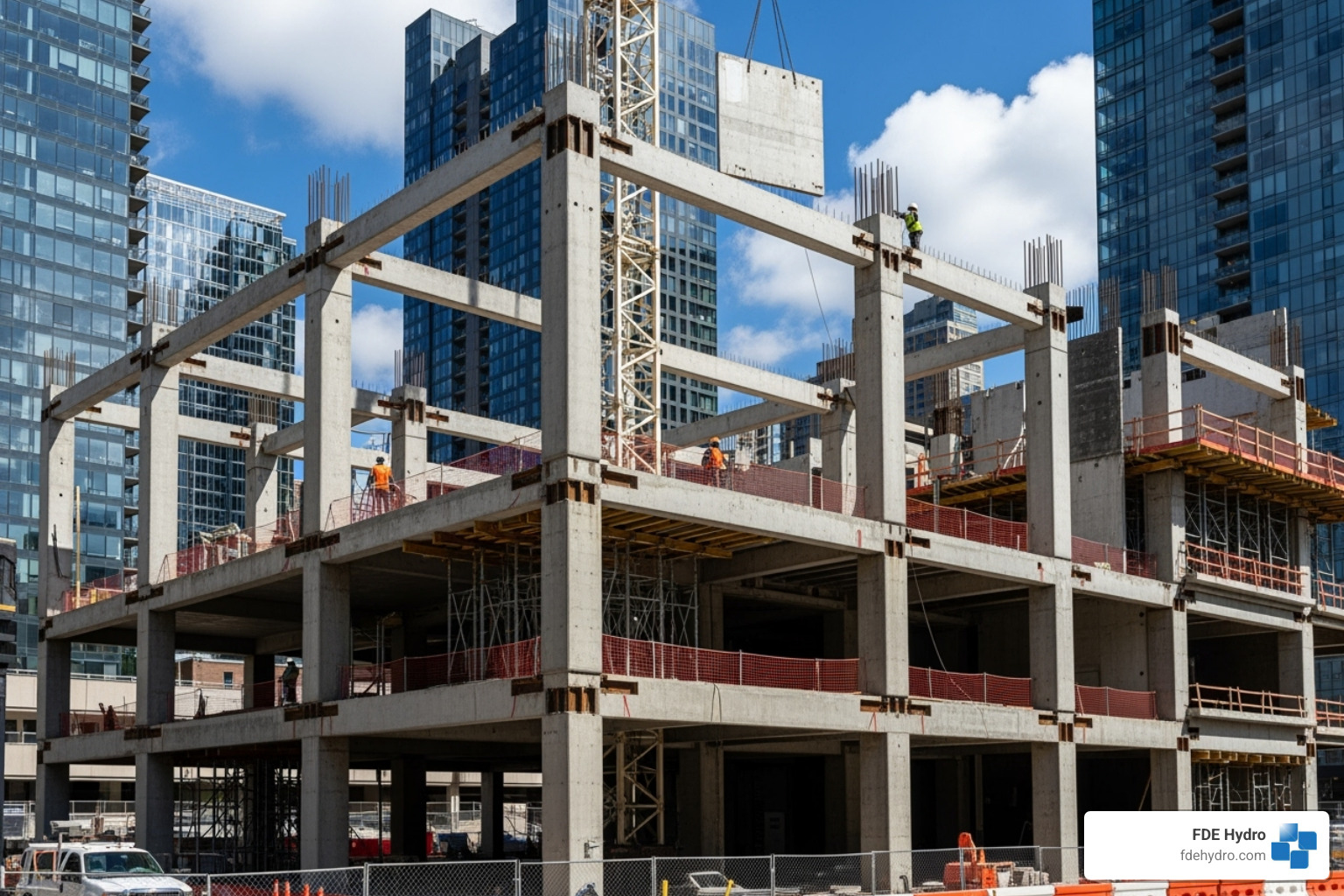
In urban environments, precast is used for commercial buildings and parking structures, where rapid assembly and durability are key. The repetitive nature of parking garage design makes precast especially efficient.
In civil infrastructure, precast excels. Bridges, for example, can be built in a fraction of the time of traditional methods. Our project, A National Example of Rapid Bridge Construction Using Modular Precast Elements, shows how entire spans can be assembled in days, minimizing public disruption. Other common applications include durable retaining walls, culverts, and sound barriers.
For specialized applications, precast is even more critical. At FDE Hydro™, we use modular precast technology for water control systems and hydropower infrastructure. These projects demand precision and resistance to constant water exposure. Our Modular Powerhouses and the Prototype of Modular Precast French Dam Completed demonstrate how precast can make renewable energy projects faster and more cost-effective.
Other applications include foundations, basements, floors, beams, columns, stairs, utility structures, and tunnel segments. All these uses share a common need for reliable, efficient, and long-lasting construction. The consistent precast concrete advantages make it an indispensable material in modern construction.
Conclusion: Building the Future with Precast Concrete
The precast concrete advantages offer a transformative approach to construction that is faster, smarter, and more durable. Every step, from factory production to on-site installation, is optimized for exceptional results.
By guaranteeing superior quality, compressing timelines by up to 50%, and reducing on-site labor and waste, precast creates a win-win scenario. Its sustainability benefits—including LEED potential, use of recycled materials, and improved energy efficiency—align with the need to build responsibly.
Precast also offers design freedom and makes construction sites safer. While there are logistical considerations, the long-term benefits of durability, speed, and cost savings make it a clear choice for forward-thinking projects.
At FDE Hydro™, we have seen how precast revolutionizes the renewable energy sector. Our patented French Dam system applies these advantages to hydropower and water infrastructure projects across North America, Brazil, and Europe, making them faster, more affordable, and built to last.
After five decades in heavy civil construction, I know that precast concrete challenges conventional thinking by prioritizing quality and safety from day one. Whether for a building, bridge, or hydropower installation, precast offers a proven path forward.
Ready to see how these precast concrete advantages can transform your next project? Explore our innovative means and methods for your next project and find how we can help you build smarter, faster, and for generations to come.
by Bill French Sr. | Dec 17, 2025 | Hydro Facility Articles
Why Water Control Systems Matter More Than Ever
A water control system is infrastructure designed to regulate, monitor, and manage the flow, distribution, and quality of water. Combining hardware (sensors, valves, pumps) with software (SCADA platforms, IoT dashboards), these systems ensure efficient water use, prevent damage, and support sustainability goals.
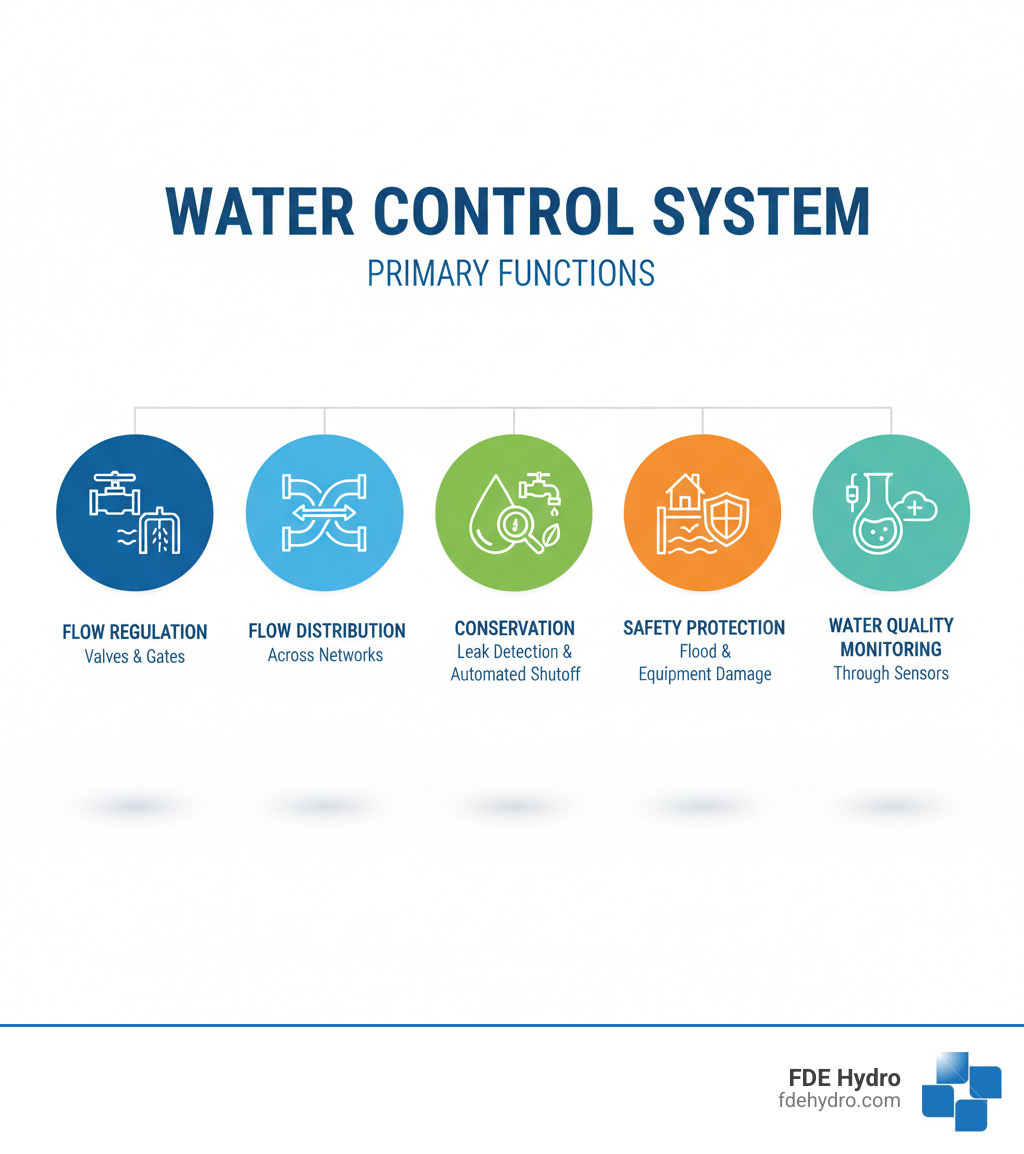
Key functions of water control systems include:
- Flow Regulation – Controlling water volume and pressure through pipes, canals, or reservoirs
- Distribution Management – Ensuring water reaches intended destinations efficiently
- Conservation – Reducing waste through leak detection, automated shutoff, and optimized usage
- Safety Protection – Preventing floods, equipment damage, and infrastructure failures
- Quality Monitoring – Tracking contamination, sediment, and chemical levels
The need for better water control is urgent. Water scarcity affects more than 40% of the world’s population—a figure expected to rise with climate change. Reflecting this, the global smart water management market is projected to reach $27.8 billion by 2030 as industries and municipalities invest in smarter systems.
These systems deliver significant savings: municipal water loss can be cut by up to 20%, agricultural water use by 15-30%, and industrial energy costs by 10-25%. For homeowners, automated shutoff systems can prevent an average of $10,000-$15,000 in leak-related damages.
I’m Bill French Sr., Founder and CEO of FDE Hydro™, where we develop modular civil construction solutions for the hydropower industry. With over five decades in heavy civil construction, I’ve learned that efficient water management is the backbone of resilient infrastructure. At FDE Hydro, we focus on innovative water control systems that benefit both present and future environments.
What Are the Core Functions of a Water Control System?
A water control system’s core mission is to ensure water goes where it needs to, when it needs to, and in the right amount. Its primary functions work in harmony to achieve this.
Water regulation and distribution are the most fundamental jobs. This means controlling the volume and pressure of water flowing through pipes, canals, or reservoirs to meet demand precisely. Whether keeping pressure steady in a home or managing levels at Dams for hydropower, this control is essential for efficiency and reliability.
Conservation has become critical as water scarcity and climate change intensify. Modern water control systems tackle this through smart leak detection, automated shutoffs, and optimized scheduling. These technologies are vital for creating Sustainable Water Infrastructure and have a massive impact in agriculture, which accounts for 70% of global freshwater use.
Safety and protection are equally important. By monitoring water levels and controlling releases through gates and Spillways, these systems protect communities from floods. They also perform water quality management by using sensors to track contaminants and sediment. At the same time, they provide equipment protection by preventing pumps from running dry or safeguarding turbines from debris, extending the life of infrastructure investments. As scientific research on water resources and climate change highlights, such integrated management is essential for climate adaptation.
Anatomy of a Modern Water Control System
A modern water control system integrates hardware and software to manage water with precision.
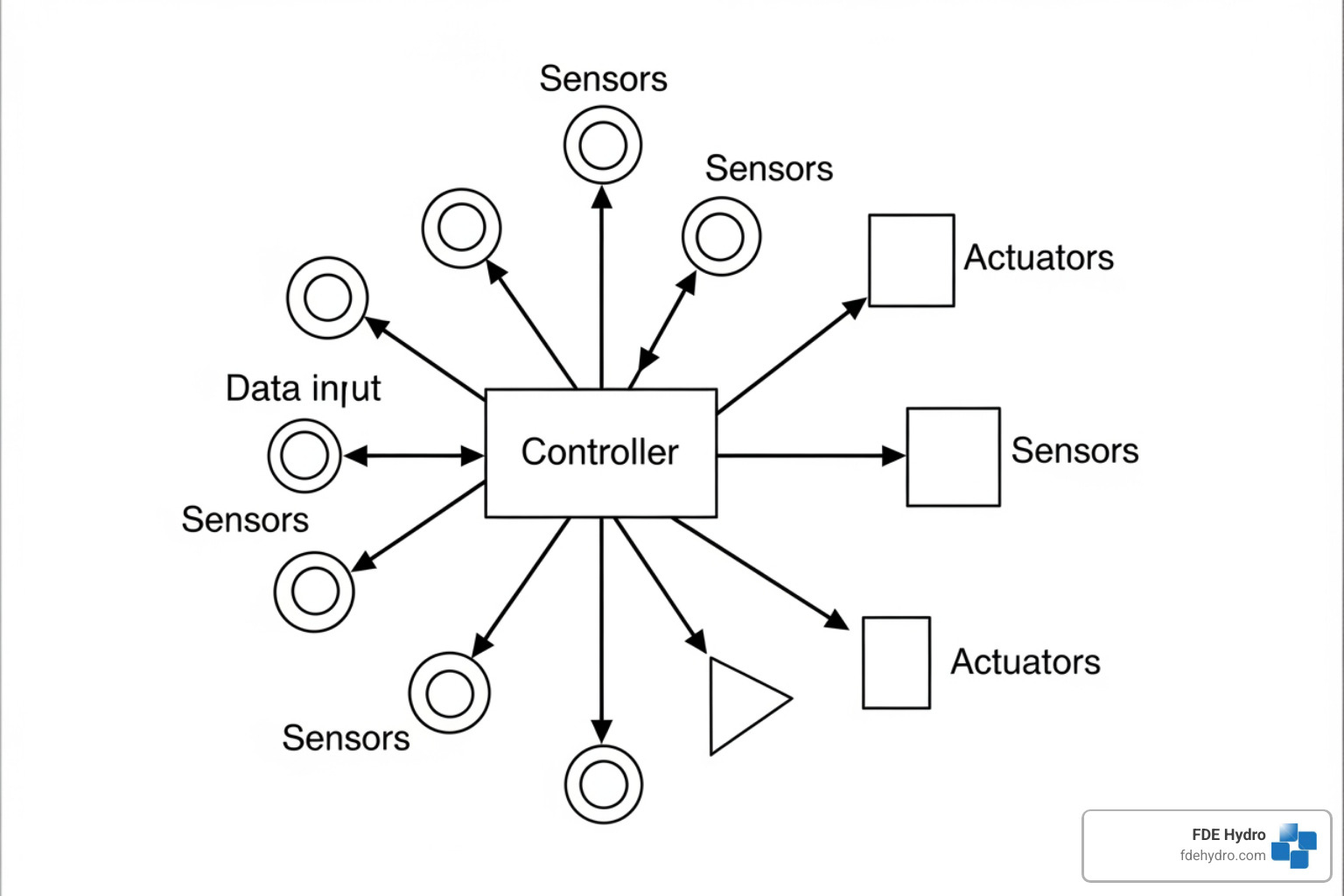
This section explains the key components of a modern water control system, showing how they work together to achieve optimal water management.
Key Hardware Components
Hardware components are the physical parts of the system that perform sensing and control actions.
- Sensors gather critical data. Flow sensors measure water speed, while pressure sensors monitor pressure and can even detect minute leaks. Level sensors, such as reliable pressure transducers or simpler float switches, track water levels in tanks and reservoirs. Quality sensors monitor pH, turbidity, and chemical composition.
- Actuators perform the physical work. Valves control flow and pressure, ranging from manual to sophisticated automatic control valves. Pumps move water where it needs to go. Control gates are massive structures that manage large water flows at Water Control Structures and hydroelectric facilities.
- Controllers are the system’s brain. Programmable Logic Controllers (PLCs) handle complex industrial automation, while smaller Microcontrollers (like the ESP32) are ideal for IoT applications. Remote Terminal Units (RTUs) enable remote monitoring and control.
- Communication Networks like radio, cellular, or wired connections link these components, enabling real-time management.
Software and Intelligent Control
Software transforms the hardware into a truly smart water control system.
Centralized control platforms (often SCADA systems) provide a complete, real-time overview of the entire water network. IoT dashboards make this data accessible from anywhere, allowing an operator to check a well’s water level or monitor industrial usage from a phone.
Data analytics and predictive modeling analyze historical data to spot trends, predict equipment failures, and optimize operations. For example, comparing rainfall data with well recovery rates provides powerful information for planning.
This intelligence is improved by integration with industrial automation, creating an interconnected framework that improves overall efficiency. At FDE Hydro, we advance these capabilities through AI-Driven Development, using artificial intelligence to make systems smarter. The Design and Implementation of an Automated Water Monitoring and Control System shows how microcontrollers can create autonomous systems that ensure reliable supply without constant human intervention.
Applications Across Sectors: From Homes to Hydropower
The versatility of a water control system allows it to be adapted for vastly different applications, from a single home to a massive hydroelectric facility. While the principles of monitoring and managing water remain the same, the scale and goals vary by sector.
| Sector |
Primary Goals |
Common Technologies |
Scale |
| Residential |
Leak prevention, water conservation, comfort |
Smart shut-off valves, leak detectors, smart irrigation, water softeners |
Single home to apartment complex |
| Agricultural |
Efficient irrigation, crop yield optimization |
Smart irrigation controllers, soil moisture sensors, automated canal gates, flow meters |
Small farm to large-scale irrigation district |
| Industrial |
Process efficiency, equipment protection, compliance |
Water level controls (cooling towers), flow control systems, wastewater treatment controls |
Single plant to multi-site operations |
| Municipal |
Distribution, quality, flood control, resource management |
SCADA systems, smart meters, pressure regulation, dam controls, flood sensors |
City-wide to regional water authority |
Residential and Commercial Systems
In homes and commercial buildings, water control systems work quietly to protect property and conserve resources. Leak detection with automated shutoff valves is a key feature, immediately closing the main water supply when a burst pipe is detected to prevent catastrophic water damage. In colder climates like Canada and the northern U.S., some systems also monitor temperature to prevent pipes from freezing and bursting.
Smart irrigation timers adjust watering schedules based on local weather data, conserving water while keeping landscapes healthy. In commercial buildings, sub-metering tracks usage by tenant to promote accountability, while water softeners and filtration systems improve water quality.
Agricultural Water Control
With agriculture being the largest consumer of freshwater, efficient water control systems are essential for global food security. Precision irrigation uses data from soil moisture sensors to deliver water directly to crop root zones, minimizing waste and maximizing yields. This technology is a genuine win-win for farmers and the environment.
Canal automation scales up this efficiency. Instead of manual gate adjustments, automated systems coordinate gates along entire canal networks to ensure consistent flow and eliminate spillage, making open canals nearly as precise as pressurized pipes at a fraction of the cost. For more insights, explore our page on irrigation control systems.
Industrial and Municipal Infrastructure
At the industrial and municipal scale, water control systems are feats of engineering managing enormous volumes of water. In process water management, they maintain exact water levels and flow rates critical for cooling towers, refineries, and manufacturing. Optimized controls can significantly reduce energy consumption from pumping.
Wastewater treatment plants rely on these systems to regulate chemical dosing and biological processes to meet strict environmental regulations. Municipal distribution networks use advanced SCADA systems to monitor thousands of miles of pipes, manage pressure, detect leaks, and ensure reliable service to millions of customers.
Flood control infrastructure, including dams and Spillways, protects communities by managing extreme water flows. At FDE Hydro, we contribute our expertise to these critical Water Control Structures, as detailed in our Hydroelectric Dam Components Ultimate Guide.
The Advantages of Automation and Smart Technology
The shift toward automated water control systems is a practical pathway to efficiency, sustainability, and significant cost savings.
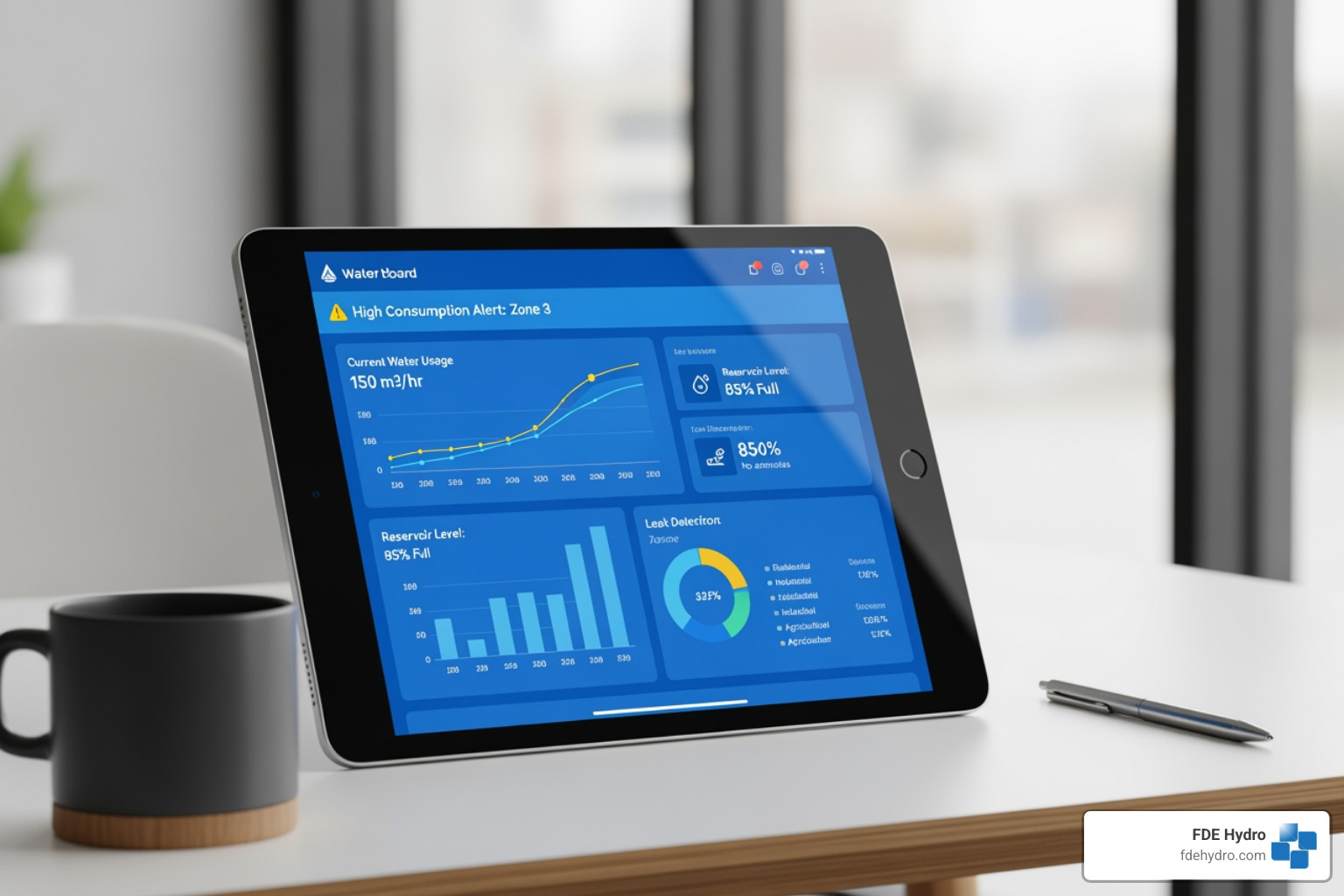
This section details the benefits of implementing an automated water control system.
Cost Savings and Efficiency
The financial case for automated water control systems is compelling. They lead to significant cost savings through reduced water loss, as every gallon saved is money that doesn’t need to be spent on sourcing, treating, and pumping. This leads directly to lower energy consumption, as pumps run only when needed and at optimal speeds.
Automation also minimizes labor costs by freeing personnel from manual monitoring and adjustments to focus on more complex tasks. Perhaps most importantly, these systems help prevent costly equipment failures. By continuously monitoring equipment health and detecting anomalies early, they can shut down machinery before catastrophic damage occurs, saving far more than the initial investment. Our work at FDE Hydro demonstrates this principle, using efficient methods like those in Why Precast Cost Less to build more resilient and cost-effective infrastructure.
Improved Conservation and Compliance
Beyond financial gains, automated systems are powerful tools for environmental stewardship. They make meeting regulatory standards in regions like the United States and Europe almost effortless by providing precise, consistent control and detailed records for reporting.
By reducing water waste and energy use, these systems directly contribute to achieving sustainability goals. This aligns with our mission at FDE Hydro to develop sustainable solutions like hydropower, which offers many environmental advantages as detailed in the Benefits of Hydropower Plant. The accurate usage data they provide transforms water management from guesswork into a science, enabling informed planning and demonstrating a commitment to reducing environmental impact.
Challenges, Maintenance, and Future Innovations
While modern water control systems offer incredible benefits, they require thoughtful planning, ongoing maintenance, and adaptation to new challenges.
The initial investment costs can be substantial, particularly for large-scale projects. However, the long-term savings from reduced water loss, lower energy bills, and prevented failures often provide a clear return on investment. Another growing concern is cybersecurity vulnerabilities. As critical infrastructure becomes connected, robust security protocols are essential to protect communities from service disruptions or safety hazards. Finally, system integration complexity requires expert implementation, especially when upgrading Aging Infrastructure Being Replaced with Next Generation Civil Solutions with a mix of old and new components.
Installation and Maintenance Considerations
Proper installation and maintenance are key to a system’s longevity and performance. This begins with a thorough site assessment to understand existing infrastructure and environmental challenges. Component selection is also critical; sensors and actuators must be rated for the specific operating environment to ensure reliability.
Ongoing tasks include periodic sensor calibration to maintain accuracy and managed software updates to patch vulnerabilities and add features. Despite automation, regular physical inspections by trained personnel remain irreplaceable for spotting leaks, corrosion, or physical damage. For major infrastructure, specialized approaches like Dam Rehabilitation Encapsulation offer innovative solutions for extending service life.
The Future of Water Control Technology
The future of water control system technology is being shaped by powerful innovations.
Digital twins, virtual replicas of physical water systems, allow engineers to simulate scenarios and optimize strategies without real-world risk. AI for predictive maintenance is evolving to analyze complex data patterns and anticipate equipment failures weeks in advance, minimizing downtime. At FDE Hydro, our work with AI-Driven Development explores how these technologies can optimize both construction and operations.
Advanced non-invasive sensors promise easier and more reliable monitoring without direct water contact, reducing installation costs. Decentralized control systems are also emerging, creating more resilient networks where segments can operate autonomously. At FDE Hydro, we focus on Using Technology to Minimize the Duration of Impacts to build smarter systems faster, more affordably, and with less environmental impact.
Conclusion
We’ve seen how water control systems are essential for regulating flow, distributing water, conserving resources, and ensuring safety. From the hardware of sensors and actuators to the intelligence of modern software, these systems are versatile tools with applications in our homes, on our farms, and across our cities.
The benefits are compelling. Intelligent automation leads to significant savings in water and energy, reduces operational costs, and prevents costly disasters. More importantly, this technology represents a collective commitment to managing water more responsibly. With a large portion of the world’s population facing water scarcity, we cannot afford to waste this vital resource.
At FDE Hydro, this mission is personal. Our innovative, patented modular precast concrete technology—the “French Dam”—is designed to make building and retrofitting hydroelectric dams and water control infrastructure faster, more cost-effective, and more sustainable across North America, Brazil, and Europe.
The future is bright, with innovations like digital twins, AI-driven predictive maintenance, and advanced sensors set to make our water systems even smarter and more resilient. We are embracing these technologies to deliver reliable, efficient, and sustainable water management.
Whether you’re managing a farm, an industrial facility, or municipal infrastructure, understanding water control systems is crucial. To learn more about how advanced water control contributes to renewable energy and sustainable infrastructure, explore our resources on Hydropower and our comprehensive guide to Water Control Systems.
by Bill French Sr. | Dec 16, 2025 | Hydropower Articles
Why Hydropower Innovation Case Studies Matter More Than Ever
Hydropower innovation case studies reveal how the renewable energy sector is changing to meet dual demands: generating more clean electricity while protecting river ecosystems. Here’s what you need to know:
Key Innovation Areas:
- Modernization of aging plants – Nearly 40% of global hydropower facilities are over 40 years old and need upgrades
- Fish-friendly turbines – New designs achieve 98%+ survival rates while maintaining efficiency
- Retrofitting existing infrastructure – Reusing dams, canals, and weirs cuts costs by 20-30%
- Digital twins and AI – Real-time monitoring improves efficiency by 1.2% and prevents failures
- Community-centered development – Projects like Tina River create 440+ local jobs while reducing CO2 by 49,500 tonnes annually
The global hydropower fleet faces a critical moment. With investment declining to $50 billion in 2023 (down from previous years) and generation decreasing by over 100 TWh, the industry must innovate or risk falling behind solar and wind. Yet hydropower remains essential—it provides more than 90% of global energy storage capacity and offers best grid stability.
The challenge isn’t just technical. Hydropower projects must balance decarbonization goals with ecosystem protection, satisfy local communities, and deliver returns despite long development timelines. Traditional construction methods—slow, expensive, and environmentally disruptive—no longer meet these demands.
That’s where innovation makes the difference. From modular construction that cuts installation time from 9 years to 6 to turbines that let fish pass safely through, these case studies show practical solutions that work today.
I’m Bill French Sr., Founder and CEO of FDE Hydro, where I’ve spent years developing modular precast concrete solutions that reduce both construction time and environmental impact for hydropower projects. Through analyzing hydropower innovation case studies from Europe to the Pacific Islands, I’ve seen how the right technologies can transform project economics while protecting the rivers we depend on.
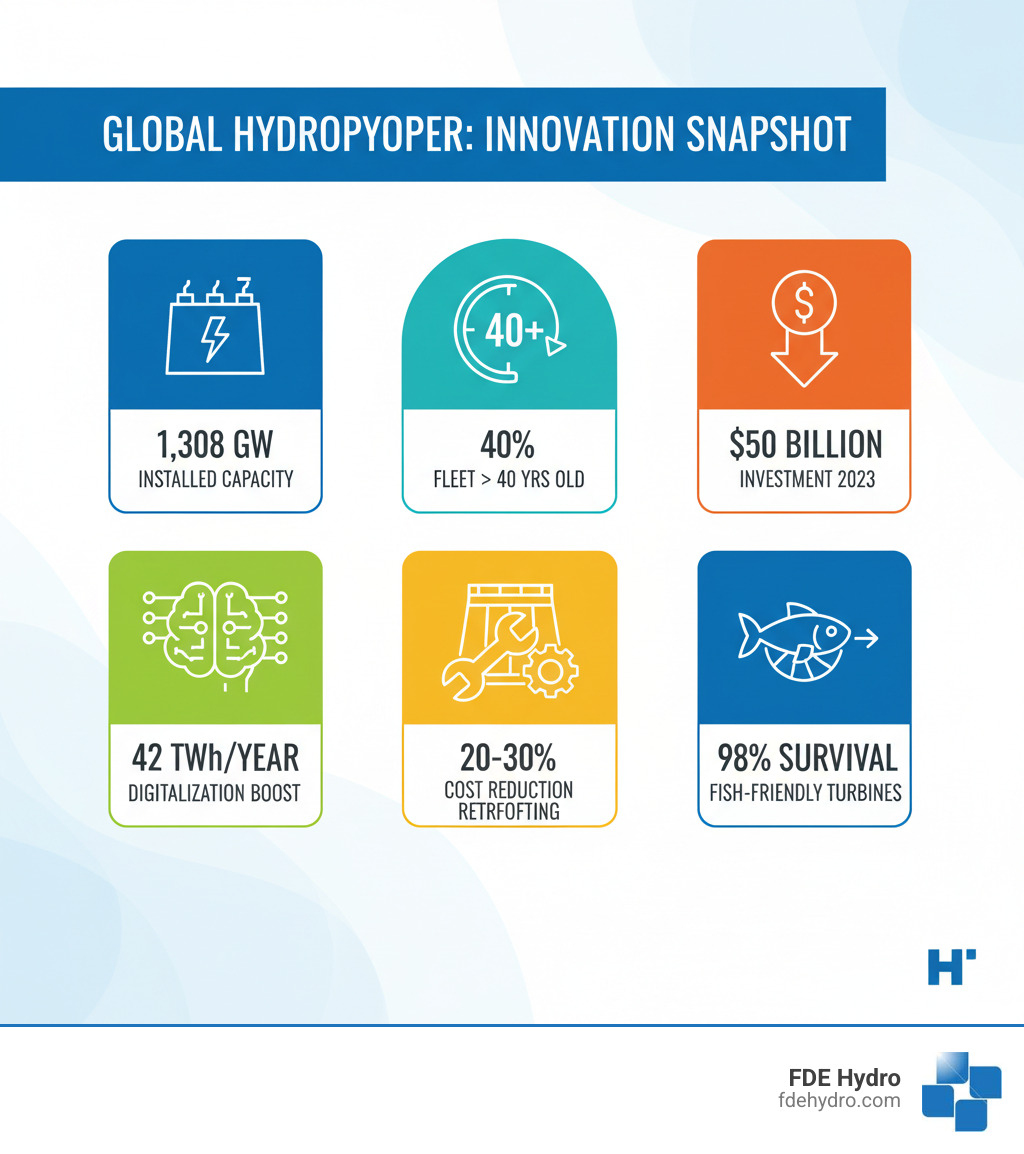
Terms related to hydropower innovation case studies:
The Dual Challenge: Modernizing an Aging Fleet While Protecting Ecosystems
Hydropower faces a dual challenge: modernizing its aging infrastructure to meet growing clean energy demands while protecting the river ecosystems it impacts.
The aging infrastructure problem is significant. Nearly 40% of the global hydropower fleet (476 GW) is over 40 years old, with many plants in North America and Europe now facing reduced efficiency, higher maintenance, and outdated environmental protections. Modernization is essential for reliable, sustainable energy.
This challenge is compounded by declining investment, which fell to around USD 50 billion in 2023. This is concerning given hydropower’s unique role in providing grid stability and flexibility. Pumped storage alone offers over 90% of the energy storage in the EU, balancing intermittent renewables like solar and wind. Without investment in modernization, this vital grid stability is at risk.
Environmentally, traditional hydropower can alter river flows, harm aquatic life, and block fish migration. Climate change exacerbates these issues with erratic rainfall affecting water availability and production. However, these challenges are driving innovation.
For example, digitalization can improve efficiency by 1.2%, potentially adding 42 TWh to global production annually. Retrofitting existing non-powered dams and upgrading facilities offers even greater promise, cutting costs by up to 277 €/kW and reducing investment periods from nine years to six by reusing existing infrastructure.
Modernization gains are substantial, with potential generation increases of 8.4% in Europe and 8.8% in the U.S. from upgrades alone. These retrofits also improve a plant’s flexibility to support grids with high solar and wind penetration. Furthermore, upgrading facilities improves their multipurpose benefits, such as irrigation, flood management, and potable water supply. Addressing these challenges requires new technologies, construction practices, and policies to secure hydropower’s role in a clean energy future.
Pioneering Hydropower Innovation Case Studies
The future of clean energy isn’t just about building new—it’s about building better. Around the world, we’re seeing hydropower innovation case studies that prove we can meet our climate goals while protecting the rivers and ecosystems we depend on. These projects show what’s possible when innovation meets determination.
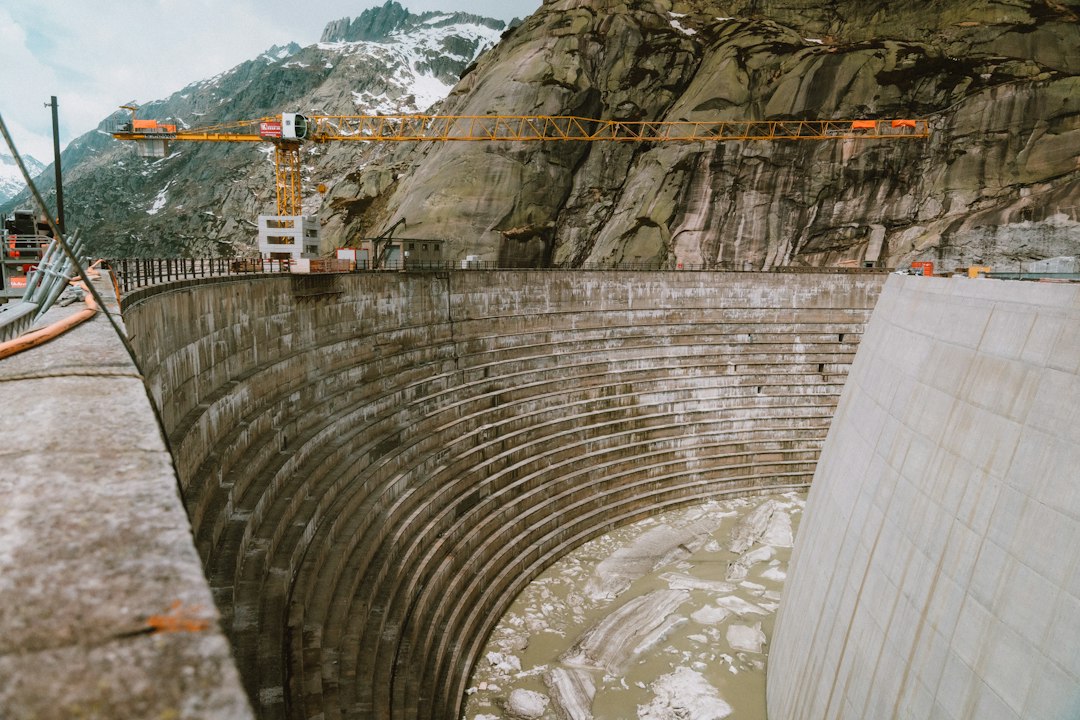
Case Study: The Tina River Project – A Model for Sustainable Development
The Tina River Hydropower Project in the Solomon Islands is a global blueprint for sustainable development. Previously reliant on expensive imported diesel, the nation’s capital now receives 68% of its electricity from this clean energy source. The project reduced diesel dependence from 97% to 30% and cuts CO2 emissions by 49,500 tonnes annually.
What makes the project a standout case study is its focus on community. It created 440 local jobs and established a landowner royalty scheme benefiting over 4,000 people, turning them into partners in success. Financially, it was the nation’s first large-scale public-private partnership, securing a USD 240 million package from a consortium including the World Bank and Green Climate Fund. This model, using concessional financing and risk insurance, demonstrates how to de-risk projects in challenging markets and aligns with The Solomon Islands’ development strategy.
Greening the Flow: Ecologically-Improved Turbines and Operations
For decades, hydropower dams that generated clean electricity could harm river ecosystems. That’s changing fast.
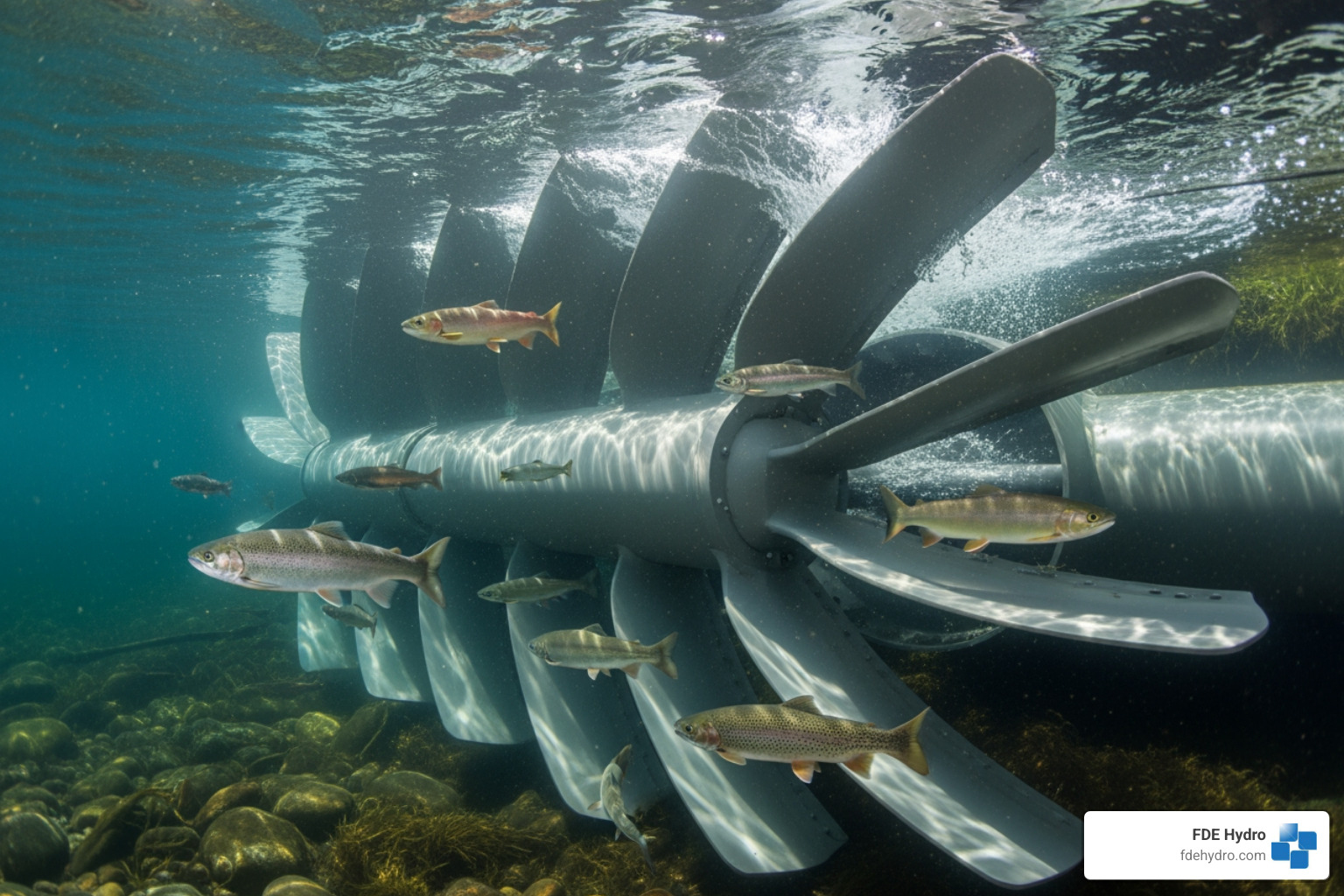
The development of ecologically improved turbines is a major advance. At the Ice Harbor Lock and Dam in Washington State, modifications achieved over 98% fish survival rates. Technologies like the Minimum Gap Runner, Alden turbine, and DIVE turbine are engineered to minimize blade strikes and pressure injuries. Other innovations include water-lubricated bearings, which eliminate the risk of oil contamination.
Another critical innovation addresses hydropeaking—rapid water flow fluctuations. In Bolzano, Italy, a plant installed demodulation reservoirs to release water gradually, dramatically improving river conditions. Smarter management of environmental flows and the use of low head hydropower converters are also opening up new, previously unusable sites like weirs and irrigation canals, often at a lower cost (less than 5,000 €/kW).
Open uping Hidden Potential: Hydropower Innovation Case Studies in Existing Infrastructure
What if the best hydropower opportunities lie not in new dams, but in using what we already have? Tens of thousands of non-powered dams, weirs, and canals exist across North America and Europe. Retrofitting these for power generation is an enormous, economically smart, and environmentally responsible opportunity.
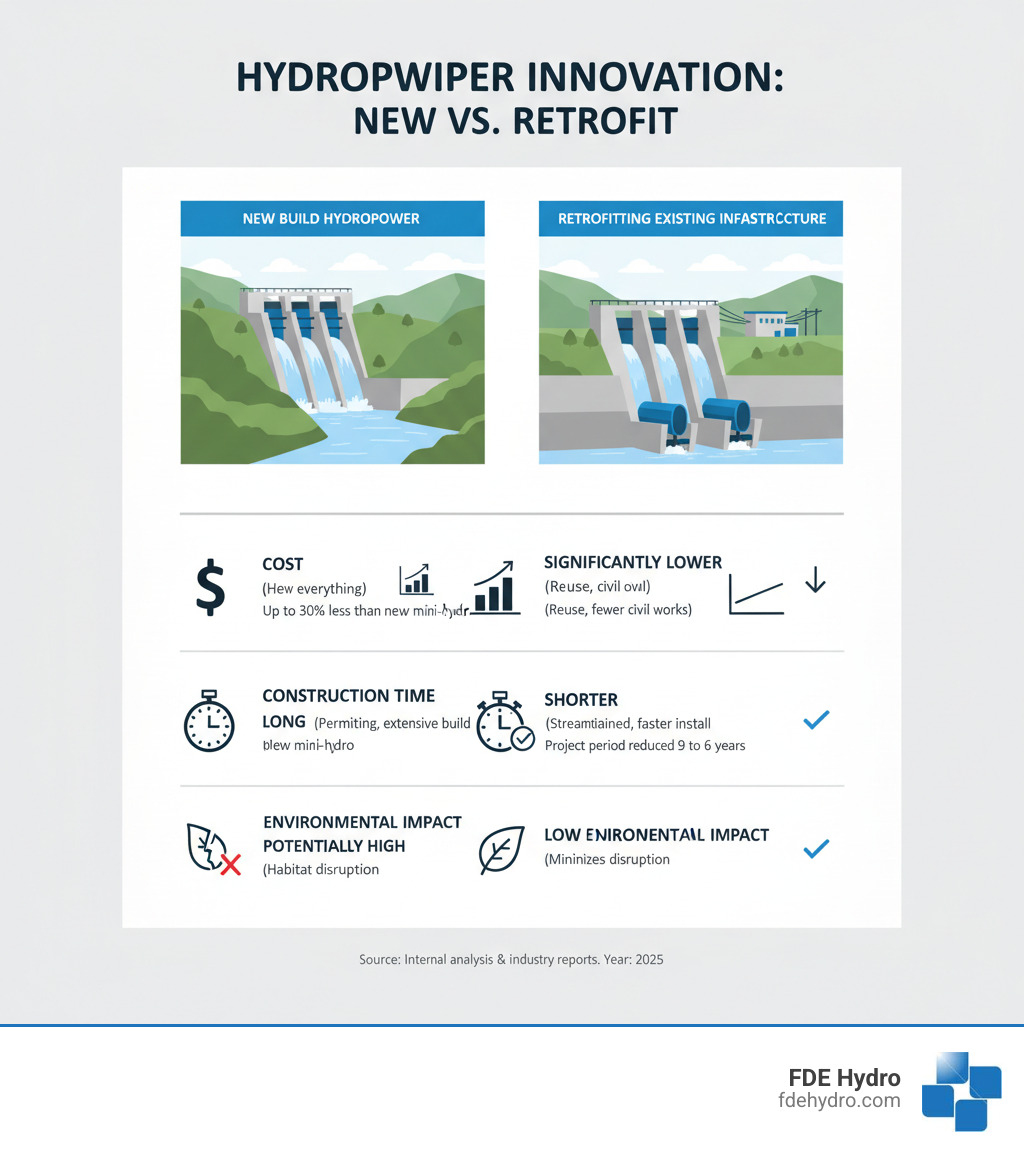
The advantages are substantial. Reusing existing infrastructure can save approximately 277 €/kW, and the investment period can shrink from nine years to six. The environmental footprint is minimal, with no new river fragmentation. Permitting is also typically faster.
The potential is vast: in the U.S., an analysis of 54,000 non-powered dams has already led to dozens of projects. Modernizing existing hydropower plants is another key opportunity, with the potential to boost generation by 8.4% in Europe and 8.8% in the U.S. This is where modular precast concrete technology, like the systems developed at FDE Hydro, makes a significant impact. Our approach minimizes on-site construction, making it ideal for open uping the hidden potential in existing infrastructure across North America, Brazil, and Europe.
The Digital Wave: Changing Hydropower with Technology
If you’ve ever wondered what the future of hydropower looks like, it’s happening right now—and it’s digital. We’re living through a remarkable change where hydropower innovation case studies increasingly showcase smart grids, advanced data analytics, and artificial intelligence working alongside traditional turbines and generators. This isn’t science fiction; it’s the practical reality reshaping how we generate clean, reliable electricity.
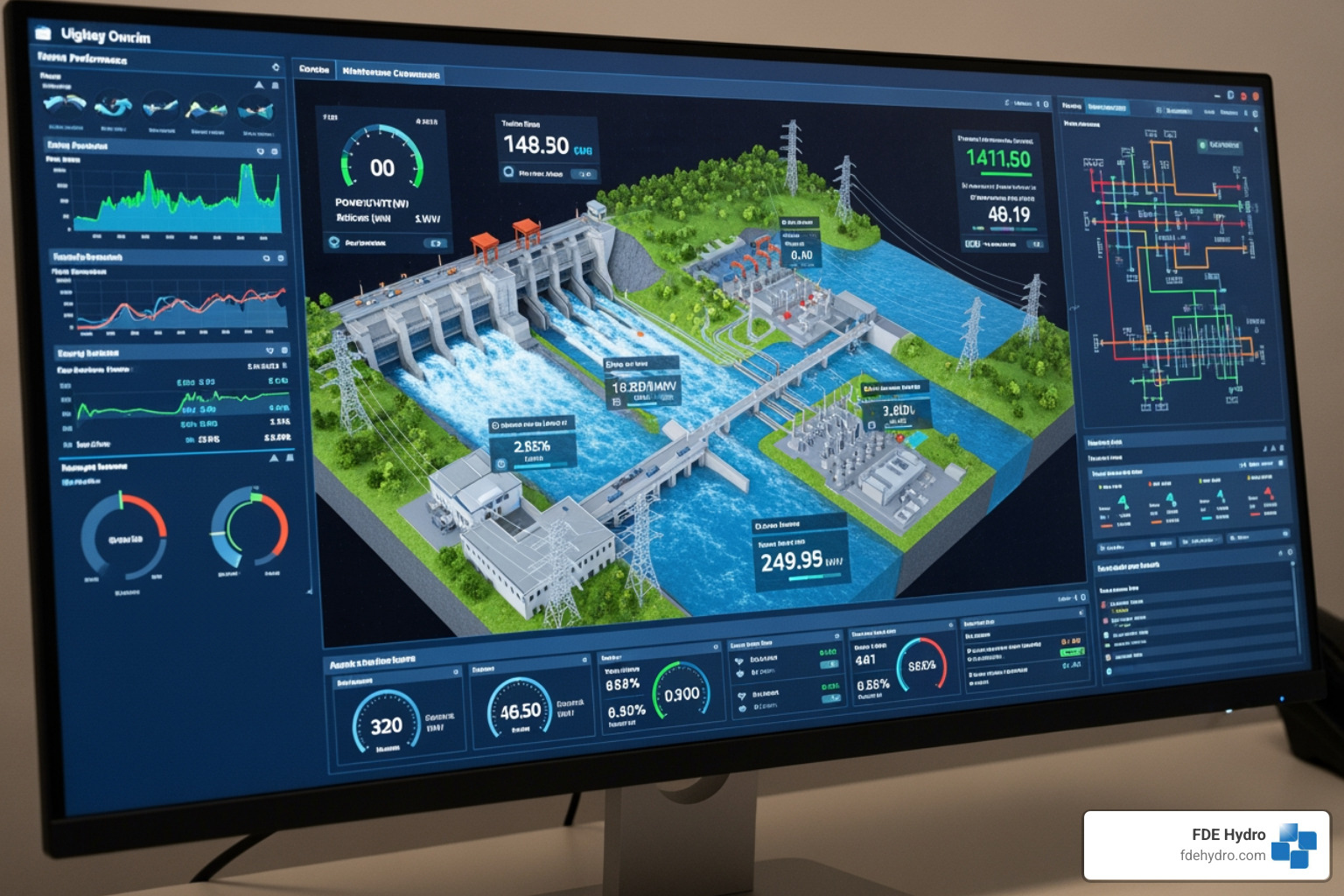
This digital revolution is critical for keeping hydropower competitive. Smart grids allow plants to respond dynamically to electricity demands, while predictive maintenance uses AI to anticipate equipment failures, scheduling repairs before they cause outages. Organizations like the IEA Hydropower Technology Collaboration Programme help accelerate the adoption of these technologies by sharing innovations globally.
How Digitalization is Changing Hydropower Operations and Maintenance
Digitalization can improve overall efficiency by 1.2%. While that may not sound earth-shattering, for large-scale facilities it translates into significant additional clean energy. An Italian plant, for example, used data-driven software to increase annual production by exactly 1.2%.
Real-time monitoring systems are now the eyes and ears of modern plants, giving operators immediate insights that prevent problems. The most fascinating development is the “digital twin”—a virtual model of a physical plant that receives real-time sensor data. At the La Bâtiaz power plant in Switzerland, a digital twin has monitored penstock fatigue since 2014. It revealed that certain grid services could increase fatigue wear tenfold, allowing operators to adjust strategies to balance grid support with equipment longevity. This fatigue monitoring is crucial for aging infrastructure.
The shift to predictive maintenance is another practical benefit, minimizing outages and reducing costs. At FDE Hydro, we see how this digital change complements our modular precast concrete technology. Combining rapid construction with smart operational systems creates facilities that are built faster and perform better from day one.
The Role of Policy and International Collaboration in Driving Innovation
Innovation requires supportive policies and international collaboration. Behind every successful hydropower innovation case study are frameworks that allow new ideas to grow. International financial institutions like the World Bank, the International Finance Corporation (IFC), and the Asian Development Bank (ADB) play a key role by de-risking ambitious projects, making them attractive to private investors.
National development strategies provide long-term vision, while regional agreements like Europe’s “Guiding Principles on Sustainable Hydropower Development in the Danube Basin” harmonize standards for environmental protection. Organizations like the IEA Hydropower Technology Collaboration Programme are vital for accelerating progress by sharing knowledge across borders. Key policy recommendations include streamlining regulations, creating market mechanisms that fairly compensate hydropower for its grid services, and supporting modernization. These efforts create the environment where technological innovations can thrive.
Frequently Asked Questions about Hydropower Innovation
How does innovation make hydropower more environmentally friendly?
Modern innovation is fundamentally changing hydropower’s relationship with river ecosystems. Key improvements include:
- New Turbine Designs: Technologies like the Minimum Gap Runner and Alden turbine are designed to be ‘fish-friendly,’ achieving over 98% fish survival rates at some sites by minimizing blade strikes and pressure changes.
- Oil-Free Systems: Water-lubricated bearings and other oil-free components eliminate the risk of petroleum leaks, protecting water quality.
- Advanced Operations: To mitigate hydropeaking (rapid flow changes that harm habitats), plants like the S. Antonio facility in Italy use demodulation reservoirs to release water gradually, restoring more natural river conditions.
- Better Sediment Management: New approaches, including continuous de-sedimentation systems, help restore the natural transport of sediment, which is vital for downstream ecosystems.
Can we add hydropower to dams that don’t currently produce power?
Yes, and this is one of the most exciting opportunities in renewable energy right now! Thousands of non-powered dams (NPDs) exist in the U.S. and Europe, built for flood control or irrigation. Adding power generation to these structures, a practice known as retrofitting, leverages existing infrastructure and avoids the environmental impact of building new dams.
The economics are compelling. Reusing existing pipes and reservoirs can save approximately 277 €/kW, and installing low head converters can cost less than 5000 €/kW, making previously uneconomical sites viable. Studies have identified significant potential, with dozens of projects already operational or in development in the US and Europe. Modular technologies, like FDE Hydro’s precast concrete solutions, are ideal for these retrofits, accelerating timelines and making projects more cost-effective.
What is a “digital twin” in hydropower?
A digital twin is a virtual, real-time replica of a physical hydropower plant. It receives a constant stream of data from sensors on the actual equipment, monitoring everything from pressure and vibration to structural stress. Its primary uses are:
- Predictive Maintenance: By analyzing data patterns, the digital twin can predict potential equipment failures before they happen. This allows maintenance to be scheduled proactively, avoiding costly outages and extending equipment life.
- Performance Optimization: The twin can run simulations to identify inefficiencies, helping to optimize operations and increase energy output, often by more than 1%.
- Structural Health Monitoring: For aging components like penstocks, a digital twin provides continuous fatigue monitoring. For example, the Hydro-Clone twin at Switzerland’s La Bâtiaz plant helped operators understand how different operations affected component wear, allowing them to adjust strategies to prolong the plant’s life.
A digital twin gives you unprecedented visibility into your plant’s health and performance. It’s like having an expert constantly watching, analyzing, and advising—helping you maximize reliability, efficiency, and longevity throughout your facility’s operational life.
Conclusion: Powering a Sustainable Future with Innovative Hydropower
We’ve journeyed through some remarkable hydropower innovation case studies together, and I hope you’ve seen what I’ve witnessed firsthand: this industry is at an exciting turning point. We’re not just maintaining the status quo—we’re reimagining what hydropower can be in the 21st century.
The path forward is becoming clearer. Sustainability isn’t a constraint; it’s an opportunity. Innovations from fish-friendly turbines to digital twins prove that protecting ecosystems and generating clean energy can be achieved together.
We’re sitting on hidden treasure. Across North America, Brazil, and Europe, thousands of existing structures—non-powered dams, irrigation canals, old weirs—are waiting to be transformed into clean energy sources. The cost savings are real: 277 €/kW by reusing irrigation infrastructure, installation costs under 5000 €/kW for low head converters. These represent practical, achievable projects that can move forward today without the environmental disruption of new construction.
Technology is reshaping everything we thought we knew about operations. Digitalization is adding 1.2% efficiency improvements that translate into millions of additional kilowatt-hours annually. For an aging fleet where 40% of plants are over 40 years old, this digital revolution couldn’t come at a better time.
None of this happens in isolation. The Tina River Project showed us how international collaboration, innovative financing, and community engagement can transform energy systems. The World Bank, IFC, and ADB aren’t just funding projects—they’re de-risking innovation and making sustainable development possible.
Here at FDE Hydro, we’re working every day to be part of this solution. Our modular precast concrete technology—what we call the “French Dam”—was born from recognizing these exact challenges. When construction timelines drop from nine years to six, when costs decrease by 20-30%, when environmental disruption is minimized—that’s when hydropower becomes accessible for more communities.
The future of hydropower is about intelligence, integration, and respect for the systems we work within. The innovations we’ve explored prove that belief is justified. We can power our modern world while protecting the natural world.
That’s the sustainable future these hydropower innovation case studies are building, project by project, innovation by innovation. And we’re proud to be part of it.
To learn more about how we’re changing hydropower development, visit our page on hydropower.

