by Bill French Sr. | Dec 15, 2025 | Precast Dam Articles
Why Precast Concrete Technology Matters Now
Precast concrete technology is an industrialized construction method that is changing how we build. Instead of pouring concrete on-site, components are cast in a controlled factory environment, cured to full strength, and then transported to the jobsite for rapid assembly.
Key Benefits of Precast Concrete Technology:
- Speed: Erect one floor of a multi-story building in as little as one week.
- Quality: Factory conditions ensure superior strength and durability, with design lifespans of 50-100 years.
- Cost: Uses less water, cement, steel, and labor than cast-in-place methods.
- Sustainability: Creates a smaller carbon footprint and reduces on-site waste.
- Safety: Moves most construction work from hazardous jobsites to controlled factory floors.
The global precast concrete market is projected to reach $168.17 billion by 2026, driven by the demand for faster, more cost-effective construction. This technology’s power comes from combining industrialized processes, advanced materials, and digital tools like Building Information Modeling (BIM) for unprecedented precision and efficiency.
Modern precast has evolved far beyond simple blocks to include smart concrete with embedded sensors, 3D-printed formwork, and high-performance insulated panels. These innovations offer solutions to longstanding challenges in critical infrastructure, especially for industries like hydropower and water control systems.
I’m Bill French Sr., Founder and CEO of FDE Hydro. Over five decades in heavy civil construction, I’ve seen precast evolve from basic components to sophisticated modular systems. My company now holds patents in the US, Canada, Europe, and Brazil for modular precast solutions that dramatically reduce construction time and costs while benefiting the environment.
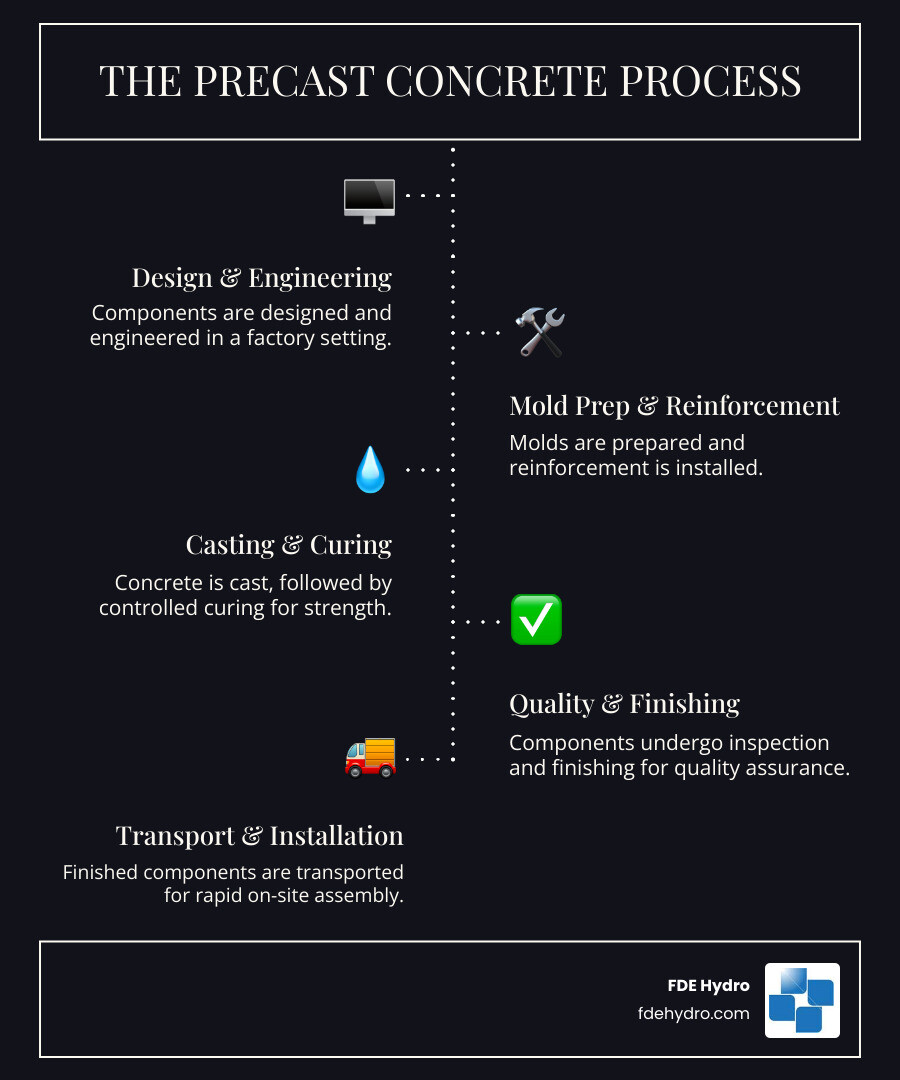
The Core Advantages: Why Precast is Reshaping Construction
Modern construction faces intense pressure to be faster, better, and more cost-effective. Precast concrete technology meets these demands in ways traditional methods cannot, representing a fundamental shift in how we build.
By manufacturing concrete components in a factory, everything changes. Consistent temperature, regulated humidity, and precise mixes result in denser, stronger concrete. This factory advantage extends beyond quality. While site preparation occurs, components are manufactured simultaneously, dramatically accelerating project timelines. Less on-site labor means lower costs and fewer delays, improving ROI.
Safety is also significantly improved. Moving labor-intensive work from hazardous jobsites to controlled factory floors protects workers from falls, weather, and other dangers. The finished product is also safer, offering excellent fire resistance and durability against impacts.
Surprisingly, precast concrete technology offers remarkable aesthetic flexibility. Modern techniques enable virtually any color, texture, or finish. Formliners create intricate patterns, and graphic concrete can embed photographic images into facades. For a detailed look at the cost advantages, explore our insights on Why Precast Cost Less.
How does precast stack up against traditional cast-in-place concrete? Here’s a clear comparison:
| Feature |
Precast Concrete |
Cast-in-Place Concrete |
| Cost |
Lower overall cost due to less labor, faster completion, and less waste. |
Higher labor costs and risk of overruns from weather and delays. |
| Quality |
Superior and consistent due to controlled factory environment and rigorous testing. |
Variable quality dependent on site conditions, weather, and skill. |
| Construction Time |
Significantly faster due to off-site manufacturing and rapid on-site assembly. |
Slower due to sequential on-site forming, pouring, and curing. |
| Sustainability |
Lower carbon footprint with less water, cement, and on-site waste. |
Higher resource use and on-site waste generation. |
| Durability |
Exceptional, with a design life of 50-100+ years. Resistant to mold and harsh weather. |
Good, but can be compromised by inconsistent quality and curing. |
| Safety |
Safer, with most work performed in a controlled factory, reducing on-site hazards. |
Higher on-site risk from formwork, pouring at heights, and weather. |
| Aesthetics |
Highly flexible with a wide range of colors, textures, and custom shapes. |
Limited by on-site finishing capabilities; consistency is a challenge. |
Best Speed and Efficiency
Speed changes everything in construction. Precast concrete technology delivers this advantage through industrialized manufacturing. By requiring fewer workers on-site, precast projects can proceed even when skilled labor is scarce in the US, Canada, and Europe.
Parallel processing is key. While foundation work happens at the site, structural components are manufactured at the plant. This just-in-time delivery means components arrive cured and ready for installation, eliminating weather delays during the critical setting period. The results are dramatic: one floor of a multi-story building can be erected in a week, and highway repairs can be completed overnight, minimizing traffic disruption.
Superior Quality and Durability
A building that lasts 100 years is a better investment than one needing repairs in 30. Precast concrete technology excels here. The controlled factory environment—with consistent temperature, humidity, and precise mix designs—is impossible to replicate on a jobsite. This produces high-strength concrete that is denser and more uniform.
The result is exceptional longevity, with design lives of 50 to 100 years, and sometimes up to 200. Precast concrete’s dense composition resists moisture, preventing mold and mildew, and it naturally resists fire and impact. For more background, the article on Precast concrete | Reinforced, Structural & Prefabricated provides excellent technical detail.
Aesthetic and Design Flexibility
Concrete doesn’t have to be plain. Modern precast concrete technology offers architects unprecedented design freedom. Architectural precast panels can achieve nearly any appearance, from smooth and polished to textured with exposed aggregate. Reusable molds make complex shapes and patterns practical and cost-effective.
Techniques like formliners can replicate the look of natural stone or brick, while graphic concrete can embed photographic images into facades. This design freedom allows buildings to be both functional and beautiful, changing urban landscapes from New York to Europe.
A Spectrum of Solutions: Types and Applications of Precast Concrete
Precast concrete technology is incredibly versatile, found in everything from skyscraper skeletons to the bridges we drive on. It’s not a one-size-fits-all material; it adapts to the specific challenges of a project.
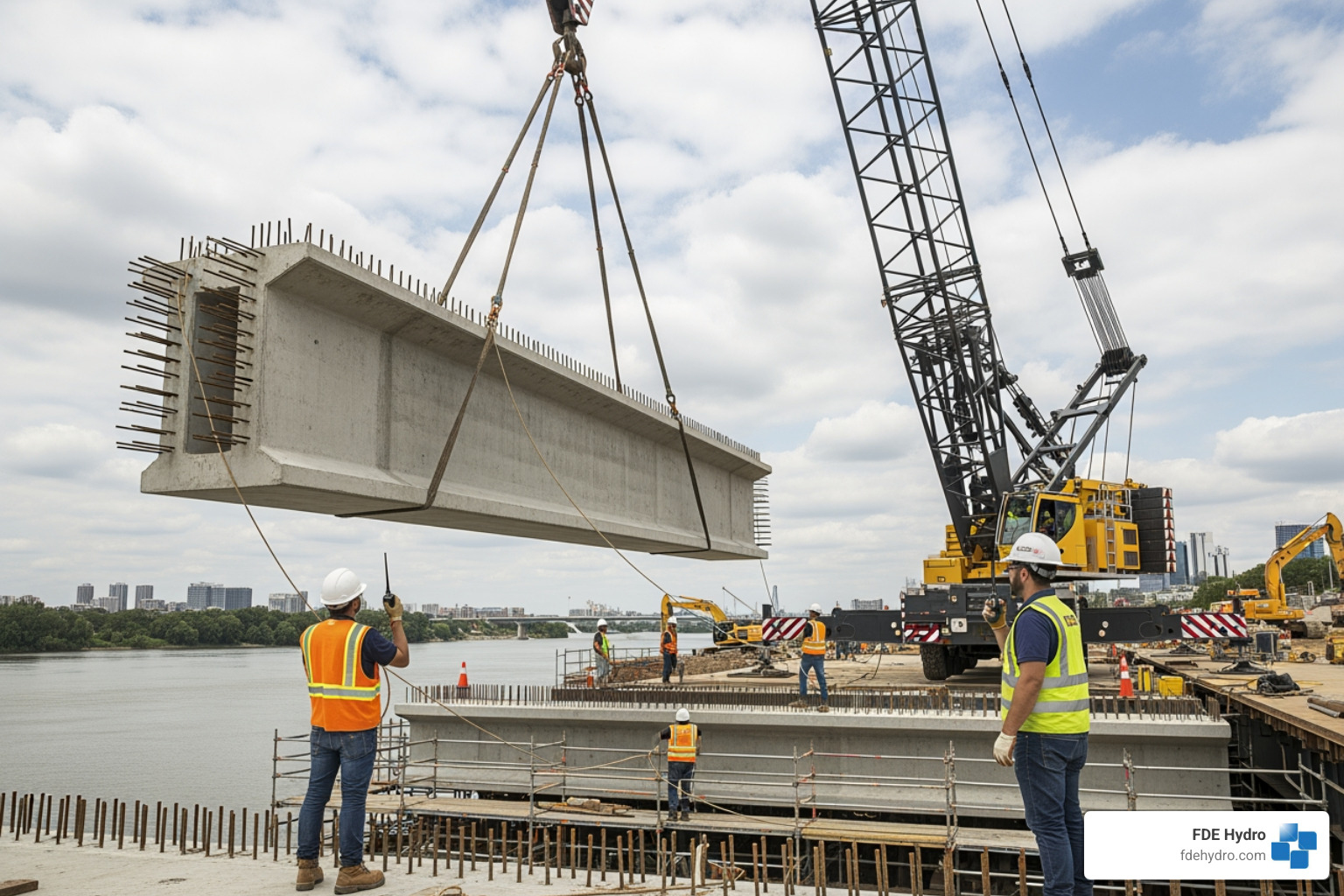
The same technology that creates architectural panels for an office in New York can produce massive bridge girders. We use precast for structural components, architectural elements, and infrastructure products that keep cities running.
At FDE Hydro, we’ve adapted this versatility for our specialized modular precast systems for hydropower and water control. The ability to be rapidly installed changes the game for civil infrastructure. You can learn more in our article on Rapid Installment of Module Precast Civil Infrastructure.
Structural and Architectural Systems
For buildings, precast concrete technology offers a toolkit combining structural strength with architectural beauty.
- Columns and Beams: These factory-made elements form the skeleton of countless buildings, manufactured to exact specifications for consistent, high load-bearing capacity.
- Hollow-Core Slabs: Lightweight yet incredibly strong, their hollow channels reduce weight and provide conduits for electrical and plumbing systems.
- Wall Panels: Available as solid structural panels, architectural cladding, or insulated sandwich panels, they offer thermal performance and noise control while enabling rapid enclosure of a structure.
- Total Precast Systems: For maximum speed, entire buildings—floors, walls, beams, and stairs—are constructed from precast elements, ensuring consistent quality.
- Cladding and Facades: These exterior walls are opportunities for creative expression, customized with virtually any color, texture, or pattern to create unique, durable, and energy-efficient building envelopes.
The Canadian Precast Concrete Institute showcases the wide range of Products and Systems – Canadian Precast Concrete Institute available for building applications.
Civil Infrastructure and Transportation
Precast proves its worth in civil infrastructure, where durability and speed are paramount.
- Bridge Construction: Precast girders, deck panels, and abutments are central to Accelerated Bridge Construction (ABC), which minimizes traffic disruption. We’ve documented examples like this National Example of Rapid Bridge Construction Using Modular Precast Elements.
- Culverts and Walls: Precast box culverts for drainage and retaining walls for earth retention are installed quickly with less site disruption.
- Precast Concrete Pavement (PCP): These durable panels are installed overnight and designed to last over 40 years, making them invaluable for busy highways in California, New York, and Kansas.
- Water Management: Stormwater systems rely on robust precast catch basins, manholes, and pipes.
- Hydropower and Water Control: At FDE Hydro, our patented “French Dam” technology is a specialized evolution of precast. We build and retrofit hydroelectric dams and water control systems faster and more cost-effectively across North America, Brazil, and Europe.
The Technological Leap: How Innovation is Advancing Precast Concrete Technology
Today’s precast concrete technology would seem like science fiction to builders just twenty years ago. We’ve moved beyond simple molds to integrate digital intelligence, robotics, and advanced materials science, creating solutions that are smarter, faster, and more precise.
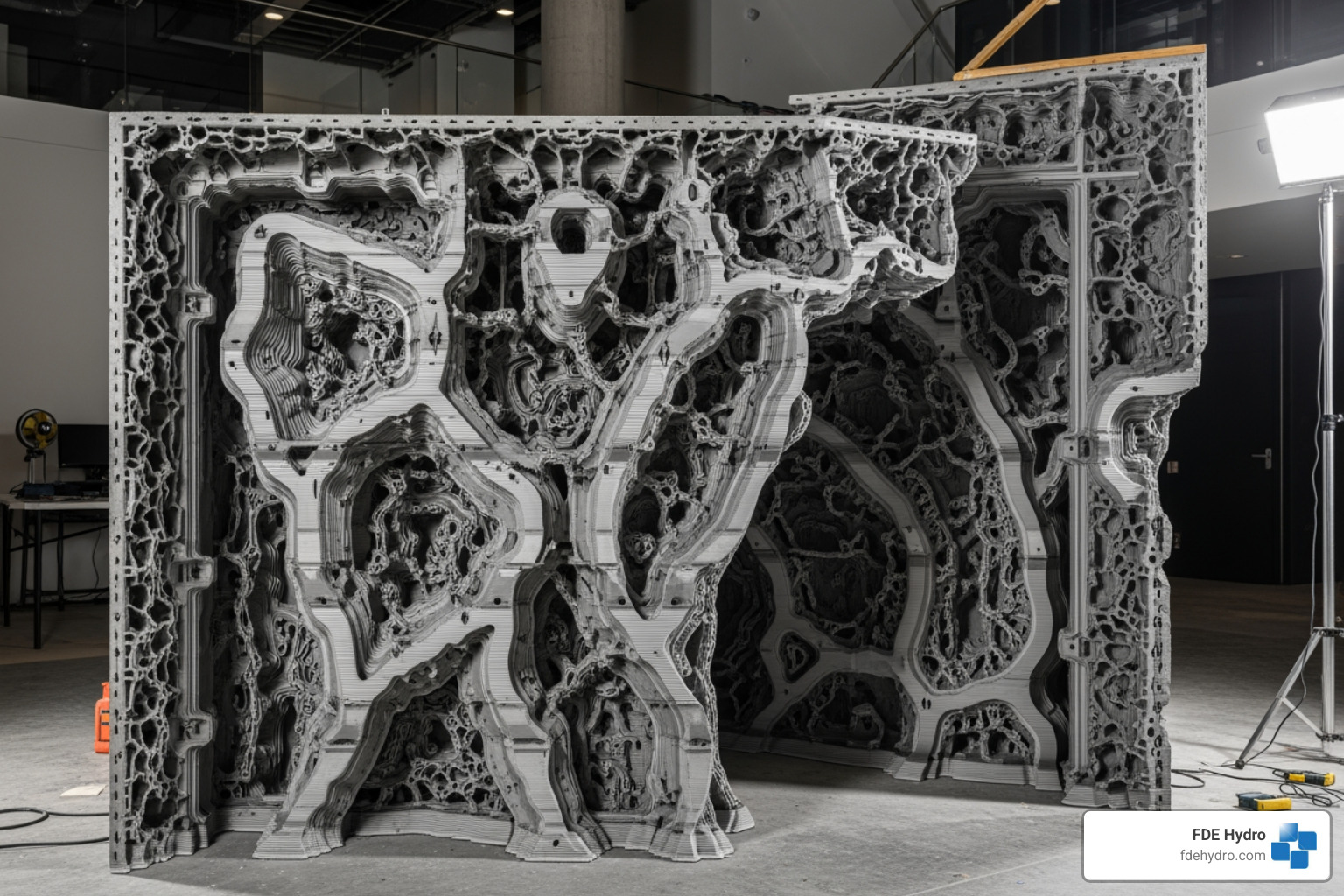
This marriage of concrete expertise with cutting-edge technology is making projects possible that were once prohibitively expensive or time-consuming.
Digital Integration: BIM and Digital Twins
The digital revolution has transformed the precast plant. Building Information Modeling (BIM) acts as a central digital blueprint, allowing teams to collaborate in real-time. At FDE Hydro, BIM lets us model every detail with precision, spot potential clashes, and coordinate with architects and engineers from New York to Brazil. This reduces on-site surprises and smooths project delivery.
Digital twin technology takes this further by creating a virtual replica of a manufacturing process or a finished structure. This allows us to monitor concrete curing, simulate production workflows, and track components from factory to site. This level of visibility helps us create more accurate Precast Models and deliver projects with unprecedented predictability.
Key Innovations in precast concrete technology
Breakthroughs are happening in the concrete itself and the molds that shape it.
Smart concrete, with embedded sensors and IoT devices, can monitor its own health. These sensors track structural integrity, temperature, and moisture, providing real-time feedback that is invaluable for critical infrastructure like bridges and dams in Canada, Europe, and the United States.
3D printing and additive manufacturing are revolutionizing custom formwork. While not yet used for entire girders, 3D printing excels at producing complex, custom molds for intricate architectural details. This approach reduces waste and speeds up the production of specialized components, offering geometric freedom for unique projects in places like California.
The concrete mix itself has evolved. Modern precast concrete technology incorporates advanced materials for superior performance.
- High-performance insulated panels sandwich insulation between concrete layers, creating structural, thermally efficient walls with R-values of R-28.2 or higher. This cuts energy costs in climates from Canadian winters to Brazilian summers.
- Advanced finishing techniques can polish concrete to a mirror shine or texture it to mimic stone or wood, improving both aesthetics and durability.
- Lightweight concrete mixes make components easier and cheaper to transport and install without sacrificing strength.
- Supplementary cementitious materials (SCMs) like fly ash and slag improve strength and durability while reducing the cement needed, lowering the carbon footprint.
- Ultra-High Performance Concrete (UHPC) achieves compressive strengths over 9,000 psi in just 10 hours, making it ideal for creating strong connections in rapid bridge construction.
Explore how these materials come together in our page on Modular Construction Techniques.
Building a Greener Future: Sustainability in Precast Concrete
The construction industry must consider its environmental consequences. Precast concrete technology offers a path forward that reduces waste, conserves resources, and creates structures that perform efficiently for generations.
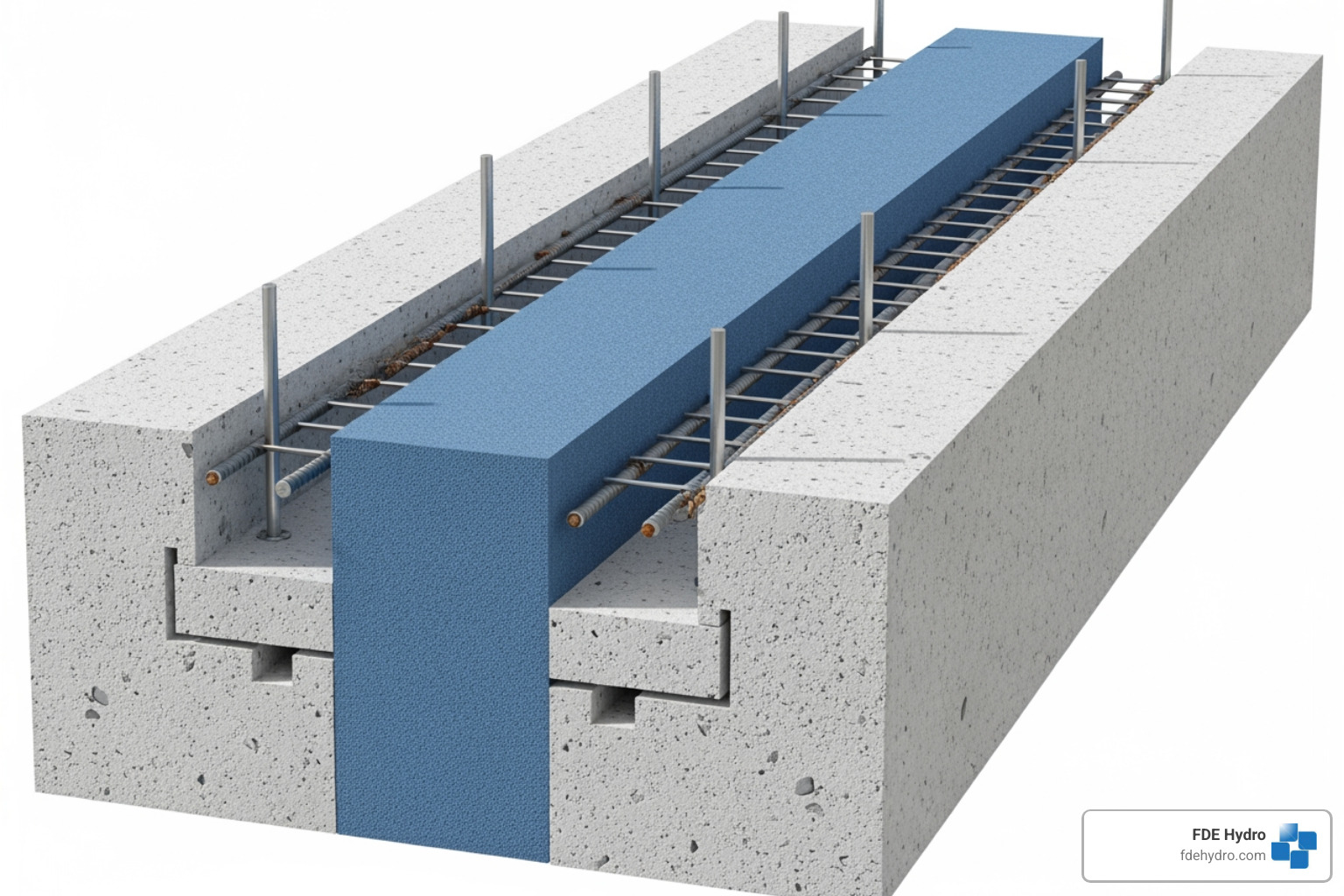
What makes precast sustainable is the entire approach, from the factory to the building’s full lifecycle. This matters everywhere, from Canada to Europe, and organizations like Sustainable Precast are advancing these green practices. At FDE Hydro, our modular precast systems for hydropower build dams faster and with less environmental disruption.
Resource Efficiency and Waste Reduction
Unlike a typical construction site, a precast factory is a model of efficiency. Mix designs are optimized to use the exact amount of water, cement, and aggregates. This precision means precast uses significantly less water, cement, and steel than cast-in-place construction.
Modern precast plants also operate as recycling centers. Excess concrete is reused as aggregate, water is recirculated, and steel molds are reused hundreds of times. When components arrive on-site, they are ready to install, eliminating the waste associated with on-site concrete work.
An exciting innovation is CO2 mineralization, where recycled carbon dioxide is injected into fresh concrete. The CO2 becomes a permanent mineral, sequestering carbon and improving strength, which allows for even less cement. This technology is gaining traction across North America and Europe.
A building’s environmental impact is dominated by its operational energy use. Precast concrete technology addresses this through its inherent thermal mass, which absorbs and releases heat to moderate indoor temperatures, reducing heating and cooling costs.
Insulated sandwich panels take this further, creating highly efficient building envelopes with R-values up to R-28.2. This can cut heating and cooling costs by 30% or more in a building in New York or California, reducing greenhouse gas emissions for decades.
Durability is also a key sustainability factor. Precast structures last 50 to 100 years with minimal maintenance, conserving the resources that would be spent on repeated repairs and reconstruction. At the end of its life, a precast structure can often be deconstructed and its components reused, supporting a circular economy. At FDE Hydro, we apply these principles to create hydropower infrastructure that generates clean energy for a century or more.
From Past to Future: The Evolution and Trajectory of Precast
The story of precast concrete technology is one of constant evolution, from ancient building techniques to today’s digital manufacturing.
A Brief History of Prefabrication
The idea of off-site construction is ancient. The Romans, masters of engineering, used standardized concrete elements for aqueducts and tunnels, many of which still stand. The principles they used were the foundation for modern precast.
Modern precast concrete technology emerged in the early 1900s. In 1905, Liverpool, England, constructed the first precast panelled buildings, proving the method’s potential for rapid assembly. You can explore more about prefabrication’s evolution in Prefabricated and Modular Architecture: Aligning Design with Manufacture and Assembly. The post-war era of the 1950s saw further refinement, as housing shortages drove innovation in manufacturing and quality standards for reinforced concrete | building material, establishing precast as a reliable, scalable construction method across Europe and North America.
Future Trends in precast concrete technology
The future of precast concrete technology is smart, sustainable, and digitally integrated. We are already seeing these trends emerge.
- Automation and AI: Robotics are handling repetitive tasks like rebar placement and pouring, improving safety and consistency in plants across the US, Canada, and Brazil. AI algorithms monitor curing in real-time to ensure optimal strength and spot potential defects.
- Renewable Energy Integration: Precast panels are being designed with embedded solar cells or thermal systems that work with geothermal energy, turning passive building materials into active energy systems.
- Circular Economy: With lifespans of 50-100 years, precast is already durable. The next step is designing for deconstruction, allowing components to be repurposed rather than demolished. This is crucial as we tackle Aging Infrastructure Being Replaced With Next Generation Civil Solutions.
At FDE Hydro, our patented “French Dam” system embodies this future, combining concrete’s strength with modern innovation to revolutionize hydroelectric projects.
Conclusion
We’ve journeyed through precast concrete technology, from its core advantages to the innovations shaping its future. This isn’t just another building method; it’s a fundamental shift in how we approach construction, addressing the critical challenges of speed, cost, quality, and sustainability all at once.
The controlled factory environment delivers superior quality, while parallel processing allows projects to be completed in a fraction of the time. Aesthetically flexible and inherently durable, precast is a genuinely sustainable choice that reduces waste and lowers energy consumption over a building’s long lifespan.
As the global precast market grows toward $168.17 billion by 2026, its applications are expanding, from highways assembled overnight to high-rises erected in record time. At FDE Hydro, we are at the forefront of this evolution. Our patented “French Dam” modular precast technology applies these principles to hydropower and water control systems, building and retrofitting critical infrastructure faster and more affordably for communities in North America, Brazil, and Europe.
The future of construction is here, and it’s built on a foundation of precast concrete. If you’re interested in seeing how these innovations can transform critical infrastructure projects, we invite you to Explore advanced precast solutions for hydropower infrastructure with us.
by Bill French Sr. | Dec 12, 2025 | Hydro Facility Articles
Why Water Control Structures Matter for Modern Infrastructure
Water control structures are permanent installations that control the stage, discharge, and direction of water flow in channels, pipes, and waterways. These hydraulic devices serve critical functions, including:
- Flow Management – Controlling the rate and direction of water movement.
- Water Level Control – Maintaining desired water levels in reservoirs and drainage systems.
- Quality Improvement – Reducing sediment and nutrient discharge.
- Habitat Creation – Supporting fish and wildlife through managed water conditions.
- Flood Risk Reduction – Impounding and releasing water to protect downstream areas.
- Agricultural Support – Managing drainage and irrigation for crop production.
These structures range from simple flashboard risers to complex automated gates, with costs varying from hundreds to many thousands of dollars for engineered systems.
The terminology has evolved from “flood control” to “flood risk management,” reflecting that structures reduce, not eliminate, water-related risks. This shift mirrors a broader understanding of working with natural systems instead of dominating them.
Modern water infrastructure faces mounting challenges from high costs, long timelines, and climate change, which requires adaptable structures. The need for innovation has never been greater.
I’m Bill French Sr., Founder and CEO of FDE Hydro. With over five decades in heavy civil construction, I’ve focused on developing modular water control structures for the hydropower industry that reduce construction time and costs while improving environmental outcomes.
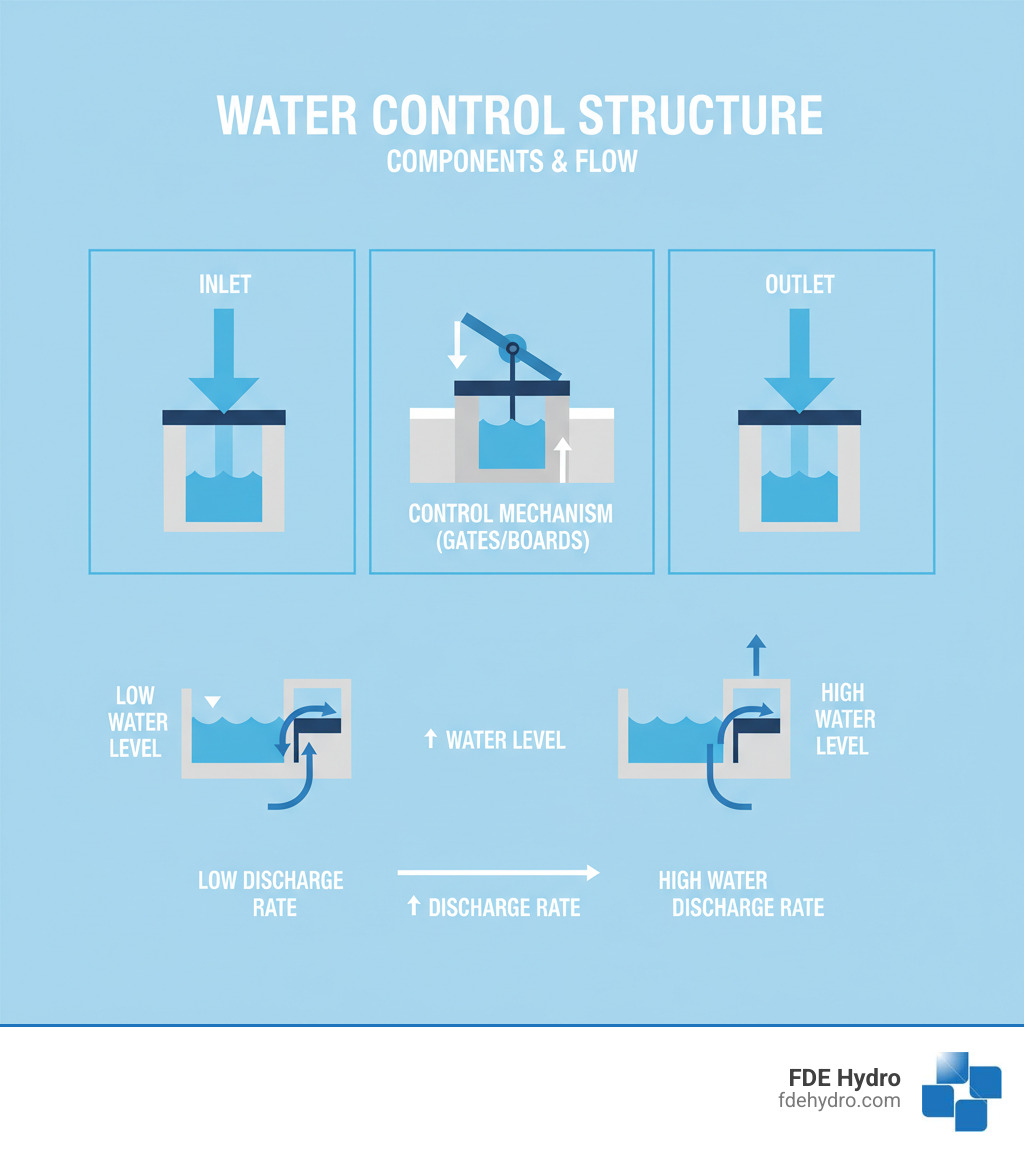
The Core Functions of Water Control Structures
Water control structures are the workhorses of modern water management, performing essential tasks that touch nearly every aspect of our lives. From our food to the health of our rivers, these structures do the heavy lifting. Let’s explore how they make a difference across three critical areas.
Managing Water for Agriculture and Conservation
When you think about farming, you might picture tractors and combines, but beneath many productive fields lies an intricate network of drainage systems—and water control structures are the valves that make them work intelligently.
These structures excel in flatter landscapes where land slopes are less than 0.5 percent. Installed in farm canals, ditches, or subsurface drain tiles, they offer a dual benefit: helping crops thrive while protecting downstream water quality.
By raising the water table in fields with subsurface drainage, these structures slow drainage outflow and create conditions for denitrification—a natural process where bacteria convert harmful nitrates into harmless nitrogen gas. The result is cleaner water flowing into streams and rivers.
The precision is remarkable. For corn, farmers might maintain water levels 12 to 18 inches below ground in spring and fall, dropping them during peak growth. When managed correctly along at least 50 percent of a ditch, keeping water within 30 inches of the surface can drastically cut nitrate losses and often leads to improved crop yields.
In conservation areas like riparian buffers, water control structures help restore natural water flow patterns. Raising the water table in these vegetated zones boosts their ability to filter pollutants. The Conservation Practice Standard Structure for Water Control (Code 587) provides detailed guidance on implementing these systems for maximum environmental benefit.
Controlling Stormwater and Preventing Floods
The shift from “flood control” to “flood risk management” reflects that we can reduce flood risks, but not eliminate them. Water control structures are central to this reduction strategy.
A reservoir behind a dam captures storm runoff, which is then released gradually via water control systems at rates the downstream channel can handle. This process smooths a dangerous flow spike into a manageable stream.
The U.S. Army Corps of Engineers manages this balance across watersheds using reservoirs, levees, and diversions. Their Management of Water Control Systems manual details how they coordinate objectives like flood reduction, water supply, and environmental protection.
A properly designed structure must discharge the design flow rate with no more than a 0.5-foot head (the water level difference across the structure). In spillways, features like concrete piers slow water to prevent erosion.
In urban areas, smaller water control structures manage runoff from pavement, reducing downstream surges and sediment loads that would otherwise harm aquatic life.
Creating and Protecting Natural Habitats
Water control structures are powerful tools for environmental restoration and habitat preservation. With thoughtful design, these structures can revive degraded ecosystems.
Wetland restoration is a perfect example. By managing water levels to create saturated conditions, we can rebuild wetlands that mimic natural patterns, creating havens for wildlife while filtering pollutants.
Water temperature regulation through cold water release structures is vital for downstream fisheries. By drawing water from various reservoir depths, we can influence release temperatures to support species like trout and salmon.
Timing also matters. Managing water levels for spawning might mean maintaining stable reservoir levels during critical breeding periods or using timed drawdowns to improve feeding opportunities for juvenile fish.
We ensure aquatic animal and recreational passage around our structures with fish ladders and other facilities. These allow migrating species to move freely, changing potential barriers into supportive structures.
The goal is always balance—meeting human needs while protecting the natural systems that sustain us.
An In-Depth Look at Common Types of Water Control Structures
Water control structures come in many shapes and sizes, each designed for specific functions and environments. Think of them as tools in a toolbox—you wouldn’t use a hammer to turn a screw, and you wouldn’t use a gate where a simple weir would do the job better.
The key distinction is between passive structures, which work without any intervention once installed, and active structures, which require manual or automated adjustments to function properly. Understanding these differences helps you choose the right solution for your specific water management challenge.
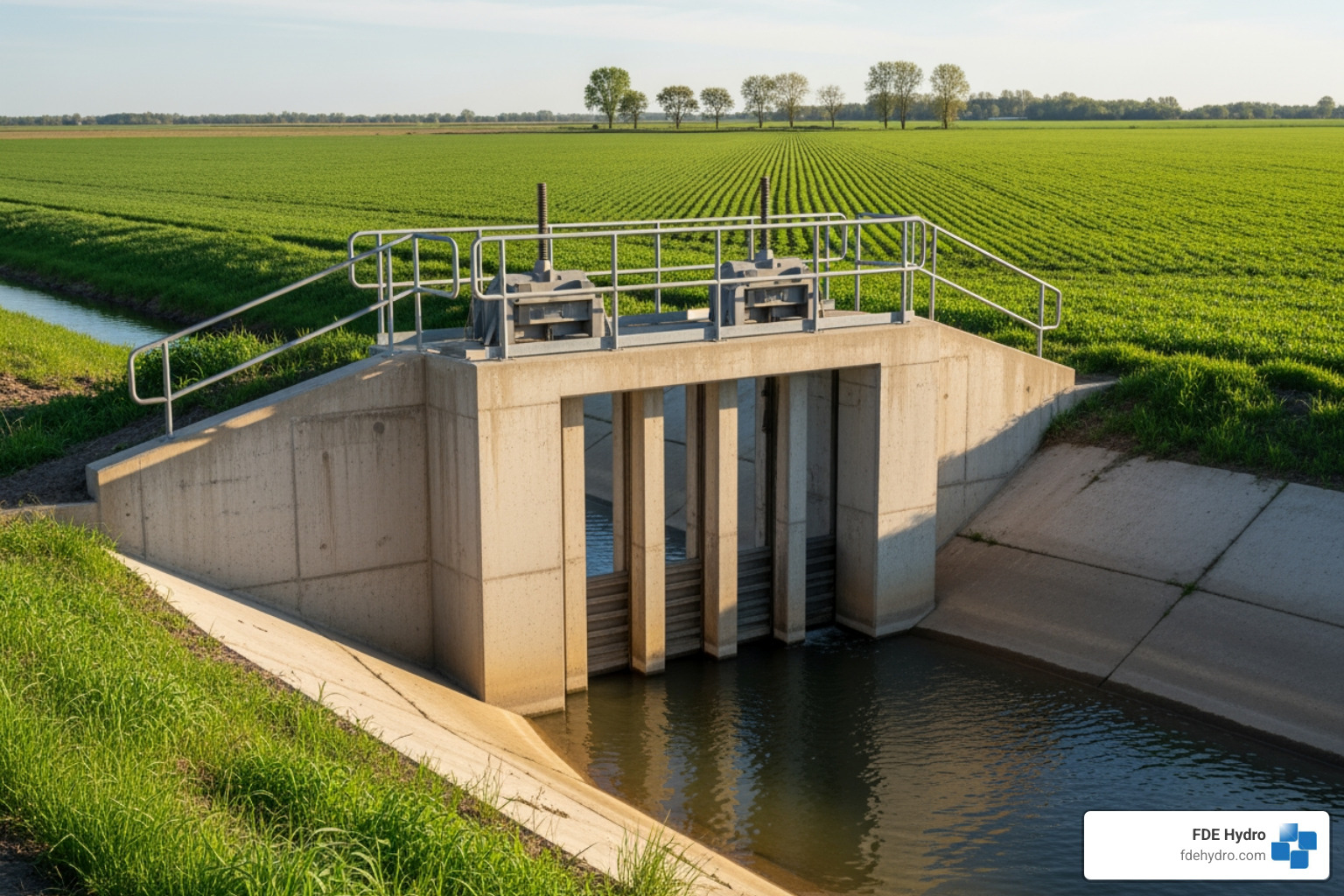
Here’s a comparison of some common types:
| Feature |
Flashboard Risers |
Gates & Valves |
Weirs |
| Control Type |
Manual, passive |
Active, manual/automated |
Passive, fixed |
| Adjustability |
Step-wise (board removal) |
Continuous |
Limited (fixed crest) |
| Primary Use |
Water level management, drainage |
Flow regulation, shut-off |
Flow measurement, level control |
| Flow Impact |
Gravity flow, adjustable |
Regulated flow, on/off |
Fixed overflow, flow measurement |
| Complexity |
Low-moderate |
Moderate-high |
Low-moderate |
Flashboard Risers and Inline Structures
Flashboard risers are workhorses in agricultural settings and pond management. The design is neatly simple: a vertical structure with grooves that hold removable boards called stoplogs. Need to drain a pond for maintenance? Remove some boards. Want to raise the water level for irrigation? Add them back. It’s like adjusting the height of a dam one board at a time.
Pond risers provide the vertical conduit through which water flows, and they’re typically designed for gravity flow systems—meaning water moves naturally downhill without pumps. This simplicity is both a strength and a limitation. While these systems are reliable and require no power, they’re not pressure-rated, and you should expect some seepage. That’s just physics at work.
Inline structures take this concept underground. These are installed directly within subsurface drainage conduits like drain tiles or tubes, managing water levels beneath your fields. Installation requires replacing at least 20 feet of perforated drain pipe with non-perforated pipe connected to the structure. For single drain lines, you’ll want the drain pipe upslope of the structure to exceed 500 feet for maximum effectiveness.
A smart cost-saving approach is installing water control structures on submains where multiple drain lines discharge. This reduces the number of structures needed while maintaining control over a larger area—assuming your topography cooperates. Our Water Control Infrastructure Guide 2025 dives deeper into these design strategies and helps you make the right choices for your specific site.
Gates, Valves, and Weirs
When you need more dynamic control over water flow, gates and valves step up to the plate. Sluice gates are commonly used for managing silt in ditches and canals—slide them open or closed to control flow. Screw gates offer even finer control, allowing you to dial in precise flow rates by turning a threaded mechanism. It’s the difference between a light switch and a dimmer.
Flap gates and tide gates serve specialized roles. Flap gates act as one-way valves, letting water flow out but preventing backflow. Tide gates are particularly valuable in coastal areas, where they prevent tidal surges or high water from pushing back into freshwater channels. Nobody wants saltwater contaminating their irrigation system.
Weirs represent the passive end of the spectrum. These structures force water to flow over a crest or through a notch, and they excel at flow measurement and maintaining specific upstream water levels. V-notch weirs are perfect for measuring low flows with precision, while outlet weirs and broader designs handle larger volumes. Concrete hump weirs create a smooth, predictable overflow pattern that’s ideal for certain applications.
The beauty of weirs is their simplicity—no moving parts, no maintenance headaches. Water hits the crest and flows over in a predictable pattern that engineers can measure and calculate with remarkable accuracy. These components often integrate into larger systems, including those covered in our Hydroelectric Dam Components Ultimate Guide.
Ancillary Components and Their Roles
The stars of water control might be gates, weirs, and risers, but the supporting cast deserves recognition too. These ancillary components keep everything running smoothly and extend the life of your infrastructure.
Trash racks and debris screens are your first line of defense against clogging. They catch leaves, branches, weed seeds, and other debris before it enters pipelines or jams control mechanisms. Think of them as the bouncer at the door—keeping the troublemakers out so the party inside can continue uninterrupted.
Bar guards take this protection a step further, blocking large debris from inlets while also deterring rodents from entering pipes. A beaver or muskrat can cause surprising damage to a water control system, and prevention is far cheaper than repair.
Speaking of beavers, beaver guards are specialized structures designed to prevent these industrious animals from building dams around or within your water control structures. Beavers are remarkable engineers in their own right, but their construction projects rarely align with your water management goals.
Stilling basins appear downstream of many structures, where they serve a critical but often overlooked function. Fast-moving water carries tremendous energy, and when it exits a pipe or flows over a weir, that energy needs somewhere to go. Stilling basins dissipate this energy gradually, preventing erosion and protecting channel beds and banks from damage.
Turnouts are simple but essential for irrigation systems. These structures divert water from main channels into smaller laterals or directly into fields. They’re the traffic directors of agricultural water management.
Finally, pump boxes protect pumps and associated equipment from weather and vandalism while allowing for controlled water transfer. They might not be glamorous, but they’re practical—and in water management, practical solutions often matter most.
Design, Materials, and Installation Best Practices
Getting a water control structure right from the start makes all the difference. At FDE Hydro, we’ve learned that proper design, smart material choices, and careful installation aren’t just nice-to-have—they’re the foundation of structures that actually work for decades.
The truth is, designing these systems isn’t always straightforward. Simple prefabricated structures for subsurface drainage might not need an engineer’s stamp, but anything more complex—especially structures going into ditches or channels—absolutely requires professional engineering oversight. We’ve seen too many well-intentioned projects fail because someone skipped this step.
Here’s something critical to understand: the effectiveness of water control structures varies dramatically from site to site. What works beautifully in one location might struggle in another, even if the structures look identical on paper. That’s why we start every project with thorough engineering design, examining topography, soil conditions, and the specific hydrological outcomes you’re trying to achieve.
Before breaking ground, you’ll need permits. This isn’t red tape for its own sake—it’s about ensuring your structure meets federal, state, and local regulations that protect water quality and public safety. We always secure all required permits before construction begins. Our Hydroelectric Dam Design Complete Guide walks through many of these considerations in detail.
Common Materials and Their Impact
The materials you choose today will determine whether you’re maintaining your structure every few months or barely thinking about it for years. We’ve worked with every material imaginable, and here’s what actually performs in the field.
PVC has become our go-to for many applications, and for good reason. It resists corrosion, stays lightweight for easier installation, and holds up remarkably well in water. Our inline structures use rugged half-inch-thick PVC with anodized aluminum corner profiles and stainless steel screws. For larger structures, we increase the bottom sheet thickness to a full inch. One important note: skip plastic risers anywhere fire is a concern.
Steel brings best strength, especially for larger gates, risers, and structural supports. Corrugated steel pipes often get an asphalt coating for extra corrosion protection. We can adapt steel designs to fit directly onto various culvert pipes, which saves time and money during installation.
Concrete used to dominate the flashboard riser market, though the old designs were often expensive and labor-intensive to build. But concrete isn’t going anywhere—it remains essential for robust foundations, larger dams, and specific weir types like concrete hump weirs. The stability of a concrete control in a channel far exceeds what you’d get in sandy, flood-prone areas.
Geotextiles might not look impressive, but these specialized fabrics do heavy lifting in filtration, separation, reinforcement, and erosion control around structures. They’re often the unsung heroes that keep everything else working properly.
We design all our water control structures to last at least 20 years, balancing upfront investment with long-term performance and minimal maintenance headaches.
Key Design Considerations for Water Control Structures
Every successful water control structure starts with careful attention to several critical design elements. Miss any of these, and you’re setting yourself up for problems down the road.
Pipe sizing matters more than many people realize. We typically work with pipes from 4 inches to 12 inches in diameter, matching the required flow capacity of your drainage system. Go too small and you create bottlenecks; too large and you waste money on unnecessary capacity.
Structure height depends entirely on your water level control needs. When risers exceed six feet, we add a 3-inch by 3-inch channel for lateral support. Wider risers—from 48 inches up to 96 inches and beyond—get 3-inch wide H-beams for improved stability. These aren’t optional extras; they’re structural necessities.
Head limitations require careful calculation. The structure’s capacity must discharge the design flow rate with no more than a half-foot of head. Under cropped conditions, exceeding this 0.5-foot design head can harm your crops and reduce the structure’s effectiveness.
Anti-seep collars prevent one of the most common failure modes: pipe washout from seepage along the outside of the pipe. These rubber collars, typically 2 feet by 2 feet or 3 feet by 3 feet, work with any smooth-wall pipe or corrugated plastic tubing. Installation requires cutting a round hole about 33 percent smaller than the pipe diameter to ensure a tight seal. We always recommend using anti-seep collars with inline structures—they’re inexpensive insurance against expensive problems.
Structural reinforcement becomes critical as structures grow larger. H-beams and channels provide the lateral support and stability that keeps everything aligned and functional year after year. Cutting corners here is penny-wise and pound-foolish.
Safety measures aren’t afterthoughts—they’re designed in from the start. We incorporate features like safety railings and clear operational instructions to prevent serious injury or loss of life. Our approach aligns with proven Dam Construction Methods that prioritize both effectiveness and safety.
Installation and Maintenance Requirements
Even the best-designed water control structure will fail if installed poorly or maintained haphazardly. Here’s what actually works in the field.
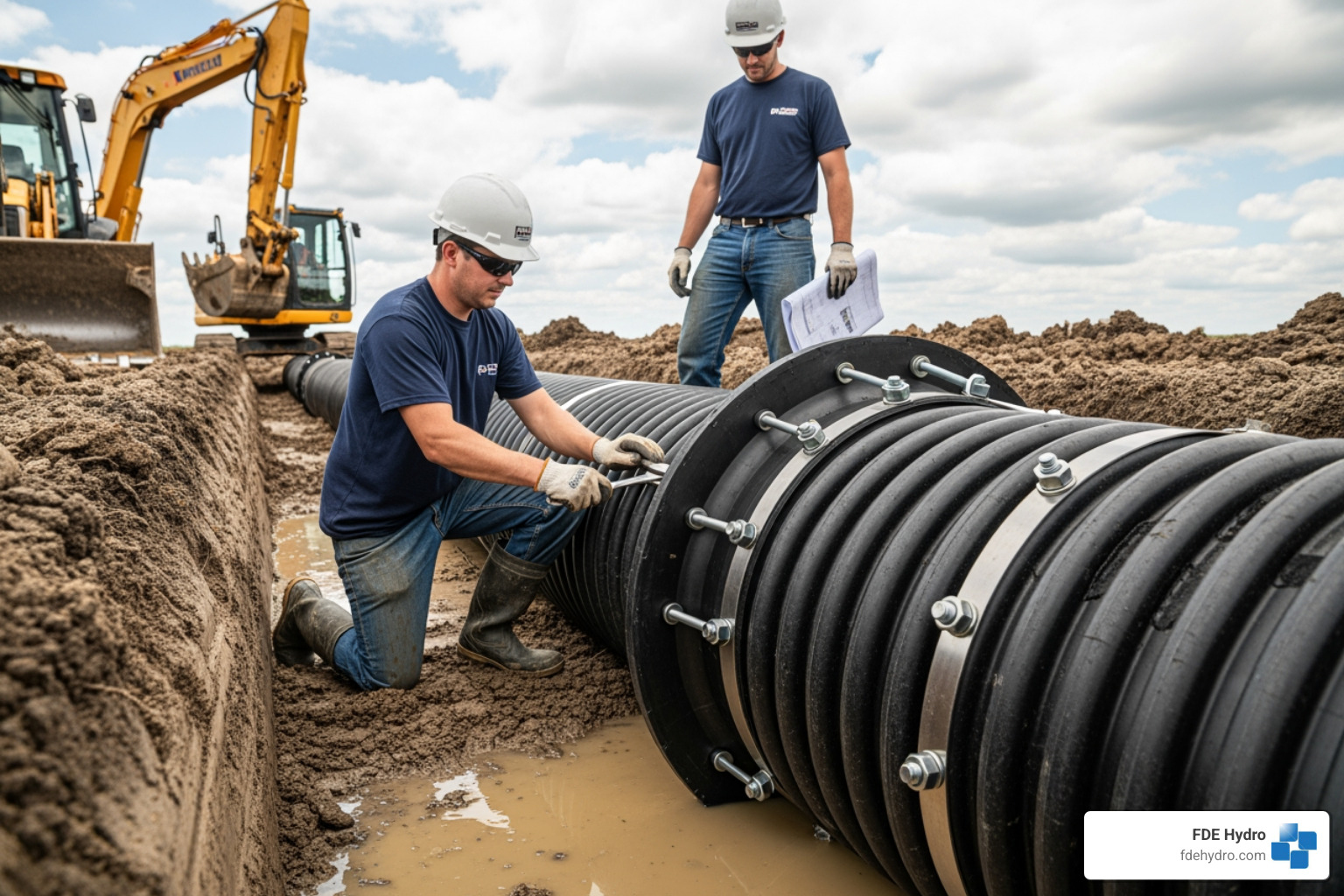
Installation starts with stable base preparation. We excavate and grade the base, inlet, and outlet pipes, then create a solid, stable foundation on compacted soil or fill sand. Shortcuts here lead to settling and misalignment that only get worse over time.
Backfilling requires patience and care. We hand-tamp in 6-inch lifts around the structure, avoiding mechanical compaction or direct contact with heavy machinery that could crack or damage components. Yes, it takes longer. Yes, it’s worth it.
Pipe connections use flexible couplers secured with stainless steel clamps, creating watertight yet flexible joints that accommodate minor ground movement. The structure must be leveled vertically before backfilling—trying to adjust it afterward rarely works well.
Once installed, regular maintenance keeps everything running smoothly. Debris removal tops the list—trash, leaves, branches, and algae can dramatically alter how your control manages water. We recommend checking pipe inlets and trash racks regularly and clearing them promptly.
For structures with movable components like stoplogs, seal lubrication with a product like Lubriplate Grease ensures smooth operation and minimizes seepage. This simple step takes minutes but prevents hours of frustration later.
Vegetative protection around structures prevents erosion and stabilizes soil. Seed or sod all disturbed earth surfaces with appropriate vegetation. Where permanent vegetation struggles, mulches or gravels provide reliable protection. Don’t let bare areas persist—they’re erosion waiting to happen.
Routine inspections should happen at least twice yearly, with additional checks after major storms. Look at structures, embankments, spillways, and appurtenances for damage or blockages. Catching small problems early prevents big failures later.
Finally, create a detailed operation and maintenance plan and review it with your land manager. This plan should cover maximum, minimum, and normal water control elevations, inspection schedules, clean-out procedures, and vegetated border use. Keep operational records of structure adjustments—they’re invaluable for troubleshooting and optimization.
Neglecting maintenance doesn’t just reduce efficiency—it increases costs and risks structural failure. Our expertise in Dam Rehabilitation Encapsulation reinforces our commitment to keeping water infrastructure healthy for the long haul.
The Future of Water Management
The landscape of water management is continuously evolving, driven by the increasing demands of a growing population and the unpredictable impacts of climate change. The design and technology of water control structures are adapting to meet these challenges, moving towards more resilient, efficient, and sustainable solutions.
Looking back, the shift from labor-intensive concrete flashboard risers to prefabricated steel inlet boxes happened because we needed something more practical and affordable. Today, we’re seeing another change—one focused on adaptability and intelligent monitoring. We’re building climate change preparedness and resilience planning into everything we do, recognizing that our structures need to handle much greater variability in water levels and flow patterns.
The rise of smart water systems and remote monitoring is revolutionizing how we manage water resources. These systems use sensors and data analytics to deliver real-time information about water levels, flow rates, and quality. This means we can respond faster and optimize control like never before. The U.S. Army Corps of Engineers, for instance, uses Water Management Enterprise Systems to integrate data and improve operational decisions across their vast network. These technological advances are fundamental to building truly Sustainable Water Infrastructure.
The Future of Water Control Structures
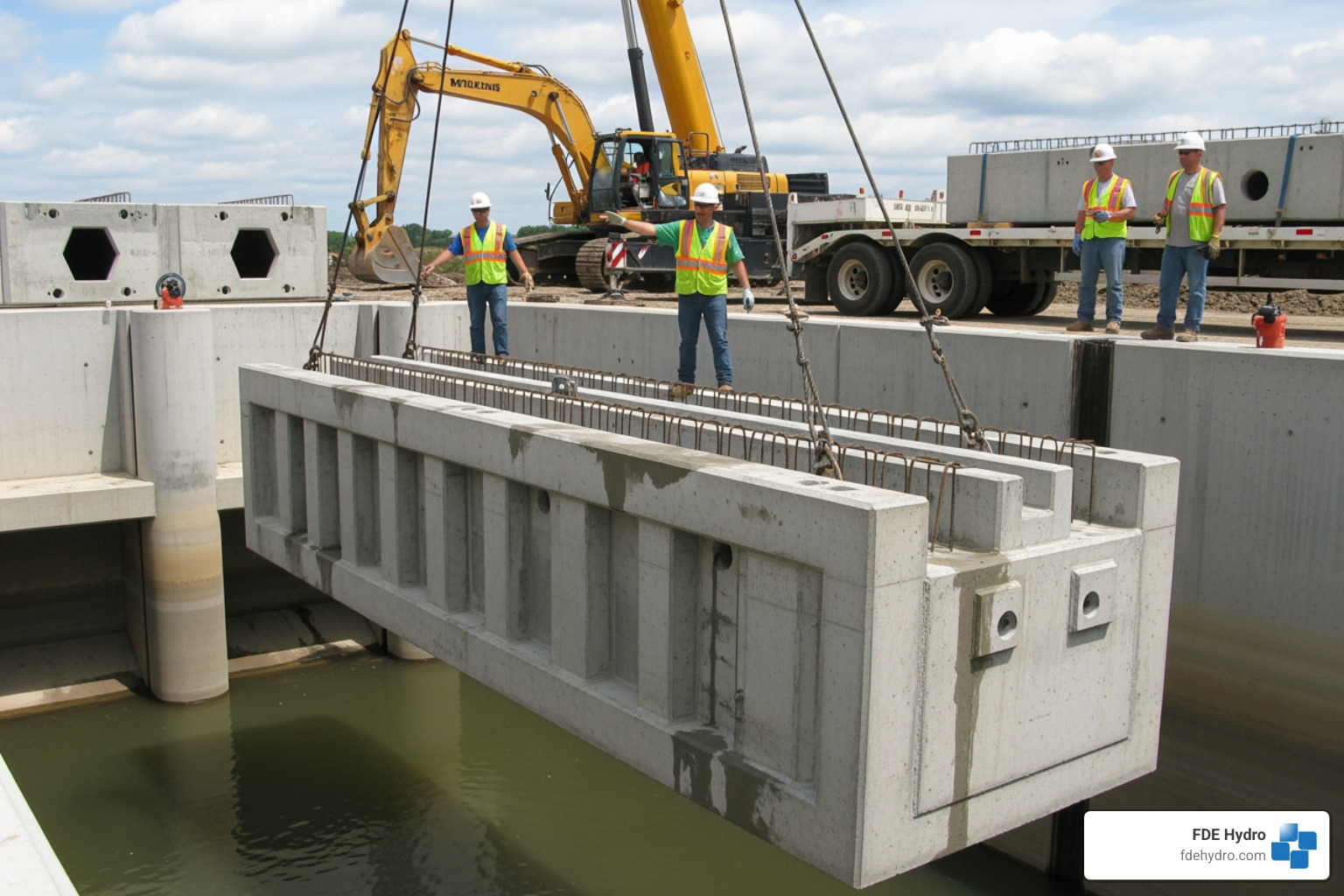
At FDE Hydro, we’re not just watching this evolution—we’re driving it. Our patented modular precast concrete technology, known as “French Dam” technology, represents a fundamental shift in how we construct and retrofit water control structures and hydroelectric dams.
This modular approach delivers tangible benefits that matter. Reduced construction time comes from prefabricating components off-site, which can slash project schedules dramatically. Significant cost reduction follows naturally when you minimize on-site labor and equipment needs—we’re talking about substantial savings that make projects financially viable. Improved durability is built into every engineered precast concrete component, ensuring structures can withstand harsh environmental conditions for decades.
Manufacturing components in a controlled factory environment also means better quality control. You get more reliable structures because every piece is built to exact specifications, not cobbled together on a muddy construction site. And perhaps most importantly, the modular nature of our components provides real flexibility—you can design with greater freedom and expand or modify structures later without starting from scratch.
We’re already deploying this innovative technology across North America, including the United States and Canada, as well as in Brazil and Europe. It’s a scalable and sustainable approach that works in diverse environments. We believe that leveraging advanced manufacturing techniques like modular precast concrete isn’t just about building better structures—it’s about open uping what could be The Biggest Untapped Solution to Climate Change is in the Water.
The future of water management demands structures that are smarter, stronger, and faster to build. That’s exactly what we’re delivering.
Conclusion
Throughout this guide, we’ve explored how water control structures serve as the backbone of modern water management, quietly performing essential work that touches nearly every aspect of our lives. These permanent installations manage the stage, discharge, and direction of water flow, supporting everything from productive farmland to thriving ecosystems.
We’ve seen how these structures lift water tables to reduce nutrient runoff in agricultural settings, regulate stormwater flows to protect communities from flooding, and create the precise conditions needed for fish spawning and wetland restoration. The diversity of available solutions—from simple flashboard risers with removable stoplogs to sophisticated gate systems and precisely calibrated weirs—demonstrates the adaptability of these technologies to meet specific site needs.
The technical details matter deeply. Selecting appropriate materials like corrosion-resistant PVC, robust steel, and durable concrete directly impacts how long a structure will serve its purpose. Design considerations such as proper pipe sizing, anti-seep collar installation, and adequate head capacity determine whether a structure will function effectively or require costly repairs. And perhaps most importantly, the commitment to regular maintenance—clearing debris, lubricating seals, and conducting semiannual inspections—separates structures that last decades from those that fail prematurely.
The future of water management is arriving faster than many realize. Climate change demands structures that can handle more extreme variability in rainfall and drought. Growing populations need solutions that work harder while costing less. At FDE Hydro, our modular precast concrete technology addresses these challenges head-on, cutting construction timelines and costs while delivering improved durability and quality control. This approach isn’t just about building better infrastructure—it’s about creating resilient systems that can adapt to whatever challenges tomorrow brings.
Water management has always required us to balance competing needs: economic development against environmental protection, immediate costs versus long-term value, human needs alongside ecosystem health. The most successful water control structures are those designed with this balance in mind, serving multiple purposes while remaining flexible enough to adapt as conditions change.
We invite you to explore how innovative solutions can transform your water management challenges into opportunities. Learn more about advanced hydropower solutions and find how modern technology is reshaping what’s possible in water infrastructure.
by Bill French Sr. | Dec 11, 2025 | Energy Resource Articles
The Environmental Price of Digital Gold
Crypto mining sustainability is a critical concern as the industry consumes vast amounts of energy and generates significant environmental impacts:
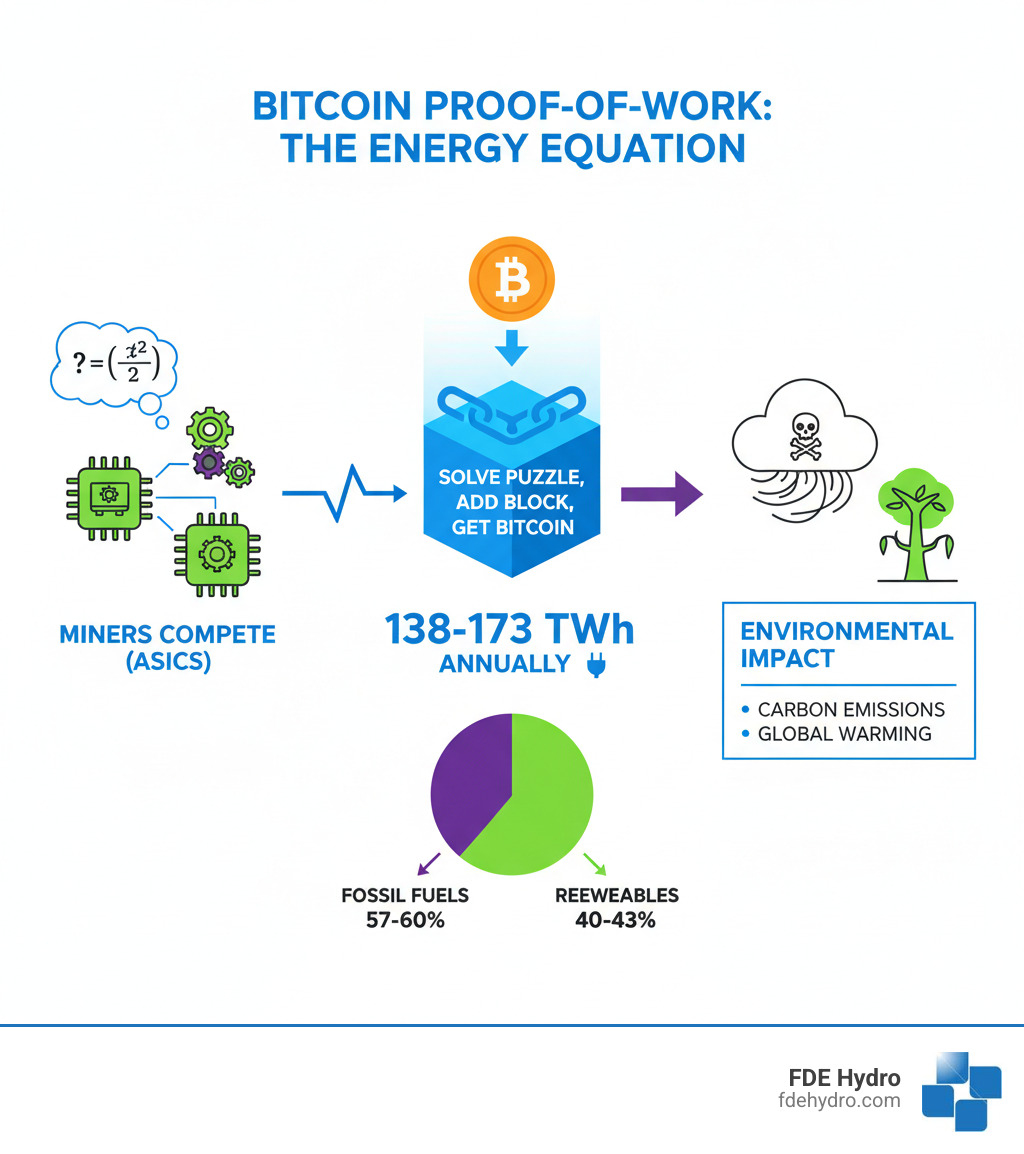
- Energy Consumption: Bitcoin mining alone uses 138-173 TWh annually, equivalent to countries like Ukraine or Poland
- Carbon Emissions: Global crypto mining produces 39.8-90.6 million tonnes of CO₂ annually
- Current Renewable Mix: Only 41-43% of Bitcoin’s energy comes from renewable sources as of 2024
- Health Impact: 1.9 million Americans are exposed to higher air pollution from mining operations
- Water & E-Waste: Mining consumes 1.65 billion cubic meters of water annually and generates significant electronic waste
Cryptocurrency mining has evolved from a niche technical pursuit into a global industry with a massive environmental footprint. Bitcoin, often called “digital gold,” reached a market capitalization exceeding $1.3 trillion by 2024. But this digital wealth comes at a real-world cost. The infrastructure supporting mainstream cryptocurrencies uses enormous amounts of energy—173.42 terawatt hours annually according to recent studies. That’s more electricity than entire nations consume.
The environmental impact extends far beyond energy consumption. Recent research reveals troubling effects on air quality, water resources, and land use. A Harvard-led study found that Bitcoin mining exposes millions of Americans to harmful fine particulate air pollution. The UN documented water usage sufficient to meet the domestic needs of over 300 million people in rural Sub-Saharan Africa. And mining operations generate mounting piles of electronic waste as specialized hardware becomes obsolete in as little as 1.3 years.
This raises urgent questions. Can an industry built on computing power ever be truly sustainable? Is the innovation worth the environmental price? And what solutions exist that could reconcile digital advancement with ecological responsibility?
As Bill French Sr., Founder and CEO of FDE Hydro™, I’ve spent decades in heavy civil construction and the past nine years focused on modular hydropower solutions designed to benefit present and future environments. My work with the Department of Energy’s Hydro Power Vision Task Force and development of innovative hydropower technologies has given me unique insight into how crypto mining sustainability can be achieved through clean, renewable energy integration.
The Unquenchable Thirst: Bitcoin’s Massive Energy Consumption

Bitcoin mining consumes 173.42 terawatt hours of electricity annually—more than entire countries like Ukraine or Poland. If Bitcoin were a country, it would rank 27th globally in energy use, consuming more power than Pakistan.
This represents about 0.5% of all electricity used on Earth. For comparison, the entire global payment system (credit cards, bank transfers) uses only 0.2%. Bitcoin alone uses more than double that.
The culprit is Bitcoin’s Proof-of-Work mechanism. Miners compete to solve complex puzzles, with the winner adding a block to the blockchain and earning Bitcoin. This relentless competition drives ever-increasing energy use.
For crypto mining sustainability, the power source is critical. As of 2025, 43% comes from renewables. The remaining 57% relies on fossil fuels (38% natural gas, 9% coal) and nuclear (10%). While the trend is positive, most of Bitcoin’s power still harms our planet.
On a per-transaction basis, the numbers are even more sobering. A single Bitcoin transaction uses an estimated 500 kilowatt hours, while a VISA transaction uses just 0.001 kWh—a difference of 500,000 times.
You can explore more detailed comparisons through this analysis: Bitcoin’s energy use compared to countries.
This electricity use translates directly into staggering carbon emissions.
Bitcoin’s annual carbon footprint equals burning 84 billion pounds of coal or running 190 natural gas power plants for a year. To offset this naturally, you’d need to plant 3.9 billion trees—a forest the size of the Netherlands.
Economically, between 2016 and 2021, every dollar of Bitcoin mined caused 35 cents in climate damage. This accounts for real-world costs like health impacts and extreme weather, leading some to call Bitcoin “digital crude” instead of “digital gold.”
As of 2025, Bitcoin produces 39.8 million tonnes of CO₂ annually, comparable to the carbon footprint of Slovakia. These figures show that Bitcoin mining creates serious environmental challenges. They highlight why a shift to clean energy, especially stable solutions like hydropower, is essential for the industry and our planet.
Beyond Carbon: The Hidden Environmental Costs
Bitcoin’s environmental impact goes beyond carbon emissions. While CO₂ gets the headlines, the true cost of crypto mining sustainability challenges affects our air, water, and land. These hidden costs impact communities, ecosystems, and public health in ways that are often overlooked.

Air Pollution: A Cross-State Public Health Concern
A groundbreaking Harvard-led study on Bitcoin mining’s air pollution revealed that mining significantly increases fine particulate air pollution (PM2.5). These microscopic particles are linked to serious health conditions like cancer, heart disease, and dementia.
The connection is straightforward: most large-scale U.S. Bitcoin mines draw power from fossil fuel plants. Burning coal or natural gas for mining’s massive electricity needs releases PM2.5 and other pollutants.
The 34 largest U.S. Bitcoin mines consumed 33% more electricity than Los Angeles from August 2022 to July 2023. This resulted in an estimated 1.9 million Americans being exposed to higher PM2.5 pollution from mining.
The challenge is that pollution crosses state borders. A North Carolina mine might use power from a Kentucky plant, with pollution drifting to Illinois. This creates a regulatory nightmare, as states cannot unilaterally regulate emissions from their neighbors, underscoring the need for federal action.
Water, Land, and Electronic Waste
The footprint extends to water, land, and e-waste. Mining hardware requires massive amounts of water for cooling. Bitcoin’s global water footprint in 2020-2021 reached 1.65 cubic kilometers—enough for the domestic needs of over 300 million people in rural sub-Saharan Africa.
At FDE Hydro, we work to harness water power sustainably. The contrast between water as a renewable solution and water consumed for cooling is stark. You can explore water’s potential as a climate solution in The Biggest Untapped Solution to Climate Change is in the Water and learn about Hydropower.
Land use is another challenge. The global Bitcoin mining network’s land footprint in 2020-2021 was over 1,870 square kilometers, 1.4 times the area of Los Angeles. Responsible land use requires thoughtful, long-term planning.
Then there’s the electronic waste problem. Bitcoin mining uses specialized hardware (ASICs) that become obsolete quickly. The average lifespan is just 1.3 years, though some studies suggest 4-5 years. This rapid turnover creates over 30,000 tonnes of e-waste annually (2021), with each transaction generating about 272 grams. The volume creates a significant environmental burden, along with noise pollution from cooling fans.
For a comprehensive look at these interconnected environmental impacts, the UN study on Bitcoin’s environmental footprint provides valuable insights into how crypto mining sustainability must address far more than just carbon emissions.
The Path to Crypto Mining Sustainability
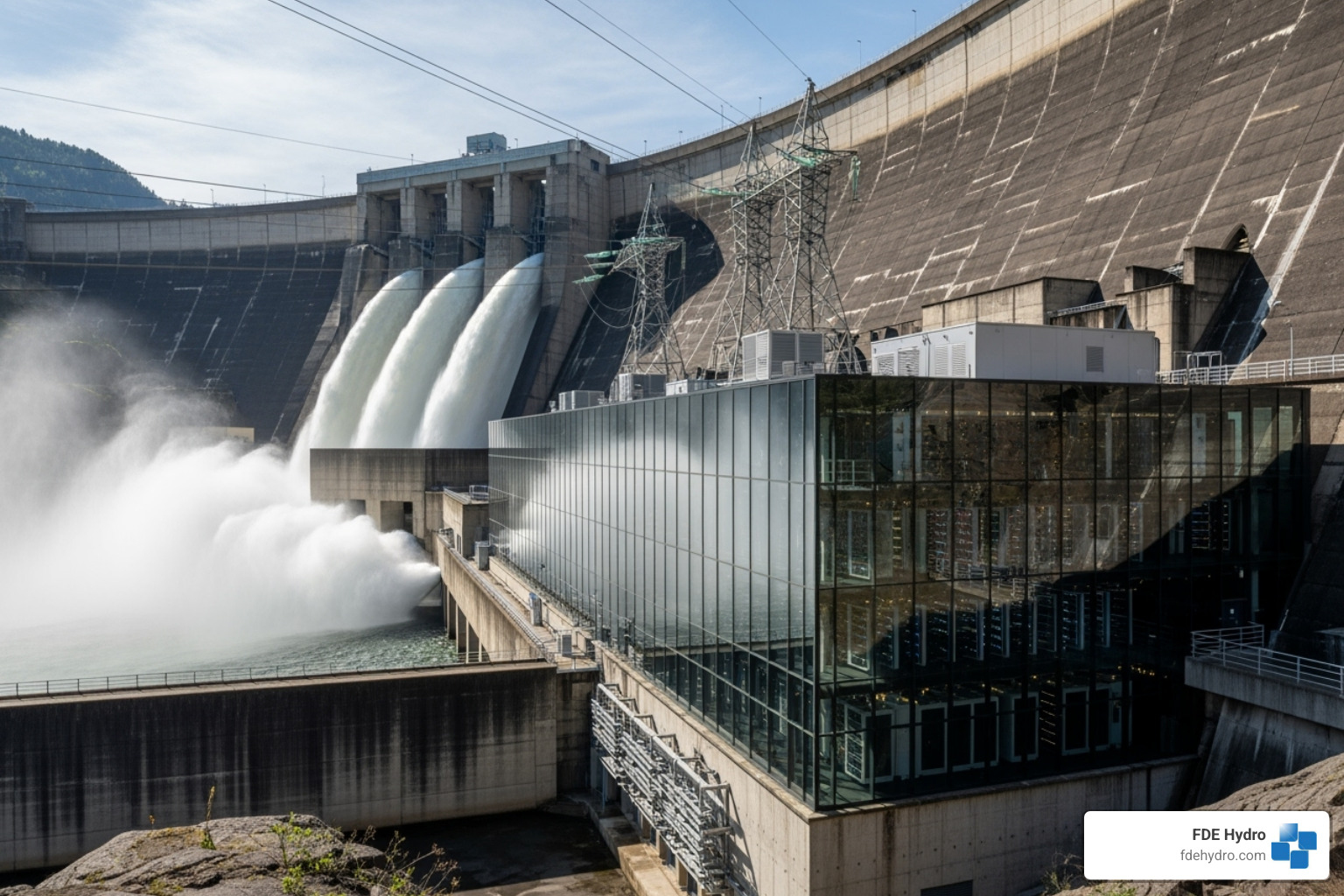
The environmental challenges are urgent, but the path to crypto mining sustainability is within reach through practical solutions. Clean, renewable energy—especially hydropower—is central to balancing technological progress with environmental stewardship. As a developer of modular hydropower, I’ve seen how the right infrastructure can transform industries. The crypto mining sector is at a crossroads, and its direction will shape the future of digital currency and our planet.
Key Challenges for Crypto Mining Sustainability
Achieving sustainable Bitcoin mining isn’t simple. Several challenges stand in the way.
The intermittency problem is the biggest hurdle. Solar and wind are not constant, but Bitcoin mining runs 24/7, demanding reliable electricity. This mismatch, without massive energy storage, leads to unpredictable power. In the competitive Proof-of-Work race, downtime means lost revenue, pushing miners toward reliable but dirty fossil fuels.
Next is the “green Bitcoin” problem. All Bitcoin is identical, whether mined with hydropower or coal. There’s no premium for sustainably mined coins. Conscious miners invest in clean energy but receive no market reward, while those using the cheapest (often dirtiest) power face no penalty. As of 2023, U.S. Bitcoin miners still drew 54% of their power from fossil fuels.
When externalities aren’t priced in—when miners don’t pay for the pollution they create—the market naturally favors the cheapest energy. The price-security feedback loop in Proof-of-Work intensifies this, rewarding computational power above all else while society bears the environmental costs. For a deeper dive into these systemic barriers, this academic research offers valuable insights: Barriers to sustainable Bitcoin mining.
Innovations and Solutions for Sustainable Crypto Mining
The transition to crypto mining sustainability is already happening, driven by smart technology, strategic energy partnerships, and thoughtful policy.
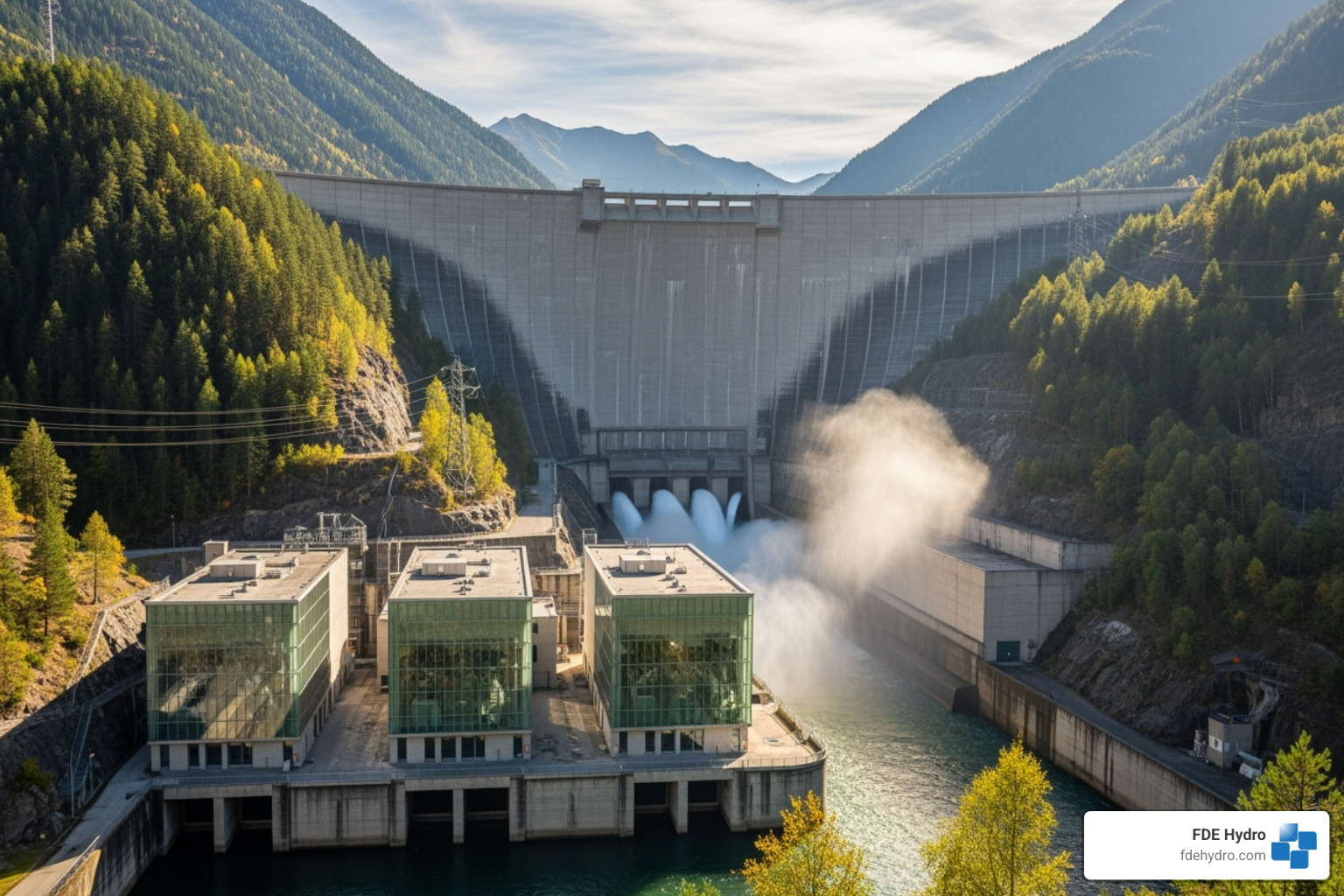
Co-locating mining operations with renewable energy projects is a promising strategy, especially with stable sources like hydropower. Unlike solar and wind, hydropower is dispatchable—you can control its output to match demand. Water stored behind a dam represents stored energy, making hydropower the perfect partner for energy-hungry operations like crypto mining.
At FDE Hydro, our modular hydropower solutions make clean energy deployment faster and more affordable. Our patented “French Dam” technology dramatically reduces the cost and time to build or retrofit hydroelectric facilities. These efficient, modular systems can bring reliable, clean hydropower to data centers and mining operations at scale. The potential is enormous, including Reinvigorating Hydropower infrastructure that already exists.
Beyond direct power supply, Bitcoin mining can support renewable energy development. Miners can act as flexible loads, consuming excess renewable energy. This improves the economics of renewable projects. Some miners even use methane that would otherwise be vented from oil wells and landfills, offering a carbon-negative contribution. In 2024, about 2.38% of Bitcoin’s energy came from this source.
The trends are positive. The renewable share in Bitcoin’s global energy mix climbed from 20% in 2011 to 41% in 2024, with projections suggesting at least 70% by 2030. This shift is driven by miners seeking cheaper power, greening energy grids, and stricter regulations.
Policy interventions are crucial. Subsidies for green energy and carbon taxes can accelerate the transition. Regulations in Canada and Iceland require environmental assessments. In the U.S., the White House and EPA are studying impacts, while states like New York have imposed moratoriums on new fossil fuel-powered operations.
Our work extends beyond traditional hydropower. We’re developing Microgrid and Pumped Storage Hydropower systems that provide grid stability and energy storage. These technologies create resilient energy systems for sustainable data centers. We actively participate in industry discussions about these innovations, as highlighted in our Recording: Innovating the Future: Cleantech and Energy Storage Panel Discussion.
The path forward is clear: we must choose clean energy over fossil fuels. This ensures technological progress serves both innovation and environmental responsibility. With the right infrastructure, smart policies, and industry leadership, we can build a digital economy that thrives without sacrificing our planet. That’s not just good for the environment—it’s good business.
Frequently Asked Questions about Crypto’s Environmental Impact
How does Bitcoin’s energy use compare to VISA?
The difference between Bitcoin and traditional payment systems is eye-opening. A single Bitcoin transaction gobbles up roughly 500 kWh of electricity. Compare that to a VISA transaction, which uses about 0.001 kWh. That’s right—one Bitcoin transaction uses thousands of times more energy than swiping your credit card at the grocery store.
When we zoom out to look at the big picture, it becomes even more striking. The entire global payment system—every credit card swipe, every digital payment, every ATM withdrawal—uses about 0.2% of the world’s electricity. Bitcoin mining alone consumes 0.5% of global electricity. Think about that for a moment: a single cryptocurrency uses more than twice the energy of the entire traditional financial transaction infrastructure that serves billions of people daily.
This comparison highlights why crypto mining sustainability isn’t just an environmental talking point—it’s an urgent challenge that demands innovative solutions.
Can crypto mining ever be truly green?
Yes, we genuinely believe crypto mining can become truly green. But let’s be honest: it won’t happen overnight, and it requires fundamental changes across the entire industry.
The potential is real. As of 2024, Bitcoin’s energy mix already includes about 41% renewable sources, and projections suggest this could reach 70% by 2030. That’s encouraging progress, but we need to push further toward 100% clean energy. This is where stable, dispatchable renewable sources like hydropower become absolutely critical. Unlike solar and wind, which fluctuate with weather conditions, hydropower provides the consistent, round-the-clock power that mining operations demand.
The path forward requires several key elements working together. We need a major shift in the energy mix, moving mining operations to facilities powered entirely by renewables. Technological advancements matter too—both in developing more energy-efficient mining hardware and in the broader adoption of alternative consensus mechanisms that don’t require massive computational power. And supportive regulations must create real incentives for green mining while penalizing reliance on fossil fuels.
At FDE Hydro, we’re working to provide exactly the kind of clean energy infrastructure this transition requires. Our modular hydropower technology can deploy reliable, renewable power faster and more affordably than traditional dam construction. By co-locating mining operations with hydropower facilities, we can dramatically reduce environmental impact while supporting the digital economy. The technology exists—now we need the will to implement it at scale.
What is being done to regulate crypto mining’s pollution?
The regulatory landscape for crypto mining looks like a patchwork quilt, with different jurisdictions taking dramatically different approaches.
China took the most extreme stance, implementing a complete ban on all cryptocurrency mining activities in 2021. Energy consumption and environmental concerns drove this decision, and it instantly reshaped the global mining landscape as operations scrambled to relocate.
The European Union has taken a more measured but still serious approach. EU regulators have actively debated banning energy-intensive Proof-of-Work mining altogether. While they haven’t pulled that trigger yet, they’ve made it clear that cryptocurrencies need to transition toward more sustainable consensus mechanisms. The pressure is mounting.
In the United States, the response has been fragmented. The White House Office of Science and Technology Policy and the EPA have launched studies examining the energy usage and environmental footprint of crypto assets. But without unified federal regulation, individual states are charting their own courses. New York, for instance, has placed moratoriums on new fossil fuel-powered crypto mining plants. Meanwhile, Texas has rolled out the welcome mat with tax incentives, hoping to put excess energy to use and potentially manage methane emissions from oil and gas operations.
This state-by-state patchwork creates real challenges. Harvard study we discussed earlier? It revealed how air pollution from mining operations crosses state lines—a Bitcoin mine in North Carolina might draw power from a Kentucky plant, and the resulting pollution drifts into Illinois. No single state can effectively regulate these cross-border impacts alone. This reality underscores the need for federal intervention, potentially through EPA regulations requiring stricter emissions controls from power plants that supply mining operations.
The global regulatory picture reveals an industry at a crossroads, with governments worldwide struggling to balance innovation with environmental responsibility.
Conclusion: Reconciling Digital Innovation with Environmental Responsibility
Our exploration of Bitcoin’s environmental impact has taken us through some sobering territory. The numbers tell a powerful story: energy consumption rivaling entire nations, carbon emissions equivalent to burning 84 billion pounds of coal, and 1.9 million Americans breathing polluted air from mining operations. Add to that a massive water footprint, significant land use, and mountains of electronic waste. The environmental price tag attached to our “digital gold” is substantial.
Yet the biggest challenges often present the greatest opportunities for innovation. The path to crypto mining sustainability isn’t a fantasy—it’s an engineering problem waiting for practical solutions.
We face significant problems like the intermittency of solar and wind, the lack of market differentiation for “green” Bitcoin, and economic pressure driving miners toward fossil fuels. These are real obstacles, but they’re not impossible.
The solution lies in a three-pronged approach: technological innovation, smart regulation, and a fundamental shift toward clean energy sources. This is where hydropower’s unique advantages become clear. Unlike intermittent renewables, hydropower delivers stable, dispatchable energy around the clock. It’s the reliable backbone that crypto mining needs to go truly green.
At FDE Hydro, we’ve spent nine years developing modular hydropower solutions to meet modern energy challenges. Our patented “French Dam” technology can deploy hydroelectric systems faster and more cost-effectively, allowing crypto mining operations to partner with stable, carbon-free power sources.
The industry is already moving in the right direction. The renewable energy share in Bitcoin mining grew to 41% in 2024, with projections suggesting 70% by 2030. We’re seeing miners co-locate with renewable projects and even tap methane that would otherwise be vented. These are smart business decisions that prove sustainability and profitability can work hand in hand.
But we can’t rely on market forces alone. Smart policy interventions—carbon taxes, green energy subsidies, and regulations that protect public health—will accelerate this transition. The digital economy and environmental responsibility don’t have to be at odds. As we continue innovating, we must build on a foundation of ecological stewardship. That means choosing reliable renewable energy sources like the hydropower systems we’re developing to power tomorrow’s sustainable infrastructure.
The technology exists. The economic incentives are aligning. The regulatory momentum is building. What we need now is commitment—from miners, policymakers, investors, and energy providers—to make crypto mining sustainability the standard, not the exception.
I invite you to explore how our hydropower innovations can contribute to a cleaner, more sustainable digital future: Learn more about our innovative hydropower solutions.
by Bill French Sr. | Dec 10, 2025 | Energy Resource Articles
Why AI for Resource Management is Changing Project Delivery
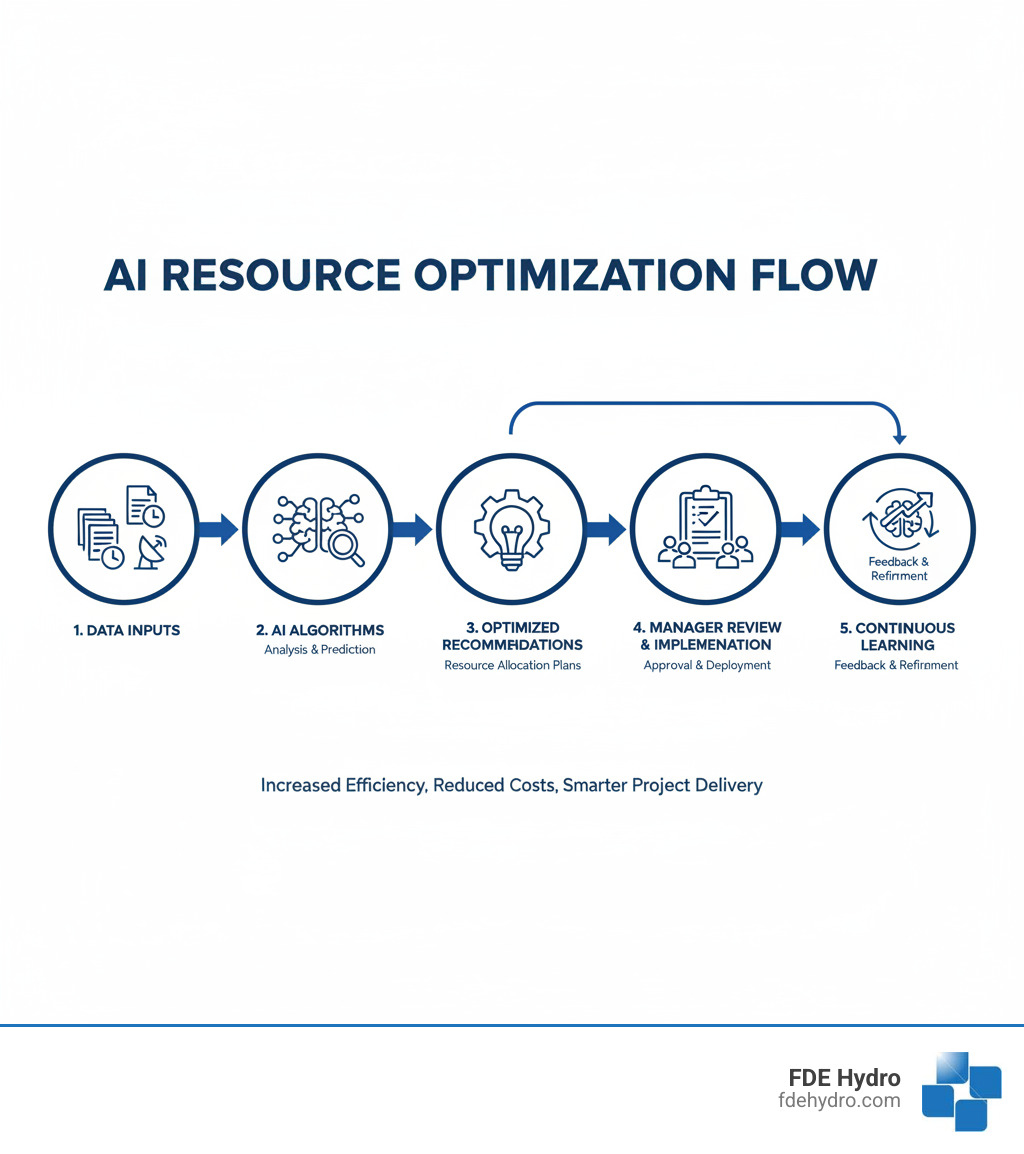
AI for resource management applies artificial intelligence to optimize how organizations allocate people, equipment, and budgets. By analyzing complex project data, it matches the right resources to tasks, predicts future needs, and automates scheduling to reduce manual planning time by up to 50%. The result is real-time visibility into team capacity and project health.
The numbers are compelling. Organizations using AI-powered tools report utilization rates above 75% (compared to the 40% industry average), a 43% increase in billable time, and 5-10% higher project margins. For large-scale infrastructure projects, these gains provide a significant competitive advantage.
Traditional resource management relies on spreadsheets and gut instinct, which is inefficient and error-prone as projects scale. AI processes vast amounts of data to find patterns humans miss, balancing deadlines, skills, and budgets simultaneously. What once required expensive custom development is now available in user-friendly platforms that forecast workloads, suggest team compositions, and alert managers to bottlenecks before they occur.
I’m Bill French Sr., Founder and CEO of FDE Hydro, where we’ve pioneered modular construction solutions for the hydropower industry. After decades of managing complex civil infrastructure projects, I’ve seen how effective resource allocation separates successful projects from troubled ones. Today’s AI tools offer capabilities we could only dream of in earlier years. Let’s explore how they can transform your project delivery.
Defining AI in a Resource Context
At its core, AI for resource management uses intelligent systems to make smarter, faster decisions about valuable assets. It moves beyond simple automation by applying predictive analytics and optimization algorithms to uncover deep insights from historical and real-time data. This allows organizations to shift from reactive problem-solving to proactive, data-driven planning, ensuring resource plans are always one step ahead.
What Types of Resources Can AI Manage?
AI is versatile and can manage a wide array of assets beyond just personnel.
- Personnel: AI matches individuals to projects based on skills and availability, helping to predict and prevent burnout.
- Equipment and Machinery: For industries like ours at FDE Hydro, AI optimizes the deployment and maintenance of heavy equipment, minimizing downtime for critical assets used in our modular precast concrete technology.
- Financial Capital: AI tracks budgets, forecasts spending, and identifies potential cost overruns early.
- Inventory and Materials: It can manage stock levels and optimize procurement to ensure materials are available when needed for our hydropower projects.
- Time: As our most precious resource, AI helps optimize project timelines and identify potential delays to maximize project velocity.
If an asset needs to be allocated, scheduled, or tracked, AI can manage it more intelligently. For more on how we use technology to maximize efficiency, explore our approach to innovation: More info about our innovative technology.
The Core Benefits of AI for Resource Management

The real-world impact of AI for resource management is about fundamentally improving project delivery. AI transforms resource management from a reactive scramble into a strategic advantage, leading to increased productivity, better project outcomes, and higher margins. Common results include a 20% boost in utilization, 5-10% higher project margins, and a 12x return on investment.
AI turns hours of manual planning into decisions made in minutes.
- Demand forecasting: AI accurately predicts resource needs by analyzing historical data, preventing over-staffing or under-staffing.
- Automated scheduling: The system continuously matches resources to tasks based on skills, availability, and deadlines, eliminating spreadsheet nightmares.
- Skill matching: AI goes beyond keywords to evaluate past performance and find the best person for each task, ensuring quality outcomes.
- Workload balancing: By monitoring team capacity, AI flags potential overloads and suggests reallocations to prevent burnout.
These capabilities reduce administrative time on scheduling and reporting by up to 50%, freeing managers for more strategic work. This people-first approach balances business goals with employee well-being, creating an environment where teams thrive.
AI for resource management provides tight control over project finances. Real-time cost tracking offers instant visibility into spending, alerting you to variances before they become critical. This allows for better margin control, with organizations consistently seeing 5-10% higher project margins through optimized resource allocation.
Revenue forecasting also becomes more reliable as AI analyzes project pipelines and resource availability. The impressive 12x return on investment comes from reduced waste, higher utilization, and faster project delivery. For budgeting, AI offers data-driven forecasting and scenario planning, allowing you to test allocation strategies and understand their financial impact before committing.
At FDE Hydro, financial performance is linked to our commitment to sustainable infrastructure. AI helps optimize resource allocation in our operations, supporting both profitability and sustainability, aligning with principles in resources like Accelerating AI with Sustainability – A Playbook.
Boosting Efficiency and Project Outcomes
AI helps ensure projects finish on time, on budget, and at high quality. Increased utilization rates (often from 40% to over 75%) mean projects move faster. AI also reduces human error in allocation, leading to more reliable planning and better team morale.
Key benefits include:
- Risk prediction: AI analyzes project data to flag risks like budget overruns or delays, allowing for proactive intervention. This is critical for complex infrastructure projects where delays cost millions.
- Improved agility: When project parameters change, AI instantly suggests optimized adjustments, making the organization more responsive.
- Reduced manual reporting: With a 50%+ reduction in reporting time, managers can focus on strategic decisions instead of administrative tasks.
At FDE Hydro, efficiency is core to our mission. Our modular precast concrete technology already cuts construction time, and AI-powered resource management amplifies these gains. Learn more about our approach here: More info about our energy solutions.
Choosing the Right AI Resource Management Software

Selecting the right AI for resource management software means finding a tool that aligns with your business needs, scales with your growth, and is easy for your team to use. Key considerations include:
- Scalability: The software should work for your current team size but also support future expansion.
- User Experience: An intuitive interface is crucial for adoption. If the software is too complex, it won’t be used effectively.
- Integration: The platform must connect seamlessly with your existing project management, CRM, and financial tools to avoid data silos.
- Customization: Look for flexibility to adapt to your industry’s unique workflows, such as the long timelines and specialized equipment needs in hydropower.
- Analytics: The software should provide deep, actionable insights, not just surface-level reports.
Core Features to Look for in AI for Resource Management Software
When evaluating platforms, prioritize these transformative features:
- Intelligent Resource Recommendation: The software should analyze skills, availability, and performance to suggest the optimal person or team for each project.
- AI Workload Forecasting: Look for tools that predict when team members will become available, preventing overbooking and helping you make realistic commitments.
- Real-time Reporting Dashboards: Instant, customizable visibility into utilization, project status, and budgets is essential for agile decision-making.
- AI Headcount Planning: This feature analyzes demand and capacity to advise when and what roles to hire, enabling proactive team building.
- Automated Resource Allocation: The platform should continuously optimize assignments based on cost, speed, and skill alignment, handling complex calculations automatically.
Integration is essential for a unified workflow. Modern platforms are designed to connect with your existing technology stack via robust API access, allowing data to flow automatically between systems.
Look for pre-built connectors for popular tools like Jira, Salesforce, and HubSpot. This ensures your sales pipeline informs resource planning and creates a smooth handoff from sales to project execution. The goal is to achieve unified project intelligence—a single source of truth that pulls data from across your organization. For unique needs, custom API integrations offer even more power, as shown in various Developer API Success Stories.
At FDE Hydro, seamless integration is key to managing our complex hydropower projects. Connecting our resource management system with project tracking and financial tools eliminates friction and keeps everyone aligned.
A Practical Guide to Integrating AI into Your Workflow

Integrating AI for resource management is a journey that requires careful planning and team buy-in. It’s about evolving how your organization makes decisions. Success depends on a solid strategy, change management, and a culture of continuous improvement.
Practical Steps for Successful Integration
- Define Clear Objectives: Before choosing a tool, determine what you want to achieve. Are you aiming to reduce budget overruns, improve work-life balance, or forecast needs more accurately? Your goals will guide the entire process.
- Evaluate Data Quality: AI is only as good as the data it receives. Assess the accuracy and consistency of your project records, time tracking, and resource usage data. Clean up your data first for the best results.
- Choose the Right Tool: Select a solution that solves your specific challenges, integrates with existing systems, and is user-friendly. Involve your team in the selection process.
- Start with a Pilot Program: Test the software with a single team or project. This low-risk approach allows you to gather feedback and make adjustments before a company-wide rollout.
- Train Your Team: Invest in comprehensive training that explains the “why” behind the change, not just the “how.” Empowering your team with knowledge is key to adoption. Learn more about our approach to teamwork here: More info about our team.
- Review and Refine Continuously: AI is not a “set it and forget it” technology. Regularly check in to assess progress against your objectives, identify bottlenecks, and act on team feedback.
Handling Data Security and Measuring ROI
Two critical questions for any implementation are data security and return on investment (ROI).
For data security, choose reputable platforms with robust encryption, access controls, and compliance with regulations like GDPR. Always verify a vendor’s security protocols and data handling practices to ensure they meet your industry’s standards, following guidelines for the Responsible use of artificial intelligence in government.
To measure ROI, track key metrics where AI delivers value. You’ll likely see utilization rates jump by 20% or more, project margins increase by 5-10%, and administrative time drop by 50%. Also, monitor project success rates and team satisfaction. Many organizations see returns as high as 12x their initial investment as efficiency, better decision-making, and reduced waste compound over time.
At FDE Hydro, the principles of precision and continuous improvement that guide our modular construction approach also apply to our adoption of new technologies. It’s about working smarter.
Frequently Asked Questions about AI Resource Management
Is AI resource management software suitable for all business sizes?
Yes. AI for resource management software is highly scalable and benefits businesses of all sizes.
- Small Businesses: AI helps smaller teams optimize limited resources, make smarter hiring decisions, and compete more effectively. Many providers offer flexible, per-user pricing models.
- Large Enterprises: For large organizations, AI is essential for coordinating complex resource allocation across numerous projects and departments, providing a unified view that is impossible to achieve manually.
The key is choosing a solution that fits your budget and scales with your growth.
How does AI resource management software handle unexpected project changes?
AI excels at adapting to unexpected changes, a key advantage over static planning tools.
- Dynamic Rescheduling: When priorities shift or a resource becomes unavailable, the AI can instantly re-evaluate dependencies and suggest a new, optimized schedule.
- Real-time Alerts: The system constantly monitors project health and alerts managers to risks like budget overruns or delays, allowing for proactive intervention.
- Scenario Planning: Many tools let you model the impact of potential changes before committing, helping you choose the best path forward and improving organizational agility.
Can AI eliminate human bias in resource allocation?
AI can significantly reduce, but not completely eliminate, human bias.
- Reduction of Bias: By using objective data like skills and availability, AI minimizes the influence of unconscious biases in allocation decisions.
- Risk of Inherited Bias: However, if the historical data used to train the AI contains biases, the system may perpetuate them.
- Human Oversight is Crucial: For this reason, human oversight is essential. Managers must review AI recommendations to ensure fairness and logic. The goal is to use AI as a powerful assistant that helps us make more objective decisions, not as a fully autonomous replacement.
Conclusion: The Future of Project Delivery is Intelligent
We’ve reached an inflection point where AI for resource management is fundamentally rethinking how projects are delivered. This technology offers tangible benefits, including higher utilization rates, increased billable time, and improved project margins, leading to healthier businesses and more engaged teams.
As we’ve explored, AI transforms tedious planning into a fast, intelligent process. By choosing the right software and following a practical integration plan, organizations can achieve operational excellence. For those of us building critical infrastructure, these capabilities are essential. At FDE Hydro, we know that innovation in how we manage our resources is just as important as the modular construction solutions we pioneer.
Adopting AI is about more than a competitive edge; it’s about creating more agile, efficient, and human-centric organizations. AI acts as a partner, handling complex data analysis so managers can focus on leading, mentoring, and creative problem-solving.
The organizations that accept these intelligent systems will not just survive but thrive. They will deliver projects faster, more profitably, and with greater predictability. They will attract top talent and build the solutions our world needs with unprecedented efficiency. The future of project delivery is intelligent, and it’s here now.
Ready to explore how intelligent systems can transform your project delivery? Learn more about how we’re applying innovation across every aspect of modern hydropower: Learn more about advanced hydropower solutions.
by Bill French Sr. | Dec 9, 2025 | Energy Resource Articles
Why Understanding Renewable Energy Efficiency Matters
What renewable energy resource is the most efficient depends on how you measure efficiency. Hydropower leads in conversion efficiency at up to 90%, wind offers the highest energy return on investment (EROI) at 1,164%, and geothermal provides the most consistent output. Here’s a quick comparison:
| Energy Source |
Conversion Efficiency |
Key Advantage |
Primary Limitation |
| Hydropower |
Up to 90% |
Highest conversion rate, reliable baseload power |
High upfront construction costs |
| Wind |
20-40% capacity factor |
Exceptional energy return (1,164% EROI), low operating costs |
Intermittent, location-dependent |
| Geothermal |
12-21% |
Consistent 24/7 generation, stable output |
Limited to specific geographic regions |
| Solar PV |
15-23% |
Rapidly declining costs, highly accessible |
Weather-dependent, requires storage |
The global energy landscape is changing, with renewables now generating over 20% of all U.S. electricity. As we move away from fossil fuels, understanding which resources deliver the most energy for the least input is critical.
But “efficiency” isn’t one simple number. Conversion efficiency measures how much incoming energy becomes electricity. Capacity factor reveals how often a plant runs at full potential. Levelized Cost of Energy (LCOE) calculates the true cost per kilowatt-hour over a project’s life. And Energy Return on Investment (EROI) shows how much energy you get back compared to what you put in.
I’m Bill French Sr., Founder and CEO of FDE Hydro. We’ve spent years developing modular solutions to answer the question of what renewable energy resource is the most efficient by reducing the construction barriers that have historically limited hydropower. Our work with the Department of Energy’s Hydro Power Vision Task Force has shown us that efficiency is about both technology and smart implementation.
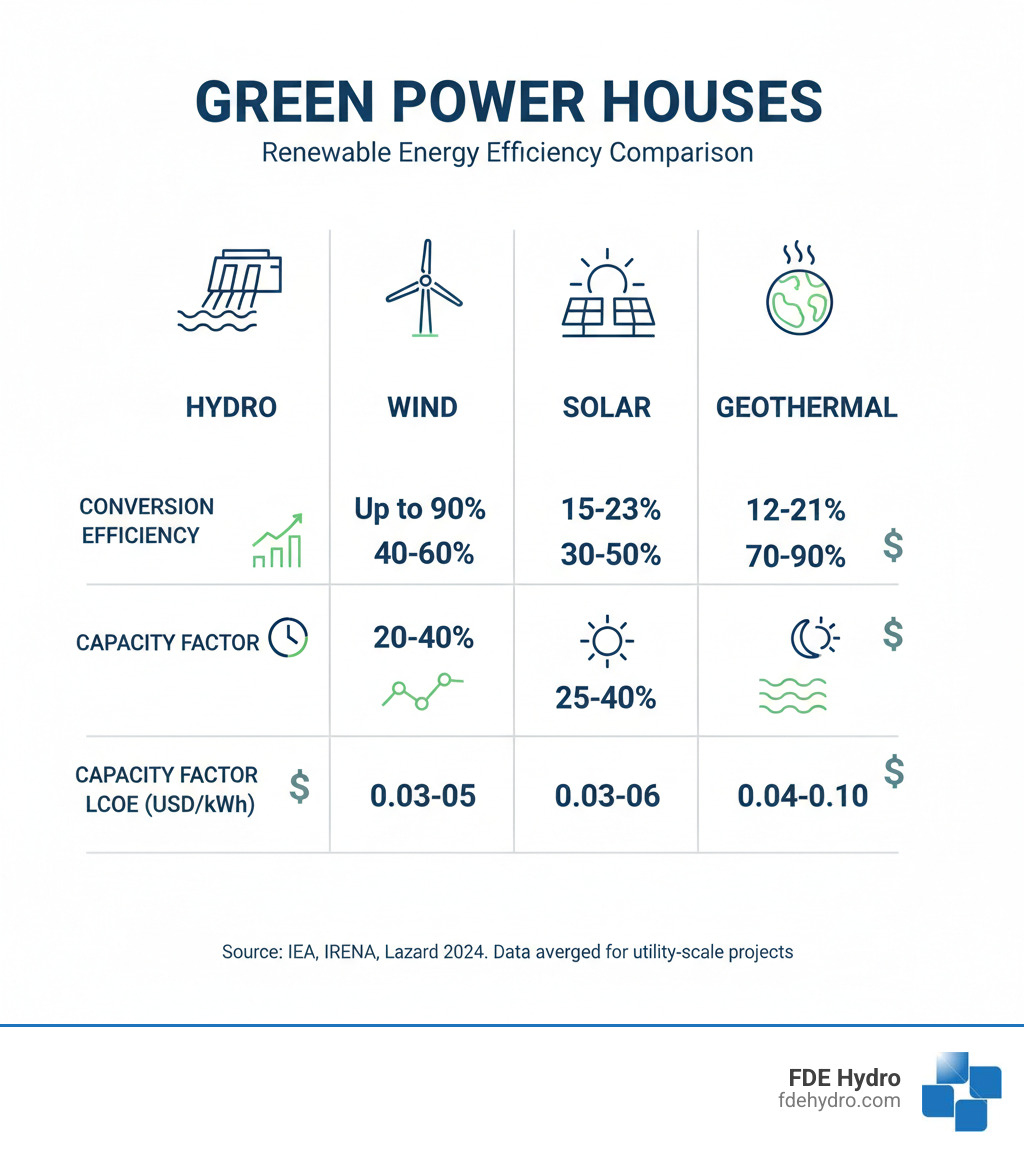
Understanding Efficiency: How Are Renewables Measured?
When asking what renewable energy resource is the most efficient, it’s important to know that the energy world uses multiple yardsticks to measure performance. Each one tells a different part of the story.
At FDE Hydro, we know the smartest approach looks at the complete picture—not just raw power, but also economics, reliability, and environmental footprint.
Here are the key metrics:
- Levelized Cost of Electricity (LCOE): This is the total cost to build and operate a power plant over its lifetime, divided by the electricity it produces. It allows for a fair comparison between different technologies. For example, the global weighted average LCOE for onshore wind was just $0.033 per kilowatt-hour in 2023, showing how competitive renewables have become.
- Capacity Factor: This tells us how much a plant actually produces compared to its maximum potential. A 100-megawatt facility running at full power half the year has a 50% capacity factor. Hydropower often achieves high capacity factors because water can be stored and released when needed, making it a reliable baseload power source.
- Conversion Efficiency: This is the percentage of incoming energy (like sunlight or water flow) that gets converted to electricity. A hydropower turbine can convert 90% of water’s kinetic energy, while a typical coal plant is only about 29% efficient.
Conversion Efficiency vs. Energy Return on Investment (EROI)
These two terms measure different things. Conversion efficiency is about the moment of generation—how much energy is captured right then and there. Energy Return on Investment (EROI) takes the long view, asking how much energy a system produces over its entire life compared to the energy used to build, maintain, and decommission it.
This is where wind energy shines, delivering an incredible 1,164% EROI. For every unit of energy invested, we get back more than eleven units. High conversion efficiency doesn’t guarantee high EROI, and vice versa. Hydropower’s 90% conversion is phenomenal, but the energy invested in construction is substantial. Each metric reveals a different truth about efficiency.
How Renewables Stack Up Against Fossil Fuels
The efficiency gap widens when you consider the entire lifecycle. Fossil fuels require energy-intensive extraction, transportation, and processing, all while producing lifecycle emissions. Renewables, once built, tap into naturally replenishing energy flows with near-zero emissions and no fuel extraction costs. Our work in Clean Energy Infrastructure focuses on maximizing this inherent advantage.
| Energy Source |
LCOE (USD/kWh, 2023 Global Avg) |
Capacity Factor (2023 Global Avg) |
Conversion Efficiency (Typical) |
| Hydropower |
0.057 |
40-60% (baseload) |
Up to 90% |
| Wind (Onshore) |
0.033 |
36% |
20-40% (capacity factor) |
| Solar PV (Utility-scale) |
0.044 |
15-30% |
15-23% |
| Geothermal |
0.069 |
70-90% |
12-21% |
| Coal |
Higher than new renewables |
50-70% |
~29% |
Data from IRENA Renewable Power Generation Costs in 2023 and multiple industry sources
What Renewable Energy Resource Is the Most Efficient? A Detailed Comparison
There is no single answer to what renewable energy resource is the most efficient. Like tools in a toolbox, each renewable source has its own superpower, making it the champion in different situations. Most experts point to wind, geothermal, hydroelectricity, and solar power as the efficiency leaders. Understanding their unique strengths is key, a topic we explore in our [Energy 101](https://fdehydro.com/energy-101/) resources.
- Wind energy delivers an extraordinary Energy Return on Investment (EROI) of 1,164%. The energy generated over a turbine’s lifetime dwarfs the energy needed to build and maintain it.
- Geothermal energy is the champion of consistency, with capacity factors reaching 70-90%. It provides reliable 24/7 power, regardless of weather.
- Hydroelectricity takes the crown for pure conversion efficiency, often hitting 90% or higher. Almost all of the water’s kinetic energy becomes electricity.
- Solar power’s efficiency story is about accessibility and economics. Costs have plummeted, making it deployable almost anywhere the sun shines.
What makes hydropower one of the most efficient renewable energy resources?
At FDE Hydro, we focus on hydropower because it excels in metrics that matter for reliable, large-scale energy.
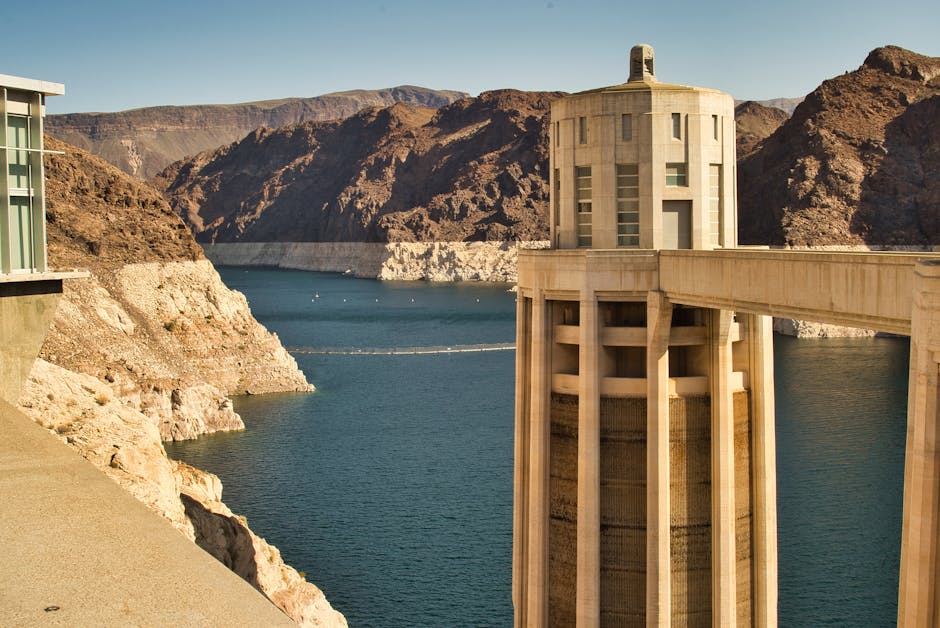
Hydropower plants achieve conversion efficiencies exceeding 90%, far surpassing fossil fuels and even other renewables in this regard. This makes it a standout when people ask what renewable energy resource is the most efficient in terms of pure conversion.
Beyond that, hydropower’s reliability and high capacity factor (often 40-60%) make it a cornerstone of a stable grid. We can control the flow of water, generating electricity precisely when needed. This dispatchability allows hydropower to act as a natural battery, balancing the grid. Once built, a hydro facility can operate for a century or more with low operating costs and free “fuel” from the water cycle.
Furthermore, [Pumped Storage Hydropower](https://fdehydro.com/pumped-storage-hydropower/) turns these facilities into massive energy storage systems, which is increasingly valuable as more intermittent renewables come online. While traditional projects have high costs and environmental impacts, our modular “French Dam” technology was developed to dramatically reduce construction costs and timelines while minimizing disruption. This approach makes this highly efficient resource more accessible and sustainable, aligning with the [Benefits of Hydropower Plant](https://fdehydro.com/benefits-of-hydropower-plant/) development.
What makes wind a contender for the most efficient renewable energy resource?
Wind turbines represent one of the most energy-efficient technologies ever developed.
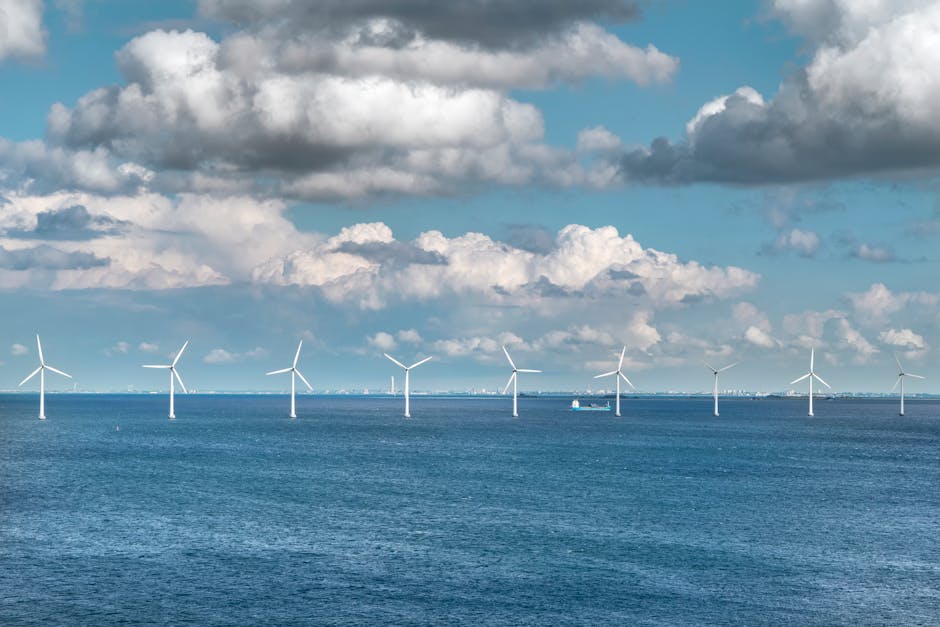
Wind’s superpower is its extraordinary Energy Return on Investment (EROI) of 1,164%. For every unit of energy invested over its lifetime, a turbine produces more than eleven units of clean electricity. Once spinning, operating costs are minimal because the fuel is free. This translates to some of the lowest electricity costs available today.
Modern turbines have capacity factors of 20-40%, and engineers continue to push closer to the theoretical maximum efficiency defined by Betz’s Law (59.3%). In the United States, wind already accounts for [9.2 percent of U.S. electricity generation](https://www.eia.gov/tools/faqs/faq.php?id=427&t=3). The main challenge is intermittency, which requires backup generation or energy storage. Siting can also be a challenge, but modern designs and careful planning are addressing these issues.
Geothermal and Solar: Consistent vs. Accessible Power
Geothermal and solar offer different paths to efficiency. Geothermal provides steady, dependable power, while solar offers widespread accessibility and rapidly improving economics.
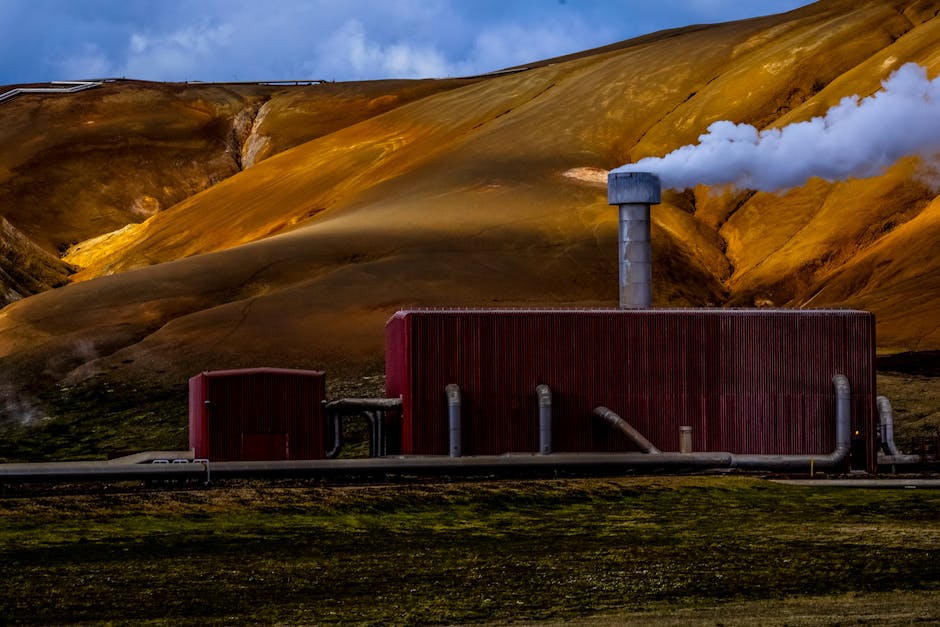
Geothermal energy taps into the Earth’s internal heat, boasting capacity factors of 70-90% for reliable, 24/7 baseload power. Its conversion efficiency is a modest 12-21%, but its unwavering output is incredibly valuable. The main limitations are high initial drilling costs and the need for specific geological conditions, though next-generation technologies aim to expand its reach.
Solar energy, on the other hand, is almost universally accessible. Its costs have dropped dramatically, making it the cheapest renewable source in many regions. Panel conversion efficiency is steadily climbing from the typical 15-23% range, with lab records exceeding 40%. Solar’s main challenge is intermittency, which requires energy storage solutions like batteries. As part of our commitment to [Sustainable Infrastructure Development](https://fdehydro.com/sustainable-infrastructure-development/), we see both as essential pieces of a diversified energy future.
Are there any renewable energy sources that are less efficient?
While all renewables are an improvement over fossil fuels, some lag behind the efficiency leaders.
Biomass energy, which involves burning organic matter, has lower conversion efficiency due to its multi-step process. There is also an ongoing debate about its carbon neutrality, as burning wood can release significant carbon that takes decades to be reabsorbed by new tree growth.
Solar thermal energy for electricity generation uses mirrors to create steam to drive a turbine. This process is generally less efficient than direct photovoltaic (PV) conversion and often requires large amounts of water, which is a problem in the arid regions best suited for it. For these reasons, biomass and solar thermal typically fall behind hydropower, wind, geothermal, and solar PV in overall efficiency.
Key Factors That Influence Renewable Energy Efficiency
When evaluating what renewable energy resource is the most efficient, it’s crucial to understand that real-world performance is not static. Efficiency is dynamic, influenced by several interconnected factors that can either boost or hinder a project’s output.
Technology advancements are a primary driver. Solar panel efficiencies are constantly climbing, wind turbines are becoming larger and more aerodynamic, and even established technologies are improving. At FDE Hydro, our work on [Renewable Energy Patents](https://fdehydro.com/renewable-energy-patents/) focuses on making hydroelectric systems more cost-effective and efficient to build.
Geographical location and weather conditions are paramount. A solar farm needs sun, a wind farm needs consistent wind, and a hydropower plant needs reliable water flow and elevation changes. Geothermal is limited to areas with accessible subterranean heat. Daily and seasonal weather patterns directly impact the output of intermittent sources like solar and wind, and long-term patterns like droughts can affect hydropower.
Maintenance and operations also play a significant role. A well-maintained facility will consistently produce more power. Regular inspections and timely repairs can make a substantial difference in energy production and revenue over the life of a plant.
Finally, grid integration is critical. A renewable source is only as efficient as the system that delivers its power. If the grid cannot handle the electricity produced, output may be curtailed, wasting free energy. Modernizing the power grid with smart technologies is vital to maximizing the efficiency of our renewable investments. Optimizing all these factors together is how we build a truly sustainable energy future.
The Future of Efficient Renewables
The quest for what renewable energy resource is the most efficient is an ongoing journey of innovation. The future is being shaped by a convergence of new technologies, smarter policies, and crucial infrastructure upgrades.
Technological breakthroughs are expanding our options. Next-generation geothermal systems (EGS) promise to open up heat from hot, dry rock almost anywhere, potentially changing it from a niche resource into a widespread baseload power option. In solar, perovskite solar cells are generating excitement for their potential to offer higher conversion efficiencies at lower manufacturing costs. Floating solar farms are also gaining traction, as they conserve land space and can be more efficient due to the cooling effect of the water.
Technology alone isn’t enough. Policy plays a crucial role by creating stable markets and incentivizing research. Initiatives like the EU’s REPowerEU Plan and the U.S. Inflation Reduction Act are releasing unprecedented funding for clean energy, streamlining development and fostering innovation.
Grid modernization is the unsung hero of this transition. A smarter grid, like the one the U.S. Department of Energy is working to build by modernizing the power grid, means less wasted energy and better integration of variable sources like wind and solar.
This brings us to energy storage solutions, the key to open uping the full potential of renewables. While battery technology is advancing rapidly, large-scale solutions like [Pumped Storage Hydropower](https://fdehydro.com/pumped-storage-hydropower/) act as giant, grid-scale batteries, ensuring reliability when the sun isn’t shining or the wind isn’t blowing.
At FDE Hydro, we are committed to this evolution through [Hydropower Innovation](https://fdehydro.com/hydropower-innovation/). Our modular approach makes hydropower a more flexible and responsive part of this diverse energy mix. The future isn’t about a single winner; it’s about an integrated system where solar’s accessibility, wind’s energy return, geothermal’s consistency, and hydropower’s reliability work together.
Frequently Asked Questions about Efficient Renewable Energy
What is the cheapest renewable energy source?
In terms of cost, solar power and onshore wind are the champions of affordability. Thanks to plummeting manufacturing costs, they are now the cheapest sources of new electricity in many regions.
The global weighted average Levelized Cost of Electricity (LCOE) in 2023 for utility-scale solar PV was just USD 0.044/kWh. Onshore wind was even cheaper at USD 0.033/kWh. This means building new renewable capacity is often more economical than new fossil fuel options, as confirmed by the [IRENA cost report](https://mc-cd8320d4-36a1-40ac-83cc-3389-cdn-endpoint.azureedge.net/-/media/Files/IRENA/Agency/Publication/2023/Aug/IRENA_Renewable_power_generation_costs_in_2022.pdf). The answer to what renewable energy resource is the most efficient increasingly includes economic efficiency, where solar and wind lead.
Is nuclear power a renewable energy source?
No, nuclear power is not considered a renewable energy source. While it is a low-carbon, zero-emission source of electricity during operation, it relies on uranium, which is a finite resource mined from the ground, much like coal or natural gas.
Renewable energy, by definition, comes from natural sources that are constantly replenished, such as sunlight, wind, water, and geothermal heat. Because its fuel source is not replenishable, nuclear power does not fit this definition. It’s an important distinction when planning for a truly sustainable energy future.
Which renewable energy is the most reliable?
When it comes to reliability—delivering power whenever it’s needed—two sources stand out: hydropower and geothermal energy.
Hydropower is “dispatchable,” meaning operators can control its output. By storing water in reservoirs, we can ramp generation up or down to meet demand, making hydropower a guardian of grid stability. This is why we at FDE Hydro are passionate about making this reliable technology more accessible.
Geothermal energy offers unwavering consistency. It taps into the Earth’s internal heat, allowing plants to operate 24/7 as a source of baseload power, which is the steady foundation of electricity the grid always needs.
In contrast, solar and wind are intermittent, as their output depends on the weather. They are crucial parts of the energy mix but require backup or storage from reliable partners like hydropower and geothermal to ensure a constant supply of power.
Conclusion: Efficiency is Key to a Sustainable Future
So, what renewable energy resource is the most efficient? The answer is a team of performers, each excelling in different ways. Hydropower offers best conversion efficiency and reliability. Wind delivers an incredible energy return on investment. Geothermal provides consistent 24/7 power, and solar leads in accessibility and low cost.
The path to a sustainable future lies in a diverse mix of these sources, creating a resilient system where each technology’s strengths compensate for the others’ limitations. Intermittent sources like solar and wind provide abundant, cheap power, while dispatchable sources like hydropower and geothermal fill the gaps to ensure constant reliability.
At FDE Hydro, we see how hydropower’s unique combination of high efficiency and reliability makes it an irreplaceable part of this energy mix. That’s why we’re focused on [Reinvigorating Hydropower](https://fdehydro.com/reinvigorating-hydropower/) with our innovative modular technology. By reducing the cost and time to build and retrofit facilities, we’re helping ensure this highly efficient resource powers our communities for generations.
The future of energy is diverse, clean, and efficient. To learn more about this cornerstone technology, explore the power and potential of [Hydropower](https://fdehydro.com/hydropower/).

