by Bill French Sr. | Oct 25, 2025 | Case Studies
Why Water Control Infrastructure is the Backbone of Modern Society
Water control infrastructure is the vast network of systems designed to manage, store, treat, and deliver water while protecting against floods and ensuring environmental health. It includes physical structures like dams, reservoirs, treatment plants, and levees; extensive drinking water and wastewater systems; and the control mechanisms that regulate water flow for everything from irrigation to hydropower. This infrastructure serves over 80% of the U.S. population with potable water, treats sewage for 75% of Americans, and supports $2 trillion in annual commerce through navigable waterways.
America’s water control infrastructure stands at a critical juncture. Much of this network, built after World War II, is aging rapidly, with some components over 100 years old. The U.S. depends on over 2.2 million miles of pipes to move 39 billion gallons of water daily, yet the EPA estimates a need for over $744 billion in the next two decades for repairs. The consequences of inaction are severe: the 2015 Flint water crisis exposed the dangers of neglect, nearly 10 million lead pipes remain in service, and the American Society of Civil Engineers gives U.S. dams a “D” grade, with over 16,000 posing a “high hazard” of failure.
Climate change compounds these challenges. Prolonged drought has pushed the Colorado River system, a water source for 40 million people, to its limits, with Lake Powell hitting record lows. Meanwhile, the Ogallala Aquifer, vital for U.S. agriculture, is being rapidly depleted.
Yet, there’s reason for optimism. The Bipartisan Infrastructure Law made a historic $50 billion investment in water infrastructure, with funds dedicated to replacing lead pipes. The Inflation Reduction Act added another $4.6 billion for drought-stricken areas. These investments offer a once-in-a-generation opportunity to modernize our systems and build resilience.
I’m Bill French Sr., Founder and CEO of FDE Hydro™. Over five decades, I’ve witnessed the evolution of water control infrastructure firsthand. This guide will walk you through its critical elements, the challenges we face, and the innovative solutions changing how we manage our most precious resource.
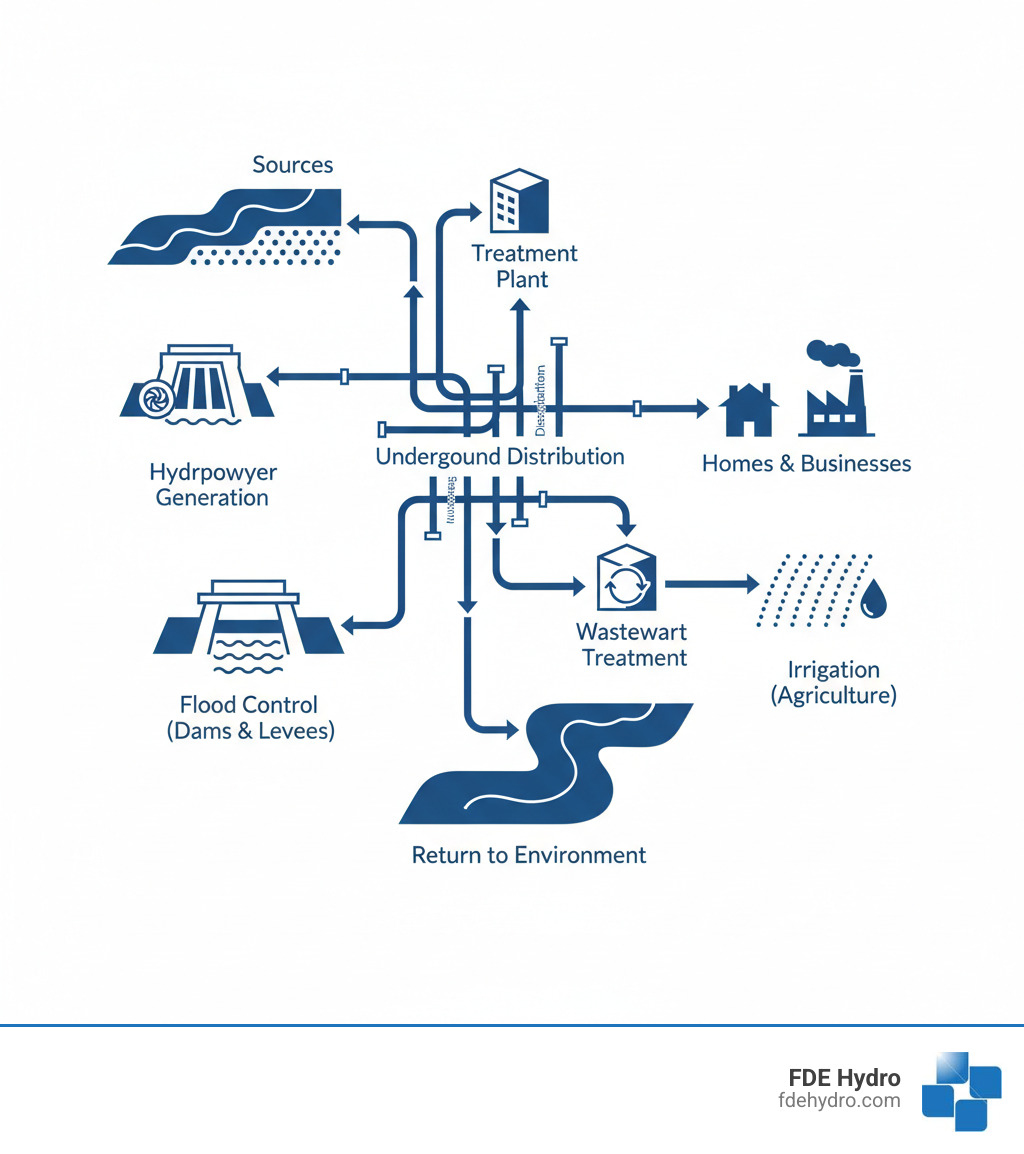
What is Water Control Infrastructure and Why is it Vital?
Water control infrastructure comprises the systems that bring clean water to your tap, carry waste away, and protect communities from floods. As defined by the American Society of Civil Engineers, it includes over 2.2 million miles of underground pipes, 16,000+ wastewater treatment plants, and vast networks of storm sewers and flood control reservoirs. This invisible backbone of modern life works 24/7 to control water flow, improve its quality, and ensure it arrives where and when it’s needed—whether for drinking, irrigation, or generating clean energy.
Consider the massive Dams that dot our landscape. These multitasking giants store drinking water, prevent floods, channel water to farms, and generate clean Hydropower, all while helping manage aquatic habitats.
Key Components of Water Control Infrastructure
Water infrastructure combines ‘gray’ (engineered) and ‘green’ (natural) approaches.
Gray infrastructure refers to the engineered systems. This includes the 2.2 million miles of pipes beneath our streets, many of which are nearing the end of their lifespan. It also includes drinking water treatment facilities that purify raw water and over 16,000 wastewater treatment plants that process sewage. With 15% of these plants already at or exceeding their design capacity, the need for upgrades is urgent. Other key components are Reservoirs for water storage, Spillways for safe flood release, and Pumping stations to keep water moving.
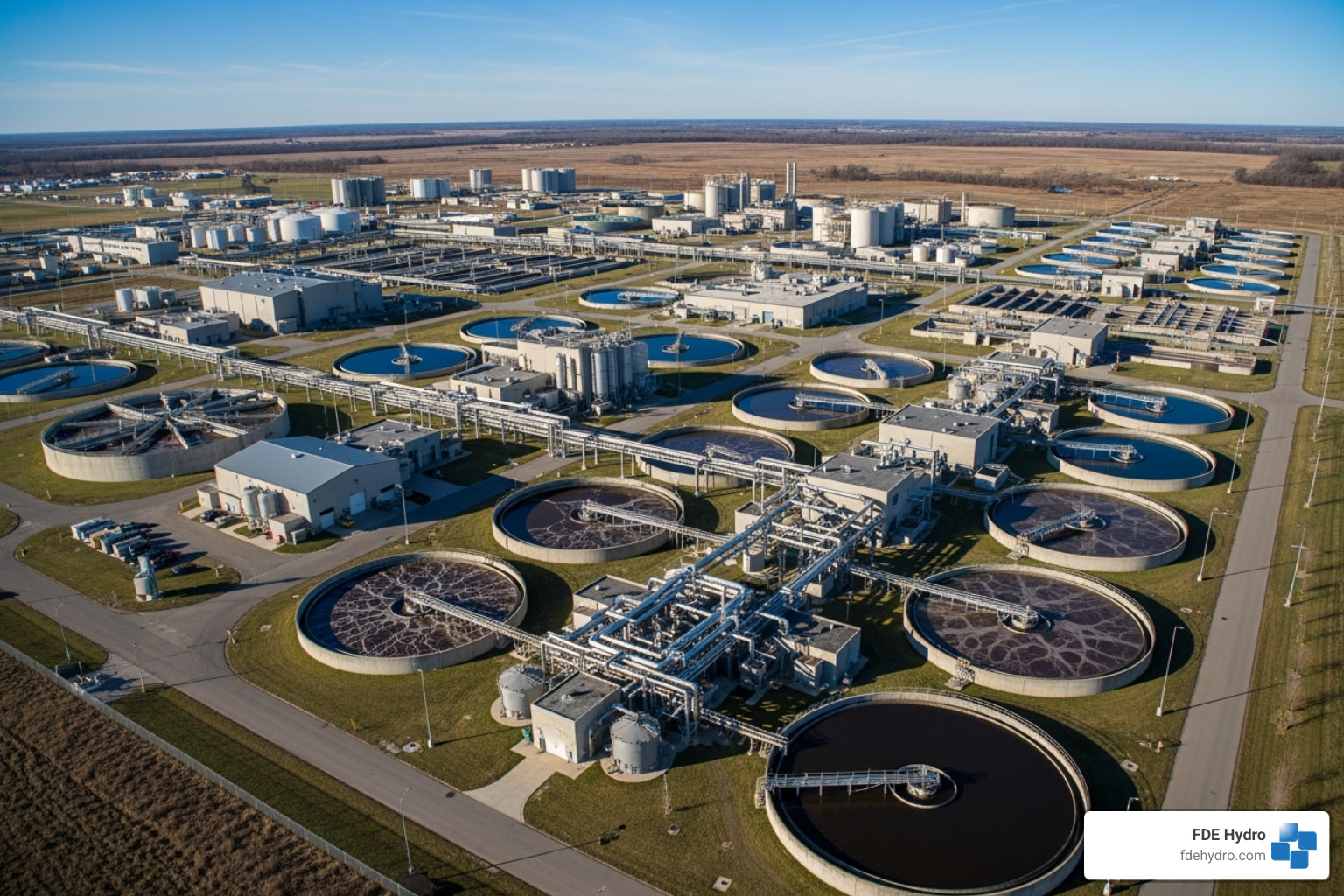
Green infrastructure works with nature. Healthy Watersheds, Ecosystems like forests, and Wetlands act as natural filters and sponges, reducing erosion, purifying water, and absorbing floodwaters. This approach complements engineered systems effectively.
Many specialized structures are also part of this network, including Weirs (low dams), Locks (for boat passage), Culverts (to carry streams under roads), Levees (for flood prevention), and Headgates (to control irrigation flow).
How Water Control Structures Function
Water Control Structures are the valves of water management, allowing for precise control over water movement. They perform several critical functions:
- Managing water levels and directing flow to ensure water reaches farms, communities, or specific habitats.
- Reducing sediment to protect water quality and prevent clogging in channels.
- Regulating temperature, which is vital for sensitive aquatic species like salmon.
- Creating and protecting fish and wildlife habitat, often by incorporating features for Aquatic Animal and Recreational Passage.
These structures are used in projects of all sizes, from large federal dams to local conservation efforts guided by resources like the NRCS guidance on water control structures. Proper engineering, construction, and maintenance are essential for their long-term effectiveness.
The State of U.S. Water Systems: A System at a Crossroads
Our nation’s water control infrastructure is at a critical moment. Built with post-war ambition, this impressive network is now aging beyond its intended lifespan, strained by deferred maintenance and insufficient investment. The ASCE’s 2021 infrastructure report card gives U.S. drinking water a “C-” grade, highlighting a problem with enormous economic stakes. Proper investment could add $4.5 trillion and 800,000 jobs to the economy by 2039, while inaction costs billions annually.
Compounding the issue are modern threats. Climate change is causing severe droughts in the West and overwhelming stormwater systems with intense rainfall elsewhere. At the same time, cyberattacks pose a growing risk to the digital controls of our water systems.
An Aging Network and Growing Threats
Much of our water infrastructure is now over 100 years old, operating far beyond its design life. The consequences are clear in frequent water main breaks, massive leaks, and, in the worst cases, public health crises. The 2015 disaster in Flint, Michigan, where lead from aging pipes contaminated the water supply, remains a stark reminder of the human cost of neglect. Today, nearly 10 million lead pipes are still in service nationwide.
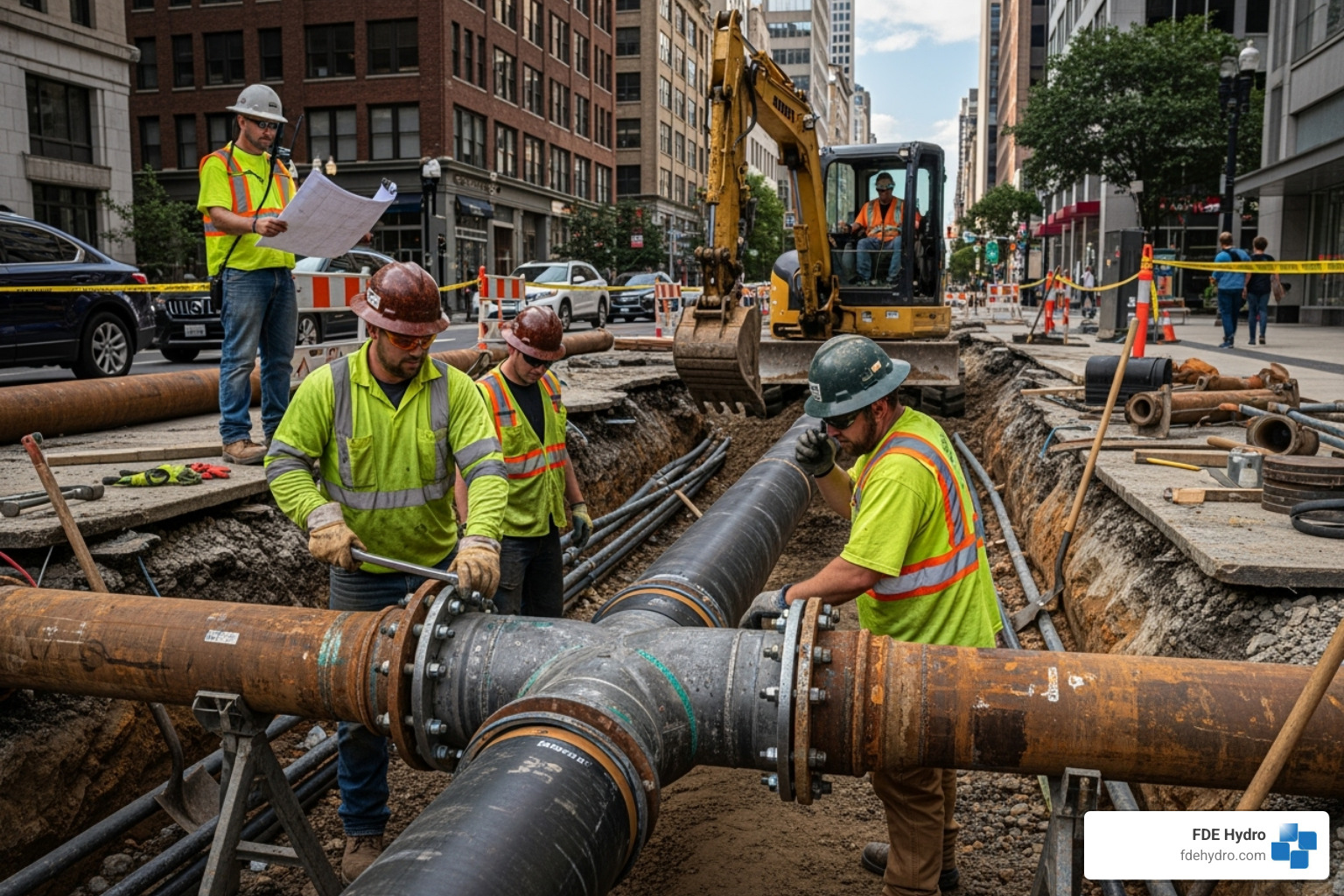
Dams face similar challenges, earning a “D” grade from the ASCE. Over 16,000 dams are classified as having a “high hazard” of failure, with rehabilitation costs for non-federal dams estimated at over $157 billion. This makes solutions like Dam Rehabilitation Encapsulation increasingly vital. Furthermore, 15% of our 16,000 wastewater treatment plants have reached or exceeded their design capacity. To combat digital threats, the EPA and CISA developed the 2024 Roadmap to a Secure and Resilient Water Sector and provide EPA Cybersecurity Resources for the Water Sector to help utilities bolster their defenses. Fortunately, we are actively developing Aging Infrastructure Being Replaced with Next Generation Civil Solutions.
Regional Flashpoints and Challenges
While problems are nationwide, certain regions face intense pressure. The Colorado River Basin, which two-thirds of people in southwestern states, nearly forty million Americans, rely on for drinking water, is suffering through the most severe drought in over a thousand years. This has forced painful water use reductions across seven states.
To the east, the Ogallala Aquifer, an underground reservoir vital to U.S. agriculture, is being depleted at an alarming rate. An estimated 30% of the aquifer was drained by 2010, threatening national food security.
In California, the State Water Project (SWP), a massive water delivery system built in the 1960s, requires urgent modernization. The proposed Delta Conveyance Project aims to update its aging infrastructure to better handle the impacts of climate change, such as less snowpack and more extreme rain events.
Finally, stormwater management remains a persistent challenge for cities, where aging drainage systems are frequently overwhelmed by intensified rainfall, leading to flooding and pollution.
Governing the Flow: Regulation, Funding, and Modernization
Managing our nation’s water control infrastructure involves a complex web of laws, regulations, and funding. After years of underinvestment, historic levels of funding are finally flowing into our water systems. The challenge is to spend these dollars wisely on resilient, long-term projects.
Landmark Legislation and Federal Oversight
Two federal laws form the bedrock of U.S. water management: the 1972 Clean Water Act (CWA), which regulates pollution in our waterways, and the 1974 Safe Drinking Water Act (SDWA), which ensures tap water is safe. The EPA sets national standards under these laws, while the Cybersecurity and Infrastructure Security Agency (CISA) works with the EPA to protect water systems from digital threats. Utilities can find guidance through EPA Cybersecurity Resources for the Water Sector.
At FDE Hydro, we believe modern infrastructure must be resilient against both physical and digital threats. Our Dam Rehabilitation Encapsulation solutions integrate modern protective measures with robust engineering from the ground up.
Historic Investments and Ongoing Needs
The Bipartisan Infrastructure Law of 2021 represents the largest federal investment in water systems in U.S. history, committing $55 billion to water infrastructure. Of this, $50 billion is channeled through the Clean Water and Drinking Water State Revolving Funds (SRFs), which provide low-interest loans for state-level projects. A key priority is the replacement of lead pipes, with at least $15 billion specifically earmarked for this purpose.
For larger projects, the Water Infrastructure Finance and Innovation Act (WIFIA) program offers federal loans for major upgrades. These programs are crucial for tackling big-ticket items like treatment plants, water recycling, and drought mitigation.
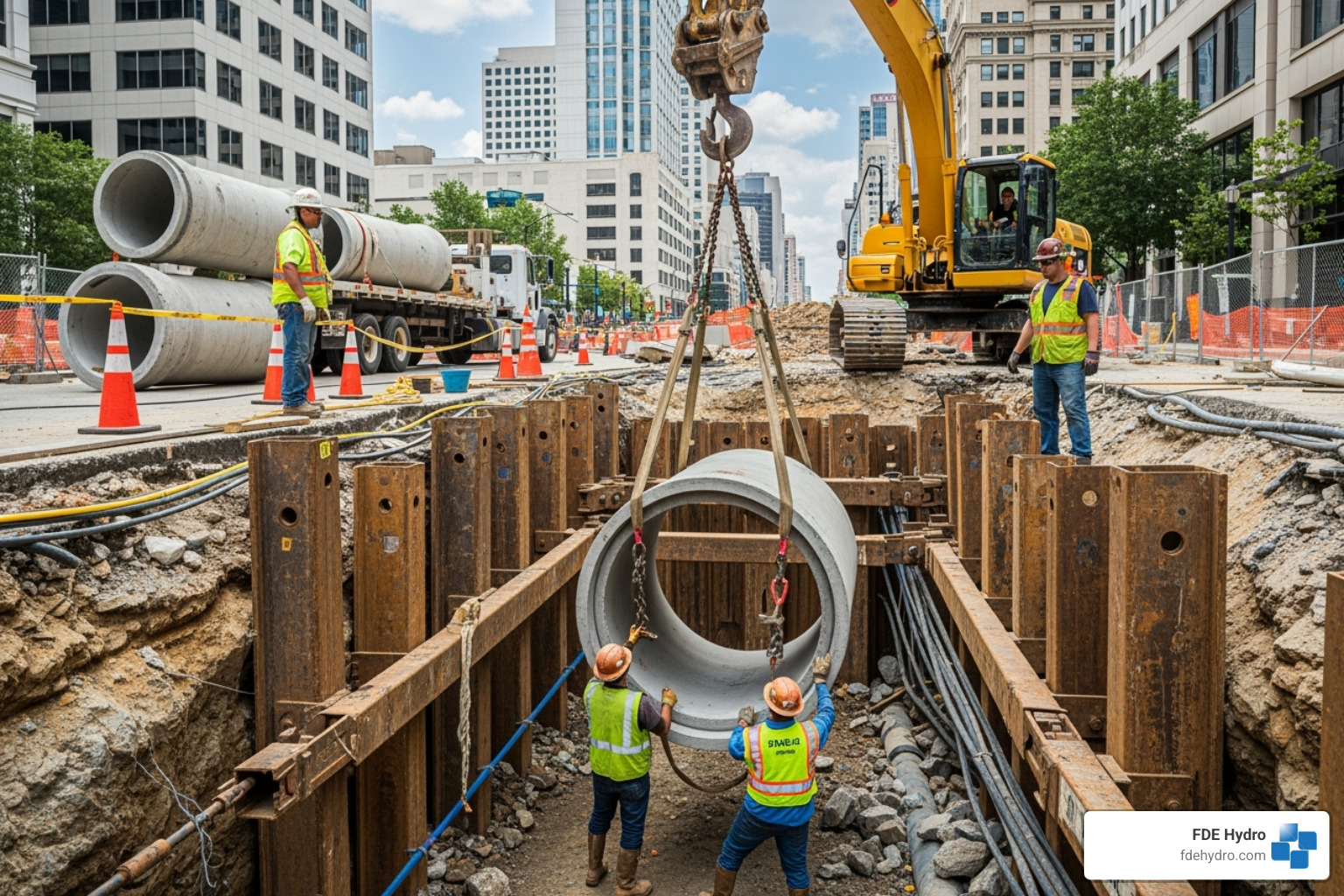
While historic, these investments are just a down payment. The ASCE calculated an $81 billion funding gap in 2019 alone, and the EPA estimates a need for over $744 billion in the next two decades. This highlights the need for cost-effective solutions.
Projects are already underway, such as California’s Delta Conveyance Project, which aims to adapt the State Water Project to climate change. This kind of forward-thinking investment is essential. At FDE Hydro, we believe The Biggest Untapped Solution to Climate Change is in the Water. By understanding Why Precast Cost Less, we can see how innovative construction methods can stretch these historic investments to accomplish even more.
The Future of Water Management: Innovation and Resilience
The future of water control infrastructure is about reimagining how we manage water. We are at a threshold where technology, nature, and innovative construction are converging to create smarter, more resilient systems.
Key trends are revolutionizing water operations. Smart technology and data-driven management, including sensors and AI, enable real-time leak detection and predictive maintenance. Resilience planning is now essential, focusing on diversifying water sources, recycling, and building redundancy into critical systems. The integration of green infrastructure, such as restored wetlands and healthy watersheds, complements traditional gray infrastructure by naturally filtering water and absorbing stormwater. Finally, modular construction is changing how we build, allowing components to be fabricated off-site and assembled rapidly, which speeds up projects, reduces costs, and minimizes environmental disruption. Our work at FDE Hydro shows Why Precast Cost Less and delivers superior results.
The Future of Water Control Infrastructure
Looking ahead, the evolution of water infrastructure will be defined by speed, efficiency, and sustainability. The old model of slow, expensive construction is no longer viable. Rapid Installment of Module Precast Civil Infrastructure offers a compelling alternative, accelerating both new construction and rehabilitation.
Precast concrete solutions provide exceptional durability and quality control, as components are manufactured and tested in a factory setting. This ensures infrastructure is built to last a century or more, with minimal on-site waste and disruption.
This innovation is especially transformative for hydropower. Modernizing facilities with efficient components can revitalize aging plants. Modular Powerhouses can be deployed rapidly, bringing clean energy online faster than ever. Hydropower is a cornerstone of a stable grid, and as explained in 4 Reasons Why Hydropower is the Guardian of the Grid, its reliability is crucial. Advanced systems like Pumped Storage Hydropower act as massive batteries, storing energy to balance intermittent renewables like solar and wind.
The convergence of these technologies paints an optimistic picture. We have the tools and knowledge to build water infrastructure for the next century. The question is whether we will act with the urgency the moment demands.
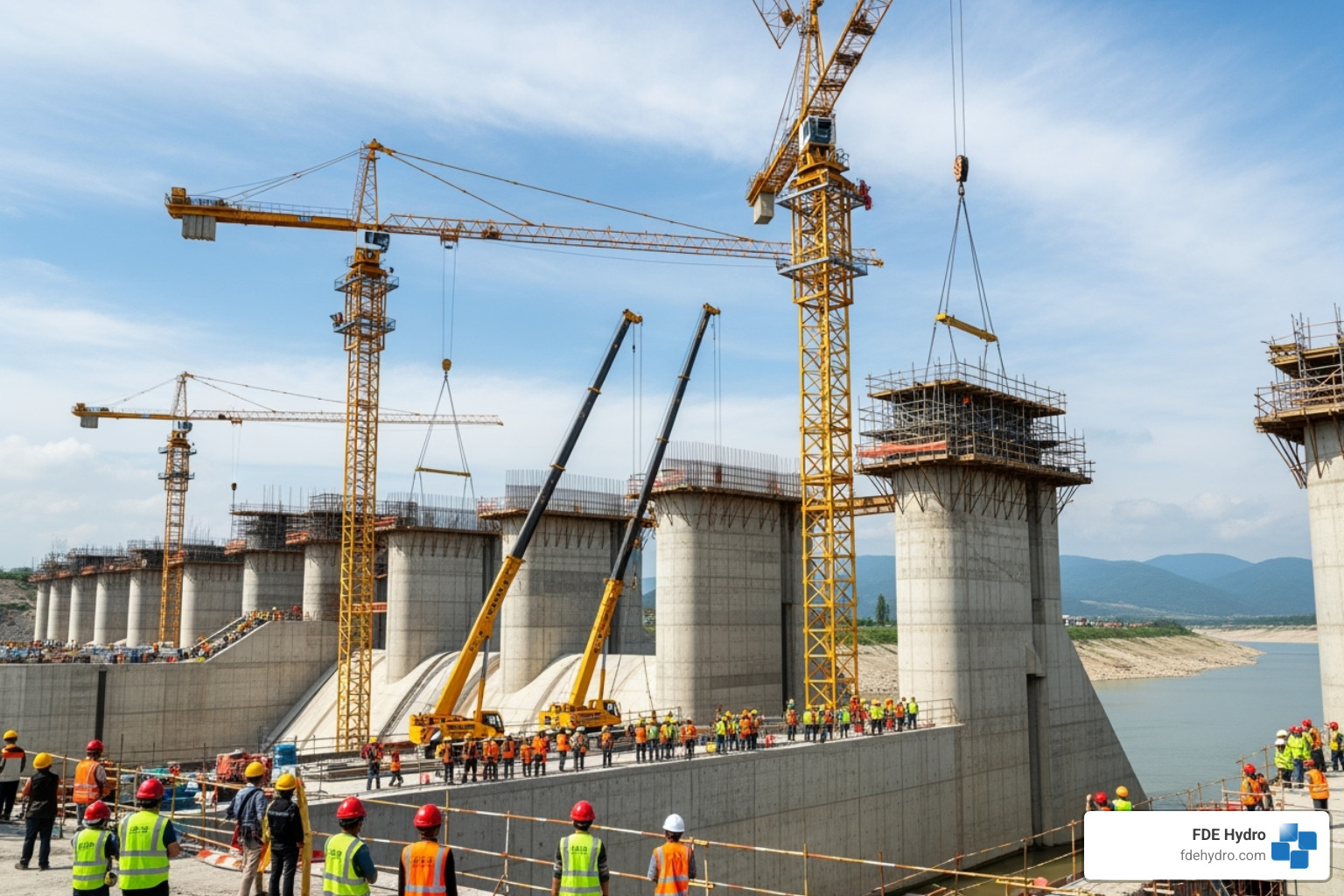
Conclusion
We’ve explored the complex world of water control infrastructure, the systems that underpin our daily lives. From our taps to our food supply, this network of pipes, plants, and dams makes modern society possible.
The challenges are urgent: aging infrastructure, a massive funding gap, and the escalating impacts of climate change. However, there is reason for hope. The Bipartisan Infrastructure Law’s $50 billion commitment is a historic step, giving communities resources to replace lead pipes, upgrade treatment plants, and improve dam safety. These are real projects that will protect American families.
But money alone is not enough. We must work smarter. Innovation is key, from modern materials like high-performance precast concrete to efficient modular construction methods that slash project timelines and costs. These are proven solutions being deployed today.
At FDE Hydro™, we are dedicated to being part of this solution. Our modular precast technology represents a fundamental shift in how we build and rehabilitate critical water control structures. By enabling communities to build resilience faster and more affordably, we are helping to secure our water future.
The path forward requires a shared commitment from engineers, policymakers, and citizens. We must continue to invest, accept new technologies, and plan for a future that will look different from our past. The water challenges of tomorrow demand the solutions we build today.
If you are involved in infrastructure planning, I encourage you to learn more about innovative means and methods for infrastructure construction. Together, we can build a water future that is resilient and sustainable for generations to come.
by Bill French Sr. | Oct 24, 2025 | Case Studies
Understanding the Building Blocks of Hydroelectric Power
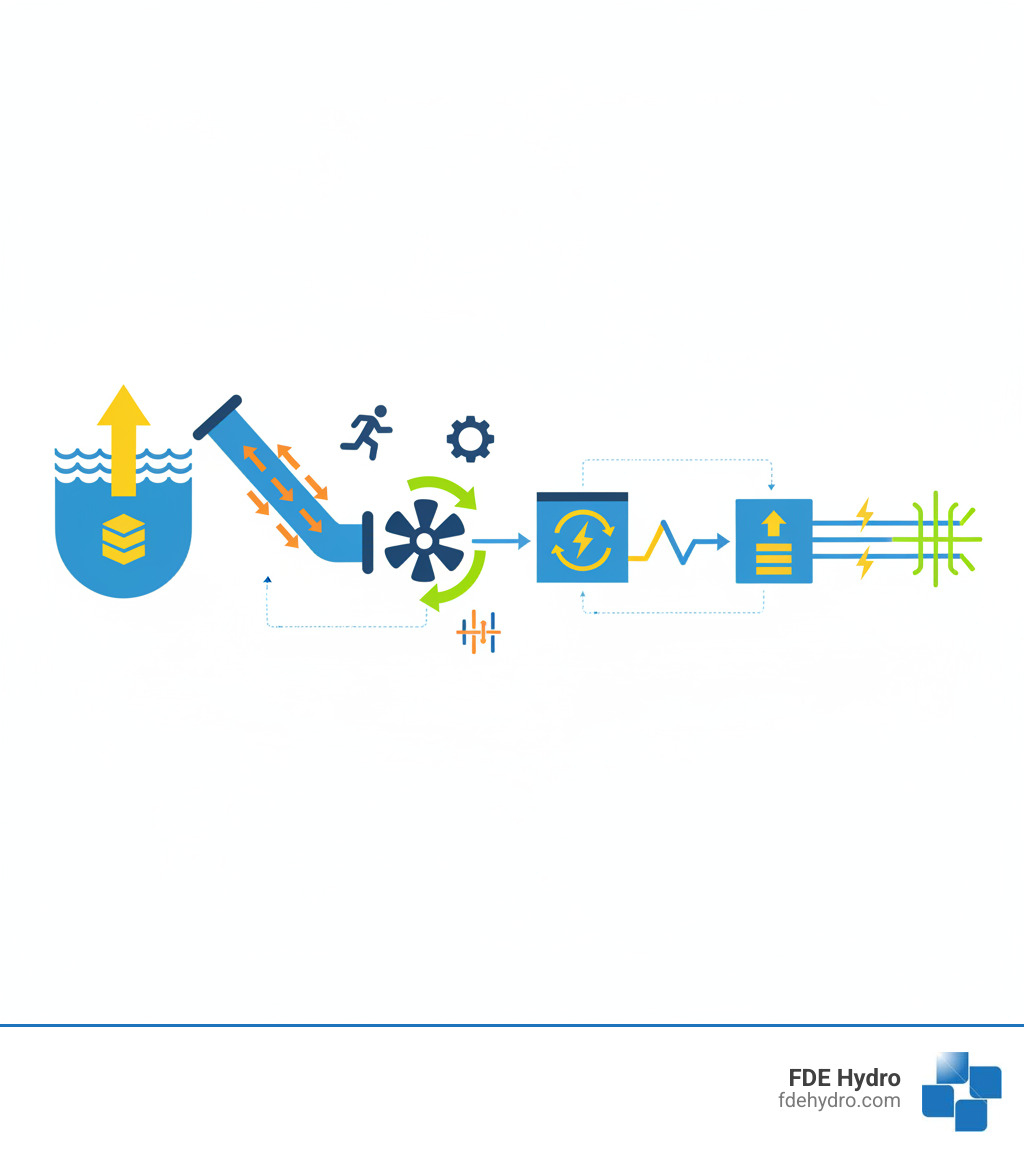
Hydroelectric dam components work together as an interconnected system to convert the energy of flowing water into electricity. At their core, these facilities rely on several key parts:
Primary Components:
- Dam – Stores water and creates elevation difference (head)
- Reservoir – Holds water at height to maximize potential energy
- Intake/Control Gates – Regulates water flow into the system
- Penstock – Channels water from reservoir to turbine at high pressure
- Turbine – Converts water’s kinetic energy into rotational motion
- Generator – Transforms mechanical rotation into electrical current
- Transformer – Steps up voltage for efficient transmission
- Switchyard/Transmission Lines – Delivers electricity to the grid
Worldwide, hydropower plants produce about 24 percent of the world’s electricity and supply more than 1 billion people with power. These facilities generate a combined total of 675,000 megawatts globally – that’s the energy equivalent of 3.6 billion barrels of oil. In 2022 alone, hydropower generated 4,289 TWh, representing 15% of total global electricity production and half of all renewable energy.
The beauty of hydroelectric systems lies in their neat simplicity: water flows in one end, and clean electricity comes out the other. Yet behind this simple concept is a carefully engineered series of components, each playing a critical role in the energy conversion process. From the massive concrete structure of the dam itself to the precisely calibrated turbine blades spinning at 90 revolutions per minute, every part must work in harmony.
Understanding these components isn’t just academic – it’s essential for operators to implement proper safety protocols, run efficient operations, plan maintenance schedules, and ultimately improve productivity while reducing costs. For anyone involved in planning, building, or operating hydroelectric facilities, knowing how each component functions and interacts with the others is fundamental to project success.
I’m Bill French, Sr., Founder and CEO of FDE Hydro, and I’ve spent decades working with hydroelectric dam components through both large-scale civil construction projects and developing innovative modular solutions for the hydropower industry. My work with the Department of Energy’s Water Power Technology Office has given me unique insight into next-generation component design and integration.
The Foundation: Water Containment and Control Structures
Every hydroelectric system begins with one fundamental challenge: how do you capture and control a river’s natural flow? The answer lies in the massive structures that form the foundation of hydropower generation. These hydroelectric dam components don’t just hold back water—they transform a free-flowing river into a carefully managed energy system.
Think of a reservoir as nature’s battery. Water stored at height contains enormous potential energy, just waiting to be released. The vertical distance between the water’s surface and the turbines below—what we call “head”—determines how much power we can generate. The greater the head height, the more energy each gallon of water can produce.
But storing water is only half the battle. We need precise control over how that water flows through the system. Modern control systems act like the dam’s nervous system, allowing operators to adjust everything from gate openings to flow rates from a central control room. These systems respond to changing electricity demand throughout the day, ramping power up during peak hours and scaling back when demand drops.
Protection starts at the intake. Trash racks filter out debris—branches, logs, leaves, and other floating materials that could damage expensive turbines downstream. Behind these screens, we create what’s called a “quiet water” area where the flow slows down enough for smaller sediment particles to settle out naturally. This two-stage filtering process keeps the water clean as it enters the penstock.
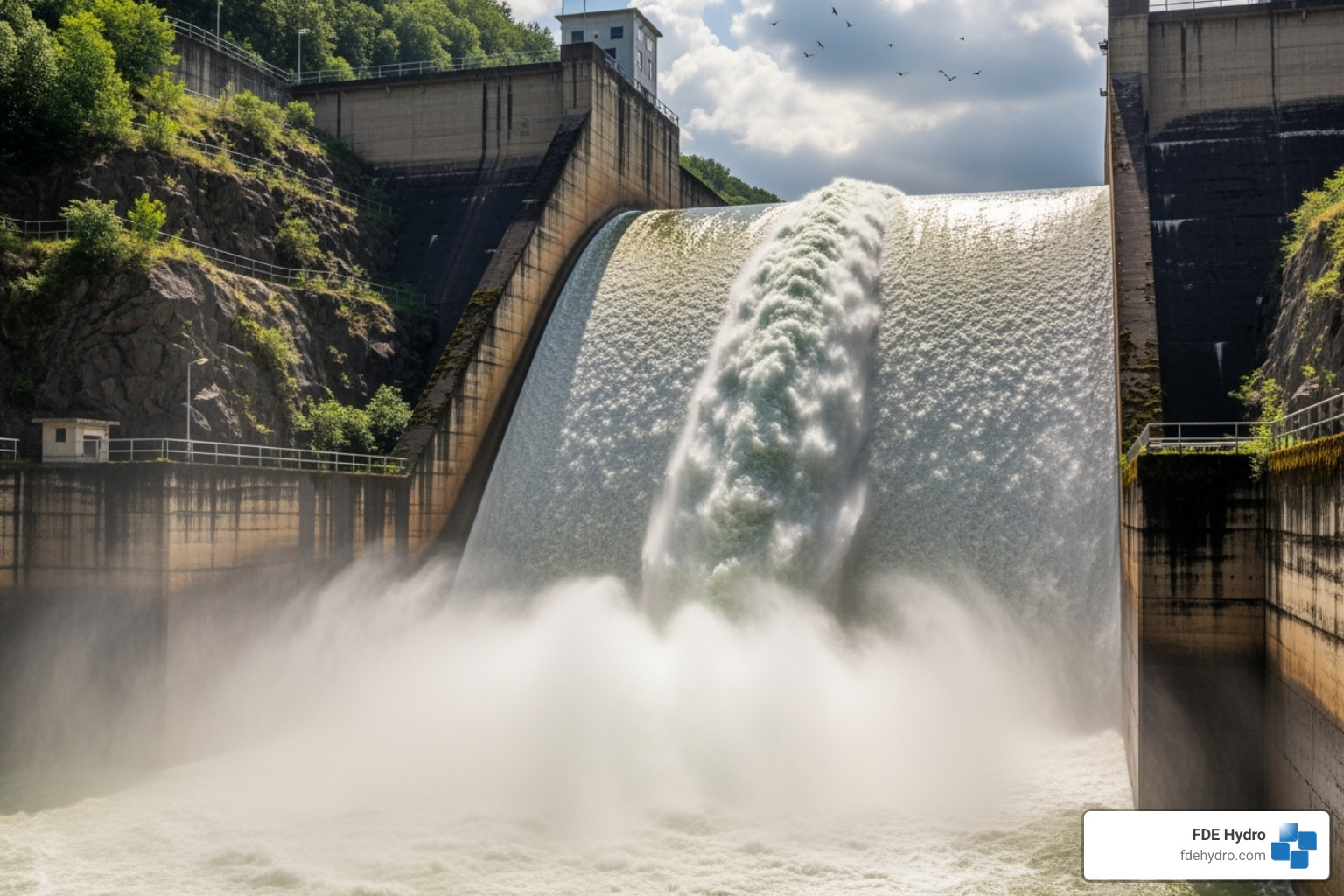
Spillways serve a different but equally critical function: flood control. When heavy rains or rapid snowmelt fill the reservoir beyond safe levels, spillways provide a controlled way to release excess water without threatening the dam’s structural integrity. You’ve probably seen dramatic footage of spillways in action—massive volumes of water cascading over concrete channels. It’s impressive to watch, but it’s really about safety and environmental protection.
These containment and control structures work together seamlessly. The dam creates the reservoir, the reservoir stores potential energy, the intake structures guide water toward the turbines, and the control gates regulate the flow. To learn more about how these systems integrate, check out our detailed resources on Water Control Structures and Spillways.
The Dam
When most people picture hydroelectric power, they see the dam. And for good reason—it’s often the most visible and impressive structure in the entire system. But a dam does much more than just look impressive. Its primary job is to stop a river in its tracks, creating a large reservoir upstream while establishing the critical head height needed for power generation.
Different sites call for different dam designs. Gravity dams use sheer weight and mass to resist the water’s pressure—think of the Hoover Dam’s massive concrete face. Arch dams take a different approach, using a curved design that redirects water pressure into the surrounding canyon walls, which is incredibly efficient in narrow gorges. Embankment dams are built from compacted earth and rock, making them ideal for sites where local materials are abundant and concrete would be impractical.
The numbers behind these structures are staggering. The United States’ tallest dam stands near Oroville, California, reaching 230 meters high and stretching 1.6 kilometers across. But that’s modest compared to China’s Jinping Dam on the Yalong River, which towers at 305 meters—taller than the Chrysler Building. These aren’t just engineering achievements; they’re critical infrastructure supporting millions of people with clean, renewable electricity.
Modern dam construction has evolved significantly. At FDE Hydro, we’ve developed modular precast concrete technology that dramatically reduces both construction time and costs compared to traditional methods. For a comprehensive look at dam design and construction, visit our Dams page.
The Reservoir
Behind every dam lies the reservoir—a vast bank of stored potential energy. This artificial lake holds water at elevation, ready to flow through turbines whenever electricity is needed. It’s energy storage on a massive scale, and remarkably efficient at it.
But reservoirs do more than just store energy for power plants. Many become valuable recreational resources for their communities. Take Lake Roosevelt behind the Grand Coulee Dam—it’s a popular destination for boating, fishing, and camping, bringing tourism dollars to the region. Reservoirs also provide reliable water supplies for cities and agricultural irrigation, especially in regions where rainfall is unpredictable.
The storage capacity of global hydropower reservoirs is truly impressive. According to the IEA’s 2021 estimates, all existing conventional hydropower reservoirs combined can store approximately 1,500 terawatt-hours of electrical energy in one full cycle. That’s equivalent to months of baseload power for entire nations.
Of course, reservoirs come with challenges too. Rivers naturally carry sediment, and over decades, this material accumulates on the reservoir floor, gradually reducing storage capacity. Managing sedimentation requires careful planning and periodic maintenance. Some facilities use controlled water releases to flush sediment downstream, while others must occasionally dredge to maintain capacity. It’s an ongoing consideration in long-term reservoir management, but one that operators have decades of experience handling.
Intake and Control Gates
Once water is stored in the reservoir, we need to guide it precisely toward the power-generating equipment. That’s where intake structures and control gates become essential hydroelectric dam components. These systems regulate exactly how much water enters the penstock and when.
The intake structure itself is carefully engineered to provide a deep, calm pool where water can enter smoothly without turbulence or air bubbles. Why does this matter? Because air mixed into the water reduces power output and can cause cavitation damage to turbine blades—tiny air bubbles collapse with enough force to literally eat away at metal surfaces over time. Preventing this starts with proper intake design.
Before water even reaches the control gates, it passes through trash racks—heavy-duty screens that catch debris like logs, branches, and other floating materials. These might seem like simple filters, but they’re critical for protecting the entire system. A single large log entering the penstock could cause catastrophic damage to a turbine spinning at high speed.
The control gates themselves give operators precise command over water flow. Opening the gates wider increases flow and power output; closing them reduces generation. This real-time control lets hydroelectric plants respond instantly to grid demands—something fossil fuel plants can’t match. During morning hours when everyone turns on their coffee makers and computers, operators can quickly ramp up generation. Late at night when demand drops, they scale back.
All of this happens from a central control room, where operators monitor water levels, gate positions, turbine speeds, and power output on digital displays. Modern systems can even automate many adjustments, though experienced human operators remain essential for handling unusual conditions and making judgment calls that computers can’t. This level of precise control makes hydropower one of the most flexible and reliable sources of electricity on the grid.
The Heart of the Plant: Key Hydroelectric Dam Components for Power Generation
Once water leaves the intake gates, it enters the powerhouse – the beating heart of any hydroelectric facility. This is where nature’s raw power transforms into something we can plug into. The powerhouse isn’t just another building; it’s a precisely engineered space where the intense forces of moving water get channeled and converted into mechanical energy that eventually lights our homes.
The design of the powerhouse matters tremendously. How water enters and exits the turbines directly impacts the efficiency of the entire system. A poorly designed powerhouse can waste precious energy, while a well-engineered one ensures every drop of water contributes its full potential. Inside these structures, we house the most critical hydroelectric dam components – the machinery that actually generates electricity.
Through decades of work in this industry, I’ve seen how thoughtful powerhouse design protects expensive equipment and maximizes output. The future of hydropower construction lies in innovative approaches that reduce both cost and timeline. Our Modular Powerhouses represent exactly this kind of thinking – bringing factory precision to hydropower construction. For those wanting to understand the complete picture of energy conversion, I recommend exploring How a Hydroelectric Dam Works.
The Penstock
Picture water sitting calmly in a reservoir. It has potential, but it’s not doing much. Now imagine that same water rushing through a massive pipeline at tremendous speed and pressure. That change happens in the penstock – one of the most crucial hydroelectric dam components you’ll find.
The penstock is essentially a large pipeline that carries water from the reservoir intake down to the turbine. But it’s not just a simple tube. As water races downward through the penstock, gravity does its work, converting the water’s potential energy into kinetic energy and building up enormous pressure. By the time water reaches the bottom, it’s moving with incredible force.
We typically construct penstocks from robust materials like steel or glass-reinforced plastic (GRP), chosen specifically to withstand the intense pressures involved. The engineering calculations for penstock design are fascinating – diameter, length, and routing all play critical roles in system efficiency. A penstock that’s too narrow restricts flow and robs the system of available power, even if there’s plenty of water. Conversely, a larger diameter reduces friction losses, allowing more powerful flow to reach the turbine.
Think of the penstock as a concentrator of energy. It takes the lazy potential of stored water and transforms it into a focused, powerful stream ready to do real work. Without this component, the water would simply flow downhill, dissipating its energy uselessly along the way.
Essential Mechanical Hydroelectric Dam Components: The Turbine
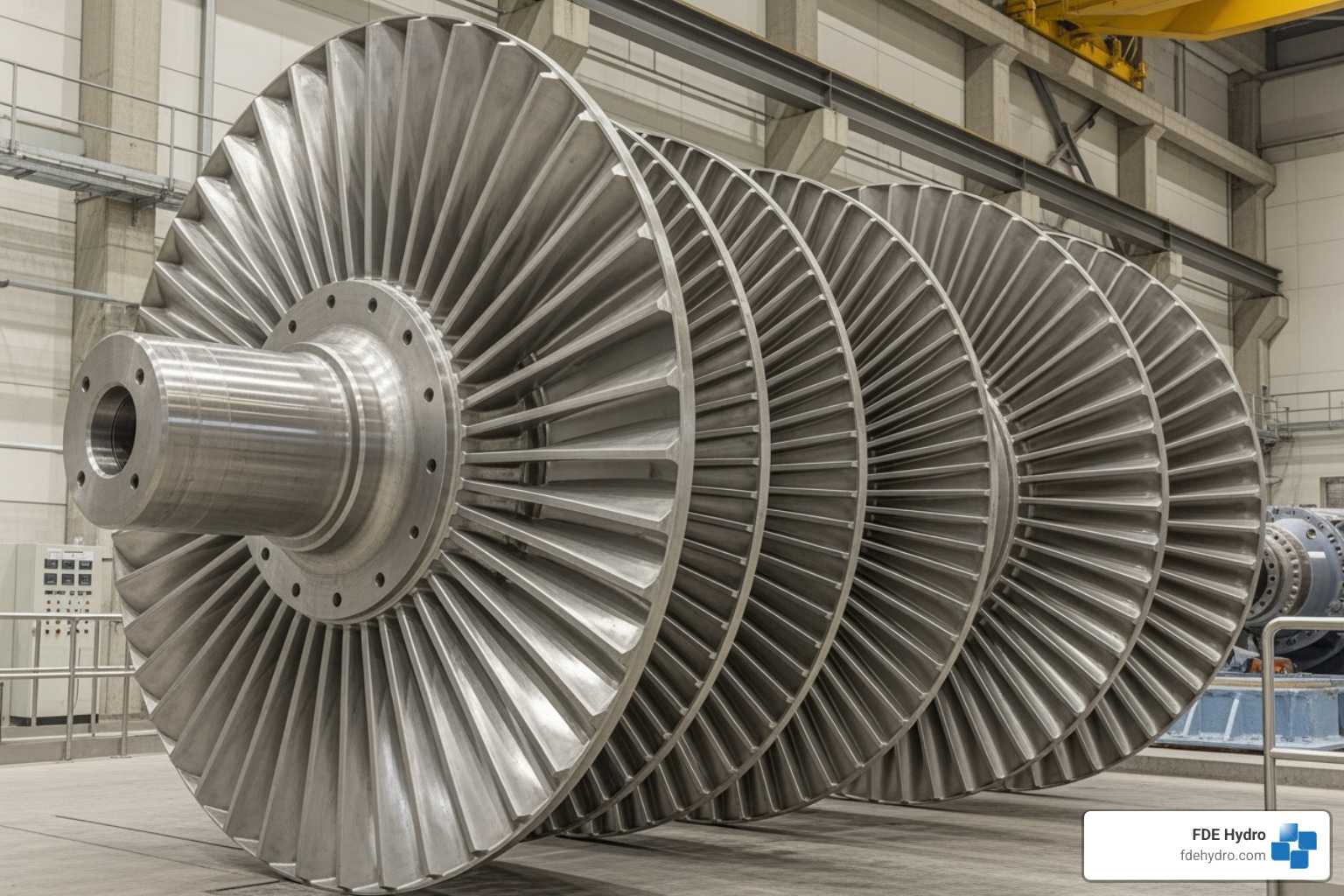
If the penstock concentrates energy, the turbine captures it. This is the true heart of any hydropower plant – the component that directly converts water’s kinetic energy into rotational motion. When high-pressure water from the penstock strikes the turbine’s carefully shaped blades, it causes a central shaft to spin. That spinning motion is the mechanical energy that will soon become electricity.
Here’s where engineering gets really interesting: turbines aren’t one-size-fits-all machines. The design depends heavily on two factors – the head (how far the water falls) and the flow (how much water is available). Over the years, engineers have developed different turbine types optimized for different conditions.
| Turbine Type |
Head Application |
Flow Application |
Typical Use Cases |
| Pelton |
High head (300+ meters) |
Low to medium flow |
Mountain streams, high dams with long penstocks |
| Francis |
Medium head (10-300 meters) |
Medium to high flow |
Most common type, versatile for various conditions |
| Kaplan |
Low head (2-40 meters) |
High flow |
Run-of-river plants, wide rivers with gentle slopes |
The Pelton turbine uses cup-shaped buckets mounted around a wheel, perfect for high-head, low-flow situations. The Francis turbine – probably the most common type worldwide – features a runner with fixed blades and works beautifully across a wide range of conditions. The Kaplan turbine looks almost like a ship’s propeller and excels in low-head, high-flow environments where other designs would struggle.
Selecting the right turbine type can make or break a hydropower project’s economics. It’s not just about generating power – it’s about generating it efficiently and reliably for decades to come.
The Generator
The turbine creates rotational motion, but we can’t send spinning shafts through power lines. That’s where the generator comes in – the final step in converting water’s energy into usable electricity. The generator connects directly to the turbine shaft, and as the turbine spins, so does the generator.
Inside the generator, we rely on a principle finded by Michael Faraday nearly two centuries ago: electromagnetic induction. When you move magnets past copper coils (or spin coils past magnets), you create an electric current. The generator contains two main parts – the stator (the stationary outer shell with copper coils) and the rotor (the spinning inner part with powerful magnets). As the turbine turns the rotor, the moving magnetic field induces electrical current in the stator coils.
The electricity produced is alternating current (AC), the same type that powers our homes and businesses. A typical hydroelectric generator might spin at around 90 revolutions per minute, producing electricity at standard grid frequency – 60 Hz in North America or 50 Hz in most other parts of the world.
What amazes me after all these years is the elegance of this conversion process. Water falls, turbine spins, magnets move past coils, electrons flow. From the raw power of a river to the gentle hum of electricity in the wires – all accomplished by these carefully engineered hydroelectric dam components working in perfect harmony.
by Bill French Sr. | Oct 23, 2025 | Case Studies
Why Hydropower Plants Remain Essential for Modern Energy Systems
The benefits of hydropower plant infrastructure extend far beyond electricity generation. As one of the world’s oldest renewable energy sources, hydropower has evolved to meet modern energy demands while providing best reliability, economic value, and environmental advantages.
Quick Overview: Top Benefits of Hydropower Plants
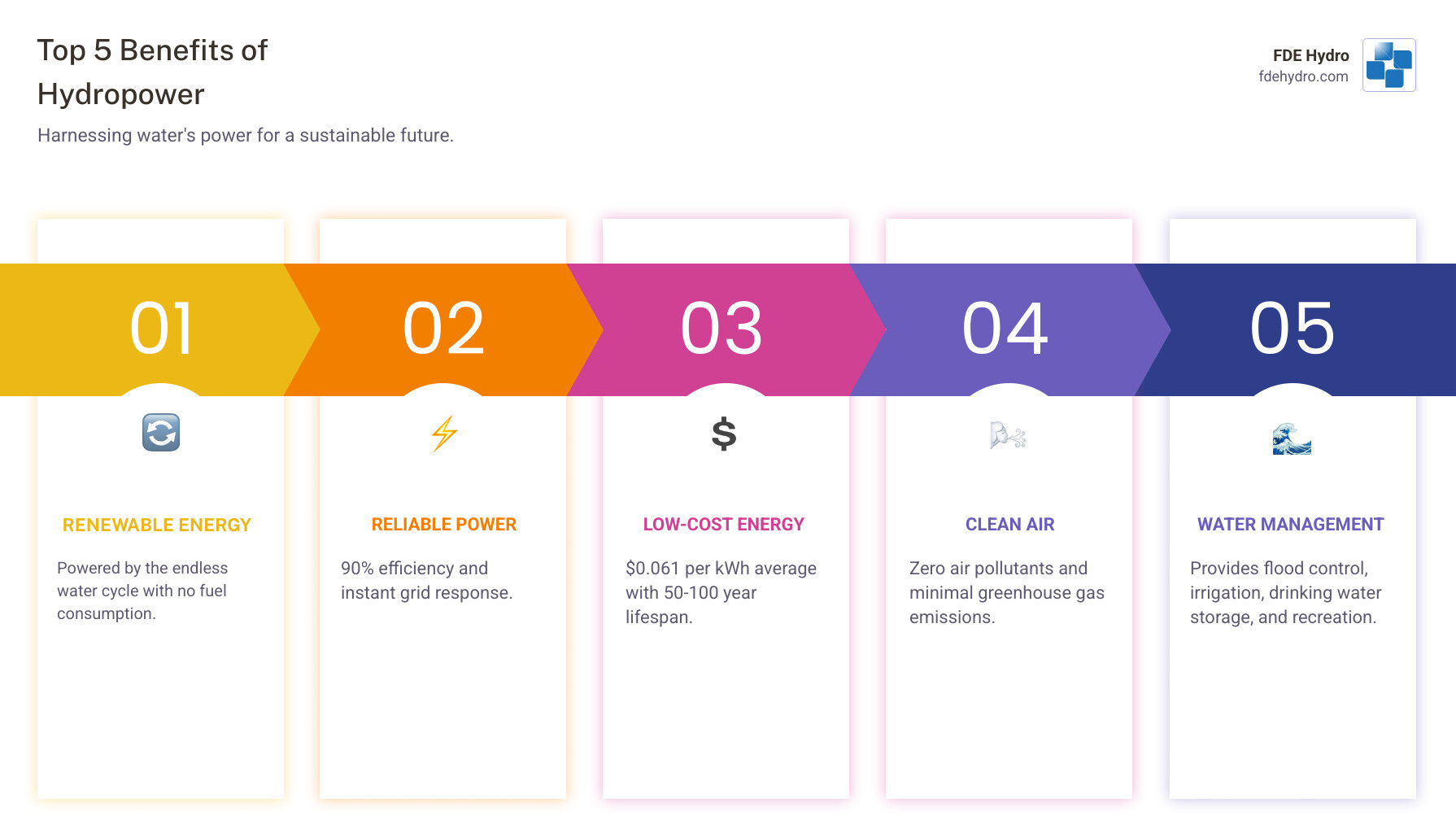
- Clean & Renewable – Zero air pollutants and ultra-low greenhouse gas emissions
- Highly Efficient – Converts up to 90% of water’s energy into electricity
- Grid Stability – Provides instant backup power and energy storage (95% of U.S. utility-scale storage)
- Economic Impact – Creates 66,500+ U.S. jobs with growth projected to 158,000 by 2050
- Multiple Services – Delivers flood control, irrigation, drinking water, and recreation
- Long-Term Value – 50-100+ year lifespan with low operating costs
- Energy Independence – Domestic resource not subject to fuel price volatility
Hydropower produces over 50% of global renewable electricity and 14.3% of total worldwide generation. Unlike intermittent renewables, it can ramp up within minutes to meet peak demand, making it the backbone of grid stability. The technology harnesses the natural water cycle—driven by the sun—to generate power without consuming water. Modern facilities range from massive dams to small run-of-river systems and pumped storage systems that act as giant rechargeable batteries.
I’m Bill French, Sr., Founder and CEO of FDE Hydro™, where we’ve pioneered modular construction solutions that maximize the benefits of hydropower plant development while reducing construction timelines and environmental impact. With five decades in heavy civil construction and as a participant in the Department of Energy’s Hydropower Vision Task Force, I’ve seen how innovation can open up hydropower’s full potential.
1. A Clean and Green Powerhouse: Environmental Advantages
Among the primary benefits of hydropower plant operations are the environmental advantages. Hydropower taps into the natural flow of water to create electricity without combustion, meaning no smoke, fumes, or toxic gases are released into the air.
Unlike fossil fuel plants, hydroelectric facilities produce zero air pollutants during operation and have ultra-low greenhouse gas emissions across their lifecycle. This makes hydropower a powerful ally in the fight against climate change.
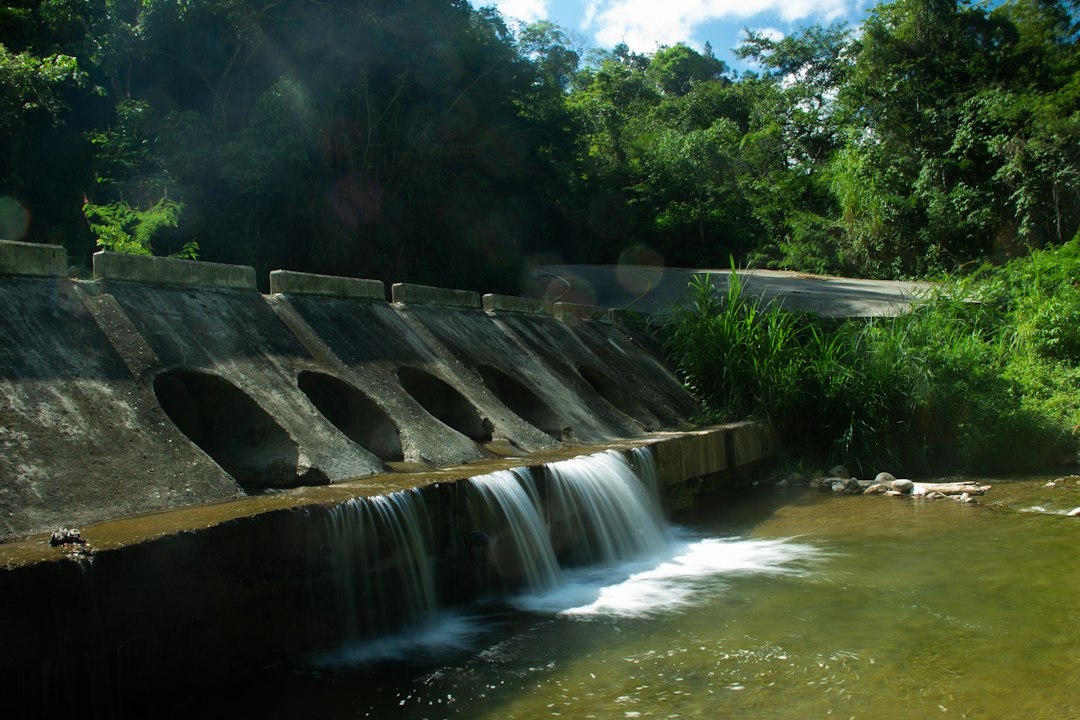
Every kilowatt-hour from hydropower displaces fossil fuel generation, reducing harmful air particulates, acid rain, and smog. The impact is significant: research shows that hydropower has helped avoid over 100 billion tonnes of carbon dioxide in the past 50 years—roughly equal to the U.S. carbon footprint for two decades.
This is why hydropower represents The Biggest Untapped Solution to Climate Change is in the Water. It uses the power of the sun-driven water cycle to generate clean energy without depleting water resources.
How Hydropower Fights Climate Change
Hydropower’s life cycle emissions are incredibly low, often matching or beating wind power. Replacing today’s hydropower with coal would add 4 billion tonnes of greenhouse gases to the atmosphere annually, increasing global emissions from fossil fuels by 10%. It would also add 150 million tonnes of air pollutants that cause respiratory illnesses and damage ecosystems.
Because hydropower involves no combustion, it releases no sulfur dioxide, nitrogen oxides, or particulate matter. This means cleaner air, healthier ecosystems, and a more stable climate. The positive environmental change is one of the most compelling benefits of hydropower plant development, happening automatically just by working with the natural force of water.
2. Powering Economies: The Economic Benefits of Hydropower Plant
The benefits of hydropower plant development extend to building thriving economies, creating careers, and delivering affordable electricity. While the initial construction requires significant investment, the long-term economics are highly favorable, providing some of the most affordable electricity in the world.
In 2022, the global weighted average cost of electricity from hydropower was just $0.061 per kilowatt-hour. In the U.S., states with abundant hydropower like Washington, Oregon, and Idaho consistently have some of the lowest electricity rates in the country. This affordability attracts businesses and provides financial relief for families. The infrastructure around Dams becomes a catalyst for regional development and lasting value.
Long-Term Affordability and Investment
While the upfront investment for a hydropower facility is substantial, the asset is built to last for 50 to 100 years—and often much longer with modern upgrades. Many plants have operated for over a century.
Once running, hydropower facilities have very low operations and maintenance costs. The “fuel”—water—is free and domestic, insulating consumers from the price volatility of international fossil fuel markets. This stability leads to predictable electricity prices, making hydropower a sound investment for energy independence and economic resilience.
Fueling Job Growth
The hydropower industry is a significant job creator. Currently, the U.S. hydropower sector employs 66,500 people in roles spanning manufacturing, construction, engineering, and operations. Hydropower creates jobs across the economic spectrum.
The future looks even brighter, with projections showing the industry expanding to 120,000 jobs by 2030 and 158,000 by 2050. More on the U.S. hydropower workforce details this growth. Many of these high-wage jobs are in rural areas, bringing sustained economic development, tax revenue, and stable employment that allows communities to flourish.
3. The Guardian of the Grid: Reliability and Flexibility
Among the most critical benefits of hydropower plant operations is reliability. Hydropower is the “guardian of the grid” because it delivers dependable power essential for our electric world.
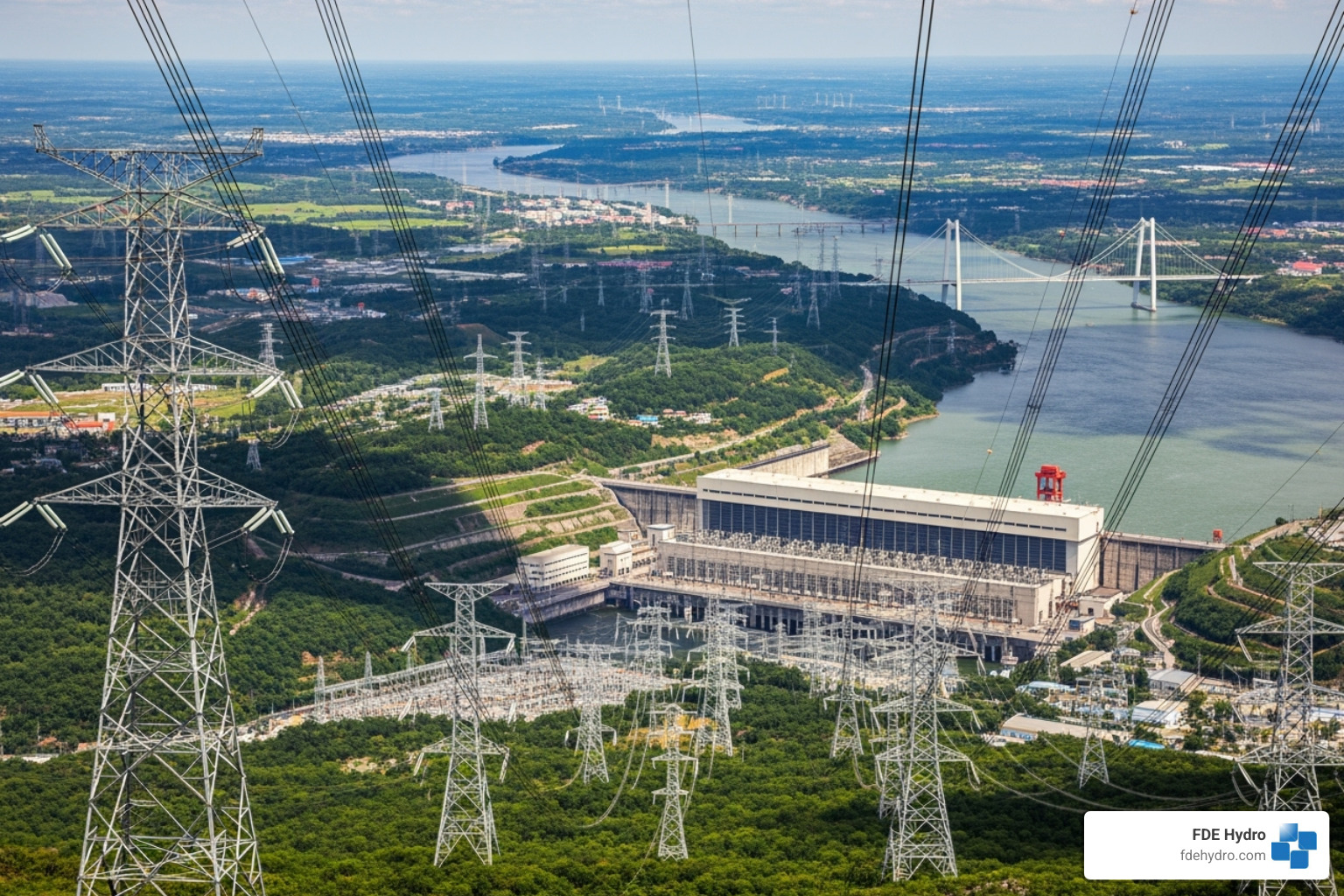
Hydropower is highly efficient, converting up to 90% of water’s kinetic energy into electricity. More importantly, it is highly responsive. While thermal plants take hours to ramp up, hydropower facilities can go from zero to full power in minutes, providing an invaluable backup during outages or demand spikes. The firm capacity of U.S. hydropower exceeds 24 gigawatts—enough to power up to 24 million homes. This dispatchable power is why 4 Reasons Why Hydropower is the Guardian of the Grid include its best flexibility.
Furthermore, hydropower improves energy independence. By relying on domestic water resources, it insulates our energy supply from volatile international fuel markets and supply disruptions.
The Ultimate Renewable Battery: Hydropower Storage Solutions
One of hydropower’s most underappreciated benefits is energy storage. Pumped storage hydropower allows the grid to function like a massive renewable battery, providing the flexibility needed to integrate variable renewables like wind and solar.
Incredibly, pumped storage provides roughly 95% of all utility-scale energy storage in the United States. Without it, our grid would struggle to handle the intermittency of other renewables. The concept is simple: use excess electricity (from wind or solar) to pump water to a higher reservoir, storing it as potential energy. When demand peaks, the water is released back down through turbines to generate electricity.
This capability makes hydropower the perfect partner for other renewables. Hydropower Storage Solutions fill the gaps when the sun isn’t shining or the wind isn’t blowing, ensuring a steady, reliable power supply. This grid flexibility is critical for transitioning to a clean energy future, enabling us to maximize renewable use while minimizing reliance on fossil fuel backups.
4. More Than Megawatts: The Societal Benefits of Hydropower Plant
The benefits of hydropower plant infrastructure go far beyond electricity. These facilities are multipurpose assets that provide water management, community development, and regional prosperity.
Many hydropower installations are comprehensive water management systems. They capture and store water, releasing it strategically to prevent floods, supply irrigation for crops, and provide clean drinking water. Modern Water Control Structures allow for effective management of these competing needs, making a single facility a valuable asset for an entire region.

Water Management and Food Security
Hydropower is critical for food security. Reservoirs store water during wet periods and release it during droughts, providing a lifeline for agriculture. According to the National Database of Dams, at least 276 U.S. dams provide both hydropower and irrigation, directly supporting farmers and ensuring stable food supplies.
Additionally, controlled water releases can improve downstream water quality by diluting pollutants and maintaining oxygen levels for aquatic life, protecting ecosystems and drinking water supplies.
Recreation and Community Development
Hydropower reservoirs often become public playgrounds for fishing, swimming, and boating, enhancing quality of life. The tourism impact can be significant; the Hoover Dam, for example, draws nearly 7 million visitors annually, boosting local commerce. Research on the Socioeconomic Benefits of Hydropower confirms that these projects generate long-term revenue and jobs for communities.
Development also brings infrastructure improvements like roads and power lines to rural and underserved areas. For local and indigenous populations, responsible hydropower development can mean improved access to electricity, transportation, and economic opportunities.
5. The Future is Fluid: Innovations in Hydropower Technology
Hydropower is not a technology of the past; it is rapidly evolving. A key benefit of hydropower plant technology today is its continuous innovation, from construction methods to smarter turbines. The focus is on building better, more efficient facilities and upgrading existing ones.
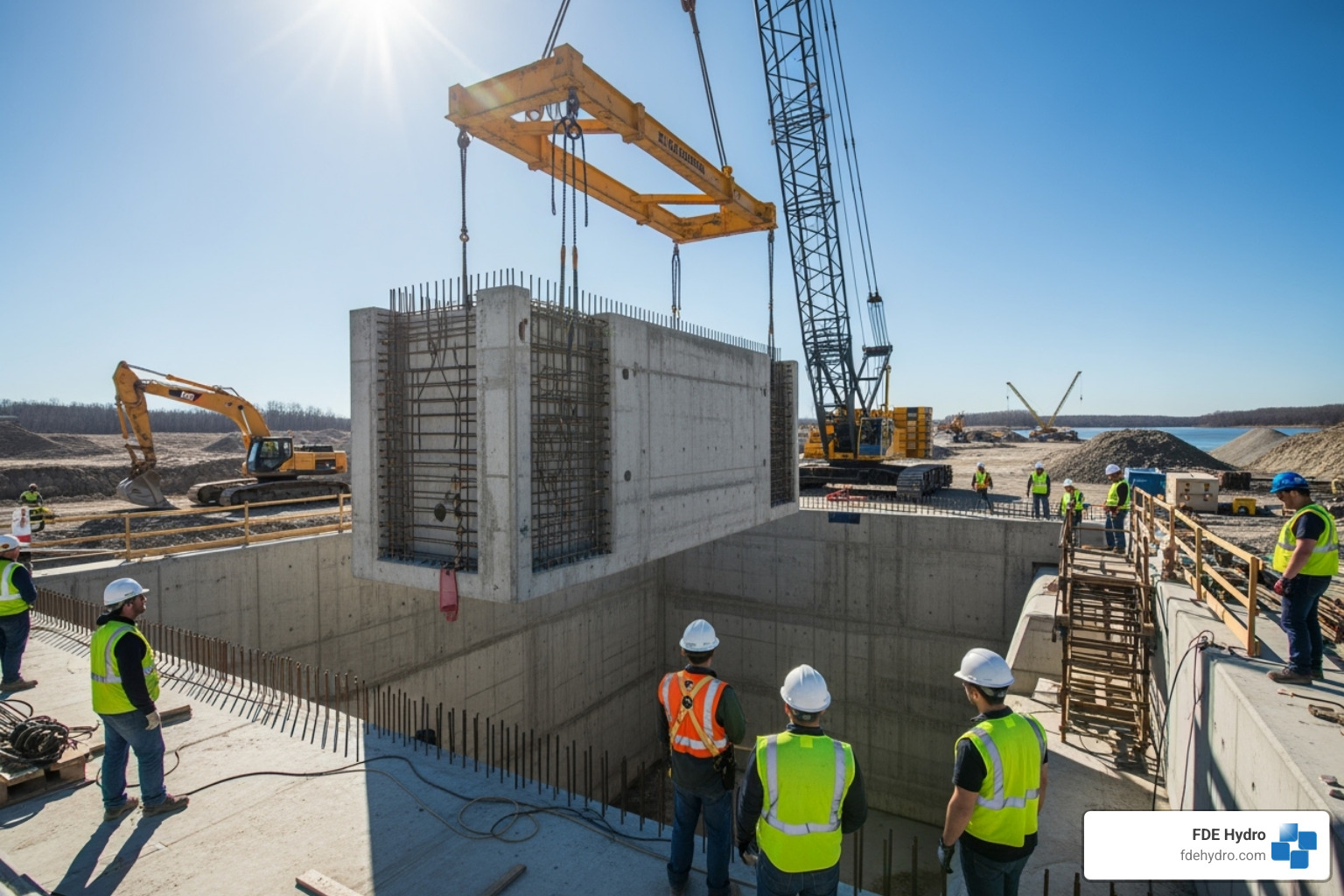
At FDE Hydro™, we are reimagining how hydropower infrastructure is built. Our patented modular precast concrete technology, the “French Dam,” is changing the economics of projects in North America, Brazil, and Europe. By using precision-manufactured components, we dramatically reduce construction costs and timelines. This makes hydropower more accessible and practical, and we’ve proven that French Dam Technology Passes the Test with reliable, modern performance.
The industry is also embracing digitalization. Sophisticated sensors and control systems optimize operations, from water flow to predictive maintenance, squeezing more energy from every drop. Our Modular Powerhouses integrate these advanced systems, creating a new generation of smarter, faster, and more adaptable hydropower facilities.
What are the ongoing innovations in hydropower?
The innovation pipeline for hydropower is diverse. Key areas include:
- Upgrading existing dams: Modernizing older facilities with new, more efficient turbines and digital controls open ups additional capacity from existing infrastructure.
- Environmental performance: Innovations like aerating turbines improve water oxygen levels, while fish-friendly turbine designs and advanced fish passage systems (ladders and elevators) help protect aquatic ecosystems.
- New frontiers: Researchers are pioneering in-stream hydropower systems that generate power from river currents with minimal environmental footprint, alongside maturing ocean wave and tidal energy technologies.
- Modular construction: Approaches like ours at FDE Hydro™ use off-site manufacturing for higher quality, faster installation, and reduced environmental disruption. This method is key to Reinvigorating Hydropower for a new era by making development feasible in more locations.
Frequently Asked Questions about Hydropower Benefits
How does hydropower compare to other renewable sources?
Hydropower stands out for its efficiency and reliability. It converts up to 90% of water’s potential energy into electricity, far surpassing the typical efficiency of solar (30-36%) and wind (25-45%). More importantly, hydropower provides “dispatchable power,” meaning it can be ramped up or down in minutes to meet grid demand. This flexibility makes it the perfect partner for intermittent renewables like solar and wind, as it can instantly fill power gaps and stabilize the grid, especially through pumped storage.
What is the typical lifespan of a hydropower plant?
Hydropower facilities are built for longevity, with a typical lifespan of 50 to 100 years. Many plants have operated for over a century. With regular maintenance and modernization, their service life can be extended indefinitely. This long-term durability is one of the key economic benefits of hydropower plant investments, as the initial cost provides value for generations.
Is hydropower completely environmentally friendly?
While hydropower is a clean energy source with zero air pollutants and very low greenhouse gas emissions, no energy source is without an environmental footprint. Large dams can alter local ecosystems and fish migration. However, the modern hydropower industry mitigates these issues through rigorous environmental assessments, fish-friendly turbines, and fish passage systems like ladders and elevators. Technologies like aerating turbines also improve water quality downstream. The goal is to balance energy needs with environmental responsibility, and when done right, hydropower’s climate benefits far outweigh its manageable, site-specific impacts.
Conclusion: A Lasting Legacy of Clean Power
The benefits of hydropower plant infrastructure are foundational to a cleaner, more prosperous, and resilient future. Hydropower is a proven clean energy source, an economic engine, and the guardian of grid stability.
We’ve seen its impressive credentials:
- Environmental: Zero air pollutants and ultra-low emissions, avoiding over 100 billion tonnes of CO2.
- Economic: Supporting over 66,500 U.S. jobs (projected to hit 158,000 by 2050) and providing affordable electricity.
- Reliability: Offering 90% efficiency, rapid response times, and 95% of U.S. utility-scale energy storage.
Beyond the grid, these facilities manage water for flood control and irrigation, create recreational opportunities, and bring development to rural areas.
Hydropower continues to evolve. At FDE Hydro™, we’re pioneering modular construction to make projects more economical and accessible. Industry-wide innovations in turbine design and digital systems ensure this technology improves with age.
In the transition to a net-zero future, hydropower’s role is more critical than ever. It is the reliable partner that enables other renewables, the long-term investment that delivers value for generations, and the domestic resource that ensures energy independence. Securing this future requires smart planning, and understanding how Financing Long-Term Hydropower Requires Mitigating Risks Prior to ROI is key to open uping its full potential.
Building or modernizing a hydropower facility creates a legacy of clean power for generations to come. It’s an investment in our shared prosperity and the health of our planet.
by Bill French Sr. | Oct 22, 2025 | Case Studies
Why Hydro Electric Dams Matter for Modern Energy Infrastructure
Hydro electric dams are a significant renewable energy asset, converting river flow into clean electricity. Here’s what you need to know:
What are hydro electric dams?
- Large structures built across rivers that use falling water to generate electricity
- Convert water’s potential and kinetic energy into electrical power through turbines and generators
- Supply 15% of the world’s electricity (4,210 TWh in 2023)
- Account for 6.2% of total U.S. utility-scale electricity generation
Key Benefits:
- Reliable power – Generate electricity 24/7, unlike solar or wind
- Long lifespan – Operate for 65-85 years with minimal maintenance
- Grid stability – Provide backup power and balance intermittent renewables
- Multiple uses – Offer flood control, water supply, and recreation
Main Types:
- Impoundment – Traditional dams with large reservoirs
- Run-of-river – Diversion systems with minimal storage
- Pumped storage – Act as massive batteries for the grid
From the massive Three Gorges Dam to small micro-hydro installations, hydro electric dams represent a spectrum of clean energy solutions. Yet fewer than 3% of the 90,000+ dams in the United States produce power, revealing significant untapped potential.
I’m Bill French, founder and CEO of FDE Hydro™. With five decades in heavy civil construction and participation in the DOE’s Hydropower Vision task force, we’ve pioneered modular construction solutions for hydro electric dams. We focus on reducing costs and timelines while improving environmental outcomes across North America, Brazil, and Europe.
How Hydropower Works: From Water Flow to Electrical Flow
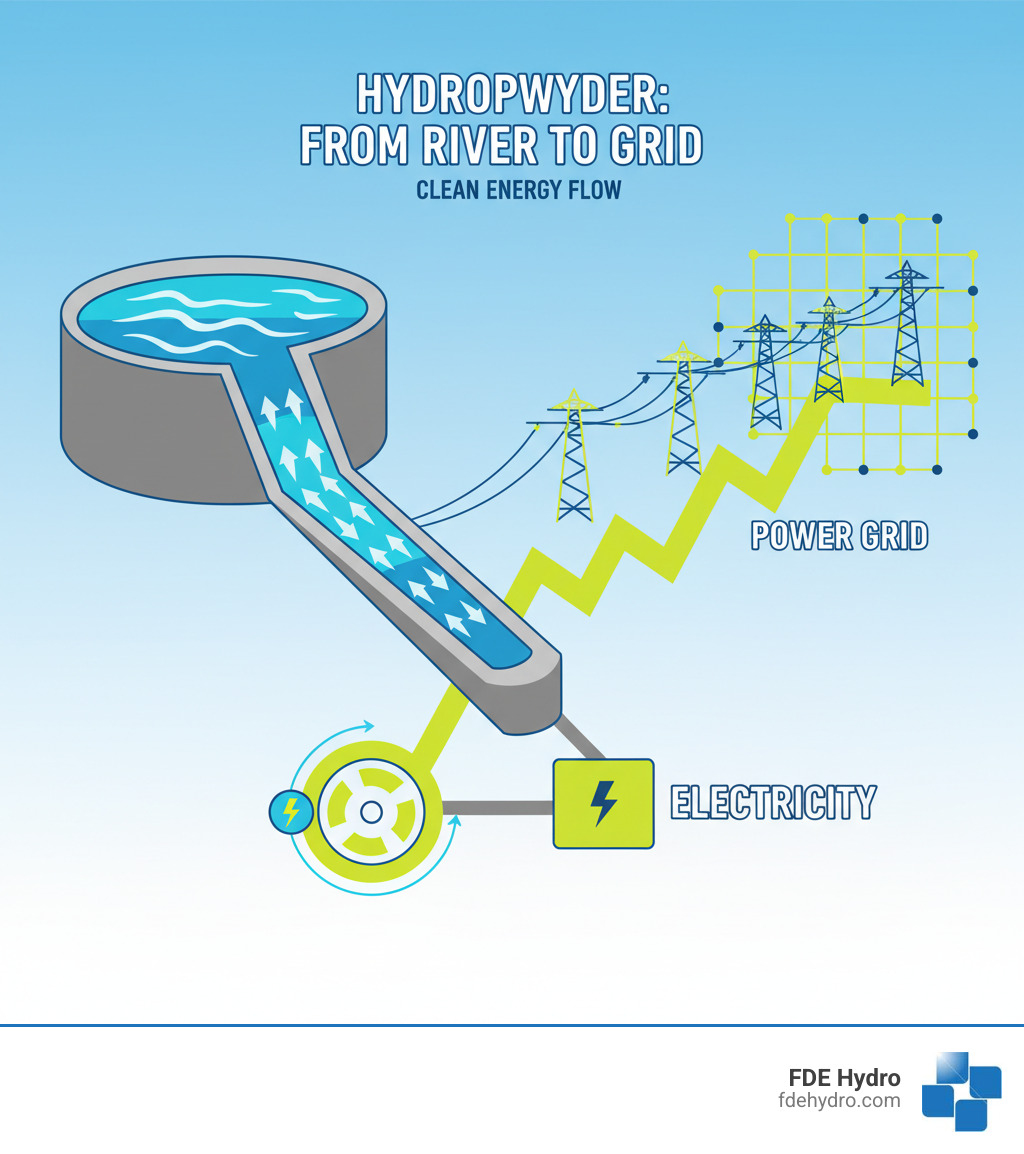
Hydropower is powered by the water cycle. Solar energy evaporates water, which falls as rain or snow and flows through rivers. This cycle, driven by the sun and gravity, is what we tap into for clean electricity.
Water at a height has potential energy. As it falls, this becomes kinetic energy—the energy of motion. Hydro electric dams are designed to capture and control this energy conversion, concentrating the power of flowing water.
A dam creates a controlled drop in elevation, concentrating a river’s energy. Hydropower facilities harness this focused power to generate electricity. The Department of Energy has a great resource explaining How Hydropower Works if you want to dig deeper.
Key Components of a Hydropower Facility
Every hydropower facility has key components working together:
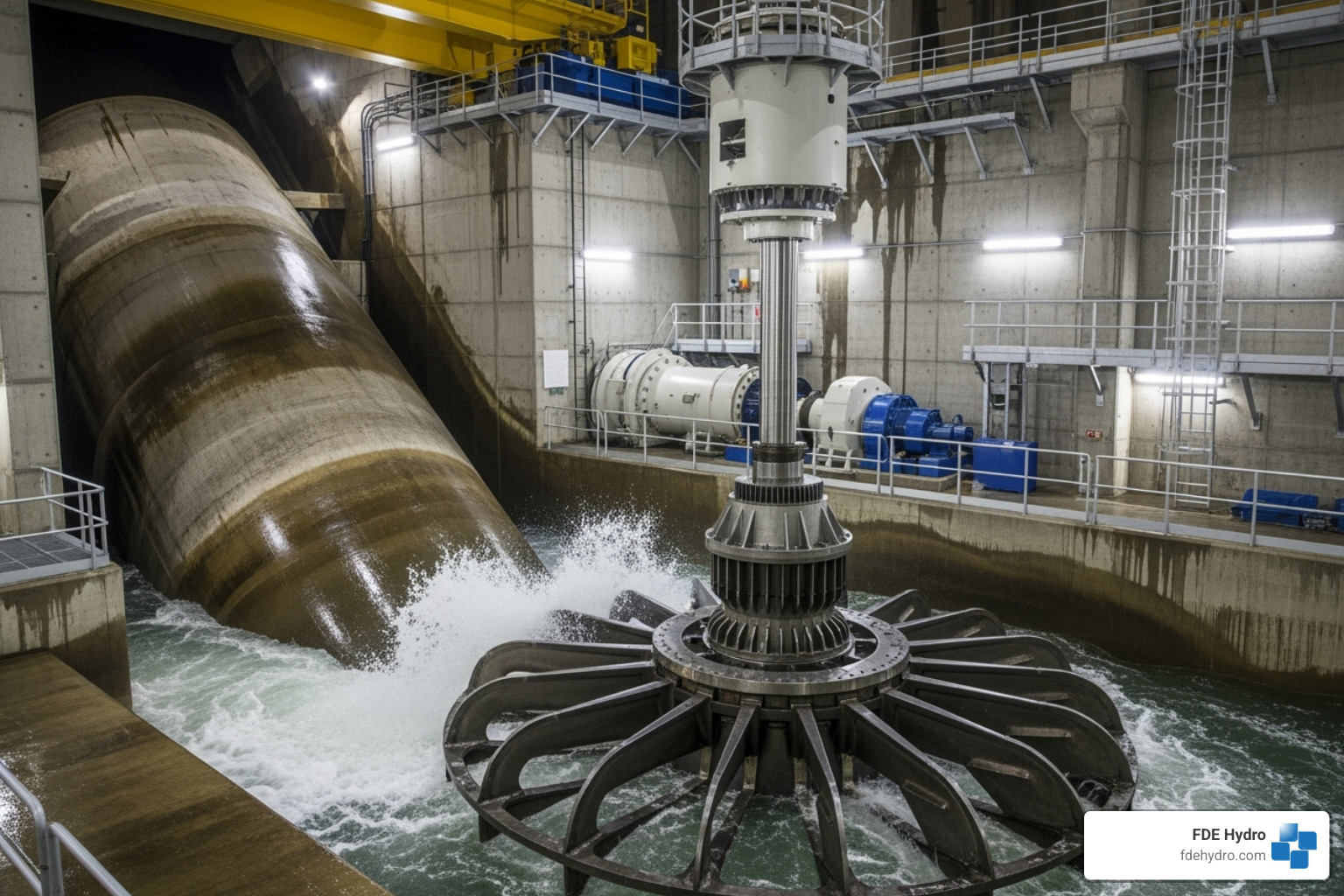
- The dam is a structure built across a river to create a reservoir. It controls water flow and creates the “head”—the vertical distance water falls to generate power.
- The reservoir is an artificial lake that stores water, allowing for consistent power generation despite seasonal changes in river flow.
- Water enters through the intake gate and flows down the penstock, a large pipe that guides it to the turbine.
- The turbine has blades that spin rapidly when hit by high-pressure water. Different designs (Francis, Kaplan, Pelton) are used for different water head and flow conditions.
- The turbine is connected to a generator, which converts mechanical energy into electricity. This equipment is housed in the powerhouse.
- After passing through the turbine, water exits via the tailrace back to the river. Power lines then transmit the electricity to the grid.
The Department of Energy maintains a helpful Glossary of Hydropower Terms if you want to explore more terminology.
The Electricity Generation Process
When dam gates open, gravity pulls water from the reservoir down the penstock, building speed and pressure. This high-pressure water spins the turbine, transferring its kinetic energy. More speed and pressure mean more power.
The spinning turbine turns a shaft connected to the generator. Inside, a rotor (electromagnet) spins within a stator (coils of wire), creating an electric current based on Faraday’s principle of electromagnetic induction. The electricity is then stepped up by transformers for long-distance transmission. The U.S. Geological Survey offers an excellent visual explanation of Hydroelectric Power: How it Works.
Construction and Operational Considerations
Building hydro electric dams requires careful site selection. A suitable river needs both sufficient head (vertical drop) and consistent flow (water volume). The foundation must be solid rock to support the dam’s weight and immense water pressure. At FDE Hydro, our innovative Means and Methods using modular precast concrete technology improve integrity while cutting construction time. Our approach demonstrates Why Precast Cost Less while delivering better results.
Operational dams serve multiple purposes. Operators balance power generation with flood control, water supply, and ecosystem protection. Sediment management is another ongoing challenge, as sediment can fill reservoirs and reduce efficiency. Proper design and maintenance are crucial for the long lifespan of hydropower facilities, which can operate for 65 to 85 years or more.
A Spectrum of Power: Types and Sizes of Hydropower Plants
Hydropower is more diverse than just massive dams. It includes a wide range of sizes, from huge structures to small systems that can power a single farmhouse. This flexibility is a key strength, with solutions available for everything from mighty rivers to small streams. The Department of Energy provides an excellent overview of the various Types of Hydropower Plants available today.
Main Types of Hydropower Facilities
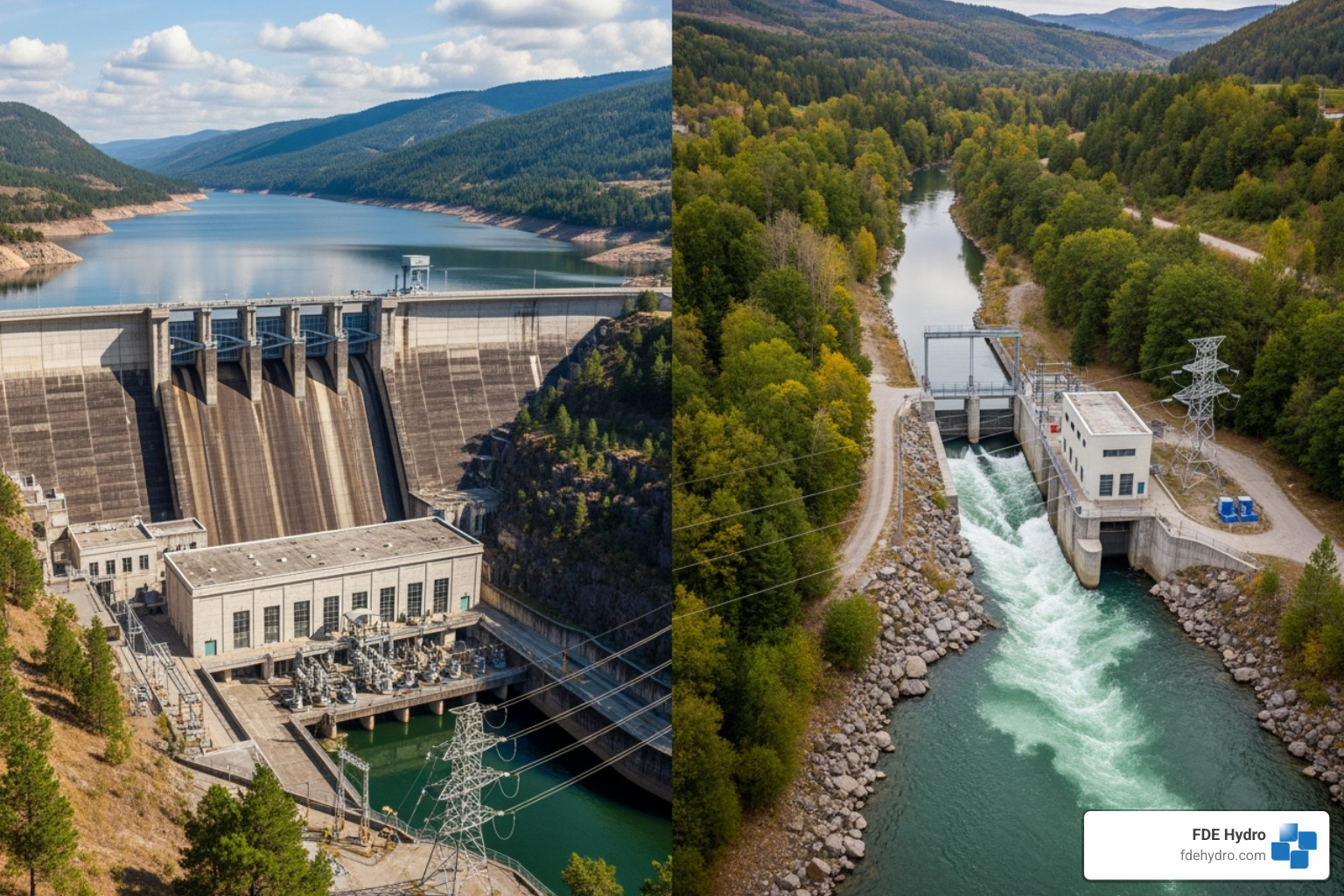
Impoundment facilities are the classic hydro electric dams. They use a dam to create a large reservoir, allowing operators to store water and release it as needed for power generation, grid balancing, flood control, and irrigation support.
Diversion facilities, or run-of-the-river systems, channel a portion of a river through a canal or penstock to generate electricity without a large dam. This approach has a smaller environmental footprint as it relies on the river’s natural flow.
Pumped storage hydropower acts like a giant battery. It uses cheap, excess electricity to pump water from a lower reservoir to an upper one. When demand is high, the water is released back down through turbines to generate power. Pumped storage provides nearly 85% of the world’s grid energy storage and is essential for balancing intermittent renewables like solar and wind. At FDE Hydro, we see these Pumped Storage Hydropower “water batteries” as vital for a renewable energy future. The Department of Energy has also recognized this potential in their research on pumped storage technology.
Sizing Up Hydropower: From Large-Scale to Micro
Hydropower can be categorized by its generating capacity:
- Large hydropower (>30 MW) facilities are the giants that can power entire cities, providing reliable baseload power.
- Small hydropower (SHP) (100 kW – 10 MW) can power thousands of homes and are ideal for regional grids or smaller communities.
- Micro hydropower (<100 kW) is ideal for remote communities, farms, or small villages.
- Pico hydropower (<5 kW) is perfect for off-grid applications like a single home or research station. They can be integrated into Microgrid systems for local energy independence.
This adaptability makes hydropower a versatile solution, scalable from national grids to individual homes. Flowing water offers a powerful renewable energy source at any scale.
The Giants of Hydropower: Notable Hydro Electric Dams
Massive dams are awe-inspiring feats of engineering. Humans have long harnessed water’s power, evolving from ancient water wheels to the giant dams that power modern cities. The Department of Energy’s “History of Hydropower” traces this remarkable journey.
The largest hydro electric dams are ambitious engineering achievements that generate electricity, reshape landscapes, control floods, and power economic development.
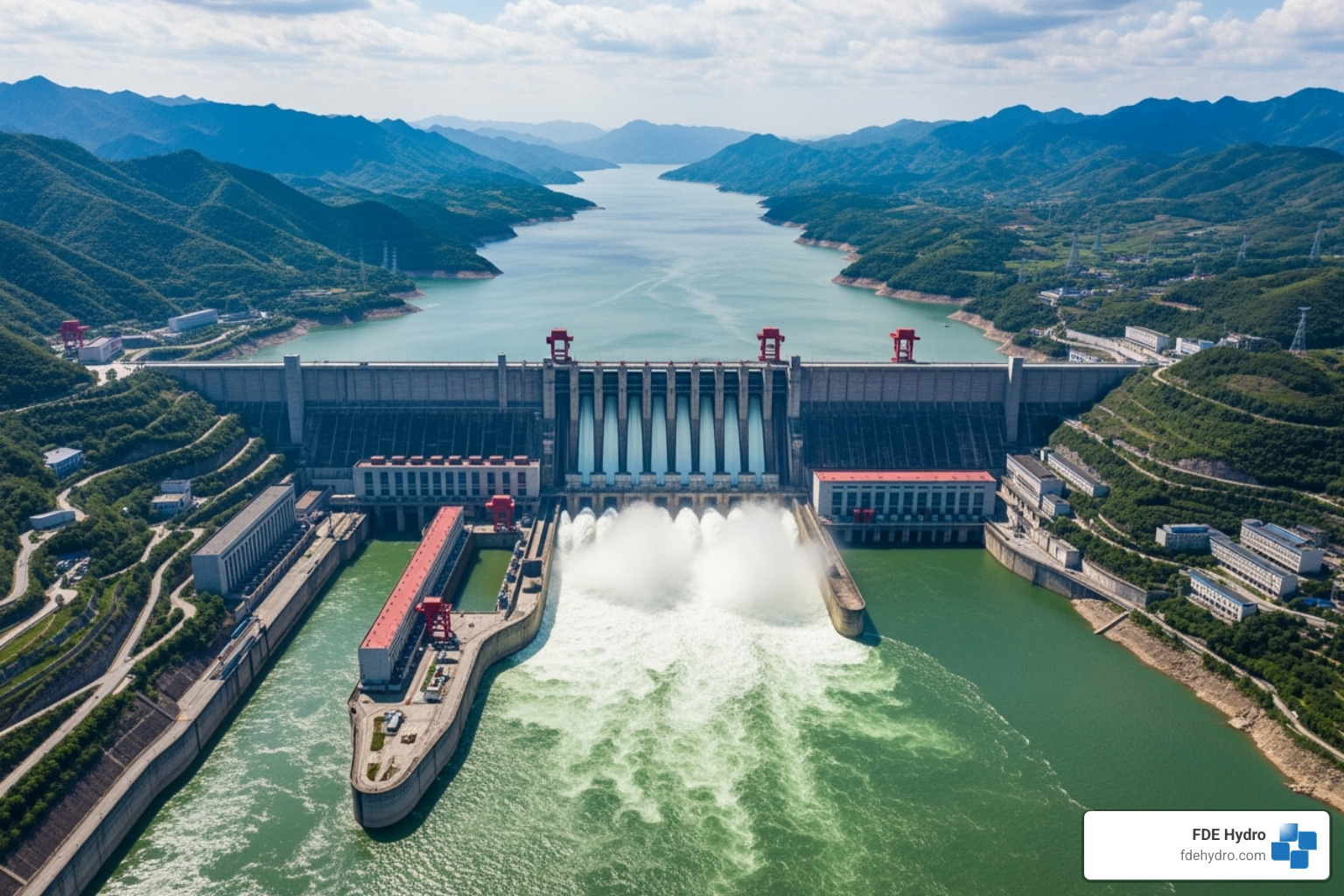
Major U.S. Hydro Electric Dams
The United States is home to some of the world’s most impressive hydro electric dams.
- The Grand Coulee Dam in Washington is America’s largest, generating 6,765 MW. Built in the 1930s, it can spill 1 million cubic feet of water per second and is the backbone of the Pacific Northwest’s energy supply.
- The Hoover Dam, an art deco icon on the Nevada-Arizona border, was built during the Great Depression. It generates 2,080 MW, weighs 6.6 million tons, and remains a major tourist attraction.
- New York’s Robert Moses Niagara Power Plant (1961) harnesses the power of Niagara Falls. Once the world’s largest hydropower facility, its 13 turbines generate significant power for the region.
- Other giants on the Columbia River include the Chief Joseph Dam, the second-largest in the U.S., and the John Day Dam, which generates 2,400 MW of clean power.
Global Hydroelectric Leaders
While U.S. dams are impressive, some international projects are even larger.
- China’s Three Gorges Dam is the world’s largest power station of any kind, with a capacity of 22,500 MW. Located at 30°49’15″N 111°00’08″E, its construction created a massive reservoir and had significant social impacts.
- The Itaipu Dam, a joint Brazil-Paraguay project, has a 14,000 MW capacity. It supplies about 90% of Paraguay’s electricity and 15% of Brazil’s.
- China’s Baihetan Dam is another titan, generating 16,000 MW. These mega-projects show the massive scale at which hydropower can meet global energy demands.
The Hydropower Debate: Balancing Benefits and Environmental Impacts
Every energy source involves trade-offs, and hydro electric dams are no exception. It’s essential to have an honest conversation about both the benefits and challenges of hydropower.
| Factor |
Hydropower |
Solar |
Wind |
Fossil Fuels |
| Operating Cost |
Very Low |
Low |
Low |
High (fuel dependent) |
| Efficiency |
85-90% |
15-20% |
35-45% |
30-60% |
| Land Use |
High (reservoir) |
Moderate |
Low |
Moderate |
| Emissions |
Very Low (operational) |
None (operational) |
None (operational) |
High |
| Grid Stability |
Excellent |
Poor (intermittent) |
Poor (intermittent) |
Excellent |
Advantages of Hydropower
Hydropower has powered communities for over a century because once a dam is built, operating costs are very low. These structures are also long-lasting, operating for 65 to 85 years or more. With up to 90% efficiency, hydropower is one of our most efficient energy sources.
Hydropower’s greatest strength is grid flexibility. Unlike intermittent solar and wind, hydro electric dams can adjust power output in seconds. This “load following” capability makes it the “Guardian of the Grid” and crucial for balancing other renewables.
Hydropower also offers black start capability to restart a grid after a blackout. Beyond power, reservoirs provide flood control, water supply for irrigation and drinking, and recreational opportunities.
Environmental and Social Concerns
Building dams transforms river ecosystems. Blocking a river disrupts natural flow, fish migration, and water temperature, while trapping sediment vital for downstream habitats. At FDE Hydro, we address these challenges with improved Aquatic Animal and Recreational Passage systems.
Sedimentation is a major issue. When sediment builds up in reservoirs, it reduces storage capacity and harms downstream ecosystems.
Reservoirs can also produce methane, a potent greenhouse gas, when submerged vegetation decomposes. This phenomenon is sometimes called hydropower’s “dirty secret.” Emissions vary by location, but it’s a factor to consider.
Large reservoirs also inundate land, which can displace communities and cause significant social disruption. Though rare, dam failures are catastrophic, a sobering reminder that rigorous engineering and safety standards are essential.
The path forward requires balancing hydropower’s strengths with efforts to minimize its impacts. At FDE Hydro, this balance guides our work, from modular designs to retrofitting existing dams, as we pursue continuous improvement in sustainable hydropower.
The Future of Hydropower: Innovation and Modernization
The future of hydropower isn’t just about building new hydro electric dams. It’s about modernizing existing infrastructure and embracing technology to make hydropower smarter, faster, and more sustainable.
Surprisingly, less than 3% of the 90,000+ dams in the U.S. generate electricity. These non-powered dams represent an enormous untapped opportunity. At FDE Hydro, we believe that “The Biggest Untapped Solution to Climate Change is in the Water” by retrofitting these existing structures.
Modernizing Aging Infrastructure
Most hydro electric dams in America were built before the mid-1970s. While resilient, this aging infrastructure needs modernization. Rehabilitating old dams is a golden opportunity to upgrade turbines, install modern controls, and improve environmental performance.
At FDE Hydro, we provide “Aging Infrastructure Being Replaced With Next Generation Civil Solutions.” Our rehabilitation approach extends lifespans, increases output, and reduces environmental impacts with shorter timelines and reasonable costs. We are “Reinvigorating Hydropower” by modernizing these valuable assets.
Technological Advancements in hydro electric dams
Hydropower innovation today is focused on being smarter, faster, and more harmonious with nature.
Our patented modular precast concrete technology, the “French Dam,” revolutionizes how hydro electric dams are built. We manufacture components off-site and assemble them quickly, reducing project timelines from years to months with less environmental disruption and lower costs. This “Rapid Installment of Module Precast Civil Infrastructure” has been recognized as one of the “French Dam: One of Top 10 Hydro Innovations and New Technologies.”
Other key innovations include fish-friendly turbines that allow aquatic life to pass through safely and advanced control systems for precise management of water flow. These systems make hydropower even more valuable for balancing renewables.
The most exciting potential lies in retrofitting non-powered dams. With modern modular construction and turbine technology, adding power to existing dams is more economically viable than ever. These innovations align with the “Update of the Hydropower Vision Roadmap,” ensuring hydropower remains a competitive and essential part of our clean energy future.
Frequently Asked Questions about Hydroelectric Dams
Here are answers to some common questions about hydro electric dams and their role in our energy future.
How much of the world’s electricity comes from hydropower?
Hydropower supplies approximately 15% of the world’s electricity (nearly 4,210 TWh in 2023), making it the largest single source of renewable energy globally. Millions of people depend on hydro electric dams for reliable power, and for many nations, it is the backbone of their energy independence.
Are all dams used to generate electricity?
No, not all dams generate electricity. In fact, less than 3% of the 90,000+ dams in the U.S. produce power. The vast majority are used for other purposes like flood control, water supply for irrigation and drinking, river navigation, and recreation. This highlights the enormous untapped potential for retrofitting non-powered dams to generate electricity.
Is hydropower a completely clean energy source?
While operating hydro electric dams produce virtually no CO2 emissions, they are not completely impact-free. Construction creates emissions, and reservoirs can release methane (a potent greenhouse gas) from decomposing organic matter, a phenomenon sometimes called hydropower’s “dirty secret.”
However, these emissions vary greatly by location, and hydropower’s overall lifecycle carbon footprint is still much lower than fossil fuels. At FDE Hydro, our modular construction methods reduce the environmental impact of building and rehabilitating hydro electric dams, reflecting our commitment to continuous improvement.
Conclusion: The Enduring Power of Water
Hydro electric dams are more than just concrete and steel; they represent a partnership with nature, converting the flow of water into clean electricity. Hydropower is a mature yet evolving technology that has proven its value as a reliable source of clean energy.
We’ve seen that hydro electric dams offer significant advantages, including low operating costs, grid stability, and benefits like flood control. We’ve also acknowledged the real environmental and social challenges they can present.
The future of hydropower lies in working smarter. The fact that fewer than 3% of U.S. dams generate power is a massive opportunity. Modern technology, like modular construction, allows us to tap into this potential efficiently and responsibly.
At FDE Hydro, we are committed to this vision. Our modular precast concrete technology makes hydropower more accessible and sustainable across North America, Brazil, and Europe by extending infrastructure life, reducing environmental impacts, and improving economic viability.
Our challenge is to harness the enduring power of water thoughtfully, balancing energy needs with environmental stewardship. If you’re interested in modernizing hydropower infrastructure, learn more about our Dam Rehabilitation Encapsulation services. Together, we can build a cleaner energy future.
by Bill French Sr. | Oct 21, 2025 | Case Studies
Why Sustainable Infrastructure Matters Now More Than Ever
Sustainable infrastructure development is the practice of planning, designing, building, operating, and decommissioning infrastructure—roads, bridges, dams, energy systems, water networks—in ways that ensure long-term economic viability, social equity, and environmental protection. It encompasses:
- Economic/Financial Sustainability: Delivering value for money, fiscal responsibility, and attracting investment
- Environmental Sustainability: Minimizing carbon footprints, protecting ecosystems, and building climate resilience
- Social Sustainability: Ensuring equitable access, community benefits, and stakeholder engagement
- Institutional Sustainability: Establishing transparent governance, robust planning, and effective regulation
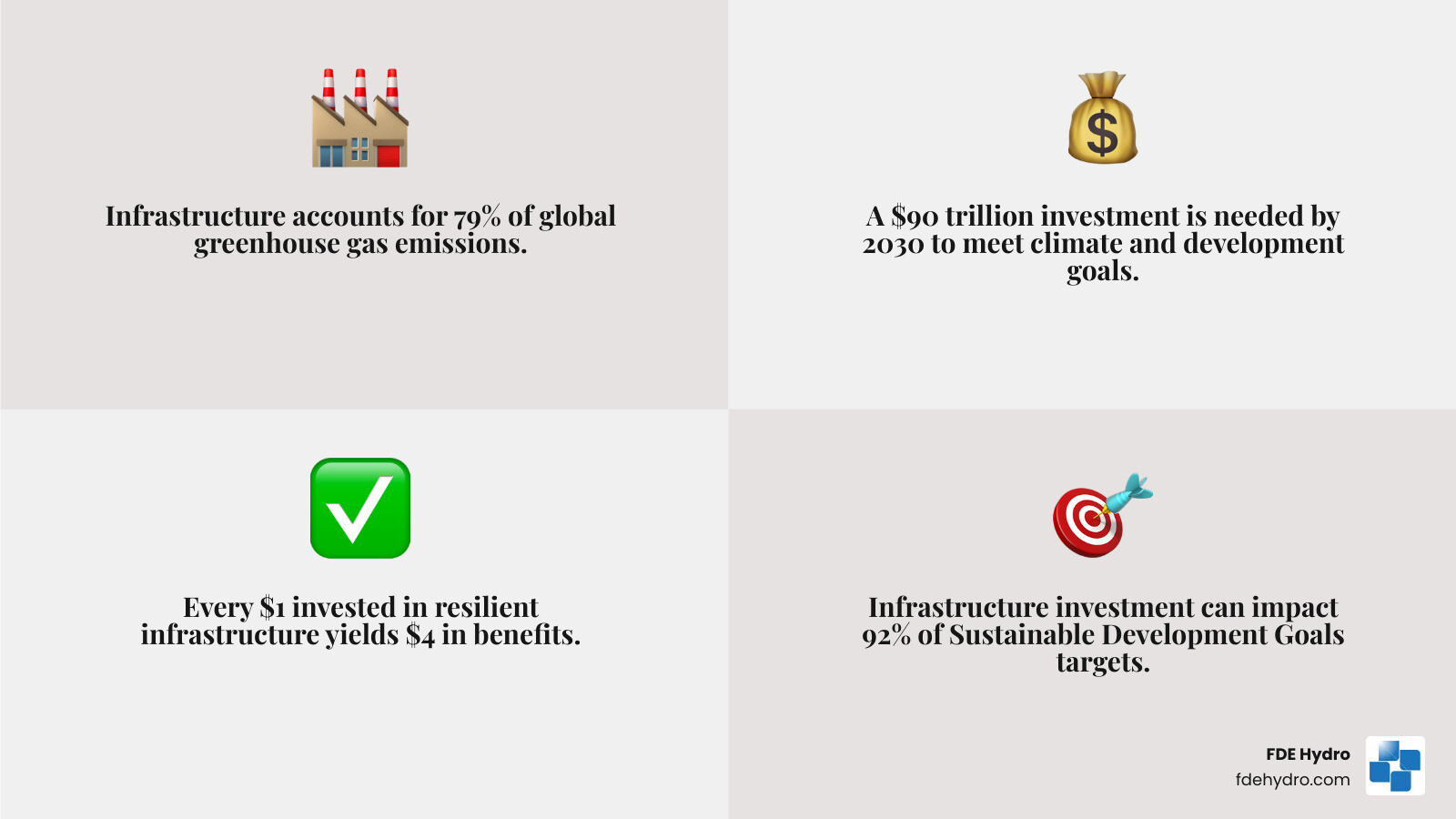
The stakes have never been higher. Infrastructure accounts for 79% of global greenhouse gas emissions, yet the world must invest $90 trillion by 2030 to meet climate targets and development goals. The good news? Every dollar invested in climate-resilient infrastructure yields about four dollars in benefits through reduced maintenance, extended asset lifetimes, and avoided disaster costs.
Traditional infrastructure approaches—marked by long timelines, cost overruns, and environmental damage—simply can’t meet the demands of a rapidly urbanizing, climate-stressed world. Decision-makers overseeing large-scale projects, particularly in water and energy, face mounting pressure to reduce capital expenditure, accelerate delivery, and mitigate financial risks while meeting sustainability commitments.
I’m Bill French Sr., Founder and CEO of FDE Hydro™, where we’ve spent decades developing modular civil construction solutions that make sustainable infrastructure development faster, more affordable, and environmentally sound for hydropower and water projects. Our approach—rooted in precast, modular design—addresses the core challenges facing infrastructure leaders today: reducing costs, shortening timelines, and building resilience into critical systems.
The ‘Why’: The Imperative for a Sustainable Shift
The growing focus on sustainable infrastructure development is driven by a simple reality: our planet and societies depend on it. The choices we make now about building and managing essential systems—like roads, power grids, and water supplies—will echo for generations. We stand at a crossroads: continue with vulnerable systems or build for resilience and long-term well-being.
The Critical Link to Climate and Global Goals
The link between infrastructure and climate is undeniable. A staggering 79% of all greenhouse gas emissions are tied to infrastructure, highlighting both the responsibility and the opportunity for change. By focusing on smart, sustainable infrastructure development and urban planning, we could cut global CO2 emissions by 3.7 gigatons per year over the next 15 years. This is a crucial part of mitigating GHG emissions and achieving Net-Zero.
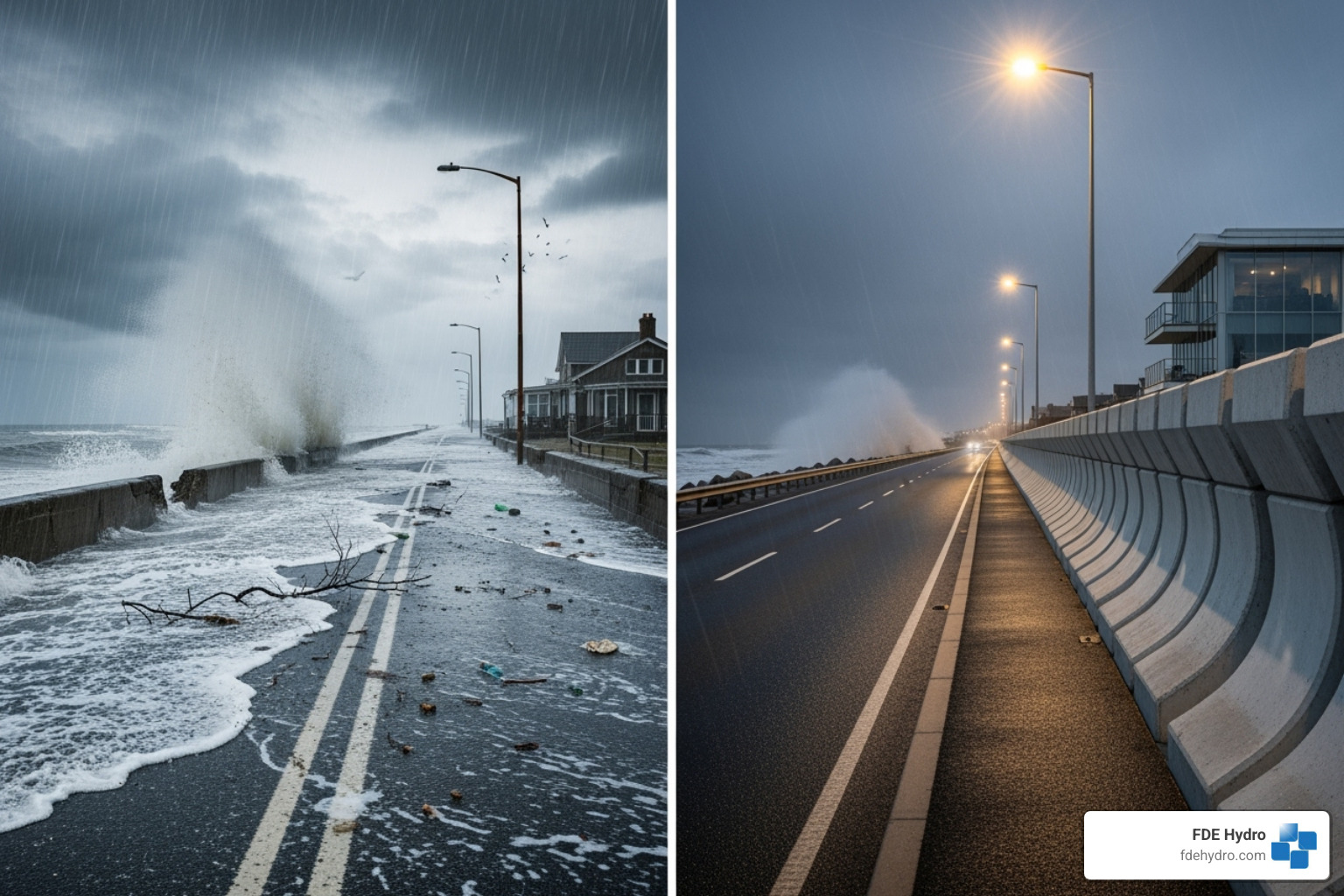
Furthermore, traditional infrastructure is often unprepared for modern climate challenges. Roads buckling in extreme heat, reservoirs drying up, and tunnels flooding are warnings that our systems were not built for today’s extreme weather events. This vulnerability demands climate change adaptation. Building resilience into our infrastructure is vital for our economy and communities.
Beyond climate change, sustainable infrastructure development is essential for achieving the global Sustainable Development Goals (SDGs). These 17 UN goals address major world problems like poverty, hunger, clean water, and affordable energy. An estimated 92% of SDG targets can be achieved through smart infrastructure investment. For instance, providing clean water (SDG 6) or reliable, clean energy (SDG 7) depends on well-planned infrastructure. At FDE Hydro, our work in hydropower directly supports SDG 7 by providing clean, dependable energy solutions.
Opening Up Long-Term Value and Benefits
Investing in sustainable infrastructure development open ups significant long-term value. Compared to “business-as-usual” approaches, it offers a compelling return on investment. The common statistic that every dollar invested in climate-resilient infrastructure yields about four dollars in benefits points to tangible savings through reduced operational costs, less maintenance, and improved service reliability. This is where the true economic advantages shine.
For example, reliable energy sources like hydropower provide stable power, reduce reliance on volatile fossil fuels, and offer long-term efficiency. At FDE Hydro, our modular precast solutions for hydropower projects are built for durability, meaning fewer costly repairs and more consistent, clean energy for communities.
Beyond financial gains, sustainable infrastructure creates numerous jobs in green industries. This means significant job creation in green sectors, with the renewable energy sector alone projected to grow from 2.3 million jobs to 20 million by 2030. These are skilled positions in design, manufacturing, installation, and maintenance that build a strong, green economy. Additionally, cleaner air and water lead to improved public health, while resilient public spaces can lead to increased property values. It’s also about creating social equity by ensuring everyone has access to vital services.
By embracing clean energy and smart sustainable infrastructure development, we can boost global economic growth by up to 4% by 2030. It’s not just an expense; it’s a wise investment in a prosperous, healthy, and resilient future for all.
The ‘What’: Core Principles and Global Frameworks
Understanding sustainable infrastructure development means looking beyond concrete and steel. It’s about creating systems that work for people, the planet, and the economy—not just today, but for generations to come. Think of it as building with intention, where every decision considers the full picture of environmental health, social benefit, and economic sense.
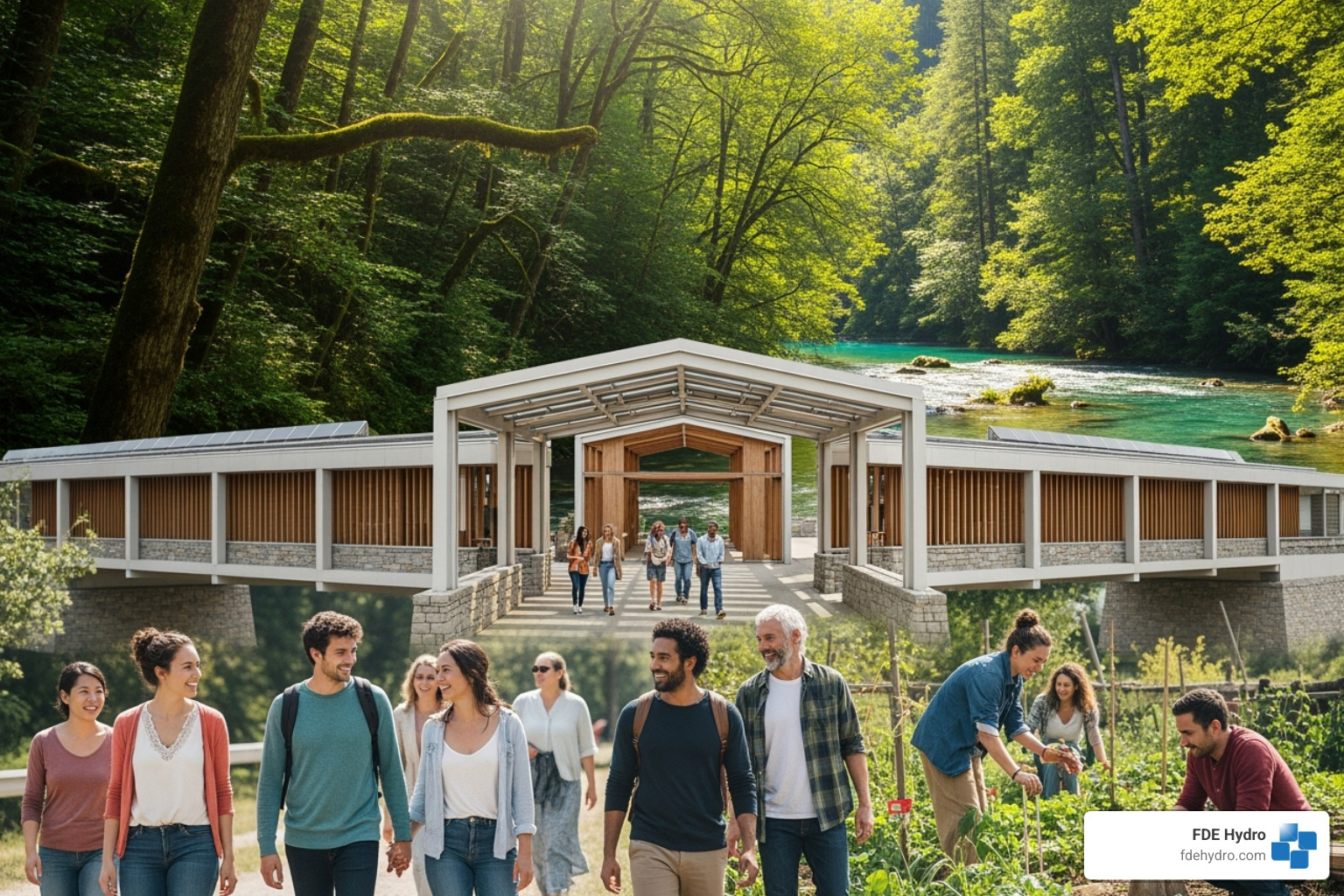
The Core Characteristics of Sustainable Infrastructure Development
When we talk about what makes infrastructure truly sustainable, we’re describing something that touches every phase of a project’s life—from the first planning meeting to the day it’s eventually decommissioned. The UN Environment Programme defines sustainable infrastructure as systems that are planned, designed, constructed, operated, and decommissioned in ways that ensure economic, social, environmental, and institutional sustainability throughout their entire lifecycle.
That might sound technical, but it boils down to six practical principles that guide real-world decisions.
First, there’s the low environmental footprint. This means minimizing greenhouse gas emissions from day one, reducing waste at every stage, and conserving natural resources. It’s about asking questions like: How much carbon is locked up in our materials? How energy-efficient will operations be? What happens to our ecosystems during construction? At FDE Hydro, our modular precast approach embodies this thinking—we dramatically cut on-site waste and construction emissions because we build precisely what’s needed in controlled factory conditions.
Climate resilience is no longer optional. Infrastructure must stand strong against extreme weather, rising seas, and unpredictable climate patterns. This isn’t about hoping for the best; it’s about engineering for the worst and building systems that adapt and endure. Our modular sea wall systems exemplify this approach, providing robust coastal protection that flexes with changing conditions rather than fighting them.
The best infrastructure doesn’t just avoid harming nature—it actively protects and improves ecosystems. This can mean restoring habitats, using nature-based solutions, or simply being thoughtful about land disturbance. When you minimize your construction footprint, as we do with precast modules, you leave more of the natural world intact.
Social inclusiveness ensures that infrastructure serves everyone, not just the privileged few. Projects should create local jobs, respect human rights, engage communities meaningfully, and provide equitable access to essential services. It’s about lifting people up and genuinely improving quality of life.
None of this matters if a project isn’t economically viable. Sustainable infrastructure must make financial sense, delivering value for money and attracting the investment needed to get built. This is where innovation really shines. Our precast solutions don’t just reduce environmental impact—they significantly lower costs, making critical water and energy projects more affordable and realistic.
Finally, institutional sustainability provides the backbone. Strong governance, transparent policies, effective regulations, and robust planning frameworks ensure that good intentions translate into actual results. Without these structures, even the best projects can falter.
These characteristics aren’t separate boxes to check—they’re interconnected aspects of a holistic approach. They represent a fundamental shift from building things that simply work to creating systems that work well for everyone and everything they touch. For those of us focused on next-generation civil solutions, these principles guide every design choice and construction method.
Key Initiatives and Guiding Principles
The world has recognized that sustainable infrastructure development can’t happen in isolation. It requires coordinated global effort, shared knowledge, and common frameworks that guide countries and companies toward better practices.
The UN Environment Assembly (UNEA) has emerged as a powerful voice in this movement. At its fifth session in 2022, member states adopted a resolution on Sustainable and Resilient Infrastructure, building on earlier commitments from 2019. These resolutions encourage nations to implement the International Good Practice Principles for Sustainable Infrastructure, which provide a practical blueprint for policymakers. These principles emphasize integrated, systems-level thinking—the kind of approach that considers how infrastructure decisions ripple through environmental, social, and economic systems.
The G20 has thrown its considerable weight behind this agenda too. Representing the world’s major economies, the G20 has endorsed frameworks that outline concrete actions to scale up sustainable infrastructure investment. These frameworks focus on practical barriers: improving project preparation, streamlining regulations, and mobilizing private capital to flow toward sustainable projects.
One of the most important collaborative platforms is the Sustainable Infrastructure Partnership (SIP), launched in 2018. SIP brings together diverse stakeholders to promote integrated approaches to infrastructure planning and development. Its mission recognizes that infrastructure sits at the heart of the 2030 Agenda for Sustainable Development. The partnership works to raise awareness, develop practical guidance and tools, and strengthen capacity—especially in developing countries where the need is greatest and resources are often stretched thin.
Organizations like the UN Environment Programme (UNEP) and the Global Infrastructure Hub (GI Hub) are doing the heavy lifting on the ground. UNEP provides technical guidance, runs capacity-building webinars, and offers direct country support in places like Chile, Costa Rica, Ghana, Mongolia, and South Africa. The GI Hub complements this work by focusing on data, investment insights, and practical tools that help governments and investors make smarter decisions.
Even national governments are stepping up with concrete commitments. Canada’s green infrastructure programs, for example, invest heavily in water systems, wastewater treatment, green spaces, and disaster mitigation. Infrastructure Canada’s 2023-2027 Departmental Sustainable Development Strategy explicitly links these investments to specific UN Sustainable Development Goals, demonstrating how national policy can align with global sustainability objectives.
These initiatives, partnerships, and policy frameworks form the foundation for global progress. They provide the guidance, resources, and accountability mechanisms needed to transform how we build. For companies like ours developing innovative construction techniques for hydropower and pumped storage projects, these frameworks validate our approach and connect our work to a larger movement toward a resilient, low-carbon future.
The Investment Landscape of Sustainable Infrastructure Development
The global ambition for sustainable infrastructure development is crystal clear, and the need for it has never been more urgent. But let’s be honest, getting these crucial projects off the ground often comes down to one big question: how do we pay for it all? We’re talking about a massive undertaking, and while the benefits are enormous, finding the funds can be a real head-scratcher.
Bridging the Multi-Trillion-Dollar Gap
Let’s talk numbers. Experts tell us we need a staggering USD 6.9 trillion every year until 2050 to build the kind of infrastructure that can meet our development goals and lead us to a low-carbon, climate-resilient future. Other estimates suggest about $2.6 trillion annually through 2030 just to hit the Sustainable Development Goals (SDGs) and stay on track for net-zero emissions. That’s a lot of zeros!
The problem is, we’re not quite there yet. There’s a multi-trillion-dollar gap between what’s needed and what’s actually being invested. Much of the money still goes into “business-as-usual” projects that often have a heavy carbon footprint. This shortfall makes it much harder to reduce emissions and reach our global goals.
So, why the gap? A few big problems stand in the way:
First, there’s a lack of “bankable” projects. Many sustainable infrastructure development projects, especially in newer markets, struggle to attract private investors. They might seem too risky or don’t have clear ways to make money. Getting a project ready for investment is a huge step, but often, there isn’t enough help or know-how to prepare them properly. We really need to scale up funding for project preparation facilities (PPFs) to create a steady flow of well-structured projects that investors will feel good about.
Then, we run into legal and regulatory problems. Investors need confidence. They want clear, stable, and predictable rules. When these rules are messy or change often, especially in emerging markets, it makes investors shy away from putting their money down for the long haul.
Another challenge is the sheer number of different data and standards out there for measuring sustainable investments. While we all agree that environmental, social, and governance (ESG) factors are important, having too many different definitions and tools makes it costly and complicated to compare projects. It’s like trying to compare apples and oranges when you just want to know which fruit is best.
Finally, let’s face it, many governments are simply facing fiscal constraints. They don’t have enough public money to cover all the necessary infrastructure work. This means getting private companies involved is absolutely vital. But turning that private capital potential into actual projects requires clever solutions and ways to reduce investment risks. All these challenges make replacing our aging infrastructure with modern, sustainable solutions a truly monumental task.
The Role of Policy and Innovative Finance
To bridge this multi-trillion-dollar gap and tackle these problems, we need a smart, two-pronged approach: strong government policies working hand-in-hand with innovative ways to finance projects.
First, governments and international organizations have a huge role to play in setting the stage. This includes:
- Creating clear regulatory frameworks that are stable and transparent. This helps reduce risk for investors, especially in developing nations. Think of it as creating a solid, trustworthy rulebook.
- Developing strategic, long-term infrastructure plans. When investors see that governments have a clear vision for the future and a pipeline of projects that align with national sustainability goals, it gives them confidence.
- Using tools like carbon pricing and other incentives. This means making it more expensive to pollute, which naturally makes cleaner, more sustainable options more attractive and profitable.
- Leveraging public procurement. Governments can use their massive buying power to demand sustainable materials and services, which then encourages the market to supply them.
Beyond traditional public funding, we need some clever new ideas to get private money flowing into sustainable infrastructure development:
- Blended finance is a fantastic tool. It’s about strategically mixing public or charitable funds with private money. This helps reduce the risk for private investors and brings commercial money into projects that might otherwise struggle to get funded.
- Green bonds and loans are becoming increasingly popular. These are special financial tools designed specifically to fund environmentally friendly projects, attracting investors who want to support sustainability.
- Multilateral Development Banks (MDBs), like the World Bank, are crucial. They offer direct funding, technical advice, and guarantees that help reduce risk for private investors, especially in trickier markets.
- InfraTech solutions are truly game-changers. This is where technology steps in to improve efficiency, cut costs, and make projects more sustainable. Digital tools, advanced materials, and smart systems can make a massive difference, helping to avoid costly overruns.
- And let’s not forget those Project Preparation Facilities (PPFs) again! Scaling up their funding is vital because they do the groundwork to make projects “investor-ready.”
For our part, at FDE Hydro, we’re focused on making essential projects highly investable. Solutions like Pumped Storage Hydropower offer a reliable way to store and release clean energy, providing stability to our grids. By reducing the upfront capital costs and speeding up construction timelines with our modular precast technology, we help make these critical sustainable infrastructure development projects more attractive to a wider range of investors. This is how we contribute to both economic viability and a healthier planet.
Blueprint in Action: From Urban Planning to Circular Economies
The shift to sustainable infrastructure development isn’t just happening in boardrooms and policy papers—it’s changing how we build our cities and manage our resources in practical, measurable ways. Around the world, communities are reimagining infrastructure to be cleaner, more resilient, and fundamentally more sustainable.
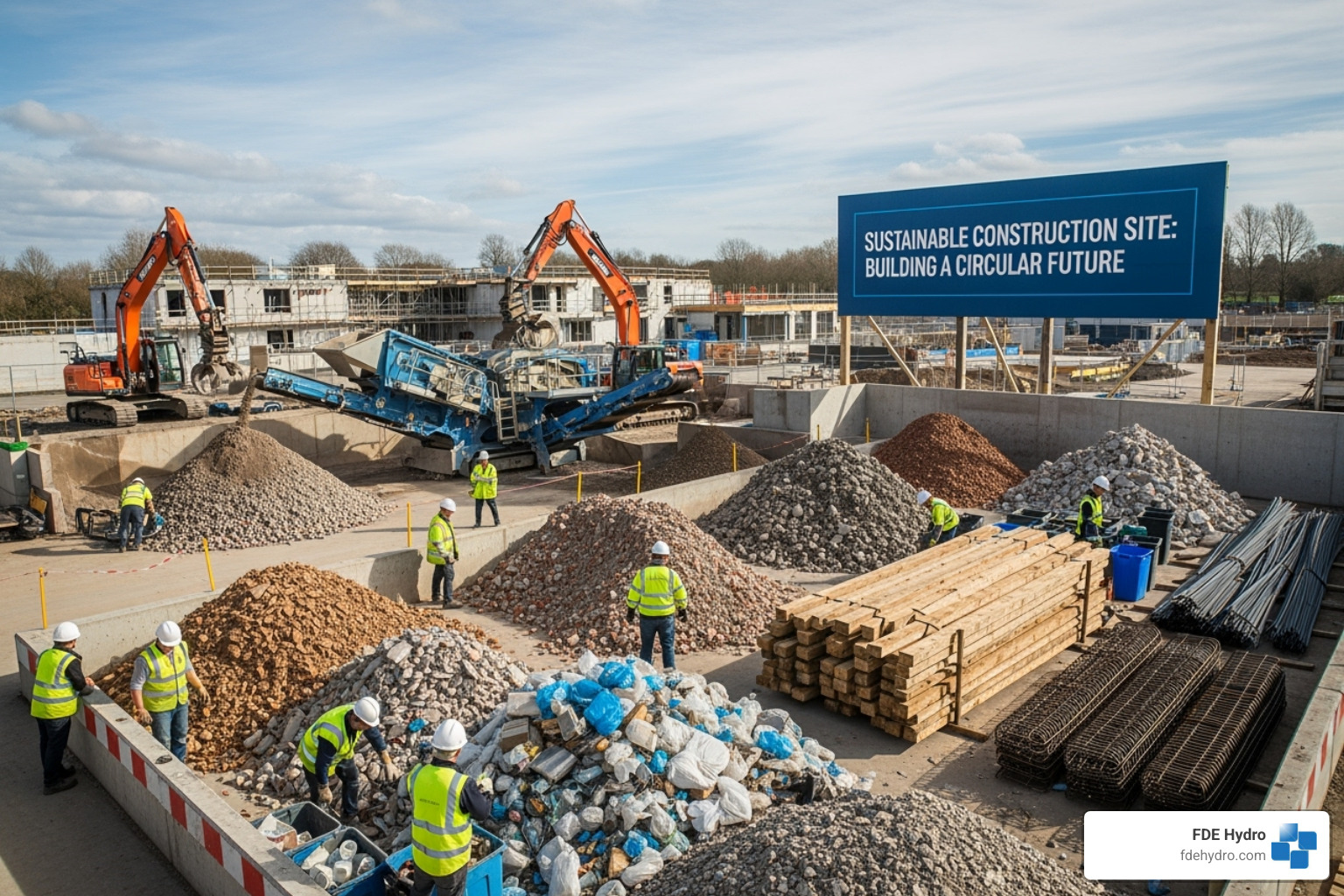
The Future of Urban Living: Sustainable Infrastructure Development in Cities
Cities are where the future of sustainability will be won or lost. By 2030, the UN projects that 60% of humanity will call cities home. Right now, urban areas generate about 70% of all greenhouse gas emissions worldwide. That’s a sobering statistic, but it also represents an enormous opportunity. When we get urban infrastructure right, the positive impact ripples outward.
The cities of tomorrow will look different from those of today. They’ll be more compact, more connected, and far more resilient to climate shocks. Sustainable transport systems—think efficient public transit, protected bike lanes, and walkable neighborhoods—will reduce our dependence on cars and dramatically cut emissions. Green buildings will become the norm rather than the exception, incorporating energy-efficient design, renewable energy sources, and materials that minimize environmental harm.
Climate resilience is particularly crucial for coastal cities. Our Modular Sea Wall Systems provide robust protection against rising sea levels and increasingly severe storms, safeguarding both communities and critical infrastructure. These aren’t just barriers—they’re essential adaptations to a changing climate.
Energy systems are evolving too. Microgrids and distributed generation allow cities to become more energy independent, ensuring power stays on even when the main grid faces disruptions. These systems can seamlessly integrate solar, hydropower, and other renewable sources, making urban energy both cleaner and more reliable.
Speed matters when cities need to upgrade aging infrastructure or expand to accommodate growing populations. Traditional construction methods can bring delays, cost overruns, and significant disruption to daily life. That’s where modular precast solutions shine. Our approach allows for rapid installment of module precast civil infrastructure, dramatically reducing on-site construction time and minimizing the headaches for residents and businesses. In dense urban environments where every square foot counts and time is money, this efficiency is invaluable.
By weaving these elements together, cities can become living laboratories for sustainability—places where economic vitality, public health, and environmental stewardship all thrive together.
Applying Circular Economy Principles
The circular economy represents a fundamental rethinking of how we approach infrastructure. Instead of the old linear model—extract resources, build something, use it, throw it away—we’re moving toward a system that’s regenerative by design. In this model, waste isn’t an inevitable byproduct; it’s a design flaw to be eliminated.
For infrastructure projects, circular thinking starts at the drawing board. When you design out waste from the beginning, you optimize every material choice, prefabricate components in controlled factory settings, and plan for what happens when the infrastructure eventually reaches the end of its useful life. Our precast concrete manufacturing exemplifies this approach. By producing components off-site in a controlled environment, we eliminate the substantial waste typically generated by traditional on-site concrete pouring.
Extending the life of materials and assets is equally important. This means choosing durable, high-quality materials that will last decades, not years. It means designing infrastructure that can be adapted, repaired, and refurbished rather than demolished and rebuilt. Our Dam Rehabilitation Encapsulation technology perfectly illustrates this principle. Instead of tearing down and replacing an aging dam—a process that’s enormously expensive and resource-intensive—we extend its life through innovative encapsulation techniques. This approach demonstrates why precast costs less over the long term: durability and reduced maintenance translate directly into lower lifecycle costs.
Regenerating natural systems takes the concept even further. Rather than simply minimizing harm to the environment, circular infrastructure can actively improve it. This might mean integrating green spaces that improve biodiversity, or designing water systems that improve rather than degrade water quality.
The use of recycled materials closes the loop. When we prioritize recycled content in our construction materials and design infrastructure components that can themselves be recycled or repurposed later, we’re building a truly circular system. Research into scaling circular economies through infrastructure shows how this approach transforms what we once considered waste into valuable resources for future projects.
Embracing circular economy principles in sustainable infrastructure development does more than reduce environmental impact. It creates economic opportunities, improves resource security, and builds systems that are inherently more resilient. Instead of viewing infrastructure as something we build once and replace when it wears out, we’re learning to see it as a long-term asset that can adapt, evolve, and contribute to sustainability for generations.
Conclusion
So, as we wrap up our journey through sustainable infrastructure development, one thing becomes crystal clear: this isn’t just a trendy concept. It’s an absolute must-have for our future, for our planet, and for our well-being. We’ve seen the crucial “why” behind this shift – from tackling climate change head-on and hitting those big global development goals, to open uping incredible long-term economic and social perks. And we’ve dug deep into the “what” – the core traits, guiding rules, and worldwide frameworks that are shaping this exciting new path.
We also looked at the “how,” diving into the investment world. We talked about the huge multi-trillion-dollar gap we need to bridge and the smart policies and creative financial tricks that are helping us get there. It’s all about building a future that’s tough, low-carbon, and works for everyone.
This future, founded on the triple bottom line of people, planet, and profit, calls for a team effort. We need our policymakers, investors, engineers, and local communities to come together. Every step of infrastructure development, from the very first sketch to the final brick, needs to weave in economic smarts, social fairness, and environmental care.
And here at FDE Hydro™, we’re proud to be leading the charge. We’re constantly dreaming up and developing innovative construction techniques that not only cut costs and speed up installation, but also seriously boost the sustainability of vital water and energy projects. Our modular precast solutions are built to last, super-efficient, and wonderfully adaptable. They directly tackle the challenges of our aging infrastructure and the ever-changing demands of our climate. We truly believe in building the right infrastructure, the right way, for generations to come.
We’d love for you to find more about our dedication to sustainable infrastructure development and how our solutions are making a real, tangible difference. Take a moment to explore these advanced means and methods and let’s build a more sustainable world, together.
by Bill French Sr. | Oct 18, 2025 | Case Studies
Why Hydropower Construction in North America Matters Now More Than Ever
Hydropower construction North America is experiencing a critical moment. With a $20.5 billion project pipeline and growing demand for clean, reliable energy, the sector stands at the intersection of opportunity and challenge. Here’s what you need to know:
Key Facts About Hydropower Construction in North America:
- Market Value: North America accounts for $20.5 billion of the global $474.7 billion hydropower construction pipeline
- Current Capacity: The U.S. operates 2,252 hydropower plants with 80.58 GW of total capacity
- Energy Contribution: Hydropower produces 31.5% of total renewable electricity in the U.S. (6.3% of all U.S. electricity)
- Major Projects: Site C Clean Energy Project (Canada, $12.7B, 1.1GW) and Lower Churchill Plant (Canada, $9.6B, 3.07GW)
- Leading Regions: Columbia River Basin (44% of U.S. hydroelectricity), Quebec, British Columbia
- Project Types: Run-of-river, storage (reservoir), and pumped storage facilities
Hydropower has been the backbone of renewable energy in North America for decades. Canada is the second-largest producer of hydroelectricity in the world, while the United States ranks third globally. Yet the sector faces mounting pressures: aging infrastructure averaging over 60 years old, complex permitting processes that can take 5-8 years, and project costs that have doubled in some cases due to COVID-19 impacts and supply chain challenges.
The landscape is changing rapidly. New federal incentives from the Bipartisan Infrastructure Law ($753 million) and Inflation Reduction Act (tax credits up to 30%) are stimulating investment. Meanwhile, the urgent need for grid stability as wind and solar capacity expands makes hydropower’s role as “the guardian of the grid” more critical than ever.
Traditional construction methods—while proven—often mean extended timelines, ballooning budgets, and significant environmental disruption during the building phase. As one industry report noted, “the regulatory environment remains a significant barrier to hydropower investment due to lengthy approval processes.” For decision-makers overseeing these megaprojects, the stakes couldn’t be higher.
I’m Bill French Sr., Founder and CEO of FDE Hydro™, where we’ve pioneered modular precast solutions specifically designed to address the challenges of hydropower construction North America. After five decades leading major civil construction projects—including participating in the Department of Energy’s Hydro Power Vision Task Force—I’ve seen how innovation can transform project delivery in this sector.
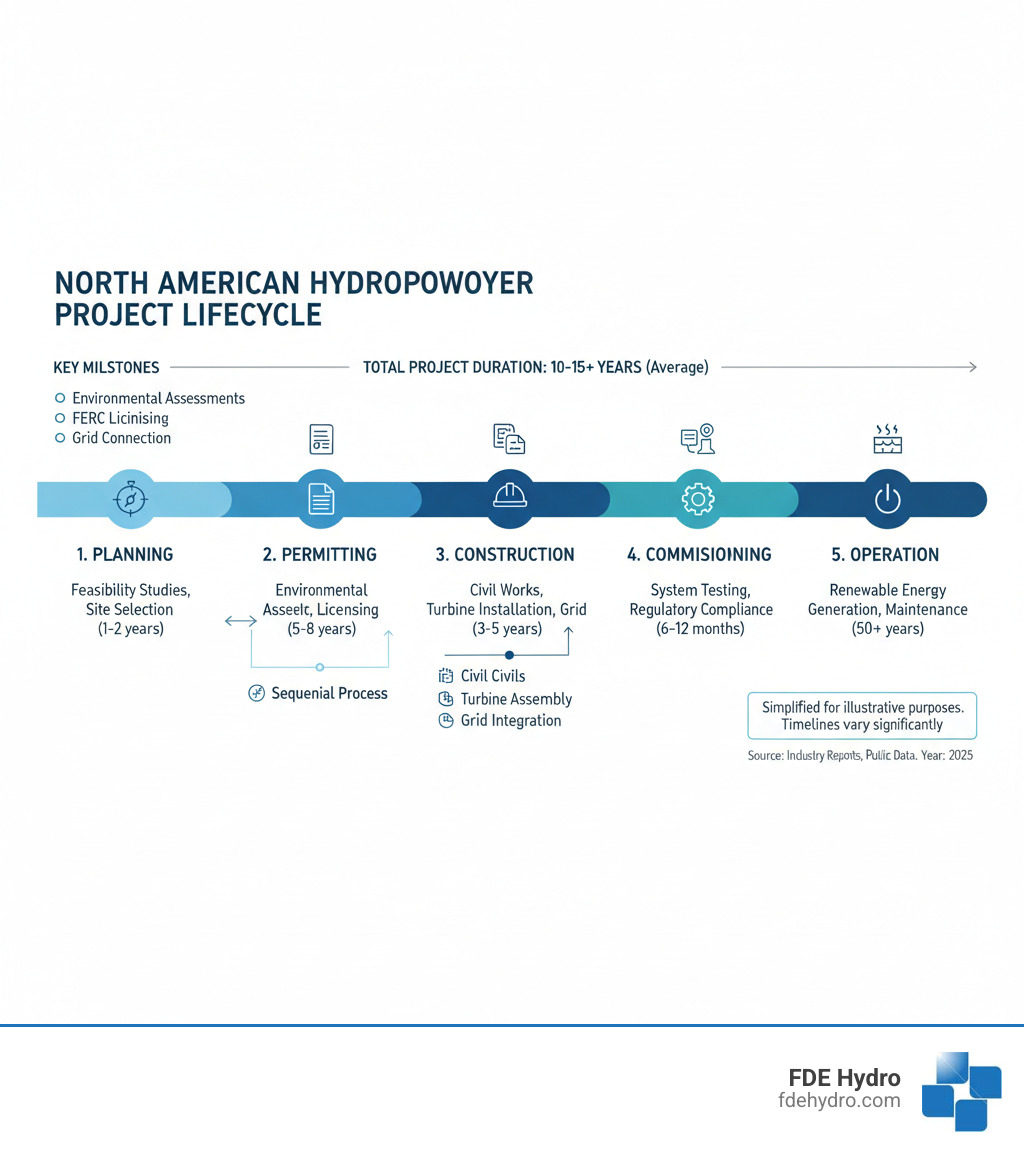
The Current State of Hydropower in North America
Let’s talk about where hydropower construction North America stands today—and trust me, it’s more dynamic than you might think.
North America’s hydropower sector represents a $20.5 billion project pipeline, a significant piece of the global hydropower construction market valued at nearly $475 billion. These aren’t just impressive numbers on a spreadsheet. They represent real infrastructure, real jobs, and real progress toward a cleaner energy future.

Globally, hydropower remains the largest source of renewable electricity. In North America, it’s not just important—it’s indispensable. Canada stands as the second-largest producer of hydroelectricity in the world, with hydropower generating almost 60% of its total annual electricity. That’s remarkable when you think about it. South of the border, the United States holds the third-largest producer title globally. According to the U.S. Hydropower Market Report 2023 Edition, hydroelectric power accounted for 31.5% of total renewable electricity and 6.3% of all U.S. electricity in 2021.
But here’s what really matters: this isn’t just about generating megawatts. It’s about stability. Unlike solar panels that stop producing at sunset or wind turbines that sit idle on calm days, hydropower delivers dependable, around-the-clock power. As we add more wind and solar to our grids—which we absolutely should—hydropower becomes even more valuable. It fills the gaps, smooths out the fluctuations, and keeps the lights on when other sources can’t.
That’s why hydropower is often called the guardian of the grid. It’s the steady hand that helps us transition to a cleaner energy future without sacrificing reliability.
Leading Countries and Key Regions
When you think about hydropower construction North America, two powerhouses immediately stand out: Canada and the United States.
Canada’s provinces of Quebec and British Columbia are home to some of the most impressive hydroelectric infrastructure on the planet. The Site C Clean Energy Project in British Columbia represents a $12.7 billion investment and will deliver 1.1 GW of clean, reliable power. Up in Newfoundland and Labrador, the Lower Churchill Hydroelectric Plant is an even larger undertaking—$9.6 billion and 3.07 GW of capacity. These aren’t just construction projects; they’re changeal investments in regional energy security. Quebec and Newfoundland & Labrador have even partnered on agreements to add 3,900 MW of new hydropower generation capacity together.
South of the border, the United States boasts its own hydropower giants. The Columbia River Basin alone produces 44% of the nation’s hydroelectricity. Think about that—nearly half of all U.S. hydropower comes from one river system. Washington state leads in installed capacity with 21,311 MW, followed by California at 10,189 MW and Oregon at 8,457 MW.
But hydropower isn’t just a West Coast story. Right here in New York, the New York Power Authority operates major facilities including the iconic Niagara Falls project. Having worked in regions from New York to California, we’ve seen how diverse North America’s hydropower landscape really is—and how each region has its own unique challenges and opportunities.
North America’s Hydropower Pipeline in a Global Context
To really understand where North America fits in the bigger picture, let’s zoom out for a moment.
The worldwide hydropower construction pipeline stands at an astounding $474.7 billion, ready to add 253.8 GW of new capacity. The Asia-Pacific region dominates this global market with $254.9 billion in projects, followed by Sub-Saharan Africa at $106.2 billion and South America at $82.1 billion.
North America’s $20.5 billion might look modest next to those numbers, but context matters. We account for about 1.5% of global hydropower capacity currently under construction—but that doesn’t tell the whole story. North America actually leads the world in proposed pumped storage hydropower (PSH) projects. Many of these are still in planning stages rather than active construction, but they represent enormous potential for grid-scale energy storage as we integrate more intermittent renewables.
Here’s another interesting perspective: globally, hydropower makes up about 14% of the total power generation construction pipeline by value, trailing behind wind at 40% and solar at 16%. Some might see this as hydropower taking a back seat. I see it differently. While wind and solar grab headlines and investment dollars—and rightfully so—hydropower provides something those technologies can’t: consistent, dispatchable power that fills in when the sun doesn’t shine and the wind doesn’t blow.
That complementary role is exactly why hydropower construction North America remains so vital to our clean energy transition. For more detailed global insights, you can explore Project Insight – Global Power Generation Construction Projects.
The bottom line? North America’s hydropower sector may not be the largest in the world, but it’s strategic, sophisticated, and absolutely essential to achieving our renewable energy goals.
The Landscape of Hydropower Construction in North America
The world of hydropower construction North America is evolving rapidly, and honestly, it’s both exciting and challenging. We’re standing at a crossroads where enormous opportunity meets real, practical obstacles that need thoughtful solutions.
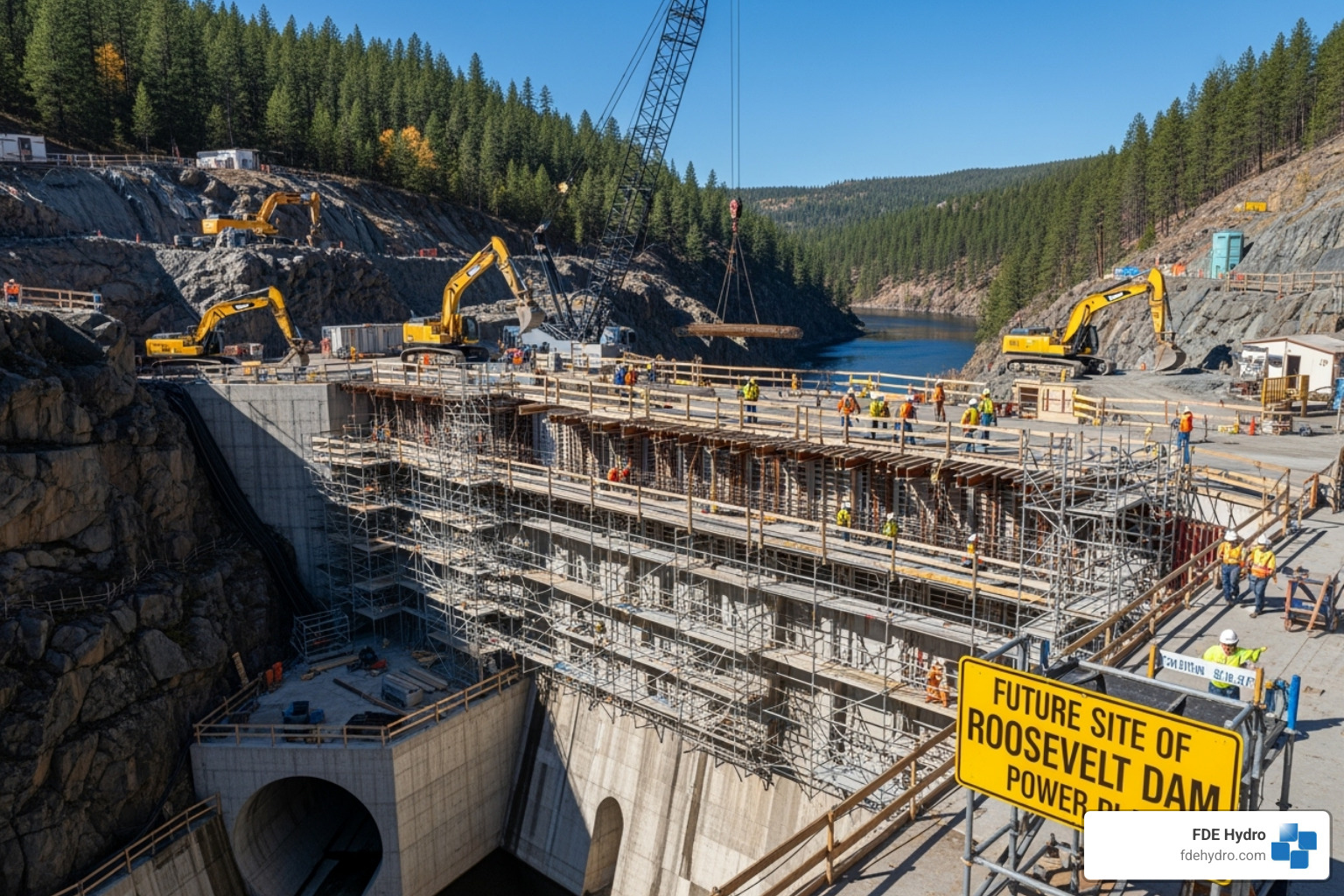
What’s pushing the sector forward is clear: we need clean, reliable energy, and we need it now. Hydropower delivers something that few other renewables can match—dependable, round-the-clock electricity. When the sun sets and the wind stops blowing, hydropower keeps running. That’s why it’s such a vital piece of our transition to a low-carbon economy, working hand-in-hand with wind and solar to create a truly resilient grid.
But let’s be honest about the problems. The permitting process for hydropower projects is notoriously complex. We’re talking about 5 to 8 years just to secure the necessary licenses, and sometimes even longer when you factor in environmental reviews and community consultations. As one industry report bluntly states, “the regulatory environment remains a significant barrier to hydropower investment due to lengthy approval processes.” These delays aren’t just frustrating—they’re expensive. High capital costs combined with potential overruns (the Site C project’s cost doubled since 2014) make financing long-term hydropower a careful balancing act between risk and reward.
Then there’s our aging infrastructure. Many facilities in North America have been operating for over 60 years, and they need serious attention. Upgrading these systems isn’t optional—it’s essential for safety, efficiency, and meeting modern environmental standards. Without streamlining the relicensing process, we risk losing valuable capacity at a time when we can least afford it.
Major Projects and Economic Impact
Despite these challenges, North America continues to invest in transformative hydropower projects. The Site C Clean Energy Project in British Columbia represents a $12.7 billion commitment to 1.1GW of clean power, with first electricity expected by late 2023 or 2025. Yes, costs have doubled since the original estimate, but the project demonstrates Canada’s determination to expand its clean energy capacity.
The Lower Churchill Hydroelectric Plant in Newfoundland and Labrador is another heavyweight, adding 3.07GW through a $9.6 billion investment. Quebec and Newfoundland & Labrador have also partnered on agreements to bring 3,900MW of new hydropower online, strengthening regional energy security.
In the United States, the Champlain Hudson Power Express is breaking new ground—literally. This project involves laying a 339-mile underground and underwater transmission line from Quebec to New York City, bringing Canadian hydropower to millions of urban consumers. Installation work in Lake Champlain is already underway, marking a significant step in cross-border clean energy collaboration.
Smaller projects matter too. The Taylor River Hydro Project in Colorado, with its 500kW capacity generating 3.8GWh annually, shows how even modest facilities contribute to local clean energy goals and community resilience.
The economic ripple effects are substantial. Site C alone employed nearly 6,000 workers at its peak in May, creating jobs that support families and communities. Beyond direct employment, these projects attract billions in investment, stimulate local businesses, and provide affordable, locally generated electricity that helps industries thrive.
Federal support is amplifying this momentum. The Bipartisan Infrastructure Law allocated $753 million specifically for hydropower incentives, while the Inflation Reduction Act offers production and investment tax credits of up to 30% for clean energy projects, including hydropower and pumped storage facilities. These policies recognize hydropower’s essential role in our energy future.
Understanding the Drivers for Hydropower Construction in North America
So what’s really motivating all this construction activity? It goes well beyond just keeping the lights on.
Energy independence is a big factor. Every megawatt we generate from our own rivers and waterways is a megawatt we don’t need to import. That strengthens national security and insulates us from volatile global energy markets.
The low-carbon economy transition makes hydropower indispensable. As we work to meet climate commitments and reduce greenhouse gas emissions, hydropower offers proven, scalable clean energy. Hydroelectric companies are literally on the front lines of climate action.
Grid integration has become critical as wind and solar capacity expands. These sources are fantastic, but they’re intermittent. Hydropower acts as the reliable partner that balances their variability, ramping up when the sun dips behind clouds or wind speeds drop. It’s what keeps our grid stable as we add more renewables.
Water management often gets overlooked in energy conversations, but it’s crucial. Many hydropower facilities with reservoirs serve multiple purposes—supplying drinking water, supporting irrigation, and providing flood control that protects communities and farmland. With over 92,000 reservoirs across the United States, this infrastructure is woven into our water security.
We’ve long believed that the biggest untapped solution to climate change is in the water. Using that potential responsibly—through modern, efficient hydropower systems—is one of the smartest investments we can make for a sustainable future.
Technologies and Types of Hydropower Plants
When we talk about hydropower construction North America, we’re really talking about a diverse family of technologies. Each type of hydropower plant has its own personality, shaped by the landscape it inhabits, the water resources available, and the specific energy challenges it needs to solve. Understanding these differences is essential to appreciating the full scope of what we’re building across the continent.
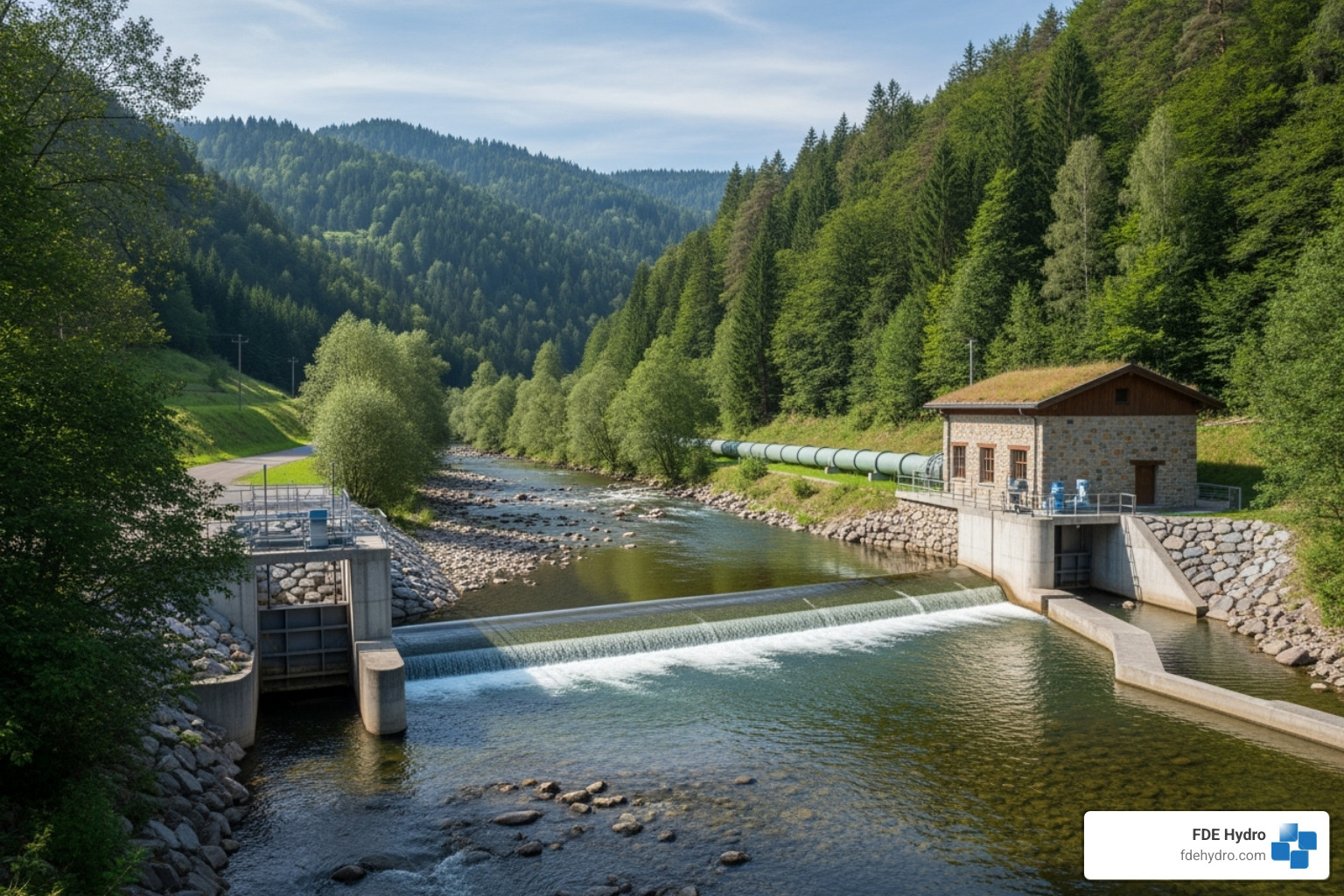
Run-of-river hydropower plants are the minimalist approach to hydropower. They channel a portion of a river’s natural flow through turbines, typically without creating a large storage reservoir behind a massive dam. Think of them as working with the river rather than trying to control it completely. These plants generate continuous electricity, though their output naturally fluctuates with the river’s flow—more power during spring runoff, less during dry summer months. The beauty of run-of-river systems is that they minimize impacts on the natural flow of water, which makes them increasingly popular as we become more environmentally conscious.
Storage (reservoir) hydropower represents the classic image most people have when they think of hydropower—the grand dams creating vast lakes behind them. These facilities use a dam to create a reservoir that stores enormous volumes of water. This stored water becomes potential energy that can be released on demand, allowing operators to generate power precisely when the grid needs it most. These projects involve significant water control structures and offer best flexibility in meeting peak electricity demand.
Pumped storage hydropower (PSH) is the clever innovator of the family. It doesn’t actually create new energy—instead, it acts like a giant rechargeable battery made of water and gravity. These facilities use two reservoirs at different elevations. During periods of low electricity demand (typically at night, when electricity prices are lower), water is pumped uphill from the lower reservoir to the upper one. When demand spikes, that stored water rushes back down through turbines to generate electricity. It’s an neat solution to one of renewable energy’s biggest challenges: storing power for when we need it most.
Here’s how these three types compare across key features:
| Feature |
Run-of-River |
Storage (Reservoir) |
Pumped Storage Hydropower (PSH) |
| Dam/Reservoir |
Small or none; channels river flow |
Large dam creating a significant reservoir |
Two reservoirs at different elevations |
| Power Output |
Variable, dependent on river flow |
Dispatchable, can be adjusted to demand |
Dispatchable, used for grid balancing and storage |
| Energy Storage |
Minimal |
Significant (stored water) |
Primary function is energy storage (“water battery”) |
| Environmental Impact |
Generally lower than storage plants |
Can have significant ecosystem impacts |
Can have ecosystem impacts, but often closed-loop |
| Prevalence in North America |
Growing, especially small hydro |
Well-established, many large existing plants |
Growing rapidly, seen as future of grid stability |
Innovations Shaping the Future of Hydropower Construction in North America
The future of hydropower construction North America isn’t just about building bigger—it’s about building smarter. We’re seeing technological innovations that are changing hydropower into a more efficient, cost-effective, and environmentally responsible energy source.
Pumped storage hydropower deserves special attention because it’s arguably the most significant innovation for our modern grid. As we add more solar panels and wind turbines to our energy mix, we face a fundamental challenge: the sun doesn’t always shine, and the wind doesn’t always blow. PSH facilities—often called “water batteries”—provide the crucial flexibility we need to balance these intermittent sources.
The numbers tell the story: the U.S. PSH fleet already accounts for 70% of utility-scale power storage capacity and an impressive 96% of energy storage capacity. With a median storage duration of 12 hours (compared to just 2 hours for utility-scale batteries), PSH offers the long-duration storage that’s essential for grid stability. We’re passionate about pumped storage hydropower because we believe it’s key to open uping a truly renewable energy future.
Modular construction and precast technology represent a fundamental shift in how we approach hydropower projects. Traditional construction methods are notoriously slow, expensive, and disruptive to the surrounding environment. At FDE Hydro™, we’ve pioneered a different approach with our patented modular precast concrete technology—what some call “French Dam” technology. By fabricating components off-site in a controlled factory environment, we can dramatically reduce construction time, lower costs, and minimize environmental impact at the project site. It’s like building with high-tech LEGO blocks instead of pouring concrete in place for months on end. This approach is changing projects across North America and beyond, as you can see in our precast models.
Turbine upgrades and digitalization are breathing new life into aging facilities. Modernizing existing plants might not sound as exciting as building new ones, but it’s often more cost-effective and environmentally sensible. This includes upgrading turbine runners, rewinding generators, and replacing cores to boost efficiency and extend operational life by decades. Meanwhile, digitalization—including advanced SCADA systems—allows operators to monitor their facilities in real-time, predict maintenance needs before failures occur, and optimize operations for maximum efficiency. These technologies are crucial for using technology to minimize the duration of impacts while ensuring plants run at peak performance year after year.
The Rise of Pumped Storage and Small Hydro
The energy landscape is evolving rapidly, and with it, the focus of hydropower construction North America is shifting in exciting directions. We’re witnessing a significant rise in two areas that were once considered secondary: pumped storage hydropower and small hydro projects.
Pumped storage hydropower is increasingly recognized as the backbone of grid-scale energy storage. Its ability to balance intermittent renewables—absorbing excess power when generation is high and releasing it precisely when demand peaks—makes it absolutely indispensable. The U.S. PSH development pipeline tells the story clearly: 96 projects totaling a staggering 91 GW of storage capacity are in various stages of planning. Closed-loop PSH configurations are particularly gaining traction because they offer siting flexibility and lower environmental impact compared to traditional open-loop systems that connect to existing rivers or lakes.
Small hydro projects and retrofitting non-powered dams represent a massive, often overlooked opportunity hiding in plain sight. The U.S. has over 80,000 unpowered dams—structures built for flood control, irrigation, or navigation that currently don’t generate any electricity. An Assessment of Energy Potential at Non-Powered Dams in the United States estimates these facilities could add 12,000 MW of hydroelectric capacity, generating 45 TWhr per year. That’s equivalent to 16% of all U.S. hydropower generation in 2008. Even more remarkably, NPD retrofits account for 95% of proposed new hydropower capacity in the U.S. development pipeline.
This approach is neat in its efficiency—we’re leveraging existing infrastructure, minimizing new environmental footprint while tapping into significant untapped energy potential. These smaller, often decentralized projects can also play a vital role in building resilient microgrids, providing localized power generation and enhancing energy security for communities that want more control over their energy future.
Environmental, Social, and Regulatory Considerations
When we talk about hydropower construction North America, we’re not just talking about concrete and turbines. We’re talking about projects that exist within living ecosystems and communities that have called these places home for generations. That’s why environmental, social, and regulatory considerations aren’t afterthoughts—they’re woven into the very fabric of every project from day one.
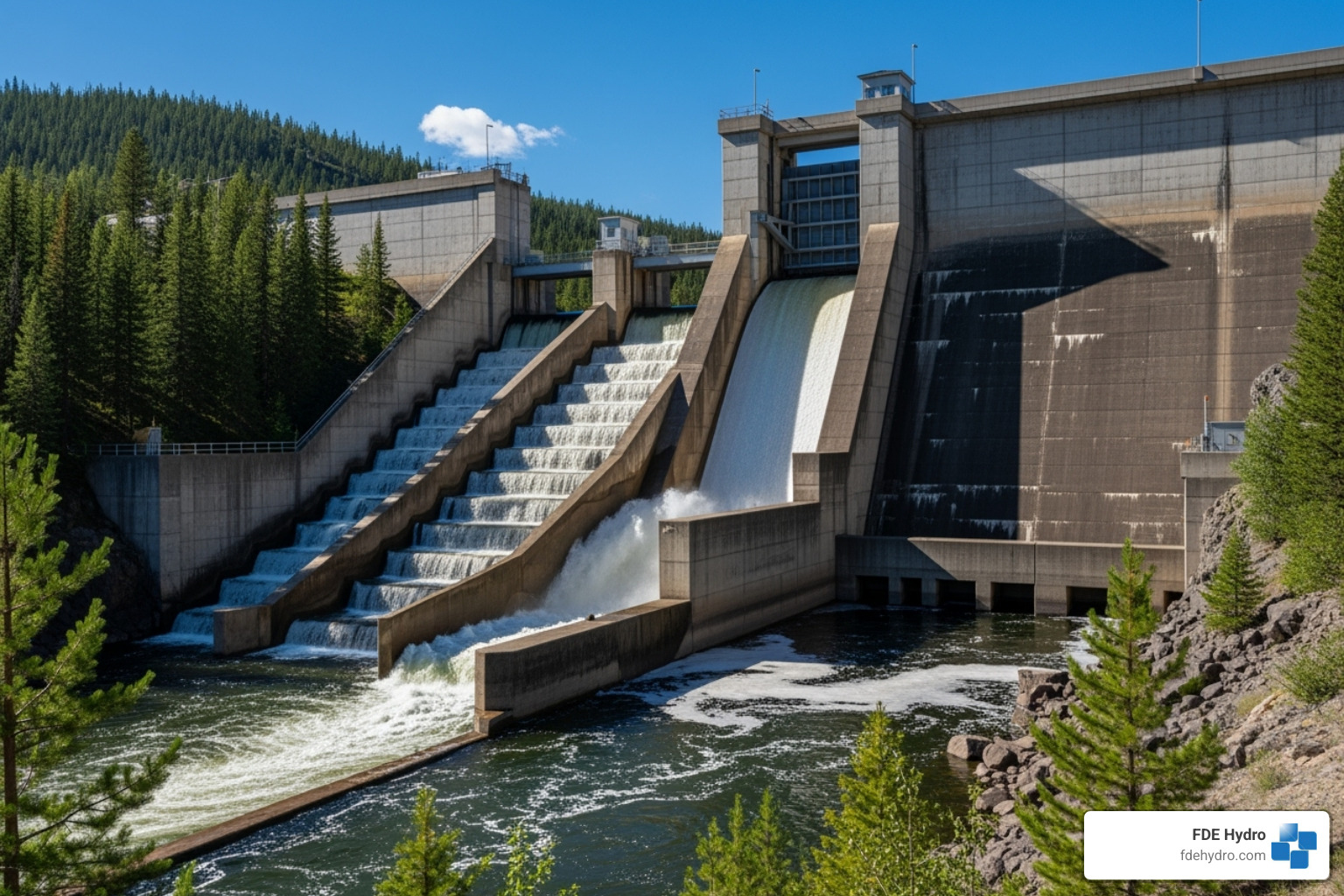
Before a single shovel breaks ground, every major hydropower project undergoes rigorous environmental impact assessments. These aren’t just bureaucratic checkboxes—they’re detailed studies that help us understand how a project might affect local wildlife, water quality, and the broader ecosystem. The goal is simple: identify potential problems early so we can design solutions that work for both energy needs and nature.
But it’s not just about the environment. The social dimension matters just as much. Indigenous communities often have deep historical and cultural connections to the rivers and lands where hydropower projects are built. That’s why meaningful partnerships aren’t optional—they’re essential. Take our own hydroelectric generating facility in Yellow Falls, Ontario, for example. It’s a joint venture with the Taykwa Tagamou Nation and Mattagami First Nation, built on mutual respect and shared benefits. This collaborative approach isn’t just the right thing to do; it leads to better, more sustainable projects.
The regulatory landscape in North America is complex, and for good reason. In the United States, the Federal Energy Regulatory Commission (FERC) oversees the licensing of hydropower projects, requiring comprehensive environmental documents like Environmental Impact Statements and Environmental Assessments. These processes ensure that every potential impact is carefully considered. The FERC Hydropower Environmental Documents (2016-Present) archives show just how thorough these reviews are.
Relicensing existing facilities is equally demanding. The median duration for relicensing is 5.8 years, and here’s something that should grab everyone’s attention: a substantial portion of U.S. hydropower licenses are set to expire between 2023 and 2027. Without reforms to streamline this process, we risk losing valuable generating capacity at a time when we need it most. As one industry report bluntly states, “the regulatory environment remains a significant barrier to hydropower investment due to lengthy approval processes.”
And then there’s dam safety—a non-negotiable priority. Rigorous standards, regular inspections, and continuous monitoring ensure that these structures protect both communities and ecosystems. After all, a hydropower facility that isn’t safe isn’t sustainable.
Balancing Energy Needs with Environmental Stewardship
Here’s the challenge we face every day: how do we generate the clean, reliable energy our society needs while protecting the rivers, fish, and ecosystems that depend on these same water systems? It’s a balancing act, and in hydropower construction North America, we’re constantly innovating to get it right.
Let’s start with fish migration, one of the most visible environmental concerns. Dams can block the natural movement of fish species like salmon and eels, disrupting their life cycles. Modern projects address this head-on with solutions like fish ladders, bypass systems, and even fish-friendly turbine designs. We’ve seen real success stories—like the initiative in Rimouski, Quebec, that significantly increased Atlantic salmon migration rates.
Other facilities have been specifically designed to prevent eels from entering turbines, protecting these vulnerable populations. Our expertise in aquatic animal and recreational passage helps ensure that fish and other aquatic life can steer around our structures safely.
Water quality and sediment management are equally critical. Rivers naturally carry sediment downstream, nourishing ecosystems and maintaining river channels. Dams can alter these patterns, sometimes trapping sediment in reservoirs or changing downstream water temperatures. Careful operational planning—including regulated seasonal drawdowns—helps mitigate these effects and maintain healthier river systems.
There’s also the matter of habitat preservation. Protecting riparian zones, wetlands, and other critical habitats around hydropower facilities ensures that local wildlife populations remain healthy and resilient.
And yes, we need to talk about methane emissions. While hydropower is a low-carbon energy source, some large reservoirs can produce methane from decaying organic matter, particularly in tropical regions but also in some temperate zones. This is an area of active research, and newer projects are designed with this factor in mind, often clearing vegetation before flooding or choosing sites with lower methane potential.
The bottom line? We’re committed to designing solutions that don’t just generate clean energy but actively contribute to healthier ecosystems. It’s not always easy, but it’s always worth it.
The Role of Modernization and Dam Rehabilitation
Here’s something many people don’t realize: much of North America’s hydropower infrastructure has been running strong for over 60 years. That’s a testament to the engineering excellence of earlier generations, but it also means we’re now facing a critical moment. These aging facilities need attention, and that’s where modernization and dam rehabilitation come into the picture for hydropower construction North America.
Upgrading existing facilities isn’t just about keeping the lights on—it’s often the smartest, most sustainable path forward. When we increase the efficiency of a plant that’s already there, we boost clean energy output without the environmental footprint of building something entirely new. The U.S. currently has 23 active upgrade projects designed to increase existing fleet capacity by 254 MW. That’s substantial new clean energy from infrastructure that’s already in place.
Our work focuses on bringing aging infrastructure being replaced with next-generation civil solutions into the modern era. Through specialized techniques like dam rehabilitation encapsulation, we can restore structural integrity, improve performance, and extend the operational life of facilities that have served their communities for decades.
The federal government recognizes how critical this work is. The Bipartisan Infrastructure Law allocated $753 million specifically for hydropower incentives, including capital investments, production at new facilities, and efficiency improvements for existing plants. This isn’t just about maintaining the status quo—it’s about ensuring that our hydropower infrastructure remains a reliable, increasingly efficient source of clean energy for the next generation and beyond.
Modernization also means incorporating new technologies: upgraded turbine runners that squeeze more power from every drop of water, rewound generators that run more efficiently, and advanced monitoring systems that catch potential problems before they become serious. When we invest in these upgrades, we’re not just fixing old infrastructure—we’re building the foundation for a cleaner energy future.
Frequently Asked Questions about Hydropower Construction
Throughout our years working in hydropower construction North America, we’ve heard the same questions come up time and again. Based on our experience and the latest industry data, here are straightforward answers to what people really want to know.
What is the largest hydropower project under construction in North America?
When people ask about the “largest” project, they usually mean either the most expensive or the highest capacity. Either way, the answer takes us north of the border to Canada, where two massive projects dominate the landscape.
The Site C Clean Energy Project in British Columbia stands out as Canada’s most expensive infrastructure project ever, with a price tag of $12.7 billion and a capacity of 1.1 GW. After nearly a decade of construction and some significant cost overruns (the price has doubled since the 2014 estimate), it’s expected to start producing power by late 2023 or 2025. When you’re on-site, the scale of this undertaking is truly breathtaking—the kind of project that reminds you why we got into this business in the first place.
The Lower Churchill Hydroelectric Plant in Newfoundland and Labrador is equally impressive, with a capacity of 3.07 GW and a value of $9.6 billion. These Canadian megaprojects showcase the continued importance of large-scale hydropower in our energy future.
Now, you might have heard about the massive pumped storage hydropower (PSH) pipeline in the United States—96 projects totaling 91 GW of storage capacity. That’s enormous potential. However, most of these projects are still in the planning and proposal stages rather than active construction. The regulatory problems and permitting processes we discussed earlier mean many of these projects face long timelines before breaking ground.
How long does it take to build a hydropower dam?
If you’re hoping for a simple answer, I wish I could give you one. The truth is, building a hydropower facility is a marathon, not a sprint, and the timeline varies dramatically based on size, location, and—perhaps most significantly—the regulatory environment.
Permitting and licensing often take longer than people expect. In the U.S., the median duration for the hydropower relicensing process was 5.8 years between 2010 and 2022, according to recent data. For new construction, you’re looking at similar or even longer timelines to secure initial permits and complete environmental assessments. The Federal Energy Regulatory Commission (FERC) licensing process is thorough—necessarily so, given the environmental and social considerations involved—but it can be a significant barrier to getting projects off the ground.
Construction itself for large-scale projects can span many years. The Site C project has been under construction for nearly a decade. When you factor in building transmission lines to connect the facility to the grid, you can add another 8-10 years to the overall timeline. That’s a long time to wait for clean energy we need today.
This is exactly why we developed our modular precast concrete technology at FDE Hydro™. By fabricating components off-site in a controlled environment, we can dramatically reduce on-site construction time. Instead of pouring concrete and waiting for it to cure while dealing with weather delays and site constraints, we arrive with precision-engineered modules ready for rapid assembly. This approach doesn’t just save time—it reduces costs, minimizes environmental disruption during construction, and gets clean energy flowing to communities faster. Innovation like this is essential when we’re racing against climate change and aging infrastructure.
Is hydropower a completely clean source of energy?
This is an important question, and it deserves an honest answer. Hydropower is absolutely a low-carbon, renewable energy source that’s crucial to our clean energy future. During operation, hydropower plants don’t produce air pollutants or greenhouse gases the way fossil fuel plants do. That’s a massive advantage.
However, saying something is “completely clean” sets an impossibly high bar that no energy source—including hydropower—can meet. Every form of energy production interacts with the environment in some way, and hydropower is no exception.
Large dams and reservoirs can alter natural river flows, change aquatic habitats, and affect fish migration patterns. This is why modern projects incorporate solutions like fish ladders and carefully managed seasonal flows to help aquatic animal and recreational passage. We’ve seen successful examples, like the fish passage improvements in Rimouski, Quebec, that increased Atlantic salmon migration.
Sedimentation is another consideration. Reservoirs naturally trap sediment that would otherwise flow downstream, which can affect both the reservoir’s capacity over time and the downstream ecosystem that depends on that sediment.
Water quality can be impacted by changes in flow, depth, and temperature. And in some cases—particularly in tropical regions or reservoirs with large amounts of decaying vegetation—reservoirs can emit methane, a potent greenhouse gas. This is less common in North America’s temperate climate, but it’s a factor that environmental assessments consider.
Because of these environmental considerations, some jurisdictions take a nuanced view. California, for instance, doesn’t consider power from large hydroelectric facilities (over 30 megawatts) as meeting their strictest definition of “renewable” for certain standards, though it’s still recognized as clean energy.
The key is that our industry takes these impacts seriously. Every major project undergoes rigorous environmental impact assessments. We work closely with communities, including Indigenous partnerships, to ensure projects balance energy needs with environmental stewardship. At FDE Hydro™, we’re committed to advancing construction methods that minimize disruption and maximize the benefits of this vital renewable resource.
Hydropower isn’t perfect, but it’s one of the most reliable, cost-effective, and low-carbon energy sources we have. As we modernize existing facilities and build new ones with better environmental safeguards, we’re constantly improving. That’s the future of responsible hydropower construction North America—meeting our energy needs while protecting the ecosystems that sustain us all.
Conclusion
After decades in this industry, I can tell you that hydropower construction North America stands at a pivotal moment. We’re not just talking about maintaining the status quo—we’re talking about reimagining what’s possible.
Throughout this article, we’ve explored how hydropower remains the backbone of renewable energy across our continent. With its $20.5 billion project pipeline and best ability to provide steady, reliable power, it’s clear this isn’t a technology of the past. It’s a cornerstone of our clean energy future. As wind and solar capacity continues to expand, hydropower’s role becomes even more critical—balancing the grid, storing energy, and ensuring the lights stay on when we need them most.
But let’s be honest about the challenges. We’re dealing with infrastructure that’s often over 60 years old. We’re navigating permitting processes that can drag on for years. We’re managing costs that can balloon unexpectedly. These aren’t small problems, and they won’t solve themselves.
The answer lies in innovation and a willingness to do things differently. The technological advancements we’ve discussed—from pumped storage hydropower acting as massive “water batteries” to the retrofitting of non-powered dams—show us the path forward. We need to build smarter, faster, and with greater respect for the environment and communities around us.
This is exactly why we developed our modular precast concrete technology at FDE Hydro™. After participating in the Department of Energy’s Hydro Power Vision Task Force and watching project after project struggle with the same issues, I knew there had to be a better way. Our approach reduces construction time, cuts costs, and minimizes on-site environmental disruption. It’s not about replacing traditional methods entirely—it’s about giving project managers and decision-makers more tools to work with.
The future of hydropower isn’t just about generating megawatts. It’s about sustainable development that respects our rivers, supports local communities, and delivers the clean, reliable energy North America needs. Every project we take on is an opportunity to prove that we can meet our energy goals without compromising on environmental stewardship or breaking the bank.
We’re excited about what’s ahead. With federal support from initiatives like the Bipartisan Infrastructure Law and the Inflation Reduction Act, combined with growing recognition of hydropower’s essential role in grid stability, the conditions are right for a renaissance in this sector.
If you’re involved in planning, financing, or building hydropower projects, I invite you to learn more about the future of Hydropower and find how modular construction technology is changing what’s possible. Together, we can build infrastructure that serves not just this generation, but the ones to come.

