

How Much Does a Hydroelectric Power Plant Actually Cost?
The cost of a hydroelectric power plant is one of the most important — and most misunderstood — numbers in renewable energy development.
Here’s a quick snapshot of what you can expect to pay:
| Plant Type | Typical CAPEX Range (per kW) |
|---|---|
| Large hydropower (greenfield) | $1,050 – $7,650/kW |
| Small hydropower | $1,300 – $8,000/kW |
| Non-powered dam (NPD) retrofit | $2,400 – $14,500/kW |
| New stream-reach development (NSD) | $5,500 – $7,900/kW |
| Refurbishment / upgrade | $500 – $1,000/kW |
- Operating costs run $15 – $60 per kW annually
- LCOE ranges from $0.02 – $0.19/kWh for large hydro
- Plant lifespan is typically 50 – 100 years
- Once built, hydropower can generate electricity for as little as 0.85 – 4 cents per kWh
The numbers above tell one story. But behind them is a much more complex picture — one shaped by site geology, head height, flow rates, environmental permitting, and whether you’re building from scratch or retrofitting an existing dam.
No two hydropower projects cost the same. A high-head site with favorable geology in an accessible location can come in at the low end of the range. A low-head, remote greenfield project can blow past the top end before the first turbine is installed.
That variability is exactly why project developers and infrastructure decision-makers need a clear, structured breakdown of where the money actually goes — from initial civil works all the way through decades of operation.
I’m Bill French, Sr., Founder and CEO of FDE Hydro™, and over five decades leading large-scale civil construction projects — including my work with the U.S. Department of Energy’s Water Power Technology Office on next-generation hydropower solutions — I’ve seen how the cost of a hydroelectric power plant can make or break a project’s viability. In this guide, I’ll walk you through every major cost driver so you can plan smarter and build with confidence.
Basic cost of a hydroelectric power plant glossary:
Understanding the Total Cost of a Hydroelectric Power Plant
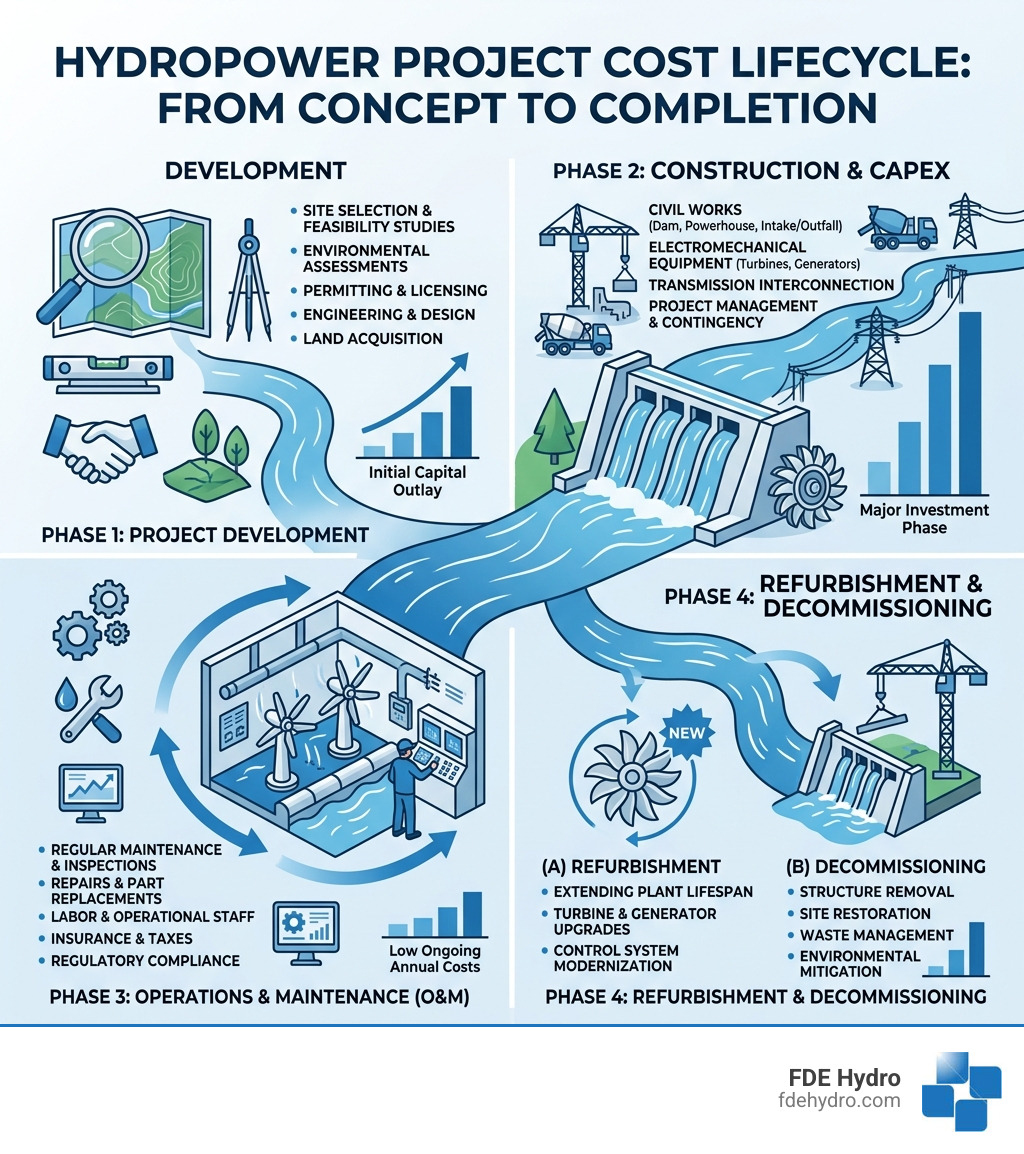
When we talk about the cost of a hydroelectric power plant, we are really looking at two massive buckets: Capital Expenditures (CAPEX) and Operational Expenditures (OpEx). Because hydropower is a “fuel-free” technology — the water keeps flowing for free (mostly) — the economic game is won or lost during the initial investment phase.
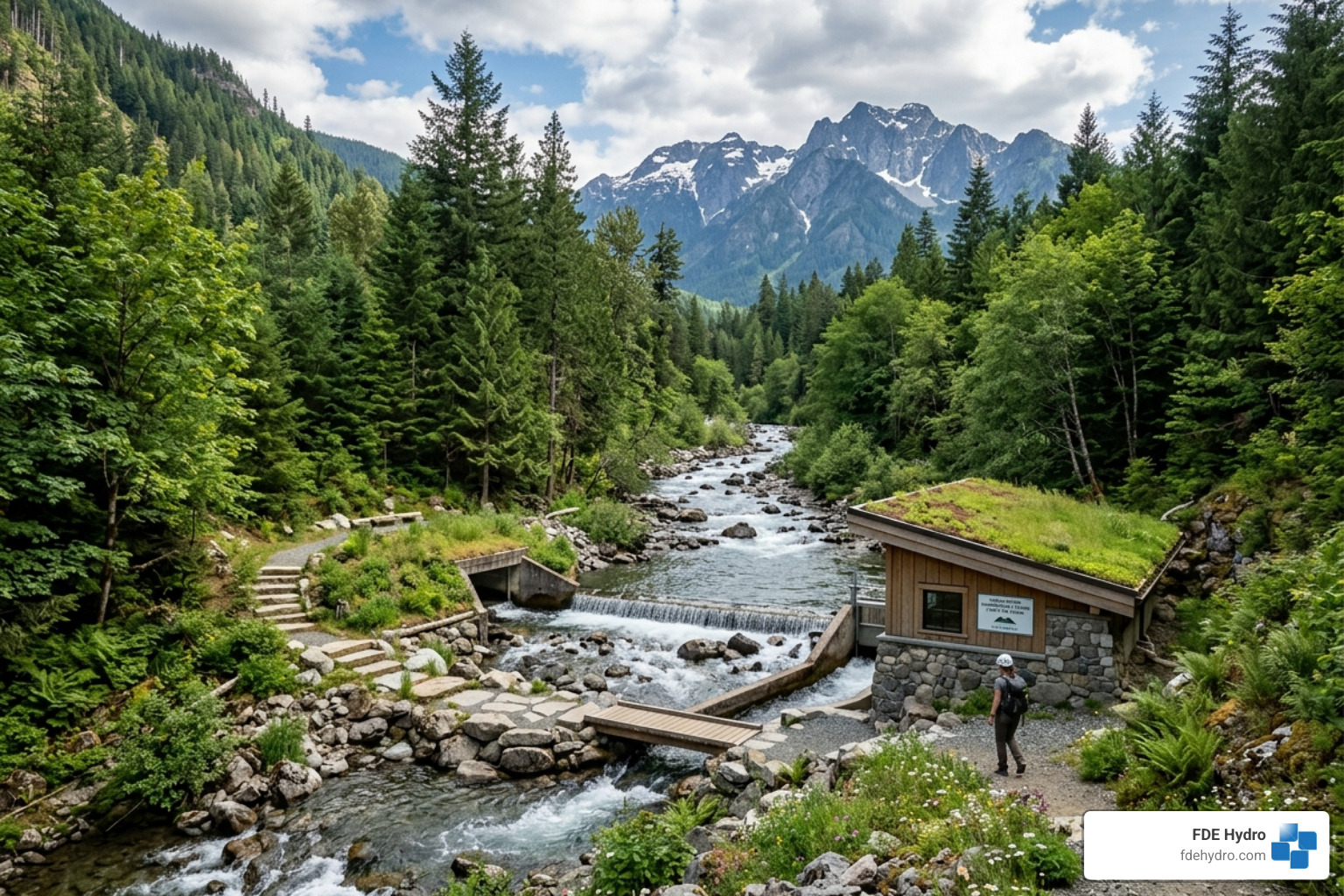
Total installed costs are usually measured in dollars per kilowatt ($/kW). According to the U.S. Hydropower Market Report, these costs can vary wildly. For instance, a “canal or conduit” project might average $7,449/kW, while a massive pumped storage project might benefit from scale and land at around $2,009/kW.
For more detail on these variables, check out our More info about hydro project costs page.
Comparing Small vs. Large Scale Facilities
It seems counterintuitive, but smaller isn’t always cheaper on a per-unit basis. Micro-hydro plants (under 1 MW) often face higher per-kilowatt pricing because they can’t take advantage of the same procurement discounts as mega-dams. While a massive 500 MW facility might cost billions in total, its cost per kW is often lower than a 100 kW stream-side turbine.
However, large-scale projects face their own “mega-project” risks. Costs for massive dams can exceed $10 billion, and construction timelines of 5 to 15 years mean that interest on loans can pile up before a single watt is sold.
Non-Powered Dams (NPD) vs. Greenfield Development
One of the smartest ways to manage the cost of a hydroelectric power plant is to look at what’s already there. In the U.S. alone, there are over 80,000 dams, but only about 3% of them actually produce power.
Retrofitting a Non-Powered Dam (NPD) is often more cost-effective than “New Stream-reach Development” (NSD) because the primary civil barrier is already built. However, NPD costs still range from $2,400 to $14,500/kW because you have to work within the constraints of an existing, sometimes aging, structure. We go into detail on this in our guide on Breaking Down The Dam Costs Of Hydropower Projects.
Breaking Down CAPEX: From Civil Works to Turbines
If you look at a budget for a new hydro plant, you’ll notice that “pouring concrete” and “buying machines” eat up the lion’s share.
Main Components of Initial Investment
The cost of a hydroelectric power plant is typically split between civil works (the dam, powerhouse, and spillways) and electromechanical equipment (the “guts” of the plant).
- Civil Engineering & Construction: This usually exceeds $1 million even for small projects and can account for 60-70% of total costs for large reservoir plants. This includes the dam itself, water diversion channels, and the powerhouse. For a deep dive into these parts, see our Hydroelectric Dam Components Ultimate Guide.
- Electromechanical Equipment: Turbines and generators are the stars of the show. In smaller projects, these components can account for 40-60% of the total budget.
- Penstocks and Gates: These are the “pipes” that deliver water to the turbine. Depending on the distance from the water source, these can be a massive line item.
- Transmission Lines & Grid Connection: Getting the power to the people isn’t free. Grid connection costs typically range from $200,000 to $500,000 depending on proximity to existing lines.
You can learn more about the physical labor involved in our article on Hydroelectric Dam Construction.
Factors Influencing the Initial Cost of a Hydroelectric Power Plant
Why does one 5 MW plant cost double another? It usually comes down to two physics terms: Head and Flow.
- High Head, Low Flow: These sites use a large “drop” in height. They require less civil work but more expensive penstock piping.
- Low Head, High Flow: These sites need massive amounts of water moving through huge turbines. This requires larger powerhouses and more extensive concrete work.
Site geology also plays a role. If the bedrock isn’t where the engineers thought it was, foundation costs can skyrocket. Environmental mitigation — like fish ladders or bypasses — are also essential “hidden” costs that can reach into the high six figures. For more on how design choices impact the bottom line, read our Hydroelectric Dam Design Complete Guide.
Operational Expenses (OpEx) and Long-Term Maintenance
Once the ribbons are cut, the cost of a hydroelectric power plant shifts into OpEx. The good news? Hydropower has some of the lowest operating costs in the energy world, ranging from 1% to 4% of the initial investment annually.
Recurring Monthly and Annual Running Costs
Running a facility isn’t just about watching water flow. A typical financial model for a mid-sized plant might project a monthly OpEx of around $543,000. This includes:
- Plant Maintenance: A fixed monthly cost (often around $150,000) for turbines and dam infrastructure.
- Operational Payroll: You need a team. A 13-person crew of engineers and operators can cost roughly $107,500 per month.
- Taxes & Insurance: Expect to pay significant property taxes and insurance premiums (around $80,000/month for larger facilities).
- Regulatory Fees: Compliance with environmental agencies and grid operators is a recurring expense.
We provide a more granular look at these numbers in our report on Hydropower Project Costs. You can also find scientific research on hydropower cost analysis for more technical benchmarks.
Managing Cash Flow and Major Overhauls
While day-to-day costs are low, “lumpy” CAPEX can cause headaches. Every 20 to 30 years, turbines need rewinds or overhauls. A major overhaul in 2026 might cost $2.275 million, which can lead to temporary cash shortfalls if not planned for decades in advance. Managing this working capital is vital for long-term survival.
Economic Viability: LCOE and Return on Investment
To truly understand the cost of a hydroelectric power plant, you have to look at the Levelized Cost of Electricity (LCOE). This is the “all-in” price of power over the plant’s entire life.
Calculating the Levelized Cost of a Hydroelectric Power Plant
Because a dam can last 100 years, the high upfront cost is spread over a century of generation.
- Large Hydro LCOE: $0.02 – $0.19/kWh.
- Small Hydro LCOE: $0.02 – $0.27/kWh.
- Micro-Hydro LCOE: $0.18 – $0.60/kWh.
The “fuel” is free, so once the debt is paid off, these plants become incredible “cash cows.” For a detailed comparison of these rates, see How Much Do Hydroelectric Power Plants Cost Per KWH?.
Comparing Hydropower to Other Energy Sources
Hydropower is the ultimate “slow and steady” winner. While solar and wind have lower CAPEX, they have shorter lifespans (20-25 years) and lower capacity factors. A hydro plant’s efficiency — often reaching 90% — and its ability to provide grid stability make it more affordable in the long run than almost any fossil fuel source. In the U.S., hydro produces power for an average of 0.85 cents per kWh, which is roughly 40% of the cost of fossil fuel generation.
Cost-Reduction Strategies and Modern Innovations
How do we bring down the cost of a hydroelectric power plant? We innovate. Traditional construction is slow, expensive, and weather-dependent.
The Role of Modular Construction in Reducing the Cost of a Hydroelectric Power Plant
At FDE Hydro, we’ve pioneered the “French Dam” technology. By using modular precast concrete, we can slash construction times and labor costs.
- Speed: Precast components are built in a controlled factory environment while site prep happens simultaneously.
- Reliability: Higher quality control than “poured-in-place” concrete.
- Cost: Reducing the time spent on-site directly translates to lower interest payments and lower labor costs.
Check out our resources on how to Reduce Construction Costs and our specific strategies for Project Cost Reduction. If you’re curious about the technical “why,” we explain Why Precast Cost Less on our dedicated page.
Leveraging Existing Infrastructure
We are huge advocates for using what we already have. Adding turbines to existing canal systems or conduits is a “low-hanging fruit” strategy. These projects avoid the massive civil costs of building a new dam and have much faster permitting timelines. You can explore NREL ATB Hydropower Data to see how these “low-impact” hydro options are projected to become even more competitive by 2050.
Frequently Asked Questions about Hydropower Costs
What is the average cost per kW for a new hydroelectric plant?
For a new greenfield project, expect between $5,500 and $7,900 per kW. However, if you are retrofitting an existing dam, that cost can drop significantly depending on the state of the infrastructure.
How much does it cost to maintain a hydroelectric dam annually?
Annual Operations and Maintenance (O&M) typically costs between 1% and 4% of the initial capital cost. For a large facility, this can equate to $15 to $60 per kilowatt of capacity every year.
Why is the upfront cost of hydropower higher than solar or wind?
Hydropower requires massive civil engineering — moving earth, pouring thousands of tons of concrete, and building infrastructure that must withstand immense water pressure for a century. Solar and wind are modular “plug-and-play” technologies by comparison, but they don’t offer the same 100-year longevity or grid-scale storage capabilities.
Conclusion
The cost of a hydroelectric power plant is undeniably high at the start, but it represents one of the most secure long-term investments in the energy sector. By shifting our focus from “how much does it cost today” to “how much value does it create over 80 years,” the economic case for hydro becomes undeniable.
At FDE Hydro™, we are committed to making that initial “splash” more affordable. Through our patented French Dam modular technology, we are helping developers in North America, Europe, and Brazil build faster and smarter. Reducing the barrier to entry means more clean, stable, and affordable power for everyone.
The key to a successful project isn’t just finding the lowest bid — it’s about mitigating risks before the first bucket of earth is moved. As we often say, Financing long-term hydropower requires mitigating risks prior to ROI. Let’s build something that lasts.
