

What Is an Electrical Grid? Real-World Examples Explained
An electrical grid example can be found all around us — here are the most important ones at a glance:
| Grid Example | Region | Key Feature |
|---|---|---|
| Eastern Interconnection | East of Rocky Mountains | Largest U.S. grid |
| Western Interconnection | West to Pacific Coast | Spans multiple countries |
| ERCOT (Texas) | ~90% of Texas | Operates independently |
| ENTSO-E | Continental Europe | 667 GW capacity |
| PJM Interconnection | 13 U.S. states + D.C. | 65 million customers |
The electricity grid is often called the world’s largest machine — and for good reason. It connects thousands of power plants to hundreds of millions of homes, businesses, and industrial facilities through an intricate web of transmission lines, substations, and transformers. All of this happens invisibly, instantly, and continuously.
Think about what happens the moment you flip a light switch. Power generated potentially hundreds of miles away travels through high-voltage lines, gets stepped down through a series of transformers, and arrives at your outlet — all in a fraction of a second. That seamless delivery is no accident. It is the result of over a century of engineering, regulation, and infrastructure investment.
For large-scale energy infrastructure developers — especially those working in hydropower — understanding how the grid is structured is not just academic. It determines where power can be injected, how it gets priced, and what reliability standards must be met.
I’m Bill French, Sr., Founder and CEO of FDE Hydro™, and my decades of experience in heavy civil construction and hydropower innovation have given me a front-row seat to how electrical grid examples like run-of-river hydro facilities connect to and strengthen the broader power network. In the sections ahead, we’ll break down exactly how the grid works — from the three major U.S. interconnections to smart grid modernization — in plain, practical terms.
Electrical grid example word list:
The Three Pillars: A U.S. Electrical Grid Example
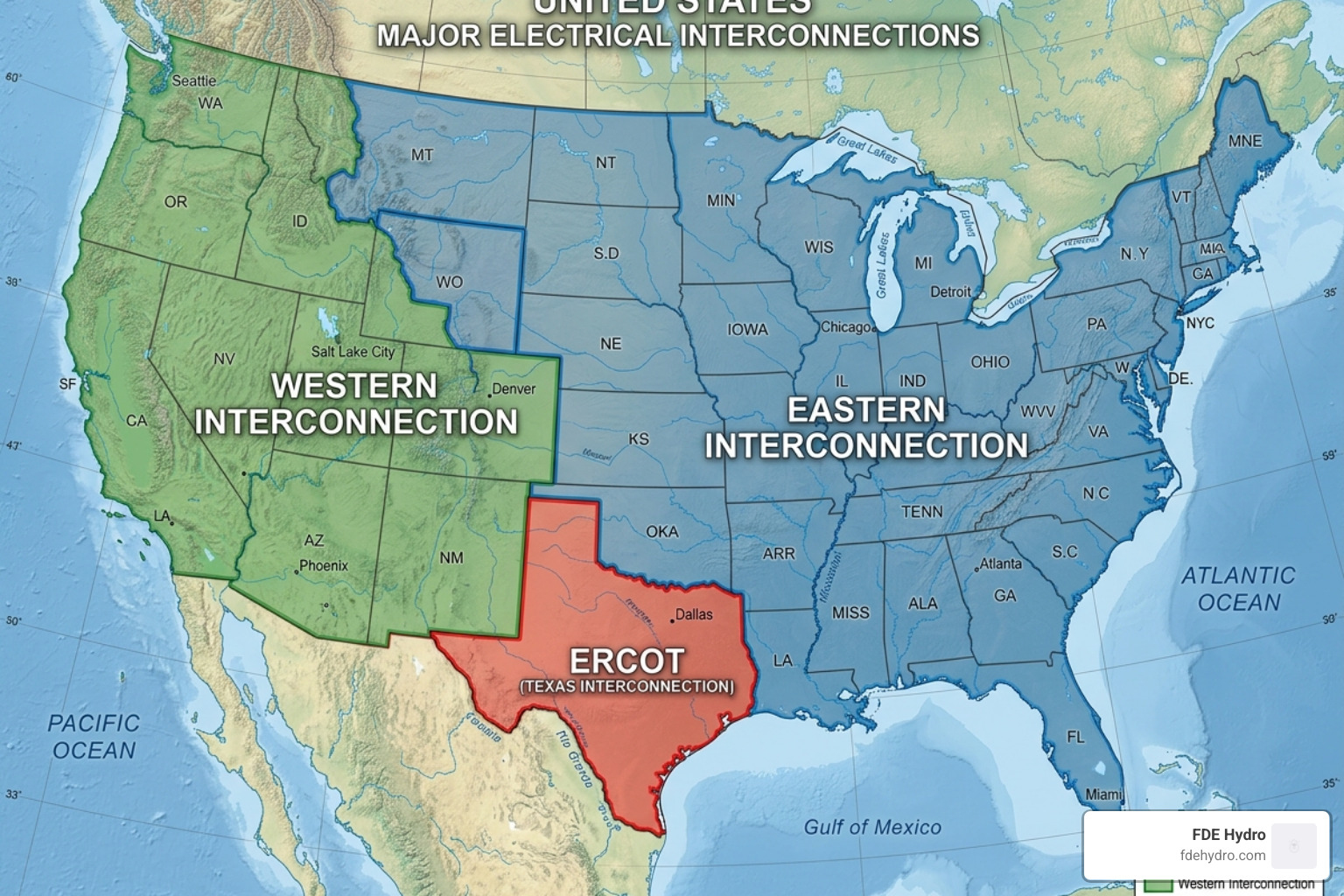
When we talk about the American power system, we aren’t talking about one single, giant web. Instead, the U.S. grid is divided into three major “interconnections.” These are essentially massive, independent islands of electricity that operate in sync within their own borders.
- The Eastern Interconnection: This is the heavyweight champion of the group. It covers everything east of the Rocky Mountains, stretching from the foot of the Rockies all the way to the Atlantic coast (excluding most of Texas).
- The Western Interconnection: This spans from the Pacific Ocean to the edge of the Rockies. It’s a truly international electrical grid example, linking parts of Western Canada and even a small slice of Mexico to the Western U.S.
- The Texas Interconnection (ERCOT): Texas famously likes to do things its own way, and its power grid is no exception. Most of the state operates on its own self-contained system.
To keep these massive machines running without a hitch, the North American Electric Reliability Corporation (NERC) steps in. NERC is a non-profit regulatory authority that oversees six regional reliability entities. Their job is to reduce risks to grid security and ensure that whether you are in New York City or a small town in Kansas, the lights stay on. You can find more technical details on these regions in The Electric Power Grid: Text-Only Version.
Understanding the Texas Electrical Grid Example (ERCOT)
The Electric Reliability Council of Texas (ERCOT) is a fascinating electrical grid example because of its isolation. By keeping its grid mostly within state lines, Texas avoids much of the federal jurisdiction from FERC (the Federal Energy Regulatory Commission).
ERCOT manages roughly 90% of the Texas electric load. It operates what we call a “nodal market,” which features over 9,000 different settlement points. This allows for incredibly precise pricing based on exactly where power is being generated and consumed. One unique feature of the Texas grid is its “energy-only” market design. Instead of paying power plants just to exist (capacity payments), it relies on “scarcity pricing.” When demand gets dangerously high, prices can skyrocket to $5,000 per MWh, which is meant to encourage more generation to come online. You can dive deeper into this unique setup at ERCOT and the Texas Electrical Grid: How the Lone Star Grid Operates.
A Global Electrical Grid Example: The European ENTSO-E
Across the pond, we find another massive electrical grid example: the Synchronous Grid of Continental Europe, managed by ENTSO-E. This is an engineering marvel that keeps dozens of countries perfectly synchronized at a frequency of 50 Hz.
With a staggering 667 GW of generation capacity, it facilitates massive cross-border energy trading. This interconnectedness allows a wind farm in the North Sea to help power a home in the Alps. The European Commission works hard to ensure these grids stay integrated to meet climate goals, as detailed in their overview of European grids.
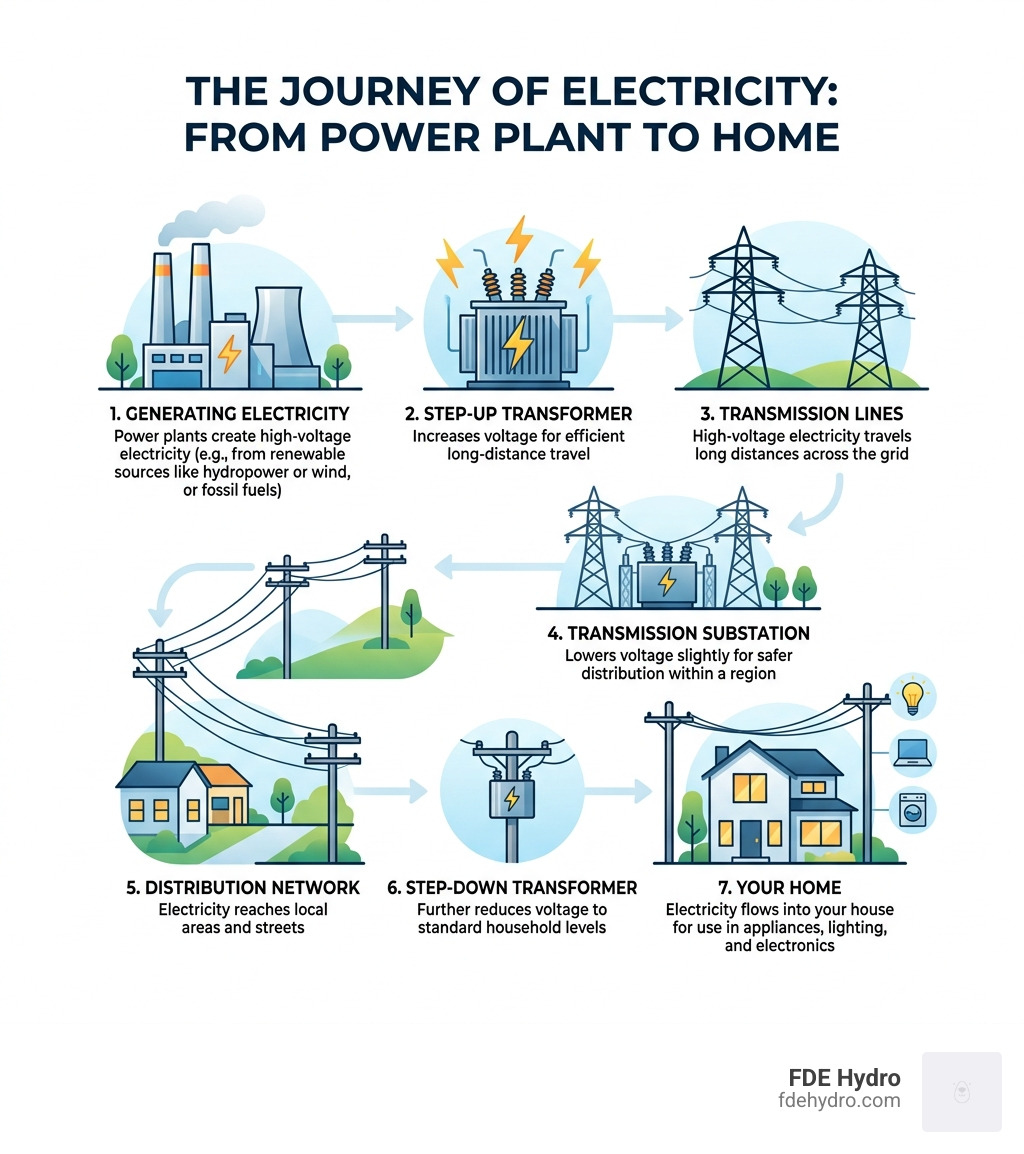
From Power Plant to Plug: The Journey of an Electron
Have you ever wondered how a spinning turbine at a dam becomes the energy that charges your phone? It’s a journey of several stages, each requiring specific infrastructure.
- Generation: This is where it starts. Whether it’s a nuclear plant, a wind farm, or one of our modular hydropower installations, energy is converted into electricity.
- Step-up Transformers: Generators usually produce electricity at lower voltages. To send it long distances, we use transformers to “step up” the voltage to hundreds of thousands of volts.
- Transmission Lines: These are the tall steel towers you see along highways. They carry high-voltage power over long distances with minimal loss.
- Subtransmission and Distribution: Once the power nears a city like Lawrence or New York, it enters a substation. Here, it’s stepped down to lower voltages for “primary distribution” along street lines, and finally “secondary distribution” (the 120V or 240V in your walls).
For a practical look at how this connects to your own property, check out our guide on how-to-power-start-your-home-connecting-to-the-grid. You can also find a great visual breakdown from the Union of Concerned Scientists.
Why High-Voltage AC Dominates the Electrical Grid Example
Why do we use such high voltages? It all comes down to physics. When you transmit electricity, some energy is lost as heat due to the resistance of the wires. By upping the voltage, we can lower the current. Since energy loss is proportional to the square of the current, doubling the voltage doesn’t just halve the loss—it cuts it by a factor of four!
This was the heart of the “War of Currents” in the late 1800s. Thomas Edison championed Direct Current (DC), but Nikola Tesla and George Westinghouse proved that Alternating Current (AC) was superior for the grid because AC can be easily stepped up or down using transformers. Without transformers, we couldn’t have a modern electrical grid example that serves millions of people from distant power sources.
Radial vs. Network Distribution Systems
Not all local grids are built the same. Depending on where you live, your electricity might arrive via a “radial” or “network” system.
| Feature | Radial System | Network System |
|---|---|---|
| Structure | Like branches on a tree | Like a spiderweb |
| Redundancy | Low (Single path) | High (Multiple paths) |
| Typical Use | Rural areas / Small towns | Dense cities (NYC, California) |
| Reliability | If the branch breaks, power goes out | If one line fails, power reroutes |
Balancing the Load: How Authorities Prevent Grid Failure
Electricity is a “just-in-time” product. Because we can’t yet store vast amounts of it cheaply, supply must match demand perfectly every second of the day. If people in California all turn on their AC at once, a power plant somewhere else must ramp up its output instantly.
This balancing act is managed by Balancing Authorities. A prime electrical grid example is PJM Interconnection. They act like the “air traffic controllers” of the grid, monitoring 88,000 miles of transmission lines and 183,000 MW of generating capacity. They use sophisticated computer models to forecast demand and dispatch the lowest-cost power plants first. You can read more about their balancing act in the PJM Power in Balance Fact Sheet.
Common Failure Scenarios and Mitigation
Despite our best efforts, things can go wrong.
- Brownouts: A intentional drop in voltage to prevent a full crash. Your lights might dim, but the system stays alive.
- Blackouts: A total loss of power. These can be localized or “cascading,” where one failure triggers a domino effect across the grid.
- Load Shedding: When demand exceeds supply, authorities may purposefully cut power to certain areas to save the rest of the grid.
In the absolute worst-case scenario, we use a black start procedure. This involves using small, self-starting generators (like some hydro plants) to “wake up” the larger power plants and restart the entire system from scratch.
Modernizing the Network: Smart Grids and Renewable Integration
The grid we have today was designed for big, steady power plants like coal and nuclear. But the future is about “distributed” and “intermittent” energy—like wind and solar. This is where Smart Grids come in.
A smart grid uses digital technology and two-way communication to adjust to changes in real-time. For example, a smart meter can tell your dishwasher to wait until 2:00 AM to run when electricity is cheapest and wind power is plentiful.
At FDE Hydro, we believe hydropower is the “guardian of the grid” in this new era. Unlike wind or solar, hydro is “dispatchable”—we can turn it on or off as needed to balance out the fluctuations of other renewables. Our modular precast concrete technology makes it faster and more affordable to build these stabilizing forces in North America, Brazil, and Europe. Learn more about why hydropower is the guardian of the grid.
The Rise of the Microgrid Example
One of the most exciting trends is the move toward the microgrid. A microgrid is a localized group of electricity sources and loads that normally operates connected to the traditional grid but can “island” itself and operate autonomously during an emergency.
If a storm knocks out the main grid in a city like Lawrence, a microgrid powered by local solar and hydro could keep the hospital and grocery stores running. This adds a massive layer of resilience to our infrastructure. If you’re curious about the technical side, we have a deep dive on what is a microgrid.
Frequently Asked Questions about Electrical Grid Examples
What are the three major interconnections in the United States?
The U.S. grid is split into the Eastern Interconnection, the Western Interconnection, and the Texas Interconnection (ERCOT). While they are linked by a few small ties, they mostly operate as independent electrical islands.
Why is electricity transmitted at such high voltages?
Transmitting at high voltage (up to 765,000 volts!) reduces the amount of energy lost as heat. It allows us to move massive amounts of power from distant generation sites to populated cities with very little waste.
What is the difference between a blackout and a brownout?
A blackout is a complete loss of power. A brownout is a partial drop in voltage—your electronics might act strangely and your lights will dim, but you still have some electricity. Brownouts are often used by utilities to reduce load during an emergency.
Conclusion
The grid is evolving. What started as a few thousand isolated “electric islands” over a century ago has become a continent-spanning machine that is now shifting toward a cleaner, smarter future. From the massive synchronous networks of Europe to the independent spirit of the Texas ERCOT system, every electrical grid example shows us that reliability requires constant innovation.
As we move toward decarbonization, the challenge will be maintaining that reliability while integrating more renewable sources. At FDE Hydro, we are proud to be part of that solution, providing the modular infrastructure needed to make hydropower a cornerstone of the modern grid. Whether it’s through smart meters, microgrids, or advanced “black start” capabilities, the goal remains the same: keeping the world powered, one electron at a time.
For more deep dives into how we keep the lights on, explore more power grid articles on our blog.
