

Understanding the Black Start Process: Your Grid’s Emergency Restart System
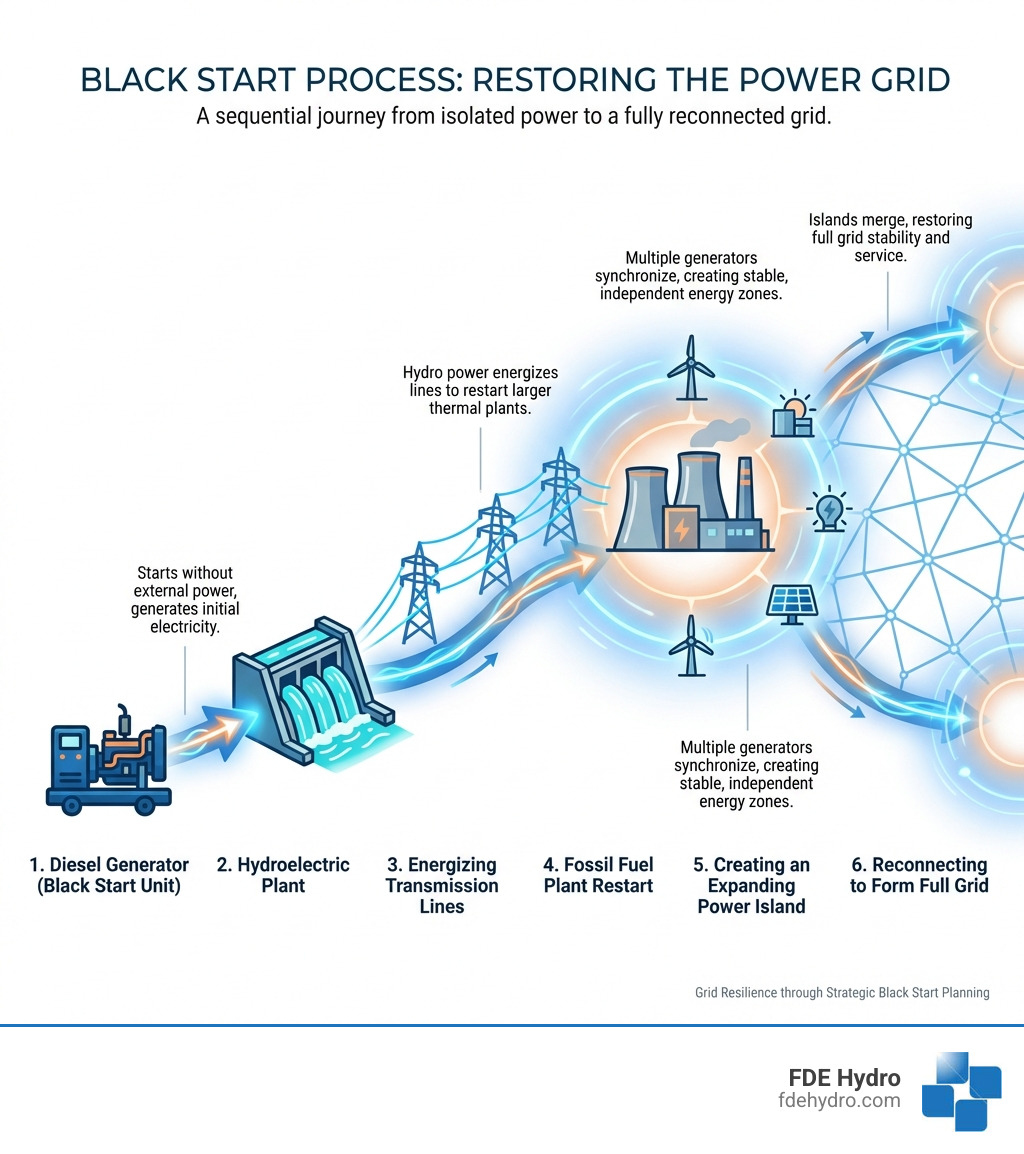
Black start is the process of restoring an electric power grid to operation without relying on external electrical power after a complete or partial shutdown. When a widespread blackout occurs, power plants need electricity to restart themselves—creating what engineers call the “power to make power” paradox. Black start-capable units solve this problem by using on-site power sources like batteries or diesel generators to restart independently, then systematically bringing other plants back online until the entire grid is restored.
How Black Start Works:
- Activation: A black start unit (BSU) uses on-site batteries or generators to restart without grid power
- Cranking Path: The BSU energizes transmission lines to reach larger power plants
- Power Islands: Multiple generators create stable “islands” of electricity
- Synchronization: Islands are carefully merged by matching frequency and phase
- Load Restoration: Customers are gradually reconnected to avoid overwhelming the system
On November 9, 1965, over 30 million people in the northeastern United States and parts of Ontario experienced one of history’s most widespread blackouts. A single misconfigured relay tripped a breaker on a key transmission line, cascading into a complete grid failure. Restoring power required a carefully choreographed black start procedure—a high-stakes process where one misstep could delay recovery by days or even weeks.
This isn’t just a technical curiosity. The 2021 Texas winter storms brought the ERCOT grid within minutes of a complete collapse that could have taken weeks to restore. Nine out of thirteen primary black start generators weren’t operating consistently during that crisis, exposing critical vulnerabilities in our energy infrastructure.
As Founder and CEO of FDE Hydro™, I’ve spent five decades in heavy civil construction and the past decade focused on next-generation hydropower solutions, including serving on the Department of Energy’s Hydro Power Vision Technology Task Force where black start capabilities were a key consideration. Understanding how black start systems work and evolve is essential for anyone involved in energy infrastructure development.
What is a Black Start and Why is it Crucial for Grid Restoration?
Imagine waking up to a world completely devoid of electricity. No lights, no internet, no running water, no heating or air conditioning, and eventually, no food as supply chains grind to a halt. This isn’t a scene from a dystopian movie; it’s the potential reality of a widespread, long-term power outage, or “blackout.” A black start is our grid’s ultimate insurance policy against such a catastrophe, the carefully planned process to bring an entire electrical system back from the brink.
A black start is the ability of generation to restart parts of the power system to recover from a blackout. It’s not merely about flipping a switch; it’s a complex, multi-stage operation. When a power grid collapses, power plants themselves often lose the electricity they need to operate their internal systems—pumps, fans, control systems, and even the excitation current needed to generate power. This “power to make power” paradox is why specialized black start units are so crucial.
The importance of black start capabilities cannot be overstated. Our modern civilization is fundamentally built upon the electrical grid. As one source states, “eight out of ten people would not survive a long-term loss of electricity.” Without electricity, critical infrastructure like hospitals, communication networks, and water treatment facilities would quickly go offline. The economic impact would be staggering, and public safety would be severely compromised.
Historical events underscore this criticality. The 1965 Northeast Blackout, which affected millions in the US and Canada, served as a stark reminder of our dependence on the grid and the need for robust restoration plans. More recently, the 2021 winter storms in Texas brought the ERCOT grid perilously close to a complete collapse. During that crisis, nine out of the thirteen primary black start generators were not operating consistently, highlighting vulnerabilities and the dire consequences if a full black start had been required.
The resilience of our Clean Energy Infrastructure relies heavily on effective black start strategies. Furthermore, the interdependencies between energy sectors, particularly electricity and natural gas, play a significant role. Many power plants rely on natural gas, and natural gas infrastructure often requires electricity to operate compressors and other equipment. This creates a challenging loop that must be carefully managed during a black start operation to ensure fuel supply to power plants. Robust black start capabilities are essential for maintaining the safe, reliable, and resilient operation of our electric power systems.

The Complete Black Start Process: From Darkness to Full Power
Bringing a power grid back to life after a total shutdown is one of the most high-stakes operations imaginable. It’s a carefully choreographed dance involving specialized equipment, highly trained personnel, and detailed procedures. This complex process unfolds in several critical stages, moving from complete darkness to the gradual restoration of power across vast regions.
At the heart of the challenge is the “station service power” paradox. Most large-scale power plants, whether coal, nuclear, or gas-fired, require a significant amount of electricity—up to 10% of their own generating capacity for steam turbines—just to run their internal systems. This includes everything from boiler feedwater pumps and combustion air blowers to cooling systems and control electronics. Without an external power source, these plants simply cannot start themselves. This is where the black start process begins.
A key component for any generator is the “excitation current,” which creates the magnetic field necessary to induce electricity. Without this initial current, the generator cannot produce power. Once a generator’s prime mover (like a turbine) is spun up, the excitation current allows it to begin producing voltage.
The entire system restoration process typically involves three phases:
- Stabilization: Assessing the extent of the outage, isolating faults, and preparing black start units.
- Critical Load Restoration: Energizing essential infrastructure, including additional power plants, and establishing stable “power islands.”
- Full Restoration: Gradually bringing more generation online, expanding the power islands, and finally reconnecting consumers in a controlled manner.
Our work in Energy Infrastructure Development Complete Guide emphasizes the importance of understanding these intricate steps to build a truly resilient grid.
The First Spark: Identifying and Activating Black Start Units (BSUs)
A black start unit (BSU) is a specially designated generating plant that can start up and operate without any external power from the grid. This means it must have its own on-site power source to get going. Traditionally, these have been smaller diesel generators or dedicated batteries that provide the initial “cranking power” to bring the main turbine or engine online.
In the United States, gas turbines represent the majority of NERC-registered black start units, accounting for 60% of the total. Hydropower units comprise another significant portion at 37%. These units are chosen for their ability to start quickly and often operate in an “islanded” mode, meaning they can produce power independently of the larger grid. For instance, ERCOT’s black start capabilities in Texas include 28 natural gas units at 13 sites, with some capable of being powered by oil if natural gas is unavailable.
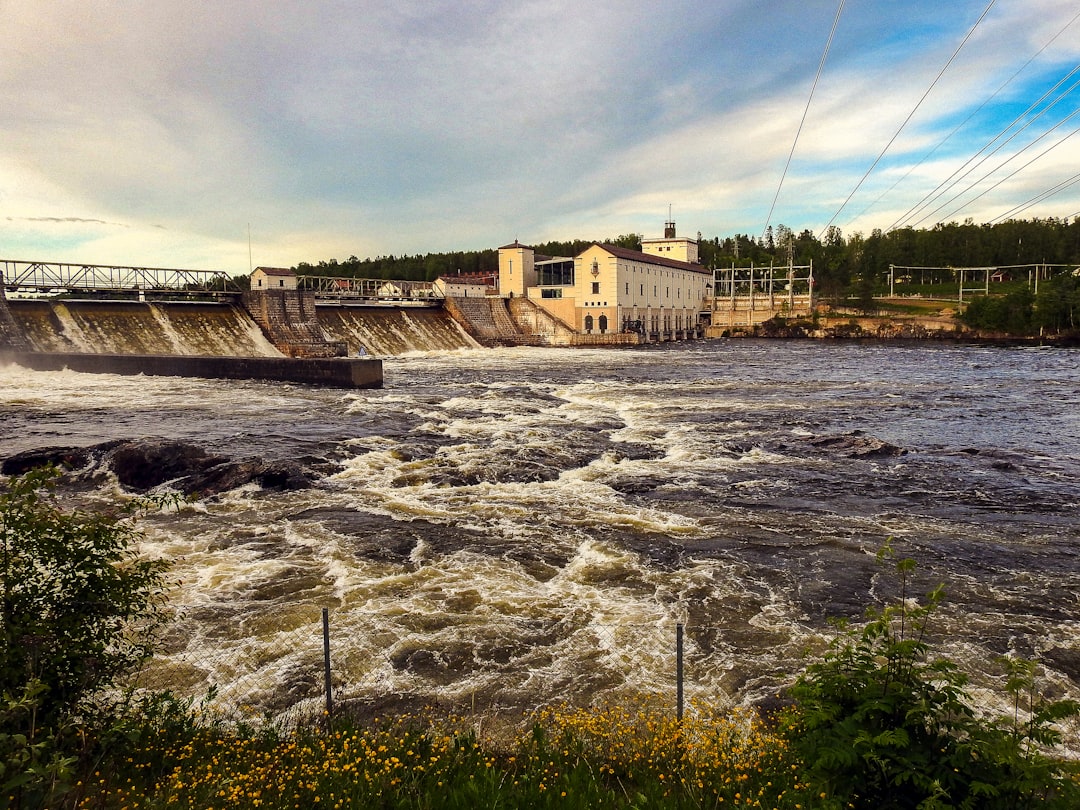
Our expertise in Hydroelectric Power Solutions Guide highlights why hydropower plants are often ideal for this role, requiring minimal initial power to start compared to thermal plants.
Building Power Islands: Cranking Paths and Synchronization
Once a BSU is online and generating power, the next challenge is to extend that power to other plants and sections of the grid. This is done by creating “cranking paths”—isolated transmission lines that are energized by the BSU. These paths are carefully selected to connect the BSU to “next-start units,” which are larger power plants that can then be brought online using the power supplied by the BSU.
The goal is to gradually build stable “power islands”—sections of the grid where generation and load are balanced. A critical step in this process is “synchronization.” Before any two power islands or a newly started generator can be connected to an existing grid, their electrical frequency and phase must be perfectly matched. Failing to do so would result in massive power surges, potentially causing severe damage to equipment and restarting the blackout. This meticulous matching ensures a smooth and stable reconnection.
Our advanced Water Control Systems play a vital role in ensuring the precise control and reliability needed for hydropower facilities to function effectively as BSUs and participate in forming these crucial power islands.
The Challenge of Cold Load Pickup
Even after power islands are established and synchronized, the restoration process isn’t over. One of the trickiest aspects is “cold load pickup.” When power is restored to a section of the grid, all the electrical devices that were previously off—refrigerators, HVAC systems, water heaters, and industrial machinery—will attempt to draw power simultaneously. This creates a massive, instantaneous surge in demand, which can be 8 to 10 times higher than normal operating load.
This sudden surge can easily overwhelm the newly restored, fragile grid, causing it to collapse again. To prevent this, grid operators must carefully manage the restoration of customers, bringing them back online in small, controlled blocks. This gradual approach allows the system to stabilize and prevent another widespread outage, ensuring that the hard-won black start doesn’t go to waste.
Powering the Revival: Generation Sources and New Technologies
The ability to perform a black start has traditionally relied on a specific set of power generation sources. However, as our energy landscape transforms, so too do the strategies and technologies employed for grid restoration. We are seeing exciting advancements in how we approach Sustainable Energy Production and Energy Resource Development that also improve our black start capabilities.
Traditional Powerhouses: Hydropower and Gas Turbines
Historically, two types of generation sources have been the workhorses of black start operations:
- Hydropower: Hydroelectric power plants are often considered the ideal black start units, and for good reason. They require very little initial power to start up—just enough for intake gates and hydraulic turbine adjustment. Once running, they can quickly inject large blocks of power into the grid, making them highly responsive and reliable for initiating the restoration process. For example, the Lake Lynn hydropower station in West Virginia (a US state) earns roughly $51,000 a year for its black start capabilities. This highlights their value, even though the same plant spends about $65,000 a year on regulatory compliance, showing the economic challenges involved. Our deep expertise in Hydropower and understanding 4 Reasons Why Hydropower is the Guardian of the Grid reinforces their critical role.
- Gas Turbines: These units are also excellent candidates for black start due to their quick start times and fuel flexibility. They can often be started with on-site diesel generators or batteries and can ramp up power relatively rapidly. In the United States, gas turbines constitute 60% of black start units registered with NERC. ERCOT, for instance, relies on 28 natural gas units across 13 sites, with 13 of these capable of running on oil if natural gas supplies are disrupted.
The New Wave: A Modern Black Start with Renewables and Batteries
The rise of renewable energy and the drive for a decarbonized grid are ushering in a paradigm shift in black start strategies. While traditional wind and solar farms were not inherently designed for black start due to their intermittent nature and reliance on the grid for synchronization, new technologies are changing the game.
The key lies in Inverter-Based Resources (IBRs) operating in a “grid-forming” mode. Unlike traditional grid-following inverters that need an existing grid signal to operate, grid-forming inverters can create their own stable AC voltage and frequency, essentially acting as a mini-grid unto themselves. This capability is crucial for black start, as it allows them to provide the initial “spark” without external power. NREL’s research on IBR-driven black start is at the forefront of this change.
Pioneering examples demonstrate this exciting potential:
- In 2020, ScottishPower Renewables achieved the world’s first black start using an onshore wind farm in Europe. This groundbreaking feat, detailed by The Scotsman, showcased how advanced wind turbine technology can contribute to grid restoration.
- Also in 2020, the Imperial Irrigation District (IID) in California made history as the first in the United States to use a 33MW/20MWh lithium-ion battery to start a 44 MW combined cycle natural gas turbine. This demonstration, hailed as a “major accomplishment in the energy industry” by Energy-Storage.news, proved the viability of battery energy storage systems (BESS) for this critical service.
These advancements highlight the growing role of Microgrids and energy storage systems. Microgrids, which can operate independently from the main grid, offer local reliability and can be used to start a system from the bottom up during widespread disruptions. Battery energy storage systems, with their rapid response and ability to provide stable voltage and frequency, are becoming invaluable for both initiating black start and stabilizing the nascent grid.
Governance, Economics, and Future-Proofing the Grid
Ensuring a robust black start capability for our power grids involves more than just technical prowess; it requires a sophisticated framework of regulations, economic incentives, and forward-thinking policy and planning. As we integrate more renewable energy and face new challenges like climate change, the governance and economics of black start are evolving rapidly. Furthermore, the intelligent application of solutions like AI Energy Management will be crucial in optimizing these complex processes.
Rules of the Road: Standards and Regulations
In the United States, the North American Electric Reliability Corporation (NERC) sets mandatory reliability standards that govern black start resources. Key standards like EOP-005-3 (System Restoration from Blackout), EOP-006-3 (System Restoration Coordination), and EOP-007-0 (Blackstart Resource Capability) ensure that grid operators and generation owners have comprehensive plans and capabilities in place. The Federal Energy Regulatory Commission (FERC) provides oversight.
Regional Transmission Organizations (RTOs) and Independent System Operators (ISOs) across the US translate these standards into specific operational requirements, which can vary significantly. These requirements often dictate parameters like the maximum allowable starting time for a black start unit and the minimum fuel inventory it must maintain.
Here’s a comparison of some RTO/ISO requirements in the US:
| RTO/ISO | Starting Time Requirement | Fuel Inventory Requirement |
|---|---|---|
| PJM | 3 to 4 hours | >16 hours |
| CAISO | 10 minutes | >12 hours |
| ERCOT | 6 hours | 72 hours preferred |
| ISO NE | Not specified | >2 hours (hydro), >12 hours (others) |
| MISO | 1 hour | 8-96 hours |
These varying standards reflect the diverse operational needs and resource mixes of different regions.
The Economics of Black Start: Costs, Compensation, and Market Models
Providing and maintaining black start capabilities is not cheap, and the economic considerations are a critical part of ensuring grid resilience. The ability to perform a black start requires complex technology and is economically costly.
Procurement models for black start services vary. Historically, in vertically integrated utilities, costs were simply rolled into tariffs. In deregulated markets, various models have emerged:
- Cost-of-service: Generators are reimbursed for their actual costs.
- Flat-rate payments: Fixed payments are made for the service.
- Competitive bidding: Generators bid into a market (like ERCOT’s Request for Proposal process) to provide the service, with selection based on factors like proximity, speed, and cost.
The annual costs can be substantial. For example, in Germany, the costs associated with black start capability amounted to 7.4 million euros in 2018. However, compensation for providing these services doesn’t always cover the full expense. The Lake Lynn hydropower station, as mentioned earlier, earned roughly $51,000 a year for its black start capabilities but spent about $65,000 a year on regulatory compliance. This disparity highlights a challenge where current monetary compensation mechanisms might not be adequate to recover all actual costs, potentially disincentivizing participation.
These services are often procured through ancillary service markets, where grid operators contract with generators to provide essential reliability services beyond just producing energy. A PNNL report on blackstart trends and challenges offers deeper insights into these evolving economic landscapes.
Future Challenges: Climate Change and Grid Modernization
The future of black start is deeply intertwined with two major trends: climate change and grid modernization. These present both significant challenges and opportunities.
- Climate Impacts: Climate change is increasing the frequency and intensity of extreme weather events, which are major drivers of widespread outages. Droughts, for example, severely impact hydropower’s ability to provide black start services. US hydropower generation declined by 14% in 2021 compared to 2020 due to drought, and California’s Edward Hyatt Power Plant shut down due to low water levels for the first time since 1967. Such events threaten a key traditional black start resource.
- Retirement of Conventional Plants: The ongoing retirement of older coal and nuclear power plants, while beneficial for decarbonization, reduces the number of traditional, synchronously connected black start units available. This necessitates finding new solutions.
- Integrating Variable Renewables: The increasing penetration of variable renewable energy (VRE) sources like solar and wind, while crucial for our clean energy future, poses challenges for black start. Their inherent unpredictability means they traditionally struggle to provide the stable voltage and frequency needed for grid restoration without advanced controls like grid-forming inverters and battery storage.
- Cybersecurity Threats: As grids become more digitized and interconnected, black start systems themselves become potential targets for cyberattacks. Robust cybersecurity measures are essential to protect these critical restoration capabilities.
- Interdependencies: The intricate links between electricity and other critical infrastructures, especially natural gas, are a growing concern. The Black Start Gas Coordination Group (BSGCG) in ERCOT, for example, works to ensure that natural gas facilities critical for supplying fuel to black start resources receive electricity during a blackout.
Policy and planning considerations for state energy offices, including those in New York, California, and Kansas, are crucial. These offices need to build and strengthen relationships with utilities and regional reliability organizations, include the impact of climate change on black start units in their State Energy Plans, and assess the resilience of these units, considering factors like fuel supply, weatherization, and cybersecurity. Understanding these challenges is key to realizing the Future of Hydropower and other energy resources.
Frequently Asked Questions about Black Start
We understand that black start is a complex topic, so let’s address some common questions:
How long does a black start take?
The duration of a black start operation can vary dramatically, ranging from hours to multiple days or even weeks, depending on the scale and nature of the outage, the complexity of the grid, and the availability of black start resources. For instance, the 1965 Northeast Blackout saw power restored to over 30 million people within 13 hours, but ERCOT’s 2021 experience showed that a full black start of their system could take “multiple days to weeks” to restore power to the entire region. It’s a meticulous, step-by-step process that cannot be rushed.
Can solar or wind farms perform a black start?
Traditionally, solar and wind farms were not considered ideal for black start because they require an existing grid signal to synchronize and operate, and their output can be intermittent. However, this is rapidly changing with new technology. As we discussed, grid-forming inverters and integrated battery energy storage systems are enabling these renewable resources to actively participate in black start. The ScottishPower wind farm in Europe’s 2020 achievement is a prime example, demonstrating that with the right technology, renewables can indeed perform a black start. Research and development in this area, including at institutions like NREL, are continuously expanding these capabilities.
What is the difference between a blackout and a black start?
A blackout is the event itself—a widespread loss of electrical power across a region or an entire grid. It’s the problem. A black start, on the other hand, is the solution. It is the specific, planned process of restoring the electric power system from that total shutdown, bringing generation units back online without external power and gradually rebuilding the grid. Essentially, a blackout is when the lights go out, and a black start is how we turn them back on.
Conclusion: Building a More Resilient Grid
The black start process is more than just a technical maneuver; it’s the ultimate insurance policy for our modern, electrified world. It represents our grid’s ability to recover from the most severe disruptions, ensuring that the essential services and comforts we rely on can be restored.
We’ve seen how black start has evolved from relying primarily on traditional hydropower and gas turbines to embracing innovative solutions like inverter-based resources, battery energy storage, and microgrids. This evolution is critical as we steer the challenges of climate change, grid modernization, and the increasing integration of renewable energy sources.
At FDE Hydro™, we are deeply committed to contributing to a more resilient and reliable grid. Our work in developing advanced Hydropower Advancements Innovations 2025 provides solutions that improve the very resources often best suited for black start capabilities. By leveraging cutting-edge modular technology for hydropower infrastructure in regions like North America (including the US and Canada) and Brazil, we help ensure that these vital resources are not only sustainable but also robust contributors to grid stability and restoration.
Understanding and continually improving black start capabilities requires robust planning, strategic investment, and a commitment to technological innovation. As we build the grids of tomorrow, the ability to bring them back to life, no matter the challenge, remains paramount. Learn more about the future of hydropower and how we’re working to secure our energy future.
