

Why Efficient Project Management is Critical for Infrastructure Success
Efficient project management is the structured approach to planning, executing, and controlling projects to meet goals within optimal time, cost, and quality parameters. For organizations managing large-scale infrastructure projects, especially in hydropower and civil construction, efficient project management is the difference between profitability and financial disaster.
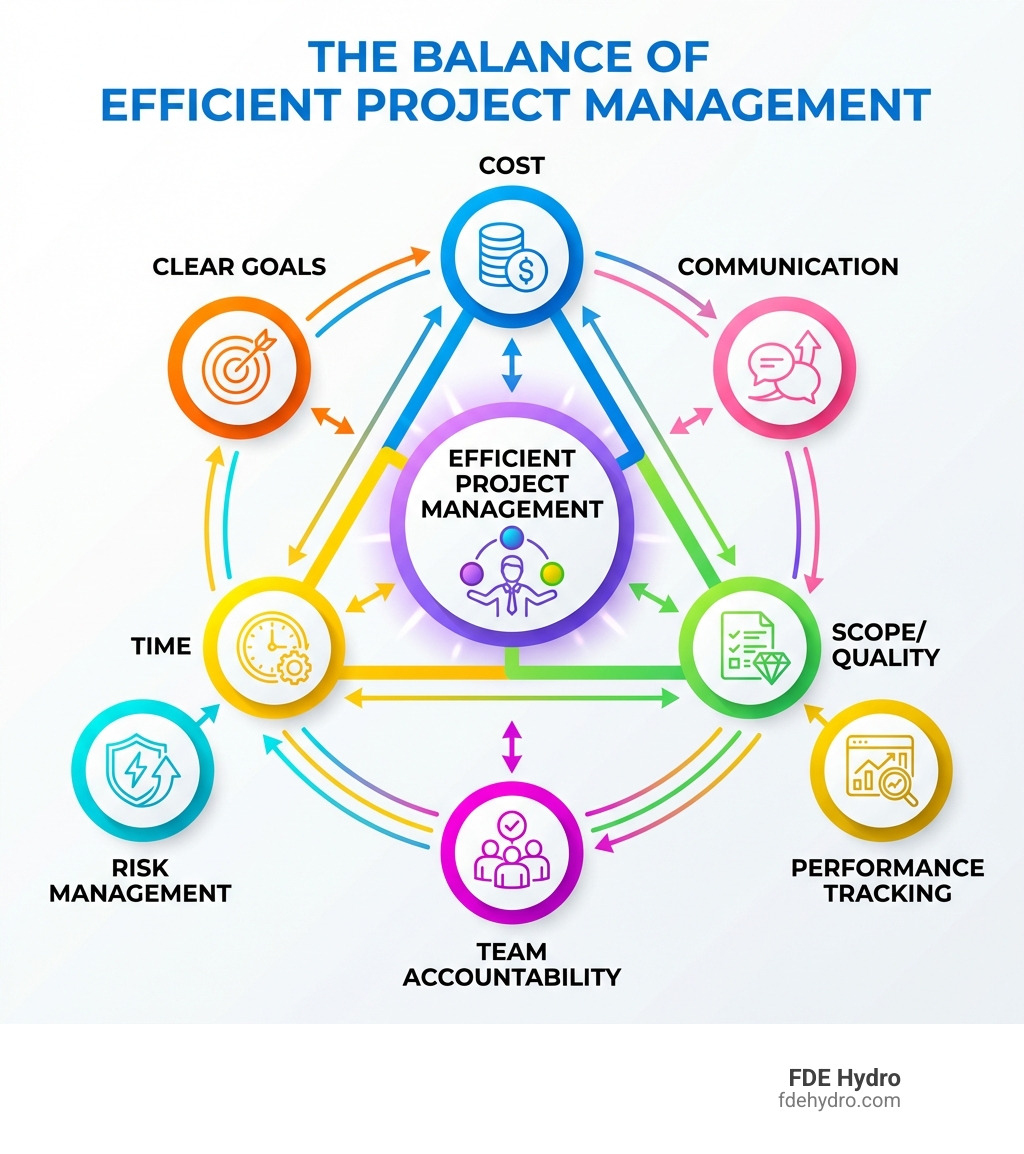
Quick Answer: Key Components of Efficient Project Management
- Clear project lifecycle – Structured phases from initiation through closing
- Defined roles and accountability – Everyone knows their responsibilities
- Robust communication – Transparent information flow among all stakeholders
- Risk management – Proactive identification and mitigation strategies
- Performance tracking – Real-time monitoring against budget and schedule
- Change control – Formal processes to prevent scope creep
- Modern tools – Digital platforms for planning, scheduling, and collaboration
The stakes couldn’t be higher. Research shows that just 2.5% of companies successfully complete 100% of their projects, and one in six IT-related projects exceeds budget by 200% and schedule by 70%. For large-scale infrastructure work—where budgets run into millions and construction windows are limited—these failures can be catastrophic.
The problem isn’t a lack of effort. Most project teams work hard. The issue is how that work is organized. As one industry expert put it: “Operations keeps the lights on, strategy provides a light at the end of the tunnel, but project management is the train engine that moves the organization forward.”
Without efficient project management, even the most innovative construction technologies and well-intentioned teams face unnecessary delays, cost overruns, and stakeholder conflicts. Projects drown in miscommunication, unclear responsibilities, and reactive firefighting instead of proactive planning.
But when organizations invest in proven project management principles—establishing clear processes, empowering skilled project managers, and leveraging modern tools—the results speak for themselves. High-performing companies that complete at least 80% of projects on time and on budget share common traits: they prioritize project management training, implement formal knowledge-sharing systems, and use integrated digital platforms for visibility and control.
For infrastructure projects involving modular construction, hydropower facilities, or large civil works, efficient project management isn’t just a nice-to-have. It’s the foundation that makes innovative delivery methods possible. It’s how you transform complex engineering challenges into predictable, profitable outcomes.
I’m Bill French Sr., Founder and CEO of FDE Hydro™, with over five decades of experience leading large-scale civil construction and infrastructure projects. Throughout my career managing projects exceeding $200M in value, I’ve learned that efficient project management is the secret sauce that turns ambitious visions into operational reality. Let me share the proven strategies and practical techniques that separate successful projects from costly failures.
Glossary for Efficient project management:
The Core Pillars of Efficient Project Management
At its heart, efficient project management is about waste minimization and maximizing output. Think of it like decluttering a massive construction warehouse: when everything has a place and every movement is intentional, the entire operation speeds up. In our world of hydropower, this means ensuring that every cubic yard of concrete and every hour of labor contributes directly to the final goal.
A landmark study from PricewaterhouseCoopers examining over 10,000 projects found that only a tiny fraction of companies hit the 100% success mark. Why? Often, it’s because they lack a standardized framework. On the flip side, PMI’s 2018 Pulse of the Profession report highlights that high-performing organizations—those that meet original goals and business intent—invest heavily in project management tools and personnel. This investment is the primary driver for Project Cost Reduction, allowing us to deliver complex dams and water control systems without the “budget bloat” that plagues traditional construction.
Mastering the Lifecycle for Efficient Project Management
We don’t just “start building.” We follow a rigorous lifecycle that ensures every stage is optimized. This lifecycle typically involves:
- Initiation: Defining the project’s feasibility and business value.
- Planning: Developing a roadmap, including timelines and resource allocation.
- Execution: The “boots on the ground” phase where the work happens.
- Monitoring and Controlling: Tracking progress and making real-time adjustments.
- Closing: Finalizing deliverables and conducting a post-mortem to learn for the next one.
By standardizing these Means and Methods, we eliminate the guesswork. For instance, in our modular precast projects, the “Execution” phase is significantly shorter because the “Planning” and “Initiation” phases were handled with surgical precision.
Nine Elements to Success
To achieve efficient project management, we lean on the “Nine Elements to Success” framework. This isn’t just theory; it’s a checklist for survival in high-stakes engineering. According to the PMI guide on the nine elements to success, these include:
- Defined Life Cycle and Milestones: Knowing exactly where we are in the journey.
- Stable Requirements and Scope: Resisting the urge to change the plan mid-stream.
- Quality Assurance: Building it right the first time to avoid costly rework.
- Planned Commitments: Ensuring budgets and schedules are based on reality, not “wishful thinking.”
When these elements are in place, the project moves like a well-oiled machine. When they are absent, you’re essentially trying to build a dam with a leaky bucket.
Empowering the Project Manager and Team
A project is only as strong as the person steering the ship. Today, the role of a project manager has evolved. It’s no longer just about checking boxes on a spreadsheet; it requires “power skills”—a blend of technical expertise and leadership. The 2023 Pulse of the Profession report notes that communication, problem-solving, and collaborative leadership are now the most sought-after traits in the industry.
We believe in continuous growth, which is why employee learning and development programs are vital. By upskilling our teams in both soft skills and the latest engineering tech, we ensure that our project managers can navigate the complexities of international regulations and innovative construction methods with ease.
Communication and Stakeholder Engagement
In my 50 years of experience, I’ve seen more projects fail due to bad communication than bad engineering. Transparency is our “secret sauce.” We foster an environment of soliciting and sharing feedback constantly.
Whether we are working in New York, Brazil, or Europe, clear communication channels ensure that stakeholders—from local government bodies to on-site engineers—are always on the same page. If a project manager spends 90% of their time communicating (as research suggests), that time must be high-quality, data-driven, and focused on removing roadblocks.
Building Accountability and Motivation
How do you keep a team motivated when they’re working in the mud on a remote site? You build a culture of accountability and recognition. Gallup research shows that motivated, engaged employees are 17% more productive.
We ensure accountability by:
- Providing individual feedback regularly.
- Defining clear roles (who is “Responsible” vs. who is “Accountable”).
- Mediating conflicts before they stall progress.
- Celebrating milestones—there’s nothing like a job well done to fuel the next phase.
Essential Tools and Techniques for High-Performance Projects
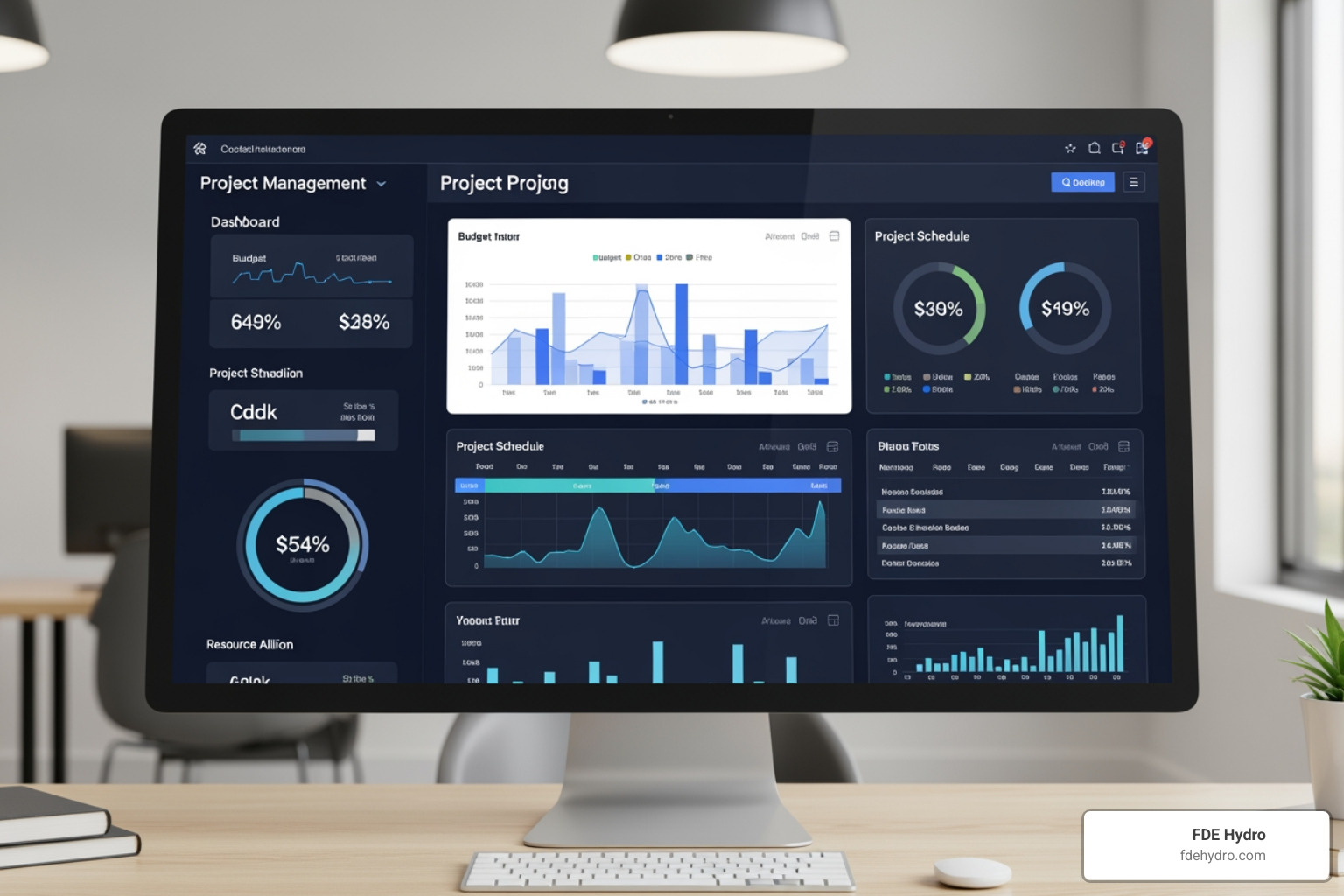
In the modern era, efficient project management is powered by a robust digital stack. We use these tools to visualize the invisible.
- Gantt Charts: For mapping out complex dependencies.
- Work Breakdown Structure (WBS): Breaking a massive dam project into bite-sized, manageable tasks.
- Kanban Boards: Visualizing the flow of work to prevent bottlenecks.
The right project management software acts as a single source of truth. When everyone can see the same dashboard, nothing slips through the cracks. We’ve even integrated AI-Driven Development to predict potential delays before they happen.
Leveraging Technology for Efficient Project Management
Automation is the friend of efficiency. By using AI for Resource Management, we can optimize how we deploy heavy machinery and specialized labor across multiple sites. Furthermore, Using Technology to Minimize the Duration of Impacts allows us to complete retrofits and repairs with minimal disruption to the local environment and power grid.
Advanced Scheduling and Estimation
We don’t guess; we calculate. Using techniques like PERT (Program Evaluation and Review Technique) and the Critical Path Method (CPM), we identify the exact sequence of events that determines the project’s end date. This is especially critical for the Rapid Installment of Module Precast Civil Infrastructure. When you’re installing a “French Dam,” the timing of the precast delivery and the crane schedule must be perfectly synchronized.
Navigating Risks and Preventing Scope Creep
Infrastructure projects are magnets for risk—geological surprises, weather delays, or regulatory shifts. We maintain a living Risk Register to track these threats and develop mitigation strategies long before we break ground.
One of the biggest silent killers of efficiency is “scope creep.” According to the PMI, scope creep affects up to 39% of projects. To combat this, we utilize a change control board process. Any change to the original plan must be vetted for its impact on time and budget. This discipline starts at the project planning stage, where we pin down requirements with stakeholders and get formal sign-offs.
Managing Financial Setbacks and Budgets
The reality is that only 34% of companies complete projects on budget. In the hydropower sector, where Hydropower Project Costs can be astronomical, we can’t afford to be in the other 66%. We manage budgets by setting realistic ROI expectations and using buffer times to account for the “unknown unknowns.”
Measuring Success and Continuous Improvement
How do we know we’re actually being efficient? We measure everything. We use Earned Value Management (EVM) to integrate schedule, cost, and scope metrics. This allows us to see, for example, if we’ve spent 50% of the budget but only completed 30% of the work—a clear signal that we need to course-correct.
| Metric | Purpose | Target |
|---|---|---|
| Schedule Variance (SV) | Tracks if the project is ahead or behind | $geq 0$ |
| Cost Performance Index (CPI) | Measures cost efficiency of work completed | $geq 1.0$ |
| Scope Creep Rate | % of new requirements added after kickoff | $< 5%$ |
| Stakeholder Satisfaction | Quality of feedback and approval speed | High |
After every project, we hold “post-mortem” meetings. We look at our Innovative Construction Techniques and ask: Did the modular blocks fit as expected? Could we have staged the equipment better? This continuous improvement loop is what keeps us at the forefront of the industry.
Frequently Asked Questions about Project Efficiency
What are the most common project management challenges?
The “big three” are budget overruns, poor communication, and unrealistic deadlines. A famous Harvard Business Review report found that IT and infrastructure projects are particularly prone to “black swan” events—massive overruns that can threaten the very existence of a company.
How do you prevent scope creep effectively?
The best defense is a good offense: early stakeholder engagement, documented and signed-off requirements, and a formal change request process. If it isn’t in the original scope document, it doesn’t happen without an approved budget and schedule adjustment.
Why is communication considered a “power skill”?
Because it is the glue that holds the project together. 68% of project managers rate it as the most critical factor for success. Effective communication removes roadblocks, aligns the team, and ensures that “bad news” travels up the chain fast enough to be addressed.
Conclusion
Efficient project management is more than just a set of tools; it’s a mindset of strategic growth and disciplined execution. As Joy Gumz said, project management is the “engine” that moves us forward. At FDE Hydro™, we’ve spent decades refining this engine to deliver hydropower solutions that are faster, cheaper, and more sustainable.
By embracing Modular Construction Techniques and the rigorous principles of efficient project management, we aren’t just building dams—we’re building a more efficient future for renewable energy. Whether you are in the United States, Canada, Brazil, or Europe, the secret sauce remains the same: plan with precision, lead with empathy, and measure with rigor.
Ready to see how efficiency can transform your next water control or hydropower project? Explore our innovative hydropower solutions and let’s build something extraordinary together.
