

Understanding the True Investment Behind Hydroelectric Projects
The cost of building hydroelectric dams varies dramatically depending on project type, location, and scale. Here’s what you need to know upfront:
Quick Cost Overview:
| Project Type | Typical Cost Range (per kW) | Notes |
|---|---|---|
| Large Hydropower Dams | $1,050 – $7,650 | Conventional reservoir projects |
| Small Hydropower | $1,300 – $8,000 | Higher per-kW costs due to scale |
| Retrofitting Existing Dams | $500 – $3,045 | Most cost-effective option |
| New Stream Development | $6,574 – $8,611 | Greenfield projects |
| Global Average (2022) | $2,881 | Rose 25% in one year |
A brisk building boom of hydropower mega-dams is underway from China to Brazil. But whether the benefits of new dams will outweigh their costs remains hotly debated.
The numbers tell a sobering story. Hydropower projects regularly run millions over budget and years beyond their original timelines. In 2016, hydro had the highest average construction cost per kilowatt of any generating technology in the U.S.—$5,312, more than double solar’s $2,434. By 2022, the global weighted average total installed cost jumped 25% to $2,881 per kilowatt.
Yet these upfront figures don’t capture the full picture. Hydropower plants operate for 50 to 100+ years—two to four times longer than solar or wind installations. Their capacity factors consistently outperform intermittent renewables, and they provide essential grid stability services that are often undervalued or not compensated at all.
Understanding what drives hydropower costs—and how to control them—is critical for anyone evaluating these projects. The site-specific nature of dam construction cannot be overstated. A plant on stable bedrock near existing grid connections faces entirely different economics than one requiring extensive tunneling in a remote watershed.
I’m Bill French Sr., founder and CEO of FDE Hydro™, and I’ve spent decades in heavy civil construction before developing innovative solutions to address the cost of building hydroelectric dams through modular precast technology. Our work across North America, Brazil, and Europe has shown that standardized, factory-produced components can dramatically reduce both construction timelines and capital expenditures.
Cost of building hydroelectric dams word list:
Breaking Down the Capital Cost of Building Hydroelectric Dams
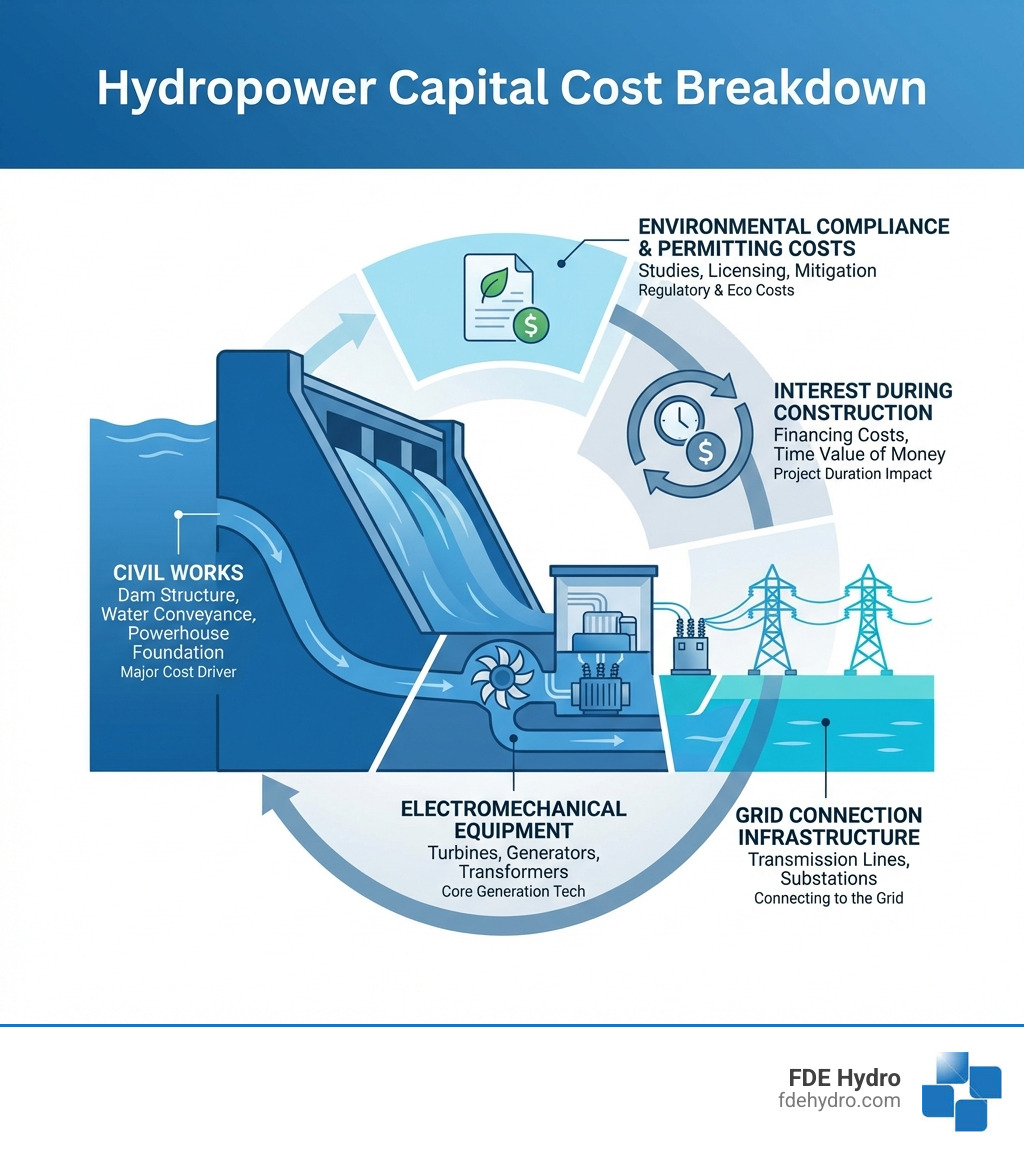
When we talk about the “price tag” of a dam, we are primarily discussing Capital Expenditure (CAPEX). This includes everything from the first shovel in the ground to the moment the turbines begin to spin. However, unlike a solar farm where costs are relatively predictable per panel, hydropower-project-costs are notoriously volatile.
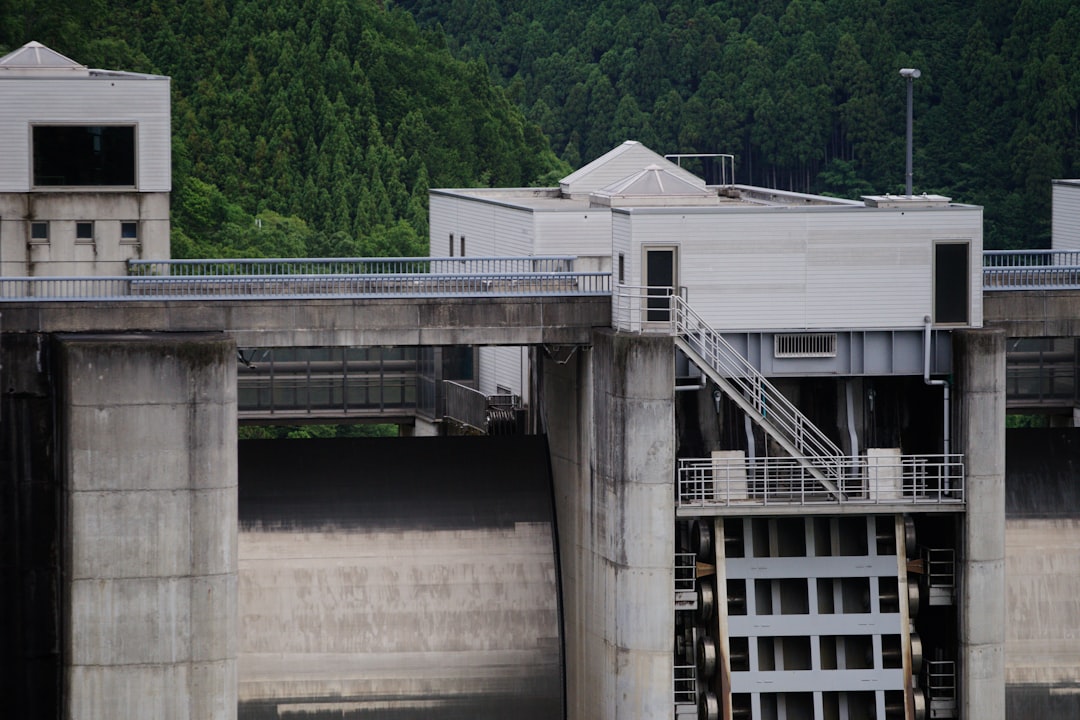
According to IRENA’s 2022 cost report, the global weighted average total installed cost for new hydropower projects reached $2,881/kW. This was a significant 25% jump from previous years, driven by supply chain disruptions and the increasing complexity of remaining viable sites. In the U.S., the U.S. Energy Information Administration data shows that hydropower often sits at the top of the construction cost pyramid, largely because you aren’t just buying equipment—you are reshaping the landscape.
Typical Investment Ranges for Different Project Types
Not all dams are created equal. The cost of building hydroelectric dams changes based on whether you are starting from scratch or utilizing existing infrastructure.
- Large Dams ($1,050 – $7,650/kW): These benefit from economies of scale but face massive civil engineering hurdles and environmental mitigation costs.
- Small Hydro ($1,300 – $8,000/kW): While the total check is smaller, the cost per kilowatt is often higher because the fixed costs of permitting and grid connection are spread over fewer units of power.
- Run-of-River: These typically avoid large reservoirs, potentially lowering land acquisition costs, though they remain vulnerable to seasonal flow variations.
One of the most exciting areas for cost reduction is the retrofitting of Non-Powered Dams (NPD). There are thousands of existing dams in the U.S. and Brazil that provide flood control or navigation but don’t produce a single watt of power. Retrofitting these is often the “low-hanging fruit” of the industry.
| Development Type | Traditional Cost (per kW) | FDE Hydro Modular Potential |
|---|---|---|
| New Stream-Reach (NSD) | $6,574 – $8,611 | N/A (Greenfield focus) |
| Non-Powered Dam (NPD) | $3,045 – $20,043 | Significant Reduction |
| Conduit/Canal | $3,955 (Avg) | Streamlined |
Estimating the Cost of Building Hydroelectric Dams by Capacity
If you were to ask us for an estimate on an 88 MW hydropower plant, the answer depends heavily on the “where” and “how.” Historically, a 120 MW facility built in the early 90s cost roughly $315 million—which translates to about $665 million in today’s dollars ($5,542/kW).
For an 88 MW project in a region like Canada, estimates range from $175 million to $440 million CAD depending on the terrain. However, as projects get smaller, the “unit price” goes up. A tiny 5 MW facility might cost $50 million ($10,000/kW). This is why we focus so heavily on project-cost-reduction strategies; without them, smaller, localized projects struggle to find financing.
Why Hydropower Projects Face Cost Overruns and Delays
If there is one thing the hydro industry is known for (besides clean energy), it’s the “budget blowout.” Research on cost overrun impacts suggests that large dams are systematically biased toward underestimating costs.
Historically, budgets often exclude inflation, debt servicing, and the true cost of environmental compliance. When a project is delayed by five years—which is common—the interest on the construction loans can become a larger line item than the concrete itself.
Site-Specific Variables and Hidden Expenses
The “hidden” cost of building hydroelectric dams usually hides underground. Geology is the great unknown; hitting a fault line or porous rock that requires extensive grouting can add millions to a budget overnight.
Furthermore, dam-construction-methods often rely on remote logistics. If you have to build a 50-mile road just to get your turbine to the site, your CAPEX will skyrocket. Then there is the “permitting paralysis.” In the U.S., the median duration for relicensing or original licensing is nearly six years. Every year spent in a boardroom instead of on the riverbank is a year of lost revenue and mounting overhead.
The Critical Role of Capital and WACC
Hydropower is a “front-loaded” investment. You pay almost everything upfront and get paid back over 80 years. This makes projects extremely sensitive to the Weighted Average Cost of Capital (WACC).
A mere 1% increase in WACC can raise the cost of the electricity generated by 7% to 14%. In developing markets like Brazil, where interest rates can be volatile, financing-long-term-hydropower-requires-mitigating-risks-prior-to-roi is the only way to make a project bankable. Investors need certainty, and traditional “stick-built” concrete dams offer very little of it.
Hydropower vs. Other Energy Sources: A Long-Term Value Analysis
It is easy to look at a solar farm’s $2,400/kW price tag and think hydropower is “too expensive.” But that is like comparing a car that lasts five years to a house that lasts a century.
Hydropower facilities often reach their 100th birthday while still using their original civil structures. When you look at the Levelized Cost of Electricity (LCOE), hydropower remains one of the cheapest sources of energy on the planet ($0.061/kWh global average in 2022).
Comparing the Cost of Building Hydroelectric Dams to Other Renewables
While wind and solar are excellent, they are intermittent. They don’t provide “inertia” or “black start” capabilities to the grid. Hydropower acts as a giant, natural battery. This is especially true for Pumped Storage Hydro (PSH), which currently accounts for 96% of utility-scale energy storage in the U.S.
When building-new-dams, we aren’t just looking at the cost per kilowatt-hour; we are looking at the value of being able to turn the power on exactly when the sun goes down or the wind stops blowing. Solar panels might occupy 13% of the land covered by a reservoir to produce the same energy, but they cannot provide the same grid stability.
Operations and Maintenance (O&M) Expenditures
Once the dam is built, the “fuel” (rain and snowmelt) is free. Typical hydroelectric-dam-construction leads to O&M costs that are only 1% to 2.5% of the initial CAPEX annually for large plants.
However, as plants age, hydropower asset management becomes vital. Refurbishing a turbine or upgrading a generator is significantly cheaper than building a new plant, often resulting in an LCOE as low as $0.01 to $0.05 per kWh. This is where the long-term ROI truly shines.
Reducing Construction Costs Through Technological Innovation
The traditional way of building dams—pouring massive amounts of wet concrete in situ—is slow, labor-intensive, and prone to weather delays. To reduce-construction-costs, the industry must move toward industrialization.
Modular Technology and Precast Solutions
At FDE Hydro™, we developed the “French Dam” system to solve the very problems we’ve discussed. By using modular-precast-dam-advantages-101, we can move the bulk of the construction work into a controlled factory environment.
- Standardization: Instead of a custom design for every foot of the dam, we use standardized modules that fit together like a high-tech puzzle.
- Timeline Acceleration: We can manufacture the dam components while the site is being prepared, cutting months or even years off the schedule.
- Reduced Labor: Fewer workers are needed on-site in hazardous conditions, which lowers insurance costs and site overhead.
This shift is why-precast-cost-less. When you reduce the “time at risk” on the river, you reduce the likelihood of a cost overrun. It changes the cost of building hydroelectric dams from an unpredictable gamble into a manageable infrastructure project.
Frequently Asked Questions about Hydropower Costs
What is the average cost per kilowatt for a new hydroelectric dam?
While it varies, the global average is approximately $2,881/kW. In the U.S., new “greenfield” projects often range between $5,000 and $10,000/kW, while retrofitting existing dams is much cheaper, often starting around $500 to $3,000/kW.
Why do hydropower projects frequently exceed their original budgets?
The primary drivers are “optimism bias” in early planning, unforeseen geological challenges, lengthy permitting processes that increase financing costs, and the sheer complexity of on-site civil engineering in remote or environmentally sensitive areas.
How does the cost of retrofitting an existing dam with FDE Hydro modular solutions compare to new construction?
Retrofitting is significantly more affordable because the primary “civil” cost—the dam itself—already exists. Using our modular precast technology further lowers costs by reducing on-site construction time and labor, often making a project viable that would otherwise be uneconomical.
Conclusion
The cost of building hydroelectric dams is undoubtedly high, but the price of ignoring our most reliable renewable resource is higher. As we move toward a carbon-free grid, the long-term value of hydropower—with its century-long lifespan and unmatched stability—is becoming more apparent to investors and policymakers alike.
By embracing innovation, from modular-dam-construction to smarter financing-long-term-hydropower-requires-mitigating-risks-prior-to-roi, we can overcome the historical hurdles of overruns and delays. At FDE Hydro™, we believe the future of hydro isn’t just about building bigger; it’s about building smarter.
If you are ready to explore how modular technology can de-risk your next project and provide a stable ROI for the next century, we invite you to look closer at our project-cost-reduction strategies. The water is flowing—it’s time we put it to work more efficiently.