

Why Construction Cost Reduction Matters for Large-Scale Infrastructure Projects
Construction cost reduction is the strategic process of minimizing project expenses without compromising quality, safety, or functionality. For large-scale water infrastructure and hydropower projects, effective cost reduction can mean the difference between a project that moves forward and one that stalls indefinitely.
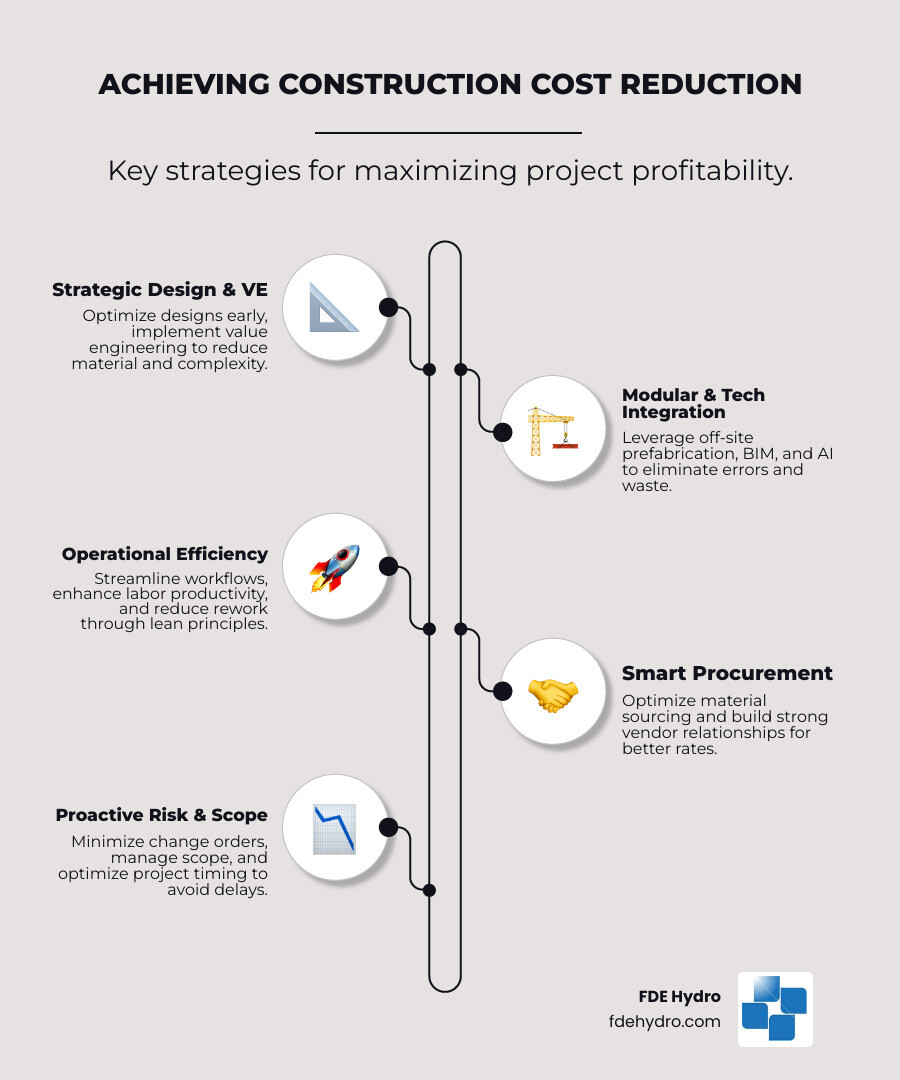
Key strategies for construction cost reduction include:
- Strategic Design & Value Engineering – Optimize designs early to reduce material usage and structural complexity
- Modular & Prefabricated Construction – Shift work off-site to controlled factory environments for 25-35% savings on industrial projects
- Technology Integration – Leverage BIM, AI, and project management software to eliminate errors and waste
- Operational Excellence – Streamline workflows, improve labor productivity, and reduce rework through lean principles
- Smart Procurement – Build strong vendor relationships and optimize material sourcing strategies
- Risk Mitigation – Identify potential delays early and maintain realistic budgets with 5-15% contingency allowances
- Timing Optimization – Schedule projects during off-peak seasons to secure better contractor rates
- Scope Management – Minimize change orders and scope creep through clear planning and stakeholder alignment
The construction industry faces unprecedented challenges. In Canada alone, residential building costs have increased 58% since 2020, while housing starts dropped 34% in major municipalities. Material inflation, labor shortages, and regulatory burdens continue to squeeze profit margins across all project types. For hydropower and water infrastructure projects specifically, these pressures are compounded by extended timelines, complex site conditions, and the scale of capital investment required.
Yet the data shows a clear path forward. Leading contractors applying lean principles have reduced completion times by up to 30% and cut addressable costs by up to 15%—boosting company-wide margins by 2-3 percentage points. Modular construction methods demonstrate even more dramatic results, with potential savings of 25-35% for industrial projects compared to traditional approaches.
The stakes are high. A delayed power plant can increase costs by 20%. A major office building delayed by disagreements can nearly double project costs. For hydropower facilities—where construction timelines stretch across years and budgets reach into the hundreds of millions—every percentage point of cost reduction translates into significant capital preservation and improved project viability.
I’m Bill French Sr., Founder and CEO of FDE Hydro™, and over five decades I’ve led construction projects ranging from Boston’s Logan Airport to the modular French Dam system, always focused on delivering construction cost reduction through innovation and operational excellence. This guide distills proven strategies from across the construction industry—from residential housing to massive infrastructure projects—with particular emphasis on approaches that work for large-scale water and hydropower facilities.
Learn more about construction cost reduction:
Identifying the Primary Drivers of Construction Expenses
To master construction cost reduction, we first have to look at where the money is actually going. In the current market, especially across North America and Europe, the financial landscape of a project is often dictated by factors beyond a simple “bricks and mortar” calculation.
Whether we are talking about a new home in Toronto or a massive water control structure in New York, the breakdown of expenses generally follows a predictable—if painful—pattern. In residential construction, building materials typically account for 25-30% of the total cost, while onsite labor takes another 20-25%. However, the “silent” drivers are often the most impactful. For instance, in Canada, a staggering 36% of the cost of a new home is attributable to the tax burden, including development fees and levies.
When we move into heavy civil and commercial sectors, site conditions and regulatory compliance become massive cost centers. Topography, soil quality, and local environmental regulations can inflate a budget by millions if not managed proactively. Understanding these drivers is the first step in Project Cost Reduction.
| Cost Category | Residential (%) | Commercial/Infrastructure (%) |
|---|---|---|
| Materials | 25-30% | 30-40% |
| Onsite Labor | 20-25% | 25-35% |
| Land/Lot Costs | 20-25% | 10-20% |
| Taxes/Regulatory | 36% (Canada) | 15-25% |
| Overhead/Financing | 8% | 10-15% |
Material inflation has been particularly brutal. Since 2020, residential building costs in Canada have spiked by 58%. This isn’t just about the price of lumber; it’s about the compounding effect of supply chain disruptions and global demand. For those of us in the hydropower sector, we see similar trends in steel and specialized concrete. This is why lower construction costs and taxes are the only path to maintaining a healthy, growing economy.
Analyzing the Impact of Project Timing
Timing isn’t just about the weather; it’s about the market. If we try to break ground when every other developer in California is doing the same, we’re going to pay a premium for labor and equipment.
Strategic timing involves scheduling projects to leverage off-peak seasons. In many regions, contractors are eager to lock in work for the autumn or winter months to keep their crews busy. By starting a project when demand is lower, we can often negotiate better rates and ensure higher availability of top-tier talent.
Furthermore, locking in material prices during market dips can lead to substantial savings. We’ve found that even a three-month shift in a project start date can result in a 5-10% difference in total labor costs. For more on how to time your efforts, check our guide on how to Reduce Construction Costs.
Understanding the Tax and Regulatory Burden
It’s no secret that red tape costs money. From New York City to Toronto, regulatory compliance is a major hurdle. In NYC, recent building code updates have been aimed at speeding up construction and cutting costs by simplifying approval processes. NYC Updates Building Code to Speed Construction is a great example of how policy can directly impact the bottom line.
However, the 36% tax burden we see in some Canadian markets is a sobering reminder that we must account for government fees early. This includes everything from permit costs to environmental impact assessments. For hydropower projects, these regulatory “soft costs” can be even higher due to the intense scrutiny on water resources and fish passage.
Strategic Design and Value Engineering for Savings
If we wait until we’re on the job site to start thinking about savings, we’ve already lost. True construction cost reduction begins at the architect’s desk. Design optimization is about finding the sweet spot where functionality, aesthetics, and cost-effectiveness meet.
One of the simplest ways to save is by reducing square footage or opting for simpler designs. Every corner we add to a building’s footprint adds cost in framing, foundation, and finishing. Choosing “stock” designs or standardized modules rather than custom, one-off designs can save thousands in engineering fees and material waste. This is what we call mastering the Means and Methods of modern construction.
Value Engineering as a Tool for Construction Cost Reduction
Value engineering (VE) is often misunderstood as just “cutting things out.” In reality, it’s a systematic method to improve the “value” of goods or services by using an examination of function. We look at a component and ask: “Can we achieve this same function at a lower cost without losing quality?”
For example, substituting a high-end finish for a durable, lower-cost alternative that looks nearly identical can save millions on a large project. In structural engineering, we might look at the “functional recovery” time after a seismic event. By designing for resilience, we might spend slightly more upfront but save exponentially on long-term repair costs. Research like Estimating the Costs and Performance of Enhanced Building Design shows that recovery-based design can lead to massive ROI.
In our world of dams and spillways, we often ask Why Precast Costs Less. The answer lies in the controlled environment of a factory, which eliminates the variables of weather and onsite labor inefficiencies.
Minimizing Change Orders and Scope Creep
Change orders are the “silent killers” of construction budgets. A client decides to add a bathroom or move a wall halfway through the job, and suddenly the schedule is blown, and the budget is in tatters.
To prevent this, we must have a “blueprint commitment.” This means spending more time in the planning phase to ensure every stakeholder has a crystal-clear vision of the finished project. Once the plans are signed, they should be set in stone unless a serious error is finded. By sticking to the plan, we avoid the hidden costs of rescheduling subcontractors and re-ordering materials. This is the core of Building Smarter: The Innovative Precast Concrete Way.
Leveraging Technology for Construction Cost Reduction
The construction site of 2025 looks very different than it did twenty years ago. We are in the midst of a digital change where AI-Driven Development and automation are no longer science fiction—they are essential tools for survival.
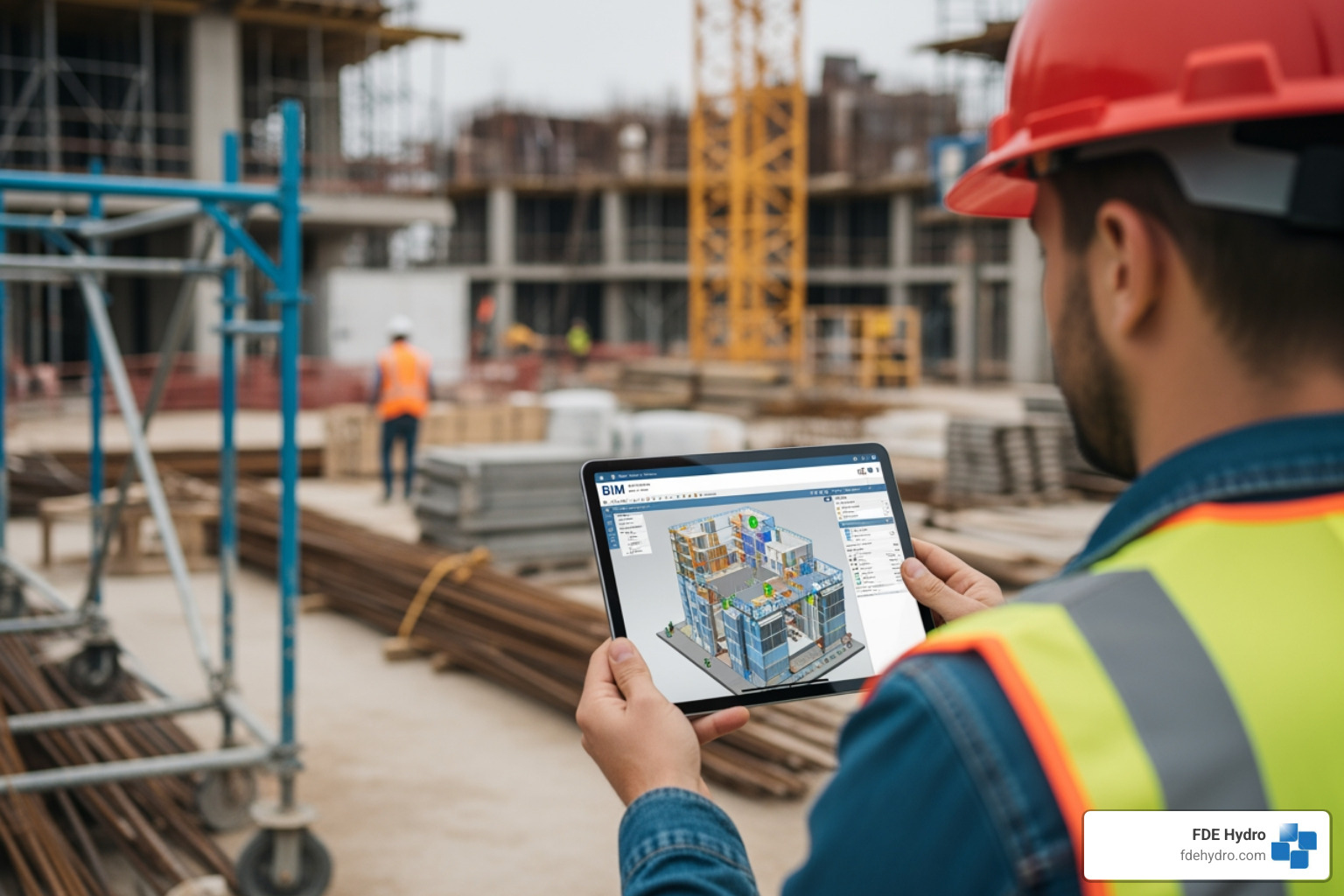
Technology allows us to see problems before they happen. By Analyzing cost impacts across the entire process of prefabricated building components, researchers have found that early-stage digital optimization has the highest coefficient of influence on the final price tag.
Implementing Modular Methods for Construction Cost Reduction
At FDE Hydro™, we’ve seen how modularity changes the game. Our patented “French Dam” technology uses Modular Precast Concrete to build hydroelectric dams and water control systems.
Instead of pouring concrete in a riverbed—a process that is messy, dangerous, and expensive—we manufacture the dam in sections at a factory. These modules are then shipped to the site and assembled. This Rapid Installment of Module Precast Civil Infrastructure can reduce construction time by months and cut costs by up to 30%. It’s about industrializing the process, much like the automotive industry did a century ago.
Utilizing BIM and AI for Resource Management
Building Information Modeling (BIM) is our best defense against “clash” errors. When the plumbing, electrical, and structural systems are all modeled in 3D before a single shovel hits the dirt, we can identify conflicts that would otherwise cost thousands to fix in the field.
AI is taking this a step further by optimizing how we use resources. From scheduling the most efficient delivery routes to predicting when a piece of equipment might fail, AI is the ultimate tool for efficiency. For a deeper dive, see how The Future of Foundations: How AI is Optimizing Infrastructure and AI for Resource Management are reshaping the industry.
Operational Excellence and Labor Productivity
You can have the best technology in the world, but if your crew isn’t working efficiently, you’re still going to overspend. Operational excellence is about the “Kaizen” philosophy—the idea of continuous, incremental improvement.
We believe in training our crews not just to do the job, but to understand the budget. When workers are motivated and understand how their efficiency impacts the project’s success, they become partners in construction cost reduction. This involves using Innovative Construction Techniques and maintaining a culture of accountability.
Streamlining Workflows with Value Stream Mapping
Value Stream Mapping (VSM) is a lean tool used to analyze the current state and design a future state for the series of events that take a project from beginning to end. It helps us identify:
- Waiting time: Crews standing around because materials haven’t arrived.
- Defects: Rework that consumes twice the labor and materials.
- Over-processing: Doing more work than the client required.
According to the Lean Advantage in Large Construction Projects, contractors using these methods have seen a 15% reduction in addressable costs. It’s about making the work flow like a river—no bottlenecks, no stagnant pools.
Enhancing Site Safety and Equipment Maintenance
Safety isn’t just a moral imperative; it’s a financial one. One serious accident can shut down a site for weeks, lead to massive OSHA fines, and skyrocket insurance premiums. By prioritizing daily site walks and proper PPE, we avoid these “black swan” expenses.
Similarly, preventive maintenance on equipment is vital. A skid steer that breaks down on a Tuesday can delay three different subcontractors. Following manufacturer schedules and performing pre-use inspections ensures our “fleet” stays in the fight. We also look at Using Technology to Minimize the Duration of Impacts on the environment, which often aligns with faster, safer work.
Financial Management and Risk Mitigation
A project without an itemized budget is just a wish. We recommend a fully transparent budget that breaks down every single expense, from the largest steel beam to the smallest screw. This allows us to track project costs weekly and find exactly where money is being wasted.
We always include a contingency allowance—typically 5 to 15 percent. This isn’t “free money”; it’s a buffer for the unknowns, like a sudden spike in material prices or a week of torrential rain. For those looking for Budget-Friendly Power: Your Guide to Cost-Efficient Renewable Energy, this financial discipline is non-negotiable.
Monitoring Key Performance Indicators (KPIs)
To stay on track, we monitor specific KPIs:
- Cost Variance (CV): Are we over or under budget right now?
- Schedule Variance (SV): Are we ahead or behind the timeline?
- Labor Productivity: How many man-hours are we spending per unit of work?
Regularly reviewing these numbers helps us catch problems while they are small and fixable. Financing Long-Term Hydropower Requires Mitigating Risks Prior to ROI, and KPIs are the dashboard that tells us if we’re on the right road.
Strategic Procurement and Vendor Partnerships
Building strong partnerships with contractors and vendors is better than constantly “bid-shopping.” When we have a long-term relationship with a supplier, we get better service, more reliable delivery, and often, volume discounts.
“Smarter buying” also means knowing when to buy in bulk and when to use Just-In-Time (JIT) delivery to avoid storage costs. Sometimes, it’s more cost-effective to outsource specialized tasks—like environmental permitting or complex electrical work—rather than trying to do everything in-house. This is a key part of Sustainable Infrastructure Development.
Frequently Asked Questions about Construction Cost Reduction
What is the difference between OPEX and COG in construction?
In the construction world, COG (Cost of Goods Sold) refers to the direct costs of building a specific project—think materials, direct labor, and equipment rentals for that site. OPEX (Operating Expenses) are the ongoing costs of running our business, like office rent, insurance, and the salaries of our support staff. To maximize profit, we have to keep a sharp eye on both.
How does value engineering differ from simple cost-cutting?
Simple cost-cutting usually means just removing features or using “cheap” materials, which can hurt the project’s quality. Value engineering is a smarter approach; it focuses on maintaining the same (or better) function and quality but finding a more efficient or less expensive way to achieve it. It’s about value, not just the price tag.
Can sustainable materials actually reduce long-term project costs?
Absolutely! While some sustainable materials have a higher upfront cost, they often lead to massive savings over the life of the building. Energy-efficient insulation reduces utility bills, and durable materials like precast concrete require far less maintenance. In the long run, “green” is often the most “gold” strategy we have.
Conclusion
At the end of the day, construction cost reduction isn’t about being cheap—it’s about being smart. By fostering strategic partnerships, embracing modular technology like our French Dam system, and maintaining a relentless focus on efficiency, we can build the infrastructure the world needs without breaking the bank.
We’ve seen that when we prioritize long-term value over short-term shortcuts, everyone wins. The project stays on budget, the quality remains high, and the resulting infrastructure serves the community for decades to come. If you’re ready to see how innovation can transform your next project, we invite you to Learn more about Hydropower Construction. Let’s build something great together—efficiently.
