

The High Stakes of Hydropower Cost and Investment
Hydropower cost is one of the most complex financial puzzles in the energy world. Here’s a quick breakdown of what you’re dealing with:
| Cost Category | Typical Range |
|---|---|
| Global average installation cost | ~$2,881/kW (2022) |
| U.S. overnight capital cost (conventional) | ~$3,421/kW |
| U.S. NPD overnight capital cost | $3,045–$20,043/kW |
| U.S. NSD overnight capital cost | $6,574–$8,611/kW |
| Fixed O&M cost | ~$47.06/kW-year |
| Variable O&M cost | ~$1.57/MWh |
| Operational generation cost | 2–4 cents/kWh |
| LCOE (new plant entering service 2030) | ~$54–$65/MWh |
| Plant lifespan | 50–100 years |
Hydropower is one of the most widely used renewable energy sources on the planet — generating over 61% of Canada’s electricity alone and reaching 1.4 terawatts of global capacity in 2022. But the financial picture is far more complicated than the low operating costs suggest.
The upfront capital investment is enormous. Construction timelines stretch for years. Cost overruns are common — often running millions of dollars over budget. And as the easiest development sites get used up, new projects are being built in harder, more expensive locations with bigger environmental and social consequences.
At the same time, once a hydropower plant is running, it can generate electricity for 50 to 100 years with relatively low fuel and maintenance costs. That long-term stability is exactly why governments and developers keep investing — and why getting the cost equation right from the start matters so much.
This guide breaks down every layer of hydropower cost — from initial capital expenditures and regional variations to operational economics, cost overrun risks, aging infrastructure, and the innovations that are starting to change the math.
I’m Bill French, Sr., Founder and CEO of FDE Hydro™, with over five decades in heavy civil construction and a direct role in shaping next-generation hydropower solutions for the U.S. Department of Energy — experience that gives me a ground-level perspective on what actually drives hydropower cost in the real world. That background is what shapes everything you’ll read in this guide.
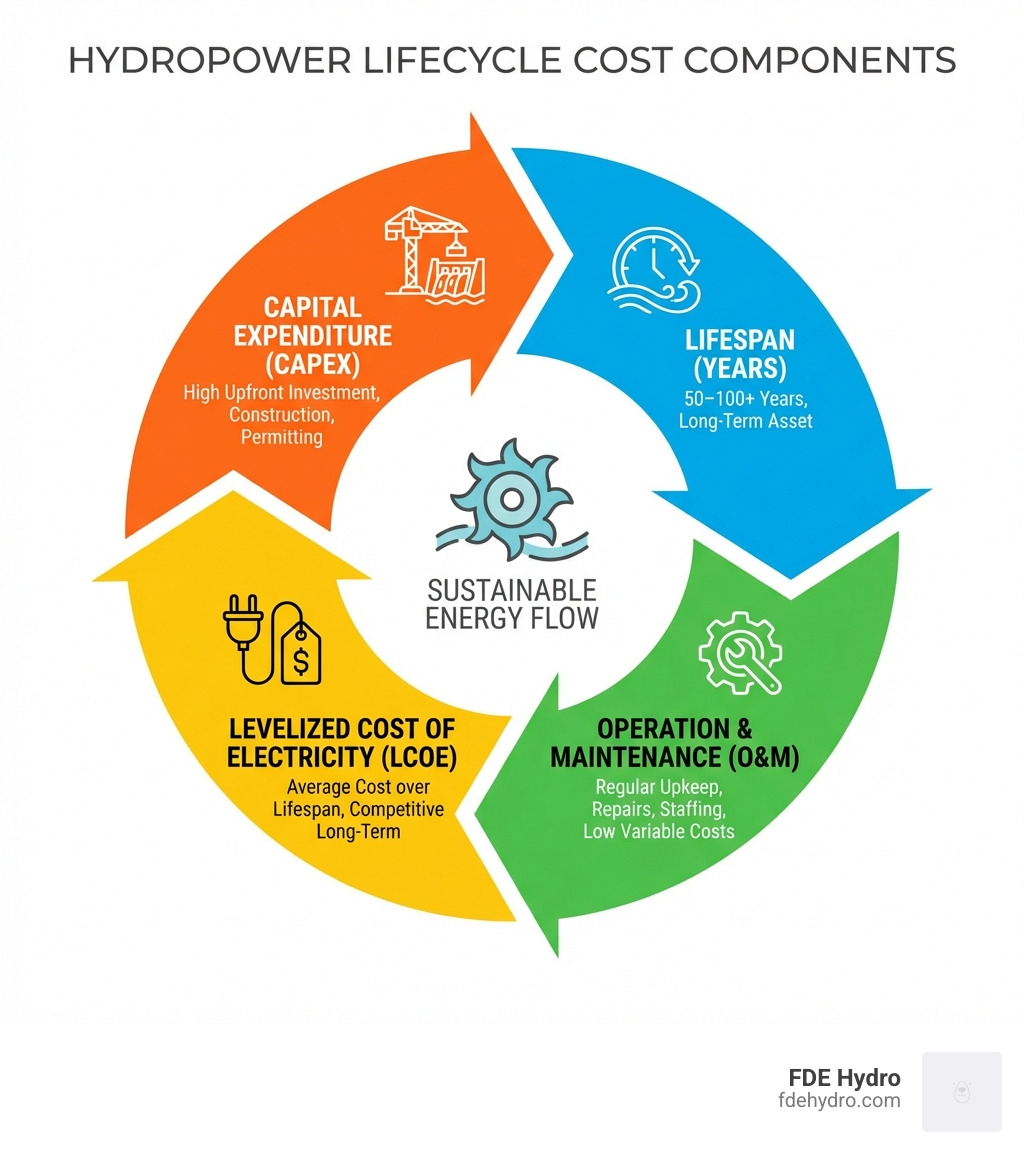
Hydropower cost vocab explained:
Upfront Capital Expenditures: Breaking Down Initial Investment
When we talk about the “sticker price” of a new power plant, we often use a term called “overnight capital cost” (OCC). This is essentially what it would cost to build the plant if you could snap your fingers and have it appear overnight, excluding interest during construction. For hydropower, this number is notoriously high compared to gas or solar.
The global average cost of setting up a hydroelectric plant was approximately $2,881 per kilowatt (kW) in 2022. However, this is just a baseline. Depending on the type of project, the costs can swing wildly:
- Nonpowered Dams (NPD): These projects involve adding generation capabilities to existing dams that don’t currently produce power. In the U.S., the OCC for these sites ranges from a manageable $3,045/kW to a staggering $20,043/kW for more difficult locations.
- New Stream-Reach Development (NSD): Building a brand-new facility where no dam exists. These are typically more expensive due to the massive civil engineering required, with U.S. estimates ranging from $6,574/kW to $8,611/kW.
- Pumped Storage: These act like giant water batteries, pumping water uphill when energy is cheap and releasing it when demand is high. While they are essential for grid stability, they require two reservoirs and complex pumping systems, making them capital-intensive.
- Conventional Hydropower: A standard 100 MW plant has a base overnight cost of about $3,421 per kilowatt (in 2022 dollars).
Regional Variations in Installation Costs
Location is everything. If you are building in the Pacific Northwest (NWPP region), you might see costs around $3,421/kW. However, try building in Florida (FRCC region), and that number can skyrocket to over $6,000/kW due to topography and labor rates.
We see these variations driven by a few key factors:
- Labor Productivity: Labor rates in New York City or California are significantly higher than in more rural areas, and the complexity of the site affects how many man-hours are required.
- Topography and Head: The “head” is the distance the water falls. Low-head sites often require more massive structures to generate the same amount of power as high-head sites, driving up detailed hydropower project costs.
- Grid Connection: If the ideal site is in the middle of a remote wilderness in Canada or Brazil, building the transmission lines to get that power to a city adds a massive line item to the budget.
Environmental and Social Capital Impacts
The “true” hydropower cost isn’t just about concrete and steel. It’s about the hurdles you have to jump over before the first shovel hits the ground. Large-scale impoundment projects often face:
- Permitting and Licensing: This can take years and cost millions in legal and environmental consulting fees.
- Social Displacement: In some regions, large reservoirs require relocating communities, which carries both high financial and ethical costs.
- Aquatic Life Mitigation: Building fish ladders or installing eco-friendly turbines to protect local ecosystems is now a standard — and expensive — requirement.
- Political Hurdles: Changes in government policy or environmental regulations mid-project can lead to delays that bleed money.
Operational Efficiency, LCOE, and Overrun Risks
Once you get past the “pain” of the initial investment, the financial story of hydropower gets much better. In fact, hydropower generation costing between 2 to 4 cents per kilowatt hour makes it one of the cheapest ways to keep the lights on.
Unlike fossil fuel plants, there are no fuel costs. You aren’t at the mercy of global natural gas or coal price spikes. The water flows for free. This stability allows hydropower to offer a very competitive Levelized Cost of Energy (LCOE). For plants entering service in 2030, the capacity-weighted LCOE is estimated at $54.40/MWh (including tax credits), which is quite impressive when you consider the 50–100 year lifespan of these assets.
Operational and Maintenance (O&M) costs are also relatively low:
- Fixed O&M: Roughly $47.06 per kilowatt-year.
- Variable O&M: A tiny $1.57 per megawatt-hour.
This makes it a more info on cost-effective energy source over the long haul, as the high initial debt is eventually paid off, leaving a low-cost “cash cow” for the grid.
Why Hydropower Projects Face Significant Cost Overruns
If the long-term math is so good, why is there so much hesitation? The answer lies in the “overrun.” Hydropower projects are notorious for finishing late and way over budget.
In Canada, where hydro provides over 61% of the power, researchers have pointed out that “easy” sites are gone. Modern projects like the W.A.C. Bennett Dam are massive engineering feats that face “strategic misrepresentation” — a fancy way of saying that risks are often downplayed to get projects approved.
When you ignore the potential for overruns in your energy modeling, you end up with economic trouble. Research on ignoring cost overruns in energy modeling shows that these hidden costs can lead to higher electricity prices for consumers and can even cause a country to miss its emissions targets because the “clean” energy took too long or cost too much to deploy.
Long-Term Economic Factors: Sediment and Aging Infrastructure
A dam built in 1924 is still a valuable asset in 2024, but it isn’t maintenance-free. Aging infrastructure requires significant reinvestment.
- Sediment Buildup: Over decades, dirt and silt settle behind the dam, reducing reservoir capacity and potentially damaging turbines. Clearing this is a major expense.
- Maintenance Cycles: Turbines and generators need overhauling every 20-30 years.
- Upgrades: Many existing facilities have the potential for capacity upgrades, which is often more cost-effective than building new ones.
Because of these long timelines, mitigating financial risks prior to ROI is essential. You have to plan for a century of operation, not just a decade.
Future Innovations to Reduce Hydropower Cost
The industry isn’t standing still. We are seeing a shift toward advanced manufacturing and digitalization to bring those scary upfront numbers down. “Smart” automation and remote monitoring are becoming standard, allowing us to optimize maintenance and reduce the need for large on-site crews.
The global market value of hydropower is projected to surpass $340 billion by 2030. To reach that, we have to find strategies for project cost reduction that make hydro as easy to deploy as solar or wind.
How Modularity Impacts Future Hydropower Cost
This is where things get exciting. Traditional dam building involves “stick-building” with poured-in-place concrete. It’s slow, weather-dependent, and labor-intensive.
By using modular precast concrete technology (like our patented “French Dam” system), we can move much of the construction into a controlled factory environment. This offers several advantages of precast concrete:
- Speed: Construction time can be cut by 50% or more.
- Predictability: Fewer weather delays and more consistent material quality.
- Scalability: You can “right-size” the dam for the specific site without starting the engineering from scratch every time.
- Cost: Reducing the time spent on-site directly slashes the labor and indirect costs that usually cause those massive overruns.
Projected Market Growth and Investment Justification
Is the investment worth it? Usually, yes. Despite the high entry price, hydropower provides something solar and wind can’t: baseload reliability. It is a “firm” resource that keeps the grid stable when the sun goes down or the wind stops blowing.
| Metric | Hydropower | Solar PV | Onshore Wind |
|---|---|---|---|
| LCOE (Subsidized) | ~$54/MWh | ~$26/MWh | ~$30/MWh |
| Capacity Factor | 50-90% | 10-30% | 25-45% |
| Lifespan | 50-100 Years | 20-25 Years | 20-25 Years |
While solar and wind have lower LCOEs, they have shorter lifespans and lower capacity factors. When you look at the full lifecycle, hydropower’s ability to produce massive amounts of power for a century makes it a cornerstone of any serious renewable energy strategy.
Frequently Asked Questions
Understanding hydropower’s long-term cost competitiveness
Q: Is hydropower actually cheaper than wind or solar? A: In terms of operating costs, yes. Hydropower generates electricity at 2–4 cents per kWh. However, because it lasts 4 times longer than a solar farm, the “cost per year of service” is often much lower. It also provides grid stabilization, which has a hidden financial value that intermittent sources don’t offer. You can find more ways to reduce construction costs to make the initial comparison even more favorable.
What is the average installation cost per kilowatt?
Q: What should I expect to pay for a new project? A: Globally, the average is around $2,881/kW. However, for a new stream-reach development in the U.S., you should budget closer to $7,000–$8,000/kW when including all indirect and owner’s costs. Small-scale hydro often has a higher cost per kW than large-scale conventional plants because you can’t spread the fixed costs (like permitting and roads) over as many megawatts.
Why are upfront costs so high compared to fossil fuels?
Q: Why does a dam cost so much more to build than a gas plant? A: It comes down to civil engineering. A gas plant is mostly a collection of machines in a building. A hydropower plant requires moving mountains of earth, diverting rivers, and building massive concrete structures that must withstand incredible water pressure for a century. The “fuel” (water) is free, but the “bucket” (the dam) is very expensive to build.
Conclusion
Navigating hydropower cost requires looking past the immediate price tag and focusing on the long-term value. While the initial capital requirements are significant and the risk of overruns is real, the 50-to-100-year lifespan and ultra-low operating costs make it an unrivaled investment for energy security.
At FDE Hydro™, we are committed to changing the “high cost” narrative. Our innovative, patented modular precast concrete technology — the French Dam — is designed to significantly reduce construction costs and time. Whether we are building new systems or retrofitting existing ones in North America, Brazil, or Europe, our goal is to make hydropower more accessible and economical for the next century of power generation.
Ready to see how modularity can change your project’s bottom line? Explore our innovative dam solutions today.