

Why Energy Storage is Critical for Tomorrow’s Grid
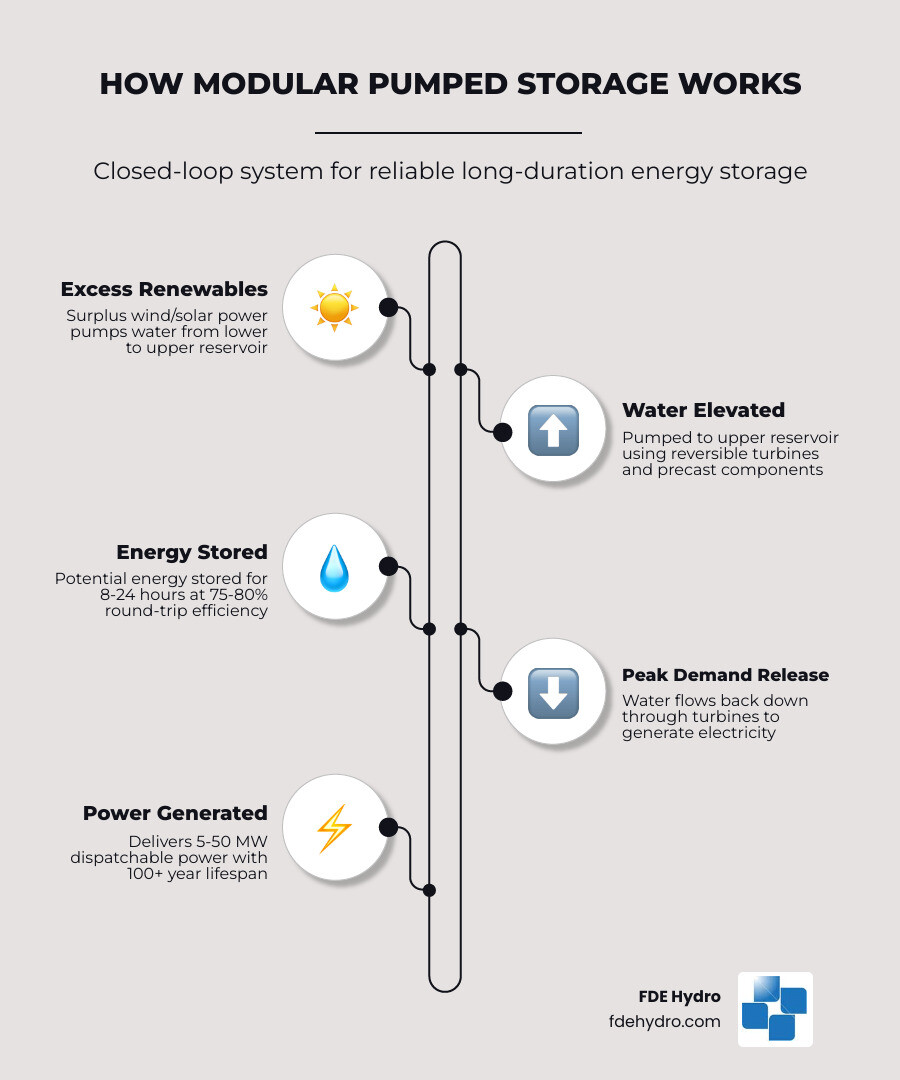
Modular pumped storage is a smaller-scale version of traditional pumped hydro that stores energy by moving water between two reservoirs at different elevations. Unlike massive utility-scale plants, modular systems typically range from 5-50 MW with 8-24 hours of storage capacity, using off-the-shelf components and standardized designs that can be deployed faster and in more locations.
Key characteristics of modular pumped storage:
- Size: 5-50 MW capacity (vs. 100+ MW for traditional PSH)
- Storage duration: 8-24 hours of energy delivery
- Design: Uses precast components and modular construction
- Location: Can be built as closed-loop systems away from natural waterways
- Efficiency: 75-80% round-trip efficiency
- Lifespan: 100+ years with minimal degradation
- Deployment: Faster construction timelines than conventional PSH
As wind and solar generation floods the grid, utilities face a critical challenge: how do you keep the lights on when the sun sets and the wind stops blowing? Short-duration storage technologies can handle 4-10 hours of storage, but they often degrade quickly and become prohibitively expensive for longer durations. Traditional pumped hydro offers the right duration and lifespan, but projects take a decade to permit and cost billions to build.
This is where modular pumped storage changes the equation.
The energy storage gap is real. Pumped storage hydropower currently provides 97% of all utility-scale energy storage in the United States—about 23 GW from just 43 operating projects. But no major new pumped storage has been built in the US for over 30 years, despite a FERC queue with 90+ proposed projects representing 50+ GW of capacity.
The barriers are clear: high upfront capital costs, 8-10 year permitting timelines, and the massive scale required to achieve economies of scale. A typical pumped storage project costs $1-3 billion and requires unique site-specific engineering.
Modular pumped storage offers a different path forward. By using standardized precast components, closed-loop designs that don’t impact natural waterways, and smaller scales that reduce capital risk, m-PSH can be deployed where traditional pumped storage cannot. These systems preserve the 100+ year lifespan and proven reliability of conventional pumped hydro while addressing the speed, cost, and flexibility challenges that have stalled development.
I’m Bill French Sr., Founder and CEO of FDE Hydro, where we’ve developed patented modular precast construction technologies specifically designed to accelerate modular pumped storage deployment and reduce costs. Our innovations address the core barriers that have prevented pumped storage from keeping pace with grid storage needs.
Modular pumped storage terms made easy:
The Future of Grid Reliability: Modular Pumped Storage
The modern electrical grid is going through a bit of an identity crisis. For a century, we relied on large, spinning turbines powered by coal or gas to provide a steady “baseload.” Today, we’re moving toward a cleaner, more variable future dominated by wind and solar. While this is great for the planet, it’s a headache for grid operators who need to balance supply and demand every second.
Modular pumped storage (m-PSH) is emerging as the “Swiss Army Knife” of grid reliability. By operating at a 5-50 MW scale, these facilities are small enough to be sited near load centers (like cities in New York or California) or renewable energy hubs, yet large enough to provide 8-24 hours of firm, dispatchable power. This makes them a cornerstone of decarbonization goals across North America, Brazil, and Europe.
Unlike their giant predecessors, these systems don’t require damming a major river. Most modern designs utilize a “closed-loop” configuration. Think of it as a giant, rechargeable water battery that just sits there, ready to go. The Scientific research on PSH trends and challenges highlights that while traditional PSH is incredibly efficient, the shift toward modularity is essential to overcome the massive site-specific hurdles that have frozen the industry for decades.
How Modular Pumped Storage Differs from Traditional PSH
If traditional pumped storage is a bespoke, hand-built mansion, modular pumped storage is a high-quality, architecturally designed prefab home. Both serve the same purpose, but one is much easier to build.
- Closed-Loop vs. Open-Loop: Traditional plants often use existing rivers (open-loop), which involves complex environmental impacts on fish and water quality. Modular systems are almost exclusively closed-loop, using two artificial reservoirs that recirculate the same water.
- Precast Components: This is where we at FDE Hydro see the biggest shift. Instead of pouring massive amounts of concrete on-site—which is slow and weather-dependent—m-PSH can use precast concrete sections (like our French Dam technology). This allows for “Lego-style” assembly, drastically reducing construction time.
- Reduced Footprint: A traditional 1,000 MW plant might require hundreds of acres. A modular 10 MW plant can fit into a much smaller footprint, sometimes even utilizing existing industrial sites or abandoned mines.
- Site Flexibility: You don’t need a massive canyon. You just need a bit of elevation change (topographic relief) and a water source to fill the loop once.
- Construction Speed: Traditional PSH takes 10+ years. Modular designs aim to cut that significantly by using standardized, off-the-shelf turbines and precast structures.
Key Components and Operational Characteristics
At its heart, modular pumped storage relies on a few high-tech but proven components:
- Reversible Pump-Turbines: These are the workhorses. During the day, when solar power is cheap and plentiful, they act as pumps to push water uphill. At night, they spin the other direction to generate electricity.
- Standardized Motor-Generators: By using smaller, modular units, we can avoid the “one-off” engineering costs that plague large projects.
- Pressure Vessels (in some designs): Some innovative systems use pressure vessels to store energy. In these systems, water is pumped into a tank, compressing a gas. When power is needed, the gas pushes the water back out through a turbine.
- Round-Trip Efficiency: Most m-PSH systems achieve 75-80% efficiency. This means for every 100 kWh you spend pumping water up, you get 80 kWh back. This beats most long-duration alternatives.
The Research on gravity storage efficiency confirms that mechanical losses in these systems are well-understood and manageable, making them far more predictable than the degradation found in other chemical storage systems.
Advantages of Modular Energy Storage Solutions
Why choose water over other storage methods? Or over a giant traditional dam? The advantages of modular pumped storage boil down to longevity and locational freedom.
100-Year Lifespan
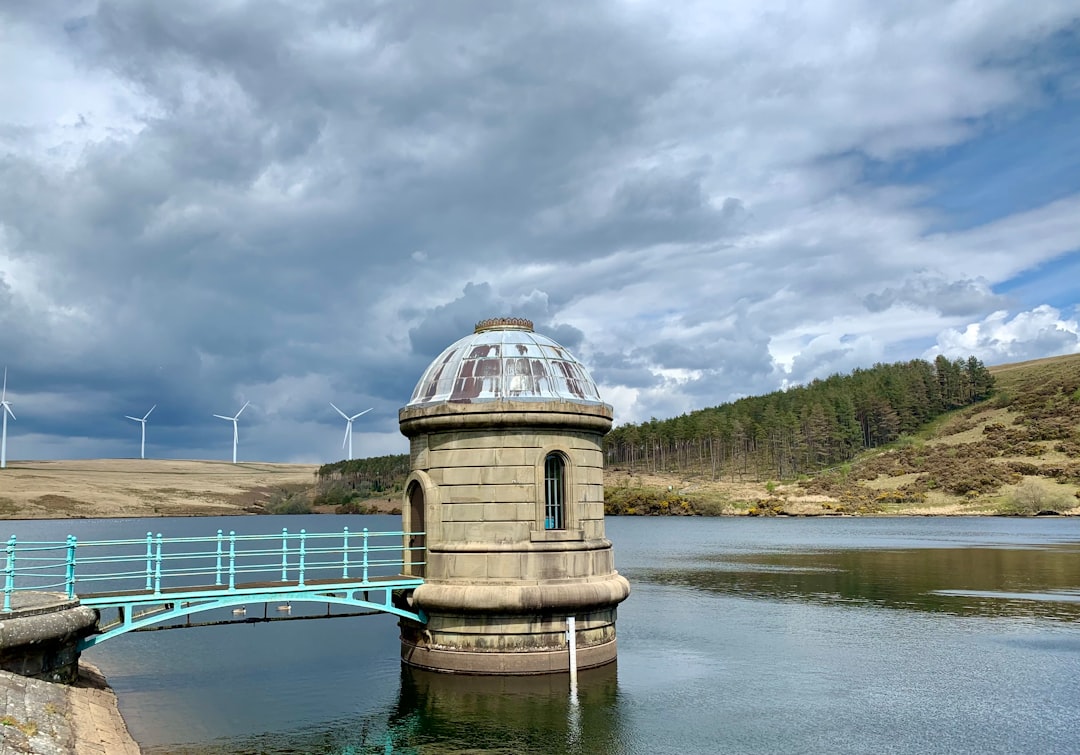
While some storage systems might last 10-15 years before they need expensive recycling and replacement, a pumped storage facility is built to last. Many PSH plants built in the 1920s are still running today. With modular precast concrete, we are building infrastructure that our grandchildren’s grandchildren will use.
Locational Flexibility
Because m-PSH is smaller and often closed-loop, we can put it in places where a 1,000 MW plant would be impossible. This includes:
- Abandoned Mines: High elevation changes already exist underground.
- Industrial Brownfields: Reusing land that already has transmission lines.
- Hilly Terrain: Small 50-acre plots can support a modular system.
Ancillary Services
These plants don’t just “store” energy. They provide “Black Start” capabilities (restarting the grid after a blackout), voltage regulation, and spinning reserves. These are services that keep the grid stable, and m-PSH does them better than almost any other tech.
Comparison Table: Modular vs. Traditional PSH
| Feature | Modular PSH (m-PSH) | Traditional PSH |
|---|---|---|
| Capacity | 5 – 50 MW | 100 – 3,000+ MW |
| Construction | Precast/Modular | Site-specific/Cast-in-place |
| Timeline | 3 – 5 years | 10 – 15 years |
| Water Source | Closed-loop (Lined) | Often Open-loop (Rivers) |
| Environmental Impact | Minimal | Significant |
| Cost Risk | Low (Standardized) | High (Bespoke) |
Integration with Renewables and Existing Infrastructure
We don’t just build these in a vacuum. modular pumped storage works best when it’s part of a “Hybrid Energy System.”
- Floating Solar: By putting solar panels on the reservoirs of an m-PSH plant, you reduce water evaporation and use the same transmission connection for two types of power. It’s a win-win.
- Run-of-River Plants: We can retrofit existing run-of-river hydropower plants in places like New York or Brazil with modular storage units. This allows a plant that used to just “flow with the river” to suddenly store energy and sell it when prices are highest.
- Grid Stability: In regions like California, where “The Duck Curve” (midday solar oversupply) is a major issue, m-PSH can soak up that excess solar and spit it back out during the evening peak.
Overcoming Deployment Challenges
If m-PSH is so great, why isn’t it everywhere? Like any infrastructure project, there are hurdles. But for the first time in decades, the wind is at our backs.
The Capital and Permitting Problem
The biggest challenge has always been the “Upfront CapEx.” It costs a lot of money to move dirt and pour concrete. Furthermore, the US permitting process via FERC can take 4-5 years for the federal level alone, even for low-impact closed-loop projects.
However, the Infrastructure Investment and Jobs Act (IIJA) has set aside $355 million specifically to support energy storage demonstration projects. This is a huge signal to investors that the government is serious about long-duration storage. You can read more about Federal funding for energy storage and how it’s helping move these projects from the lab to the field.
The Economic Viability of Modular Pumped Storage
When you look at the Levelized Cost of Storage (LCOS), modular pumped storage is incredibly competitive over its lifetime.
- Recoupment Periods: Some research suggests that a well-placed modular system can recoup its costs in as little as 3 to 6 years depending on the market.
- Revenue Streams: These plants make money through “Arbitrage” (buying low, selling high) and by getting paid for “Ancillary Services” by the grid operator.
- Market Design: We are seeing a shift in market rules in North America and Europe to better value “firm” power. As these rules change, the economic case for m-PSH becomes a slam dunk.
Innovative m-PSH Technologies and Projects
The world of modular pumped storage is evolving with new methods that make it easier to deploy storage in diverse environments without the need for traditional large-scale damming.
Closed-Loop Atlas and Site Identification
Researchers have identified over 800,000 potential sites globally for closed-loop pumped hydro. Many of these are in North America and Brazil, often using abandoned mines or existing reservoirs. This “Bluefield” development is the next frontier for modular precast technology, allowing for the rapid conversion of existing topography into high-capacity energy storage.
Modular Precast Reservoir Systems
One of the most significant innovations is the shift from site-specific civil engineering to standardized, modular construction. By using precast concrete components, developers can now implement “plug-and-play” reservoir structures. This approach reduces the environmental footprint and allows for the creation of storage facilities in locations previously thought unsuitable for hydropower, such as industrial brownfields or remote off-grid locations. These systems leverage the same proven physics of traditional pumped hydro but with the speed and flexibility of modern manufacturing.
Frequently Asked Questions about Modular Pumped Storage
What is the typical size of a modular pumped storage project?
Most modular projects fall into the 5-50 MW range. To put that in perspective, 10 MW can power roughly 7,500 to 10,000 homes. These systems are designed to be “scalable,” meaning if you need 100 MW, you might build two 50 MW modules side-by-side. The storage duration is typically 8-24 hours, which is the “sweet spot” for balancing solar and wind.
How long do modular pumped storage systems last?
This is the “killer app” of the technology. While many storage technologies are effectively “consumables” that wear out, m-PSH is “infrastructure.” These systems have a 100-year+ lifespan. The mechanical parts (turbines and pumps) might need a tune-up every 20-30 years, but the concrete structures—especially our modular precast French Dam components—are built for the long haul.
Can m-PSH be built away from natural rivers?
Yes! In fact, that is the whole point of “closed-loop” design. By using lined reservoirs or underground storage options, we don’t need to touch a single fish or disturb a natural riverbed. We can build them in the desert, on old coal mines in Kansas, or near industrial parks in New York City. They have minimal water consumption because the water just moves back and forth in a loop, with only a tiny bit of “makeup water” needed to account for evaporation.
Conclusion: Building the Backbone of the Clean Grid
The transition to 100% renewable energy isn’t just a dream; it’s a massive engineering project. But we can’t build that future on the back of short-lived, chemically intensive storage systems alone. We need the “Small but Mighty” power of modular pumped storage.
By shrinking the scale and standardizing the construction, we are making the world’s most proven storage technology accessible to everyone. Whether it’s retrofitting an old dam in Brazil or building a new closed-loop system in California, modularity is the key to speed and affordability.
At FDE Hydro, we are proud to be at the forefront of this movement. Our patented French Dam technology and modular precast concrete methods are designed to slash construction times and costs, making m-PSH a reality for utilities and private developers alike. We aren’t just building dams; we’re building energy security for the next century.
If you’re interested in how we can help your next project, or if you just want to learn more about the future of water-based energy storage, explore our modular dam construction solutions and let’s build a more resilient grid together.
Ready to take the next step in sustainable infrastructure? Contact us today to learn more about our French Dam technology
