

Why Canada is a Global Leader in Renewable Energy
Canada renewable energy powers two-thirds of the nation’s electricity grid, making it one of the world’s top producers of clean power. In 2023 alone, renewable sources generated 411 terawatt-hours (TWh) of the country’s 620 TWh total electricity production.
Quick Facts: Canada Renewable Energy Overview
- Total Renewable Share: 66% of electricity generation (2023)
- Dominant Source: Hydroelectricity (58% of national generation)
- Rapid Growth: Wind generation up 364%, solar up 40-fold (2010-2023)
- Installed Capacity: Over 24 GW of wind, solar, and storage combined
- Global Rankings: 4th in hydropower production, 9th in wind capacity
- Climate Target: Net-zero emissions by 2050
Canada’s renewable energy landscape is dominated by hydroelectric power, which has been the backbone of the grid for decades. But the story doesn’t end there. Wind and solar capacity has grown by 46% in just five years (2019-2024), with nearly 5 GW of new wind, 2.6 GW of new solar, and 200 MW of energy storage added during this period.
The country’s vast geography and diverse resources give it a unique advantage. From massive hydro installations in Quebec and British Columbia to wind farms across Alberta’s prairies and solar projects in Ontario, Canada is changing how it generates and stores power.
This change isn’t just about environmental goals. The environmental and clean technology sector now contributes $70.5 billion to Canada’s economy and employs over 430,000 workers, with wages averaging 22% higher than the national average.
I’m Bill French Sr., founder and CEO of FDE Hydro, and I’ve spent decades working on innovative solutions for Canada renewable energy infrastructure, including developing modular hydropower technologies that reduce costs and construction timelines. In 2015, I was selected by the U.S. Department of Energy to help define next-generation hydropower solutions, work that directly applies to Canada’s ongoing grid modernization.
This guide breaks down everything you need to know about Canada’s renewable energy sector: where the power comes from, how it’s stored, who’s building it, what policies drive it, and where it’s headed as the country works toward its 2050 net-zero target.
The Current State of Canada Renewable Energy
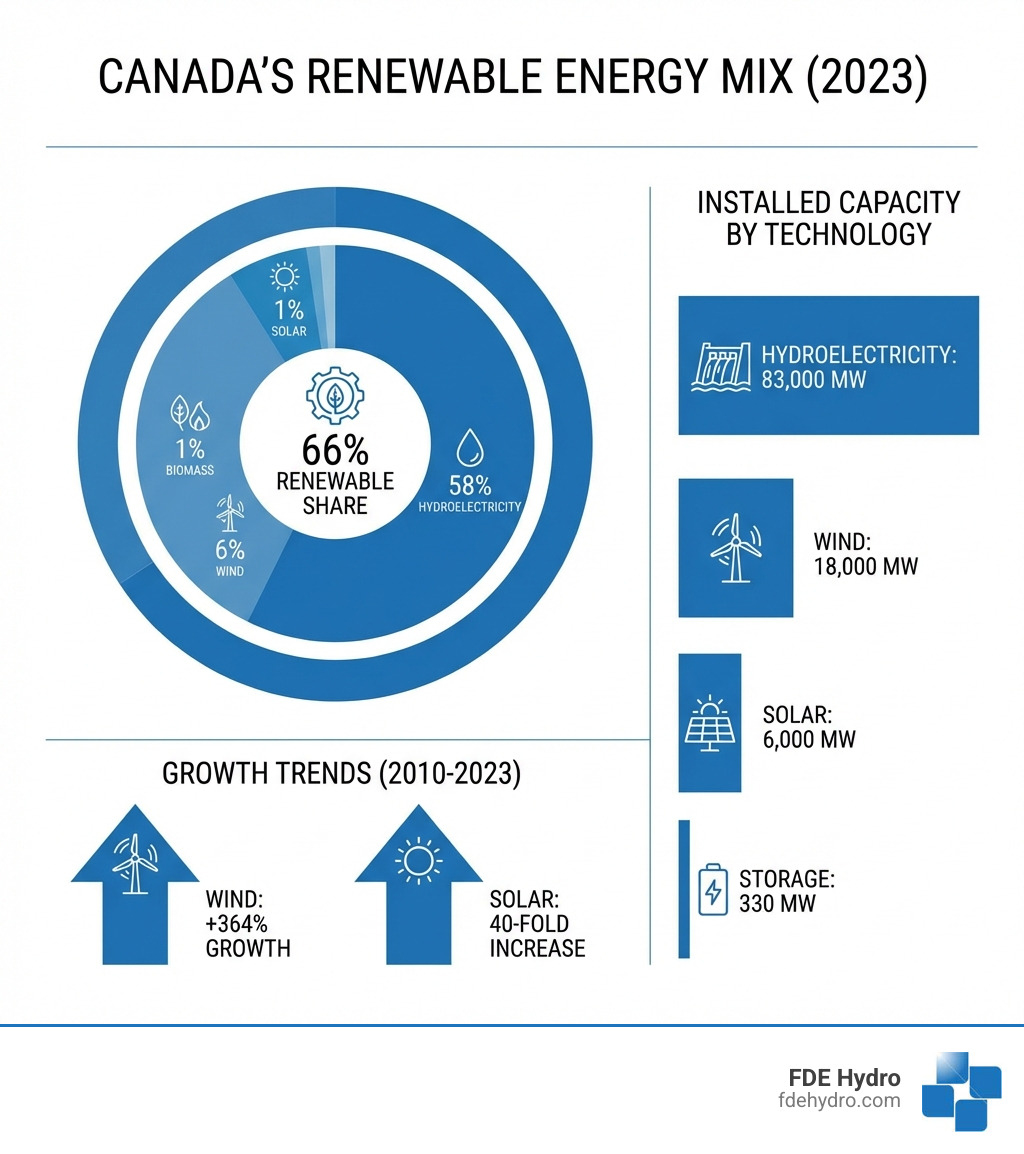
Canada renewable energy is experiencing dynamic growth. From 2019-2024, total installed capacity for wind, solar, and energy storage surged 46% to over 24 GW. This expansion includes over 18 GW of wind, 5+ GW of solar, and 330 MW of energy storage, highlighting Canada’s commitment to diversifying its energy mix.
While newer technologies are gaining ground, hydroelectricity remains the powerhouse of Canada renewable energy, accounting for 58% of national generation in 2023. That year, Canada generated 620 terawatt-hours (TWh) of electricity, with 411 TWh (66%) from renewables, making it the fourth-largest global producer of renewable electricity.
The growth in wind and solar has been particularly impressive. Between 2010 and 2023, wind generation soared 364% to 40.1 TWh, while solar generation increased more than fortyfold to 4.9 TWh. This represents a significant shift in our energy landscape, with wind and solar collectively meeting over 8% of Canada’s electricity demand in 2023.
Strategic planning and innovation are key to managing our energy resources. For more detailed insights, you can explore More info about Energy Resource Development.
Primary Sources and Their Evolution
Hydroelectricity is the historical champion of Canada renewable energy. For decades, Canada’s vast rivers have generated clean, reliable power, accounting for 58% of national generation in 2023. Provinces like Quebec, British Columbia, and Manitoba rely heavily on hydro, which powers most of their grids.
However, the past decade saw a dramatic evolution in the energy mix. Wind and solar have become significant contributors, with wind generation growing 364% between 2010 and 2023 to contribute 6% to national generation. Solar, though smaller at 1% of national generation, saw a fortyfold increase in output. This expansion is due to decreasing costs and increasing efficiency.
Biomass also plays a part, accounting for 6% of national generation in 2023 after a 7% increase from 2010. Other renewables like geothermal and tidal remain small contributors. This evolving mix reflects a commitment to Sustainable Energy Production and a more resilient grid.
The Critical Role of Energy Storage
As Canada adopts more variable renewables like wind and solar, energy storage is critical for grid stability. It acts like a giant battery, balancing supply and demand by capturing excess power and releasing it when needed to ensure a reliable supply.
Energy storage capacity grew an explosive 192% from 2019-2024. While current capacity is 330 MW, planned Battery Energy Storage Systems (BESS) additions before 2030 could increase it tenfold. These 4-hour BESS units are excellent for short-duration grid support.
Beyond batteries, pumped storage hydropower (PSH) offers longer-duration storage. PSH pumps water uphill when power is cheap and releases it through turbines to generate power when demand is high. However, PSH deployment is geographically constrained. Canada has one Compressed Air Energy Storage (CAES) facility in Goderich, Ontario (1.75 MW).
Hybrid projects are also on the rise, with 65 MW of solar-plus-storage in operation (130 MW under construction) and 20 MW of wind-plus-storage operational. These integrated solutions are key to a cleaner, more stable grid.
Deep Dive into Canada’s Key Renewable Sources
The journey toward a greener grid is often paved with technological advancements and, crucially, significant cost reductions. We’ve seen this play out globally, and Canada renewable energy is directly benefiting. Since 2009, the cost of solar energy has plummeted by an astonishing 83%, making it an increasingly competitive option. Similarly, wind energy costs have declined by 65% over the same period. These dramatic reductions have made renewables the cheapest source of new electricity generation in many parts of the world, including Canada.
This cost-effectiveness, combined with environmental benefits, is why we’re seeing such a rapid expansion of wind and solar across the country. Understanding these underlying economic trends helps us appreciate the scale and speed of the transition. To explore which renewable energy resource truly offers the most bang for the buck, you might be interested in What Renewable Energy Resource Is The Most Efficient?.
Hydroelectric Power: The Backbone of Canada’s Grid
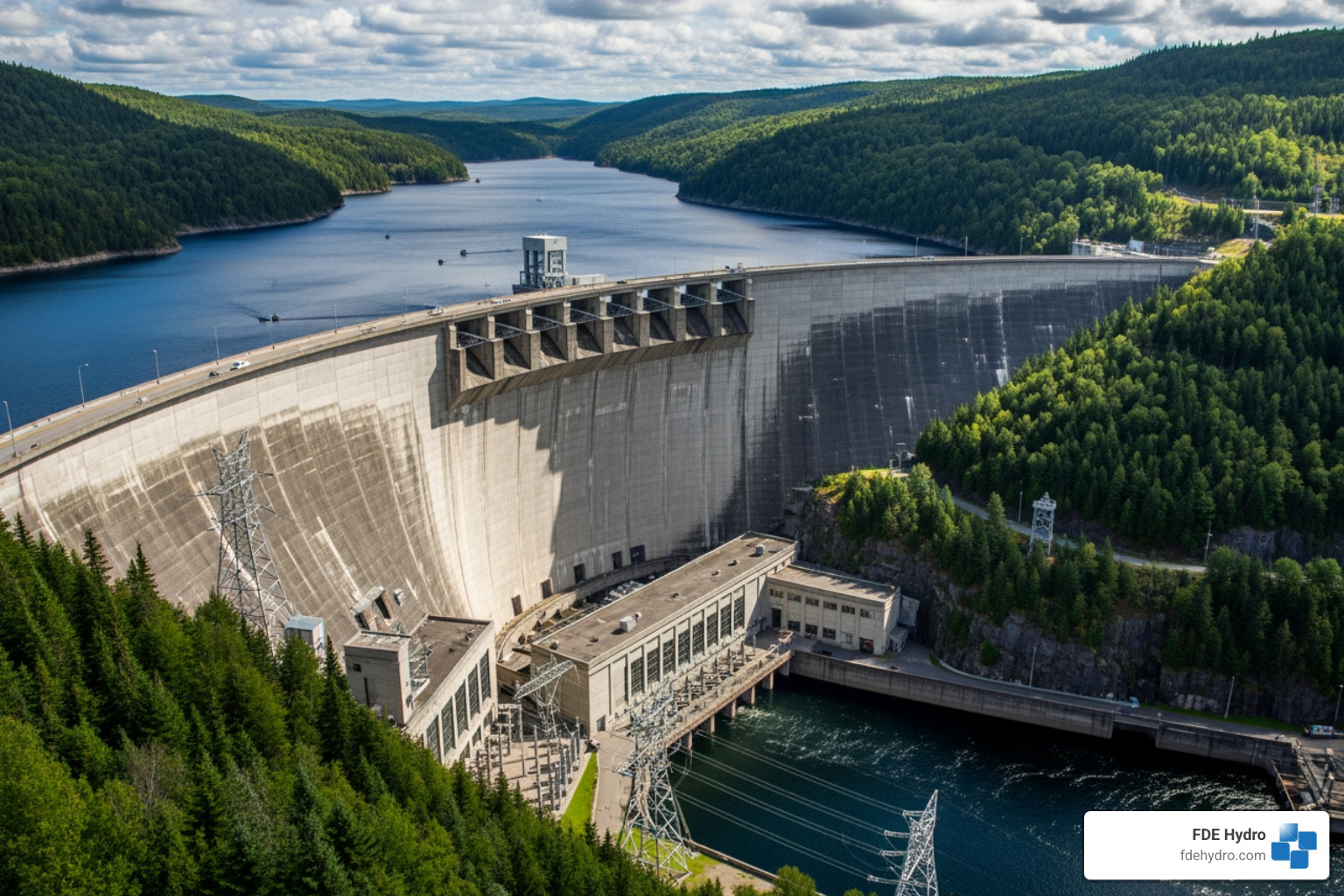
When we talk about Canada renewable energy, hydroelectric power inevitably takes center stage. It’s not just a part of our energy mix; it’s the very backbone of our electricity grid. In 2023, hydroelectricity accounted for a colossal 58% of our national electricity generation. This incredible capacity places Canada as the fourth-largest global producer of hydropower by capacity, a ranking we’ve held since at least 2021.
Our installed hydroelectric capacity is immense, reaching over 83,000 MW in 2024. This isn’t just a historical legacy; it’s an active and vital part of our present. Provinces like Quebec, British Columbia, Manitoba, and Newfoundland and Labrador rely heavily on hydro, often generating over 90% of their electricity from this source. Quebec, in particular, is a powerhouse, producing roughly half of all of Canada’s hydroelectric power. We have massive projects like Site C in British Columbia, Muskrat Falls in Labrador, Keeyask in Manitoba, and La Romaine 4 in Quebec, all contributing significantly to our clean energy supply.
While remarkably reliable, hydroelectric generation can be sensitive to environmental factors. For instance, in 2023, we saw a 9% (37 TWh) drop in hydroelectric generation compared to the previous year, primarily due to drought conditions. This highlights the importance of managing water resources carefully and diversifying our renewable portfolio.
At FDE Hydro, we recognize the critical role of Hydroelectric Power Generation and are dedicated to innovating within this sector. Our patented modular precast concrete technology is designed to make building and retrofitting hydroelectric dams more efficient and cost-effective, ensuring this vital resource continues to power Canada for generations. However, we also understand the need to address the Hydropower Environmental Impact to ensure sustainable development.
The Growth of Wind and Solar in Canada’s Renewable Energy Mix
While hydroelectricity remains our steadfast foundation, the growth of wind and solar power has been nothing short of spectacular, adding dynamic new layers to Canada renewable energy. As of 2024, we boast over 18 GW of wind capacity from 341 projects across the country, positioning us as the 9th largest wind power producer globally. Solar power, both utility-scale and on-site, has also expanded significantly, with over 4 GW of utility-scale capacity and more than 1 GW of on-site solar from 217 major projects and nearly 96,000 individual installations. This places us 24th in the world for installed solar capacity.
This rapid expansion isn’t uniform across the country, with certain provinces taking the lead. Alberta, for example, has experienced a remarkable renewable energy boom. Its abundant wind and solar resources, coupled with a flexible electricity system, have attracted significant investment. This surge is not only diversifying Alberta’s energy mix but also creating substantial economic opportunities, with projections suggesting it could power 4,500 jobs. Even oil companies in Alberta are investing in renewable energy to offset their emissions, showcasing a broader industry shift.
Ontario also holds an established leadership position, particularly in its early adoption of wind and solar power. The province led Canada in both capacities and famously phased out coal power in 2014, demonstrating a clear commitment to clean energy. While its Green Energy Act faced some controversies and was eventually scrapped, it undeniably kickstarted much of the province’s renewable development.
British Columbia is also making strides, with BC Hydro committing to a C$6 billion investment in wind farms, including nine new projects that will significantly improve the province’s grid capacity. Even Saskatchewan, traditionally reliant on fossil fuels, has seen plans to double its wind power generation and develop more solar projects.
These developments highlight the increasing maturity and competitiveness of wind and solar technologies, making them integral components of our expanding Clean Energy Infrastructure.
Policy, Economy, and People: The Drivers of Change
The rapid evolution of Canada renewable energy isn’t happening in a vacuum; it’s driven by a complex interplay of policy, economic incentives, and the collective efforts of people across various sectors. From federal mandates to provincial initiatives and grassroots community involvement, these factors are shaping our transition to a low-carbon future.
The authority to legislate and implement policies on renewable energy in Canada is shared among federal, provincial, and even municipal governments. This multi-level governance can be both a strength and a challenge. The federal government often sets national climate goals, such as reaching net-zero emissions by 2050, and implements broad mechanisms like carbon pricing and clean electricity regulations. These policies create a framework and incentives for provinces and industry to invest in renewables. For instance, the Federal Budget 2025 has been seen as setting a clear path for Canada’s clean energy competitiveness.
However, provinces hold significant control over their own electricity markets and natural resources, leading to diverse approaches and priorities. While the federal government can influence provincial energy policies, provinces have the final say on many aspects of electricity generation and distribution. Municipalities also play a role through zoning regulations and construction permits, while Indigenous communities are increasingly recognized as primary authorities on their lands.
This intricate web of governance, coupled with national climate targets and evolving regulations, creates the environment in which our renewable energy sector operates and thrives.
Economic Impacts and Job Creation
The growth of Canada renewable energy isn’t just an environmental success story; it’s a significant economic engine and a major creator of jobs. The Environmental and Clean Technology (ECT) sector in Canada is a powerhouse, contributing substantially to our national economy. In 2019, the value of the Canadian ECT products sector alone reached an impressive $70.5 billion. This sector’s growth rate has been remarkable, outpacing Canada’s overall economy by one-third between 2010 and 2017.
This booming sector translates directly into employment opportunities. By June 2020, the ECT sector employed a staggering 430,500 workers across Canada. Even in 2019, there were 339,000 ECT jobs, representing 1.7% of all jobs in the country. What’s even more compelling is the quality of these jobs: over 90% are full-time, and they offer attractive compensation. In 2019, the average annual wage in the ECT sector was $77,144, significantly higher than the national average of $63,490. This demonstrates that investing in clean energy is investing in well-paying, stable employment for Canadians.
The skills required for these roles are diverse, ranging from engineering and manufacturing to installation and maintenance. A substantial portion of ECT workers hold college or university degrees, highlighting the high-tech nature of the industry. This economic vibrancy underscores the importance of continued investment in Green Energy Construction Complete Guide and related fields. For a more detailed look at the workforce, you can refer to the Portrait of environmental and clean technology jobs in Canada, 2019.
Indigenous Communities: Key Partners in the Green Transition
Indigenous communities are playing an increasingly integral role in the development and expansion of Canada renewable energy. We recognize that these communities are not just stakeholders; they are often primary authorities on their traditional lands and reserves, and their involvement is crucial for the success and sustainability of any project. Meaningful consultation and equitable partnerships are essential for forging respectful and productive relationships.
Many Indigenous communities are actively leading the charge in developing renewable energy projects, often driven by a desire for energy independence, economic opportunity, and environmental stewardship. For instance, Whitesand First Nation in Ontario is developing a new renewable power station that uses organic wood pellets, showcasing innovative bioenergy solutions. Similarly, Cat Lake First Nations have entered into an agreement to install solar power, with the community holding a significant 51% ownership stake in the company. In British Columbia, First Nations often hold a 51% ownership in most new wind farm projects, exemplifying a model of shared prosperity and control.
One of the most significant contributions of Indigenous-led renewable projects is in reducing reliance on diesel fuel in remote communities. Many northern and isolated communities currently depend on expensive and polluting diesel generators. Transitioning to local renewable energy sources not only cuts emissions but also provides energy security, economic benefits, and healthier living environments. This transition is a powerful example of how Indigenous leadership is driving positive change across Canada. You can learn more about these initiatives in Spotlight: Bioenergy in Indigenous communities.
Provincial Spotlights and Future Outlook
Achieving Canada’s 2050 net-zero goal hinges on expanding and integrating Canada renewable energy. Planned capacity additions from 2024-2030 are substantial, with an expected 12,102 MW (11.5%) increase led by wind (7,833 MW), solar (3,019 MW), and hydro (1,227 MW). This growth will push the renewable share of total capacity from 69.5% in 2023 to an estimated 72.9% by 2030.
However, realizing these goals has challenges. Significant infrastructure development, like grid modernization and inter-provincial transmission, is needed to handle new renewable energy. Streamlining project permitting and assessments is also critical for timely deployment.
To see how different provinces contribute, we recommend you View the Canadian Renewable Energy Project Map.
| Province/Territory | Primary Renewable Source | Key Developments / Capacity (Approx.) |
|---|---|---|
| Quebec | Hydroelectricity | Nearly 100% renewable grid; Half of Canada’s hydro; La Romaine 4 project. |
| Ontario | Hydro, Wind, Solar | Significant wind/solar capacity; Phased out coal; Was leader in new capacity. |
| Alberta | Wind, Solar | Rapid surge in wind/solar; Increased renewables 66% (2005-2015); Oil companies investing. |
| British Columbia | Hydroelectricity | 98.4% renewable (2016); 9 new wind farm projects; Site C project. |
| Manitoba | Hydroelectricity | Mostly hydro-power; Keeyask project. |
| Saskatchewan | Wind, Hydro | Plans to increase wind/solar; Traditionally coal/natural gas. |
| Yukon | Hydroelectricity | Mostly hydro; Also diesel/LNG; Biomass for heating. |
| NWT | Hydro, Wind, Solar PV | ~1/3 renewable; Reducing diesel reliance. |
| Nunavut | Diesel | Almost all electricity from diesel; High potential for renewables. |
Provincial Spotlights on Canada’s Renewable Energy Landscape
Each province contributes uniquely to the mosaic of Canada renewable energy.
- Quebec is a global leader, with nearly all its electricity from hydro. It produces about half of Canada’s hydroelectricity.
- Ontario has a diversified grid and was an early leader in wind and solar, having phased out coal in 2014.
- Alberta is a dynamic hub for wind and solar, with excellent resources fueling a surge in generation and attracting major investment.
- British Columbia has a very clean grid (98.4% renewable in 2016), mostly from hydro, and is expanding its wind capacity with a C$6 billion investment from BC Hydro.
- Manitoba relies almost entirely on hydropower, giving it one of North America’s cleanest grids.
- Saskatchewan is diversifying from fossil fuels, with plans to increase wind and solar generation.
- In the north, the Northwest Territories generates about a third of its electricity from renewables, focusing on reducing diesel reliance. The Yukon also relies mainly on hydro. Nunavut remains heavily dependent on diesel, a critical area for future renewable development.
These regional efforts show a nation transitioning its energy infrastructure. For a deeper dive, refer to our Renewable Energy Projects Complete Guide.
Challenges and Opportunities for Expansion
While the trajectory is positive, Canada faces challenges and opportunities on its path to net-zero. A significant challenge is grid modernization and inter-provincial transmission. Integrating variable renewables requires a smarter grid and new transmission lines, a complex and capital-intensive process. Project permitting and environmental assessments can also be time-consuming, requiring careful collaboration to avoid delays.
However, Canada has immense untapped renewable potential. Geothermal energy offers consistent power, and Canada’s first utility-scale geothermal plant opened in Alberta in 2023. Tidal power in the Bay of Fundy holds massive potential, though past projects faced environmental issues from which we can learn. Innovative opportunities like agrivoltaics (combining solar and agriculture) also exist to maximize land use. The Future of Hydropower also holds promise with new technologies. Addressing these challenges while seizing opportunities will be crucial for Canada to realize its full renewable energy potential.
Frequently Asked Questions about Renewable Energy in Canada
What is the main source of renewable energy in Canada?
Hydroelectricity is the dominant source, accounting for approximately 58% of the country’s total electricity generation in 2023. Provinces like Quebec, British Columbia, and Manitoba generate over 90% of their power from hydro, making it the foundational element of Canada renewable energy.
Which Canadian province is the leader in renewable energy?
Quebec is the undisputed leader in total renewable energy generation, primarily due to its massive hydroelectric capacity, which provides nearly 100% clean power to the province. However, Alberta has recently emerged as a leader in new wind and solar project development, showing the fastest growth in these sectors and attracting significant investment, making it a key player in the evolving Canada renewable energy landscape.
How is Canada progressing towards its net-zero 2050 goal?
Canada is making significant progress, with a grid that is already two-thirds renewable. The rapid expansion of wind, solar, and energy storage, supported by federal policies like carbon pricing and clean electricity regulations, are key to this transition. Our total wind, solar, and storage capacity grew 46% in the past five years, and planned additions will further boost renewable capacity by 11.5% by 2030. However, decarbonizing remaining sectors like heavy industry and transportation remains a major challenge that we are actively working to address.
Conclusion
Canada renewable energy stands on a strong foundation, primarily anchored by our abundant hydroelectric resources. This has allowed us to become a global leader, with 66% of our electricity coming from clean sources. But our story is evolving rapidly; wind and solar are emerging as the future growth engines, demonstrating impressive expansion and becoming increasingly cost-effective.
The path to net-zero by 2050 is ambitious, but achievable. It demands continued policy support, robust investment, and relentless innovation across all levels of government, industry, and communities. The economic benefits, including significant job creation and higher wages in the clean technology sector, underscore the wisdom of this transition. Furthermore, the crucial role of Indigenous communities as partners and leaders in project development is vital for equitable and sustainable growth.
At FDE Hydro, we are proud to contribute to this vital transition. Our innovative, patented modular precast concrete technology is designed to modernize and expand hydropower infrastructure in Canada, North America, Brazil, and Europe, reducing construction costs and accelerating project timelines. By enhancing the efficiency and longevity of our hydroelectric assets, we help ensure that the backbone of Canada renewable energy remains strong and adaptable for future generations.
We are committed to powering tomorrow with sustainable solutions. To learn more about advanced hydropower solutions and how we’re making a difference, please visit Learn more about advanced Hydropower solutions.
