

Why Water Flow Control Matters for Infrastructure Performance
Water flow control is the practice of regulating fluid movement through pipes and channels using specialized valves. These devices maintain predetermined flow rates regardless of pressure fluctuations, protecting infrastructure and ensuring optimal performance across residential, commercial, and industrial applications.
Key Types of Water Flow Control Devices:
| Device Type | Primary Function | Typical Application |
|---|---|---|
| Flow Control Valves | Maintain constant GPM regardless of pressure | Hydronic heating, irrigation |
| Pressure-Compensated Regulators | Use flexible orifice to adjust automatically | Plumbing systems, distribution |
| Pilot-Operated Valves | Sense differential pressure for precise control | Large-scale infrastructure |
| Dual-Chamber Designs | Operate at low pressures (as low as 3m head) | Low-pressure waterworks |
Modern flow control technology has evolved into sophisticated hydraulic and electronic systems. Today’s valves remain accurate within 15% of their rated Gallon Per Minute (GPM) capacity and handle pressures up to 125 PSI. They often employ flexible orifices that constrict with increasing pressure and relax as pressure decreases to maintain a constant flow without moving parts.
Uncontrolled water flow leads to wasted resources, damaged equipment, and unpredictable system performance. Whether managing a municipal network or an industrial process, selecting the right flow control mechanism determines operational efficiency and long-term cost savings. Improper control can cause cavitation—where pressure drops create bubbles that collapse and damage piping.
I’m Bill French Sr., founder of FDE Hydro. We develop modular civil construction solutions that integrate advanced water flow control principles into renewable energy infrastructure. My experience with the Department of Energy’s Hydro Power Vision task force has reinforced that effective water flow control is the foundation of reliable water infrastructure.
Understanding the Mechanics of Water Flow Control
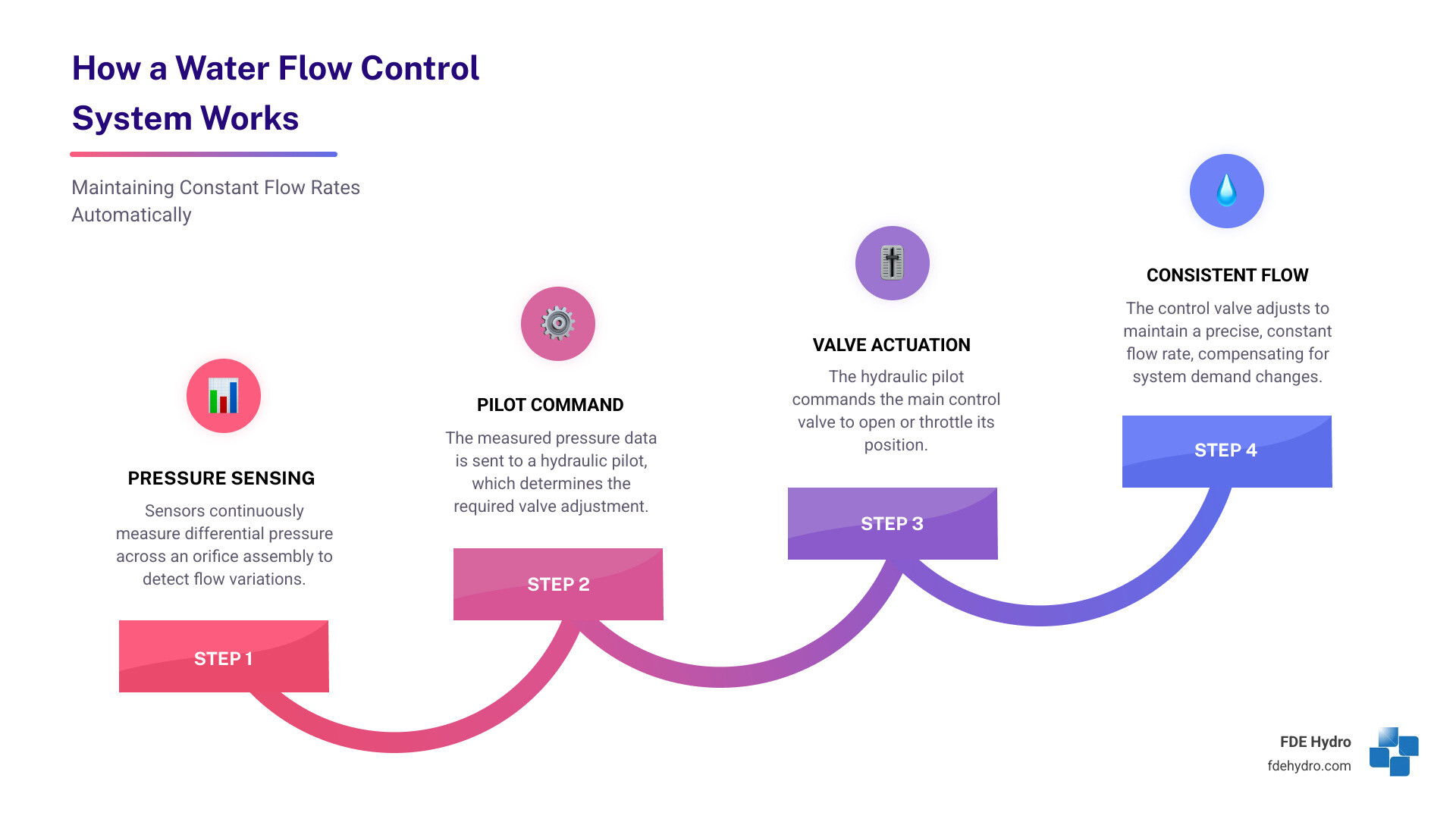
At its core, a water flow control valve regulates fluid movement to ensure a consistent flow rate. Its primary function is to maintain this rate irrespective of system pressure fluctuations. This precision is vital for everything from residential plumbing comfort to optimizing complex industrial processes, including Water Control Systems in large-scale infrastructure.
Most flow control valves operate using pressure-compensated mechanisms, such as a flexible orifice or an O-ring that dynamically adjusts to upstream and downstream pressure. When pressure increases, the component constricts to reduce the opening; as pressure decreases, it relaxes to widen the opening. This self-adjusting gatekeeper ensures the correct volume passes through at all times.
Advanced systems, like the FC3W controller, use Karman vortex flow sensors to provide feedback. This data allows a motor-driven valve to establish a flow rate corresponding to an analog input signal. This level of control is essential when a single supply is divided into multiple lines, ensuring each receives a consistent flow. For more on these principles, explore Flow control valve principles.
How Flow Control Valves Maintain Constant Rates
Water flow control valves are engineered for accuracy, typically within 15% of their rated GPM, even with significant pressure drops up to 125 PSI. Their internal mechanisms often rely on material elasticity rather than traditional moving parts. As upstream pressure pushes more water toward the valve, the flexible orifice constricts to compensate. Conversely, if pressure drops, the element relaxes to maintain the target GPM.
In industrial settings, controllers can adjust flow on each line to a constant rate using analog signals. This ensures that even when a supply is split, each point receives the precise amount of water needed, contributing to system stability.
The Role of Actuators and Pilots in Water Flow Control
Sophisticated water flow control often involves actuators and pilots for automated regulation in complex systems. Actuators physically move the valve’s modulating element. Pneumatically-actuated globe valves use compressed air, while hydraulic actuators leverage system fluid pressure to operate without external power.
Pilot-operated valves use a smaller control mechanism to sense conditions like differential pressure. The pilot then commands the main valve to throttle or open. If demand exceeds the set point, the pilot signals the valve to throttle back, maintaining constant flow. This progressive throttling optimizes energy efficiency, a principle we use in our Water Management Solutions.
Control solenoids can also be integrated for immediate response. For example, a controller can be paired with a VXZ 2-port solenoid valve for complete flow stoppage. For technical details, refer to Rate of Flow Control technical details.
Comparing Types of Water Flow Control Valves
Selecting the right water flow control valve requires understanding design specifications. Key considerations include GPM ratings, PSI limits, and material composition.
| Feature/Type | Single-Hole Design | Three-Hole Design | Mechanical Valves | Electronic Valves |
|---|---|---|---|---|
| Noise Levels | Generally noisier | Quieter | Varies | Often quieter |
| Plugging Risk | Less prone | Greater chance | Susceptible to debris | Less susceptible |
| Maintenance | Potentially longer | Potentially shorter | Regular checks | Diagnostics-driven |
| GPM Ratings | Varies | Varies | 2-20 GPM typical | Precise digital |
| PSI Specs | Up to 125 PSI | Up to 125 PSI | Up to 125 PSI | 0.2-0.4 MPa |
Single-Hole vs. Three-Hole Design Performance
Single-hole designs feature one orifice. While generally noisier, they are less prone to plugging because they lack small crevices where sediment accumulates. This makes them robust for systems with variable water quality.
Three-hole designs are engineered for quiet operation by distributing flow across multiple orifices, reducing turbulence. However, these smaller openings are more susceptible to mineral buildup and debris, potentially requiring more frequent maintenance. Choosing between them involves balancing noise tolerance against clogging risks.
Selecting Specifications for Residential and Commercial Water Flow Control
Choosing a water flow control valve requires matching GPM, PSI, and material to the application. Flow rates are measured in GPM or liters per minute (lpm). Valves might restrict flow to 5 US GPM for common uses or provide precise ranges like 0.5-4.0 lpm for specialized systems.
Pressure handling is critical; most valves operate between 0 and 125 PSI. Material selection, such as brass or stainless steel, impacts durability. Lead-free options are now standard for potable water. Connection types, such as 1/2″ or 3/4″ FNPT, and maximum working temperatures (typically 150F) must also be verified to ensure compatibility with Sustainable Water Infrastructure.
Preventing System Failure: Cavitation and Maintenance
Cavitation is a major threat to water flow control systems. It occurs when liquid experiences a sharp pressure drop, often at the “vena contracta.” If pressure falls below the vapor pressure, vapor bubbles form. As the water moves downstream and pressure recovers, these bubbles implode, generating shockwaves that damage internal surfaces.
The sound of cavitation—a hiss or rattle like gravel in the pipes—is a warning of ongoing erosion. Over time, this leads to pitting and material loss on valve seats and pipe walls. For a deeper understanding of these failures, the Control Valve Handbook research is an essential resource for Water Resources Management.
Identifying Potential Issues and Improper Selection
Improper selection of water flow control valves leads to several common issues:
- Incorrect Sizing: Small valves cause excessive velocity and cavitation; large valves lack control at low flows.
- Pressure Extremes: Operating outside the 125 PSI range compromises accuracy.
- Debris: Three-hole designs are particularly vulnerable to scale and sediment blockage.
- Installation Errors: Installing a valve against the directional flow arrow impairs function.
- Material Incompatibility: Corrosive water can degrade unsuitable materials, leading to leaks.
Best Practices for Avoiding Cavitation Damage
Preventing cavitation is essential for system longevity. We advocate these best practices:
- Maintain Pressure: Ensure downstream pressure stays above the liquid’s vapor pressure through proper hydraulic design.
- Dual-Chamber Configurations: These designs operate with minimal head loss even at low pressures (3m head), reducing cavitation risk.
- Pilot-Operated Precision: Pilots make fine adjustments to maintain favorable pressure conditions and optimize energy efficiency.
- Proper Sizing: Engineers must consider flow rates and pressure differentials under all operating conditions.
- Hydraulic Modeling: For complex Water Control Structures, modeling helps predict and mitigate risks during the design phase.
The Economic Impact of Efficient Water Flow Control
Effective water flow control translates into significant economic advantages. By preventing over-consumption, these valves save water and money. In municipal networks or large irrigation systems, precise control ensures only the necessary amount of water is delivered, even during pressure surges.
These valves also protect infrastructure. By mitigating cavitation and excessive pressure, they extend the lifespan of pipes and pumps, reducing repair costs. This proactive protection is a primary benefit of integrating flow control into any water system.
Maximizing Efficiency with Water Flow Control
Efficient control is vital for Energy Resource Development. In hydronic heating, flow control valves limit water to equipment, ensuring optimal heat transfer without overworking the system. In tankless water heaters, they ensure water moves at a rate that allows for proper temperature rise, preventing energy waste. By keeping systems within designed parameters, these valves contribute to significant energy savings and a smaller environmental footprint, as detailed in our Energy Infrastructure Development Complete Guide.
Long-term Benefits for Large-Scale Infrastructure
For large-scale projects, robust water flow control protects multi-million dollar investments. In municipal distribution, valves manage reservoir inlets and balance mixing junctions, protecting aging infrastructure from pressure surges that cause bursts.
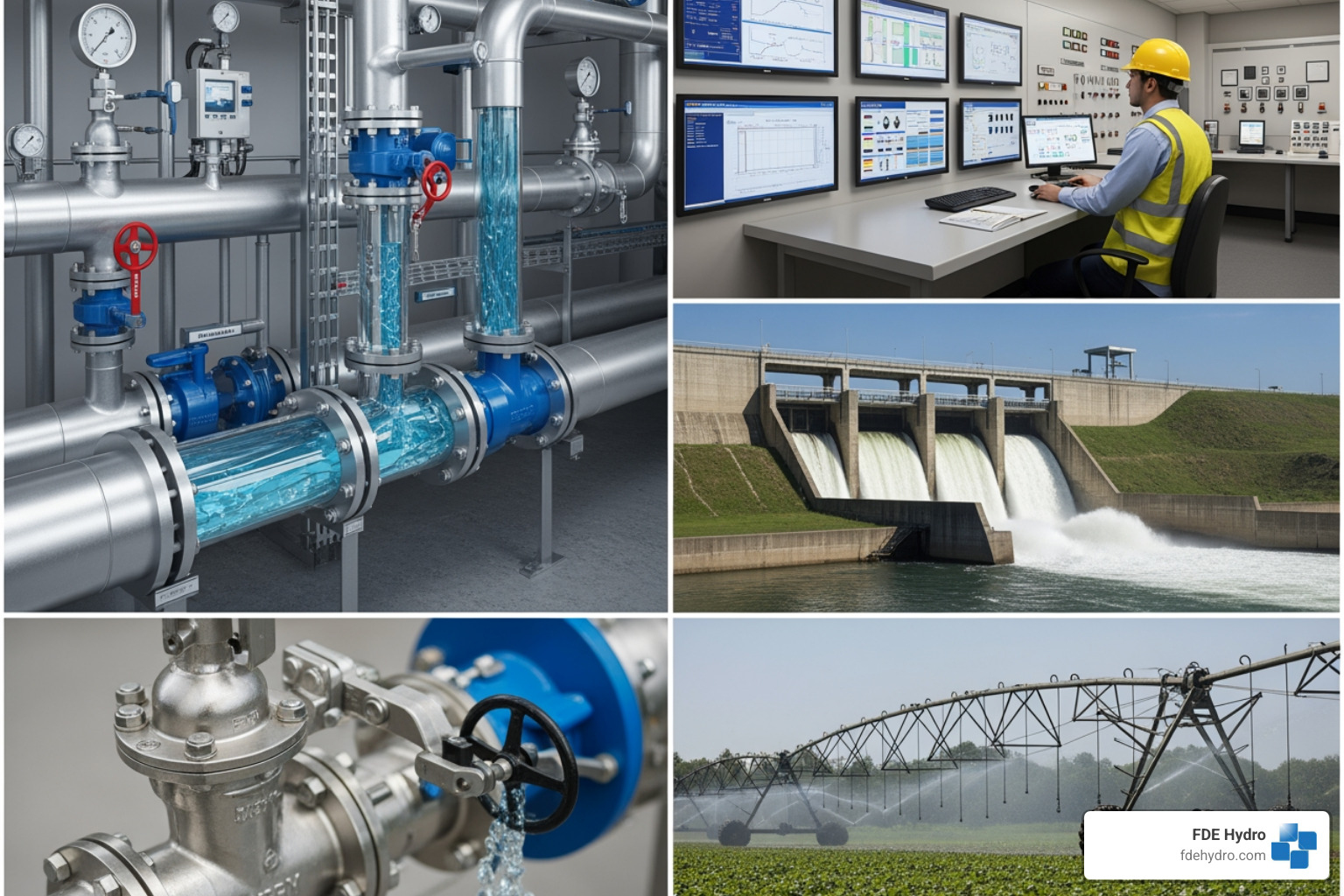
In irrigation, efficient flow control ensures crops receive precise water amounts, optimizing yields while conserving resources. In flood control, these structures manage discharge rates to protect communities. High-quality flow control is the backbone of any Water Infrastructure Projects Guide, ensuring resilience and sustainability for decades.
Frequently Asked Questions about Flow Regulation
What is the primary difference between a flow regulator and a flow restrictor?
A flow restrictor is a passive device that limits the maximum flow rate by creating a fixed obstruction. The actual flow rate will still fluctuate if upstream pressure changes. A flow regulator (or flow control valve) is an active device that maintains a constant flow rate regardless of pressure changes. It uses internal mechanisms to dynamically adjust, ensuring the flow remains at its predetermined GPM.
How do pressure variations affect the accuracy of a flow control valve?
Modern flow control valves are specifically engineered to counteract pressure variations. Their internal flexible orifices or O-rings are pressure-compensated. If upstream pressure increases, the orifice constricts; if it drops, the orifice relaxes. This allows the valve to remain accurate within 15% of its rated GPM, even at pressures up to 125 PSI.
Why is a self-cleaning mechanism important for water flow devices?
A self-cleaning mechanism is vital for maintaining accuracy and reducing maintenance. Over time, water carries sediment and mineral deposits. In valves without this feature, particles accumulate and cause blockages. A self-cleaning design flushes these deposits away, ensuring the internal mechanisms operate freely and preserving the valve’s accuracy over its entire lifespan.
Conclusion
Water flow control is a triumph of engineering that ensures constant flow rates, prevents cavitation, and promotes conservation across the globe. At FDE Hydro, we believe mastering water flow is essential for building sustainable infrastructure.
Our patented “French Dam” technology integrates these advanced water control principles into modular precast concrete systems for hydroelectric dams. By reducing construction time and costs, we are facilitating the implementation of the Water Control Infrastructure Guide 2025. Combining intelligent flow control with modern construction secures our water and energy resources for the future. To see how we are revolutionizing the industry, Learn more about our Means and Methods.
