

Why Water Management Infrastructure Is the Foundation of Modern Society
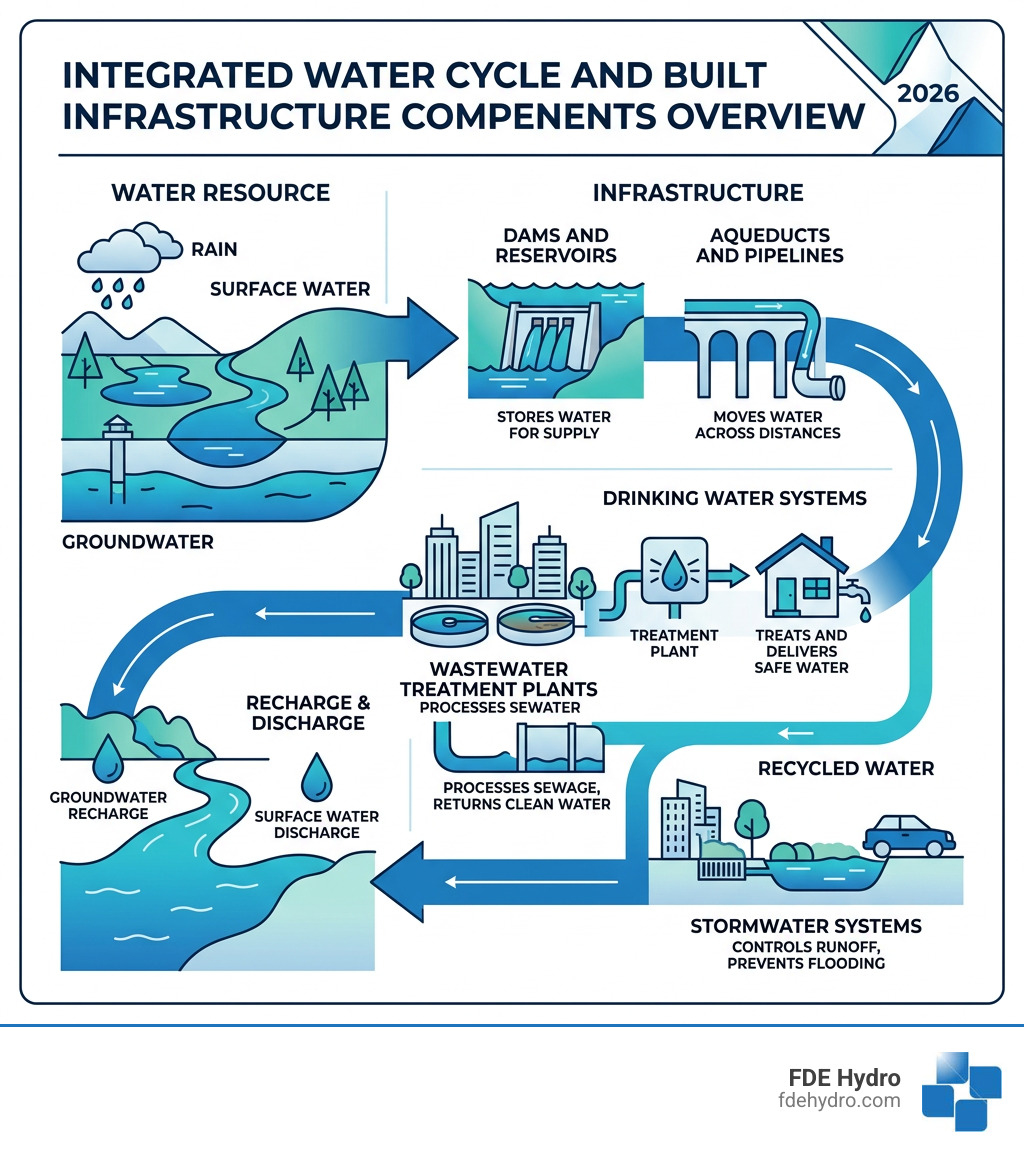
Water management infrastructure is the network of systems — pipes, treatment plants, dams, reservoirs, aqueducts, and stormwater controls — that collects, treats, stores, and delivers water to communities while safely removing wastewater.
Here is a quick overview of what it includes and why it matters:
| Component | What It Does |
|---|---|
| Drinking water systems | Treats and delivers safe potable water to homes and businesses |
| Wastewater treatment plants | Processes sewage and returns clean water to the environment |
| Stormwater systems | Controls runoff to prevent flooding and pollution |
| Dams and reservoirs | Stores water for supply, flood control, and power generation |
| Aqueducts and pipelines | Moves water across long distances to where it is needed |
Together, these systems serve over 80% of the U.S. population with clean drinking water and treat the wastewater of roughly 75% of Americans. Globally, the need for reliable water infrastructure is urgent — experts estimate a $10 trillion investment is needed by 2030 just to meet basic development goals, yet the world currently falls short by about $135 billion every year.
Much of what exists today was built after World War II. Some components are now over 100 years old. The gap between what we have and what we need — in funding, capacity, and resilience — is growing fast.
This guide walks you through how water management systems are built, what threatens them, and where the industry is heading.
I’m Bill French, Sr., Founder and CEO of FDE Hydro™ — a company built on five decades of heavy civil construction experience and focused on delivering modular solutions to the water management infrastructure and hydropower industries. My background spans large-scale site development, federal infrastructure projects, and patented modular construction technologies designed to make water systems faster, safer, and more cost-effective to build. That experience shapes every insight in this guide.
Water management infrastructure terms to learn:
Defining the Core Components of Water Management Infrastructure
To understand water management infrastructure, we have to look beneath the surface—literally. Most of us only think about water when we turn on a tap or flush a toilet, but those actions are the “last mile” of a massive engineering feat.
The infrastructure is generally divided into three main categories: drinking water, wastewater, and stormwater. Each has its own set of guidelines and studies that dictate how they are built and maintained.
| System Type | Number of Systems (U.S.) | Primary Goal |
|---|---|---|
| Public Drinking Water | ~152,000 | Deliver safe, potable water |
| Wastewater Treatment | >16,000 | Remove contaminants before discharge |
| Stormwater | Varies by municipality | Prevent urban flooding and erosion |
Beyond these, we have the “heavy lifters”: dams, reservoirs, and aqueducts. These components are responsible for the bulk storage and transport of water, often across hundreds of miles. In places like New York or California, these systems are the lifeblood of the economy, supporting both massive urban populations and vast agricultural tracts.
Drinking Water Systems and Distribution Networks in Water Management Infrastructure
The scale of the U.S. drinking water network is staggering. It includes more than 2.2 million miles of underground pipes. If you were to lay those pipes end-to-end, they would wrap around the Earth nearly 90 times.
These systems are composed of:
- Intake Structures: Drawing water from lakes, rivers, or aquifers.
- Treatment Plants: Using filtration and disinfection to meet safety standards.
- Storage Tanks: Elevated or ground-level reservoirs that maintain pressure and provide emergency supply.
- Distribution Mains: The massive network of pipes that move water to your neighborhood.
While large cities like Raleigh require facilities that handle tens of millions of gallons daily, there is also a critical need for smaller systems. The EPA provides specific guidelines for communities with fewer than 10,000 people, where the challenges of maintenance and funding are often more acute.
Wastewater Treatment and Resource Recovery
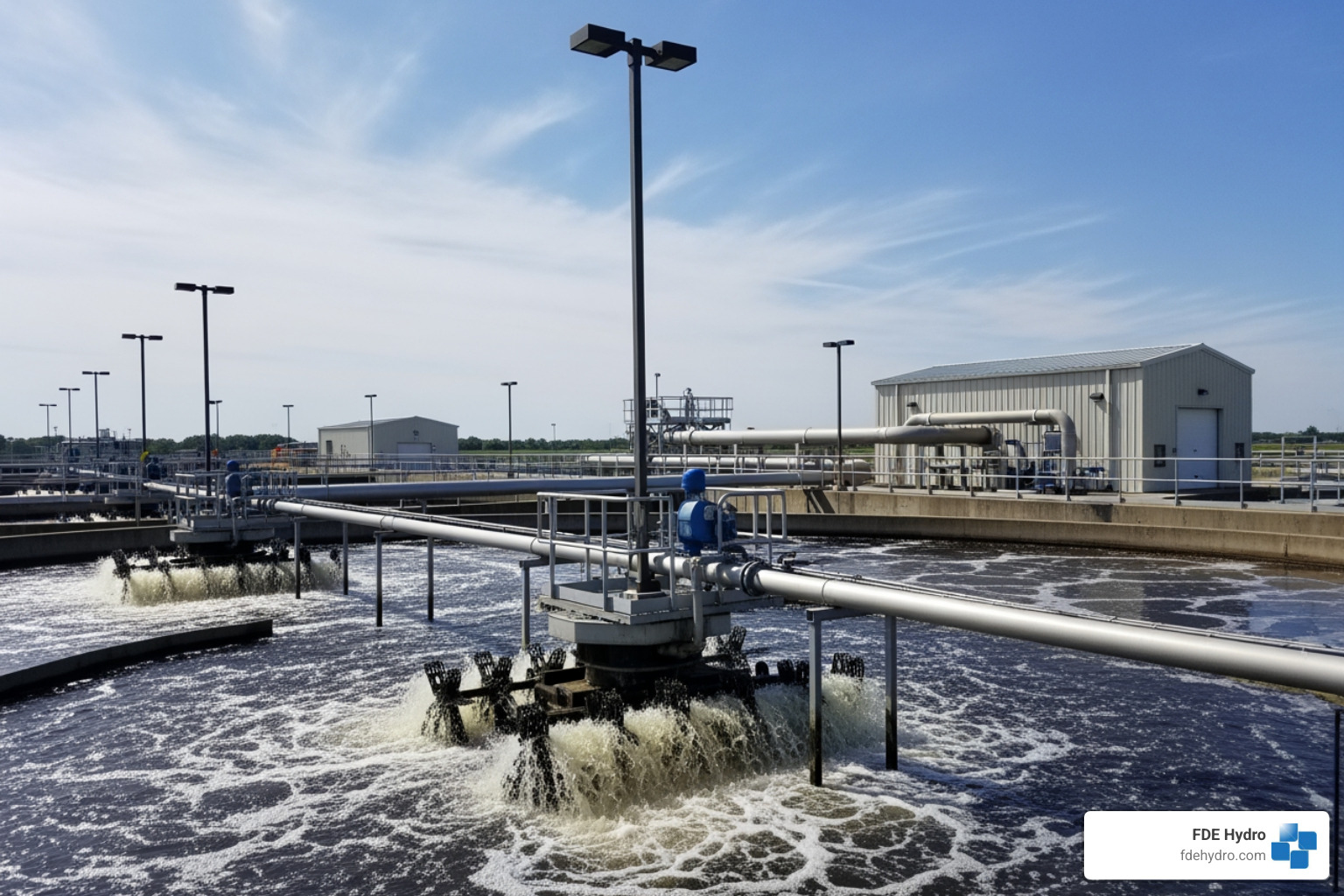
Wastewater treatment is essentially a factory process designed to mimic and accelerate nature’s way of cleaning water. There are more than 16,000 wastewater treatment plants in the U.S., and on average, they function at about 81% of their design capacity. However, 15% of these facilities have already reached or exceeded their limit.
The process typically involves:
- Mechanical Treatment: Removing large debris and grit.
- Biological Treatment: Using bacteria to break down organic matter in aeration tanks.
- Chemical Treatment: Disinfecting the water (often with chlorine or UV light) to meet federal discharge standards.
In major hubs like New York City, these plants process hundreds of millions of gallons every single day. The goal is no longer just “disposal”—it is “resource recovery,” where we extract energy, nutrients, and reclaimed water from what was once considered waste.
Critical Challenges Facing Modern Water Systems
We are currently at a crossroads. Much of our water management infrastructure was built in the post-WWII era, intended to last 50 years. We are now well past that expiration date. In some older cities, we are still relying on wooden pipes or brick sewers laid over a century ago.
The American Society of Civil Engineers (ASCE) frequently highlights these priority issues. The primary hurdles include:
- Aging Systems: Frequent main breaks lose trillions of gallons of treated water annually.
- Lead Service Lines: The urgent need to replace toxic lead pipes in older communities.
- Cyber Threats: As systems become more digital, they become targets for hackers looking to disrupt public services.
- Natural Disasters: Earthquakes, hurricanes, and floods can take out a treatment plant or breach a levee in hours.
The Impact of Climate Change on Water Management Infrastructure
Climate change is an “accelerant” for all these problems. In the Western U.S., prolonged droughts have led to record-low reservoir levels. In some cases, over-pumping of groundwater has caused the land itself to sink—a process known as subsidence.
The State Water Project Adaptation Strategy notes that reliability could be reduced by as much as 25% over the next 20 years. We aren’t just dealing with “less water”; we are dealing with “more unpredictable water.” Sea-level rise threatens to contaminate coastal aquifers with saltwater, while extreme storms overwhelm combined sewer systems, leading to raw sewage overflows.
Funding and Investment Shortfalls
The gap between what we need to spend and what we actually spend is wide. Globally, the shortfall is $135 billion annually. In the U.S., the Bipartisan Infrastructure Law has made a historic $50 billion investment in water infrastructure, primarily through the Clean Water and Drinking Water State Revolving Funds.
While this is a massive step forward, it is only a fraction of the total need. This is where we see the rise of Sustainable Water Infrastructure initiatives and public-private partnerships. We need to find ways to build more efficiently, and that is exactly why we developed the modular “French Dam” technology—to cut the time and cost of construction so that limited funds can go further.
The Lifecycle of Water Infrastructure Development Projects
Building a new treatment plant or dam isn’t like building a house. These are multi-decade commitments that involve hundreds of stakeholders.
The process is structured into four main phases:
- Planning: Feasibility studies, flood risk assessments, and Water Resources Management analysis.
- Preconstruction: Bidding, cost estimation, and refining designs for “constructability.”
- Construction: The actual physical build, which often requires on-site concrete plants for large-scale projects like dams.
- Post-construction: Rigorous testing, third-party inspections, and the creation of “as-built” documents for future maintenance.
Coordination is managed through groups like the Water Government Coordinating Council (WGCC) and the Sector Coordinating Council (WSCC), which ensure that private owners and government agencies are aligned on security and safety.
The Construction and Inspection Process
Once ground is broken, the focus shifts to precision and compliance. For pipelines, work is often done in segments—excavation, installation, and finishing—to allow parallel progress.
Quality control is non-negotiable. Facilities must follow NPDES inspection and testing protocols to ensure they aren’t leaking pollutants into the environment. Similarly, water storage facilities must meet strict safety standards to prevent catastrophic failures. We’ve found that using digital document management tools like Procore helps keep these complex projects on track, ensuring that every RFI and submittal is accounted for.
Case Studies: Large-Scale Water Projects in the United States
To see water management infrastructure at its most ambitious, we look to the massive projects that transformed the American West.
The Central Valley Project (CVP), managed by the Bureau of Reclamation, is a network of 20 dams and reservoirs and over 500 miles of canals. It annually delivers about 7 million acre-feet of water. To put that in perspective, it’s enough water to irrigate 3 million acres of farmland—producing food that feeds millions.
Then there is the California State Water Project (SWP). It is the nation’s largest state-owned water and power generator. Its centerpiece, the California Aqueduct, is over 400 miles long. It lifts water nearly 2,000 feet over the Tehachapi Mountains—the highest single-lift pumping effort in the world.
Adapting the California State Water Project
These historic projects are now being forced to modernize. The SWP is implementing a Climate Action Plan to address the “new normal” of extreme weather. Managers use a data dashboard to monitor reservoir levels and snowpack in real-time.
One of the biggest issues they face is land subsidence. In parts of the San Joaquin Valley, the ground is sinking by up to a foot per year because of groundwater depletion. This causes the concrete canals of the aqueduct to buckle and lose their “carrying capacity.” Fixing this requires a blend of Water Control Structures and new management strategies to recharge aquifers during wet years.
Future Trends and Sustainable Solutions
The future of water management infrastructure isn’t just about more concrete; it’s about smarter concrete and nature-based solutions.
- Nature-Based Solutions: Integrating wetlands and forests into the water cycle to naturally filter water and reduce flood peaks.
- Solar Canals: There is groundbreaking research on solar-covered canals which suggests that covering aqueducts with solar panels can generate massive amounts of renewable energy while reducing water loss from evaporation by up to 22 million gallons per mile.
- Digital Twins: Creating virtual replicas of water systems to predict how they will react to a flood or a pipe break before it happens.
- Modular Construction: This is where we are leading the way. By using patented modular precast concrete technology, we can build or retrofit dams and Water Control Systems in a fraction of the time required by traditional “poured-in-place” methods.
Frequently Asked Questions about Water Infrastructure
Why is much of the U.S. water infrastructure outdated?
Most of our systems were built in the mid-20th century with a 50-year lifespan. For decades, funding was diverted to other priorities, leading to a “fix-it-when-it-breaks” mentality rather than proactive maintenance.
What are the main threats to water system security?
The primary threats include physical attacks on remote facilities, cyberattacks on automated control systems, natural disasters like earthquakes, and the slow-moving threat of climate change-induced drought.
How does the Bipartisan Infrastructure Law help local communities?
It provides $50 billion in grants and low-interest loans. This allows communities—especially rural ones—to replace lead pipes, address PFAS “forever chemicals,” and upgrade aging treatment plants that they otherwise couldn’t afford.
Conclusion
The path to a resilient future depends on how we manage our most precious resource. Water management infrastructure is no longer just about moving water from point A to point B; it is about energy efficiency, environmental stewardship, and economic survival.
At FDE Hydro™, we believe that the old ways of building are too slow and too expensive for the challenges we face today. Our modular precast “French Dam” technology is designed to help communities in North America, Brazil, and Europe build Sustainable Water Infrastructure faster. Whether it’s retrofitting a historic dam for hydropower or building new Water Infrastructure Solutions, we are committed to building the future of water management.
Ready to learn more about how we can accelerate your next project? Explore our water control infrastructure guide.