

Why Control System Upgrades Are Critical for Long-Term Operational Success
Control system upgrades are the process of replacing or modernizing outdated industrial automation hardware, software, and logic to improve reliability, safety, efficiency, and cybersecurity. Here’s a quick overview of what you need to know:
- What they are: Replacing legacy PLCs, HMIs, DCS platforms, and control logic with modern, supported systems
- Why they matter: Outdated systems cause unplanned downtime, create cybersecurity risks, and are increasingly expensive to maintain
- When to act: When parts are no longer available, software runs on unsupported operating systems, or safety and compliance standards can’t be met
- Key benefits: Reduced downtime, remote access, real-time data visibility, improved safety, and longer equipment life
- Biggest risk of waiting: Every month of delay increases exposure to failure, regulatory penalties, and runaway maintenance costs
For large-scale infrastructure like hydropower, the stakes are even higher. A single unplanned outage doesn’t just cost production time — it can trigger regulatory violations and cascade into costly civil or mechanical damage.
Consider this: one chemical manufacturing facility was experiencing two to three shutdowns every month because of a failing legacy control system. Each incident cost tens of thousands of dollars in fines and lost production. The fix wasn’t replacing the entire plant — it was upgrading the controls.
That’s the core insight here. You often don’t need to replace expensive, long-life equipment. A targeted controls upgrade can extend asset life and dramatically improve performance.
I’m Bill French, Sr., Founder and CEO of FDE Hydro™, and over five decades of leading large-scale civil and infrastructure projects — including hydropower innovation and heavy construction — I’ve seen how control system upgrades determine whether a facility thrives or stalls. In the sections ahead, I’ll walk you through everything you need to make a smart, strategic modernization decision.
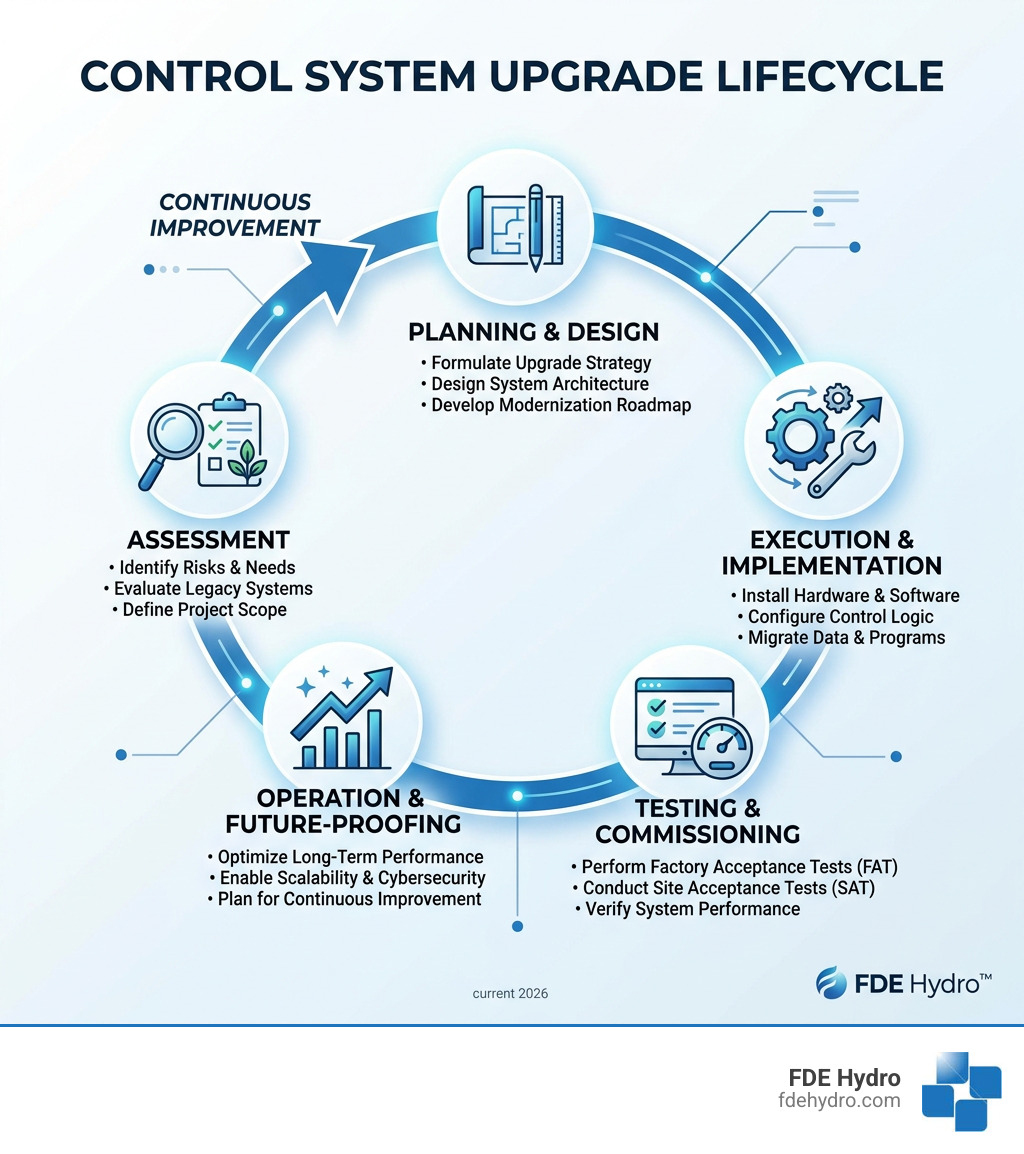
Terms related to Control system upgrades:
Identifying the Need for Control system upgrades
Buying industrial equipment isn’t like buying a new iPhone. You don’t upgrade just because a sleek new model hit the shelves. In industries like hydropower or chemical manufacturing, we work with expensive, bespoke equipment designed to last for decades. However, while the concrete and steel of a dam might be in its prime, the “brains” of the operation—the control system—can age rapidly.
Common Signs It’s Time for Control system upgrades
How do you know when “just keeping it running” is no longer a viable strategy? We often see several “red flags” that indicate a system has reached its breaking point.
First is the frequency of unexplained downtime. If your team is spending more time troubleshooting intermittent communication faults than actually running the plant, you have a problem. One facility we know of suffered through 4-8 hours of line downtime per incident just because of a failing communication module in an old PLC rack.
Second is the “eBay Factor.” If your maintenance team is scavenging for replacement parts on secondary markets because the original manufacturer no longer stocks them, you are living on borrowed time. When a critical I/O module fails and the only replacement is a used part from a stranger online, your operational stability is officially at risk.
Finally, a lack of remote access is a major sign. Modern Control system upgrades allow operators to clear alerts or resolve issues via a secure web connection from home. If your system requires a physical presence for every minor hiccup, you’re missing out on massive efficiency gains.
Why Legacy Systems Become Liabilities
Legacy systems eventually transition from assets to liabilities. One of the biggest risks is cybersecurity. Many older systems run on unsupported operating systems like Windows XP. These are “sitting ducks” for modern malware and viruses because they no longer receive security patches.
There is also the “Knowledge Gap.” As the engineers who installed these systems in the 1990s retire, they take their “tribal knowledge” with them. If your system relies on “that one guy” who knows how to coax the old code into working, you have a massive single point of failure.
Furthermore, compliance is a moving target. Safety standards have evolved significantly since the early 2000s. Modern systems must adhere to the IEC 61131-3 specification, which standardizes programming languages like Ladder Diagram and Structured Text. Staying on an old, non-compliant platform can leave facility owners liable if an accident occurs. For those managing complex aquatic environments, you can find more info about water control system management to see how modern logic integrates with physical structures.
Strategic Planning and Evaluation for Modernization
A successful upgrade doesn’t start with a purchase order; it starts with a forensic audit. We’ve seen projects fail because the field cabling didn’t match the 20-year-old drawings. You must document exactly what is physically present in the cabinets—every sensor, valve, and I/O point. This is a critical part of hydropower asset management.
The Role of Phased Implementation
In brownfield environments—existing plants that must keep running—a “rip and replace” approach is rarely feasible. Instead, we advocate for phased implementation. This might involve dividing a control room in half and updating one side at a time, or upgrading unit by unit.
At one major smelter, a massive control system upgrade was completed under a tight eight-week schedule without disrupting production. This was only possible through upfront planning and “dual-running” systems where the old and new controls operate in parallel until the team is 100% confident in the new logic.
Avoiding Mistakes During Control system upgrades
One of the most common mistakes is treating I/O mapping as a simple “copy and paste” exercise. Over ten or twenty years, plants add sensors, bypass valves, and temporary fixes that never made it onto the official drawings. If you don’t perform disciplined field testing to verify every single point, your new system will be born with errors.
Another pitfall is upgrading hardware without reviewing the process logic. Old code was often written for different production targets or slower hardware. Simply porting old, “messy” code into a high-speed modern PLC is like putting a lawnmower engine in a Ferrari—it won’t perform. We recommend a full logic audit to strip out “temporary” code fixes that have become permanent risks.
Common Commissioning Pitfalls to Avoid:
- Rushing the Factory Acceptance Test (FAT).
- Ignoring integration with existing VFDs, robotics, or SCADA.
- Failing to build in spare I/O capacity for future expansion.
- Underestimating the time needed for Site Acceptance Testing (SAT).
Maximizing ROI: Upgrade vs. Full Equipment Replacement
A common question we hear is: “Should I just buy a whole new machine?” Generally, we use the “50% Rule.” If the cost of the Control system upgrades exceeds 50% of the cost of a brand-new unit, a full replacement might be the better path. However, for large bespoke equipment like hydroelectric turbines or chemical reactors, the controls are usually a small fraction of the total asset value.
| Factor | Controls Upgrade | Full Equipment Replacement |
|---|---|---|
| Typical Cost | 15-30% of new | 100% |
| Lead Time | 2-4 months | 6-12+ months |
| Operational Impact | Phased/Minimal | Significant Shutdown |
| Asset Life Extension | 10-15 years | 20-30 years |
By focusing on the controls, you can often achieve a “new lease on life” for your equipment at a fraction of the cost. This is a core strategy in hydropower retrofitting, where we modernize the “brains” to keep the heavy iron running efficiently.
Operational Benefits and Efficiency Gains
The numbers speak for themselves. One customer reduced their downtime by a staggering 45% and boosted production by 15% simply by replacing an outdated PLC. In the nuclear industry, industry data shows that poor feedwater control has been a top contributor to reactor trips since the 1980s. Upgrading to a digital platform like Ovation provides the fault tolerance and precision needed to prevent these costly shutdowns.
Real-World Success Stories
We’ve seen these benefits across industries. In the chemical sector, an RTO (Regenerative Thermal Oxidizer) upgrade stopped the 2-3 monthly shutdowns that were costing tens of thousands in environmental fines. In power plants, upgrading unit controls and protective relaying one unit at a time has allowed facilities to modernize without ever reducing total power output to the grid.
Overcoming Challenges in Brownfield and Integrated Systems
Upgrading a “greenfield” site (starting from scratch) is easy. Upgrading a “brownfield” site (an existing, active plant) is where the real work happens. You’re often dealing with undocumented workarounds and physical infrastructure challenges, like cable trays that are already at 100% capacity.
When we look at dam rehabilitation, the integration of new sensors into old concrete requires a delicate touch. The same applies to control systems. You must verify that the new digital signals can actually travel over the existing field wiring, or plan for a complete “re-pull” of cables.
Training and Change Management
The best control system in the world is useless if the operators don’t trust it. We’ve seen “rushed” commissioning lead to faulty alarms that eventually cause operators to ignore the system entirely.
To prevent this, we prioritize human-centered HMI (Human-Machine Interface) design. Modern screens should be intuitive, using high-performance graphics that highlight problems rather than overwhelming the user with data. We also recommend hands-on simulation training. By letting operators “break” the system in a virtual environment, they gain the confidence to run it at peak efficiency on day one.
Integrating New Technologies
Modern Control system upgrades open the door to advanced technologies like AI and machine learning. Once your data is digitized and accessible, you can use AI for resource management to predict when a bearing might fail or to optimize water flow based on weather patterns. This level of scalability is impossible on a legacy platform.
Future-Proofing and Modern Requirements
Future-proofing means more than just buying the latest hardware. It means choosing open protocols that allow different brands of equipment to talk to each other. If you lock yourself into a single proprietary “black box,” you’ll be facing the same obsolescence issues in ten years.
To future-proof your Distributed Control Systems, look for modular designs that allow you to swap out individual components as technology evolves.
Addressing Cybersecurity and Remote Access
In the past, “security by obscurity” was the norm—if the system wasn’t on the internet, it was safe. Today, that’s no longer true. Modern upgrades must follow standards like IEC 62443. This includes implementing secure VPNs for remote troubleshooting and ensuring that the control network is physically or logically separated from the office “guest” Wi-Fi. This visibility allows for real-time data analysis without opening the door to hackers.
Long-Term Viability Strategies
Standardization is your best friend. If your plant has five different brands of PLCs, your team has to learn five different languages and keep five different sets of spare parts. Use your upgrade as an opportunity to standardize on one or two key brands.
Also, always plan for the future. We recommend building in at least 20% spare I/O capacity. It’s much cheaper to add a few extra terminal blocks now than to try and squeeze a new cabinet into a crowded room five years from now. For water-specific applications, integrating water management AI can further extend the viability of your investment by automating complex decision-making processes.
Frequently Asked Questions about Control System Upgrades
When is the best time to schedule a control system upgrade?
The best time is during a planned maintenance shutdown. However, because Control system upgrades can be phased, you can often perform the preparatory work (like installing new cabinets and pulling cable) while the plant is running, leaving only the final “cut-over” for the shutdown window.
How do upgrades improve industrial cybersecurity?
Modern systems are built with security in mind. They support encrypted communications, user authentication (who changed what and when?), and run on modern operating systems that receive regular security patches. They also allow for better network segmentation to keep the “brains” of your plant isolated from external threats.
Can I upgrade my controls without replacing my mechanical equipment?
Absolutely. In fact, this is the most common way we work. By keeping the heavy mechanical assets and simply upgrading the sensors, processors, and software, you can achieve “like-new” performance for a fraction of the cost of a full replacement.
Conclusion
At FDE Hydro™, we believe that modernization is not a luxury—it is a strategic necessity. Whether you are managing a small municipal water structure or a massive hydroelectric facility, the “brains” of your operation dictate your success.
Control system upgrades offer a path to operational excellence, allowing you to reduce downtime, enhance safety, and protect your assets from the growing threat of cybersecurity breaches. By following a structured approach—audit, plan, phase, and train—you can transform your legacy liabilities into modern competitive advantages.
Don’t wait for a catastrophic failure to force your hand. Proactive modernization ensures that your facility remains reliable and profitable for the next generation. Unlock long-term ROI with expert hydropower financing and risk mitigation and start planning your upgrade today.
