

Why Power Start Matters for Connecting Your Home to the Grid
Power start is the process of initializing electrical service — getting your home reliably connected to the grid and capable of running high-demand appliances from the moment power flows.
Here’s a quick overview of what that involves:
- Confirm your utility service requirements — voltage, amperage, and inrush capacity for appliances like HVACs
- Choose the right power infrastructure — battery storage, grid connection hardware, or hybrid systems
- Plan your project clearly — define purpose, outcomes, and roles before work begins
- Execute and verify — connect, test, and confirm stable power delivery
Most homeowners and project managers underestimate what a true power start requires. It’s not just flipping a switch. High-inrush appliances — like HVAC systems — demand a surge of current at startup that can overwhelm under-spec’d systems. A 7-person planning meeting that goes off the rails can waste $900 in labor time before a single wire is run. Poor preparation compounds every problem downstream.
Getting your power start right means aligning the technical side (amps, torque, storage capacity) with the planning side (clear goals, defined roles, stakeholder buy-in).
I’m Bill French, Sr., Founder and CEO of FDE Hydro™, and after five decades leading large-scale civil construction and hydropower development projects, I’ve seen how a well-executed power start — whether for a modular hydropower facility or a grid-connected home — determines the success of everything that follows. In this guide, I’ll walk you through both the technical and strategic frameworks you need to get it right.
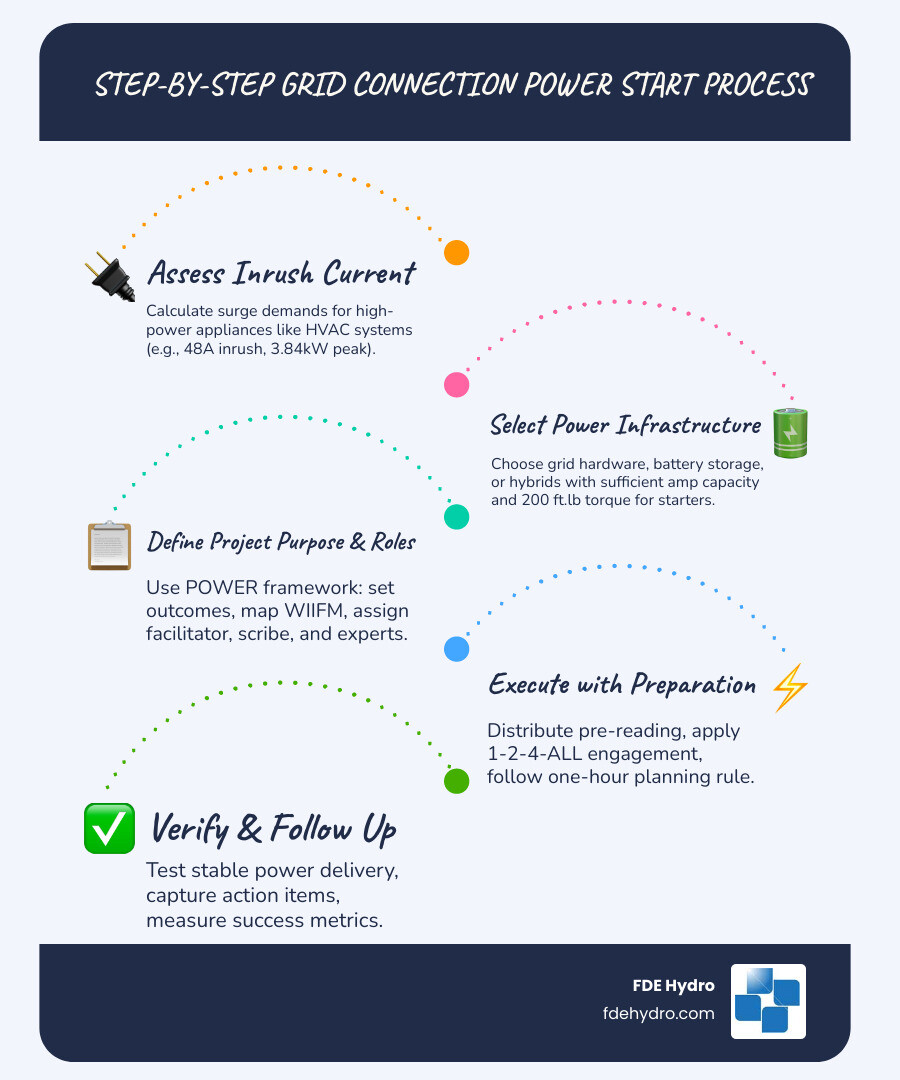
Power start terms to remember:
Understanding the Technical Power Start Capability
When we talk about a power start in the context of home energy and grid connectivity, we are often referring to the system’s ability to handle “inrush current.” This is the sudden surge of electricity required to start heavy motors. If your system lacks this capability, your lights might flicker, or worse, your expensive HVAC system could sustain damage over time due to poor power quality.

Modern battery systems have revolutionized this. For instance, high-performance batteries now offer a 48 Amp power start capability. This means a single battery unit can provide the “kick” needed to get a power-hungry appliance running without relying on the grid. In a modular architecture, you can scale this from 5 kWh up to 80 kWh, providing roughly 3.84 kW of power for every 5 kWh of capacity. This scalability is vital for homes in places like New York or California, where energy independence and grid stability are top priorities.
The technical requirements for a power start aren’t limited to home batteries; they mirror the physics we see in mechanical starters. According to Starter Basics and Torque Requirements, the amount of torque required is dictated by the resistance of the system. For high-compression engines (over 12:1), a 200 ft.lb torque starter is recommended. Just as a racing engine needs massive torque to overcome internal resistance, your home electrical system needs high amperage to overcome the “rotational resistance” of an air conditioner compressor.
At FDE Hydro, we apply these same principles of high-capacity initialization to Hydroelectric Power Generation. Whether you are starting a home HVAC or a turbine, the physics of power delivery remain the same: you need enough initial force to move the needle.
The POWER Start Framework for Project Planning
While the technical side handles the electrons, the strategic side handles the people. In my experience, a project only succeeds if the initial “meeting of the minds” is as high-torque as the equipment. This is where the POWER Start technique comes in.
Originally developed by the Agile Coaching Institute, the POWER Start is a framework designed to eliminate the “vague meeting” syndrome. We’ve all been there: seven people sitting in a room for an hour with no clear goal. If those seven people average $100/hour in labor costs, that’s a $900 meeting (including prep and overhead) that yielded nothing.
The acronym breaks down as follows:
- Purpose: Why are we here?
- Outcomes: What specific things will we leave with?
- WIIFM (What’s In It For Me): Why should the stakeholders care?
- Engagement: How will we keep everyone involved?
- Roles: Who is doing what?
By investing about one hour of preparation for every hour of meeting time, you significantly boost Hydroelectric Dam Efficiency and project velocity. It turns a “talk shop” into a high-output engine.
Defining the Purpose of Your Power Start
The “Purpose” in a POWER Start should be a concise statement in plain language. Avoid corporate jargon like “aligning synergies.” Instead, try: “To decide on the specific battery capacity and grid connection point for the Lawrence project so we can order parts by Friday.”
A clear purpose acts as a north star. If the conversation drifts toward unrelated topics, anyone in the room can point back to the purpose statement and get the project back on track. This alignment is the first step in any successful utility service connection.
Roles and Engagement in a Power Start Project
Every participant in a power start meeting should have a defined role. This isn’t just about who is the boss; it’s about function. Common roles include:
- Facilitator: Keeps the meeting moving and follows the framework.
- Scribe: Captures decisions and action items.
- Subject Matter Experts (SMEs): Provide the technical “torque” regarding electrical codes or battery specs.
Engagement is the “fuel” of the meeting. To avoid the “strong personality” trap where one person dominates, use mapping techniques to ensure everyone’s “What’s In It For Me” (WIIFM) is addressed. If a stakeholder knows exactly how this grid connection benefits their specific department or budget, they are much more likely to contribute constructively.
Step-by-Step Guide to Implementing the Framework
Implementing a power start for your home or project isn’t a suggestion; it’s a requirement for efficiency. Whether you’re in Kansas or Europe, the steps remain remarkably consistent.
Phase 1: Pre-Meeting Preparation
The most important rule is the One-Hour Rule: for every hour of the meeting, spend one hour preparing. Use this time to:
- Draft Outcome Bulletpoints: Don’t just list “topics.” List “decisions to be made.”
- Prepare Pre-reading: Send out technical specs or Hydro Electric Dams data 24 hours in advance.
- Plan Engagement: Decide if you will use the 1-2-4-ALL technique (reflecting alone, then in pairs, then fours, then the whole group) to generate ideas quickly.
| Feature | Traditional Agenda | POWER Start Framework |
|---|---|---|
| Focus | List of topics to discuss | Specific outcomes to achieve |
| Engagement | Passive listening | Active participation (e.g., 1-2-4-ALL) |
| Roles | Often undefined | Clear roles (Facilitator, Scribe, SME) |
| Value | “Why am I here?” | WIIFM is clearly mapped |
Phase 2: During the Meeting
When the meeting begins, display your purpose and outcomes visually. This could be on a physical whiteboard or a shared digital screen for hybrid teams in New York City and Brazil.
Use Dot Voting to quickly find a consensus on hardware choices. For example, if you’re choosing between different battery configurations, have everyone “vote” with dots on the options that best meet the project’s amp requirements. To generate a high volume of ideas for troubleshooting a connection, try 25/10 Crowdsourcing, where participants rapidly rate ideas to find the top 10% most viable solutions.
Phase 3: Post-Meeting Follow-up
A power start doesn’t end when the meeting does. You must capture commitments immediately. Who is calling the utility company? Who is verifying the inrush current of the HVAC?
For hybrid or virtual meetings, use digital tools to track these success metrics. Ensure that the “Roles” defined earlier carry over into the execution phase. If the meeting was the “starter motor,” the follow-up is the “alternator” that keeps the project’s battery charged.
Avoiding Pitfalls in Utility Service Connections
The biggest pitfall in any power start is a vague purpose. If you don’t know exactly what “success” looks like, you will waste time and money. As mentioned earlier, a poorly managed 7-person meeting can cost $900 in lost productivity. Over the course of a large-scale project, these “small” wastes can balloon into tens of thousands of dollars.
Another common issue is allowing “strong personalities” to derail the technical requirements. Just because someone talks the loudest doesn’t mean their plan accounts for the 48 Amp inrush current needed for the home’s cooling system. By using the Hydroelectric Power Solutions Guide, you can keep the focus on data-driven decisions rather than opinions.
Frequently Asked Questions about Power Start
Who developed the POWER Start technique?
The POWER Start technique was originally developed by the Agile Coaching Institute. It grew out of a need for better facilitation in complex, fast-moving environments (like software development and renewable energy). It is now taught as a core framework for keeping meetings focused and delivering high-quality outcomes.
How does POWER Start differ from a standard agenda?
A standard agenda is usually just a list of things to talk about. A POWER Start is a commitment to what will be done. It focuses heavily on engagement and “What’s In It For Me” (WIIFM), ensuring that every person in the room is there for a reason and understands the value of the project.
What tools are needed to implement a POWER Start?
You don’t need fancy software. A simple downloadable template or a visual board (like a whiteboard) is often most effective. The “tools” are really the techniques: check-in questions to gauge the room’s energy, visual agendas to keep everyone on track, and facilitation methods like dot voting to reach a consensus quickly.
Conclusion
At FDE Hydro, we believe that the way you start a project dictates how you finish it. Whether you are connecting a single home to the grid or building a massive modular dam, a power start ensures you have the technical capacity and the strategic clarity to succeed.
By combining high-amp hardware with the POWER planning framework, you reduce waste, protect your appliances, and ensure a reliable flow of Hydropower or grid energy for years to come. Don’t just flip a switch — start with power.
