

Why Modular Building Systems Are Revolutionizing Construction
Modular building systems are revolutionizing construction by offering a faster, more cost-effective, and sustainable alternative to traditional methods. This approach involves prefabricating building sections—or modules—in a factory, then transporting and assembling them at the final location.
Key Facts About Modular Building Systems:
- Speed: Projects can be completed up to 50% faster due to simultaneous site preparation and factory manufacturing.
- Structure: Modules are 60% to 90% completed off-site in climate-controlled factories.
- Strength: Modular buildings are often stronger than site-built structures, as each module is engineered to withstand transportation and craning.
- Cost: Can yield up to 20% in total project cost savings through reduced labor and material waste.
- Safety: Reduces reportable accidents by over 80% compared to traditional construction.
- Waste: Achieves up to 90% reduction in construction waste through controlled manufacturing.
- Timeline: A typical modular building can be move-in ready in about three months.
For project managers, the modular approach addresses critical pain points like high capital costs, extended timelines, and operational risks. By moving approximately 80% of construction activity off-site, modular building systems minimize site disruption, weather delays, and improve project predictability.
The modular industry generates over $8 billion annually and is projected to deliver $22 billion in annual cost savings by 2030 for the US and European markets. This growth reflects demand for standardized solutions in sectors like housing, healthcare, and industrial applications.
I’m Bill French Sr., Founder and CEO of FDE Hydro™, where we’ve pioneered applying modular building systems to hydropower infrastructure with innovations like the French Dam and modular powerhouses. My five decades in heavy civil construction, including modular precast projects like the I-93 Fast14, have shown me how modularity transforms complex engineering into streamlined, cost-effective solutions.
Modular building systems word guide:
The Modular Method: From Factory to Foundation
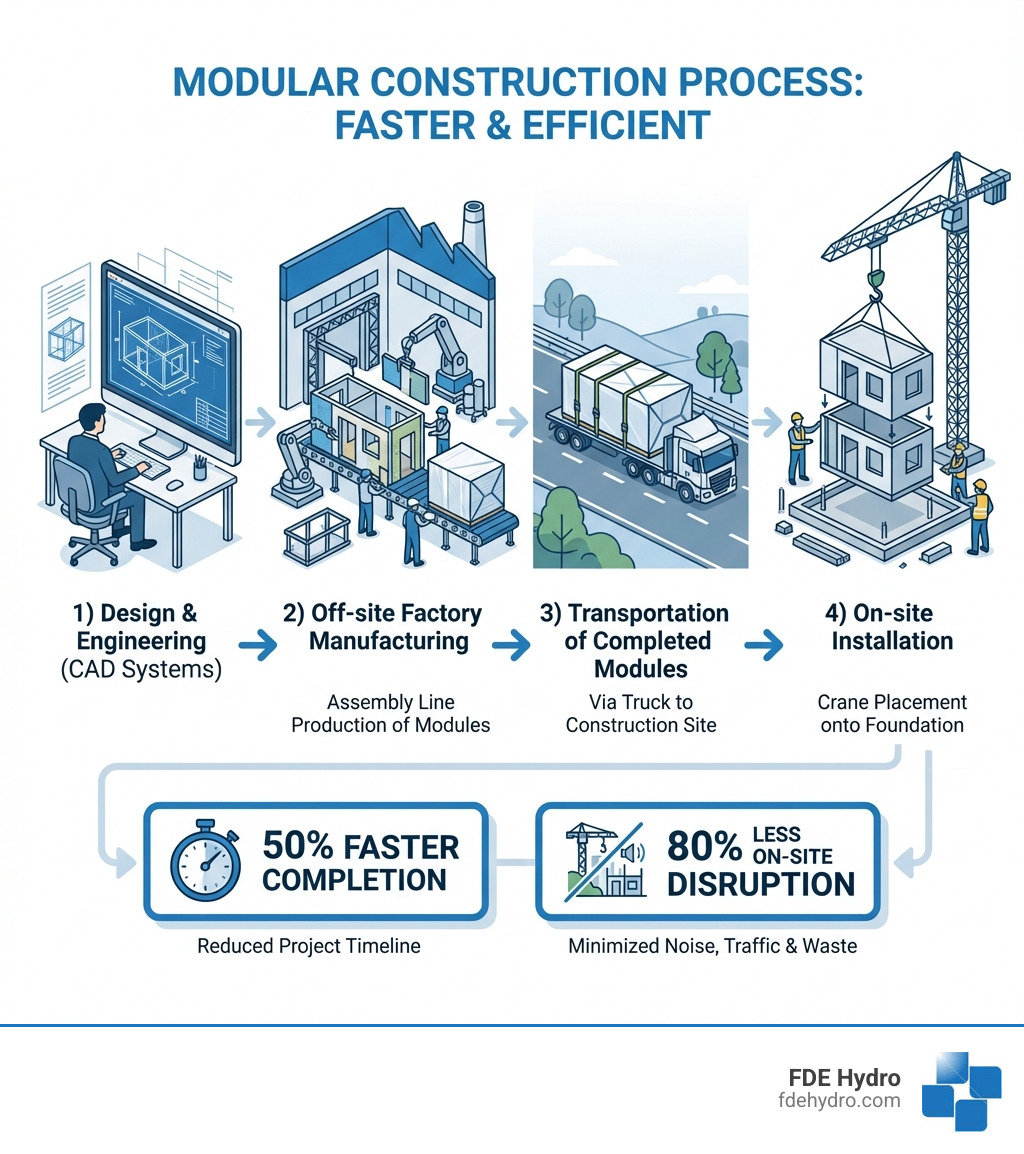
The essence of modular building systems is a carefully orchestrated process that shifts most construction from an unpredictable job site to a controlled factory. This method streamlines the entire project, from design to installation, altering traditional timelines and quality control. The journey begins with meticulous design, moves through precision factory fabrication, and culminates in rapid on-site assembly. This allows us to deliver projects with unparalleled speed, whether it’s a new school in Kansas or a hydroelectric powerhouse in Brazil. Find more about our approach to Modular Construction Techniques.
The Step-by-Step Modular Construction Process
Here is the typical process for bringing a modular building to life:
- Design & Engineering: This crucial initial phase uses advanced Building Information Modeling (BIM) and 3D modeling to create detailed designs. Unlike traditional construction, modular designs are finalized upfront, from structural integrity to MEP systems. This front-loaded effort pays dividends in efficiency, allowing our engineers to tailor solutions for even the most complex structures.
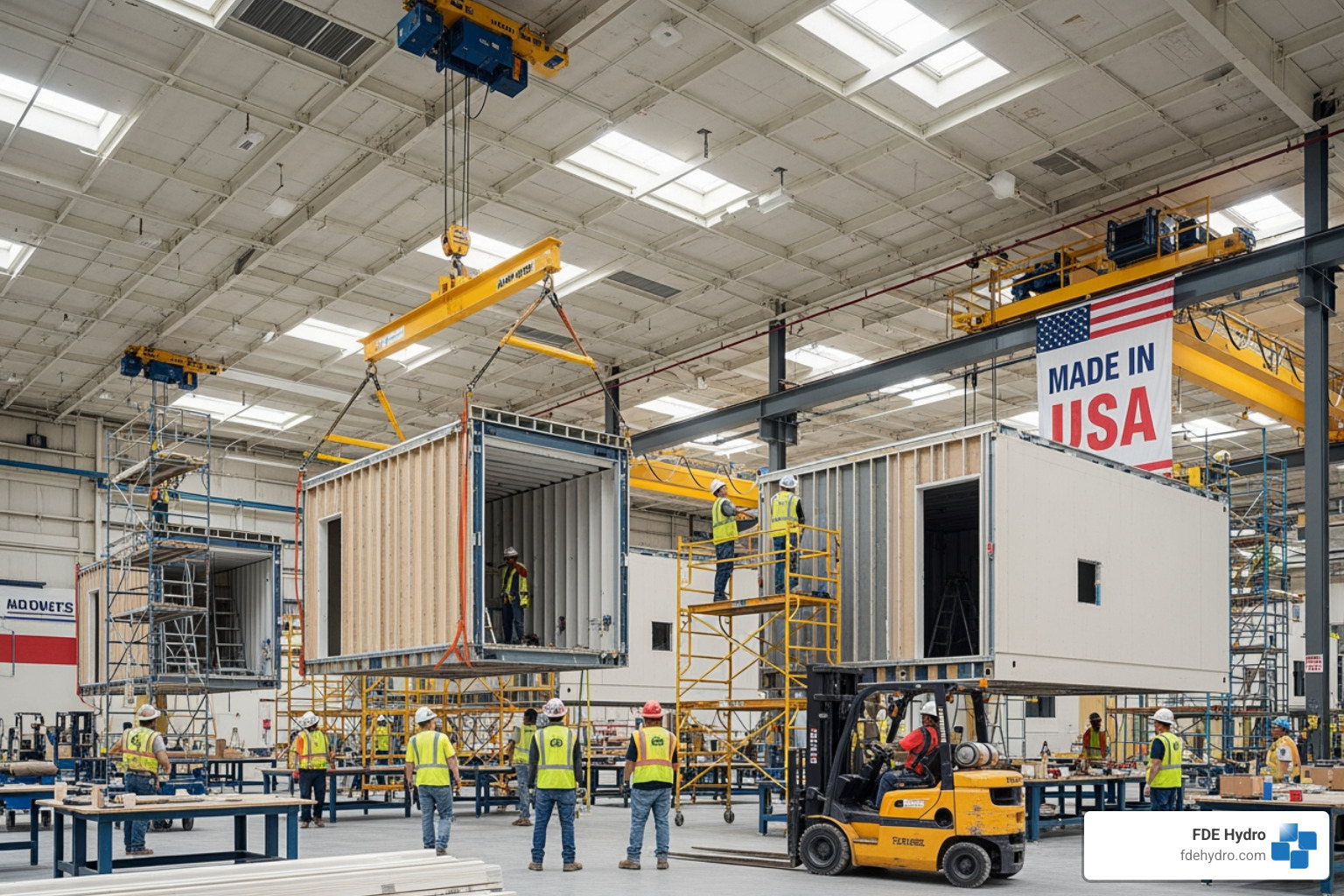
- Off-site Manufacturing: With designs approved, modules are precision-crafted on factory assembly lines. Up to 90% of the building—including walls, floors, wiring, and fixtures—is completed off-site. This controlled environment eliminates weather delays, reduces waste, and enables stringent quality assurance programs with independent inspections.
- Site Preparation: While modules are built in the factory, the construction site is prepared simultaneously. This parallel process is a key time-saver. Foundations are laid and utilities are installed, often faster than traditional builds due to the precise weight distribution of modules.
- Module Transportation: After factory inspection, completed modules are transported to the site. This requires careful logistical planning. While transportation costs for fabricated modules can be higher than for raw materials, the overall savings in labor and time typically outweigh these expenses.
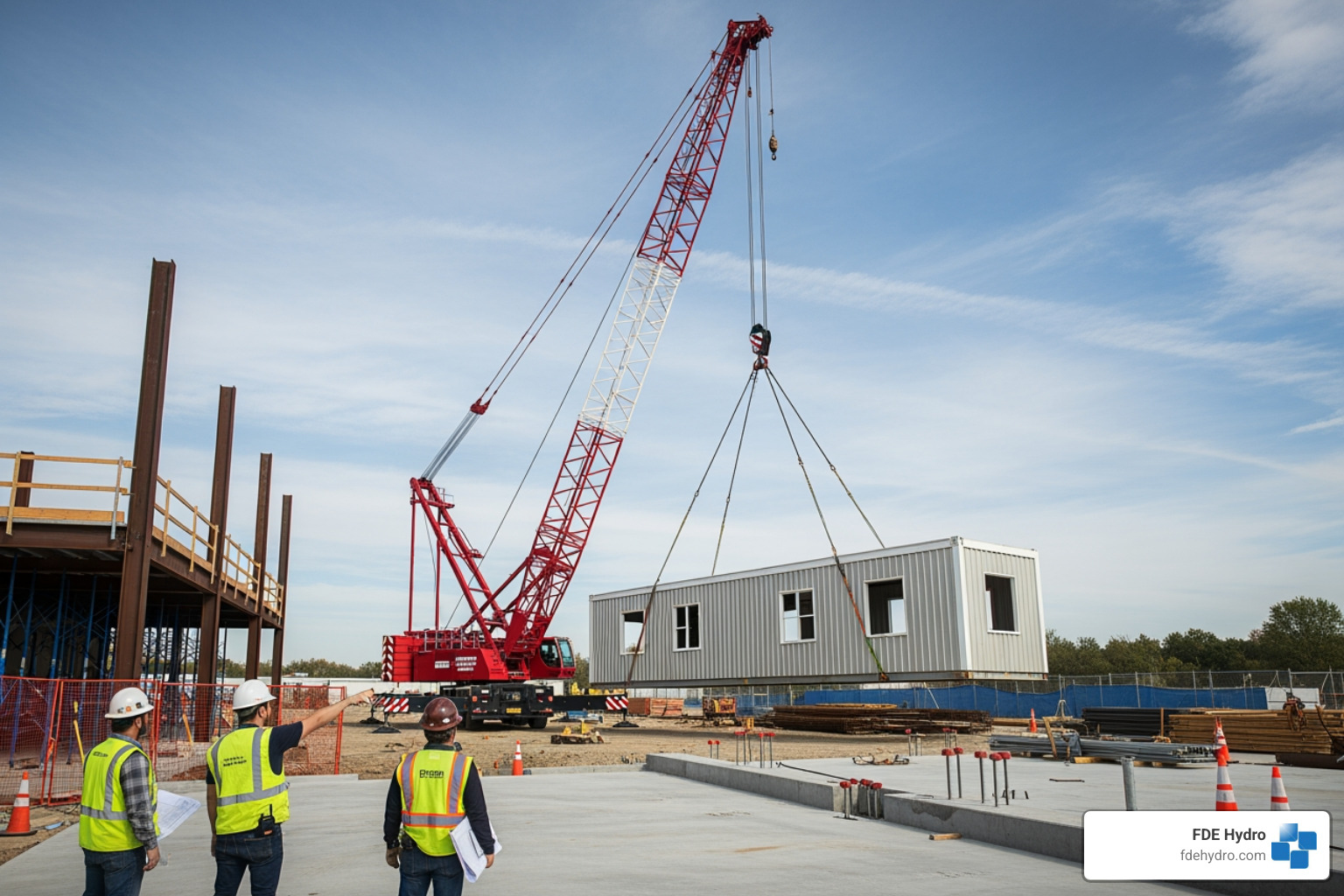
- On-site Installation: This phase is remarkably fast. Using cranes, a small crew lifts and places each module onto the prepared foundation. Modules are then secured and connected to site utilities. A team can assemble up to six 3D modules (270 sq. meters) in a single day, rapidly changing the site.
- Finishing Work & Site Restoration: Once modules are assembled, final touches like exterior cladding and landscaping are applied. Since most work is done off-site, there is minimal disruption, resulting in less noise, traffic, and a safer environment for the community.
Modular vs. Prefabricated vs. Mobile Homes
The terms “modular,” “prefabricated,” and “mobile home” are often confused. They represent distinct construction types with key differences in codes, foundations, and financing.
| Feature | Modular Buildings | Prefabricated Components | Mobile Homes (Manufactured Homes) |
|---|---|---|---|
| Definition | Complete building sections (modules) built off-site. | Individual components (wall panels, trusses) built off-site. | Factory-built homes on a permanent steel chassis. |
| Building Codes | Built to local, state, and national building codes (e.g., IBC), same as site-built homes. | Built to project specifications; part of a larger structure. | Built to a federal HUD code, not local codes. |
| Foundation Type | Designed for permanent foundations (e.g., basement), integral to the structure. | Varies with the overall construction method. | Integral steel chassis; can be placed on non-permanent or permanent foundations. |
| Customization | High customization with CAD design; often indistinguishable from site-built. | Varies by component and project needs. | Limited customization with standardized designs. |
| Financing | Financed like site-built homes with conventional mortgages. | N/A (part of a larger project). | Often requires specialized lenders; may depreciate like vehicles. |
| Resale Value | Appraised similarly to site-built homes. | N/A | Can depreciate over time; often registered like vehicles. |
| Identification | Data plate inside with manufacturer and inspection info. | N/A | Small metal tag on the exterior of each section. |
In short, all modular buildings are prefabricated, but not all prefabrication is modular. A prefabricated wall panel is a component, while a fully equipped room is a module. Mobile homes are a distinct category governed by different federal standards and are not designed for permanent foundations in the same way modular homes are, which affects zoning, financing, and value.
The Core Advantages of Modular Building Systems
Choosing modular building systems means building smarter. The benefits extend beyond cost and time, encompassing superior quality, sustainability, and safety. These advantages are why we at FDE Hydro™ champion modularity, especially in demanding applications like hydropower. You can learn more about how we apply these principles to our Precast Concrete Advantages.
Accelerated Project Timelines
A compelling advantage of modular building systems is the ability to cut project schedules by up to 50%.
- Simultaneous Work: The key is parallel construction. Site preparation occurs while modules are manufactured in the factory, completing two major phases at once.
- Factory Efficiency: A controlled factory environment uses optimized workflows and assembly-line techniques to speed up manufacturing.
- Reduced Weather Delays: With 60% to 90% of construction completed indoors, weather-related delays that halt traditional projects in Canada, Brazil, or California are virtually eliminated.
- Faster ROI: Faster project completion means earlier occupancy and a quicker return on investment. This is crucial for commercial projects like our Modular Powerhouses, with some buildings move-in ready in about three months.
Sustainability and Waste Reduction
Modular building systems are a model of sustainable construction, using the factory environment for powerful waste reduction and eco-friendly practices.
- Material Optimization: Building indoors allows for precise material management, optimized cuts, and scrap recycling, leading to up to 90% less waste than traditional methods. This significantly minimizes waste from materials like timber, concrete, and plasterboard.
- Reduced Site Disruption: Moving about 80% of construction activity off-site means less noise, dust, and traffic, minimizing disturbance to the local community and environment.
- Energy Efficiency: Modular buildings are often more tightly built, leading to superior energy efficiency and lower utility costs. We prioritize eco-friendly materials like recycled steel and wood, meeting the growing demand for green building. You can explore more about Sustainable Construction research.
Superior Quality and Structural Integrity
Modular construction results in buildings that are often stronger and of higher quality than site-built equivalents.
- Factory QA/QC Programs: Manufacturing plants use stringent Quality Assurance (QA) and Quality Control (QC) programs, including independent inspections, to ensure uniform quality at every step.
- Built to Withstand Transport: Each module is engineered to withstand the rigors of transportation and craning. This requires additional bracing, stronger joints, and often 8-10% more lumber, making the final structure inherently more robust.
- Stronger Than Site-Built: This superior integrity is proven. A FEMA study on Hurricane Andrew’s destruction found that modular homes performed best compared to other construction types.
- Consistent Quality: Repeatable factory processes and uniform training produce a consistent level of quality that is difficult to achieve on a traditional job site. This also contributes to Why Precast Cost Less.
Understanding the costs of modular building systems
While the cost of modular building systems is nuanced, it often results in significant savings.
- Labor and Material Savings: Moving up to 80% of labor off-site reduces the need for expensive, specialized on-site workers. Combined with reduced material waste from factory optimization, this can lead to up to 20% in total project cost savings.
- Transportation Costs: A key consideration is logistics. Transporting large, fabricated modules is more expensive than shipping raw materials and carries a risk of damage.
- Other Factors: Costs are also influenced by whether modules are new or used and the degree of customization. New, highly customized units offer maximum flexibility but are more expensive than standard or used options.
Despite higher logistics costs, careful planning makes modular construction a highly cost-effective solution for many projects, contributing to a projected $22 billion in annual savings for the US and European markets by 2030.
Navigating Challenges and Real-World Applications
While the benefits of modular building systems are compelling, it’s important to acknowledge the practical challenges. Understanding these considerations allows us to leverage modular construction effectively, whether we’re building in New York City or a remote site in Brazil.
Logistical and Design Considerations
The shift to off-site construction introduces unique considerations requiring meticulous planning:
- Transportation and Site Access: Moving large modules requires specialized carriers, permits, and careful route planning, especially in dense urban areas like New York City or remote locations. Site accessibility for cranes and trucks is also a critical factor that demands thorough assessment.
- Module Size and Design: Module dimensions are limited by transportation regulations, which can influence architectural design and room sizes. Functionality and aesthetics must be achieved within these parameters.
- Early Design Lock-in: Unlike traditional builds, modular construction requires design decisions to be finalized early. Changes during production are costly and cause delays, making upfront collaboration with clients and architects essential. To explore more about these considerations, see Why Build Modular?.
Ideal Applications for modular building systems
Modular building systems are suited for diverse projects across the United States, Canada, Brazil, and Europe:
- Repeatable Designs: Ideal for projects with standardized layouts like hotels, student housing, and affordable housing, where factory repetition maximizes efficiency.
- Time-Sensitive Facilities: Healthcare, educational, and commercial facilities in places like Kansas and California benefit from rapid, weather-independent construction timelines.
- Industrial & Manufacturing: Perfect for creating in-plant offices, equipment enclosures, and mezzanine structures that maximize existing space.
- Community & Relief: Cost-effective for worship facilities and critical for rapid-deployment disaster relief housing.
- Specialized Infrastructure: At FDE Hydro™, we use modular systems for critical infrastructure. Our patented “French Dam” technology and Modular Powerhouses significantly reduce costs and timelines for complex hydropower projects.
While highly irregular designs may still suit traditional methods, the versatility of modular construction makes it a superior choice for a vast array of projects.
The Future is Modular: Technology and Industry Outlook
Modular building systems are at the forefront of a rapidly evolving construction landscape. The industry already generates over $8 billion annually in the US and is projected to create $22 billion in annual cost savings by 2030 for US and European markets. This growth is driven by global needs for affordable housing and sustainable practices, heralding an era of Innovative Construction Techniques.
How Technology is Advancing Modular Construction
Technology is the engine making modular building systems more sophisticated and efficient.
- Building Information Modeling (BIM) and 3D Modeling: These indispensable digital tools allow for precise design, clash detection, and visualization before manufacturing, streamlining the entire process.
- Automation and Robotics: Design automation through “module libraries” will standardize and speed up the initial phase. In the factory, robotic fabrication ensures unparalleled precision and consistency for projects from Lawrence, Kansas, to Brazil.
- Advanced Logistics and Systems: Smart scheduling algorithms are being developed to optimize production and assembly. Advanced panelized systems, crafted in a factory and delivered flat-packed, offer a faster, more sustainable alternative to traditional methods.
- Open-Source and 3D Printing: The “open modular” concept, where communities share open-source plans, is gaining traction. Combined with 3D printing, this makes construction more accessible and affordable.
- Continuous R&D: Ongoing research by organizations like the Modular Building Institute pushes the boundaries of what modular can achieve, applying the technology to ever-taller buildings. For more insights, refer to Modular Buildings in Modern Construction.
These technologies promise a future where construction is faster, safer, more affordable, and sustainable, capable of addressing critical global needs.
Frequently Asked Questions about Modular Construction
We often hear common questions about modular building systems. Let’s clear up some of the most frequent inquiries.
How long do modular buildings last?
A common misconception is that modular buildings are temporary. In reality, permanent modular structures are built to last for decades, the same as their site-built counterparts. Crafted with high-quality materials like steel, wood, and concrete, their longevity is comparable to any traditionally constructed building, making them ideal for long-term needs from a school in California to an office in New York.
Are modular buildings structurally weaker?
No, modular building systems are generally stronger. Each module is engineered to withstand the rigors of transport and craning, requiring additional reinforcement like extra bracing and stronger joints. This superior strength is proven; a FEMA study on Hurricane Andrew found that modular homes performed best compared to other construction types, demonstrating their resilience in extreme conditions.
Do modular buildings all look the same?
This is an outdated stereotype. Modern modular building systems offer a high degree of customization. Using computer-assisted design (CAD), we can create nearly limitless designs and layouts. A wide range of exterior finishes—including brick, stone, and stucco—ensures the final building is often indistinguishable from a site-built structure. From multi-story complexes in New York City to schools in Kansas, modular can achieve any architectural vision.
Conclusion
The evolution of modular building systems marks a pivotal moment for construction, offering a compelling alternative to traditional methods. This innovative approach delivers projects with remarkable speed, cost-effectiveness, and quality by streamlining every phase from factory to final assembly.
Modular buildings are stronger, more sustainable, and highly versatile, meeting the same rigorous building codes as site-built structures while offering extensive customization. Propelled by advancements in technology, the future of modular is bright, promising to address critical needs from affordable housing to specialized infrastructure.
At FDE Hydro™, we are proud to lead this revolution, applying modular building systems to transform hydropower infrastructure across North America, Brazil, and Europe. Our commitment to innovation ensures we deliver high-quality, efficient, and sustainable solutions for tomorrow’s challenges.
Ready to build smarter with modular construction? Learn more about advanced hydropower solutions and how our expertise can benefit your next project.
