

Why the World Needs Innovative Water Solutions Now
Innovative water solutions are technologies and approaches that address water scarcity through advanced methods like solar-powered desalination, atmospheric water harvesting, greywater recycling, and AI-driven leak detection. These solutions aim to close the projected 40% gap between global water supply and demand by 2030 while reducing costs, energy use, and environmental impact.
Key Categories of Innovative Water Solutions:
- Desalination & Purification – Solar-powered systems producing 5,000+ liters daily with 94% energy efficiency
- Water Harvesting – Atmospheric generators extracting 6 liters per kilo of material at 30% humidity
- Greywater Recycling – Onsite systems recovering up to 95% of water for non-potable reuse
- Smart Management – Digital twins and AI reducing water loss by 50% through precision monitoring
- Decentralized Treatment – Modular systems treating 300,000 liters monthly per building
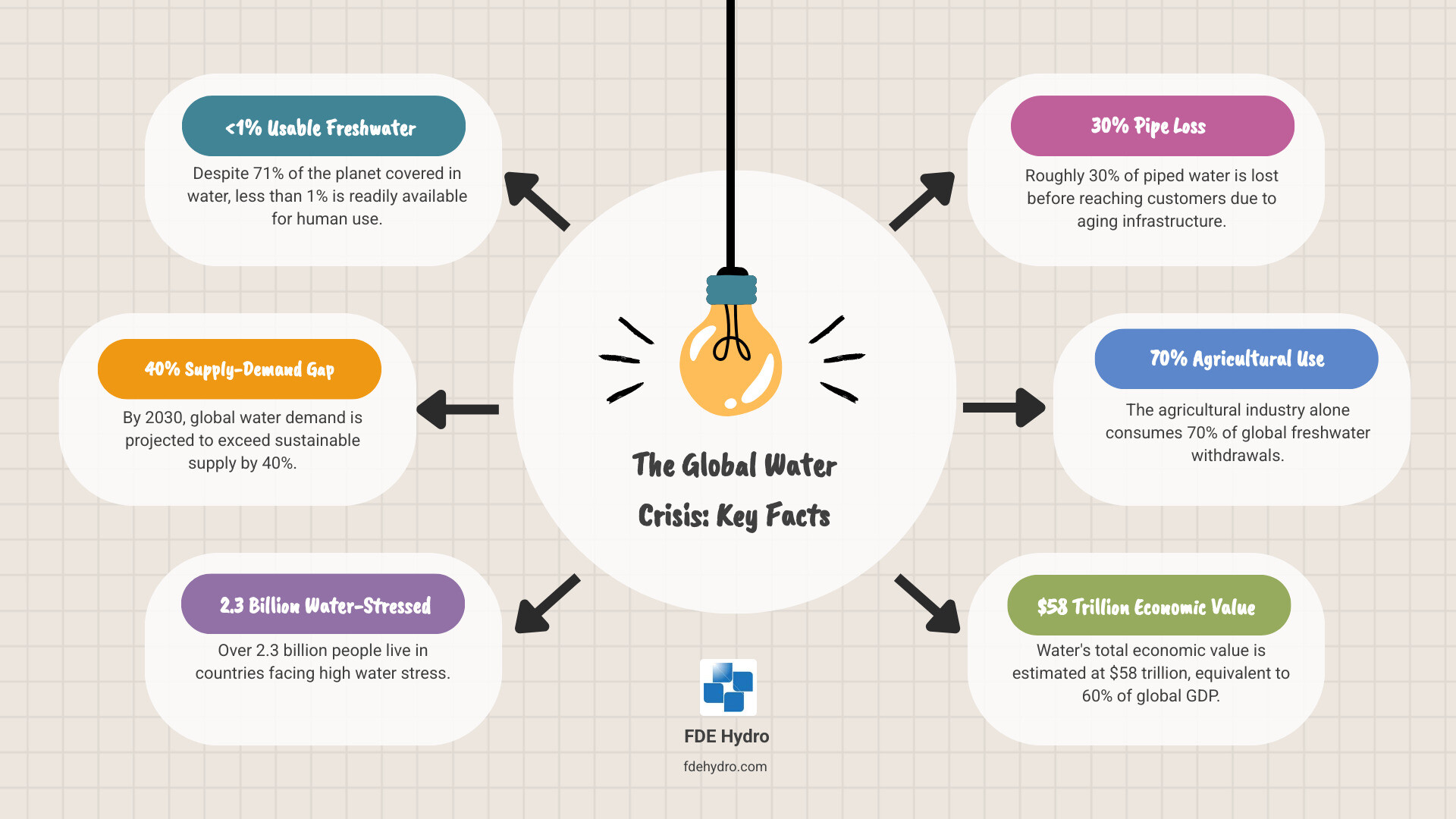
The numbers paint a stark picture. Water covers 71% of our planet, yet less than 1% is usable freshwater. By 2030, global water demand will exceed sustainable supply by 40%. Meanwhile, 2.3 billion people live in water-stressed countries, and roughly 30% of piped water is lost before reaching customers.
This isn’t just an environmental crisis—it’s an economic one. Water’s value has been priced at approximately $58 trillion, equivalent to 60% of global GDP. Yet 80% of wastewater still flows untreated back into the environment, and the agricultural industry alone consumes 70% of global freshwater withdrawals.
The challenge isn’t a lack of water—it’s how we capture, treat, manage, and reuse it.
Traditional water infrastructure faces three critical problems: high capital costs, extended construction timelines, and significant operational risks. Conventional desalination plants are energy-intensive and produce toxic brine. Legacy pipe networks leak at alarming rates. And new water technology can take up to 14 years to disseminate due to regulatory barriers and risk-averse adoption patterns.
But change is accelerating. Previously an overlooked corner of clean tech, water-focused technologies are now attracting venture capital, innovative financing models, and breakthrough engineering. From machines that pull water from air to AI systems that detect leaks in real-time, the solutions exist—and they’re becoming economically viable.
I’m Bill French Sr., Founder and CEO of FDE Hydro, where we’ve spent decades delivering modular civil construction solutions to the hydropower industry, including our patented “French Dam” technology that reduces costs and environmental impact through innovative water solutions. My experience managing major infrastructure projects has shown me how modular, technology-driven approaches can transform what’s possible in water management.
Related content about innovative water solutions:
The Global Crisis Driving Innovative Water Solutions

The global water crisis is a multifaceted challenge, driven by a growing population, climate change, and aging infrastructure. As we’ve seen, over a quarter of the world’s population, about 2.3 billion people, live in water-stressed countries. This means that these territories use 25% or more of their renewable freshwater resources, a clear indicator of unsustainable consumption patterns.
One of the biggest culprits in this scenario is the agricultural industry, which is responsible for a staggering 70% of global freshwater withdrawals. Imagine that—nearly three-quarters of our precious freshwater goes to growing food, much of it through inefficient irrigation methods. This isn’t just about crops; it’s about the entire ecosystem supported by these water sources.
Adding to the complexity is our decaying infrastructure. The World Bank estimates that about 30% of piped water is lost before it even reaches the customer. That’s a massive amount of treated water, simply vanishing due to leaks, old pipes, and inefficient distribution systems. This not only wastes a vital resource but also represents a significant economic loss. Addressing these issues requires robust Water Resources Management strategies that incorporate modern solutions.
The economic value of water has been priced at approximately US$58 trillion, equivalent to 60% of global GDP. This astounding figure underscores just how integral water is to every aspect of our economy, from agriculture and industry to public health and energy production. When water resources are strained, the economic ripple effects are profound.
Despite the urgency, the adoption of new water policies is notoriously slow. Paul O’Callaghan, Founder & CEO of BlueTech Research, notes that new water technology can take up to 14 years to be disseminated. Governments often face challenges in managing their water resources effectively, hindering much-needed water policy reform. This inertia is a significant barrier to implementing the innovative water solutions we desperately need. We need to overcome these systemic problems to ensure a sustainable water future for all. For more insights on this, you can review scientific research on water policy reform.
Breakthrough Technologies in Water Conservation and Management
Thankfully, human ingenuity is rising to meet these challenges. A wave of breakthrough technologies is changing how we conserve and manage water, offering hope for regions struggling with scarcity. We are seeing remarkable advancements that are not only efficient but also environmentally conscious.
One of the most exciting areas is solar-powered desalination. MIT engineers, for instance, have built a new system that runs with the rhythms of the sun, generating up to 5,000 liters of potable water per day from brackish groundwater. What makes this particularly innovative is its ability to harness over 94 percent of the electrical energy from solar panels without needing extra batteries, even with large swings in weather and sunlight. This is a game-changer for inland communities in places like the American Southwest or parts of Europe, where access to seawater and grid power might be limited. This technology directly addresses the issue of increasing groundwater salinity due to climate change. You can dig deeper into this research on solar-powered desalination systems.
Another fascinating development is atmospheric water generation. Imagine pulling freshwater directly from the air! Researchers have demonstrated systems that can extract nearly 6 liters of freshwater per kilo of material from air with just 30% relative humidity in 24 hours. This technology holds immense promise for arid and semi-arid regions, providing a decentralized and renewable water source.
Beyond these, we’re seeing other innovative water solutions emerge:
- Wave-powered desalination: Companies like Oneka Technologies in Canada are developing solutions that use renewable energy from ocean waves to produce drinking water, requiring no land space and producing no greenhouse gas emissions.
- Advanced filtration: Innovations like electro-ceramic desalination membranes are achieving up to 98% water recovery, making it possible to recycle water even in challenging industrial conditions.
- Nanobubbles: These extremely small bubbles improve gas transfer, making water treatment more efficient and energy-saving. Water treatment is a highly energy-intensive process, accounting for a whopping 4% of global electricity consumption, so any efficiency gains here are huge.
These technologies, alongside our commitment to Sustainable Water Infrastructure, are paving the way for a more water-secure future.
Decentralized Innovative Water Solutions for Buildings
While large-scale projects capture headlines, many innovative water solutions are making a significant impact at the building and community level. Decentralized systems offer flexibility, reduce reliance on vast centralized infrastructure, and promote local resource management.
Greywater recycling is a prime example. This involves treating lightly used water from sinks, showers, and washing machines for non-potable purposes like toilet flushing, irrigation, and cleaning. Companies like Epic Cleantec (USA) are deploying onsite water treatment and reuse systems in buildings, capable of re-using up to 95% of water for such applications. This drastically reduces a building’s freshwater demand. For instance, AQUAKIT SRL, a greywater treatment system, can reclaim up to 300,000 liters per month from a single 12-story building. Imagine the cumulative impact across cities like New York or Los Angeles! This is a massive untapped opportunity, especially as regulations, like those in California, begin to support wider adoption.
Rainwater capture and reuse is another “no-brainer,” particularly as climate change brings more intense rainfall events. Systems are being developed to transform rain into a dependable local freshwater source, combating urban flooding, drought, and heat stress. For residential and commercial properties, this means collecting rooftop runoff and storing it for later use in irrigation or even for indoor non-potable uses.
At home, we can contribute significantly through smart design:
- Low-flow fixtures: Modern low-flow toilets use 6 liters of water or less per flush, a vast improvement over older models that used 13.25 liters. Dual-flush toilets can save up to 20% more water. Low-flow showerheads use as little as 6.6 liters per minute, well below the federal maximum of 9.46 liters.
- Laundry-to-landscape systems: A simple, gravity-based setup that redirects water from your washing machine to your yard for around $200-$300.
- Rainwater harvesting: Collecting rainwater for garden use or even filtering it for indoor non-potable applications.
These decentralized and localized approaches are crucial components of comprehensive Water Control Solutions Complete Guide. You can find more info on onsite water treatment and reuse and how it’s changing urban water management.
Digital Twins and AI in Innovative Water Solutions
The digital revolution is profoundly impacting water management, bringing unprecedented levels of efficiency and insight. Digital technologies, Artificial Intelligence (AI), and data analytics are being leveraged to create truly innovative water solutions.
One of the most pressing issues in water distribution is leakage. As we noted, about 30% of piped water is lost before it reaches the customer. This is where AI and digital twins shine. Companies like PYDRO (Germany) are pioneering self-powered sensing and acting systems to combat water loss in smart water networks. Their flagship product, the PT1, revolutionizes data transmission by eliminating the need for external power or battery exchange, making leak detection and anomaly identification swift and accurate. Fluid Analytics Inc. (India/US) is also leveraging robotics and AI to monitor urban water pollution and infrastructure health at scale.
In agriculture, the sector responsible for 70% of global freshwater withdrawals, digital twins and AI are enabling precision irrigation. SEABEX (France), for example, uses AI algorithms to allow for sensor-less precision irrigation, enhancing crop yields while enabling farmers to reduce water waste by up to 50%. This is a huge leap forward from traditional, often wasteful, irrigation practices.
Digital twins, which are virtual representations of a real-world object or system, are gaining traction. SmartTerra (India) is deploying digital twin technology in water networks to improve efficiency, reduce water losses, and improve revenue streams by swiftly detecting leaks and anomalies. This allows for real-time modeling and experimentation, optimizing water flow and distribution.
For building managers and homeowners, IoT-enabled SaaS solutions, like those from Shayp (Belgium), empower them to eradicate leaks and mitigate damages through precise, real-time water consumption monitoring. This helps us move towards a future of Water Management AI and AI for Sustainability.
Here’s a quick comparison of how AI is changing water management:
| Feature | Traditional Water Management | AI-Driven Water Management |
|---|---|---|
| Leak Detection | Manual inspections, pressure drops, reactive repairs | Real-time sensor data, predictive analytics, precise leak localization |
| Irrigation Efficiency | Scheduled watering, generalized crop needs | Precision irrigation, sensor-less optimization, 50% water savings |
| Infrastructure Monitoring | Periodic physical checks, reactive maintenance | Robotics and AI for continuous health monitoring, predictive maintenance |
| Water Quality | Lab testing, delayed results | Remote biosensors, real-time bacterial detection |
| Resource Allocation | Static models, historical data | Dynamic optimization, real-time demand forecasting |
| Energy Consumption | Inefficient pumping, high treatment energy | Optimized pump schedules, energy-efficient treatment, nanobubbles |
Sustainability and the Economic Value of Water Innovation
The drive for innovative water solutions isn’t just about addressing scarcity; it’s deeply intertwined with our global sustainability goals. These solutions are designed to reduce waste, lower energy consumption, and decrease carbon emissions, contributing to a more circular and resilient economy.
The economic implications are immense. As noted earlier, the economic value of water has been priced at approximately US$58 trillion, equivalent to 60% of global GDP. This staggering figure highlights that investing in water innovation isn’t merely an environmental cost; it’s a critical economic investment with a significant potential return. For businesses and communities adopting these solutions, this translates to reduced operational costs, increased resource security, and improved brand reputation. Understanding the Economic value of freshwater ecosystems is paramount.
Consider the energy footprint of water. Water treatment is an incredibly energy-intensive process, accounting for a whopping 4% of global electricity consumption. Any innovation that reduces this energy demand has a massive positive impact. For example, VVater’s technology is 43% more energy-efficient (fewer kWh/MG) than traditional reverse osmosis (RO). Similarly, nanobubbles, which are extremely small, allow for more efficient gas transfer, making wastewater treatment more energy-efficient. Integrating renewable energy sources, like the MIT solar-powered desalination system, further slashes the carbon footprint associated with water purification.
Reducing waste is another pillar of sustainability. Onsite greywater and wastewater treatment systems, which recover up to 95% of water for non-potable uses, dramatically cut down on the amount of water discharged and the energy required to treat it at centralized facilities. Companies like Vivreau exemplify how innovative water solutions can lead to tangible carbon footprint reductions. Their client, the Atlantis Casino Resort Spa, saved 1 million single-use water bottles per year by switching to Vivreau’s sustainable water solution. Another hotel saved 60,000 plastic bottles annually, reducing over 60 truck deliveries and saving $42,000, all while significantly cutting their carbon footprint. Vivreau’s high-volume bottlers produce 86% less CO2 emissions than single-use plastic bottles and 64% less than traditional water coolers.
These innovations cater to diverse needs across sectors:
- Agriculture: Precision irrigation systems reduce water waste by up to 50%.
- Industry: Advanced wastewater treatment and reuse systems enable companies to recover and reuse water, shrinking their environmental footprint.
- Municipalities: Smart water networks reduce leaks and optimize distribution, safeguarding public health and conserving resources.
- Residential: Low-flow fixtures, greywater recycling, and smart home water management reduce household consumption and bills.
At FDE Hydro, our focus on Hydroelectric Power Solutions Guide directly contributes to clean energy generation, which can power these water treatment processes sustainably.
Overcoming Barriers to Scaling Water Technology
Despite the incredible progress in developing innovative water solutions, significant barriers hinder their widespread adoption and scaling. The water sector is notoriously risk-averse, which isn’t entirely surprising given the critical nature of water for public health and safety. This caution often translates into slow adoption rates; as we noted, new water technology can take up to 14 years to be disseminated.
We face several key challenges:
- Low Understanding and Jargon: The technical complexities and specialized terminology of the water sector can be off-putting to potential investors and policymakers.
- Regulatory Problems: Existing policies and regulations are often not designed to accommodate novel technologies, creating roadblocks for innovation. Governments still struggle with effective water resource management, which hinders necessary water policy reform.
- Financing Gaps: While venture capital interest in water is increasing, financial investment still lags significantly behind other sectors like energy. Clean energy investment topped $1.4 trillion in 2022, while venture investment in water innovation hovers around $100-$200 million per year. Much of the funding that does exist often targets seed or pilot-phase projects, leaving a gap for later-stage scaling.
Overcoming these barriers requires a concerted effort from all stakeholders. We believe we can tackle these by focusing on:
- Enabling Policies: Governments must foster creative and flexible regulations that encourage, rather than impede, the proliferation of water technologies. This could include subsidizing “kiloliters saved” in the same way we subsidize “kWh produced,” incentivizing conservation and reuse.
- Innovative Financing Models: We need new models that support water technologies beyond their initial development phases. This means attracting more diverse investors, including public funding, for later-stage technologies that are ready for market. For us, Financing Long-Term Hydropower Requires Mitigating Risks Prior to ROI is a familiar challenge.
- Public Engagement and Collaboration: Building public buy-in and fostering collaboration among diverse actors—from businesses and governments to NGOs and local communities—is essential. Initiatives like the 2030 Water Resources Group, which helps close the gap between global water demand and supply, and the 50L Home Coalition, aimed at solving the urban water crisis, demonstrate the power of partnerships. Transparent communication about the benefits and safety of new technologies is crucial to gain public trust.
The journey of water technology from lab to widespread implementation highlights these challenges. As the research on water technology dissemination suggests, this path is long, but with collective will and strategic investment, we can accelerate the pace of change.
Frequently Asked Questions about Water Innovation
What are the most effective ways to reduce industrial water waste?
Reducing industrial water waste is critical, given that industrial water use accounts for 20% of global water withdrawals. We find that the most effective strategies involve a combination of advanced treatment, reuse, and smart management:
- Onsite Wastewater Treatment and Reuse: Companies like Epic Cleantec (USA) offer systems that treat industrial wastewater for reuse within the facility, significantly reducing freshwater intake and discharge. Specialized treatment processes are needed for industrial wastewater, which can contain heavy metals and toxic chemicals.
- Advanced Filtration Technologies: Innovations like electro-ceramic desalination, such as those from Membrion (US), can recover up to 98% of water from challenging industrial waste streams, enabling high-purity recycling.
- Energy-Efficient Treatment: Utilizing technologies like nanobubbles can make industrial wastewater treatment more energy-efficient, reducing the substantial energy footprint of water processing.
- Digital Twins and AI for Process Optimization: Implementing digital twins and AI analytics allows industries to monitor water usage in real-time, identify inefficiencies, predict equipment failures, and optimize processes to minimize waste.
- Water-as-a-Service (WaaS) Models: These models, offered by companies like VVater, reduce upfront capital expenditure for industries, making it easier to adopt advanced water treatment and reuse systems. Their consumable-free technology offers a lower operating cost.
How does climate change impact the future of water management?
Climate change is fundamentally altering global water cycles, creating unprecedented challenges for water management. Its impacts are diverse and far-reaching:
- Increased Water Stress and Droughts: Many regions, including parts of California and the American Midwest, are experiencing more frequent and severe droughts, leading to chronic water scarcity. This intensifies competition for limited resources.
- More Intense Rainfall and Flooding: Conversely, other areas are facing heavier rainfall events, overwhelming existing infrastructure and leading to increased flooding. This necessitates innovative water solutions for stormwater management and flood control.
- Rising Groundwater Salinity: As sea levels rise and droughts persist, freshwater aquifers, especially in coastal areas like parts of California or Florida, are becoming increasingly saline, rendering them unsuitable for drinking or agriculture. The MIT solar desalination system is specifically designed to tackle this.
- Impact on Water Quality: Changes in temperature and precipitation patterns can degrade water quality, promoting harmful algal blooms and increasing the concentration of pollutants.
- Need for Resilient Infrastructure: Climate change demands more resilient and adaptive water infrastructure, capable of withstanding extreme weather events and fluctuating water availability. This includes investing in technologies like modular dams and advanced water control systems that can adapt to changing conditions.
The future of water management will require a proactive, adaptive approach, heavily reliant on forecasting, data analytics, and flexible, decentralized innovative water solutions.
What role does renewable energy play in water purification?
Renewable energy plays a pivotal and increasingly critical role in water purification, especially given twhat water treatment accounts for 4% of global electricity consumption. Integrating renewables into water purification offers multiple benefits:
- Reduced Carbon Footprint: By powering desalination and treatment plants with solar, wind, or hydropower, we significantly reduce the greenhouse gas emissions associated with these energy-intensive processes. This aligns directly with global climate goals.
- Decentralized Solutions: Renewable energy sources, particularly solar, enable the deployment of off-grid water purification systems in remote or underserved areas. The MIT solar-powered desalination system, for example, operates without batteries, directly utilizing variable solar power to produce up to 5,000 liters of water daily.
- Cost Savings: While initial investment can be higher, renewable energy often leads to lower operational costs in the long run, as fuel expenses are eliminated. This makes clean water more affordable and accessible.
- Energy Independence: Relying on local renewable sources for water treatment improves energy security and reduces vulnerability to grid outages or fuel price volatility.
- Innovative Technologies: We’re seeing innovations like wave-powered desalination from Oneka Technologies (Canada), which directly uses ocean energy to produce freshwater, eliminating the need for land space and emissions.
Renewable energy is not just a cleaner alternative; it’s an enabler of truly sustainable and resilient innovative water solutions, particularly for communities where traditional energy grids are unreliable or non-existent.
Conclusion
The challenges facing our global water resources are immense, but so too is the human capacity for innovation. From the staggering 40% projected gap between water supply and demand by 2030 to the 70% of freshwater consumed by agriculture, the statistics paint a clear picture: we need to act now. We’ve explored how innovative water solutions—from solar-powered desalination and atmospheric water harvesting to AI-driven leak detection and decentralized greywater recycling—are providing tangible pathways toward a water-secure future.
These technologies not only promise to alleviate scarcity but also contribute significantly to sustainability goals by reducing energy consumption, cutting carbon emissions, and fostering a circular water economy. While barriers like risk-aversion, slow policy adoption, and financing gaps persist, collaborative efforts and smart investments are beginning to accelerate the pace of change.
At FDE Hydro, we are proud to be part of this innovative landscape. Our patented “French Dam” technology, utilizing modular precast concrete, offers a approach to building and retrofitting hydroelectric dams and water control systems. This innovation significantly reduces construction costs and timelines, while minimizing environmental impact—critical factors for developing resilient and sustainable water infrastructure in North America, Brazil, and and Europe. Our work in modular construction for hydropower is a testament to how innovative engineering can address complex infrastructure challenges efficiently and sustainably.
The future outlook for water innovation is bright, with emerging trends in digital twins, advanced materials, and renewable energy integration ready to reshape the water landscape. We are committed to pushing these boundaries, ensuring that future generations have access to clean, abundant water.
Ready to learn more about how cutting-edge engineering can support our water future? Explore Innovative Water Control Structures and find our commitment to Sustainable Infrastructure Development.
