

Why Commercial Renewable Energy Solutions Matter Now
Renewable energy solutions are changing how businesses operate by offering cost savings, energy independence, and a competitive edge. For commercial operations, transitioning to clean energy is not just environmentally responsible; it’s economically strategic.
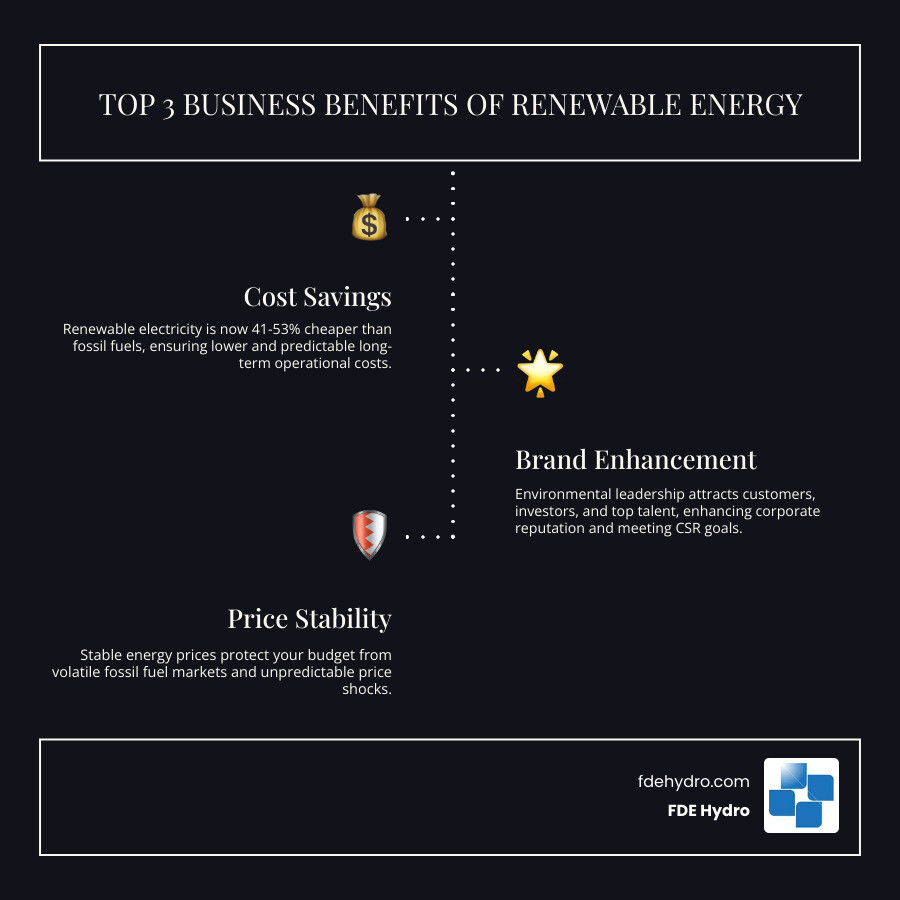
Top 3 business benefits of renewable energy:
- Cost Savings – Renewable electricity is now cheaper than fossil fuels in most parts of the world, with solar and offshore wind being 41% and 53% cheaper, respectively.
- Brand Improvement – Companies demonstrating environmental leadership attract customers, investors, and top talent.
- Price Stability – Unlike volatile fossil fuel markets, renewable energy provides predictable, long-term operational costs.
The numbers are compelling. In 2024, $2 trillion flowed into clean energy—$800 billion more than fossil fuels—while the sector drove 10% of global GDP growth in 2023. Renewables also create three times as many jobs per dollar invested compared to fossil fuels.
The path forward is clear: over 90% of new renewable projects cost less than fossil fuel alternatives. Modern renewable energy solutions include solar, wind, hydropower, geothermal, energy storage, and emerging technologies like green hydrogen. Businesses can procure these through direct ownership, power purchase agreements (PPAs), or renewable energy credits (RECs).
The health case strengthens the business argument. Air pollution from fossil fuels causes 7 million premature deaths annually, with economic health damages totaling $8.1 trillion per year. A clean energy transition eliminates these costs and positions your organization as a responsible corporate citizen.
I’m Bill French Sr., Founder and CEO of FDE Hydro. With five decades in heavy civil construction, I’ve seen how businesses can leverage renewable energy to build resilient, cost-effective, and sustainable operations. At FDE Hydro, we pioneer innovative modular construction for hydropower that dramatically reduces project timelines and costs.
Key renewable energy solutions vocabulary:
Why Your Business Should Transition to Clean Energy
The move to clean energy is a present-day imperative and a smart business decision. For businesses in the United States, Canada, Brazil, and Europe, embracing renewable energy solutions offers a multitude of benefits that span economic, environmental, and social spheres. It’s about building a more resilient, profitable, and respected business.
The Economic Case for Renewables
The primary goal for businesses is to thrive, and renewables offer a direct path to achieving that.
Historically, energy bills have been a significant and unpredictable expense. With renewable energy solutions, such as solar or wind, the “fuel” is free. While there’s an initial investment, operational costs are dramatically lower and more predictable, leading to substantial savings. In fact, over 90% of new renewable projects are now cheaper than fossil fuel alternatives.
Stable energy prices are a game-changer for financial planning. Knowing your energy costs will remain relatively constant for decades, insulated from the price shocks of fossil fuel markets, reduces financial risk and allows for better long-term strategy.
Governments in regions like the United States and Canada often provide significant tax incentives, rebates, and grants that drastically reduce upfront capital expenditure. Furthermore, investing in on-site renewable energy solutions can increase your property’s value, making it a more attractive asset to buyers and tenants.
The clean energy sector is a massive engine for growth, driving 10% of global GDP growth in 2023. For every dollar invested, renewable energy creates three times as many jobs as the fossil fuel industry. A strong commitment to sustainability also improves your brand image, attracting customers, investors, and employees who prioritize strong environmental, social, and governance (ESG) credentials.
We see this as a powerful opportunity for Energy Resource Development for businesses across our operating regions.
The Environmental and Social Impact
Beyond economics, the environmental and social benefits of adopting renewable energy solutions are profound. The most direct benefit is a significant reduction in your carbon footprint, as renewables create far lower emissions than burning fossil fuels.
This also improves local air quality. Fossil fuels release harmful pollutants that contribute to smog, acid rain, and respiratory illnesses, causing an estimated 7 million premature deaths annually. By choosing renewables, your business helps reduce these pollutants and their associated health costs, which amount to $8.1 trillion a year globally.
Adopting renewable energy solutions allows your business to meet and exceed its sustainability goals. Businesses that actively work towards Sustainable Power Generation demonstrate a commitment to responsible operations and position themselves as leaders.
The transition to a clean energy economy must also be a just transition, ensuring that the shift supports workers and communities. By investing in renewables, businesses contribute to this positive societal shift.
A Guide to Commercial Renewable Energy Solutions
Renewable energy solutions for commercial clients include a diverse portfolio of technologies and procurement methods. Whether you’re a small business in Kansas or a large corporation in New York City, there’s a pathway to clean energy for you.
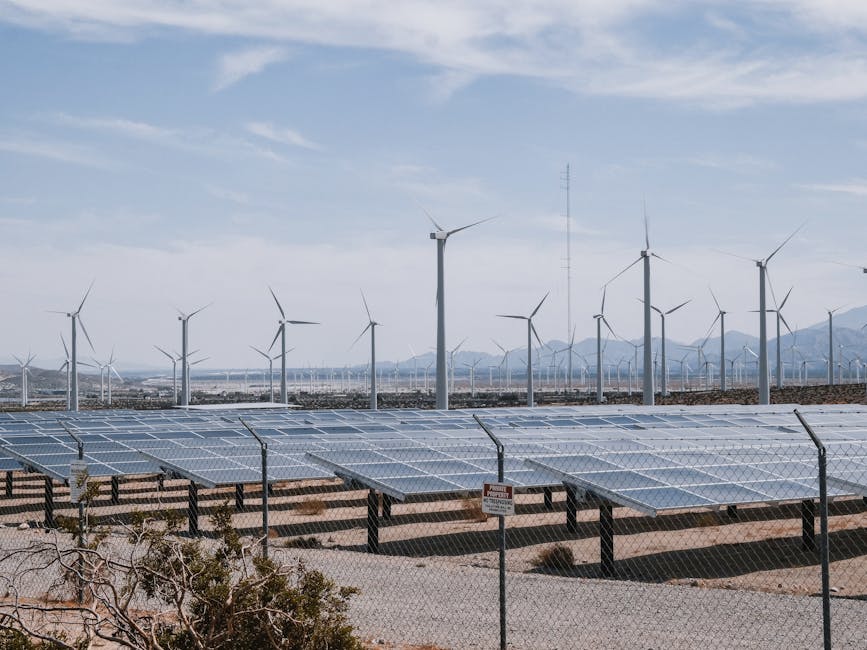
Organizations can procure renewable energy in three primary ways:
- Owning renewable energy systems and consuming the energy they generate.
- Purchasing renewable power from third-party-owned systems, often through Power Purchase Agreements (PPAs).
- Purchasing unbundled renewable energy credits (RECs). To make renewable energy claims, an organization must own and retire the RECs associated with the power.
Solar and Wind Power Solutions
Solar and wind are two of the most recognizable and rapidly expanding renewable energy solutions, with costs that have plummeted over the last decade.
Solar PV Systems: Solar offers versatile solutions for businesses.
- Rooftop Solar: Converts unused roof space into a power generator.
- Ground-Mount Solar: For businesses with available land, allowing for larger-scale deployment.
- Solar Carports: Offer dual benefits of shaded parking and electricity generation.
The cost of manufacturing solar panels has fallen dramatically, and they offer a long-term return on investment with a lifespan of roughly 30 years.
Wind Power: This is a viable solution for businesses in windy regions of the United States, Canada, or Europe.
- Onshore Wind Turbines: Can range from smaller turbines for individual businesses to utility-scale projects.
- Offshore Wind Farms: The growth of offshore wind contributes to an increasingly decarbonized grid from which businesses can draw power.
The falling costs of both solar and wind make them attractive for businesses looking to control costs. We view these as critical components of broader Energy Resource Development strategies.
Hydropower and Geothermal Energy Solutions
While solar and wind get headlines, hydropower and geothermal energy solutions offer powerful advantages, especially for industrial applications.
Hydropower: As the largest source of renewable electricity globally, hydropower provides reliable, baseload power. Its ability to store energy makes it crucial for grid stability. At FDE Hydro, our patented modular precast concrete technology allows us to build and retrofit hydroelectric dams with significantly reduced construction costs and time. This makes hydropower more accessible and cost-effective in North America, Brazil, and Europe. We also focus on solutions like Pumped Storage Hydropower, which acts like a giant battery for the grid. We’re committed to Reinvigorating Hydropower to support clean energy grids.
Geothermal Energy: Geothermal harnesses the Earth’s internal heat for consistent power and heating/cooling.
- Geothermal Heating and Cooling Systems: Use stable underground temperatures for highly efficient HVAC, leading to significant cost savings.
- Geothermal Power Plants: In geologically active areas, these plants provide continuous, baseload electricity.
Incentives are often available; we encourage businesses to check DSIRE.org for local policies.
Emerging Renewable Energy Solutions
The landscape of renewable energy solutions is constantly evolving with new technologies.
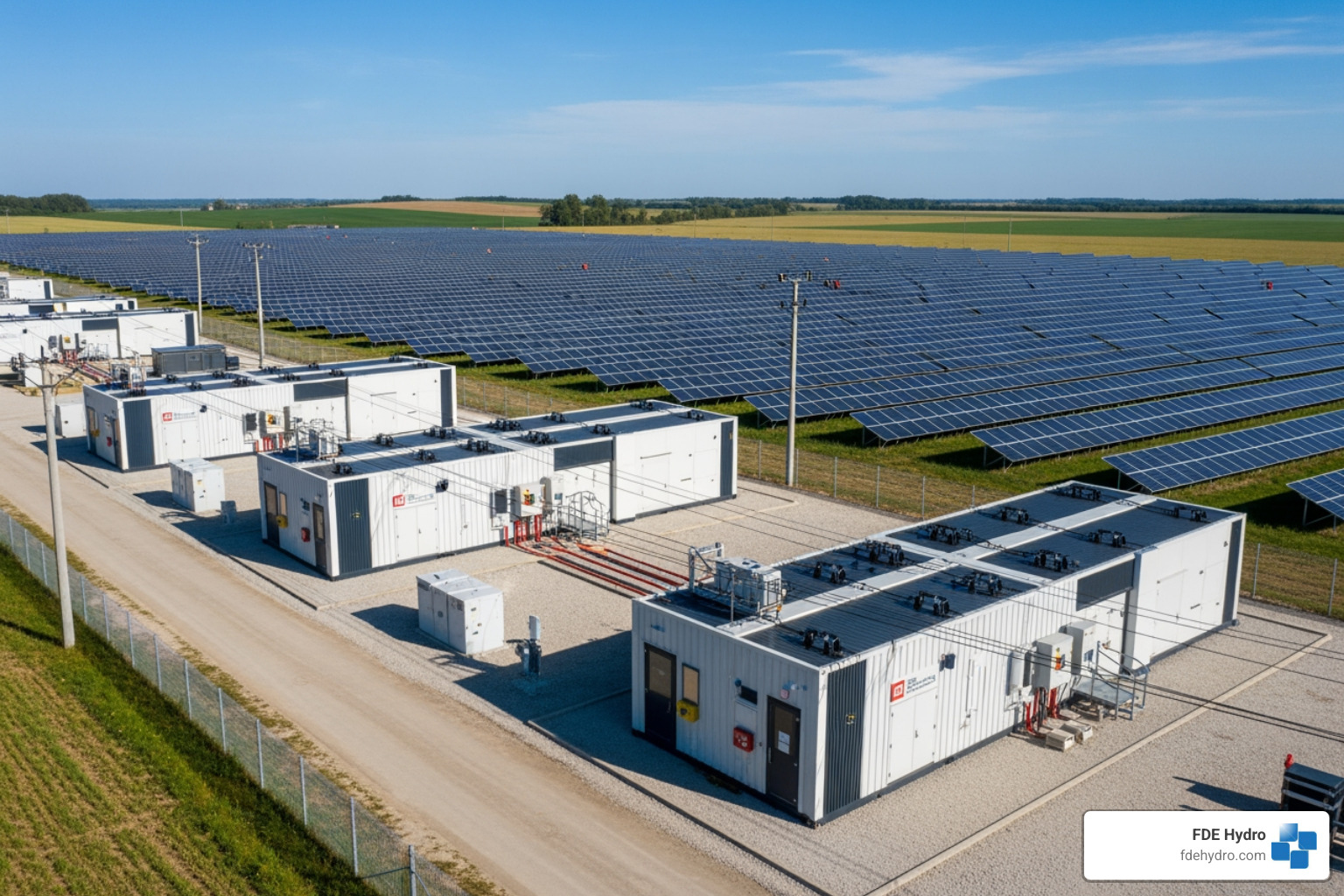
Battery Storage: Critical for integrating intermittent renewables, battery systems store excess energy, improve resilience, and reduce peak demand charges. This is a key component of Microgrid development.
Green Hydrogen: Produced with renewable electricity, green hydrogen is an emerging clean fuel for decarbonizing heavy industry and transportation.
Bioenergy: Produced from organic materials, sustainable bioenergy can play a role in waste management and providing dispatchable power.
Ocean Energy: Though in early stages, technologies like wave and tidal power have immense theoretical potential for future clean energy generation.
From Blueprint to Operation: Managing Your Energy Project
A commercial renewable energy project involves a detailed journey from concept to operation. At FDE Hydro, we streamline this process for Green Energy Construction, ensuring efficiency and optimal performance.
Navigating Development and Construction
The development phase begins with meticulous site selection and navigating the complex permitting process, which varies by region. We engage proactively with stakeholders to ensure projects are developed responsibly.
Construction management is where our unique capabilities shine. Our Innovative Construction Techniques, particularly our modular precast concrete technology, significantly reduce construction time and costs. This is a game-changer for large-scale projects like hydropower dams. By prefabricating components, we minimize on-site disruption and accelerate project timelines, contributing directly to Project Cost Reduction. We have successfully applied these methods across our operations in North America, Brazil, and Europe.
Optimizing Performance with Technology
Once built, the focus shifts to operations, maintenance (O&M), and asset optimization using digital technologies. Modern renewable energy solutions are increasingly smart. Data analytics from sensors provide real-time insights, allowing for predictive maintenance that identifies potential issues before they cause costly downtime.
Artificial Intelligence (AI) is also revolutionizing asset management. AI for Resource Management can analyze vast datasets to forecast energy production and optimize dispatch. For instance, AI can learn optimal operating patterns for a hydropower plant based on water levels and electricity demand, maximizing output.
Effective grid integration is another critical aspect. Advanced digital solutions help manage the balance of supply and demand, ensuring grid stability. By leveraging these technologies, we ensure your investment delivers maximum value throughout its operational life.
The Evolving Landscape of Global Energy
The global energy transition is accelerating, presenting immense opportunities for businesses across the United States, Canada, Brazil, and Europe. We are witnessing an unprecedented shift towards renewable energy solutions, driven by economic advantages, environmental imperatives, and technological advancements.
Global renewable electricity capacity is expanding rapidly. While much of this growth is driven by countries like China, their scale and innovation indicate what is possible globally. This momentum translates into unparalleled opportunities for Sustainable Infrastructure Development in our regions. Projections show onshore wind additions almost doubling by 2030, offshore wind capacity quadrupling, and over 165 GW of new hydropower becoming operational between 2024-2030.
Innovations Driving the Transition
The pace of innovation in renewable energy solutions is breathtaking. Advanced energy storage, including next-generation batteries and pumped storage hydropower, is crucial for addressing intermittency and ensuring a stable power supply.
Digital technologies are at the forefront. Digital twins allow for predictive modeling and remote monitoring, while AI-powered grid management systems are becoming essential for balancing complex grids. Innovative applications like agrivoltaics (combining agriculture with solar) are also gaining traction, allowing land to serve dual purposes. These integrated solutions offer multiple benefits, an approach supported by initiatives like the World Economic Forum’s Centre for Energy & Materials.
Challenges and Opportunities on the Horizon
Despite rapid progress, the transition faces challenges that also present opportunities for growth.
Key challenges include grid modernization to integrate decentralized renewables, the need for consistent policy support to de-risk investments, and ensuring supply chain resilience. Workforce development is also critical to meet the growing demand for skilled labor.
Financing the transition remains a hurdle, but the estimated $4.5 trillion needed annually until 2030 to reach net-zero represents an enormous investment opportunity.
At FDE Hydro, we are positioned to address many of these challenges. Our modular construction techniques make hydropower projects more economical and faster to deploy, directly helping with cost and timeline issues. We believe that by embracing Hydropower Advancements Innovations 2025 and collaboration, we can open up the full potential of renewable energy solutions.
Frequently Asked Questions About Commercial Renewables
Here are some common questions from businesses considering the switch to renewable energy solutions.
What are the primary financial benefits of switching to renewable energy?
The financial benefits are substantial and multifaceted:
- Reduced Electricity Bills: Generating your own power or locking in long-term contracts significantly lowers monthly energy expenses.
- Long-Term Budget Certainty: Renewable energy costs are predictable for decades, unlike volatile fossil fuel prices.
- Tax Credits and Rebates: Government incentives in the United States, Canada, and Europe can drastically reduce the upfront cost of installations.
- Increased Asset Value: Properties with modern renewable energy solutions often command higher market values.
- Positive Brand Perception: Strong corporate social responsibility can lead to increased customer loyalty and attract top talent.
How can a business procure renewable energy without installing its own system?
Several options exist for businesses that cannot or prefer not to install on-site systems:
- Power Purchase Agreements (PPAs): A third party installs and operates a system on your property, and you buy the power at a fixed rate.
- Virtual Power Purchase Agreements (VPPAs): A financial contract for power from an off-site project that provides RECs and price certainty.
- Unbundled Renewable Energy Credits (RECs): Purchasing RECs allows your business to claim renewable energy use even if your power comes from the grid mix.
- Community Solar: Subscribe to a local solar farm and receive credits on your electricity bill.
- Green Tariffs: Opt to pay your utility a premium to source your energy from renewables.
Which renewable energy technology is the most efficient?
Efficiency varies, but in terms of energy conversion, Hydropower is one of the most efficient sources, converting over 90% of available water energy into electricity.
- Solar PV Efficiency: Panels convert around 15-22% of sunlight to electricity, and this figure is constantly improving.
- Wind Turbine Efficiency: Modern turbines have high capacity factors (35-50%+), meaning they generate power a significant amount of the time.
- Geothermal Efficiency: Geothermal plants have very high capacity factors, often running 24/7, making them reliable for baseload power.
The “most efficient” technology depends on your location, energy needs, and available resources.
Build Your Sustainable Future Today
The transition to renewable energy solutions is a profound business opportunity, not just an environmental choice. We’ve explored the compelling economic advantages, from cost savings and stable prices to improved brand value. We’ve also highlighted the critical environmental and social benefits, including reduced carbon footprints and cleaner air.
The future of energy is clean and decentralized. For businesses in the United States, Canada, Brazil, and Europe, embracing this future means building a more resilient, competitive, and sustainable operation. The tools and technologies are available today to transform your energy landscape.
At FDE Hydro, we are proud to be at the forefront of this change. Our innovative modular precast concrete technology is revolutionizing hydropower, offering faster, more cost-effective ways to harness the power of water. We are dedicated to providing Clean Energy Infrastructure that supports your business goals and contributes to a healthier planet.
Taking the next step is a decision that will pay dividends for years to come. We are here to partner with you on this journey.
