

Why Every Decision-Maker Should Understand the Renewable Energy Source Landscape
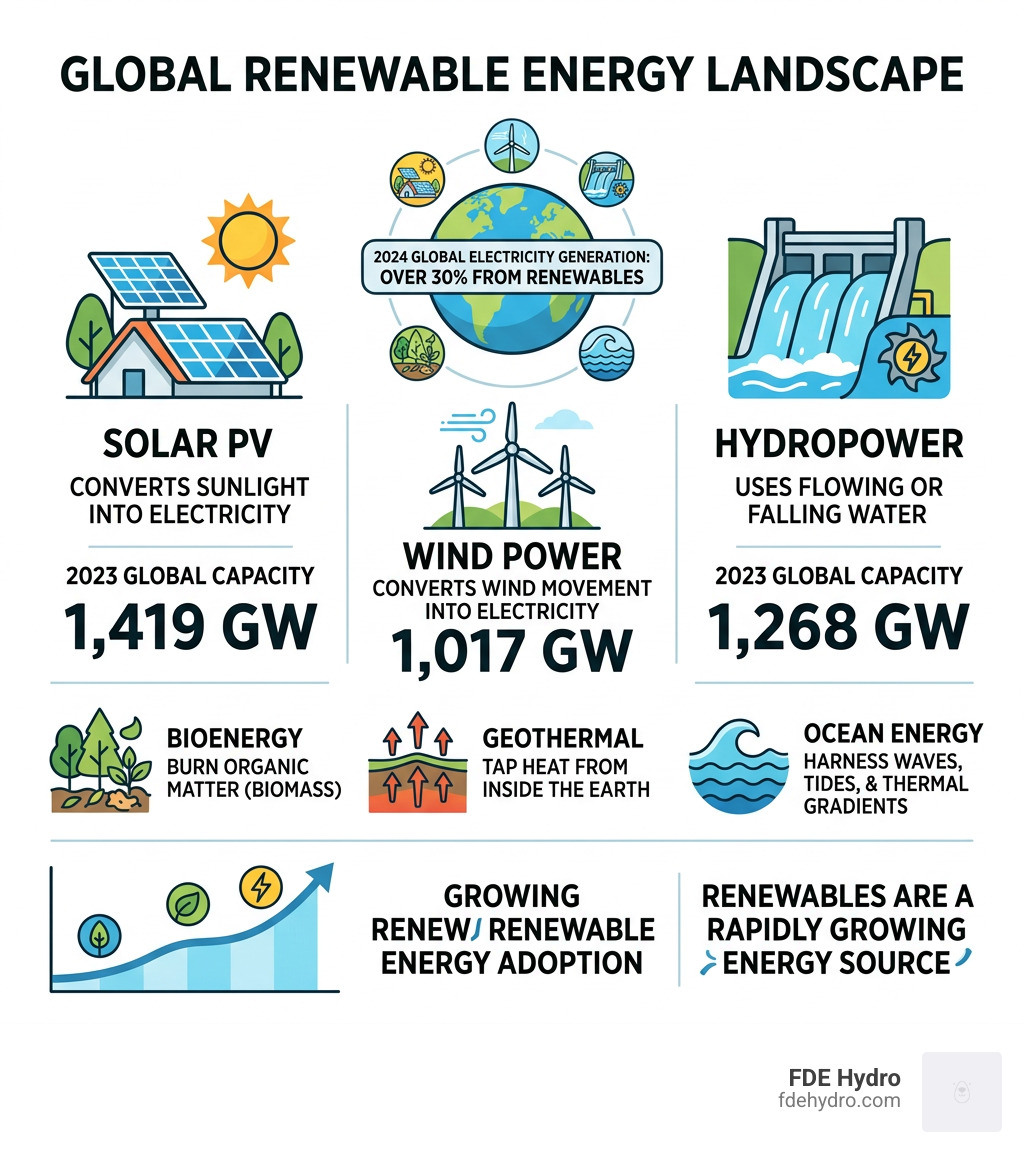
A renewable energy source is any energy resource that is naturally replenished faster than it is consumed — meaning it will not run out. Here are the major types at a glance:
| Renewable Energy Source | How It Works | 2023 Global Capacity |
|---|---|---|
| Solar PV | Converts sunlight into electricity | 1,419 GW |
| Wind Power | Converts wind movement into electricity | 1,017 GW |
| Hydropower | Uses flowing or falling water to generate electricity | 1,268 GW |
| Bioenergy | Burns organic matter (biomass) to produce energy | Varies by region |
| Geothermal | Taps heat from inside the Earth | Mature, stable output |
| Ocean Energy | Harnesses waves, tides, and thermal gradients | Early-stage development |
Together, these sources supplied over 30% of global electricity generation in 2024 — and that share is growing fast.
The energy world is changing at a pace most people didn’t expect a decade ago. Renewable energy is no longer a niche alternative. It’s the dominant choice for new electricity capacity being built worldwide. In the U.S. alone, renewables accounted for 21% of total electricity generation in 2023, up from near-zero contributions just a few decades earlier. Globally, projections point to renewables exceeding 45% of electricity generation by 2030.
For infrastructure decision-makers — especially those overseeing large-scale water and energy projects — understanding which renewable technologies exist, how they perform, and where they fit in the broader energy transition is no longer optional. It’s essential.
I’m Bill French, Sr., Founder and CEO of FDE Hydro™, and for over five decades I’ve worked at the intersection of heavy civil construction and energy infrastructure, including being selected by the U.S. Department of Energy to help shape the national roadmap for next-generation hydropower as a renewable energy source. That hands-on experience — from excavation to modular dam innovation — is the lens through which this guide is written.
Renewable energy source further reading:
Defining the Renewable Energy Source: Renewables vs. Alternatives
To truly understand the shift in our power grids, we must first get our definitions straight. While often used interchangeably, “renewable energy” and “alternative energy” carry different technical weights.
A renewable energy source is defined by its ability to naturally replenish itself on a human timescale. Sunlight, wind, and the hydrological cycle aren’t going anywhere. In contrast, fossil fuels like coal, oil, and natural gas are finite; once we burn through the reserves that took millions of years to form, they are gone.
The term “alternative energy” generally refers to any energy source that is a non-traditional substitute for fossil fuels. This can include nuclear power. While nuclear is a “carbon-free” source, it is not strictly renewable because it relies on finite supplies of uranium. However, some scientists argue that if we move toward breeder reactors, the definition might blur.
Another key distinction is the carbon footprint. Most renewables are carbon-neutral or low-carbon. For example, when we burn biomass, it releases carbon dioxide, but that carbon was recently absorbed by the plant during its growth, creating a closed loop. Fossil fuels, however, release “ancient” carbon that has been buried for millennia, which is the primary driver of the greenhouse effect.
For a deeper dive into how we are moving toward a grid dominated by these resources, we recommend reviewing this scientific research on the electricity-powered world. Understanding these basics is the first step in our Energy 101 journey.
Primary Types of Renewable Energy Source Technology
The transition to a sustainable future isn’t a “one-size-fits-all” scenario. It requires a diverse portfolio of technologies, each with unique strengths and geographic requirements. In our work across the United States, Canada, Brazil, and Europe, we see these technologies interacting to create more resilient grids.
The primary categories of renewable energy source technology include:
- Solar Photovoltaics (PV): Capturing sunlight directly using semiconducting materials.
- Wind Power: Utilizing the kinetic energy of airflows through onshore and offshore turbines.
- Hydropower: Harnessing the energy of moving water, from massive dams to run-of-river systems.
- Bioenergy: Converting organic materials (biomass) into heat, electricity, or liquid fuels.
- Geothermal: Tapping into the thermal energy stored beneath the Earth’s crust.
Technology Comparison Table: Growth and Share
| Technology | 2023 Generation Share | Annual Growth Rate (2014-2023) | Key Characteristic |
|---|---|---|---|
| Solar PV | ~5.5% | 25% | Fastest growing; intermittent |
| Wind | ~8% | 13% | High technical potential; variable |
| Hydropower | 14.3% | ~1% | Largest renewable source; baseload |
| Bioenergy | Varies | Stable | Controllable; provides heat/fuel |
| Geothermal | <1% | Stable | 24/7 baseload; site-specific |
As we explore renewable energy solutions, it becomes clear that while solar and wind are the “growth engines,” traditional sources like hydropower remain the “backbone” of the system.
Solar and Wind: The Leaders of Renewable Energy Source Capacity
Solar and wind have become the “poster children” of the energy transition for a good reason: their costs have plummeted while their capacity has exploded.
Solar PV capacity reached a staggering 1419 GW in 2023. This growth is driven by “Swanson’s Law,” which suggests that the cost of solar panels drops by about 20% for every doubling of cumulative shipped capacity. Today, in many parts of the U.S. and Europe, solar is the cheapest form of new electricity generation available.
Wind Power followed closely, crossing the 1000 GW threshold in 2023. We are seeing a massive push toward offshore wind, particularly in Europe and the coastal United States, because offshore winds are generally stronger and more consistent than those on land.
The biggest challenge for these two is intermittency. The sun doesn’t always shine, and the wind doesn’t always blow. To solve this, we need overcapacity and better storage. However, the theoretical potential is nearly limitless. According to research, the Technical Potential of Solar and Wind could meet global energy demand 100 times over.
Hydropower and the Role of Modern Infrastructure
While solar and wind get the headlines, hydropower is the quiet workhorse of the renewable energy source world. In 2023, it accounted for 14.3% of global electricity generation — more than solar and wind combined in many regions.
Hydropower’s greatest strength is its ability to provide baseload power. Unlike solar or wind, a dammed hydroelectric system can provide a steady, controllable flow of electricity 24/7. It can also act as a giant battery through pumped-storage technology, which currently accounts for over 85% of all grid-scale energy storage worldwide.
At FDE Hydro™, we focus on making this traditional source fit for the 21st century. The old way of building dams — massive, multi-decade, billion-dollar cast-in-place concrete projects — is often too slow and expensive for today’s needs. We’ve pioneered the French Dam, a patented modular precast concrete technology.
By using precast sections, we can build or retrofit hydroelectric dams in a fraction of the time and at a significantly lower cost. This is particularly vital for retrofitting existing non-powered dams. In the U.S. alone, there are thousands of dams that do not currently produce electricity; adding our modular systems to these existing structures is one of the fastest ways to increase clean energy capacity without the environmental impact of a new “greenfield” project.
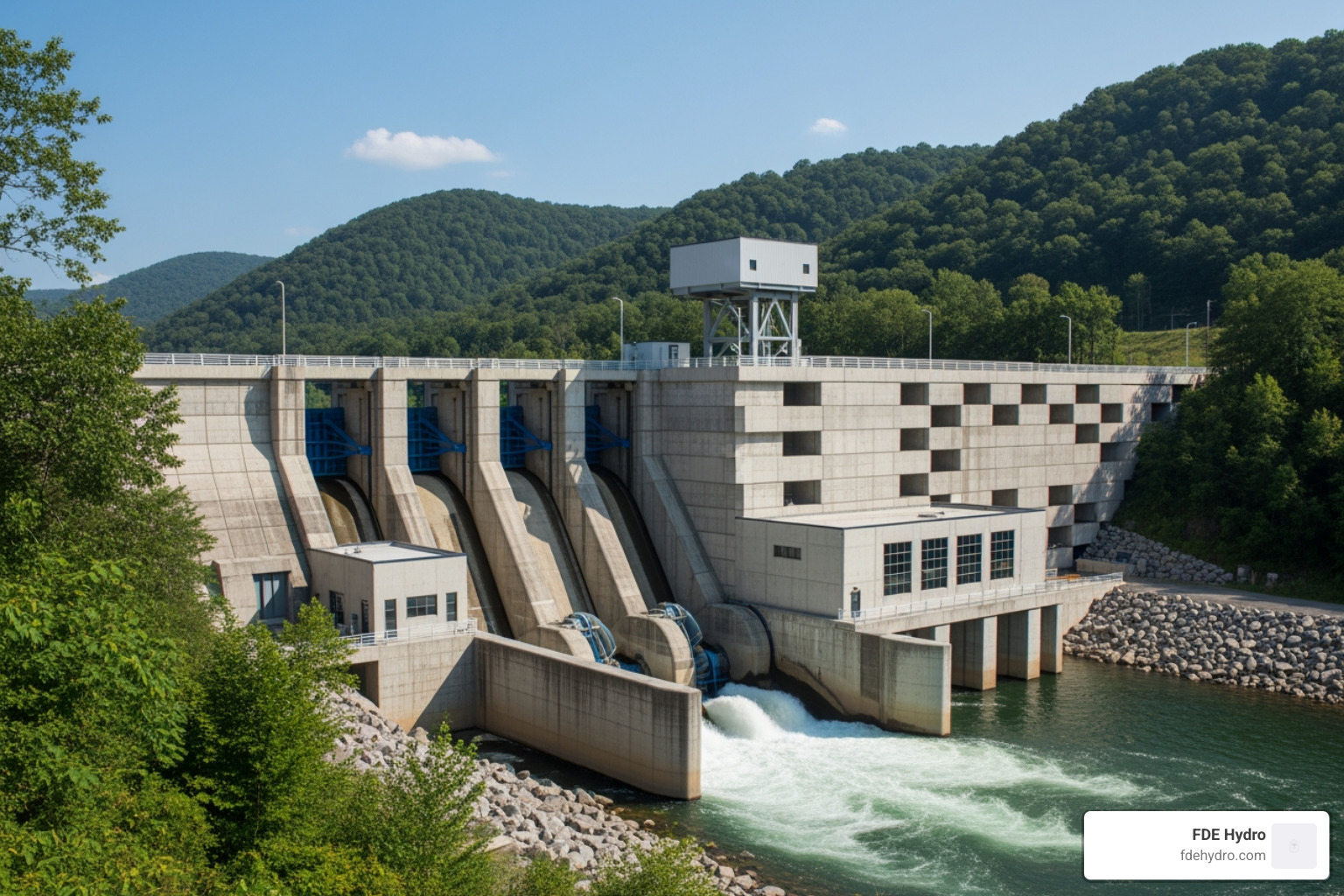
Whether it’s in the rugged terrain of Canada or the industrial hubs of Brazil, our sustainable power generation solutions are proving that hydropower is a modern, high-tech renewable energy source.
Current Statistics and Market Trends for 2024
The numbers for 2024 confirm that the energy transition has reached a tipping point. Globally, renewables now account for over 30% of electricity generation.
In the United States, the 2023 data showed that renewables provided about 9% of total energy consumption (8.2 quadrillion BTUs). While that might sound small, “total energy” includes transportation and industrial heat. When we look strictly at the electric power sector, renewables provided 21% of U.S. electricity in 2023.
Key 2023/2024 Stats:
- Global Solar Growth: Solar PV accounted for 70% of the growth in renewable electricity generation in 2023.
- U.S. Generation: Wind and solar now produce enough electricity to power nearly the entire country if the grid were perfectly efficient.
- Investment: Global investment in clean energy reached record highs, significantly outpacing investment in fossil fuels.
The IEA Renewables 2023 Report highlights that we are on a path to triple global renewable capacity by 2030, provided that policy support remains strong. For those planning infrastructure, our Renewable Energy Projects Complete Guide provides a roadmap for navigating this fast-moving market.
Global Adoption of a Renewable Energy Source
The adoption of renewables is no longer limited to wealthy nations. In fact, developing countries are often leading the charge because renewables allow them to “leapfrog” traditional, expensive centralized grids.
Brazil is a prime example. It has one of the cleanest electricity matrices in the world, largely thanks to its massive hydropower resources and a rapidly growing wind sector. In Europe, countries like Norway generate nearly 100% of their electricity from renewables (mostly hydro).
The economic benefits are also undeniable. Globally, the renewable sector employed over 12 million people as of 2020, with solar PV being the largest employer. Beyond jobs, renewables provide energy security. By using a local renewable energy source, countries reduce their dependence on imported fuels and the volatile price swings of global oil and gas markets.
Overcoming Intermittency and Storage Challenges
The “Achilles’ heel” of a grid powered by a renewable energy source has always been variability. The sun sets, and the wind dies down. How do we keep the lights on?
The answer lies in a combination of storage, diversity, and sector coupling.
- Battery Storage: Lithium-ion battery costs have dropped as fast as solar costs. Large-scale battery arrays are now being deployed in California and New York to “shave the peak” of evening demand.
- Innovative Storage: Beyond lithium, we see emerging tech like sand batteries in Finland, which store heat for months, and green hydrogen, which uses excess renewable power to split water into hydrogen fuel.
- Pumped Hydro: As mentioned, this is the most mature storage tech. By pumping water uphill when energy is cheap (mid-day solar) and letting it flow down when energy is needed, we create a massive physical battery.
- Sector Coupling: This involves linking the electricity, heating, and transport sectors. For example, using electric vehicle batteries to support the grid during high demand (Vehicle-to-Grid).
For those interested in the technical side of grid integration, this Research on sector coupling is an excellent resource. Integrating these clean energy solutions is the next great engineering challenge of our time.
Frequently Asked Questions about Clean Energy
What is the most efficient renewable energy source?
Efficiency can be measured in different ways, but in terms of energy conversion efficiency, hydropower is the undisputed king. Modern hydroelectric turbines can convert over 90% of the energy in falling water into electricity. For comparison, solar panels typically range from 15% to 22%, and wind turbines are usually between 35% and 45%. You can find more details in our guide on what renewable energy resource is the most efficient.
How do costs of renewables compare to fossil fuels?
In most of the world, new wind and solar projects are now cheaper than new coal or gas plants. The “Levelized Cost of Energy” (LCOE) for solar and onshore wind has dropped so significantly that it is often cheaper to build new renewables than to continue operating existing coal plants. Hydropower also remains highly cost-effective over its long lifespan (often 50-100 years), especially when using modular construction to reduce upfront capital.
Can renewables meet 100% of global energy demand?
Technically, yes. The solar energy hitting the Earth in just one hour is enough to power the entire world for a year. The challenge isn’t the amount of energy; it’s the infrastructure required to capture, store, and move it. With a mix of technologies — including baseload hydro and geothermal, variable wind and solar, and robust storage — a 100% renewable grid is physically possible and increasingly economically viable.
Conclusion
The shift toward every available renewable energy source is no longer just an environmental goal; it is an economic and security imperative. From the solar farms of California to the modular hydroelectric power solutions we are implementing in Brazil and Europe, the transition is well underway.
We are moving away from a world of finite, polluting fuels toward a future of abundance and sustainability. By leveraging innovative technologies like our modular precast concrete “French Dam,” we can accelerate this transition, making clean energy more affordable and accessible than ever before.
The future of energy is decentralized, digital, and, above all, renewable. At FDE Hydro™, we are proud to be building the infrastructure that makes that future possible.
Ready to explore how modular hydropower can fit into your next project? Visit our Renewable Energy Solutions page to learn more.
