

What is Precast Modular Technology?
Precast Modular Technology is a modern way to build. It involves making parts of a building, or even whole rooms, in a factory. These parts are then brought to the construction site and put together quickly.
Here’s a quick look at what Precast Modular Technology is:
- Factory-made: Building sections or “modules” (like walls, floors, or entire bathroom pods) are created in a controlled factory setting.
- Off-site precision: This allows for high quality and exact measurements, as factory conditions are ideal.
- On-site assembly: Once made, these modules are shipped to the building site and rapidly assembled, like giant LEGO blocks.
- Faster construction: This method significantly cuts down the time it takes to build, compared to traditional ways.
The construction world is changing fast, and Precast Modular Technology is leading the way. This innovative approach moves much of the building process from the messy, outdoor construction site to clean, efficient factories. Instead of building piece-by-piece on location, large parts of a structure are made ahead of time.
Think of it like this: whole rooms, wall sections, or floor panels are cast from concrete in a factory. These “modules” are built with high precision and quality control. Once they are ready, they are delivered to the building site. There, workers quickly put them together. This way of building is a big step away from traditional methods. It makes construction faster, more reliable, and often better for the environment.
I’m Bill French Sr., and I’ve spent decades in civil construction, where I’ve seen how Precast Modular Technology is changing the industry, especially in projects like modular bridge construction. At FDE Hydro™, we’re focused on bringing these powerful, factory-made solutions to the hydropower sector, building faster and smarter.
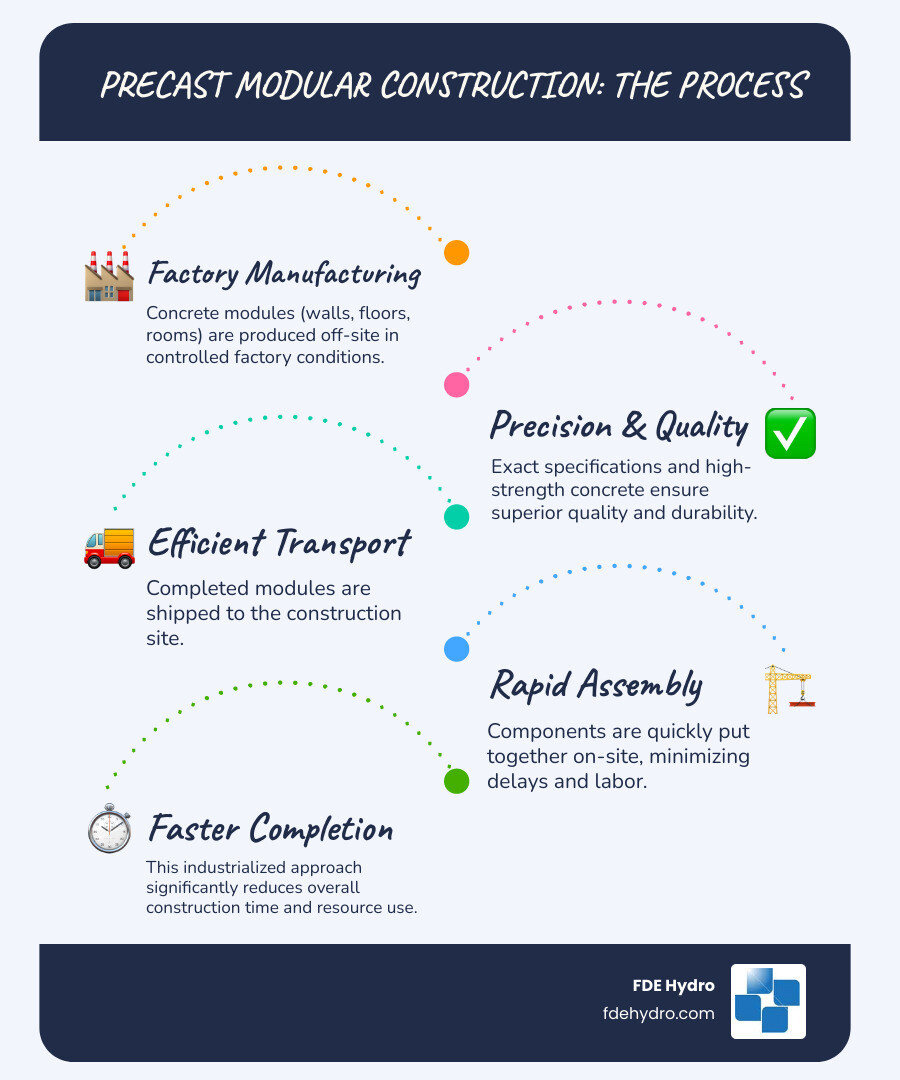
At its core, Precast Modular Technology involves the industrialized design, production, and construction using prefabricated reinforced concrete elements. This means that instead of pouring concrete and building walls on-site (traditional cast-in-situ methods), components like slabs, walls, and stairs are manufactured off-site in a controlled environment. These elements are then transported and assembled on the construction site. This method is gaining popularity worldwide because it offers significant advantages over traditional building.
For instance, 3D Modular Precast Technology involves casting “lego-like” concrete modules—such as entire rooms, toilets, kitchens, and bathrooms—in a factory. These complete units are then delivered to the site, ready for assembly. This change in how we build means less time, cost, and resources are expended compared to conventional approaches. We achieve this by leveraging advanced Modular Construction Techniques that streamline the entire process from design to assembly.
Key Precast Modular Technology vocabulary:
The Unbeatable Advantages of Building Modular
When we talk about the benefits of Precast Modular Technology, we’re not just talking about minor improvements; we’re discussing a shift that makes construction faster, more cost-effective, higher quality, more sustainable, and safer. Many industry experts consider modular precast one of the fastest, most profitable, sustainable, and cost-effective ways to build today.
Let’s look at how Precast Modular Technology stacks up against traditional construction methods:
| Feature | Precast Modular Construction | Traditional Construction |
|---|---|---|
| Timeline | Significantly reduced due to parallel processes and off-site manufacturing | Longer, sequential processes, subject to delays |
| On-site Labor | Minimized, requiring smaller, specialized assembly teams | High demand for various trades, labor-intensive |
| Waste | Dramatically reduced through factory precision and material management | Higher waste generation from on-site cutting and errors |
| Weather Delays | Manufacturing unaffected by weather; only assembly is exposed | Highly susceptible to weather-related delays |
| Quality | Superior, consistent quality due to controlled factory environment | Varies greatly, dependent on on-site conditions and labor skills |
We’ve seen how adopting precast solutions leads to a wide array of benefits. You can Explore Precast Concrete Advantages to understand the depth of these benefits.
Accelerated Construction Timelines
One of the most compelling advantages of Precast Modular Technology is the dramatic reduction in construction timelines. How do we achieve this? It’s all about efficiency and parallel processing.
Unlike traditional construction, where site preparation and building construction happen sequentially, precast modular methods allow for both to occur simultaneously. While our teams are preparing the foundation and site, modules are being manufactured in a factory. This parallel workflow significantly shortens the overall construction timeline. For example, precast installation can save up to 30% of the time compared to a poured-in-place solution.
The controlled factory environment also means that manufacturing can continue regardless of adverse weather conditions. Rain, snow, or extreme temperatures—which would typically halt or delay traditional on-site work—have no impact on module production. This ensures continuous work and predictable delivery schedules. The reduced need for on-site labor also contributes to speed, as fewer workers are needed for the assembly phase, allowing for quicker mobilization and completion. This focus on speed is critical for projects demanding Rapid Installment of Module Precast Civil Infrastructure.
Superior Quality and Precision Through Factory Control
Quality and precision are paramount in construction, and this is where Precast Modular Technology truly shines. When components are manufactured in a controlled factory environment, they are built to exact specifications, resulting in higher quality and consistency than what can typically be achieved on a dynamic construction site.
This controlled setting allows for rigorous quality control at every stage of production. Each module is carefully crafted, ensuring improved precision, consistency, and durability. This means fewer defects, less rework, and a stronger, more reliable finished product. The robust construction techniques used in module manufacturing also improve the resilience of buildings, making them more resistant to natural disasters such as earthquakes and hurricanes. The result is a high-strength concrete product with many inherent benefits, as it is manufactured off-site at a specialized production facility. We dig deeper into these aspects when we Learn about Precast Concrete Technology.
Cost Savings and Environmental Responsibility
Beyond speed and quality, Precast Modular Technology also offers significant cost savings and plays a crucial role in environmental responsibility.
The efficiency of factory production leads to better resource management and the use of sustainable materials, which in turn reduces waste and minimizes environmental impact. The efficient use of materials and resources in a factory setting minimizes waste and reduces the overall environmental footprint of construction projects. This approach not only helps us build greener but also contributes to lower long-term operating costs.
For instance, buildings constructed with advanced precast systems can be 60% more energy-efficient and produce less than 10% of the greenhouse gas emissions compared to typical low-rise buildings. This inherent energy efficiency, often achieved by positioning insulation on the exterior of the precast concrete walls, reduces heating and cooling demands. Furthermore, precast concrete is fire, mold, and weather-resistant, reducing long-term maintenance needs. This leads to buildings that are less costly to build and operate. To understand the full financial picture, we encourage you to Discover Why Precast Costs Less.
The Building Blocks: Components and Applications of Precast Modular Technology
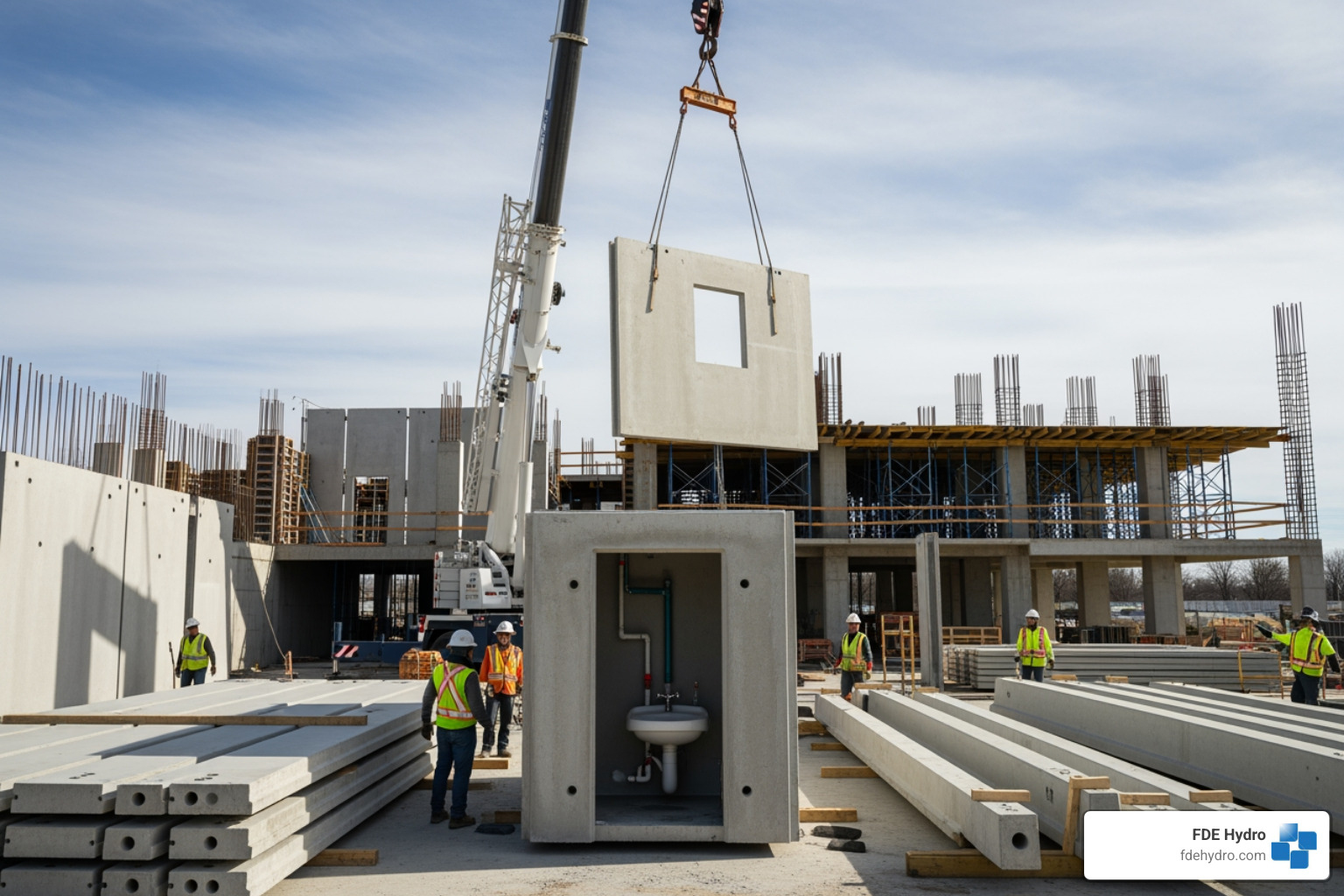
The versatility of Precast Modular Technology lies in its “building blocks”—the diverse components and modules that can be manufactured off-site. These elements range from simple flat panels to complex three-dimensional volumetric units, allowing us to construct a wide array of structures. This technology is changing multiple industries, from housing to critical infrastructure.
The core idea is to create standardized, yet adaptable, components that can be rapidly assembled. From structural panels to entire bathroom pods, the possibilities are vast. This adaptability means that a broad spectrum of projects can benefit from the speed, quality, and sustainability that precast modular methods offer.
The Core Components of Precast Modular Technology
At the heart of Precast Modular Technology are its varied components. We can categorize these into several types:
- 2D Panels: These are flat elements like precast wall panels and floor slabs. They are engineered to bear loads and form the structural envelope of a building. For example, some precast concrete building systems use structural building modules and precast wall panels, while others rely on prefabricated concrete panels for walls, floors, and stairs.
- 3D Volumetric Modules: These are complete, three-dimensional units, often referred to as volumetric pods. They can be entire rooms, bathrooms, kitchens, or utility spaces. 3D Modular Precast Technology involves casting these “lego-like” concrete modules in a factory. Bathroom pods, commonly used in hotels and retirement homes, are a prime example of these prefabricated components that are installed directly on the building site.
- Structural Elements: Beyond panels, precast technology also produces beams, columns, and stairs. These elements are designed to integrate seamlessly, forming the skeleton of the structure. For instance, precast stairs are often manufactured as monolithic pieces with embedded electrical conduits and slip-resistant finishes.
- Integrated Systems: A significant advancement in precast modular construction is the ability to embed various building systems directly into the concrete components during manufacturing. This can include electrical conduits, plumbing lines, fire suppression systems, and even HVAC ductwork. Some advanced systems, for example, integrate multiple construction divisions—structural, architectural, electrical, building envelope, heating/cooling, fire suppression, and plumbing—into single precast components.
We constantly develop new applications and designs for these components. You can See examples of Precast Models that showcase the breadth of this technology.
Industries Transformed by Modular Methods
Precast Modular Technology is not limited to a single sector; its advantages make it suitable for a diverse range of industries and building types, particularly in North America, Brazil, and Europe.
- Multi-Unit Residential Housing: From detached houses to multi-story apartment buildings, modular precast offers rapid construction and consistent quality, helping to address housing shortages. We’ve seen significant use of precast components in residential projects, often constituting a large volume of the structural concrete.
- High-Demand Data Centers: The rapid growth of data centers, especially across North America, demands expedited construction schedules. There are nearly 5,000 operating data centers across North America, with hundreds more in development. The Canada data center market alone is projected to more than double by 2030 to U$22.24 billion. Precast modular concrete is proving to be a robust solution for these facilities, which require high load capacities, large clear spans, and rapid deployment.
- Hospitals and Schools: Public buildings like schools and hospitals benefit from the speed and controlled environment of modular construction, allowing for faster delivery of essential infrastructure with high quality and minimal disruption to surrounding communities.
- Hotels and Hospitality: The use of volumetric pods, such as prefabricated bathroom units, significantly accelerates hotel construction, ensuring consistency and quality across many rooms.
- Infrastructure: Beyond buildings, precast modular elements are invaluable for infrastructure projects. This includes bridges, tunnels, and water control systems. We are actively involved in these applications, particularly for Aging Infrastructure Being Replaced with Next-Generation Civil Solutions.
Navigating Challenges and The Future Outlook
While the benefits of Precast Modular Technology are undeniable, like any advanced construction method, it comes with its own set of challenges. However, the industry is continuously innovating to address these, paving the way for an even brighter future. The outlook for precast modular construction is incredibly promising, as it offers compelling solutions to some of the most pressing global demands, from housing crises to the rapid expansion of digital infrastructure.
Addressing the Practical Limitations
We acknowledge that there are specific problems that need to be considered when implementing Precast Modular Technology:
- Transportation Logistics for Large Modules: Transporting large modules from the factory to the construction site can be logistically challenging, especially for sites located in remote or hard-to-reach areas. This requires careful planning and specialized heavy transport equipment.
- High Initial Factory Investment: The initial setup for a specialized manufacturing facility can be significant. The cost of specialized equipment and the development of factory infrastructure may be higher than traditional construction methods. However, this investment often pays off through economies of scale and long-term efficiency gains.
- Site Access Constraints: Urban construction sites, particularly in dense cities like New York City, can have limited access, making it difficult to maneuver and hoist large precast components. This necessitates meticulous site planning and coordination.
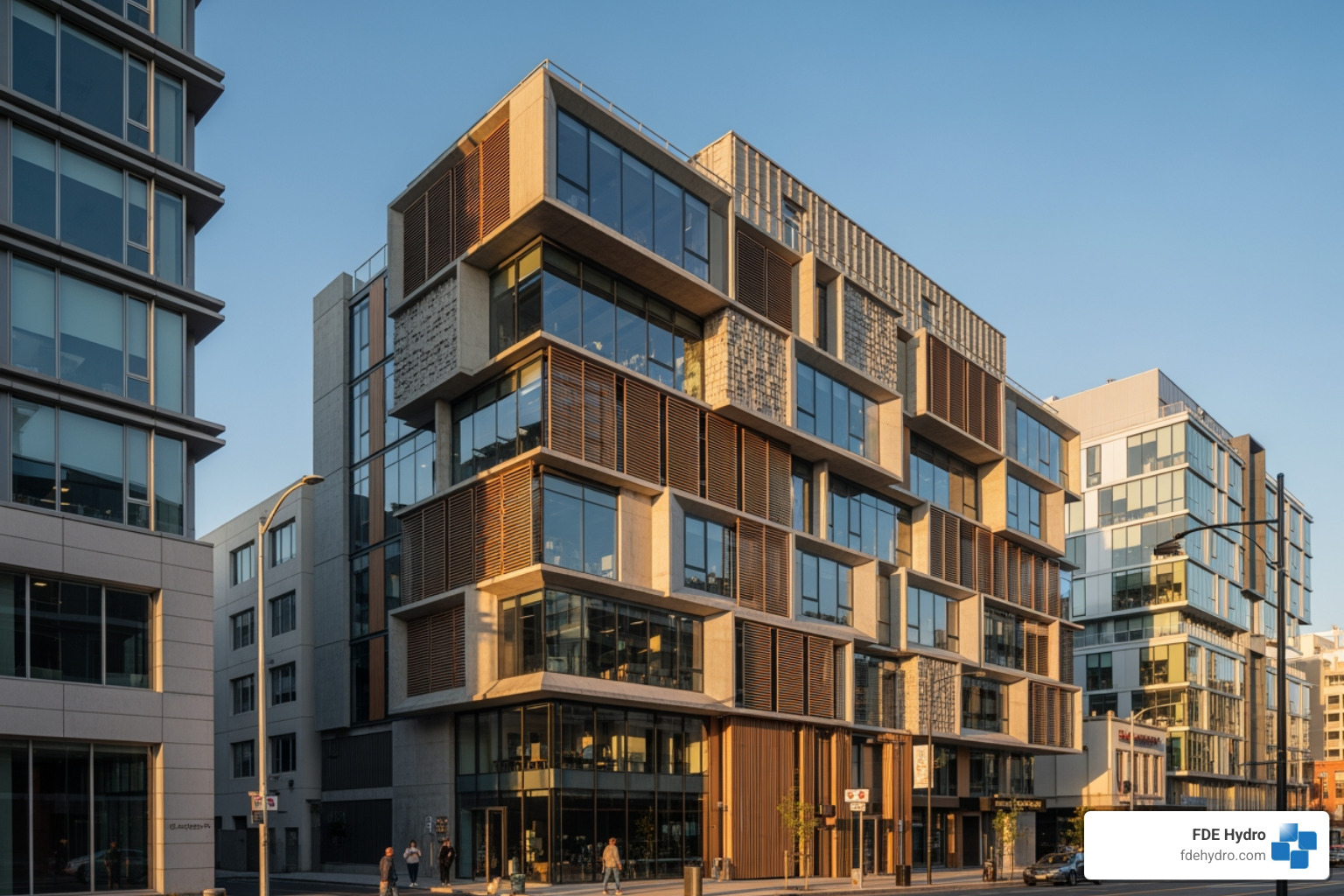
- Perceived Design Rigidity: Historically, modular construction was sometimes associated with a uniform, boxy aesthetic. However, modern Precast Modular Technology offers a wide range of design options and architectural finishes, allowing for significant flexibility and unique building designs. We can achieve diverse architectural styles through various exterior cladding options, ensuring aesthetic freedom.
The Future of Precast Modular Technology in a Demanding World
The future of Precast Modular Technology is bright, driven by global trends and specific industry demands.
- Solving Housing Shortages: In many regions, including parts of the United States and Europe, there’s an urgent need for affordable and rapidly deployable housing. Precast modular methods offer a scalable solution to build quality homes faster and more efficiently.
- Fueling the Data Center Boom: The digital economy relies heavily on data centers, and their demand is exploding. Globally, a McKinsey report forecasts $6.7 trillion of capital expenditures associated with data centers and supporting infrastructure over the next five years. The current timeline of nine to twelve months to complete a new facility is no longer acceptable, with developers targeting under four months for turnkey data centers. Precast concrete provides the speed, structural integrity, and thermal performance needed for these critical facilities, which are growing rapidly in North America, with nearly 5,000 operating data centers across the continent and hundreds more in development in the U.S. and Canada.
- Impact of AI on Construction Needs: The rise of Artificial Intelligence (AI) is further accelerating the demand for data centers and other specialized infrastructure. Precast Modular Technology is uniquely positioned to meet these urgent, high-volume demands.
- Smart Cities and Digitalization: As cities evolve into smart, interconnected environments, the need for efficient, adaptable, and sustainable construction methods grows. Precast modular solutions align perfectly with the principles of smart city development, offering industrialized construction that can be integrated with digital design and building management systems.
Case Study Spotlight: Next-Generation Infrastructure
At FDE Hydro™, we are at the forefront of applying Precast Modular Technology to critical infrastructure, demonstrating its power in real-world scenarios across North America, Brazil, and Europe. Our innovative, patented modular precast concrete technology, often referred to as the “French Dam,” is specifically designed for building and retrofitting hydroelectric dams and water control systems. This significantly reduces construction costs and time, providing solutions for:
- Rapid Bridge Construction: Using modular precast elements, we’ve seen examples of A National Example of Rapid Bridge Construction Using Modular Precast Elements that dramatically cut down project timelines and minimize disruption.
- Water Control Systems: Our expertise extends to developing advanced water control infrastructure, utilizing modular precast for efficiency and durability.
- Hydropower Applications: The “French Dam” technology exemplifies how modular precast can revolutionize hydroelectric projects, offering faster deployment and improved resilience. You can learn more about Modular Dam Construction and how we’re building the future of renewable energy.
Frequently Asked Questions about Precast Modular Construction
We often get questions about Precast Modular Technology. Here are some of the most common ones we address:
How durable are precast modular buildings?
Precast Modular Technology results in exceptionally durable structures. Buildings constructed with precast concrete are designed for a long lifespan, often exceeding 100 years. The robust nature of precast concrete means it offers superior resistance to fire, mold, pests, and general wear and tear, reducing long-term maintenance needs. Furthermore, the inherent strength and precise engineering of precast modules significantly improve resilience against natural disasters such as earthquakes and hurricanes, ensuring structures remain safe and stable.
Is precast modular construction environmentally friendly?
Yes, Precast Modular Technology is highly environmentally friendly. The controlled factory environment allows for precise material usage, minimizing waste and enabling efficient recycling of materials. This significantly reduces on-site construction waste, noise, and dust levels, making construction projects less disruptive to surrounding communities. Moreover, precast modular buildings are designed for inherent energy efficiency, often incorporating insulation directly into the panels. This leads to structures that are 60% more energy-efficient and produce less than 10% of the greenhouse gas emissions compared to traditional buildings, reducing the operational carbon footprint over the building’s lifespan.
Can you customize the design of a precast modular building?
Absolutely! Modern Precast Modular Technology offers remarkable design flexibility. While standardization is key to efficiency, it does not limit aesthetic choices or unique building designs. We can achieve a wide range of architectural styles and finishes. The exterior cladding, for example, is often separate from the precast structure, allowing for diverse architectural expressions that can be applied either in the factory or on-site. This ensures that while the core structure benefits from modular efficiency, the final appearance can be fully customized to meet specific design visions and blend seamlessly with any urban or natural landscape.
Conclusion: Building the Future, One Module at a Time
As we’ve explored, Precast Modular Technology is more than just a construction method; it’s a paradigm shift that is reshaping how we build the world around us. From accelerating timelines and enhancing quality to driving sustainability and reducing costs, its advantages are revolutionizing the construction industry. This technology provides efficiency and scalability previously unimagined, addressing critical demands like housing shortages and the exponential growth of data centers.
At FDE Hydro™, we are proud to be part of this revolution, applying advanced modular precast systems to vital infrastructure projects. Our patented “French Dam” technology for hydroelectric dams and water control systems in North America, Brazil, and Europe is a testament to the power and potential of this innovative approach. As the industry evolves, precast modular systems offer a smarter, faster, and more sustainable path forward for everything from housing to critical infrastructure. We believe the future is truly modular, and we are building it, one precisely engineered component at a time.
