

Why Hydropower Project Management Is Critical to Clean Energy Success
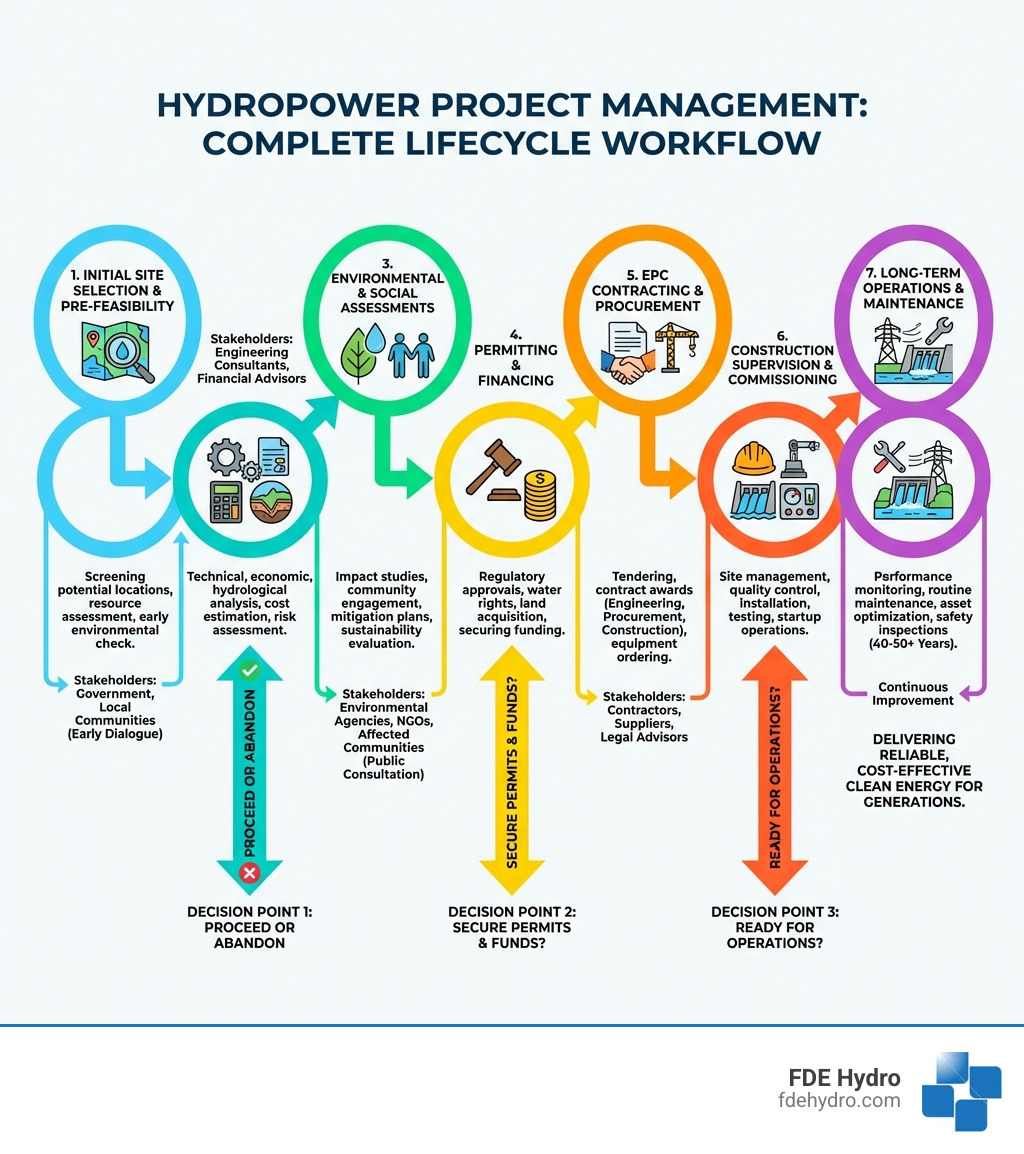
Hydropower project management is the coordinated oversight of planning, design, construction, and operation activities required to develop and maintain hydroelectric power facilities. It involves managing technical teams, environmental assessments, stakeholder engagement, permitting, construction contracts, and long-term asset performance to deliver reliable, cost-effective renewable energy.
Core responsibilities of a hydropower project manager include:
- Planning and coordination – Overseeing feasibility studies, site selection, hydrological analysis, and engineering design across civil, mechanical, and electrical disciplines
- Regulatory compliance – Securing environmental clearances, water rights, construction permits, and maintaining safety standards throughout the project lifecycle
- Stakeholder engagement – Consulting with communities, government agencies, contractors, and investors to address concerns and ensure project acceptance
- Risk management – Mitigating uncertainties related to hydrology, geology, costs, schedules, and environmental impacts
- Construction oversight – Managing EPC contracts, supervising civil works, equipment installation, and commissioning activities
- Operations and maintenance – Monitoring performance, maintaining equipment, optimizing production, and ensuring facilities operate for 40-50 years or longer
Hydropower represents the world’s largest source of renewable electricity, accounting for over 60% of global renewable generation. With installed capacity reaching 1,290 GW in 2018 and projected to nearly double to 1,947 GW by 2050, effective project management has never been more important. Sub-Saharan Africa alone holds over 400 GW of undeveloped hydro potential—enough to quadruple the continent’s existing 80 GW capacity.
The stakes are high. Large greenfield projects typically cost between $1,000 and $3,500 per kilowatt, requiring substantial capital investment. Poor management leads to cost overruns, schedule delays, environmental damage, and community conflicts. The 2009 Sayano-Shushenskaya accident in Russia—caused by neglected maintenance—resulted in 75 deaths and the loss of 6 GW of generating capacity, demonstrating the catastrophic consequences of inadequate oversight.
Yet hydropower facilities can operate for over 100 years with proper management, offering extremely low operating costs and reliable dispatchable power that enables integration of intermittent renewables like wind and solar. Electricity generation costs range from just $0.02 to $0.085 per kWh, making hydropower one of the most cost-effective energy sources globally.
I’m Bill French Sr., Founder and CEO of FDE Hydro™, where I’ve applied five decades of heavy civil construction experience to develop modular solutions that address the core challenges of Hydropower project management—reducing costs, accelerating timelines, and mitigating risks for developers and investors. This guide draws on industry best practices, international standards, and real-world case studies to help you successfully steer every phase of hydropower development.
Relevant articles related to Hydropower project management:
Core Responsibilities in Hydropower Project Management
The role of a project manager (PM) in the hydroelectric industry is as diverse as the rivers we harness. In Hydropower project management, the PM is the glue that holds together scientific data, engineering precision, and community relations. Whether you are called a facility operator, a hydro station supervisor, or a power project manager, the core mission remains the same: producing sustainable electricity at competitive rates while keeping everyone safe.
Daily Duties and Equipment Oversight
No two days are the same. A PM might start the morning reviewing water flow and pressure data and end it coordinating an emergency response for a power system glitch. Key daily responsibilities include:
- Equipment Monitoring: Overseeing hydro-turbines, generators, and control systems to ensure they are running at peak efficiency.
- Production Optimization: Adjusting operations based on seasonal flow variations to meet peak power demand.
- Reporting: Keeping meticulous records of maintenance activities and production levels for both internal review and external compliance.
- Safety Leadership: Enforcing strict safety standards during inspections to protect the workforce and the public.
Integrated Project Management
Effective Integrated Project Management refers to a developer’s capacity to coordinate all project components simultaneously. This means thinking about how a construction decision today will affect hydropower asset management thirty years from now. We focus on meeting budget and timing objectives while managing the “interface issues”—the friction points where different contractors or phases of work meet.
Key Phases of Hydropower Development and Execution
Developing a hydropower plant is a marathon, not a sprint. From the first topographic survey to the final commissioning, each phase requires specialized oversight.
Site Selection and Pre-Feasibility
Success starts with the right location. Project managers must evaluate topography, geology, and access to the power grid. A critical rule of thumb in the industry is to use at least 15 years of hydrological data. Why? Because rivers are fickle. You need to understand the 90% dependable year—the flow rate you can count on almost all the time—to optimize the plant’s installed capacity without overbuilding.
Detailed Project Reports (DPR) and Design
According to Guidelines for formulation of DPR, a project must be technically viable and economically justified before a single cubic yard of concrete is poured. This phase involves:
- Geological Mapping: Identifying rock stability to avoid “geological surprises” during excavation.
- Layout Alternatives: Comparing different dam heights or tunnel lengths to find the most cost-effective path.
- Cost Estimation: Factoring in everything from the turbines to the access roads.
Execution and Contracting
Once the design is set, hydroelectric dam construction begins. Most large projects use Engineering, Procurement, and Construction (EPC) contracts. These “turnkey” agreements help transfer schedule and budget risks to the contractors. For new hydro facilities, we often recommend dividing work into civil works, electro-mechanical (E&M) equipment, and grid connection to maintain better control over specialized tasks.
Technical and Environmental Considerations for Hydropower Project Management
Technical excellence and environmental stewardship are two sides of the same coin. A project manager must ensure the facility is built to last while respecting the ecosystem.
- Sediment Management: Intakes should be positioned in straight river sections to avoid sediment buildup. If you don’t manage silt, your turbines won’t last their intended 40-60 years.
- Spillway Design: Safety is paramount. Spillways are often designed to handle “1,000-year flood” events to ensure the dam remains stable even in extreme weather.
- Water Control Systems: Implementing advanced water control systems allows for precise management of reservoir levels, which is crucial for both power generation and downstream safety.
- Standards: We adhere to IFC Performance Standards and Equator Principles to manage hydropower environmental impact mitigation effectively. This includes everything from fish passage solutions to water quality monitoring.
Ensuring Sustainability and Stakeholder Engagement
Sustainability in Hydropower project management isn’t just about “being green”—it’s about the long-term viability of the project in its social and environmental context.
The Sustainability Protocol
The Hydropower Sustainability Assessment Protocol (HSAP) is our gold standard. It evaluates projects across 23 topics, including community health, biodiversity, and labor conditions. To score high, we don’t just “avoid the negative”; we strive for positive outcomes. This might include creating bird sanctuaries, improving local water quality, or providing new health services to the community.
Engaging Hard-to-Reach Stakeholders
Stakeholder engagement is often where projects succeed or fail. “Hard-to-reach” groups—such as remote indigenous communities or vulnerable populations who may not read standard project notices—require custom communication.
- Early Consultation: We start talking to people years before construction begins.
- Transparency: Proactively addressing concerns about resettlement or changes to the river flow helps build the “social license” to operate.
- Inclusion: Ensuring that sustainable energy production goals align with local needs, such as irrigation or flood control.
By focusing on clean energy infrastructure that benefits everyone, project managers reduce the risk of legal delays and protests that can derail even the best-engineered projects.
Managing Different Types of Hydropower Project Management
Not all hydro is created equal. The management approach changes significantly depending on the technology used.
| Project Type | Primary Management Focus | Environmental Footprint | Grid Benefit |
|---|---|---|---|
| Run-of-River | Managing seasonal flow variations; minimal storage. | Lower; preserves natural river flow. | Constant “baseload” power. |
| Storage Dams | Reservoir management; multi-purpose use (irrigation/flood). | Higher; requires land inundation. | High dispatchability (peak power). |
| Pumped Storage | Energy arbitrage; managing two reservoirs. | Moderate; often closed-loop. | “Giant battery” for the grid. |
Pumped storage hydropower benefits are particularly vital today. With 80% efficiency, these plants act as the “guardian of the grid,” storing excess wind or solar energy and releasing it when the sun goes down. Managing these requires a deep understanding of grid integration and rapid-response operations.
Risk Mitigation and Long-term Asset Performance
The “ultimate success” of a project is measured over decades. Hydropower plants are capital-intensive upfront, but their O&M (Operation and Maintenance) costs are remarkably low—typically only 1% to 4% of the initial investment annually.
Addressing Uncertainty
The biggest risks in Hydropower project management are often hidden underground or in the clouds.
- Hydrological Uncertainty: If the rains don’t come, the revenue doesn’t either. We mitigate this through conservative financial modeling and 15+ years of data.
- Cost Overruns: Civil works are notorious for surprises. We use project cost reduction strategies, such as modular construction, to keep budgets predictable.
Maintenance Strategies
To ensure a facility lasts 100 years, we move beyond “fix it when it breaks.” We follow the World Bank’s Operation and Maintenance Strategies for Hydropower guidelines, emphasizing:
- Reliability-Centered Maintenance (RCM): Focusing resources on the components most likely to cause a failure.
- Root Cause Analysis: If a turbine vibrates, we don’t just tighten the bolts; we find out why it’s vibrating to prevent a catastrophic failure like Sayano-Shushenskaya.
- KPIs: We track the Availability Factor (aiming for >95%) and the Forced Outage Rate (aiming for <4%) to gauge hydro power plant maintenance success.
Frequently Asked Questions about Hydropower Project Management
What are the primary risks in hydropower development?
The “Big Three” risks are hydrological (not enough water), geological (bad soil or rock conditions), and regulatory (delays in permits). These can lead to massive financing long-term hydropower risks if the project cannot start generating revenue on time. We mitigate these through exhaustive pre-construction studies and robust contingency funds.
How long is the typical lifespan of a hydropower plant?
The initial mechanical equipment (turbines and generators) usually lasts 40-50 years. However, the civil structures—the dam and intake—can last 100 years or more. With modern dam rehabilitation and encapsulation techniques, we can “refresh” older plants to operate for another century at a fraction of the cost of a new build.
How do project managers handle hard-to-reach stakeholders?
We use custom communication strategies. This means going to where the people are, rather than expecting them to come to us. For vulnerable groups, we provide translators, hold small-group meetings in local community centers, and ensure our sustainable water infrastructure plans include local benefits like improved roads or access to clean drinking water.
Conclusion
The future of hydropower is bright, but it requires a new generation of project management. As we strive to meet global capacity targets and integrate more wind and solar into our grids, the need for reliable, flexible hydro has never been greater.
At FDE Hydro™, we believe the path to Hydropower project management success lies in innovation. Our patented “French Dam” modular precast technology is designed to solve the very problems this guide addresses: it reduces construction time, slashes costs, and provides a safer, more predictable way to build or retrofit dams. Whether you are in New York, California, Brazil, or Europe, we are here to help you build the clean energy solutions of tomorrow.
Ready to take your project from the drawing board to the river? Let’s work together to create a sustainable, high-performing asset that will power communities for the next century.
