

The Two Sides of the Blockchain Sustainability Coin

Sustainable blockchain technology represents both a critical challenge and a powerful solution for our environmental future. Here’s what you need to know:
The Challenge:
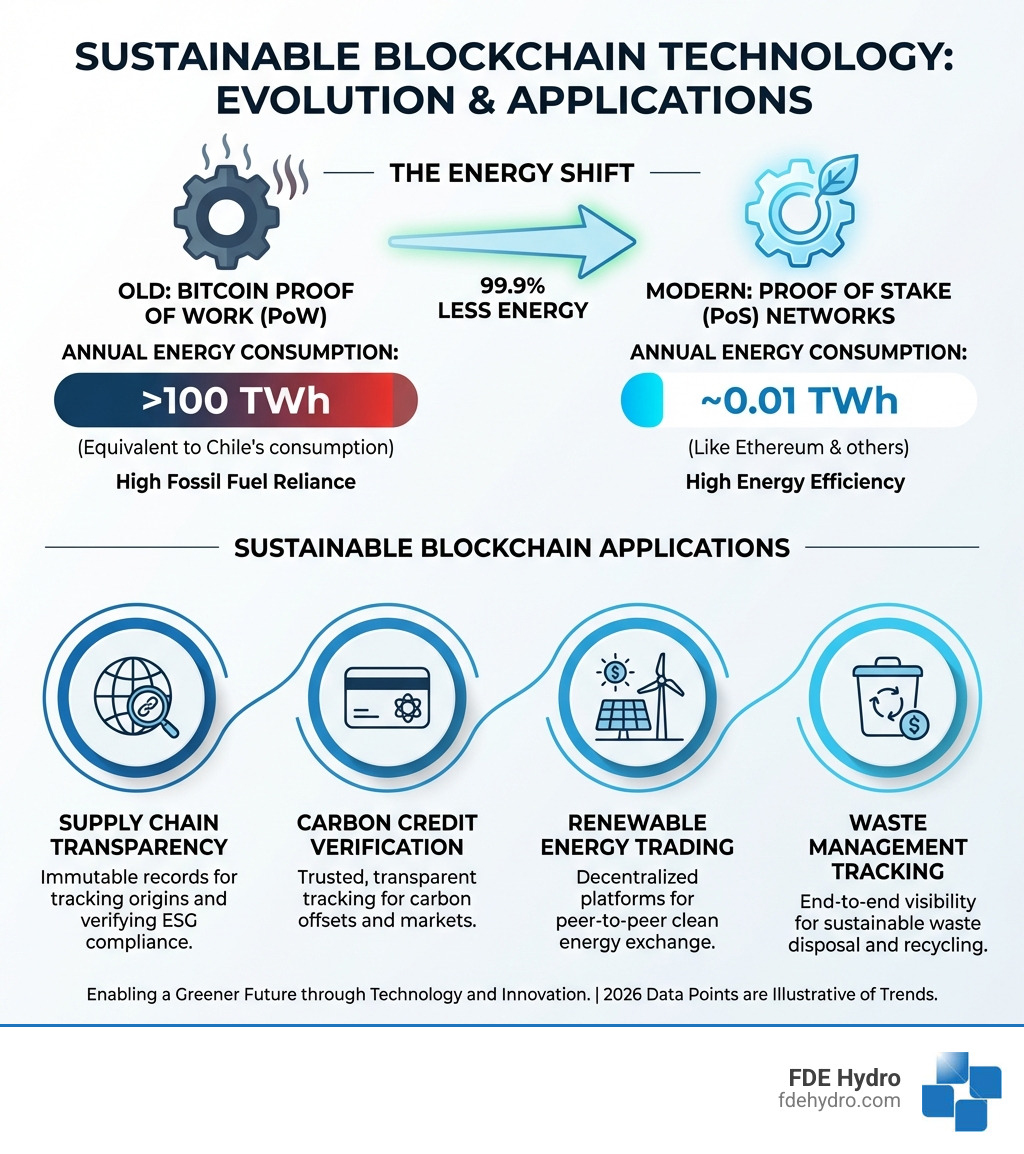
- Traditional blockchains like Bitcoin consume energy equivalent to entire countries
- Proof of Work mining produces significant carbon emissions and e-waste
- Up to 61% of Bitcoin’s power comes from fossil fuels
The Solution:
- Proof of Stake systems use 99.9% less energy than Proof of Work
- Up to 60% of active blockchains now use energy-efficient protocols
- Blockchain enables transparent carbon tracking and renewable energy trading
The Opportunity:
- Supply chain emissions account for over 90% of corporate carbon footprints
- Blockchain provides immutable records for ESG compliance and verification
- Real-world applications span renewable energy, waste management, and carbon markets
When you hear “blockchain,” you might think of Bitcoin’s notorious energy consumption—reportedly around 100 terawatt-hours annually, more than Chile’s entire electricity use. That’s the old story. The new story is about innovation. Blockchain technology has evolved dramatically, with modern networks consuming a fraction of the energy while enabling unprecedented transparency for sustainability efforts.
The paradox is striking: the same technology once criticized for environmental harm now offers tools to combat climate change, verify carbon credits, and create transparent supply chains. The difference lies in how the blockchain operates—the consensus mechanism at its core.
This isn’t just a theoretical debate. Ethereum’s 2022 shift to Proof of Stake cut its energy consumption by 99.9% overnight. Projects across the globe are using blockchain to track renewable energy, verify sustainable sourcing, and create trusted carbon markets. Meanwhile, emerging regulations like the EU’s MiCA framework and Corporate Sustainability Reporting Directive are pushing the entire industry toward accountability.
For infrastructure decision-makers evaluating emerging technologies, understanding sustainable blockchain matters because it intersects with two critical priorities: reducing environmental impact and ensuring transparent, verifiable data for compliance and stakeholder trust. The technology that powers it—whether renewable energy from hydropower, solar, or geothermal sources—determines whether blockchain becomes part of the climate solution or remains part of the problem.
I’m Bill French Sr., Founder and CEO of FDE Hydro, and I’ve spent decades working at the intersection of infrastructure innovation and environmental stewardship, including participation in the Department of Energy’s strategic planning for next-generation hydropower solutions that can power sustainable blockchain technology. My focus on modular, environmentally beneficial construction aligns with the need for clean energy sources that make truly sustainable digital infrastructure possible.
Simple Sustainable blockchain technology glossary:
The Energy Challenge: Why Blockchains Have an Environmental Reputation
The conversation around sustainable blockchain technology often begins with its energy footprint. For years, the headlines have focused on the immense power consumption of cryptocurrency mining, particularly Bitcoin. This perception is rooted in the design of early blockchain networks, which relied on a consensus mechanism called Proof of Work (PoW).

In a PoW system, computers on a peer-to-peer network, known as “miners,” compete to solve complex computational puzzles to validate transactions and add new blocks to the blockchain. This process, often referred to as “hashing,” requires significant energy. The more computing power a miner dedicates, the higher their chance of winning the reward, creating an arms race for computational intensity.
The true drivers of this energy use and associated emissions are multifaceted. Primarily, it’s an economic incentive: miners are driven to use the cheapest available energy to maximize profits. Unfortunately, the cheapest energy often comes from fossil fuels, leading to substantial greenhouse gas emissions. Even when green energy is used, the sheer scale of demand can strain existing energy grids, potentially diverting power from other critical needs or hindering broader clean energy transitions. Beyond operational energy, we must also consider the embodied carbon and e-waste impact of the specialized mining hardware and data centers required for PoW. The rapid obsolescence of these machines contributes to a growing e-waste problem.
Understanding the Environmental Impact of Non-Sustainable Blockchain Technology
The environmental impact of non-sustainable blockchain technology, primarily driven by PoW, is significant. Bitcoin, the pioneer of this model, consumes an estimated 100 terawatt-hours (TWh) of electricity annually, an amount comparable to the energy consumption of entire countries. A substantial portion of this energy, up to 61%, is derived from fossil fuels, leading to a considerable carbon footprint. Each dollar of Bitcoin value created has been estimated to generate significant health and climate damages, including $0.49 in the US.
The core issue lies in the hashing computations that define PoW. These computations are intentionally designed to be difficult and resource-intensive, ensuring the network’s security and immutability. However, this design directly translates to high energy demand. The economic incentive for miners to find the cheapest energy sources, regardless of their environmental impact, exacerbates the problem. For more details on the energy demands of this process, see our insights on Crypto Mining Power Consumption.
It’s crucial to separate myths from facts. While the narrative often paints all blockchain as inherently energy-intensive, the truth is that PoW is the only consensus protocol inherently based on energy consumption. Many other protocols do not require significant hash computations. The perception that all blockchains are energy hogs is a myth that we must dispel as the industry evolves towards more sustainable solutions.
Comparing Consensus Mechanisms: The Core of the Issue
The heart of the discussion around sustainable blockchain technology lies in its consensus mechanisms. These are the protocols that enable a distributed network to agree on the validity of transactions and the state of the ledger. The choice of mechanism profoundly impacts a blockchain’s energy intensity, security, and decentralization.
| Consensus Mechanism | Energy Intensity | Security | Decentralization Trade-offs |
|---|---|---|---|
| Proof of Work (PoW) | Very High | High | Can lead to mining pool centralization |
| Proof of Stake (PoS) | Very Low | High | Can lead to stake centralization |
| Proof of Authority (PoA) | Very Low | Moderate | Centralized around trusted validators |
Proof of Work (PoW), as discussed, is highly energy-intensive. While it offers robust security due to the immense computational effort required to attack the network, it can lead to centralization as only those with significant capital can afford the necessary hardware and electricity.
Proof of Stake (PoS) emerged as a direct response to PoW’s energy concerns. Instead of computational competition, validators are chosen to create new blocks based on the amount of cryptocurrency they “stake” as collateral. This dramatically reduces energy consumption, with estimates suggesting a potential reduction of up to 99% compared to PoW. PoS maintains high security by penalizing malicious validators (slashing their stake) and aims for decentralization by allowing anyone to stake.
Proof of Authority (PoA) is another low-energy alternative, often used in permissioned or private blockchains. In PoA, a limited number of pre-approved and trusted validators are responsible for creating new blocks. This offers high transaction speeds and very low energy consumption but comes at the cost of decentralization, as trust is placed in a select group.
The trend is clear: over 60% of all active blockchains now use PoS or other low-energy mechanisms, demonstrating a significant industry shift towards more sustainable practices.
The Path to Sustainable Blockchain Technology: Solutions and Strategies
The journey towards truly sustainable blockchain technology is multifaceted, encompassing a range of solutions and strategic approaches. It’s about not only mitigating the environmental impact of the technology itself but also leveraging its unique capabilities to foster broader sustainability goals.
Our path involves a combination of adopting energy-efficient protocols, strategically sourcing clean energy, and establishing robust measurement and reporting frameworks. This holistic approach ensures that blockchain can fulfill its promise as a tool for environmental and social good without compromising our planet. For a deeper dive into these strategies, a comprehensive survey on green blockchain provides valuable insights: A Comprehensive Survey on Green Blockchain: Developing the Next Generation of Energy Efficient and Sustainable Blockchain Systems.
The Shift to Energy-Efficient Protocols
One of the most impactful shifts in the blockchain landscape has been the move towards energy-efficient consensus mechanisms. The most prominent example is Ethereum’s “Merge” in 2022, which transitioned the network from Proof of Work to Proof of Stake. This monumental shift resulted in Ethereum’s energy consumption plummeting by an astonishing 99.9%.
This transition offers crucial lessons for other networks. It demonstrates that a major, established blockchain can successfully pivot to a more sustainable model without compromising security or functionality. This success has accelerated the broader trend towards PoS adoption; today, up to 60% of all active blockchains use PoS or other low-energy mechanisms. This includes a growing number of networks in North America and Europe, where regulatory pressures and environmental consciousness are particularly high. The continuous development of these energy-efficient protocols is vital for the future of sustainable blockchain technology. You can explore more about these advancements and their impact on our Energy Efficient Crypto page.
Sourcing Clean Energy and Grid Integration
Beyond technical protocol changes, a critical component of sustainable blockchain technology involves powering networks with clean, renewable energy. This means transitioning miners and validators from fossil fuel-sourced energy to green sources.
Here are some key renewable energy sources being explored and used for blockchain operations:
- Hydropower: A consistent and powerful source, especially relevant in regions like the US, Canada, and Brazil, where FDE Hydro specializes in developing advanced hydropower solutions. Hydropower offers reliable, low-carbon electricity that can support energy-intensive operations. Learn more about the benefits of Hydropower.
- Solar Power: Increasingly cost-effective and scalable, solar farms can provide significant energy, particularly in sunny regions like California.
- Wind Power: Abundant in many parts of the US and Europe, wind energy offers a clean power source.
- Geothermal Power: While often associated with regions like East Africa, geothermal resources are also present in parts of the US and Europe, offering a stable, continuous energy supply.
- Volcanic Energy: An innovative solution, as seen in El Salvador, utilizing volcanic activity to power mining operations. While not directly applicable to all our operating regions, it exemplifies the creative approaches to sourcing clean energy globally.
Furthermore, crypto mining operations can play a role in grid integration and stabilization. By strategically locating mining facilities near renewable energy sources, they can use curtailed or stranded energy that might otherwise go to waste. This can provide grid services, acting as a flexible load that can be ramped up or down to balance supply and demand, improving grid stability. The concept of 24/7 carbon-free energy matching, where energy consumption is matched with local, clean energy generation on an hourly basis, is a promising pathway for achieving true net-zero operations. Our commitment at FDE Hydro is to build the infrastructure that can support this vision, ensuring a reliable supply of Sustainable Energy Production for all uses, including advanced digital technologies.
Measuring, Reporting, and Regulation
For sustainable blockchain technology to gain widespread trust and adoption, robust measurement, reporting, and regulatory frameworks are indispensable. We need clear system boundaries to measure a blockchain’s environmental footprint, encompassing not just the core Layer 1 network but also Layer 2 solutions, intermediaries, custodians, bridges, and oracles.
Several methodologies and benchmarks are emerging to address this. Organizations like the Cambridge Centre for Alternative Finance (CCAF) and the Crypto Carbon Ratings Institute (CCRI) provide estimates of energy consumption and carbon footprints. Broader ESG reporting standards such as GRI 302 (Energy), ESRS E1 (Climate Change), and ISSB IFRS S1/S2 (General and Climate-related Disclosures) are becoming increasingly relevant for blockchain firms. In the US, the SEC is also proposing climate-related disclosure mandates.
Regulatory bodies are stepping up. The EU’s MiCA (Markets in Crypto-assets) Regulation, for instance, includes mandatory sustainability indicators for crypto-asset issuers and service providers, setting detailed yet attainable requirements. These regulations, including the Corporate Sustainability Reporting Directive (CSRD), are crucial for driving accountability and transparency. PwC has even developed a Blockchain Sustainability Framework to help organizations evaluate their environmental footprint and align with these evolving standards. Such frameworks and disclosure mandates are essential tools to ensure that the blockchain industry contributes positively to our climate goals. The European Union is actively considering guidelines on energy-intensive crypto mining.
Beyond the Footprint: Blockchain as a Global Sustainability Tool
While reducing its own environmental impact is crucial, the potential of sustainable blockchain technology extends far beyond its internal footprint. Blockchain offers unique features—immutability, transparency, and decentralization—that can be powerful tools for addressing global environmental, social, and governance (ESG) challenges. It can serve as a foundational layer for new systems that promote sustainability across various sectors, from supply chains to climate action.
This includes enabling digital Measurement, Reporting, and Verification (dMRV) for environmental initiatives, creating more transparent and trusted carbon markets, enhancing supply chain traceability, and facilitating the use of Renewable Energy Certificates (RECs). Blockchain can support social sustainability by empowering communities and ensuring fair practices.
Enhancing Transparency in Supply Chains and Carbon Markets
One of the most compelling applications of sustainable blockchain technology is its ability to improve transparency in supply chains and carbon markets. Over 90% of a company’s greenhouse gas emissions are attributable to its supply chains, making this a critical area for intervention. As detailed in the EY report on supply chain emissions, integrating business sustainability strategies within supply chain management is crucial.
Blockchain provides an immutable ledger that can track products from raw materials to end-consumer, offering unprecedented traceability. This helps combat greenwashing by providing verifiable data for ESG claims, ensuring that companies’ sustainability statements are genuine. By recording every step of a product’s journey, from sourcing to recycling, blockchain promotes circular economy principles and helps prevent illegal practices like corruption or fraud. The United Nations Global Compact has outlined criteria for measuring supply chain sustainability, covering human rights, labor practices, and environmental responsibility, which blockchain can help enforce.
In carbon markets, blockchain can address critical issues like additionality, permanence, leakage, and double counting. By tokenizing carbon credits and providing an immutable record of their origin and retirement, blockchain can build trust and integrity in these markets, which have historically been plagued by questions of authenticity. This digital infrastructure for carbon accounting can verify reforestation efforts and carbon capture initiatives, ensuring that climate funds are genuinely impactful.
Real-World Applications of Sustainable Blockchain Technology
The practical applications of sustainable blockchain technology are diverse and impactful, touching upon various aspects of environmental and social well-being. Here are some compelling real-world use cases:
- Renewable Energy Trading: Blockchain enables peer-to-peer trading of renewable energy, allowing individuals and communities to buy and sell surplus clean energy. This fosters decentralized energy markets and encourages local renewable energy generation.
- Waste Management and Circularity: By tokenizing recycled materials or tracking waste streams, blockchain can improve transparency in waste management, promote recycling, and support the transition to a circular economy.
- Sustainable Water Infrastructure: In areas like the US, Canada, and Brazil, blockchain can be used to track water usage rights, monitor water quality, and manage water resources more efficiently, supporting sustainable water stewardship.
- Biodiversity Credits: Blockchain can facilitate the creation and trading of biodiversity credits, incentivizing conservation efforts and providing transparent funding for nature-based solutions.
- Supply Chain Traceability: From agri-food products to apparel, blockchain tracks goods throughout their lifecycle, verifying ethical sourcing, fair wages, and environmental compliance. Projects like the World Bank’s initiative in Haiti to empower farmers demonstrate how blockchain can provide transparency and direct access to markets, improving livelihoods. The UN Global Compact criteria for supply chain sustainability can be directly supported by blockchain’s immutable records.
- Digital MRV (dMRV): Integrating with sensors, satellites, and oracles, blockchain enables transparent and tamper-proof monitoring of environmental data, crucial for verifying climate action and carbon offset projects. Zero-knowledge proofs can protect sensitive data while maintaining verification.
- Anti-Corruption and Fair Practices: Blockchain’s immutability makes it an excellent tool for combating corruption and ensuring fair practices, particularly in complex supply chains and aid distribution.
These applications demonstrate how blockchain can move beyond its energy challenges to become a powerful force for good, creating transparent, efficient, and equitable systems for a more sustainable future.
Innovations in Governance and Incentives
The long-term success of sustainable blockchain technology hinges not only on technical solutions but also on robust governance and innovative incentive mechanisms. These elements ensure that sustainability commitments are upheld and that the ecosystem evolves in an environmentally and socially responsible manner.
On-chain voting allows token holders or validators to directly participate in decision-making processes, including proposals related to energy efficiency upgrades, renewable energy procurement, or even changes in consensus mechanisms. This decentralized governance can enforce sustainability commitments by baking them directly into the protocol’s evolution.
Token design can be leveraged to promote sustainable behavior. For example, “carbon-aware staking” could incentivize validators to source renewable energy by offering higher rewards. Fee routing mechanisms could direct a portion of transaction fees to climate funds or sustainability initiatives. This creates economic alignment between network participation and environmental stewardship.
Validator scorecards can track and publicly display validators’ adherence to sustainability criteria, such as their energy mix or participation in green initiatives. This transparency fosters accountability and encourages best practices.
Furthermore, zero-knowledge proofs (ZKPs) play a crucial role in protecting sensitive data while maintaining transparency. For instance, in a dMRV system, a company could prove its compliance with emissions targets without revealing proprietary operational data. This balances the need for verification with privacy concerns, encouraging broader participation from enterprises.
Integrating these governance and incentive structures, potentially improved by advanced analytics and optimization through AI for Resource Management, allows blockchain ecosystems to self-regulate towards sustainability goals, making them more resilient and impactful.
Frequently Asked Questions about Sustainable Blockchains
How does Proof of Stake (PoS) reduce energy consumption?
Proof of Stake (PoS) replaces energy-intensive mining with a system where validators are chosen to create new blocks based on the amount of cryptocurrency they “stake” as collateral. This eliminates the competitive computational race, reducing energy use by over 99% compared to Proof of Work. In PoS, validators don’t expend massive amounts of energy solving cryptographic puzzles; instead, their economic stake in the network secures it. This fundamental difference makes PoS a cornerstone of sustainable blockchain technology.
Can blockchain really help fight climate change?
Yes, beyond reducing its own footprint, blockchain offers powerful tools for climate action. It can create transparent, trusted carbon credit markets, enable peer-to-peer trading of renewable energy, and provide immutable verification for sustainable supply chains and reforestation efforts through dMRV (digital Measurement, Reporting, and Verification). By providing an unchangeable record of environmental data and transactions, blockchain can combat greenwashing and build trust in climate initiatives, making it a valuable asset in the fight against climate change.
What are the biggest challenges to making all blockchains sustainable?
The main challenges include the inertia of established Proof of Work networks like Bitcoin, which would require a significant and complex transition similar to Ethereum’s Merge. There’s also the need for clear and globally consistent regulations that incentivize sustainability without stifling innovation. Ensuring interoperability between different sustainable chains and with legacy systems remains a technical hurdle. Finally, overcoming the technical problems of scaling solutions to handle global demand without compromising decentralization or increasing energy consumption is a continuous challenge that the industry is actively addressing.
Conclusion: Building a Greener, More Transparent Future
The journey toward sustainable blockchain technology is twofold: reducing the technology’s own environmental impact and using its unique features to solve global ESG challenges. By transitioning to energy-efficient consensus mechanisms and integrating with Clean Energy Solutions, the industry can overcome its reputation for high energy use. Furthermore, its application in creating transparent supply chains, trusted carbon markets, and verifiable environmental data presents a powerful new toolkit for a sustainable world. Innovators like FDE Hydro, focused on building next-generation Sustainable Infrastructure Development, are creating the foundational clean energy resources that will power this green digital change. To learn more about the backbone of a sustainable energy future, explore the potential of hydropower.
