

Why Cost-Effective Crypto Mining Matters in 2025
Cost effective crypto mining is no longer about who can afford the most expensive hardware—it’s about who can operate most efficiently. The mining landscape has fundamentally shifted: after Bitcoin’s halving, rising electricity prices, and increased network difficulty, profitability now belongs to those who optimize every variable in the equation: Revenue – Electricity Cost = Real Profit.
Quick Answer: The Four Pillars of Cost-Effective Mining
- Hardware Efficiency – Choose miners with the best J/TH or J/MH ratio (11-15 J/TH is competitive), not just the highest hash rate
- Electricity Costs – Target rates below $0.10/kWh through hosting or on-site renewable power
- Smart Coin Selection – Mine lower-difficulty altcoins (Monero, Zcash, Ravencoin) instead of competing directly with Bitcoin’s industrial miners
- Mining Pools – Join pools to share resources and achieve consistent, predictable payouts
The reality is stark: mining Bitcoin at home with typical electricity rates ($0.12-$0.24/kWh) makes it nearly impossible to profit. But older, efficient hardware mining the right coins in regions with cheap power can still generate returns. The key insight from 2025 data shows that efficiency metrics matter more than hardware age—a 2020 Antminer Z15 consuming 1,510W can still outperform newer machines if it targets the right algorithm.
For operations at scale, electricity represents the single largest variable cost. It takes approximately 266,000 kWh to mine one Bitcoin, translating to $13,300-$133,000 depending on your power rates. This is why geographic advantage and access to renewable energy sources like hydropower have become critical competitive differentiators.
As Bill French Sr., Founder and CEO of FDE Hydro™, I’ve spent decades in civil construction and infrastructure, and now focus on delivering modular solutions that enable sustainable, low-cost power generation for energy-intensive industries. Through my work with the Department of Energy’s Hydro Power Vision initiative and developing next-generation hydropower infrastructure, I’ve seen how access to affordable, clean energy transforms the economics of Cost effective crypto mining. This guide will show you exactly how to build a profitable mining operation by optimizing every element of your setup.
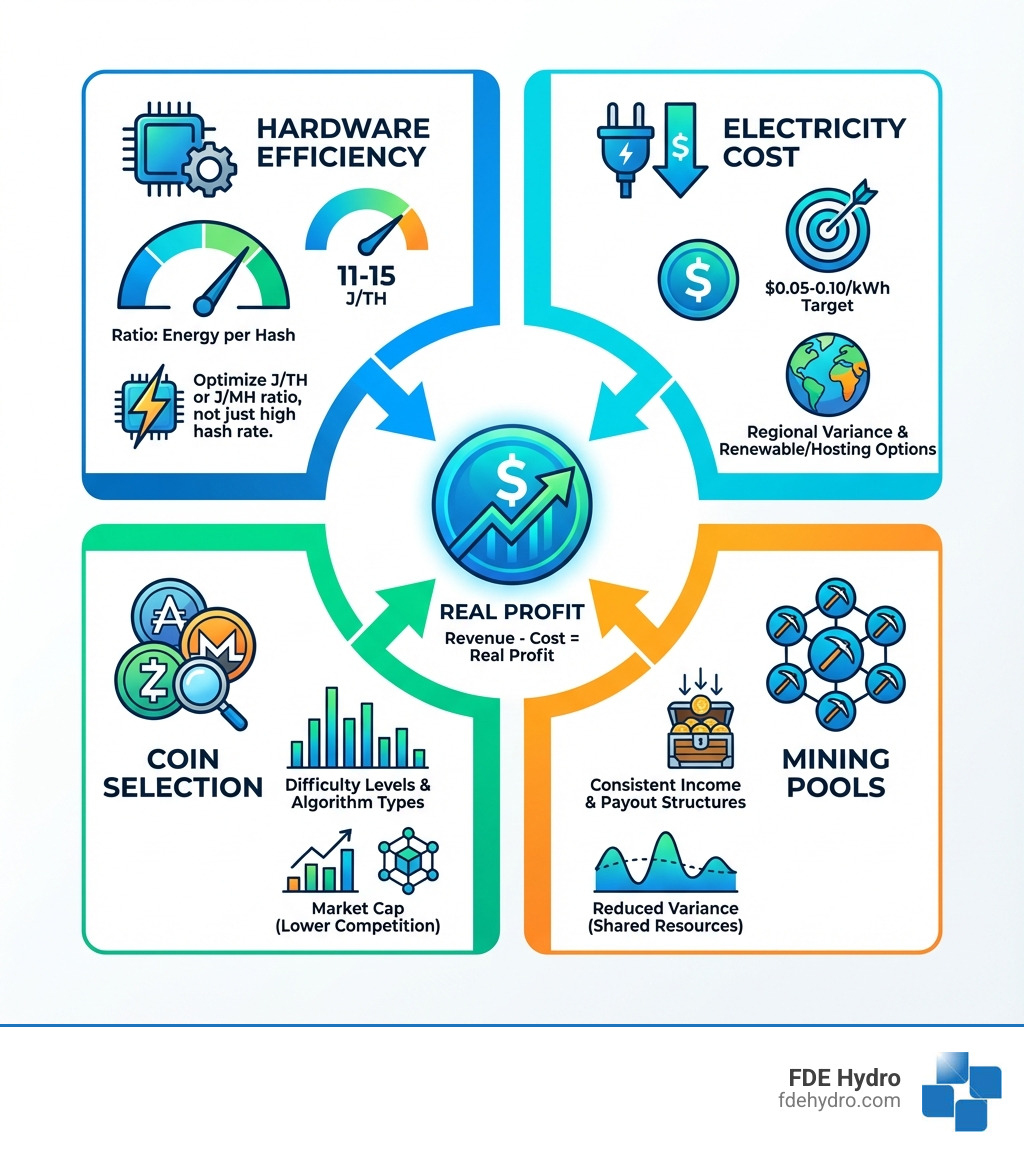
Simple guide to Cost effective crypto mining terms:
The Economics of Crypto Mining: Key Factors for Profitability
When we talk about cost effective crypto mining, we’re essentially trying to solve a complex puzzle. What are the most crucial pieces that determine whether we’re printing money or just burning through our wallet? It boils down to a few core factors: the cost of our hardware, the price of electricity, the efficiency of our mining algorithm, the ever-changing mining difficulty, and the overall network hash rate. Understanding these dynamics is our first step towards maximizing profit.
Understanding Mining Difficulty and Network Hash Rate
Imagine a treasure hunt where everyone is looking for the same chest. The more people join the hunt, the harder it becomes for any one person to find the treasure. That’s essentially what mining difficulty and network hash rate represent in the crypto world.
Mining difficulty is a measure of how hard it is to find a new block for a given cryptocurrency. This difficulty adjusts dynamically, usually every few weeks or so, to ensure that new blocks are found at a consistent rate (e.g., every 10 minutes for Bitcoin). If more miners join the network, the difficulty goes up, making it harder to earn rewards. Conversely, if miners leave, the difficulty drops.
The network hash rate is the total combined computational power being used to mine a specific cryptocurrency. A higher hash rate means more competition. This directly impacts our reward probability: with more people trying to solve the same problem, our individual chances of being the one to find the solution (and earn the block reward) decrease. Over time, this constant adjustment can significantly affect our long-term earnings, making what was once profitable suddenly less so. For instance, Bitcoin’s mining difficulty is notoriously hard, presenting a formidable challenge for individual miners.
The Crucial Role of Hardware: Hash Rate vs. Efficiency
Our mining hardware is our digital pickaxe, and choosing the right one is paramount. We often hear about “hash rate” – the raw speed at which our machine can perform calculations (e.g., TH/s for terahashes per second, GH/s for gigahashes per second). A higher hash rate means more attempts to solve the block, which sounds great on paper.
However, the real hero in cost effective crypto mining is energy efficiency, measured in Joules per Terahash (J/TH) or Joules per Megahash (J/MH). This metric tells us how much electricity our machine consumes for every unit of hashing power it produces. A machine with a high hash rate but poor efficiency will quickly drain our profits through electricity bills.
We’ve seen new hardware like the Bitmain Antminer S21 XP+ Hyd (500Th) offering an impressive 11 J/TH, and the Bitmain Antminer S21e XP Hyd 3U at 13 J/Th. Other contenders like the Auradine Teraflux AH3880 are at 14.5 J/T, the Bitdeer SealMiner A2 Pro Hyd at 14.9 J/TH, and the MicroBT WhatsMiner M66S++ at 15.5 J/TH. These machines are setting the standard, and we find that a balance of 11-15 J/TH is highly competitive for modern mining operations. Choosing equipment that strikes the best balance of price, performance, and energy efficiency is key to our success.
The Power Equation: Why Electricity Cost is King
If hardware is our pickaxe, electricity is the fuel. And just like a car, if the fuel costs too much, the journey isn’t worth it. Electricity cost is undeniably the single most critical factor in cost effective crypto mining. It’s our primary operational expense, often dwarfing the initial hardware investment over the long run.
The impact of our electricity rate ($/kWh) on our profit margin cannot be overstated. A slight difference in cents per kilowatt-hour can completely flip a mining operation from profitable to a money pit. We know it takes around 266,000 kWh to mine a single Bitcoin. If our electricity costs $0.10/kWh, that’s $26,600 just for power. If it’s $0.20/kWh, that jumps to $53,200! This variable alone can make or break our mining venture. This is why we at FDE Hydro are so passionate about Sustainable Energy Production for power-intensive operations like crypto mining.
Choosing Your Mining Hardware for the Best ROI
Investing in mining hardware is a significant step, and we want to ensure every dollar we spend contributes to a strong return on investment (ROI). It’s not just about the upfront cost, but also the total cost of ownership over the machine’s lifespan.
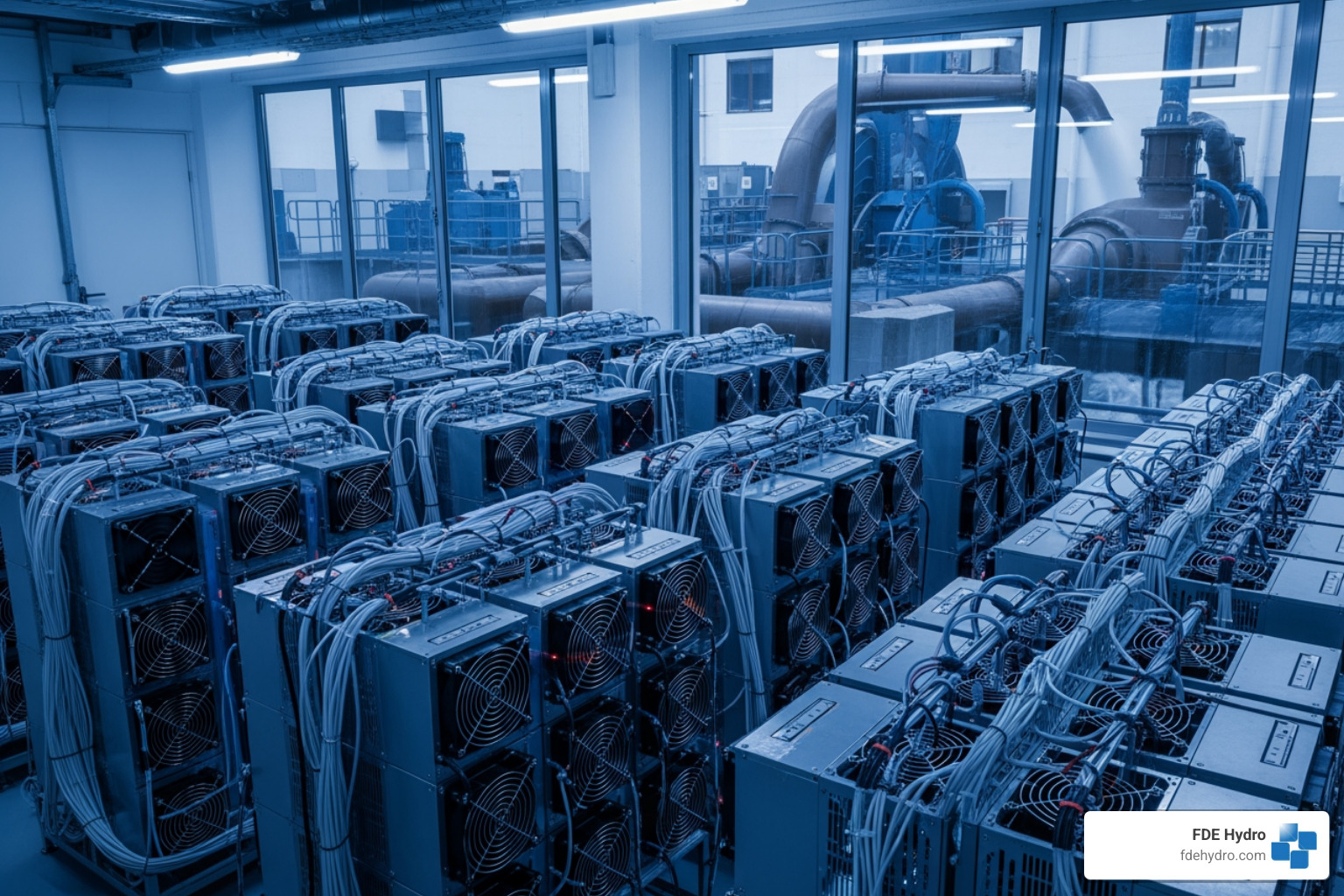
Selecting Hardware for Cost Effective Crypto Mining
When we’re looking at hardware for cost effective crypto mining, we need to evaluate several aspects beyond just the sticker price.
- Initial Purchase Price: While the most profitable machines often cost over $1,000, we’ve seen a wide range. For example, the Bitmain Antminer S21e XP Hyd 3U can be $17,000+, while the Auradine Teraflux AH3880 starts around $7,800, and the Bitdeer SealMiner A2 Pro Hyd can be found for $3,958. For altcoin mining, options like the IceRiver ALEO AE1 Lite start from $1,899, and the VolcMiner D1 (18.5Gh) from $1,885. Our budget will heavily influence our choices.
- Power Consumption (Watts): This directly ties into our electricity bill. A machine’s power draw needs to be balanced against its hash rate. For instance, the Bitmain Antminer S21e XP Hyd 3U has a hash rate of 860 TH/s with a power consumption of 11,180W, giving it that excellent 13 J/Th efficiency.
- Hash Rate Performance: This is the raw processing power. We need to ensure the hash rate is sufficient to compete on the network for our chosen cryptocurrency.
- Algorithm Support: Different cryptocurrencies use different mining algorithms. Bitcoin uses SHA-256, while Litecoin and Dogecoin use Scrypt. Aleo uses zkSNARK. Our hardware must support the algorithm of the coin we intend to mine. For example, a SHA-256 miner won’t mine Scrypt coins.
Long-Term Considerations: Depreciation, Maintenance, and Resale Value
Buying a mining rig isn’t a one-and-done deal. We need to think about the long haul.
- Hardware Depreciation: Mining hardware, especially ASICs, can depreciate rapidly as newer, more efficient models are released. This means the value of our equipment will likely decrease over time.
- Maintenance Needs: These machines work hard! They generate significant heat and can be noisy (often 50-85 decibels, sometimes higher – think vacuum cleaner levels!). Proper cooling solutions are essential, especially for high-performance units that often use hydro cooling. Maintenance includes keeping them clean, ensuring good airflow, and occasionally replacing parts.
- Resale Value: The potential resale value of our mining hardware can significantly impact our overall cost-effectiveness. If we can sell our used equipment for a decent price, it lowers our net investment. However, rapid technological advancements can diminish resale value quickly.
Bitcoin vs. Altcoins: The Profitability Trade-Off
This is a classic dilemma for miners. Do we go for the king, Bitcoin, or try our luck with the princes and princesses, the altcoins?
- Bitcoin Mining Competition: Bitcoin mining is incredibly competitive. It’s dominated by large-scale operations with massive capital and access to very cheap electricity. For at-home miners, or even medium-sized operations, competing directly with these giants can be a losing battle. Bitcoin’s mining difficulty is very hard, making it challenging to be profitable without significant investment in top-tier ASICs and ultra-low electricity costs.
- Altcoin Opportunities: Many altcoins offer potentially more cost effective crypto mining opportunities. Cryptocurrencies like Monero (XMR), Zcash (ZEC), Ravencoin (RVN), and Vertcoin (VTC) have easier mining difficulties and are often ASIC-resistant, meaning they can be mined profitably with CPUs or GPUs. Ethereum Classic (ETC) also presents an easy to medium difficulty, suitable for at-home miners. These coins provide an entry point without the prohibitive costs of Bitcoin ASICs.
- Coins with Diverse Mining Algorithms: Some altcoins use algorithms that are less resource-intensive or more accessible to general-purpose hardware. This allows us to leverage more affordable GPUs or even CPUs. For example, Aleo uses zkSNARK, which has dedicated miners like the IceRiver ALEO AE1 Lite.
- Niche Cryptocurrencies: Keeping an eye on emerging or niche cryptocurrencies can unveil hidden gems. These might have lower network hash rates, meaning less competition and a higher chance for individual miners to secure rewards before the difficulty ramps up. However, these often come with higher market volatility risks.
The trade-off is clear: Bitcoin offers stability but fierce competition, while altcoins offer potentially higher returns with lower entry barriers but often come with increased price volatility and liquidity risks.
Strategic Mining: Choosing Coins and Pools for Cost-Effectiveness
Once we have our hardware, the next strategic step is deciding what to mine and how to participate in the network. This involves smart coin selection and leveraging the power of mining pools.
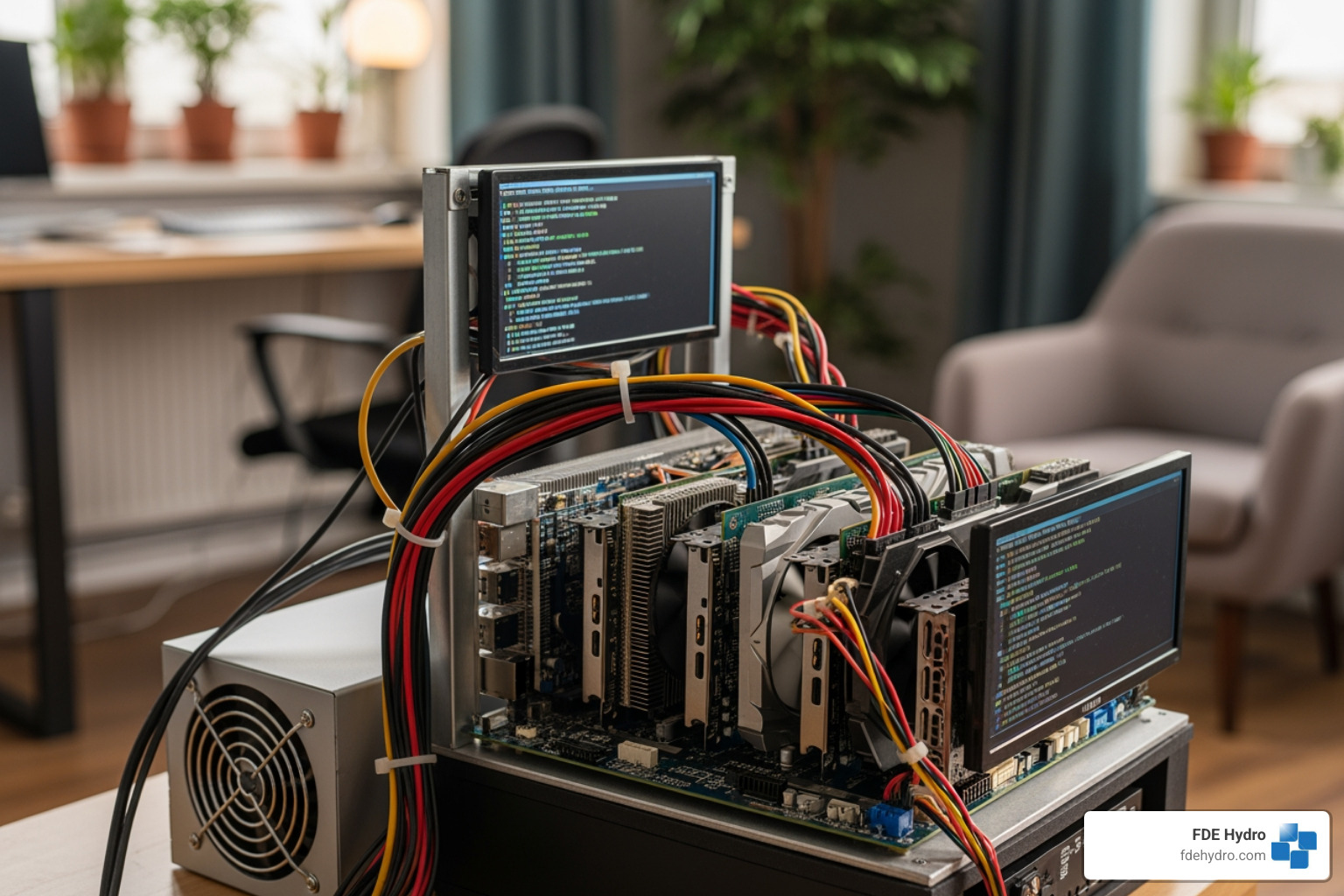
Identifying Cost-Effective Cryptocurrencies to Mine
Our goal is to find cryptocurrencies where our mining efforts yield the best return for our investment in hardware and electricity. This means looking beyond just the biggest names.
- Coins with Lower Mining Difficulty: As discussed, coins like Monero (XMR), Zcash (ZEC), Ravencoin (RVN), and Vertcoin (VTC) are often cited for their easier mining difficulties. Monero, Ravencoin, and Vertcoin are particularly interesting because they are ASIC-resistant, allowing us to use more readily available (and often cheaper) CPUs or GPUs. Zcash, while having an easy difficulty, can still benefit from more efficient ASIC miners. Ethereum Classic (ETC), a fork from the 2016 DAO hack, also offers an easy to medium difficulty level.
- Emerging Projects: The crypto landscape is always evolving. New projects, or established altcoin ecosystems like Aleo, Kaspa, and Zcash, can offer higher initial profitability before their network hash rate swells. We need to continuously evaluate their network potential, market capitalization, and trading volume to make informed decisions.
- Evaluating Network and Market Potential: It’s not enough for a coin to be easy to mine; it also needs to have market value. We need to consider the coin’s utility, community support, development roadmap, and where it’s listed for trade. A coin that’s easy to mine but impossible to sell isn’t going to help our bottom line.
The Power of Collaboration: How Mining Pools Boost Profitability
For individual miners, especially when dealing with higher difficulty coins, joining a mining pool is almost a necessity for consistent earnings.
- Combining Hash Power: Mining pools allow us to combine our computational power with thousands of other miners. Instead of trying to find a block by ourselves (which could take years for a small miner on a high-difficulty network), we contribute our hash rate to a collective effort.
- Payout Structures: When the pool collectively finds a block, the reward is distributed among all participants according to their contribution. Different pools have various payout methods, such as proportional (rewards based on effort, good when coin price surges) or pay-per-share (guaranteed flat fee, better for stable, lower coin prices).
- Reward Sharing: While we have to share the rewards, the benefit is significantly reduced variance. Instead of waiting indefinitely for a rare solo block reward, we receive smaller, more frequent payouts. This creates a more predictable income stream, which is crucial for managing operational costs.
Analyzing Financial Viability
Before we commit to any hardware or coin, we need to crunch the numbers. This means estimating our potential profitability and understanding our payback period.
- Profitability Estimation: We can use online tools like BTC.com’s calculator, NiceHash, or ASICminervalue to estimate daily, weekly, or monthly profits. These calculators take into account our hardware’s hash rate, power consumption, electricity cost, and the current network difficulty and coin price.
- Payback Period: This tells us how long it will take for our mining profits to cover our initial hardware investment. A shorter payback period is generally better. For example, under specific conditions, an ASIC miner might show a payback period of 660 days. We need to be realistic about these projections, factoring in potential increases in difficulty and market volatility.
- Using an online mining calculator to forecast earnings: These tools are invaluable. We input our specific hardware details, our electricity cost (e.g., $0.10/kWh for US hosting facilities, or typical home rates), and the current market price of the cryptocurrency. The calculator then provides estimates for revenue, electricity costs, and net profit. Remember to factor in pool fees (typically 1-2%) for an accurate picture. These calculations help us make informed decisions about which coins to mine and whether a particular hardware setup is truly cost effective crypto mining for us.
The Ultimate Guide to Cost Effective Crypto Mining Power Solutions
We’ve established that electricity is the king of operational costs. Therefore, securing low-cost, stable power is the ultimate game-changer for cost effective crypto mining. This is where geography and innovative energy solutions, like those provided by FDE Hydro, come into play.
The Geographic Advantage: How Regional Electricity Costs Impact Profitability
Electricity costs vary wildly across different regions, and this variance can make or break a mining operation.
- Global Electricity Price Variance: We see significant differences globally. While some regions in the US offer hosting facilities with rates as low as $0.06-$0.075/kWh, typical home mining rates worldwide can range from $0.12-$0.24/kWh. This disparity is why large-scale miners often flock to areas with abundant and cheap energy.
- High-Cost vs. Low-Cost Regions: If we’re operating in New York City or California, where electricity rates can be higher, our profit margins will be squeezed. Conversely, regions like Canada, particularly areas with significant hydropower resources, can offer some of the most competitive electricity prices. This is why Canada Crypto Mining has become attractive. For us, accessing these lower rates, either through dedicated facilities or by generating our own power, is paramount.
- Impact on Operational Viability: If our electricity cost is above $0.10/kWh, it often makes more sense to consider hosting services in regions with cheaper power. This critical threshold can be the difference between a profitable venture and one that consistently operates at a loss.
The Future of Cost Effective Crypto Mining: Renewable Energy
The shift towards renewable energy isn’t just about being eco-friendly; it’s a strategic move for cost effective crypto mining.
- Shifting to Renewables: Many crypto miners are already embracing renewable energy sources, such as hydro and solar power, to reduce both costs and environmental impact. This trend will only accelerate.
- Hydropower and Other Clean Energy Sources: Hydropower, in particular, offers a consistent, reliable, and often very low-cost source of electricity. Unlike solar or wind, hydropower can provide baseload power, making it ideal for energy-intensive, 24/7 operations like crypto mining. This is precisely where FDE Hydro focuses its efforts.
- Securing Low, Stable Energy Prices: By tapping into renewable sources, we can secure long-term, stable energy prices, insulating our operations from volatile energy markets. This predictability is invaluable for financial planning and maximizing profitability. This commitment contributes to overall Crypto Mining Sustainability.
Beyond the Grid: On-Site Sustainable Power Generation
The ultimate play for cost effective crypto mining is to control our energy supply directly.
- Co-locating Mining Farms with Hydropower Sources: Imagine a mining facility situated right next to a hydropower plant. This eliminates transmission costs, reduces energy losses, and provides unparalleled access to cheap, clean power. This model is gaining traction in regions like the US and Canada.
- Reducing Transmission Costs: Transmission and distribution charges can add significantly to our electricity bill. By generating power on-site, we bypass many of these costs, dramatically lowering our operational expenses.
- Energy Independence: Producing our own power grants us energy independence, shielding us from grid outages and price fluctuations. This level of control is a significant competitive advantage. At FDE Hydro, we specialize in modular solutions for Sustainable Power Generation, making it easier and more affordable to implement on-site energy for various applications, including crypto mining. Our innovative modular precast concrete technology can rapidly deploy new hydropower facilities, dramatically reducing construction costs and time, particularly in North America and Brazil. This is an incredible opportunity for miners looking to truly optimize their power costs.
Frequently Asked Questions about Cost-Effective Mining
Is crypto mining still profitable for individuals?
Yes, it can be, but the game has changed. Profitability for individuals now hinges on efficiency, securing low-cost power (ideally below $0.10/kWh), and making smart coin selections. We can’t compete on raw hash rate with industrial farms, but we can out-optimize them on other fronts.
Can I start mining with a small budget?
Yes, you absolutely can, but it’s crucial to manage expectations. Starting with a smaller budget means focusing on efficient, potentially second-hand hardware, joining mining pools for consistent payouts, and being extremely mindful of electricity costs. We might need to target easier-to-mine altcoins rather than Bitcoin.
How do I calculate potential mining profitability?
We use online mining calculators. We input our hardware’s hash rate, its power consumption in watts, and our electricity cost per kWh. Don’t forget to factor in any mining pool fees. These calculators will then estimate our potential daily or monthly profit, helping us determine if our setup is truly cost effective crypto mining.
Conclusion: Building a Sustainable and Profitable Mining Future
The landscape of crypto mining has evolved, moving past the days of easy profits and into an era where precision, efficiency, and sustainability are paramount. For us, building a profitable mining future means embracing a strategy centered on efficiency over expenditure.
We must prioritize operational excellence in every facet of our mining endeavors, from selecting the most energy-efficient hardware to strategically choosing which cryptocurrencies to mine. The role of clean energy, particularly hydropower, cannot be overstated. It offers the stability and low-cost electricity necessary to thrive in this competitive environment.
At FDE Hydro, we are proud to contribute to Sustainable Infrastructure Development by providing innovative solutions for clean power generation. Our modular precast concrete technology is designed to make hydropower more accessible and affordable, ultimately supporting energy-intensive industries like cost effective crypto mining in North America, Brazil, and Europe. We believe that by integrating sustainable practices, we can not only maximize profits but also build a more responsible and resilient future for cryptocurrency.
Learn more about how hydropower is powering the next generation of sustainable industries.
