

Why Renewable Energy Patents Matter for the Future of Clean Power
Renewable energy patents are a critical early-warning system for the global shift away from fossil fuels. Here’s what the data reveals:
- Explosive Growth: Patent applications under the Patent Cooperation Treaty (PCT) for renewables surged 547% from 2002 to 2012, signaling massive R&D investment.
- Solar Dominates: Solar technology accounts for over 50% of renewable energy patents as of 2019, with a 678% increase in applications over 17 years.
- Regional Leaders: Japan leads overall patent filings, while China has risen to third place and dominates solar patent families. Denmark leads in wind, the USA in geothermal.
- Technology Shift: Innovation is moving from energy supply (solar panels, wind turbines) toward end-use and enabling technologies like batteries, smart grids, and electric vehicles.
- Investment Signal: Patent data provides insights into which technologies are attracting R&D funding and are likely to reach commercial markets.
The energy transition needed to combat climate change requires unprecedented innovation. Patents are the earliest public signal of this innovation, revealing which technologies are being developed, where breakthroughs are happening, and who the key players are years before products hit the market. Patent databases offer invaluable technical details on the transition’s pace and direction. From 2002 to 2019, patenting in low-carbon energy grew by over 400%, while fossil fuel patents entered a four-year decline. This shift reflects economic reality: the weighted-average cost of offshore wind fell 59% between 2010 and 2022, with similar reductions across other renewables.
For decision-makers in large-scale infrastructure, especially hydropower, understanding these patent trends is essential. Innovation in modular construction, grid integration, and energy storage is reshaping project delivery, costs, and efficiency. The technologies patented today will define tomorrow’s competitive landscape.
I’m Bill French Sr., Founder and CEO of FDE Hydro™, and after decades in large-scale infrastructure, I now focus on developing patented modular solutions for hydropower, using insights from renewable energy patents to reduce costs and accelerate project timelines.
The Big Picture: Overall Trends in Renewable Energy Patents
The story of renewable energy patents over the past two decades shows a profound shift in global innovation. Data from the Patent Cooperation Treaty (PCT), administered by the World Intellectual Property Organization (WIPO), provides a clear view of this trend.
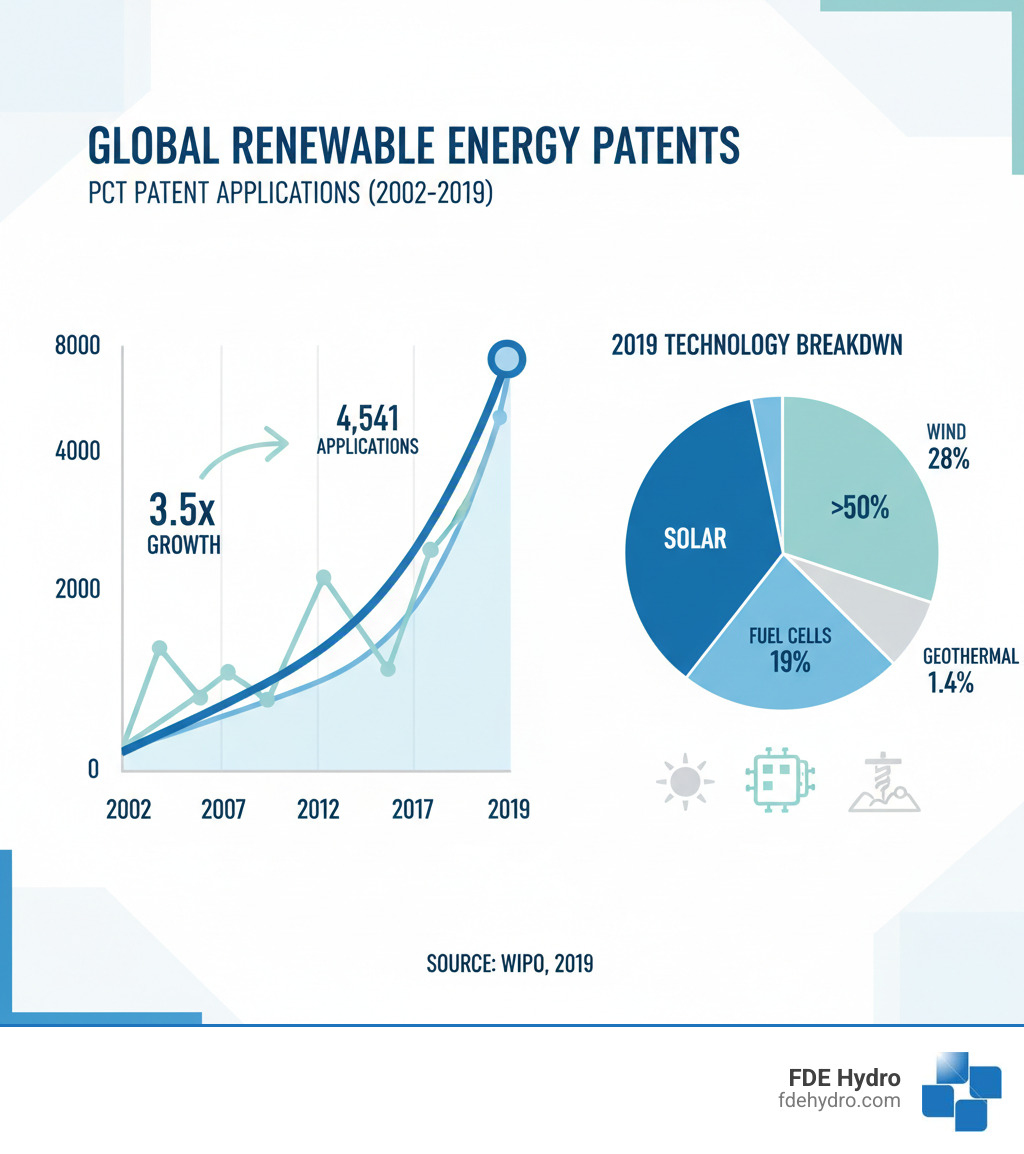
Between 2002 and 2012, patent applications for renewable technologies exploded by 547 percent, peaking in 2012 with 4,541 international applications. This surge reflected a global realization that our energy future needed to change. After this peak, activity stabilized, but by 2019, PCT applications for renewables were still 3.5 times higher than in 2002, demonstrating sustained innovation at scale.
While renewables represented just over 1 percent of all PCT applications in 2018, the trajectory is what matters. As renewables climbed, fossil fuel patents entered an unprecedented four-year decline. The Patents and the energy transition report from the IEA captures this fundamental redirection of inventive effort.
It’s also important to consider the long lead time from patent to product. The innovations patented during the 2002-2012 boom are the technologies hitting the market now. This lag means we are currently benefiting from that early wave of R&D, and the patents being filed today will shape the energy landscape of the 2030s.
The Shift from Supply to Smart Solutions
A fascinating change has occurred beneath the surface of these numbers. Early patents focused on energy supply technologies like solar panels and wind turbines. Recently, however, the focus has pivoted toward end-use technologies (how we consume energy) and enabling technologies (the infrastructure that makes it all work).
Since 2017, the growth in low-carbon energy patents has slowed, but this signals a strategic refocusing, not a stall. By 2019, end-use technologies represented over 60 percent of low-carbon energy patenting, while energy supply patents dropped to just 17 percent. Meanwhile, enabling technologies like storage and smart grids climbed to 34 percent of patents in 2019, up from 27 percent in 2000.
This means we’ve largely figured out how to generate renewable energy; the next frontier is optimizing how we store, distribute, and integrate it. Electric vehicles (EVs) became a major driver of this shift, overtaking other clean road vehicle technologies in patenting as early as 2011. The innovation extends beyond the cars to charging infrastructure and grid interaction, where a parked EV can act as a mobile storage unit.
Smart grids are the nervous system of the modern energy network, balancing supply and demand and integrating variable renewables. As reports like Patents for Improved Electricity Grids detail, this technology is becoming increasingly sophisticated.
At FDE Hydro, we see this shift firsthand. Our work on Microgrid solutions aligns with this trend. Hydropower is no longer just about generation; it’s about providing the grid stability and storage that makes variable renewables like solar and wind viable at scale. The patent trends validate our focus: the future of energy isn’t just cleaner sources, it’s smarter systems.
A Technology Breakdown: Where is Innovation Accelerating?
Digging into the details of renewable energy patents reveals that innovation isn’t uniform. Some sectors are booming while others find specialized niches. These trends show where breakthroughs are happening and where future commercialization will focus, often mirroring investment and the drive for cost reduction.
Solar Power: The Undisputed Leader
Solar power is the clear winner in the renewable patent race. In 2002, solar accounted for just over a quarter of renewable PCT applications. By 2019, it represented over half of all renewable energy patents. Over that 17-year period, solar patent applications grew by an extraordinary 678 percent.
Solar innovation has also evolved. Early patents focused on new cell designs, while today’s innovations are increasingly about manufacturing optimization and cost reduction. Developments in organic PV cells are also opening up new applications. This sustained R&D has directly contributed to dramatic cost reductions, making solar one of the cheapest sources of new electricity.
Wind, Geothermal, and Fuel Cells
While solar leads, other technologies are carving out important roles.
Wind energy was the second-largest category in 2019, accounting for 28 percent of renewable publications. Denmark leads the world in wind energy patents from 2010-2019, with Germany close behind, reflecting their massive investments in wind infrastructure.
Innovation in offshore wind is particularly exciting. As detailed in the Offshore wind energy – Patent insight report, patent filings surged after 2017. Innovators are focusing on floating foundations for deep-water turbines and more efficient transmission systems.
Geothermal energy plays a more specialized role, representing just 1.4 percent of renewable energy patents. The United States ranks highest in geothermal patenting, leveraging its significant resources in states like California and Nevada.
Fuel cells saw a patent boom that peaked around 2008. By 2019, they accounted for 19 percent of renewable patents, suggesting the technology has moved from foundational R&D into a phase of refinement and specific applications.
The Crucial Role of Hydropower and Storage
While solar and wind capture most headlines, Hydropower remains essential to a functioning renewable energy system. It provides the foundation that makes intermittent renewables viable. When the sun isn’t shining or the wind isn’t blowing, energy storage becomes critical.
Patent activity reflects this reality, with battery technology patents surging. For large-scale, long-duration storage, Pumped Storage Hydropower remains a leading solution, acting like an enormous battery to balance the grid.
Hydropower functions as the Guardian of the Grid, providing stability that variable renewables cannot deliver alone. At FDE Hydro, our patented modular precast concrete technology addresses one of hydropower’s biggest challenges: high costs and long construction timelines. By making projects more affordable and faster to complete, we help this proven technology partner with other renewables for a stable, clean grid.
The Global Race for Green Tech Dominance

The competition to lead the clean energy revolution is global, and renewable energy patents reveal the key players. International Patent Families (IPFs)—inventions protected in multiple countries—signal serious intent to compete in international markets. Another metric, Revealed Technology Advantage (RTA), shows where countries have developed specialized expertise. Encouragingly, international collaboration on these patents is also increasing, accelerating the energy transition through a mix of competition and cooperation.
Established Leaders: Japan, Europe, and the USA
For decades, a few regions have consistently led in green innovation.
Japan has been the overall leader in renewable energy patenting. Between 2010 and 2019, Japanese inventors filed more renewable PCT applications than any other nation, with particular dominance in solar and fuel cell technology.
Europe accounted for 28 percent of all low-carbon energy IPFs during the 2010-2019 period. Within the continent, specialization is clear: Denmark leads the world in wind energy patents, while Germany contributes significantly across multiple technologies.
The United States contributed 20 percent of all low-carbon energy IPFs in the same period. The USA’s primary strength is in geothermal technology, where it ranks first globally for patent applications, leveraging its abundant natural resources.
These established leaders continue to push boundaries in their areas of specialization, setting technical standards for the next generation of renewable technologies.
The Rise of China
While traditional powers have maintained their positions, the past decade has seen China’s dramatic rise as a clean energy leader. In the latter half of the 2010-2019 decade, China surged to third place globally with 1,522 published international patent applications for renewables.
Looking at patent families reveals China’s strategy. Between 2013 and 2017, Chinese inventors originated 45,472 patent families—more than double Japan’s total. This massive number indicates a clear ambition to commercialize innovations internationally.
China’s focus on solar is particularly striking. During the 2013-2017 period, Chinese applicants filed three times as many solar patents as their Japanese counterparts. This intensive innovation has translated directly into massive real-world deployment. China became the first country to pass 100 gigawatts of installed solar capacity in 2017 and has continued to expand at a record pace. This trajectory shows how patenting activity can foreshadow fundamental shifts in global markets.
At FDE Hydro, we watch these global trends closely. As variable renewables like solar expand, hydropower’s stabilizing role becomes even more critical. Our patented modular technology aims to make hydropower projects more competitive globally, contributing to a diverse and resilient renewable energy portfolio.
From Patent to Power Plant: What the Data Reveals

The real story of renewable energy patents is what happens after invention. Successful patents transform from technical drawings into the power plants and grid systems that power our lives. Patent data reveals where innovation is heading and which technologies are attracting R&D investment, giving us a head start on understanding future energy trends.
For example, a 2019 World Economic Forum published an article noting that renewable investment growth was slowing. This wasn’t due to lost interest, but because costs for solar and wind had fallen so dramatically—driven by innovations from earlier patents—that the same investment bought more capacity. This highlights the importance of life-cycle cost analysis, as today’s patents will determine operating expenses and system efficiency for decades.
How patent analysis informs renewable energy solutions
Patent documents reveal crucial technical details. For instance, patent US8604641B2 describes methods for optimizing multiple energy sources working together. It focuses on “coincident operation”—how different renewables interact on the same grid. This system-level thinking is what enables facilities to achieve net-zero energy goals while minimizing life-cycle costs.
This approach resonates with our philosophy at FDE Hydro. Our patented modular technology is designed for seamless integration into broader energy systems. We believe The Biggest Untapped Solution to Climate Change is in the Water, and our innovations make hydropower projects faster and more affordable, open uping that potential. Modern renewable energy is about smart integration and economic optimization, turning concepts into bankable projects.
Limitations of using renewable energy patents as an indicator
While patents are valuable early indicators, they aren’t perfect predictors of commercial success. The lag time between filing and deployment can be five to ten years or more, during which markets and technologies can change.
Furthermore, the type of patent matters. International Patent Families (IPFs) signal strong commercial intent, whereas utility models may only represent incremental improvements. The Methodology for counting patents is crucial for drawing accurate conclusions.
The Patent Cooperation Treaty (PCT) system also captures only part of the picture, as many innovations are patented only in specific national markets. Therefore, patent data is most powerful when combined with other indicators like deployment data, cost trends, and policy developments to get a complete view of the energy transition.
Frequently Asked Questions about Renewable Energy Patents
Here are answers to some common questions about renewable energy patents and their role in the energy transition.
Which country files the most renewable energy patents?
Between 2010 and 2019, Japan led in total international PCT applications for renewables, with a strong focus on solar and fuel cells. However, when looking at entire patent families—a better indicator of global commercial ambition—China has surged to dominance, especially in solar. Leadership is also specialized: Denmark ranks top for wind energy, while the United States leads in geothermal patents.
Which renewable technology is patented the most?
Solar power dominates the patent landscape, accounting for over half of all international renewable patent applications in 2019. This reflects massive global R&D investment and has driven significant cost reductions and rapid capacity expansion. Wind energy is second, with 28 percent of patent publications in 2019, followed by fuel cells at 19 percent. Geothermal is more niche, representing 1.4 percent of patents.
Do more patents guarantee faster deployment of green energy?
Not directly, but patents are a strong early indicator of factors that drive deployment. They signal where R&D funding is flowing and where breakthroughs are likely. These innovations lead to the cost reductions that make green energy economically viable. As a 2019 World Economic Forum article noted, investment growth can slow simply because costs have fallen so much that we get more capacity for less money. The patents filed during the 2002-2012 boom are now maturing into the cost-competitive technologies being deployed today. At FDE Hydro, our patented modular technology embodies this principle: innovation today enables faster, more affordable deployment tomorrow.
Conclusion
The data on renewable energy patents tells a clear story: the energy transition is accelerating, driven by a powerful wave of innovation. The trends show a clear frontrunner in solar power, continued advancement in wind, and a critical strategic shift from simple power generation toward smart integration with batteries, grids, and electric vehicles.
The global race for green tech leadership is also reshaping the landscape. While established leaders like Japan, Europe, and the US continue to innovate, China’s strategic focus on securing international patents, particularly in solar, signals a long-term commitment to leading the global market.
Patent data gives us a window into the future. The innovations being patented today will define the cost, efficiency, and reliability of clean energy for decades. More patents ultimately mean more accessible and affordable renewable energy for everyone.
At FDE Hydro, we are proud to be part of this global innovation story. Our patented modular precast concrete technology addresses a critical piece of the puzzle: making hydropower more economical and accessible. By reducing construction time and costs, we are Reinvigorating Hydropower to ensure it can fulfill its vital role as the guardian of grid stability in an ecosystem of variable renewables. The future of energy is an integrated one, and we are building a key part of it.
Learn more about our innovative means and methods and see how we’re building the future of hydropower, one modular piece at a time.
