

Why Modular Precast Dams Are Changing Water Infrastructure
A modular precast dam is a water impoundment structure built from factory-manufactured concrete modules that are transported to the site and rapidly assembled, offering dramatic reductions in construction time and cost compared to traditional cast-in-place methods.
Key advantages of modular precast dams include:
- Cost Savings: 40-60% reduction in construction costs compared to conventional dams
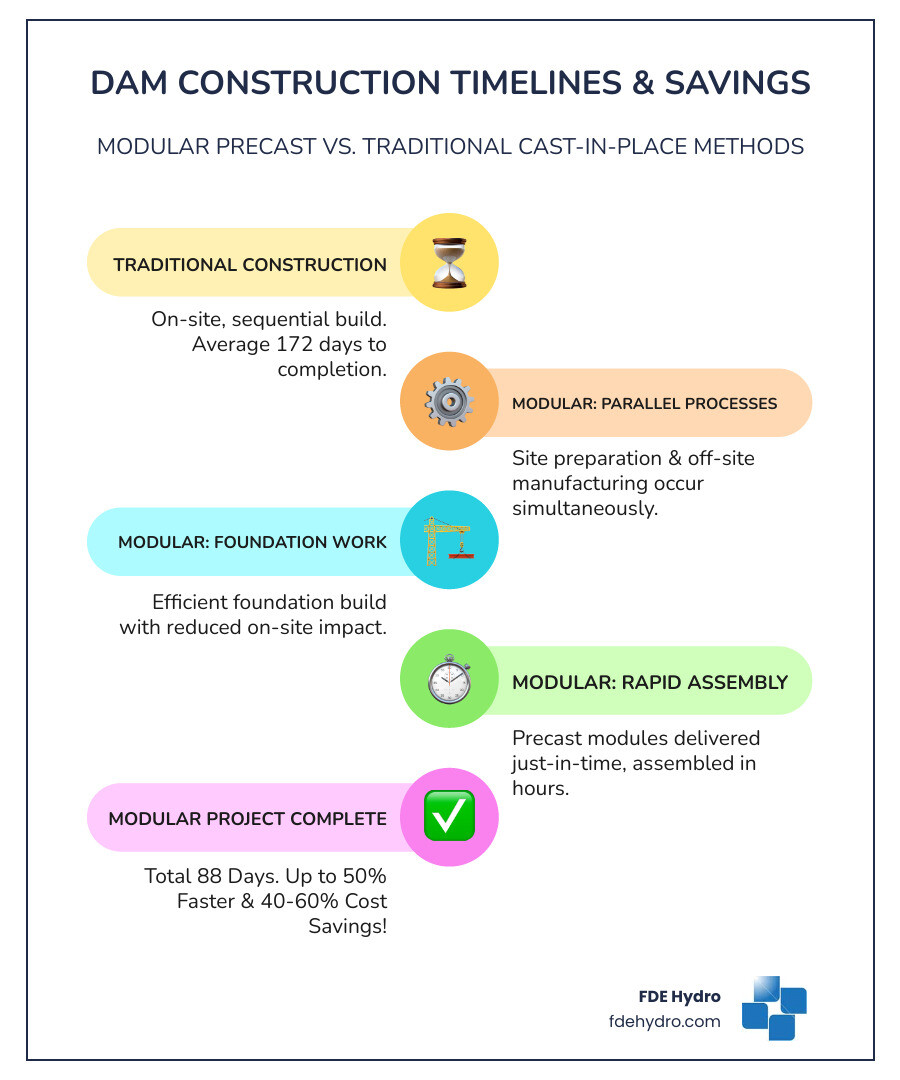
- Speed: Construction timeline reduced by up to 50% (from 172 days to 88 days)
- Quality Control: Factory-manufactured in controlled environments for consistent strength and durability
- Weather Independence: Off-site manufacturing eliminates weather-related delays
- Reduced Risk: Minimized on-site labor requirements and shortened exposure to schedule overruns
- Environmental Benefits: Smaller construction footprint and reduced riverbed disruption
Traditional dam construction faces significant challenges. The average U.S. dam is 58 years old, and physical civil construction accounts for 40-90% of total hydropower development costs. Weather delays, lengthy construction periods, and budget overruns plague conventional projects. These factors make dam repair and new development increasingly difficult to justify financially.
Modular precast dam technology addresses these challenges head-on. Instead of building dams entirely on-site with weather-dependent concrete pours, precast modules are manufactured in controlled factory settings while site preparation happens simultaneously. Once delivered, these modules—some weighing 27,000 pounds—can be assembled in hours rather than months. The result is a monolithic structure that meets or exceeds the strength and durability of traditional dams.
I’m Bill French Sr., Founder and CEO of FDE Hydro™, where we’ve pioneered the patented “French Dam” modular precast dam system to revolutionize water infrastructure construction. My five decades in heavy civil construction and site development provide the foundation for delivering these innovative solutions to the hydropower industry.
The evidence is compelling. Full-scale design comparisons show that a modular precast dam can be constructed in 88 days versus 172 days for cast-in-place alternatives. Cost savings are equally dramatic: a 22-foot high modular precast dam costs approximately $900,000 compared to $1,980,000 for traditional construction—a 55% reduction. For larger structures, savings remain substantial, with a 50-foot dam showing 40% cost reduction.
Related content about modular precast dam:
The Enduring Challenges of Conventional Dam Construction
For generations, dams have been cornerstones of our infrastructure, providing hydropower, water supply, flood control, and irrigation. However, the methods used to build and maintain these structures have long been fraught with significant challenges and costs.
One of the most pressing issues we face today is aging infrastructure. The average age of the 90,580 recorded dams in the U.S. is 58 years, with many exceeding their original 50-year service life expectancy. This aging network demands urgent repair and replacement, yet the costs and complexities of traditional civil construction often make such projects prohibitive. The physical civil construction itself is the largest single component of new hydropower development cost, ranging from a staggering 40% to 90% of the total capital cost, depending on the project size.
These high capital costs are exacerbated by inherent project risks. Traditional dam construction relies heavily on on-site, in-situ concrete pouring, which makes projects highly susceptible to weather delays and river flood events. A single major storm can bring work to a standstill, pushing schedules back by weeks or even months, leading to significant budget overruns. Lengthy construction periods, contracting delays, and long lead times for major equipment further compound these risks. When a project stretches for years, the potential for unexpected issues—from material price fluctuations to labor shortages—grows exponentially.
Beyond the financial and logistical problems, conventional dam construction often entails significant environmental disruption. Large-scale on-site operations require extensive land disturbance, heavy machinery, and prolonged periods of activity within sensitive river ecosystems. This can negatively impact water quality, aquatic habitats, and local communities. For instance, massive projects like the Belo Monte Hydroelectric Dam complex in Brazil, while providing immense power, also highlight the scale of environmental and social impacts associated with traditional large-dam construction.
The need for innovative and more efficient Dam Construction Methods that can mitigate these challenges is clearer than ever. We need solutions that are not only cost-effective and faster but also minimize environmental impact and improve safety.
How a Modular Precast Dam Revolutionizes the Building Process
Imagine building a dam like assembling a giant set of LEGOs. That’s essentially the revolution offered by modular precast construction. This approach tackles the traditional challenges head-on by shifting the majority of the civil construction work from the unpredictable river environment to controlled factory settings.
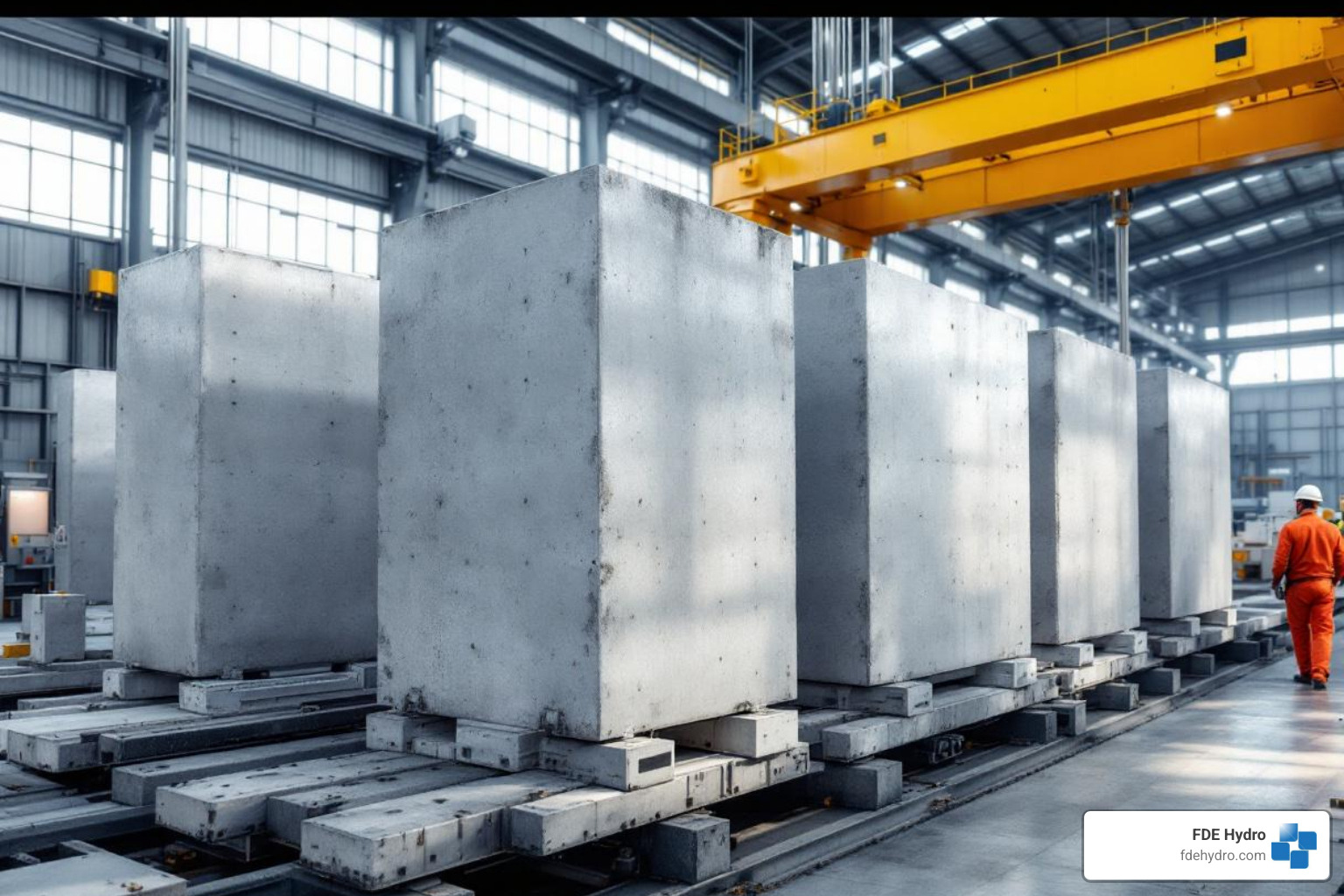
At the heart of this revolution is off-site manufacturing. Instead of pouring concrete on-site, which is weather-dependent and requires extensive temporary formwork, we manufacture high-quality, reinforced concrete modules in specialized facilities. This allows for superior quality control, as conditions like temperature, humidity, and curing can be precisely managed, leading to stronger, more durable concrete elements.
This method also enables parallel processing. While our skilled teams are busy fabricating the specialized modules in the factory, another crew can be simultaneously preparing the project site. This could involve foundation work, excavation, and other necessary groundwork. This parallel workflow dramatically shortens the overall project timeline, as these crucial phases are no longer sequential.
Once manufactured, the modules are transported to the site for just-in-time delivery. This minimizes the need for large on-site storage areas, further reducing the construction footprint. The modules are then rapidly assembled using cranes and specialized equipment. This “click-and-connect” approach means that a project that might traditionally take months or even years of on-site work can be completed in a fraction of the time. This rapid installation is a hallmark of Rapid Installment of Module Precast Civil Infrastructure.
The benefits extend to reduced on-site labor. With most of the heavy, complex work completed off-site, fewer personnel are required in the potentially hazardous construction zone. This not only improves safety but also addresses challenges related to skilled labor availability. The entire Precast Concrete Industry benefits from this shift towards efficiency and control.
The ‘French Dam’ System: A Case Study in Innovation
Our patented “French Dam” system exemplifies this innovative approach. It’s designed specifically for the construction and retrofit of hydroelectric dams, water control systems, and powerhouses, offering a sophisticated and adaptable solution for almost every type of site condition.
The system works by utilizing standardized, yet adaptable, interlocking concrete blocks. These modules are engineered to fit together precisely, forming a robust structure. Once positioned, they are secured using post-tensioning systems and rock anchors, effectively changing the individual modules into a single, monolithic structure that can withstand immense hydraulic forces. The design allows for independent replacement of modular elements or removal of the entire structure if needed, offering unparalleled flexibility.
We, along with our partners, successfully completed a prototype of the “French Dam” in the U.S. This prototype, a 24-foot-long by 16-foot-high structure, consisted of six 8-foot by 8-foot concrete blocks, each weighing approximately 27,000 pounds. The most impressive part? This entire structure was assembled in less than 3.5 hours. This proof-of-concept demonstrated that precast concrete modules meet desired structural and hydraulic integrity, with minimal leakage observed during testing. This success was a significant milestone, confirming the viability of the technology and its potential to be a “game changer” for the hydro industry, as detailed in the Prototype of Modular Precast French Dam Completed report and subsequent validation that French Dam Technology Passes the Test.
Versatile Applications for Modern Water Infrastructure
The adaptability of the modular precast dam system means its applications are incredibly broad, extending beyond just traditional dam construction. We can use this technology for a wide array of water impoundment and control structures.
For new Hydroelectric Dam Construction, our modular approach provides a faster, more cost-effective pathway to developing new renewable energy sources. But it’s not just about new builds. With so much aging infrastructure in the U.S., dam rehabilitation is a critical need. Our system is ideal for retrofitting or rehabilitating existing dams, enhancing their safety and extending their operational life.
Beyond large dams, the technology is perfectly suited for smaller structures like weirs (low dams used to raise the water level of a river or stream) and diversion structures that channel water for irrigation or other purposes. We can also construct modular powerhouses, integrating the turbine and generator units directly into the precast structure, further streamlining hydropower development.
Our solutions also extend to coastal and flood protection, including sea walls. Modular precast sea walls can be constructed off-site and installed rapidly, enabling deployment in half the time of conventional concrete walls. This is crucial for protecting communities from rising sea levels and extreme weather events. The “French Dam” system offers comprehensive Water Infrastructure Solutions for various needs, adapting to virtually any size, shape, height, and width.
The Quantifiable Benefits of Precast Modular Dams
The adoption of a modular precast dam system isn’t just about innovation; it’s about delivering tangible, measurable advantages that translate into significant project success. The benefits are wide-ranging, impacting everything from project timelines and budgets to safety and environmental stewardship.
At FDE Hydro™, we’ve seen how our approach leads to substantial risk mitigation. By moving complex construction tasks to a controlled factory environment, we reduce the uncertainties associated with on-site work, such as adverse weather, difficult terrain, and fluctuating river conditions. This minimizes potential delays and safety hazards, contributing to improved site safety for all personnel.
For developers, this translates directly into a faster ROI (Return on Investment). Shorter construction periods mean that hydropower facilities can come online much sooner, generating revenue and offsetting initial capital investments more quickly. This speed and efficiency are key drivers for Hydropower Innovation and the broader adoption of advanced construction techniques. The advantages of precast concrete are well-documented across various industries, and its application in water impoundment structures brings these same Precast Concrete Advantages to a critical sector.
Drastic Reductions in Cost and Time for a modular precast dam
Perhaps the most compelling benefits of our modular precast dam technology are the dramatic reductions in both cost and construction time. Our research and full-scale design comparisons consistently show significant savings over traditional cast-in-place (CIP) methods.
Consider the following table, which illustrates the estimated cost savings for different dam heights:
| Dam Height | Conventional Cast-in-Place (CIP) Cost | Modular Precast Dam Cost | Percentage Savings |
|---|---|---|---|
| 22 feet | $1,980,000 | $900,000 | 55% |
| 30 feet | $3,830,000 | $1,500,000 | 60% |
| 50 feet | $8,050,000 | $4,600,000 | 40% |
These figures highlight how a modular precast dam can drastically Reduce Construction Costs for water infrastructure projects. The savings are achieved through a combination of reduced on-site labor, faster installation, minimized material waste, and the efficiencies of factory production.
Beyond cost, the impact on the construction schedule is equally impressive. A hypothetical full-scale design analysis, comparing a modular precast dam to a previously constructed CIP dam in the U.S., revealed significant time savings. The original CIP reconstruction took 172 days. By utilizing our modular precast approach, the estimated reconstruction time was reduced to 118 days with fixed start dates (a 31% reduction), and an even more remarkable 88 days with flexible scheduling (a 49% reduction). This ability to cut project duration by nearly half is invaluable, especially for critical infrastructure projects where every day counts.
Environmental and Safety Advantages of a modular precast dam
Our commitment to innovation extends beyond economics and efficiency to encompass environmental responsibility and safety. A modular precast dam offers distinct advantages in these crucial areas.
The most immediate environmental benefit is a reduced on-site footprint. Because most of the fabrication occurs off-site, the construction area at the dam location is significantly smaller and less intrusive. This minimizes the disturbance to surrounding ecosystems, requiring less excavation, less temporary infrastructure, and fewer heavy vehicle movements in sensitive areas. We also generate less construction waste on-site, as any waste from module manufacturing is typically recycled within the factory environment.
Critically, the method allows for minimized riverbed disruption. Rapid assembly means that periods of in-river work can be significantly shortened, reducing the impact on aquatic life and water flow. This approach aligns with principles of Sustainable Infrastructure Development.
From a safety perspective, transferring manufacturing to a controlled factory environment inherently leads to fewer on-site labor hours in hazardous conditions. Workers are not exposed to the same risks of working at heights, around heavy machinery in unpredictable weather, or in close proximity to flowing water for extended periods. This drastically improves overall site safety. Furthermore, the weather-independent construction schedule of off-site manufacturing means that projects are less likely to experience delays due to harsh conditions, avoiding the pressure to work in unsafe environments to meet deadlines.
Implementation and Future Outlook
Implementing a modular precast dam project, while offering numerous advantages, requires careful planning and consideration to ensure seamless execution.
The first critical step is a thorough site suitability analysis. While our system is highly adaptable, understanding the specific hydrological, geological, and physical conditions of a site is paramount. This includes assessing the riverbed, rock formations, and flood patterns to inform the foundation design. Foundation preparation is a key aspect, often involving rock anchors or pile support systems to securely link the modular elements to the riverbed, creating a cohesive, stable structure. Our patented working platform system with rock bolt linkage is specifically designed for this purpose.
Transportation logistics also play a vital role. While modules are designed for efficient transport, factors like road weight restrictions and access to remote locations must be carefully planned. However, the benefits of controlled off-site manufacturing and rapid on-site assembly typically outweigh these logistical considerations.
The future outlook for modular precast dam technology is incredibly promising. The U.S. DOE Hydropower VISION report has already recommended modular approaches for new in-stream hydropower facilities, recognizing their potential to revitalize the sector. We are seeing growing adoption by regulators in the U.S. and Europe who are increasingly willing to include precast concrete as an alternative in project specifications. This indicates a growing recognition of the safety, environmental, and economic benefits of modular construction.
Our technology, as highlighted in the Precast, Modular Construction for Water Impoundment Infrastructure paper, represents a significant step forward. We believe that modular precast construction will become a standard practice in the hydropower and water infrastructure sectors, driving innovation and efficiency. The ongoing advancements and discussions, such as those anticipated at Hydropower Advancements & Innovations 2025, underscore this growing momentum. Our Means and Methods are continually evolving to meet these future demands.
Frequently Asked Questions about Modular Precast Dams
How strong are modular precast dams?
Our modular precast dams are engineered to be exceptionally strong and durable. They use high-strength concrete manufactured in controlled factory environments, which often exceeds the quality achievable with on-site pours. The modules are designed with interlocking joints and are further reinforced using post-tensioning cables and rock anchors. This system effectively binds the individual modules together, forming a truly monolithic structure that meets or exceeds the most stringent engineering standards for conventional dams, capable of withstanding significant hydraulic, seismic, and environmental loads.
Can modular dams be used for any size project?
Absolutely! The beauty of our modular system is its incredible scalability and adaptability. Our designs are custom to be highly flexible, allowing them to adapt to any size, shape, height, and width required for a project. Whether it’s a small weir for water diversion, a medium-sized dam for hydropower generation, or a large-scale impoundment structure, the modular approach can be customized to fit the specific needs. This flexibility means that Precast Pushes the Limits of Scale, making it a versatile solution for diverse water infrastructure demands.
What is the lifespan of a precast dam?
With a modular precast dam, we’re not just building for today, but for generations to come. The use of high-quality factory-produced concrete ensures superior density and durability, which are critical for long-term performance in harsh water environments. Our dams are engineered for an impressive service life of 100+ years, often surpassing the typical lifespan of traditionally constructed dams. They are highly resistant to environmental degradation, including freeze-thaw cycles and chemical exposure, thanks to the controlled manufacturing processes and robust materials used.
Conclusion: Building the Future of Water Infrastructure
The challenges facing our aging water infrastructure are immense, but the solutions offered by modular precast dam technology provide a clear path forward. We’ve seen how this innovative approach delivers unparalleled speed, cost-effectiveness, improved safety, and critical sustainability benefits.
By shifting construction from unpredictable river environments to controlled factory settings, we dramatically reduce project timelines, cut costs by up to 60%, and mitigate the risks inherent in traditional civil construction. The “French Dam” system, with its interlocking, high-strength concrete modules, is a proven solution for modernizing our infrastructure, making hydropower development more attractive and accessible than ever before.
At FDE Hydro™, we are proud to be at the forefront of this change, providing the innovative technologies needed for a sustainable future. We invite you to explore how our solutions can benefit your next project.
Renewable Energy Construction is not just about generating power; it’s about building smarter, faster, and more responsibly. Explore our innovative dam solutions and find how we are shaping the future of water infrastructure.
