

Why Modular Hydropower Matters for Modern Energy Infrastructure
Hydro power modules are revolutionizing how we generate clean energy from water. These prefabricated, standardized systems offer a faster, more affordable alternative to traditional large-scale hydroelectric dams—making hydropower accessible to communities, businesses, and water infrastructure projects that were previously left behind.
What are hydro power modules?
- Prefabricated turbine-generator units that arrive ready to install
- Standardized components (like Kaplan, Francis, or Pelton turbines) designed for specific head and flow conditions
- Containerized “plug-and-play” systems that integrate turbines, controls, and grid equipment in shipping containers
- Precast concrete civil works that snap together on-site like building blocks
- Power output ranges from micro-hydro (5 kW) to small hydro (30 MW+)
Unlike conventional hydropower that requires years of custom engineering and massive civil construction, modular systems are built in factories, tested before shipping, and installed in weeks or months instead of years. They’re ideal for retrofitting existing dams, powering irrigation canals, supporting remote microgrids, and adding renewable baseload capacity to complement solar and wind.
The modular advantage is clear: Lower upfront costs. Faster revenue generation. Reduced construction risk. And the ability to scale power output by adding more units as needed.
I’m Bill French Sr., Founder and CEO of FDE Hydro™, where we’ve spent the last decade developing modular precast solutions that make hydropower faster and more economical to deploy. Our work with hydro power modules has helped redefine what’s possible for run-of-river facilities, retrofits, and new sustainable infrastructure projects across North America and beyond.
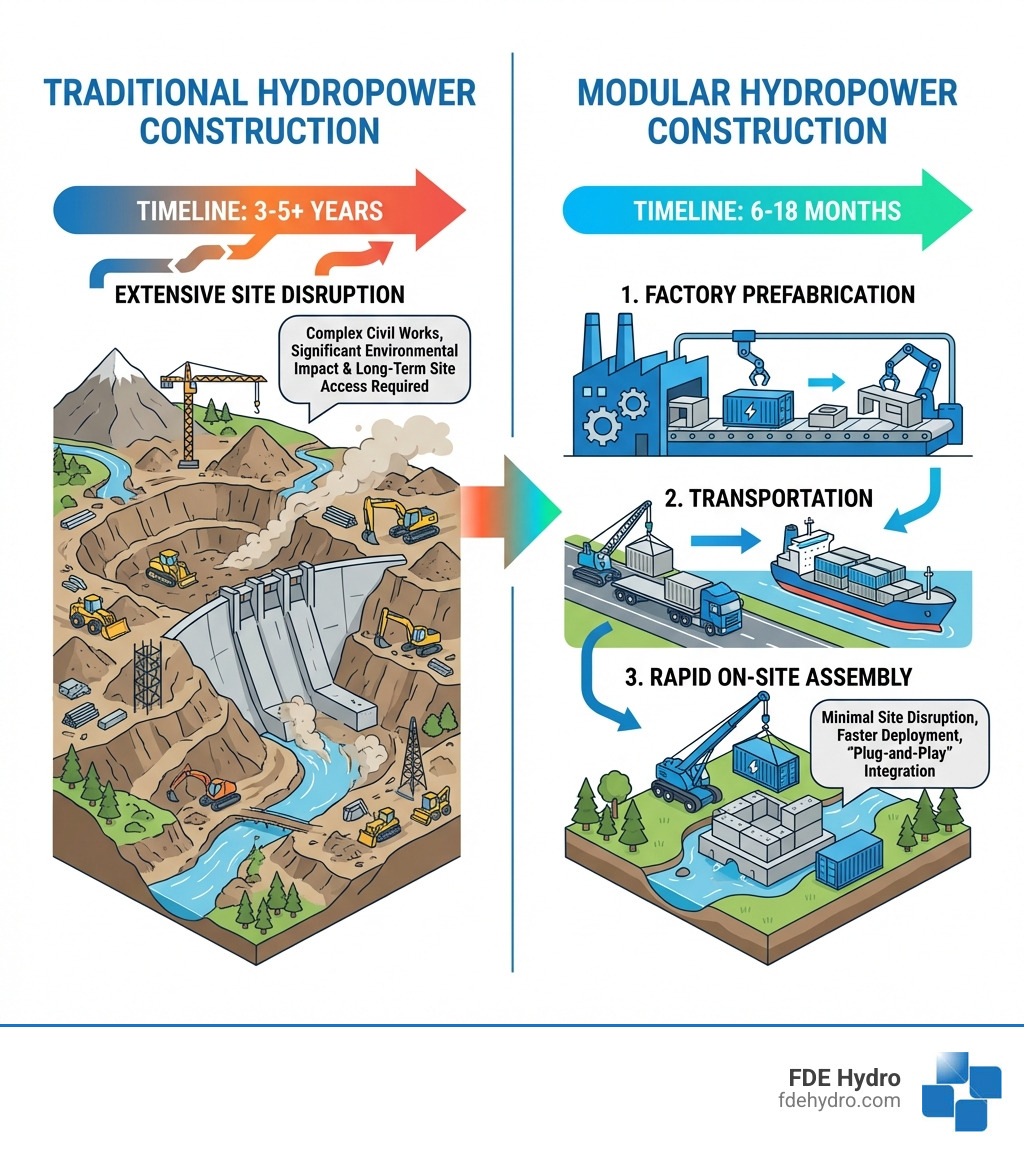
A Guide to Different Types of Hydro Power Modules
When we talk about hydro power modules, we’re referring to a diverse range of innovative technologies, each designed to optimize energy generation for specific site conditions. These aren’t just off-the-shelf products; they are sophisticated, standardized turbine-generator units and civil infrastructure components that arrive pre-assembled and ready for integration. Our approach focuses on delivering complete water-to-wire solutions, encompassing everything from the turbine to the grid connection.
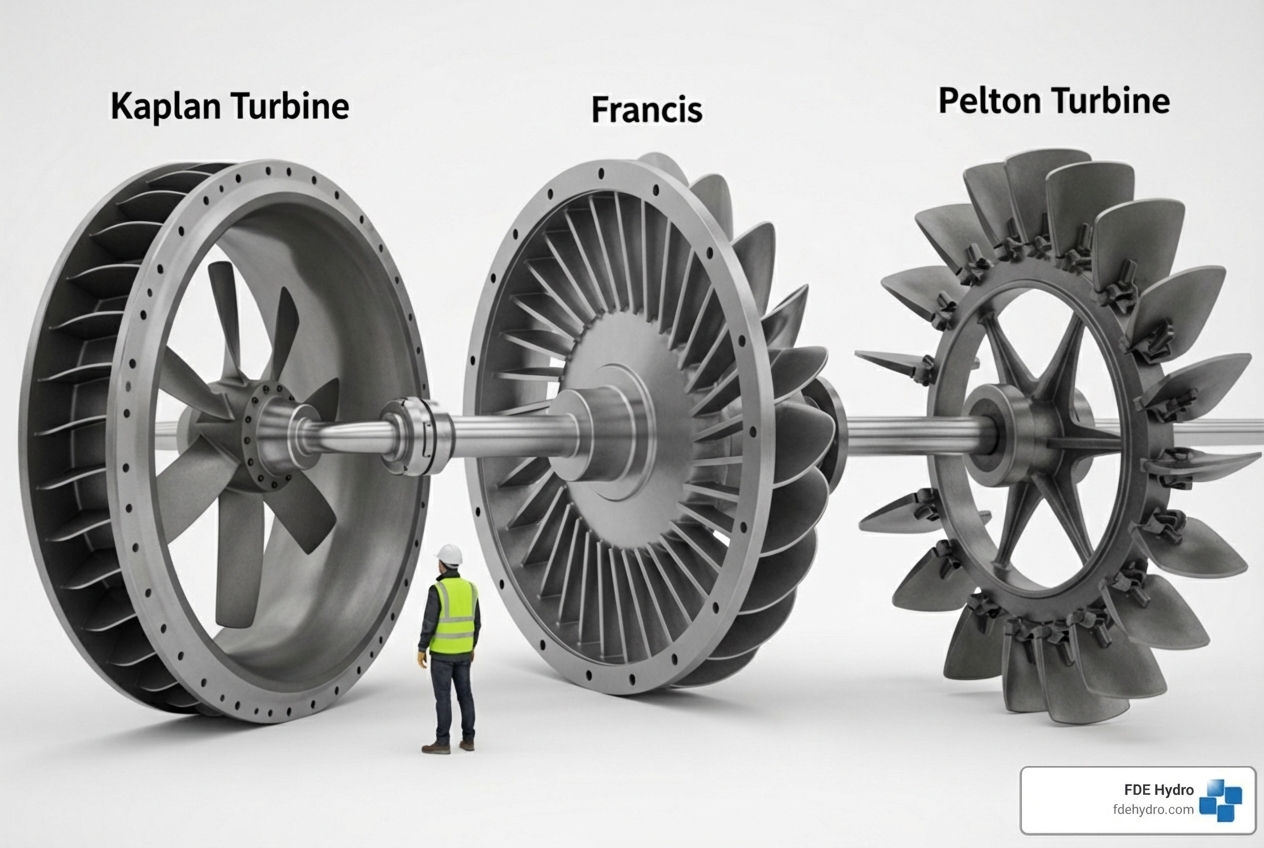
Different types of turbines are suited for varying water conditions, specifically head (the vertical distance water falls) and flow (the volume of water moving). For instance, our modular Kaplan turbines typically operate effectively with a head range of 2 to 10 meters and a flow of 2 to 20 cubic meters per second, generating up to 1,000 kW. For sites with higher heads, our modular Francis turbines excel, handling heads from 20 to 80 meters and flows from 0.25 to 3.80 cubic meters per second, with outputs up to 1,700 kW. For the highest head applications, our Pelton turbines are designed for heads between 80 and 340 meters and flows of 0.4 to 1.6 cubic meters per second, capable of producing up to 4,750 kW. This diverse range allows us to tailor solutions precisely to the unique characteristics of each site, ensuring optimal energy capture. For a deeper dive into the mechanics, we encourage exploring the various Types of Hydropower Plants.
Containerized “Plug-and-Play” Systems
One of the most exciting advancements in modular hydropower is the development of containerized “plug-and-play” systems. These units integrate turbines, generators, controls, and grid interconnection equipment within prefabricated, modified shipping containers. This innovative design significantly reduces the need for extensive civil works on-site, as much of the complex machinery is housed within a robust, transportable module.
These systems are built and thoroughly tested in a factory environment before being shipped to the project location, dramatically cutting down on-site construction time and costs. They are particularly ideal for remote locations, small businesses, or households, and can even be scaled by deploying multiple containers for sites with large variations in water flow. Applications range from providing power to irrigation canals and mining facilities to supporting independent microgrids and larger grid-applied systems. This modular approach truly makes decentralized hydropower generation economically attractive and more accessible, as highlighted by discussions at industry events like Clean Currents. We are proud to offer advanced Modular Powerhouses that embody this plug-and-play philosophy.
Precast Concrete Civil Works
At FDE Hydro, we specialize in the use of modular precast concrete technology, which we believe is a game-changer for hydropower civil works. This method involves manufacturing concrete components off-site in a controlled factory environment, then transporting them to the project site for rapid assembly. This dramatically accelerates construction timelines and reduces overall project costs compared to traditional cast-in-place concrete methods.
Our h-Modulor™ System, for example, is a testament to this approach, offering a faster and lower-cost way to build civil works, integrate fish passage solutions, and house turbomachinery. Our precast components are designed to interlock seamlessly, creating robust and durable structures. We use various configurations to suit different site needs:
- Module Stacks: These are used for projects ranging from 0.5 to 25 MW, providing a structured way to add power generation and ensure fish passage.
- Pressure Boxes: Ideal for adding power to non-powered dams or integrating into existing penstock designs.
- Siphon Modules: A particularly ingenious solution, these modules can add power generation to existing civil works, such as irrigation drops, without requiring the costly and disruptive process of dewatering the site.
Our patented modular precast concrete technology, often referred to as the “French Dam” technology, allows us to build and retrofit hydroelectric dams and water control systems with unprecedented speed and efficiency across North America, Brazil, and Europe. This is a core part of our expertise in Modular Precast Concrete and Modular Dam Construction.
Specialized Low-Head and Micro-Hydro Modules
Beyond the larger-scale modular systems, we also see significant innovation in specialized low-head and micro-hydro hydro power modules. These systems are designed to harness energy from smaller drops and lower flow rates, opening up vast new potential for hydropower generation in locations previously deemed unsuitable.
One such innovative approach involves using conventional water pumps in reverse as turbines, often referred to as Pumps as Turbines (PAT). These systems offer negligible environmental impacts, minimal water requirements, and negate the need for artificial reservoirs, making them highly attractive for smaller, environmentally sensitive projects.
Another example is the development of oil-free, streamlined designs that improve environmental compatibility. For instance, some propeller turbines feature river-water lubricated bearings, eliminating the need for oil and grease and ensuring an oil-free operation. These designs are inherently fish-friendly, minimizing harm to aquatic life. Vortex micro hydro power plants also exemplify this, operating with low heads (as little as 1 to 2 meters) and moderate flow rates (over 1 cubic meter per second). They create a slow-moving water vortex that powers a turbine at low RPM, making them exceptionally fish-friendly, requiring no dam creation or water holdup, and generating power in harmony with nature. These specialized hydro power modules represent the forefront of Hydropower Innovation.
The Modular Advantage: Faster, Cheaper, and More Efficient
The shift towards hydro power modules isn’t just about new technology; it’s about fundamentally changing the economics and logistics of hydropower development. The advantages are clear and compelling, offering solutions that are faster to deploy, more cost-effective, and inherently more flexible than traditional, custom-built hydropower plants.
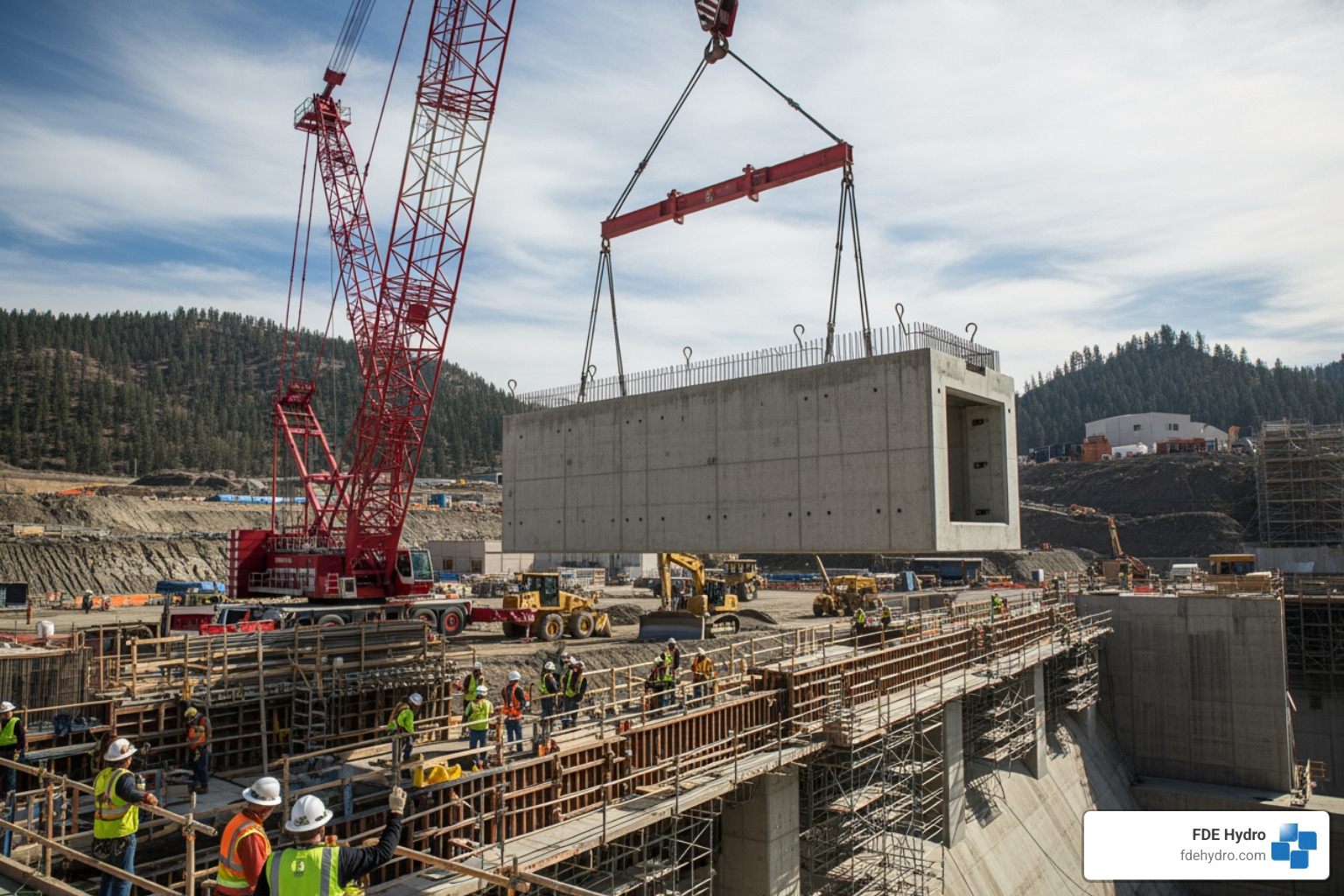
One of the most significant benefits is the substantial reduction in project costs. By manufacturing components off-site in controlled factory environments, we can achieve economies of scale, reduce labor costs, and minimize waste. This modular approach significantly cuts down on overall Hydropower Project Costs.
Coupled with cost savings is the dramatic reduction in construction time. Where traditional hydropower projects can take many years to complete, modular installations can be up and running in a matter of months. This accelerated timeline translates directly into faster revenue generation and a quicker return on investment for project developers and investors.
The scalability of hydro power modules is another key advantage. Whether a project requires a small micro-hydro unit or a larger multi-megawatt installation, modules can be configured and combined to meet specific power needs. This inherent flexibility also contributes to lower financial risk, as projects can be phased or expanded as demand or resources change. Our expertise in Precast Concrete Advantages further improves these benefits, providing robust and efficient civil infrastructure solutions.
Installation, Commissioning, and Maintenance
The streamlined nature of hydro power modules extends throughout their entire lifecycle, from initial installation to long-term maintenance. A cornerstone of this efficiency is factory assembly and testing. By building and rigorously testing components and even entire powerhouses (like containerized systems) in a controlled factory setting, we ensure that everything is in perfect working order before it even leaves the facility. This meticulous pre-assembly dramatically reduces the potential for on-site issues and speeds up deployment.
Once on-site, the installation process is significantly simplified. With precast concrete elements that fit together like building blocks and “plug-and-play” turbine units, the civil works and equipment integration require far less time and specialized on-site labor. Our advanced techniques enable the Rapid Installment of Module Precast Civil Infrastructure, minimizing disruption and accelerating project completion.
Commissioning is also expedited, often being a “plug-and-play” process due to the pre-tested nature of the modules. For maintenance, the modular design offers several advantages. Many systems are designed for minimal upkeep, with features like oil-free operation and river-water lubricated bearings. Even for more complex tasks, the standardized components mean easier access to parts and more straightforward repair procedures, contributing to lower operational costs over the plant’s long lifespan. This focus on ease of operation and simplified care is central to effective Hydro Power Plant Maintenance.
Return on Investment (ROI) and Economic Viability
The economic case for hydro power modules is exceptionally strong, driven by their lower upfront capital requirements and faster path to profitability. By reducing construction costs and timelines, modular systems allow for quicker deployment and, consequently, faster revenue generation. This accelerated cash flow is a significant draw for private investors, making hydropower projects more attractive and financially viable.
Furthermore, these systems are built for durability and longevity. Many modular hydropower installations, particularly those utilizing robust concrete structures like ours, boast an impressive operational lifespan of 50 to 100 years. This long-term reliability, combined with lower maintenance needs, contributes to an excellent return on investment. For example, some micro-hydro vortex systems report Net Energy Returns as high as 16:1, meaning the energy invested in their construction is returned sixteenfold over their lifetime. This long-term value proposition helps mitigate risks and ensures sustainable returns, as we discuss further in Financing Long-Term Hydropower Requires Mitigating Risks Prior to ROI.
Key Innovations and Applications for Hydro Power Modules
The rapid evolution of hydro power modules is fueled by a commitment to innovation, leveraging advanced manufacturing techniques and smart technologies to make hydropower more versatile and efficient. Standardization and prefabrication are at the heart of this revolution, allowing for consistent quality, faster deployment, and cost efficiencies that were previously unattainable.
Beyond physical components, technological advancements like AI-driven development are beginning to optimize everything from site selection to operational efficiency. Digital twins can simulate performance and predict maintenance needs, while advanced automation systems ensure seamless operation and integration with existing grids. These innovations are continuously pushing the boundaries of what’s possible in hydropower, marking a new era of Hydropower Innovation.
Typical Applications for modular hydro power modules
The flexibility and adaptability of hydro power modules open up a vast array of applications, making hydropower accessible in diverse settings across the United States, Canada, Brazil, and Europe. We are seeing these systems deployed in scenarios that were once economically or logistically challenging for traditional hydropower:
- Powering Non-Powered Dams: A significant opportunity lies in retrofitting existing non-powered dams, turning them into clean energy generators without requiring extensive new construction. Our pressure box configurations, for instance, are perfectly suited for this.
- Hydropower Retrofitting: We frequently upgrade and modernize existing hydroelectric facilities, enhancing their efficiency and extending their operational life. This involves replacing aging infrastructure with next-generation modular solutions.
- Irrigation Canals: Integrating hydro power modules into irrigation systems allows for dual-purpose infrastructure – water delivery and clean energy generation. Our siphon modules are ideal for this, adding power without disrupting water flow or dewatering.
- Water Treatment Plants: These facilities require significant energy, and modular hydro can provide a sustainable, on-site power source, often utilizing existing water flows within the plant’s operations.
- Remote Communities: For areas lacking reliable grid access, micro-hydro modules can provide essential electricity, replacing diesel generators and fostering energy independence.
- Mining Facilities: Mines have substantial energy demands, and modular hydropower can offer a consistent, clean power supply, especially in regions with available water resources.
- Energy Recovery: Beyond direct power generation, modular turbines can be used for energy recovery in various water systems, including desalination plants (Reverse Osmosis) and drinking/wastewater networks.
These diverse applications underscore the critical role hydro power modules play in modern Water Infrastructure Projects Guide.
Site Requirements and Feasibility
While hydro power modules offer unprecedented flexibility, successful implementation still hinges on careful site assessment. Key factors include the available head and flow rate. Many modular solutions are specifically designed for low-head sites and run-of-river applications, which are common across our operational regions.
For example, micro-hydro vortex plants typically require heads as low as 1 to 2 meters (or up to 4 meters if plants are sequenced) and flow rates exceeding 1 cubic meter per second. Our h-Modulor™ system can accommodate flows from 100 to 25,000 cubic feet per second and heads from 10 to 50 feet, showcasing the broad range of sites modular solutions can address.
Accurate flow rate analysis and head measurement are crucial for selecting the appropriate modular system. We leverage state-of-the-art tools, including powerful GIS (Geographic Information System) software, to identify suitable sites globally, including within the United States, Canada, Brazil, and Europe. Beyond the water parameters, practical considerations such as road or waterway access for module delivery, proximity to grid connection points, and even 3G (or better) reception for remote monitoring are important for optimizing construction costs and operational efficiency. Understanding these elements is fundamental to any Hydroelectric Dam Design: Complete Guide.
Sustainability, Grid Independence, and the Future of Modular Hydro
The rise of hydro power modules is not just an engineering triumph; it’s a critical development for achieving a sustainable, resilient, and decentralized energy future. These systems inherently contribute to grid independence and the proliferation of microgrids, offering a stable and predictable power source.
Unlike intermittent renewables like solar and wind, hydropower provides continuous, baseload power, making it an ideal complement to ensure grid stability. Modular hydro can serve as an on-demand addition to existing intermittent wind and solar systems, providing power when the sun isn’t shining or the wind isn’t blowing. This makes hydropower a vital “guardian of the grid,” ensuring energy security and reliability. The ability to deploy these modules rapidly and cost-effectively in various locations fosters decentralized energy generation, empowering communities and industries to produce their own power and reduce reliance on centralized grids. This is why we firmly believe in 4 Reasons Why Hydropower is the Guardian of the Grid.
Addressing Environmental Concerns with hydro power modules
One of the most compelling aspects of modern hydro power modules is their commitment to minimizing environmental impact. Unlike large-scale traditional dams that can alter ecosystems significantly, modular designs are often custom for low environmental footprints.
Many systems are designed to be fish-friendly, incorporating features that allow for safe fish passage and minimize harm to aquatic life. For instance, some propeller turbines use oil-free operation with river-water lubricated bearings, preventing potential contamination. Vortex micro hydro plants are specifically engineered to be fish-friendly, with slow-moving rotors and no need for large dams or water holdup, ensuring the renaturation and revitalization of water. We prioritize Aquatic Animal and Recreational Passage in our designs.
Furthermore, these modules often operate in run-of-river configurations, meaning they use the natural flow of a river without creating large reservoirs, thus preserving natural habitats and water levels. The closed-loop nature of some systems also ensures water recycling and ecosystem conservation, contributing to a carbon-neutral energy solution. These advancements demonstrate that hydropower can be both powerful and environmentally responsible, mitigating common Hydropower Environmental Impact concerns.
The Future Outlook for Modular Hydropower
The future for hydro power modules is exceptionally bright, marked by significant growth potential and an increasing recognition of their role in a sustainable energy landscape. As outlined in the Update of the Hydropower Vision Roadmap, there’s a strong push for modernizing and expanding hydropower capacity, especially through innovative, modular approaches.
A major driver for this growth is the need to retrofit and upgrade aging infrastructure across North America and Europe. Thousands of existing low-head hydro sites and non-powered dams present tremendous potential for energy recovery. Our modular precast solutions are perfectly positioned to address this, offering next-generation civil solutions that replace Aging Infrastructure Being Replaced with Next Generation Civil Solutions with efficient, long-lasting assets.
Modular hydropower is also crucial in the global effort to mitigate climate change, providing a reliable, low-carbon energy source that complements other renewables. Industry events, such as Clean Currents, serve as vital platforms for discussing and advancing modular and standardized approaches to small hydro development, fostering collaboration and knowledge sharing that propels the sector forward. We anticipate a dynamic market for small hydropower stations, demanding fast, innovative, and highly efficient modular solutions.
Frequently Asked Questions about Modular Hydropower
How much power can a modular hydro system generate?
The power output of a modular hydro system is highly scalable and depends on the specific site’s head and flow conditions, as well as the type and number of hydro power modules deployed. We see a wide range of capacities:
- Micro-hydro systems can start as low as 5 kW, with some vortex micro hydro plants generating 5 to 50 kW per basin.
- Mini hydro systems typically range from 20 kW to 3,000 kW (3 MW), suitable for heads from 10 to 150 meters.
- Small hydro installations can produce anywhere from 500 kW to 30 MW. For instance, our modular Kaplan turbines can reach up to 1,000 kW, Francis turbines up to 1,700 kW, and Pelton turbines up to 4,750 kW for single units.
- Some modular systems, like our h-Modulor™ system with module stacks, can deliver between 0.5 MW and 25 MW.
- For larger demands, multiple turbines can be clustered to generate several megawatts of energy, demonstrating significant scalability for diverse project requirements.
Are hydro power modules suitable for existing dams?
Absolutely, one of the most significant advantages of hydro power modules is their suitability for existing dams, particularly non-powered dams or those in need of retrofitting and upgrading. Instead of constructing entirely new, large-scale facilities, we can integrate modular solutions with minimal civil works.
Our h-Modulor™ system, for example, offers pressure boxes specifically designed to add power to non-powered dams. Our siphon modules are a game-changer for adding power to existing civil structures like irrigation drops, crucially without requiring site dewatering, which saves significant time and cost. This approach allows us to transform underused or aging water infrastructure into productive clean energy assets. We are experts in Dam Rehabilitation Encapsulation, breathing new life into old structures. There are thousands of existing low-head hydro sites and underused resources across the United States, Canada, Brazil, and Europe that are prime candidates for such retrofitting and upgrades.
What is the typical lifespan of a modular hydropower installation?
Hydro power modules are built for remarkable durability and a long operational lifespan, designed to be robust and reliable for decades. The expected lifetime for many modular hydropower installations ranges from 50 to 100 years.
This impressive longevity is due to several factors:
- Concrete Structures: Our modular precast concrete components are engineered for extreme durability, often outlasting mechanical components. Concrete structures are known for their resilience and minimal degradation over time, contributing significantly to the overall lifespan of the plant.
- Mechanical Components: While turbines and generators may have shorter lifespans than civil structures, modular designs facilitate easier maintenance and replacement. Many systems are designed with lower maintenance needs, such as oil-free operations and slow-moving, fish-friendly turbines that experience less wear and tear.
- High Net Energy Return: The long operational life, combined with efficient energy generation, translates into a high net energy return, meaning the system produces many times more energy than was consumed in its manufacturing and installation. This long-term economic viability underscores the sustainability of modular hydropower.
Conclusion
The emergence of hydro power modules marks a pivotal moment in renewable energy, offering a flexible, cost-effective, and environmentally conscious path forward. We’ve seen how these prefabricated, standardized systems streamline everything from design and construction to operation and maintenance, making hydropower more accessible and appealing than ever before.
The advantages are clear: faster deployment, lower financial risk, impressive scalability, and a significantly reduced environmental footprint. By addressing concerns like fish passage and promoting decentralized energy generation, modular hydro contributes to a more resilient and independent grid, perfectly complementing intermittent renewables.
At FDE Hydro, we are proud to be at the forefront of this change. Our innovative Modular Precast solutions, including our patented “French Dam” technology, are pioneering the next generation of hydropower development across North America, Brazil, and Europe. We believe that by embracing these advanced techniques, we can accelerate the transition to a truly Sustainable Infrastructure Development.
Ready to explore how modular hydropower can power your future? We invite you to view our advanced Precast Models and find the possibilities.
