

Why Hydroelectric Power Solutions Are Critical to Our Energy Future
Hydroelectric power solutions are a proven, reliable method for generating clean electricity. By converting the kinetic energy of water into power, these systems provide over 15% of the world’s electricity with the lowest lifecycle carbon footprint of any energy source. From massive storage dams to run-of-river plants, hydroelectric solutions offer a unique combination of renewable generation, grid stability, and large-scale energy storage.
Key Hydroelectric Power Solutions:
- Storage (Impoundment) Systems – Large dams with reservoirs for on-demand power generation
- Run-of-River Plants – Minimal environmental impact, continuous generation from natural flow
- Pumped Storage Hydropower – Grid-scale energy storage providing 96% of US utility-scale storage capacity
- Small and Micro-Hydro – Decentralized, community-scale installations for localized power
- Hybrid Systems – Integration with solar, wind, and battery storage for optimized performance
The global hydropower sector is at a critical juncture. By 2030, 40% of all hydropower plants worldwide will be at least 40 years old, creating an urgent need for modernization. Traditional development has been constrained by high capital costs, long construction timelines (5-10 years), and significant environmental concerns.
“The industrial revolution was powered by water; water, wind and sun together will power the sustainable growth of the future.” This vision is becoming reality as the industry adopts new technologies that reduce construction time and costs while minimizing environmental disruption.
I’m Bill French Sr., Founder and CEO of FDE Hydro™, where I’ve pioneered patented modular precast construction technology. After five decades in civil construction, I founded FDE Hydro™ to address the industry’s most pressing challenges with faster, more cost-effective approaches to delivering hydroelectric power solutions.
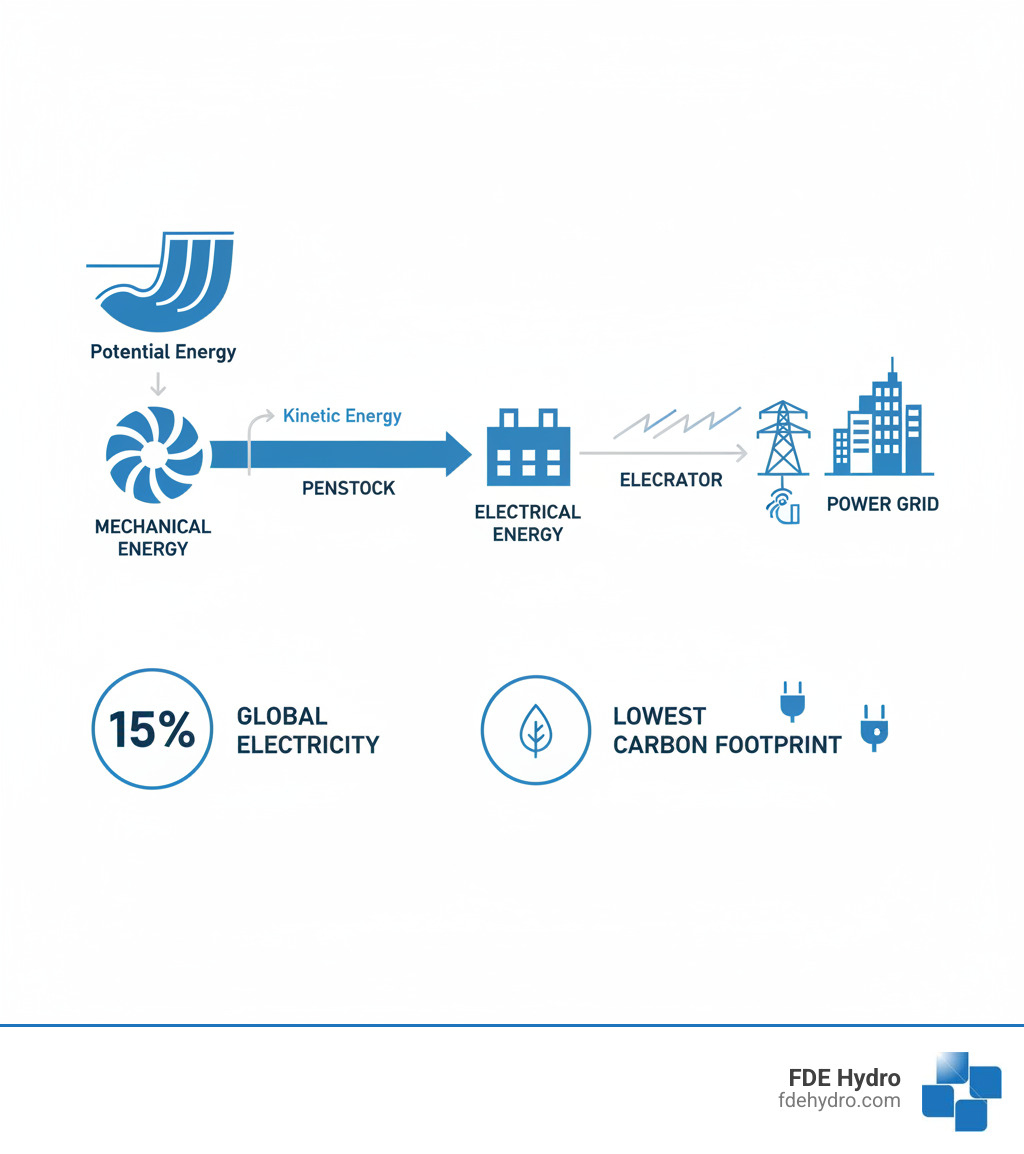
Must-know hydroelectric power solutions terms:
A Guide to Hydroelectric Plant Types
Hydropower plants vary to match their environment and energy needs. Understanding the differences is key, as each type offers unique strengths—from large-scale energy storage to steady baseline power. At FDE Hydro™, our modular construction expertise makes all types of hydroelectric power solutions faster to build, more affordable, and gentler on the environment across our projects in North America, Brazil, and Europe.
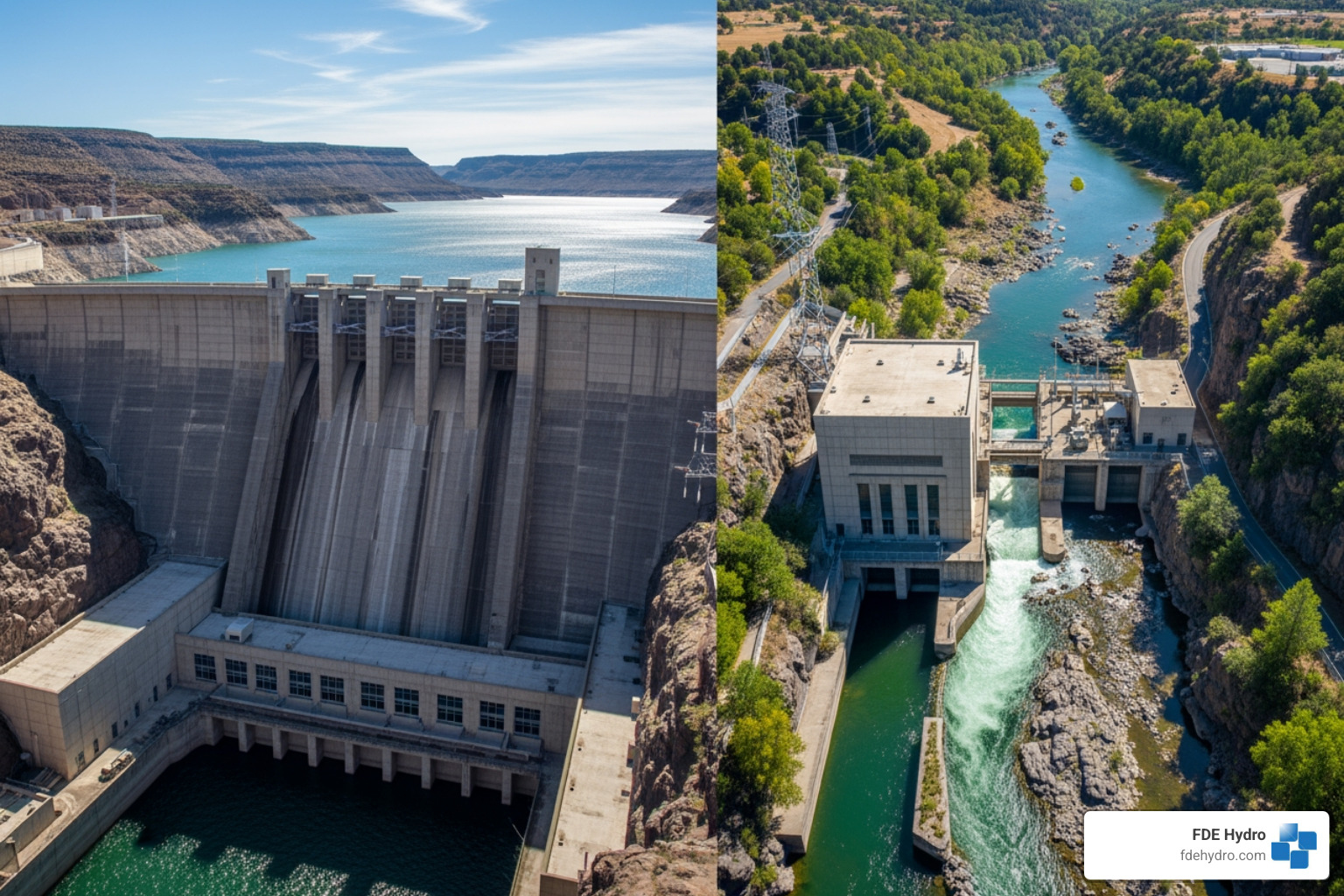
Storage (Impoundment) Hydropower
Storage hydropower plants, like the Hoover Dam, use massive dams to create reservoirs. This stored water represents potential energy, enabling valuable on-demand power generation. Operators can release water through turbines within minutes to meet demand spikes, making these plants perfect for peak load supply. Hydropower provides over 24 GW of firm capacity in the U.S., much of it from storage plants that can store energy for days or even months.
For more information on these foundational structures, explore our resources on Dams.
Run-of-River Hydropower
Run-of-river plants work with a river’s natural flow instead of blocking it with a large dam. They divert some water through a powerhouse and return it downstream. This minimal impoundment approach reduces the environmental footprint, avoiding large-scale flooding and ecosystem disruption. These plants provide continuous electricity for baseline power, often with lower transmission losses, making them a viable clean energy solution where large dams are not feasible.
Find how we’re advancing these types of facilities at New Hydro Facilities.
Pumped Storage Hydropower (PSH)
Pumped storage hydropower (PSH) acts as the world’s water battery. It uses two reservoirs at different elevations. When power is cheap and plentiful, water is pumped to the upper reservoir. When demand is high, the water is released back down through turbines to generate electricity. This makes PSH the top solution for grid-scale energy storage, providing an astounding 96% of all utility-scale energy storage in the United States. PSH plants can ramp up in minutes, making them essential for balancing the grid and backing up intermittent renewables like wind and solar.
Learn more about this vital technology on our Pumped Storage Hydropower page.
Small and Micro-Hydro Solutions
Small hydropower plants (typically up to 30 megawatts) fit where large dams cannot, such as in municipal water systems or irrigation canals. These small and micro-hydro solutions provide decentralized power for remote communities or industrial facilities, delivering community-scale benefits. They are affordable, often paying for themselves in a few years, and are ideal for low-head applications. Our modular construction techniques are particularly effective for these projects, allowing for quick, cost-effective deployment.
Explore the potential of community-scale projects through the Drawdown® Explorer on small hydro.
The Core Technology Behind Hydroelectric Power Solutions
Every hydroelectric plant converts water’s natural power into electricity using several core technologies working in harmony. At FDE Hydro™, we advance these technologies to ensure our hydroelectric power solutions deliver exceptional performance and reliability.
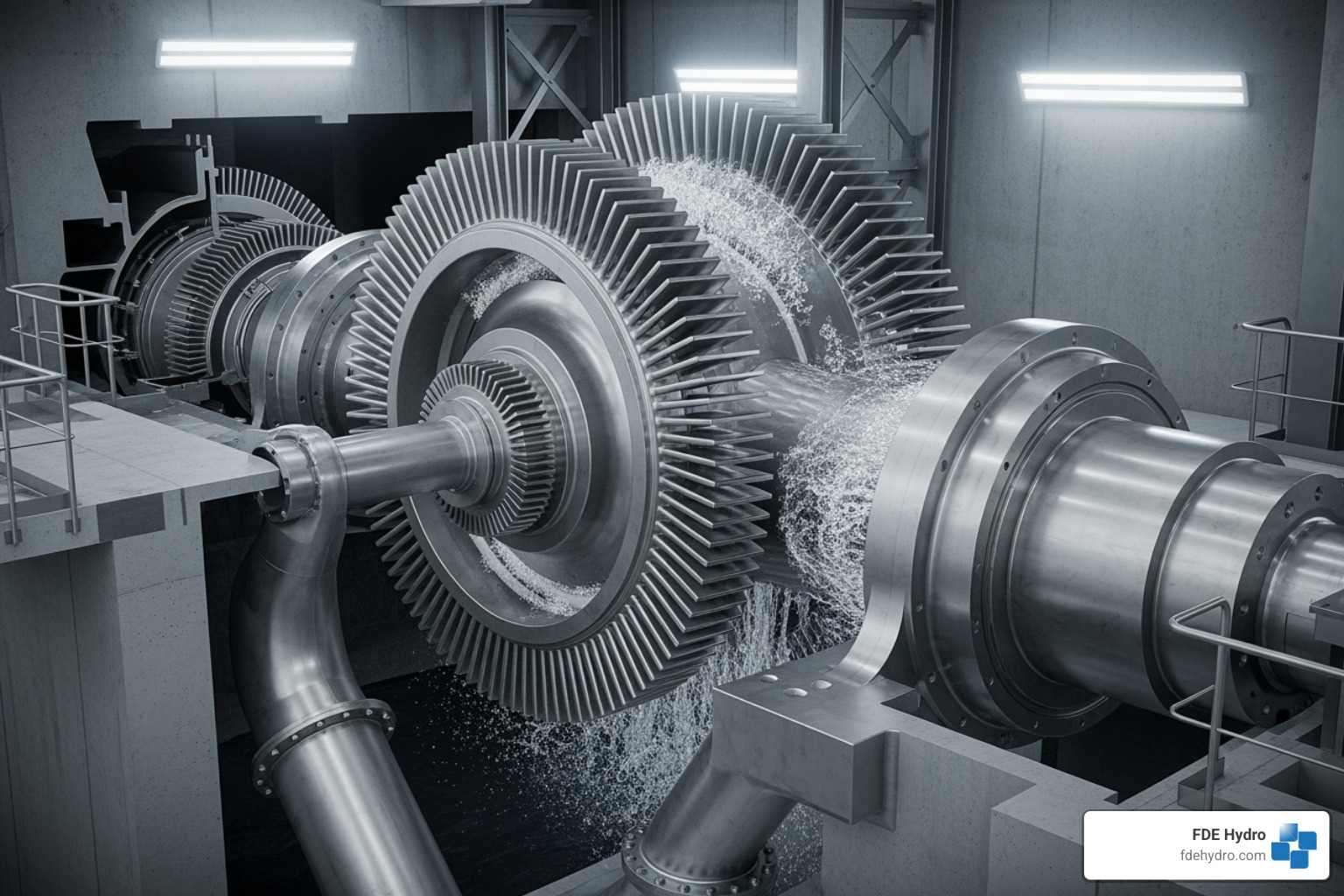
Turbines and Generators
Water strikes turbine blades, causing them to spin at high speed. The turbine choice depends on the site’s head (water fall distance) and flow rate.
- Pelton turbines are for high-head, low-flow sites.
- Francis turbines, the most common type, suit medium head and flow conditions.
- Kaplan turbines are ideal for low-head, high-flow environments, with adjustable blades for efficiency.
The turbine spins a connected generator, which uses electromagnetic induction to convert this mechanical rotation into AC electricity for the grid. Our comprehensive Hydroelectric Dam Components: The Ultimate Guide explores these components in greater detail.
Dams and Water Control Infrastructure
The infrastructure managing water flow is as critical as the turbines for successful hydroelectric power solutions.
- Penstocks are massive pipes that channel water to the turbines under high pressure.
- Spillways act as safety valves, releasing excess water during floods to prevent the dam from overtopping.
- Gates provide operators with precise control over water movement into penstocks and spillways.
Proper management of these components ensures safe, efficient operation. Our approach to Water Control Infrastructure Guide 2025 reflects our commitment to building reliable systems.
Digitalization and Automation
Digital technology has made modern hydropower plants smarter and more responsive.
- Smart plant operation uses advanced control systems for real-time monitoring of performance, water levels, and equipment status.
- Predictive maintenance uses sensor data to identify potential issues before they cause downtime, reducing costs and extending equipment life.
- Digital twin technology creates virtual models for testing and optimizing operations without affecting the physical plant.
These digital tools, including centralized IoT monitoring, build a more resilient and efficient energy infrastructure. We integrate these technologies into all our projects, believing they are essential to the future of Hydropower Innovation.
Hydropower’s Role as the Guardian of the Modern Grid
The electrical grid requires a constant balance between power supply and fluctuating demand. With intermittent renewables like solar and wind, this is a major challenge. Hydroelectric power solutions are key to solving this puzzle and ensuring grid stability.
Ensuring Grid Stability and Flexibility
Hydropower provides firm capacity—reliable power that’s available on demand, unlike weather-dependent solar and wind. The U.S. has over 24 GW of firm hydropower capacity. Hydropower’s real superpower is its speed; plants can respond to grid changes in minutes. For example, pumped storage can ramp up to 400 MW in less than 60 seconds. This rapid response makes hydropower the perfect backup for intermittent renewables, seamlessly filling gaps when the sun isn’t shining or the wind isn’t blowing. This flexibility makes it the guardian of the grid, a role we explore at 4 Reasons Why Hydropower is the Guardian of the Grid.
A Cornerstone of the Renewable Energy Mix
In North America, hydroelectric power solutions are a renewable energy heavyweight, accounting for 27.37% of U.S. utility-scale renewable generation and 5.86% of total U.S. generation. Hydropower’s longevity is remarkable; facilities routinely operate for 65-85 years, far longer than solar or wind assets, making them multi-generational sources of clean energy. Canada, the world’s second-largest hydropower producer, exemplifies its importance. This proven reliability makes hydropower a trusted foundation for Sustainable Power Generation.
Beyond Electricity: Co-Benefits
Beyond electricity, many hydroelectric power solutions offer significant co-benefits. Dams provide critical flood control by storing excess water, while their reservoirs supply reliable water for agricultural irrigation and municipal drinking water. These man-made lakes also create recreational opportunities like boating and fishing, which boost local economies. This multi-purpose nature makes hydropower an integrated water management solution, and at FDE Hydro™, we consider all these benefits when designing our projects.
Navigating the Economics and Environmental Landscape
Understanding the economics and environmental impact of hydroelectric power solutions is crucial. While there are significant upfront costs, they are balanced by decades of low-cost, clean energy. At FDE Hydro™, our innovative approaches make these projects more economically accessible while reducing their environmental footprint.
The Economic Case for Hydropower
The primary financial hurdle for hydropower is its high initial investment. However, once operational, the economics are highly favorable. Operational costs are remarkably low because the fuel—water—is free, and facilities are built to last 65 to 85 years with modest maintenance. This results in stable energy prices and a strong long-term return on investment. Modernization can further boost efficiency by up to 7% and output by as much as 50%, with quick payback. As we explain in Financing Long-Term Hydropower Requires Mitigating Risks Prior to ROI, our modular approach helps reduce upfront costs and financial risks. For a full breakdown, see our Hydropower Project Costs guide.
Key Environmental Considerations and Mitigations
While hydropower has the lowest lifecycle carbon footprint of any energy source, address its environmental impacts.
- Fish migration can be disrupted, but modern solutions like fish ladders and bypass channels provide safe passage.
- Water quality can be affected by changes in flow and temperature. We design facilities to maintain healthy environmental flows to support downstream ecosystems.
- Sediment management is also key, as dams can trap sediment. We use techniques like sediment flushing and bypasses to maintain natural river processes.
At FDE Hydro™, our commitment to Sustainable Water Infrastructure means we design hydroelectric power solutions that generate clean energy while protecting the rivers that make it possible.
The Next Wave: Innovations in Hydropower
The hydropower industry is in the middle of an exciting change, with innovations fundamentally altering how we build and operate hydroelectric power solutions. At FDE Hydro™, we are actively driving this evolution with technologies that make hydropower faster, more affordable, and more sustainable.
Modernizing Aging Infrastructure
By 2030, 40% of all hydropower plants worldwide will be at least 40 years old, presenting a major opportunity. Modernizing these plants can dramatically improve efficiency by up to 7% and increase peak output by up to 50%. These upgrades extend a facility’s life, making it perform like new. Refurbishing existing plants is often more sustainable and economical than building from scratch, which is why we focus on Aging Infrastructure Being Replaced With Next-Generation Civil Solutions.
The Future of Hydroelectric Power Solutions: Modular Construction
FDE Hydro™ is leading the charge with our patented modular precast concrete technology—the “French Dam.” Traditional dam construction takes 5-10 years. Our approach flips this model by manufacturing large, precision-engineered modules off-site for rapid on-site installation. This means faster construction and substantial cost savings. Shorter construction periods also mean less environmental disruption. Our Modular Construction Techniques offer a superior alternative, as documented in Why Precast Costs Less.
Advancements in Research and Hybrid Systems
The future of hydropower lies in creating smarter, integrated energy systems. Researchers are exploring innovative combinations like floating solar panels on reservoirs to maximize generation from a single site. Battery storage hybrids pair hydropower’s bulk energy with the instantaneous response of batteries for optimal grid support. Meanwhile, national labs like the National Renewable Energy Laboratory continue to advance research in materials, turbines, and environmental strategies, ensuring the Future of Hydropower remains at the cutting edge.
Conclusion: Powering a Sustainable Future with Water
Hydropower is a proven, evolving force for clean energy. It provides 15% of the world’s electricity with the lowest lifecycle carbon footprint and acts as the guardian of the grid by providing best stability and flexibility. The fact that 40% of global plants will be over 40 years old by 2030 is not a crisis, but a transformative opportunity to reimagine how we build and maintain these facilities.
At FDE Hydro™, our patented modular precast concrete technology addresses this challenge. Traditional construction takes 5-10 years; our method of manufacturing modules off-site for rapid assembly delivers projects faster, more affordably, and with less environmental disruption across North America, Brazil, and Europe.
The future of hydroelectric power solutions combines the technology’s 65-85 year lifespan with innovations like floating solar integration, battery storage hybrids, and digital twin technology. At FDE Hydro™, we are committed to using water’s potential efficiently and responsibly. The future is efficient, rapidly deployable, and powered by water.
Ready to be part of this change? Explore next-generation dam technologies and find how we’re building tomorrow’s energy infrastructure today.
