

The Rise of Eco Friendly Crypto Mining
If you’re looking for Eco friendly crypto mining methods, here’s a quick overview of how the industry is becoming more sustainable:
- Renewable Energy: Using clean sources like hydro, solar, and wind.
- Efficient Mechanisms: Moving from Proof-of-Work (PoW) to Proof-of-Stake (PoS).
- Heat Reuse: Repurposing waste heat for heating or agriculture.
- Grid Balancing: Stabilizing power grids by managing energy demand.
- Waste Energy: Utilizing flared natural gas that would otherwise be wasted.
Eco friendly crypto mining is a critical topic, as the high energy use of currencies like Bitcoin has raised significant environmental concerns over carbon emissions and grid strain.
However, the industry is shifting towards greener mining. This guide explores innovative solutions for creating digital value responsibly, benefiting both the planet and the digital economy.
My name is Bill French Sr., and as the Founder and CEO of FDE Hydro, I’ve dedicated my career to sustainable infrastructure solutions. My team and I developed the “French Dam,” a patented modular hydropower system, which directly supports the potential for truly Eco friendly crypto mining operations.
Quick look at Eco friendly crypto mining:
The Environmental Cost of Digital Gold: Understanding Crypto’s Carbon Footprint
The concept of “digital gold” is compelling, but traditional cryptocurrency mining, especially for Bitcoin, has historically come at a high environmental cost, straining natural resources.
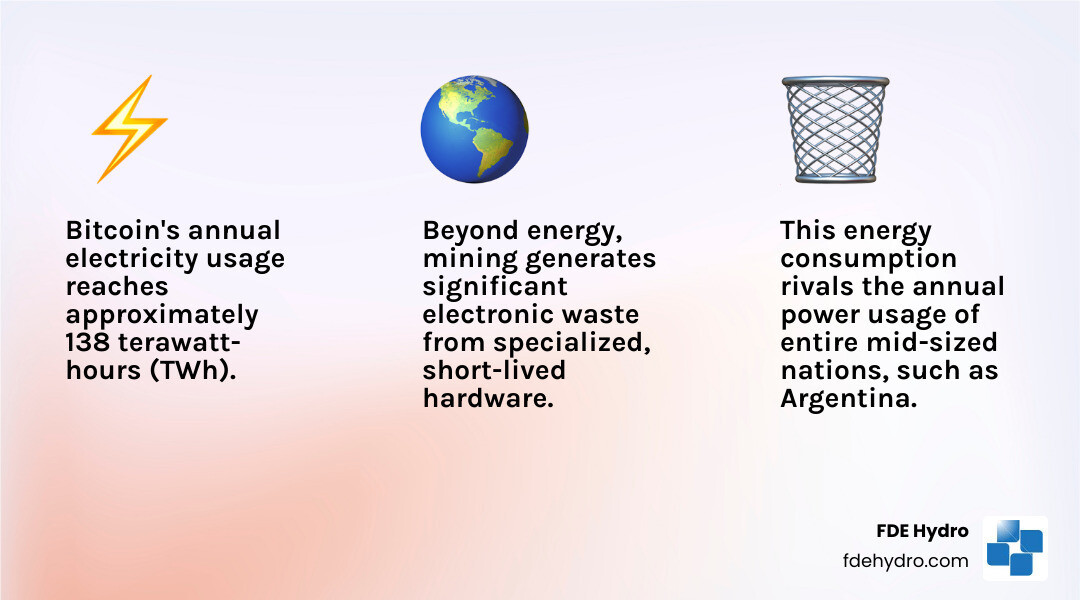
Traditional crypto mining, particularly for big names like Bitcoin, relies on something called Proof-of-Work (PoW). It’s super secure, but it also uses a ton of energy. Recent studies estimate Bitcoin’s annual electricity usage at around 138 TWh (terawatt-hours)—comparable to the consumption of a country like Argentina or Ukraine.
When sourced from fossil fuels, this energy use results in significant carbon emissions, once estimated at nearly 40 million tons of CO2 annually. Beyond emissions, the full environmental story includes electronic waste (e-waste), water consumption, land use, and noise pollution. As detailed in a study on Bitcoin’s environmental effects, these challenges highlight the need for sustainable crypto solutions.
How Proof-of-Work (PoW) Drives Energy Demand
Proof-of-Work (PoW) is energy-intensive by design. It involves a global competition where powerful computers race to solve complex mathematical puzzles. The winner adds the next block of transactions to the blockchain and earns a cryptocurrency reward.
The network’s difficulty automatically adjusts to maintain a consistent block creation time, forcing miners to use ever-more powerful hardware. This led to the development of Application-Specific Integrated Circuits (ASICs)—machines designed solely for mining that consume vast amounts of electricity.
This incentive structure creates a continuous cycle of seeking cheaper electricity and more powerful hardware, driving the network’s total energy consumption upward. As HBR explains, Bitcoin’s energy use is integral to its security, making the balance with Eco friendly crypto mining a key challenge.
Beyond Energy: The Full Environmental Impact
While we often focus on energy use, the environmental toll of traditional crypto mining goes much deeper than just electricity bills.
Reliance on fossil fuels significantly increases mining’s carbon footprint. Despite growing awareness, recent CCAF estimates showed a substantial portion of Bitcoin’s energy still comes from non-renewable sources like coal and natural gas, contributing to greenhouse gas emissions.
Another major issue is electronic waste (e-waste). ASIC miners have a short lifespan of 4-5 years before becoming obsolete. One 2021 study estimated this generates over 30,000 tons of e-waste annually, posing a significant disposal and recycling challenge.
Water consumption is another concern, as facilities require large amounts for cooling, especially in warm climates. This can strain local water supplies in water-scarce regions.
Finally, noise pollution from the constant hum of cooling fans can disrupt nearby communities. At FDE Hydro, we design modular, contained solutions that minimize environmental impacts like noise, which is vital for truly Eco friendly crypto mining.
The Green Revolution: Advancing Sustainable Mining with Renewable Energy
The environmental challenges of crypto mining have sparked a green revolution in the industry. This shift away from fossil fuels is driven by economics and a vision for the future of cryptocurrency.
Switching from fossil fuels to clean energy can cut a mining operation’s greenhouse gas emissions by over 70%. This isn’t a minor improvement; it’s a fundamental reimagining of the industry.
At FDE Hydro, our patented modular hydropower systems are a perfect match for this transition. By reducing the cost and construction time of hydroelectric projects, we make clean energy more accessible for miners across North America and beyond.
Energy-efficient practices are also crucial. Miners are optimizing operations with better cooling, more efficient hardware, and timing their energy use to align with renewable availability. This combination makes Eco friendly crypto mining economically attractive.
Hydropower: A Leading Solution for Eco Friendly Crypto Mining
The greenest mining operations often cluster around hydroelectric resources in places like Canada, the Pacific Northwest of the United States, and Brazil. Hydropower offers a key advantage over other renewables: reliability.
Let’s be honest about the differences between traditional mining and hydropower-based operations:
| Feature | Traditional Fossil-Fuel Mining | Hydropower-Based Mining |
|---|---|---|
| Energy Source | Coal, Natural Gas, Oil | Hydroelectric Dams |
| Carbon Emissions | High | Very Low to Zero |
| Energy Cost Stability | Volatile, subject to market fluctuations | Generally stable and low over long term |
| Environmental Impact | Significant (GHG, air pollution, water use for cooling towers) | Minimal (habitat disruption during construction, water flow management) |
| Operational Reliability | Dependent on fuel supply chains | Highly reliable, consistent baseload power |
| Scalability | Can be scaled with grid access | Scalable, especially with modular solutions like ours |
| Grid Impact | Adds strain, especially during peak demand if grid is fossil-heavy | Can improve grid stability, use excess capacity |
Hydroelectric power provides a consistent, renewable energy supply 24/7, unlike intermittent solar and wind. This baseload power is invaluable for mining operations that need to run continuously. The IEA offers a comprehensive review of hydropower’s environmental advantages.
The low carbon emissions of hydropower are another key benefit. Powering rigs with water instead of coal virtually eliminates an operation’s carbon footprint, which is increasingly important to environmentally conscious investors.
Modern hydropower technology also offers scalability and reliability. Our modular French Dam system was designed to overcome the high cost and long construction timelines of traditional dams, making it feasible to develop new hydro resources for mining operations.
Hydropower-based mining also strengthens network security and decentralization. Geographically dispersed operations powered by local renewables make the network more resilient to disruptions.
Addressing Challenges in Renewable-Powered Mining
However, renewable-powered mining faces several challenges.
Key challenges include grid integration to balance variable renewables, managing seasonal variability in power generation (even for hydro), and securing the large infrastructure investment required for new projects.
Modular and scalable solutions are essential. Our technology addresses this by allowing projects to start smaller and expand as needed. Overcoming adoption barriers requires proving that green mining is economically smart. As renewable energy is often the cheapest option, the business case for Eco friendly crypto mining is becoming undeniable.
Powering the Future: Hydropower and Eco Friendly Crypto Mining
The future of Eco friendly crypto mining is not just an environmental imperative; it’s a smart business decision. Environmental responsibility and economic advantage are now aligning.
Miners need cheap, reliable energy to remain profitable, especially as Bitcoin rewards decrease. Increasingly, renewable energy is the cheapest option, with some sources costing less than two cents per kilowatt-hour. This makes the choice for green energy an obvious one.
This economic reality is driving global change. For example, Gryphon Digital Mining achieved 100% renewable power by early 2024, primarily from hydroelectric sources. Other major players show a similar commitment. CleanSpark (94% carbon-free power), TeraWulf (91% zero-carbon), Iris Energy (95-99% renewable), and Bitfarms (99% renewable) all rely heavily on sources like hydro, nuclear, wind, and solar.
This trend is industry-wide. Recent data from the Cambridge Centre for Alternative Finance shows that sustainable sources (renewables and nuclear) now power over half of the Bitcoin network, a significant increase from previous years. The industry is changing in real time.
Tapping into Clean Energy Sources
The future of Eco friendly crypto mining depends on smart infrastructure connecting miners to clean power. Hydroelectric power is central to this vision due to its 24/7 reliability.
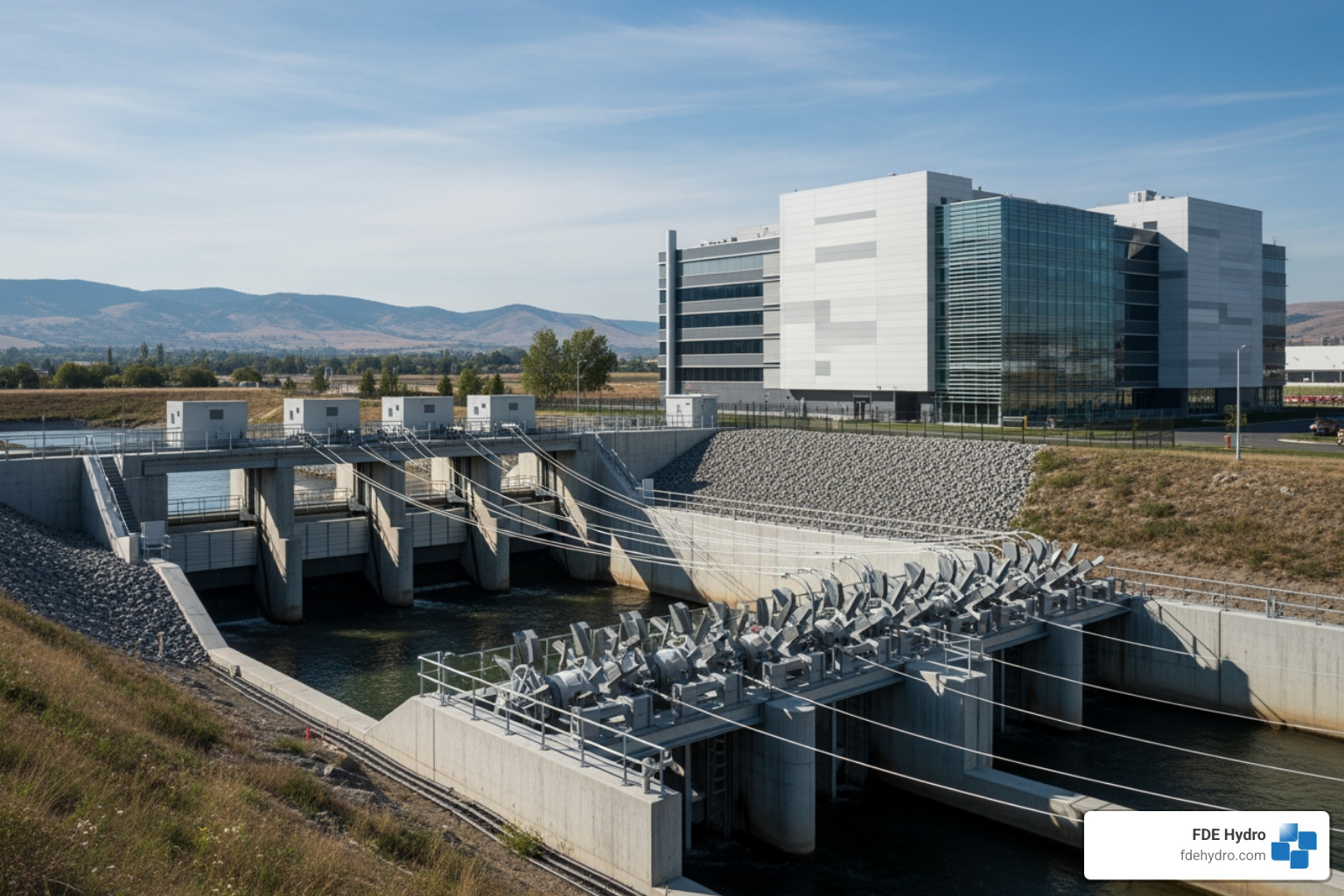
Our work at FDE Hydro is directly relevant here. The French Dam, our patented modular hydropower system, overcomes the high cost and long timelines of traditional hydro projects, accelerating clean energy adoption. This allows us to deploy affordable, dedicated clean energy infrastructure for miners across the United States, Canada, Brazil, and Europe, matching the scale and location of their operations.
While hydropower provides reliable baseload power, it can be combined with solar and wind to create a resilient, hybrid energy mix. This approach offers flexibility and maximizes the use of clean resources.
The Symbiotic Relationship with Energy Grids
Eco friendly crypto mining operations are evolving from mere energy consumers to active partners in stabilizing renewable energy grids.
Renewable sources like solar and wind often produce excess power when demand is low. This energy is typically wasted, or ‘curtailed.’ Crypto miners can act as a ‘buyer of last resort,’ consuming this surplus energy and making renewable projects more financially viable. Through demand response programs, they can also power down during peak demand to stabilize the grid, as seen in places like Texas.
This flexibility acts as a shock absorber for the grid. In fact, one study shows that Bitcoin mining can accelerate the sustainable energy transition by improving the economics of renewable plants.
Measuring and Verifying Eco Friendly Crypto Mining
As the industry matures, transparently measuring and verifying Eco friendly crypto mining claims is crucial to prevent ‘greenwashing.’
It’s important to distinguish between zero-carbon (no emissions from the source, like hydropower) and carbon-neutral (emissions are offset via methods like purchasing Renewable Energy Certificates). While carbon-neutrality has a role, we believe in prioritizing true zero-carbon energy sources. Preventing emissions at the source is always the better approach.
Transparency is key. Initiatives are emerging to help miners measure and report their energy use with standardized metrics, allowing for data-backed validation of green claims. At FDE Hydro, we support this push for verification. Our modular hydropower systems provide verifiable, zero-carbon energy, making sustainability a built-in feature of the infrastructure itself.
Beyond the Grid: Innovative Approaches to Sustainable Mining
Beyond clean energy, the crypto mining industry is embracing creative solutions to shrink its environmental footprint. This innovative, circular-economy approach is at the heart of Eco friendly crypto mining.
Turning Waste into Value: Heat Reuse and Gas Flaring
One of the most innovative strategies is heat reuse, which turns the immense heat generated by mining equipment into a valuable resource. In Europe, some companies capture this waste heat for district heating systems. Others use it to warm greenhouses for agriculture, as seen in the Netherlands. In a unique example from Norway, one miner even uses waste heat to dry timber, showcasing how byproducts can serve other industries.

Another innovation tackles gas flaring at oil fields. Instead of wasting this methane—a potent greenhouse gas—companies are capturing it to power mobile mining rigs. This reduces emissions while providing energy for Eco friendly crypto mining.
The Role of Policy and Market Incentives
Technology alone isn’t enough; government policy and market incentives are crucial for promoting sustainable mining.
In the United States, government reports have highlighted crypto’s climate impact, leading to a mix of policies. Some states have placed moratoriums on certain mining types, while others offer tax incentives for using clean energy.
A key market challenge is the ‘lack of product differentiation’—it’s difficult to distinguish ‘green’ Bitcoin from Bitcoin mined with fossil fuels. This can penalize miners who invest in renewable energy. Potential solutions include subsidies for green mining or methods to ‘tag’ coins based on their energy source, ensuring that sustainability makes good business sense.
Frequently Asked Questions about Eco-Friendly Crypto Mining
Here are answers to some of the most common questions about making crypto mining more sustainable.
Which cryptocurrencies are the most eco-friendly?
The most eco-friendly cryptocurrencies are defined by two factors: their consensus mechanism and their energy source.
The primary difference is between energy-intensive Proof-of-Work (PoW), used by Bitcoin, and the highly efficient Proof-of-Stake (PoS) mechanism. PoS validators stake their own crypto to validate transactions, eliminating the need for a computational race. When Ethereum switched to PoS in 2022 (‘The Merge’), its energy consumption dropped by over 99.9%.
Other cryptocurrencies designed for sustainability include Solana (PoS), Cardano (PoS), and Chia, which uses a unique ‘Proof of Space and Time’ mechanism based on hard drive storage.
However, the energy source is just as important. A PoW currency like Bitcoin can be mined sustainably when powered by renewables. At FDE Hydro, our modular hydropower systems provide the reliable, zero-carbon energy needed to make PoW mining eco-friendly.
Can Bitcoin mining ever be truly sustainable?
Yes, Bitcoin mining can be truly sustainable, and the transition is already happening.
The path to 100% renewable-powered PoW is driven by economics. Miners seek the cheapest energy, and renewables like hydropower are now often the most cost-effective option. This advantage is critical as mining rewards decrease over time.
Bitcoin mining also offers a unique sustainability benefit: grid stabilization. Miners can act as a flexible load, consuming excess renewable energy that would otherwise be wasted and powering down during peak demand. This helps balance the grid and improves the economics of renewable projects.
Leading companies are already proving this model works. Gryphon Digital Mining, CleanSpark, TeraWulf, Iris Energy, and Bitfarms all power their large-scale operations with exceptionally high percentages (91-100%) of carbon-free and renewable energy, with a heavy reliance on hydropower.
These large-scale facilities prove that Eco friendly crypto mining is both feasible and profitable. Our modular hydropower technology at FDE Hydro accelerates this transition by making clean energy infrastructure more accessible.
How can I support eco friendly crypto mining?
Anyone can take steps to support Eco friendly crypto mining.
- Support transparent miners. Choose mining companies that openly report their energy mix and carbon footprint. This encourages accountability and allows for informed decisions.
- Advocate for smart policy. Encourage policymakers in the United States, Canada, Brazil, and Europe to create regulations and incentives that favor renewable energy for mining.
- Invest in green operations. Consider investing in mining operations powered by renewables like hydropower. Supporting these companies helps fund the infrastructure, like that built by FDE Hydro, needed for a sustainable digital future.
- Choose green platforms. As the market evolves, use exchanges and platforms that highlight or prioritize sustainably mined assets. This sends a clear market signal that sustainability matters.
Conclusion: Building a Sustainable Digital Future
The journey of cryptocurrency mining began with energy-intensive Proof-of-Work systems that raised valid environmental concerns, from carbon emissions to e-waste. It became clear that the “digital gold” rush needed a greener path.
The good news is that a green revolution is underway. The industry is rapidly shifting to Eco friendly crypto mining by embracing clean energy like solar, wind, and especially hydropower. Leading companies in the United States, Canada, and Europe are proving that renewable-powered mining is a present-day reality.
Innovation extends beyond clean energy to a circular economy model. Creative solutions like reusing waste heat for district heating or agriculture and using flared gas to power mining rigs turn waste into value.
This evolution is also a smart economic move. Eco friendly crypto mining helps stabilize energy grids by acting as a flexible load, making renewable projects more profitable and pushing the industry toward a greener future.
At FDE Hydro, we believe the future of cryptocurrency must be sustainable. Our patented modular hydropower technology offers a practical path forward by reducing the cost and time needed to build renewable energy infrastructure. This is vital for a greener digital economy, enabling miners in the United States, Canada, Brazil, and Europe to access clean, reliable power.
The journey to fully Eco friendly crypto mining is ongoing. Through continued innovation and shared commitment, we can build a sustainable digital future that benefits our planet, our communities, and the digital economy.
Learn more about our innovative hydropower solutions
