

Why Clean Energy Infrastructure is the Foundation of Our Future
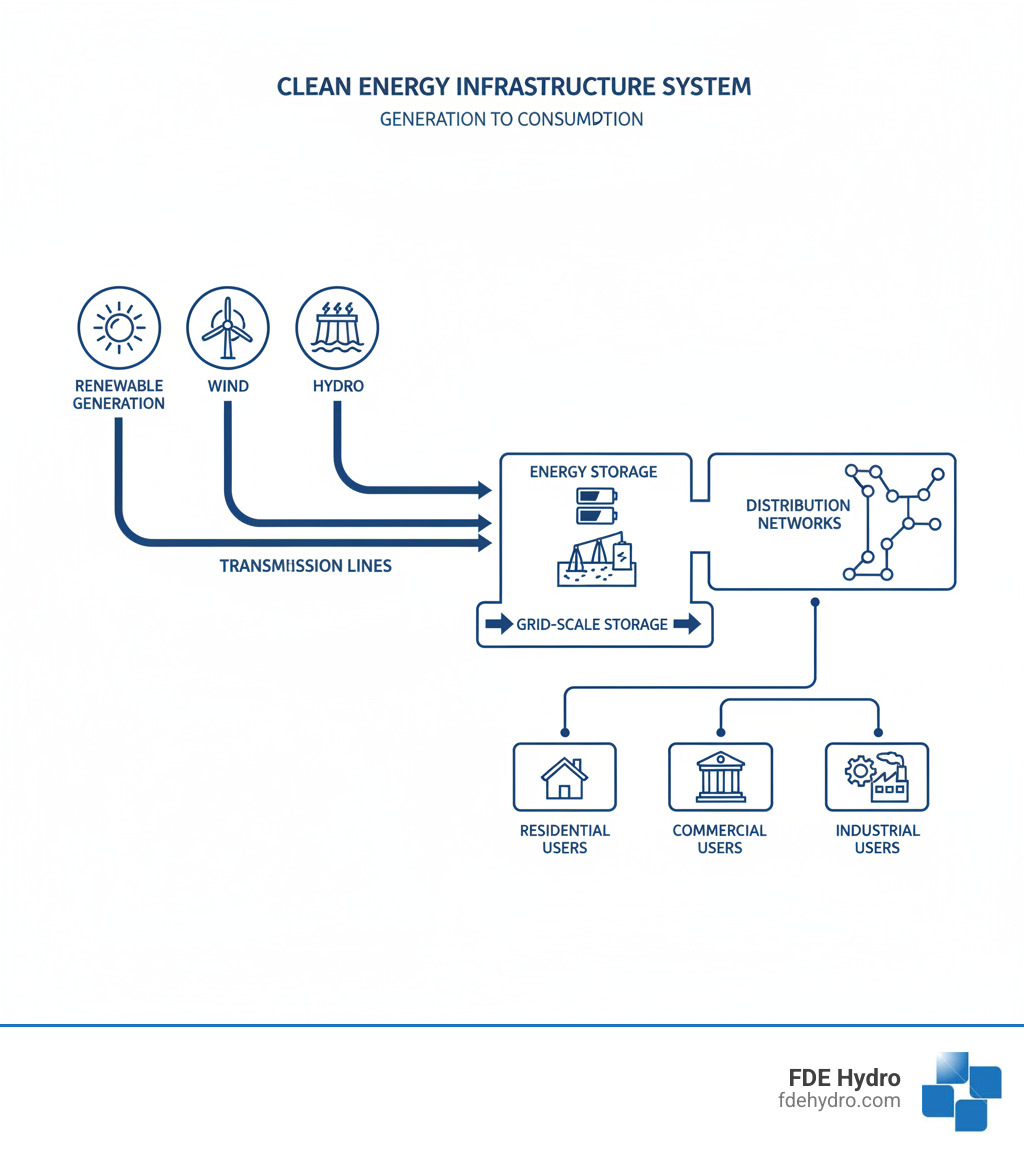
Clean energy infrastructure encompasses the systems for generating, storing, transmitting, and distributing electricity from renewable sources like solar, wind, and hydropower. This includes generation facilities, transmission and distribution networks, energy storage, and the integrated grid that balances supply and demand.
Addressing climate change is an infrastructure challenge. With 70% of global greenhouse gas emissions from energy, industry, and buildings, reaching net-zero by mid-century requires a massive shift in our energy systems.
The numbers are compelling. Global investment in clean energy infrastructure hit $2 trillion in 2024, driven by renewables and grid improvements. The U.S. has committed over $97 billion via the Bipartisan Infrastructure Law and Inflation Reduction Act. Europe targets a 55% emissions reduction by 2030, while China leads in manufacturing capacity.
The challenge is that while renewable technology costs have fallen, the supporting infrastructure lags. The grid needs massive updates, storage capacity must expand dramatically, and lengthy permitting processes are slowing the transition.
Beyond environmental goals, this infrastructure creates jobs, lowers energy costs, strengthens energy security, and improves air quality. For developers and operators, it represents a fundamental shift in planning, financing, and building critical systems.
I’m Bill French, Founder and CEO of FDE Hydro™, where we’ve developed innovative modular solutions for clean energy infrastructure in the hydropower sector, including patented technologies deployed across North America, Europe, and Brazil. For over five decades, I’ve led large-scale civil construction projects and participated in the Department of Energy’s strategic planning for next-generation hydropower solutions.
The Current State of Clean Energy Infrastructure
The global push toward clean energy infrastructure is accelerating. Investment is set to hit $2 trillion in 2024, up nearly 50% from 2019. This capital is funding renewable generation, energy efficiency, and essential grid and storage systems, proving that governments and businesses have chosen a clean energy future.
Global and Regional Momentum
Momentum is building worldwide.
In the United States, over $97 billion from the Bipartisan Infrastructure Law and Inflation Reduction Act is catalyzing private investment, with a national target of 100% carbon pollution-free electricity by 2035.
Europe aims for a 55% reduction in greenhouse gas emissions by 2030, driving massive solar and wind deployment, a trend confirmed by the Clean Energy Market Monitor – March 2024.
China leads in manufacturing solar panels, wind turbines, and batteries. While this has lowered costs, it also highlights the need for diverse, resilient supply chains to weather disruptions. Emerging economies are also making progress, though financing remains a hurdle.

The Economic and Environmental Stakes
The payoff for this transition is immense.
Jobs are a major benefit. Building and manufacturing clean energy systems creates significant employment. In the U.S., private companies have announced nearly $880 billion in new investments since January 2021, with over $410 billion for clean energy and EVs, fueling job growth.
Lower costs and improved security are key outcomes. Renewables reduce vulnerability to fossil fuel price volatility. The Department of Energy projects clean sources could provide 80% of U.S. electricity by 2030, leading to more stable, affordable energy and less dependence on imports.
Climate action and public health are the ultimate stakes. Every megawatt of clean energy reduces greenhouse gas emissions and air pollution, leading to fewer respiratory illnesses and healthier communities. For example, our hydropower projects have already prevented over 2.1 million metric tons of greenhouse gas emissions—equivalent to taking hundreds of thousands of cars off the road. You can learn More about the benefits of hydropower and its role in a sustainable future.
The momentum is clear, but scaling clean energy infrastructure requires solving complex challenges in transmission, storage, and financing.
The Backbone of the Transition: Grid Modernization, Storage, and Transmission
We’re running a modern energy system on an outdated grid. Built for one-way power flow from large plants, today’s grid must handle decentralized renewables like rooftop solar and remote wind farms, creating a major bottleneck.
Grid modernization is the foundation of the energy transition. Without updating transmission, adding storage, and building new infrastructure, new solar and wind installations will be unable to deliver their power. A modernized grid is also more resilient against extreme weather, aging equipment, and cyber attacks.
Why Transmission is the Critical Link
Transmission is the critical link. Abundant renewable resources are often located far from population centers, requiring high-voltage lines to carry that electricity across long distances.
Our current transmission system is a fragmented patchwork, causing clean energy projects to wait in “interconnection queues” for years. This bottleneck prevents gigawatts of clean power from reaching the grid. To meet climate goals, we need to double transmission capacity in the next two decades. While costly, the price of inaction—delayed clean energy and higher energy prices—is far greater.
Modern transmission must also be smarter, with advanced monitoring and digital controls to manage a decentralized system. Hydropower is invaluable here, providing the stability to balance fluctuations from wind and solar. Find 4 Reasons Why Hydropower is the Guardian of the Grid and see why it’s so critical. Efficient design also minimizes the 6% of electricity typically lost as heat during transmission.

The Role of Energy Storage
If transmission is the highway, energy storage is the parking garage. The sun doesn’t shine at night, and the wind isn’t always blowing. Without large-scale storage, we can’t ensure a reliable supply of clean power.
Energy storage has become essential for clean energy infrastructure. It captures excess energy when generation is high and releases it when demand peaks, making intermittent renewables as reliable as traditional power plants.
Storage capacity has increased nearly twelve-fold recently. Battery storage has exploded, while Virtual power plants and Microgrids offer flexibility and localized resilience.
However, one of the most proven technologies is pumped storage hydropower. It acts as a massive natural battery: excess electricity pumps water uphill to a reservoir, and when power is needed, the water is released back down through turbines.
Pumped storage hydropower provides large-scale, long-duration storage that batteries can’t match, acting as a shock absorber for the grid. At FDE Hydro, our modular solutions make it faster and more cost-effective to build these facilities, expanding their role in a renewable energy future.
Overcoming Problems: Financing and Policy for Clean Energy Infrastructure
Building clean energy infrastructure isn’t just a technical challenge—it’s a puzzle of money, regulations, and politics. The biggest roadblocks are surprisingly human.
Permitting and siting delays can stall projects for 5 to 15 years, far longer than construction takes, due to bureaucracy and public opposition. Simultaneously, supply chain constraints for critical minerals and components, along with a shortage of skilled workers, create significant delays. Finally, land-use conflicts can stall vital projects when local communities feel their concerns about property rights or visual impacts are ignored.

Innovative Financing Models
Trillions of dollars are needed, and traditional financing isn’t enough.
Public-private partnerships (PPPs) are essential, leveraging private capital to finance, build, and operate infrastructure, spreading risk and accelerating development. The Independent Transmission Project (ITP) model, successful in India and Brazil, uses competitive bidding to drive down costs and attract stable, long-term capital.
Blended finance combines public and private funds to de-risk projects for commercial investors. For example, South Africa’s Just Energy Transition Partnerships are funding grid deployment. At FDE Hydro, we pursue DOE Grant Projects to show how public investment can catalyze private development.
Green bonds and other sustainable finance instruments are also growing, directing capital toward environmentally beneficial projects.
Essential Policy and Regulatory Frameworks
Financing models need the solid ground of clear, consistent policy.
Renewable Portfolio Standards (RPS) at the state level have been game-changers, requiring utilities to source a minimum percentage of power from renewables. Nearly half of all U.S. renewable growth since 2000 is linked to state RPS requirements.
In Europe, the Sustainable Finance Disclosure Regulation (SFDR) promotes transparency in green investing. In the U.S., federal tax credits in the Inflation Reduction Act make clean energy projects economically competitive. The Department of Energy’s Clean Energy Infrastructure Funding for Projects and Programs further channels billions toward modernization.
Regulatory bodies like the Federal Energy Regulatory Commission (FERC) are also critical. FERC Order 1000 promotes regional transmission planning and cost allocation, helping break down barriers between grids. These policies are the foundation for turning our clean energy vision into reality.
The Future is Now: Technology and Community in the Energy Transition
The future of clean energy infrastructure is unfolding now, shaped by breakthrough technologies and a growing focus on community-centered development.
Key Technological Trends Shaping Clean Energy Infrastructure
Innovation is accelerating across the energy sector. At FDE Hydro™, our patented “French Dam” technology uses modular precast concrete solutions to revolutionize hydroelectric construction. This approach enables [Rapid Installment of Module Precast Civil Infrastructure](https://fdehydro.com/rapid-installment-of-module-precast-civil-infrastructure/), completing projects faster and at a lower cost in North America, Brazil, and Europe.
Broader trends include grid digitalization, where AI and advanced sensors create “smart grids” that optimize energy flow and seamlessly integrate variable renewables. Advanced monitoring enables predictive maintenance, improving reliability and reducing costs. In hydropower, this technology helps optimize water use and extend infrastructure lifespan.
Materials science is also advancing, with new composites for wind turbine blades and more efficient solar panels. Battery technology continues to evolve rapidly. Looking ahead, small modular reactors, advanced geothermal, and green hydrogen will further diversify our energy mix. At FDE Hydro™, we remain committed to [next-gen solutions](https://fdehydro.com/aging-infrastructure-being-replaced-with-next-generation-civil-solutions/) that combine innovation with proven reliability.

Ensuring an Equitable and Just Transition
Technology alone is not enough. How we build this new infrastructure matters just as much as what we build.
The transition to clean energy infrastructure must be equitable. This begins with proactive community engagement—bringing local residents into the conversation early to build partnerships.
Community benefit agreements can formalize this partnership, ensuring host communities receive tangible benefits like local job creation, investments in local infrastructure, and direct financial contributions. These are fundamental to building projects the right way.
Addressing the energy burden on low-income households is another critical piece. While clean energy generally reduces system-wide costs, targeted programs can ensure affordable, reliable power reaches everyone. By combining technological innovation with authentic community partnerships, we can build infrastructure that is environmentally sustainable, socially responsible, and economically inclusive.
Frequently Asked Questions about Clean Energy Infrastructure
When I talk to project developers, investors, and community leaders about clean energy infrastructure, I hear the same questions come up again and again. Let me address the most common ones directly.
What are the biggest challenges to building clean energy infrastructure?
The biggest obstacles are not technological but systemic.
- Inefficient planning and permitting: Projects can be stuck in regulatory approval for 5-15 years, creating long queues for grid interconnection.
- Public opposition to siting: Local concerns about land use and visual impacts can stall or cancel projects if communities are not engaged early and meaningfully.
- Precarious supply chains: Global competition for critical minerals and components creates vulnerabilities and project delays.
- Skilled worker shortages: There is a growing shortage of electricians, engineers, and construction crews trained in new energy technologies.
- Massive capital investment: Grid modernization requires hundreds of billions of dollars, and securing sufficient long-term capital remains a persistent challenge.
What is the difference between 100% renewable and 100% clean energy?
This distinction is important for policy and corporate goals.
100% renewable energy comes from sources that naturally replenish, like solar, wind, geothermal, and hydropower. These sources are inexhaustible and produce no net carbon emissions.
100% clean energy is a broader term including all non-carbon-emitting sources. This encompasses renewables but can also include nuclear power or fossil fuels with carbon capture technology. The key criterion is the absence of carbon dioxide emissions during operation.
At FDE Hydro™, our focus is on hydropower, which is both renewable and clean.
How does hydropower contribute to a stable clean energy grid?
Hydropower acts as the grid’s stabilizer. Unlike variable solar and wind, it provides reliable, on-demand clean electricity, ramping up or down in seconds to balance supply and demand. This flexibility is crucial for preventing blackouts and integrating other renewables.
Furthermore, pumped storage hydropower acts like a massive, natural battery. It uses surplus electricity to pump water to an upper reservoir, storing it for later use. When demand peaks, the water is released back down through turbines, generating electricity precisely when needed.
This long-duration storage capability is something even advanced batteries struggle to match at scale. A pumped storage facility can provide power for hours or even days, ensuring reliability. That’s why hydropower is the “guardian of the grid,” providing the resilience a decarbonizing energy system requires. Learn more in our article on why [hydropower is the guardian of the grid](https://fdehydro.com/4-reasons-why-hydropower-is-the-guardian-of-the-grid/).
Our modular solutions at FDE Hydro™ make these vital facilities faster and more cost-effective to build, strengthening hydropower’s stabilizing role in our clean energy infrastructure.
Conclusion
We stand at a pivotal moment. The journey to a net-zero future is an urgent mission, and clean energy infrastructure is its foundation.
We’ve seen the remarkable progress: global investment is surging, nations are setting ambitious targets, and new technologies are making renewables more affordable. There are genuine reasons for optimism.
Yet, we’ve also confronted hard truths: our aging grids, lengthy permitting delays, fragile supply chains, and the need for better community engagement are significant problems.
The path forward requires a multi-front effort. We must expand and modernize our transmission grid, deploy energy storage at an unprecedented scale—including pumped storage hydropower—and use innovative financing and supportive policies to clear roadblocks.
Technology will continue to evolve. At FDE Hydro™, we’re proud to contribute with our modular precast concrete solutions that make hydropower projects faster and more cost-effective. But technology alone is not enough. We need genuine collaboration between governments, industry, and communities.
This transition promises extraordinary benefits: millions of jobs, lower energy costs, greater energy security, and a healthier planet. The economic case is compelling, and the environmental imperative is undeniable. The opportunity to build a modern, resilient, and equitable energy system is right in front of us.
The future won’t build itself. It requires commitment from all of us. At FDE Hydro™, we’re doing our part with innovative, sustainable solutions. We invite you to join us in this vital mission. [Explore the future of Hydropower](https://fdehydro.com/hydropower/) and find how we’re working together to power a cleaner world.
