

Why AI in Infrastructure Matters Now More Than Ever
AI in infrastructure is changing how we plan, build, and maintain critical systems like power grids, water facilities, and transportation networks. Here’s what you need to know:
Key Applications & Benefits:
- Cost Savings: AI can help avoid approximately US$70 billion in direct natural disaster costs to infrastructure by 2050
- Predictive Maintenance: Machine learning and computer vision enable early detection of infrastructure failures
- Improved Safety: AI-powered monitoring reduces accidents in construction and operations
- Optimized Planning: AI analyzes vast datasets to improve project design, scheduling, and resource allocation
- Energy Efficiency: AI optimizes grid management and reduces operational costs
However, the challenge is real: AI-optimized data centers are expected to quadruple their electricity use in just five years, with US data centers ready to account for nearly half of the country’s electricity demand growth between now and 2030.
Infrastructure managers grapple with unexpected failures, budget overruns, and pressure to deliver projects faster and more sustainably. Traditional, reactive approaches can’t keep pace with modern complexities. The industry faces unprecedented challenges like climate change, aging assets, labor shortages, and a need for US$139 trillion in sustainable infrastructure investment globally by 2050.
AI offers a way forward. From predicting equipment failures before they happen to optimizing construction schedules and enhancing disaster resilience, artificial intelligence is proving it can address the chronic, costly problems that have plagued the sector for decades. But AI itself creates new challenges—particularly around energy consumption and implementation risks—that demand innovative solutions.
I’m Bill French Sr., Founder and CEO of FDE Hydro™, where we focus on delivering modular solutions to the hydropower industry after decades in heavy civil construction. My experience with AI in infrastructure includes participating in the Department of Energy’s Hydro Power Vision Task Force and implementing data-driven approaches in large-scale construction projects across New England.
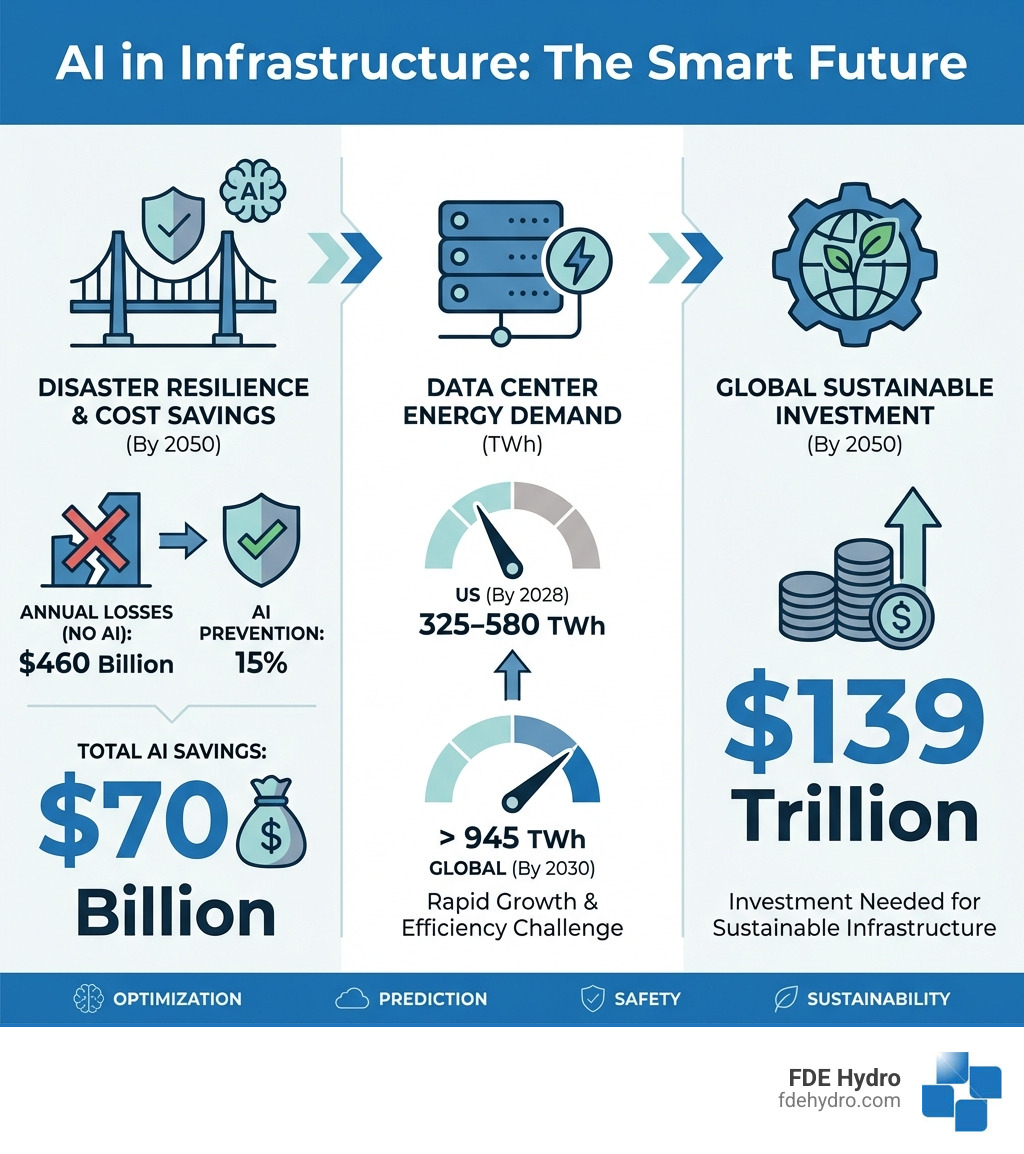
Simple guide to AI in infrastructure:
The AI Revolution in Infrastructure: Current Applications and Future Promise
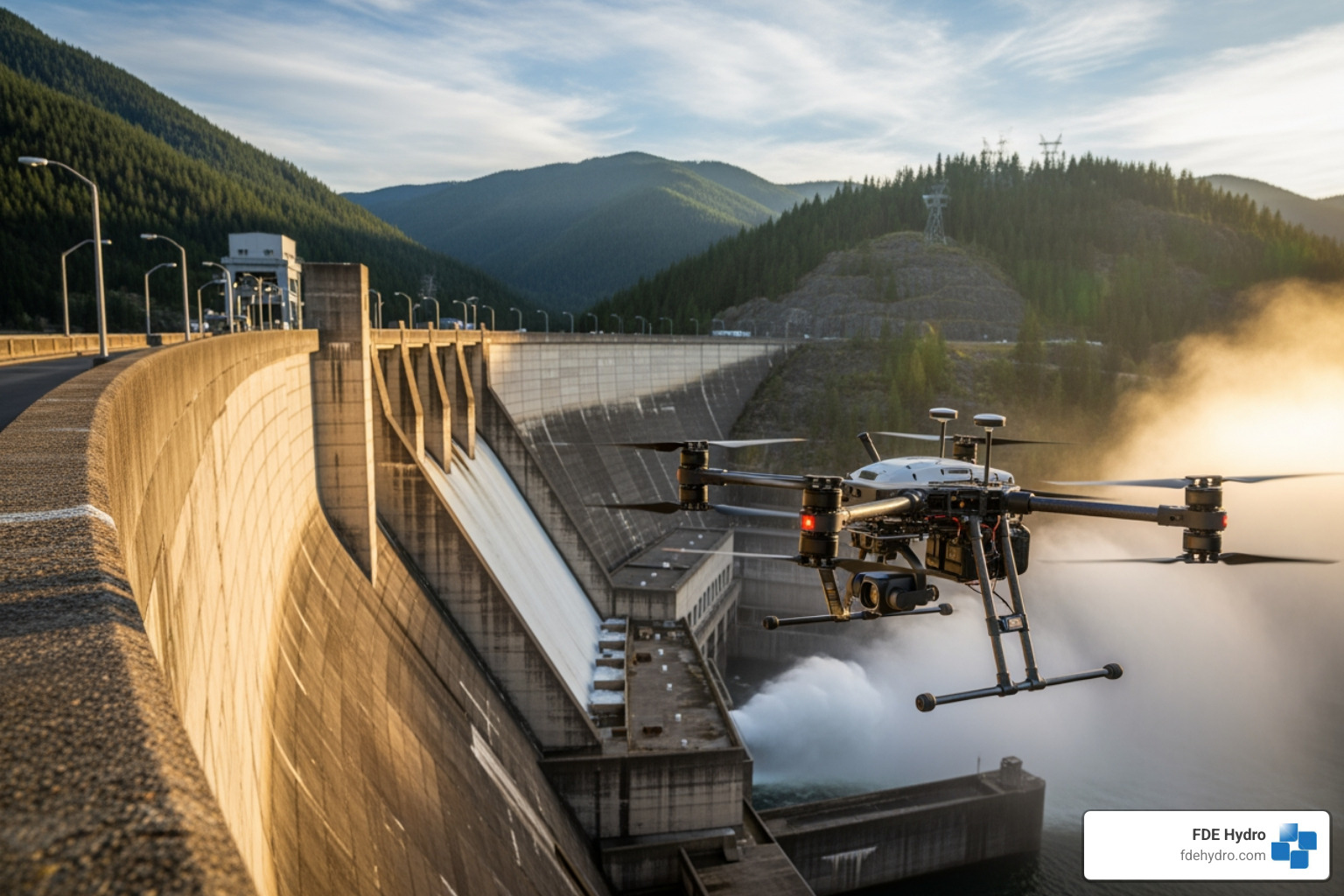
The integration of artificial intelligence into our infrastructure is a rapidly evolving reality. From power grids in New York to transportation systems in California, AI in infrastructure is reshaping how we manage and develop essential services.
How AI is currently being used in infrastructure management
AI is being deployed across infrastructure management, bringing new levels of efficiency, safety, and foresight. Current applications include:
- Predictive Maintenance: AI analyzes sensor data from assets like hydropower dams or bridges to predict maintenance needs. This proactive approach prevents costly failures and extends asset lifespans. For example, in hydropower, AI can monitor turbine health to predict wear and schedule maintenance before a critical issue arises.
- Asset Management: AI learns from historical data to identify patterns in asset deterioration and maintenance cycles. This allows for proactive prioritization, risk mitigation, and extended infrastructure life.
- Project Planning and Design: AI is revolutionizing early project stages. Generative design tools explore thousands of options, optimizing for cost, materials, and environmental impact. Machine learning can also analyze satellite imagery to map site conditions and optimize access routes, which is invaluable for planning new hydropower facilities.
- Safety Monitoring: On construction sites, AI-powered computer vision monitors for PPE use and other hazards. Construction robotics can automate dangerous tasks, reducing accidents and addressing labor shortages, which is highly relevant for dam construction.
- Natural Disaster Mitigation and Resilience: AI is a game-changer for disaster preparedness. It analyzes weather and geological data to predict the impact of storms or floods, enabling preventative measures and faster responses.
- Traffic Prediction and Management: In cities like New York City and Lawrence, Kansas, AI analyzes real-time traffic data to predict congestion, optimize signals, and manage traffic flow, improving commutes and reducing emissions.
- Energy Efficiency: AI optimizes energy use in buildings, smart grids, and industrial facilities. In power generation, it can balance supply and demand, better integrate renewables, and reduce energy waste.
- Digital Twins: These virtual replicas of physical infrastructure, powered by AI, allow for simulations and performance predictions without impacting the real-world asset. They are powerful tools for understanding complex systems like integrated water management.
- Risk Analysis and Supply Chain Optimization: AI improves risk analysis for project delays and supply chain disruptions by identifying bottlenecks and suggesting alternatives. This is crucial for large-scale projects across Canada, the US, and Europe.
A critical review of AI in infrastructure construction emphasizes that while safety and process management are primary focuses, the potential for AI to improve environmental performance, cost control, and quality remains largely untapped. For more detailed insights, we recommend exploring A critical review of AI in infrastructure construction.
Projected benefits and cost savings of AI integration
The financial and operational benefits of integrating AI in infrastructure are substantial. AI promises transformative savings and improved resilience.
Here are the key financial impacts we project:
- Massive Disaster Cost Avoidance: AI can help avoid an estimated US$70 billion in direct natural disaster costs to infrastructure by 2050. This is a monumental saving, considering projected annual losses of US$460 billion globally by 2050.
- Significant Loss Prevention: Enhancing infrastructure resilience with AI could prevent 15% of these projected losses, saving approximately US$70 billion annually. These resources could then be reallocated to preventative measures and new development.
- Targeted Savings in Critical Areas: Applying AI to storm and flood planning and response could save an estimated US$50 billion annually by 2050, protecting vulnerable communities in regions like coastal New York.
- Revenue Optimization and Capital Expenditure Programs: AI also improves financial performance by optimizing usage prediction for better revenue forecasting and more efficient capital expenditure programs. This leads to smarter investments for projects across the US, Canada, Brazil, and Europe.
The implementation of AI in infrastructure leads to material improvements in efficiency, productivity, and optimization. This includes accident reduction, improved customer experience, and efficiency gains in maintenance and energy use.
At FDE Hydro, we believe in innovative approaches that drive both efficiency and resilience. We’re constantly exploring how AI can integrate with our modular precast concrete technology to further reduce construction costs and time. You can find More info about our innovative Means and Methods on our website.
Under the Hood: Key AI Technologies and Their Infrastructure
To understand how AI in infrastructure works, we must look at the technologies that power it and the specialized infrastructure required. AI demands more than a typical IT setup. For FDE Hydro, this means optimizing hydropower and energy systems with cutting-edge digital capabilities.
Impactful AI technologies for the infrastructure sector
Several AI technologies are particularly impactful in the infrastructure sector, offering tools that can fundamentally change how we manage our physical world.
- Machine Learning (ML): This is the workhorse of AI, enabling systems to learn from data. In infrastructure, ML is used for:
- Predictive Maintenance: Analyzing sensor data to forecast failures in assets like bridges or turbines.
- Resource Optimization: Optimizing energy dispatch or water flow in utility networks.
- Risk Prediction: Identifying project risks based on historical data.
- Forecasting: Predicting utility demand or traffic patterns.
For a deeper dive, we recommend An overview of machine learning models.
- Computer Vision (CV): This technology allows computers to interpret visual information. Its applications include:
- Automated Inspection: Drones use cameras to inspect assets like dams and turbines for damage, which is faster and safer than manual inspection.
- Safety Monitoring: Monitoring construction sites for PPE compliance and operational safety.
- Progress Monitoring: Tracking construction progress against plans using video or drone imagery.
- Asset Inventory: Automatically identifying and cataloging assets.
- Natural Language Processing (NLP): NLP enables computers to understand human language. In infrastructure, this is used for:
- Document Analysis: Extracting key information from documents like contracts and specifications.
- Public Sentiment Analysis: Gauging public opinion on projects by monitoring social media and news.
- Automated Compliance Checking: Verifying that documentation meets regulatory standards.
- Deep Learning (DL): A subset of machine learning, deep learning uses neural networks to learn complex patterns from large datasets, powering advanced applications like highly accurate image recognition and real-time anomaly detection.
These technologies are critical for many AI applications, including our focus on Pumped Storage Hydropower, where real-time data analysis can significantly improve efficiency and grid stability.
Key components of AI in infrastructure
The infrastructure supporting AI is distinct from traditional IT, requiring specialized components for intense computation and massive datasets.
- Hardware:
- GPUs (Graphics Processing Units) and TPUs (Tensor Processing Units): Designed for parallel processing, these are ideal for the intense computations in AI model training, unlike traditional CPUs. GPUs speed up general ML training, while TPUs are custom-built for deep learning.
- High-Performance Servers: These are equipped with large amounts of RAM and high-speed storage to handle immense data volumes.
- Software:
- Machine Learning Frameworks: Tools like TensorFlow and PyTorch provide the foundation for building and deploying AI models.
- Data Processing and Management Tools: These handle the ingestion, cleaning, and storage of massive datasets.
- MLOps Platforms: These streamline the AI lifecycle—from data collection and training to deployment and monitoring—and are essential for managing complex AI projects at scale.
- Networking:
- High-Bandwidth, Low-Latency Networks: Rapid data transfer is critical for AI. Technologies like InfiniBand and 5G are vital for ensuring fast, reliable data flow, especially for real-time applications.
- Storage:
- Scalable and Durable Storage Solutions: AI requires storage for petabytes of data, much of it unstructured. Object storage is well-suited for this, offering the scalability and durability needed for high-performance AI.
- Data Pipelines: These are the automated workflows that move and process data for AI model training and inference.
- AI Models and Vector Databases: Trained AI models are a key component, and specialized vector databases are emerging to efficiently store and retrieve complex data representations.
- Cloud Computing: Many organizations leverage cloud platforms for AI infrastructure due to their flexibility and scalability, though on-premises solutions offer greater control.
For those looking to understand the core processing power behind AI, A guide to GPUs for AI provides excellent insights into platforms and key features.
Navigating the Challenges: AI’s Energy Demand and Implementation Risks
While AI in infrastructure promises a brighter future, its adoption comes with significant challenges. The most pressing are the escalating energy demand of AI and the risks of its implementation. As FDE Hydro focuses on sustainable energy, these challenges are particularly relevant.
How the energy demand for AI infrastructure impacts sustainability
The AI-powered digital revolution is creating an insatiable appetite for electricity, directly impacting sustainability goals.
- Explosive Growth in Data Center Energy Use: Data center energy consumption is skyrocketing. In the US, demand climbed from 58 terawatt-hours (TWh) in 2014 to 176 TWh in 2023, with projections reaching 325 to 580 TWh by 2028. Globally, demand could exceed 945 TWh by 2030—more than double current levels. AI-optimized data centers are expected to quadruple their electricity use in just five years.
- Strain on the Grid: This rapid growth means US data centers could account for nearly half the country’s electricity demand growth by 2030. The US data center pipeline capacity exploded to over 92 gigawatts (GW) by late 2024, placing immense pressure on the grid, especially in regions like New York, California, and Kansas.
- A Climate Liability? If this demand is met by fossil fuels, AI could become a climate liability. We must act with foresight to power AI cleanly, balancing growth with climate goals.
- Sustainable Solutions, Especially Hydropower: The question is how to meet this demand cleanly. The answer lies in low-carbon, reliable, and dispatchable energy.
- Hydropower: Hydropower offers clean, renewable, and dispatchable power that can be adjusted to meet fluctuating demand, making it ideal for powering data centers.
- Dispatchable Solar with Thermal Storage: This provides clean, 24-hour power on demand, offering a resilient and cost-effective alternative to lithium-ion batteries.
- Advanced Nuclear and Geothermal: These technologies also provide firm, zero-carbon energy.
Building AI infrastructure around sustainable power offers benefits beyond emissions reductions, including promoting regional economic development and strengthening energy security. For more information, refer to The US Department of Energy’s report on data center electricity demand. For our perspective, explore The Biggest Untapped Solution to Climate Change is in the Water.
Primary challenges and risks of AI implementation
Implementing AI in infrastructure is not without pitfalls, and we must understand the risks involved.
- Cybersecurity Threats: Generative AI amplifies cybersecurity risks, enabling sophisticated attacks like deepfakes and automated phishing. The growing use of IoT in critical infrastructure increases the attack surface, making systems like hydropower plants more vulnerable to breaches.
- Algorithmic Bias and Errors: AI models trained on biased or incomplete data can lead to unfair or incorrect decisions. This can cause critical failures or inequitable service. Challenges like model drift and data drift can also degrade performance over time.
- Data Privacy and Intellectual Property: The sheer volume of data required for AI raises significant privacy concerns and evolving questions around intellectual property for AI-generated content.
- Workforce Impact: While AI creates new jobs, it also has the potential to displace certain roles. We must proactively address these impacts by investing in reskilling and upskilling programs.
- Regulatory Gaps: The rapid evolution of AI often outpaces the development of necessary regulations, creating uncertainty regarding accountability and liability.
- High Initial Investment and Data Quality: AI implementation requires significant upfront investment. Additionally, many operators lack the high-quality digital data needed for meaningful AI applications, as data preparation is often time-consuming.
Managing these risks requires a holistic framework that identifies and addresses emerging threats. This includes robust cybersecurity, careful data governance, and transparent AI models. Incorporating solutions like hydropower, which provides reliable energy, is a foundational part of building more resilient infrastructure. Learn more in 4 Reasons Why Hydropower is the Guardian of the Grid.
Building the Future: A Roadmap for Successful AI Integration
Leveraging AI in infrastructure is a complex but achievable journey. It requires a fundamental shift in collaboration, thinking, and operations. At FDE Hydro, we believe in building robust frameworks for successful AI integration to improve resilience and sustainable development across the US, Canada, Brazil, and Europe.
Fostering collaboration and enhancing resilience with AI
Cross-sector collaboration is paramount for integrating AI into infrastructure. We need an ecosystem where public and private sectors, academia, and tech providers work together to tackle the challenges and opportunities.
- Public-Private Partnerships: Governments can partner with tech firms and infrastructure companies to pilot AI solutions, share data securely, and co-develop best practices, bridging the gap between innovation and implementation.
- Ecosystem Development: Platforms that encourage data sharing, standard protocols, and joint research can accelerate AI adoption. This includes forums for discussing legal and ethical concerns.
- AI’s Role in Resilience Phases: AI significantly improves each phase of infrastructure resilience:
- Planning Phase: AI helps identify risks sooner by analyzing data on climate impacts and asset vulnerabilities. It can optimize resource allocation and inform resilient infrastructure design. For example, predictive modeling can simulate storm impacts to protect critical assets like hydropower facilities.
- Response Phase: During an event, AI accelerates response times with real-time monitoring. It can quickly assess damage, prioritize repairs, and optimize resource deployment for a faster, coordinated reaction.
- Recovery Phase: Post-disaster, AI aids in rapid damage assessment and resource allocation for rebuilding, helping communities recover faster.
The EY and FIDIC report, “How artificial intelligence can open up a new future for infrastructure,” emphasizes that a collaborative, flexible model is crucial. It highlights the need for integrated ways of working and responsive assets. This holistic view is essential for building resilient systems, including those supported by Microgrid technologies that AI can help optimize.
The new mindset and skillsets required for the AI era
To leverage AI in infrastructure, the industry needs significant changes in mindset, skillset, and toolset.
- Mindset Shift:
- Openness to Innovation: Move beyond traditional approaches to an adaptive, experimental mindset, including piloting new technologies and learning from failures.
- Collaborative Approach: Foster cross-disciplinary collaboration between engineers, data scientists, and ethicists.
- Focus on Societal Benefit: Prioritize end-user needs and broader societal benefits like public safety and environmental impact.
- Long-Term Vision: Understand that AI implementation is a journey that requires sustained investment and commitment.
- Skillset Evolution:
- Data Literacy: All professionals need a foundational understanding of data, including its collection, analysis, quality, bias, and privacy implications.
- AI Literacy: A basic understanding of AI capabilities, technologies (ML, CV, NLP), and ethics is essential.
- Analytical and Problem-Solving Skills: The ability to frame infrastructure problems for AI and critically evaluate its insights.
- Interdisciplinary Skills: Engineers need to understand computational concepts, and data scientists need to grasp infrastructure operations.
- Continuous Learning: A commitment to ongoing professional development is non-negotiable.
- Toolset Evolution:
- Standardized Methods and Protocols: Developing industry-wide standards for data is crucial for scaling AI solutions.
- Secure Data-Sharing Platforms: Robust platforms are needed to exchange sensitive infrastructure data securely.
- AI-Specific Contract Provisions: Legal frameworks must evolve to address liability and data ownership for AI systems.
- User-Friendly AI Tools: The rise of low-code AI tools is making the technology more accessible to domain experts.
We must build capacity for AI implementation, investing in training and fostering a culture of continuous learning. This ensures our teams, from New England to Brazil, are equipped to harness AI responsibly and effectively.
Conclusion
The journey of AI in infrastructure is truly at a crossroads. We’ve explored how AI is already optimizing management and development, offering incredible benefits like predictive maintenance, improved safety, and substantial cost savings in disaster mitigation—potentially saving US$70 billion annually by 2050. We’ve digd into the powerful technologies like machine learning, computer vision, and NLP that drive these changes, and examined the specialized hardware, software, and networking that form their foundation.
However, we’ve also confronted the significant challenges. The escalating energy demand of AI infrastructure, with data centers projected to consume a staggering amount of electricity, presents a critical sustainability dilemma. Additionally, risks such as cybersecurity threats, algorithmic bias, and the impact on the workforce demand our careful attention and proactive solutions.
The path forward requires a new approach: one rooted in cross-sector collaboration, a transformed mindset, and continuous skill development. We must foster partnerships, accept data literacy, and prioritize ethical considerations to ensure AI serves humanity’s best interests.
The future of AI is intrinsically intertwined with clean energy solutions. For us at FDE Hydro, this means a deep commitment to hydropower. As a leading renewable and dispatchable energy source, hydropower offers a vital solution to power the burgeoning demands of AI sustainably, efficiently, and reliably.
By embracing the transformative power of AI and conscientiously powering it with sustainable energy sources like hydropower, we can build a more efficient, resilient, and prosperous future for communities across the United States, Canada, Brazil, and Europe. Let’s work together to make this vision a reality.
