

AI for Sustainability: Balancing Innovation with Environmental Responsibility
AI for sustainability represents one of the most important—and complex—challenges of our time. Here’s what you need to know:
How AI Helps Sustainability:
- Environmental Monitoring: Tracks deforestation, methane emissions, and biodiversity changes in real-time
- Energy Optimization: Manages smart grids and forecasts renewable energy production
- Precision Agriculture: Reduces water usage by up to 25% and chemical runoff by 30%
- Climate Prediction: Improves weather forecasting and disaster early warning systems
- Waste Management: Improves recycling efficiency by up to 50% through automated sorting
Environmental Costs of AI:
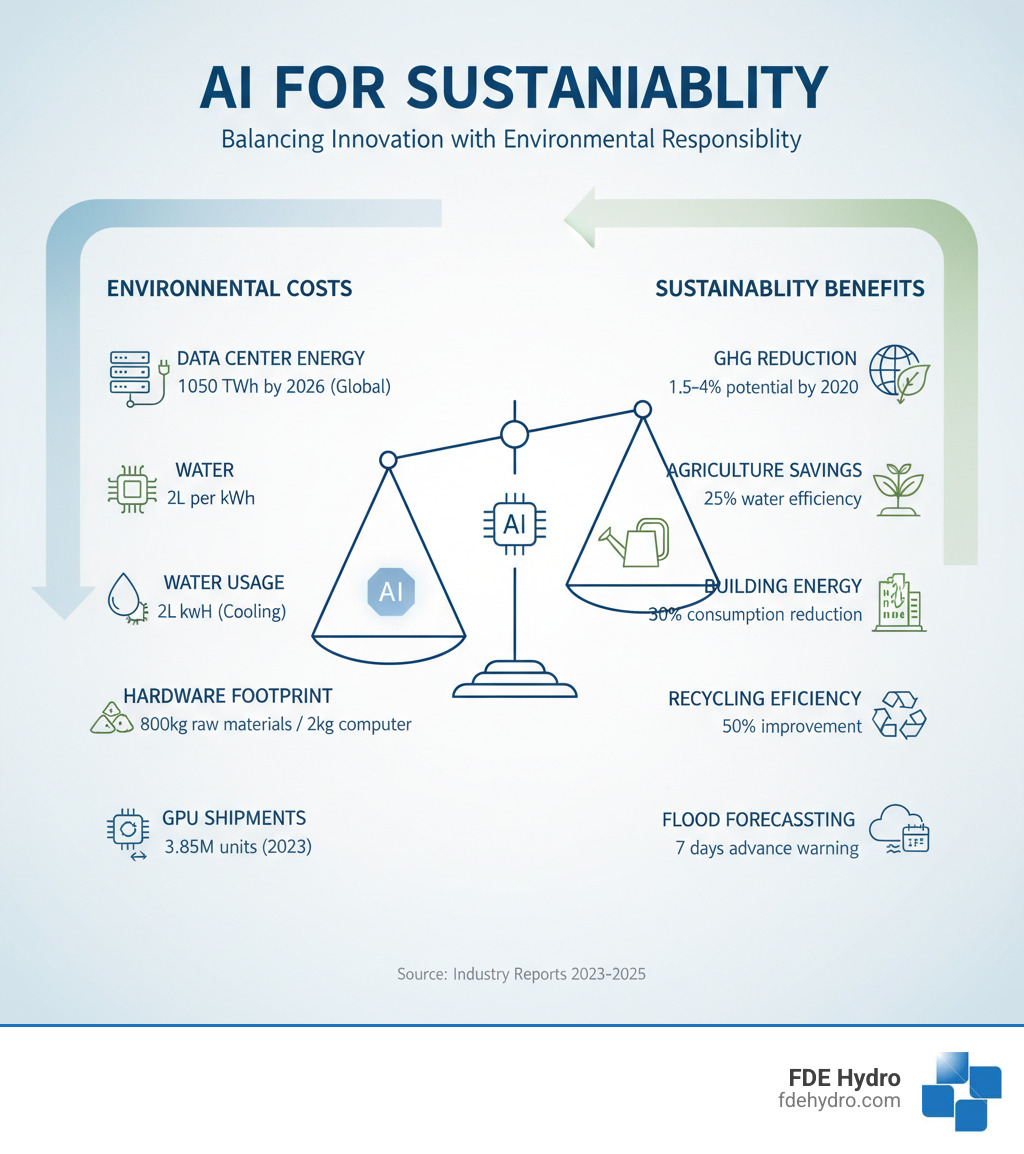
- Energy Consumption: Data centers use about 1% of global electricity; AI queries consume 5-10x more than traditional searches
- Water Usage: Requires approximately 2 liters of water per kilowatt-hour for cooling
- Hardware Impact: A 2 kg computer requires 800 kg of raw materials to manufacture
- Carbon Emissions: Training a single large language model can generate 552 tons of CO2
There’s real urgency here. AI could help reduce global greenhouse gas emissions by 1.5-4% by 2030. But the number of data centers has surged from 500,000 in 2012 to 8 million today, and their electricity consumption is projected to more than double by 2026.
Sustainability, as defined by the 1987 Brundtland Report, means “development that meets the needs of the present without compromising the ability of future generations to meet their own needs.” This definition captures why the AI sustainability question matters so much.
The Cornell AI for Sustainability Initiative (CAISI) represents one of the leading efforts to address this challenge. It connects academia, industry, and nonprofits to develop AI-powered solutions focused on decarbonizing energy and agri-food systems while advancing sustainable materials findy.
This guide explores both sides of AI’s sustainability story. You’ll learn about the environmental costs of AI infrastructure, the powerful ways AI enables sustainability solutions across sectors, and the practical strategies for reducing AI’s footprint through optimization and renewable energy.
I’m Bill French Sr., Founder and CEO of FDE Hydro, a company delivering modular civil construction solutions to the hydropower industry. With decades of experience in heavy civil construction and five years focused on next-generation hydropower technology, I’ve seen how innovation can advance both business goals and environmental stewardship, making AI for sustainability a natural evolution in our industry’s approach to clean energy infrastructure.
The Environmental Cost of the AI Boom
There’s something ironic about AI for sustainability. Here we have this powerful technology that could help solve environmental problems, yet it’s creating some pretty serious environmental challenges of its own. The infrastructure needed to build, train, and run AI models—especially the complex systems behind tools like ChatGPT—requires massive amounts of resources. We’re talking about staggering energy consumption, enormous water usage, and a hidden cost in raw materials and electronic waste that most people never see.
It’s the classic double-edged sword: a tool with incredible potential that comes with its own set of problems we need to solve.

The Soaring Energy and Water Demands of Data Centers
Data centers are where AI’s environmental challenge really hits home. These massive, temperature-controlled buildings house all the computing infrastructure—servers, storage drives, network equipment—that power our digital world. And with AI exploding in popularity, their numbers have grown dramatically. We went from 500,000 data centers in 2012 to 8 million today. That’s not a typo.
This explosive growth means one thing: these facilities are consuming electricity at an incredible rate. In North America alone, the power requirements nearly doubled from 2,688 megawatts at the end of 2022 to 5,341 megawatts by the end of 2023. Globally, data centers consumed 460 terawatt-hours in 2022, and we’re looking at 1,050 terawatt-hours by 2026. To put that in perspective, data centers could soon rank fifth globally in electricity consumption—using more power than most countries.
Generative AI is especially power-hungry. A single ChatGPT query uses about five to ten times the electricity of a regular search. Training one large model like GPT-3 consumed 1,287 megawatt hours of electricity and generated roughly 552 tons of carbon dioxide. That’s enough energy to power 120 average American homes for an entire year—just to train one model.
The hardware demands are equally staggering. GPU shipments to data centers jumped from 2.67 million in 2022 to 3.85 million in 2023. All those powerful chips need cooling, which puts enormous strain on power grids. When the grid can’t keep up, facilities often turn to diesel generators to handle the load, which just adds more greenhouse gas emissions to the problem.
In Ireland, the situation is particularly striking. AI-driven data centers could account for nearly 35 percent of the country’s total energy use by 2026. That’s simply not sustainable if we keep powering these facilities the same way we do today. The IEA report on electricity demand lays out these challenges in detail.
But it’s not just about electricity. Data centers are incredibly thirsty, too. All those powerful machines generate tremendous heat, and cooling them requires vast amounts of water. For every kilowatt-hour of energy a data center uses, it needs roughly two liters of water for cooling. When you add it all up, AI-related infrastructure globally may soon consume six times more water than the entire country of Denmark.
This matters even more when you consider that a quarter of humanity already lacks access to clean water and sanitation. The environmental footprint of generative AI extends far beyond electricity—it touches our most precious resources.
From Mines to Landfills: The Hidden Lifecycle Costs
The environmental story of AI doesn’t start when you flip the switch on a data center. It begins much earlier, deep in mines where workers extract rare earth elements and other raw materials. And it doesn’t end when a server stops working—it continues in landfills where electronic waste piles up.
Manufacturing computer hardware, especially the specialized chips AI systems need, is shockingly resource-intensive. Building a 2 kg computer requires 800 kg of raw materials. Let that sink in—you need 400 times more materials than the finished product weighs. Many of these materials are rare earth elements, and extracting them can devastate local environments and create social problems in mining communities.
The supply chain for AI hardware spans the globe, with manufacturing and transportation adding significant energy use and emissions at every step. And here’s where things get worse: AI technology evolves so rapidly that hardware becomes obsolete quickly. This creates a mounting e-waste crisis that we’re only beginning to understand.
These discarded electronics aren’t just trash—they contain hazardous substances like mercury and lead. If not properly handled, they pose serious risks to human health and the environment. The UNCTAD report on electronics paints a sobering picture of just how much electronic waste we’re generating globally.
We need to think more carefully about the full picture. As MIT research on AI’s sustainability implications points out, we must systematically understand what new AI developments really cost us. We need to weigh the perceived benefits of generative AI against its complete environmental and societal costs—from the mines to the data centers to the landfills.
Before we deploy AI for sustainability solutions at massive scale, we need to make sure the net effect is genuinely positive. That means being honest about the entire lifecycle impact and working to reduce it at every stage. The good news? We’re becoming more aware of these challenges, and awareness is the first step toward finding real solutions.
Using AI for Sustainability: Applications and Case Studies
Now we get to the exciting part. Yes, AI infrastructure has environmental costs—but the technology itself holds remarkable promise for tackling some of our planet’s biggest sustainability challenges. When we deploy AI for sustainability thoughtfully, it becomes a powerful ally in our fight against climate change and resource depletion.
The numbers tell a compelling story. Research suggests that AI for sustainability applications could reduce global greenhouse gas emissions by 1.5-4% by 2030. That might not sound like much at first, but when you’re talking about global emissions, even a few percentage points represent millions of tons of carbon dioxide kept out of our atmosphere.
The key is applying AI where it can make the biggest difference: monitoring our environment in real-time, optimizing how we use resources, and helping us make smarter decisions about energy, food, water, and waste. Let’s look at how this plays out across different sectors.
Revolutionizing Energy and Utilities
The energy sector is undergoing its biggest change in a century, and AI is accelerating that change in ways we couldn’t have imagined even a decade ago.
Think about the complexity of managing a modern power grid. You’ve got thousands of power sources—some steady and predictable, others like wind and solar that fluctuate with the weather. You’ve got millions of consumers whose demand changes by the hour. And you need to balance it all in real-time, because electricity can’t be stored easily at scale (well, except through technologies like pumped storage hydropower, but more on that in a moment).
AI algorithms excel at this kind of complex optimization. They analyze real-time data from across the grid to predict energy demand and supply shifts, allowing smart grids to distribute power more effectively. This is particularly vital for integrating intermittent renewable energy sources like solar and wind. When AI can forecast renewable energy generation with precision, grid operators can balance supply and demand without resorting to fossil fuel backup power.
At FDE Hydro, we see how critical stable, dispatchable power is in this evolving landscape. Hydropower, especially pumped storage, acts as a natural partner for AI-driven grid optimization. While AI manages the complex dance of variable renewables, hydropower provides the flexibility and reliability the grid needs. Our modular hydropower solutions are designed to integrate seamlessly into these smart energy systems. You can learn more about how hydropower is the guardian of the grid and the potential of pumped storage hydropower to support these efforts.
Beyond the grid itself, AI is changing how individual buildings and industrial facilities use energy. Smart energy management systems learn usage patterns and automatically adjust HVAC, lighting, and other energy-intensive operations to minimize waste. Some systems have achieved an average 30% reduction in building energy consumption. The U.S. Department of Energy recognized the critical role that innovative hydropower technologies play in this sustainable energy future, endorsing FDE Hydro’s technology in their Hydropower Vision Report. Read more about how the U.S. Department of Energy Hydropower Vision Report endorses FDE Technology.
Water utilities are also benefiting from AI’s analytical power. Advanced systems can identify anomalies in water distribution networks, detecting leaks that would otherwise go unnoticed for months or years. Some implementations have achieved a 40% reduction in water leakage and helped agricultural users decrease water consumption by 25%. When water scarcity affects billions of people, these improvements matter enormously.

Cultivating a Greener Future with AI in Agriculture
Agriculture faces an enormous challenge: feeding a growing global population while reducing its environmental footprint. Currently, farming accounts for about 70% of global freshwater use and contributes significantly to greenhouse gas emissions through fertilizer use and land-use changes.
This is where precision farming powered by AI offers genuinely transformative solutions. Instead of treating an entire field the same way, AI analyzes data from drones, IoT sensors, and satellite imagery to understand the specific needs of different areas within a single field. The soil might be drier here, the nutrient levels different there, pest pressure higher in another spot.
AI algorithms can determine precisely how much water, fertilizer, and pesticide each area needs—and just as importantly, when it needs it. The results are impressive. Some precision farming platforms have achieved up to 25% reductions in water usage and 30% reductions in chemical runoff, all while boosting crop yields by 20%. Less waste, fewer chemicals entering waterways, more food produced. That’s a win across the board.
The environmental benefits extend beyond individual farms. AI helps optimize entire food supply chains, from farm to fork, reducing spoilage and waste at every step. Research on AI to improve the food and agriculture sector demonstrates the technology’s broad applicability across the industry.
For retailers, AI platforms can predict inventory needs more accurately, leading to 20% reductions in food waste. Restaurants using AI demand forecasting have decreased surplus food by 15%. When you consider that roughly one-third of all food produced globally is wasted, these improvements represent significant progress toward AI for sustainability goals.
Optimizing Waste Management and the Circular Economy
Let’s be honest: we’ve created a waste problem. Globally, we generate over 2 billion tons of municipal solid waste annually, and much of it ends up in landfills or polluting our environment. Traditional recycling processes struggle with efficiency and contamination, making it economically challenging to recycle many materials.
AI-powered automated sorting systems are changing this equation dramatically. Using computer vision and machine learning, these systems can identify and separate different types of materials with unprecedented speed and accuracy. They can distinguish between different grades of plastic, identify contaminated materials, and sort at speeds no human workforce could match.
Some advanced sorting systems have improved recycling efficiency by 50%. That means less contamination, more materials actually getting recycled instead of landfilled, and better economics for recycling operations. When recycling becomes more profitable, more of it happens—it’s that simple.
But AI’s role in waste reduction goes beyond just sorting what we’ve already thrown away. Throughout the supply chain, AI helps companies reduce waste before it happens. By accurately forecasting demand, optimizing logistics, and identifying inefficiencies, AI moves us toward a more circular economy where resources stay in use as long as possible.
Enhancing Environmental Monitoring and Climate Prediction
Perhaps the most direct application of AI for sustainability is helping us understand what’s actually happening to our planet. Climate change and environmental degradation are complex, global phenomena that generate enormous amounts of data—more than any human team could possibly analyze manually.
AI excels at processing this flood of information. Algorithms can analyze satellite imagery to track deforestation rates in near real-time, monitoring vast forest areas that would be impossible to survey on the ground. They can identify illegal sand dredging operations that damage marine ecosystems, as demonstrated by UNEP’s Marine Sand Watch. They can even detect when oil and gas facilities vent methane, a greenhouse gas over 80 times more potent than carbon dioxide in the short term.
For climate prediction, AI models are pushing the boundaries of what’s possible. Traditional weather and climate models require massive computational resources and still struggle with certain types of predictions. AI approaches can forecast weather patterns and extreme events with greater accuracy and longer lead times.
Google’s Flood Forecasting project can predict riverine floods up to seven days in advance, providing crucial early warnings to vulnerable communities in over 100 countries. Seven days might not sound like much, but it’s enough time to evacuate, move livestock, and prepare emergency supplies—potentially saving thousands of lives. You can learn more about this initiative at Google’s Flood Forecasting project.
AI is also making breakthroughs in wildfire detection. New satellite systems are being developed that can track wildfires globally with high-resolution imagery updated every 20 minutes, enabling faster response times that could prevent small fires from becoming disasters.
Cities are using AI to tackle extreme heat by analyzing satellite and aerial imagery to identify neighborhoods most vulnerable to heat islands—areas where concrete and asphalt create dangerously high temperatures. Armed with this information, urban planners can target cooling interventions like tree planting and reflective surfaces where they’re needed most.
The applications keep expanding. AI can analyze flight data and weather patterns to help airlines avoid creating contrails—those white streaks behind planes that, it turns out, contribute significantly to climate warming. It can monitor biodiversity changes, track wildlife populations, and identify ecosystems under stress before they collapse.
What ties all these applications together is AI’s ability to find patterns in complexity, to make sense of vast datasets, and to provide actionable insights that help us protect our planet. The technology isn’t perfect, and it comes with environmental costs of its own. But when deployed thoughtfully, AI for sustainability gives us powerful tools to address challenges that once seemed impossible.
The Path to Green AI: Strategies for a Lighter Footprint
As we accept the power of AI for sustainability, it’s equally crucial to address the technology’s own environmental footprint. We can’t solve environmental problems by creating new ones. The goal is to develop “Green AI”—AI systems that are inherently more efficient and powered by sustainable infrastructure. This requires a multi-pronged approach, focusing on optimizing the AI models themselves, designing more efficient hardware and data centers, and ensuring these facilities are powered by renewable energy.
| Feature | Benefits of AI for Sustainability | Risks & Environmental Costs |
|---|---|---|
| Energy Systems | Optimizes smart grids, integrates renewables, and reduces building energy consumption by up to 30%. | Data centers consume ~1% of global electricity (projected to double by 2026), with AI queries using 5-10x more energy than standard searches. |
| Water Resources | Reduces water usage in agriculture by up to 25% and detects leaks in utility networks. | Data centers require ~2 liters of water per kWh for cooling, straining local water supplies. |
| Climate & Environment | Improves climate prediction, tracks deforestation and emissions, and improves disaster warnings. | Training a single large AI model can generate over 552 tons of CO2 emissions. |
| Resource Management | Improves recycling efficiency by up to 50% and enables precision agriculture to reduce chemical runoff. | Manufacturing hardware is resource-intensive (800 kg of raw materials for a 2 kg computer) and contributes to a growing e-waste problem. |
