

Why the Europe Hydropower Market Matters for the Energy Transition
The Europe hydropower market is experiencing a resurgence as the continent shifts toward renewable energy and energy independence. Here’s what you need to know:
Key Market Facts:
- Current Market Size: USD 50.9 billion (2023), projected to reach USD 88.06 billion by 2035
- Growth Rate: 4.71% CAGR (2025-2035)
- Installed Capacity: 263 GW generating 680 TWh annually
- Renewable Contribution: Hydropower accounts for 29.9% of EU’s renewable electricity
- Storage Leader: Pumped storage provides over 90% of Europe’s utility-scale energy storage
Why It Matters: Unlike intermittent solar and wind, hydropower offers reliable, dispatchable electricity while providing critical grid stability services. As Europe phases out nuclear and coal, hydropower’s role as the “guardian of the grid” becomes even more essential.
Europe’s hydropower story began over a century ago, contributing to industrial development. Today, with nearly 25,000 plants—many averaging 45 years old—the sector is at a crossroads. The 2022 energy crisis, triggered by geopolitical tensions and droughts, highlighted hydropower’s vital role in energy security and price stability.
The path forward involves three key priorities: modernizing aging infrastructure (which could increase generation by 10%), expanding pumped storage capacity (with a pipeline of 52.9 GW in development), and implementing innovative construction methods to reduce costs and timelines.
I’m Bill French Sr., Founder and CEO of FDE Hydro. After decades in heavy civil construction, I developed modular solutions for the Europe hydropower market and beyond. Through initiatives like the U.S. Department of Energy’s Hydropower Vision and developing patented modular technologies, I’ve seen how innovation can address key challenges: high capital costs, long project timelines, and environmental concerns.
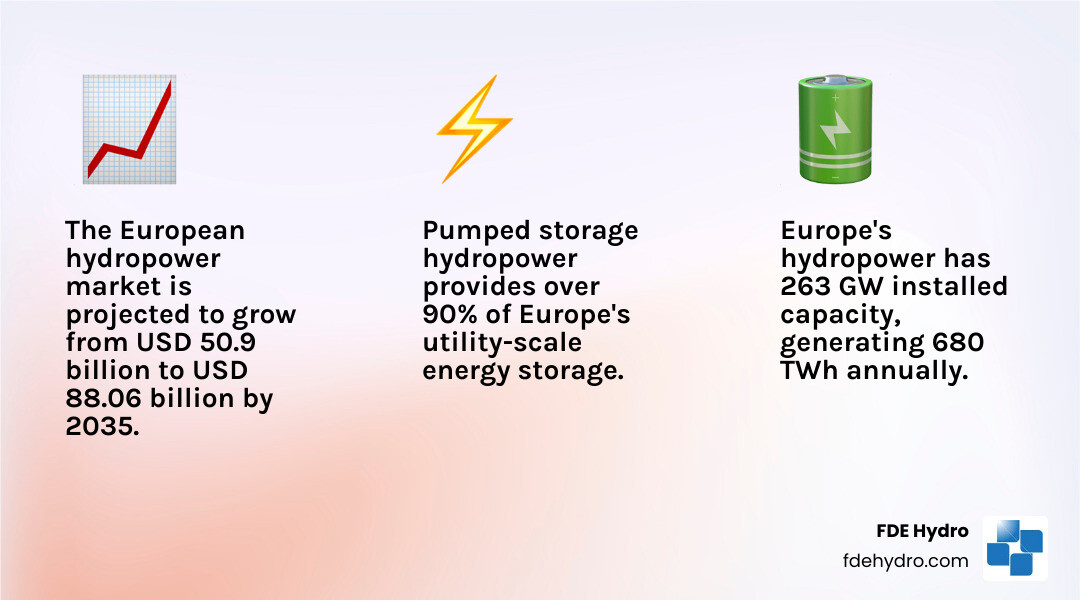
Key terms for Europe hydropower market:
The Current State of the Europe Hydropower Market: Size and Projections
The Europe hydropower market is a dynamic and growing sector crucial for the continent’s energy future. The numbers show hydropower remains a cornerstone of Europe’s renewable energy mix.
In 2023, the market was valued at USD 50.9 billion. Projections indicate a robust expansion to USD 88.06 billion by 2035, with a CAGR of approximately 4.71% from 2025-2035. This growth highlights the increasing recognition of hydropower’s value in a decarbonizing energy landscape.
As of 2024, Europe has an installed hydropower capacity of 263 GW, generating around 680 TWh of electricity annually. According to Eurostat, in 2024, hydropower accounted for 29.9% of the EU’s renewable electricity, making it the second-largest source and indispensable for meeting climate goals and ensuring energy independence.
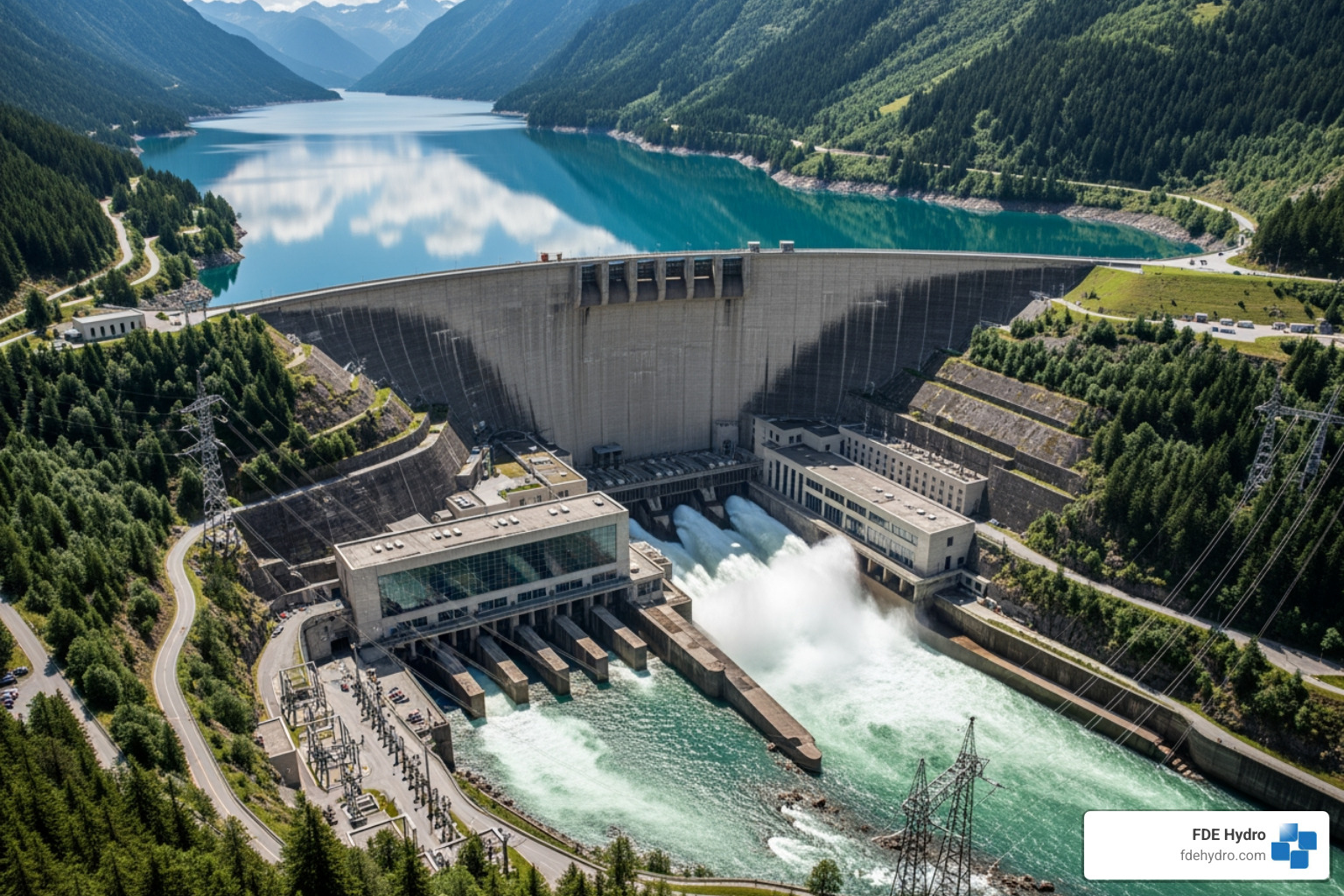
The market’s growth isn’t uniform; it’s a nuanced landscape of different capacities and technologies.
Market Segmentation by Capacity
The Europe hydropower market is segmented by the installed capacity of individual plants, reflecting diverse applications and scales of operation.
- Large & Medium Hydropower: This segment, comprising large-scale dams and power plants, is the dominant force, projected to be valued at USD 54.09 billion by 2035. These facilities provide substantial baseload power and grid services.
- Small Hydropower: Defined by capacities from 1 MW to 10 MW, this segment is expected to reach USD 19.87 billion by 2035. Small hydro projects often have a lower environmental footprint and can be integrated into existing water infrastructure. Countries like Norway and Austria are effectively capitalizing on their river systems with smaller projects.
- Micro & Pico Hydropower: These are the smallest-scale installations (often <1 MW), designed for localized energy solutions in rural or remote areas. This segment is projected to be valued at USD 5.8 billion in 2035 and represents a sustainable approach to decentralized energy.
Each type contributes uniquely to Europe’s energy security and renewable targets. Our Hydroelectric Power Solutions Guide digs deeper into the various types and their applications.
Leading Countries by Installed Capacity
While Europe as a whole is a strong performer, certain countries stand out for their installed capacity.
| Country | Installed Hydropower Capacity (2024) | Pumped Storage Capacity (2024) |
|---|---|---|
| Russia | 54,327 MW | 1,385 MW |
| Norway | 33,909 MW | 1,401 MW |
| France | 25,777 MW | – |
| Italy | 22,089 MW | 7,256 MW |
| Germany | 14,561 MW | 9,449 MW |
Russia holds the largest hydropower market in the region, with an installed capacity of 54,327 MW in 2024 and ambitious plans for expansion. Norway is another major player with 33,909 MW. France and Italy also contribute significantly, with 25,777 MW and 22,089 MW respectively. Germany, with 14,561 MW, stands out for its substantial pumped storage capacity of 9,449 MW, highlighting its focus on grid stability. Germany is also projected to hold the largest market share by valuation (USD 22.5 billion by 2035), with the UK market also expected to show significant growth (USD 15.5 billion by 2035).
These leading nations underscore the diverse and robust nature of the Europe hydropower market.
Key Drivers and Trends Shaping the Industry
The growth of the Europe hydropower market is fueled by powerful drivers and emerging trends that highlight its indispensable role in the continent’s energy transition.
A significant driver is the EU’s commitment to decarbonization. The European Green Deal’s goal to reduce emissions by at least 55% by 2030 places renewables at the forefront, and hydropower, as a clean source, is a natural fit.
Energy security has also become a paramount concern, especially since the 2022 energy crisis. Reliance on expensive LNG imports has prompted nations to accelerate decarbonization, prioritizing indigenous, reliable sources like hydropower to reduce vulnerability to volatile fuel markets.
The increasing use of variable renewables like solar and wind requires greater grid flexibility. Hydropower provides essential grid services that balance supply and demand, optimizing the integration of these intermittent sources.
Furthermore, with many of Europe’s plants averaging 45 years old, there is a significant opportunity for modernization. Upgrading this infrastructure can improve output, increase efficiency, and extend operational lifespans. We see this as a key area for our expertise in Renewable Energy Construction.
The Crucial Role of Pumped Storage Hydropower (PSH)
Within the Europe hydropower market, pumped storage hydropower (PSH) is gaining recognition as Europe’s “water battery.” PSH stores energy by pumping water to an upper reservoir during low demand and releases it to generate power when demand is high.
This capability makes PSH an indispensable asset for grid balancing and integrating variable renewables. By providing large-scale, long-duration energy storage, PSH acts as a critical buffer, ensuring grid stability.
The business case for PSH is clear, with a project pipeline of 52.9 GW in development. Notable investments include Drax Group PLC’s £500 million (USD 607 million) commitment to its Cruachan power station in the UK to add 600 MW of PSH capacity, with plans to double it by 2030. As of 2024, Europe has 56 GW of installed PSH capacity, an expansion vital for supporting the grid. PSH truly embodies the concept of 4 Reasons Why Hydropower is the Guardian of the Grid.
Key Trends in the Europe Hydropower Market
Beyond PSH, several other key trends are shaping the market:
- Modernization and Upgrading: The focus on improving existing plants is paramount, driven by the energy crisis. Between 9,000 MW and 12,000 MW of new capacity were under planning in 2024. Our expertise in Hydropower Retrofitting is directly aligned with this need.
- Growth in Small-Scale Hydro: There’s a growing emphasis on smaller, distributed solutions. Countries like Norway and Austria are effectively using river systems for energy production through small-scale plants with minimal environmental impact.
- Digitalization and Automation: The integration of IoT and AI is improving efficiency, enabling predictive maintenance, and allowing for better water resource management.
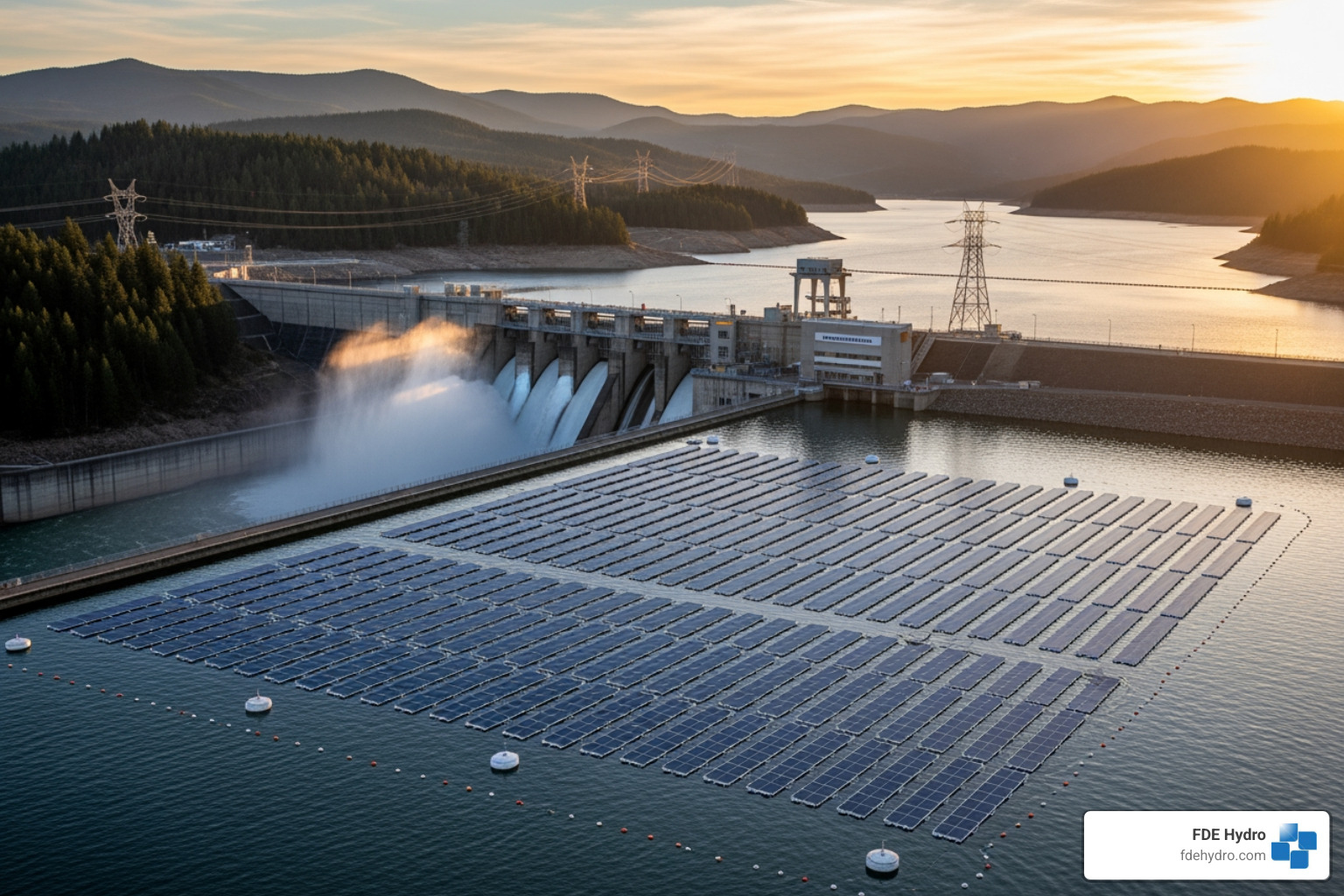
- Hybridization with Other Renewables: An exciting trend is combining hydropower with technologies like floating solar panels on reservoirs and battery energy storage systems (BESS). This hybridization maximizes resource use and optimizes renewable energy output.
These trends point towards a more flexible, efficient, and integrated Europe hydropower market.
Navigating the Policy Landscape and Industry Challenges
While the Europe hydropower market has great potential, its development faces significant challenges. Navigating these requires a deep understanding of the technical and regulatory landscapes.
A primary challenge is stringent environmental regulations. Directives like the Water Framework Directive (WFD) impose strict requirements to protect ecosystems. While crucial for sustainability, these rules can lead to complex, lengthy permitting processes, delaying projects and increasing costs.
The high initial investment for hydropower projects remains a significant restraint. Developing new dams or major pumped storage facilities involves substantial capital outlay. This financial commitment, coupled with long project timelines, often makes financing challenging, as detailed in our insights on Hydropower Project Costs.
Lengthy permitting processes can stretch for years, adding to project risk and making long-term revenue forecasting difficult for investors. This bureaucratic burden can hinder the timely delivery of new capacity.
Market uncertainty also poses challenges. The lack of appropriate market compensation for the full range of grid services that hydropower provides can undermine its financial viability. For PSH, financial viability can be compromised where power used for pumping is subject to grid fees or double taxation.
Finally, social acceptance can be a hurdle for large projects due to concerns about environmental impact or changes to local landscapes. This necessitates careful planning and transparent communication.
Government Influence: Policies and Incentives
Government policies and incentives play a pivotal role in shaping the Europe hydropower market. The EU’s REPowerEU plan, for instance, aims to diversify energy supplies and reduce dependence on imported fossil fuels, favoring domestic renewables like hydropower. The EU Electricity Market Design reform also seeks to ensure that flexibility services are adequately valued and compensated.
National governments have also introduced support schemes. Examples include the UK’s Cap & Floor mechanism for storage and capacity markets in Italy and Spain, which provide revenue stability. These policy developments are crucial for strengthening investment confidence, but misalignments and market uncertainty can still act as barriers. More detailed insights can be found in the Clean Energy Technology Observatory: Hydropower and Pumped Storage Hydropower in the European Union – 2024 Status Report.
Overcoming Environmental and Social Problems
Addressing environmental and social impacts is essential for sustainable development. This involves balancing energy needs with ecological preservation.
Hydropower projects should ideally be designed as multi-purpose initiatives, contributing to energy production, flood control, water supply, and recreation. This holistic approach, known as the Water-Energy-Food-Ecosystem (WEFE) nexus, can foster wider acceptance.
Mitigation measures are crucial for minimizing environmental harm. Solutions for fish migration, such as fish ladders, are increasingly implemented to address the impact of dams on aquatic fauna. The AMBER project identified at least 630,000 barriers in European rivers, highlighting the scale of this challenge. We recognize that sustainable hydropower requires continuous innovation in environmental mitigation, as detailed in our discussion on Hydropower Environmental Impact. By integrating best practices, we can ensure hydropower remains a clean and responsible energy source.
Innovation and the Future of European Hydropower
The future of the Europe hydropower market is linked to innovation and using its untapped potential. Hydropower is ready to play a more critical role in Europe’s journey to a renewable, climate-resilient energy grid.
Despite significant utilization, considerable potential remains. Europe currently uses about 65% of its economically feasible hydropower potential, meaning a substantial 35% awaits development. In 2024, between 9,000 MW and 12,000 MW of new capacity were under planning, indicating a strong growth pipeline.
Hydropower’s role as a catalyst for the energy transition is undeniable. As Europe expands solar and wind power, the need for flexible, dispatchable power and large-scale storage becomes paramount. Hydropower, especially PSH, provides this essential balancing act, ensuring grid stability. This truly is the Future of Hydropower.
Technological Advancements in the Europe Hydropower Market
The Europe hydropower market is a hotbed of innovation, evolving to improve efficiency, reduce environmental impact, and improve grid integration.
- Variable-Speed Turbines: These advanced turbines adjust their speed to optimize energy conversion across a wider range of water flows, improving efficiency and flexibility.
- Battery Storage Hybridization (BESS): Hybridizing hydropower plants with BESS is an exciting development. This technology, seen in the XFLEX HYDRO project, allows faster response times, greater flexibility, and reduced wear on turbine components. A pilot study at the Vogelgrun HPP showed BESS hybridization reduced runner blade bearing movement by 40-50%, cutting wear and tear by an estimated 55% and extending lifespan by around 50 years. This is a key trend highlighted by xflexhydro.com.
- AI for Predictive Maintenance and Optimization: AI and machine learning are being deployed to analyze operational data, enabling predictive maintenance to minimize downtime. AI also optimizes power generation schedules to maximize profitability.
- Advanced Monitoring Systems: Sophisticated sensors and real-time data analytics provide operators with unprecedented insights into plant performance, allowing for more precise control and better water management.
These advancements are making hydropower a more intelligent and responsive energy asset, as outlined in our Hydropower Advancements & Innovations 2025 guide.
New Opportunities in Construction and Development
Significant opportunities exist in new construction and strategic development within the Europe hydropower market.
- Modernizing Aging Plants: Modernizing Europe’s aging hydropower plants has immense potential. Upgrades can integrate new technologies, improve efficiency, increase generation capacity by up to 10%, and provide greater grid flexibility.
- Developing Hidden Potential: Europe’s existing water infrastructure, including irrigation canals and abandoned mines, presents “hidden hydropower” opportunities for small-scale generation or new PSH projects with minimal environmental impact.
- Innovative Construction Methods: Traditional hydropower construction is time-consuming and costly. We at FDE Hydro are pioneering modular precast concrete technology (“French Dam” technology) to significantly reduce construction time and costs. Our Modular Construction Techniques are designed to overcome these historical barriers.
- New PSH Projects: PSH development is not limited to mountain valleys. Opportunities are being explored to interconnect existing reservoirs or use abandoned mines, creating new storage capacity. A European project pipeline of 52.9 GW for PSH development illustrates this ambition.
These opportunities are critical for open uping the full potential of the Europe hydropower market.
Frequently Asked Questions about the European Hydropower Market
What is the projected growth of the Europe hydropower market?
The Europe hydropower market is projected to grow from USD 53.07 billion in 2024 to USD 88.06 billion by 2035, at a CAGR of approximately 4.71%. This robust growth is driven by the urgent need to meet climate goals, improve energy security, and provide essential grid stability amidst the increasing integration of intermittent renewable energy sources.
Why is hydropower considered a “catalyst” for the energy transition?
Hydropower is considered a “catalyst” for the energy transition because it provides essential flexibility and large-scale energy storage, particularly through pumped storage hydropower (PSH). This capability allows it to balance the grid, quickly responding to fluctuations in supply from variable renewable sources like wind and solar. By doing so, hydropower enables a higher penetration of these intermittent renewables, accelerating the transition away from fossil fuels and ensuring a stable and reliable electricity supply.
What are the main opportunities for future hydropower development in Europe?
The main opportunities for future hydropower development in Europe lie in several key areas. Firstly, modernizing and upgrading the existing, aging fleet of hydropower plants offers significant potential to boost efficiency and extend operational lifespans. Secondly, expanding pumped storage capacity is crucial for enhancing grid flexibility and energy storage. Lastly, developing small-scale and micro-hydro projects, often utilizing existing water infrastructure, presents an opportunity for decentralized energy generation with minimal environmental impact.
Conclusion: The Enduring Power of Water in Europe’s Energy Future
As we’ve explored, the Europe hydropower market is a cornerstone of the continent’s energy landscape, playing a vital and evolving role in its transition to a sustainable, secure, and decarbonized future. Hydropower’s inherent reliability, flexibility, and unique storage capabilities make it an indispensable asset, particularly as Europe integrates more intermittent renewable sources like wind and solar.
We recognize the ongoing challenge of balancing energy demands with environmental sustainability. However, through continuous innovation, careful planning, and a commitment to multi-purpose projects, these challenges can be effectively addressed. The increasing focus on modernization, pumped storage expansion, and technological advancements like BESS hybridization and AI-driven optimization underscores the dynamism of the sector.
The importance of supportive government policies, clear regulatory frameworks, and robust investment cannot be overstated. These elements are crucial for open uping the full potential of Europe’s hydropower resources. We believe that innovative technologies, including FDE Hydro’s modular construction methods, are key to opening up this potential by significantly reducing project timelines and costs, making sustainable hydropower development more accessible and efficient.
The enduring power of water will continue to be a driving force in Europe’s energy future, safeguarding its climate goals and ensuring a resilient energy supply for generations to come. For those looking to invest in this vital sector, understanding the risks and opportunities is paramount. Learn more about Financing Long-Term Hydropower Requires Mitigating Risks Prior to ROI.