

Why Water Management AI Matters Now More Than Ever
Water management AI applies artificial intelligence to optimize how we monitor, distribute, and protect our water resources. By combining smart sensors, predictive analytics, and automated systems, this technology addresses critical challenges like leak detection, demand forecasting, flood prediction, wastewater treatment, and agricultural irrigation.
Global pressures like population growth, urbanization, and climate change are straining our water systems. Agriculture consumes over 85% of available water in some areas, and traditional, static management methods can’t keep up with fluctuating conditions or aging infrastructure. This leads to wasted energy, treatment delays, and mounting pressure on utilities to do more with less.
This is where Water management AI becomes transformative. The technology is already in use today. Cities like Tucson, Arizona, use machine learning to predict pipe breaks, while researchers deploy AI to forecast droughts. Even data centers are using smart water management to address their own consumption, which is projected to reach 150 to 180 billion liters in the U.S. by 2028.
With the global AI market growing at 37.3% annually and U.S. investment in digital water solutions expected to hit $10.8 billion by 2030, this is more than just technology adoption. It’s about fundamentally reimagining our approach to a critical resource.
As Bill French Sr., Founder and CEO of FDE Hydro™, I’ve spent decades in heavy civil construction and now focus on next-generation hydropower, where Water management AI represents a major shift. My work with the Department of Energy’s Water Power Technology Office and Oak Ridge National Lab has reinforced that intelligent systems are essential for the future of water security.
The infographic above illustrates the top five water management challenges that AI technology is actively solving: Infrastructure Leaks (detecting and preventing water loss in distribution systems), Water Contamination (real-time monitoring and quality assessment), Operational Inefficiency (optimizing treatment processes and energy use), Water Scarcity (demand forecasting and conservation planning), and Disaster Prediction (early warning systems for floods and droughts).
Current Applications of Water Management AI Across Sectors
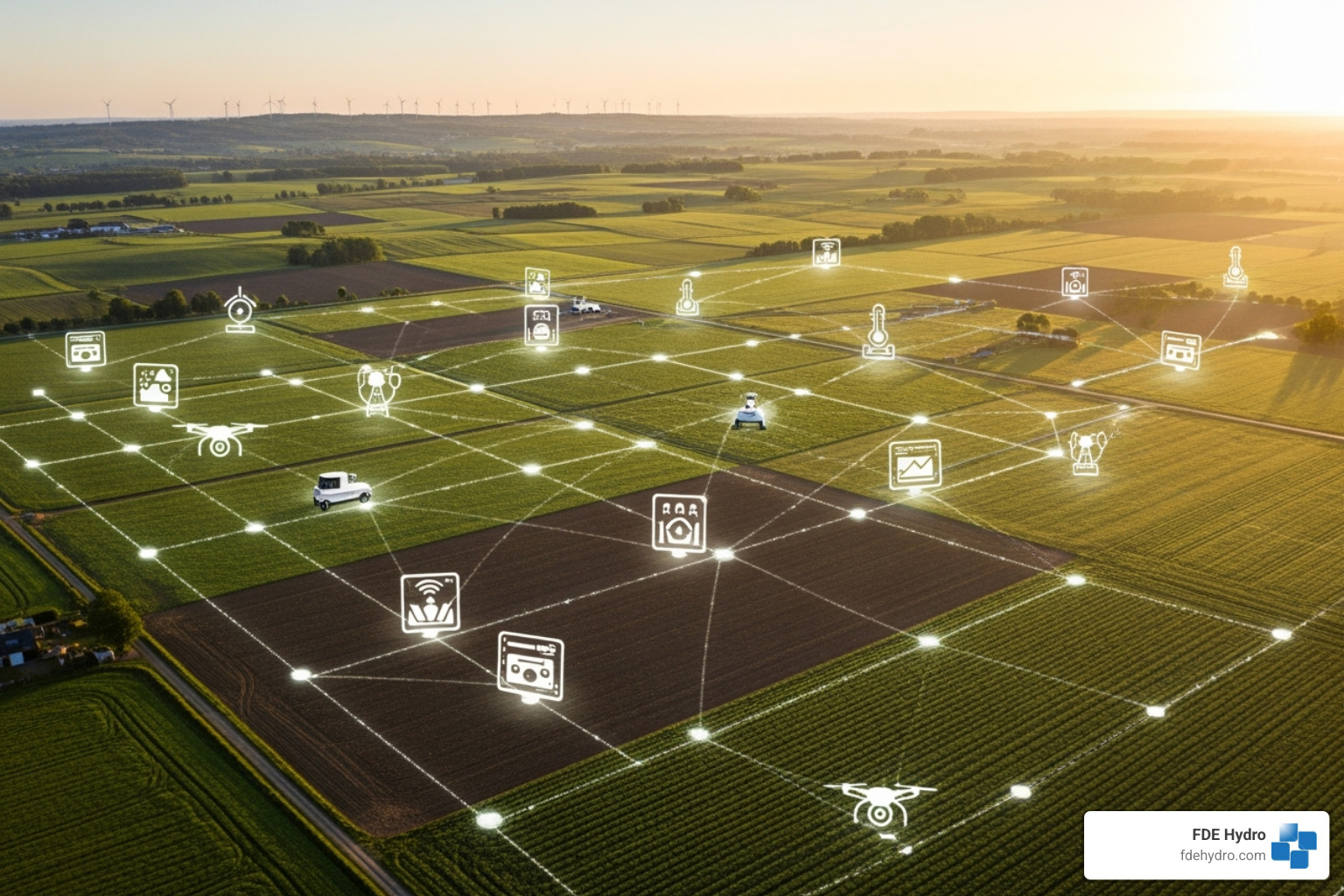
The real power of Water management AI is clear in its applications across urban infrastructure, agriculture, and industry. These intelligent systems are fundamentally changing how we manage water.
Optimizing Urban Water Systems
Instead of waiting for pipes to burst, cities are now using AI to predict failures. In 2020, Tucson, Arizona, implemented machine learning from VODA.ai to manage its 4,600 miles of water pipes. By analyzing historical failures, soil conditions, and weather, the AI calculates the Likelihood and Consequence of Failure for each pipe, allowing utilities to prioritize repairs and prevent emergencies.
Beyond leak detection, demand forecasting helps utilities optimize supply and reduce waste. Predictive maintenance schedules repairs for water control structures before critical failures occur, extending infrastructure life. In wastewater treatment, AI can help identify and prevent leaks in water distribution systems and optimize processes. Since aeration can account for 60% of a facility’s energy use, AI-driven optimization yields substantial energy savings and improves water quality.
Revolutionizing Agriculture with Precision Irrigation
Agriculture accounts for a massive portion of water use, often inefficiently. Water management AI addresses this with precision irrigation. These systems analyze data from soil moisture sensors and weather pattern analysis to calculate exact crop water requirements based on growth stage and conditions.
This means farmers water crops only when and where needed. AI can help optimize water usage by providing insights that reduce waste while improving yields, which is crucial for sustainable agriculture. In regions like Africa, AI-powered mobile platforms are even helping smallholder farmers monitor irrigation in real-time.
Enhancing Industrial Efficiency and Hydropower
Industrial facilities use AI to optimize water-intensive processes like cooling. Data centers, for example, generate immense heat, and water-based cooling is 23.5 times more efficient than air-based methods. AI optimizes these systems to reduce both energy consumption and water waste.
In the hydropower sector, AI enables real-time monitoring of water levels, flow rates, and equipment. This allows for precise optimization of water releases through turbines, balancing energy generation with environmental flows. Reinvigorating hydropower with AI also enables predictive maintenance, extending equipment life and ensuring optimal energy generation without compromising water quality management for downstream ecosystems.
Predicting and Mitigating Water-Related Risks
As climate change increases the frequency of floods and droughts, traditional forecasting struggles. AI excels at flood forecasting by simultaneously analyzing satellite data, river level monitoring, and weather information to create highly accurate predictions. AI can be used to analyze data from weather forecasts, providing timely warnings that allow communities to prepare.
Similarly, AI is used for drought prediction. The International Water Management Institute is harnessing AI-driven tools to forecast droughts in Africa, mapping groundwater and predicting water availability. These early warning systems protect lives and livelihoods by giving people time to prepare, turning potential tragedies into manageable events.
The Technology Behind Smart Water: AI Algorithms and Models

Behind Water management AI are sophisticated algorithms that process vast amounts of data, recognize patterns, and learn from experience at a scale impossible for humans.
Key Technologies in Water Management AI Solutions
Several key AI technologies are used, often in combination:
- Artificial Neural Networks (ANNs), inspired by the human brain, are excellent at spotting complex patterns, like predicting water quality from multiple factors.
- Deep Learning (DL) models, which are ANNs with many layers, handle more complex tasks like analyzing satellite imagery to map floods.
- Long Short-Term Memory (LSTM) Networks are specialized for time-series data, making them ideal for predicting river levels or daily water demand. In a recent Japanese study, researchers trained LSTM networks to predict river discharge with high accuracy.
- Computer Vision allows AI to interpret images from drones or satellites to inspect water control structures or monitor reservoir levels.
- Support Vector Machines (SVM) and Random Forests are effective for classification tasks, such as determining if water quality meets safety standards.
- Natural Language Processing (NLP) helps analyze documents and public feedback to inform policy and risk assessment.
From Data to Decisions: How the Algorithms Work
The process begins with data from IoT sensors, weather stations, and historical records. This raw data is messy, so data preprocessing is a crucial first step to clean, standardize, and fill in missing values.
Next, through pattern recognition, algorithms identify non-obvious relationships, such as the specific conditions that lead to pipe failures. During model training, the AI practices on historical data, adjusting its parameters to improve accuracy. The ultimate goal is predictive modeling—forecasting future events like pipe failures or water demand.
Modern systems are powerful because of real-time data analysis, continuously updating predictions as new data arrives. For example, the AquaFlowNet framework uses machine learning to predict wastewater flows and assess water quality in real-time, preventing overflows. At FDE Hydro™, we see this intelligence layer as the perfect complement to our work in reinvigorating hydropower, as it optimizes the performance and lifespan of critical water assets.
The Double-Edged Sword: Benefits and Challenges of AI in Water

Water management AI offers tremendous benefits but also presents significant challenges that must be addressed.
Major Benefits of AI Implementation
The advantages are impressive. Increased efficiency is paramount, as AI optimizes complex distribution networks and treatment processes. For example, the AquaFlowNet framework improved wastewater management efficiency by 93.9%. This leads directly to water conservation by catching leaks early and forecasting demand accurately. Improved reliability comes from proactive maintenance, which prevents infrastructure failures and service disruptions. These factors combine to deliver reduced operational costs from lower energy use and water loss, and provide managers with data-driven insights for improved decision-making.
The Paradox: AI’s Own Water Footprint
Here’s the uncomfortable truth: the technology used to save water is a massive water consumer itself. The issue lies with data centers, which house the servers that power AI. These facilities generate immense heat, and water-based cooling, while 23.5 times more efficient than air-cooling, requires enormous amounts of water.
A single 1 MW data center can consume 25.5 million liters of water annually. By 2028, U.S. data centers are expected to require 150 to 180 billion liters of fresh water. The energy consumption is also staggering, with its own indirect water footprint. This paradox is driving innovation in closed-loop water recycling and the use of treated wastewater for cooling.
| Cooling Method | Efficiency (vs. Air-cooled) | Water Demand (Illustrative) |
|---|---|---|
| Air-cooled | 1x | High energy, no direct water consumption |
| Water-cooled | 23.5x | Significant direct water consumption |
The table above compares the relative efficiency and water demand of air-cooled versus water-cooled data centers, illustrating the trade-offs involved in managing the heat generated by AI infrastructure.
Ethical Considerations and Governance
Beyond the environmental footprint, Water management AI raises important ethical questions.
- Data privacy is a concern, as detailed customer usage data must be protected.
- Algorithmic bias can occur if AI models learn from historical data that reflects past inequities, potentially leading to unfair water allocation.
- Equitable water allocation during scarcity must be ensured, prioritizing human needs alongside economic efficiency.
- Job displacement is a possibility as AI automates tasks, requiring strategies for workforce retraining.
These challenges highlight the urgent need for governance frameworks that ensure transparency, accountability, and ethical oversight. Building trust in AI requires explainable models that explain the decision-making process. At FDE Hydro™, these considerations inform how we integrate intelligent systems into water control structures, ensuring technology is deployed thoughtfully and equitably.
The Future of Water: AI’s Role in Global Security and Sustainability
The story of Water management AI is just beginning, but it’s clear the technology will be essential in reshaping how we secure and sustain our most precious resource.
The Future of Water Management AI: Global Security and Sustainability
AI’s impact is especially critical in water-stressed regions. Africa, for example, is becoming a center for innovation. The International Water Management Institute (IWMI) is harnessing AI-driven tools to forecast droughts in Africa, map groundwater, and optimize irrigation. Success depends on developing localized AI models that fit unique regional conditions, building local capacity by training local experts, and fostering international collaboration.
As the World Economic Forum notes, AI must be integrated with strong policy. The technology can help identify policy gaps and guide governments in creating regulations that bolster water and climate resilience.
Projecting the Long-Term Impact
Looking ahead, we are moving toward autonomous water networks that can sense, predict, and self-adjust in real-time. These intelligent systems will achieve system-wide optimization, tracking every drop from source to tap and back again.
This will lead to a dramatic reduction in energy consumption, making a real contribution to net-zero goals. For FDE Hydro™, this is particularly relevant to maximizing hydropower efficiency while protecting environmental flows. Most importantly, AI will help build resilient infrastructure that can withstand climate change through predictive maintenance and early warning systems.
This vision aligns with our work on aging infrastructure being replaced with next generation civil solutions. Combining our modular precast concrete technology with AI-powered optimization creates water infrastructure that is not just built for today, but is adaptable for the future. Technology also helps minimize the duration of impacts when problems occur, shrinking recovery times from days to hours.
The path forward requires better data, stronger governance, and continued innovation. Water management AI will be central to achieving global water security, and it’s an opportunity FDE Hydro™ is proud to be part of.
Frequently Asked Questions about AI in Water Management
What are the main benefits of using AI in water management?
AI delivers significant benefits by improving efficiency in water distribution and treatment, which leads to major cost savings. It improves water conservation by detecting leaks and predicting demand, enables proactive risk management through predictive maintenance, and ensures improved water quality monitoring in real-time. The result is cleaner, more reliable, and more sustainable water resource management.
How does AI help predict water-related disasters like floods and droughts?
AI acts as a sophisticated forecasting tool. It analyzes vast amounts of data simultaneously, including historical data, real-time weather forecasts, satellite imagery, and river levels. By identifying patterns that precede disasters, AI models can issue highly accurate and timely warnings, giving communities precious time to prepare, evacuate, and mitigate the impacts of floods and droughts.
What is the ‘water footprint’ of AI?
The water footprint of AI refers to the large quantity of water consumed by the infrastructure that powers it, primarily data centers. These facilities use thousands of powerful servers that generate immense heat. Water-based cooling systems are highly efficient but require millions of liters of water annually. This creates a paradox where the technology used to manage water is also a significant water consumer, driving the need for more sustainable AI infrastructure.
Conclusion
We are at a turning point where Water management AI is fundamentally reshaping our relationship with water. We’ve seen how it is optimizing urban infrastructure, agriculture, and industry while providing critical warnings for floods and droughts.
While challenges like AI’s own water footprint and ethical considerations require responsible solutions and strong governance, they do not diminish the technology’s transformative potential. At FDE Hydro™, we focus on next-generation hydropower solutions, and our patented modular precast concrete technology, the French Dam, is designed to integrate with the intelligent systems of tomorrow. Combining advanced civil engineering with the power of Water management AI creates infrastructure that adapts, learns, and optimizes.
The future we are building is one where water scarcity is managed, infrastructure is self-monitoring, and communities are resilient. This is happening now, from Tucson to Japan to Africa. The path forward requires collaboration, but the potential for global water security is immense. At FDE Hydro™, we are proud to be part of building a future where intelligence meets infrastructure, ensuring everyone has the clean, reliable water they need to thrive.
