

Why Renewable Energy Construction Matters Now More Than Ever
Renewable energy construction is the specialized process of designing and building infrastructure that generates power from clean sources like solar, wind, and water. This rapidly expanding sector is changing the global energy landscape by replacing fossil fuel facilities with cleaner alternatives, employing millions, and driving technological innovation in large-scale infrastructure.
Key facts about renewable energy construction:
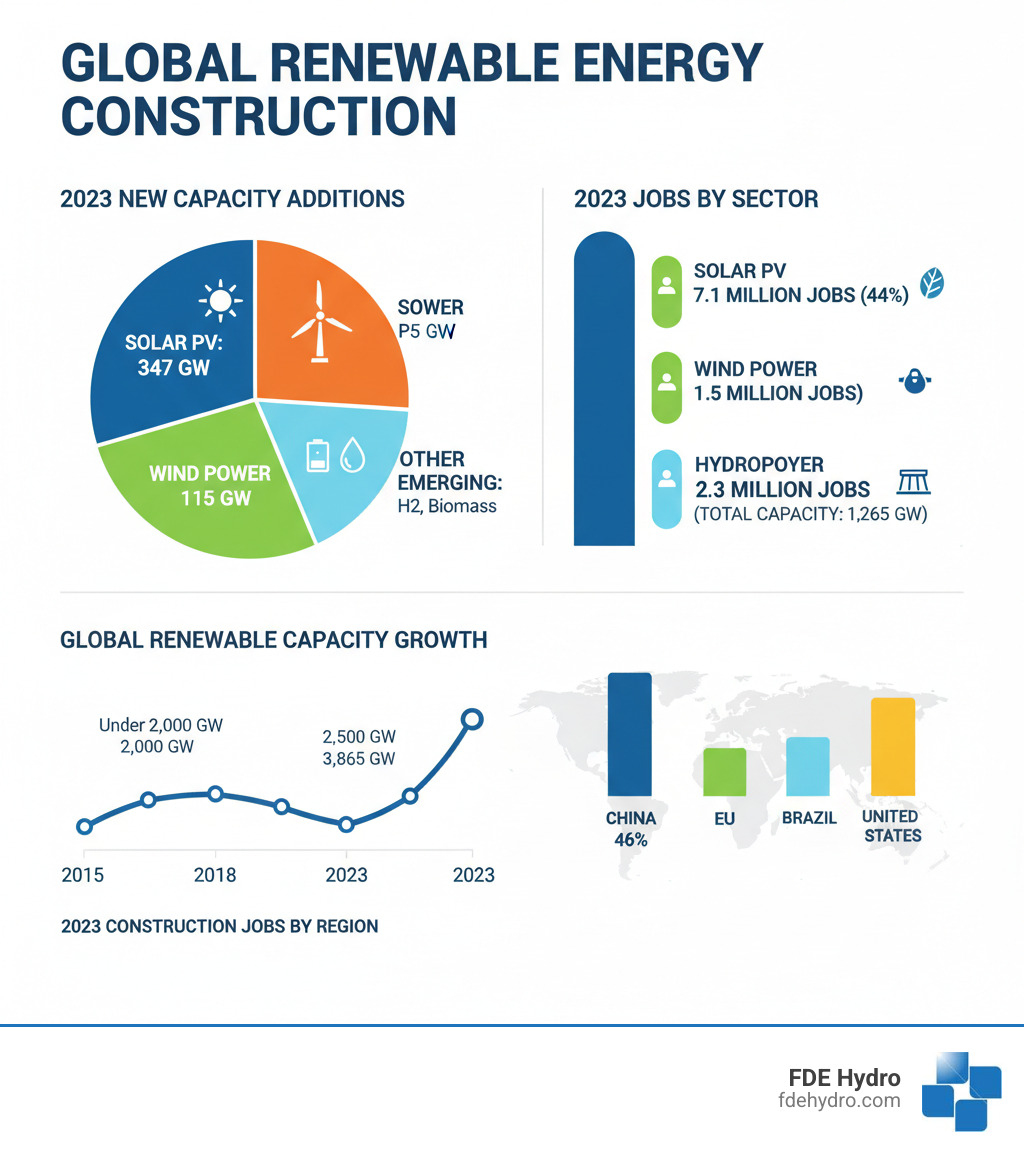
- Scale of Growth: 473 gigawatts (GW) of new renewable capacity were installed globally in 2023, with solar PV leading at 347 GW.
- Employment Impact: The sector employed 16.2 million people worldwide in 2023, with solar PV accounting for 7.1 million jobs.
- Major Project Types: Solar farms, wind parks, hydroelectric facilities, battery storage, and green hydrogen plants.
- Top Challenges: Supply chain constraints, skilled labor shortages, permitting delays, and grid integration.
- Cost Trends: Technology costs continue to fall while demand accelerates, making projects more economically viable.
The global shift to renewables is reshaping the construction sector. A convergence of climate goals, government incentives, and falling technology costs has created an unprecedented building boom in clean energy infrastructure. While the sector faces challenges like supply chain strains and labor shortages, the momentum is undeniable, with global investment in clean technology manufacturing reaching $235 billion in 2023.
I’m Bill French Sr., Founder and CEO of FDE Hydro. We’ve pioneered modular construction solutions for the hydropower industry, including our patented French Dam technology. With five decades of experience in major civil construction, I’ve seen how innovation can dramatically reduce costs and timelines in renewable energy construction.
Find more about renewable energy construction:
The Driving Forces Behind the Green Building Boom
An unprecedented surge in renewable energy construction is fundamentally changing how we power our lives. This green building boom is driven by several converging forces.
The urgency to reduce carbon emissions has moved from policy discussions to concrete action on construction sites worldwide. Governments are backing this with financial incentives that have transformed the economic equation for renewable projects. In the United States, federal tax credits can cover up to 30% of adoption costs, while similar government policies in Europe and Brazil are creating favorable investment conditions.
It’s not just governments pushing this forward. Corporate ESG goals have become a powerful driver, as major companies build onsite solar, invest in wind farms, and partner on community projects to meet carbon neutrality targets. This is good for the planet and for business, as customers, investors, and employees increasingly demand sustainability.
Energy security is another key motivator. Countries are realizing the strategic advantage of domestic renewable resources like wind, sun, and water, which offer resilience and independence from the geopolitical complications of imported fossil fuels. Building out clean energy infrastructure means building national resilience.
Perhaps most compellingly, the economics have fundamentally shifted. Falling technology costs have made renewable energy construction financially smart. With no ongoing fuel costs, the global market for clean energy technologies is projected to nearly triple to over $2 trillion by 2035. Finally, strong public demand for sustainability translates into the political will and corporate action needed to reshape our energy landscape.
At FDE Hydro, we see these forces driving innovation in sustainable power generation, particularly in building and modernizing hydropower facilities faster and more cost-effectively than ever before.
A Spectrum of Projects: What’s Being Built?
Renewable energy construction encompasses a diverse ecosystem of projects, each designed to harness nature’s power in unique ways. From vast solar fields to towering wind turbines, this sector is changing our landscapes.
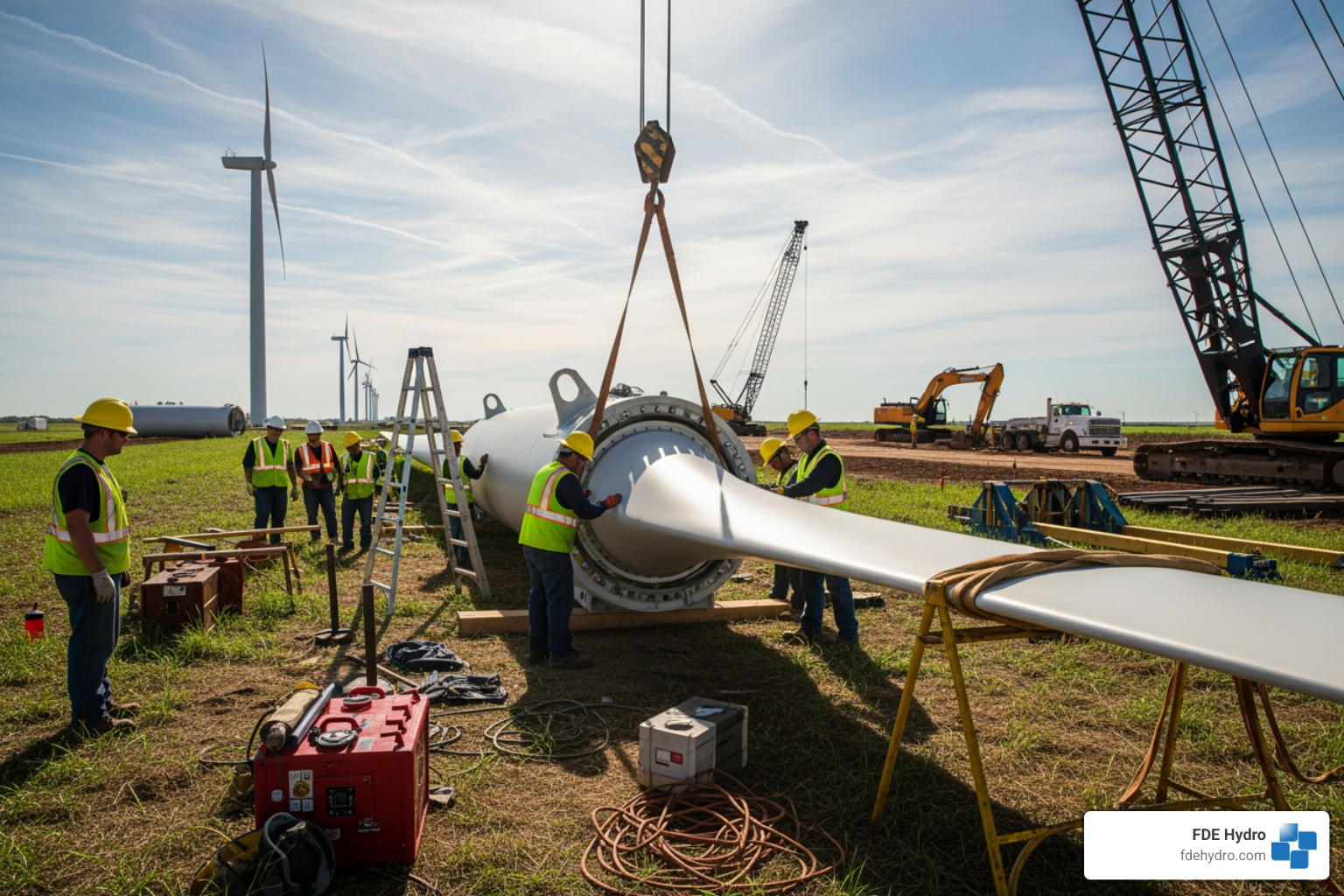
This section details the major types of renewable energy construction projects changing our energy landscape.
Solar Power Plant Construction
Solar is the fastest-growing segment in renewable energy construction, with a record 347 GW of solar photovoltaic capacity added globally in 2023. Utility-scale solar farms can cover thousands of acres, requiring extensive site preparation and complex electrical work for grid interconnection. In 2023, the U.S. installed 24.8 GW, Europe added 54.3 GW, and Brazil installed 11.9 GW. Other projects include community solar, which allows multiple customers to share a local installation, and agrivoltaics, an innovative approach where liftd solar panels allow farming to continue beneath them. Even buildings are becoming power generators, with building-integrated solar systems capable of fulfilling up to 83% of a structure’s energy needs, contributing to efficient Sustainable Power Generation.
Wind Farm Construction
Wind energy construction presents impressive logistical challenges, such as transporting massive turbine blades. Onshore wind farms require massive foundations and tall towers; in 2023, the US installed 6.3 GW and Brazil added nearly 5 GW. Offshore wind projects are even more complex, using stronger winds in harsh marine environments with specialized underwater foundations and subsea cabling. Globally, 115 GW of wind power capacity were added in 2023, driven by technology like improved blade designs. We’re also seeing innovation in building-integrated wind systems as part of comprehensive Energy 101 solutions.
Hydropower Construction and Modernization
Water is one of our oldest and most reliable renewable sources, and it’s where FDE Hydro’s expertise shines. While new dam construction continues in regions like Brazil, much of the opportunity in North America and Europe lies in hydropower retrofitting. Modernizing aging facilities with new turbines and controls can dramatically boost efficiency and extend their operational life. This work involves upgrading powerhouses, dams, spillways, and gates. Learn more about Hydropower Retrofitting.
Pumped storage hydropower is also crucial, acting as a giant grid battery by storing energy to be released during peak demand. This technology is vital for integrating intermittent renewables like solar and wind. More about Pumped Storage Hydropower.
Our patented French Dam technology revolutionizes these projects. This modular precast concrete system, utilizing Modular Construction Techniques, significantly reduces costs and timelines, making Hydroelectric Dam Construction faster and more sustainable.
Emerging Renewable Energy Construction Projects
The sector constantly evolves with new technologies:
- Battery Energy Storage Systems (BESS) are critical for grid stability, storing excess renewable energy for later use.
- Green hydrogen facilities use renewable electricity to split water, creating a clean fuel for heavy industry and transportation.
- Biomass power plants convert organic waste into electricity, requiring specialized material handling equipment.
- Geothermal energy extraction taps into the earth’s heat, providing reliable baseload power through deep well drilling and power plant construction.
These emerging areas highlight an important truth: The Biggest Untapped Solution to Climate Change is in the Water, and in the ingenuity of our engineers and construction crews.
Navigating the Complexities of Renewable Energy Construction
Building a clean energy future presents real challenges, but these same challenges are driving innovation and creating significant economic opportunities. This section explores the primary problems, required expertise, and economic impacts of clean energy infrastructure development.
Overcoming Key Construction Challenges
Renewable energy projects come with a unique set of complications:
- Supply chain constraints: Global demand for components like solar panels and turbine blades leads to delays and cost increases, sometimes forcing project cancellations.
- Permitting and regulatory maze: Navigating local, state, and federal permits is often lengthy and unpredictable, creating uncertainty for developers.
- Grid integration issues: Connecting new projects to the grid often requires significant and costly upgrades to existing transmission infrastructure, leading to delays.
- Skilled labor shortage: The sector’s rapid growth has led to a shortage of qualified engineers, project managers, and electricians. Robust workforce development programs are critical.
- Managing project costs: The upfront capital investment for construction is substantial. Innovative methods, like FDE Hydro’s modular approach, are key to reducing costs and ensuring financial returns, as detailed in Financing Long-Term Hydropower Requires Mitigating Risks Prior to ROI.
Essential Expertise for Project Success
Success in renewable energy construction depends on assembling a team with the right expertise:
- Preconstruction services: Meticulous planning and risk mitigation are crucial to avoid costly surprises during the build phase.
- Engineering and design: Deep knowledge of renewable technologies is paramount to optimize for efficiency, longevity, and site-specific conditions.
- Project management: Professionals must execute complex projects on time and budget while coordinating diverse labor forces and subcontractors.
- Quality control: Every component must meet stringent standards to ensure safety and long-term performance.
- Site safety protocols: A world-class safety culture is non-negotiable to protect workers in inherently dangerous environments.
- Risk management: Proactively addressing environmental, financial, and operational risks keeps projects on track. At FDE Hydro, we bring this comprehensive expertise to every project, as outlined in our Energy Infrastructure Development: Complete Guide.
The Economic and Social Impact of Renewable Energy Construction
The growth of renewable energy construction is changing economies and communities in profound ways.
Renewable energy employed 16.2 million people globally in 2023, with solar PV leading at 7.1 million jobs and wind at 1.5 million. These are often well-paying, future-proof careers. The EU has 1.8 million jobs in the sector, the U.S. has over 1 million, and Brazil boasts 1.6 million. You can explore these figures in IRENA’s annual review on jobs.
Beyond direct employment, projects inject capital into local economies by using local suppliers and crews. Many developers also prioritize community benefit agreements, providing direct economic advantages to local residents. The ultimate goal is a just energy transition that ensures this massive shift provides inclusive and equitable socio-economic benefits for everyone.
The Future is Now: Innovation and Sustainability in Construction
The renewable energy construction sector is evolving rapidly, driven by essential innovations that are making projects smarter, faster, and more sustainable.

This section looks at the technologies and trends shaping the next generation of green infrastructure.
Technological Innovations Shaping the Sector
Technology is changing how we build massive infrastructure projects. AI Energy Management helps optimize project schedules and manage grid operations. Drones are now a common tool for site surveying and inspection, improving efficiency and safety. Robotics are increasingly used for repetitive assembly tasks, while advanced materials like more efficient solar cells and lighter turbine blades are expanding what’s possible.
Modular construction is a key innovation. At FDE Hydro, we’ve pioneered this with our Modular Powerhouses and patented French Dam technology. We fabricate components in a factory and assemble them on-site, which slashes construction time, minimizes environmental disruption, and ensures superior quality. This proves Why Precast Cost Less while delivering better results. These Modular Construction Techniques are revolutionizing hydropower.
Building a Sustainable Future, Sustainably
If we’re building clean energy infrastructure, we must build it cleanly. This means integrating sustainability into every phase of construction.
We use green building practices, such as choosing sustainable materials and energy-efficient equipment. We practice responsible land stewardship; for example, agrivoltaics projects allow farming to continue under solar panels. We also conduct lifecycle assessments and accept circular economy principles by designing for durability, reuse, and recycling to minimize waste. Reducing our construction carbon footprint by optimizing logistics and using cleaner fuels is an ongoing priority. This holistic approach to Sustainable Infrastructure Development is critical for meeting global climate goals, as noted in the IEA’s report on energy tech perspectives.
Outlook and Future Trends
Looking ahead, several key trends are reshaping renewable energy construction:
- Hybrid projects combining solar with battery storage are becoming standard to provide reliable power.
- Grid modernization with smart technologies is essential to handle the complexity of modern energy systems.
- Decentralized energy resources like microgrids are gaining traction, making the energy system more resilient.
- Repowering aging assets, such as retrofitting older wind and hydropower facilities with modern technology, can dramatically increase output. This is a core part of our work in Hydropower Retrofitting.
These trends point to a future that is not just cleaner, but smarter and more resilient. At FDE Hydro, we are proud to help shape the Future of Hydropower and the broader renewable energy landscape.
Frequently Asked Questions about Renewable Energy Construction
Here are answers to some of the most common questions we receive about renewable energy construction, based on our decades of experience in the field.
What are the biggest challenges in renewable energy construction today?
The biggest challenges in renewable energy construction are supply chain disruptions, a shortage of skilled labor, lengthy and complex permitting processes, and delays in connecting projects to the electrical grid. These factors can increase costs and extend project timelines, making streamlined construction processes like those we explore in Financing Long-Term Hydropower Requires Mitigating Risks Prior to ROI even more critical.
How does technology make renewable construction more efficient?
Technology is making renewable energy construction faster, safer, and more cost-effective. For example, our modular precast components, like those used in our patented French Dam technology, are fabricated in controlled factory settings for higher quality and then rapidly assembled on-site. This approach, detailed in Why Precast Cost Less, significantly reduces construction timelines. Other key technologies include AI-driven project management and drones for site surveying, all of which boost efficiency and are central to innovations like our Modular Powerhouses.
Which renewable energy sector creates the most construction jobs?
Solar photovoltaics (PV) is the largest job creator in renewable energy construction, accounting for 7.1 million jobs globally in 2023. The sector provides employment across the entire value chain, from manufacturing to installation and maintenance. Wind energy is also a major employer with 1.5 million jobs, while hydropower offers stable, long-term employment, particularly in the modernization projects that FDE Hydro specializes in.
Conclusion: Building the Power of Tomorrow
Renewable energy construction is not just another industry—it’s the foundation upon which we’re building a livable future. Every solar farm, wind turbine, and modernized hydropower facility represents hope, progress, and a commitment to a better world.
Despite challenges like supply chain tangles and complex regulations, the momentum is undeniable. In 2023, the world added 473 gigawatts of new renewable capacity, and the sector now employs 16.2 million people globally, boosting economies from North America to Brazil and Europe.
At FDE Hydro, we’ve seen how innovation can revolutionize this field. Our patented French Dam technology and modular precast solutions prove we can build critical Hydropower infrastructure faster, more cost-effectively, and with less environmental disruption than traditional methods.
Looking forward, the opportunities are breathtaking. Hybrid projects, grid modernization, and the repowering of aging assets are becoming standard. The convergence of AI, modular techniques, and advanced materials is making previously impossible projects routine.
Beyond the technology and economics, we are building resilience and a system that works with nature. The challenges are real, but when innovation meets determination, remarkable things happen. We are not just building the power of tomorrow; we are constructing opportunity, security, and a sustainable future, one project at a time.
