

Why Speed Matters in Critical Infrastructure Deployment
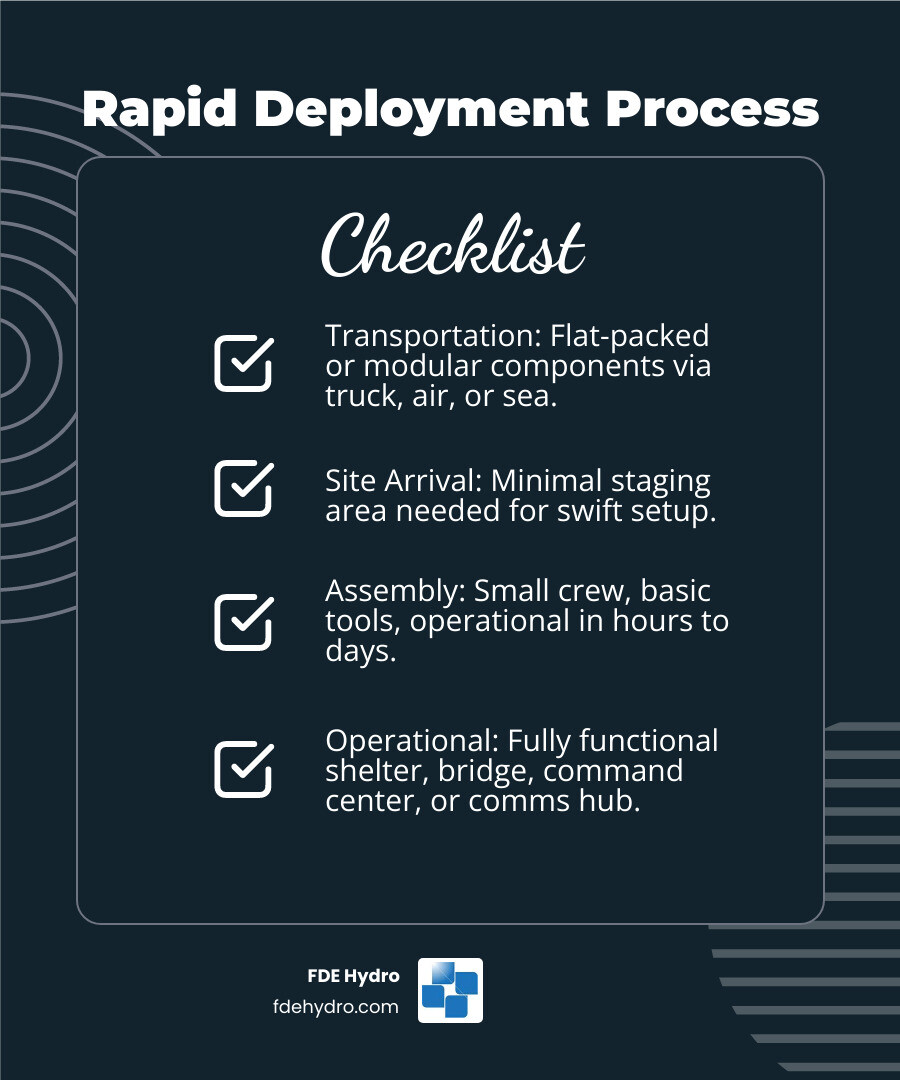
Rapidly deployable solutions are systems, structures, or technologies designed to be transported, assembled, and made operational in minimal time—often within hours or days rather than weeks or months. These solutions are critical when time is the most valuable resource.
Key characteristics of rapidly deployable systems include:
- Speed: Operational in hours to days, not weeks or months
- Portability: Lightweight, flat-packed, or modular for easy transport
- Simplicity: Minimal crew size, often requiring little specialized training
- Flexibility: Configurable for multiple applications and environments
- Durability: Built to withstand harsh conditions despite rapid setup
The world faces accelerating challenges that don’t wait for traditional construction timelines. Natural disasters strike with little warning. Military operations demand immediate infrastructure in remote locations. Critical infrastructure fails unexpectedly. Communication networks collapse when they’re needed most.
Traditional construction methods—measured in months and years—simply can’t keep pace with these urgent demands. A hospital that takes 18 months to build offers no help during a pandemic’s first wave. A bridge requiring six months of engineering and construction can’t restore supply chains after a catastrophic flood.
This gap between need and capability has driven innovation across multiple sectors. The military pioneered many rapid deployment technologies out of necessity—soldiers can’t wait for permanent bases in conflict zones. Emergency responders adopted and adapted these approaches for disaster relief. Now, industries from telecommunications to hydropower are finding how rapidly deployable systems can transform project economics and timelines.
The stakes are tangible. A RAPID steel barrier wall can expand to 35 feet long and be deployed by five unskilled workers in under 30 minutes—potentially saving lives in active threat situations. Modular structures can provide 1,600 square feet of usable space while storing in just 200 square feet when flat-packed, enabling massive logistical efficiencies. Underwater sensor arrays can be deployed at Arctic chokepoints to monitor submarine activity without requiring shore-based infrastructure in extreme environments.
I’m Bill French Sr., founder and CEO of FDE Hydro, where we’ve spent decades pioneering modular precast construction methods that make rapidly deployable infrastructure practical for hydropower and civil projects. My experience leading large-scale site development and participating in the Department of Energy’s Hydropower Vision initiative has shown me how modular, rapidly deployable approaches can transform both emergency response and planned infrastructure development.
Whether responding to emergencies, supporting military operations, or building critical infrastructure on accelerated timelines, rapidly deployable technologies share a common promise: delivering capability when and where it’s needed most, without compromise.
Handy rapidly deployable terms:
Why the World Needs to Move Faster: Challenges Demanding Rapid Solutions
The call for rapidly deployable solutions isn’t just a matter of convenience; it’s a critical response to a world that seems to be speeding up, often in unpredictable ways. From the sudden fury of natural disasters to the complex demands of military operations and the unexpected failure of vital infrastructure, the need for quick, effective interventions has never been greater.
The world is facing increasingly serious threats, including stronger storms, devastating fires, historic-level floods, and even cycles of more deadly pandemics. Governments and organizations in regions like the United States, Canada, and Europe must respond quickly to these threats to protect their citizens and maintain stability. When a bridge collapses in Kansas, or a hurricane devastates a coastal community in New York, we can’t afford to wait months for traditional solutions.
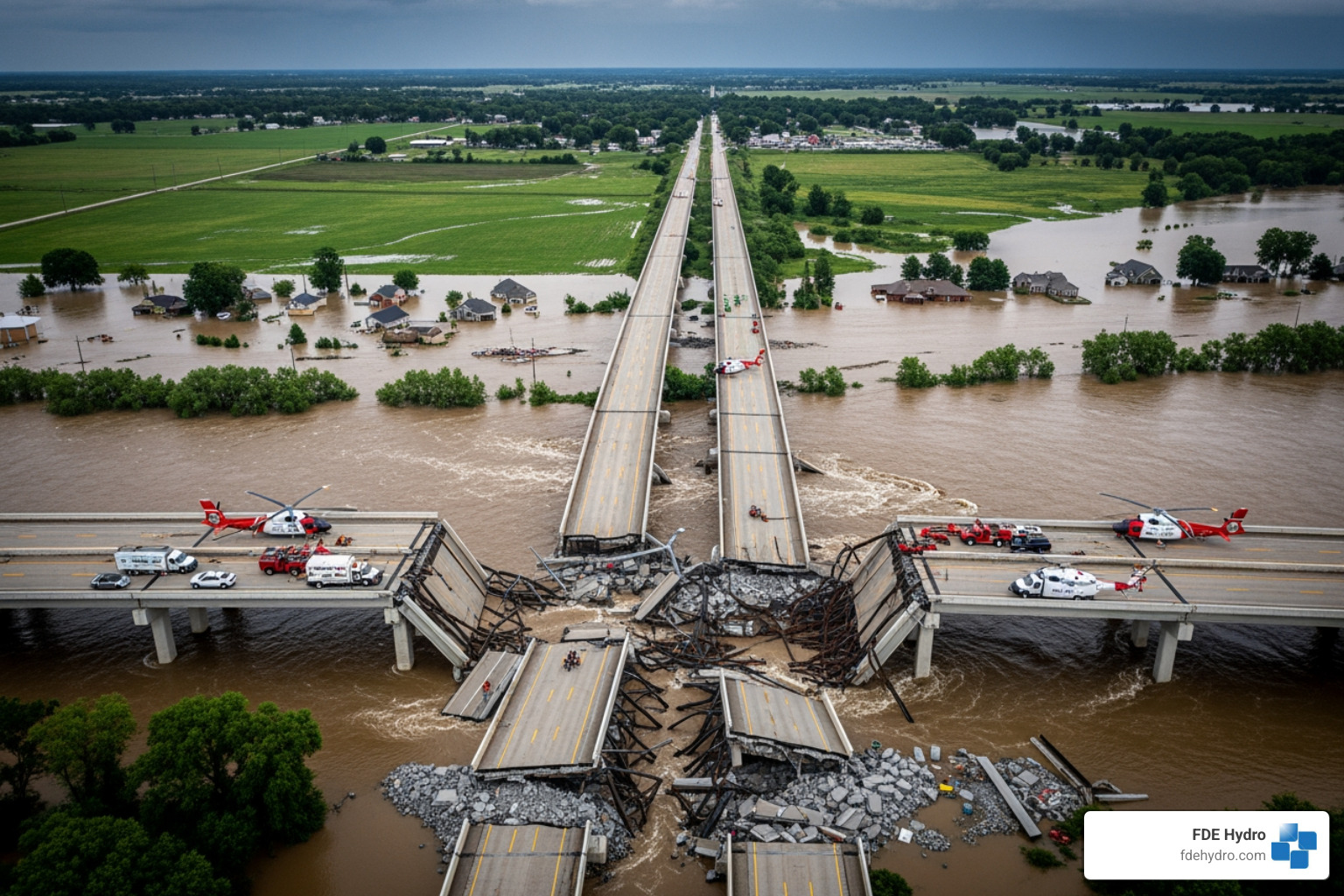
These challenges often present themselves as:
- Natural disasters: Earthquakes, floods, wildfires, and hurricanes can wipe out infrastructure and leave communities isolated in an instant, demanding immediate shelter, medical aid, and communication.
- Humanitarian crises: Whether due to conflict or natural catastrophe, large populations may require urgent, temporary housing, medical facilities, and logistical support.
- Military conflict: Operations require swift establishment of bases, protection, and communication in often hostile and remote environments.
- Infrastructure failure: Unexpected breakdowns in power grids, transportation networks, or water systems can cripple daily life and require immediate, temporary fixes.
- Communication blackouts: Loss of traditional communication channels in emergencies can sever vital links, making rapidly deployable connectivity solutions essential.
- Security threats: Protecting assets and personnel from evolving threats requires flexible and fast-to-deploy physical barriers and surveillance.
- Pandemic response: As we’ve seen, global health crises necessitate quick establishment of testing centers, temporary hospitals, and mass notification systems.
Bridging Critical Gaps in Emergencies
In the chaos of an emergency, the ability to quickly provide basic necessities and critical services can be the difference between life and death. Rapidly deployable solutions are purpose-built to bridge these immediate gaps:
- Shelter provision: When homes are destroyed, we need to quickly erect emergency shelters and housing. These can range from simple tents to sophisticated modular structures. The State of California has even undertaken studies on rapidly deployable emergency housing to address the needs of its vulnerable populations after disasters.
- Medical facilities: Temporary hospitals, clinics, and isolation units can be set up in hours or days, providing crucial medical care where permanent facilities are overwhelmed or inaccessible. Some solutions include emergency hospitals and decontamination tents that are instantly available for deployment.
- Mass notification systems: In times of crisis, clear and immediate communication is paramount. Solutions like Alertus offer rapidly deployable mass notification systems to address challenges from stronger storms to pandemics, ensuring critical information reaches affected populations efficiently. These systems are vital for managing multiple sites centrally or communicating via distributed networks in the United States.
- Decontamination tents: In situations involving hazardous materials or biological threats, quickly establishing decontamination zones is essential for public safety.
- Emergency housing: Beyond immediate shelters, modular systems can create more robust emergency housing, offering comfort and resilience for longer durations.
Securing Assets and Personnel
Protecting people and valuable assets, especially in dynamic or high-threat environments, is another area where rapidly deployable technologies shine.
- Force protection: Military and security forces require immediate defensive structures.
- Perimeter security: Establishing secure zones quickly is vital for events, temporary bases, or disaster relief efforts. The ERDC’s Ready Armor Protection Instant Deployment (RAPID) wall is a prime example. This steel barrier wall can expand like an accordion to 35 feet long and be deployed by an unskilled crew of five in less than 30 minutes. It’s seven times faster to assemble than comparable technologies, providing ballistic and fragmentation protection, intrusion prevention, and line-of-sight denial for urban operations or asset protection. You can learn more about the ERDC’s deployable RAPID wall here.
- Checkpoints and command centers: For crowd control, traffic management, or incident response, rapidly deployable checkpoints and mobile command centers are essential. These can be set up quickly for events like the NFL Draft, as demonstrated by the ERDC’s technologies.
- Underwater surveillance: In strategic locations, such as Canada’s Arctic Territory, rapidly deployable fixed array sensor (RDFAS) projects are being developed. These underwater sensors can be rapidly deployed, recovered, and redeployed to strategic choke points to monitor for submarine activity, operating without shore-based infrastructure in cold, near-ice environments. This project aims to provide a flexible and cost-reduced array capability, able to be deployed along an invading submarine’s most likely route based on intelligence.
- Asset protection: From critical infrastructure to temporary storage, these solutions offer immediate physical protection against various threats.
A Spectrum of Solutions: Rapidly Deployable Systems Across Sectors
The beauty of rapidly deployable solutions lies in their versatility. What started as military necessity has blossomed into a diverse array of technologies serving numerous sectors, including emergency response, communication, and infrastructure development. We see these solutions cropping up from the busy streets of New York City to remote construction sites in Brazil.
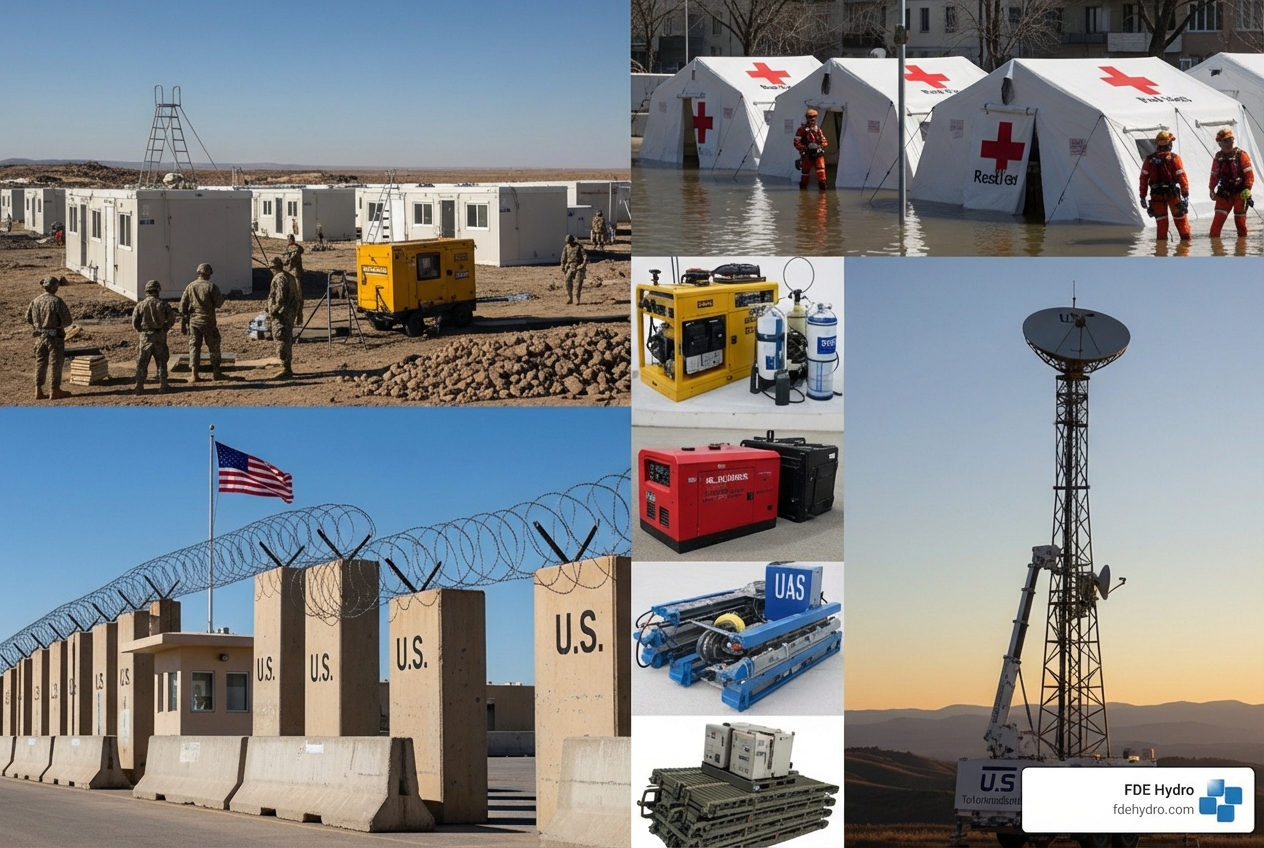
Infrastructure and Shelter Solutions
When we talk about rapidly deployable infrastructure, we’re often talking about structures that can literally be picked up, moved, and reassembled with impressive speed.
- Modular buildings: These systems use standardized frame and wall panel assemblies that allow stacking and connecting in any direction. They can be configured for virtually any application: housing (single-family, multi-family, dormitories, barracks), commercial (offices, retail), educational (schools, classrooms), healthcare (hospitals, clinics), and recreational facilities. Our own work at FDE Hydro, especially with Modular Construction Techniques and Rapid Installment of Module Precast Civil Infrastructure, exemplifies how modularity can revolutionize construction, even for large-scale projects like hydropower dams.
- Inflatable shelters: Lightweight and surprisingly robust, these structures can be deployed quickly by inflating them, providing immediate cover for aid, military, or emergency response operations. RAPID Cabin® and RAPID Hangar® are examples of high-performance, military-grade inflatable solutions built for demanding environments.
- Emergency housing: Beyond basic tents, these are designed for longer-term, more comfortable stays, crucial for disaster recovery in California and other affected areas.
- Temporary bridges and decking systems: For damaged infrastructure or challenging terrain, rapidly deployable decking systems like ERDC’s Over-Decking System can bridge free spans up to 46 feet, accommodating heavy vehicles like an M1A1 main battle tank. These systems are adjustable, configurable, and adaptable for quick deployment at austere locations, offering an expedient ramp and platform for loading/unloading rolling stock from various transportation modalities.
- Accordion-style barriers: As mentioned, the RAPID steel barrier wall is a formidable example of how physical security can be rapidly established.
- Command centers: CRESCENDO provides a rapidly deployable, versatile command center for personnel in disaster recovery or field incident response environments to interoperate with others via their existing communications. It’s lightweight and transportable, able to fit into a vehicle or aircraft overhead locker.
- Medical facilities: Whether inflatable or modular, these provide essential healthcare infrastructure in emergency zones.
Communication and Command Systems
In an age where connectivity is king, losing it can be catastrophic. Rapidly deployable communication systems ensure we stay connected, even when traditional networks fail.
- Mobile command centers: These are fully equipped vehicles or modular units that can be quickly driven or flown into an incident zone, becoming the nerve center for response efforts. Crescendo’s system, for instance, allows for dynamic networking of multiple units and connection to third-party systems via VoIP/SIP.
- Satellite connectivity: Leveraging technologies like Starlink Satellite, these solutions provide seamless, high-performance internet wherever and whenever it is needed, particularly in remote areas or after disaster-induced blackouts. This is crucial for emergency response teams and temporary worksites across the US and Canada.
- 4G/5G networks: Portable 4G/5G nodes can create temporary cellular coverage, restoring vital communication for communities.
- Interoperable radio systems: Bridging communication gaps between different agencies (police, fire, EMS) is critical. Systems that integrate IP, analog, radio, and cellular systems into a single platform are invaluable.
- Mass notification: As Alertus highlights, these systems are essential for disseminating critical information during rapidly unfolding events.
- VoIP/SIP integration: This allows diverse communication devices to talk to each other, creating a unified communication environment in the field.
- Real-time monitoring: Integrated systems allow for real-time tracking of events and resources, improving situational awareness for emergency responders.
Military and Defense Systems
The military has been a primary driver of rapidly deployable innovation, needing to establish and secure operations in diverse and often hostile environments.
- Inflatable hangars: RAPID Hangar®, made from durable Drop-Stitch Weave Fabric, offers a reusable and cost-effective alternative to traditional steel structures for aircraft and vehicle protection.
- Protective barriers: Beyond the RAPID wall, various systems offer quick-to-erect ballistic and blast protection for personnel and equipment.
- Water crossing platforms: RAPID Platform® is an inflatable, military-grade solution designed to enable ground vehicles to cross water bodies like rivers and lakes, supporting payloads ranging from 1,814 kg to over 90,718 kg. This eliminates the need for time-consuming and costly traditional bridge construction.
- Underwater sensor arrays: The RDFAS project for the Canadian Armed Forces/Royal Canadian Navy is a clear example, providing a flexible and cost-reduced array capability for anti-submarine warfare.
- Covert operations: Some rapidly deployable platforms even feature silent propulsion for stealthy deployments.
- EU Rapid Deployment Capacity: Europe is also investing in its Rapid Deployment Capacity, recognizing the strategic importance of being able to react swiftly to crises.
The Core Advantages and Enabling Technologies
What makes rapidly deployable solutions so appealing? It’s a combination of practical benefits and the smart application of cutting-edge technology. These systems are not just about doing things faster; they’re about doing them better, more efficiently, and often more cost-effectively.
Key Benefits of Rapidly Deployable Systems
The advantages are clear, especially when compared to traditional construction or response methods:
- Speed of deployment: This is the defining characteristic. A RAPID steel barrier wall, for instance, can be deployed in less than 30 minutes by an unskilled crew of five. Modular structures can be assembled in hours or days, not weeks or months.
- Portability: Many solutions are designed as ‘Flat Packed’ units for intermodal transportability, meaning they can be easily moved by air, road, rail, or sea. This minimizes staging and storage requirements. For example, 1,600 sq ft of usable space from modular units can be stored in a mere 200 sq ft area when flat-packed and double-stacked.
- Modularity: The ability to combine standardized components allows for flexible configurations and scalability. Need a bigger command center? Just add more modules!
- Scalability: Solutions can be expanded or contracted based on evolving needs, from a single shelter to a full base camp.
- Reusability: Many systems are engineered to be disassembled and returned to a flat-pack system for storage and subsequent reuse across multiple missions, offering significant cost savings and tactical flexibility. RAPID Hangar® is a prime example of a reusable, inflatable structure.
- Durability: Despite their rapid setup, these solutions are built to withstand challenging conditions, including specific wind, snow, and seismic requirements, ensuring they perform when it matters most.
- Reduced labor needs: Many systems are designed for assembly by small, unskilled crews, reducing reliance on specialized labor and heavy equipment. The ERDC’s Over-Decking System, for example, doesn’t require power tools, heavy equipment, or skilled labor for assembly.
- Cost-effectiveness: By reducing construction time, labor, and the need for heavy machinery, rapidly deployable solutions often lead to significant Project Cost Reduction. As we often say at FDE Hydro, there are many reasons Why Precast Cost Less—and rapid deployment is a big part of that equation. They provide a reliable, cost-effective alternative to traditional construction, particularly for military and field operations.
Technological Drivers of Rapidly Deployable Innovation
Behind every impressive rapidly deployable solution is a story of technological innovation. These advancements are pushing the boundaries of what’s possible:
- Advanced materials: The development of lightweight, high-strength fabrics (like Drop-Stitch Weave Fabric and Double Wall Reinforced Fabric for inflatable structures) and resilient composites allows for highly portable yet durable construction.
- Inflatable structures: These have moved far beyond simple bouncy castles, now forming the basis for military-grade hangars, shelters, and even water-crossing platforms.
- Modular Precast Concrete: This is where FDE Hydro truly shines. Our patented modular precast concrete technology is a game-changer for hydropower and civil infrastructure. It allows for components to be manufactured off-site under controlled conditions, then transported and rapidly assembled on-site, drastically cutting down construction time and cost for dams and water control systems in North America, Brazil, and Europe. This approach is a cornerstone of Innovative Construction Techniques Guide.
- 3D printing: While still emerging for large-scale structures, 3D printing holds immense promise for on-demand fabrication of components in remote locations.
- Hydraulic systems: Simple yet powerful hydraulic systems, as seen in the RAPID steel barrier wall, enable quick expansion and retraction of complex structures with minimal human effort.
- Satellite communication: Technologies like Starlink have revolutionized remote connectivity, providing high-speed internet access in areas where traditional infrastructure is non-existent or compromised, making rapidly deployable connectivity a reality for emergency responders and field operations.
From Blueprint to Field: Deployment Logistics and Future Innovations
Getting a rapidly deployable solution from concept to operational reality involves careful planning and execution. It’s not just about the technology itself, but how we manage its journey and anticipate its evolution.
Logistical Considerations for Successful Deployment
Even the fastest solution requires smart logistics to ensure it arrives and functions as intended.
- Transportation methods: Whether by air, truck, rail, or sea, the design of rapidly deployable systems prioritizes efficient transport. Many are designed as ‘Flat Packed’ units for intermodal transportability, meaning they can be moved via various modes without needing to be repacked.
- Flat-pack design: This minimizes volume, allowing more units to be transported at once and reducing shipping costs. For example, a 4-module unit (800 sq ft total) can be transported flat-packed, containing all erection materials and assembly components.
- Staging and storage: Efficient storage and staging areas are crucial, especially for reusable systems that need to be ready for the next deployment. The ability to store large amounts of usable space in a small footprint is a key advantage.
- Crew size and skill: The goal is often minimal crew size, ideally unskilled personnel, to reduce logistical complexity and training requirements. The RAPID wall’s deployment by five unskilled personnel in under 30 minutes is a testament to this design philosophy.
- Equipment needs: Solutions are increasingly designed to require minimal or no heavy equipment or power tools for assembly, simplifying operations in austere environments.
- Intermodal transport: The seamless transition between different transportation modes is vital for global reach and efficiency. These considerations are part of the Means and Methods we always evaluate in our project planning at FDE Hydro, ensuring our modular solutions are as efficient to deploy as they are to build.
The Next Frontier: Future Trends in Rapid Deployment
The field of rapidly deployable technologies is far from static. Innovation continues at a brisk pace, promising even more sophisticated and autonomous solutions.
- Increased automation: Imagine drones deploying sensor networks or robotic systems assembling modular shelters with minimal human intervention. This is already on the horizon, reducing risk and increasing speed.
- Smart self-assembling structures: Future systems might use advanced robotics and AI to self-assemble, even adapting to environmental conditions autonomously.
- Sustainable materials: As environmental concerns grow, there will be a greater emphasis on using recycled, recyclable, or rapidly renewable materials for these temporary and reusable structures.
- Improved sensor integration: We’ll see more sophisticated, miniaturized sensors integrated into deployable structures for real-time monitoring of everything from structural integrity to environmental conditions. The RDFAS project is just one early example of this trend.
- AI-driven logistics: Artificial intelligence will optimize transportation routes, predict maintenance needs, and manage inventory for rapidly deployable assets, making deployment even smoother and more efficient.
- Next-gen biosecurity platforms: As highlighted by projects like HoX securing a Department of War-backed Lawrence Livermore Pilot Contract in California, the development of advanced biosecurity platforms that can be rapidly deployed to detect and mitigate biological threats is a critical future trend.
Conclusion: Building a Resilient Future, Faster
We’ve seen that rapidly deployable technologies are not just a niche; they are a fundamental shift in how we approach problem-solving in a , unpredictable world. From providing immediate shelter and medical aid in disaster zones to securing military operations and restoring vital communication, these solutions offer speed, efficiency, and resilience when every second counts.
The versatility of these solutions is truly remarkable, spanning military, emergency response, communication, and infrastructure sectors. Their core benefits—speed, portability, modularity, reusability, and cost-effectiveness—make them indispensable tools for governments, NGOs, and businesses alike. From the RAPID steel barrier wall to modular command centers and satellite internet hubs, these innovations empower us to react quickly and effectively to crises.
Technological advancements, particularly in advanced materials, inflatable structures, and our own pioneering Modular Precast Concrete at FDE Hydro, are continually pushing the boundaries of what’s possible. These innovations are changing construction timelines and project economics, enabling us to build a more resilient future, faster.
At FDE Hydro, we understand the profound impact of rapidly deployable methodologies. Our commitment to innovative construction techniques, especially in hydropower and water control systems, directly contributes to this vision. By significantly reducing construction costs and time for critical infrastructure, we are helping to future-proof essential systems across North America, Brazil, and Europe.
The future promises even greater automation, intelligence, and sustainability in rapidly deployable systems. As we continue to face evolving challenges, the ability to deploy solutions with instant impact will be more critical than ever. We are proud to be at the forefront of this movement, helping to build resilience and ensure that when the unexpected happens, we are ready to respond.
To learn more about how our innovative approaches can benefit your next project, especially in the critical area of water infrastructure, we invite you to explore our work. Learn about Modular Dam Construction.
