

The World’s Largest Battery You’ve Never Heard Of
Hydropower energy storage, or pumped-storage hydropower (PSH), is the world’s largest and oldest form of grid-scale energy storage. It functions like a giant water battery, pumping water to an upper reservoir during low electricity demand and releasing it through turbines to generate power during peak demand.
Why it matters:
- Accounts for 94% of global long-duration energy storage capacity
- Provides 179 GW of installed capacity worldwide (as of 2025)
- Stores up to 9,000 GWh of electricity globally
- Offers 70-80% round-trip efficiency with lifespans of 50-100+ years
- Critical for balancing intermittent renewable energy sources like wind and solar
While modern batteries get the headlines, PSH has anchored grid stability since the early 1900s. As the world integrates more renewables, this proven technology is making a major comeback. PSH already provides 97% of utility-scale energy storage in the United States. To meet net-zero targets by 2050, global PSH capacity must more than double to over 420 GW, requiring roughly 10 GW of new capacity annually.
Modern PSH facilities are remarkably flexible, switching between pumping and generating in seconds to provide essential grid services like frequency regulation, voltage control, and black start capability—services that wind and solar cannot provide alone.
As Bill French Sr., Founder and CEO of FDE Hydro™, I’ve spent decades focused on next-generation hydropower solutions. Our work at FDE Hydro™ centers on modular construction innovations that make hydropower energy storage projects faster, more cost-effective, and more environmentally beneficial. The path forward requires both proven technology and new approaches to deployment.
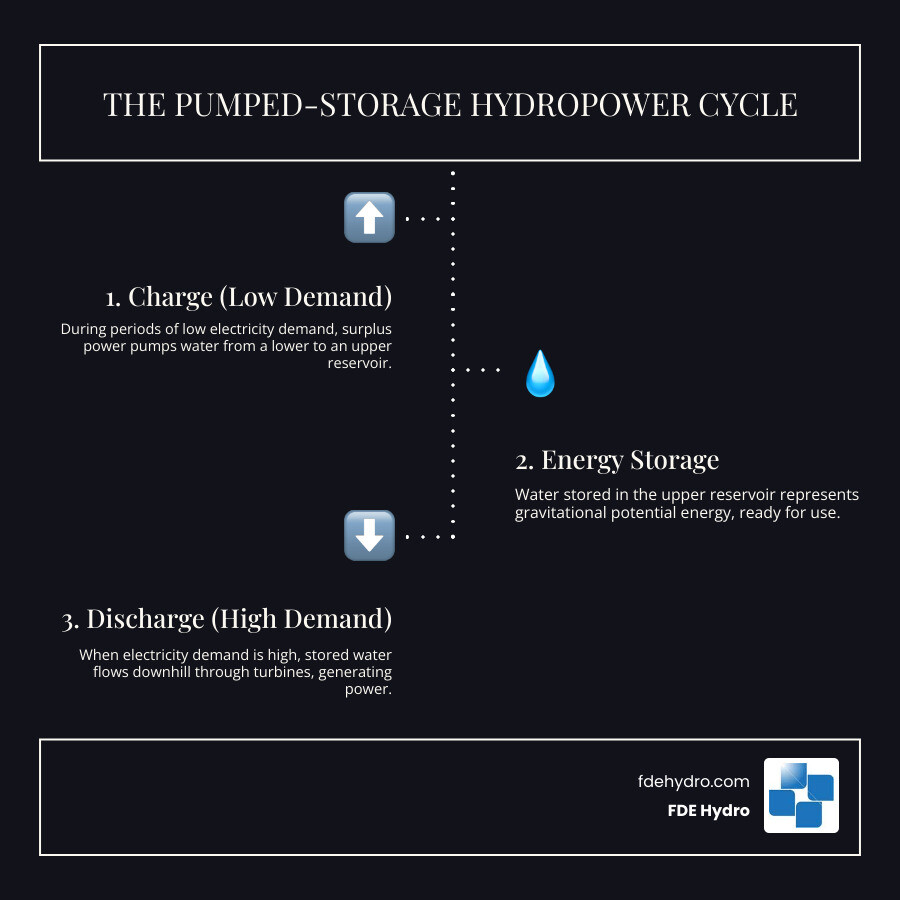
Basic hydropower energy storage terms:
How Pumped-Storage Hydropower Works and Why It’s Essential
At its core, pumped-storage hydropower (PSH) is a simple solution to the complex problem of balancing electricity supply and demand. It’s a rechargeable battery that uses water and gravity.
The process involves two cycles:
- Pumping Cycle (Charging): During low demand or when cheap power from wind or solar is abundant, PSH facilities use electricity to pump water from a lower reservoir to an upper one. This converts electrical energy into stored gravitational potential energy, preventing surplus generation from being wasted.
- Generating Cycle (Discharging): When demand is high, the stored water is released. It flows downhill through large pipes (penstocks), spinning reversible pump-turbines to generate electricity for the grid. This can happen within seconds, making PSH highly responsive.
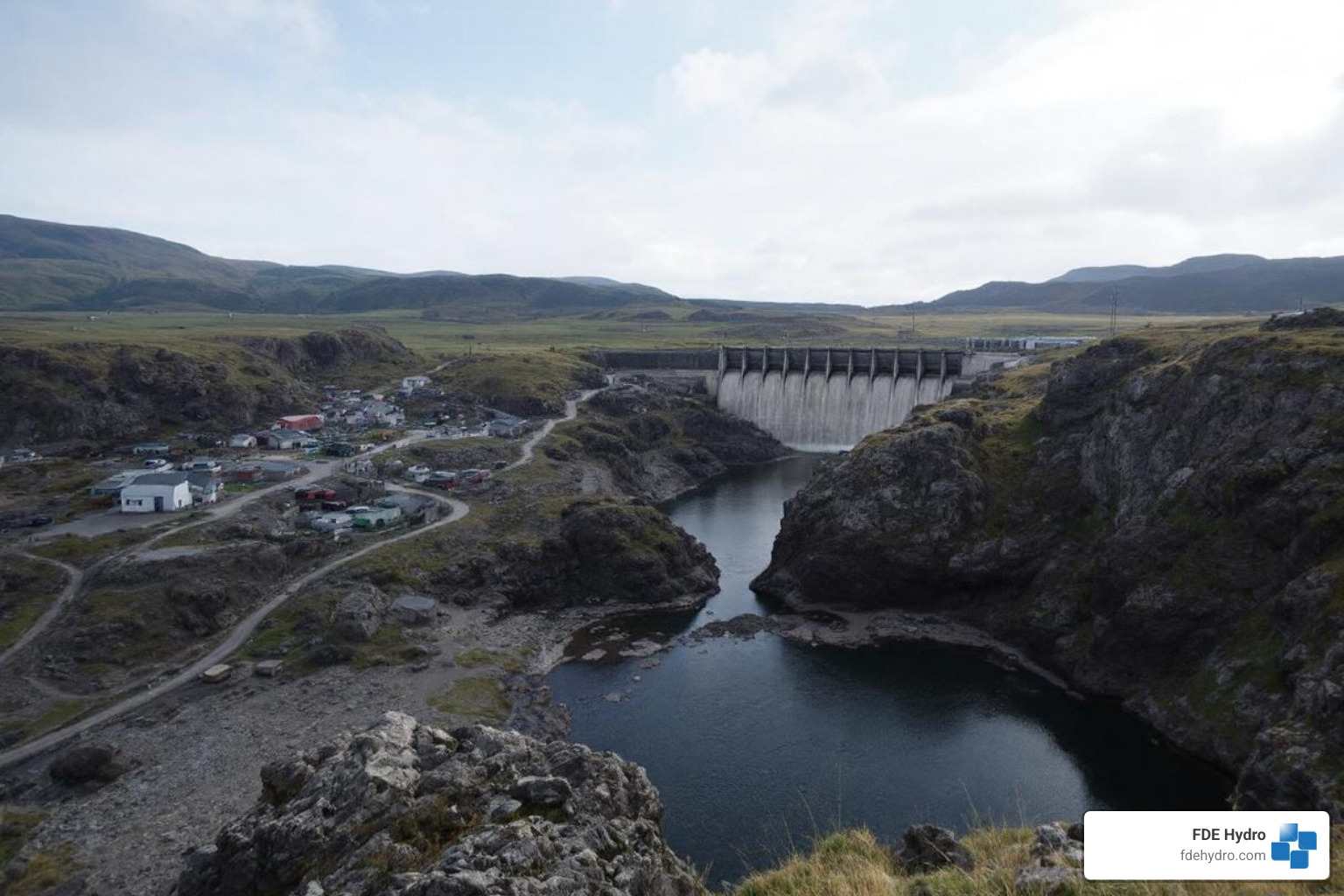
The key components are massive in scale:
- Upper and Lower Reservoirs: Two bodies of water at different elevations. The height and volume determine the storage capacity.
- Penstocks: Large pipelines connecting the reservoirs.
- Reversible Pump-Turbines: Machines that act as both pumps (moving water up) and turbines (generating power on the way down).
- Motor-Generators: Devices that convert mechanical energy to electrical energy and vice-versa, connecting the facility to the grid.
This mechanism is crucial for maintaining grid reliability. For more details, the U.S. Department of Energy explains How Pumped Storage Hydropower Works.
The Key Components and Design Variants
While the basic design of hydropower energy storage is consistent, several variants improve its flexibility:
- Open-Loop Systems: These facilities are connected to a natural water source like a river, allowing them to assist with water management.
- Closed-Loop Systems: These use self-contained reservoirs not connected to natural waterways, reducing environmental impacts and offering more siting flexibility. FDE Hydro™’s modular techniques are ideal for these projects.
- Ternary Sets: Some facilities use separate pumps and turbines for greater operational flexibility.
- Variable-Speed Technology: A major advancement allowing PSH to adjust power consumption or output more precisely, which is vital for managing modern grid fluctuations.
- Underground and Seawater PSH: Innovative concepts using abandoned mines or the ocean as lower reservoirs to overcome geographical constraints. A comprehensive review of pumped hydro energy storage offers more insight.
Benefits for a Renewable-Powered Grid
Hydropower energy storage is the ideal partner for a grid powered by intermittent renewables like wind and solar.
- Balancing Intermittency: PSH absorbs surplus renewable energy by pumping water and releases it to fill gaps when renewable output drops, ensuring a reliable power supply.
- Reducing Curtailment: By storing excess energy that the grid can’t absorb, PSH reduces the wasteful practice of “curtailing” (shutting down) renewable generators.
- Providing Ancillary Services: PSH is a “guardian of the grid,” offering critical stability services:
- Frequency Regulation: Rapidly adjusts power output to maintain the grid’s precise operating frequency.
- Voltage Control: Manages reactive power to maintain stable voltage levels.
- Inertia: The rotating mass of PSH generators naturally resists frequency changes, a crucial property many renewables lack.
- Black Start Capability: Can restart a collapsed grid without external power.
- Rapid Response: Can react to grid needs in seconds, a rapid response capability that is among the best for large-scale storage.
By providing these services, PSH makes the transition to renewables both sustainable and reliable, which is why FDE Hydro™ is focused on Reinvigorating Hydropower for the 21st century.
The Unique Advantages of Hydropower Energy Storage
While battery technology is advancing, hydropower energy storage (PSH) offers distinct advantages for large-scale, long-duration applications.
- Long-Duration Storage: PSH is the leader in long-duration storage, capable of providing power for hours, days, or even seasonally. The Bath County PSH, for example, can power 750,000 homes for 11 hours, and many facilities are built for 20+ hours of storage.
- Grid-Scale Reliability: With its massive capacity and rapid response, PSH acts as a shock absorber for the grid, smoothing out fluctuations and providing critical backup power.
- Proven Technology: PSH has operated reliably for over a century, providing confidence in its performance.
- Exceptional Lifespan: Facilities have an incredibly long lifespan of 50 to 100+ years, reducing lifetime costs and aligning with FDE Hydro™’s focus on Sustainable Infrastructure Development.
- Cost-Effectiveness: Despite high upfront capital costs, the immense scale, long life, and low operational costs make PSH highly cost-effective for large-scale storage, as noted in the 2022 Grid Energy Storage Technology Cost and Performance Assessment.
Comparing Hydropower Energy Storage Approaches
Here’s how hydropower energy storage compares to another common solution, utility-scale lithium-ion batteries.
| Characteristic | Pumped-Storage Hydropower (PSH) | Lithium-ion Batteries (Utility-Scale) |
|---|---|---|
| Capacity (GWh) | Up to 9,000 GWh (globally) | ~240.3 GWh (China, May 2025) |
| Lifespan (years) | 50-100+ | 10-15 |
| Round-Trip Efficiency | 70-80% | 85-95% |
| Long-Duration Storage | Excellent (hours to seasonal) | Limited (typically 2-8 hours) |
| Grid Services | Full suite (inertia, black start, frequency, voltage) | Frequency, voltage (synthetic inertia) |
| Environmental Footprint | Significant land/water use, but potential for closed-loop/repurposing solutions | Raw material extraction, recycling challenges |
| Cost-Effectiveness | High for large-scale, long-duration | High for short-duration, rapid response |
The comparison highlights PSH’s strengths: unparalleled storage capacity, longevity, and a full suite of grid services. While its round-trip efficiency is slightly lower than batteries, its long lifespan and low maintenance make it the most cost-effective solution for large-scale, long-duration storage over its lifecycle. This is a key consideration in Financing Long-Term Hydropower Requires Mitigating Risks Prior to ROI.
The Global Landscape and Future of Hydropower Energy Storage
The global energy transition is accelerating the adoption of hydropower energy storage. As of 2025, global PSH capacity reached 179 GW, storing 9,000 GWh of electricity. To meet net-zero goals, IRENA projects that over 420 GW will be needed by 2050, requiring about 10 GW of new capacity annually. You can track projects with the IHA Pumped Storage Tracking Tool.
PSH Development in Key Regions
PSH is a vital asset in key regions where FDE Hydro™ operates:
- United States: PSH is the country’s largest form of energy storage, accounting for 97% of utility-scale capacity with 23 GW across 42 sites. Over 50 GW of new capacity is planned across 21 states, supporting the vision of the Update of the Hydropower Vision Roadmap.
- Canada: The country’s largest energy storage form is PSH, with the Sir Adam Beck Pump Generating Station’s capacity exceeding all of Canada’s other storage technologies combined.
- Europe: A major market with 57 GW of capacity (33% of the global total). Countries like Switzerland, Austria, and Germany continue to rely on PSH for grid flexibility.
- Brazil: Actively exploring PSH to improve grid stability and renewable integration.
- China’s Leadership: China is a leader, adding 7.75 GW in 2024 to reach a total of 58.69 GW. With over 200 GW under construction or approved, it is set to exceed its 2030 target of 120 GW, as detailed in the International Hydropower Association’s (IHA) 2024 World Hydropower Outlook.
The Future of Hydropower Energy Storage in a Net-Zero World
The future of hydropower energy storage involves innovation to meet the demands of a net-zero system.
- Meeting Long-Duration Needs: PSH is uniquely positioned to provide the long-duration energy storage (LDES) needed to balance grids with high levels of renewables.
- Supporting Net-Zero Goals: The projected growth to over 420 GW by 2050 highlights PSH’s critical role in enabling a decarbonized grid.
- Global Potential: The potential is vast, with studies identifying over 800,000 potential sites globally, representing 86 million GWh of storage. Currently, 600 GW of projects are in development.
- Innovations in PSH: R&D continues to advance the technology, from variable-speed turbines to hybrid systems. The International Forum on Pumped Storage Hydropower is working to address barriers and open up PSH’s full potential.
FDE Hydro™ contributes to this future by developing Hydropower Advancements Innovations 2025 through modular construction, making these vital projects more feasible.
Navigating the Problems: Economics, Environment, and Policy
Despite its benefits, the adoption of hydropower energy storage faces economic, environmental, and policy challenges.
- High Upfront Capital Costs: PSH projects are major civil engineering works that require significant initial investment.
- Long Development and Permitting Timelines: Projects often face lengthy permitting processes that can extend for years, adding risk and cost. FDE Hydro™’s modular construction helps accelerate these timelines.
- Market Design: Many electricity markets do not adequately compensate PSH for its full range of grid stability services beyond energy arbitrage (buying low, selling high).
- Revenue Streams: Unpredictable revenue from energy arbitrage, capacity markets, and ancillary services can create financial uncertainty for developers.
Environmental Impacts and Mitigation
Like any large infrastructure, hydropower energy storage has environmental impacts that require careful management.
- Land and Water Use: Reservoirs require significant land and can increase water evaporation.
- Aquatic Ecosystems: Open-loop systems connected to rivers can alter natural flows and affect aquatic life.
- Mitigation Strategies: To minimize impact, the industry is focusing on:
- Closed-Loop Systems: These are not connected to natural waterways and have a smaller ecological footprint. NREL has noted that “closed-loop pumped hydro [is the] ‘smallest emitter’ among energy storage technologies.”
- Repurposing Infrastructure: Using disused mines, quarries, or retrofitting non-powered dams leverages existing sites to reduce new environmental disturbance.
Life-cycle assessments of pumped hydropower storage are crucial for ensuring PSH contributes to Sustainable Power Generation.
Overcoming Barriers with Policy and Innovation
Addressing these challenges requires a concerted effort from policymakers and innovators.
- Regulatory Reform: Streamlining the permitting process is essential to reduce project delays and costs.
- Valuing Grid Services: Markets must evolve to properly compensate PSH for all the grid services it provides, as demonstrated by initiatives like XFLEX Hydro.
- Incentives: Government incentives like investment tax credits (ITCs) can help offset high upfront costs.
- Public-Private Partnerships: Collaboration can de-risk projects and accelerate development.
- Technological Innovation: At FDE Hydro™, our patented modular precast concrete technology, the “French Dam,” revolutionizes Hydroelectric Dam Construction. This approach significantly cuts time and costs for new builds and retrofits of Water Control Systems, making PSH projects more viable and a game-changer for Renewable Energy Construction.
Frequently Asked Questions about Hydropower Energy Storage
Here are answers to some common questions about hydropower energy storage.
Is pumped hydro a net energy consumer?
Yes, PSH is a net energy consumer due to efficiency losses. Its round-trip efficiency is 70-80%, meaning it uses more energy to pump water than it generates. However, its primary role isn’t to create energy but to shift energy in time. It stores cheap, surplus electricity from low-demand periods and delivers it as valuable power during high-demand periods. This ability to balance the grid and integrate renewables far outweighs the net energy loss.
How long can pumped hydro store energy?
Hydropower energy storage excels at long-duration storage. While many plants are designed for 6-12 hours of generation at full capacity, newer facilities often provide 20+ hours. The total energy stored (in GWh) is massive. For instance, the Bath County PSH can power 750,000 homes for 11 hours. Some systems are even designed for seasonal storage, making PSH indispensable for managing long-term energy fluctuations.
Can PSH be built anywhere?
Not traditionally. Conventional PSH requires specific geography with a significant elevation difference between two reservoirs. However, innovation is expanding the possibilities:
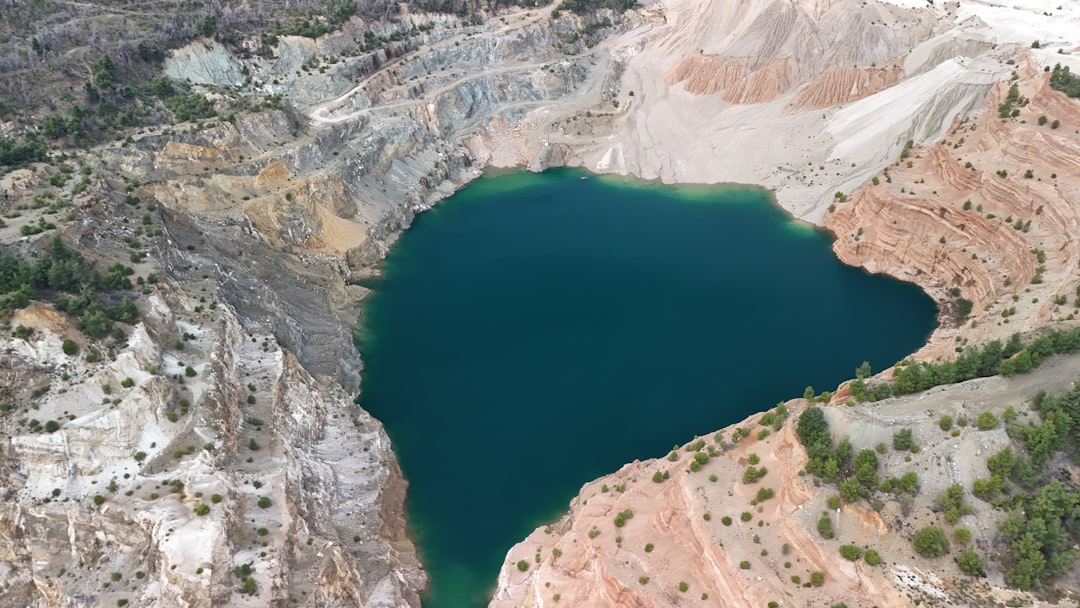
- Repurposing Sites: Disused underground mines and quarries can serve as lower reservoirs.
- Coastal Systems: The ocean can be used as a lower reservoir in coastal areas.
- Off-River Sites: Closed-loop systems don’t need a connection to a river, greatly broadening site selection.
Recent studies have identified over 800,000 potential sites globally, showing that innovative engineering is making hydropower energy storage feasible in a growing number of locations. FDE Hydro™’s modular construction further helps make more of these sites viable.
Conclusion
As we steer the complexities of the global energy transition, hydropower energy storage stands out as a proven, powerful, and essential technology. It is the world’s largest battery, quietly ensuring grid stability, integrating variable renewable energy sources, and providing a suite of invaluable ancillary services.
Its best-in-class scale, long lifespan, and robust reliability make it indispensable for achieving net-zero energy goals and building a resilient power grid. While challenges related to high capital costs, lengthy permitting, and market valuation persist, innovative solutions and supportive policies are paving the way for its accelerated growth.
At FDE Hydro™, we are committed to advancing the future of hydropower. Our innovative modular precast concrete technology is designed to make hydropower energy storage projects more efficient, cost-effective, and environmentally responsible. By drastically reducing construction times and costs for dams and water control systems, we are helping to open up the immense potential of PSH in North America, Europe, and Brazil.
We believe that the future of clean energy is in the water. To learn more about how our advanced modular dam construction can benefit your next water control or hydropower project, please don’t hesitate to contact us.
