

Understanding the Precast Concrete Industry
The precast concrete industry is revolutionizing construction worldwide. Here’s what defines this sector:
What is the Precast Concrete Industry?
- Manufacturing Method: Concrete components are cast in reusable molds within controlled factory environments, then transported to construction sites for assembly
- Market Size: Valued at USD 151.49 billion in 2024, projected to reach USD 246.07 billion by 2032
- Key Applications: Structural building components, transportation infrastructure, water systems, and commercial/residential construction
- Primary Benefits: Reduced construction time (up to 75% faster), improved quality control, lower costs, and improved sustainability
This approach industrializes construction. Instead of pouring concrete on-site—subject to weather, quality issues, and hazards—components are made in controlled factories. They arrive at the job site ready for rapid assembly, like large-scale building blocks.
The results are clear: precast uses less water, cement, steel, and labor. Multi-storey buildings can add a floor per week, and the products last 50 to 100 years or more.
Precast concrete is the backbone of modern infrastructure, from bridges to water systems. While the Asia-Pacific region leads growth, adoption is accelerating globally as urbanization demands faster, more reliable construction.
As Bill French Sr., Founder and CEO of FDE Hydro, my five decades in civil construction have shown me how the precast concrete industry revolutionizes project delivery, especially in heavy civil and modular work. My experience on projects like the I-93 Fast14, which used modular precast bridge construction, proves this technology’s power to shorten timelines and improve outcomes.
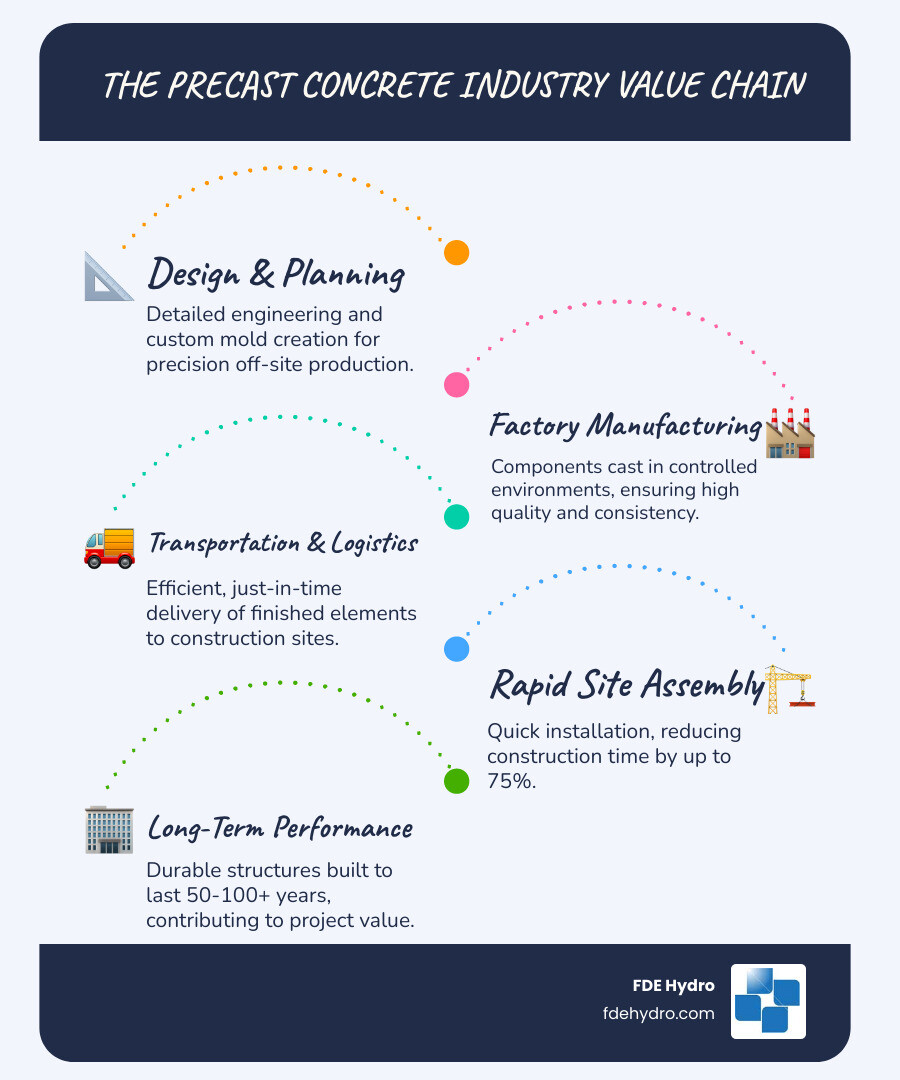
The Blueprint of Precast Concrete: From Factory to Site
The precast concrete industry thrives in the controlled environment of a factory, where precision meets efficiency.
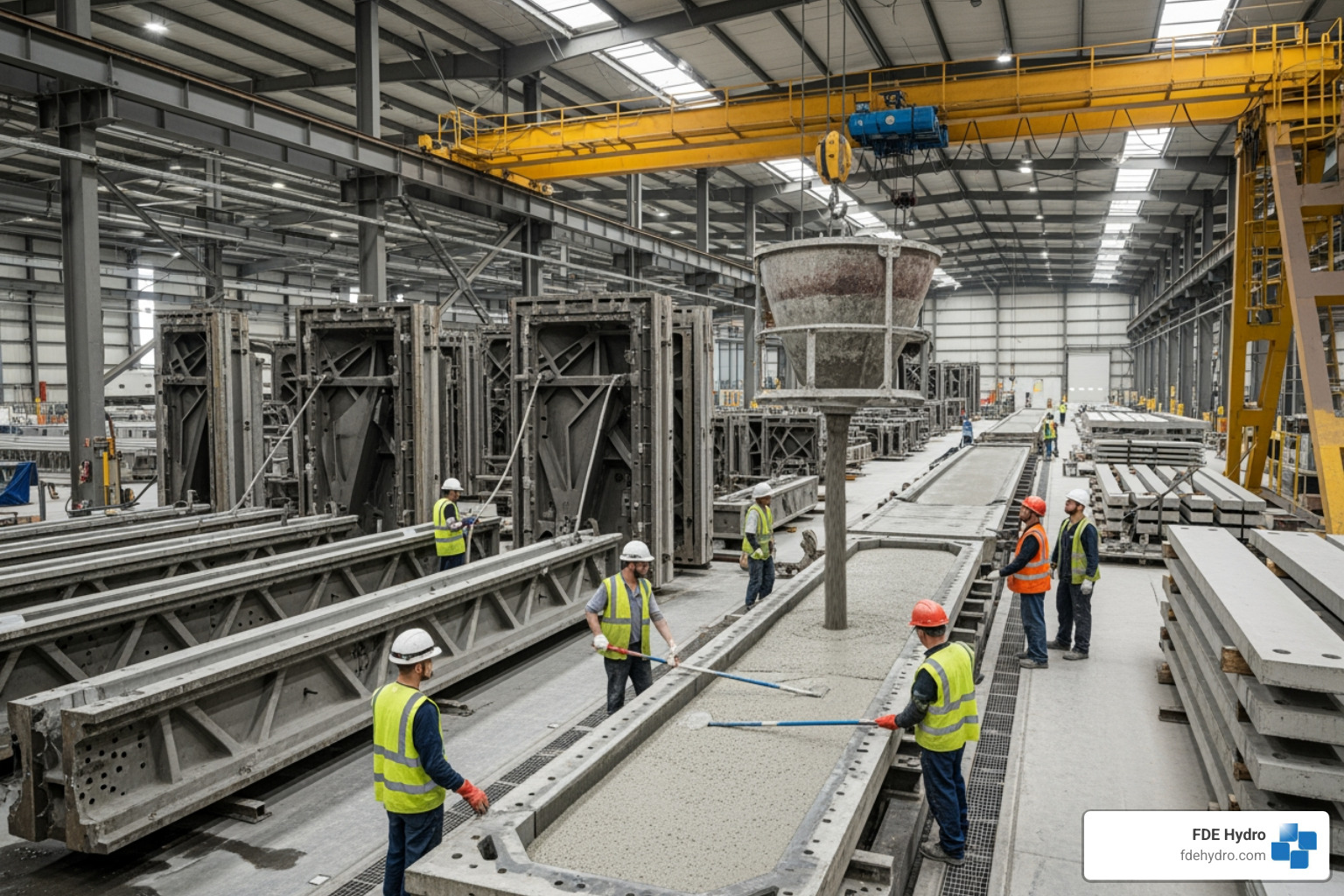
The process begins with reusable molds made of steel, plastic, or other durable materials, which can be used thousands of times. This reusability is a cornerstone of precast’s economic advantage.
In the factory, concrete is poured into molds under consistent temperature and humidity. This eliminates weather-related issues like rain, freezing, or excessive heat that plague on-site work. After casting to strict specifications, the concrete cures in a climate-controlled setting to develop optimal strength and durability, far exceeding typical on-site results. Rigorous quality control ensures every piece meets standards before shipment.
Steel reinforcement is added to handle tension and shear forces, creating reinforced concrete that can withstand the complex stresses of modern structures. For harsh environments, reinforcement can be upgraded with stainless steel or protective coatings to prevent corrosion and extend the product’s lifespan.
After final inspection, components are transported to the site. Just-in-time delivery eliminates on-site storage and keeps projects on schedule.
Precast vs. Cast-in-Situ Concrete
Understanding the difference between precast and cast-in-situ concrete helps explain why the precast concrete industry continues to grow so rapidly.
| Feature | Precast Concrete | Cast-in-Situ Concrete |
|---|---|---|
| Construction Time | Significantly reduced (e.g., one floor per week for multi-storey buildings) | Longer, as concrete must be poured and cured on-site |
| Quality Control | Superior (factory-controlled environment) | Variable (subject to on-site conditions and workmanship) |
| Cost | Potentially lower overall due to efficiency and less labor | Can be higher due to extensive formwork, scaffolding, and labor |
| Labor Requirements | Less on-site labor, shifts work to factory | More on-site labor for pouring, finishing, and curing |
| Site Disruption | Minimal (components arrive ready for assembly) | Higher (on-site mixing, pouring, and curing) |
| Weather Dependency | Low (factory production is unaffected by weather) | High (weather can cause delays and quality issues) |
The distinction is factory production versus on-site pouring. With precast, manufacturing happens off-site while foundations are prepared. Finished components arrive for quick assembly, like precisely engineered building blocks.
Cast-in-situ requires building formwork, mixing, pouring, and curing on-site. Each step is vulnerable to weather delays and site conditions. Factory production eliminates these variables. Every piece meets the same high standard, leading to better quality, faster construction, and reduced on-site labor, making projects more predictable and efficient.
Building Better: The Key Advantages of Precast Concrete
The precast concrete industry enables smarter construction: projects that are faster, more affordable, and longer-lasting, while also being safer and more sustainable.
Let’s start with the most visible benefit: speed. While the site is prepared, components are manufactured simultaneously in a factory. Once the site is ready, pieces arrive for immediate assembly. This allows a multi-storey building to add one complete floor per week, changing project timelines and accelerating return on investment.
Cost-effectiveness is another key advantage. Precast uses less water, cement, steel, and on-site labor. With savings of around 75% on formwork and scaffolding, precast slabs and columns are often 20-25% cheaper than cast-in-situ options. Learn more in our guide, Why Precast Cost Less.
Precast also delivers durability and resilience. Engineered for lifespans of 50 to 100 years (or more), the factory-controlled process creates a denser, stronger product. Combined with excellent fire resistance, it protects investments for generations.
Modern precast offers remarkable design flexibility. Architects can specify custom finishes, colors, and textures to create stunning facades, as noted here: Precast concrete facades bring buildings to life. Utilities and windows can even be embedded in the factory, speeding up on-site work.
Finally, precast offers improved safety. Shifting work to a controlled factory minimizes exposure to weather extremes and dangerous heights. With fewer people on-site, there are fewer opportunities for accidents.
Sustainability in Precast Construction
Here’s where the precast concrete industry really earns its environmental credentials. Building responsibly isn’t just good ethics—it’s good business, and precast delivers on both fronts.
Precast significantly reduces resource consumption. The precision of factory production means less water, cement, and steel are used compared to on-site methods. This efficiency directly results in a smaller CO2 footprint. Waste is minimized both in the factory, where leftovers are recycled, and on-site, which remains cleaner with less material sent to landfills.
The energy efficiency of precast concrete provides long-term benefits. Its natural thermal mass helps regulate indoor temperatures, lowering energy bills and the building’s carbon footprint over its lifetime. It also provides excellent thermal, moisture, and sound insulation.
Modern production also incorporates recyclable materials and industrial by-products, advancing a circular economy in construction. Explore these innovations at Sustainable Precast.
At FDE Hydro, we see these sustainability advantages in our own infrastructure projects. For long-lasting hydropower facilities, these environmental benefits are essential.
A World of Applications: The Versatility of Precast Concrete Products
A key strength of the precast concrete industry is its versatility. From residential towers to critical infrastructure, precast concrete adapts to meet nearly any construction challenge.
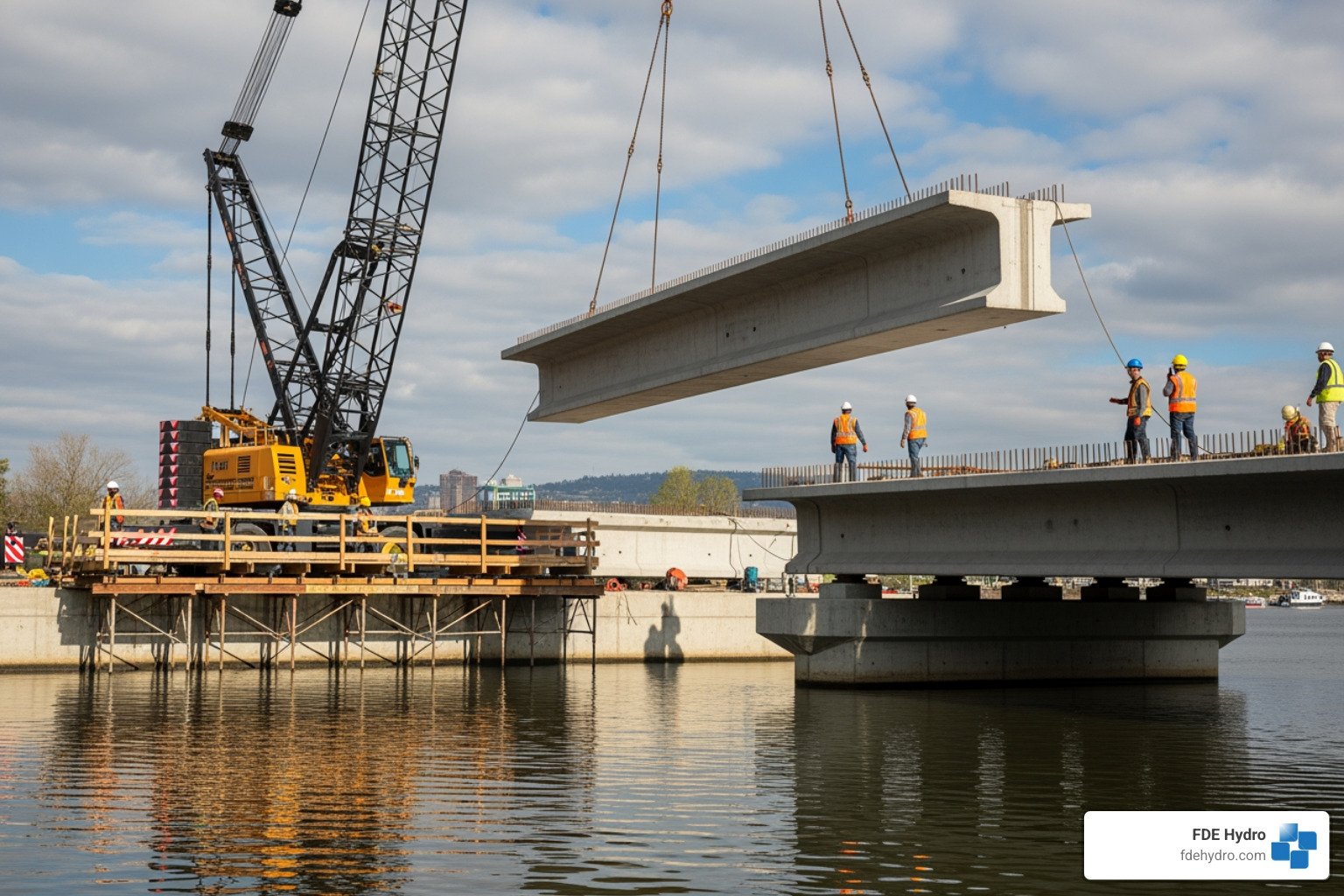
I’ve seen precast transform projects across all sectors. Its adaptability makes it a powerful solution for modern construction, with design possibilities we explore in our discussion on Precast Models.
Structural and Building Components
In any modern city, you’re surrounded by precast concrete. Buildings often use precast columns and beams for their structural frame and hollow-core slabs for flooring, which cleverly reduce weight while providing channels for utilities. Wall panels showcase precast’s versatility, serving as either structural or non-load-bearing elements. Insulated sandwich panels create energy-efficient walls in a single component. Openings for windows, doors, and utilities can be cast in the factory, speeding up on-site work.
Even stairs and facades are often precast. Factory-made stairs ensure uniformity and safety, while precast facades offer architects endless creative freedom with textures, colors, and finishes. The scale achievable is impressive, as shown in our article on how Precast Pushes the Limits of Scale.
The Role of Precast in Infrastructure Development
The precast concrete industry is essential to daily life. The infrastructure we depend on, like bridges, tunnels, and water systems, increasingly relies on precast for new construction and upgrades.
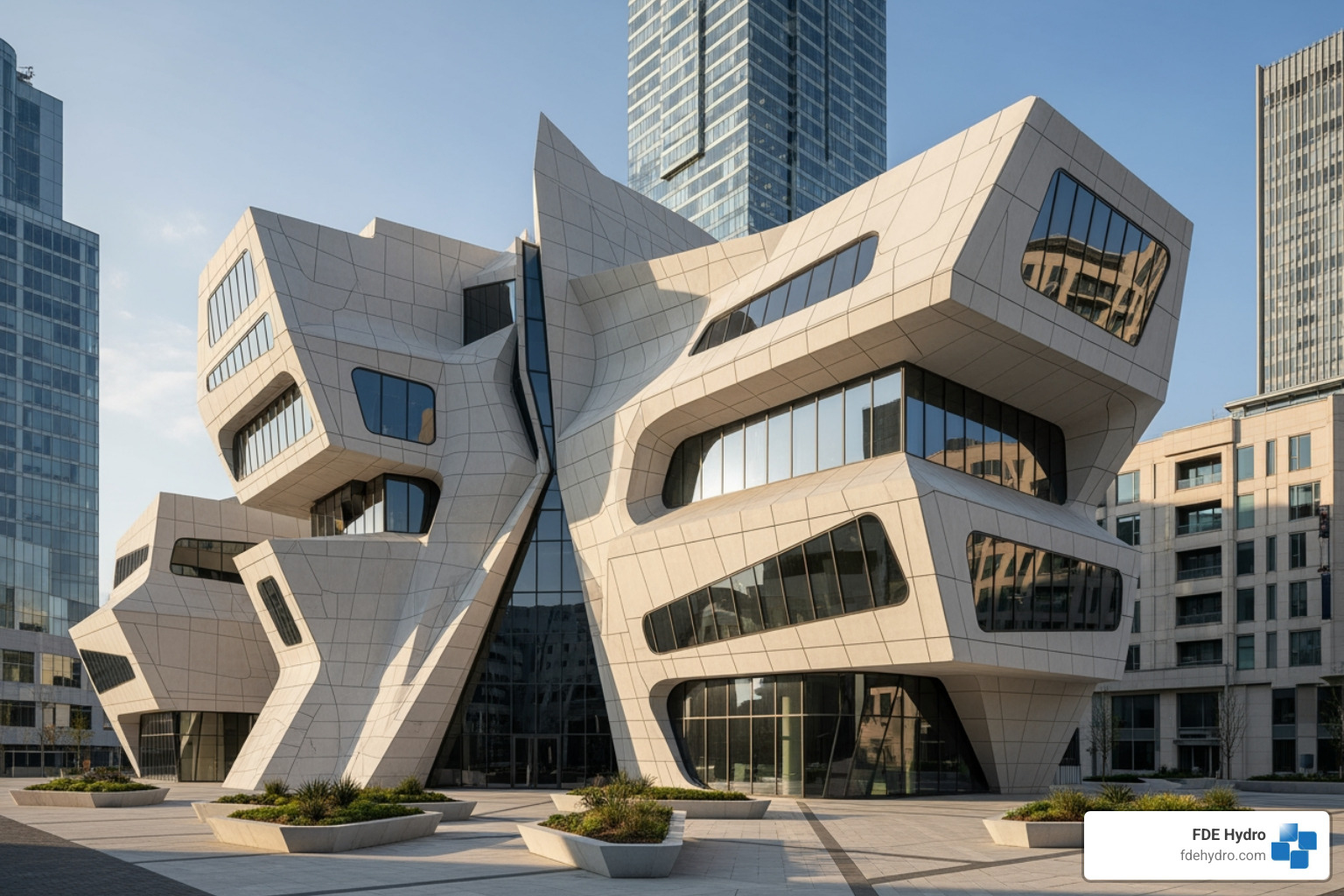
Bridges are a prime example. Precast elements enable rapid replacement, often in weekend closures instead of months. Our work on A National Example of Rapid Bridge Construction Using Modular Precast Elements shows how this approach minimizes disruption. Precast tunnels and culverts arrive ready to install, simplifying drainage projects. Retaining walls range from simple barriers to complex, attractive engineered systems.
Water control systems are an exciting application. At FDE Hydro, our patented modular precast technology, the “French Dam,” is revolutionizing how hydroelectric dams are built and retrofitted in North America, Brazil, and Europe. This system slashes time and costs while ensuring top quality. Our Modular Sea Wall Systems efficiently protect coastlines, and our Modular Powerhouses generate renewable energy, building essential infrastructure for a sustainable future.
Utility and Environmental Applications
Much critical infrastructure is unseen, yet precast concrete makes these buried systems reliable and long-lasting, keeping communities safe and functional.
Stormwater management systems, including precast detention vaults and manholes, prevent flooding by safely channeling water. The durability of precast is invaluable for these components. Precast utility vaults and manholes provide robust, accessible protection for underground communication, electrical, and gas lines, simplifying maintenance.
For properties off the main sewer grid, precast septic tanks and grease interceptors provide durable wastewater management. The deployment speed is remarkable, as detailed in our article on the Rapid Installment of Module Precast Civil Infrastructure. This minimizes community disruption while ensuring long-term reliability.
The Growing Precast Concrete Industry: Market Trends and Future Outlook
The precast concrete industry is fundamentally changing construction. From my five decades in the field, I’ve seen a genuine shift in how major projects are executed, especially in our core markets of the United States, Canada, Brazil, and Europe.
The numbers are compelling: the global market is valued at USD 151.49 billion in 2024 and projected to reach USD 246.07 billion by 2032, a 6.3% CAGR. This growth represents thousands of projects that will shape communities for generations. While the Asia-Pacific region sees explosive growth, major opportunities exist in North America, Brazil, and Europe due to heavy investment in infrastructure modernization. The non-residential segment leads this charge, driven by government projects.
It’s exciting to see precast becoming the default choice. For replacing bridges or upgrading water treatment plants, precast is increasingly the first option considered.
Key Drivers and Challenges in the Precast Concrete Industry
Several forces are driving this shift. Urbanization demands infrastructure that can be built quickly without sacrificing quality. Infrastructure investment is a massive opportunity as structures from the last century reach their end-of-life. Skilled labor shortages also drive adoption, making factory work a practical solution. Finally, the demand for efficient construction methods is about meeting modern expectations for quality, sustainability, and speed.
Challenges remain, including raw material price volatility, complex transportation logistics for large components, and a lingering lack of awareness about precast’s full capabilities in some sectors.
Future Trends Shaping the Precast Concrete Industry
I’m excited about the future of the precast concrete industry. Modular construction is accelerating, moving from individual components to entire building systems. Our work with Modular Construction Techniques at FDE Hydro shows how this reduces timelines and improves quality.
Digital integration with tools like BIM is revolutionizing project coordination, reducing errors and increasing efficiency. 3D printing of concrete, while still emerging, holds the potential to create highly customized shapes. Green concrete is now mainstream, with recycled materials becoming standard practice, as you can see at Sustainable Precast.
Smart technologies, like embedded sensors for monitoring structural health, are enabling proactive maintenance. Finally, automation and robotics in factories are improving productivity and making jobs safer and more effective.
The future of construction is being built right now, in precast concrete factories around the world. And from where I sit, having spent fifty years in this industry, I can tell you: the best is yet to come.
Frequently Asked Questions about Precast Concrete
In my years in the precast concrete industry, I’ve answered many questions about this technology. Here are the most common ones.
How does precast concrete save time in construction?
The speed advantage comes from parallel processing: components are manufactured in a factory while site preparation happens simultaneously. Once the site is ready, finished elements arrive for immediate assembly—no on-site forming or curing is needed. This allows for the erection of one complete floor per week in many multi-storey projects. This rapid construction leads to earlier project completion, faster occupancy, and a quicker return on investment.
Is precast concrete more sustainable than traditional concrete?
Yes. The factory process is inherently more sustainable. Materials like water, cement, and steel are precisely measured, minimizing waste compared to on-site pouring. This efficiency reduces the overall CO2 footprint. Furthermore, precast products are designed to last 50 to 100 years or more, reducing the need for resource-intensive repairs and replacements. The thermal mass of concrete also improves a building’s energy efficiency. For more on these practices, visit Sustainable Precast.
What gives precast concrete its strength and durability?
Strength and durability come from the controlled factory environment. Unlike on-site work, precast manufacturing ensures optimal curing conditions, free from weather interference. This results in a denser, more consistent concrete mix. Steel reinforcement is precisely placed according to engineering specifications, creating a powerful composite material known as reinforced concrete. Rigorous quality control at every stage ensures a final product designed to last for 50 to 100 years or more. This makes precast the smart choice for structures that must endure.
Conclusion
After decades in civil construction, I see the precast concrete industry as the intersection of smart engineering and practical problem-solving. This guide has shown how precast moves construction from chaotic job sites into controlled factories, changing the process.
We’ve covered the key benefits: remarkable speed, significant cost savings, and incredible durability for structures that last 50-100 years. These advantages fundamentally change project delivery and budget management. The versatility is amazing, from architectural facades to rapid bridge construction. Its sustainability advantages—less water, cement, and waste for a smaller CO2 footprint—also make it the responsible choice.
At FDE Hydro, we apply these principles to the demanding hydropower sector. Our patented “French Dam” modular precast technology is revolutionizing dam construction and retrofitting across the United States, Canada, Brazil, and Europe. We prove daily that precast can slash costs and timelines while delivering superior quality.
The future of construction is here, and the precast concrete industry is leading. It’s about creating strong, efficient, and responsible infrastructure for future generations. For any major project, precast concrete offers a proven path forward.
If you’re curious about how we’re applying these cutting-edge construction methods to power the future with clean, renewable hydropower, we’d love to share more. Learn more about our innovative hydropower solutions and find how modular precast technology is changing what’s possible in water control and energy generation.
