

The Blueprint for Modern Construction
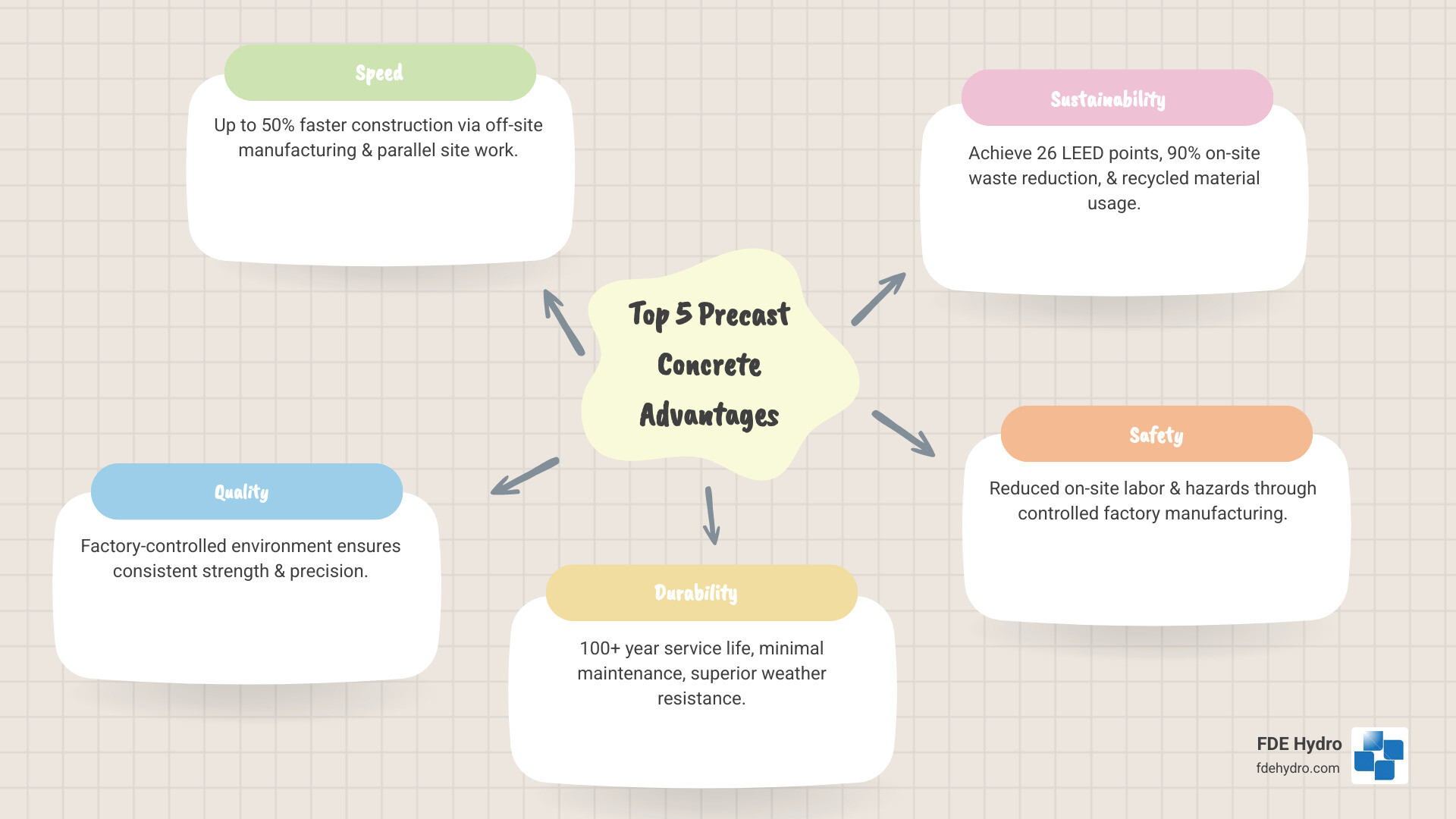
Precast concrete advantages are changing how we build large-scale infrastructure. The key benefits include:
- Speed: Reduces construction timelines by up to 50%.
- Quality: Factory-controlled production ensures consistent strength.
- Durability: Offers a service life exceeding 100 years with minimal maintenance.
- Sustainability: Can earn up to 26 LEED points and reduces on-site waste by 90%.
- Safety: Reduces on-site labor and hazards.
- Cost-Effectiveness: Delivers lower long-term costs and a faster ROI.
Precast concrete is cast in reusable molds in a controlled factory, cured to optimal strength, and then transported to sites for rapid installation. This differs from traditional cast-in-place methods, where concrete is poured and cured on-site, subject to weather delays and quality issues.
Manufacturing occurs in certified plants where structural components—columns, beams, walls, and more—are produced under rigorous quality control. This allows for year-round production while site preparation proceeds simultaneously. Once cured, components are delivered just-in-time for quick installation, compressing schedules from months to weeks.
For water infrastructure and hydropower, these precast concrete advantages are critical. Harsh conditions and tight project windows make precast an ideal solution. Its resistance to moisture, corrosion, and extreme weather addresses the unique challenges of marine applications.
I’m Bill French, founder and CEO of FDE Hydro™, and in my five decades in heavy civil construction, I’ve seen precast technology revolutionize project delivery. My experience proves that embracing modular precast isn’t just about building faster—it’s about building smarter for the next century.
1. Accelerated Construction: Building Faster and Smarter
One of the most significant precast concrete advantages is speed. Projects using precast can finish up to 50% faster than with traditional methods, a timeline reduction that can save an entire season of work.
The secret is parallel processing. With traditional cast-in-place concrete, work is sequential: pour, wait, cure, and hope for good weather. Precast flips this model. While the site team excavates and lays foundations, structural components are simultaneously manufactured in a controlled factory environment. Site work and fabrication happen at the same time.
This synchronized approach enables just-in-time delivery. Components arrive on-site fully cured, inspected, and ready for immediate installation, eliminating on-site curing delays and material storage issues.
Furthermore, all-weather manufacturing means production continues year-round, regardless of rain, snow, or extreme temperatures. This eliminates weather-related delays that commonly plague traditional construction.
The installation phase is also remarkably fast. A small erection team can assemble precast components in days or weeks, a task that would take months for a large on-site crew. This minimized on-site labor requirement accelerates the schedule and reduces costs.
We’ve applied these principles to critical infrastructure. Our Rapid Installment of Module Precast Civil Infrastructure shows how complex systems can be assembled with speed. Similarly, the 93 Fast Bridge Replacement System Now Being Utilized Throughout US proves that entire bridge sections can be installed over a weekend.
Faster project completion means reduced financing costs, earlier revenue generation, and less community disruption. In an industry where time is money, these precast concrete advantages deliver significant value.
2. Superior Quality and Best Resilience
When it comes to quality and resilience, the precast concrete advantages are clear. The factory setting provides a controlled environment where every variable is managed, unlike on-site cast-in-place concrete, which is exposed to weather and inconsistent conditions.
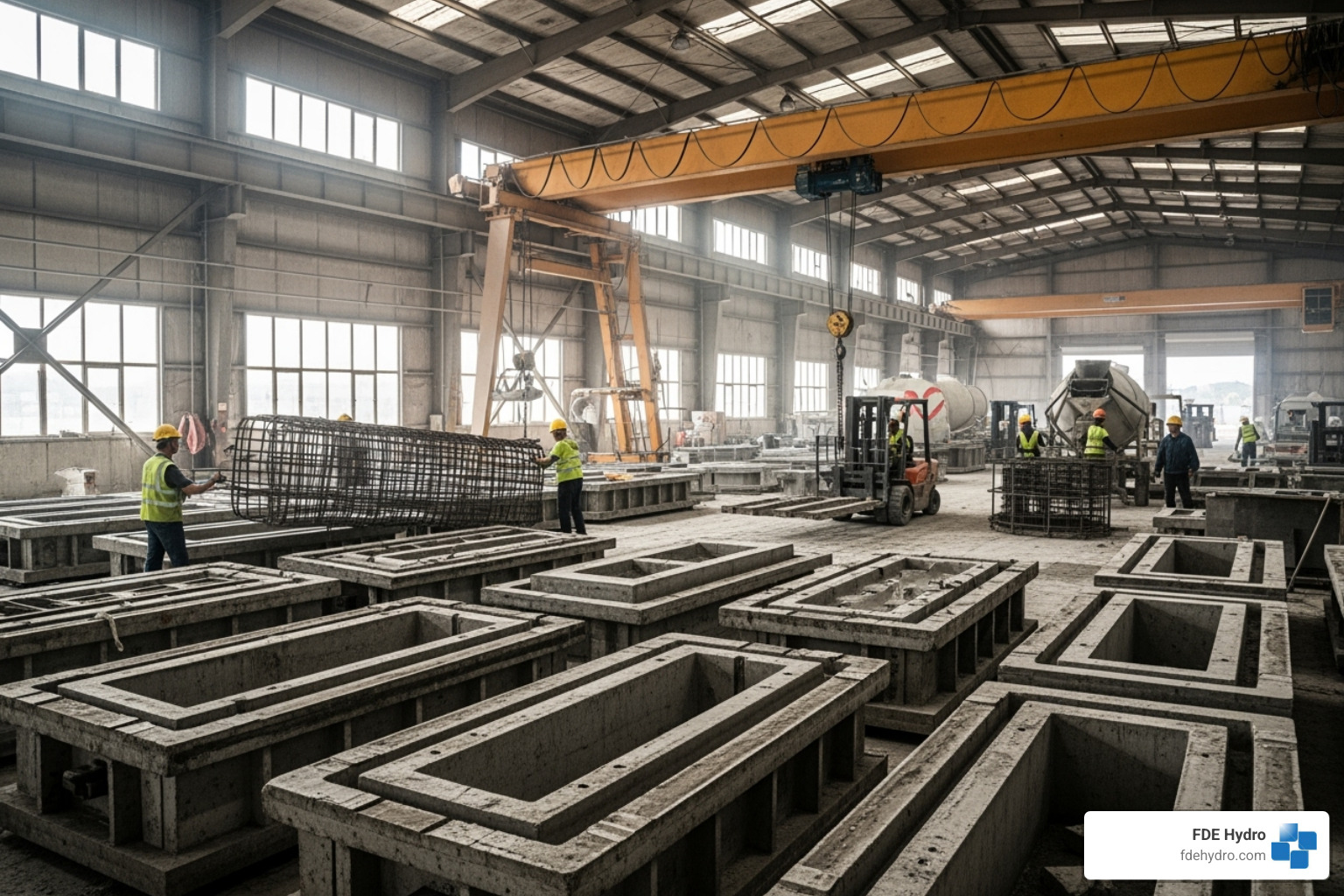
Inside a precast plant, quality control is integral. Consistent mix designs, precise aggregate ratios, and optimal curing conditions are maintained—standards nearly impossible to replicate on an open construction site. This meticulous process produces concrete with superior strength. Pre-stressing techniques can be added to achieve even greater load-bearing capacity, allowing for longer clear spans with slender structural members.
The real payoff is longevity. Precast structures have a service life that can exceed 100 years with minimal maintenance. This durability is confirmed by research, such as that from the Resilient Structures – Canadian Precast Concrete Institute, which shows precast is built to withstand environmental stressors and time.
Improved Performance Characteristics
Beyond strength, precast concrete offers impressive performance benefits.
- Fire Resistance: Concrete is non-combustible and earns an excellent A1 fire rating. It maintains structural integrity far longer than steel in high heat, providing critical time for evacuation and preventing the spread of fire.
- Sound Insulation: The natural density of precast concrete walls makes them excellent at blocking noise, ideal for residential buildings, hotels, and offices.
- Environmental Resistance: Precast concrete resists rot, pests, mildew, and freeze-thaw cycles. This resilience is essential for projects in harsh conditions.
Our Modular Sea Wall Systems, for example, face relentless saltwater and wave action. In these applications, the moisture resistance and durability of precast are not just benefits—they are essential for creating a system that lasts for decades without constant, expensive repairs.
3. Unpacking the Core Precast Concrete Advantages for Cost and Sustainability
Beyond speed and quality, the precast concrete advantages for cost and sustainability are equally impressive.
Factory-based production significantly reduces on-site labor needs, lowering costs from day one. Over the long term, precast’s exceptional durability leads to dramatically lower lifecycle costs. A structure that requires minimal maintenance and lasts over a century offers a faster return on investment, as explained in Why Precast Costs Less.
From a sustainability perspective, precast excels. The controlled factory environment allows for precise material management, reducing on-site waste by up to 90%. Excess materials and even recycled content like glass can be incorporated back into production, minimizing the demand for virgin resources. This efficiency contributes to a lower carbon footprint.
Precast concrete can also contribute up to 26 LEED points. Its thermal mass helps regulate building temperatures, improving energy efficiency. It also acts as an effective air barrier and emits virtually no volatile organic compounds (VOCs), leading to healthier indoor air quality.
Cost-Effectiveness: Long-Term Precast Concrete Advantages
While a precast plant requires initial investment, the long-term savings are substantial. The durability of precast means minimal maintenance, translating directly into lower operational expenses over the structure’s 100+ year service life.
This cost-effectiveness is particularly impactful for large-scale developments like affordable housing. As shown in projects highlighted by Precast Concrete Delivers Affordable Housing, the combination of rapid construction and low ongoing costs makes precast an ideal solution for community infrastructure.
A faster ROI is achieved through quicker construction, reduced labor costs, and minimal maintenance expenses. For developers and owners, these precast concrete advantages create a compelling business case that grows stronger over time.
4. Design Freedom and A Safer Work Environment
Contrary to the image of plain gray boxes, one of the key precast concrete advantages is incredible design freedom. Precast is an architect’s playground, offering immense creative possibilities.
Its versatility allows for virtually any texture, color, or shape. Finishes can range from smooth and polished to textured, and facing materials like brick or stone can be incorporated directly into panels. Reusable molds enable the creation of custom forms with intricate details that would be difficult or expensive to achieve with cast-in-place methods. This allows for bold facades, curved walls, and unique architectural expressions, as shown in our Precast Models.
Beyond aesthetics, pre-stressed precast concrete allows for long, clear spans without interior columns. This creates open, flexible interior spaces that can be easily reconfigured. As the Architectural Precast Association notes in Why Use Architectural Precast, the material delivers versatility, resilience, and quality in one package.
Safety as a Standard
Safety is another critical advantage. Traditional construction sites are crowded and hazardous. Precast concrete transforms this by shifting most of the work to a controlled factory environment.
This move dramatically reduces the number of on-site workers, which in turn lowers the risk of accidents. The factory itself is a safer setting, with specialized equipment, strict safety protocols, and no weather-related hazards. On-site, the installation process is streamlined and requires less time, minimal material storage, and reduced congestion. This shift to off-site manufacturing significantly reduces risks, making the entire construction process safer for everyone involved.
5. Precast vs. Cast-in-Place: A Head-to-Head Comparison
Choosing between precast and traditional cast-in-place concrete is a fundamental project decision. While both use concrete, their manufacturing and application methods lead to vastly different outcomes, highlighting the true precast concrete advantages.
The key differences are summarized below:
| Feature | Precast Concrete | Cast-in-Place Concrete |
|---|---|---|
| Speed | Faster construction through off-site fabrication and parallel processing with just-in-time delivery | Slower sequential on-site pouring and curing, highly weather-dependent |
| Quality Control | High consistency from factory-controlled environment with precise mix design and optimal curing | Variable quality affected by on-site conditions, weather, and less controlled processes |
| Cost | Lower long-term lifecycle costs with reduced on-site labor; higher initial plant setup | Higher on-site labor costs with potential delay expenses; lower initial setup if no plant needed |
| Site Impact | Minimal waste (up to 90% reduction), less congestion, reduced noise and disruption | More on-site waste, material storage, noise, and disruption |
| Weather Dependency | Manufacturing unaffected by weather, ensuring consistent production schedules | Highly dependent on favorable conditions for pouring and curing, leading to potential delays |
| Design Flexibility | Excellent aesthetic versatility with custom forms, textures, colors, and long clear spans | More limited aesthetic options without extensive on-site finishing; complex shapes require custom formwork |
While the precast concrete advantages are compelling, it is important to consider potential challenges.
- Transportation logistics: Large, heavy precast components require specialized trucks, cranes, and careful route planning. Proximity to a precast plant is a key factor, as we’ve learned from projects like the 93 Fast Bridge Replacement System Now Being Utilized Throughout US, where logistics are critical.
- Connection sensitivity: The connections between precast elements must be executed with precision on-site to ensure structural integrity. Working with experienced engineers and installers is essential to avoid issues.
- Initial plant investment: Setting up a precast facility requires a significant upfront cost. However, for projects with large volumes or repeatable components, this investment pays for itself through efficiency, consistency, and long-term savings.
With careful planning, these challenges are manageable. For FDE Hydro, the benefits of precast align perfectly with the demanding requirements of water infrastructure and hydropower projects, where durability, precision, and rapid deployment are paramount.
6. Versatile Applications: From Buildings to Bridges and Beyond
The precast concrete advantages of speed, quality, and durability make it a remarkably versatile solution for a diverse range of projects, from commercial buildings to critical infrastructure.
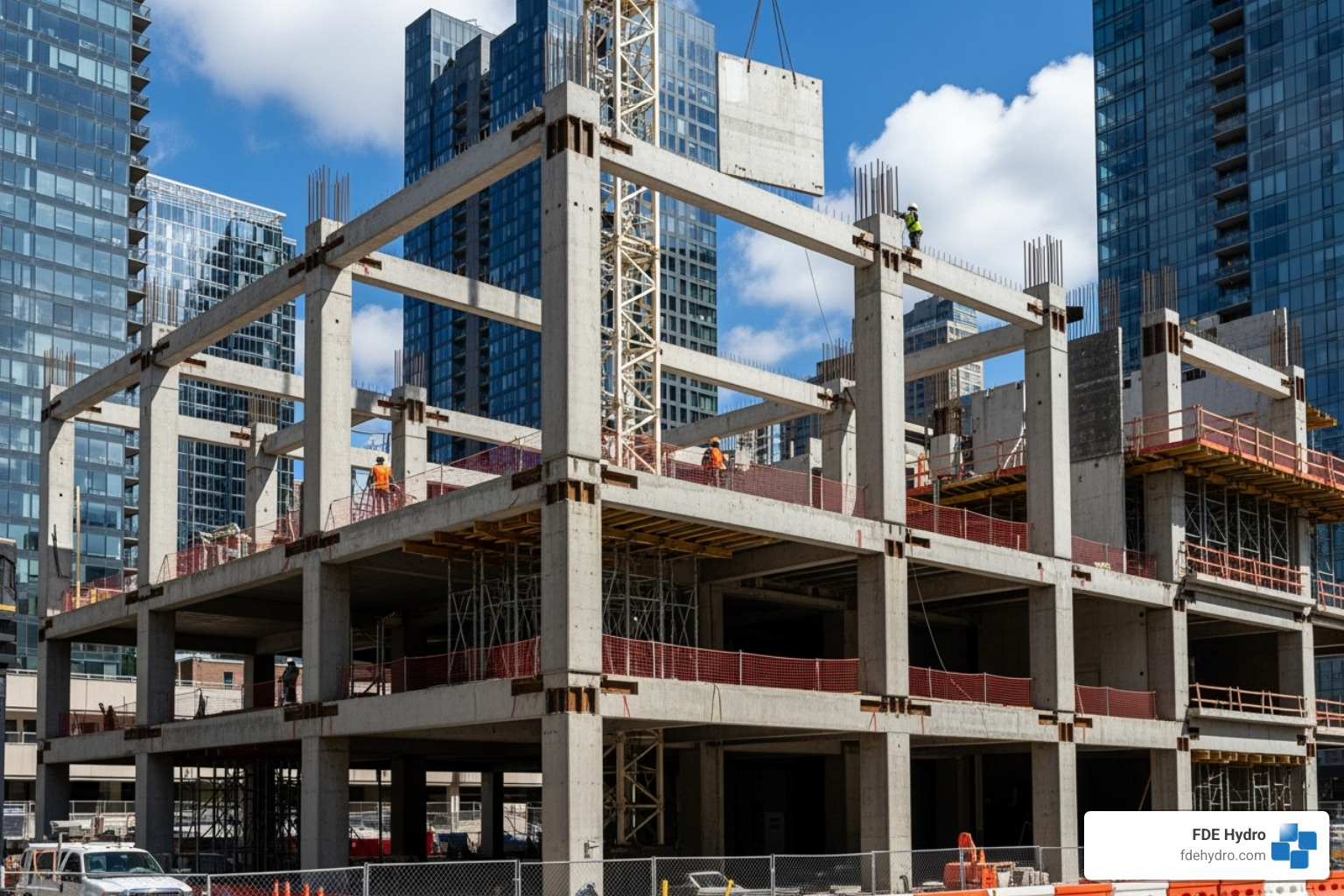
In urban environments, precast is used for commercial buildings and parking structures, where rapid assembly and durability are key. The repetitive nature of parking garage design makes precast especially efficient.
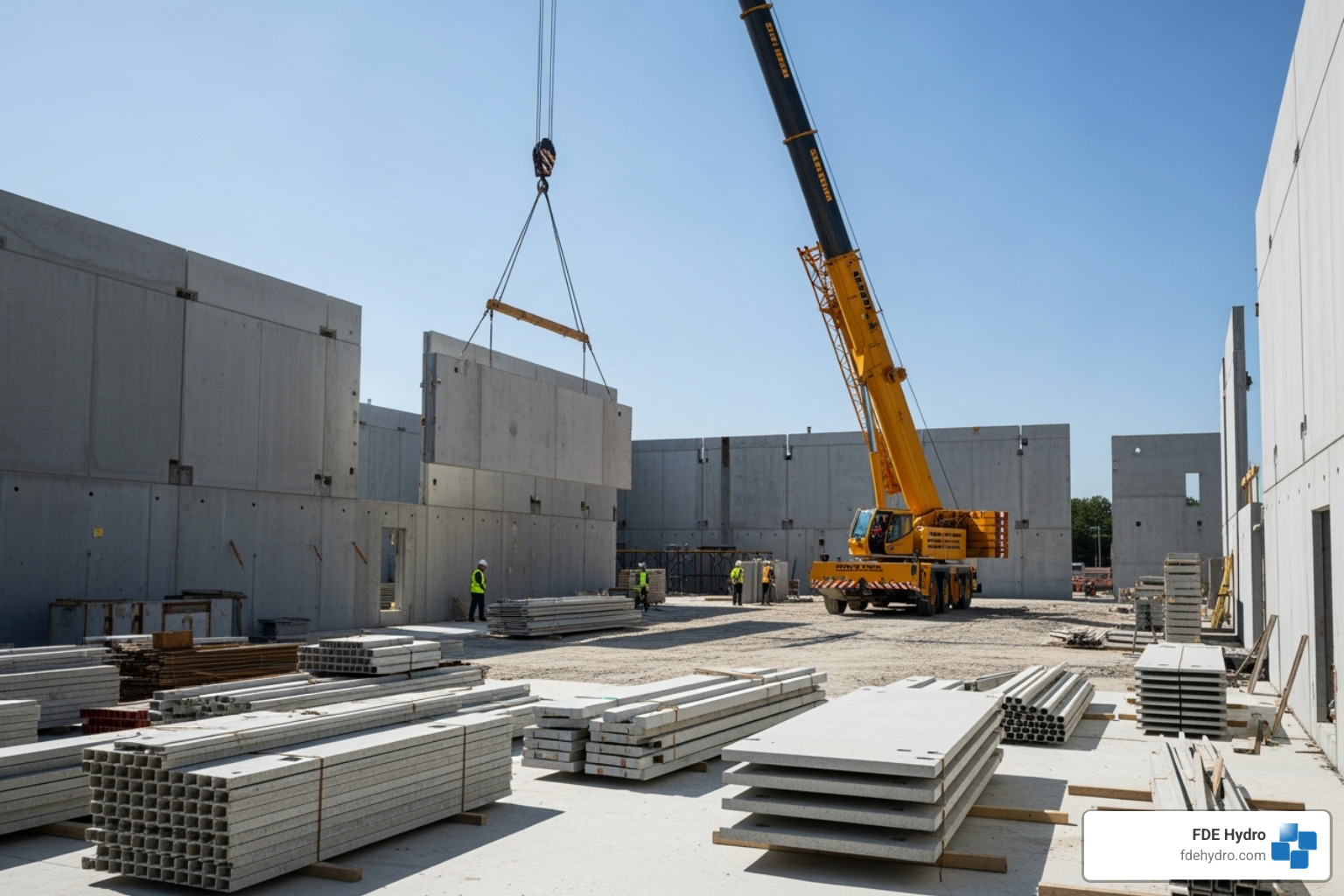
In civil infrastructure, precast excels. Bridges, for example, can be built in a fraction of the time of traditional methods. Our project, A National Example of Rapid Bridge Construction Using Modular Precast Elements, shows how entire spans can be assembled in days, minimizing public disruption. Other common applications include durable retaining walls, culverts, and sound barriers.
For specialized applications, precast is even more critical. At FDE Hydro™, we use modular precast technology for water control systems and hydropower infrastructure. These projects demand precision and resistance to constant water exposure. Our Modular Powerhouses and the Prototype of Modular Precast French Dam Completed demonstrate how precast can make renewable energy projects faster and more cost-effective.
Other applications include foundations, basements, floors, beams, columns, stairs, utility structures, and tunnel segments. All these uses share a common need for reliable, efficient, and long-lasting construction. The consistent precast concrete advantages make it an indispensable material in modern construction.
Conclusion: Building the Future with Precast Concrete
The precast concrete advantages offer a transformative approach to construction that is faster, smarter, and more durable. Every step, from factory production to on-site installation, is optimized for exceptional results.
By guaranteeing superior quality, compressing timelines by up to 50%, and reducing on-site labor and waste, precast creates a win-win scenario. Its sustainability benefits—including LEED potential, use of recycled materials, and improved energy efficiency—align with the need to build responsibly.
Precast also offers design freedom and makes construction sites safer. While there are logistical considerations, the long-term benefits of durability, speed, and cost savings make it a clear choice for forward-thinking projects.
At FDE Hydro™, we have seen how precast revolutionizes the renewable energy sector. Our patented French Dam system applies these advantages to hydropower and water infrastructure projects across North America, Brazil, and Europe, making them faster, more affordable, and built to last.
After five decades in heavy civil construction, I know that precast concrete challenges conventional thinking by prioritizing quality and safety from day one. Whether for a building, bridge, or hydropower installation, precast offers a proven path forward.
Ready to see how these precast concrete advantages can transform your next project? Explore our innovative means and methods for your next project and find how we can help you build smarter, faster, and for generations to come.
