

What is Microgrid Technology and Why It Matters
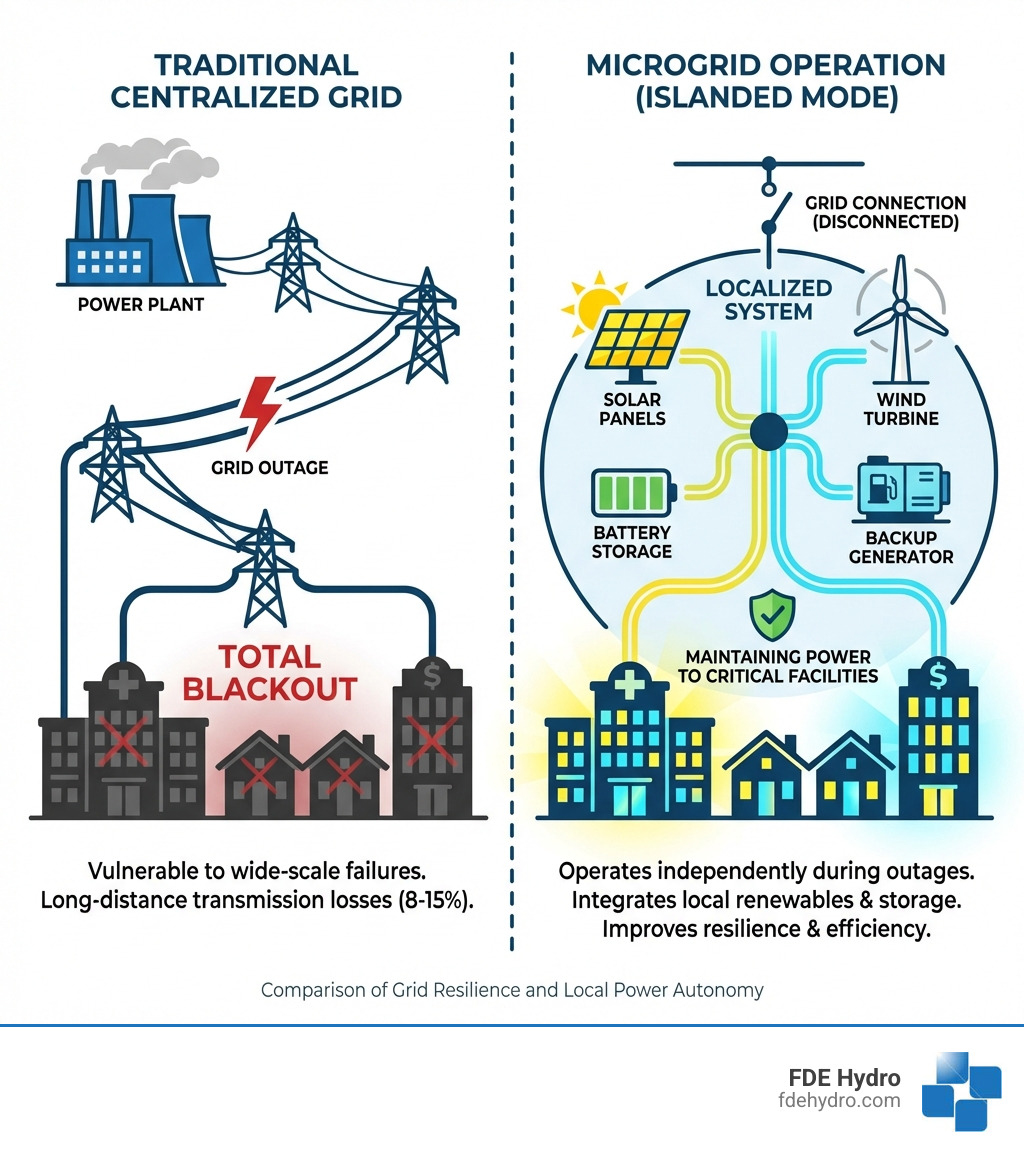
Microgrid technology is a localized electrical grid system that can operate independently from or in connection with the main power grid. Here’s what defines a microgrid:
- Self-contained system with distributed energy resources (solar, wind, generators, batteries)
- Clearly defined electrical boundaries serving a specific area or facility
- Intelligent control systems that manage energy flow automatically
- Two operating modes: connected to the main grid or “islanded” (independent operation)
- Critical capability: Can disconnect during outages and keep power flowing locally
The U.S. Department of Energy defines a microgrid as “a group of interconnected loads and distributed energy resources within clearly defined electrical boundaries that acts as a single controllable entity with respect to the grid.” Unlike a simple backup generator, a microgrid operates 24/7, intelligently managing multiple energy sources to optimize reliability, cost, and clean energy use.
The need for microgrid technology has never been more urgent. Traditional centralized grids lose 8% to 15% of electricity during transmission, and aging infrastructure leaves communities vulnerable to increasingly severe weather events. Superstorm Sandy in 2012, for example, left 7.9 million people across 15 states without power—a stark reminder of our grid’s fragility. Microgrids offer a solution by generating power close to where it’s consumed, dramatically improving resilience and efficiency.
The market recognizes this potential. Global microgrid capacity is projected to reach 19,888.8 MW by 2028, up from just 3,480.5 MW in 2019, with the market expected to approach $39.4 billion by 2028. This explosive growth reflects microgrids’ proven ability to improve energy security, integrate renewable resources, and reduce costs for everything from military bases and hospitals to remote communities and industrial facilities.
I’m Bill French Sr., Founder and CEO of FDE Hydro™. After five decades in infrastructure development, I founded our company to deliver modular hydropower solutions. In 2015, while working with the Department of Energy’s Water Power Technology Office, I saw how perfectly microgrid technology integrates with renewables like hydropower to create resilient energy systems. This guide will explain how microgrids work, their components, and why they are essential for our energy future.
Essential microgrid technology terms:
The Anatomy of a Microgrid: Key Components and How They Work
A microgrid is a sophisticated system of interconnected electrical components working together to provide reliable power. More than just generators, it’s an intelligent system that adapts to changing energy demands and disruptions. Understanding its core elements is key to appreciating microgrid technology.
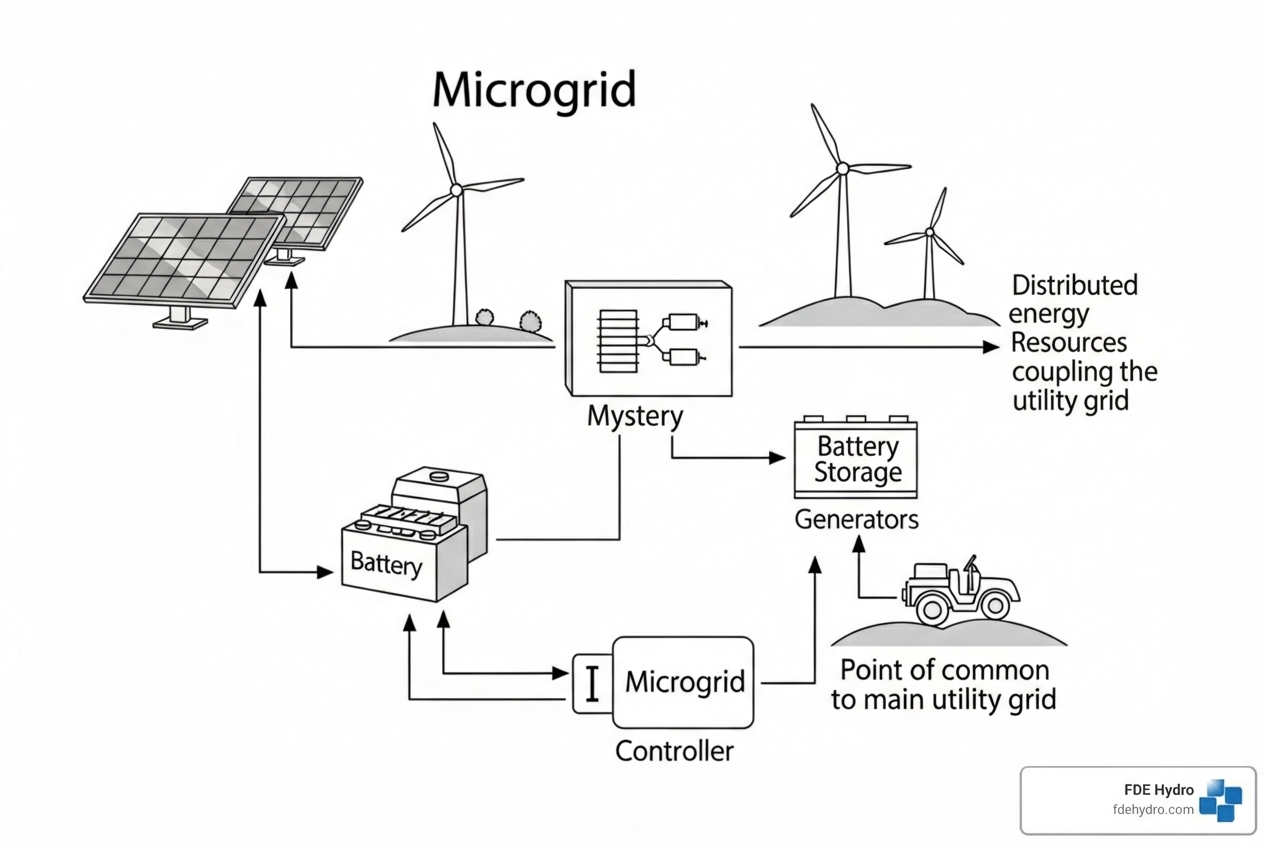
The primary building blocks of any microgrid include Distributed Energy Resources (DERs), energy storage systems, and the all-important microgrid controller. These components are typically connected within a defined electrical boundary, often interacting with the larger utility grid at a specific Point of Common Coupling (PCC).
Key Components of Modern Microgrid Technology
Let’s dive a little deeper into the specific components that make up these localized energy networks:
- Distributed Energy Resources (DERs): These are the power producers within the microgrid, often located close to the point of consumption. They are diverse and can include:
- Solar panels: Using the sun’s energy, solar photovoltaic (PV) systems are increasingly integral to microgrids, offering clean, renewable power. We’ve seen significant research and development in solar integration for these systems.
- Wind turbines: Especially effective in windy regions, these provide another renewable source of electricity, balancing the intermittency of solar.
- Combined Heat and Power (CHP) systems: These highly efficient systems capture waste heat from electricity generation for heating or cooling, greatly improving overall energy efficiency.
- Generators: Often fueled by natural gas or diesel, these provide reliable backup power, particularly when renewable sources are insufficient or during extreme events.
- Hydropower: For us at FDE Hydro™, this is a game-changer. Hydropower offers a highly reliable, dispatchable, and continuous source of renewable energy, making it an ideal anchor resource for any microgrid. Our modular powerhouses and innovative “French Dam” technology are designed to integrate seamlessly into resilient energy infrastructures.
- Energy Storage Systems (ESS): The critical role of energy storage cannot be overstated. Renewables like solar and wind are intermittent, meaning their output fluctuates. Energy storage, primarily large-scale batteries, smooths out these fluctuations, stores excess power for later use, and provides instant power during outages. Lithium-ion batteries are a common choice due to their energy density and declining costs.
- Inverters: These devices are essential for converting direct current (DC) electricity from solar panels or batteries into alternating current (AC) for use by most household and commercial appliances, or vice-versa.
- Microgrid Controller: This is the “brain” of the operation. The microgrid controller is a sophisticated software and hardware system that manages all DERs, loads, and storage. It constantly monitors energy demand and supply, decides when to connect or disconnect from the main grid, optimizes energy flow for efficiency or cost, and ensures grid stability.
- Point of Common Coupling (PCC): This is the electrical point where the microgrid connects to the main utility grid. It’s the gateway, allowing power to flow both into and out of the microgrid when it’s operating in grid-connected mode.
Types of Microgrids: AC, DC, and Hybrid Topologies
Just as there are different ways to generate and store power, there are various structural configurations for microgrids, each with its own advantages:
- AC Microgrids: The most common type, these systems distribute power using alternating current, compatible with most existing electrical infrastructure and appliances. DERs that produce DC (like solar and batteries) require inverters to convert their power to AC before distribution.
- DC Microgrids: These systems distribute power using direct current. They are particularly efficient when integrating DC-producing DERs (solar, batteries) and DC loads (LED lighting, electronics, electric vehicles), as they minimize conversion losses. We’re seeing growing interest in DC microgrids in various applications.
- Hybrid Microgrids: These combine both AC and DC buses, connected by bidirectional converters. This topology offers the best of both worlds, allowing for efficient integration of both AC and DC sources and loads, and providing greater flexibility.
Beyond these fundamental topologies, microgrids also come in different scales and operational modes:
- Nanogrids: These are essentially very small microgrids, often serving a single home or building. They represent the smallest scale of localized energy management. The interconnection of multiple nanogrids can even form a larger microgrid.
- Stand-alone vs. Grid-connected: A key characteristic of microgrid technology is its ability to operate in two modes. A grid-connected microgrid normally operates connected to the main utility grid, but it can disconnect and function autonomously in “island mode” if technical or economic conditions dictate. An isolated microgrid, also known as a “stand-alone microgrid,” operates entirely off-the-grid, without any connection to a wider electric power system. These are common in remote areas or islands where grid extension is impractical or too costly.
Here’s a quick comparison of the main microgrid topologies:
| Feature | AC Microgrid | DC Microgrid | Hybrid Microgrid |
|---|---|---|---|
| Efficiency | Good, but conversion losses for DC sources/loads | High, especially with DC sources/loads | Very High, optimized for both AC and DC |
| Cost | Moderate, leverages existing AC infrastructure | Potentially lower for new DC-heavy installations | Higher initial complexity, but long-term savings |
| Complexity | Moderate, well-understood | Simpler control for DC components | High, combines AC and DC control challenges |
| Applications | Most common, general purpose | Data centers, EV charging, residential solar | Comprehensive energy management |
Microgrid Control and Management Systems
The sophistication of microgrid technology truly shines in its control and management systems. These systems are what allow a microgrid to operate intelligently, making real-time decisions to optimize performance.
A common approach is hierarchical control, which involves multiple layers of management:
- Primary Control: The fastest layer, responsible for immediate voltage and frequency stabilization and power sharing among DERs to ensure flicker-free power.
- Secondary Control: This layer restores voltage and frequency to their nominal values and manages power quality, correcting any deviations.
- Tertiary Control: The highest layer handles economic optimization. It manages power flow, grid interaction (buying/selling power), and demand response strategies, allowing the microgrid to adjust consumption based on price or grid conditions.
Control can also be centralized, where a single entity makes all decisions, or decentralized, where individual DERs have more autonomy and communicate to achieve overall system goals. Many modern systems use a blend, with a central Energy Management System (EMS) overseeing distributed intelligence. Our own expertise in AI energy management aligns perfectly with these advanced control strategies.
The National Renewable Energy Laboratory (NREL) has been deeply involved in the modeling, development, testing, and deployment of microgrids since 2001, conducting extensive research into control algorithms and cyber-physical test platforms. Their work highlights the continuous innovation in making these systems smarter and more robust. We are constantly learning from their advancements to ensure our hydropower solutions contribute effectively to modern grid architectures.
Microgrid Benefits: Enhancing Resilience, Efficiency, and Sustainability
The appeal of microgrid technology isn’t just theoretical; it delivers tangible benefits that address some of the most pressing challenges facing our energy infrastructure today. From keeping critical services running during major outages to reducing our carbon footprint, microgrids are proving to be invaluable assets.

Resilience and Reliability Against Grid Disturbances
A compelling advantage of microgrids is their ability to provide unparalleled resilience and reliability. For critical facilities like hospitals, data centers, and emergency services, a loss of power can be catastrophic.
- Grid Independence and Islanding Capability: This is where microgrids truly shine. They can seamlessly disconnect, or “island,” from the main utility grid when a disturbance occurs, continuing to power local loads autonomously. This means that while your neighbors might be in the dark, essential services within the microgrid’s boundaries remain operational. This capability is key to blackout protection and ensures critical infrastructure can weather any storm.
- Hardened Infrastructure: Microgrids are often designed with improved physical and cyber security, making them less vulnerable to extreme weather, natural disasters, or even cyberattacks. The damage from Superstorm Sandy underscored the profound need for more resilient local energy solutions. We understand the importance of hardening infrastructure, a core principle in our sustainable infrastructure development efforts.
Efficiency and Affordability
Microgrids also offer significant economic and efficiency gains for operators and consumers.
- Reduced Energy Loss: By generating power closer to where it’s consumed, microgrids drastically reduce the transmission and distribution losses inherent in traditional grids, where as much as 8% to 15% of electricity dissipates in transit. This makes the entire system more efficient.
- Lower Energy Costs: Intelligent microgrid controllers can optimize energy use by leveraging cheaper power sources when available. This includes strategies like peak shaving, where the microgrid uses its own generation or stored energy during periods of high demand to avoid purchasing expensive electricity from the main grid at peak rates. This can lead to substantial project cost reduction for consumers and businesses.
- Reduced Infrastructure Investment: In some cases, deploying microgrids can defer or even avoid the need for costly upgrades to traditional grid infrastructure. For example, feasibility studies have shown microgrids enabling the deferral of a $1 billion substation in New York, demonstrating their potential to provide a more cost-effective solution than traditional grid expansion.
Contribution to Decarbonization
Microgrid technology is a powerful tool in the fight against climate change, facilitating the transition to a cleaner energy future.
- Integration of Renewables: Microgrids are perfectly suited for integrating high percentages of renewable energy sources like solar, wind, and, of course, hydropower. Their control systems can manage the variability of these sources, ensuring a stable and reliable power supply. This is a core part of our mission at FDE Hydro™ in promoting sustainable power generation.
- Reduced Fossil Fuel Reliance and Lower Carbon Emissions: By maximizing renewable energy use, microgrids reduce dependence on fossil fuels, leading to a significant decrease in greenhouse gas emissions. This directly supports decarbonization efforts across various sectors.
- Supporting EV Charging Infrastructure: As electric vehicles become more common, the demand for charging infrastructure will surge. Microgrids can help support the EV transition by providing localized, resilient, and often renewable-powered charging stations, easing the strain on the main grid.
- Balancing Intermittent Renewables: The intelligence of the microgrid controller, combined with energy storage, allows for the effective balancing of intermittent renewables. When the sun isn’t shining or the wind isn’t blowing, stored energy or other dispatchable DERs (like hydropower or generators) can seamlessly step in, ensuring continuous power delivery.
The Future of Microgrid Technology: Challenges, Opportunities, and Innovations
The journey of microgrid technology is still unfolding, but its trajectory is clear: it’s a rapidly expanding sector ready for significant growth and innovation. Microgrids are undeniably a cornerstone of future energy systems, with growth driven by the need for grid modernization, the push towards smart grids, and the potential of vehicle-to-grid (V2G) integration.
Overcoming Deployment Challenges
While the benefits are immense, deploying microgrids isn’t without its problems. We’re actively working to address these challenges to open up the full potential of this technology.
- Technical Challenges:
- Low Inertia Systems: Microgrids heavy with inverter-based resources (solar, batteries) lack the inherent stability (inertia) of traditional power plants. This makes them susceptible to frequency issues, demanding sophisticated control algorithms to maintain stability, especially in island mode.
- Protection Coordination: Diverse DERs create complex and reverse power flows, complicating traditional grid protection. This requires advanced, adaptive coordination to prevent equipment damage and ensure safety.
- Modeling Complexities: Predicting microgrid behavior under various conditions requires advanced modeling and simulation tools to account for load changes, renewable intermittency, and grid disconnections.
- Economic and Regulatory Problems:
- High Initial Costs: While microgrids offer long-term savings, the upfront capital investment can be substantial. A 2018 study by NREL found that microgrids in the Continental U.S. cost an average of $2 million-$5 million per megawatt to develop.
- Complex Regulations: The regulatory landscape for microgrids is still evolving. Navigating interconnection standards, utility tariffs, and local permitting can be a significant barrier. The “legal identity” of a microgrid and clear ownership models are still being defined in many jurisdictions.
- Interconnection Standards: Standards like IEEE 2030.7 provide a framework for microgrid controllers, but their implementation and local interpretation can still pose challenges. We believe that streamlining these processes is essential for broader adoption.
Real-World Examples and Case Studies
Despite the challenges, innovative microgrids are being successfully implemented across our target geographies, demonstrating their diverse applications and profound impact.
- Calistoga Resiliency Center, California: This zero-emission microgrid, powered by battery energy storage and hydrogen fuel cells, can power the town for up to 48 hours during emergencies.
- Sonoma Community Microgrid Initiative, California: This initiative improves local energy resilience with community-scale microgrids for areas facing wildfire risks.
- Military Base Applications: Installations like MCAS Miramar in California use advanced microgrids integrating diverse fuels and intelligent controls. They prioritize energy security and operational continuity, making them highly resilient.
- University Campuses: Many universities in the U.S. and Europe, including in New York, are microgrid pioneers, using them to maintain power for critical research and campus facilities during outages.
- Data Centers: With immense power needs, data centers in places like New York City are using microgrid technology to ensure uninterrupted operation, often integrating their own generation and storage.
- Rural Electrification (Mini Grids): In remote areas of Brazil, Canada, and Europe, microgrids (or “mini grids”) provide essential electricity where grid extension is cost-prohibitive, often using renewables. Brazil’s largest microgrid at Unicamp University, for example, includes 2 MWh of battery storage.
- Île d’Yeu, France: This European island community’s Harmon’Yeu microgrid uses solar panels and battery storage to increase local energy autonomy and reduce fossil fuel reliance.
- Stone Edge Farm Winery, California: This winery operates a sophisticated microgrid with micro-turbines, fuel cells, batteries, hydrogen electrolyzers, and PV systems, demonstrating advanced energy independence.
The Role of Microgrids in Grid Modernization
Microgrids are pivotal to the broader change of our entire electric grid, serving as essential building blocks for a cleaner, more reliable, and flexible energy future.
- Advanced Control Strategies: The development of sophisticated control algorithms, often using AI and machine learning in energy management, is pushing the boundaries of what microgrids can achieve. These systems predict demand, optimize DER dispatch, and manage grid transitions.
- Clustered Microgrids: A trend towards interconnected or “clustered” microgrids allows them to share resources and provide mutual support, enhancing regional resilience and creating a more robust, self-healing network.
- Hardware-in-the-Loop (HIL) Testing: Research facilities like NREL use advanced HIL testing to rigorously evaluate microgrid controllers and components in realistic simulations before field deployment, accelerating innovation.
- Open-Source Hardware and Software: The growth of open-source tools for microgrid optimization and control, like SAMA (Solar Alone Multi-Objective Advisor), is democratizing access to advanced microgrid technology.
- A Comprehensive Review: A detailed review of microgrid technologies, key drivers, and outstanding issues highlights how microgrids address the “three Ds” of energy change: decentralization, decarbonization, and democratization, reinforcing their role as a fundamental shift in energy infrastructure.
Frequently Asked Questions about Microgrids
We often encounter common questions about microgrid technology as more communities and industries explore these innovative energy solutions. Let’s address some of the most frequent inquiries.
What is the difference between a microgrid and a backup generator?
A traditional backup generator is a reactive solution, providing power only when the main grid fails. It’s designed for temporary emergency power and doesn’t actively manage energy or interact with the grid.
A microgrid, however, is a proactive, self-contained energy system. It incorporates multiple generation sources (like renewables), energy storage, and an intelligent controller. This controller actively manages power flow 24/7, optimizes for cost and efficiency, and can seamlessly operate connected to the grid or independently (“islanded”). It’s a fundamental shift from simple backup to comprehensive energy management and resilience.
Can a microgrid sell power back to the main grid?
Yes. Many grid-connected microgrids can sell excess power back to the utility, turning them into “prosumers”—producers and consumers of energy. When a microgrid generates more power than it needs, or when grid prices are high, its controller can sell the excess, creating a revenue stream that helps offset investment costs.
Beyond selling energy, microgrids can provide valuable ancillary services to the main grid, such as frequency regulation and voltage support. Utilities often pay for these services, which help stabilize the larger grid and further improve the economic viability of microgrid technology.
How does hydropower fit into a microgrid?
Hydropower is an exceptionally strong fit for microgrid technology, acting as a highly reliable and dispatchable anchor resource. While solar and wind are excellent renewable sources, their output is intermittent. Hydropower, particularly from smaller, run-of-river or modular dams, offers a consistent, predictable, and controllable power supply.
This stability is invaluable within a microgrid, as it can:
- Provide Baseload Power: Hydropower can consistently meet a significant portion of the microgrid’s energy demand, reducing reliance on fossil fuel generators.
- Balance Intermittent Renewables: When solar or wind output drops, hydropower can quickly ramp up generation to compensate, ensuring a stable power supply without relying heavily on battery storage or less clean sources.
- Improve Resilience: As a dispatchable resource, hydropower significantly strengthens the microgrid’s ability to operate reliably in island mode, providing a continuous power source during main grid outages.
- Offer Long-Term Sustainability: Our focus at FDE Hydro™ is on developing sustainable hydropower solutions using innovative modular construction techniques. Our “French Dam” technology is designed for efficient, cost-effective, and environmentally sensitive hydropower generation, making it an ideal long-term component for community or industrial-scale microgrids in North America, Brazil, and Europe. This integration of reliable, clean hydropower is crucial for building truly resilient and sustainable energy futures.
Conclusion: Powering a Smarter, More Resilient World
We’ve explored microgrid technology, from its components and operational modes to its profound benefits. Microgrids represent a pivotal shift in how we generate, distribute, and consume electricity. They offer unparalleled resilience against grid failures, improve efficiency by reducing transmission losses, and drive sustainability by integrating renewable energy.
The traditional centralized grid, while a marvel of engineering, is increasingly vulnerable to modern demands and the growing threat of climate change. Microgrids, with their local intelligence and ability to “island” when needed, are emerging as the essential building blocks for the electric grid of the future. They empower communities, businesses, and critical infrastructure to take control of their energy destiny.
At FDE Hydro™, we are deeply committed to this future. Our innovative, patented modular precast concrete technology, often referred to as “French Dam” technology, is designed to deliver cost-effective and rapid deployment of hydropower solutions. By integrating our sustainable hydropower into microgrids, we can provide the reliable, dispatchable renewable energy needed to stabilize these local grids and contribute to a smarter, more resilient energy landscape across North America, Brazil, and Europe.
The future of energy is distributed, intelligent, and sustainable. We invite you to join us in powering this transition.
Learn more about our innovative hydropower solutions
