

Why Hydropower Advancements Innovations 2025 Matter Now More Than Ever
Hydropower advancements innovations 2025 are reshaping the world’s oldest renewable energy source into a modern, flexible, and environmentally responsible cornerstone of the clean energy transition. As variable renewables like solar and wind grow rapidly, hydropower’s ability to provide baseload power, grid stability, and massive energy storage becomes increasingly critical.
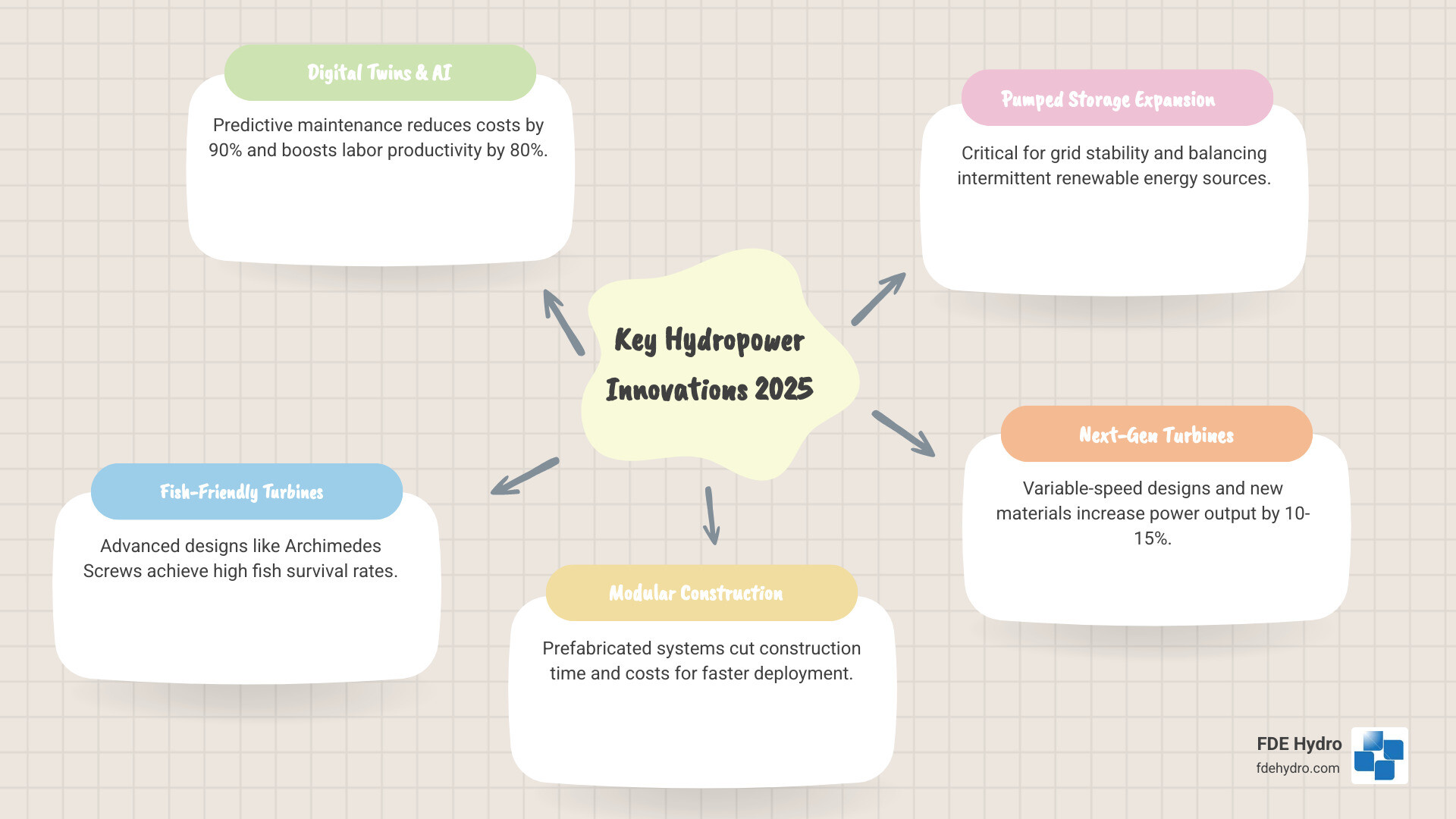
Key 2025 Hydropower Innovations:
- Digital Twins and AI – Predictive maintenance reducing corrective costs by 90% and boosting labor productivity by 80%
- Fish-Friendly Turbines – Archimedes Screw and advanced runner designs achieving 100% fish survival rates
- Modular Construction – Prefabricated systems cutting construction time and costs while enabling small-scale deployment
- Pumped Storage Expansion – PSH capacity growing 5% globally to 189 GW, with pipelines exceeding 600 GW
- Marine and Hydrokinetic Systems – Zero-head tidal and river current technologies opening new water resources
- Performance Analytics – Real-time monitoring and numerical cloning optimizing efficiency and reliability
- Variable-Speed Turbines – Permanent magnet generators and composite materials increasing output by 10-15%
The urgency is clear: hydropower must grow from 80 GW to nearly 150 GW in the U.S. by 2050 to meet climate goals. Yet many plants are over 60 years old, and traditional construction methods are too slow and expensive. The gap between current development pipelines (500+ GW globally) and what’s needed (an additional 600-850 GW by 2050) demands faster, smarter solutions.
As Malcolm Turnbull noted in the 2025 World Hydropower Outlook: “Markets alone won’t deliver what is needed. Continued momentum will require bold policy action, including reforms to reward hydropower’s multiple benefits, and faster permitting. The only resource we lack is time.”
I’m Bill French, founder and CEO of FDE Hydro™, where we’ve pioneered modular civil construction solutions—including the patented “French Dam”—specifically designed to accelerate delivery of hydropower advancements innovations 2025 while reducing costs and environmental impacts. After five decades building infrastructure and serving on the DOE’s Hydro Power Vision Technology Task Force, I’ve seen how modular approaches can transform an industry constrained by conventional methods.
The Digital Dam: AI and Data Analytics in Hydropower
The future of hydropower isn’t just about water and concrete anymore. It’s also about the thousands of data points streaming from sensors every second, the algorithms predicting tomorrow’s problems today, and the virtual models that let us test ideas without risk. This digital change is one of the most exciting hydropower advancements innovations 2025 has brought to our industry.
Think about it this way: we’ve been moving water through turbines for over a century. We’re pretty good at that part. But now we’re learning to make those systems smarter, more efficient, and far more reliable by letting computers do what they do best—spot patterns humans might miss and predict what’s coming next.
Optimizing Operations with Predictive Analytics
Here’s something that would have seemed like science fiction just a decade ago: knowing exactly when a bearing will fail three weeks before it happens. That’s predictive maintenance in action, and it’s changing how we run hydropower plants.
Instead of waiting for something to break or doing maintenance “just because it’s been six months,” we’re using AI to tell us exactly when equipment needs attention. Sensors continuously monitor vibration, temperature, pressure, and dozens of other variables. Machine learning algorithms analyze this data and flag potential issues before they become problems.
The results are honestly remarkable. One comprehensive study found that implementing advanced analytics and continuous monitoring for predictive maintenance led to a 90% decrease in corrective maintenance costs and an 80% increase in labor productivity. That’s not a typo—ninety percent fewer emergency repairs because we caught issues early. The International Energy Agency has highlighted how digital technologies are changing hydropower operations worldwide, making them more efficient and reliable than ever before.
AI-powered forecasting goes beyond just equipment health, too. Self-learning algorithms can now predict water inflow patterns and electricity price fluctuations, letting operators create optimal dispatch plans. This means generating power when it’s most valuable and most needed for the grid. Satellite radar systems are even tracking dam conditions from space, identifying potential structural concerns before they require site visits.
This integration of artificial intelligence and data analytics represents a fundamental shift in how we operate facilities. Instead of reacting to problems, we’re preventing them. Instead of guessing when to run turbines, we’re optimizing every hour based on real-time data and sophisticated predictions.
The Rise of Digital Twins and Advanced Simulations
Digital twins might sound futuristic, but they’re becoming standard tools for modern hydropower operations. Think of a digital twin as a complete virtual replica of your physical facility—a living, breathing model that mirrors exactly what’s happening in the real world.
These aren’t just static 3D renderings. They’re dynamic simulations fed by real-time sensor data, allowing us to test scenarios, stress-test designs, and plan maintenance without touching the actual equipment. Want to know what happens if you increase flow by 20% during a heat wave? Run it in the digital twin first.
IoT platforms are creating comprehensive views of every machine in a facility, tracking performance, predicting maintenance needs, and even suggesting operational improvements. This technology is invaluable whether you’re designing a new dam, planning a major retrofit, or optimizing daily operations at an existing plant.
The really exciting part? We’re moving toward what some experts call “AI dam designers”—systems that can optimize designs for both efficiency and environmental impact. These tools can model countless design variations, finding solutions that human engineers might never consider. They can dynamically reconstruct facilities, simulate different operational scenarios, and analyze outcomes with incredible precision.
At FDE Hydro, we’re embracing these digital tools in our modular construction approach. For more on how we’re integrating advanced technology into dam development, check out our insights on AI-Driven Development.
The combination of digital twins, predictive analytics, and AI-powered optimization isn’t just making hydropower more efficient—it’s making it smarter, more responsive, and better equipped to play its crucial role in the clean energy transition.
Greener Hydro: Innovations for Environmental Sustainability
For too long, hydropower has faced criticism regarding its environmental impact, particularly on aquatic life. However, hydropower advancements innovations 2025 are heavily focused on mitigating these concerns, leading to a new era of “greener hydro” that prioritizes ecological balance alongside energy generation. We’re committed to proving that hydropower can be both powerful and protective of our precious ecosystems.
Fish-Friendly Turbine Designs
The impact of turbines on migrating fish has been a major challenge. But innovative designs are changing the game. The Archimedes Screw Turbine (AST), for instance, has demonstrated a remarkable 100% survival rate for migrating fish in projects like the Hanover Pond Dam in Meriden, Connecticut. These turbines operate at slower speeds with wider openings, creating a gentler passage for aquatic life.
Another breakthrough is the Restoration Hydro turbine (RHT), which integrates advanced runner blade designs to eliminate the need for costly screens and ensures high survival rates for juvenile fish. The Freedom Falls Project in Maine, for example, has shown estimated 100% 48-hour survival with less than 3% injury for juvenile alewives. Beyond turbines, nature-like fishways, such as the one implemented at the Oswegatchie River Project in New York, are proving highly effective, allowing over 2,000 fish from 14 species to pass safely within just five days of installation. These solutions are crucial for maintaining river connectivity and biodiversity.
Aeration and Water Quality Improvements
Maintaining optimal water quality, especially dissolved oxygen levels, is vital for aquatic ecosystems downstream of hydropower facilities. Innovations in turbine aeration systems and advanced reservoir management techniques are helping us achieve this. Some projects even use solar-powered aerators to actively maintain water health, ensuring that the water released from our facilities supports thriving aquatic life. This focus on water quality is part of a broader commitment to sustainable water management, a topic we explore further in The Biggest Untapped Solution to Climate Change is in the Water.
Powering the Future: Key Hydropower Advancements Innovations 2025
The U.S. has an ambitious goal: grow our hydropower capacity from 80 GW to nearly 150 GW by 2050. That’s almost doubling what we have now. The challenge? Many of our existing plants were built when your grandparents were young—some are over a century old. We can’t just patch them up and hope for the best. We need smarter, faster, more cost-effective solutions.
This is where hydropower advancements innovations 2025 really shine. We’re not just talking about incremental improvements; we’re talking about game-changing technologies that make hydropower more efficient, more affordable, and more adaptable to modern grid demands.
Next-Generation Turbines: Efficiency and Hydropower Innovations 2025
Think of turbines as the heart of a hydropower plant. The more efficiently they convert water flow into electricity, the more power we generate from the same resource. New variable-speed turbines can adjust to fluctuating water flows, capturing energy that older fixed-speed designs would miss.
Permanent magnet generators (PMGs) are revolutionizing this space. They’re smaller and lighter than conventional generators, yet they deliver higher power output—even at low speeds. This makes them perfect for both upgrading existing plants and building new ones. Advanced composite materials and additive manufacturing (yes, 3D printing for turbines!) are creating components that are lighter, stronger, and more durable.
The result? These innovations can boost power generation capacity by 10-15% at existing facilities. That’s like adding new capacity without building new dams. The U.S. Department of Energy has identified advanced manufacturing as a critical opportunity for hydropower, and we’re seeing that potential realized right now. To understand more about how this power source works, visit our Hydropower page.
Modular Hydropower: The Key to Scalability
Here’s the hard truth: building dams the traditional way is slow and expensive. It can take years just to get through permitting, then more years for construction. When you’re trying to double your hydropower capacity in 25 years, that timeline just doesn’t work.
Modular construction is changing everything. Instead of building everything on-site from scratch, we use standardized, precast components that can be manufactured in controlled factory settings and assembled quickly in the field. It’s like the difference between building a house stick by stick versus assembling a prefabricated home.
Our patented “French Dam” technology takes this approach to heart. We use modular precast concrete structures to build and retrofit hydroelectric facilities, dramatically cutting both construction time and costs. This isn’t just theory—we’ve proven it works in North America, Brazil, and Europe. Learn more about our Modular Construction Techniques and see how our Prototype of Modular Precast French Dam Completed is setting new standards.
The beauty of modular systems goes beyond speed. They’re perfect for electrifying non-powered dams—structures that already exist but don’t generate power. The U.S. has thousands of these. They’re also ideal for canal and conduit projects, opening up vast untapped potential for small-scale hydropower generation. We believe this approach is essential for Reinvigorating Hydropower across the country.
Tapping New Waters: Marine and Hydrokinetic (MHK) Innovations 2025
Not all water power comes from dams. Marine and hydrokinetic technology captures energy from ocean currents, tides, waves, and even free-flowing rivers—no dam required. This opens up entirely new locations for renewable energy generation, especially in coastal areas and rivers where traditional hydropower isn’t practical.
River current systems are particularly exciting because they can generate electricity from flowing water with minimal environmental impact. Some designs operate just below the water surface and can even self-submerge during floods, protecting both the equipment and the ecosystem. Tidal power harnesses the predictable rhythm of ocean tides, providing reliable renewable energy for coastal communities.
These zero-head technologies (systems that don’t need a significant water height difference) are perfect for decentralized energy generation. They can power remote communities, island grids, or supplement existing power systems without the infrastructure requirements of traditional hydropower. As we look toward a more distributed, resilient energy grid, MHK innovations represent a crucial piece of the puzzle for hydropower advancements innovations 2025.
The Water Battery: Energy Storage and Grid Flexibility
Think of pumped-storage hydropower as a giant rechargeable batteryexcept instead of lithium and chemicals, it uses water and gravity. As solar panels go dark at sunset and wind turbines slow on calm days, the grid desperately needs something to fill the gaps. That’s where hydropower’s energy storage capabilities become absolutely critical.
PSH provides the largest form of energy storage in power grids worldwide, with 179 GW installed globally as of 2023. But here’s the exciting part: PSH capacity is growing rapidly, hitting 189 GW with development pipelines exceeding 600 GW. These aren’t just numbersthey represent the infrastructure that will keep our lights on as we transition to a cleaner energy future.
The beauty of PSH is simple: when we have excess renewable energy (like midday solar), we pump water uphill to a reservoir. When demand spikes or the sun sets, we release that water through turbines to generate power exactly when it’s needed. It’s energy storage at a scale that batteries alone simply can’t match yet.
The Evolution of Pumped Storage Hydropower (PSH)
PSH technology isn’t standing still. The latest hydropower advancements innovations 2025 are making these systems smarter, faster, and more flexible than ever before.
Variable-speed PSH represents a major leap forward. Unlike traditional fixed-speed systems, these plants can adjust their pumping and generating rates in real-time, responding to grid needs within seconds. This flexibility is invaluable for balancing the moment-to-moment fluctuations that come with wind and solar power.
Ternary units and closed-loop systems are also gaining traction. Closed-loop PSH doesn’t rely on river flowsinstead, it circulates water between two reservoirs, dramatically reducing environmental impacts on aquatic ecosystems. This makes permitting easier and opens up more potential sites.
One of the most innovative developments involves repurposing abandoned underground mines for PSH. These existing cavities offer high heads (vertical drops) perfect for energy storage, and they’re already excavatedno need to flood valleys or build massive above-ground reservoirs. The mines become productive assets again, storing energy in closed-loop systems that use gravity and water to balance the grid.
Another breakthrough uses high-density fluids instead of plain water, allowing PSH plants to operate on lower hills rather than requiring mountain heights. This innovation slashes construction costs and expands the number of viable PSH sites dramatically. Suddenly, regions that couldn’t consider PSH before have options.
These advancements are essential for supporting clean energy systems and ensuring grid stability as we add more renewables. For a deeper dive into how this technology works, visit our dedicated Pumped Storage Hydropower page.
Hybrid Energy Systems
The smartest grids don’t rely on just one technologythey combine the best features of multiple sources. That’s the thinking behind hydro-battery hybrid systems, which pair PSH’s massive long-duration storage with the lightning-fast response of grid-scale batteries.
PSH excels at storing enormous amounts of energy for hours or even days. Batteries, on the other hand, can respond in milliseconds to provide frequency regulation and stabilize voltage. Together, they create a powerful combination that offers superior grid reliability and ancillary services that neither could provide alone.
We’re also seeing more co-location of hydropower with solar and wind farms. This makes tremendous sense: the same transmission lines that carry hydropower can also handle solar and wind energy, and the hydropower can smooth out their variability. When the wind dies down or clouds roll in, hydropower steps up instantly. When renewables are producing more than the grid needs, PSH stores that excess energy for later.
These hybrid systems maximize the strengths of each energy source while minimizing their weaknesses. They ensure a more resilient, flexible grid that can handle the complexities of a renewable-dominated future. As we continue integrating variable renewables, these hybrid approaches will become not just helpful, but essential for maintaining the reliable power we all depend on.
Frequently Asked Questions about Hydropower Innovation
What is the biggest challenge facing the hydropower industry?
If I’m being honest, we’re facing a perfect storm of challenges. The most pressing issue is simply aging infrastructure. Walk into many hydropower facilities today, and you’ll find equipment that’s been running for 60, 70, even 100 years. These plants were engineering marvels when they were built, but they weren’t designed to last forever. Outdated machinery doesn’t just underperform; it creates real risks of costly, unexpected failures.
Beyond the physical infrastructure, we’re navigating a maze of complex regulatory problems. Permitting processes can drag on for years, and while environmental protections are absolutely necessary, the approval timelines often don’t reflect the urgency of our climate goals. There’s also a public perception challenge—many people still associate hydropower with the massive environmental disruptions of decades past, not realizing how much the technology and our approach have evolved.
Then there’s the economic reality: high upfront capital costs make new projects difficult to finance, especially when traditional construction methods are slow and expensive. Add supply chain complications into the mix, and you can see why expansion has been sluggish. The good news? Hydropower advancements innovations 2025 are directly tackling these barriers through modular construction, digital optimization, and more environmentally sensitive designs. It’s not an easy road, but the path forward is becoming clearer.
How do new technologies make hydropower more cost-effective?
The economics of hydropower are being transformed from multiple angles, and it’s genuinely exciting to watch. Modular construction is probably the most dramatic game-changer. At FDE Hydro, we’ve seen how using standardized, precast components can slash both construction time and labor costs. What used to take years can now happen in months. Less time on-site means lower costs, plain and simple.
Digitalization is the other major cost-cutter. When you can predict equipment failures before they happen, you avoid the astronomical costs of emergency repairs and unplanned downtime. We’re seeing plants reduce their corrective maintenance costs by 90% and boost labor productivity by 80% through AI-driven predictive maintenance and performance analytics. That’s not incremental improvement; that’s revolutionary.
And here’s something that often gets overlooked: efficiency upgrades to existing facilities. Next-generation turbines with advanced materials and variable-speed technology can increase power output by 10-15% from the same amount of water. That means more revenue from assets you already own, without the expense of building something new. When you combine faster construction, lower maintenance costs, and higher output, suddenly hydropower projects that didn’t pencil out before become economically viable.
What are the societal benefits of advancing hydropower?
This is where I get passionate, because hydropower’s benefits ripple far beyond the electricity meter. At the most fundamental level, hydropower provides increased grid reliability. While solar panels go dark at night and wind turbines stop when the air is still, hydropower delivers steady, dependable baseload power. Even better, it can ramp up or down quickly to balance those intermittent sources, preventing blackouts and keeping the lights on for everyone.
The climate impact is enormous. Hydropower is a zero-carbon energy source, meaning every megawatt-hour we generate is a megawatt-hour that doesn’t come from fossil fuels. As we race toward climate goals, that matters more every single day.
There’s also a significant economic benefit through job creation. Building, operating, and maintaining hydropower facilities creates good-paying jobs in manufacturing, engineering, construction, and operations. These aren’t jobs that can be outsourced; they’re rooted in local communities and support local economies.
But here’s something people don’t always realize: modern hydropower isn’t just about electricity. It’s about comprehensive water management. The same infrastructure that generates power also helps control floods, provides water for irrigation during droughts, and creates recreational opportunities like fishing and boating. When we advance hydropower with fish-friendly designs and improved water quality measures, we’re not just generating clean energy—we’re protecting and enhancing entire river ecosystems for future generations. That’s the kind of multi-benefit infrastructure our world desperately needs.
Conclusion
We’re living through a remarkable moment in hydropower history. The hydropower advancements innovations 2025 we’ve explored in this article represent far more than technical upgrades—they’re fundamentally reshaping how we think about this time-tested renewable energy source.
The digital revolution is making our plants smarter and more efficient, with AI and digital twins catching problems before they happen and optimizing every drop of water that flows through our turbines. Environmental innovations are proving that we can generate clean power while protecting the fish and ecosystems that share our rivers. Modular construction is breaking down the time and cost barriers that have held back expansion for too long.
Perhaps most exciting is hydropower’s emerging role as the backbone of our renewable energy future. As pumped storage capacity expands and hybrid systems combine the best of multiple technologies, hydropower is becoming the “water battery” that makes solar and wind power truly reliable. This isn’t just about keeping the lights on—it’s about building a stable, resilient grid that can support our transition to net-zero emissions.
The path forward is clear, but the clock is ticking. We need to grow capacity dramatically by 2050, and traditional construction methods simply aren’t fast enough. That’s why we at FDE Hydro have dedicated ourselves to pioneering modular civil construction solutions that accelerate delivery while reducing costs and environmental impacts. Our patented “French Dam” technology is specifically designed to help the industry meet this moment.
After five decades in this industry and serving on the DOE’s Hydro Power Vision Technology Task Force, I’ve never been more optimistic about hydropower’s future. The innovations are here. The technology works. Now it’s about scaling these solutions quickly enough to meet the challenge ahead. We believe that by embracing these advancements—from digitalization to sustainability to modularity—we can open up hydropower’s full potential and secure a cleaner, more resilient energy future for our children and grandchildren.
More info about our innovative modular dam technology
