

Why Hydroelectric Dam Construction Matters for Our Energy Future
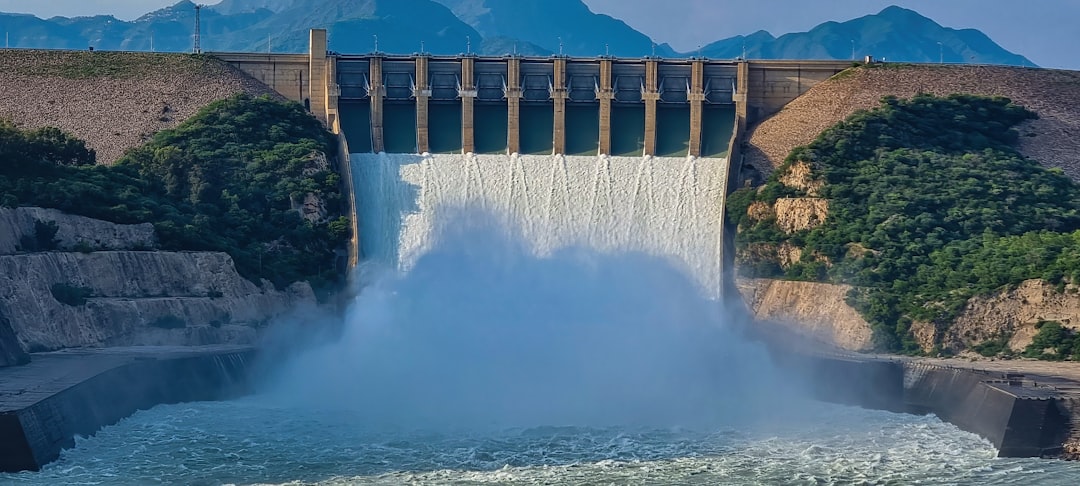
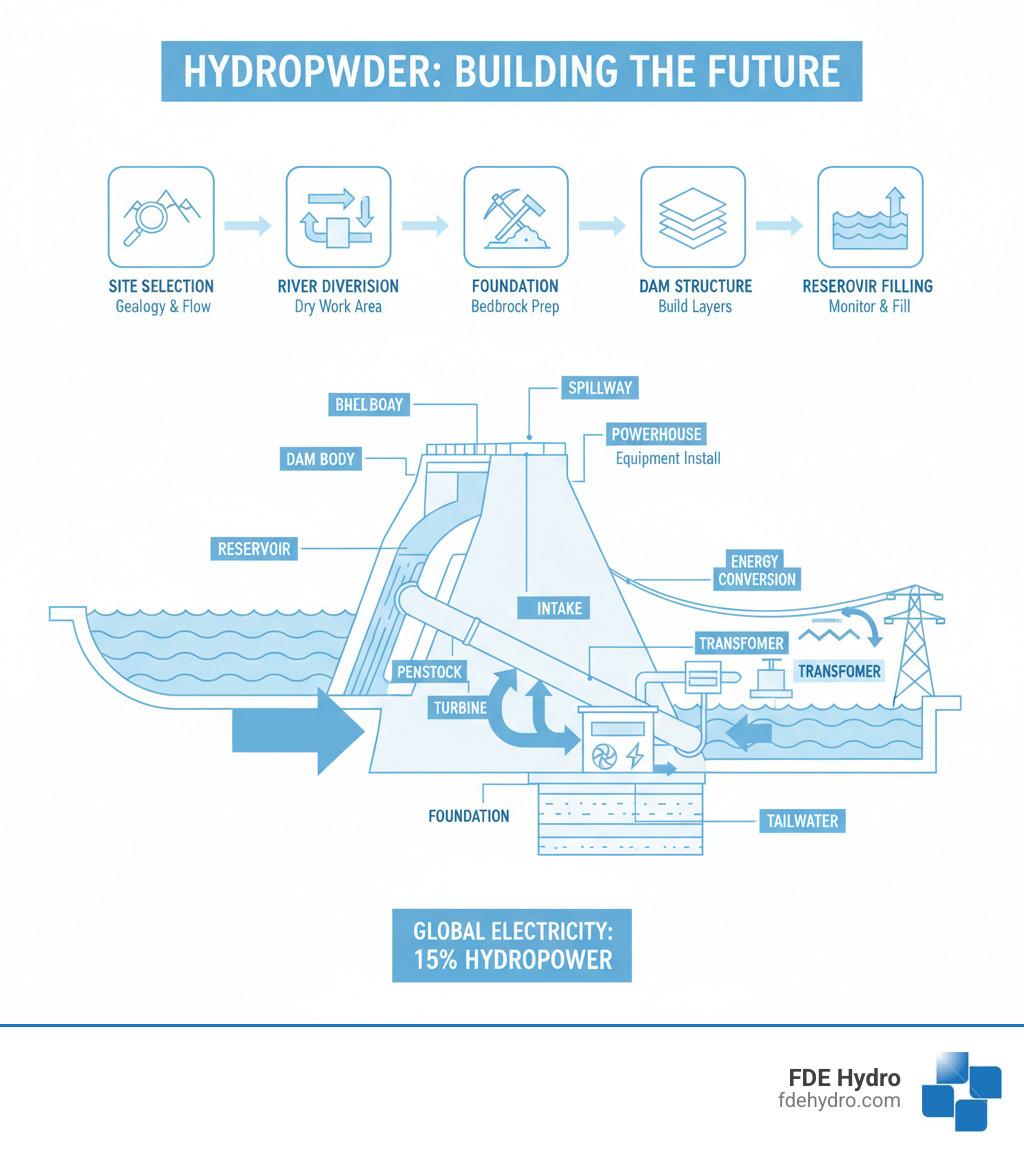
Hydroelectric dam construction transforms flowing water into reliable, renewable electricity. These complex civil engineering projects follow a multi-stage process, from site selection and river diversion to building the dam, installing power equipment, and filling the reservoir.
Hydropower is the world’s largest renewable energy source, supplying 15% of global electricity. Beyond power, these structures provide flood control, irrigation water, and recreational opportunities. However, the industry faces challenges: construction has slowed since the 1970s, costs have risen, and many older dams in North America require modernization.
I’m Bill French Sr., Founder and CEO of FDE Hydro™, where we address these challenges head-on. With five decades of experience in civil construction, I founded FDE Hydro to pioneer faster, more cost-effective methods for hydroelectric dam construction through innovations like modular precast concrete systems.
This guide explores how these engineering marvels are built, their importance to our energy future, and the innovations making them more sustainable.
Why We Build Dams: More Than Just Power
While hydropower is a major electricity source—providing 15% of the world’s power and over 59% in Canada—the reasons for hydroelectric dam construction extend far beyond energy generation.
These engineering giants serve multiple critical functions:
- Flood Control: Dams act as safety valves, holding back excess water from snowmelt or heavy storms that would otherwise devastate downstream communities and infrastructure.
- Irrigation and Water Supply: Reservoirs provide a reliable water source for agriculture in arid regions, such as Southern Alberta and B.C., and supply drinking water to cities and industries.
- River Flow Regulation: By maintaining steady, predictable water flow, dams support river navigation, help sustain ecosystems, and ensure water availability during dry seasons.
- Recreation and Tourism: The man-made lakes created by dams become hubs for fishing, boating, and camping, boosting local economies.
World-renowned dams exemplify this multi-purpose design. The Hoover Dam provides power, flood control, and water to the arid U.S. Southwest. China’s Three Gorges Dam, the world’s largest power station, was built equally for flood control on the Yangtze River. And Canada’s W.A.C. Bennett Dam is a cornerstone of both power generation and water management.
These projects are not just power plants; they are comprehensive water management systems. To learn more about how they manage water, see our insights on water control structures.
The Step-by-Step Process of Hydroelectric Dam Construction
Building a hydroelectric dam is a massive and complex undertaking in civil engineering. While each project is unique, the construction process follows a proven sequence of stages, guided by strict safety protocols and comprehensive Engineering Guidelines for the Evaluation of Hydropower Projects.
Here’s a look at how these engineering marvels are built, from the initial site survey to generating power.
Stage 1: Site Selection and Feasibility Studies
This critical first phase can take years and involves a careful balancing act between technical, economic, environmental, and social factors. Key assessments include:
- Geological Stability: Teams drill test borings to ensure the site has solid bedrock capable of supporting the dam’s immense weight and water pressure.
- Hydrological Analysis: Engineers study decades of river flow data to confirm sufficient water volume and “head” (the vertical drop of the water), which directly determines power generation potential.
- Environmental and Social Impact: Studies evaluate the project’s effects on fish, wildlife, water quality, and local communities, including potential relocations and impacts on cultural sites.
- Economic Viability: The analysis confirms the project is economically sound, considering construction costs and proximity to the power grid for transmission.
Stage 2: River Diversion and Foundation Preparation
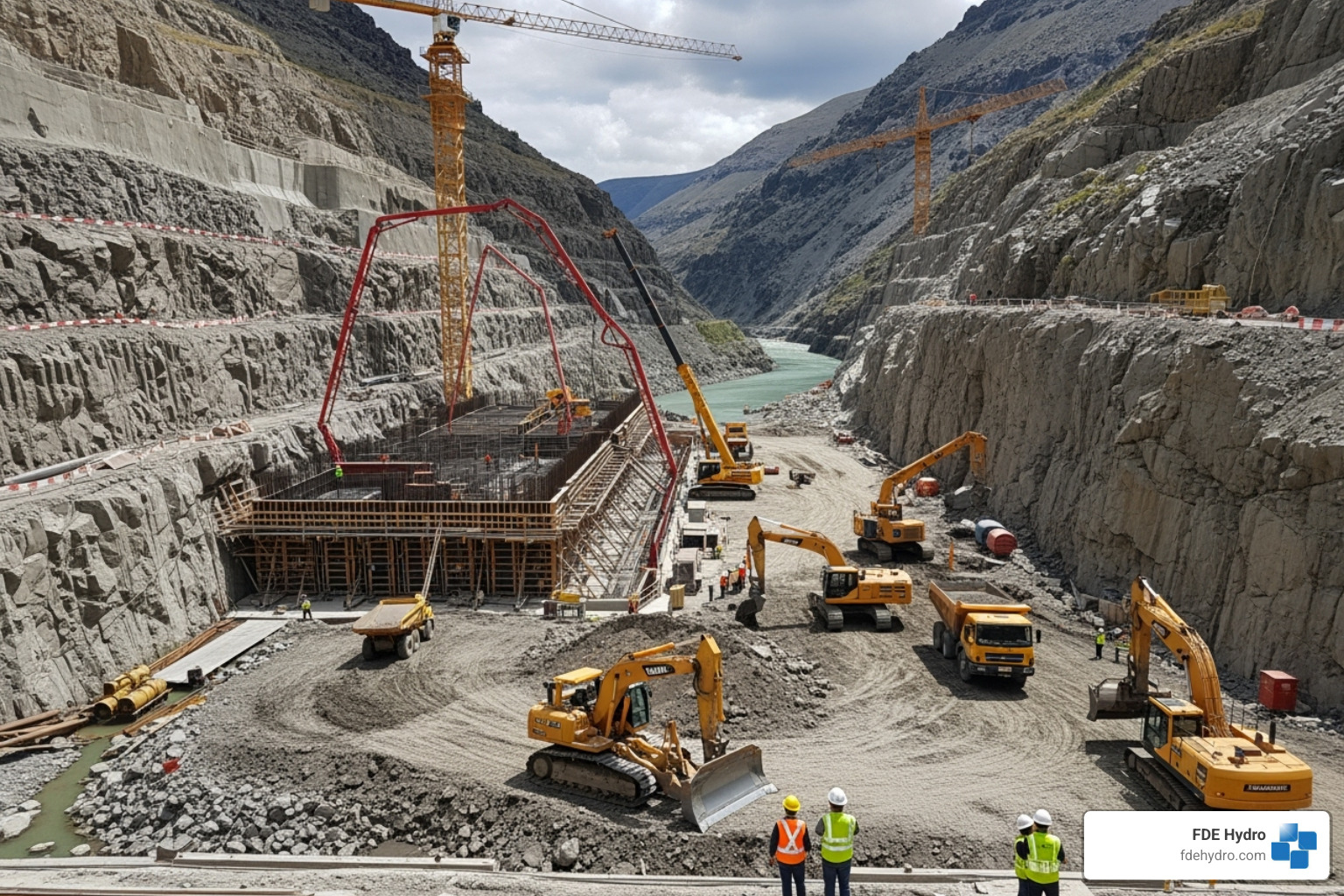
To build in a flowing river, the water must first be diverted. This is done using temporary tunnels or channels built around the worksite. Cofferdams—temporary watertight walls—are also used to create a dry area in the riverbed.
With the site dry, foundation preparation begins. Crews excavate all soil and loose material down to solid bedrock. The exposed rock is then cleaned and strengthened. Any cracks are filled with high-pressure grout to create a watertight seal and prevent seepage under the dam. In unstable areas, long steel rock bolts are drilled into the bedrock to reinforce it. This meticulous preparation is vital for the dam’s long-term safety and stability, ensuring it can last for 65 to 85 years or more.
Stage 3: Building the Dam Structure
Once the foundation is prepared, the dam structure begins to rise. The type of dam depends on the site’s geology and available materials.
- Gravity Dams: Massive concrete structures that use their sheer weight to hold back water. They are built by pouring concrete in large, interlocking sections.
- Arch Dams: Graceful, curved structures that transfer water pressure to the strong rock walls of a narrow canyon. They use less concrete than gravity dams.
- Buttress Dams: A solid upstream wall supported by a series of triangular buttresses on the downstream side, saving on concrete while maintaining strength.
- Embankment Dams: Built from compacted layers of earth and rock, often with an impervious clay core. Many of the world’s tallest dams are this type.
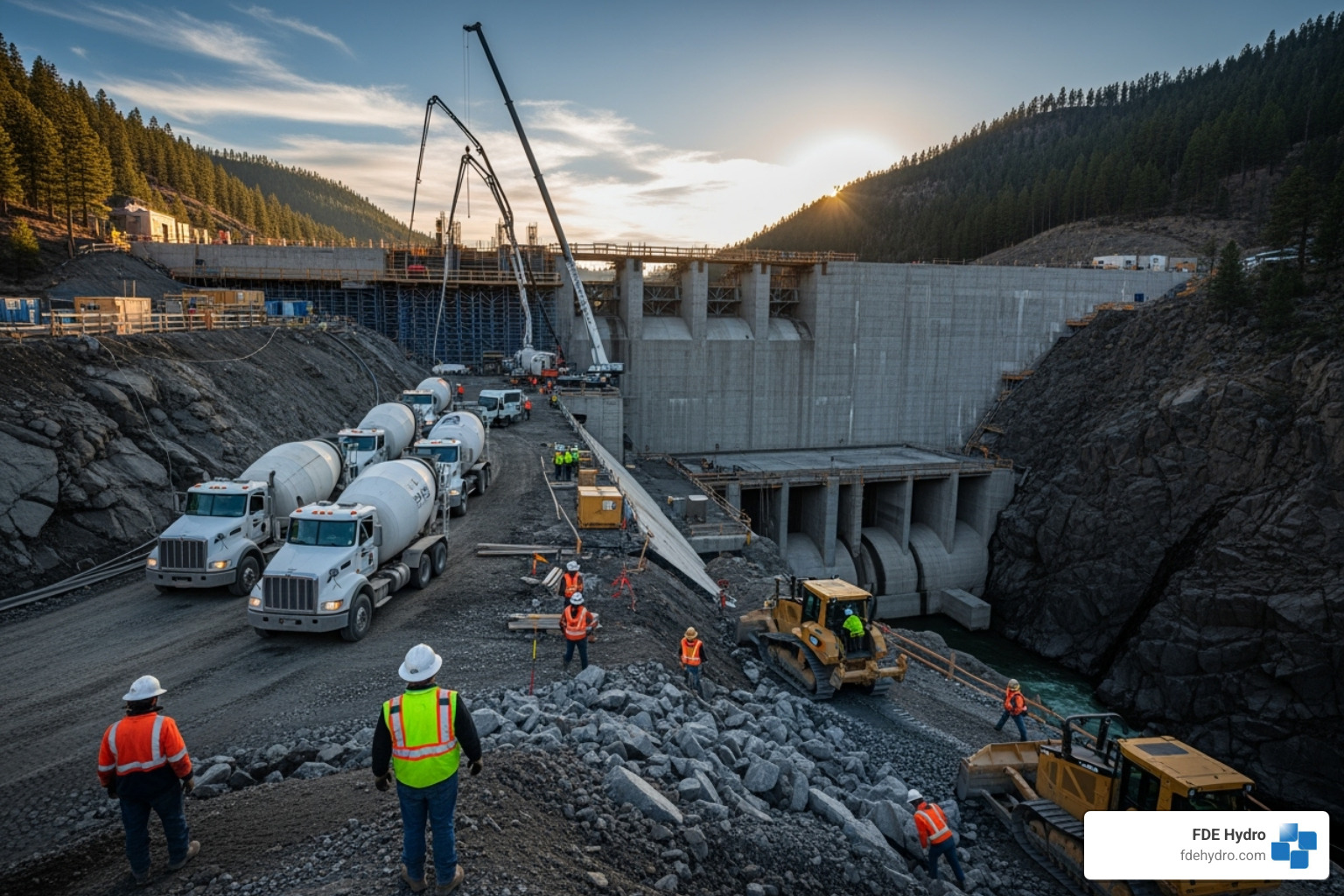
A key innovation in hydroelectric dam construction is Roller-Compacted Concrete (RCC), a drier mix that is spread and compacted like pavement. RCC is much faster and less expensive than traditional methods.
During construction, critical components like spillways (to release floodwater safely) and intake structures (to channel water to the turbines) are also built. At FDE Hydro, our modular precast concrete methods offer a more efficient way to build these structures, reducing time and cost. Learn more about dams.
Stage 4: Powerhouse and Equipment Installation
The powerhouse is where falling water is converted into electricity. It can be located at the dam’s base, within the structure, or even deep underground, like at Canada’s Robert-Bourassa generating station.
The process involves installing:
- Penstocks: Large pipes that carry water from the reservoir down to the turbines.
- Turbines and Generators: Fast-moving water spins the turbine blades, which in turn drives a generator. The generator uses electromagnetic induction to produce electricity.
- Transformers and Transmission Lines: Transformers increase the electricity’s voltage for efficient long-distance transport to the power grid.
After installation and testing, the final step is controlled reservoir filling. The reservoir is filled slowly over weeks or months while engineers monitor the dam’s structural integrity. This ensures any issues are addressed before the dam operates at full capacity.
FDE Hydro’s innovative modular powerhouses can streamline this critical stage, reducing project timelines and costs.
How Hydropower Works and Types of Facilities
Hydropower harnesses the energy of moving water. The process is a simple conversion of energy:
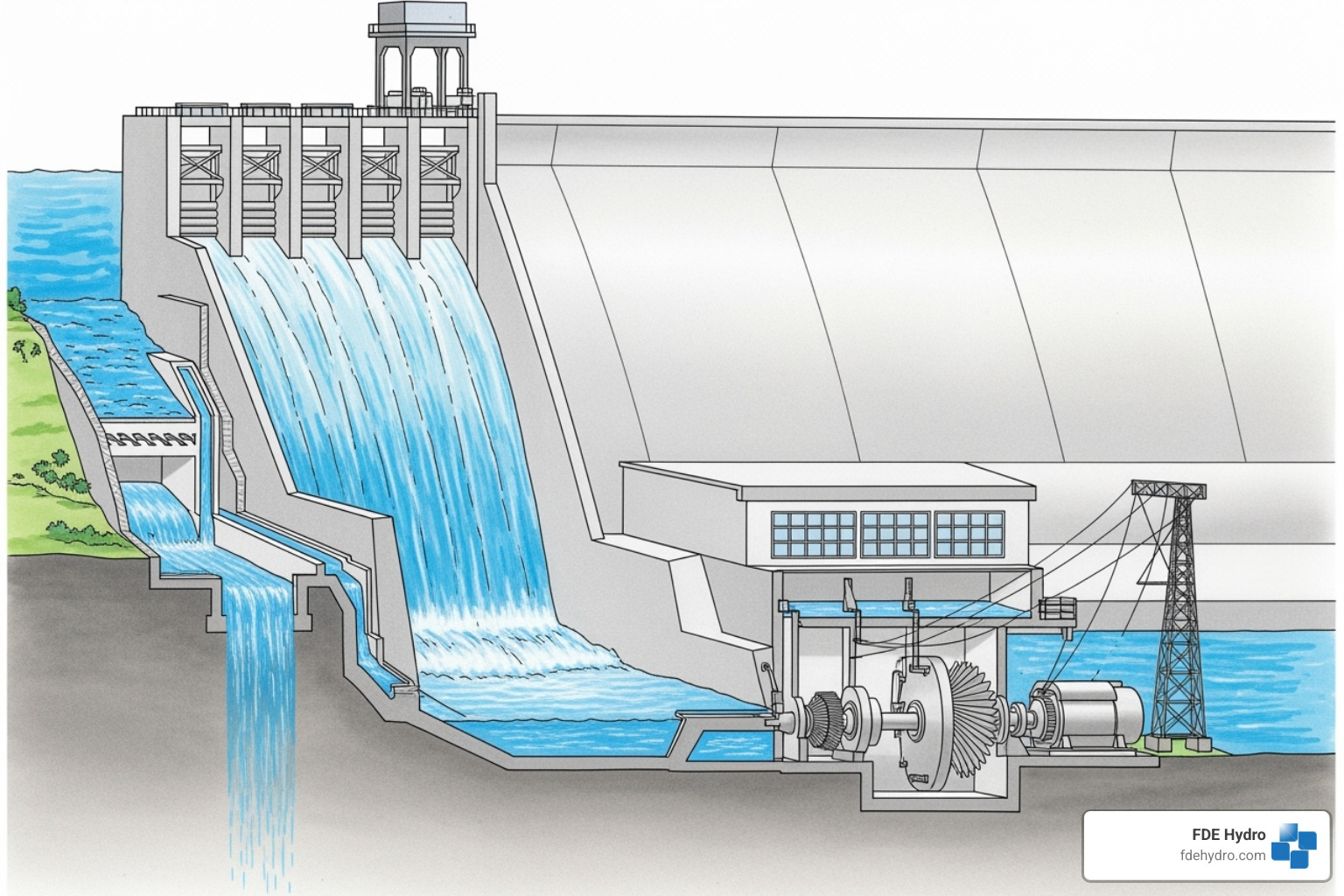
Water in a reservoir holds potential energy. As it flows down a penstock, it becomes kinetic energy. This moving water spins a turbine (mechanical energy), which drives a generator to create electrical energy. The amount of power generated depends on the head (water’s vertical drop) and flow rate.
Conventional Impoundment Dams
This is the most common type, using a large dam to create a reservoir. Storing water allows operators to release it as needed, providing both consistent base-load power and flexible peak power to meet demand. Examples include the Grand Coulee Dam in the U.S. and Canada’s Robert-Bourassa station.
Pumped Storage Hydropower
Pumped storage hydropower (PSH) acts like a giant, rechargeable battery. During low demand, excess grid electricity pumps water from a lower reservoir to an upper one. During high demand, the water is released back down through turbines to generate power. This technology is critical for grid stability, providing 96% of all utility-scale energy storage in the U.S. and balancing intermittent renewables like solar and wind. Learn more about pumped storage hydropower.
Run-of-River and Diversion Facilities
These projects divert a portion of a river’s flow through a powerhouse with little or no reservoir. This reduces the environmental footprint but means power generation fluctuates with the river’s natural flow. Canada’s Beauharnois Power Station is a large-scale example.
Sizes of Hydropower Facilities
Hydropower is highly scalable:
- Large hydro: >30 MW, powering national grids.
- Small hydro: <30 MW, often using existing water flows in canals or municipal systems.
- Micro hydro: <100 kW, for remote communities or single properties.
- Pico hydro: <5 kW, for very small-scale needs.
The Broader Impact of Hydropower Projects
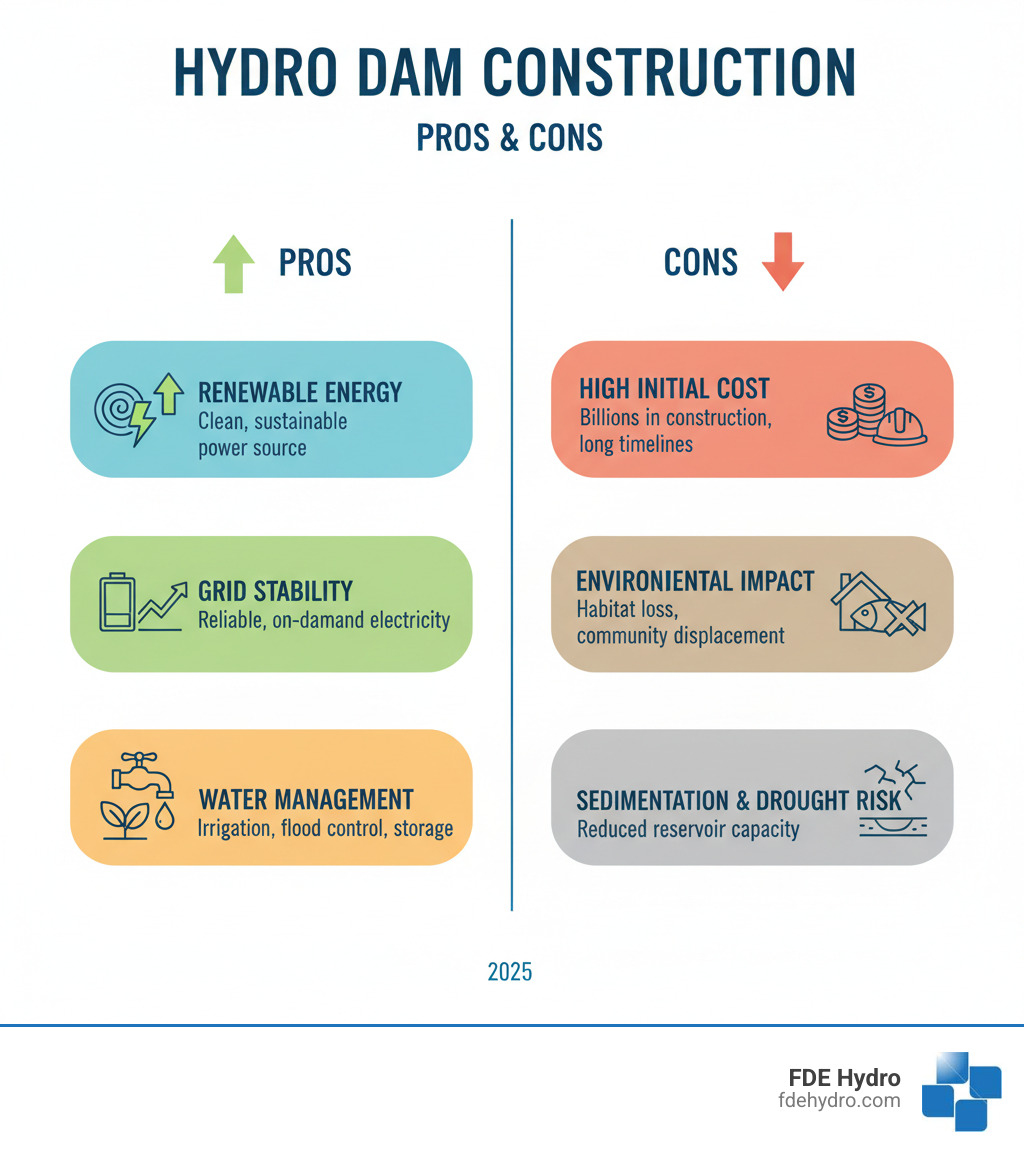
Responsible hydroelectric dam construction requires acknowledging both the benefits and the significant costs—financial, environmental, and social.
Economic Costs and Benefits
Hydropower projects involve enormous upfront investment and are known for cost overruns, making financing a challenge. That’s why financing long-term hydropower requires mitigating risks prior to ROI. However, their long lifespan (65-85+ years) and free fuel (water) result in low operating costs and affordable electricity over time. The economic landscape is changing, as hydropower costs rose 62% from 2010-2021 while solar and wind costs fell dramatically, making construction innovation essential.
Environmental and Social Considerations
Large dams have significant impacts:
- Ecosystem Alteration: Dams change river flows, block fish migration, and flood terrestrial habitats.
- Sedimentation: Sediment trapped in reservoirs reduces storage capacity over time. A 2021 study found that large dams have already lost 13-19% of their storage to this issue.
- Methane Emissions: In tropical regions, decaying submerged vegetation can release methane, a potent greenhouse gas.
- Human Displacement: Large dam projects have displaced an estimated 40 to 80 million people worldwide, disrupting communities and flooding cultural heritage sites.
Risks and Mitigation
Key risks include catastrophic dam failure (though rare), water loss from evaporation, and reduced reliability due to climate change-induced droughts. Mitigation involves rigorous dam safety programs, regular inspections following Engineering Guidelines for the Evaluation of Hydropower Projects, and continuous monitoring. Modernization is critical, and we must keep using technology to minimize the duration of impacts to ensure safety and environmental stewardship.
The Future of Hydropower: Modernization and Innovation
The era of massive hydroelectric dam construction has slowed since its peak in the 1970s, due to high costs, environmental concerns, and fewer ideal sites. The industry’s focus is now shifting. Instead of building new, the priority is modernizing the vast fleet of existing dams, many of which were built in the mid-20th century and are now aging. This involves aging infrastructure being replaced with next-generation civil solutions.
Hydropower is also taking on a new role as the flexible partner to intermittent renewables like solar and wind, providing crucial grid stability.
Key Challenges in Hydroelectric Dam Construction
Persistent challenges for new and retrofit projects include:
- Time: Large projects take 5-10 years, with megaprojects taking even longer.
- Cost: Enormous upfront investment and frequent cost overruns make financing difficult.
- Permitting: Complex environmental regulations and public opposition can cause significant delays.
Modern Innovations in Hydroelectric Dam Construction
Innovation is key to overcoming these challenges. Advancements include fish-friendly turbines, improved fish passages, and new materials like self-healing concrete. The most transformative innovation is modular precast construction.
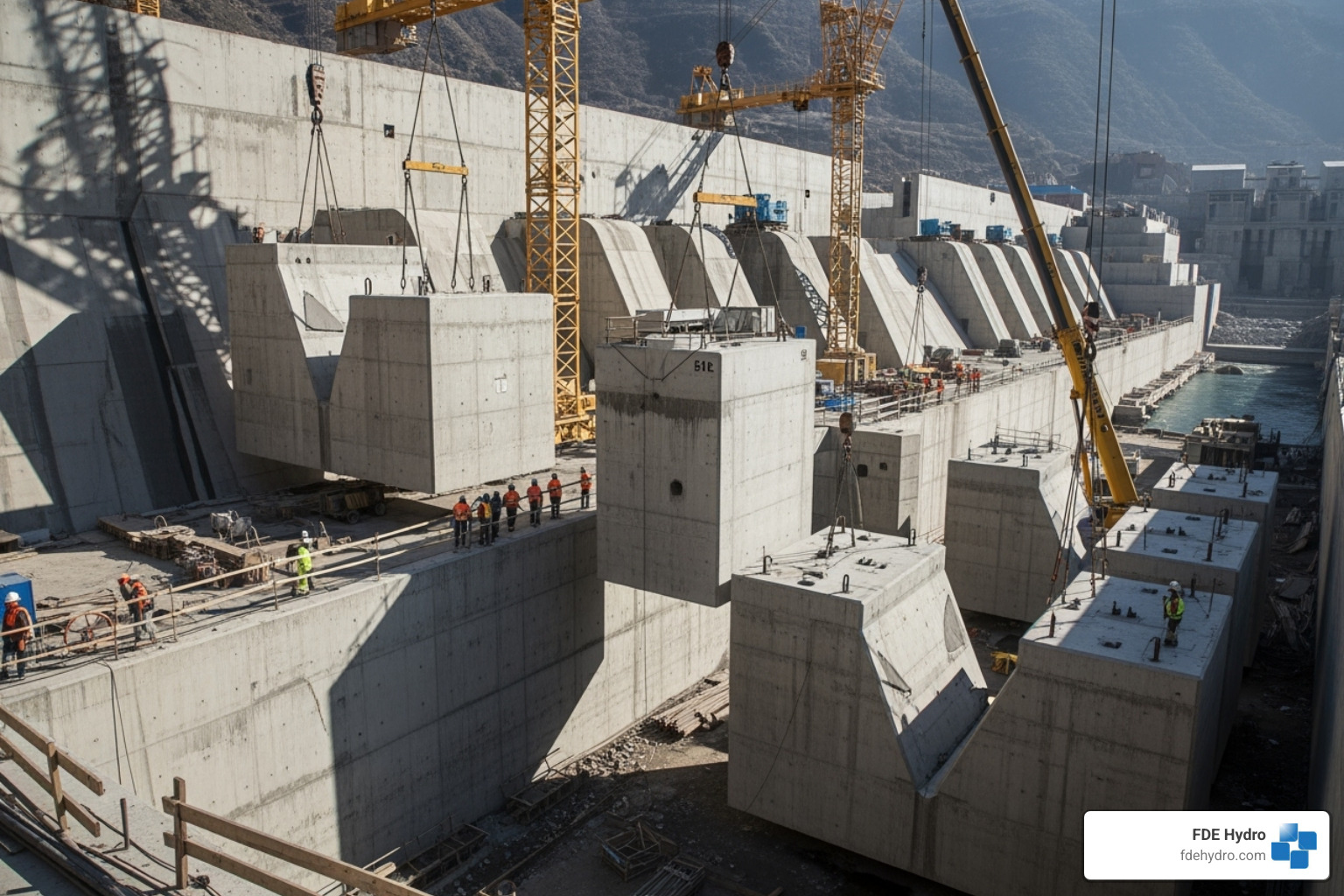
At FDE Hydro, our patented “French Dam” technology revolutionizes the process. We manufacture large concrete components in a factory and assemble them on-site. This approach dramatically reduces construction time, lowers costs, and improves quality control. By tackling the core issues of time and money, modular methods make hydropower projects more viable and sustainable. Find why precast costs less and how we are building a smarter, faster future for hydropower.
Frequently Asked Questions about Hydroelectric Dam Construction
How long does it take to build a hydroelectric dam?
The timeline for hydroelectric dam construction varies significantly with project size and complexity. A small dam may take 2-5 years to build, while a large dam typically requires 5-10 years. Megaprojects like the Three Gorges Dam can take nearly two decades. Factors like site geology, weather, logistics, and environmental permitting all influence the schedule. Innovative methods like FDE Hydro’s modular precast approach can significantly shorten these timelines.
Is hydropower a clean energy source?
Yes, but it’s complicated. During operation, hydropower produces zero direct air pollutants and has a much lower lifecycle carbon footprint than fossil fuels. However, large-scale projects have significant environmental and social trade-offs. The construction process and creation of reservoirs alter ecosystems, block fish migration, and can release methane from submerged vegetation in tropical regions. They can also displace communities. Responsible hydropower development seeks to mitigate these impacts through better design and modern technology.
What is the largest hydroelectric dam in the world?
That depends on the metric:
- By Power Generation: The Three Gorges Dam in China is the world’s largest power station of any kind, with a capacity of 22,500 MW.
- By Height: The Jinping-I Dam, also in China, is the world’s tallest dam at 305 meters.
For comparison, the tallest dams in the U.S. and Canada are the Oroville Dam (230 m) and the Mica Dam (243 m), respectively. These massive projects highlight the scale of traditional construction, which innovative methods now aim to make more efficient.
Conclusion
Hydroelectric dam construction creates remarkable engineering marvels that serve a dual role: they are a major source of renewable energy and vital water management systems for flood control and irrigation. The multi-stage construction process is a testament to engineering skill, but it comes with significant financial, environmental, and social challenges.
The future of hydropower is evolving. The focus is shifting from building new megaprojects to modernizing our existing, aging dam infrastructure. Hydropower’s flexibility, especially through pumped storage, is also becoming indispensable for stabilizing grids that rely on intermittent renewables like solar and wind.
At FDE Hydro, we believe this technology is vital for a sustainable energy future. Our innovative approaches to hydroelectric dam construction, including our patented “French Dam” modular precast technology, are designed to overcome the high costs and long timelines of traditional methods. We are making hydropower projects faster, more affordable, and more practical.
Whether you are developing a new project or modernizing an existing one, we invite you to explore the full potential of modern hydropower solutions with us. Together, we can ensure hydropower remains a cornerstone of our clean energy grid for generations.
