

Understanding the Building Blocks of Hydroelectric Power
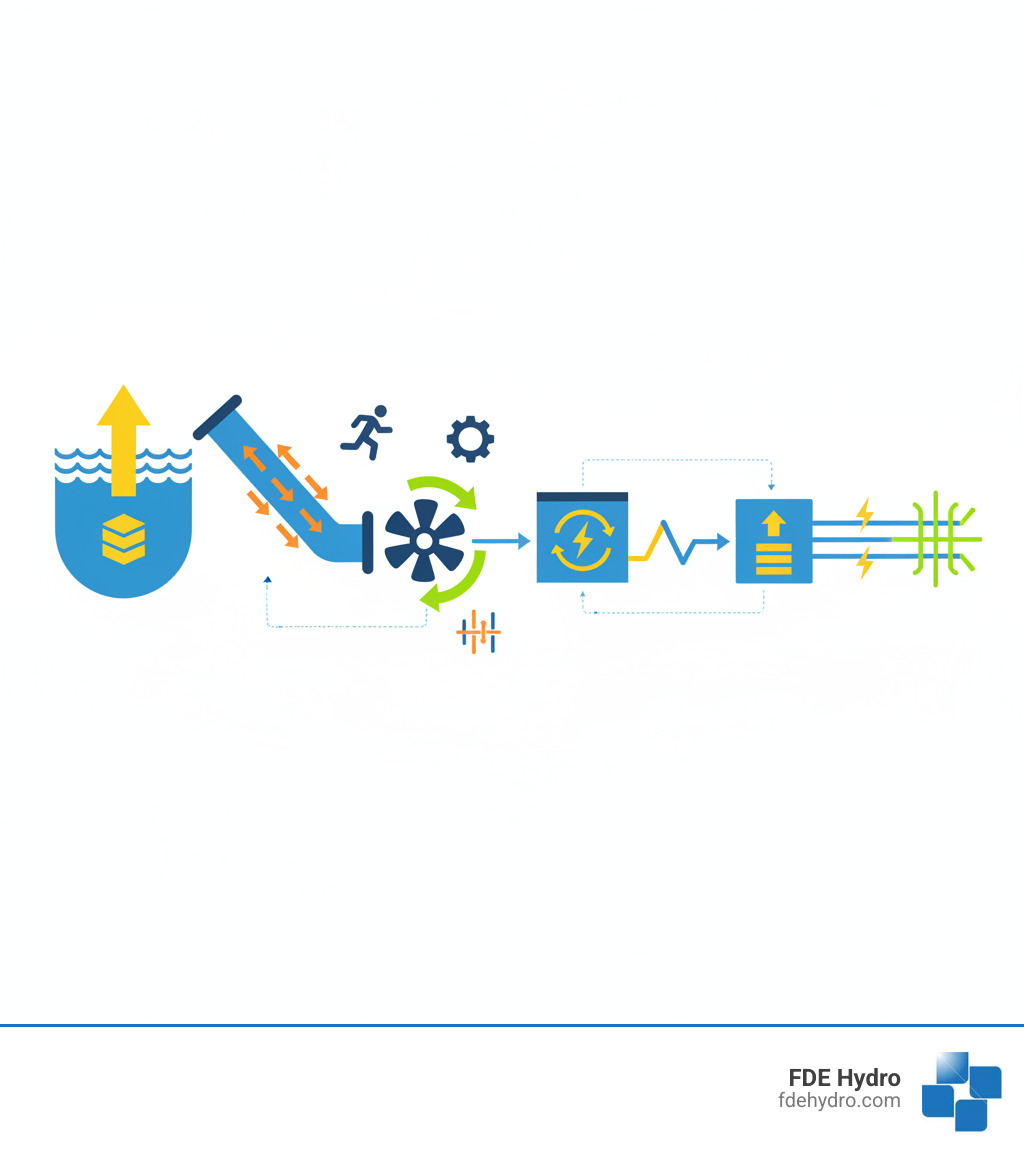
Hydroelectric dam components work together as an interconnected system to convert the energy of flowing water into electricity. At their core, these facilities rely on several key parts:
Primary Components:
- Dam – Stores water and creates elevation difference (head)
- Reservoir – Holds water at height to maximize potential energy
- Intake/Control Gates – Regulates water flow into the system
- Penstock – Channels water from reservoir to turbine at high pressure
- Turbine – Converts water’s kinetic energy into rotational motion
- Generator – Transforms mechanical rotation into electrical current
- Transformer – Steps up voltage for efficient transmission
- Switchyard/Transmission Lines – Delivers electricity to the grid
Worldwide, hydropower plants produce about 24 percent of the world’s electricity and supply more than 1 billion people with power. These facilities generate a combined total of 675,000 megawatts globally – that’s the energy equivalent of 3.6 billion barrels of oil. In 2022 alone, hydropower generated 4,289 TWh, representing 15% of total global electricity production and half of all renewable energy.
The beauty of hydroelectric systems lies in their neat simplicity: water flows in one end, and clean electricity comes out the other. Yet behind this simple concept is a carefully engineered series of components, each playing a critical role in the energy conversion process. From the massive concrete structure of the dam itself to the precisely calibrated turbine blades spinning at 90 revolutions per minute, every part must work in harmony.
Understanding these components isn’t just academic – it’s essential for operators to implement proper safety protocols, run efficient operations, plan maintenance schedules, and ultimately improve productivity while reducing costs. For anyone involved in planning, building, or operating hydroelectric facilities, knowing how each component functions and interacts with the others is fundamental to project success.
I’m Bill French, Sr., Founder and CEO of FDE Hydro, and I’ve spent decades working with hydroelectric dam components through both large-scale civil construction projects and developing innovative modular solutions for the hydropower industry. My work with the Department of Energy’s Water Power Technology Office has given me unique insight into next-generation component design and integration.
The Foundation: Water Containment and Control Structures
Every hydroelectric system begins with one fundamental challenge: how do you capture and control a river’s natural flow? The answer lies in the massive structures that form the foundation of hydropower generation. These hydroelectric dam components don’t just hold back water—they transform a free-flowing river into a carefully managed energy system.
Think of a reservoir as nature’s battery. Water stored at height contains enormous potential energy, just waiting to be released. The vertical distance between the water’s surface and the turbines below—what we call “head”—determines how much power we can generate. The greater the head height, the more energy each gallon of water can produce.
But storing water is only half the battle. We need precise control over how that water flows through the system. Modern control systems act like the dam’s nervous system, allowing operators to adjust everything from gate openings to flow rates from a central control room. These systems respond to changing electricity demand throughout the day, ramping power up during peak hours and scaling back when demand drops.
Protection starts at the intake. Trash racks filter out debris—branches, logs, leaves, and other floating materials that could damage expensive turbines downstream. Behind these screens, we create what’s called a “quiet water” area where the flow slows down enough for smaller sediment particles to settle out naturally. This two-stage filtering process keeps the water clean as it enters the penstock.
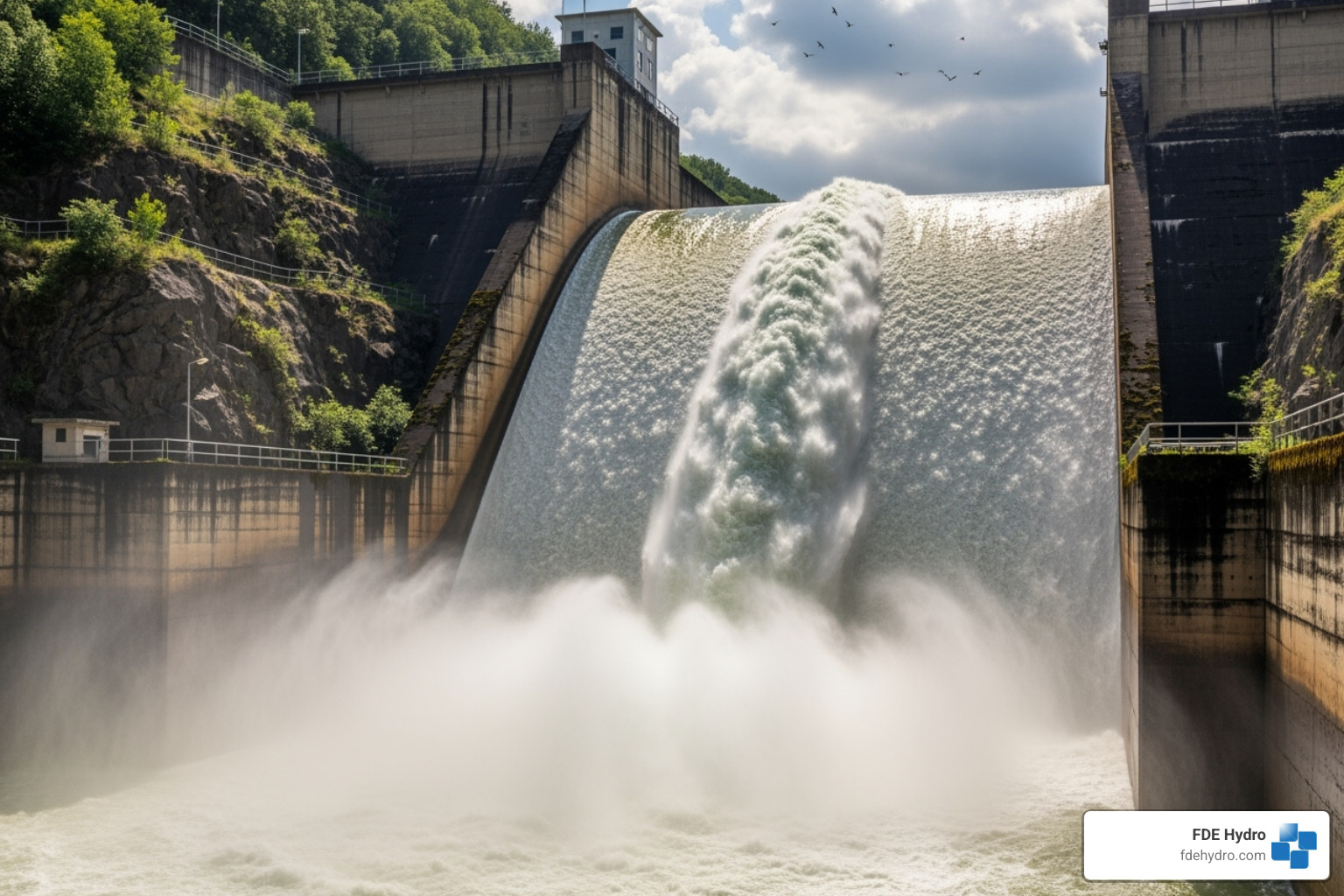
Spillways serve a different but equally critical function: flood control. When heavy rains or rapid snowmelt fill the reservoir beyond safe levels, spillways provide a controlled way to release excess water without threatening the dam’s structural integrity. You’ve probably seen dramatic footage of spillways in action—massive volumes of water cascading over concrete channels. It’s impressive to watch, but it’s really about safety and environmental protection.
These containment and control structures work together seamlessly. The dam creates the reservoir, the reservoir stores potential energy, the intake structures guide water toward the turbines, and the control gates regulate the flow. To learn more about how these systems integrate, check out our detailed resources on Water Control Structures and Spillways.
The Dam
When most people picture hydroelectric power, they see the dam. And for good reason—it’s often the most visible and impressive structure in the entire system. But a dam does much more than just look impressive. Its primary job is to stop a river in its tracks, creating a large reservoir upstream while establishing the critical head height needed for power generation.
Different sites call for different dam designs. Gravity dams use sheer weight and mass to resist the water’s pressure—think of the Hoover Dam’s massive concrete face. Arch dams take a different approach, using a curved design that redirects water pressure into the surrounding canyon walls, which is incredibly efficient in narrow gorges. Embankment dams are built from compacted earth and rock, making them ideal for sites where local materials are abundant and concrete would be impractical.
The numbers behind these structures are staggering. The United States’ tallest dam stands near Oroville, California, reaching 230 meters high and stretching 1.6 kilometers across. But that’s modest compared to China’s Jinping Dam on the Yalong River, which towers at 305 meters—taller than the Chrysler Building. These aren’t just engineering achievements; they’re critical infrastructure supporting millions of people with clean, renewable electricity.
Modern dam construction has evolved significantly. At FDE Hydro, we’ve developed modular precast concrete technology that dramatically reduces both construction time and costs compared to traditional methods. For a comprehensive look at dam design and construction, visit our Dams page.
The Reservoir
Behind every dam lies the reservoir—a vast bank of stored potential energy. This artificial lake holds water at elevation, ready to flow through turbines whenever electricity is needed. It’s energy storage on a massive scale, and remarkably efficient at it.
But reservoirs do more than just store energy for power plants. Many become valuable recreational resources for their communities. Take Lake Roosevelt behind the Grand Coulee Dam—it’s a popular destination for boating, fishing, and camping, bringing tourism dollars to the region. Reservoirs also provide reliable water supplies for cities and agricultural irrigation, especially in regions where rainfall is unpredictable.
The storage capacity of global hydropower reservoirs is truly impressive. According to the IEA’s 2021 estimates, all existing conventional hydropower reservoirs combined can store approximately 1,500 terawatt-hours of electrical energy in one full cycle. That’s equivalent to months of baseload power for entire nations.
Of course, reservoirs come with challenges too. Rivers naturally carry sediment, and over decades, this material accumulates on the reservoir floor, gradually reducing storage capacity. Managing sedimentation requires careful planning and periodic maintenance. Some facilities use controlled water releases to flush sediment downstream, while others must occasionally dredge to maintain capacity. It’s an ongoing consideration in long-term reservoir management, but one that operators have decades of experience handling.
Intake and Control Gates
Once water is stored in the reservoir, we need to guide it precisely toward the power-generating equipment. That’s where intake structures and control gates become essential hydroelectric dam components. These systems regulate exactly how much water enters the penstock and when.
The intake structure itself is carefully engineered to provide a deep, calm pool where water can enter smoothly without turbulence or air bubbles. Why does this matter? Because air mixed into the water reduces power output and can cause cavitation damage to turbine blades—tiny air bubbles collapse with enough force to literally eat away at metal surfaces over time. Preventing this starts with proper intake design.
Before water even reaches the control gates, it passes through trash racks—heavy-duty screens that catch debris like logs, branches, and other floating materials. These might seem like simple filters, but they’re critical for protecting the entire system. A single large log entering the penstock could cause catastrophic damage to a turbine spinning at high speed.
The control gates themselves give operators precise command over water flow. Opening the gates wider increases flow and power output; closing them reduces generation. This real-time control lets hydroelectric plants respond instantly to grid demands—something fossil fuel plants can’t match. During morning hours when everyone turns on their coffee makers and computers, operators can quickly ramp up generation. Late at night when demand drops, they scale back.
All of this happens from a central control room, where operators monitor water levels, gate positions, turbine speeds, and power output on digital displays. Modern systems can even automate many adjustments, though experienced human operators remain essential for handling unusual conditions and making judgment calls that computers can’t. This level of precise control makes hydropower one of the most flexible and reliable sources of electricity on the grid.
The Heart of the Plant: Key Hydroelectric Dam Components for Power Generation
Once water leaves the intake gates, it enters the powerhouse – the beating heart of any hydroelectric facility. This is where nature’s raw power transforms into something we can plug into. The powerhouse isn’t just another building; it’s a precisely engineered space where the intense forces of moving water get channeled and converted into mechanical energy that eventually lights our homes.
The design of the powerhouse matters tremendously. How water enters and exits the turbines directly impacts the efficiency of the entire system. A poorly designed powerhouse can waste precious energy, while a well-engineered one ensures every drop of water contributes its full potential. Inside these structures, we house the most critical hydroelectric dam components – the machinery that actually generates electricity.
Through decades of work in this industry, I’ve seen how thoughtful powerhouse design protects expensive equipment and maximizes output. The future of hydropower construction lies in innovative approaches that reduce both cost and timeline. Our Modular Powerhouses represent exactly this kind of thinking – bringing factory precision to hydropower construction. For those wanting to understand the complete picture of energy conversion, I recommend exploring How a Hydroelectric Dam Works.
The Penstock
Picture water sitting calmly in a reservoir. It has potential, but it’s not doing much. Now imagine that same water rushing through a massive pipeline at tremendous speed and pressure. That change happens in the penstock – one of the most crucial hydroelectric dam components you’ll find.
The penstock is essentially a large pipeline that carries water from the reservoir intake down to the turbine. But it’s not just a simple tube. As water races downward through the penstock, gravity does its work, converting the water’s potential energy into kinetic energy and building up enormous pressure. By the time water reaches the bottom, it’s moving with incredible force.
We typically construct penstocks from robust materials like steel or glass-reinforced plastic (GRP), chosen specifically to withstand the intense pressures involved. The engineering calculations for penstock design are fascinating – diameter, length, and routing all play critical roles in system efficiency. A penstock that’s too narrow restricts flow and robs the system of available power, even if there’s plenty of water. Conversely, a larger diameter reduces friction losses, allowing more powerful flow to reach the turbine.
Think of the penstock as a concentrator of energy. It takes the lazy potential of stored water and transforms it into a focused, powerful stream ready to do real work. Without this component, the water would simply flow downhill, dissipating its energy uselessly along the way.
Essential Mechanical Hydroelectric Dam Components: The Turbine
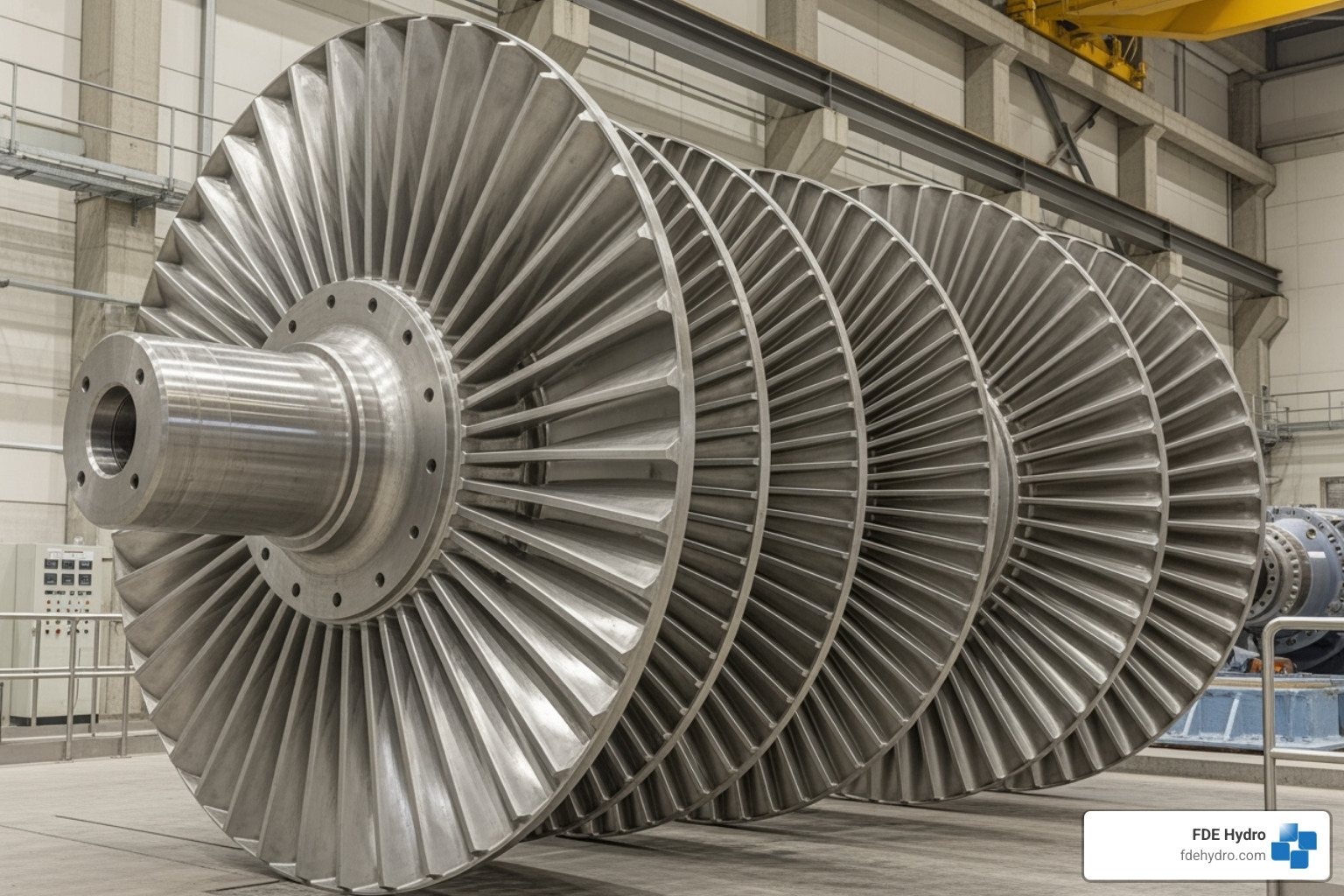
If the penstock concentrates energy, the turbine captures it. This is the true heart of any hydropower plant – the component that directly converts water’s kinetic energy into rotational motion. When high-pressure water from the penstock strikes the turbine’s carefully shaped blades, it causes a central shaft to spin. That spinning motion is the mechanical energy that will soon become electricity.
Here’s where engineering gets really interesting: turbines aren’t one-size-fits-all machines. The design depends heavily on two factors – the head (how far the water falls) and the flow (how much water is available). Over the years, engineers have developed different turbine types optimized for different conditions.
| Turbine Type | Head Application | Flow Application | Typical Use Cases |
|---|---|---|---|
| Pelton | High head (300+ meters) | Low to medium flow | Mountain streams, high dams with long penstocks |
| Francis | Medium head (10-300 meters) | Medium to high flow | Most common type, versatile for various conditions |
| Kaplan | Low head (2-40 meters) | High flow | Run-of-river plants, wide rivers with gentle slopes |
The Pelton turbine uses cup-shaped buckets mounted around a wheel, perfect for high-head, low-flow situations. The Francis turbine – probably the most common type worldwide – features a runner with fixed blades and works beautifully across a wide range of conditions. The Kaplan turbine looks almost like a ship’s propeller and excels in low-head, high-flow environments where other designs would struggle.
Selecting the right turbine type can make or break a hydropower project’s economics. It’s not just about generating power – it’s about generating it efficiently and reliably for decades to come.
The Generator
The turbine creates rotational motion, but we can’t send spinning shafts through power lines. That’s where the generator comes in – the final step in converting water’s energy into usable electricity. The generator connects directly to the turbine shaft, and as the turbine spins, so does the generator.
Inside the generator, we rely on a principle finded by Michael Faraday nearly two centuries ago: electromagnetic induction. When you move magnets past copper coils (or spin coils past magnets), you create an electric current. The generator contains two main parts – the stator (the stationary outer shell with copper coils) and the rotor (the spinning inner part with powerful magnets). As the turbine turns the rotor, the moving magnetic field induces electrical current in the stator coils.
The electricity produced is alternating current (AC), the same type that powers our homes and businesses. A typical hydroelectric generator might spin at around 90 revolutions per minute, producing electricity at standard grid frequency – 60 Hz in North America or 50 Hz in most other parts of the world.
What amazes me after all these years is the elegance of this conversion process. Water falls, turbine spins, magnets move past coils, electrons flow. From the raw power of a river to the gentle hum of electricity in the wires – all accomplished by these carefully engineered hydroelectric dam components working in perfect harmony.
