

Why Understanding Hydroelectric Infrastructure Matters
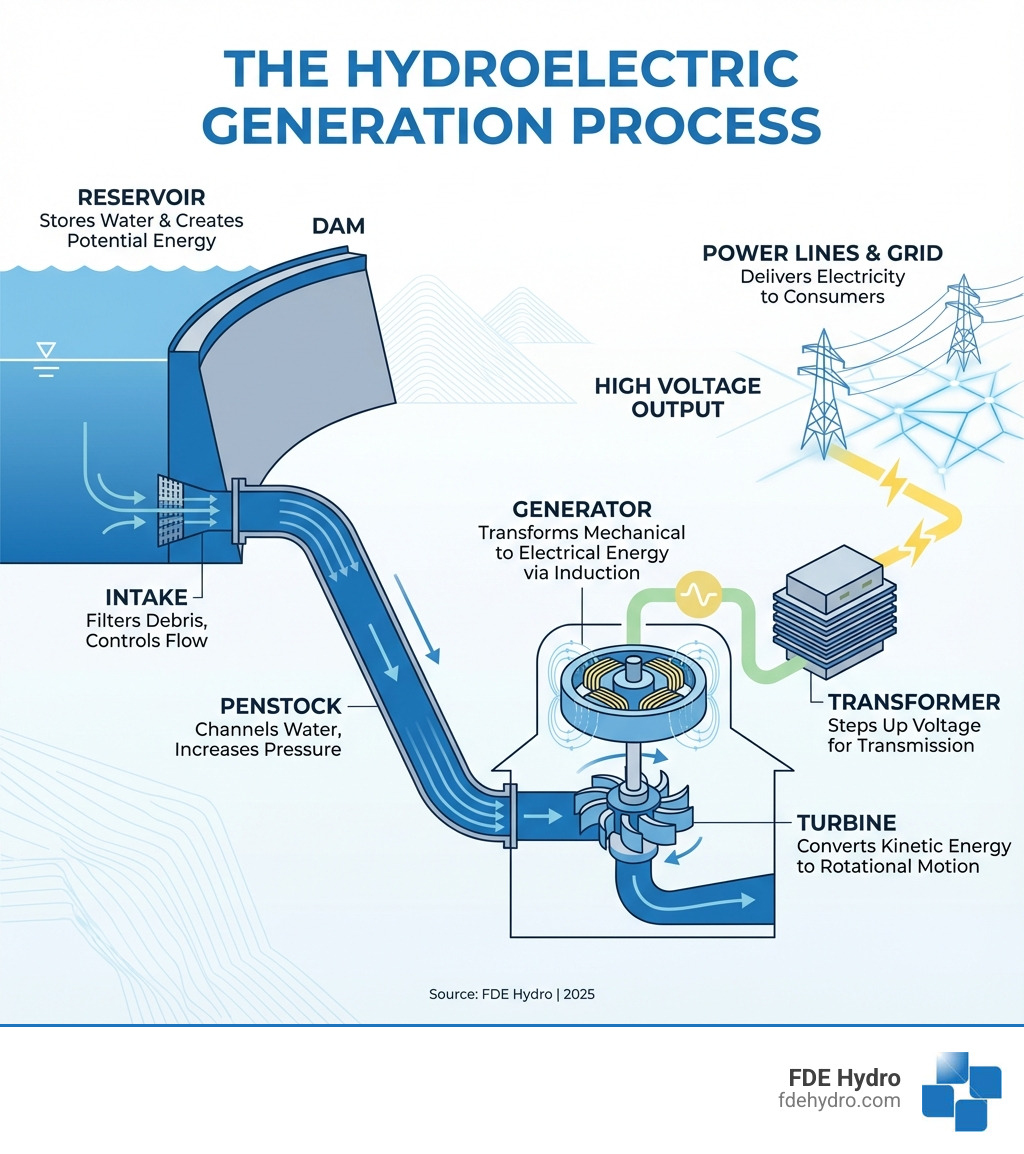
Hydro dam components are the essential building blocks that transform the raw power of flowing water into the electricity that powers over 1 billion people worldwide. These interconnected systems include:
- Dam and Reservoir – Stores water and creates hydraulic head
- Intake Structures and Gates – Controls water flow and filters debris
- Penstock – Channels water under high pressure to the turbines
- Turbine – Converts water’s kinetic energy into rotational motion
- Generator – Transforms mechanical energy into electrical energy
- Transformers and Control Systems – Regulates voltage and manages operations
- Powerhouse – Houses turbines, generators, and control equipment
- Transmission Lines – Delivers electricity to the grid
In 2022 alone, hydropower generated 4,289 TWh, representing 15% of total global electricity production and half of all renewable energy. The beauty of hydroelectric systems lies in their neat simplicity—water flows in one end, and electricity comes out the other, with theoretical conversion efficiencies near 100% because the process involves mechanical energy rather than thermal energy.
Each component plays a critical role in this energy conversion chain. The dam creates potential energy by establishing head height. The penstock accelerates water flow and increases pressure. The turbine converts kinetic energy into rotational motion. The generator uses electromagnetic induction to produce electrical current. And control systems act as the facility’s nervous system, ensuring safe and efficient operation.
I’m Bill French Sr., founder and CEO of FDE Hydro, and over the past five decades I’ve worked extensively with hydroelectric infrastructure, including participation in the Department of Energy’s Hydro Power Vision Technology Task Force focused on next-generation solutions for hydro dam components. This experience has shown me that understanding these core systems is essential for anyone overseeing water infrastructure projects.
The Foundation: Water Containment and Control Structures
At the very heart of any hydroelectric system, we find the structures that manage the water itself. Think of these as the gatekeepers and the battery, holding vast amounts of potential energy ready to be releaseed. Our goal, as engineers and innovators in this field, is to harness this natural power safely and efficiently.
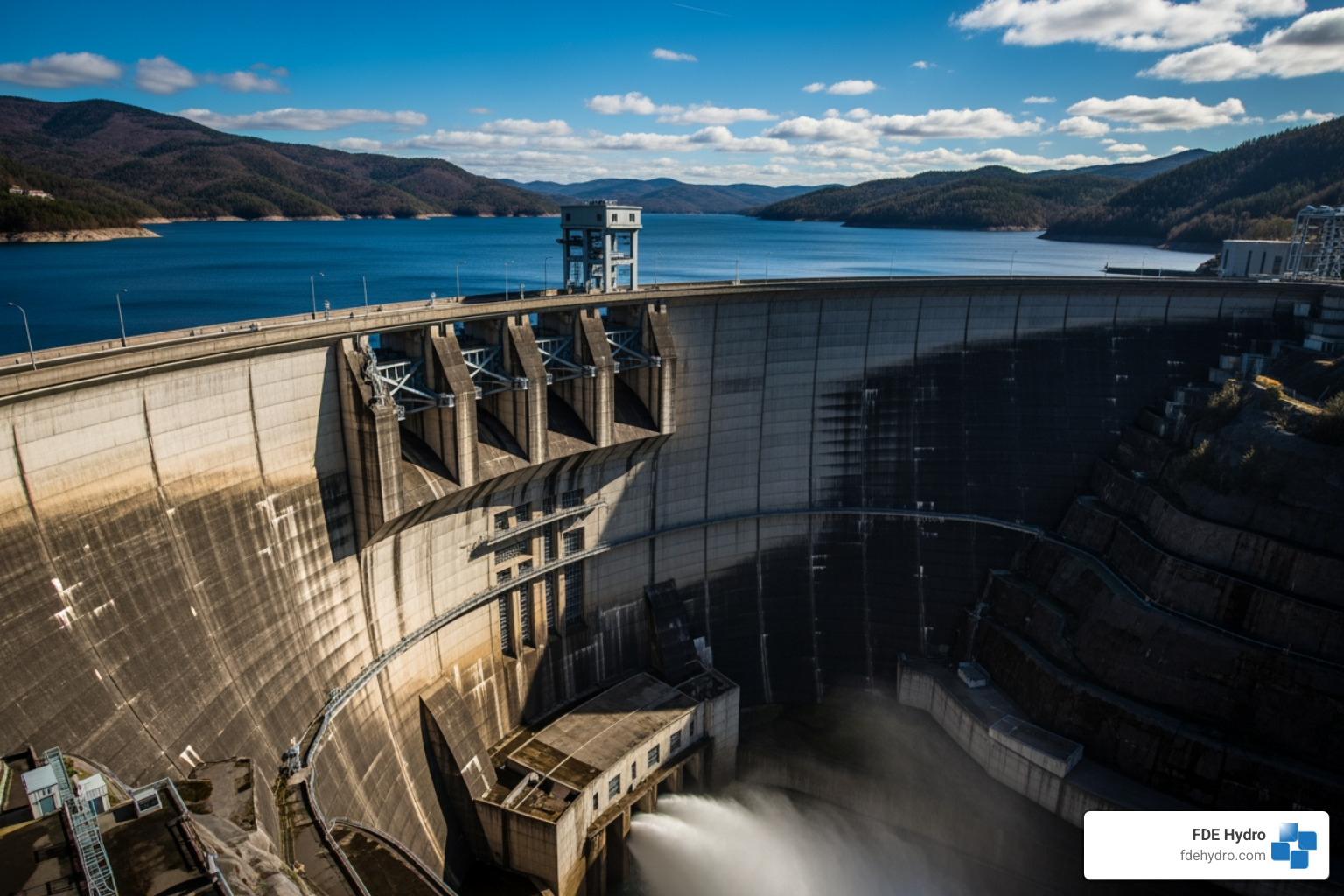
The dam, a colossal feat of engineering, is the primary structure that holds back a river, creating a large body of water known as the reservoir. This isn’t just a big puddle; it’s our energy storage unit. The higher the water is held, the greater its potential energy – a concept we call “head height.” This head height is crucial because it dictates how much force the water will have when it eventually flows through the system.
Beyond power generation, these reservoirs serve multiple vital functions. They are often critical for flood control, regulating water levels to protect downstream communities. Many also provide reliable water supplies for cities and agriculture, and let’s not forget the recreational opportunities they create. Imagine the joy of boating or fishing on a reservoir that’s also powering thousands of homes! The storage capacity of global hydropower reservoirs is truly impressive, estimated at approximately 1,500 terawatt-hours of electrical energy in one full cycle. This makes them nature’s battery, storing energy on a massive scale.
The Dam
When we talk about the dam itself, we’re discussing a structure designed to withstand immense pressure. There are several types, each suited to different geological and hydrological conditions:
- Gravity Dams: These rely on their sheer weight and mass to resist the water’s pressure. They are often thick and robust, like a steadfast guardian holding back the tide.
- Arch Dams: Utilizing a curved design, these dams transfer the water’s force horizontally into the surrounding canyon walls, making them highly efficient in narrow, rocky gorges. They’re like a natural archer, redirecting the force.
- Embankment Dams: Constructed from compacted earth and rock, these dams are usually wider at the base and taper upwards. They are versatile and can be built in various locations.
At FDE Hydro, we’re constantly pushing the boundaries of dam construction. Our innovative modular precast concrete technology, often referred to as the “French Dam,” is revolutionizing how these structures are built and retrofitted in regions like North America, Brazil, and Europe. This approach significantly reduces construction costs and time, making hydropower projects more accessible and sustainable. You can learn more about these methods on our Dam Construction Methods and Dams pages.
Intake, Gates, and Spillways
Once the water is safely stored, we need precise ways to control its flow. This is where the intake structures, gates, and spillways come into play.
The intake structure is the entry point for water from the reservoir into the power generation system. Its design is critical to ensure a smooth, air-free inlet, which is essential for optimal efficiency and to prevent damage to downstream equipment. Imagine trying to drink through a straw that keeps sucking in air – it’s not very effective, right? The same principle applies here.
A crucial part of the intake is the trash rack. These are sturdy screens designed to filter out larger debris like leaves, branches, or even curious logs, preventing them from entering the penstock and potentially damaging the turbine. We also often design an area of ‘quiet water’ at the intake, allowing finer sediment to settle before it can cause abrasive wear on the turbine blades.
Control gates, such as sluice gates, are positioned at the intake to regulate the amount of water flowing into the penstock. These are our precise valves, allowing operators to adjust water flow based on electricity demand or water availability. These high-pressure gates, whether fixed wheel, sliding, or radial, need to be robust to handle the immense forces of the water. For more on how we manage this flow, check out our insights on Water Control Structures.
Finally, spillways are the dam’s ultimate safety valves. They are designed to safely release excess water from the reservoir, especially during periods of heavy rainfall or snowmelt, preventing the dam from being overtopped. This is a critical flood control mechanism, ensuring the safety of the dam and downstream areas. Spillway gates, often radial or fixed wheel, enable controlled flood discharge, making them essential for operational safety. You can dig deeper into their function on our Spillways page.
The Primary Hydro Dam Components for Power Generation
Now that we’ve contained and controlled the water, it’s time to put its energy to work. This section covers the core hydro dam components that perform the magical change of water’s kinetic energy into mechanical energy, and then into electricity. It’s a journey from raw power to usable power!
The entire process hinges on a brilliant chain reaction of energy conversion. The potential energy stored in the reservoir is released as water flows downwards, converting into kinetic energy. This kinetic energy then drives the turbine, changing it into mechanical energy. Finally, the generator takes this mechanical energy and, through the wonders of electromagnetism, converts it into the electrical energy that lights up our homes and cities. The elegance of this conversion process, from water’s raw power to electricity, is truly amazing. If you’re curious about the mechanics, we highly recommend exploring How a Hydroelectric Dam Works.
The Penstock
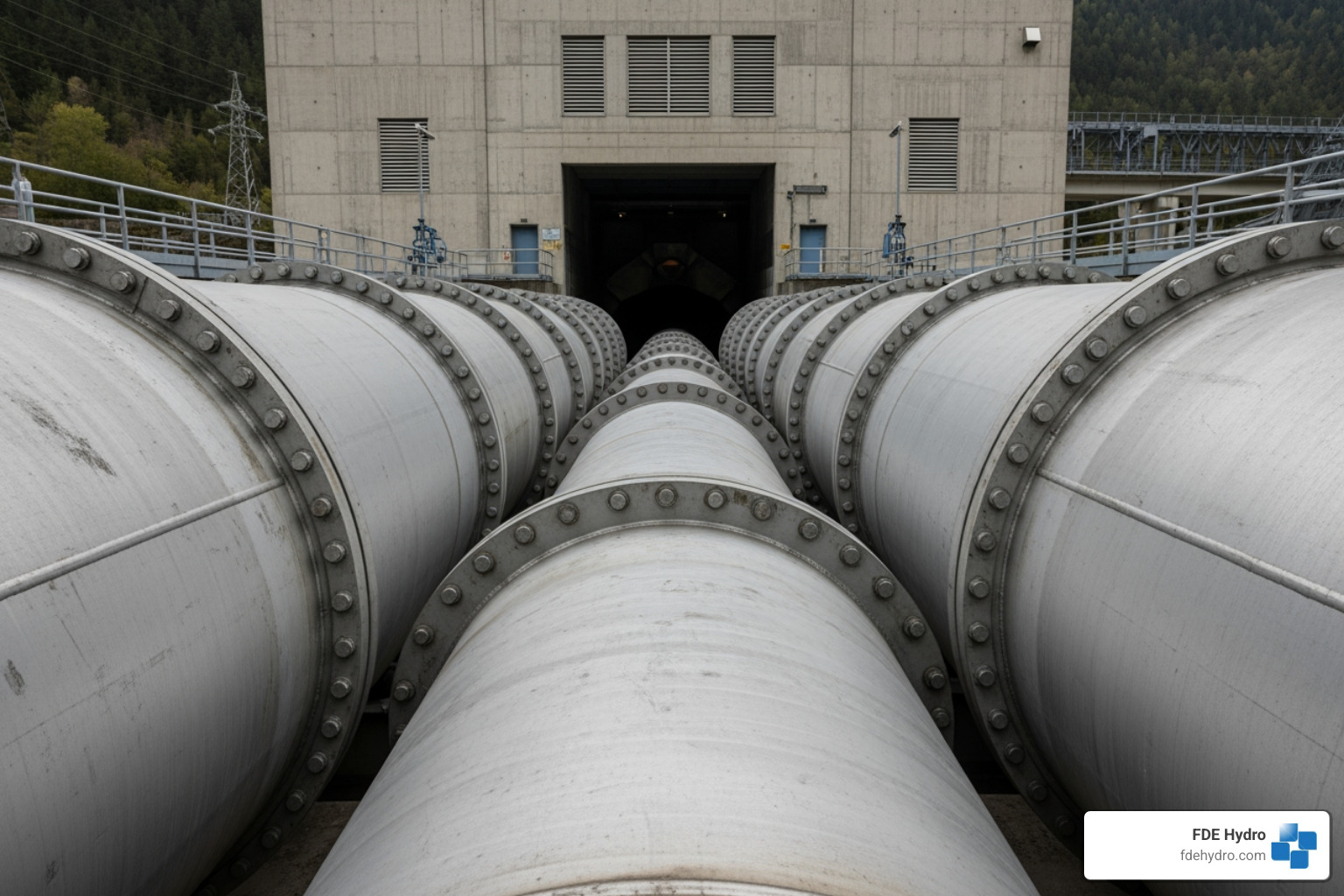
The penstock is essentially a large pipeline that channels water from the intake structure down to the turbine. But it’s far more than just a pipe; it’s a critical component designed to increase water pressure and direct it with immense force. As the water travels down the penstock, the vertical drop creates significant head pressure, focusing the water’s power directly towards the turbine.
Penstocks are typically made of robust materials like steel, capable of withstanding the high internal pressures and external environmental conditions. The design of the penstock—its diameter, length, and routing—is paramount to the system’s efficiency. A small-diameter penstock, for instance, can significantly reduce the available horsepower even if it carries all the available water, due to increased friction. Conversely, larger diameters create less friction, optimizing flow. Furthermore, ensure no air enters the pipeline, as air pockets can reduce horsepower and even damage the turbine. Hydraulic optimization of these water conduits is a major concern in penstock construction, ensuring the least head losses. To learn more about this crucial conduit, check out What is a Penstock?.
Essential Mechanical Hydro dam components: The Turbine
The turbine is often considered the heart of the hydroelectric power plant. It’s the component that directly translates the force of the flowing water into rotational motion, setting the entire electricity generation process in motion. When the high-pressure water from the penstock strikes the turbine’s blades, it causes a central shaft to spin rapidly. This rotational motion is the mechanical energy we’ve been working towards.
Selecting the right type of turbine is crucial and depends heavily on the specific “head” (the vertical distance the water falls) and “flow” (the volume of water available) conditions of the site. Here’s a quick overview of the main types:
| Turbine Type | Head Conditions | Flow Conditions | Typical Application |
|---|---|---|---|
| Pelton | High (150m – 1500m) | Low | High head dams with long penstocks. |
| Francis | Medium (20m – 600m) | Medium to High | The most common and versatile type, used in a wide range of conditions. |
| Kaplan | Low (2m – 50m) | High | Run-of-river plants and other low-head projects. |
| Bulb/Pit/S | Very Low (2m – 30m) | High | Low-head projects needing high efficiency and flow capacities. |
| Pump | Wide Range (Up to 700m) | Variable | Pumped storage plants, which can also pump water back to the reservoir. |
Turbine innovation has been ongoing for over 150 years, leading to solutions that are not only powerful but also environmentally conscious. For example, pioneering work has been done on fish-friendly designs and oil-free hubs to prevent water pollution, which aligns perfectly with our commitment to sustainable infrastructure.
Key Electrical Hydro dam components: The Generator
Once the turbine is spinning, its mechanical energy needs to be converted into usable electricity. This is the job of the generator, a marvel of electrical engineering. The generator is directly coupled to the turbine’s shaft, so as the turbine spins, the generator also rotates.
The magic happens inside the generator through a principle called electromagnetic induction. This is where magnets spin rapidly past coils of copper wire (or vice versa), causing electrons to move and thereby generating an electrical current. The generator consists of two main parts:
- Rotor: This is the rotating part, typically equipped with powerful electromagnets.
- Stator: This is the stationary part, containing the copper wire coils.
As the rotor spins within the stator, the magnetic fields cut across the copper coils, inducing an electrical voltage and current. This process converts the mechanical energy from the spinning turbine into electrical energy, specifically alternating current (AC). A typical hydroelectric generator might spin at around 90 revolutions per minute, producing electricity at standard grid frequencies (e.g., 60 Hz in North America). This clever conversion is how we harness the raw force of water into the electrical power we use every day.
The Delivery Network: From Powerhouse to Grid
With electricity successfully generated, the next crucial step is to prepare it for distribution and send it out to the wider world. This involves several more specialized hydro dam components that ensure the power is safe, stable, and ready for consumption.
The powerhouse is the central hub where the turbines and generators are housed. It’s more than just a building; it’s a strategically designed facility that protects all the vital equipment from the elements and serves as the epicenter of renewable energy generation. From here, the newly generated electricity starts on its final journey, passing through transformers for voltage regulation and then onto transmission lines to reach the National Grid.
Control Systems and Transformers
Operating a hydroelectric dam is a complex dance between water flow, electricity demand, and safety protocols. This is orchestrated by sophisticated control systems, which we like to think of as the dam’s “nervous system.” These systems, often incorporating SCADA (Supervisory Control and Data Acquisition) technology, allow operators to monitor and adjust critical parameters in real-time. We can fine-tune water flow rates, open and close gates, and regulate turbine speeds to ensure the plant operates at peak efficiency and responds dynamically to grid demands. This level of automation and precision is vital for both safety and optimal power output. For more insights into these intricate systems, visit our Water Control Systems page.
Immediately after the generators, the electricity, typically produced at a relatively low voltage, enters the transformers. These are essential for preparing the power for long-distance transmission. Transformers “step up” the voltage, converting the lower voltage electricity into a much higher voltage. Why higher voltage? Because transmitting electricity at high voltages drastically reduces energy loss over long distances. Without this crucial step, a significant portion of the generated power would dissipate as heat before it ever reached our homes and businesses. Once the voltage is boosted, the electricity is ready to be fed into the transmission lines, which carry it across vast distances to substations and ultimately to consumers.
Design, Innovation, and Sustainability in Hydropower
Building and operating hydroelectric dams isn’t just about raw power; it’s about smart design, continuous innovation, and a deep commitment to sustainability. At FDE Hydro, we understand that every decision, from the initial blueprint to daily maintenance, impacts the long-term success and environmental footprint of a project.
Our design considerations always prioritize operational safety, efficiency, and longevity. We aim for systems that are robust, reliable, and easy to maintain. This means building in fail-safe mechanisms, ensuring redundancy in critical systems, and providing comprehensive training for operators. Regular maintenance of all hydro dam components isn’t just a good idea; it’s crucial for ensuring efficiency and extending the lifespan of the entire plant. It helps prevent costly breakdowns, saves budget in the long run, and ensures consistent productivity. Our work with modular precast concrete technology, for instance, significantly reduces the time and cost associated with construction and retrofitting, making these projects more feasible and sustainable. Dive deeper into our advancements on our Hydropower Innovation page.
Minimizing Environmental Impact
While hydropower is a clean, renewable energy source, we acknowledge the importance of minimizing its environmental footprint. Innovations in hydro dam components are constantly evolving to address these concerns, particularly regarding aquatic life and water quality.
A major focus is on protecting fish populations. This has led to the development of fish-friendly turbines, designed to reduce harm to fish passing through the system. Technologies like the Minimum Gap Runner (MGR) improve fish survival rates to over 95% by minimizing gaps where fish could be injured. Some modern turbine concepts, for example, feature slower rotational speeds and fewer blades, specifically engineered to reduce fish mortality. Beyond turbine design, we also implement solutions like fish ladders (structures that allow fish to bypass dams) to facilitate upstream and downstream migration. You can find more details on these advancements in fish-friendly turbine design.
Another critical area is maintaining water quality. Traditional turbine hubs sometimes use oil, which could potentially leak and pollute the water. Innovations like oil-free hubs and greaseless technologies eliminate this risk entirely, ensuring that no harmful substances are released into the environment. Furthermore, aerating turbines (also known as auto-venting turbines) are designed to improve dissolved oxygen levels in the water released downstream. This is particularly important in reservoirs where water at lower depths can become oxygen-deficient, impacting aquatic ecosystems. By drawing atmospheric air into the turbine during operation, we can significantly improve the health of the downstream river environment. These advancements are integral to our vision for Sustainable Power Generation.
The Future of Hydro Dam Components
The world of hydropower is far from static. We are continually exploring new technologies and approaches to make hydroelectric systems even more efficient, sustainable, and adaptable. The future of hydro dam components is exciting and holds immense promise.
We’re seeing rapid advancements in areas like smart sensors and AI for resource management. These technologies allow for unprecedented levels of real-time monitoring, predictive maintenance, and optimized operation. Imagine a system that can anticipate potential equipment failures before they happen, or intelligently adjust water release based on complex weather patterns and energy demand forecasts. This is the power of AI for Resource Management coming to life.
Future trends also include the development of hybrid systems, where hydropower plants are integrated with other renewable energy sources like solar or wind, and coupled with advanced energy storage solutions. This creates a more stable and reliable energy supply, leveraging the strengths of each technology.
At FDE Hydro, we’re particularly enthusiastic about our role in pioneering modular dam construction using precast concrete technology. This approach allows for faster, more cost-effective, and less disruptive construction and retrofitting of dams in North America, Brazil, and Europe. Instead of building dams piece by piece on-site, we can manufacture large, high-quality precast components off-site and then rapidly assemble them. This not only speeds up project timelines but also improves quality control and reduces environmental impact during construction. This innovative shift in construction methodology is a game-changer for the industry, making hydropower expansion more practical and efficient.
Frequently Asked Questions about Hydro Dam Parts
What are the 5 main parts of a hydroelectric dam?
The five primary hydro dam components are:
- The Dam itself, which creates the reservoir.
- The Reservoir, storing the water and its potential energy.
- The Penstock, channeling the water under pressure.
- The Turbine, which converts water’s energy into mechanical rotation.
- The Generator, changing mechanical energy into electricity.
How do the components work together to generate electricity?
It’s a beautifully orchestrated sequence:
Water stored in the reservoir (created by the dam) builds up potential energy. When released, it flows with increasing speed and pressure through the penstock. This high-velocity water strikes the blades of the turbine, causing it to spin. The spinning turbine, in turn, rotates the shaft of the generator, which then uses electromagnetic induction to convert this mechanical energy into electrical energy. This electricity is then sent through transformers and transmission lines to the grid.
What is the most important component of a hydroelectric power plant?
While the turbine and generator are often considered the “heart” of power production because they perform the actual energy conversion to electricity, it’s crucial to understand that all hydro dam components are interdependent. The dam and reservoir provide the necessary potential energy. The penstock delivers the water with force. The intake, gates, and spillways ensure controlled and safe operation. Without any one of these elements functioning correctly, the entire system cannot operate safely or efficiently. Therefore, while some parts directly produce power, the interconnectedness and integrity of all components are what truly make a hydroelectric power plant successful.
Conclusion
We’ve journeyed through the intricate world of hydro dam components, from the towering structures that hold back vast bodies of water to the delicate mechanisms that convert raw kinetic energy into the electricity powering our lives. Each part, whether it’s the mighty dam, the precise control gates, the robust penstock, the dynamic turbine, or the electrical generator, plays an indispensable role in the complex, interconnected system of hydroelectric power generation.
Hydropower stands as a cornerstone of our Clean Energy Infrastructure, providing a reliable and sustainable source of electricity for billions worldwide. As we look to the future, our commitment at FDE Hydro is to continue innovating, developing solutions that not only improve efficiency and safety but also minimize environmental impact. Our modular precast concrete technology is a testament to this, offering advanced and rapid-install solutions for both new construction and retrofitting projects in North America, Brazil, and Europe.
We invite you to explore how our innovative approaches are shaping the future of water infrastructure. To learn more about our cutting-edge designs and how we’re building the next generation of hydroelectric power, we encourage you to explore our advanced and rapid-install solutions with our precast models. Together, we can build a more sustainable and energy-secure future.
